





FOOTWEAR
Agenda Global scenario Indian market scenario Segmentation and consumer behaviour Major brands Market trends
Global Scenario
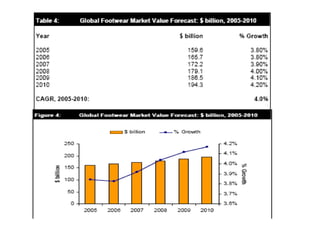
Global Scenario The global footwear market grew by 3.8% in 2005 to reach a value of $159.6 billion. Expected value by the end of 2010 is $194.3 billion. The most profitable regional footwear market is America. The global footwear market grew by 5.4% in 2005 to reach a volume of 10 billion pairs.
Competitive Landscape Leading companies include Nike, Adidas‑Salomon, Reebok and Asics Extensive revenues within the Asia Pacific region High research and development Overcome cost increases by decreasing prices of products from suppliers Maintain margins through developing volume sales Consolidation along the supply chain adding to the effect of maturity
Indian Market Scenario
Indian Footwear Market Liberalization of Indian economy led to  increase in the buying capacity of the country’s middle class. Market Volume Forecast In 2009, the market is forecast to have a volume of 2.3 billion pairs, an increase of 29% since 2004. Market Volume The market grew by 8% in 2004 to reach a volume of 1.8 billion pairs. Market Value Forecast In 2009, the market is forecast to have a value of $3.2 billion, an increase of 31.5% since 2004. Market Value The Indian footwear market grew by 8.2% in 2004 to reach a value of $2.4 billion.
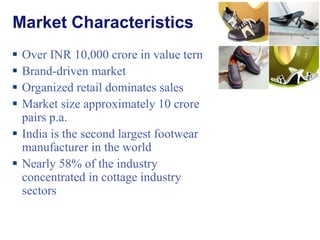
Market Characteristics Over INR 10,000 crore in value terms Brand-driven market Organized retail dominates sales Market size approximately 10 crore pairs p.a. India is the second largest footwear manufacturer in the world Nearly 58% of the industry concentrated in cottage industry sectors
Segmentation  and  Consumer Behaviour
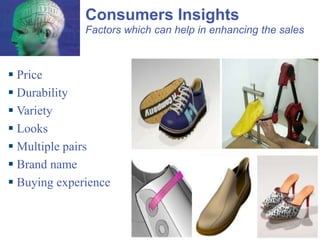
Consumers Insights Factors which can help in enhancing the sales Price  Durability Variety Looks Multiple pairs Brand name Buying experience
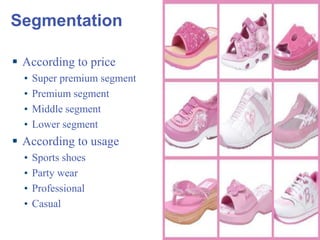
Segmentation   According to price Super premium segment Premium segment Middle segment Lower segment According to usage Sports shoes Party wear Professional Casual
Consumer Behaviour If we segment the market according to the price Super premium segment Brand conscious Money is secondary Demands more variety Examples – Gucci, Red Tape, etc. Premium segment Quality conscious Have an upper limit to the money Try to get lowest price possible for high quality brand Examples – Bata, Reebok, Nike, etc.
Consumer Behaviour If we segment the market according to the price Middle segment Do not care much about brands More concerned about looks and comfort Price one of the main factors. Examples: Bata, Liberty, etc. Lower segment Do not care about brands at all Size of this particular segment very high in India Much more concerned about the functionality and durability Try to get lowest price possible Examples: Khadim, Shree leathers, etc.
Consumer Behaviour If we segment the market according to the usage Sports wear Brand conscious Money is secondary More choosy Loyal customers Examples: Addidas, Reebok, Nike, etc. Party wear Main concentration on the looks Comfort is considered but is a secondary thing Demand of high variety Examples: Gucci, etc.
Consumer Behaviour Professional wear Brand conscious Lesser variety Importance to durability and comfort Loyal customers Examples – Bata, Liberty, etc. Casual wear Comfort is of utmost importance Longevity is one of the important factors Value for money Lot of untapped market Examples: Bata, Liberty, etc. If we segment the market according to the usage
Major Brands
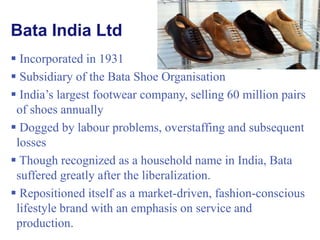
Bata India Ltd Incorporated in 1931 Subsidiary of the Bata Shoe Organisation India’s largest footwear company, selling 60 million pairs of shoes annually Dogged by labour problems, overstaffing and subsequent losses Though recognized as a household name in India, Bata suffered greatly after the liberalization. Repositioned itself as a market-driven, fashion-conscious lifestyle brand with an emphasis on service and production.
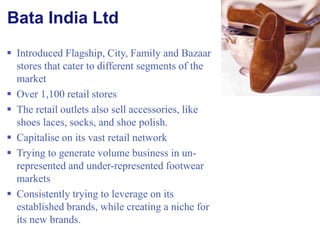
Bata India Ltd Introduced Flagship, City, Family and Bazaar stores that cater to different segments of the market Over 1,100 retail stores The retail outlets also sell accessories, like shoes laces, socks, and shoe polish. Capitalise on its vast retail network Trying to generate volume business in un-represented and under-represented footwear markets Consistently trying to leverage on its established brands, while creating a niche for its new brands.
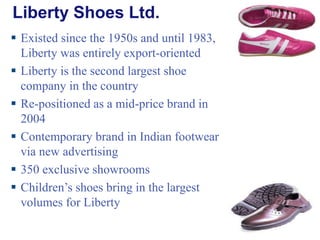
Liberty Shoes Ltd.   Existed since the 1950s and until 1983, Liberty was entirely export-oriented Liberty is the second largest shoe company in the country Re-positioned as a mid-price brand in 2004 Contemporary brand in Indian footwear via new advertising 350 exclusive showrooms Children’s shoes bring in the largest volumes for Liberty
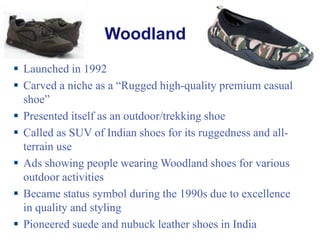
Woodland Launched in 1992 Carved a niche as a “Rugged high‑quality premium casual shoe” Presented itself as an outdoor/trekking shoe Called as SUV of Indian shoes for its ruggedness and all-terrain use Ads showing people wearing Woodland shoes for various outdoor activities Became status symbol during the 1990s due to excellence in quality and styling Pioneered suede and nubuck leather shoes in India
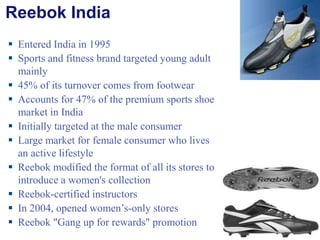
Reebok India Entered India in 1995 Sports and fitness brand targeted young adult mainly 45% of its turnover comes from footwear Accounts for 47% of the premium sports shoe market in India Initially targeted at the male consumer Large market for female consumer who lives an active lifestyle Reebok modified the format of all its stores to introduce a women's collection Reebok-certified instructors In 2004, opened women’s-only stores Reebok "Gang up for rewards" promotion
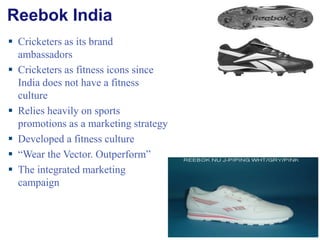
Reebok India Cricketers as its brand ambassadors Cricketers as fitness icons since  India does not have a fitness culture Relies heavily on sports promotions as a marketing strategy Developed a fitness culture “ Wear the Vector. Outperform” The integrated marketing campaign
Market Trends
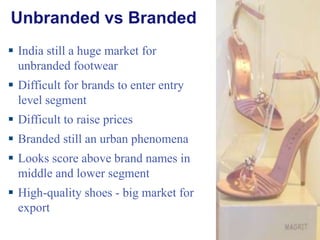
Unbranded vs Branded India still a huge market for unbranded footwear Difficult for brands to enter entry level segment Difficult to raise prices Branded still an urban phenomena Looks score above brand names in middle and lower segment High-quality shoes - big market for export
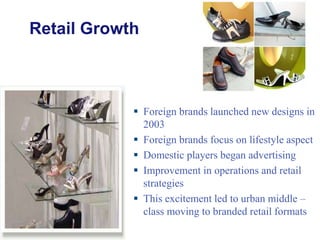
Retail Growth Foreign brands launched new designs in 2003 Foreign brands focus on lifestyle aspect Domestic players began advertising Improvement in operations and retail strategies This excitement led to urban middle – class moving to branded retail formats
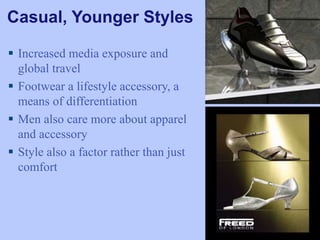
Casual, Younger Styles Increased media exposure and global travel Footwear a lifestyle accessory, a means of differentiation Men also care more about apparel and accessory Style also a factor rather than just comfort
Women’s and Kids’ Segment Opportunity for retail chains in these categories Ladies constitute 40% of market though 80-90% of these sales are through unorganized sector Indian women changing from product conscious to brand conscious Kids’ segment also expected to grow due to young population Indulgent parents also a factor Leased space and franchizing popular modes
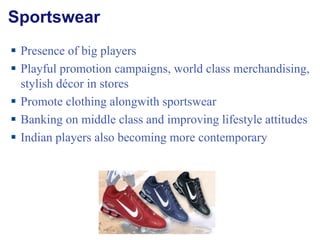
Sportswear Presence of big players Playful promotion campaigns, world class merchandising, stylish décor in stores Promote clothing alongwith sportswear Banking on middle class and improving lifestyle attitudes Indian players also becoming more contemporary
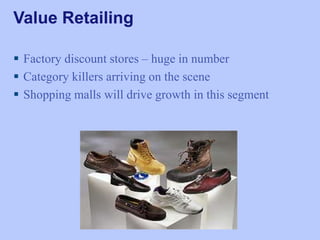
Value Retailing Factory discount stores – huge in number Category killers arriving on the scene Shopping malls will drive growth in this segment
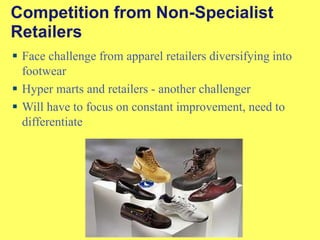
Competition from Non-Specialist Retailers Face challenge from apparel retailers diversifying into footwear Hyper marts and retailers - another challenger Will have to focus on constant improvement, need to differentiate
Innovative Locations and Distribution Strategies Future possibilities could be health spas, health clubs, airports Exclusive and multi-brand stores both present Multi-brand – possible entry point for foreign players Cross-promotions benefit all
Market Value Forecast In 2010, the global footwear market is forecast to have a value of $194.3 billion, an increase of 21.8% since 2005. The compound annual growth rate of the market in the period 2005-2010 is predicted to be 4%.
 
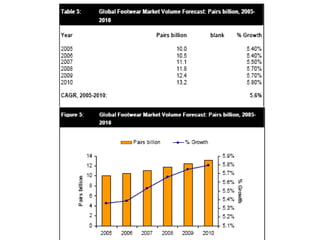
Market Volume Forecast In 2010, the global footwear market is forecast to have a volume of 13.2 billion pairs, an increase of 31.5% since 2005. The compound annual growth rate of the market volume in the period 2005-2010 is predicted to be 5.6%.
 
Questions?

Footwear

  • 1.
  • 2.
    Agenda Global scenarioIndian market scenario Segmentation and consumer behaviour Major brands Market trends
  • 3.
  • 4.
    Global Scenario Theglobal footwear market grew by 3.8% in 2005 to reach a value of $159.6 billion. Expected value by the end of 2010 is $194.3 billion. The most profitable regional footwear market is America. The global footwear market grew by 5.4% in 2005 to reach a volume of 10 billion pairs.
  • 5.
    Competitive Landscape Leadingcompanies include Nike, Adidas‑Salomon, Reebok and Asics Extensive revenues within the Asia Pacific region High research and development Overcome cost increases by decreasing prices of products from suppliers Maintain margins through developing volume sales Consolidation along the supply chain adding to the effect of maturity
  • 6.
  • 7.
    Indian Footwear MarketLiberalization of Indian economy led to increase in the buying capacity of the country’s middle class. Market Volume Forecast In 2009, the market is forecast to have a volume of 2.3 billion pairs, an increase of 29% since 2004. Market Volume The market grew by 8% in 2004 to reach a volume of 1.8 billion pairs. Market Value Forecast In 2009, the market is forecast to have a value of $3.2 billion, an increase of 31.5% since 2004. Market Value The Indian footwear market grew by 8.2% in 2004 to reach a value of $2.4 billion.
  • 8.
    Market Characteristics OverINR 10,000 crore in value terms Brand-driven market Organized retail dominates sales Market size approximately 10 crore pairs p.a. India is the second largest footwear manufacturer in the world Nearly 58% of the industry concentrated in cottage industry sectors
  • 9.
    Segmentation and Consumer Behaviour
  • 10.
    Consumers Insights Factorswhich can help in enhancing the sales Price Durability Variety Looks Multiple pairs Brand name Buying experience
  • 11.
    Segmentation According to price Super premium segment Premium segment Middle segment Lower segment According to usage Sports shoes Party wear Professional Casual
  • 12.
    Consumer Behaviour Ifwe segment the market according to the price Super premium segment Brand conscious Money is secondary Demands more variety Examples – Gucci, Red Tape, etc. Premium segment Quality conscious Have an upper limit to the money Try to get lowest price possible for high quality brand Examples – Bata, Reebok, Nike, etc.
  • 13.
    Consumer Behaviour Ifwe segment the market according to the price Middle segment Do not care much about brands More concerned about looks and comfort Price one of the main factors. Examples: Bata, Liberty, etc. Lower segment Do not care about brands at all Size of this particular segment very high in India Much more concerned about the functionality and durability Try to get lowest price possible Examples: Khadim, Shree leathers, etc.
  • 14.
    Consumer Behaviour Ifwe segment the market according to the usage Sports wear Brand conscious Money is secondary More choosy Loyal customers Examples: Addidas, Reebok, Nike, etc. Party wear Main concentration on the looks Comfort is considered but is a secondary thing Demand of high variety Examples: Gucci, etc.
  • 15.
    Consumer Behaviour Professionalwear Brand conscious Lesser variety Importance to durability and comfort Loyal customers Examples – Bata, Liberty, etc. Casual wear Comfort is of utmost importance Longevity is one of the important factors Value for money Lot of untapped market Examples: Bata, Liberty, etc. If we segment the market according to the usage
  • 16.
  • 17.
    Bata India LtdIncorporated in 1931 Subsidiary of the Bata Shoe Organisation India’s largest footwear company, selling 60 million pairs of shoes annually Dogged by labour problems, overstaffing and subsequent losses Though recognized as a household name in India, Bata suffered greatly after the liberalization. Repositioned itself as a market-driven, fashion-conscious lifestyle brand with an emphasis on service and production.
  • 18.
    Bata India LtdIntroduced Flagship, City, Family and Bazaar stores that cater to different segments of the market Over 1,100 retail stores The retail outlets also sell accessories, like shoes laces, socks, and shoe polish. Capitalise on its vast retail network Trying to generate volume business in un-represented and under-represented footwear markets Consistently trying to leverage on its established brands, while creating a niche for its new brands.
  • 19.
    Liberty Shoes Ltd. Existed since the 1950s and until 1983, Liberty was entirely export-oriented Liberty is the second largest shoe company in the country Re-positioned as a mid-price brand in 2004 Contemporary brand in Indian footwear via new advertising 350 exclusive showrooms Children’s shoes bring in the largest volumes for Liberty
  • 20.
    Woodland Launched in1992 Carved a niche as a “Rugged high‑quality premium casual shoe” Presented itself as an outdoor/trekking shoe Called as SUV of Indian shoes for its ruggedness and all-terrain use Ads showing people wearing Woodland shoes for various outdoor activities Became status symbol during the 1990s due to excellence in quality and styling Pioneered suede and nubuck leather shoes in India
  • 21.
    Reebok India EnteredIndia in 1995 Sports and fitness brand targeted young adult mainly 45% of its turnover comes from footwear Accounts for 47% of the premium sports shoe market in India Initially targeted at the male consumer Large market for female consumer who lives an active lifestyle Reebok modified the format of all its stores to introduce a women's collection Reebok-certified instructors In 2004, opened women’s-only stores Reebok "Gang up for rewards" promotion
  • 22.
    Reebok India Cricketersas its brand ambassadors Cricketers as fitness icons since India does not have a fitness culture Relies heavily on sports promotions as a marketing strategy Developed a fitness culture “ Wear the Vector. Outperform” The integrated marketing campaign
  • 23.
  • 24.
    Unbranded vs BrandedIndia still a huge market for unbranded footwear Difficult for brands to enter entry level segment Difficult to raise prices Branded still an urban phenomena Looks score above brand names in middle and lower segment High-quality shoes - big market for export
  • 25.
    Retail Growth Foreignbrands launched new designs in 2003 Foreign brands focus on lifestyle aspect Domestic players began advertising Improvement in operations and retail strategies This excitement led to urban middle – class moving to branded retail formats
  • 26.
    Casual, Younger StylesIncreased media exposure and global travel Footwear a lifestyle accessory, a means of differentiation Men also care more about apparel and accessory Style also a factor rather than just comfort
  • 27.
    Women’s and Kids’Segment Opportunity for retail chains in these categories Ladies constitute 40% of market though 80-90% of these sales are through unorganized sector Indian women changing from product conscious to brand conscious Kids’ segment also expected to grow due to young population Indulgent parents also a factor Leased space and franchizing popular modes
  • 28.
    Sportswear Presence ofbig players Playful promotion campaigns, world class merchandising, stylish décor in stores Promote clothing alongwith sportswear Banking on middle class and improving lifestyle attitudes Indian players also becoming more contemporary
  • 29.
    Value Retailing Factorydiscount stores – huge in number Category killers arriving on the scene Shopping malls will drive growth in this segment
  • 30.
    Competition from Non-SpecialistRetailers Face challenge from apparel retailers diversifying into footwear Hyper marts and retailers - another challenger Will have to focus on constant improvement, need to differentiate
  • 31.
    Innovative Locations andDistribution Strategies Future possibilities could be health spas, health clubs, airports Exclusive and multi-brand stores both present Multi-brand – possible entry point for foreign players Cross-promotions benefit all
  • 32.
    Market Value ForecastIn 2010, the global footwear market is forecast to have a value of $194.3 billion, an increase of 21.8% since 2005. The compound annual growth rate of the market in the period 2005-2010 is predicted to be 4%.
  • 33.
  • 34.
    Market Volume ForecastIn 2010, the global footwear market is forecast to have a volume of 13.2 billion pairs, an increase of 31.5% since 2005. The compound annual growth rate of the market volume in the period 2005-2010 is predicted to be 5.6%.
  • 35.
  • 36.

Editor's Notes