1
Passenger Cars
2
Profile of the Automotive Industry
Vehicle sales in India in 2005 - 06
(in million)
1.14
0.35
7.05
0.36
0 2 4 6 8
Cars CVs Two wheelers Three Wheelers
Size of around USD 34
billion in 2006
 The industry has grown at a CAGR of 14% p.a over the last 5 years, with total sales of vehicles
reaching around 9 million vehicles in 2005-06
 The Indian auto industry has the potential to emerge as one of the largest in the world.
Presently, India is
– 2nd largest two wheeler market in the world
– 4th largest commercial vehicle market in the world
– 11th largest passenger car in the world and is expected to be the 7th largest market
by 2016
 The industry has emerged as a key contributor to the Indian economy
3
Players in the Auto industry
Global
OEM
Domestic
OEM
Domestic
Suppliers
Global
Suppliers
Engineering
&
Development
Companies
Auto
Industry
•GM
•Toyota
•Ford
•Hyundai
•Maruti Suzuki
•Honda
•Skoda
•Volvo
•Mercedes
•Tata Motors
•Mahindra &
Mahindra
•Bajaj Auto
•TVS Motors
•Hero Honda
•Bajaj Tempo
•Ashok Leyland
The auto industry is highly competitive with a number of
global and domestic auto companies present in the country.
4
Current Scenario
 5th largest commercial vehicle manufacturer in the world
 4th largest car market in Asia - crossed the 1 million
mark
 Unlike the USA, the Indian passenger vehicle market is
dominated by cars (79%)
 India became the fastest growing car market in the world
in 2004, growth rate of 20%
 India is the second-biggest market for small cars after
Japan
5
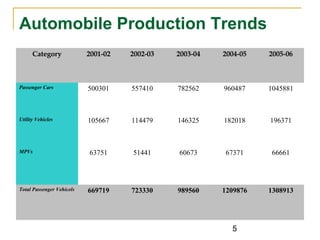
Automobile Production Trends
Category 2001-02 2002-03 2003-04 2004-05 2005-06
Passenger Cars 500301 557410 782562 960487 1045881
Utility Vehicles 105667 114479 146325 182018 196371
MPVs 63751 51441 60673 67371 66661
Total Passenger Vehicels 669719 723330 989560 1209876 1308913
6
Automobile Domestic Sales Trends
Category 2001-02 2002-03 2003-04 2004-05 2005-06
Passenger Cars 509088 541491 696153 820179 882094
Utility Vehicles 104253 113620 146388 176360 194577
MPVs 61775 52087 59555 65033 66366
Total Passenger
Vehicles
675116 707198 902096 1061572 1143037
Category 2001-02 2002-03 2003-04 2004-05 2005-06
Passenger Cars 49273 70263 125320 160670 170193
Utility Vehicles 3077 1177 3049 4505 4486
MPVs 815 565 922 1227 1093
Total Passenger Vehicles 53165 72005 129291 166402 175772
Automobile Exports Trends
7
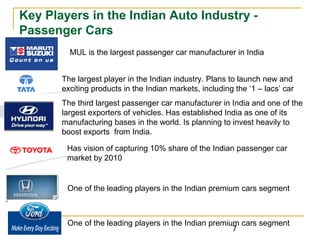
Key Players in the Indian Auto Industry -
Passenger Cars
The largest player in the Indian industry. Plans to launch new and
exciting products in the Indian markets, including the ‘1 – lacs’ car
MUL is the largest passenger car manufacturer in India
The third largest passenger car manufacturer in India and one of the
largest exporters of vehicles. Has established India as one of its
manufacturing bases in the world. Is planning to invest heavily to
boost exports from India.
Has vision of capturing 10% share of the Indian passenger car
market by 2010
One of the leading players in the Indian premium cars segment
8
Key Players in the Indian Auto Industry -
Passenger Cars
One of the leading players in the Indian premium cars segment.
Plans to enter the small car segment by relaunching the Matiz
One of the largest domestic players in the UV / MUV segment
Tata Motors manages the marketing and distribution of the Fiat
branded cars through selected Tata outlets throughout India
E, C and S Class passenger cars are assembled in India,
other models are imported as completely built units
(CBUs) and retailed in India.
One of the original three car manufacturers in India, founded in
1942, it was a leader in car sales until the 1980s, when the industry
was opened up from protection HM has a joint venture with
Mitsubishi, producing versions of the Lancer & Pajero.
9
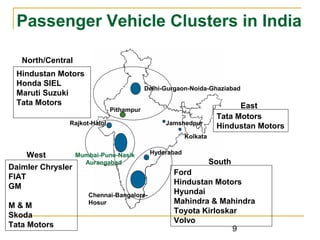
Passenger Vehicle Clusters in India
Mumbai-Pune-Nasik
Aurangabad
Pithampur
Rajkot-Halol
Chennai-Bangalore-
Hosur
Hyderabad
Jamshedpur
Kolkata
Delhi-Gurgaon-Noida-Ghaziabad
Hindustan Motors
Honda SIEL
Maruti Suzuki
Tata Motors
North/Central
Daimler Chrysler
FIAT
GM
M & M
Skoda
Tata Motors
West
Ford
Hindustan Motors
Hyundai
Mahindra & Mahindra
Toyota Kirloskar
Volvo
South
Tata Motors
Hindustan Motors
East
10
Segmentation (based on car prices)
Under Rs. 3 Lakhs Maruti 800 Alto Omni Reva
Rs. 3-5 Lakhs Ambassador Fiat Palio Hyundai Santro Getz Chevrolet Opel Corsa Maruti Zen Wagon R Versa
Esteem Gypsy Ford Icon & Fiesta Tata Indica Indigo Mahindra Bolero
Rs. 5-10 Lakhs Chevrolet Swing Optra Tavera Hyundai Accent Elantra
Mahindra Scorpio Maruti Baleno Toyota Corolla Innova
Tata Safari Mitsubishi Lancer Lancer Cedia Honda City
Rs. 10-15 Lakhs Ford Mondeo & Endeavour Chevrolet Forester Skoda Octavia Classic & Combi Honda Civic &
CR-V
Rs. 15-30 Lakh Maruti Suzuki Grand Vitara Hyundai Sonata Embera Terracan & Tucson Mitsubishi Pajero Audi
A4 Opel Vectra Honda Accord Mercedes C Class Toyota Camry
Rs. 30-90 Lakhs Audi A6 A8 & TT BMW X5 5 Series & 7 Series Mercedes E Class, S Class, SLK, SL & CLS-Class
Porsche Boxster Cayenne 911 Toyota Prado
Above Rs. 1 Crore Bentley Arnage Continental GT & Flying Spur
Rolls Royce Phantom Maybach
11
Regulations - Auto Policy
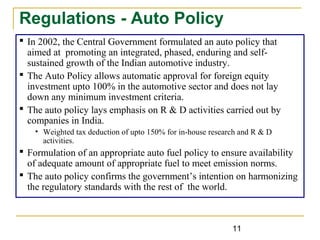
 In 2002, the Central Government formulated an auto policy that
aimed at promoting an integrated, phased, enduring and self-
sustained growth of the Indian automotive industry.
 The Auto Policy allows automatic approval for foreign equity
investment upto 100% in the automotive sector and does not lay
down any minimum investment criteria.
 The auto policy lays emphasis on R & D activities carried out by
companies in India.
• Weighted tax deduction of upto 150% for in-house research and R & D
activities.
 Formulation of an appropriate auto fuel policy to ensure availability
of adequate amount of appropriate fuel to meet emission norms.
 The auto policy confirms the government’s intention on harmonizing
the regulatory standards with the rest of the world.
12
Automotive Regulations
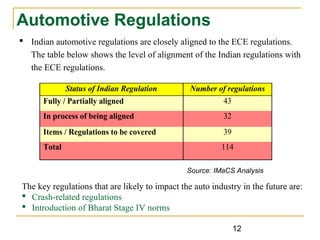
 Indian automotive regulations are closely aligned to the ECE regulations.
The table below shows the level of alignment of the Indian regulations with
the ECE regulations.
Status of Indian Regulation Number of regulations
Fully / Partially aligned 43
In process of being aligned 32
Items / Regulations to be covered 39
Total 114
The key regulations that are likely to impact the auto industry in the future are:
 Crash-related regulations
 Introduction of Bharat Stage IV norms
Source: IMaCS Analysis
13
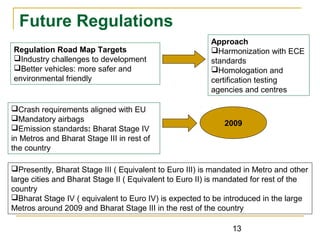
Future Regulations
Regulation Road Map Targets
Industry challenges to development
Better vehicles: more safer and
environmental friendly
Approach
Harmonization with ECE
standards
Homologation and
certification testing
agencies and centres
Crash requirements aligned with EU
Mandatory airbags
Emission standards: Bharat Stage IV
in Metros and Bharat Stage III in rest of
the country
2009
Presently, Bharat Stage III ( Equivalent to Euro III) is mandated in Metro and other
large cities and Bharat Stage II ( Equivalent to Euro II) is mandated for rest of the
country
Bharat Stage IV ( equivalent to Euro IV) is expected to be introduced in the large
Metros around 2009 and Bharat Stage III in the rest of the country
14
Demand Drivers
 The growth in domestic demand is driven by a number of
factors including:
• Overall economic growth
• Rising income levels
• Low cost of finance and easy availability of finance
• Increased consumer awareness
• Closer linkages with global auto trend leading to introduction of
contemporary models
• Government’s specific policy initiatives such as lower excise duties on
smaller cars
• Increased job demands
• Growth of satellite towns
• Onset of consumerism and travelling culture
• Completion of Golden Quadrilateral project
15
Key Success Factors – Market Leaders
 Presence across segments - Manufacturers with presence across
various segments can ensure higher volumes and better capacity
utilization by using common manufacturing facilities.
 Cost-competitive operations - Higher localization, reduction in the
vendor base, use of common components, manufacturing a larger
number of models on a single platform have helped bring down prices.
 Wide dealer network - After sales service and access to original spare
parts act as distinct advantages in the marketing of a model.
 Easy availability of finance - MUL tied up with State Bank of India
(SBI) in June 2003 to offer finance to its rural and semi-urban
customers through the latter's 13,000 plus strong branch network.
 Strong support from parent companies:
• Strong brand
• Strong financial and technological support
• Access to latest technology for launching new models, enhanced export capability
16
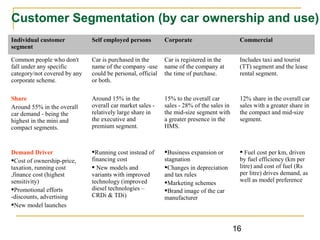
Customer Segmentation (by car ownership and use)
Individual customer
segment
Self employed persons Corporate Commercial
Common people who don't
fall under any specific
category/not covered by any
corporate scheme.
Car is purchased in the
name of the company -use
could be personal, official
or both.
Car is registered in the
name of the company at
the time of purchase.
Includes taxi and tourist
(TT) segment and the lease
rental segment.
Share
Around 55% in the overall
car demand - being the
highest in the mini and
compact segments.
Around 15% in the
overall car market sales -
relatively large share in
the executive and
premium segment.
15% to the overall car
sales - 28% of the sales in
the mid-size segment with
a greater presence in the
HMS.
12% share in the overall car
sales with a greater share in
the compact and mid-size
segment.
Demand Driver
Cost of ownership-price,
taxation, running cost
,finance cost (highest
sensitivity)
Promotional efforts
-discounts, advertising
New model launches
Running cost instead of
financing cost
 New models and
variants with improved
technology (improved
diesel technologies –
CRDi & TDi)
Business expansion or
stagnation
Changes in depreciation
and tax rules
Marketing schemes
Brand image of the car
manufacturer
 Fuel cost per km, driven
by fuel efficiency (km per
litre) and cost of fuel (Rs
per litre) drives demand, as
well as model preference
17
Changing Dynamics of Segmental
Demand
18
Player-wise Market Share
19
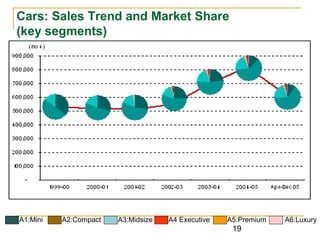
Cars: Sales Trend and Market Share
(key segments)
A1:Mini A2:Compact A3:Midsize A4 Executive A5:Premium A6:Luxury
20
Comparison Tests:
Differences in Marketing
21
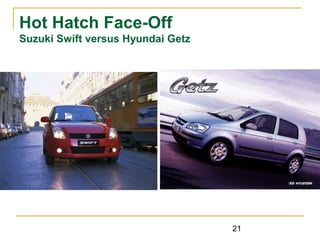
Hot Hatch Face-Off
Suzuki Swift versus Hyundai Getz
22
Background
Suzuki Swift
 Esteem in India: known
overseas as ‘Swift’ earlier
 Now Suzuki’s “Global Car”
– All new car launched at
Paris Auto show ’04
 Well appreciated in Europe.
Hyundai Getz
 Not a very well-known
model
 Few awards won here and
there. For example, Budget
car of the year by ‘What
Car?’ (UK, 2003)
23
Marketing: Swift
 Buzz in the industry: Maruti’s first new car in two
decades!
 Differentiating factor: Hot shot looks and also awards
in India (Car of the Year awards)
 USP: Killer Price!
 OTL: TVCs that communicate hardly anything
 BTL:
• Separate sections at showrooms
• Personnel trained specially for “Swift selling”
24
Marketing: Getz
 Initially marketed as feature packed: failed
 Now being marketed as a big, spacious car
 USP: Space
 Price about Rs. 50,000 more than the Swift
 Not as successful as the Swift so far
25
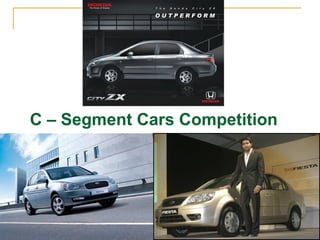
C – Segment Cars Competition
26
Marketing: City
 Fairly advanced stage of the product lifecycle:
Growth/Maturity
• Undergone a full makeover since its launch: all new city
launched 4 years back
 USP: Honda brand name
 Advertising
• Hi tech car: Honda name (esp. VTEC)
• Rising diesel costs in India relative to petrol (so cost saving
due to diesel is unsustainable)
• Quality (good scores on JD Power surveys): lower
maintenance costs overall in comparison
27
Marketing: Fiesta
 Newest in the line of “made for India” Ford cars
 Exists as a hatchback in Europe, suitably modified for
India
 Abhishek Bacchan (movie star in India) was hired as
brand ambassador
 “Go fida” campaign: a car that will bowl you over –
this was the message communicated
 Mileage: 31 kilometers/litre record (published
recently in an auto magazine)
28
Marketing: Verna
 Latest car from Hyundai, India.
 (Originally) Intended as replacement for the Accent –
sandwiched on both sides
 Good features: Diesel economy with high technology
(VGT) and power (110 bhp / 24kgm).
 Market response – time will tell!
29
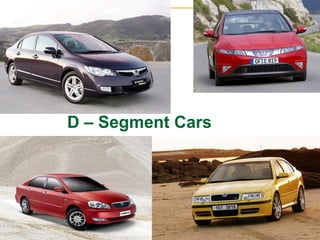
D – Segment Cars
30
Marketing: Octavia
 Skoda’s first car in India: need to build the Skoda
brand first
 Quality differentiator: “Obsessed with quality, since
1895” – this was the tagline used
 Built on the golf platform – Skoda is part of the VW
group
 USP: Diesel economy (users have reported 19 km per
litre mileage)
 Replacement of the Octavia (Skoda Laura) falls in the
next segment, i.e. competes with Honda Accord
31
Marketing: Corolla
 Best selling car in the world (over the years)
 Not as successful as Toyota would like
 Marketing changed over time
• Initial: Successful people use Corolla
• Now: Trying to cash in on its worldwide acceptance
 Quality niggles (on a Toyota!) in the interior have
been a cause for complaint among owners
32
Marketing: Civic
 One of Honda’s best selling brands worldwide:
eagerly awaited before its launch in India
 Currently outsells the Corolla – in markets abroad,
too.
 Brand communication: “Pure Exhilaration” tagline
used to communicate sporty nature
 Scores on the styling front – especially the interior
 Aggressive salespeople
 Already the leading seller in the segment
33
Future Trends
 Individual buyers, lease rental-based bulk buyers for high volume growth
 More importance to fuel efficiency, adaptability with road condition, heavy traffic
 Not many crave a status symbol  small car is the choice of the hour
 Government regulations favouring manufacturing of small cars
 The development of a vibrant used car market will drive the growth of new car and
UV sales by
• Helping owners: Dispose old car; Upgrade to a new car
• Creating potential customers for new cars: Used car owners upgrade to new models
• Demand from two-wheeler owners who want to upgrade to used cars
 All major players to launch diesel variants and models with increasing frequency.
However, the following player initiatives will have a significant impact on diesel
share:
• Maruti setting up an initial 100,000 diesel engine capacity by the end of 2006, which it
eventually plans to expand to 300,000 units
• Tata Motors' Rs 100,000 car, targeted for launch by mid-2008

Passenger car

  • 1.
  • 2.
    2 Profile of theAutomotive Industry Vehicle sales in India in 2005 - 06 (in million) 1.14 0.35 7.05 0.36 0 2 4 6 8 Cars CVs Two wheelers Three Wheelers Size of around USD 34 billion in 2006  The industry has grown at a CAGR of 14% p.a over the last 5 years, with total sales of vehicles reaching around 9 million vehicles in 2005-06  The Indian auto industry has the potential to emerge as one of the largest in the world. Presently, India is – 2nd largest two wheeler market in the world – 4th largest commercial vehicle market in the world – 11th largest passenger car in the world and is expected to be the 7th largest market by 2016  The industry has emerged as a key contributor to the Indian economy
  • 3.
    3 Players in theAuto industry Global OEM Domestic OEM Domestic Suppliers Global Suppliers Engineering & Development Companies Auto Industry •GM •Toyota •Ford •Hyundai •Maruti Suzuki •Honda •Skoda •Volvo •Mercedes •Tata Motors •Mahindra & Mahindra •Bajaj Auto •TVS Motors •Hero Honda •Bajaj Tempo •Ashok Leyland The auto industry is highly competitive with a number of global and domestic auto companies present in the country.
  • 4.
    4 Current Scenario  5thlargest commercial vehicle manufacturer in the world  4th largest car market in Asia - crossed the 1 million mark  Unlike the USA, the Indian passenger vehicle market is dominated by cars (79%)  India became the fastest growing car market in the world in 2004, growth rate of 20%  India is the second-biggest market for small cars after Japan
  • 5.
    5 Automobile Production Trends Category2001-02 2002-03 2003-04 2004-05 2005-06 Passenger Cars 500301 557410 782562 960487 1045881 Utility Vehicles 105667 114479 146325 182018 196371 MPVs 63751 51441 60673 67371 66661 Total Passenger Vehicels 669719 723330 989560 1209876 1308913
  • 6.
    6 Automobile Domestic SalesTrends Category 2001-02 2002-03 2003-04 2004-05 2005-06 Passenger Cars 509088 541491 696153 820179 882094 Utility Vehicles 104253 113620 146388 176360 194577 MPVs 61775 52087 59555 65033 66366 Total Passenger Vehicles 675116 707198 902096 1061572 1143037 Category 2001-02 2002-03 2003-04 2004-05 2005-06 Passenger Cars 49273 70263 125320 160670 170193 Utility Vehicles 3077 1177 3049 4505 4486 MPVs 815 565 922 1227 1093 Total Passenger Vehicles 53165 72005 129291 166402 175772 Automobile Exports Trends
  • 7.
    7 Key Players inthe Indian Auto Industry - Passenger Cars The largest player in the Indian industry. Plans to launch new and exciting products in the Indian markets, including the ‘1 – lacs’ car MUL is the largest passenger car manufacturer in India The third largest passenger car manufacturer in India and one of the largest exporters of vehicles. Has established India as one of its manufacturing bases in the world. Is planning to invest heavily to boost exports from India. Has vision of capturing 10% share of the Indian passenger car market by 2010 One of the leading players in the Indian premium cars segment One of the leading players in the Indian premium cars segment
  • 8.
    8 Key Players inthe Indian Auto Industry - Passenger Cars One of the leading players in the Indian premium cars segment. Plans to enter the small car segment by relaunching the Matiz One of the largest domestic players in the UV / MUV segment Tata Motors manages the marketing and distribution of the Fiat branded cars through selected Tata outlets throughout India E, C and S Class passenger cars are assembled in India, other models are imported as completely built units (CBUs) and retailed in India. One of the original three car manufacturers in India, founded in 1942, it was a leader in car sales until the 1980s, when the industry was opened up from protection HM has a joint venture with Mitsubishi, producing versions of the Lancer & Pajero.
  • 9.
    9 Passenger Vehicle Clustersin India Mumbai-Pune-Nasik Aurangabad Pithampur Rajkot-Halol Chennai-Bangalore- Hosur Hyderabad Jamshedpur Kolkata Delhi-Gurgaon-Noida-Ghaziabad Hindustan Motors Honda SIEL Maruti Suzuki Tata Motors North/Central Daimler Chrysler FIAT GM M & M Skoda Tata Motors West Ford Hindustan Motors Hyundai Mahindra & Mahindra Toyota Kirloskar Volvo South Tata Motors Hindustan Motors East
  • 10.
    10 Segmentation (based oncar prices) Under Rs. 3 Lakhs Maruti 800 Alto Omni Reva Rs. 3-5 Lakhs Ambassador Fiat Palio Hyundai Santro Getz Chevrolet Opel Corsa Maruti Zen Wagon R Versa Esteem Gypsy Ford Icon & Fiesta Tata Indica Indigo Mahindra Bolero Rs. 5-10 Lakhs Chevrolet Swing Optra Tavera Hyundai Accent Elantra Mahindra Scorpio Maruti Baleno Toyota Corolla Innova Tata Safari Mitsubishi Lancer Lancer Cedia Honda City Rs. 10-15 Lakhs Ford Mondeo & Endeavour Chevrolet Forester Skoda Octavia Classic & Combi Honda Civic & CR-V Rs. 15-30 Lakh Maruti Suzuki Grand Vitara Hyundai Sonata Embera Terracan & Tucson Mitsubishi Pajero Audi A4 Opel Vectra Honda Accord Mercedes C Class Toyota Camry Rs. 30-90 Lakhs Audi A6 A8 & TT BMW X5 5 Series & 7 Series Mercedes E Class, S Class, SLK, SL & CLS-Class Porsche Boxster Cayenne 911 Toyota Prado Above Rs. 1 Crore Bentley Arnage Continental GT & Flying Spur Rolls Royce Phantom Maybach
  • 11.
    11 Regulations - AutoPolicy  In 2002, the Central Government formulated an auto policy that aimed at promoting an integrated, phased, enduring and self- sustained growth of the Indian automotive industry.  The Auto Policy allows automatic approval for foreign equity investment upto 100% in the automotive sector and does not lay down any minimum investment criteria.  The auto policy lays emphasis on R & D activities carried out by companies in India. • Weighted tax deduction of upto 150% for in-house research and R & D activities.  Formulation of an appropriate auto fuel policy to ensure availability of adequate amount of appropriate fuel to meet emission norms.  The auto policy confirms the government’s intention on harmonizing the regulatory standards with the rest of the world.
  • 12.
    12 Automotive Regulations  Indianautomotive regulations are closely aligned to the ECE regulations. The table below shows the level of alignment of the Indian regulations with the ECE regulations. Status of Indian Regulation Number of regulations Fully / Partially aligned 43 In process of being aligned 32 Items / Regulations to be covered 39 Total 114 The key regulations that are likely to impact the auto industry in the future are:  Crash-related regulations  Introduction of Bharat Stage IV norms Source: IMaCS Analysis
  • 13.
    13 Future Regulations Regulation RoadMap Targets Industry challenges to development Better vehicles: more safer and environmental friendly Approach Harmonization with ECE standards Homologation and certification testing agencies and centres Crash requirements aligned with EU Mandatory airbags Emission standards: Bharat Stage IV in Metros and Bharat Stage III in rest of the country 2009 Presently, Bharat Stage III ( Equivalent to Euro III) is mandated in Metro and other large cities and Bharat Stage II ( Equivalent to Euro II) is mandated for rest of the country Bharat Stage IV ( equivalent to Euro IV) is expected to be introduced in the large Metros around 2009 and Bharat Stage III in the rest of the country
  • 14.
    14 Demand Drivers  Thegrowth in domestic demand is driven by a number of factors including: • Overall economic growth • Rising income levels • Low cost of finance and easy availability of finance • Increased consumer awareness • Closer linkages with global auto trend leading to introduction of contemporary models • Government’s specific policy initiatives such as lower excise duties on smaller cars • Increased job demands • Growth of satellite towns • Onset of consumerism and travelling culture • Completion of Golden Quadrilateral project
  • 15.
    15 Key Success Factors– Market Leaders  Presence across segments - Manufacturers with presence across various segments can ensure higher volumes and better capacity utilization by using common manufacturing facilities.  Cost-competitive operations - Higher localization, reduction in the vendor base, use of common components, manufacturing a larger number of models on a single platform have helped bring down prices.  Wide dealer network - After sales service and access to original spare parts act as distinct advantages in the marketing of a model.  Easy availability of finance - MUL tied up with State Bank of India (SBI) in June 2003 to offer finance to its rural and semi-urban customers through the latter's 13,000 plus strong branch network.  Strong support from parent companies: • Strong brand • Strong financial and technological support • Access to latest technology for launching new models, enhanced export capability
  • 16.
    16 Customer Segmentation (bycar ownership and use) Individual customer segment Self employed persons Corporate Commercial Common people who don't fall under any specific category/not covered by any corporate scheme. Car is purchased in the name of the company -use could be personal, official or both. Car is registered in the name of the company at the time of purchase. Includes taxi and tourist (TT) segment and the lease rental segment. Share Around 55% in the overall car demand - being the highest in the mini and compact segments. Around 15% in the overall car market sales - relatively large share in the executive and premium segment. 15% to the overall car sales - 28% of the sales in the mid-size segment with a greater presence in the HMS. 12% share in the overall car sales with a greater share in the compact and mid-size segment. Demand Driver Cost of ownership-price, taxation, running cost ,finance cost (highest sensitivity) Promotional efforts -discounts, advertising New model launches Running cost instead of financing cost  New models and variants with improved technology (improved diesel technologies – CRDi & TDi) Business expansion or stagnation Changes in depreciation and tax rules Marketing schemes Brand image of the car manufacturer  Fuel cost per km, driven by fuel efficiency (km per litre) and cost of fuel (Rs per litre) drives demand, as well as model preference
  • 17.
    17 Changing Dynamics ofSegmental Demand
  • 18.
  • 19.
    19 Cars: Sales Trendand Market Share (key segments) A1:Mini A2:Compact A3:Midsize A4 Executive A5:Premium A6:Luxury
  • 20.
  • 21.
    21 Hot Hatch Face-Off SuzukiSwift versus Hyundai Getz
  • 22.
    22 Background Suzuki Swift  Esteemin India: known overseas as ‘Swift’ earlier  Now Suzuki’s “Global Car” – All new car launched at Paris Auto show ’04  Well appreciated in Europe. Hyundai Getz  Not a very well-known model  Few awards won here and there. For example, Budget car of the year by ‘What Car?’ (UK, 2003)
  • 23.
    23 Marketing: Swift  Buzzin the industry: Maruti’s first new car in two decades!  Differentiating factor: Hot shot looks and also awards in India (Car of the Year awards)  USP: Killer Price!  OTL: TVCs that communicate hardly anything  BTL: • Separate sections at showrooms • Personnel trained specially for “Swift selling”
  • 24.
    24 Marketing: Getz  Initiallymarketed as feature packed: failed  Now being marketed as a big, spacious car  USP: Space  Price about Rs. 50,000 more than the Swift  Not as successful as the Swift so far
  • 25.
    25 C – SegmentCars Competition
  • 26.
    26 Marketing: City  Fairlyadvanced stage of the product lifecycle: Growth/Maturity • Undergone a full makeover since its launch: all new city launched 4 years back  USP: Honda brand name  Advertising • Hi tech car: Honda name (esp. VTEC) • Rising diesel costs in India relative to petrol (so cost saving due to diesel is unsustainable) • Quality (good scores on JD Power surveys): lower maintenance costs overall in comparison
  • 27.
    27 Marketing: Fiesta  Newestin the line of “made for India” Ford cars  Exists as a hatchback in Europe, suitably modified for India  Abhishek Bacchan (movie star in India) was hired as brand ambassador  “Go fida” campaign: a car that will bowl you over – this was the message communicated  Mileage: 31 kilometers/litre record (published recently in an auto magazine)
  • 28.
    28 Marketing: Verna  Latestcar from Hyundai, India.  (Originally) Intended as replacement for the Accent – sandwiched on both sides  Good features: Diesel economy with high technology (VGT) and power (110 bhp / 24kgm).  Market response – time will tell!
  • 29.
  • 30.
    30 Marketing: Octavia  Skoda’sfirst car in India: need to build the Skoda brand first  Quality differentiator: “Obsessed with quality, since 1895” – this was the tagline used  Built on the golf platform – Skoda is part of the VW group  USP: Diesel economy (users have reported 19 km per litre mileage)  Replacement of the Octavia (Skoda Laura) falls in the next segment, i.e. competes with Honda Accord
  • 31.
    31 Marketing: Corolla  Bestselling car in the world (over the years)  Not as successful as Toyota would like  Marketing changed over time • Initial: Successful people use Corolla • Now: Trying to cash in on its worldwide acceptance  Quality niggles (on a Toyota!) in the interior have been a cause for complaint among owners
  • 32.
    32 Marketing: Civic  Oneof Honda’s best selling brands worldwide: eagerly awaited before its launch in India  Currently outsells the Corolla – in markets abroad, too.  Brand communication: “Pure Exhilaration” tagline used to communicate sporty nature  Scores on the styling front – especially the interior  Aggressive salespeople  Already the leading seller in the segment
  • 33.
    33 Future Trends  Individualbuyers, lease rental-based bulk buyers for high volume growth  More importance to fuel efficiency, adaptability with road condition, heavy traffic  Not many crave a status symbol  small car is the choice of the hour  Government regulations favouring manufacturing of small cars  The development of a vibrant used car market will drive the growth of new car and UV sales by • Helping owners: Dispose old car; Upgrade to a new car • Creating potential customers for new cars: Used car owners upgrade to new models • Demand from two-wheeler owners who want to upgrade to used cars  All major players to launch diesel variants and models with increasing frequency. However, the following player initiatives will have a significant impact on diesel share: • Maruti setting up an initial 100,000 diesel engine capacity by the end of 2006, which it eventually plans to expand to 300,000 units • Tata Motors' Rs 100,000 car, targeted for launch by mid-2008

Editor's Notes

  • #10 The 3 auto hubs - Chennai, Manesar and Pune account for around 90 % of the total industry
  • #15 Growth in income levels and availability of easy finance have increased consumer demand for auto products. Increased consumer awareness and closer linkages with the global auto trends have resulted in the companies introducing contemporary products in the Indian market. The stable government economic policies adopted by successive governments s have contributed to the overall economic growth including growth of the auto sector. In addition, the government has stake specific policy initiatives such as lower excise duties on smaller cars, etc to boost local demand India is targeting to emerge as the manufacturing hub for small cars. It has already been recognised as low cost source for components and vehicle and is expected to capitalise on the increase in outsourcing to low cost countries. Growth in income levels and availability of easy finance have increased consumer demand for auto products. Increased consumer awareness and closer linkages with the global auto trends have resulted in the companies introducing contemporary products in the Indian market. The stable government economic policies adopted by successive governments s have contributed to the overall economic growth including growth of the auto sector. In addition, the government has stake specific policy initiatives such as lower excise duties on smaller cars, etc to boost local demand India is targeting to emerge as the manufacturing hub for small cars. It has already been recognised as low cost source for components and vehicle and is expected to capitalise on the increase in outsourcing to low cost countries.