Download to read offline
![International Research Journal of Engineering and Technology (IRJET) e-ISSN: 2395 -0056
Volume: 04 Issue: 03 | Mar -2017 www.irjet.net p-ISSN: 2395-0072
© 2017, IRJET | Impact Factor value: 5.181 | ISO 9001:2008 Certified Journal | Page 2045
Controlling a Raspberry Pi Robot over Internet with HTML & Shell
Scripts
Ashish G. Jadhav [1]
BE E&TC
DYPCOE, Akurdi
Maharashtra, India
Ankit [1]
BE E&TC
DYPCOE, Akurdi
Maharashtra, India
Ashish Ranjan [1]
BE E&TC
DYPCOE, Akurdi
Maharashtra, India
Aditi Chaudhuri [2]
ASSOCIATE PROFESSOR
E&TC, DYPCOE, Akurdi
Maharashtra, India
---------------------------------------------------------------------***---------------------------------------------------------------------
Abstract - For making aware of the new environment one
should go there and analyze what is happening, but life is
precious so robots are used instead. The main theme of this
paper is to develop a Raspberry Pi based robot which can be
controlled remotely via internet. The robot has beenprimarily
built over Raspberry Pi which controls data transmission
between the server and the robot, and controls the motion of
the motors via motor controller L293D. The robot direction is
controlled by using Wi-Fi module through webpage over
internet. The camera in the robot can be used to visually
control the robot directions even from far places as well as to
get the live video feed over the webpage.
Key Words: Robot, Raspberry Pi, IOT, Wi-Fi Module,
Webcam.
1. INTRODUCTION
IOT based robot plays an important role in manyarea where
people can’t reach easily. The rapid growth of industry and
advancement of technology has resulted in reduction of
human efforts, the main reason for whichbeing robot.Inthis
project we use internet to establishcommunicationbetween
the user and a robotic vehicle. This is a reliable connection
and a continuous video vehicle. Due to the use of internet,
there is no limitation on range or distance between the user
and the robotic vehicle. Robots have found an increasing
demand in a wide range of applications in our life. Their use
in defense has increased by the day. In today’s world, robots
find use in various places be it to detonate buried bombs or
in industrial applications or even robotic components used
in children’s toys. The complexity of computer software
depends on how difficult the robot’s tasks are. In Wi-Fi
Robot for Video Monitoring & Surveillance System, the
proposed robot motion will be controlled with PWM
techniques using a Microcontroller and Bidirectional DC
Bridge for Motor Driving. It is proposed to address the low
cost, efficient, high speed processing & control hardwarefor
the self-navigating robotics application.
2. PROPOSED THEORY
The first part is construction of the robotic vehicle. With the
help of inbuilt Wi-Fi and network settings an internet
connection is established between the robotic vehicle and
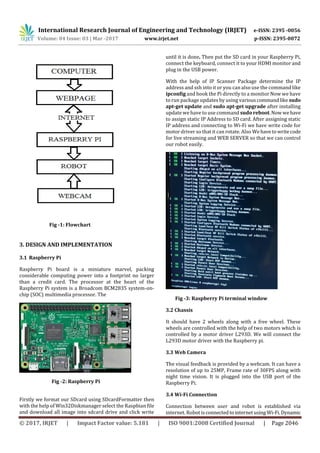
the user. Then robot captures the images using a webcam
and stores them into the memory. The next task istocapture
and send live video feed using internet at a rate sufficient to
make them seem like a live video to the human eye. The next
task is to capture and send live images using internet at a
rate sufficient to make them seem like a live video to the
human eye. This was initially implementedusingLAN before
moving to internet. The desired result was achieved by
sending compressed low resolution images so that
transmission would not be affected in case high upload
speeds were not available. Then the program was made
more dynamic by varying the resolution of the video to be
transmitted depending on the upload speed availableatthat
particular time. Like for example in case of availability of
good upload speeds, high resolution video will be sent and
vice versa in case of low upload speeds.](https://image.slidesharecdn.com/irjet-v4i3543-180104084228/85/Controlling-A-Raspberry-Pi-Robot-Over-Internet-With-HTML-Shell-Scripts-1-320.jpg)
![International Research Journal of Engineering and Technology (IRJET) e-ISSN: 2395 -0056
Volume: 04 Issue: 03 | Mar -2017 www.irjet.net p-ISSN: 2395-0072
© 2017, IRJET | Impact Factor value: 5.181 | ISO 9001:2008 Certified Journal | Page 2045
Controlling a Raspberry Pi Robot over Internet with HTML & Shell
Scripts
Ashish G. Jadhav [1]
BE E&TC
DYPCOE, Akurdi
Maharashtra, India
Ankit [1]
BE E&TC
DYPCOE, Akurdi
Maharashtra, India
Ashish Ranjan [1]
BE E&TC
DYPCOE, Akurdi
Maharashtra, India
Aditi Chaudhuri [2]
ASSOCIATE PROFESSOR
E&TC, DYPCOE, Akurdi
Maharashtra, India
---------------------------------------------------------------------***---------------------------------------------------------------------
Abstract - For making aware of the new environment one
should go there and analyze what is happening, but life is
precious so robots are used instead. The main theme of this
paper is to develop a Raspberry Pi based robot which can be
controlled remotely via internet. The robot has beenprimarily
built over Raspberry Pi which controls data transmission
between the server and the robot, and controls the motion of
the motors via motor controller L293D. The robot direction is
controlled by using Wi-Fi module through webpage over
internet. The camera in the robot can be used to visually
control the robot directions even from far places as well as to
get the live video feed over the webpage.
Key Words: Robot, Raspberry Pi, IOT, Wi-Fi Module,
Webcam.
1. INTRODUCTION
IOT based robot plays an important role in manyarea where
people can’t reach easily. The rapid growth of industry and
advancement of technology has resulted in reduction of
human efforts, the main reason for whichbeing robot.Inthis
project we use internet to establishcommunicationbetween
the user and a robotic vehicle. This is a reliable connection
and a continuous video vehicle. Due to the use of internet,
there is no limitation on range or distance between the user
and the robotic vehicle. Robots have found an increasing
demand in a wide range of applications in our life. Their use
in defense has increased by the day. In today’s world, robots
find use in various places be it to detonate buried bombs or
in industrial applications or even robotic components used
in children’s toys. The complexity of computer software
depends on how difficult the robot’s tasks are. In Wi-Fi
Robot for Video Monitoring & Surveillance System, the
proposed robot motion will be controlled with PWM
techniques using a Microcontroller and Bidirectional DC
Bridge for Motor Driving. It is proposed to address the low
cost, efficient, high speed processing & control hardwarefor
the self-navigating robotics application.
2. PROPOSED THEORY
The first part is construction of the robotic vehicle. With the
help of inbuilt Wi-Fi and network settings an internet
connection is established between the robotic vehicle and
the user. Then robot captures the images using a webcam
and stores them into the memory. The next task istocapture
and send live video feed using internet at a rate sufficient to
make them seem like a live video to the human eye. The next
task is to capture and send live images using internet at a
rate sufficient to make them seem like a live video to the
human eye. This was initially implementedusingLAN before
moving to internet. The desired result was achieved by
sending compressed low resolution images so that
transmission would not be affected in case high upload
speeds were not available. Then the program was made
more dynamic by varying the resolution of the video to be
transmitted depending on the upload speed availableatthat
particular time. Like for example in case of availability of
good upload speeds, high resolution video will be sent and
vice versa in case of low upload speeds.](https://image.slidesharecdn.com/irjet-v4i3543-180104084228/75/Controlling-A-Raspberry-Pi-Robot-Over-Internet-With-HTML-Shell-Scripts-1-2048.jpg)

![International Research Journal of Engineering and Technology (IRJET) e-ISSN: 2395 -0056
Volume: 04 Issue: 03 | Mar -2017 www.irjet.net p-ISSN: 2395-0072
© 2017, IRJET | Impact Factor value: 5.181 | ISO 9001:2008 Certified Journal | Page 2048
can be added. We can use different typesofsensorsothatwe
can use robot in different field i.e. Temperature Sensor,
Pressure Sensor, Heat Sensor, Position Sensor, Proximity
Sensor.
We can also add Text To Speech converter in our robot. We
can also mount rotating camera on the Robot whichcanhelp
to know the position of Robot accurately.
We can also turn our robot as an UAV (Unmanned Aerial
Vehicle) which can save our soldier in spying.
REFERENCES
[1] Remote Access of FPGA Robot via Internet - Dhanabal
Bh.S.R.Phanindra Varma ,BharathiV,2014International
Conference on Electronics and Communication System
(ICECS -2014) .
[2] Robotic Vehicle Control using Internet via Webpageand
Keyboard, by Ketan Dumbre, Snehal Ganeshkar,Ajinkya
Dhekne, International Journal of ComputerApplications
(0975–8887), Volume 114 No. 17, March 2015.
[3] Wireless ControlledSurveillanceRobot byKunal Borkar,
Rohan Gaikwad, Ajay Singh Rajput – International
Journal of Advance Research in Computer Science and
Management Studies,ISSN:2321-7782(Online),Volume
2 Issue 2, Feb 2014.
[4] Advanced embedded wireless robot with motion
detection system and live video / audiotransmission by
M. A. wajeed, K. Varun Kumar - International Journal of
Communication Network Security, ISSN: 2231 – 1882,
Volume-2, Issue-2, 2013.
[5] Mobile Robot in Coal Mine Disaster Surveillance by Mr.
Sabarish Chakkath , S. Hariharan siddharath ,
B.Hemalatha -IOSR Journal of Engineering (IOSRJEN) e-
ISSN: 2250-3021, p-ISSN: 2278-8719, Volume 2, Issue
10 (October 2012), PP 77-82.
[6] Wireless Surveillance Robot with Motion Detection and
Live Video Transmission by A. Sivasoundari, S.
Kalaimani, M. Balamurugan -International Journal of
Emerging Science and Engineering (IJESE) ISSN: 2319–
6378, Volume-I, Issue-6 April 2013
BIOGRAPHIES
Ashish G. Jadhav1 pursuing
bachelor’s degree in Electronics
and Telecommunication from D.Y.
Patil College of Engineering,
Akurdi, Pune. Project interests are
in Automation and Wireless
Communication.
Ashish Ranjan1 pursuing
bachelor’s degree in Electronics
and Telecommunication from D.Y.
Patil College of Engineering,
Akurdi, Pune. Project interest is in
Wireless Communication.
Ankit1 pursuing bachelor’s
degree in Electronics and
Telecommunication fromD.Y.Patil
College of Engineering, Akurdi,
Pune. Project interest is in
Embedded processors.
Aditi Chaudhuri2 Associate
Professor in D. Y. Patil College of
Engineering, Akurdi, Pune.
Received Mtech in
Electronics(2009). Research
interest in VLSI design field.](https://image.slidesharecdn.com/irjet-v4i3543-180104084228/85/Controlling-A-Raspberry-Pi-Robot-Over-Internet-With-HTML-Shell-Scripts-4-320.jpg)

This document describes the development of a Raspberry Pi controlled robot that can be remotely operated over the internet. The robot is built using a Raspberry Pi single board computer to control data transmission and motor movement. A WiFi module allows the robot's direction to be controlled via a webpage. A camera provides live video feedback to the user. The robot performs swiftly, responding to commands in under 1 second via the internet connection. Future work may include additional sensors and an autonomous aerial drone capability.


![[Deck] What's New in Spark-Iceberg Integration via DSV2.pptx](https://cdn.slidesharecdn.com/ss_thumbnails/deckwhatsnewinspark-icebergintegrationviadsv2-260210005337-25955b12-thumbnail.jpg?width=640&height=640&fit=bounds)

