DESIGN AND CONSTRUCTION OF A LINUX BASED WEB
CONTROLLED SURVEILLANCE BASED UNMANNED GROUND
VEHICLE
BY
YUSUF SALIHU IBRAHIM
U11EE1006
Department of Electrical and Computer Engineering,
Ahmadu Bello University, Zaria, Nigeria.
Outline
 Introduction
 Aim and Objectives
 Project motivation
 Methodology
 Project Description
 Results of Hardware and Software tests
 Conclusion
 Limitations and Recommendation
INTRODUCTION
An unmanned ground vehicle (UGV) is a vehicular robot that is
capable of operating on the ground over a wide variety of terrain
without an onboard presence of a human. UGVs can be employed
for many applications where it may be difficult, dangerous or
impossible for a human to access.
Aim and Objectives
 Development of a mobile robot system that can be controlled via a web
interface.
 Development of a web interface (using HTML, CSS and JavaScript) that has a live
video feed.
 Configuration of a FastCGI enabled web server that communicates the control
command from the web interface to a microcontroller.
 Development of a wheel odometry system using an optical encoder that
communicates distance covered to a single board computer.
 Prototyping the robot.
Project Motivation
The deployment of optical fiber cables through sewer requires
firstly, that the sewer infrastructure be surveyed to ascertain
whether the infrastructure is fit for the deployment or not. Because
the sewer infrastructure falls under the category of areas that is
inaccessible to humans there was need to use a UGV that is
equipped with a digital camera for surveillance.
Methodology
The methodology adopted for the design and construction of the robot is as
described below:
 Specification of the robot’s features and functions
 Decision of robot’s mode of operation
 Selection of the computing peripherals to be used
 Software design and implementation
 Hardware design and implementation
 Design of vehicular chassis
 Assembly of parts and components, testing and demonstration
Project Description
The following technologies were adopted and this lead to the realization of the robot.
 Embedded Systems
 Embedded Linux (Debian)
 Single Board Computers (RaspberryPi)
 Web Development (Lighttpd, HTML, CSS, Javascript, Websockets and FastCGI)
 Optical Encoding
 Software Programming (Python and C++)
 Electronics (PWM)
Project Description contd.
The robot features a single board computer (Raspberry Pi) that runs a
debian distribution of linux called “Raspbian”. The Raspberry Pi which is
the heart of the robot hosts a webpage which can be accessed via the
robot’s internet protocol (ip) address on a web browser. It also hosts a
command line streaming application which streams live video captured
by the robot’s HD camera.
Project Description contd.
The web server and the video streaming application give the robot ability of
being controlled from a remote location by a client who is on the same wireless
network as the robot. The client click on buttons to control the movement of the
robot based on what is revealed by the live stream. The html buttons upon
clicking sends a “GET” request from the web client side to the web server
(raspberry pi) and the pi parses the request and sends it over to a microcontroller
which controls the servo motors attached to the wheel of the robot.
Project Description contd.
Web
Control
Interface
Web
Server
Robot
Communic
ation
Software
Robot
Control
Software
Servo
Motors
GET
REQUEST Serial PWM
Block Diagram Of Robot’s Control
With optical encoders attached to the robot the distance covered is sent in real-time to the webpage
alongside the video feed.
Optical
Encoder
Robot
Controller
Software
Wheel
Odometry
Software
Websocketd
Web
Control
Interface
Interrupt Interrupt
Arduino Raspberry Pi
Block diagram of Robot’s Wheel Odometry
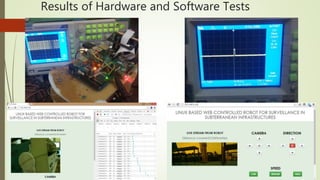
Results of Hardware and Software Tests
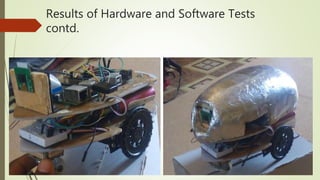
contd.
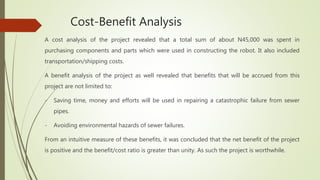
Cost-Benefit Analysis
A cost analysis of the project revealed that a total sum of about N45,000 was spent in
purchasing components and parts which were used in constructing the robot. It also included
transportation/shipping costs.
A benefit analysis of the project as well revealed that benefits that will be accrued from this
project are not limited to:
- Saving time, money and efforts will be used in repairing a catastrophic failure from sewer
pipes.
- Avoiding environmental hazards of sewer failures.
From an intuitive measure of these benefits, it was concluded that the net benefit of the project
is positive and the benefit/cost ratio is greater than unity. As such the project is worthwhile.
Conclusion
With regards to the objectives set forth above, it can be said that each objective
was carried out with positive results, as the robot was able to perform its desired
task successfully. It has thus been demonstrated that Embedded Linux with Web
development are a feasible technology for making web controlled robots as well as
devices.
Limitations and Recommendation
Limitations:
 The robot can only be controlled within the area of coverage of the Wi-Fi
enabled router
 The robot can only be used in a flat and dry infrastructure
Recommendation:
 Additional work can be done to extend the capability of the robot by
including a work-head that will enable the use of the robot for full
deployment of fiber through sewer as well as routine maintenance.
Thank You.

DESIGN AND CONSTRUCTION OF A LINUX BASED WEB (1)

  • 1.
    DESIGN AND CONSTRUCTIONOF A LINUX BASED WEB CONTROLLED SURVEILLANCE BASED UNMANNED GROUND VEHICLE BY YUSUF SALIHU IBRAHIM U11EE1006 Department of Electrical and Computer Engineering, Ahmadu Bello University, Zaria, Nigeria.
  • 2.
    Outline  Introduction  Aimand Objectives  Project motivation  Methodology  Project Description  Results of Hardware and Software tests  Conclusion  Limitations and Recommendation
  • 3.
    INTRODUCTION An unmanned groundvehicle (UGV) is a vehicular robot that is capable of operating on the ground over a wide variety of terrain without an onboard presence of a human. UGVs can be employed for many applications where it may be difficult, dangerous or impossible for a human to access.
  • 4.
    Aim and Objectives Development of a mobile robot system that can be controlled via a web interface.  Development of a web interface (using HTML, CSS and JavaScript) that has a live video feed.  Configuration of a FastCGI enabled web server that communicates the control command from the web interface to a microcontroller.  Development of a wheel odometry system using an optical encoder that communicates distance covered to a single board computer.  Prototyping the robot.
  • 5.
    Project Motivation The deploymentof optical fiber cables through sewer requires firstly, that the sewer infrastructure be surveyed to ascertain whether the infrastructure is fit for the deployment or not. Because the sewer infrastructure falls under the category of areas that is inaccessible to humans there was need to use a UGV that is equipped with a digital camera for surveillance.
  • 6.
    Methodology The methodology adoptedfor the design and construction of the robot is as described below:  Specification of the robot’s features and functions  Decision of robot’s mode of operation  Selection of the computing peripherals to be used  Software design and implementation  Hardware design and implementation  Design of vehicular chassis  Assembly of parts and components, testing and demonstration
  • 7.
    Project Description The followingtechnologies were adopted and this lead to the realization of the robot.  Embedded Systems  Embedded Linux (Debian)  Single Board Computers (RaspberryPi)  Web Development (Lighttpd, HTML, CSS, Javascript, Websockets and FastCGI)  Optical Encoding  Software Programming (Python and C++)  Electronics (PWM)
  • 8.
    Project Description contd. Therobot features a single board computer (Raspberry Pi) that runs a debian distribution of linux called “Raspbian”. The Raspberry Pi which is the heart of the robot hosts a webpage which can be accessed via the robot’s internet protocol (ip) address on a web browser. It also hosts a command line streaming application which streams live video captured by the robot’s HD camera.
  • 9.
    Project Description contd. Theweb server and the video streaming application give the robot ability of being controlled from a remote location by a client who is on the same wireless network as the robot. The client click on buttons to control the movement of the robot based on what is revealed by the live stream. The html buttons upon clicking sends a “GET” request from the web client side to the web server (raspberry pi) and the pi parses the request and sends it over to a microcontroller which controls the servo motors attached to the wheel of the robot.
  • 10.
    Project Description contd. Web Control Interface Web Server Robot Communic ation Software Robot Control Software Servo Motors GET REQUESTSerial PWM Block Diagram Of Robot’s Control With optical encoders attached to the robot the distance covered is sent in real-time to the webpage alongside the video feed. Optical Encoder Robot Controller Software Wheel Odometry Software Websocketd Web Control Interface Interrupt Interrupt Arduino Raspberry Pi Block diagram of Robot’s Wheel Odometry
  • 11.
    Results of Hardwareand Software Tests
  • 12.
    Results of Hardwareand Software Tests contd.
  • 13.
    Cost-Benefit Analysis A costanalysis of the project revealed that a total sum of about N45,000 was spent in purchasing components and parts which were used in constructing the robot. It also included transportation/shipping costs. A benefit analysis of the project as well revealed that benefits that will be accrued from this project are not limited to: - Saving time, money and efforts will be used in repairing a catastrophic failure from sewer pipes. - Avoiding environmental hazards of sewer failures. From an intuitive measure of these benefits, it was concluded that the net benefit of the project is positive and the benefit/cost ratio is greater than unity. As such the project is worthwhile.
  • 14.
    Conclusion With regards tothe objectives set forth above, it can be said that each objective was carried out with positive results, as the robot was able to perform its desired task successfully. It has thus been demonstrated that Embedded Linux with Web development are a feasible technology for making web controlled robots as well as devices.
  • 15.
    Limitations and Recommendation Limitations: The robot can only be controlled within the area of coverage of the Wi-Fi enabled router  The robot can only be used in a flat and dry infrastructure Recommendation:  Additional work can be done to extend the capability of the robot by including a work-head that will enable the use of the robot for full deployment of fiber through sewer as well as routine maintenance.
  • 16.