

©2016 Qualcomm Technologies, Inc. and/or its affiliated companies. All Rights Reserved. 1
Is Vision The New Wireless? Raj Talluri
SVP, IoT, Mobile Computing
Qualcomm Technologies, Inc.
@rajtalluri
May 2, 2016
©2016 Qualcomm Technologies, Inc. and/or its affiliated companies. All Rights Reserved. 2
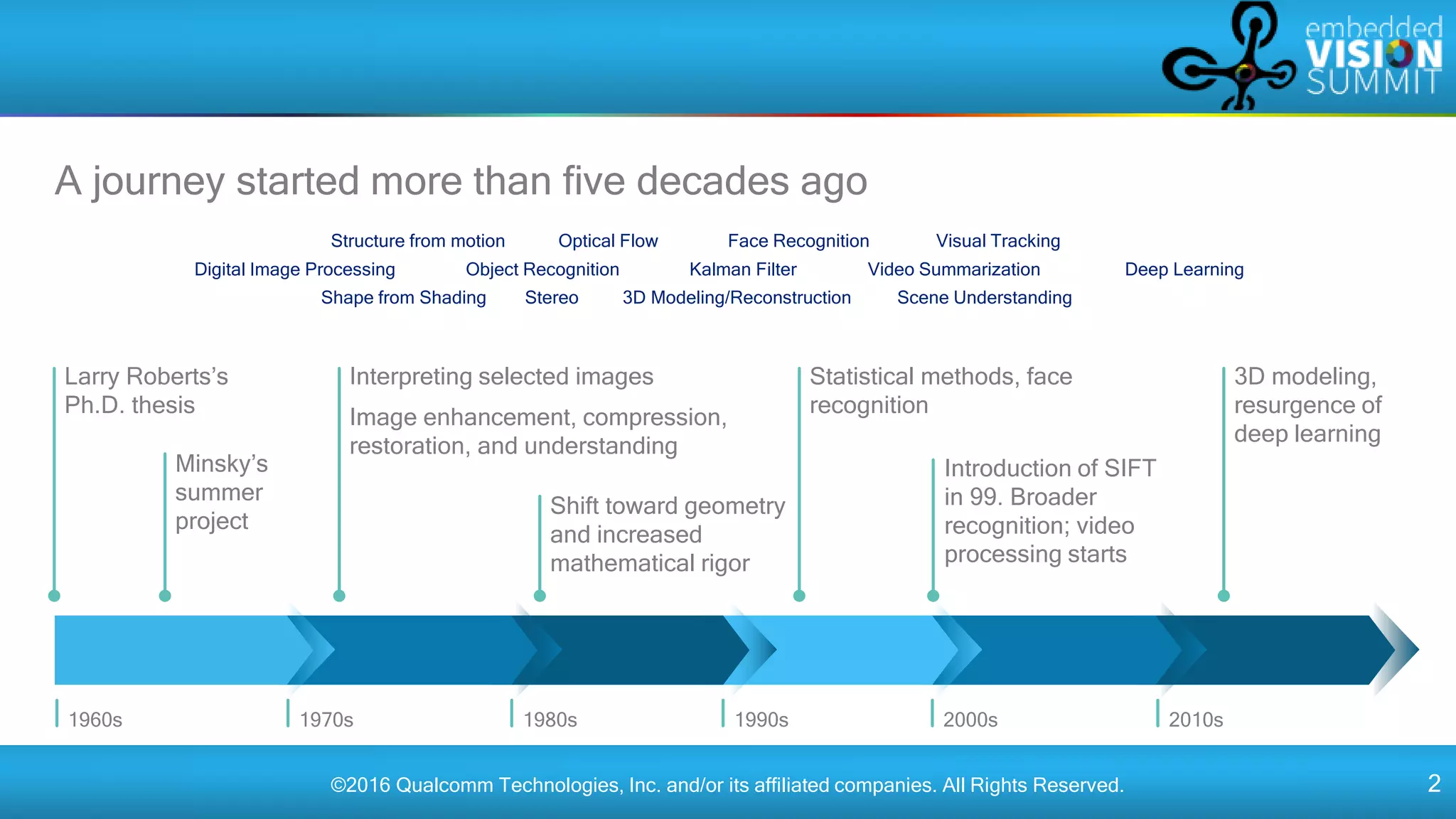
A journey started more than five decades ago
1960s 1970s 1980s 1990s 2000s 2010s
Shift toward geometry
and increased
mathematical rigor
Statistical methods, face
recognition
3D modeling,
resurgence of
deep learning
Introduction of SIFT
in 99. Broader
recognition; video
processing starts
Structure from motion Face RecognitionOptical Flow
3D Modeling/Reconstruction
Video SummarizationDigital Image Processing
Scene UnderstandingShape from Shading Stereo
Visual Tracking
Object Recognition Deep LearningKalman Filter
Larry Roberts’s
Ph.D. thesis
Minsky’s
summer
project
Interpreting selected images
Image enhancement, compression,
restoration, and understanding
©2016 Qualcomm Technologies, Inc. and/or its affiliated companies. All Rights Reserved. 3
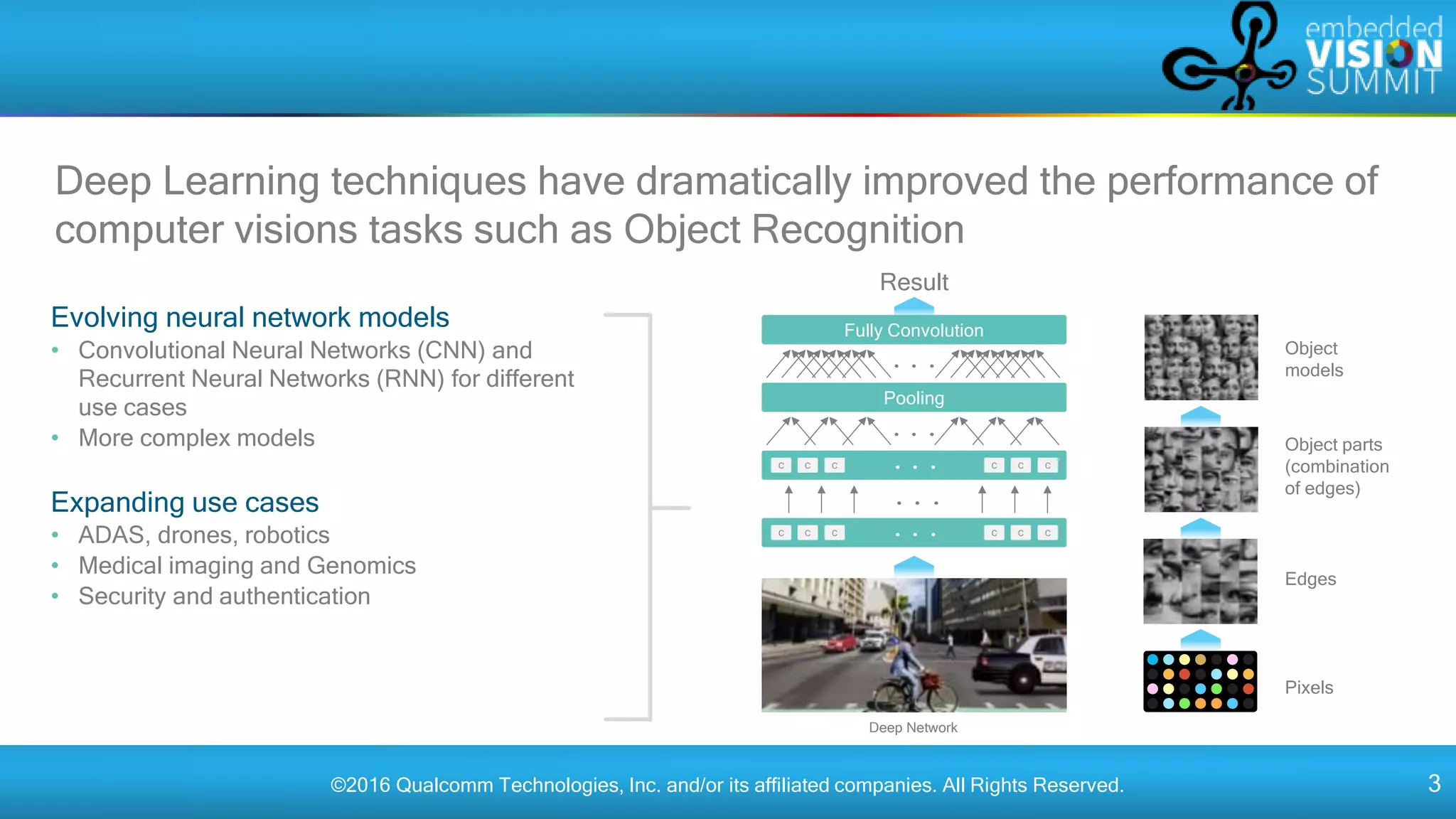
Deep Learning techniques have dramatically improved the performance of
computer visions tasks such as Object Recognition
Pooling
Fully Convolution
Result
Pooling
Pixels
Edges
Object parts
(combination
of edges)
Object
models
Evolving neural network models
• Convolutional Neural Networks (CNN) and
Recurrent Neural Networks (RNN) for different
use cases
• More complex models
Expanding use cases
• ADAS, drones, robotics
• Medical imaging and Genomics
• Security and authentication
Deep Network
C CC C CC
C CC C CC
©2016 Qualcomm Technologies, Inc. and/or its affiliated companies. All Rights Reserved. 4
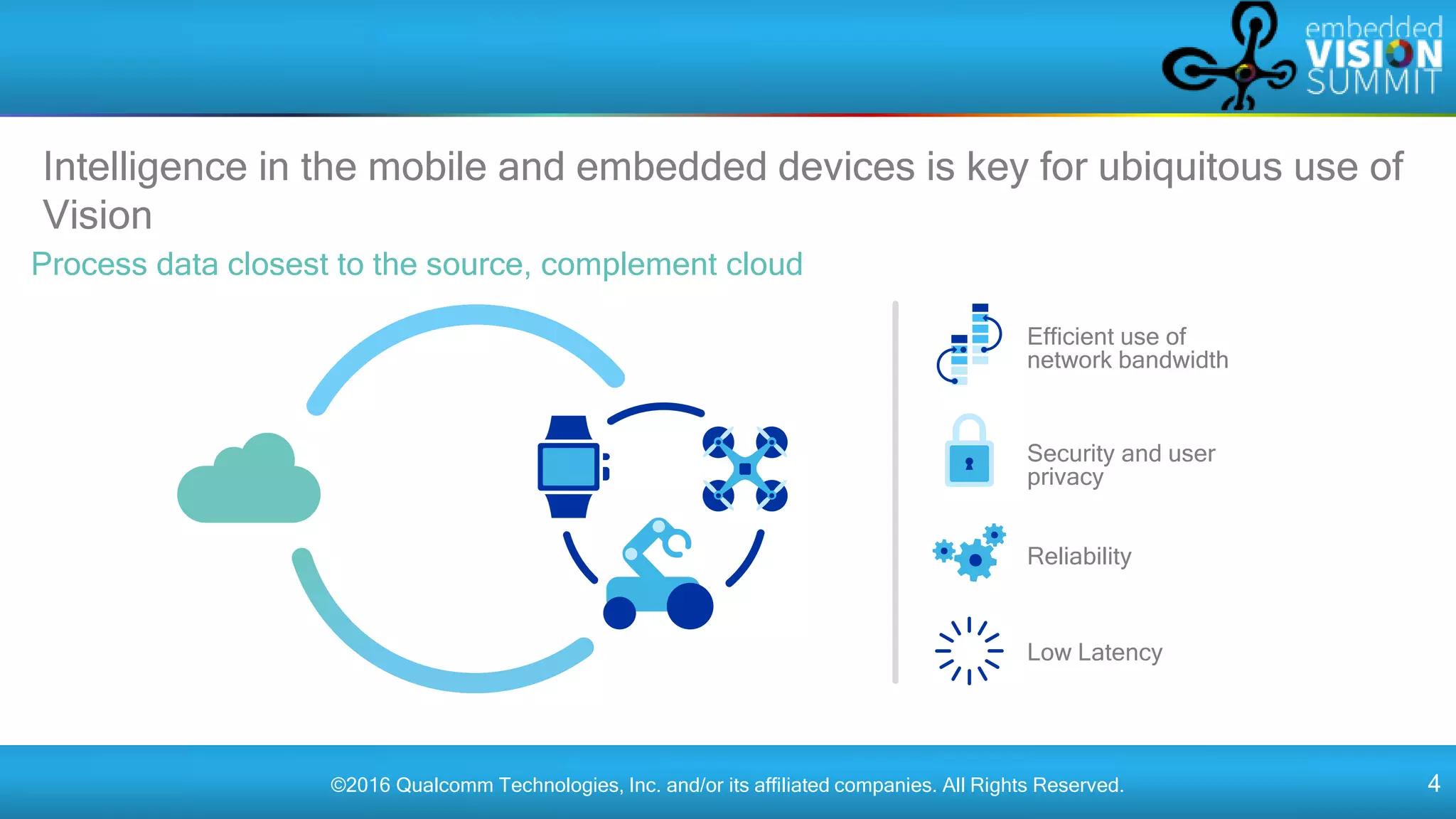
Intelligence in the mobile and embedded devices is key for ubiquitous use of
Vision
Process data closest to the source, complement cloud
Security and user
privacy
Efficient use of
network bandwidth
Reliability
Low Latency
©2016 Qualcomm Technologies, Inc. and/or its affiliated companies. All Rights Reserved. 5
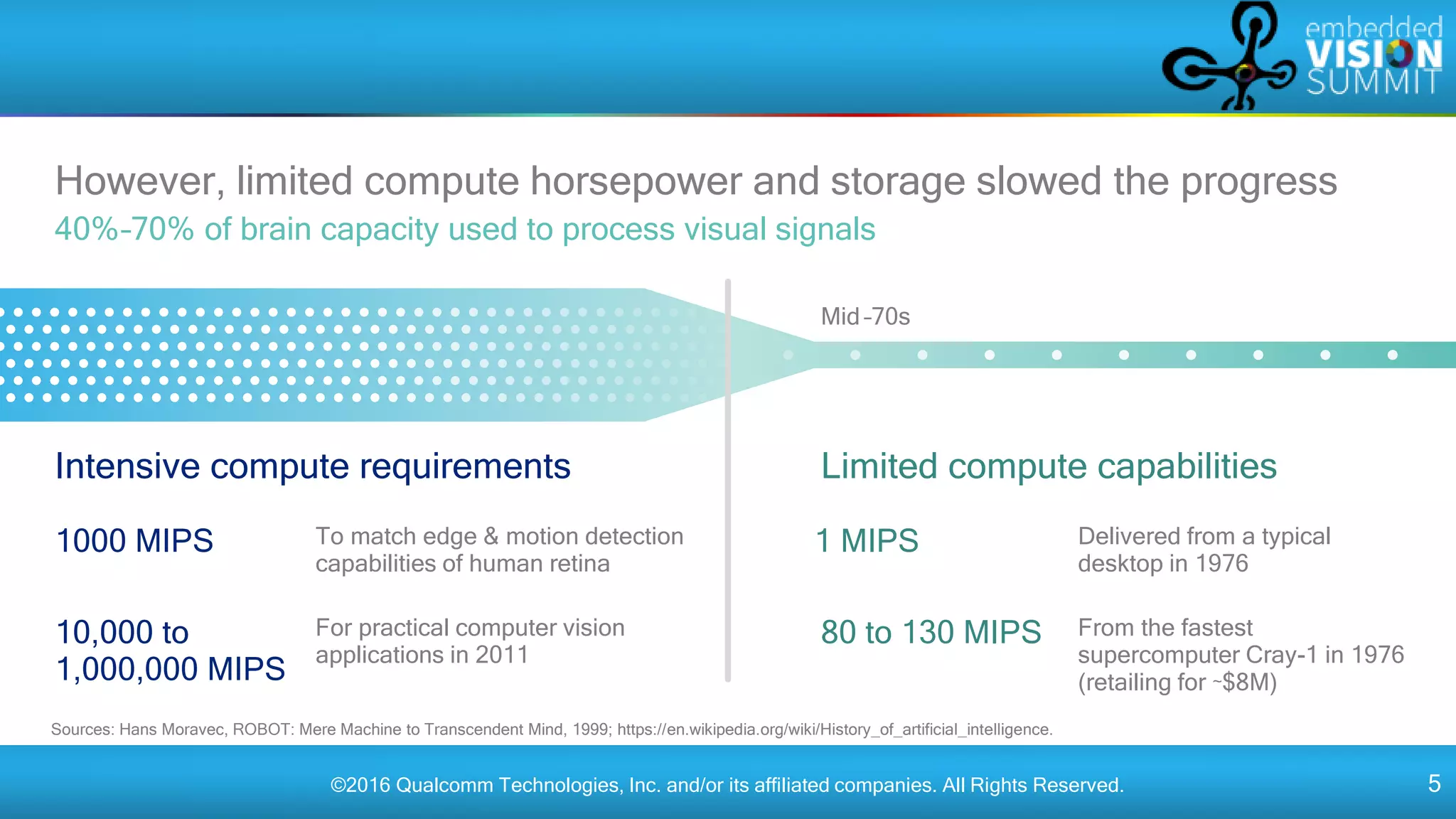
However, limited compute horsepower and storage slowed the progress
40%–70% of brain capacity used to process visual signals
1 MIPS
80 to 130 MIPS
1000 MIPS
10,000 to
1,000,000 MIPS
Intensive compute requirements Limited compute capabilities
Mid –70s
Delivered from a typical
desktop in 1976
From the fastest
supercomputer Cray-1 in 1976
(retailing for ~$8M)
To match edge & motion detection
capabilities of human retina
For practical computer vision
applications in 2011
Sources: Hans Moravec, ROBOT: Mere Machine to Transcendent Mind, 1999; https://en.wikipedia.org/wiki/History_of_artificial_intelligence.
©2016 Qualcomm Technologies, Inc. and/or its affiliated companies. All Rights Reserved. 6
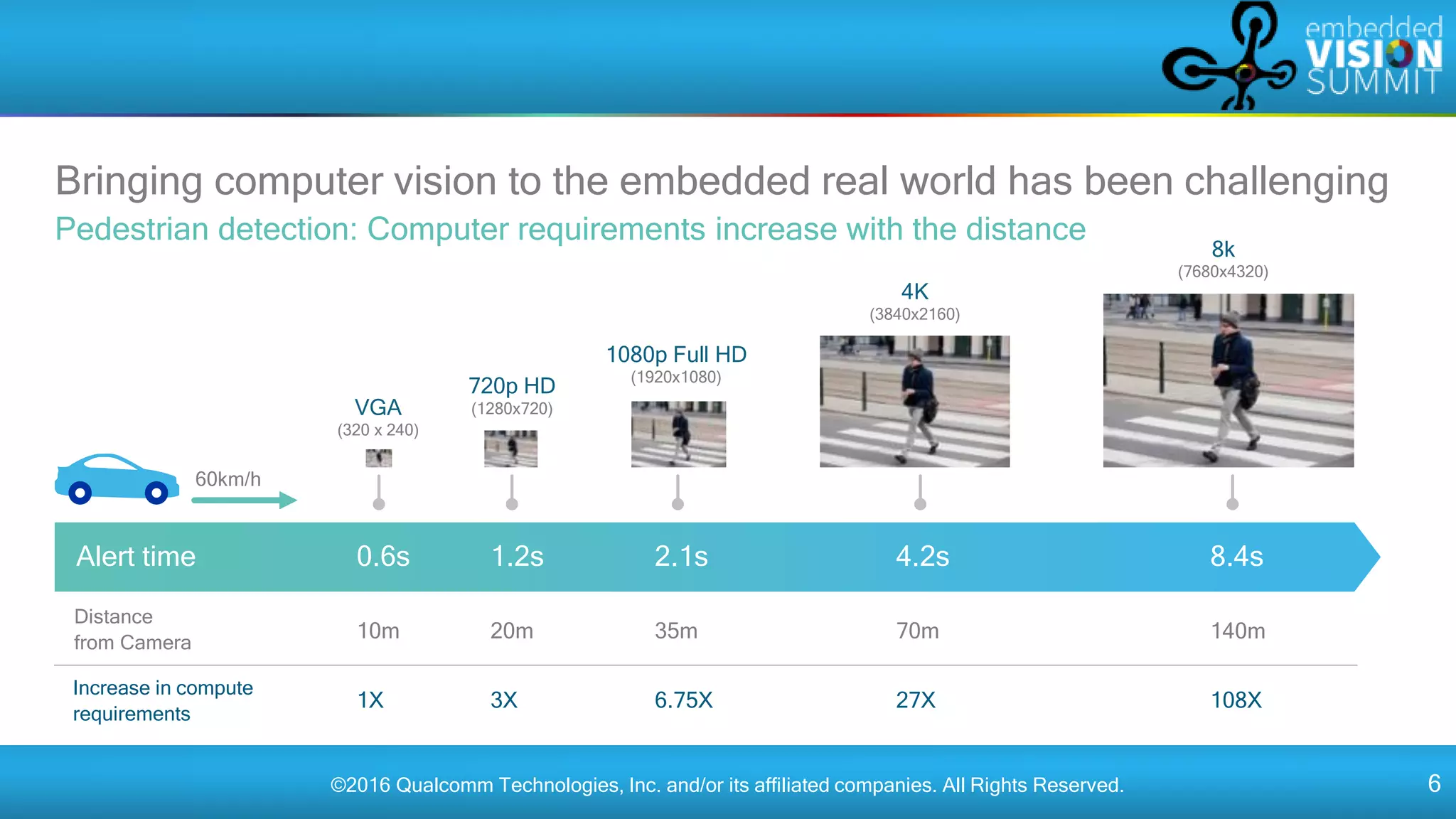
Bringing computer vision to the embedded real world has been challenging
Pedestrian detection: Computer requirements increase with the distance
720p HD
(1280x720)VGA
(320 x 240)
60km/h
1080p Full HD
(1920x1080)
4K
(3840x2160)
8k
(7680x4320)
Distance
from Camera
10m 35m 70m 140m20m
Increase in compute
requirements
1X 3X 6.75X 27X 108X
Alert time 0.6s 1.2s 2.1s 4.2s 8.4s
©2016 Qualcomm Technologies, Inc. and/or its affiliated companies. All Rights Reserved. 7
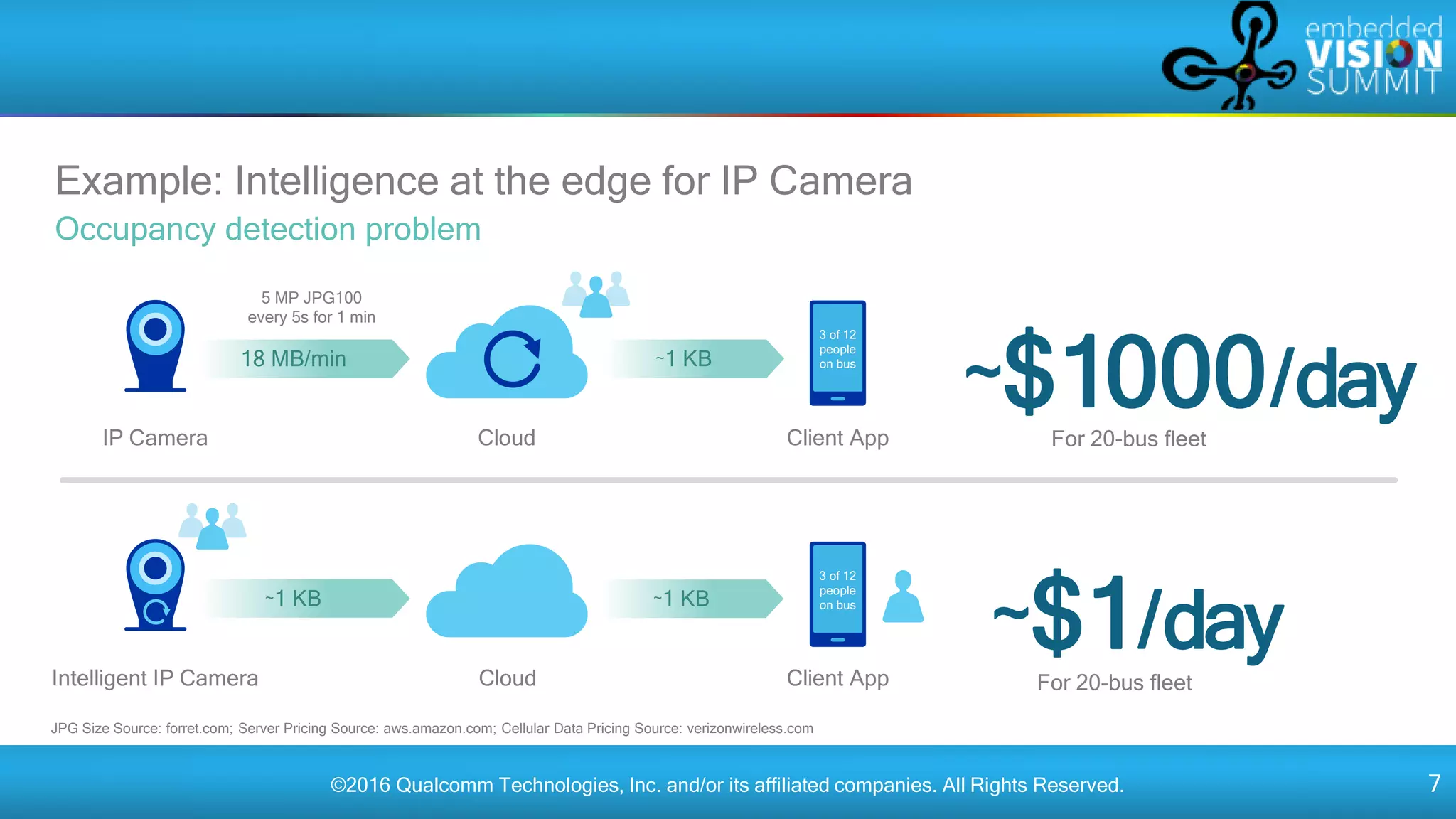
Example: Intelligence at the edge for IP Camera
Occupancy detection problem
~$1000/dayFor 20-bus fleet
~$1/day
For 20-bus fleet
IP Camera Cloud
18 MB/min
5 MP JPG100
every 5s for 1 min
Client App
3 of 12
people
on bus~1 KB
Intelligent IP Camera Cloud
~1 KB ~1 KB
Client App
3 of 12
people
on bus
JPG Size Source: forret.com; Server Pricing Source: aws.amazon.com; Cellular Data Pricing Source: verizonwireless.com
©2016 Qualcomm Technologies, Inc. and/or its affiliated companies. All Rights Reserved. 8
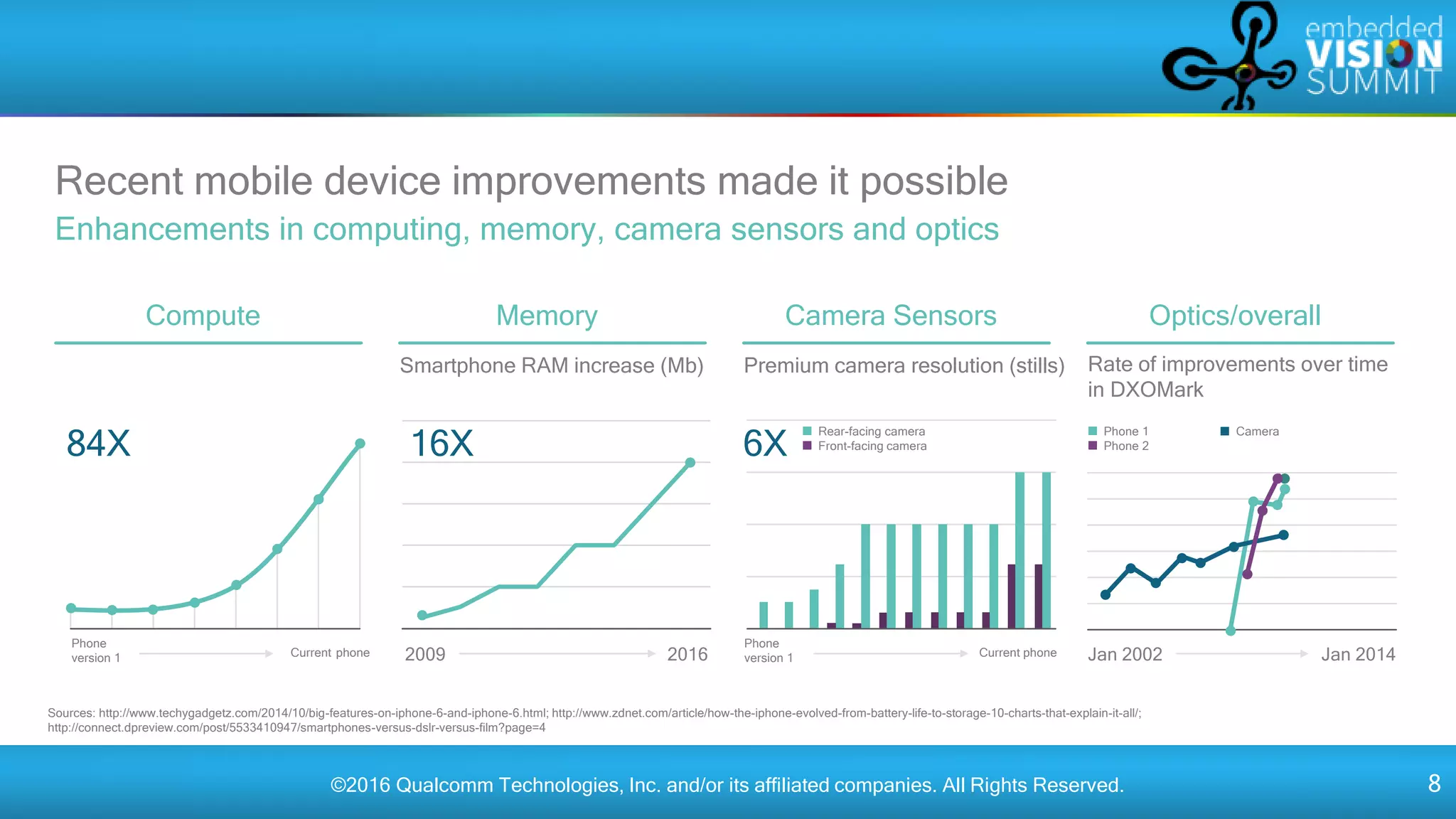
Recent mobile device improvements made it possible
Enhancements in computing, memory, camera sensors and optics
Compute Memory Camera Sensors Optics/overall
Phone
version 1 Current phone
16X
Smartphone RAM increase (Mb)
2009 2016
Phone
version 1 Current phone
Premium camera resolution (stills) Rate of improvements over time
in DXOMark
Jan 2014Jan 2002
Sources: http://www.techygadgetz.com/2014/10/big-features-on-iphone-6-and-iphone-6.html; http://www.zdnet.com/article/how-the-iphone-evolved-from-battery-life-to-storage-10-charts-that-explain-it-all/;
http://connect.dpreview.com/post/5533410947/smartphones-versus-dslr-versus-film?page=4
6X84X
Phone 1
Phone 2
CameraRear-facing camera
Front-facing camera
©2016 Qualcomm Technologies, Inc. and/or its affiliated companies. All Rights Reserved. 9
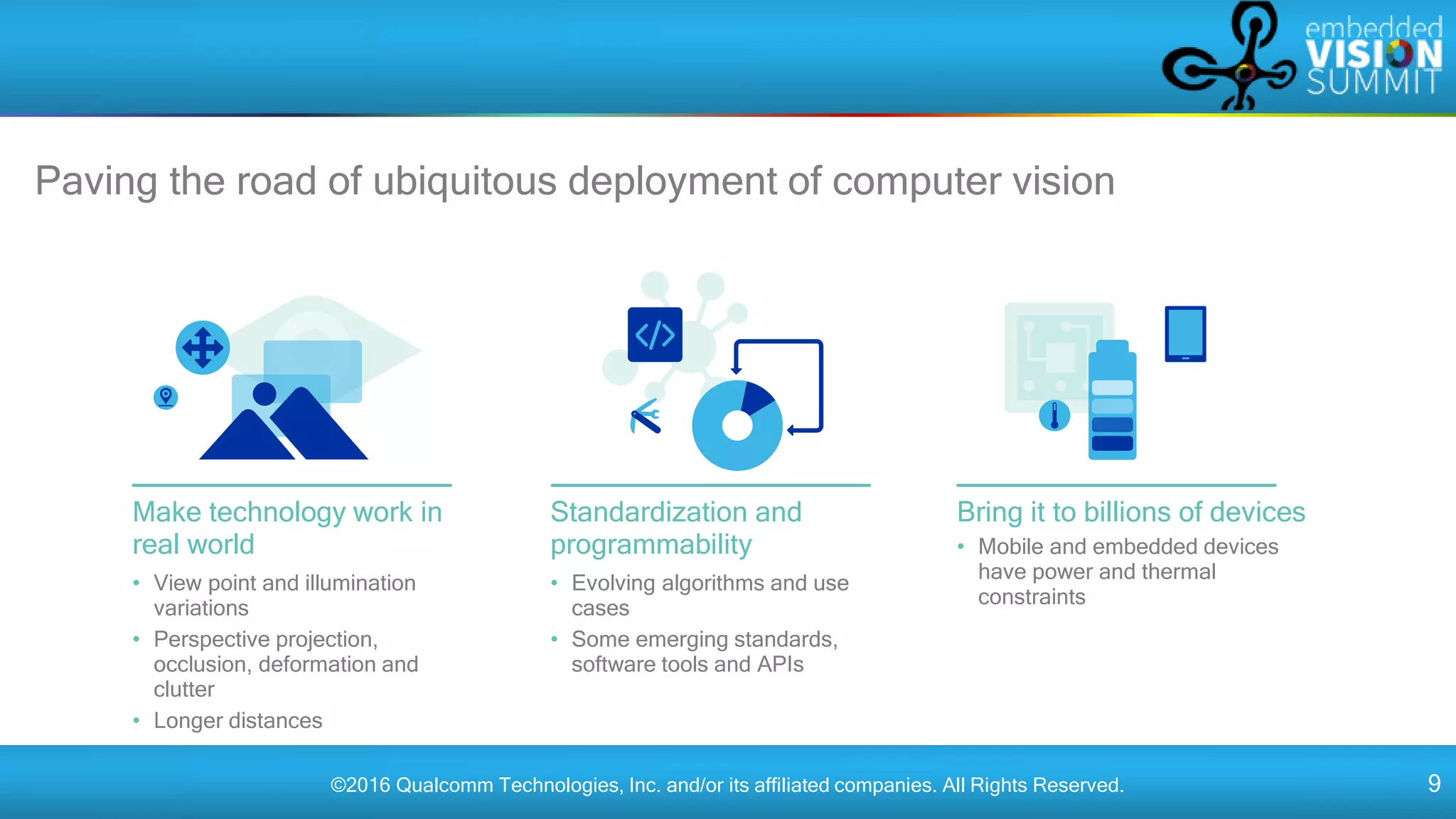
Paving the road of ubiquitous deployment of computer vision
Make technology work in
real world
• View point and illumination
variations
• Perspective projection,
occlusion, deformation and
clutter
• Longer distances
Standardization and
programmability
• Evolving algorithms and use
cases
• Some emerging standards,
software tools and APIs
Bring it to billions of devices
• Mobile and embedded devices
have power and thermal
constraints
©2016 Qualcomm Technologies, Inc. and/or its affiliated companies. All Rights Reserved. 10
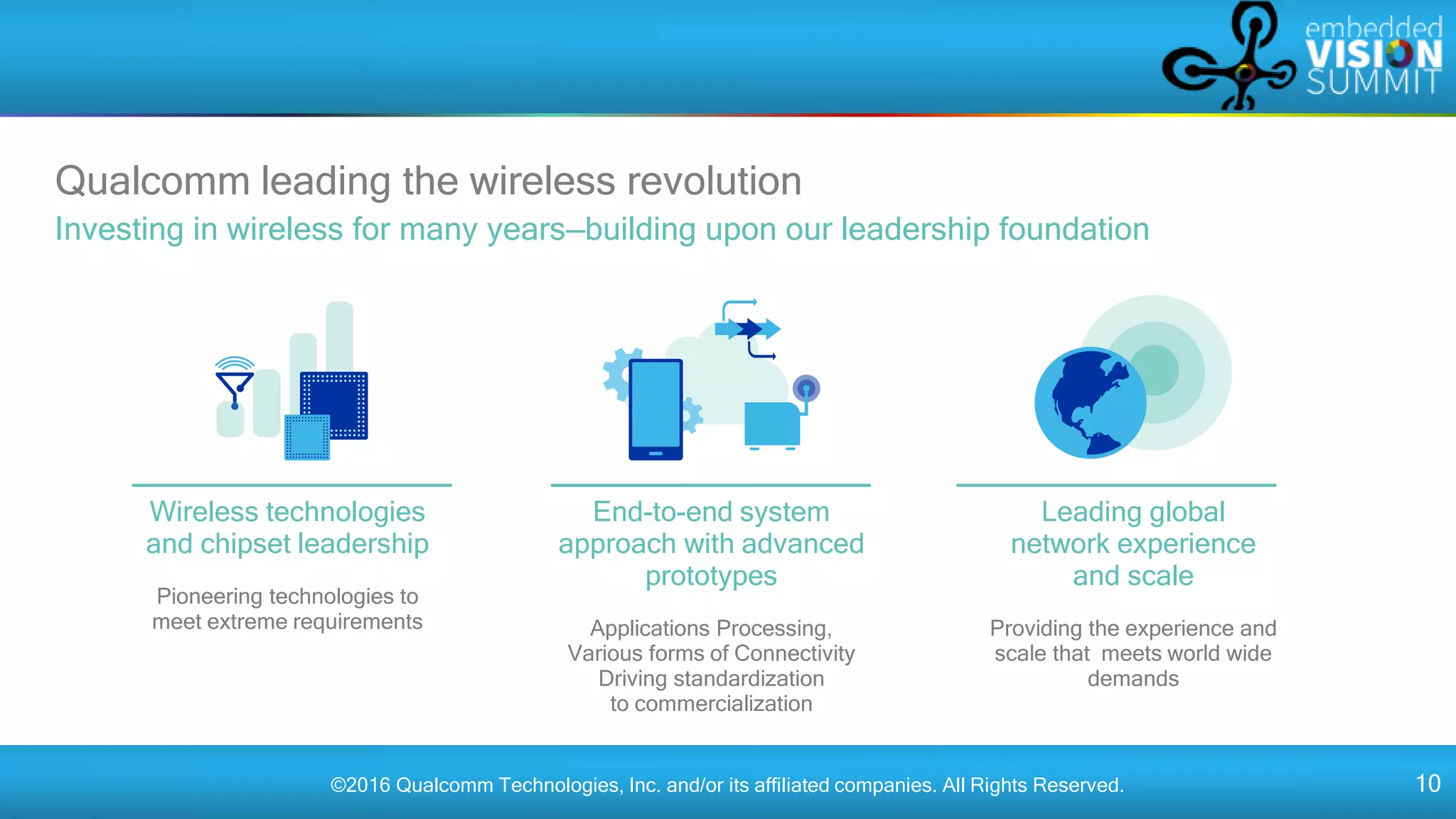
Qualcomm leading the wireless revolution
Wireless technologies
and chipset leadership
Pioneering technologies to
meet extreme requirements
End-to-end system
approach with advanced
prototypes
Applications Processing,
Various forms of Connectivity
Driving standardization
to commercialization
Leading global
network experience
and scale
Providing the experience and
scale that meets world wide
demands
Investing in wireless for many years—building upon our leadership foundation
©2016 Qualcomm Technologies, Inc. and/or its affiliated companies. All Rights Reserved. 11
Common model framework support
• Convolutional or recurrent neural networks
• Support of Caffe and Cuda-convnet
Efficient execution
• Taking advantage of Snapdragon’s
heterogeneous computing capabilities
Debugging and optimization tools
• Debug and analyze network performance
• Ease of integration into customer applications
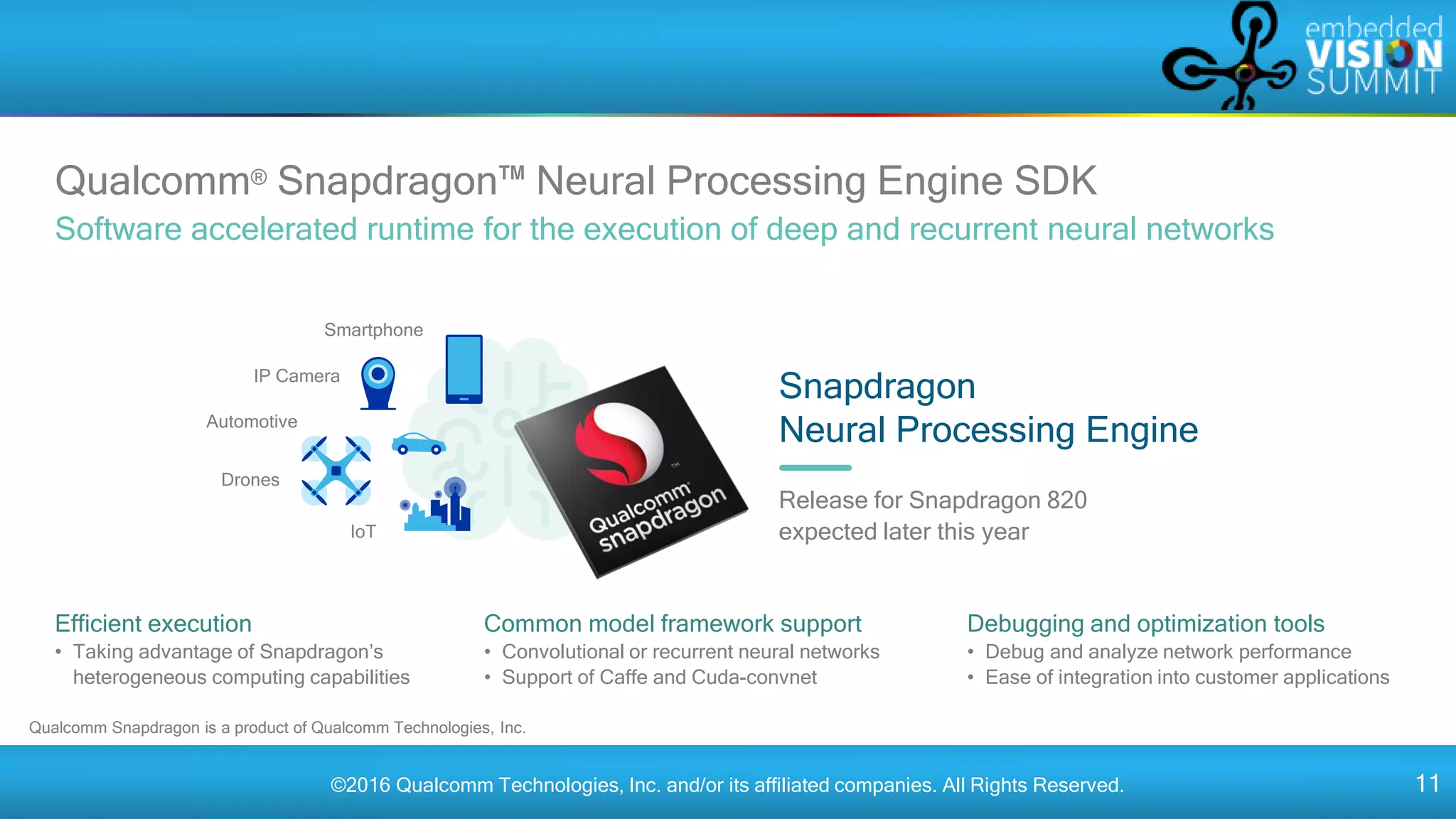
Qualcomm® Snapdragon™ Neural Processing Engine SDK
Software accelerated runtime for the execution of deep and recurrent neural networks
Snapdragon
Neural Processing Engine
Release for Snapdragon 820
expected later this year
Smartphone
IP Camera
Drones
Automotive
IoT
Qualcomm Snapdragon is a product of Qualcomm Technologies, Inc.
©2016 Qualcomm Technologies, Inc. and/or its affiliated companies. All Rights Reserved. 12
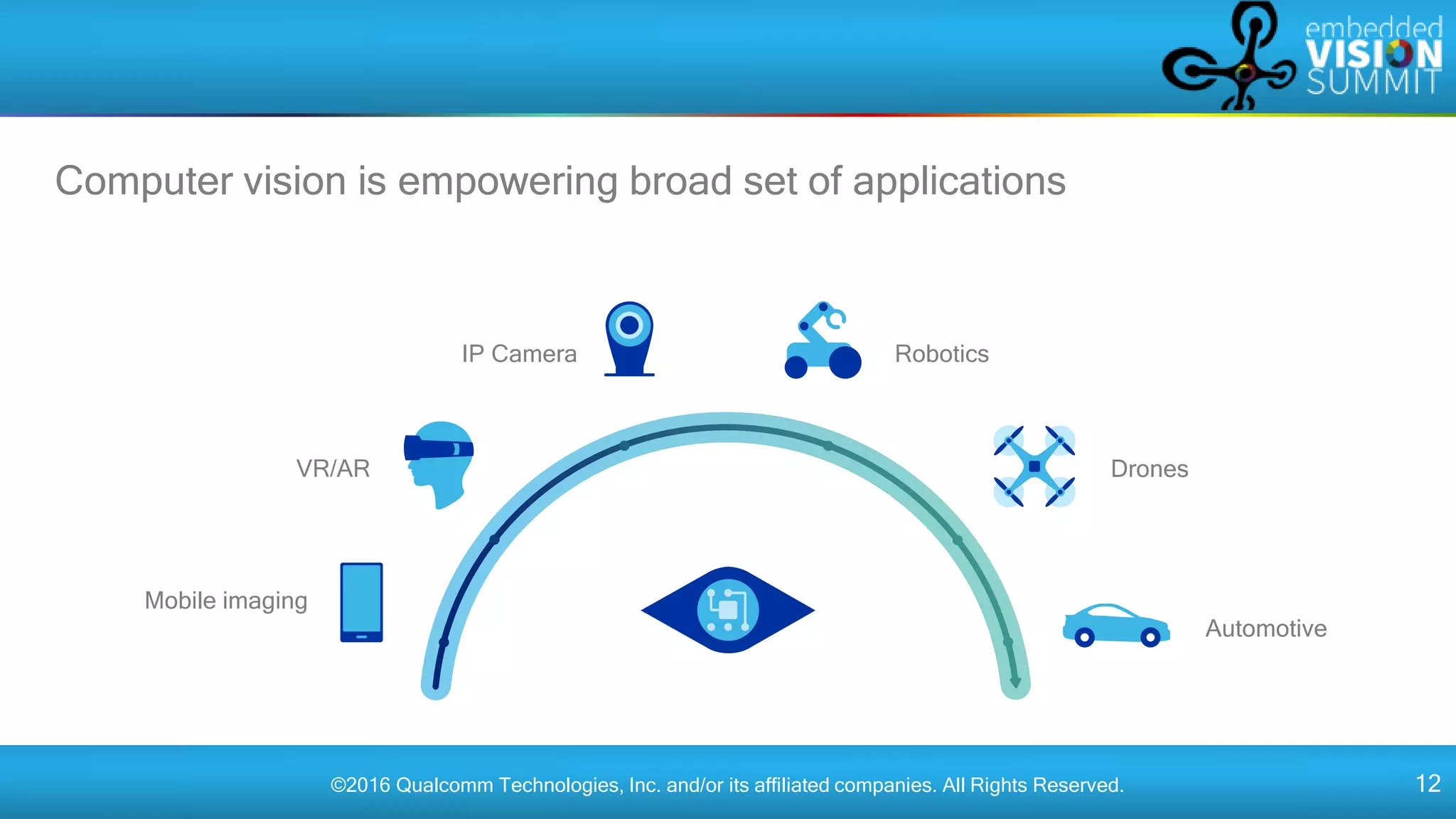
Computer vision is empowering broad set of applications
Mobile imaging
Robotics
VR/AR
IP Camera
Drones
Automotive
©2016 Qualcomm Technologies, Inc. and/or its affiliated companies. All Rights Reserved. 13
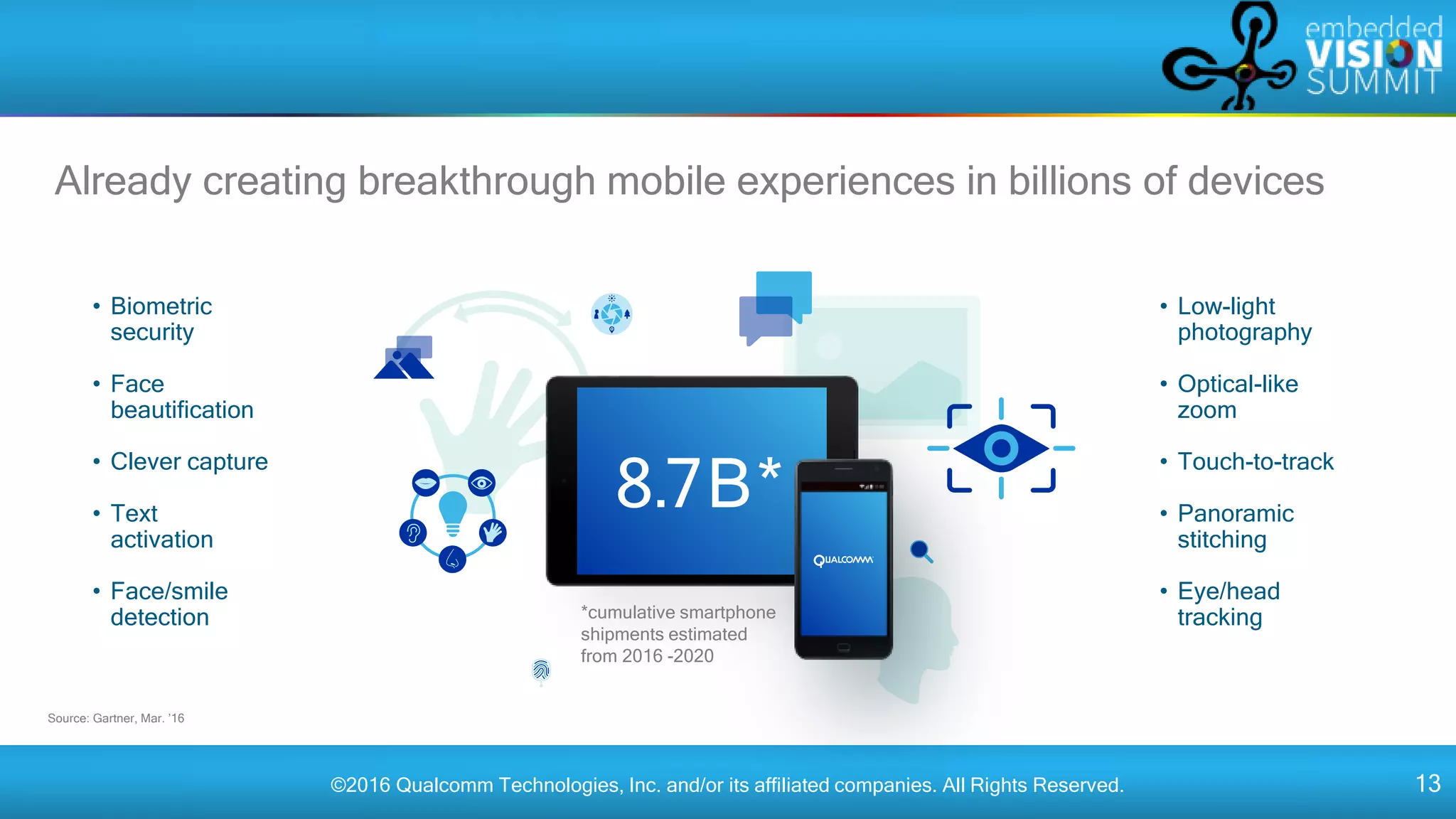
Already creating breakthrough mobile experiences in billions of devices
• Low-light
photography
• Optical-like
zoom
• Touch-to-track
• Panoramic
stitching
• Eye/head
tracking
• Biometric
security
• Face
beautification
• Clever capture
• Text
activation
• Face/smile
detection
8.7B*
Source: Gartner, Mar. ’16
*cumulative smartphone
shipments estimated
from 2016 -2020
©2016 Qualcomm Technologies, Inc. and/or its affiliated companies. All Rights Reserved. 14
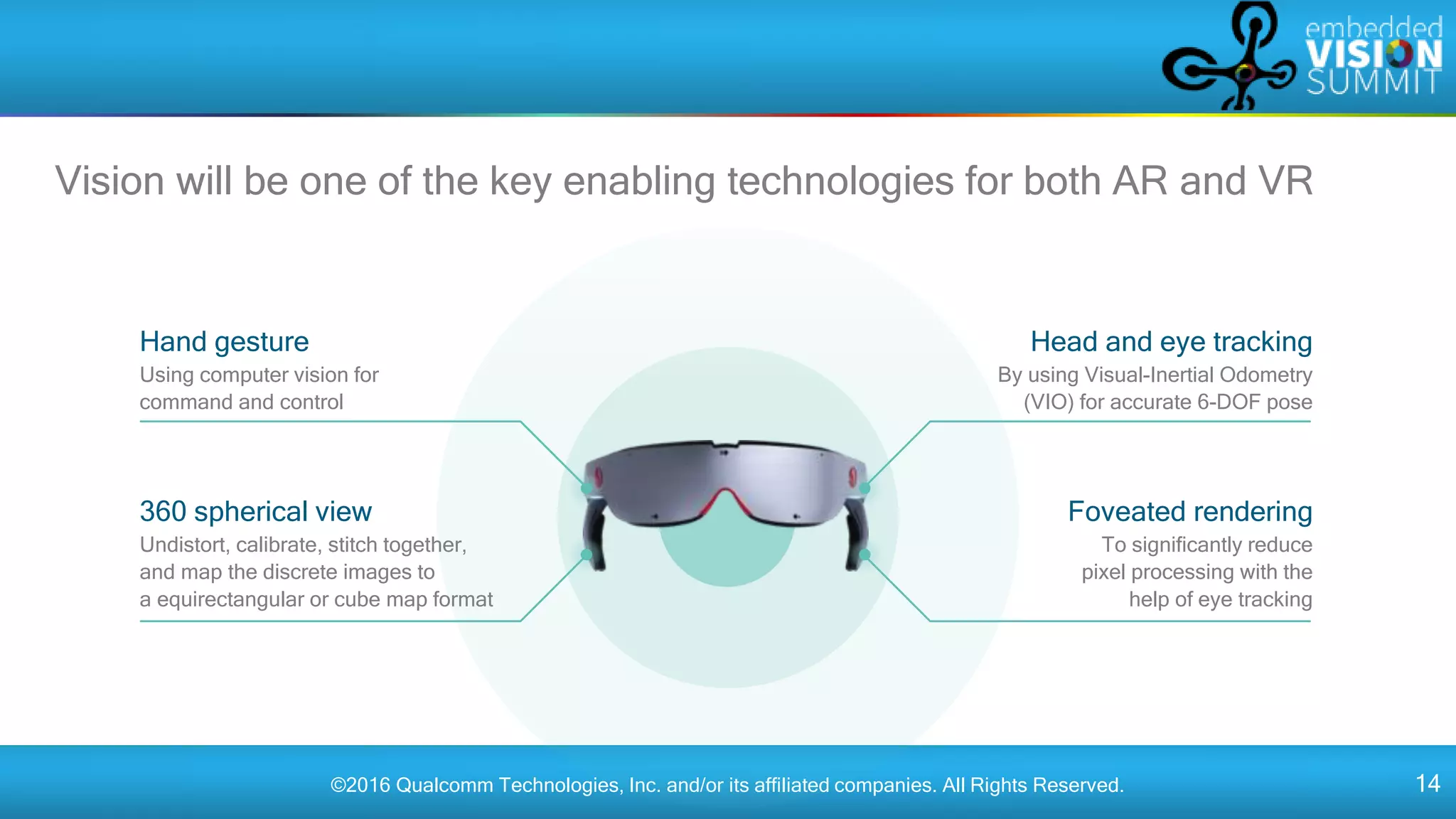
Vision will be one of the key enabling technologies for both AR and VR
360 spherical view
Undistort, calibrate, stitch together,
and map the discrete images to
a equirectangular or cube map format
Foveated rendering
To significantly reduce
pixel processing with the
help of eye tracking
Head and eye tracking
By using Visual-Inertial Odometry
(VIO) for accurate 6-DOF pose
Hand gesture
Using computer vision for
command and control
©2016 Qualcomm Technologies, Inc. and/or its affiliated companies. All Rights Reserved. 15
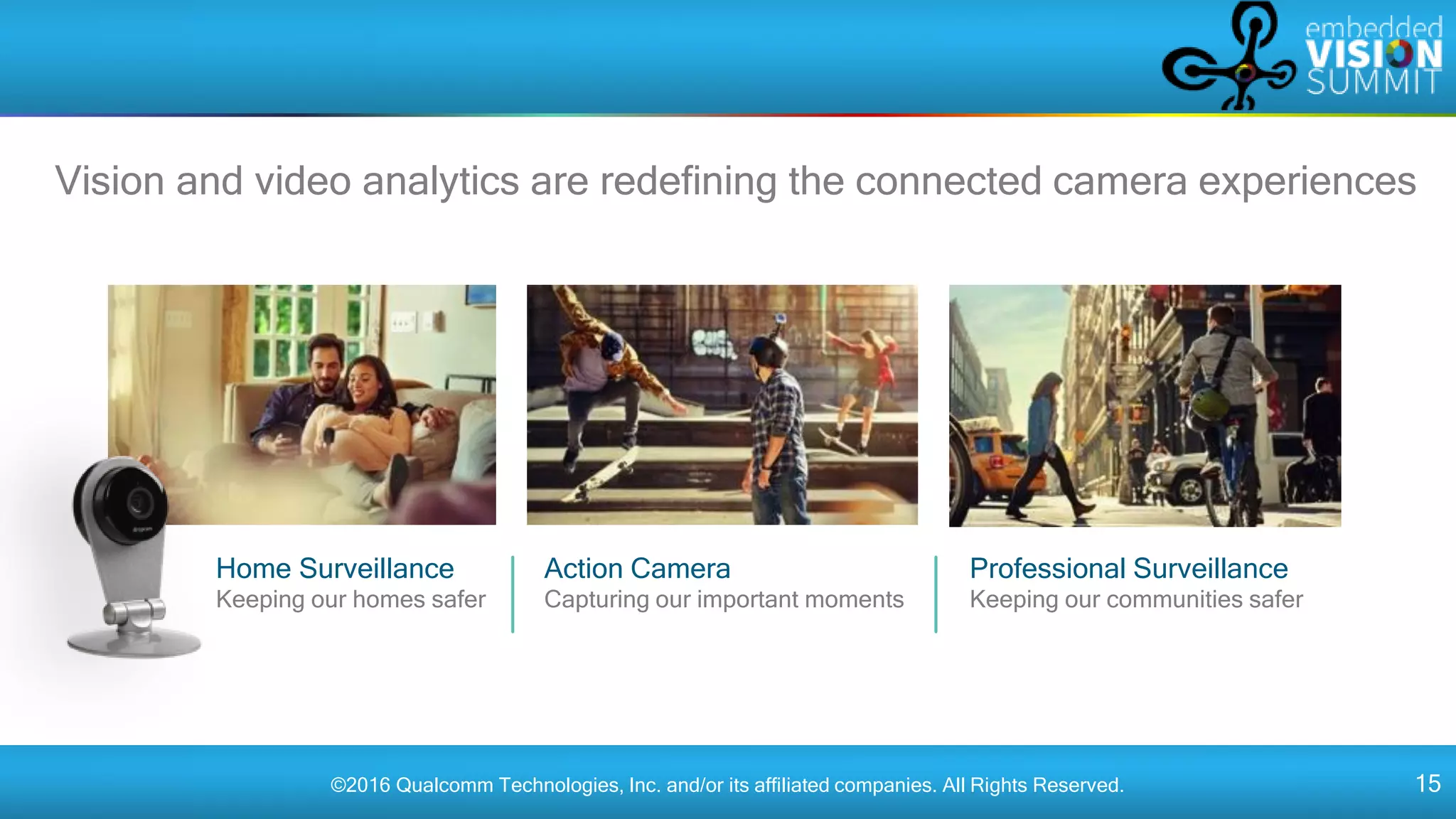
Vision and video analytics are redefining the connected camera experiences
Action Camera
Capturing our important moments
Home Surveillance
Keeping our homes safer
Professional Surveillance
Keeping our communities safer
©2016 Qualcomm Technologies, Inc. and/or its affiliated companies. All Rights Reserved. 16
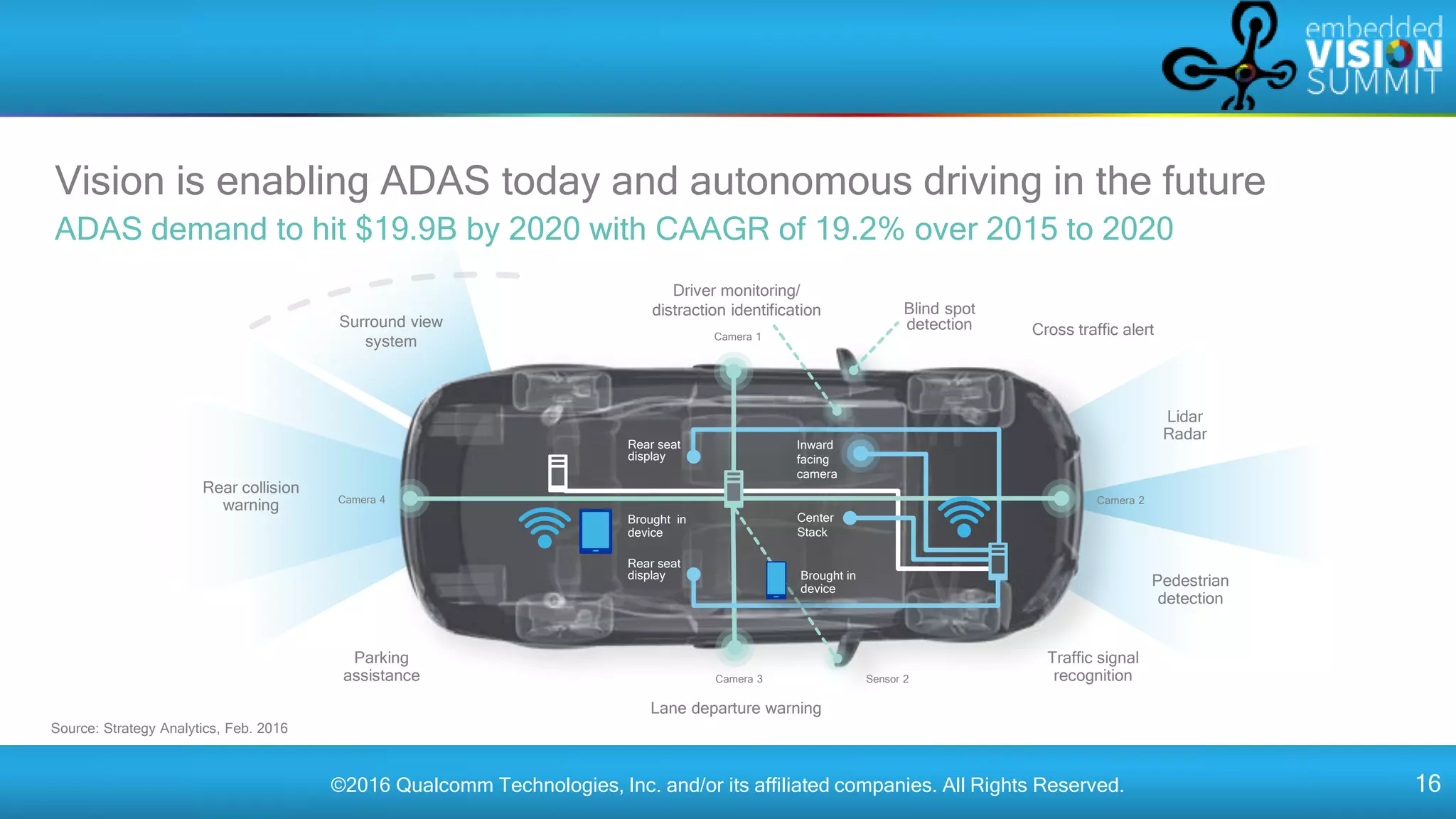
Vision is enabling ADAS today and autonomous driving in the future
ADAS demand to hit $19.9B by 2020 with CAAGR of 19.2% over 2015 to 2020
Camera 4
Inward
facing
camera
Lidar
Radar
Lane departure warning
Pedestrian
detection
Traffic signal
recognition
Blind spot
detection
Rear collision
warning
Parking
assistance
Surround view
system
Driver monitoring/
distraction identification
Cross traffic alert
Camera 3
Rear seat
display
Brought in
device
Camera 1
Sensor 2
Camera 2
Center
Stack
Brought in
device
Rear seat
display
Source: Strategy Analytics, Feb. 2016
©2016 Qualcomm Technologies, Inc. and/or its affiliated companies. All Rights Reserved. 17
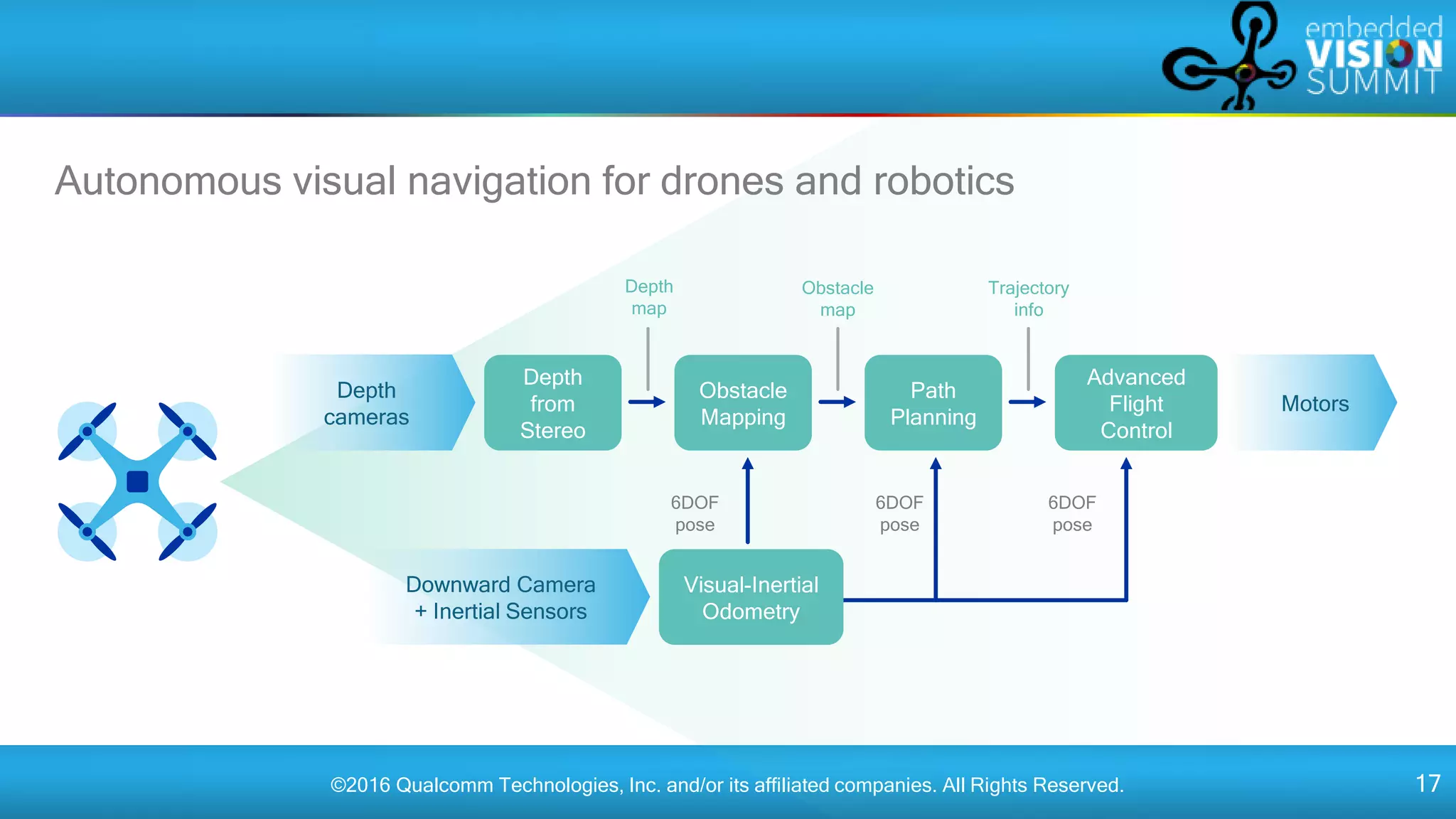
Autonomous visual navigation for drones and robotics
Downward Camera
+ Inertial Sensors
Depth
map
Obstacle
map
Trajectory
info
6DOF
pose
6DOF
pose
6DOF
pose
Depth
cameras
Motors
Depth
from
Stereo
Obstacle
Mapping
Path
Planning
Advanced
Flight
Control
Visual-Inertial
Odometry
©2016 Qualcomm Technologies, Inc. and/or its affiliated companies. All Rights Reserved. 18
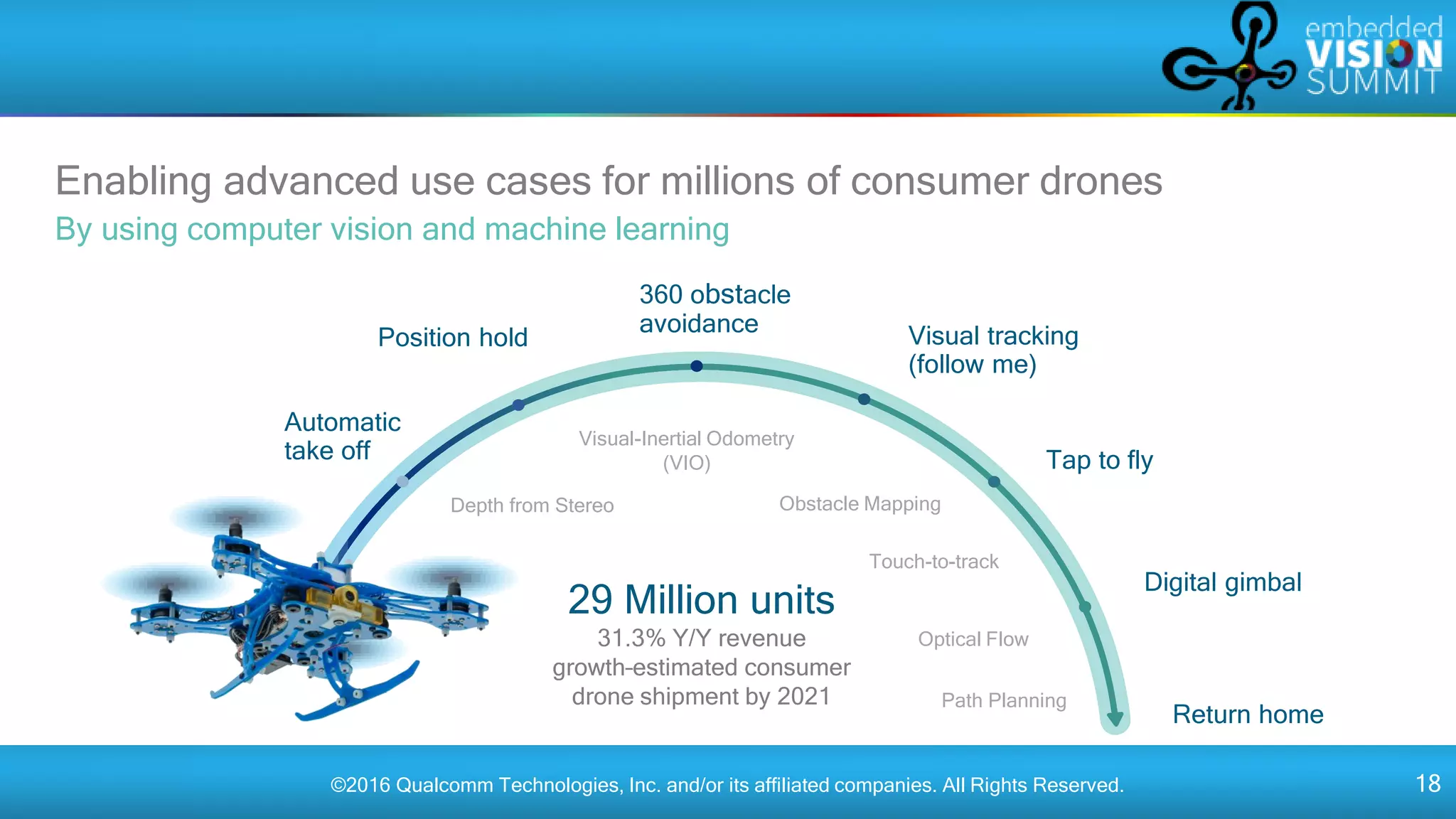
Enabling advanced use cases for millions of consumer drones
By using computer vision and machine learning
Position hold
Return home
360 obstacle
avoidance
Tap to fly
Visual tracking
(follow me)
Digital gimbal
Depth from Stereo
Optical Flow
Visual-Inertial Odometry
(VIO)
Obstacle Mapping
Touch-to-track
Path Planning
Automatic
take off
29 Million units
31.3% Y/Y revenue
growth–estimated consumer
drone shipment by 2021
©2016 Qualcomm Technologies, Inc. and/or its affiliated companies. All Rights Reserved. 19
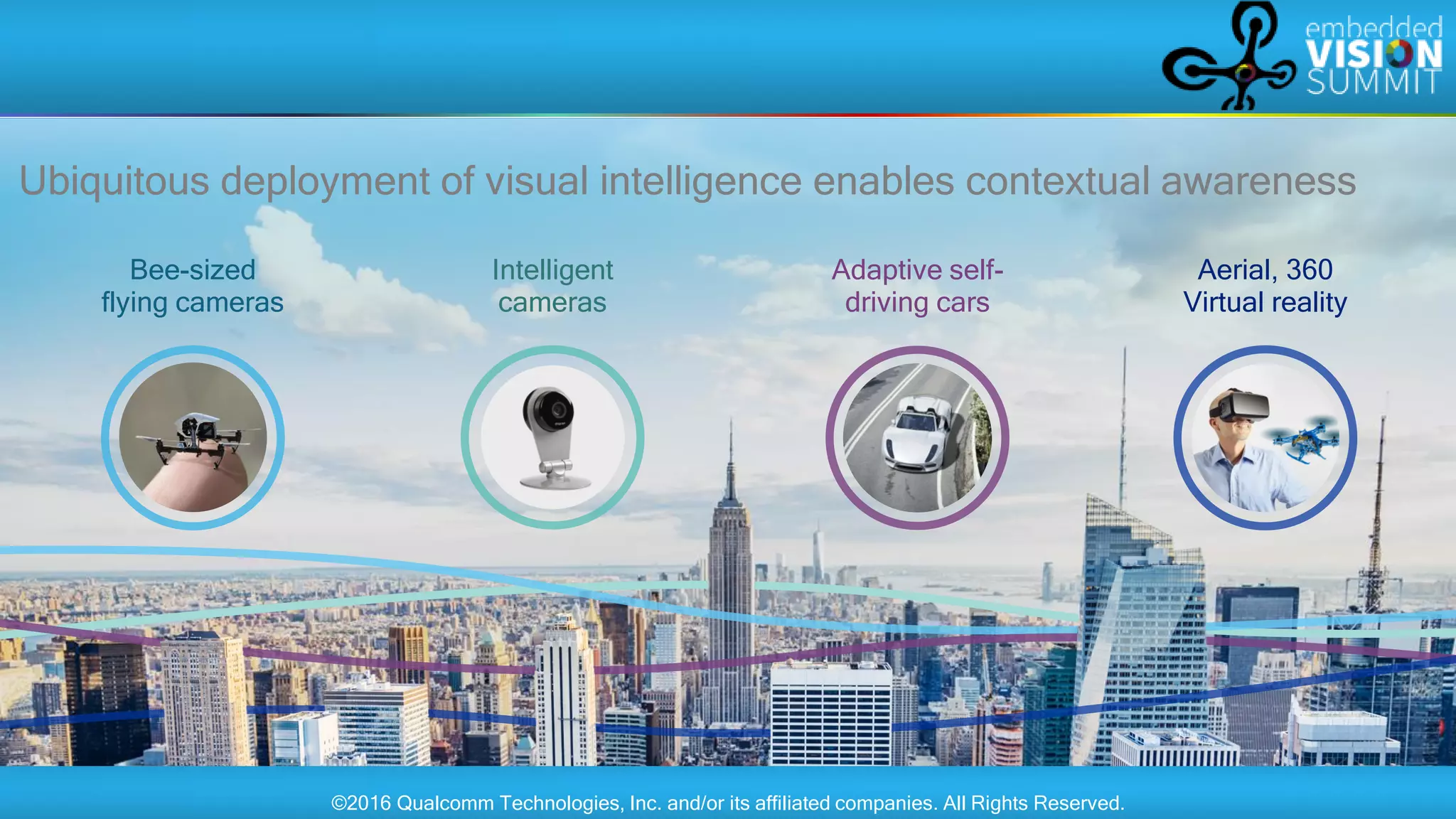
Aerial, 360
Virtual reality
Ubiquitous deployment of visual intelligence enables contextual awareness
Bee-sized
flying cameras
Adaptive self-
driving cars
Intelligent
cameras
©2016 Qualcomm Technologies, Inc. and/or its affiliated companies. All Rights Reserved.
©2016 Qualcomm Technologies, Inc. and/or its affiliated companies. All Rights Reserved. 20
Closing Thoughts
• Computer Vision is a fundamental technology that has the potential to change
the way we live and use machines
• After many decades of research it is now finally beginning to show great results
• Embedded vision is key to ubiquitous adoption of vision in our daily life
• Exciting times ahead us as we deliver mobile platforms and technologies for
mass scale deployment of computer vision – in harmony with the cloud
©2016 Qualcomm Technologies, Inc. and/or its affiliated companies. All Rights Reserved. 21
Nothing in these materials is an offer to sell any of the components or devices referenced herein.
©2016 Qualcomm Technologies, Inc. and/or its affiliated companies. All Rights Reserved.
Qualcomm and Snapdragon are trademarks of Qualcomm Incorporated, registered in the United States and other countries. Other products and brand
names may be trademarks or registered trademarks of their respective owners.
References in this presentation to “Qualcomm” may mean Qualcomm Incorporated, Qualcomm Technologies, Inc., and/or other subsidiaries
or business units within the Qualcomm corporate structure, as applicable. Qualcomm Incorporated includes Qualcomm’s licensing business, QTL, and the
vast majority of its patent portfolio. Qualcomm Technologies, Inc., a wholly-owned subsidiary of Qualcomm Incorporated, operates, along with its
subsidiaries, substantially all of Qualcomm’s engineering, research and development functions, and substantially all
of its product and services businesses, including its semiconductor business, QCT.
Thank you
Follow us on:
For more information, visit us at:
www.qualcomm.com & www.qualcomm.com/blog

"Is Vision the New Wireless?," a Presentation from Qualcomm

  • 1.
    ©2016 Qualcomm Technologies,Inc. and/or its affiliated companies. All Rights Reserved. 1 Is Vision The New Wireless? Raj Talluri SVP, IoT, Mobile Computing Qualcomm Technologies, Inc. @rajtalluri May 2, 2016
  • 2.
    ©2016 Qualcomm Technologies,Inc. and/or its affiliated companies. All Rights Reserved. 2 A journey started more than five decades ago 1960s 1970s 1980s 1990s 2000s 2010s Shift toward geometry and increased mathematical rigor Statistical methods, face recognition 3D modeling, resurgence of deep learning Introduction of SIFT in 99. Broader recognition; video processing starts Structure from motion Face RecognitionOptical Flow 3D Modeling/Reconstruction Video SummarizationDigital Image Processing Scene UnderstandingShape from Shading Stereo Visual Tracking Object Recognition Deep LearningKalman Filter Larry Roberts’s Ph.D. thesis Minsky’s summer project Interpreting selected images Image enhancement, compression, restoration, and understanding
  • 3.
    ©2016 Qualcomm Technologies,Inc. and/or its affiliated companies. All Rights Reserved. 3 Deep Learning techniques have dramatically improved the performance of computer visions tasks such as Object Recognition Pooling Fully Convolution Result Pooling Pixels Edges Object parts (combination of edges) Object models Evolving neural network models • Convolutional Neural Networks (CNN) and Recurrent Neural Networks (RNN) for different use cases • More complex models Expanding use cases • ADAS, drones, robotics • Medical imaging and Genomics • Security and authentication Deep Network C CC C CC C CC C CC
  • 4.
    ©2016 Qualcomm Technologies,Inc. and/or its affiliated companies. All Rights Reserved. 4 Intelligence in the mobile and embedded devices is key for ubiquitous use of Vision Process data closest to the source, complement cloud Security and user privacy Efficient use of network bandwidth Reliability Low Latency
  • 5.
    ©2016 Qualcomm Technologies,Inc. and/or its affiliated companies. All Rights Reserved. 5 However, limited compute horsepower and storage slowed the progress 40%–70% of brain capacity used to process visual signals 1 MIPS 80 to 130 MIPS 1000 MIPS 10,000 to 1,000,000 MIPS Intensive compute requirements Limited compute capabilities Mid –70s Delivered from a typical desktop in 1976 From the fastest supercomputer Cray-1 in 1976 (retailing for ~$8M) To match edge & motion detection capabilities of human retina For practical computer vision applications in 2011 Sources: Hans Moravec, ROBOT: Mere Machine to Transcendent Mind, 1999; https://en.wikipedia.org/wiki/History_of_artificial_intelligence.
  • 6.
    ©2016 Qualcomm Technologies,Inc. and/or its affiliated companies. All Rights Reserved. 6 Bringing computer vision to the embedded real world has been challenging Pedestrian detection: Computer requirements increase with the distance 720p HD (1280x720)VGA (320 x 240) 60km/h 1080p Full HD (1920x1080) 4K (3840x2160) 8k (7680x4320) Distance from Camera 10m 35m 70m 140m20m Increase in compute requirements 1X 3X 6.75X 27X 108X Alert time 0.6s 1.2s 2.1s 4.2s 8.4s
  • 7.
    ©2016 Qualcomm Technologies,Inc. and/or its affiliated companies. All Rights Reserved. 7 Example: Intelligence at the edge for IP Camera Occupancy detection problem ~$1000/dayFor 20-bus fleet ~$1/day For 20-bus fleet IP Camera Cloud 18 MB/min 5 MP JPG100 every 5s for 1 min Client App 3 of 12 people on bus~1 KB Intelligent IP Camera Cloud ~1 KB ~1 KB Client App 3 of 12 people on bus JPG Size Source: forret.com; Server Pricing Source: aws.amazon.com; Cellular Data Pricing Source: verizonwireless.com
  • 8.
    ©2016 Qualcomm Technologies,Inc. and/or its affiliated companies. All Rights Reserved. 8 Recent mobile device improvements made it possible Enhancements in computing, memory, camera sensors and optics Compute Memory Camera Sensors Optics/overall Phone version 1 Current phone 16X Smartphone RAM increase (Mb) 2009 2016 Phone version 1 Current phone Premium camera resolution (stills) Rate of improvements over time in DXOMark Jan 2014Jan 2002 Sources: http://www.techygadgetz.com/2014/10/big-features-on-iphone-6-and-iphone-6.html; http://www.zdnet.com/article/how-the-iphone-evolved-from-battery-life-to-storage-10-charts-that-explain-it-all/; http://connect.dpreview.com/post/5533410947/smartphones-versus-dslr-versus-film?page=4 6X84X Phone 1 Phone 2 CameraRear-facing camera Front-facing camera
  • 9.
    ©2016 Qualcomm Technologies,Inc. and/or its affiliated companies. All Rights Reserved. 9 Paving the road of ubiquitous deployment of computer vision Make technology work in real world • View point and illumination variations • Perspective projection, occlusion, deformation and clutter • Longer distances Standardization and programmability • Evolving algorithms and use cases • Some emerging standards, software tools and APIs Bring it to billions of devices • Mobile and embedded devices have power and thermal constraints
  • 10.
    ©2016 Qualcomm Technologies,Inc. and/or its affiliated companies. All Rights Reserved. 10 Qualcomm leading the wireless revolution Wireless technologies and chipset leadership Pioneering technologies to meet extreme requirements End-to-end system approach with advanced prototypes Applications Processing, Various forms of Connectivity Driving standardization to commercialization Leading global network experience and scale Providing the experience and scale that meets world wide demands Investing in wireless for many years—building upon our leadership foundation
  • 11.
    ©2016 Qualcomm Technologies,Inc. and/or its affiliated companies. All Rights Reserved. 11 Common model framework support • Convolutional or recurrent neural networks • Support of Caffe and Cuda-convnet Efficient execution • Taking advantage of Snapdragon’s heterogeneous computing capabilities Debugging and optimization tools • Debug and analyze network performance • Ease of integration into customer applications Qualcomm® Snapdragon™ Neural Processing Engine SDK Software accelerated runtime for the execution of deep and recurrent neural networks Snapdragon Neural Processing Engine Release for Snapdragon 820 expected later this year Smartphone IP Camera Drones Automotive IoT Qualcomm Snapdragon is a product of Qualcomm Technologies, Inc.
  • 12.
    ©2016 Qualcomm Technologies,Inc. and/or its affiliated companies. All Rights Reserved. 12 Computer vision is empowering broad set of applications Mobile imaging Robotics VR/AR IP Camera Drones Automotive
  • 13.
    ©2016 Qualcomm Technologies,Inc. and/or its affiliated companies. All Rights Reserved. 13 Already creating breakthrough mobile experiences in billions of devices • Low-light photography • Optical-like zoom • Touch-to-track • Panoramic stitching • Eye/head tracking • Biometric security • Face beautification • Clever capture • Text activation • Face/smile detection 8.7B* Source: Gartner, Mar. ’16 *cumulative smartphone shipments estimated from 2016 -2020
  • 14.
    ©2016 Qualcomm Technologies,Inc. and/or its affiliated companies. All Rights Reserved. 14 Vision will be one of the key enabling technologies for both AR and VR 360 spherical view Undistort, calibrate, stitch together, and map the discrete images to a equirectangular or cube map format Foveated rendering To significantly reduce pixel processing with the help of eye tracking Head and eye tracking By using Visual-Inertial Odometry (VIO) for accurate 6-DOF pose Hand gesture Using computer vision for command and control
  • 15.
    ©2016 Qualcomm Technologies,Inc. and/or its affiliated companies. All Rights Reserved. 15 Vision and video analytics are redefining the connected camera experiences Action Camera Capturing our important moments Home Surveillance Keeping our homes safer Professional Surveillance Keeping our communities safer
  • 16.
    ©2016 Qualcomm Technologies,Inc. and/or its affiliated companies. All Rights Reserved. 16 Vision is enabling ADAS today and autonomous driving in the future ADAS demand to hit $19.9B by 2020 with CAAGR of 19.2% over 2015 to 2020 Camera 4 Inward facing camera Lidar Radar Lane departure warning Pedestrian detection Traffic signal recognition Blind spot detection Rear collision warning Parking assistance Surround view system Driver monitoring/ distraction identification Cross traffic alert Camera 3 Rear seat display Brought in device Camera 1 Sensor 2 Camera 2 Center Stack Brought in device Rear seat display Source: Strategy Analytics, Feb. 2016
  • 17.
    ©2016 Qualcomm Technologies,Inc. and/or its affiliated companies. All Rights Reserved. 17 Autonomous visual navigation for drones and robotics Downward Camera + Inertial Sensors Depth map Obstacle map Trajectory info 6DOF pose 6DOF pose 6DOF pose Depth cameras Motors Depth from Stereo Obstacle Mapping Path Planning Advanced Flight Control Visual-Inertial Odometry
  • 18.
    ©2016 Qualcomm Technologies,Inc. and/or its affiliated companies. All Rights Reserved. 18 Enabling advanced use cases for millions of consumer drones By using computer vision and machine learning Position hold Return home 360 obstacle avoidance Tap to fly Visual tracking (follow me) Digital gimbal Depth from Stereo Optical Flow Visual-Inertial Odometry (VIO) Obstacle Mapping Touch-to-track Path Planning Automatic take off 29 Million units 31.3% Y/Y revenue growth–estimated consumer drone shipment by 2021
  • 19.
    ©2016 Qualcomm Technologies,Inc. and/or its affiliated companies. All Rights Reserved. 19 Aerial, 360 Virtual reality Ubiquitous deployment of visual intelligence enables contextual awareness Bee-sized flying cameras Adaptive self- driving cars Intelligent cameras ©2016 Qualcomm Technologies, Inc. and/or its affiliated companies. All Rights Reserved.
  • 20.
    ©2016 Qualcomm Technologies,Inc. and/or its affiliated companies. All Rights Reserved. 20 Closing Thoughts • Computer Vision is a fundamental technology that has the potential to change the way we live and use machines • After many decades of research it is now finally beginning to show great results • Embedded vision is key to ubiquitous adoption of vision in our daily life • Exciting times ahead us as we deliver mobile platforms and technologies for mass scale deployment of computer vision – in harmony with the cloud
  • 21.
    ©2016 Qualcomm Technologies,Inc. and/or its affiliated companies. All Rights Reserved. 21 Nothing in these materials is an offer to sell any of the components or devices referenced herein. ©2016 Qualcomm Technologies, Inc. and/or its affiliated companies. All Rights Reserved. Qualcomm and Snapdragon are trademarks of Qualcomm Incorporated, registered in the United States and other countries. Other products and brand names may be trademarks or registered trademarks of their respective owners. References in this presentation to “Qualcomm” may mean Qualcomm Incorporated, Qualcomm Technologies, Inc., and/or other subsidiaries or business units within the Qualcomm corporate structure, as applicable. Qualcomm Incorporated includes Qualcomm’s licensing business, QTL, and the vast majority of its patent portfolio. Qualcomm Technologies, Inc., a wholly-owned subsidiary of Qualcomm Incorporated, operates, along with its subsidiaries, substantially all of Qualcomm’s engineering, research and development functions, and substantially all of its product and services businesses, including its semiconductor business, QCT. Thank you Follow us on: For more information, visit us at: www.qualcomm.com & www.qualcomm.com/blog