FLUID MECHANICS-I PROJECT
“HYDRAULIC EXCAVATOR”
TEACHER IN-CHARGE: MR JITUL BARUAH
MR. S. SEKHAR MALLICK
(DEPT. OF MECHANICAL ENGINEERING)
SUBMITTED BY-
DEEPJYOTI PATOWARY (170610102021)
KALPADEEP NANDY (170610102040)
SUBHASISH CHAKRABORTY (170610002052)
TRIDIB KUMAR DEKA (170610002053)
VICTOR TALUKDAR (170610002054)
YOYOSHI MACHIYA DEORI (170610002055)
[BE 4TH
SEMESTER, MECHANICAL ENGINEERING, AEC]
CONTENTS
1. ABSTRACT
2. INTRODUCTION
3. OBJECTIVE
4. WORKING PRINCIPLE
5. CONCLUSION
6. REFERENCES
ABSTRACT
The project is on designing an excavator model based on the principle of
hydraulic system. In this project, the model is hydraulically operated and
controlled by the movement filled with some fluid. It consists of various parts
connected to each other in a pre-designed manner which are guided in a
constrained way to obtained required output. The principle of working of
hydraulic excavator is Pascal’s law. The law states that when a pressure is
applied at the one point of the fluid contained in constrained volume, then the
pressure due to that force is equally transmitted to all the point of the fluid,
which is acted upon by the same pressure. Using the same principle, we applied
pressure to fluid in syringe which is transmitted to other end of the tube which is
connected to syringe. The operation of the excavator arm is controlled by the
pressure of the fluid and can obtain the desired function.
INTRODUCTION
A hydraulic excavator is an automotive built with hydraulic jack used to
lift heavy loads. It is capable of exerting great force. It uses a liquid to push
against a piston. Hydraulic systems provide a means of remotely controlling
wide range of components by transmitting a force through a confined fluid. This
is based on Pascal’s principle. The principle states that: “pressure exerted
anywhere in a confined incompressible fluid is transmitted equally in all
directions throughout the field such that the pressure variations”. Pressure in a
closed container is the same at all points. If there are two cylinders connected,
applying force to the smaller cylinder will result in the same amount of pressure
in the larger cylinder. However, since the larger cylinder has more area, the
resulting force will be greater. In other words, an increase in area leads to an
increase in force. The greater difference in size between the two cylinders will
be greater the increase in force. A hydraulic excavator operates based on this
two cylinder systems.
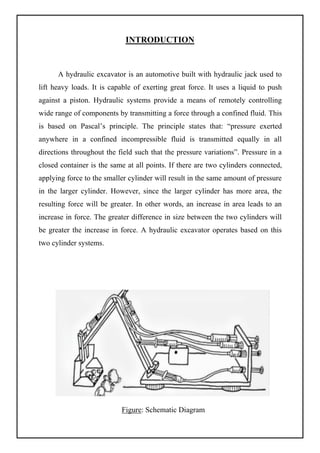
Figure: Schematic Diagram
OBJECTIVES
 To design a simplified and easy operational mini hydraulic excavator
attachment to minimize complexity with available excavator attachment
of machines.
 Design of excavator backhoe attachment with smallest bucket cavity
which is very suitable for explanation of light duty construction work.
 To improve working range by keeping less or same sizes of linkages of
excavator attachment.
 To describe the fluid mechanism involved in the working of the
excavator.
WORKING PRINCIPLE
The working principle of hydraulic excavator is Pascal’s law which states
that when a pressure is applied at the one point of the fluid contained in
constrained volume, then the pressure due to that force is equally transmitted to
all the point of the fluid, which is acted upon by the same pressure. Using the
same principle, we applied pressure to fluid in syringe which is transmitted to
other end of the tube which is connected to syringe. The operation of the
excavator arm is controlled by the pressure of the fluid and can obtain the
desired function.
Hydraulic excavators are entirely dependent upon hydraulic system. The
hydraulic excavator’s base/under carriage consists of a track or wheeled
platform and provide transportation for the vehicle while supporting the chassis.
The chassis allows the driver to control the hydraulic excavator by using levers
to drive the vehicle, raising the bottom up and down and controlling the bucket.
Because the chassis is built on the top of the under carriage, it is able to rotate
360 degrees. The bottom and the bucket are attached to the chassis, work in
conjunction to move materials, but are controlled independently.
The system has the hydraulic characteristics of constant torque control;
pump drive can be neutral and fine turning control of the hydraulic pump.
CONCLUSION
The design of the project uses the basic ideas and principles to receive the
required prototype mechanism. These are very versatile machines with simple
yet acute designing; also Hydraulic Excavators are primarily used for earth
removing machinery. In addition to that, several pistons can be used in order to
operate the arms of the excavators and thus making eligible for various
applications. With such steep growth in engineering and technology, we are
nearing to attaining innovations so as to improve the functionality as well as
accessibility of such large machines in our practical life.
At last undoubtedly, these large machines contribute a lot directly to the
world economy as well as global warming, and an important factor is that they
replace manual labour and make the jobs easily attainable with huge saving of
time and energy.
REFERENCES
 Fluid Mechanics and Hydraulic Machines by R.K. Bansal
 https://youtu.be/8CRMUKwrhUQ
 https://www.slideshare.net/phexcom1/jcb-hydraulic-truck-using-wood-
and-syringes
 https://www.instructables.com/id/CARDBOARD-Robotic-Hydraulic-
Arm/

FLUID MECHANICS PROJECT

  • 1.
    FLUID MECHANICS-I PROJECT “HYDRAULICEXCAVATOR” TEACHER IN-CHARGE: MR JITUL BARUAH MR. S. SEKHAR MALLICK (DEPT. OF MECHANICAL ENGINEERING) SUBMITTED BY- DEEPJYOTI PATOWARY (170610102021) KALPADEEP NANDY (170610102040) SUBHASISH CHAKRABORTY (170610002052) TRIDIB KUMAR DEKA (170610002053) VICTOR TALUKDAR (170610002054) YOYOSHI MACHIYA DEORI (170610002055) [BE 4TH SEMESTER, MECHANICAL ENGINEERING, AEC]
  • 2.
    CONTENTS 1. ABSTRACT 2. INTRODUCTION 3.OBJECTIVE 4. WORKING PRINCIPLE 5. CONCLUSION 6. REFERENCES
  • 3.
    ABSTRACT The project ison designing an excavator model based on the principle of hydraulic system. In this project, the model is hydraulically operated and controlled by the movement filled with some fluid. It consists of various parts connected to each other in a pre-designed manner which are guided in a constrained way to obtained required output. The principle of working of hydraulic excavator is Pascal’s law. The law states that when a pressure is applied at the one point of the fluid contained in constrained volume, then the pressure due to that force is equally transmitted to all the point of the fluid, which is acted upon by the same pressure. Using the same principle, we applied pressure to fluid in syringe which is transmitted to other end of the tube which is connected to syringe. The operation of the excavator arm is controlled by the pressure of the fluid and can obtain the desired function.
  • 4.
    INTRODUCTION A hydraulic excavatoris an automotive built with hydraulic jack used to lift heavy loads. It is capable of exerting great force. It uses a liquid to push against a piston. Hydraulic systems provide a means of remotely controlling wide range of components by transmitting a force through a confined fluid. This is based on Pascal’s principle. The principle states that: “pressure exerted anywhere in a confined incompressible fluid is transmitted equally in all directions throughout the field such that the pressure variations”. Pressure in a closed container is the same at all points. If there are two cylinders connected, applying force to the smaller cylinder will result in the same amount of pressure in the larger cylinder. However, since the larger cylinder has more area, the resulting force will be greater. In other words, an increase in area leads to an increase in force. The greater difference in size between the two cylinders will be greater the increase in force. A hydraulic excavator operates based on this two cylinder systems. Figure: Schematic Diagram
  • 5.
    OBJECTIVES  To designa simplified and easy operational mini hydraulic excavator attachment to minimize complexity with available excavator attachment of machines.  Design of excavator backhoe attachment with smallest bucket cavity which is very suitable for explanation of light duty construction work.  To improve working range by keeping less or same sizes of linkages of excavator attachment.  To describe the fluid mechanism involved in the working of the excavator.
  • 6.
    WORKING PRINCIPLE The workingprinciple of hydraulic excavator is Pascal’s law which states that when a pressure is applied at the one point of the fluid contained in constrained volume, then the pressure due to that force is equally transmitted to all the point of the fluid, which is acted upon by the same pressure. Using the same principle, we applied pressure to fluid in syringe which is transmitted to other end of the tube which is connected to syringe. The operation of the excavator arm is controlled by the pressure of the fluid and can obtain the desired function. Hydraulic excavators are entirely dependent upon hydraulic system. The hydraulic excavator’s base/under carriage consists of a track or wheeled platform and provide transportation for the vehicle while supporting the chassis. The chassis allows the driver to control the hydraulic excavator by using levers to drive the vehicle, raising the bottom up and down and controlling the bucket. Because the chassis is built on the top of the under carriage, it is able to rotate 360 degrees. The bottom and the bucket are attached to the chassis, work in conjunction to move materials, but are controlled independently. The system has the hydraulic characteristics of constant torque control; pump drive can be neutral and fine turning control of the hydraulic pump.
  • 7.
    CONCLUSION The design ofthe project uses the basic ideas and principles to receive the required prototype mechanism. These are very versatile machines with simple yet acute designing; also Hydraulic Excavators are primarily used for earth removing machinery. In addition to that, several pistons can be used in order to operate the arms of the excavators and thus making eligible for various applications. With such steep growth in engineering and technology, we are nearing to attaining innovations so as to improve the functionality as well as accessibility of such large machines in our practical life. At last undoubtedly, these large machines contribute a lot directly to the world economy as well as global warming, and an important factor is that they replace manual labour and make the jobs easily attainable with huge saving of time and energy.
  • 8.
    REFERENCES  Fluid Mechanicsand Hydraulic Machines by R.K. Bansal  https://youtu.be/8CRMUKwrhUQ  https://www.slideshare.net/phexcom1/jcb-hydraulic-truck-using-wood- and-syringes  https://www.instructables.com/id/CARDBOARD-Robotic-Hydraulic- Arm/