- Reported speech is used to report what other people have said by changing the tense and pronouns. For example, "I am tired" would become "She said that she was tired."
- Tenses in reported speech are typically one step back from the original tense. For example, present simple becomes past simple.
- Reported questions use verbs like "ask" and change the question structure, but maintain normal word order. For example, "Where does Peter live?" becomes "She asked him where Peter lived."
- The reporting verbs used can be more descriptive than just "say", like admit, reveal, or suggest.
Reported speech isused in both written and
spoken English
•Intermediate level English learners should study
the reported speech in order to relate what
others have said.
•If the reporting verb (i.e. said) is in the past, the
reported clause is in a past form. This form is
usually one step back into the past from the
original.
3.
For example:
•He saidthe test was difficult.
•She said she watched TV every day.
•If simple present, present perfect or the future
is used in the reporting verb (i.e. says) the
tense is retained.
4.
Study Reported Speechin Depth:
•The reported speech calls for changes in tenses,
pronouns and time expressions. This reported
speech guide provides all the information
required. Reported speech generally uses the
verbs 'say' and 'tell'. However, there are also a
number of other reporting verbs that are much
more descriptive (admit, reveal, suggest, etc.)
5.
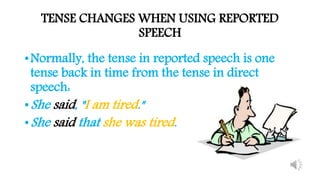
TENSE CHANGES WHENUSING REPORTED
SPEECH
•Normally, the tense in reported speech is one
tense back in time from the tense in direct
speech:
•She said, "I am tired."
•She said that she was tired.
6.
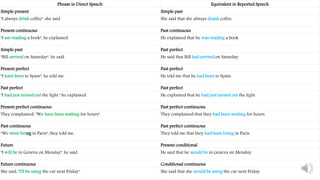
Phrase in DirectSpeech Equivalent in Reported Speech
Simple present Simple past
"I always drink coffee", she said She said that she always drank coffee.
Present continuous Past continuous
"I am reading a book", he explained. He explained that he was reading a book
Simple past Past perfect
"Bill arrived on Saturday", he said. He said that Bill had arrived on Saturday.
Present perfect Past perfect
"I have been to Spain", he told me. He told me that he had been to Spain.
Past perfect Past perfect
"I had just turned out the light," he explained. He explained that he had just turned out the light.
Present perfect continuous Past perfect continuous
They complained, "We have been waiting for hours". They complained that they had been waiting for hours.
Past continuous Past perfect continuous
"We were living in Paris", they told me. They told me that they had been living in Paris.
Future Present conditional
"I will be in Geneva on Monday", he said. He said that he would be in Geneva on Monday.
Future continuous Conditional continuous
She said, "I'll be using the car next Friday". She said that she would be using the car next Friday.
7.
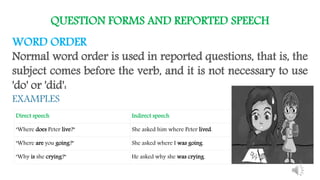
QUESTION FORMS ANDREPORTED SPEECH
Direct speech Indirect speech
"Where does Peter live?" She asked him where Peter lived.
"Where are you going?" She asked where I was going.
"Why is she crying?" He asked why she was crying.
WORD ORDER
Normal word order is used in reported questions, that is, the
subject comes before the verb, and it is not necessary to use
'do' or 'did':
EXAMPLES
8.
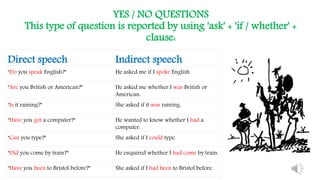
YES / NOQUESTIONS
This type of question is reported by using 'ask' + 'if / whether' +
clause:
Direct speech Indirect speech
"Do you speak English?" He asked me if I spoke English.
"Are you British or American?" He asked me whether I was British or
American.
"Is it raining?" She asked if it was raining.
"Have you got a computer?" He wanted to know whether I had a
computer.
"Can you type?" She asked if I could type.
"Did you come by train?" He enquired whether I had come by train.
"Have you been to Bristol before?" She asked if I had been to Bristol before.
9.
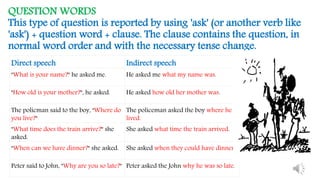
QUESTION WORDS
This typeof question is reported by using 'ask' (or another verb like
'ask') + question word + clause. The clause contains the question, in
normal word order and with the necessary tense change.
Direct speech Indirect speech
"What is your name?" he asked me. He asked me what my name was.
"How old is your mother?", he asked. He asked how old her mother was.
The policman said to the boy, "Where do
you live?"
The policeman asked the boy where he
lived.
"What time does the train arrive?" she
asked.
She asked what time the train arrived.
"When can we have dinner?" she asked. She asked when they could have dinner.
Peter said to John, "Why are you so late?" Peter asked the John why he was so late.