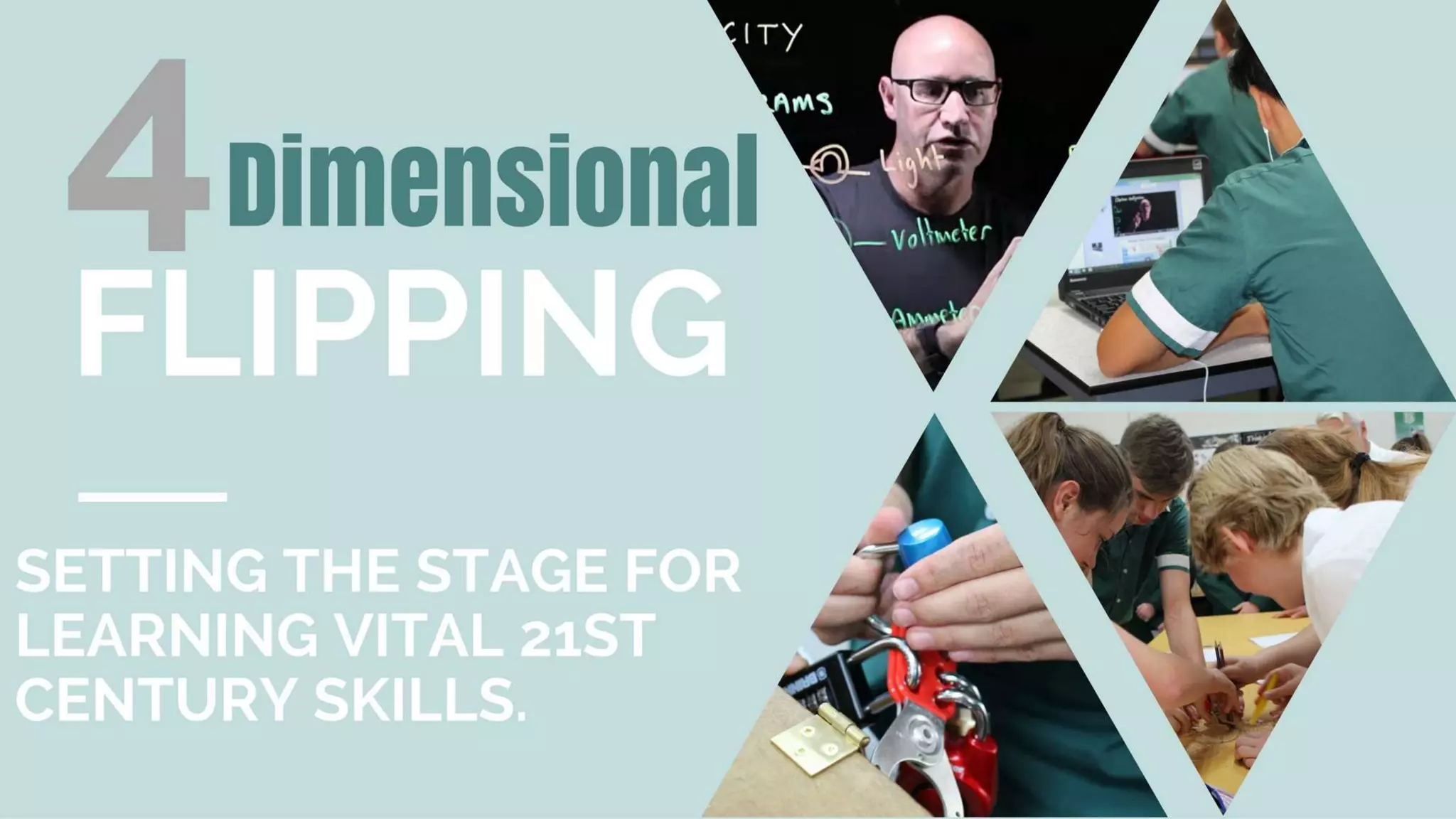
This Slideshare presentation is based on Steve
Griffith’s article “4 Dimensional Flipping:
Setting the Stage for Learning Vital 21st
Century Skills”, published on the Flipped
Learning Network
*(with permission)
How Flipped Learning fits into the
Four Dimensional Education Framework
of Educational Goals
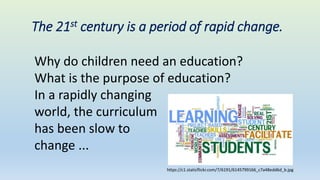
The 21st century is a period of rapid change.
Why do children need an education?
What is the purpose of education?
In a rapidly changing
world, the curriculum
has been slow to
change ...
https://c1.staticflickr.com/7/6191/6145799166_c7a48edd6d_b.jpg
The purpose of school has to be to prepare
students for the world of today … and the world
of tomorrow.
“Today, schools need to prepare students for
more rapid economic and social change than ever
before, for jobs that have not yet been created, to
use technologies that have not yet been invented,
and to solve social problems that we don’t yet know
will arise”
- Andreas Schleicher the Director
of Education and Skills, OECD
Source: http://curriculumredesign.org/our-work/four-dimensional-21st-century-education-learning-competencies-future-2030/
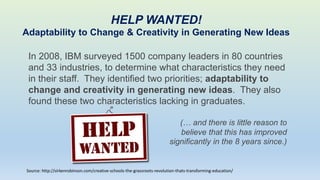
In 2008, IBM surveyed 1500 company leaders in 80 countries
and 33 industries, to determine what characteristics they need
in their staff. They identified two priorities; adaptability to
change and creativity in generating new ideas. They also
found these two characteristics lacking in graduates.
(… and there is little reason to
believe that this has improved
significantly in the 8 years since.)
HELP WANTED!
Adaptability to Change & Creativity in Generating New Ideas
Source: http://sirkenrobinson.com/creative-schools-the-grassroots-revolution-thats-transforming-education/
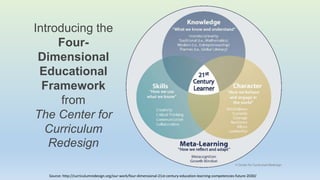
Introducing the
Four-
Dimensional
Educational
Framework
from
The Center for
Curriculum
Redesign
Source: http://curriculumredesign.org/our-work/four-dimensional-21st-century-education-learning-competencies-future-2030/
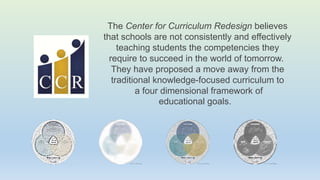
The Center for Curriculum Redesign believes
that schools are not consistently and effectively
teaching students the competencies they
require to succeed in the world of tomorrow.
They have proposed a move away from the
traditional knowledge-focused curriculum to
a four dimensional framework of
educational goals.
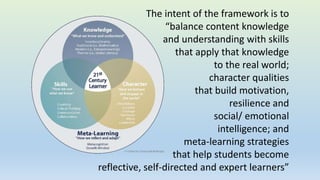
The intent of the framework is to
“balance content knowledge
and understanding with skills
that apply that knowledge
to the real world;
character qualities
that build motivation,
resilience and
social/ emotional
intelligence; and
meta-learning strategies
that help students become
reflective, self-directed and expert learners”
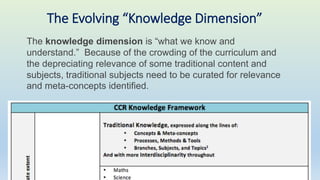
The knowledge dimension is “what we know and
understand.” Because of the crowding of the curriculum and
the depreciating relevance of some traditional content and
subjects, traditional subjects need to be curated for relevance
and meta-concepts identified.
The Evolving “Knowledge Dimension”
With ready access to information on the Internet,
the need to cover all of the content in a particular
subject is no longer necessary. Instead, the CCR
recommends focusing on understanding the key
aspects, or the meta-concepts and big picture
processes of the discipline, in a meaningful way.
This means the 21st-century concepts and competencies that
are over-arching and are relevant across disciplines.
It is the knowledge that we want to stick with students after
school where it can be built on with further study or applied
in life and the workforce regardless of the field.
https://c1.staticflickr.com/7/6130/6012029995_75d09b3868_b.jpg
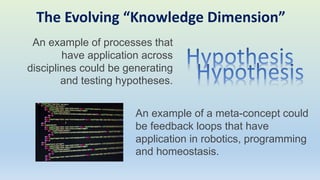
An example of a meta-concept could
be feedback loops that have
application in robotics, programming
and homeostasis.
An example of processes that
have application across
disciplines could be generating
and testing hypotheses.
The Evolving “Knowledge Dimension”
Flipped learning continues to be very relevant in the
knowledge dimension but perhaps with some minor
tweaking for some flipped
educators. Instead of
generating a raft of videos
for all the detailed content,
flipped educators
should focus their
videos on the key
meta-concepts and processes and make the
connections with other disciplines more explicit.
The Evolving “Knowledge Dimension” and Flipped Learning
A major advantage of flipped learning is that students
interact with new content in their individual learning
space so that more class time can be spent practicing
and deepening the knowledge.
Effective flipped learning includes
meaningful and authentic learning
experiences to practice procedural
knowledge and deepen
declarative knowledge.
The Evolving “Knowledge Dimension” and Flipped Learning
The themes provided in Four-Dimensional Education
represent important strands that are relevant across many
traditional and modern disciplines.
These themes include the following:
• Global
• Environmental
• Information & Digital Literacies
• Design Thinking
… these themes are to be
embedded across disciplines as appropriate.
The class time saved
by flipped learning
affords the flip
educator with precious
class time to embed
these important cross-
curricular themes.
The skills dimension is “what we do with what we know”.
The CCR has focused on four skills that are required to
prepare students for the complexity of life and work in the
21st Century.
These “eduployment” skills are in high demand by
employers:
• Communication
• Collaboration
• Critical thinking
• Creativity
The Skills Dimension
Knowledge and skills need to develop together.
We always learn by learning something.
The knowledge “becomes the source of creativity, the subject
of critical thought and communication, and the impetus for
collaboration”.
So the meta-concepts and processes are the context
around which the 21st-century skills are applied.
The Skills Dimension
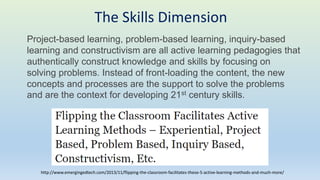
Project-based learning, problem-based learning, inquiry-based
learning and constructivism are all active learning pedagogies that
authentically construct knowledge and skills by focusing on
solving problems. Instead of front-loading the content, the new
concepts and processes are the support to solve the problems
and are the context for developing 21st century skills.
The Skills Dimension
http://www.emergingedtech.com/2013/11/flipping-the-classroom-facilitates-these-5-active-learning-methods-and-much-more/
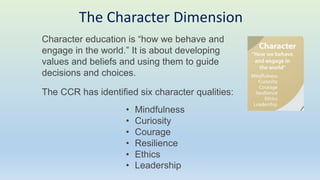
Character education is “how we behave and
engage in the world.” It is about developing
values and beliefs and using them to guide
decisions and choices.
The CCR has identified six character qualities:
• Mindfulness
• Curiosity
• Courage
• Resilience
• Ethics
• Leadership
The Character Dimension
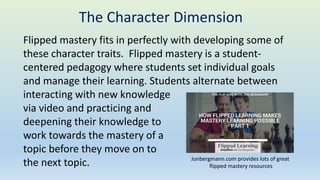
Flipped mastery fits in perfectly with developing some of
these character traits. Flipped mastery is a student-
centered pedagogy where students set individual goals
and manage their learning. Students alternate between
interacting with new knowledge
via video and practicing and
deepening their knowledge to
work towards the mastery of a
topic before they move on to
the next topic. Jonbergmann.com provides lots of great
flipped mastery resources
The Character Dimension
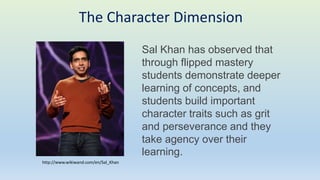
Sal Khan has observed that
through flipped mastery
students demonstrate deeper
learning of concepts, and
students build important
character traits such as grit
and perseverance and they
take agency over their
learning.
The Character Dimension
http://www.wikiwand.com/en/Sal_Khan
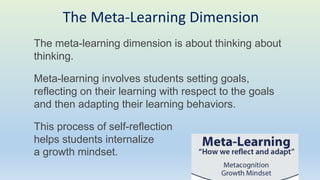
The meta-learning dimension is about thinking about
thinking.
Meta-learning involves students setting goals,
reflecting on their learning with respect to the goals
and then adapting their learning behaviors.
This process of self-reflection
helps students internalize
a growth mindset.
The Meta-Learning Dimension
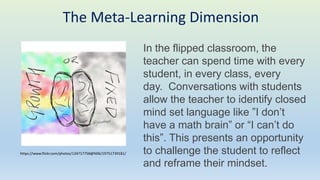
In the flipped classroom, the
teacher can spend time with every
student, in every class, every
day. Conversations with students
allow the teacher to identify closed
mind set language like ”I don’t
have a math brain” or “I can’t do
this”. This presents an opportunity
to challenge the student to reflect
and reframe their mindset.
https://www.flickr.com/photos/134717758@N06/19751739181/
Flipped Learning is a Powerful Opportunity
for a Much Needed Change
There are potentially
many opportunities
to incorporate
flipped learning into
the Four
Dimensional
Education
framework.
Flipped learning
done well, can
enhance deep
learning and develop
students who are
versatile, reflective,
self-directed and self-
reliant.
Provided that flipped learners are guided by the “why” of education, flipped
learning can be an important “how” tool to address the “what” of education
outlined in the Four Dimensional Education framework.
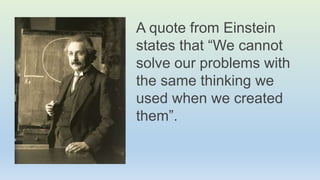
A quote from Einstein
states that “We cannot
solve our problems with
the same thinking we
used when we created
them”.
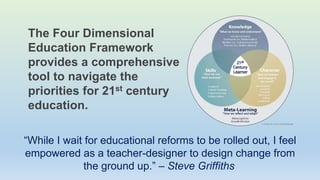
The Four Dimensional
Education Framework
provides a comprehensive
tool to navigate the
priorities for 21st century
education.
“While I wait for educational reforms to be rolled out, I feel
empowered as a teacher-designer to design change from
the ground up.” – Steve Griffiths
Access the full original article at:
http://flippedlearning.org/4-dimensional-flip

Flippedclassroom4dimensional21stcenturystevegriffiths 161017223440

  • 2.
    This Slideshare presentationis based on Steve Griffith’s article “4 Dimensional Flipping: Setting the Stage for Learning Vital 21st Century Skills”, published on the Flipped Learning Network *(with permission) How Flipped Learning fits into the Four Dimensional Education Framework of Educational Goals
  • 3.
    The 21st centuryis a period of rapid change. Why do children need an education? What is the purpose of education? In a rapidly changing world, the curriculum has been slow to change ... https://c1.staticflickr.com/7/6191/6145799166_c7a48edd6d_b.jpg
  • 4.
    The purpose ofschool has to be to prepare students for the world of today … and the world of tomorrow. “Today, schools need to prepare students for more rapid economic and social change than ever before, for jobs that have not yet been created, to use technologies that have not yet been invented, and to solve social problems that we don’t yet know will arise” - Andreas Schleicher the Director of Education and Skills, OECD Source: http://curriculumredesign.org/our-work/four-dimensional-21st-century-education-learning-competencies-future-2030/
  • 5.
    In 2008, IBMsurveyed 1500 company leaders in 80 countries and 33 industries, to determine what characteristics they need in their staff. They identified two priorities; adaptability to change and creativity in generating new ideas. They also found these two characteristics lacking in graduates. (… and there is little reason to believe that this has improved significantly in the 8 years since.) HELP WANTED! Adaptability to Change & Creativity in Generating New Ideas Source: http://sirkenrobinson.com/creative-schools-the-grassroots-revolution-thats-transforming-education/
  • 6.
    Introducing the Four- Dimensional Educational Framework from The Centerfor Curriculum Redesign Source: http://curriculumredesign.org/our-work/four-dimensional-21st-century-education-learning-competencies-future-2030/
  • 7.
    The Center forCurriculum Redesign believes that schools are not consistently and effectively teaching students the competencies they require to succeed in the world of tomorrow. They have proposed a move away from the traditional knowledge-focused curriculum to a four dimensional framework of educational goals.
  • 8.
    The intent ofthe framework is to “balance content knowledge and understanding with skills that apply that knowledge to the real world; character qualities that build motivation, resilience and social/ emotional intelligence; and meta-learning strategies that help students become reflective, self-directed and expert learners”
  • 9.
    The knowledge dimensionis “what we know and understand.” Because of the crowding of the curriculum and the depreciating relevance of some traditional content and subjects, traditional subjects need to be curated for relevance and meta-concepts identified. The Evolving “Knowledge Dimension”
  • 10.
    With ready accessto information on the Internet, the need to cover all of the content in a particular subject is no longer necessary. Instead, the CCR recommends focusing on understanding the key aspects, or the meta-concepts and big picture processes of the discipline, in a meaningful way. This means the 21st-century concepts and competencies that are over-arching and are relevant across disciplines. It is the knowledge that we want to stick with students after school where it can be built on with further study or applied in life and the workforce regardless of the field. https://c1.staticflickr.com/7/6130/6012029995_75d09b3868_b.jpg
  • 11.
    An example ofa meta-concept could be feedback loops that have application in robotics, programming and homeostasis. An example of processes that have application across disciplines could be generating and testing hypotheses. The Evolving “Knowledge Dimension”
  • 12.
    Flipped learning continuesto be very relevant in the knowledge dimension but perhaps with some minor tweaking for some flipped educators. Instead of generating a raft of videos for all the detailed content, flipped educators should focus their videos on the key meta-concepts and processes and make the connections with other disciplines more explicit. The Evolving “Knowledge Dimension” and Flipped Learning
  • 13.
    A major advantageof flipped learning is that students interact with new content in their individual learning space so that more class time can be spent practicing and deepening the knowledge. Effective flipped learning includes meaningful and authentic learning experiences to practice procedural knowledge and deepen declarative knowledge. The Evolving “Knowledge Dimension” and Flipped Learning
  • 14.
    The themes providedin Four-Dimensional Education represent important strands that are relevant across many traditional and modern disciplines. These themes include the following: • Global • Environmental • Information & Digital Literacies • Design Thinking … these themes are to be embedded across disciplines as appropriate. The class time saved by flipped learning affords the flip educator with precious class time to embed these important cross- curricular themes.
  • 15.
    The skills dimensionis “what we do with what we know”. The CCR has focused on four skills that are required to prepare students for the complexity of life and work in the 21st Century. These “eduployment” skills are in high demand by employers: • Communication • Collaboration • Critical thinking • Creativity The Skills Dimension
  • 16.
    Knowledge and skillsneed to develop together. We always learn by learning something. The knowledge “becomes the source of creativity, the subject of critical thought and communication, and the impetus for collaboration”. So the meta-concepts and processes are the context around which the 21st-century skills are applied. The Skills Dimension
  • 17.
    Project-based learning, problem-basedlearning, inquiry-based learning and constructivism are all active learning pedagogies that authentically construct knowledge and skills by focusing on solving problems. Instead of front-loading the content, the new concepts and processes are the support to solve the problems and are the context for developing 21st century skills. The Skills Dimension http://www.emergingedtech.com/2013/11/flipping-the-classroom-facilitates-these-5-active-learning-methods-and-much-more/
  • 18.
    Character education is“how we behave and engage in the world.” It is about developing values and beliefs and using them to guide decisions and choices. The CCR has identified six character qualities: • Mindfulness • Curiosity • Courage • Resilience • Ethics • Leadership The Character Dimension
  • 19.
    Flipped mastery fitsin perfectly with developing some of these character traits. Flipped mastery is a student- centered pedagogy where students set individual goals and manage their learning. Students alternate between interacting with new knowledge via video and practicing and deepening their knowledge to work towards the mastery of a topic before they move on to the next topic. Jonbergmann.com provides lots of great flipped mastery resources The Character Dimension
  • 20.
    Sal Khan hasobserved that through flipped mastery students demonstrate deeper learning of concepts, and students build important character traits such as grit and perseverance and they take agency over their learning. The Character Dimension http://www.wikiwand.com/en/Sal_Khan
  • 21.
    The meta-learning dimensionis about thinking about thinking. Meta-learning involves students setting goals, reflecting on their learning with respect to the goals and then adapting their learning behaviors. This process of self-reflection helps students internalize a growth mindset. The Meta-Learning Dimension
  • 22.
    The Meta-Learning Dimension Inthe flipped classroom, the teacher can spend time with every student, in every class, every day. Conversations with students allow the teacher to identify closed mind set language like ”I don’t have a math brain” or “I can’t do this”. This presents an opportunity to challenge the student to reflect and reframe their mindset. https://www.flickr.com/photos/134717758@N06/19751739181/
  • 23.
    Flipped Learning isa Powerful Opportunity for a Much Needed Change There are potentially many opportunities to incorporate flipped learning into the Four Dimensional Education framework. Flipped learning done well, can enhance deep learning and develop students who are versatile, reflective, self-directed and self- reliant. Provided that flipped learners are guided by the “why” of education, flipped learning can be an important “how” tool to address the “what” of education outlined in the Four Dimensional Education framework.
  • 24.
    A quote fromEinstein states that “We cannot solve our problems with the same thinking we used when we created them”.
  • 25.
    The Four Dimensional EducationFramework provides a comprehensive tool to navigate the priorities for 21st century education. “While I wait for educational reforms to be rolled out, I feel empowered as a teacher-designer to design change from the ground up.” – Steve Griffiths
  • 26.
    Access the fulloriginal article at: http://flippedlearning.org/4-dimensional-flip