21st
Century
Teaching &
Learning
 A growing number of business leaders, politicians,
and educators are united around the idea that
students need "21st century skills" to be successful
today. It's exciting to believe that we live in times
that are so revolutionary that they demand new and
different abilities. But in fact, the skills students
need in the 21st century are not new.
 Pedagogy in the 21st century has to put the
emphasis on the 4Cs – collaboration, critical
thinking, creativity and communication. In
our fast-changing world, more of the same
knowledge and skills will not address the
challenges of the future.
 Our education system must equip young
people with the capacity to think, solve
problems and respond to and thrive within a
changing society.
The 21st century dawned as the beginning of the Digital Age
Time of unprecedented growth in
technology and its subsequent
information explosion.
Tools for information access and
management made such an impact on the
way we live, work, shop and play.
Identify the life, career, and learning
skills that define the skills needed for
success in the 21st century world.
 Our challenge as educators is to ensure quality
pedagogy works within the world of
contemporary students and to keep up skilling
our teachers to meet these needs.
 The teacher poses the questions, provides the
tools and research methods, as well as delivering
subject content and guidance for problem-
solving in a collaborative environment. It is an
evolution in teaching practice that offers exciting
possibilities.
Characteristics
of 21st Century
Teachers
 1. Learner-Centered Classroom and Personalized Instructions
As students have access to any information possible, there
certainly is no need to "spoon-feed" the knowledge or teach
"one-size fits all" content. As students have different
personalities, goals, and needs, offering personalized
instructions is not just possible but also desirable. When
students are allowed to make their own choices, they own
their learning, increase intrinsic motivation, and put in more
effort -- an ideal recipe for better learning outcomes
2. Students as Producers
Today's students have the latest and greatest tools, yet, the
usage in many cases barely goes beyond communicating with
family and friends via chat, text, or calls. Even though
students are now viewed as digital natives, many are far from
producing any digital content
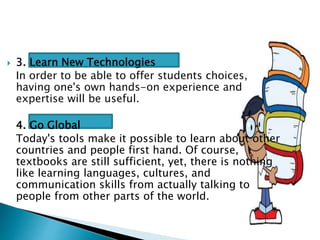
 3. Learn New Technologies
In order to be able to offer students choices,
having one's own hands-on experience and
expertise will be useful.
4. Go Global
Today's tools make it possible to learn about other
countries and people first hand. Of course,
textbooks are still sufficient, yet, there is nothing
like learning languages, cultures, and
communication skills from actually talking to
people from other parts of the world.
 5. Be Smart and Use Smart Phones
Once again -- when students are encouraged
to view their devices as valuable tools that
support knowledge (rather than distractions),
they start using them as such.
 6. Innovate
I invite you to expand your teaching toolbox
and try new ways you have not tried before,
such as teaching with social media or replacing
textbooks with web resources. Not for the sake
of tools but for the sake of students!
 It's important that we value the knowledge that
students acquire outside of school and use those
experiences to make learning relevant.
Our challenge is not just to harness the potential
technology can offer to support quality pedagogy,
but to use technology to extend learning
opportunities and curriculum breadth for all
students.
 Technology has allowed us, for example, to
establish our first virtual school with Aurora
College, which is linking students in rural and
remote NSW to specialist teachers, extending
curriculum options and providing new
opportunities for gifted and talented students.
 Technology is a wonderful enabler for learning
and innovation, but great teachers still need to
have high expectations for every student, a deep
understanding of their subject content and a
capacity to inspire and motivate students, just as
they have done in previous generations.
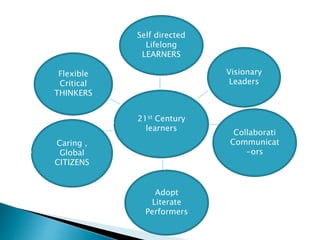
21st Century
learners
Self directed
Lifelong
LEARNERS
Visionary
Leaders
Flexible
Critical
THINKERS
Collaborati
Communicat
-ors
Caring ,
Global
CITIZENS
Adopt
Literate
Performers
 Technology integration Remixed
The new 21st century learners must master more than
the core curriculum to succeed in secondary and
postsecondary institutions, as well as in the workplace.
The Partnership for 21st Century Skills, a national
organization advocating for 21st century readiness for
every student, explains the outcomes of this
transformation as fusing the traditional three R’s with
four C’s: critical thinking, creativity, communication,
and collaboration.
As students develop the four C’s, we have discovered
that effective application of these vital skills in a
technology-infused life and workplace requires
acquiring them in a technology-infused learning
environment.
 Shift in Roles
Following the joyous moment when educators realize
their students are capable, independent technology
users who can create inspiring digital masterpieces,
the next reaction is often a more solemn, “How do we
fit it all in?” In fact, the answer to this question is vital
to a successful technology integration transformation.
 In this configuration, the teacher acts as a learning
catalyst, orchestrating and facilitating activities that
spark defining moments for students.
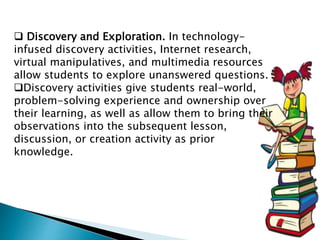
 Discovery and Exploration. In technology-
infused discovery activities, Internet research,
virtual manipulatives, and multimedia resources
allow students to explore unanswered questions.
Discovery activities give students real-world,
problem-solving experience and ownership over
their learning, as well as allow them to bring their
observations into the subsequent lesson,
discussion, or creation activity as prior
knowledge.
Creation and Design. Likewise, creation
activities provide students the ability to
develop creativity and problem-solving skills
by displaying their mastery in profound and
meaningful ways.

Educational Technology

  • 1.
  • 2.
     A growingnumber of business leaders, politicians, and educators are united around the idea that students need "21st century skills" to be successful today. It's exciting to believe that we live in times that are so revolutionary that they demand new and different abilities. But in fact, the skills students need in the 21st century are not new.
  • 3.
     Pedagogy inthe 21st century has to put the emphasis on the 4Cs – collaboration, critical thinking, creativity and communication. In our fast-changing world, more of the same knowledge and skills will not address the challenges of the future.  Our education system must equip young people with the capacity to think, solve problems and respond to and thrive within a changing society.
  • 4.
    The 21st centurydawned as the beginning of the Digital Age Time of unprecedented growth in technology and its subsequent information explosion. Tools for information access and management made such an impact on the way we live, work, shop and play. Identify the life, career, and learning skills that define the skills needed for success in the 21st century world.
  • 5.
     Our challengeas educators is to ensure quality pedagogy works within the world of contemporary students and to keep up skilling our teachers to meet these needs.  The teacher poses the questions, provides the tools and research methods, as well as delivering subject content and guidance for problem- solving in a collaborative environment. It is an evolution in teaching practice that offers exciting possibilities.
  • 6.
  • 7.
     1. Learner-CenteredClassroom and Personalized Instructions As students have access to any information possible, there certainly is no need to "spoon-feed" the knowledge or teach "one-size fits all" content. As students have different personalities, goals, and needs, offering personalized instructions is not just possible but also desirable. When students are allowed to make their own choices, they own their learning, increase intrinsic motivation, and put in more effort -- an ideal recipe for better learning outcomes 2. Students as Producers Today's students have the latest and greatest tools, yet, the usage in many cases barely goes beyond communicating with family and friends via chat, text, or calls. Even though students are now viewed as digital natives, many are far from producing any digital content
  • 8.
     3. LearnNew Technologies In order to be able to offer students choices, having one's own hands-on experience and expertise will be useful. 4. Go Global Today's tools make it possible to learn about other countries and people first hand. Of course, textbooks are still sufficient, yet, there is nothing like learning languages, cultures, and communication skills from actually talking to people from other parts of the world.
  • 9.
     5. BeSmart and Use Smart Phones Once again -- when students are encouraged to view their devices as valuable tools that support knowledge (rather than distractions), they start using them as such.  6. Innovate I invite you to expand your teaching toolbox and try new ways you have not tried before, such as teaching with social media or replacing textbooks with web resources. Not for the sake of tools but for the sake of students!
  • 10.
     It's importantthat we value the knowledge that students acquire outside of school and use those experiences to make learning relevant. Our challenge is not just to harness the potential technology can offer to support quality pedagogy, but to use technology to extend learning opportunities and curriculum breadth for all students.
  • 11.
     Technology hasallowed us, for example, to establish our first virtual school with Aurora College, which is linking students in rural and remote NSW to specialist teachers, extending curriculum options and providing new opportunities for gifted and talented students.  Technology is a wonderful enabler for learning and innovation, but great teachers still need to have high expectations for every student, a deep understanding of their subject content and a capacity to inspire and motivate students, just as they have done in previous generations.
  • 12.
  • 14.
     Technology integrationRemixed The new 21st century learners must master more than the core curriculum to succeed in secondary and postsecondary institutions, as well as in the workplace. The Partnership for 21st Century Skills, a national organization advocating for 21st century readiness for every student, explains the outcomes of this transformation as fusing the traditional three R’s with four C’s: critical thinking, creativity, communication, and collaboration. As students develop the four C’s, we have discovered that effective application of these vital skills in a technology-infused life and workplace requires acquiring them in a technology-infused learning environment.
  • 15.
     Shift inRoles Following the joyous moment when educators realize their students are capable, independent technology users who can create inspiring digital masterpieces, the next reaction is often a more solemn, “How do we fit it all in?” In fact, the answer to this question is vital to a successful technology integration transformation.  In this configuration, the teacher acts as a learning catalyst, orchestrating and facilitating activities that spark defining moments for students.
  • 16.
     Discovery andExploration. In technology- infused discovery activities, Internet research, virtual manipulatives, and multimedia resources allow students to explore unanswered questions. Discovery activities give students real-world, problem-solving experience and ownership over their learning, as well as allow them to bring their observations into the subsequent lesson, discussion, or creation activity as prior knowledge.
  • 17.
    Creation and Design.Likewise, creation activities provide students the ability to develop creativity and problem-solving skills by displaying their mastery in profound and meaningful ways.