Skills for the 21st century

    William Bickerdike,
    Regional Manager,
    South Asia, Cambridge
    International Examinations
    November 2012
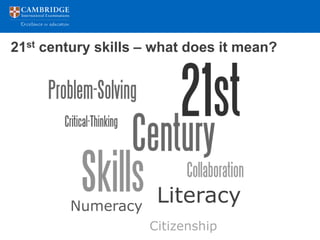
21st century skills – what does it mean?


        Numeracy
                     Literacy
                    Citizenship
Teaching in the 21st century


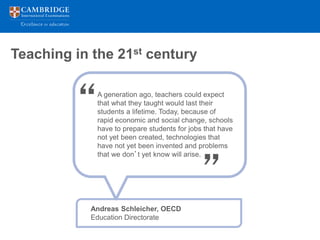
         “   A generation ago, teachers could expect
             that what they taught would last their
             students a lifetime. Today, because of
             rapid economic and social change, schools
             have to prepare students for jobs that have
             not yet been created, technologies that
             have not yet been invented and problems


                                             ”
             that we don’t yet know will arise.


            Andreas Schleicher, OECD
            Education Directorate
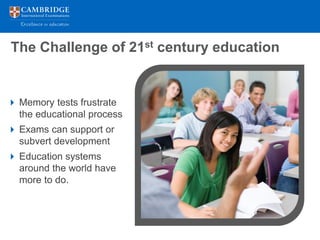
The Challenge of 21st century education


 Memory tests frustrate
  the educational process
 Exams can support or
  subvert development
 Education systems
  around the world have
  more to do.
OECD proposed that students should be introduced to:


 new ways of thinking: including creativity, critical
  thinking, problem-solving and decision-making;
 new ways of working: including new forms of
  collaboration and communication;
 using new tools for working: including the capacity
  to harness the potential of new technologies.
Changing the Educational Paradigm
adapted from Helping students to become better learners
                                       Hargreaves Presentation in Delhi 2006.]
  19th / 20th Century assumptions            21st Century assumptions

Intelligence is perceived as unitary,   Intelligence is understood as multi
fixed and innate                        faceted, plastic and [to a certain
                                        extent] learnable
Learning is the acquisition of          Students as producers, not just
subject content. Students are           consumers of knowledge. Learning
consumers of knowledge                  focus on application of knowledge
Curriculum focuses on content           Curriculum focuses on processes of
coverage and behavioural objectives     learning to learn, metacognition and
                                        skill development
Information and knowledge focus         Information literacy. Learning to
                                        handle information is the focus
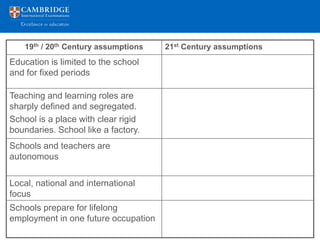
19th / 20th Century assumptions   21st Century assumptions
Education is limited to the school    Education is lifelong and
and for fixed periods                 unconstrained in time and place

Teaching and learning roles are       Roles are blurred and overlapping
sharply defined and segregated.       School as a network and part of a
School is a place with clear rigid    broader web
boundaries. School like a factory.
Schools and teachers are              Schools and teachers are
autonomous                            embedded in complex
                                      interconnected relationships
Local, national and international     Local, national and global focus
focus
Schools prepare for lifelong          Students identities and destinies are
employment in one future occupation   fluid and changing
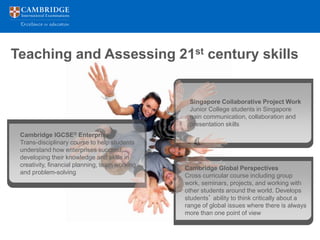
Teaching and Assessing 21st century skills


                                                 Singapore Collaborative Project Work
                                                 Junior College students in Singapore
                                                 gain communication, collaboration and
                                                 presentation skills
 Cambridge IGCSE® Enterprise
 Trans-disciplinary course to help students
 understand how enterprises succeed,
 developing their knowledge and skills in
 creativity, financial planning, team working
                                                Cambridge Global Perspectives
 and problem-solving
                                                Cross curricular course including group
                                                work, seminars, projects, and working with
                                                other students around the world. Develops
                                                students’ ability to think critically about a
                                                range of global issues where there is always
                                                more than one point of view
Cambridge Global Perspectives
 Aims to prepare today’s learners for tomorrow
 Based on skills rather than specific content
 Develops a flexible set of skills valued by
  universities and employers
    Thinking and problem solving skills
    Research and communication
 Engages learners with global issues
 Requires students to work collaboratively
 Provides learners and schools with a wide
  choice of study topics.
Cambridge IGCSE Enterprise
 The first Cambridge IGCSE® to ask learners to set up and
  run a new enterprise
 Develops an understanding of the principles of running a
  small business and what it takes to be an entrepreneur
 Discusses contemporary enterprise issues in a range of
  local, national and global contexts
 Learners investigate the world of work and entrepreneurial
  organisations.
New technologies
 Access to new technologies is paramount for 21st
  century skills
 Innovative teaching practices will flourish when
  particular conditions are in place such as
  1. teaching collaboration that focuses on peer support
  2. professional development that involves the active
  engagement of teachers
  3. school culture that offers common vision of
  innovation.
Virtual Learning Platform
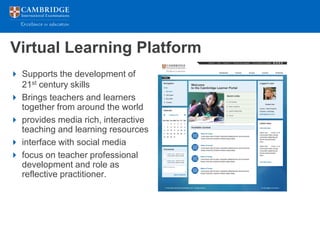
 Supports the development of
  21st century skills
 Brings teachers and learners
  together from around the world
 provides media rich, interactive
  teaching and learning resources
 interface with social media
 focus on teacher professional
  development and role as
  reflective practitioner.
Developing a global awareness

21st century skills = the development of skills for
 local and global citizenship
Education has a vital role to play in promoting
 understanding and mutual respect
Young people need a greater global awareness and
 knowledge of other countries.
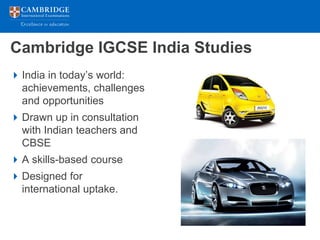
Cambridge IGCSE India Studies
 India in today’s world:
  achievements, challenges
  and opportunities
 Drawn up in consultation
  with Indian teachers and
  CBSE
 A skills-based course
 Designed for
  international uptake.
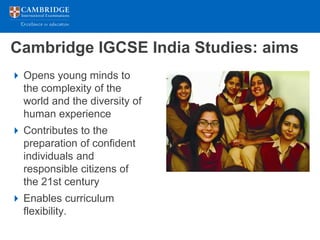
Cambridge IGCSE India Studies: aims
 Opens young minds to
  the complexity of the
  world and the diversity of
  human experience
 Contributes to the
  preparation of confident
  individuals and
  responsible citizens of
  the 21st century
 Enables curriculum
  flexibility.
Learn more!
Getting in touch with
Cambridge is easy
Email us at
info@cie.org.uk
or telephone
+44 (0) 1223 553554
www.cie.org.uk

21st century skills William Bickerdike

  • 1.
    Skills for the21st century William Bickerdike, Regional Manager, South Asia, Cambridge International Examinations November 2012
  • 2.
    21st century skills– what does it mean? Numeracy Literacy Citizenship
  • 3.
    Teaching in the21st century “ A generation ago, teachers could expect that what they taught would last their students a lifetime. Today, because of rapid economic and social change, schools have to prepare students for jobs that have not yet been created, technologies that have not yet been invented and problems ” that we don’t yet know will arise. Andreas Schleicher, OECD Education Directorate
  • 4.
    The Challenge of21st century education  Memory tests frustrate the educational process  Exams can support or subvert development  Education systems around the world have more to do.
  • 5.
    OECD proposed thatstudents should be introduced to: new ways of thinking: including creativity, critical thinking, problem-solving and decision-making; new ways of working: including new forms of collaboration and communication; using new tools for working: including the capacity to harness the potential of new technologies.
  • 6.
    Changing the EducationalParadigm adapted from Helping students to become better learners Hargreaves Presentation in Delhi 2006.] 19th / 20th Century assumptions 21st Century assumptions Intelligence is perceived as unitary, Intelligence is understood as multi fixed and innate faceted, plastic and [to a certain extent] learnable Learning is the acquisition of Students as producers, not just subject content. Students are consumers of knowledge. Learning consumers of knowledge focus on application of knowledge Curriculum focuses on content Curriculum focuses on processes of coverage and behavioural objectives learning to learn, metacognition and skill development Information and knowledge focus Information literacy. Learning to handle information is the focus
  • 7.
    19th / 20thCentury assumptions 21st Century assumptions Education is limited to the school Education is lifelong and and for fixed periods unconstrained in time and place Teaching and learning roles are Roles are blurred and overlapping sharply defined and segregated. School as a network and part of a School is a place with clear rigid broader web boundaries. School like a factory. Schools and teachers are Schools and teachers are autonomous embedded in complex interconnected relationships Local, national and international Local, national and global focus focus Schools prepare for lifelong Students identities and destinies are employment in one future occupation fluid and changing
  • 8.
    Teaching and Assessing21st century skills Singapore Collaborative Project Work Junior College students in Singapore gain communication, collaboration and presentation skills Cambridge IGCSE® Enterprise Trans-disciplinary course to help students understand how enterprises succeed, developing their knowledge and skills in creativity, financial planning, team working Cambridge Global Perspectives and problem-solving Cross curricular course including group work, seminars, projects, and working with other students around the world. Develops students’ ability to think critically about a range of global issues where there is always more than one point of view
  • 9.
    Cambridge Global Perspectives Aims to prepare today’s learners for tomorrow  Based on skills rather than specific content  Develops a flexible set of skills valued by universities and employers  Thinking and problem solving skills  Research and communication  Engages learners with global issues  Requires students to work collaboratively  Provides learners and schools with a wide choice of study topics.
  • 10.
    Cambridge IGCSE Enterprise The first Cambridge IGCSE® to ask learners to set up and run a new enterprise  Develops an understanding of the principles of running a small business and what it takes to be an entrepreneur  Discusses contemporary enterprise issues in a range of local, national and global contexts  Learners investigate the world of work and entrepreneurial organisations.
  • 11.
    New technologies  Accessto new technologies is paramount for 21st century skills  Innovative teaching practices will flourish when particular conditions are in place such as 1. teaching collaboration that focuses on peer support 2. professional development that involves the active engagement of teachers 3. school culture that offers common vision of innovation.
  • 12.
    Virtual Learning Platform Supports the development of 21st century skills  Brings teachers and learners together from around the world  provides media rich, interactive teaching and learning resources  interface with social media  focus on teacher professional development and role as reflective practitioner.
  • 13.
    Developing a globalawareness 21st century skills = the development of skills for local and global citizenship Education has a vital role to play in promoting understanding and mutual respect Young people need a greater global awareness and knowledge of other countries.
  • 14.
    Cambridge IGCSE IndiaStudies  India in today’s world: achievements, challenges and opportunities  Drawn up in consultation with Indian teachers and CBSE  A skills-based course  Designed for international uptake.
  • 15.
    Cambridge IGCSE IndiaStudies: aims  Opens young minds to the complexity of the world and the diversity of human experience  Contributes to the preparation of confident individuals and responsible citizens of the 21st century  Enables curriculum flexibility.
  • 16.
    Learn more! Getting intouch with Cambridge is easy Email us at info@cie.org.uk or telephone +44 (0) 1223 553554 www.cie.org.uk