The Learning Spaces 
EDFD459 ASSIGNMENT 2 
CHLOE BOURKE 
S00134947
| I N T R O D U C T I O N | 
As with most things in the world around us educational settings and the way in which us as 
educators teach our students, is always evolving. An important part of our role as teachers is 
to be constantly adapting to such changes in order to give our students the best possible 
learning experience. There are five key learning spaces that are imperative in enhancing 
learners in the 21st century: 
The Classroom and The School 
Beyond the Classroom 
The Electronic Learning Space 
The Individual Learning Space 
Group Learning Spaces 
As we discover what each learning space has to offer, we will be exploring the strengths and 
weaknesses, the curriculum and pedagogy, as well as touching on the importance of each 
space on teachers and students.
THE CLASSROOM AND THE SCHOOL 
The importance of a well-designed classroom and school setting is vital for learning in the 21st century, and 
allows the teacher to successfully meet the needs and learning styles of each student within the class. Read 
(2010) and Cinar (2010) outline a number of key factors that contribute to the design of a classroom which 
include, colour, materials, furnishings, temperature, walls and cabinetry. The traditional arrangement as shown in 
Figure 1, is generally hard to find in the 21st century classroom. 
Australian Curriculum and Victorian Essential Learning Standards: 
• Classroom design should be directly connected to the AusVELS curriculum, to promote student learning. 
• Traditional layouts will determine how much or little a student is engaged based on where they are seated (Cinar, 
2010). 
• When planning lessons, teachers will need to think about the key factors above that will encourage student learning 
and help them to achieve AusVELS standards. 
Strengths Weaknesses 
• Multiple areas for students to learn, 
catering for different learning styles. 
• Overwhelming for some students. 
• Engaging, lot’s of discussion. • School funding may limit design. 
• Students become self-directed, 
concrete materials available. 
• Highly populated classes may hinder 
student participation.
THE CLASSROOM AND THE SCHOOL 
Figure 1. (Cinar, 2010), Traditional Classroom, teacher centered. 
Figure 2. (Read, 2010), Stimulating Classroom, student centered.
BEYOND THE CLASSROOM 
Effective student learning doesn’t necessarily always occur within the four walls of the classroom. There 
are such experiences that become both “novel and stimulating” (Lorenza, 2009) beyond the classroom. I 
am talking about excursions and incursions, where for example, students experience learning in settings 
such as parks, museums or while outdoors camping. 
• Excursions or incursions allow students and teachers to socialise and interact with people and places 
who they would not normally. 
• Excursions and incursions are easily able to be linked to classroom work and the curriculum. 
• Lorenza (2009) states “the learning process is enhanced when information is presented in context” 
Strengths Weaknesses 
• Offers new opportunities for 
students 
• High amount of organisation for 
schools and teachers. 
• Engaging, and connects to 
classroom learning. 
• Costs 
• New and exciting interactions, 
resources and information. 
• Finding time during the already 
hectic school schedule.
BEYOND THE CLASSROOM 
(Dolphin Discovery, 2014) 
(Scitech, 2014)
THE ELECTRONIC LEARNING SPACE 
Technology nowadays is almost impossible to avoid, the accessibility and mobility of electronic devices is fast 
evolving and always changing or updating to allow for easier use. Technology is becoming more prominent in 21st 
century classrooms, with many schools installing smart boards, and using iPad’s to aide student learning. 
• AusVELS (2013) states that the use of ICT “focuses on providing students with the tools to transform their learning and 
to enrich their learning environment”, completing tasks in a different context. 
• “The number of portable computers in learning environments has exploded” as explained by Murray & Olcese (2011, 
suggesting that electronic devices are popular in classrooms. 
• This particular learning space is student directed, and also allows them to become more independent with their learning. 
Teachers are offered the chance to mix up their teaching styles. 
Strengths Weaknesses 
• Enhanced access to resources • Distraction from task at hand 
• Tools to build on student 
knowledge (apps) 
• Cyber dangers/safety – policies 
will need to be thought. 
• Use to store assessment (virtual 
student portfolios) 
• Students from low socio-economic 
may feel intimidated
THE ELECTRONIC LEARNING SPACE 
Students Using iPads (Pinterest, 2014) 
(iTeach, n.d.)
THE INDIVIDUAL LEARNING 
SPACE 
There is no denying that each student has a different learning style and therefore may prefer to learn in different 
spaces to that of their peers. Individual learning spaces hold a number of different factors, helping students to 
decipher how best they learn as an individual. Lighting, sounds and social factors all play a roll in what makes up 
ones individual learning space. 
• The following statement can be applied to both adults and students in that we “should take control of 
[our] own learning and adopt self-directed inquiry as a lifelong priority”(Smith, 2013). 
• The space when engaged in self-directed learning should be one that allows students to successfully 
achieve their work. 
• Teachers need to be sure they are encouraging their students to find what works best for them and their 
learning. 
• It is important for students to be familiar with their own learning style, and what space helps them to 
achieve their learning goals to the best of their ability. 
Strengths Weaknesses 
• Creates self directed learners. • No support or guidance. 
• Students set goals and achieve 
them on their own terms. 
• Can’t easily clarify problems that 
arise.
THE INDIVIDUAL LEARNING 
SPACE 
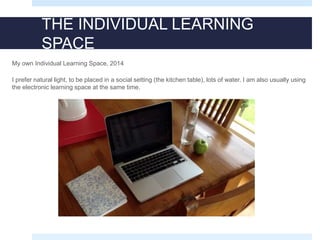
My own Individual Learning Space, 2014 
I prefer natural light, to be placed in a social setting (the kitchen table), lots of water. I am also usually using 
the electronic learning space at the same time.
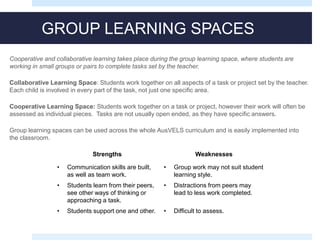
GROUP LEARNING SPACES 
Cooperative and collaborative learning takes place during the group learning space, where students are 
working in small groups or pairs to complete tasks set by the teacher. 
Collaborative Learning Space: Students work together on all aspects of a task or project set by the teacher. 
Each child is involved in every part of the task, not just one specific area. 
Cooperative Learning Space: Students work together on a task or project, however their work will often be 
assessed as individual pieces. Tasks are not usually open ended, as they have specific answers. 
Group learning spaces can be used across the whole AusVELS curriculum and is easily implemented into 
the classroom. 
Strengths Weaknesses 
• Communication skills are built, 
as well as team work. 
• Group work may not suit student 
learning style. 
• Students learn from their peers, 
see other ways of thinking or 
approaching a task. 
• Distractions from peers may 
lead to less work completed. 
• Students support one and other. • Difficult to assess.
GROUP LEARNING SPACES 
Cooperative Learning (Pinterest, 2013) 
Collaborative Learning Space 
(Pinterest, 2014)
| C O N C L U S I O N | 
For me as an up and coming teacher in the 21st century, I am able to see links between the five learning 
spaces, and how they will benefit the students in my class. 
The Classroom and School Learning Space are able to foster the Electronic Learning Space, Group 
Learning Space and Individual Learning Space. 
Within the Classroom Learning Space, students will continue to focus on the learning that takes place 
beyond the classroom. 
All learning spaces, excluding the Classroom, can be successfully used outside of the four walls, 
particularly the electronic learning space. 

| R E F E R E N C E L I S T | 
Cinar, I. (2010). Classroom geography: who sit where in the traditional classrooms?. The Journal of International 
Social Research, 3(10), 200-212. 
Education.vic.gov.au, (2014). Excursions and Activities. [online] Available at: 
http://www.education.vic.gov.au/school/principals/spag/safety/pages/excursions.aspx [Accessed 15 Sep. 2014]. 
Dolphin Discovery, (2014). http://dolphindiscovery.com.au/discover/school-excursions/. [image] Available at: 
http://dolphindiscovery.com.au/discover/school-excursions/ [Accessed 15 Sep. 2014]. 
iTeach, (n.d.). iPad Image. [image] Available at: http://www.iteach-uk.com/ [Accessed 16 Sep. 2014]. 
Lorenza, L. (2009). Beyond four walls: why go beyond the bounds of school? Teacher, 22-25. Retrieved from 
http://leo.acu.edu.au/course/view.php?id=12700 
Murray, O., & Olcese, N. (2011). Teaching and Learning with iPads, Ready or Not? TechTrends, 55(6), 42-48 
Pinterest, (2013). Cooperative Learning. [image] Available at: http://www.pinterest.com/pin/6473993187487582/ 
[Accessed 16 Sep. 2014]. 
Pinterest, (2014). Collaborative Learning Space. [image] Available at: 
http://www.pinterest.com/pin/544372673682528251/ [Accessed 16 Sep. 2014]. 
Pinterest, (2014). Students Using iPads. [image] Available at: http://www.pinterest.com/pin/542402348842329286/ 
[Accessed 15 Sep. 2014]
| R E F E R E N C E L I S T | 
Read, M.A. (2010). Contemplating design: listening to children’s preferences about classroom design. 
Creative Education, 2, 75-80. 
Scitech, (2014). Eye Control. [image] Available at: 
http://museumvictoria.com.au/scienceworks/whatson/science-fiction-science-future/ [Accessed 16 Sep. 
2014]. 
Slavin, R. (2010). Co-operative learning: what makes group-work work? The Nature of Learning: Using 
Research to Inspire Practice, OECD Publishing 
Smith, M. (2013). Self-direction in learning. [online] infed.org. Available at: http://infed.org/mobi/self-direction-in- 
learning/ [Accessed 16 Sep. 2014].

The Learning Spaces

  • 1.
    The Learning Spaces EDFD459 ASSIGNMENT 2 CHLOE BOURKE S00134947
  • 2.
    | I NT R O D U C T I O N | As with most things in the world around us educational settings and the way in which us as educators teach our students, is always evolving. An important part of our role as teachers is to be constantly adapting to such changes in order to give our students the best possible learning experience. There are five key learning spaces that are imperative in enhancing learners in the 21st century: The Classroom and The School Beyond the Classroom The Electronic Learning Space The Individual Learning Space Group Learning Spaces As we discover what each learning space has to offer, we will be exploring the strengths and weaknesses, the curriculum and pedagogy, as well as touching on the importance of each space on teachers and students.
  • 3.
    THE CLASSROOM ANDTHE SCHOOL The importance of a well-designed classroom and school setting is vital for learning in the 21st century, and allows the teacher to successfully meet the needs and learning styles of each student within the class. Read (2010) and Cinar (2010) outline a number of key factors that contribute to the design of a classroom which include, colour, materials, furnishings, temperature, walls and cabinetry. The traditional arrangement as shown in Figure 1, is generally hard to find in the 21st century classroom. Australian Curriculum and Victorian Essential Learning Standards: • Classroom design should be directly connected to the AusVELS curriculum, to promote student learning. • Traditional layouts will determine how much or little a student is engaged based on where they are seated (Cinar, 2010). • When planning lessons, teachers will need to think about the key factors above that will encourage student learning and help them to achieve AusVELS standards. Strengths Weaknesses • Multiple areas for students to learn, catering for different learning styles. • Overwhelming for some students. • Engaging, lot’s of discussion. • School funding may limit design. • Students become self-directed, concrete materials available. • Highly populated classes may hinder student participation.
  • 4.
    THE CLASSROOM ANDTHE SCHOOL Figure 1. (Cinar, 2010), Traditional Classroom, teacher centered. Figure 2. (Read, 2010), Stimulating Classroom, student centered.
  • 5.
    BEYOND THE CLASSROOM Effective student learning doesn’t necessarily always occur within the four walls of the classroom. There are such experiences that become both “novel and stimulating” (Lorenza, 2009) beyond the classroom. I am talking about excursions and incursions, where for example, students experience learning in settings such as parks, museums or while outdoors camping. • Excursions or incursions allow students and teachers to socialise and interact with people and places who they would not normally. • Excursions and incursions are easily able to be linked to classroom work and the curriculum. • Lorenza (2009) states “the learning process is enhanced when information is presented in context” Strengths Weaknesses • Offers new opportunities for students • High amount of organisation for schools and teachers. • Engaging, and connects to classroom learning. • Costs • New and exciting interactions, resources and information. • Finding time during the already hectic school schedule.
  • 6.
    BEYOND THE CLASSROOM (Dolphin Discovery, 2014) (Scitech, 2014)
  • 7.
    THE ELECTRONIC LEARNINGSPACE Technology nowadays is almost impossible to avoid, the accessibility and mobility of electronic devices is fast evolving and always changing or updating to allow for easier use. Technology is becoming more prominent in 21st century classrooms, with many schools installing smart boards, and using iPad’s to aide student learning. • AusVELS (2013) states that the use of ICT “focuses on providing students with the tools to transform their learning and to enrich their learning environment”, completing tasks in a different context. • “The number of portable computers in learning environments has exploded” as explained by Murray & Olcese (2011, suggesting that electronic devices are popular in classrooms. • This particular learning space is student directed, and also allows them to become more independent with their learning. Teachers are offered the chance to mix up their teaching styles. Strengths Weaknesses • Enhanced access to resources • Distraction from task at hand • Tools to build on student knowledge (apps) • Cyber dangers/safety – policies will need to be thought. • Use to store assessment (virtual student portfolios) • Students from low socio-economic may feel intimidated
  • 8.
    THE ELECTRONIC LEARNINGSPACE Students Using iPads (Pinterest, 2014) (iTeach, n.d.)
  • 9.
    THE INDIVIDUAL LEARNING SPACE There is no denying that each student has a different learning style and therefore may prefer to learn in different spaces to that of their peers. Individual learning spaces hold a number of different factors, helping students to decipher how best they learn as an individual. Lighting, sounds and social factors all play a roll in what makes up ones individual learning space. • The following statement can be applied to both adults and students in that we “should take control of [our] own learning and adopt self-directed inquiry as a lifelong priority”(Smith, 2013). • The space when engaged in self-directed learning should be one that allows students to successfully achieve their work. • Teachers need to be sure they are encouraging their students to find what works best for them and their learning. • It is important for students to be familiar with their own learning style, and what space helps them to achieve their learning goals to the best of their ability. Strengths Weaknesses • Creates self directed learners. • No support or guidance. • Students set goals and achieve them on their own terms. • Can’t easily clarify problems that arise.
  • 10.
    THE INDIVIDUAL LEARNING SPACE My own Individual Learning Space, 2014 I prefer natural light, to be placed in a social setting (the kitchen table), lots of water. I am also usually using the electronic learning space at the same time.
  • 11.
    GROUP LEARNING SPACES Cooperative and collaborative learning takes place during the group learning space, where students are working in small groups or pairs to complete tasks set by the teacher. Collaborative Learning Space: Students work together on all aspects of a task or project set by the teacher. Each child is involved in every part of the task, not just one specific area. Cooperative Learning Space: Students work together on a task or project, however their work will often be assessed as individual pieces. Tasks are not usually open ended, as they have specific answers. Group learning spaces can be used across the whole AusVELS curriculum and is easily implemented into the classroom. Strengths Weaknesses • Communication skills are built, as well as team work. • Group work may not suit student learning style. • Students learn from their peers, see other ways of thinking or approaching a task. • Distractions from peers may lead to less work completed. • Students support one and other. • Difficult to assess.
  • 12.
    GROUP LEARNING SPACES Cooperative Learning (Pinterest, 2013) Collaborative Learning Space (Pinterest, 2014)
  • 13.
    | C ON C L U S I O N | For me as an up and coming teacher in the 21st century, I am able to see links between the five learning spaces, and how they will benefit the students in my class. The Classroom and School Learning Space are able to foster the Electronic Learning Space, Group Learning Space and Individual Learning Space. Within the Classroom Learning Space, students will continue to focus on the learning that takes place beyond the classroom. All learning spaces, excluding the Classroom, can be successfully used outside of the four walls, particularly the electronic learning space. 
  • 14.
    | R EF E R E N C E L I S T | Cinar, I. (2010). Classroom geography: who sit where in the traditional classrooms?. The Journal of International Social Research, 3(10), 200-212. Education.vic.gov.au, (2014). Excursions and Activities. [online] Available at: http://www.education.vic.gov.au/school/principals/spag/safety/pages/excursions.aspx [Accessed 15 Sep. 2014]. Dolphin Discovery, (2014). http://dolphindiscovery.com.au/discover/school-excursions/. [image] Available at: http://dolphindiscovery.com.au/discover/school-excursions/ [Accessed 15 Sep. 2014]. iTeach, (n.d.). iPad Image. [image] Available at: http://www.iteach-uk.com/ [Accessed 16 Sep. 2014]. Lorenza, L. (2009). Beyond four walls: why go beyond the bounds of school? Teacher, 22-25. Retrieved from http://leo.acu.edu.au/course/view.php?id=12700 Murray, O., & Olcese, N. (2011). Teaching and Learning with iPads, Ready or Not? TechTrends, 55(6), 42-48 Pinterest, (2013). Cooperative Learning. [image] Available at: http://www.pinterest.com/pin/6473993187487582/ [Accessed 16 Sep. 2014]. Pinterest, (2014). Collaborative Learning Space. [image] Available at: http://www.pinterest.com/pin/544372673682528251/ [Accessed 16 Sep. 2014]. Pinterest, (2014). Students Using iPads. [image] Available at: http://www.pinterest.com/pin/542402348842329286/ [Accessed 15 Sep. 2014]
  • 15.
    | R EF E R E N C E L I S T | Read, M.A. (2010). Contemplating design: listening to children’s preferences about classroom design. Creative Education, 2, 75-80. Scitech, (2014). Eye Control. [image] Available at: http://museumvictoria.com.au/scienceworks/whatson/science-fiction-science-future/ [Accessed 16 Sep. 2014]. Slavin, R. (2010). Co-operative learning: what makes group-work work? The Nature of Learning: Using Research to Inspire Practice, OECD Publishing Smith, M. (2013). Self-direction in learning. [online] infed.org. Available at: http://infed.org/mobi/self-direction-in- learning/ [Accessed 16 Sep. 2014].