Flipkart Case Study 
By : - Abhinab Robert Rao, Anurag Bari, Nitish Sahu, 
Poonam Bachiyani, Tanuj Sethia
Online retailing 
 Online industry is booming in India. 
 The huge population is only one part of the story because of Low Internet usage, low 
credit card penetration, slow internet speeds and fulfillment issues. 
 It took time for the customers to adopt Modern Retail Outlets format like Reliance 
Fresh. 
 Then came yet another format : e-retailing. 
 It was really tough to break into this space because Indians were very skeptical about 
doing transactions online; providing their passwords , debit card number and all. 
 Schemes like Cash On Delivery & EMI system made it easy for the customers to get 
used to online purchase. 
 These online portals often sell at loss for getting the traffic in their website & getting 
them experience their service.
Consumer analysis 
 Time poor 
 Want everything at ease 
 Need a wide range of products to choose from 
 Need deliveries on time 
 Want their information to be kept confidential
Mission 
 Mission – Providing a delightful and memorable 
customer. 
 Vision – To become the Amazon of India. 
 Objective - Completely hassle free shopping 
experience with best prices in India.
Core Values 
 Customer Obsession 
 Ownership 
 Impact 
 Honesty 
 Selflessness 
 Communication 
 Innovation
Introduction of New Category 
Over the years in Flipkart 
 2007- Books 
 2010- Media. Mobile Phones & Accessories. 
 2011- Gaming and Console , Audio Players and TV, 
Personal and Health care, office Supplies, Home and 
Kitchen. 
 2012-Health and Beauty , Lifestyle, Toys, Posters, 
Apparels, Sport and fitness, Shoes.
Important factors 
 Order flow :- Customer -> Desktop, Mobile Site, 
Mobile Apps -> Flipkart page -> Place Order-> 
Confirm order. 
 Customer Policies-> Payment Options, Cancellation 
Policies , Refund Policies 
 Flipkart website Indian ranking 10. 
 Marketing:- Offline and Online Media both. 
 Result of marketing Initiatives:- Growth in traffic, 
Growth in orders received and Growth in revenue.
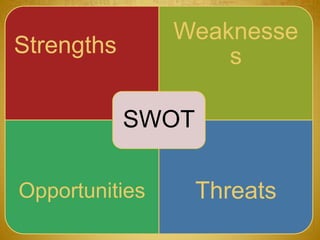
Strengths 
Weaknesse 
s 
SWOT 
Opportunities Threats
Strengths 
• Strong Brand Value 
• Own logistics arm e-Kart 
• Own Online payment gateway solution Payzippy. 
• Own Marketplace Model. 
• Acquisitions 
 Myntra. 
 Mime360 
 Weread. 
 Chakpak. 
 Letsbuy.com.
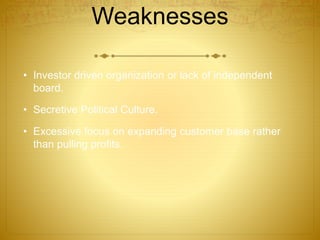
Weaknesses 
• Investor driven organization or lack of independent 
board. 
• Secretive Political Culture. 
• Excessive focus on expanding customer base rather 
than pulling profits.
Opportunities 
• Providing logistics services to its competitors. 
• Growth in online retail sector in India.
Threats 
 From competitors like Amazon, Snapdeal, Infibeam, 
Indiaplaza, Homeshop18 etc.
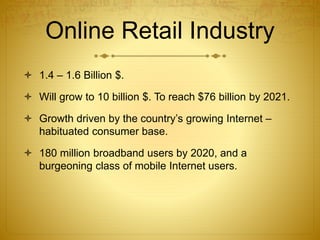
Online Retail Industry 
 1.4 – 1.6 Billion $. 
 Will grow to 10 billion $. To reach $76 billion by 2021. 
 Growth driven by the country’s growing Internet – 
habituated consumer base. 
 180 million broadband users by 2020, and a 
burgeoning class of mobile Internet users.
Major Challenges for 
Online Retailers 
 Customer Loyalty, Trust and Education. 
 Most of the customers prefer Cash on Delivery option 
instead of credit/debit card payment. 
 So, this makes online retailers to lose some of the 
cash as the delivery companies will keep the money 
for 15 days and later they pay to these online retail 
companies.
Porter’s Five Forces Framework 
of this Industry. 
 Supplier power: 
 In this industry, suppliers are the manufacturers of 
finished products like Nike, Dell, Apple etc. 
 Online retail companies sell various products ranging 
from books to computer accessories to apparels to 
footwear. 
 Since there are many suppliers for any particular 
category, they can’t show power on online retail 
companies.
 Buyer power: 
 Buyers in this industry are customers who purchase 
products online. Since this industry is flooded with so many 
players, buyers are having lot of options to choose. 
 Switching costs are also less for customers since they can 
easily switch from one online retail company to other one. 
 Same products will be displayed in several online retail 
websites. So, product differentiation is almost low. So, all 
these factors make customers to possess more power 
when compared to online retail companies.
 Threat of New Entrants: 
 Indian government is going to allow 51% FDI in multi-brand online retail and 
100% FDI in single brand online retail sooner or later. So, this means foreign 
companies can come and start their own online retail companies. 
 There are very less barriers to entry like less amount of money required to 
start a business, less amount of infrastructure required to start business. All 
you need is to tie up with suppliers of products and you need to develop a 
website to display products so that customers can order products, and a tie 
up with online payment gateway provider like bill desk. 
 Industry is also going to grow at a rapid rate. It is going to touch 76 billion $ 
by 2021. Industry is going to experience an exponential growth rate. So, 
obviously no one wants to miss this big opportunity.
 Threat of substitutes: 
 Substitute for this industry as of now is physical stores. 
Their threat is high for this industry. Though the customers 
are going for online purchases instead of going to physical 
stores as it will save time, effort, and money. But still many 
people still rely on retail stores. 
 When we compare relative quality, relative price of product 
that he/she buys online with physical store, both are almost 
same and in some cases, online discounts will be available 
which makes customers to buy products online.
 Rivalry with in Industry: 
 Competition is very high in this industry with so many 
players like Flipkart, Myntra, Jabong, Snapdeal, 
Amazon, Indiaplaza, Homeshop18 etc.
Environmental Analysis 
 Demographic trends: When it comes to online retail 
industry, for people to shop online, they need to have 
internet. India is third largest country when it comes to 
internet usage after U.S and China. Presently, above 
200 million people are using internet. Out of this, 110 
million people access internet through mobiles. In 
India, 8-10% of online users transact online. So, it 
means it comes to 20 million people. And also, with 
smart phones, tablets coming into picture, number of 
people who are going to use internet is going to be 
increased. This means, increase in the online retail 
usage in India.
 Socio-cultural Influences: 
• Culturally, Indians tend to buy the products in physical stores. They 
want to touch, feel the product before buying. 
• If the risk associated with product is very high, like in purchase of 
Television, Laptop, Washing Machine etc., they tend to go to physical 
store. 
• Indians will mostly influenced by peers, friends while purchasing the 
products. So, these factors are negatively affecting online retail 
industry. 
• But slowly, culture of buying is changing. They are going for online 
purchases but this rate is less when compared to offline purchase. But 
with 30 day replacement guarantee, if the product is not functioning 
properly, by E-commerce companies, and with the availability of peer’s 
or friend’s feedback about products online, they are slowly moving from 
offline to online purchases.
 Political-Legal factors: India is pushing for Foreign 
Direct Investment in Online Retail Industry.
 Technological Factors: 
 With the advancement of technology at a rapid pace, 
online retail industry is going to benefit a lot. 
 Several technological devices like smart phones, laptops, 
tablets etc. are going to help this online retail Industry 
because with the penetration of these devices, Indian 
consumers are going to purchase their products online. 
 Even Smart phone market is growing at a very rapid rate 
in India. 
 Since companies can gather the data about their 
customers when they are doing business with them, they 
can use these data to personalize the services by using 
predictive analytics
Competition 
 The competitors for Flipkart are not only the online 
portals but also the offline marketers like Reliance 
fresh , big bazaar , etc. 
 Flipkart is an attacker brand who has adopted flanker 
attack strategy to fight against competition from leader 
brands like amazon.
Actions recommended for 
Flipkart: 
 Since online retail is going to boom in the coming years, it is necessary for this industry to have 
logistics support. So, since Flipkart is already having its own logistics arm E-kart, it can provide 
this logistics service to its competitors in online retail industry. 
 In this type of industry, price matters a lot to customers. If same product is offered by two e-tailers 
at two different prices, customers will go for the lowest price. So, Flipkart should try to 
offer the products at lower prices. This can be done by optimizing its logistics services. Since 
logistics cost plays an important role in determining the price of the product. Filpkart should try 
to optimize its supply chain in such a manner that its supply chain costs should be very less and 
try to offer products at lower price compared to its competitors. 
 Predictive analytics are going to play a big role in the future.. So, Flipkart can use data about its 
customers like what are they buying, what are their buying patterns and can target them by using 
predictive analytics. For example, Amazon uses customer’s purchase history and suggests 
products according to it. 
 Flipkart can also employ relationship marketing into it. Instead of mainly focusing on customer 
acquisition, it should also focus on customer retention. Because loyal customers are more 
profitable when compared to new customers.

Flipkart analysis

  • 1.
    Flipkart Case Study By : - Abhinab Robert Rao, Anurag Bari, Nitish Sahu, Poonam Bachiyani, Tanuj Sethia
  • 2.
    Online retailing Online industry is booming in India.  The huge population is only one part of the story because of Low Internet usage, low credit card penetration, slow internet speeds and fulfillment issues.  It took time for the customers to adopt Modern Retail Outlets format like Reliance Fresh.  Then came yet another format : e-retailing.  It was really tough to break into this space because Indians were very skeptical about doing transactions online; providing their passwords , debit card number and all.  Schemes like Cash On Delivery & EMI system made it easy for the customers to get used to online purchase.  These online portals often sell at loss for getting the traffic in their website & getting them experience their service.
  • 3.
    Consumer analysis Time poor  Want everything at ease  Need a wide range of products to choose from  Need deliveries on time  Want their information to be kept confidential
  • 4.
    Mission  Mission– Providing a delightful and memorable customer.  Vision – To become the Amazon of India.  Objective - Completely hassle free shopping experience with best prices in India.
  • 5.
    Core Values Customer Obsession  Ownership  Impact  Honesty  Selflessness  Communication  Innovation
  • 6.
    Introduction of NewCategory Over the years in Flipkart  2007- Books  2010- Media. Mobile Phones & Accessories.  2011- Gaming and Console , Audio Players and TV, Personal and Health care, office Supplies, Home and Kitchen.  2012-Health and Beauty , Lifestyle, Toys, Posters, Apparels, Sport and fitness, Shoes.
  • 7.
    Important factors Order flow :- Customer -> Desktop, Mobile Site, Mobile Apps -> Flipkart page -> Place Order-> Confirm order.  Customer Policies-> Payment Options, Cancellation Policies , Refund Policies  Flipkart website Indian ranking 10.  Marketing:- Offline and Online Media both.  Result of marketing Initiatives:- Growth in traffic, Growth in orders received and Growth in revenue.
  • 8.
    Strengths Weaknesse s SWOT Opportunities Threats
  • 9.
    Strengths • StrongBrand Value • Own logistics arm e-Kart • Own Online payment gateway solution Payzippy. • Own Marketplace Model. • Acquisitions  Myntra.  Mime360  Weread.  Chakpak.  Letsbuy.com.
  • 10.
    Weaknesses • Investordriven organization or lack of independent board. • Secretive Political Culture. • Excessive focus on expanding customer base rather than pulling profits.
  • 11.
    Opportunities • Providinglogistics services to its competitors. • Growth in online retail sector in India.
  • 12.
    Threats  Fromcompetitors like Amazon, Snapdeal, Infibeam, Indiaplaza, Homeshop18 etc.
  • 13.
    Online Retail Industry  1.4 – 1.6 Billion $.  Will grow to 10 billion $. To reach $76 billion by 2021.  Growth driven by the country’s growing Internet – habituated consumer base.  180 million broadband users by 2020, and a burgeoning class of mobile Internet users.
  • 14.
    Major Challenges for Online Retailers  Customer Loyalty, Trust and Education.  Most of the customers prefer Cash on Delivery option instead of credit/debit card payment.  So, this makes online retailers to lose some of the cash as the delivery companies will keep the money for 15 days and later they pay to these online retail companies.
  • 15.
    Porter’s Five ForcesFramework of this Industry.  Supplier power:  In this industry, suppliers are the manufacturers of finished products like Nike, Dell, Apple etc.  Online retail companies sell various products ranging from books to computer accessories to apparels to footwear.  Since there are many suppliers for any particular category, they can’t show power on online retail companies.
  • 16.
     Buyer power:  Buyers in this industry are customers who purchase products online. Since this industry is flooded with so many players, buyers are having lot of options to choose.  Switching costs are also less for customers since they can easily switch from one online retail company to other one.  Same products will be displayed in several online retail websites. So, product differentiation is almost low. So, all these factors make customers to possess more power when compared to online retail companies.
  • 17.
     Threat ofNew Entrants:  Indian government is going to allow 51% FDI in multi-brand online retail and 100% FDI in single brand online retail sooner or later. So, this means foreign companies can come and start their own online retail companies.  There are very less barriers to entry like less amount of money required to start a business, less amount of infrastructure required to start business. All you need is to tie up with suppliers of products and you need to develop a website to display products so that customers can order products, and a tie up with online payment gateway provider like bill desk.  Industry is also going to grow at a rapid rate. It is going to touch 76 billion $ by 2021. Industry is going to experience an exponential growth rate. So, obviously no one wants to miss this big opportunity.
  • 18.
     Threat ofsubstitutes:  Substitute for this industry as of now is physical stores. Their threat is high for this industry. Though the customers are going for online purchases instead of going to physical stores as it will save time, effort, and money. But still many people still rely on retail stores.  When we compare relative quality, relative price of product that he/she buys online with physical store, both are almost same and in some cases, online discounts will be available which makes customers to buy products online.
  • 19.
     Rivalry within Industry:  Competition is very high in this industry with so many players like Flipkart, Myntra, Jabong, Snapdeal, Amazon, Indiaplaza, Homeshop18 etc.
  • 20.
    Environmental Analysis Demographic trends: When it comes to online retail industry, for people to shop online, they need to have internet. India is third largest country when it comes to internet usage after U.S and China. Presently, above 200 million people are using internet. Out of this, 110 million people access internet through mobiles. In India, 8-10% of online users transact online. So, it means it comes to 20 million people. And also, with smart phones, tablets coming into picture, number of people who are going to use internet is going to be increased. This means, increase in the online retail usage in India.
  • 21.
     Socio-cultural Influences: • Culturally, Indians tend to buy the products in physical stores. They want to touch, feel the product before buying. • If the risk associated with product is very high, like in purchase of Television, Laptop, Washing Machine etc., they tend to go to physical store. • Indians will mostly influenced by peers, friends while purchasing the products. So, these factors are negatively affecting online retail industry. • But slowly, culture of buying is changing. They are going for online purchases but this rate is less when compared to offline purchase. But with 30 day replacement guarantee, if the product is not functioning properly, by E-commerce companies, and with the availability of peer’s or friend’s feedback about products online, they are slowly moving from offline to online purchases.
  • 22.
     Political-Legal factors:India is pushing for Foreign Direct Investment in Online Retail Industry.
  • 23.
     Technological Factors:  With the advancement of technology at a rapid pace, online retail industry is going to benefit a lot.  Several technological devices like smart phones, laptops, tablets etc. are going to help this online retail Industry because with the penetration of these devices, Indian consumers are going to purchase their products online.  Even Smart phone market is growing at a very rapid rate in India.  Since companies can gather the data about their customers when they are doing business with them, they can use these data to personalize the services by using predictive analytics
  • 24.
    Competition  Thecompetitors for Flipkart are not only the online portals but also the offline marketers like Reliance fresh , big bazaar , etc.  Flipkart is an attacker brand who has adopted flanker attack strategy to fight against competition from leader brands like amazon.
  • 25.
    Actions recommended for Flipkart:  Since online retail is going to boom in the coming years, it is necessary for this industry to have logistics support. So, since Flipkart is already having its own logistics arm E-kart, it can provide this logistics service to its competitors in online retail industry.  In this type of industry, price matters a lot to customers. If same product is offered by two e-tailers at two different prices, customers will go for the lowest price. So, Flipkart should try to offer the products at lower prices. This can be done by optimizing its logistics services. Since logistics cost plays an important role in determining the price of the product. Filpkart should try to optimize its supply chain in such a manner that its supply chain costs should be very less and try to offer products at lower price compared to its competitors.  Predictive analytics are going to play a big role in the future.. So, Flipkart can use data about its customers like what are they buying, what are their buying patterns and can target them by using predictive analytics. For example, Amazon uses customer’s purchase history and suggests products according to it.  Flipkart can also employ relationship marketing into it. Instead of mainly focusing on customer acquisition, it should also focus on customer retention. Because loyal customers are more profitable when compared to new customers.

Editor's Notes

  • #6 By seeing the mission and values of the organization, we can infer that they are in sync with each other. For example, its mission statement reads out that it wants to provide customers with online memorable experience and one of its values is customer obsession. So, until and unless you are concerned about your customers or obsessed with your customers, you can’t provide delightful experience.
  • #9 Strentghs – Marketplace model where sellers need to register in this platform and buyers can negotiate with the sellers on varied service levels and it also helps company to reduce its own inventory. Flipkart will just deliver those products. Weakness – 1) Most of the money have been invested by Venture firms like Tiger global and Accel Partners. So, most of the decisions that are taken by founders of firm have to be approved by Investors. 2) They are recruiting hires which is creating problems in this company. Opportunity – If Flipkart offers its logistics services to its competitors, it can gain money from those transactions. As online commerce sector going to boom in the coming years, online transactions are going to increase.
  • #14 According to a recent TechnoPak Report.
  • #16 For example, if you take computers category, there are many suppliers like Dell, Apple, Lenovo, and Toshiba who wants to sell their products through these online retail companies. So, they won’t be having power to control the online retail companies. Online customers can select the products on their own and the switching costs in this case is zero. It is very difficult for manufacturers of finished products to come into this industry because of challenges in Logistics. Online retail industry is important to suppliers because it acts as one of the channel to sell the products. Now, with most of the customers in India purchasing online through online retail companies, they can’t afford to lose this channel. So, they can’t dictate terms with online retail companies. So, in this industry the supplier power is low.