“MARKETING ANALYSIS”
ON
Submitted in partial fulfilment of the requirement of
B.COM
IN
“BUSINESS RESEARCH METHODS AND PROJECT WORK”
Submitted by
T. Subham Sharaff
ROLL NO. BC16-120
EXAM ROLLNO.011603CM380
B.COM FINAL YEAR (2016 – 2019)
Under the guidance of
(Sri. Asis Kumar Sahu)
KHALLIKOTE AUTONOMOUS COLLEGE
BERHAMPUR (GANJAM)
PIN – 760001
Marketing Analysis on Flipkart
T. SUBHAM SHARAFF
1
CERTIFICATE
This is to certify that T. Subham Sharaff student of B.Com. Honours in
Accounting & Finance of Khallikote University has worked under my
supervision and guidance for his Project Work and prepared a Project
Report with the title MARKETING ANALYSIS ON FLIPKART which he is
submitting, is his genuine and original work to the best of my knowledge.
Signature:
Date: (Sri. Asis Kumar sahu)
Place: BERHAMPUR
Marketing Analysis on Flipkart
T. SUBHAM SHARAFF
2
DECLARATION
I hereby declare that the Project Work with the title “MARKETING
ANALYSIS ON FLIPKART” submitted by me under the guidance of Sri. Asis
Kumar Sahu for the partial fulfilment of the degree of B.Com. Honours in
Accounting & Finance under the KHALLIKOTE UNIVERSITY is my original
work and has not been submitted earlier to any other University
/Institution for the fulfilment of the requirement for any course of study.
I also declare that no chapter of this manuscript in whole or in part has
been incorporated in this report from any earlier work done by others or
by me. However, extracts of any literature which has been used for this
report has been duly acknowledged providing details of such literature
in the references.
Signature:
Name: T. Subham Sharaff
Registration No.:
Place: BERHAMPUR
Date:
Marketing Analysis on Flipkart
T. SUBHAM SHARAFF
3
ACKNOWLEGEMENT
Project work is never the work of an individual. It is more a combination
of ideas, suggestions, and contribution and work involving many jobs.
One of the most important parts of writing a report is the opportunity to
thank all those who have contributed to it. The list of expression of
thanks, no matter how extensive, is always incomplete and inadequate.
This acknowledgement is no exception.
I want to express my sincere gratitude towards who provided me with
her expert guidance and invaluable suggestion.
I would like to thank my classmates and all those who directly or
indirectly helped me in one or the other way in the successful completion
of the project.
T. Subham Sharaff
Marketing Analysis on Flipkart
T. SUBHAM SHARAFF
4
EXECUTIVE SUMMARY
The concept of e-commerce is downloading at a fairly rapid pace in the psyche of
the Indian consumer. In the metros, shortage of time is a big driver for online
shopping. On the other hand, accessibility to a variety of products makes audiences
from smaller towns and cities opt for the online route. Major retailers face
challenges in stocking their stores adequately. Often, customers are unable to
purchase items of their choice, thus prompting them to resort to e-retailers.
Flipkart has accorded a lot of importance in trust building exercise that is why it has
a strong Customer Support Team which helps the customers with the website
guidance and resolving issues.
Flipkart uses its in-house logistics (FKL) as well as third party logistics (3PL) services
as the logistics is one of the most important for a success of any ecommerce
venture. Along with the logistics, reverse logistics of Flipkart is also well developed
with a 30 day return policy and flipkart bearing courier charges for returned
products.
Flipkart when it started employed the consignment model of procurement as it was
the most risk free way to operate but then they changed to Inventory model to
ensure superior delivery times. But with foreign direct investment (FDI) favoring
the marketplace model in April2013, Flipkart changed its business model to
marketplace model.
WS Retail a pet project of Flipkart now handles the inventory and warehouse
management. Flipkart has continued to fare very well in terms of the delivery time
because of their developed supply chain management and dedicated customer
support team to ensure customer delight.
This causes them to build a lot of slack into their existing systems causing higher
costs at several points in the supply chain. How they address this challenge is what
will determine their future success.
Marketing Analysis on Flipkart
T. SUBHAM SHARAFF
5
CONTENTS:- Page
CHAPTER 1 INTRODUCTION:- 7
1. Introduction of Company
2. Importance of Study
3. Scope of Study
4. Research Methodology
5. Limitations
CHAPTER 2 COMPANY PROFILE: 12
1. Finance
2. Acquisitions
3. Awards and Recognitions
4. In House Products
CHAPTER 3 MARKETING STRATEGY OF FLIPKART 16
1. Market Overview
2. SWOT Analysis
3. Major Competitors
4. Market Segmentations
5. Market positioning
6. Poter’s 5 Factors
7. Flipkart PLUS
8. Future Road Map
CHAPTER 4 SUPPLY CHAIN MANAGEMENT 32
1. Introduction
Marketing Analysis on Flipkart
T. SUBHAM SHARAFF
6
2. Logistics
3. Procurement
4. Inward Processing
5. Storage Management
6. Inventory Management
7. Outward Processing
8. Order Fulfilment
9. Supplier Management
10.Customer Support
CHAPTER 5 Flipkart’s Current Overview 43
1. Flipkart + Walmart
2. Vision
3. Mission
4. Market Position
5. More about Flipkart
Suggestions: 45
Conclusion: 46
Questionnaire: 47
Bibliography: 50
Marketing Analysis on Flipkart
T. SUBHAM SHARAFF
7
CHAPTER 1
INTRODUCTION:
Things are easier said than done!
To realize our dreams and that
also in such a grand manner is
really a tough task. The founders
of Flipkart have probably
conquered their dreams with the amazing success of Flipkart.
Flipkart is something which has really opened up the Indian e-commerce market
and that also in a big way.
Flipkart was co-founded by SACHIN BANSAL and BINNY BANSAL in Oct 2007. Both
are graduates from IIT-Delhi and have prior work experience in Amazon.com They
both were solid coders and wanted to open a portal that compared different e-
commerce websites, but there were hardly any such sites in India and they decided
to give birth to their own e-commerce venture - Flipkart.com
Thus was born Flipkart in Oct 2007 with an initial investment of 4 lac (co-founders
savings). It was never going to be easy since India has bad past experiences with e-
commerce trading. It was not an easy segment to break into, people were very
particular in paying money for something which they had not seen and received.
The trust was missing in the Indian customers. So what Flipkart had to do was to
instill trust and faith in their customers. And they did exactly the same,
will discuss more on how they did so later in the post.
Flipkart began with selling books, since books are easy to procure, target market
which reads books is in abundance, books provide more margin, are easy to pack
and deliver, do not get damaged in transit and most importantly books are not very
expensive, so the amount of money a customer has to spend to try out one's service
for one time is very minimal. Flipkart sold only books for the first two years.
Marketing Analysis on Flipkart
T. SUBHAM SHARAFF
8
Flipkart started with the consignment model (procurement based on demand) i.e.
they had ties with 2 distributors in Bangalore, whenever a customer ordered a
book, they used to personally procure the book from the dealer, pack the book in
their office and then courier the same. In the initial months the founder's personal
cell numbers used to be the customer support numbers. So, in the start they tried
their best to provide good service, focus on the website - easy to browse and order
and hassle-free, and strove hard to resolve any customer issues. Since there were
not any established players in the market, this allowed them a lot of space to grow,
and they did in fact grew very rapidly.
Flipkart had a revenue of 4 crore in FY 2008 - 2009, 20 crore in FY 2009 - 2010, 75
crore in FY 2010 - 2011, and the revenue for FY 2011 - 2012 which ends on 31 Mar
2012 is expected to be 500 crore. This is indeed a massive growth. The company
targets revenues of 5000 crore by 2015.
The company started from 2 employees and now has around 4500 employees.
Flipkart started with consignment model as discussed above, since most of the
customer issues like delivery delays etc. result from procurement model, the
company started opening its own warehouses as it started getting more
investments. The company opened its first warehouse in Bangalore and later on
opened warehouses in Delhi, Kolkata and Mumbai. Today the company works with
more than 500 suppliers. As on date more than 80% orders of Flipkart are handled
via warehouses which help in quick and efficient service.
A humble beginning from books, Flipkart now has a gamut of products ranging
from: Cell phones, laptops, computers, cameras, games, music, audio players, TV's,
healthcare products, washing machines etc. etc. Still, Flipkart derives around 50%
of its revenue from selling books online.
Flipkart is the Indian market leader in selling books both offline and online, it enjoys
an online share of around 80%. The electronic items have a large number of players
like Naaptol, Letsbuy, Indiaplaza, Tradus, Infibeam, Yebhi etc. The electronic
market share is distributed among them in different unknown proportions.
Marketing Analysis on Flipkart
T. SUBHAM SHARAFF
9
India has around 13.5 crore internet users today where as the number of homes
with Cable and Satellite (C&S) television is 10.5 crore. The expected internet users
will reach a figure of 30 crore by 2014 and C&S homes are expected to be 14 crore
by 2014. Thus India has a tremendous internet growth and with the customers
getting accustomed to e-commerce, the future of ecommerce sector is definitely
rosy. An approximated 25 lac people have transacted online this year, the number
is all set to increase with time.
Also to mention most of the Flipkart customers use internet from PC's/Laptops to
order goods. The use of mobile internet is very less at the moment, but with the
advent of smart phones the use of mobile internet for e-commerce transactions
will soar with time. India has 8 crore mobile net users at the moment, the number
is expected to swell to 22.5 crore by 2014.
Importance of Study
1. To know the Overview of the Flipkart Company
2. To analyse Reputation of the company in market
3. To analyse Consumer Perception towards the services
4. To analyse Competitors in the market
Scope of Study:
This study examines the success of Flipkart.com in utilizing 4P’s of products and
services to satisfy its online customers. It also focuses on the techniques of
Segmentation, Targeting and Positioning (STP) by online marketers in India.
Research Methodology & Objectivity:
The research was conducted to know the various factors of services offers by
Flipkart which affected the satisfaction level of customers and to measure the
availability of Products at the Web Portal of Flipkart.
Marketing Analysis on Flipkart
T. SUBHAM SHARAFF
10
Descriptive research is also called Statistical Research. The main goal of this type
of research is to describe the data and characteristics about what is being studied.
The idea behind this type of research is to study frequencies, averages, and other
statistical calculations. Although this research is highly accurate, it does not gather
the causes behind a situation. Descriptive research is mainly done when a
researcher wants to gain a better understanding of a topic for example, a frozen
ready meals company learns that there is a growing demand for fresh ready meals
but does not know much about the area of fresh food and so has to carry out
research in order to gain a better understanding. It is quantitative and uses surveys
and panels and also the use of probability sampling. Descriptive research is the
exploration of the existing certain phenomena. The details of the facts won’t be
known. The existing phenomena facts are not known to the persons.
To determine and measure the satisfaction level in the services provided
by Flipkart among the customers. To measure the availability of several stuffs at
the web portal of Flipkart. To aware the customers about the services and offers
provided by Flipkart with the special reference to Flipkart. To improve the
availability of several stuffs at the web portal and influence the customers to
access Flipkart for shopping.
Limitation of Study:
Almost attention was taken to eliminate any kind of biasness & misinterpretation
in the study to get optimum result, even though the following limitations could
have certain degree of impact on the findings.
➢ The study was confined to Delhi region only which may not represent the
real picture of the entire Delhi.
➢ Many Delivery Boys were not interested to participate in this research
study.
➢ Data collected about satisfaction & awareness level may not represent
the real picture.
➢ My Study is confined only 100 respondents.
➢ Lack of the research experience.
➢ The major problem is to find out the consumers of Flipkart as my study is
Marketing Analysis on Flipkart
T. SUBHAM SHARAFF
11
to find out the satisfaction level of the services provides by Flipkart to its’
consumers.
➢ Many consumers were also not get ready to participate in the research
study.
Interesting Statistics about the company:
• As of today, Flipkart employs over 4500 people.
• It experiences 2 million unit sales and 4 million unique visitors per month
with sales growing at 25% per month, eyeing a $50 million run rate.
• With close to 11.5 million titles, Flipkart is the largest online book retailer in
India with 80 per cent market share.
• It has a registered user base of two million customers and ships out as
many as 30,000 items a day, clocking daily sales of Rs 2.5 crore.
• Flipkart is rapidly expanding its network of warehouses, distribution centers,
procurement operations and 24/7 customer support teams. The company
even has its own delivery network in 27 cities and is set to expand this even
further by next year.
Marketing Analysis on Flipkart
T. SUBHAM SHARAFF
12
CHAPTER 2
Company Profile:
Finance:
Initially, the founders had spent 400,000 only for making website to set up the
business. Flipkart has later raised funding from venture capital funds Accel
India (US$1 million in 2009) and Tiger Global (US$10 million in 2010 and US$20
million in June 2011).
On 24 August 2012, Flipkart announced the completion of its 4th round of $150
million funding from MIH (part of Naspers Group) and ICONIQ Capital. The
company announced, on 10 July 2013, that it has raised an additional $200 million
from existing investors including Tiger Global,Naspers, Accel Partners and Iconiq
Capital.
Flipkart's reported sales were 40 million in FY 2008–2009, 200 million in FY 2009–
2010 and 750 million for FY 2010–2011. In FY 2011–2012, Flipkartis set to cross the
5 billion (US$100 million) mark as Internet usage in the country increases and
people get accustomed to making purchases online. Flipkart projects its sales to
reach 10 billion by year 2014. On average, Flipkart sells nearly 10 products per
minute and is aiming at generating a revenue of 50 billion (US$0.81 billion) by 2015.
On November 2012, Flipkart became one of the companies being probed for
alleged violations of FDI regulations of the Foreign Exchange Management Act,
1999.
In July 2013, Flipkart raised USD 160 million from private equity investors. In
October 2013, it was reported that Flipkart had raised an additional $160 million
from new investors Dragoneer Investment Group, Morgan Stanley Wealth
Management, Sofina SA and Vulcan Inc. with participation from existing investor
Tiger Global. On 26 May 2014, Flipkart announced that it has raised $210 million
from Yuri Milner’s DST Global and its existing investors Tiger Global, Naspers and
Iconiq Capital. In early July 2014, it was also highly speculated that Flipkart was
in negotiations to raise at least $500 million, for a likely listing in the US for 2016.
Marketing Analysis on Flipkart
T. SUBHAM SHARAFF
13
On 29 July 2014, Flipkart announced that it raised $1 billion from Tiger Global
Management LLC, Accel Partners, and Morgan Stanley Investment Management
and a new investor Singapore sovereign-wealth fund GIC.
On 6 October 2014, Flipkart sold products worth INR 650Crore in 10 hours in a
special one-day event - "The Big Billion Day", claiming they had created ecommerce
history, but their hard-won reputation for good customer service suffered because
of technical problems, and angry reactions on social media from buyers
disappointed with the pricing and availability of products. It claimed to sell a
whopping 5 lakh mobile handsets, five-lakh clothes and shoes and 25,000 television
sets within hours of opening its discounted sale at 8 AM. In December 2014, after
it received $700 million from another funding, Flipkart had a marketcap of $11
billion or Rs.66000 crore.
ACQUISITIONS
2010:
WeRead, a social book discovery tool. The stated goal was to give Flipkart a social
recommendation platform for buyers to make informed decisions based on
recommendations from people within their social network.
2011:
Mime360, a digital content platform company.
2011:
Chakpak.com is a Bollywood news site that offers updates, news,photos and
videos. Flipkart acquired the rights to Chakpak‘s digital catalogue which includes
40,000 filmographies, 10,000 movies and close to 50,000 ratings. Flipkart has
categorically said that it will not be involved with the original site and will not use
the brand name.
Marketing Analysis on Flipkart
T. SUBHAM SHARAFF
14
2012:
Letbuy.com is India‘s second largest E-retailer in electronics. Flipkart
bought the company for an estimated US$ 25 million.
2014:
Acquired Myntra.com in an estimated INR 2,000 crore deal.
Awards and Recognition:
• Co-Founder of Flipkart Sachin Bansal, got Entrepreneur of the Year Award
2012-2013 from Economic Times, leading Indian Economic Daily.
• Flipkart.com was awarded Young Turk of the Year at CNBC TV 18's 'India
Business Leader Awards 2012' (IBLA).
• Flipkart.com- got nominated for India MART Leaders of Tomorrow Awards
2011.
Marketing Analysis on Flipkart
T. SUBHAM SHARAFF
15
• Flipkart.com, secured second position in the List of Cheapest Mobile Store
2013, compiled by Indian e-commerce observer Zoutons.com.
In- House Products
• In July 2014 Flipkart launched its own set of tablet, mobile phones
& Phablet. The first among these series of tablet phones was Digiflip Pro
XT 712 Tablet.
• In July 2014 Flipkart launched its first networking router, under its own
brand name named DigiFlip WR001 300 Mbit/s Wireless N Router.
• In September 2014 Flipkart launched its in-house home appliances and
personal healthcare brand Citron. The label includes a wide range of
cooking utilities and grooming products.
Marketing Analysis on Flipkart
T. SUBHAM SHARAFF
16
CHAPTER 3
Market Strategies of Flipkart:
MARKET OVERVIEW
India has an internet user base of
about
250.2 million as of June 2014. The
penetration of e-commerce is low
compared to markets like the United
States and the United Kingdom but is
growing at a much faster rate with a
large number of new entrants. The
industry consensus is that growth is at
an inflection point. Unique to India (and potentially to other developing
countries), cash on delivery is a preferred
payment method. India has a vibrant cash economy as a result of which 80% of
Indian ecommerce tends to be Cash on Delivery. However, COD may harm e-
commerce business in India in the long run and there is a need to make a shift
towards online payment mechanisms.
Similarly, direct imports constitute a large component of online sales. Demand for
international consumer products (including long-tail items) is growing much faster
than in-country supply from authorized distributors and e-commerce offerings.
India's e-commerce market was worth about $2.5 billion in 2009, it went up to $6.3
billion in 2011 and to $14 billion in 2012. About 75% of this is travel related (airline
tickets, railway tickets, hotel bookings, online mobile recharge etc.). Online
Retailing comprises about 12.5% ($300 Million as of 2009) India has close to 10
million online shoppers and is growing at an estimated 30% CAGR vis-à-vis a global
growth rate of 8–10%. Electronics and Apparel are the biggest categories in terms
of sales.
Marketing Analysis on Flipkart
T. SUBHAM SHARAFF
17
Key drivers in Indian e-commerce are:
• Increasing broadband Internet (growing at 20% MoM) and 3G penetration.
• Rising standards of living and a burgeoning, upwardly mobile middle class
with high disposable incomes
• Availability of much wider product range (including long tail and Direct
Imports)
• compared to what is available at brick and mortar retailers
• Busy lifestyles, urban traffic congestion and lack of time for offline shopping
• Lower prices compared to brick and mortar retail driven by
disintermediation and reduced inventory and real estate costs
• Increased usage of online classified sites, with more consumer buying and
selling secondhand goods India's retail market is estimated at $470 billion in
2011 and is expected to grow to $675 billion by 2016 and $850 billion by
2020, – estimated CAGR of 7%.
According to Forrester, the ecommerce market in India is set to grow the fastest
within the Asia-Pacific Region at a CAGR of over 57% between 2012–16.
As per "India Goes Digital", a report by Avendus Capital, a leading Indian Investment
Bank specializing in digital media and technology sector, the Indian e-commerce
market is estimated at Rs 28,500 Crore ($6.3 billion) for the year 2011. Online travel
constitutes a sizable portion (87%) of this market today. Online travel market in
India is expected to grow at a rate of 22% over the next 4 years and reach Rs 54,800
Crore ($12.2 billion) in size by 2015.
Indian e-tailing industry is estimated at Rs 3,600 crore (US$800 mn) in 2011 and
estimated to grow to Rs 53,000 Crore ($11.8 billion) in 2015. Overall e-commerce
market is expected to reach Rs 1, 07,800 crores (US$24 billion) by the year 2015
with both online travel and e-tailing contributing equally. Another big segment in
ecommerce is mobile/DTH recharge with nearly 1 million transactions daily by
operator websites.
Marketing Analysis on Flipkart
T. SUBHAM SHARAFF
18
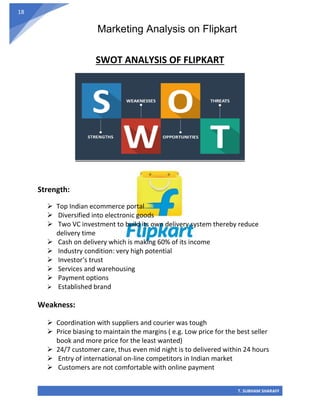
SWOT ANALYSIS OF FLIPKART
Strength:
➢ Top Indian ecommerce portal
➢ Diversified into electronic goods
➢ Two VC investment to build its own delivery system thereby reduce
delivery time
➢ Cash on delivery which is making 60% of its income
➢ Industry condition: very high potential
➢ Investor‘s trust
➢ Services and warehousing
➢ Payment options
➢ Established brand
Weakness:
➢ Coordination with suppliers and courier was tough
➢ Price biasing to maintain the margins ( e.g. Low price for the best seller
book and more price for the least wanted)
➢ 24/7 customer care, thus even mid night is to delivered within 24 hours
➢ Entry of international on-line competitors in Indian market
➢ Customers are not comfortable with online payment
Marketing Analysis on Flipkart
T. SUBHAM SHARAFF
19
➢ Not profitable operationally
➢ Time to build confidence among the customers
➢ Middle management retention issues.
Opportunities:
➢ Already working towards customer delight will obtain customer loyalty
gradually
➢ Supplier database interface with flipkart website for JIT procurement
➢ Mobile internet usage is increasing there by chances of increase in sales
through mobile shopping.
➢ Development of m-commerce in the e-market
➢ Increasing internet penetration
➢ Target social medias to reach young population
➢ High interest among VC/PE.
Threats:
➢ Small players and emerging competitor
➢ In capabilities to manage certain costs like delivery cost, bank charges
➢ High competition from major international online retailers
➢ Capture of alternative market by competitors
➢ Major players like AMAZON.
Marketing Analysis on Flipkart
T. SUBHAM SHARAFF
20
MAJOR COMPETITIORS
Amazon.com is an American international electronic commerce company with
headquarters in Seattle, Washington, United States. It is the world's largest
internet company, based on revenue and number of employees.
Snapdeal.com is an online marketplace, headquartered in New Delhi, India. The
company was started by Kunal Bahl and Rohit Bansal, in February 2010.
eBay Inc., is an American multinational corporation and e-commerce company,
providing consumer-to-consumer sales services via Internet. It is headquartered
in San Jose, California, United States.
HomeShop18 is an online and on-air retail and distribution venture of Network 18
Group, India.HomeShop18 was launched on 9 April 2008 as India's first 24-hour
Home Shopping TV channel.
Marketing Analysis on Flipkart
T. SUBHAM SHARAFF
21
Yebhi.com is an Indian Online shopping E-commerce portal for Home, Lifestyle &
Fashion e-retailer, launched in the year 2009.
MARKET SEGMENTATION
The process of defining and subdividing a large homogenous market into clearly
identifiable segments having similar needs, wants, or demand characteristics. Its
objective is to design a marketing mix that precisely matches the expectations of
customers in the targeted segment.
Few companies are big enough to supply the needs of an entire market; most
must breakdown the total demand into segments and choose those that the
company is best equipped to handle.
The four basic market segmentation-strategies are based on
GEOGRAPHIC SEGMENTATION –
• CATERS TO TIER 1, TIER 2 AND TIER 3 CITIES
DEMOGRAPHIC SEGMENTATION –
• 75% of online users between the age group of 15-34 years.
• Flipkart targets mainly the youth of the country,
BEHAVIOURAL SEGMENTATION –
• Web friendly people.
Marketing Analysis on Flipkart
T. SUBHAM SHARAFF
22
PSYCHOGRAPHIC SEGMENTATION –
• Flipkart concentrates on more Psychographic, which helps in deciding
where to display ads online
• They target online shoppers and people who don‘t online shop (thus TVC
to encourage them)
MARKET POSITIONING
An effort to influence consumer perception of a brand or product relative to the
perception of competing brands or products. Its objective is to occupy a clear,
unique, and advantageous position in the consumer's mind.
Points of parity:
• Easy locating of products
• Competitive prices.
• No hassles of going to shops personally and shop for products
• Availability of various products on one platform
• Discount on purchases.
• Home delivery
• Gifting services
• Cash on delivery
• Availability of liquor
• Flipifts
• Academic related books
Points of Difference:
• Flipkart membership cards for premium customers
• Vernacular language
• Better user interface-one drag approach
Marketing Analysis on Flipkart
T. SUBHAM SHARAFF
23
MARKETING STRATEGIES
• Word of mouth (initial marketing even now they want to satisfy customer
so they come back for more)
• Good use of SEO
• “We DO NOT sell old books or used books. All the books listed at Flipkart.com
are new books. The books listed at Flipkart.com are NOT available for free
download in e-book or PDF format”
• Thus when you search free e-books or pdf books old or used books flipkart
will be displayed.
• Good use of SEM
• Ads at proper places and use pay per click to pay for ads
• Very easy web interface
• Payment convenience
• Cash/card on delivery – there by encouraging students and people with no
credit/debit card to purchase in flipkart, with mobile internet penetration
there is chances of capturing rural market (60% revenue by COD)
• EMI –by targeting price sensitive customers
• Wallet – customer can recharge money online and purchase then and when
needed those entering details always is rectified, target heavy purchase and
luxury customer
Marketing Analysis on Flipkart
T. SUBHAM SHARAFF
24
• Customer conversion rate is so high more than 70% Personalization of the
user page
• Product recommendation with your previous purchases
Poter’s 5 forces
Bargain power of suppliers (low):
➢ The readers are reducing thus suppliers are in weak position Inventory
turnover is lower, thus more inventory again flipkart is at the upper hand
Bargain of Buyers (high):
➢ Not many buyers
➢ Best deals online
➢ Cash on delivery
➢ One stop solution
➢ Faster delivery with free shipping cost
Threat of New entries (high):
➢ Market potential for this industry is high
➢ Low entry barriers, but sustaining is tough
Threat of substitutes (Low):
➢ Diminishing brick and mortar model
➢ Increasing customer ease and customer satisfaction
Industry rivals (Medium):
➢ Many small players (snapdeal, naaptol ..)
➢ Entry of international players like Amazon into India
Marketing Analysis on Flipkart
T. SUBHAM SHARAFF
25
Flipkart- 4’Ps
Product:
• Aims most segments except automobiles and groceries.
• Website is great, easy to use, easy to browse through the products, add
products to wishlist or to a cart, get product reviews and opinions, pre-order
products, make convenient payments using different methods and better
Search Engine Optimization.
• Quality level of the products is absolutely fine E.g., If we take the quality of
books available in Crossword and Landmark is same as the quality of books
ordered by Flipkart.com.
• Products are packed in such a way that they are Tamper proof, weather
proof and breakage proof.
• Product line on Flipkart.com have warranties as promised by the brand of
the product if applicable. E.g., Bajaj MX 2 1200 WattsIron with 2 Years Bajaj
India Warranty and extra paid warranty for the particular brand is available
if applicable.
• 30-day replacement guarantee for faulty products. (Video for the same).
• Product line is extensive one as discussed earlier. Derives around 50% of its
revenue from selling books online.
• Flipkart as a brand has already differentiated itself as a pioneer in book
retailer, trustworthy in terms of swift services and secure payments, quality-
oriented products with lower price offerings than retail market), innovative
product line, customer delightful service which has helped them to form its
Marketing Analysis on Flipkart
T. SUBHAM SHARAFF
26
own distinctive image better than few unheard competitors such as
Tradus.in and Indiaplaza.com.
• Some unique product features of Flipkart.com such as Wishlists, E-gift
Voucher.
• Flipkart launched a new Electronic Wallet feature that allows shoppers to
purchase credit to their Flipkart account using creditor debit cards,and can
subsequently be utilized to make purchases on the site, as and when
required.
PRICE:
• Price of the product taking account of various expenses such as Supplier
expenses, transportation expenses, Packaging expenses, Shipping expenses,
Courier expenses, inventory maintenance expense, office and stationery
expenses, sales and advertisement expenses, taxes, depreciation, discount
allowances and many more expenses.
• Roughly about 5-7% profit per book orders which indicates that generation
of revenue is on volume basis.
• Differentiated themselves by giving best selections, best services at lowest
best possible prices.
• Discounts up to 35% across all categories
• Upper edge in competitive pricing
• Special discount for loyal customers and regular buyers.
• As shipping is within India the shipping cost reduces, which indirectly reduces
the overall cost for the company and thus company offers less price as
compared to other players.
Marketing Analysis on Flipkart
T. SUBHAM SHARAFF
27
• Free shipping overall Indian boundaries after certain amount of purchase
done from the site and even without minimum purchase for the regular and
loyal customers.
• For expensive products transit cost is borne by company
• Maximum discounts in the occasional time like Diwali, Eid etc.
• Pricing would always differ if you are buying from e-commerce sites and
Shopping Malls, reason for that is the middleman charges and the cost of
store which increases the price of the particular product.
PLACE:
• Channel type: Words of mouth (if we can say that) which has been key
driver for their growth.
• When an order is placed they either serve the order from their inventory or
procure the book on demand from various suppliers and then deliver the
customer.
• As on date more than 80% orders of Flipkart are handled via warehouses
which help in quick and efficient service.
• We deliver orders in 1 day in Tier-I cities and 2-3 days in Tier II cities and 3-5
days Tier III cities.
• Shipping and Courier would act as intermediaries in this process.
• Delivery services through e-kart and postal services
• Tie ups with local vendors and courier firms (thereby avoiding octroi
charges)
Marketing Analysis on Flipkart
T. SUBHAM SHARAFF
28
• Company owned warehouse in major cities near airport.
• Trying to achieve minimum returns.
• If the courier can‘t delivery to the location the product is shipped through
government post.
Warehouses are located in the following cities, often near airports:
➢ Bangalore
➢ Chennai
➢ Delhi
➢ Hyderabad
➢ Mumbai
➢ Noida
➢ Pune
➢ Kolkata.
PROMOTIONS:
• Employees of divisions like Website, Business Planning and Analytics, ERP,
Business Development, Product Management and Marketing, Supply-Chain
Management and Customer Support are generating revenue for it.
• Selection Criteria at Flipkart:-While years of experience are always beneficial
for a candidate, Flipkart's focus is to hire those who are able to consistently
raise the bar and introduce a variety of innovation to move this organization
forward. As Flipkart grows, we feel it is absolutely necessary that our
employees are also able to grow professionally with the organization.
• Adequate Training as per their roles and responsibilities is given to them
accordingly and incentives
Marketing Analysis on Flipkart
T. SUBHAM SHARAFF
29
• Telephone Sales force is only 2% of the total employees focusing to reduce
the unsold/goods not much in demand
• Majority of Flipkart are employed in Customer support division.
• It is the only customer support division in India having 24x7customer support
functioning for issues such as regarding choice of the product to purchase,
shipping, courier, how to order on website, mode of payment, gift voucher,
order status & cancellation and returns.
• Having even tie up with Skype for the same on the website for user delight.
• Unique tool of Sales Promotion is Affiliate on their website.
• As internet/web strategy used Google Ad-words, blogs, social networking
sites such as twitter, facebook, used Google ad-words, e-mail campaigns.
• Launched their second campaign “No kidding. No worries” that we are
serious about our promises we make and experience shopping safely,
delightfully and with ease.
One more latest Promotions i.e Flipkart Plus Zone:
Marketing Analysis on Flipkart
T. SUBHAM SHARAFF
30
Benefits of Flipkart Plus
Flipkart Plus is Flipkart’s loyalty program that customers can subscribe to without
having to pay an additional fee. It can be used on the website as well as the mobile
app. The Plus program will offer you a host of benefits like free delivery on certain
products, faster delivery time, early access to big sales and other discounts.
If you have accumulated over 50 coins and become a member of Flipkart Plus, then
these are the others rewards you will get:
1. A ₹1,000 voucher on Flipkart
2. A ₹1,200 voucher on BookMyShow
3. An annual subscription to Hotstar Premium
4. An annual subscription to Zomato Gold
5. A ₹1,100 gift card for MakeMyTrip
In addition to having access to free and fast delivery and early access to sales,
Flipkart Plus is also offering some more cool advantages that extend beyond the
website/app itself.
PEOPLE:
• Service people, Sales Clerks, Delivery drivers, Managers, Complaints
department, accounting, Warranty people, Technical people, all work for the
customer ease, customer satisfaction and customer delight,
Marketing Analysis on Flipkart
T. SUBHAM SHARAFF
31
• Customer service centers for complaints and review,
• Investors,
• Employees schemes.
FUTURE ROAD MAP
✓ They aim at 10 times growth and eyes at $ 1Billion sales by 2015.
✓ They will look at bigger investments in their supply chain and technology.
✓ Investment will be made in large warehouses and increased automation of
their process, so that the product is not delayed.They intend to enter in to
various new categories and expand their current categories as well.
✓ Everything except for groceries and automobiles will be available on Flipkart
in future.To go further in the value chain, Flipkart is looking at associations
with a larger number of suppliers and partners, both nationally and
internationally.
Marketing Analysis on Flipkart
T. SUBHAM SHARAFF
32
CHAPTER 4
SUPPLY CHAIN MANAGEMENT:
The company structure of Flipkart is divided into three broad categories. First is
Product and technology which is the core team of the company, second is Business
Development which is related to sales and third is Operations which deals with the
supply chain management of the company.
Product and Technology Team
The product and technology team is the core strength of the company. The team
manage the entire process right from listing of item to search engine optimization
to maintenance of website.
Business Development Team
Business development team is responsible for all the activities related to sales
including vendor management to pricing and discount strategy.
Operations Team
Operations team deals with all the supply chain aspects of the company right
from procurement and warehouse management till customer support. The team
support the customers both online via telephone as well as offline via email.
Customer Support team
Flipkart has a strong focus on customer service with customer delight as the top
most priority. And to fulfil it the company guarantees a 24/7 full customer support
and to cater this facility it has a dedicated customer support team which offers both
inbound and outbound support. Bn
Logistics
Logistics is one of the most important facets of any successful ecommerce venture.
Flipkart ships more than 100000 items a day which makes management of the
logistics a cumbersome task for the company. Furthermore, the cost of the delivery
is born by the company itself making logistics a financially complex issue also.
Marketing Analysis on Flipkart
T. SUBHAM SHARAFF
33
Hence in order to successfully manage logistics. Flipkart uses its in-house logistics
known as „eKart‟ (EKL).
The e-commerce company created eKart as a separate brand to serve WS- Retail,
the B2C side of Flipkart, in April 2013 and currently reaches consumers in about
150 cities. eKart currently offers services such as delivery logistics, reverse logistics
and pay on delivery. It also offers customer support and technology integration for
order tracking, customer notifications, reporting and analysis, billing etc. In March
2014, Flipkart began to deliver packages for its competitors, as the company's
logistics arm; eKart Logistics opens services for other e-tail ventures.
While more than 90% of the Cash on delivery (COD) shipments and about 60-70%
of the overall shipments are delivered by the EKL the rest of shipments are catered
by 3PL service providers. Moreover, if there are more than 100 deliveries for a
particular destination the company uses EKL. In case of EKL, the shipment is first
transported to Mother hub and then to delivery hub and subsequently from
delivery hub the last mile delivery is done using suitable mode of transport such as
two-wheelers, bicycles, or on foot. The company has tie-ups with more than 15
courier companies like Blue Dart, First Flight etc. to deliver their products and
Indian post for areas where couriers do not reach. And to manage the 3PL providers
efficiently the company allocates time slots to different logistics partners and they
can pick up deliveries on specified time slots only.
Developing its in house logistics has helped Flipkart save commissions‟ worth than
2% that would have been otherwise paid to courier firms. It is also easily able to
accept cash on delivery, which make up about 60 percent of its orders. It can also
track packages more accurately. And because labour costs are relatively low in
India, its delivery cost is a modest ₹65 a package.
For delivering the items the logistics service among the three is decided based on
the area where the item needs to be delivered as well as product type and payment
method. EKL is presently available in major tier 1 cities including metros only. The
company uses India Post only in case if the shipment location is not serviced by any
of the 3PL as well as EKL primarily because of the higher delivery time. Moreover,
India Post orders are of prepaid nature only. The delivery time varies between 3
days to 3 weeks depending on the location and availability of the product.
Marketing Analysis on Flipkart
T. SUBHAM SHARAFF
34
For example imported products take about 3 weeks‟ time to get delivered to the
customers whereas if product is available in local warehouse it gets deliver within
3 days. The mode of transportation is also dependent on the location. For example,
the inter-city, trans-zone deliveries are made using air cargo whereas satellite cities
and others in close proximity; products are transported overnight by train or truck.
For the local parts of the cities where the warehouses of the company exist
products are delivered using two-wheelers, bicycles, or on foot depending upon
the proximity of the place.
Reverse logistics / returns processing:
The returns for Flipkart are 2.6%. If follows a 30 day return policy. This policy which
is primarily aimed to build trust with the consumers, has led to many customers
duping Flipkart.
For example there have been several incidents when a customer buys a book only
to read it and then return it within 30 days. Similar incidents have been observed
with mobile phones as well.
Flipkart, through its data management systems, has tried to identify such frauds.
Return of a product to Flipkart can happen if the 3rd party cannot deliver to the
address or the customer does not accept the product. Some orders are cancelled
while the delivery is being processes by the courier company. Such orders are not
recalled but delivered to the address and then cancelled. Customers can call the
customer support and courier back the product to Flipkart.The delivery cost is
borne by Flipkart.
When a customer requests return of a product, there are 3 paths this request can
take:
1. Replacement: Flipkart returns the product to the supplier and obtains a
replacement that is delivered to the customer.
Marketing Analysis on Flipkart
T. SUBHAM SHARAFF
35
2. Store credit: If the customer is not satisfied with the product, he or she is
given store credit of the same amount.
3.Actual cash-back: Given out as cash for cash-on-delivery payment or
refunded for online payment.
Procurement
When Flipkart started its operations, they had employed the consignment model
of procurement. In this model, the retailer (in this case Flipkart) holds the inventory
owned by the supplier and buys it from the supplier only when it is sold to the end
consumer. Since the channel was new and unproven, this was the most risk-free
way to operate. Later this was discontinued and inventory was purchased to ensure
superior delivery times and customer satisfaction. But with foreign direct
investment (FDI) favouring the marketplace model in April 2013, Flipkart changed
its business model to marketplace model.
With a marketplace model, Flipkart no longer has an inventory of its own, rather
buyers can deal with sellers directly and the delivery will be done by Flipkart. The
model is similar to eBay India and Amazon.in At present, the entire inventory of
Flipkart is being managed by WS Retail which is flipkart‟s pet project. While WS
Retail will continue to be one of the sellers, Flipkart has added more than 50 sellers
to its list.
Procurement of items could be for:
Inventory: These items are pre-ordered based on previous sales data to stock as
inventory. This category includes items with relatively low demand elasticity, fast
selling items and items with relatively long shelf life.
Just in-time: Items procured just-in-time are used to serve immediate outstanding
orders. Items with low or unpredictable demand are typically procured on an order-
to-order basis. Just-in-time procurement is also used for expensive items or
products that have seen slow sales growth.
Marketing Analysis on Flipkart
T. SUBHAM SHARAFF
36
As of now, the number of orders served from the inventory is roughly 75%, with
25% orders being served by procuring just-in-time. Procuring just-in-time is
comparatively more expensive as the volumes for such orders are low, and the
supplier discount offered therefore is considerably lower. However when ordering
for inventory, bulk purchase is made and hence a much better price is realised.
Therefore the company would ideally like to move to a ratio of 9:1 ratio of orders
served through inventory to those procured just-in-time.
As a caveat however, there is an inherent trade-off between the company’s long
term objective of reducing just-in-time procurement, and its motto of “Consumer
Delight”. This is because in order to maximize consumer delight, the company
would have to strive to serve all types of consumer orders and provide them with
the maximum possible variety of products, which would require just-in-time
procurement since many products have limited demand and cannot be stored as
inventory. However, operational efficiency demands rationalisation of product line
and choosing one’s customers.
Sourcing at Flipkart is conducted at two levels:
Regional: By Regional Procurement Teams
Centre: By the Central Procurement Team
Each regional procurement team has a network of local suppliers for made-to-stock
as well as on on-demand (Just in-time) procurement. They also have visibility of the
stock for different SKUs with these suppliers, as last updated on the procurement
teams system by these suppliers. From Flipkart’s perspective:
Stock out: Defined as when the product is unavailable in the inventory (held in
warehouses) as well as Flipkart‟s suppliers (as last updated) The central
procurement team has visibility of all the regional procurement teams‟ views, and
therefore can monitor the stock levels for their suppliers all over the country. The
central team’s focus is on bigger suppliers with a country-wide reach.
Marketing Analysis on Flipkart
T. SUBHAM SHARAFF
37
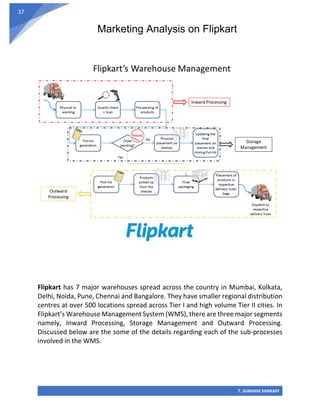
Flipkart has 7 major warehouses spread across the country in Mumbai, Kolkata,
Delhi, Noida, Pune, Chennai and Bangalore. They have smaller regional distribution
centres at over 500 locations spread across Tier I and high volume Tier II cities. In
Flipkart’s Warehouse Management System (WMS), there are three major segments
namely, Inward Processing, Storage Management and Outward Processing.
Discussed below are the some of the details regarding each of the sub-processes
involved in the WMS.
Marketing Analysis on Flipkart
T. SUBHAM SHARAFF
38
Inward Processing
Physical inwarding:
This is the area where physical delivery of goods from suppliers to the warehouse
is taken.
Quality Check + Scan:
As soon as the goods are received, they go through an initial quality check at this
stage. After this, they are scanned to make an electronic entry to record the input
of goods into the warehouse on the IT systems. This step of quality check is also
undertaken at the supplier’s premises depending on the contract that Flipkart has
with them.
Pre-packing of products:
At this stage, an initial packing of each of the products is done. This pre-packing
varies according to product. For instance, a book-mark and think transparent film
packing will be done for a book. Similarly, if there is a freebie attached to a product,
then the two products will be packed together.
Storage Management
Put-list generation: When the input of all products is done on the IT systems, a
system generated list of shelves corresponding to the products is generated to
facilitate placement of products on shelves. This is called Put-list generation, which
marks the place where the respective items need to be put.
Order pending check: As soon as the system gets the input of the incoming
products, system checks if any of the orders for the incoming products are pending
or not. If orders are pending, the respective product is sent directly to the Final
Packaging Area for Outward Processing.
Physical placement on shelves: Based on the Put-list, the products are placed on
the respective shelves. If the marked shelves are not empty, the product is put on
an empty shelf, and the respective shelf number is updated on the Put-list.
Closing Put-list: Once the product placement is done, Put-list is updated with the
actual placement information and the list is Closed.
Marketing Analysis on Flipkart
T. SUBHAM SHARAFF
39
Outward Processing
Pick-list generation: Based on the orders to be delivered for the day, a Pick-list is
generated by the IT system.
Pick-up from shelves: The respective products from the Pick-list are picked up from
the shelves as per the IT system entries and gathered together to move towards
Final Packaging Area.
Final packaging: The picked-up products are packed in Flipkart-branded boxes. At
this stage, packaging is done according to the Category of the product, e.g.,
electronic items are packed differently from stationery. Placement in respective
delivery hubs’ bags: After the final packaging, a product is placed in a specific bag
which is dedicated for that destination area delivery hub. These bags are
dispatched to their respective delivery hubs on a fixed timing during the day.
Issues at the Warehouse Management level:
All the scans while conducting inward processing for each of the products are done
manually. There is some scope of automation at this stage. Due to packaging litter,
there emerge chances of difficulty in mobility within the warehouse. Disposal of
packing material may be addressed for better streamlining and ease of mobility.
Currently, there are separate sections for separate categories in the storage area,
e.g., in the Bangalore warehouse, a whole floor is dedicated to books, while the
other floor is dedicated to other categories. With the increase in the number of
SKUs that Flipkart is undertaking for sale, the Warehouse management system’s
complexity will increase and its scalability in the current form might come under
question. Hence, pre-emptive efforts may be made to make sure that the systems
and processes are scalable based on increasing variety and quantity of SKUs
handled.
Order Processing
Flipkart uses its own ERP systems to process orders and track the details of all the
transactions that need to be carried out. A typical order at Flipkart starts with the
Marketing Analysis on Flipkart
T. SUBHAM SHARAFF
40
customer searching, selecting the required item and placing the order. This on an
average takes around 8-10 clicks to get the order placed. The email Id is considered
to be the unique identification of a customer and all the records are maintained
with reference to this Id.
The payment can be made by using debit card, debit card, Net-banking or COD
(Cash on Delivery). Flipkart launched its payments brand called PayZippy in July
2013 to provide safe and hassle free payment option to its customers and online
merchants.
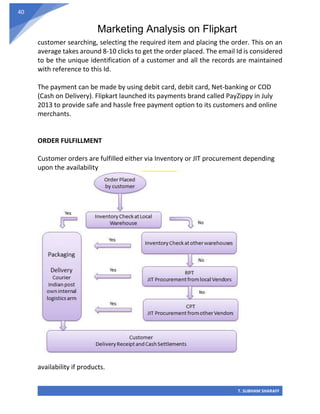
ORDER FULFILLMENT
Customer orders are fulfilled either via Inventory or JIT procurement depending
upon the availability
availability if products.
Marketing Analysis on Flipkart
T. SUBHAM SHARAFF
41
As soon as the order is placed and approved, there is an inventory check done at
the local warehouse. If the item is not found at the local warehouse, then the order
goes to the nearest and then other warehouses. The product is then packaged and
delivered to the customer. If the item is not found in the inventory it is forwarded
to the Regional Procurement Team (RPT) for JIT procurement from local vendors.
If yet not possible, the order goes to the central procurement team (CPT) for the
last option of procurement. After procuring from the vendor, the product is
packaged and delivered to the customer via the most convenient warehouse. They
have an understanding with their vendors for order tracking, reconciliation and MIS
(Management Information Systems).
Flipkart, with its focus on customer delight, ensures an excellent after-sales service
to its customers with regard to the delivery and/or addressing grievances related
to any faulty or unsatisfactory products. The return of such items is done in an
effective manner without any disputes. This is possible given the understanding
with the vendors. For example, in case of electronics, warranty and after-sales
service is largely manufacturer‟s responsibility. Whenever required, Flipkart
facilitates a smooth interaction between the customer and manufacturer/service
centre. Flipkart varies between one day guaranteed delivery and three weeks
depending on location and availability of product.
Inventory Management
The inventory stocks are replenished whenever it goes below Reorder point. The
company employs FIFO (First In First Out) method for its inventory management,
under which for any shipment request to a particular warehouse the oldest
inventory items are shipped first. This makes a lot of sense especially for the
electronics items since the technology becomes obsolete very quickly.
With respect to determining what items to store in the warehouse and what items
to be procured from vendors, Flipkart uses Long Tail Concept, which is nothing but
selling a large number of unique items with relatively small quantities. Flipkart
orders such items on adhoc basis and usually don’t keep inventory of such items
since the demand for such items is very less and thereby minimizing overall
distribution and inventory costs.
Marketing Analysis on Flipkart
T. SUBHAM SHARAFF
42
Supplier Management
Flipkart has always operated on the philosophy of starting out small and then
scaling up as demand grows. It has been the same with selection of suppliers. For
a new category, they generally start of by sourcing from local suppliers and
distributors. Once there is enough demand generated, they approach the larger
wholesalers or manufacturers directly. This serves two main purposes:
• It helps them to get better deals from the bigger manufacturers if they can
order in larger quantities frequently enough.
• It avoids the channel conflict dilemma that large suppliers face when they
agree to similar terms with a smaller volume online player like Flipkart as
compared to an established offline distributor.
Customer Support:
Customer Support function for an e-commerce website is one of the most
important touch-points for the business in terms of building trust, customer
acquisition and maintaining customer loyalty. Flipkart’s Customer Support team
consists of call-centre agents who handle in-bound and outbound calls and also a
team that handles e-mail queries. The entire team is based out of Bangalore and
forms a core part of Flipkart‟s 6,000-strong employee base. Given that Flipkart
tries to differentiate itself on superior shopping experience and customer service is
an integral part of that – Flipkart prefers to train its own support staff rather than
outsourcing the function to a BPO agency.
At present, a customer calls due to one of the below reasons:
• Sales Assistance,
• General Enquiries,
• Product/Shipping related enquiry.
Marketing Analysis on Flipkart
T. SUBHAM SHARAFF
43
CHAPTER 5
FLIPKART’S CURRENT OVERVIEW
Flipkart and Walmart
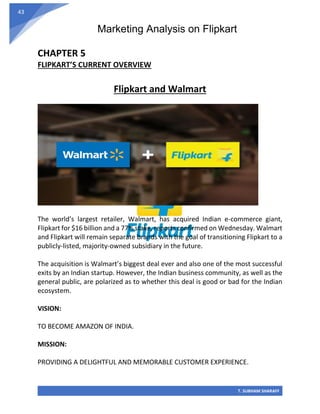
The world’s largest retailer, Walmart, has acquired Indian e-commerce giant,
Flipkart for $16 billion and a 77% stake, reports confirmed on Wednesday. Walmart
and Flipkart will remain separate brands with the goal of transitioning Flipkart to a
publicly-listed, majority-owned subsidiary in the future.
The acquisition is Walmart’s biggest deal ever and also one of the most successful
exits by an Indian startup. However, the Indian business community, as well as the
general public, are polarized as to whether this deal is good or bad for the Indian
ecosystem.
VISION:
TO BECOME AMAZON OF INDIA.
MISSION:
PROVIDING A DELIGHTFUL AND MEMORABLE CUSTOMER EXPERIENCE.
Marketing Analysis on Flipkart
T. SUBHAM SHARAFF
44
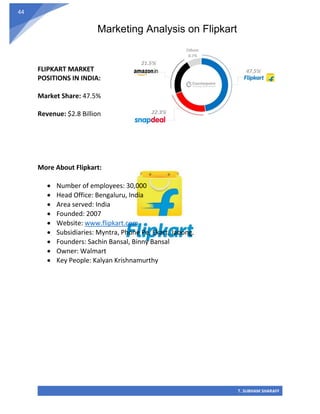
FLIPKART MARKET
POSITIONS IN INDIA:
Market Share: 47.5%
Revenue: $2.8 Billion
More About Flipkart:
• Number of employees: 30,000
• Head Office: Bengaluru, India
• Area served: India
• Founded: 2007
• Website: www.flipkart.com
• Subsidiaries: Myntra, Phone Pe, Ekart, Jabong.
• Founders: Sachin Bansal, Binny Bansal
• Owner: Walmart
• Key People: Kalyan Krishnamurthy
Marketing Analysis on Flipkart
T. SUBHAM SHARAFF
45
SUGGESTIONS
Flipkart has successfully placed itself into the prospects mind making it the India‘s
largest online store with huge range of products. But Flipkart still needs to work on
their core competence that is books and stationery items. With the entry of
Amazon.com it will be a huge competitive market for Flipkart and hence will have
to position itself better, as we still see that huge percentage of females are still
unaware of Flipkart. Those female who purchase, has a very less frequency which
has remained unchanged. Therefore they need to get aggressive at providing better
services which can be fulfilled by reducing the delivery time, selling second hand
products which will increase consumers‘ affordability much more and enhance
penetration into the market.
They can even have their retail stores which can give an access to consumers to feel
and analyze the products, which will help them win the consumers faith. Price will
still be a factor as amazon being a huge company will use its economies of scale to
remove their competitors from the market; therefore they need to be more
competitive on that aspect. Be very focused on consumers and build amazing
experiences for the customers.
Marketing Analysis on Flipkart
T. SUBHAM SHARAFF
46
CONCLUSION
A credible rival can do wonders to an enterprise and Flipkart is no different. The
entry of Amazon in India has enabled Flipkart develop a lot of in-house innovation
and organically developed best-practices - that have now become the industry
standard.
Flipkart began operations on the consignment model; goods were procured from
suppliers on demand, based on the orders received through the website. Later,
the books-to-electronics e-shop adopted the warehouse model. The company had
its own warehouses, and maintained its own inventory. However in July 2013,
Flipkart launched its model of marketplace just one month after Amazon
launched its marketplace in India.
It introduced payments brand PayZippy for online merchants and customers
seeking fast, hassle free and safe payment options. Some 70 per cent of its
shipments are done by its own logistics company and about half of deliveries are
on a cash-on-delivery basis.
Flipkart has recently introduced the next day guarantee delivery service and
shopping from its own mobile application. Given the critical mass of transactions
Flipkart controls - about 100,000 a day - the company is betting that it has the
volumes to lay the foundation of what will be a profitable business.
Last but not the least; Flipkart has very clearly prioritized customer delight as its
chief avenue for customer acquisition and retention. This causes them to build a
lot of slack into their existing systems causing higher costs at several points in the
supply chain. How they address this challenge is what will determine their future
success.
Marketing Analysis on Flipkart
T. SUBHAM SHARAFF
47
QUESTIONNAIRE
Thank You for participating in this Survey. I am a student of Undergraduate course
at Khalikote university. The information provided by you will be kept fully
confidential and will not be used for any other commercial purpose except
academic learning.
Q1) Gender?
Male Female
Q2) Do you access any website for online shopping?
Yes No
Q3) Which company website do you access for online shopping?
Snapdeal Amazon
Flipkart Junglee
Homeshop18 Any other
(TERMINATE THIS INTERVIEW IF ANSWER IS NOT “FLIPKART”)
Q4) From where did you come to know about Flipkart?
TV Ads News Paper Ads
Hoardings Internet Ads
Any others please Specify……………………………………………….
Marketing Analysis on Flipkart
T. SUBHAM SHARAFF
48
Q5) Since how long are you accessing Flipkart?
Less than 1 Month
to 6 Month
7 to 12 Month
More than a Year
Q6) Did you get any offer from Flipkart?
Yes No
Q7) Do you agree on Flipkart’s claim that it’s every products are 100%
Genuine?
Yes No
Q8) What is your view on services offered by Flipkart?
Good Poor
Q9) What is your view on offers provided by Flipkart?
Satisfied Not Satisfied
Q10) Do you believe that at Flipkart’s web portal all several stuffs are always
available?
Yes No
Can’t say
Q11) Are you satisfied with the behaviour of Delivery boys?
Satisfied Not Satisfied
Marketing Analysis on Flipkart
T. SUBHAM SHARAFF
49
Q12) Are you satisfied with the after sales services of Flipkart?
Satisfied Not Satisfied
Q13) What is view on price strategy of Flipkart?
Satisfied Not Satisfied
Q14) After rating above questions your overall satisfaction toward Flipkart?
Highly satisfied Satisfied
Neither satisfied nor dissatisfied Dissatisfied
Highly Dissatisfied
Marketing Analysis on Flipkart
T. SUBHAM SHARAFF
50
BIBLIOGRAPHY
www.flipkart.com
www.thehindu.com/features/magazine/the-flipkart.../article3290735.ece
http://articles.economictimes.indiatimes.com/2013-10-15/news/43068552_1_marketplacesflipkart-
online
http://academic.reportlinker.com/d012905924/The-Indian-E-commerce-Industry.html
www.startupdunia.com/interview-with-flipkart-founder-binny-bansal-776
www.facebook.com/flipkart
www.hindustantimes.com/technology/industrytrend/how-flipkart-broke-indias-online-
shoppinginertia/so-article1-780440.aspx
THANK YOU
Name: T. Subham Sharaff
RollNo: BC16-120
Exam RollNo:011603CM380

Marketing Analysis Fipkart

  • 1.
    “MARKETING ANALYSIS” ON Submitted inpartial fulfilment of the requirement of B.COM IN “BUSINESS RESEARCH METHODS AND PROJECT WORK” Submitted by T. Subham Sharaff ROLL NO. BC16-120 EXAM ROLLNO.011603CM380 B.COM FINAL YEAR (2016 – 2019) Under the guidance of (Sri. Asis Kumar Sahu) KHALLIKOTE AUTONOMOUS COLLEGE BERHAMPUR (GANJAM) PIN – 760001
  • 2.
    Marketing Analysis onFlipkart T. SUBHAM SHARAFF 1 CERTIFICATE This is to certify that T. Subham Sharaff student of B.Com. Honours in Accounting & Finance of Khallikote University has worked under my supervision and guidance for his Project Work and prepared a Project Report with the title MARKETING ANALYSIS ON FLIPKART which he is submitting, is his genuine and original work to the best of my knowledge. Signature: Date: (Sri. Asis Kumar sahu) Place: BERHAMPUR
  • 3.
    Marketing Analysis onFlipkart T. SUBHAM SHARAFF 2 DECLARATION I hereby declare that the Project Work with the title “MARKETING ANALYSIS ON FLIPKART” submitted by me under the guidance of Sri. Asis Kumar Sahu for the partial fulfilment of the degree of B.Com. Honours in Accounting & Finance under the KHALLIKOTE UNIVERSITY is my original work and has not been submitted earlier to any other University /Institution for the fulfilment of the requirement for any course of study. I also declare that no chapter of this manuscript in whole or in part has been incorporated in this report from any earlier work done by others or by me. However, extracts of any literature which has been used for this report has been duly acknowledged providing details of such literature in the references. Signature: Name: T. Subham Sharaff Registration No.: Place: BERHAMPUR Date:
  • 4.
    Marketing Analysis onFlipkart T. SUBHAM SHARAFF 3 ACKNOWLEGEMENT Project work is never the work of an individual. It is more a combination of ideas, suggestions, and contribution and work involving many jobs. One of the most important parts of writing a report is the opportunity to thank all those who have contributed to it. The list of expression of thanks, no matter how extensive, is always incomplete and inadequate. This acknowledgement is no exception. I want to express my sincere gratitude towards who provided me with her expert guidance and invaluable suggestion. I would like to thank my classmates and all those who directly or indirectly helped me in one or the other way in the successful completion of the project. T. Subham Sharaff
  • 5.
    Marketing Analysis onFlipkart T. SUBHAM SHARAFF 4 EXECUTIVE SUMMARY The concept of e-commerce is downloading at a fairly rapid pace in the psyche of the Indian consumer. In the metros, shortage of time is a big driver for online shopping. On the other hand, accessibility to a variety of products makes audiences from smaller towns and cities opt for the online route. Major retailers face challenges in stocking their stores adequately. Often, customers are unable to purchase items of their choice, thus prompting them to resort to e-retailers. Flipkart has accorded a lot of importance in trust building exercise that is why it has a strong Customer Support Team which helps the customers with the website guidance and resolving issues. Flipkart uses its in-house logistics (FKL) as well as third party logistics (3PL) services as the logistics is one of the most important for a success of any ecommerce venture. Along with the logistics, reverse logistics of Flipkart is also well developed with a 30 day return policy and flipkart bearing courier charges for returned products. Flipkart when it started employed the consignment model of procurement as it was the most risk free way to operate but then they changed to Inventory model to ensure superior delivery times. But with foreign direct investment (FDI) favoring the marketplace model in April2013, Flipkart changed its business model to marketplace model. WS Retail a pet project of Flipkart now handles the inventory and warehouse management. Flipkart has continued to fare very well in terms of the delivery time because of their developed supply chain management and dedicated customer support team to ensure customer delight. This causes them to build a lot of slack into their existing systems causing higher costs at several points in the supply chain. How they address this challenge is what will determine their future success.
  • 6.
    Marketing Analysis onFlipkart T. SUBHAM SHARAFF 5 CONTENTS:- Page CHAPTER 1 INTRODUCTION:- 7 1. Introduction of Company 2. Importance of Study 3. Scope of Study 4. Research Methodology 5. Limitations CHAPTER 2 COMPANY PROFILE: 12 1. Finance 2. Acquisitions 3. Awards and Recognitions 4. In House Products CHAPTER 3 MARKETING STRATEGY OF FLIPKART 16 1. Market Overview 2. SWOT Analysis 3. Major Competitors 4. Market Segmentations 5. Market positioning 6. Poter’s 5 Factors 7. Flipkart PLUS 8. Future Road Map CHAPTER 4 SUPPLY CHAIN MANAGEMENT 32 1. Introduction
  • 7.
    Marketing Analysis onFlipkart T. SUBHAM SHARAFF 6 2. Logistics 3. Procurement 4. Inward Processing 5. Storage Management 6. Inventory Management 7. Outward Processing 8. Order Fulfilment 9. Supplier Management 10.Customer Support CHAPTER 5 Flipkart’s Current Overview 43 1. Flipkart + Walmart 2. Vision 3. Mission 4. Market Position 5. More about Flipkart Suggestions: 45 Conclusion: 46 Questionnaire: 47 Bibliography: 50
  • 8.
    Marketing Analysis onFlipkart T. SUBHAM SHARAFF 7 CHAPTER 1 INTRODUCTION: Things are easier said than done! To realize our dreams and that also in such a grand manner is really a tough task. The founders of Flipkart have probably conquered their dreams with the amazing success of Flipkart. Flipkart is something which has really opened up the Indian e-commerce market and that also in a big way. Flipkart was co-founded by SACHIN BANSAL and BINNY BANSAL in Oct 2007. Both are graduates from IIT-Delhi and have prior work experience in Amazon.com They both were solid coders and wanted to open a portal that compared different e- commerce websites, but there were hardly any such sites in India and they decided to give birth to their own e-commerce venture - Flipkart.com Thus was born Flipkart in Oct 2007 with an initial investment of 4 lac (co-founders savings). It was never going to be easy since India has bad past experiences with e- commerce trading. It was not an easy segment to break into, people were very particular in paying money for something which they had not seen and received. The trust was missing in the Indian customers. So what Flipkart had to do was to instill trust and faith in their customers. And they did exactly the same, will discuss more on how they did so later in the post. Flipkart began with selling books, since books are easy to procure, target market which reads books is in abundance, books provide more margin, are easy to pack and deliver, do not get damaged in transit and most importantly books are not very expensive, so the amount of money a customer has to spend to try out one's service for one time is very minimal. Flipkart sold only books for the first two years.
  • 9.
    Marketing Analysis onFlipkart T. SUBHAM SHARAFF 8 Flipkart started with the consignment model (procurement based on demand) i.e. they had ties with 2 distributors in Bangalore, whenever a customer ordered a book, they used to personally procure the book from the dealer, pack the book in their office and then courier the same. In the initial months the founder's personal cell numbers used to be the customer support numbers. So, in the start they tried their best to provide good service, focus on the website - easy to browse and order and hassle-free, and strove hard to resolve any customer issues. Since there were not any established players in the market, this allowed them a lot of space to grow, and they did in fact grew very rapidly. Flipkart had a revenue of 4 crore in FY 2008 - 2009, 20 crore in FY 2009 - 2010, 75 crore in FY 2010 - 2011, and the revenue for FY 2011 - 2012 which ends on 31 Mar 2012 is expected to be 500 crore. This is indeed a massive growth. The company targets revenues of 5000 crore by 2015. The company started from 2 employees and now has around 4500 employees. Flipkart started with consignment model as discussed above, since most of the customer issues like delivery delays etc. result from procurement model, the company started opening its own warehouses as it started getting more investments. The company opened its first warehouse in Bangalore and later on opened warehouses in Delhi, Kolkata and Mumbai. Today the company works with more than 500 suppliers. As on date more than 80% orders of Flipkart are handled via warehouses which help in quick and efficient service. A humble beginning from books, Flipkart now has a gamut of products ranging from: Cell phones, laptops, computers, cameras, games, music, audio players, TV's, healthcare products, washing machines etc. etc. Still, Flipkart derives around 50% of its revenue from selling books online. Flipkart is the Indian market leader in selling books both offline and online, it enjoys an online share of around 80%. The electronic items have a large number of players like Naaptol, Letsbuy, Indiaplaza, Tradus, Infibeam, Yebhi etc. The electronic market share is distributed among them in different unknown proportions.
  • 10.
    Marketing Analysis onFlipkart T. SUBHAM SHARAFF 9 India has around 13.5 crore internet users today where as the number of homes with Cable and Satellite (C&S) television is 10.5 crore. The expected internet users will reach a figure of 30 crore by 2014 and C&S homes are expected to be 14 crore by 2014. Thus India has a tremendous internet growth and with the customers getting accustomed to e-commerce, the future of ecommerce sector is definitely rosy. An approximated 25 lac people have transacted online this year, the number is all set to increase with time. Also to mention most of the Flipkart customers use internet from PC's/Laptops to order goods. The use of mobile internet is very less at the moment, but with the advent of smart phones the use of mobile internet for e-commerce transactions will soar with time. India has 8 crore mobile net users at the moment, the number is expected to swell to 22.5 crore by 2014. Importance of Study 1. To know the Overview of the Flipkart Company 2. To analyse Reputation of the company in market 3. To analyse Consumer Perception towards the services 4. To analyse Competitors in the market Scope of Study: This study examines the success of Flipkart.com in utilizing 4P’s of products and services to satisfy its online customers. It also focuses on the techniques of Segmentation, Targeting and Positioning (STP) by online marketers in India. Research Methodology & Objectivity: The research was conducted to know the various factors of services offers by Flipkart which affected the satisfaction level of customers and to measure the availability of Products at the Web Portal of Flipkart.
  • 11.
    Marketing Analysis onFlipkart T. SUBHAM SHARAFF 10 Descriptive research is also called Statistical Research. The main goal of this type of research is to describe the data and characteristics about what is being studied. The idea behind this type of research is to study frequencies, averages, and other statistical calculations. Although this research is highly accurate, it does not gather the causes behind a situation. Descriptive research is mainly done when a researcher wants to gain a better understanding of a topic for example, a frozen ready meals company learns that there is a growing demand for fresh ready meals but does not know much about the area of fresh food and so has to carry out research in order to gain a better understanding. It is quantitative and uses surveys and panels and also the use of probability sampling. Descriptive research is the exploration of the existing certain phenomena. The details of the facts won’t be known. The existing phenomena facts are not known to the persons. To determine and measure the satisfaction level in the services provided by Flipkart among the customers. To measure the availability of several stuffs at the web portal of Flipkart. To aware the customers about the services and offers provided by Flipkart with the special reference to Flipkart. To improve the availability of several stuffs at the web portal and influence the customers to access Flipkart for shopping. Limitation of Study: Almost attention was taken to eliminate any kind of biasness & misinterpretation in the study to get optimum result, even though the following limitations could have certain degree of impact on the findings. ➢ The study was confined to Delhi region only which may not represent the real picture of the entire Delhi. ➢ Many Delivery Boys were not interested to participate in this research study. ➢ Data collected about satisfaction & awareness level may not represent the real picture. ➢ My Study is confined only 100 respondents. ➢ Lack of the research experience. ➢ The major problem is to find out the consumers of Flipkart as my study is
  • 12.
    Marketing Analysis onFlipkart T. SUBHAM SHARAFF 11 to find out the satisfaction level of the services provides by Flipkart to its’ consumers. ➢ Many consumers were also not get ready to participate in the research study. Interesting Statistics about the company: • As of today, Flipkart employs over 4500 people. • It experiences 2 million unit sales and 4 million unique visitors per month with sales growing at 25% per month, eyeing a $50 million run rate. • With close to 11.5 million titles, Flipkart is the largest online book retailer in India with 80 per cent market share. • It has a registered user base of two million customers and ships out as many as 30,000 items a day, clocking daily sales of Rs 2.5 crore. • Flipkart is rapidly expanding its network of warehouses, distribution centers, procurement operations and 24/7 customer support teams. The company even has its own delivery network in 27 cities and is set to expand this even further by next year.
  • 13.
    Marketing Analysis onFlipkart T. SUBHAM SHARAFF 12 CHAPTER 2 Company Profile: Finance: Initially, the founders had spent 400,000 only for making website to set up the business. Flipkart has later raised funding from venture capital funds Accel India (US$1 million in 2009) and Tiger Global (US$10 million in 2010 and US$20 million in June 2011). On 24 August 2012, Flipkart announced the completion of its 4th round of $150 million funding from MIH (part of Naspers Group) and ICONIQ Capital. The company announced, on 10 July 2013, that it has raised an additional $200 million from existing investors including Tiger Global,Naspers, Accel Partners and Iconiq Capital. Flipkart's reported sales were 40 million in FY 2008–2009, 200 million in FY 2009– 2010 and 750 million for FY 2010–2011. In FY 2011–2012, Flipkartis set to cross the 5 billion (US$100 million) mark as Internet usage in the country increases and people get accustomed to making purchases online. Flipkart projects its sales to reach 10 billion by year 2014. On average, Flipkart sells nearly 10 products per minute and is aiming at generating a revenue of 50 billion (US$0.81 billion) by 2015. On November 2012, Flipkart became one of the companies being probed for alleged violations of FDI regulations of the Foreign Exchange Management Act, 1999. In July 2013, Flipkart raised USD 160 million from private equity investors. In October 2013, it was reported that Flipkart had raised an additional $160 million from new investors Dragoneer Investment Group, Morgan Stanley Wealth Management, Sofina SA and Vulcan Inc. with participation from existing investor Tiger Global. On 26 May 2014, Flipkart announced that it has raised $210 million from Yuri Milner’s DST Global and its existing investors Tiger Global, Naspers and Iconiq Capital. In early July 2014, it was also highly speculated that Flipkart was in negotiations to raise at least $500 million, for a likely listing in the US for 2016.
  • 14.
    Marketing Analysis onFlipkart T. SUBHAM SHARAFF 13 On 29 July 2014, Flipkart announced that it raised $1 billion from Tiger Global Management LLC, Accel Partners, and Morgan Stanley Investment Management and a new investor Singapore sovereign-wealth fund GIC. On 6 October 2014, Flipkart sold products worth INR 650Crore in 10 hours in a special one-day event - "The Big Billion Day", claiming they had created ecommerce history, but their hard-won reputation for good customer service suffered because of technical problems, and angry reactions on social media from buyers disappointed with the pricing and availability of products. It claimed to sell a whopping 5 lakh mobile handsets, five-lakh clothes and shoes and 25,000 television sets within hours of opening its discounted sale at 8 AM. In December 2014, after it received $700 million from another funding, Flipkart had a marketcap of $11 billion or Rs.66000 crore. ACQUISITIONS 2010: WeRead, a social book discovery tool. The stated goal was to give Flipkart a social recommendation platform for buyers to make informed decisions based on recommendations from people within their social network. 2011: Mime360, a digital content platform company. 2011: Chakpak.com is a Bollywood news site that offers updates, news,photos and videos. Flipkart acquired the rights to Chakpak‘s digital catalogue which includes 40,000 filmographies, 10,000 movies and close to 50,000 ratings. Flipkart has categorically said that it will not be involved with the original site and will not use the brand name.
  • 15.
    Marketing Analysis onFlipkart T. SUBHAM SHARAFF 14 2012: Letbuy.com is India‘s second largest E-retailer in electronics. Flipkart bought the company for an estimated US$ 25 million. 2014: Acquired Myntra.com in an estimated INR 2,000 crore deal. Awards and Recognition: • Co-Founder of Flipkart Sachin Bansal, got Entrepreneur of the Year Award 2012-2013 from Economic Times, leading Indian Economic Daily. • Flipkart.com was awarded Young Turk of the Year at CNBC TV 18's 'India Business Leader Awards 2012' (IBLA). • Flipkart.com- got nominated for India MART Leaders of Tomorrow Awards 2011.
  • 16.
    Marketing Analysis onFlipkart T. SUBHAM SHARAFF 15 • Flipkart.com, secured second position in the List of Cheapest Mobile Store 2013, compiled by Indian e-commerce observer Zoutons.com. In- House Products • In July 2014 Flipkart launched its own set of tablet, mobile phones & Phablet. The first among these series of tablet phones was Digiflip Pro XT 712 Tablet. • In July 2014 Flipkart launched its first networking router, under its own brand name named DigiFlip WR001 300 Mbit/s Wireless N Router. • In September 2014 Flipkart launched its in-house home appliances and personal healthcare brand Citron. The label includes a wide range of cooking utilities and grooming products.
  • 17.
    Marketing Analysis onFlipkart T. SUBHAM SHARAFF 16 CHAPTER 3 Market Strategies of Flipkart: MARKET OVERVIEW India has an internet user base of about 250.2 million as of June 2014. The penetration of e-commerce is low compared to markets like the United States and the United Kingdom but is growing at a much faster rate with a large number of new entrants. The industry consensus is that growth is at an inflection point. Unique to India (and potentially to other developing countries), cash on delivery is a preferred payment method. India has a vibrant cash economy as a result of which 80% of Indian ecommerce tends to be Cash on Delivery. However, COD may harm e- commerce business in India in the long run and there is a need to make a shift towards online payment mechanisms. Similarly, direct imports constitute a large component of online sales. Demand for international consumer products (including long-tail items) is growing much faster than in-country supply from authorized distributors and e-commerce offerings. India's e-commerce market was worth about $2.5 billion in 2009, it went up to $6.3 billion in 2011 and to $14 billion in 2012. About 75% of this is travel related (airline tickets, railway tickets, hotel bookings, online mobile recharge etc.). Online Retailing comprises about 12.5% ($300 Million as of 2009) India has close to 10 million online shoppers and is growing at an estimated 30% CAGR vis-à-vis a global growth rate of 8–10%. Electronics and Apparel are the biggest categories in terms of sales.
  • 18.
    Marketing Analysis onFlipkart T. SUBHAM SHARAFF 17 Key drivers in Indian e-commerce are: • Increasing broadband Internet (growing at 20% MoM) and 3G penetration. • Rising standards of living and a burgeoning, upwardly mobile middle class with high disposable incomes • Availability of much wider product range (including long tail and Direct Imports) • compared to what is available at brick and mortar retailers • Busy lifestyles, urban traffic congestion and lack of time for offline shopping • Lower prices compared to brick and mortar retail driven by disintermediation and reduced inventory and real estate costs • Increased usage of online classified sites, with more consumer buying and selling secondhand goods India's retail market is estimated at $470 billion in 2011 and is expected to grow to $675 billion by 2016 and $850 billion by 2020, – estimated CAGR of 7%. According to Forrester, the ecommerce market in India is set to grow the fastest within the Asia-Pacific Region at a CAGR of over 57% between 2012–16. As per "India Goes Digital", a report by Avendus Capital, a leading Indian Investment Bank specializing in digital media and technology sector, the Indian e-commerce market is estimated at Rs 28,500 Crore ($6.3 billion) for the year 2011. Online travel constitutes a sizable portion (87%) of this market today. Online travel market in India is expected to grow at a rate of 22% over the next 4 years and reach Rs 54,800 Crore ($12.2 billion) in size by 2015. Indian e-tailing industry is estimated at Rs 3,600 crore (US$800 mn) in 2011 and estimated to grow to Rs 53,000 Crore ($11.8 billion) in 2015. Overall e-commerce market is expected to reach Rs 1, 07,800 crores (US$24 billion) by the year 2015 with both online travel and e-tailing contributing equally. Another big segment in ecommerce is mobile/DTH recharge with nearly 1 million transactions daily by operator websites.
  • 19.
    Marketing Analysis onFlipkart T. SUBHAM SHARAFF 18 SWOT ANALYSIS OF FLIPKART Strength: ➢ Top Indian ecommerce portal ➢ Diversified into electronic goods ➢ Two VC investment to build its own delivery system thereby reduce delivery time ➢ Cash on delivery which is making 60% of its income ➢ Industry condition: very high potential ➢ Investor‘s trust ➢ Services and warehousing ➢ Payment options ➢ Established brand Weakness: ➢ Coordination with suppliers and courier was tough ➢ Price biasing to maintain the margins ( e.g. Low price for the best seller book and more price for the least wanted) ➢ 24/7 customer care, thus even mid night is to delivered within 24 hours ➢ Entry of international on-line competitors in Indian market ➢ Customers are not comfortable with online payment
  • 20.
    Marketing Analysis onFlipkart T. SUBHAM SHARAFF 19 ➢ Not profitable operationally ➢ Time to build confidence among the customers ➢ Middle management retention issues. Opportunities: ➢ Already working towards customer delight will obtain customer loyalty gradually ➢ Supplier database interface with flipkart website for JIT procurement ➢ Mobile internet usage is increasing there by chances of increase in sales through mobile shopping. ➢ Development of m-commerce in the e-market ➢ Increasing internet penetration ➢ Target social medias to reach young population ➢ High interest among VC/PE. Threats: ➢ Small players and emerging competitor ➢ In capabilities to manage certain costs like delivery cost, bank charges ➢ High competition from major international online retailers ➢ Capture of alternative market by competitors ➢ Major players like AMAZON.
  • 21.
    Marketing Analysis onFlipkart T. SUBHAM SHARAFF 20 MAJOR COMPETITIORS Amazon.com is an American international electronic commerce company with headquarters in Seattle, Washington, United States. It is the world's largest internet company, based on revenue and number of employees. Snapdeal.com is an online marketplace, headquartered in New Delhi, India. The company was started by Kunal Bahl and Rohit Bansal, in February 2010. eBay Inc., is an American multinational corporation and e-commerce company, providing consumer-to-consumer sales services via Internet. It is headquartered in San Jose, California, United States. HomeShop18 is an online and on-air retail and distribution venture of Network 18 Group, India.HomeShop18 was launched on 9 April 2008 as India's first 24-hour Home Shopping TV channel.
  • 22.
    Marketing Analysis onFlipkart T. SUBHAM SHARAFF 21 Yebhi.com is an Indian Online shopping E-commerce portal for Home, Lifestyle & Fashion e-retailer, launched in the year 2009. MARKET SEGMENTATION The process of defining and subdividing a large homogenous market into clearly identifiable segments having similar needs, wants, or demand characteristics. Its objective is to design a marketing mix that precisely matches the expectations of customers in the targeted segment. Few companies are big enough to supply the needs of an entire market; most must breakdown the total demand into segments and choose those that the company is best equipped to handle. The four basic market segmentation-strategies are based on GEOGRAPHIC SEGMENTATION – • CATERS TO TIER 1, TIER 2 AND TIER 3 CITIES DEMOGRAPHIC SEGMENTATION – • 75% of online users between the age group of 15-34 years. • Flipkart targets mainly the youth of the country, BEHAVIOURAL SEGMENTATION – • Web friendly people.
  • 23.
    Marketing Analysis onFlipkart T. SUBHAM SHARAFF 22 PSYCHOGRAPHIC SEGMENTATION – • Flipkart concentrates on more Psychographic, which helps in deciding where to display ads online • They target online shoppers and people who don‘t online shop (thus TVC to encourage them) MARKET POSITIONING An effort to influence consumer perception of a brand or product relative to the perception of competing brands or products. Its objective is to occupy a clear, unique, and advantageous position in the consumer's mind. Points of parity: • Easy locating of products • Competitive prices. • No hassles of going to shops personally and shop for products • Availability of various products on one platform • Discount on purchases. • Home delivery • Gifting services • Cash on delivery • Availability of liquor • Flipifts • Academic related books Points of Difference: • Flipkart membership cards for premium customers • Vernacular language • Better user interface-one drag approach
  • 24.
    Marketing Analysis onFlipkart T. SUBHAM SHARAFF 23 MARKETING STRATEGIES • Word of mouth (initial marketing even now they want to satisfy customer so they come back for more) • Good use of SEO • “We DO NOT sell old books or used books. All the books listed at Flipkart.com are new books. The books listed at Flipkart.com are NOT available for free download in e-book or PDF format” • Thus when you search free e-books or pdf books old or used books flipkart will be displayed. • Good use of SEM • Ads at proper places and use pay per click to pay for ads • Very easy web interface • Payment convenience • Cash/card on delivery – there by encouraging students and people with no credit/debit card to purchase in flipkart, with mobile internet penetration there is chances of capturing rural market (60% revenue by COD) • EMI –by targeting price sensitive customers • Wallet – customer can recharge money online and purchase then and when needed those entering details always is rectified, target heavy purchase and luxury customer
  • 25.
    Marketing Analysis onFlipkart T. SUBHAM SHARAFF 24 • Customer conversion rate is so high more than 70% Personalization of the user page • Product recommendation with your previous purchases Poter’s 5 forces Bargain power of suppliers (low): ➢ The readers are reducing thus suppliers are in weak position Inventory turnover is lower, thus more inventory again flipkart is at the upper hand Bargain of Buyers (high): ➢ Not many buyers ➢ Best deals online ➢ Cash on delivery ➢ One stop solution ➢ Faster delivery with free shipping cost Threat of New entries (high): ➢ Market potential for this industry is high ➢ Low entry barriers, but sustaining is tough Threat of substitutes (Low): ➢ Diminishing brick and mortar model ➢ Increasing customer ease and customer satisfaction Industry rivals (Medium): ➢ Many small players (snapdeal, naaptol ..) ➢ Entry of international players like Amazon into India
  • 26.
    Marketing Analysis onFlipkart T. SUBHAM SHARAFF 25 Flipkart- 4’Ps Product: • Aims most segments except automobiles and groceries. • Website is great, easy to use, easy to browse through the products, add products to wishlist or to a cart, get product reviews and opinions, pre-order products, make convenient payments using different methods and better Search Engine Optimization. • Quality level of the products is absolutely fine E.g., If we take the quality of books available in Crossword and Landmark is same as the quality of books ordered by Flipkart.com. • Products are packed in such a way that they are Tamper proof, weather proof and breakage proof. • Product line on Flipkart.com have warranties as promised by the brand of the product if applicable. E.g., Bajaj MX 2 1200 WattsIron with 2 Years Bajaj India Warranty and extra paid warranty for the particular brand is available if applicable. • 30-day replacement guarantee for faulty products. (Video for the same). • Product line is extensive one as discussed earlier. Derives around 50% of its revenue from selling books online. • Flipkart as a brand has already differentiated itself as a pioneer in book retailer, trustworthy in terms of swift services and secure payments, quality- oriented products with lower price offerings than retail market), innovative product line, customer delightful service which has helped them to form its
  • 27.
    Marketing Analysis onFlipkart T. SUBHAM SHARAFF 26 own distinctive image better than few unheard competitors such as Tradus.in and Indiaplaza.com. • Some unique product features of Flipkart.com such as Wishlists, E-gift Voucher. • Flipkart launched a new Electronic Wallet feature that allows shoppers to purchase credit to their Flipkart account using creditor debit cards,and can subsequently be utilized to make purchases on the site, as and when required. PRICE: • Price of the product taking account of various expenses such as Supplier expenses, transportation expenses, Packaging expenses, Shipping expenses, Courier expenses, inventory maintenance expense, office and stationery expenses, sales and advertisement expenses, taxes, depreciation, discount allowances and many more expenses. • Roughly about 5-7% profit per book orders which indicates that generation of revenue is on volume basis. • Differentiated themselves by giving best selections, best services at lowest best possible prices. • Discounts up to 35% across all categories • Upper edge in competitive pricing • Special discount for loyal customers and regular buyers. • As shipping is within India the shipping cost reduces, which indirectly reduces the overall cost for the company and thus company offers less price as compared to other players.
  • 28.
    Marketing Analysis onFlipkart T. SUBHAM SHARAFF 27 • Free shipping overall Indian boundaries after certain amount of purchase done from the site and even without minimum purchase for the regular and loyal customers. • For expensive products transit cost is borne by company • Maximum discounts in the occasional time like Diwali, Eid etc. • Pricing would always differ if you are buying from e-commerce sites and Shopping Malls, reason for that is the middleman charges and the cost of store which increases the price of the particular product. PLACE: • Channel type: Words of mouth (if we can say that) which has been key driver for their growth. • When an order is placed they either serve the order from their inventory or procure the book on demand from various suppliers and then deliver the customer. • As on date more than 80% orders of Flipkart are handled via warehouses which help in quick and efficient service. • We deliver orders in 1 day in Tier-I cities and 2-3 days in Tier II cities and 3-5 days Tier III cities. • Shipping and Courier would act as intermediaries in this process. • Delivery services through e-kart and postal services • Tie ups with local vendors and courier firms (thereby avoiding octroi charges)
  • 29.
    Marketing Analysis onFlipkart T. SUBHAM SHARAFF 28 • Company owned warehouse in major cities near airport. • Trying to achieve minimum returns. • If the courier can‘t delivery to the location the product is shipped through government post. Warehouses are located in the following cities, often near airports: ➢ Bangalore ➢ Chennai ➢ Delhi ➢ Hyderabad ➢ Mumbai ➢ Noida ➢ Pune ➢ Kolkata. PROMOTIONS: • Employees of divisions like Website, Business Planning and Analytics, ERP, Business Development, Product Management and Marketing, Supply-Chain Management and Customer Support are generating revenue for it. • Selection Criteria at Flipkart:-While years of experience are always beneficial for a candidate, Flipkart's focus is to hire those who are able to consistently raise the bar and introduce a variety of innovation to move this organization forward. As Flipkart grows, we feel it is absolutely necessary that our employees are also able to grow professionally with the organization. • Adequate Training as per their roles and responsibilities is given to them accordingly and incentives
  • 30.
    Marketing Analysis onFlipkart T. SUBHAM SHARAFF 29 • Telephone Sales force is only 2% of the total employees focusing to reduce the unsold/goods not much in demand • Majority of Flipkart are employed in Customer support division. • It is the only customer support division in India having 24x7customer support functioning for issues such as regarding choice of the product to purchase, shipping, courier, how to order on website, mode of payment, gift voucher, order status & cancellation and returns. • Having even tie up with Skype for the same on the website for user delight. • Unique tool of Sales Promotion is Affiliate on their website. • As internet/web strategy used Google Ad-words, blogs, social networking sites such as twitter, facebook, used Google ad-words, e-mail campaigns. • Launched their second campaign “No kidding. No worries” that we are serious about our promises we make and experience shopping safely, delightfully and with ease. One more latest Promotions i.e Flipkart Plus Zone:
  • 31.
    Marketing Analysis onFlipkart T. SUBHAM SHARAFF 30 Benefits of Flipkart Plus Flipkart Plus is Flipkart’s loyalty program that customers can subscribe to without having to pay an additional fee. It can be used on the website as well as the mobile app. The Plus program will offer you a host of benefits like free delivery on certain products, faster delivery time, early access to big sales and other discounts. If you have accumulated over 50 coins and become a member of Flipkart Plus, then these are the others rewards you will get: 1. A ₹1,000 voucher on Flipkart 2. A ₹1,200 voucher on BookMyShow 3. An annual subscription to Hotstar Premium 4. An annual subscription to Zomato Gold 5. A ₹1,100 gift card for MakeMyTrip In addition to having access to free and fast delivery and early access to sales, Flipkart Plus is also offering some more cool advantages that extend beyond the website/app itself. PEOPLE: • Service people, Sales Clerks, Delivery drivers, Managers, Complaints department, accounting, Warranty people, Technical people, all work for the customer ease, customer satisfaction and customer delight,
  • 32.
    Marketing Analysis onFlipkart T. SUBHAM SHARAFF 31 • Customer service centers for complaints and review, • Investors, • Employees schemes. FUTURE ROAD MAP ✓ They aim at 10 times growth and eyes at $ 1Billion sales by 2015. ✓ They will look at bigger investments in their supply chain and technology. ✓ Investment will be made in large warehouses and increased automation of their process, so that the product is not delayed.They intend to enter in to various new categories and expand their current categories as well. ✓ Everything except for groceries and automobiles will be available on Flipkart in future.To go further in the value chain, Flipkart is looking at associations with a larger number of suppliers and partners, both nationally and internationally.
  • 33.
    Marketing Analysis onFlipkart T. SUBHAM SHARAFF 32 CHAPTER 4 SUPPLY CHAIN MANAGEMENT: The company structure of Flipkart is divided into three broad categories. First is Product and technology which is the core team of the company, second is Business Development which is related to sales and third is Operations which deals with the supply chain management of the company. Product and Technology Team The product and technology team is the core strength of the company. The team manage the entire process right from listing of item to search engine optimization to maintenance of website. Business Development Team Business development team is responsible for all the activities related to sales including vendor management to pricing and discount strategy. Operations Team Operations team deals with all the supply chain aspects of the company right from procurement and warehouse management till customer support. The team support the customers both online via telephone as well as offline via email. Customer Support team Flipkart has a strong focus on customer service with customer delight as the top most priority. And to fulfil it the company guarantees a 24/7 full customer support and to cater this facility it has a dedicated customer support team which offers both inbound and outbound support. Bn Logistics Logistics is one of the most important facets of any successful ecommerce venture. Flipkart ships more than 100000 items a day which makes management of the logistics a cumbersome task for the company. Furthermore, the cost of the delivery is born by the company itself making logistics a financially complex issue also.
  • 34.
    Marketing Analysis onFlipkart T. SUBHAM SHARAFF 33 Hence in order to successfully manage logistics. Flipkart uses its in-house logistics known as „eKart‟ (EKL). The e-commerce company created eKart as a separate brand to serve WS- Retail, the B2C side of Flipkart, in April 2013 and currently reaches consumers in about 150 cities. eKart currently offers services such as delivery logistics, reverse logistics and pay on delivery. It also offers customer support and technology integration for order tracking, customer notifications, reporting and analysis, billing etc. In March 2014, Flipkart began to deliver packages for its competitors, as the company's logistics arm; eKart Logistics opens services for other e-tail ventures. While more than 90% of the Cash on delivery (COD) shipments and about 60-70% of the overall shipments are delivered by the EKL the rest of shipments are catered by 3PL service providers. Moreover, if there are more than 100 deliveries for a particular destination the company uses EKL. In case of EKL, the shipment is first transported to Mother hub and then to delivery hub and subsequently from delivery hub the last mile delivery is done using suitable mode of transport such as two-wheelers, bicycles, or on foot. The company has tie-ups with more than 15 courier companies like Blue Dart, First Flight etc. to deliver their products and Indian post for areas where couriers do not reach. And to manage the 3PL providers efficiently the company allocates time slots to different logistics partners and they can pick up deliveries on specified time slots only. Developing its in house logistics has helped Flipkart save commissions‟ worth than 2% that would have been otherwise paid to courier firms. It is also easily able to accept cash on delivery, which make up about 60 percent of its orders. It can also track packages more accurately. And because labour costs are relatively low in India, its delivery cost is a modest ₹65 a package. For delivering the items the logistics service among the three is decided based on the area where the item needs to be delivered as well as product type and payment method. EKL is presently available in major tier 1 cities including metros only. The company uses India Post only in case if the shipment location is not serviced by any of the 3PL as well as EKL primarily because of the higher delivery time. Moreover, India Post orders are of prepaid nature only. The delivery time varies between 3 days to 3 weeks depending on the location and availability of the product.
  • 35.
    Marketing Analysis onFlipkart T. SUBHAM SHARAFF 34 For example imported products take about 3 weeks‟ time to get delivered to the customers whereas if product is available in local warehouse it gets deliver within 3 days. The mode of transportation is also dependent on the location. For example, the inter-city, trans-zone deliveries are made using air cargo whereas satellite cities and others in close proximity; products are transported overnight by train or truck. For the local parts of the cities where the warehouses of the company exist products are delivered using two-wheelers, bicycles, or on foot depending upon the proximity of the place. Reverse logistics / returns processing: The returns for Flipkart are 2.6%. If follows a 30 day return policy. This policy which is primarily aimed to build trust with the consumers, has led to many customers duping Flipkart. For example there have been several incidents when a customer buys a book only to read it and then return it within 30 days. Similar incidents have been observed with mobile phones as well. Flipkart, through its data management systems, has tried to identify such frauds. Return of a product to Flipkart can happen if the 3rd party cannot deliver to the address or the customer does not accept the product. Some orders are cancelled while the delivery is being processes by the courier company. Such orders are not recalled but delivered to the address and then cancelled. Customers can call the customer support and courier back the product to Flipkart.The delivery cost is borne by Flipkart. When a customer requests return of a product, there are 3 paths this request can take: 1. Replacement: Flipkart returns the product to the supplier and obtains a replacement that is delivered to the customer.
  • 36.
    Marketing Analysis onFlipkart T. SUBHAM SHARAFF 35 2. Store credit: If the customer is not satisfied with the product, he or she is given store credit of the same amount. 3.Actual cash-back: Given out as cash for cash-on-delivery payment or refunded for online payment. Procurement When Flipkart started its operations, they had employed the consignment model of procurement. In this model, the retailer (in this case Flipkart) holds the inventory owned by the supplier and buys it from the supplier only when it is sold to the end consumer. Since the channel was new and unproven, this was the most risk-free way to operate. Later this was discontinued and inventory was purchased to ensure superior delivery times and customer satisfaction. But with foreign direct investment (FDI) favouring the marketplace model in April 2013, Flipkart changed its business model to marketplace model. With a marketplace model, Flipkart no longer has an inventory of its own, rather buyers can deal with sellers directly and the delivery will be done by Flipkart. The model is similar to eBay India and Amazon.in At present, the entire inventory of Flipkart is being managed by WS Retail which is flipkart‟s pet project. While WS Retail will continue to be one of the sellers, Flipkart has added more than 50 sellers to its list. Procurement of items could be for: Inventory: These items are pre-ordered based on previous sales data to stock as inventory. This category includes items with relatively low demand elasticity, fast selling items and items with relatively long shelf life. Just in-time: Items procured just-in-time are used to serve immediate outstanding orders. Items with low or unpredictable demand are typically procured on an order- to-order basis. Just-in-time procurement is also used for expensive items or products that have seen slow sales growth.
  • 37.
    Marketing Analysis onFlipkart T. SUBHAM SHARAFF 36 As of now, the number of orders served from the inventory is roughly 75%, with 25% orders being served by procuring just-in-time. Procuring just-in-time is comparatively more expensive as the volumes for such orders are low, and the supplier discount offered therefore is considerably lower. However when ordering for inventory, bulk purchase is made and hence a much better price is realised. Therefore the company would ideally like to move to a ratio of 9:1 ratio of orders served through inventory to those procured just-in-time. As a caveat however, there is an inherent trade-off between the company’s long term objective of reducing just-in-time procurement, and its motto of “Consumer Delight”. This is because in order to maximize consumer delight, the company would have to strive to serve all types of consumer orders and provide them with the maximum possible variety of products, which would require just-in-time procurement since many products have limited demand and cannot be stored as inventory. However, operational efficiency demands rationalisation of product line and choosing one’s customers. Sourcing at Flipkart is conducted at two levels: Regional: By Regional Procurement Teams Centre: By the Central Procurement Team Each regional procurement team has a network of local suppliers for made-to-stock as well as on on-demand (Just in-time) procurement. They also have visibility of the stock for different SKUs with these suppliers, as last updated on the procurement teams system by these suppliers. From Flipkart’s perspective: Stock out: Defined as when the product is unavailable in the inventory (held in warehouses) as well as Flipkart‟s suppliers (as last updated) The central procurement team has visibility of all the regional procurement teams‟ views, and therefore can monitor the stock levels for their suppliers all over the country. The central team’s focus is on bigger suppliers with a country-wide reach.
  • 38.
    Marketing Analysis onFlipkart T. SUBHAM SHARAFF 37 Flipkart has 7 major warehouses spread across the country in Mumbai, Kolkata, Delhi, Noida, Pune, Chennai and Bangalore. They have smaller regional distribution centres at over 500 locations spread across Tier I and high volume Tier II cities. In Flipkart’s Warehouse Management System (WMS), there are three major segments namely, Inward Processing, Storage Management and Outward Processing. Discussed below are the some of the details regarding each of the sub-processes involved in the WMS.
  • 39.
    Marketing Analysis onFlipkart T. SUBHAM SHARAFF 38 Inward Processing Physical inwarding: This is the area where physical delivery of goods from suppliers to the warehouse is taken. Quality Check + Scan: As soon as the goods are received, they go through an initial quality check at this stage. After this, they are scanned to make an electronic entry to record the input of goods into the warehouse on the IT systems. This step of quality check is also undertaken at the supplier’s premises depending on the contract that Flipkart has with them. Pre-packing of products: At this stage, an initial packing of each of the products is done. This pre-packing varies according to product. For instance, a book-mark and think transparent film packing will be done for a book. Similarly, if there is a freebie attached to a product, then the two products will be packed together. Storage Management Put-list generation: When the input of all products is done on the IT systems, a system generated list of shelves corresponding to the products is generated to facilitate placement of products on shelves. This is called Put-list generation, which marks the place where the respective items need to be put. Order pending check: As soon as the system gets the input of the incoming products, system checks if any of the orders for the incoming products are pending or not. If orders are pending, the respective product is sent directly to the Final Packaging Area for Outward Processing. Physical placement on shelves: Based on the Put-list, the products are placed on the respective shelves. If the marked shelves are not empty, the product is put on an empty shelf, and the respective shelf number is updated on the Put-list. Closing Put-list: Once the product placement is done, Put-list is updated with the actual placement information and the list is Closed.
  • 40.
    Marketing Analysis onFlipkart T. SUBHAM SHARAFF 39 Outward Processing Pick-list generation: Based on the orders to be delivered for the day, a Pick-list is generated by the IT system. Pick-up from shelves: The respective products from the Pick-list are picked up from the shelves as per the IT system entries and gathered together to move towards Final Packaging Area. Final packaging: The picked-up products are packed in Flipkart-branded boxes. At this stage, packaging is done according to the Category of the product, e.g., electronic items are packed differently from stationery. Placement in respective delivery hubs’ bags: After the final packaging, a product is placed in a specific bag which is dedicated for that destination area delivery hub. These bags are dispatched to their respective delivery hubs on a fixed timing during the day. Issues at the Warehouse Management level: All the scans while conducting inward processing for each of the products are done manually. There is some scope of automation at this stage. Due to packaging litter, there emerge chances of difficulty in mobility within the warehouse. Disposal of packing material may be addressed for better streamlining and ease of mobility. Currently, there are separate sections for separate categories in the storage area, e.g., in the Bangalore warehouse, a whole floor is dedicated to books, while the other floor is dedicated to other categories. With the increase in the number of SKUs that Flipkart is undertaking for sale, the Warehouse management system’s complexity will increase and its scalability in the current form might come under question. Hence, pre-emptive efforts may be made to make sure that the systems and processes are scalable based on increasing variety and quantity of SKUs handled. Order Processing Flipkart uses its own ERP systems to process orders and track the details of all the transactions that need to be carried out. A typical order at Flipkart starts with the
  • 41.
    Marketing Analysis onFlipkart T. SUBHAM SHARAFF 40 customer searching, selecting the required item and placing the order. This on an average takes around 8-10 clicks to get the order placed. The email Id is considered to be the unique identification of a customer and all the records are maintained with reference to this Id. The payment can be made by using debit card, debit card, Net-banking or COD (Cash on Delivery). Flipkart launched its payments brand called PayZippy in July 2013 to provide safe and hassle free payment option to its customers and online merchants. ORDER FULFILLMENT Customer orders are fulfilled either via Inventory or JIT procurement depending upon the availability availability if products.
  • 42.
    Marketing Analysis onFlipkart T. SUBHAM SHARAFF 41 As soon as the order is placed and approved, there is an inventory check done at the local warehouse. If the item is not found at the local warehouse, then the order goes to the nearest and then other warehouses. The product is then packaged and delivered to the customer. If the item is not found in the inventory it is forwarded to the Regional Procurement Team (RPT) for JIT procurement from local vendors. If yet not possible, the order goes to the central procurement team (CPT) for the last option of procurement. After procuring from the vendor, the product is packaged and delivered to the customer via the most convenient warehouse. They have an understanding with their vendors for order tracking, reconciliation and MIS (Management Information Systems). Flipkart, with its focus on customer delight, ensures an excellent after-sales service to its customers with regard to the delivery and/or addressing grievances related to any faulty or unsatisfactory products. The return of such items is done in an effective manner without any disputes. This is possible given the understanding with the vendors. For example, in case of electronics, warranty and after-sales service is largely manufacturer‟s responsibility. Whenever required, Flipkart facilitates a smooth interaction between the customer and manufacturer/service centre. Flipkart varies between one day guaranteed delivery and three weeks depending on location and availability of product. Inventory Management The inventory stocks are replenished whenever it goes below Reorder point. The company employs FIFO (First In First Out) method for its inventory management, under which for any shipment request to a particular warehouse the oldest inventory items are shipped first. This makes a lot of sense especially for the electronics items since the technology becomes obsolete very quickly. With respect to determining what items to store in the warehouse and what items to be procured from vendors, Flipkart uses Long Tail Concept, which is nothing but selling a large number of unique items with relatively small quantities. Flipkart orders such items on adhoc basis and usually don’t keep inventory of such items since the demand for such items is very less and thereby minimizing overall distribution and inventory costs.
  • 43.
    Marketing Analysis onFlipkart T. SUBHAM SHARAFF 42 Supplier Management Flipkart has always operated on the philosophy of starting out small and then scaling up as demand grows. It has been the same with selection of suppliers. For a new category, they generally start of by sourcing from local suppliers and distributors. Once there is enough demand generated, they approach the larger wholesalers or manufacturers directly. This serves two main purposes: • It helps them to get better deals from the bigger manufacturers if they can order in larger quantities frequently enough. • It avoids the channel conflict dilemma that large suppliers face when they agree to similar terms with a smaller volume online player like Flipkart as compared to an established offline distributor. Customer Support: Customer Support function for an e-commerce website is one of the most important touch-points for the business in terms of building trust, customer acquisition and maintaining customer loyalty. Flipkart’s Customer Support team consists of call-centre agents who handle in-bound and outbound calls and also a team that handles e-mail queries. The entire team is based out of Bangalore and forms a core part of Flipkart‟s 6,000-strong employee base. Given that Flipkart tries to differentiate itself on superior shopping experience and customer service is an integral part of that – Flipkart prefers to train its own support staff rather than outsourcing the function to a BPO agency. At present, a customer calls due to one of the below reasons: • Sales Assistance, • General Enquiries, • Product/Shipping related enquiry.
  • 44.
    Marketing Analysis onFlipkart T. SUBHAM SHARAFF 43 CHAPTER 5 FLIPKART’S CURRENT OVERVIEW Flipkart and Walmart The world’s largest retailer, Walmart, has acquired Indian e-commerce giant, Flipkart for $16 billion and a 77% stake, reports confirmed on Wednesday. Walmart and Flipkart will remain separate brands with the goal of transitioning Flipkart to a publicly-listed, majority-owned subsidiary in the future. The acquisition is Walmart’s biggest deal ever and also one of the most successful exits by an Indian startup. However, the Indian business community, as well as the general public, are polarized as to whether this deal is good or bad for the Indian ecosystem. VISION: TO BECOME AMAZON OF INDIA. MISSION: PROVIDING A DELIGHTFUL AND MEMORABLE CUSTOMER EXPERIENCE.
  • 45.
    Marketing Analysis onFlipkart T. SUBHAM SHARAFF 44 FLIPKART MARKET POSITIONS IN INDIA: Market Share: 47.5% Revenue: $2.8 Billion More About Flipkart: • Number of employees: 30,000 • Head Office: Bengaluru, India • Area served: India • Founded: 2007 • Website: www.flipkart.com • Subsidiaries: Myntra, Phone Pe, Ekart, Jabong. • Founders: Sachin Bansal, Binny Bansal • Owner: Walmart • Key People: Kalyan Krishnamurthy
  • 46.
    Marketing Analysis onFlipkart T. SUBHAM SHARAFF 45 SUGGESTIONS Flipkart has successfully placed itself into the prospects mind making it the India‘s largest online store with huge range of products. But Flipkart still needs to work on their core competence that is books and stationery items. With the entry of Amazon.com it will be a huge competitive market for Flipkart and hence will have to position itself better, as we still see that huge percentage of females are still unaware of Flipkart. Those female who purchase, has a very less frequency which has remained unchanged. Therefore they need to get aggressive at providing better services which can be fulfilled by reducing the delivery time, selling second hand products which will increase consumers‘ affordability much more and enhance penetration into the market. They can even have their retail stores which can give an access to consumers to feel and analyze the products, which will help them win the consumers faith. Price will still be a factor as amazon being a huge company will use its economies of scale to remove their competitors from the market; therefore they need to be more competitive on that aspect. Be very focused on consumers and build amazing experiences for the customers.
  • 47.
    Marketing Analysis onFlipkart T. SUBHAM SHARAFF 46 CONCLUSION A credible rival can do wonders to an enterprise and Flipkart is no different. The entry of Amazon in India has enabled Flipkart develop a lot of in-house innovation and organically developed best-practices - that have now become the industry standard. Flipkart began operations on the consignment model; goods were procured from suppliers on demand, based on the orders received through the website. Later, the books-to-electronics e-shop adopted the warehouse model. The company had its own warehouses, and maintained its own inventory. However in July 2013, Flipkart launched its model of marketplace just one month after Amazon launched its marketplace in India. It introduced payments brand PayZippy for online merchants and customers seeking fast, hassle free and safe payment options. Some 70 per cent of its shipments are done by its own logistics company and about half of deliveries are on a cash-on-delivery basis. Flipkart has recently introduced the next day guarantee delivery service and shopping from its own mobile application. Given the critical mass of transactions Flipkart controls - about 100,000 a day - the company is betting that it has the volumes to lay the foundation of what will be a profitable business. Last but not the least; Flipkart has very clearly prioritized customer delight as its chief avenue for customer acquisition and retention. This causes them to build a lot of slack into their existing systems causing higher costs at several points in the supply chain. How they address this challenge is what will determine their future success.
  • 48.
    Marketing Analysis onFlipkart T. SUBHAM SHARAFF 47 QUESTIONNAIRE Thank You for participating in this Survey. I am a student of Undergraduate course at Khalikote university. The information provided by you will be kept fully confidential and will not be used for any other commercial purpose except academic learning. Q1) Gender? Male Female Q2) Do you access any website for online shopping? Yes No Q3) Which company website do you access for online shopping? Snapdeal Amazon Flipkart Junglee Homeshop18 Any other (TERMINATE THIS INTERVIEW IF ANSWER IS NOT “FLIPKART”) Q4) From where did you come to know about Flipkart? TV Ads News Paper Ads Hoardings Internet Ads Any others please Specify……………………………………………….
  • 49.
    Marketing Analysis onFlipkart T. SUBHAM SHARAFF 48 Q5) Since how long are you accessing Flipkart? Less than 1 Month to 6 Month 7 to 12 Month More than a Year Q6) Did you get any offer from Flipkart? Yes No Q7) Do you agree on Flipkart’s claim that it’s every products are 100% Genuine? Yes No Q8) What is your view on services offered by Flipkart? Good Poor Q9) What is your view on offers provided by Flipkart? Satisfied Not Satisfied Q10) Do you believe that at Flipkart’s web portal all several stuffs are always available? Yes No Can’t say Q11) Are you satisfied with the behaviour of Delivery boys? Satisfied Not Satisfied
  • 50.
    Marketing Analysis onFlipkart T. SUBHAM SHARAFF 49 Q12) Are you satisfied with the after sales services of Flipkart? Satisfied Not Satisfied Q13) What is view on price strategy of Flipkart? Satisfied Not Satisfied Q14) After rating above questions your overall satisfaction toward Flipkart? Highly satisfied Satisfied Neither satisfied nor dissatisfied Dissatisfied Highly Dissatisfied
  • 51.
    Marketing Analysis onFlipkart T. SUBHAM SHARAFF 50 BIBLIOGRAPHY www.flipkart.com www.thehindu.com/features/magazine/the-flipkart.../article3290735.ece http://articles.economictimes.indiatimes.com/2013-10-15/news/43068552_1_marketplacesflipkart- online http://academic.reportlinker.com/d012905924/The-Indian-E-commerce-Industry.html www.startupdunia.com/interview-with-flipkart-founder-binny-bansal-776 www.facebook.com/flipkart www.hindustantimes.com/technology/industrytrend/how-flipkart-broke-indias-online- shoppinginertia/so-article1-780440.aspx THANK YOU Name: T. Subham Sharaff RollNo: BC16-120 Exam RollNo:011603CM380