Real-Time Streaming in Azure
Timothy Spann | Developer Advocate
Tim Spann
Developer Advocate
● https://www.datainmotion.dev/
● https://github.com/tspannhw/SpeakerProfile
● https://dev.to/tspannhw
● https://sessionize.com/tspann/
DZone Zone Leader and Big Data
MVB Data DJay
Founded by the original developers of
Apache Pulsar and Apache BookKeeper,
StreamNative builds a cloud-native event
streaming platform that enables
enterprises to easily access data as
real-time event streams.
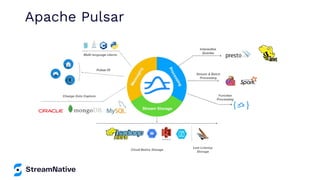
Apache Pulsar
Apache is an open source, cloud-native
distributed messaging and streaming platform.
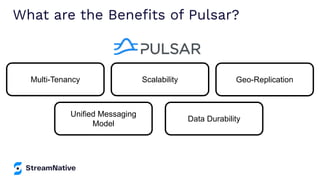
What are the Benefits of Pulsar?
Data Durability
Scalability Geo-Replication
Multi-Tenancy
Unified Messaging
Model
Apache Pulsar
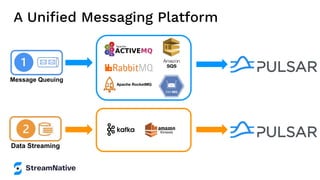
A Unified Messaging Platform
Message Queuing
Data Streaming
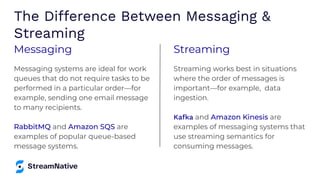
Messaging
Messaging systems are ideal for work
queues that do not require tasks to be
performed in a particular order—for
example, sending one email message
to many recipients.
RabbitMQ and Amazon SQS are
examples of popular queue-based
message systems.
Streaming
Streaming works best in situations
where the order of messages is
important—for example, data
ingestion.
Kafka and Amazon Kinesis are
examples of messaging systems that
use streaming semantics for
consuming messages.
The Difference Between Messaging &
Streaming
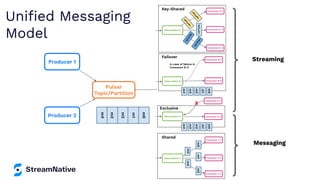
Unified Messaging
Model
Streaming
Messaging
Producer 1
Producer 2
Pulsar
Topic/Partition
m0
m1
m2
m3
m4
Consumer D-1
Consumer D-2
Consumer D-3
Subscription D
<
k
2
,
v
1
>
<
k
2
,
v
3
>
<k3,v2>
<
k
1
,
v
0
>
<
k
1
,
v
4
>
Key-Shared
Consumer C-1
Consumer C-2
Consumer C-3
Subscription C
m1
m2
m3
m4
m0
Shared
Failover
Consumer B-1
Consumer B-0
Subscription B
m1
m2
m3
m4
m0
In case of failure in
Consumer B-0
Consumer A-1
Consumer A-0
Subscription A
m1
m2
m3
m4
m0
Exclusive
X
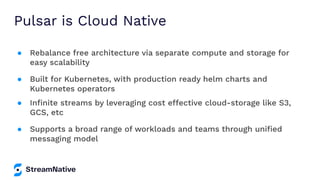
Pulsar is Cloud Native
● Rebalance free architecture via separate compute and storage for
easy scalability
● Built for Kubernetes, with production ready helm charts and
Kubernetes operators
● Infinite streams by leveraging cost effective cloud-storage like S3,
GCS, etc
● Supports a broad range of workloads and teams through unified
messaging model
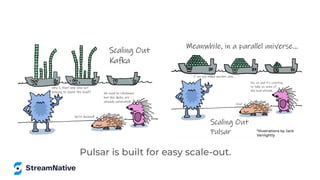
Pulsar is built for easy scale-out.
*Illustrations by Jack
Vanlightly
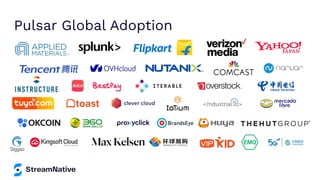
Pulsar Global Adoption
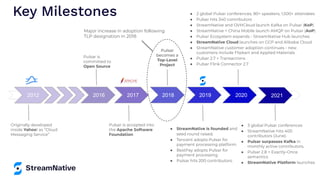
Key Milestones
2012 2016 2017 2018 2019 2020
Originally developed
inside Yahoo! as “Cloud
Messaging Service”
Pulsar is
committed to
Open Source
Pulsar is accepted into
the Apache Software
Foundation
Pulsar
becomes a
Top-Level
Project
● StreamNative is founded and
seed round raised.
● Tencent adopts Pulsar for
payment processing platform.
● BestPay adopts Pulsar for
payment processing.
● Pulsar hits 200 contributors.
● 2 global Pulsar conferences, 80+ speakers, 1,500+ attendees
● Pulsar hits 340 contributors
● StreamNative and OVHCloud launch Kafka on Pulsar (KoP)
● StreamNative + China Mobile launch AMQP on Pulsar (AoP)
● Pulsar Ecosystem expands - StreamNative Hub launches
● StreamNative Cloud launches on GCP and Alibaba Cloud
● StreamNative customer adoption continues - new
customers include Flipkart and Applied Materials
● Pulsar 2.7 + Transactions
● Pulsar Flink Connector 2.7
Major increase in adoption following
TLP designation in 2018
2021
● 3 global Pulsar conferences
● StreamNative hits 400
contributors (June).
● Pulsar surpasses Kafka in
monthly active contributors.
● Pulsar 2.8 + Exactly-Once
semantics
● StreamNative Platform launches
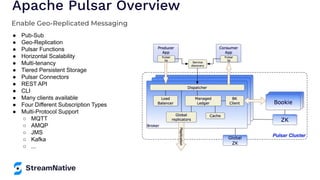
Apache Pulsar Overview
Enable Geo-Replicated Messaging
● Pub-Sub
● Geo-Replication
● Pulsar Functions
● Horizontal Scalability
● Multi-tenancy
● Tiered Persistent Storage
● Pulsar Connectors
● REST API
● CLI
● Many clients available
● Four Different Subscription Types
● Multi-Protocol Support
○ MQTT
○ AMQP
○ JMS
○ Kafka
○ ...
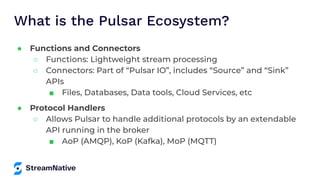
What is the Pulsar Ecosystem?
● Functions and Connectors
○ Functions: Lightweight stream processing
○ Connectors: Part of “Pulsar IO”, includes “Source” and “Sink”
APIs
■ Files, Databases, Data tools, Cloud Services, etc
● Protocol Handlers
○ Allows Pulsar to handle additional protocols by an extendable
API running in the broker
■ AoP (AMQP), KoP (Kafka), MoP (MQTT)
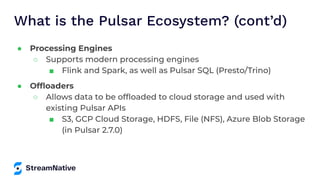
What is the Pulsar Ecosystem? (cont’d)
● Processing Engines
○ Supports modern processing engines
■ Flink and Spark, as well as Pulsar SQL (Presto/Trino)
● Offloaders
○ Allows data to be offloaded to cloud storage and used with
existing Pulsar APIs
■ S3, GCP Cloud Storage, HDFS, File (NFS), Azure Blob Storage
(in Pulsar 2.7.0)
Pulsar Functions
Provides a simple API to:
● Receive a message (consume)
● Process the message using your own code
● Send a message (produce)
Takes care of the boilerplate code so there is no need to create
producers and consumers.
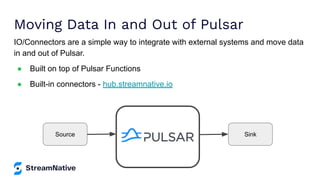
Moving Data In and Out of Pulsar
IO/Connectors are a simple way to integrate with external systems and move data
in and out of Pulsar.
● Built on top of Pulsar Functions
● Built-in connectors - hub.streamnative.io
Source Sink
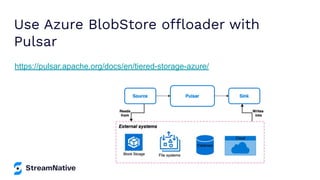
Use Azure BlobStore offloader with
Pulsar
https://pulsar.apache.org/docs/en/tiered-storage-azure/
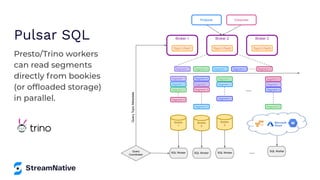
Pulsar SQL
Presto/Trino workers
can read segments
directly from bookies
(or offloaded storage)
in parallel.
Bookie
1
Segment 1
Producer Consumer
Broker 1
Topic1-Part1
Broker 2
Topic1-Part2
Broker 3
Topic1-Part3
Segment 2 Segment 3 Segment 4 Segment X
Segment 1
Segment 1 Segment 1
Segment 3 Segment 3
Segment 3
Segment 2
Segment 2
Segment 2
Segment 4
Segment 4
Segment 4
Segment X
Segment X
Segment X
Bookie
2
Bookie
3
Query
Coordinator
...
...
SQL Worker SQL Worker SQL Worker
SQL Worker
Query
Topic
Metadata
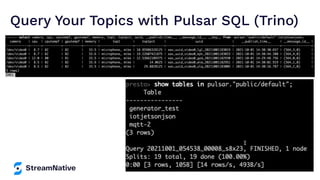
Query Your Topics with Pulsar SQL (Trino)
Apache Flink
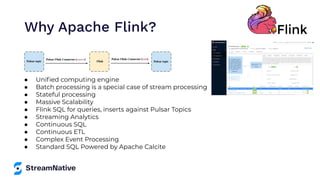
● Unified computing engine
● Batch processing is a special case of stream processing
● Stateful processing
● Massive Scalability
● Flink SQL for queries, inserts against Pulsar Topics
● Streaming Analytics
● Continuous SQL
● Continuous ETL
● Complex Event Processing
● Standard SQL Powered by Apache Calcite
Why Apache Flink?
Apache Flink
● Apache Flink is a distributed stream
processing system.
● It is capable of providing high
throughput, near real-time
processing of streams from Pulsar.
● It is ideal for ambitious Stream
Processing compared to Pulsar’s
model of lightweight Stream
Processing.
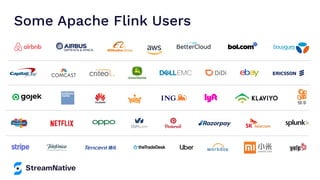
Some Apache Flink Users
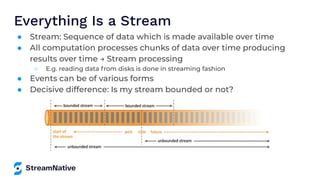
● Stream: Sequence of data which is made available over time
● All computation processes chunks of data over time producing
results over time → Stream processing
○ E.g. reading data from disks is done in streaming fashion
● Events can be of various forms
● Decisive difference: Is my stream bounded or not?
Everything Is a Stream
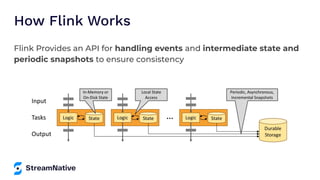
How Flink Works
Flink Provides an API for handling events and intermediate state and
periodic snapshots to ensure consistency
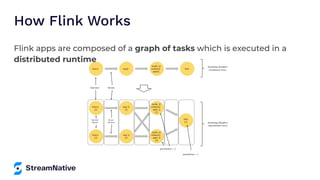
How Flink Works
Flink apps are composed of a graph of tasks which is executed in a
distributed runtime
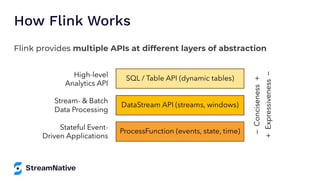
How Flink Works
Flink provides multiple APIs at different layers of abstraction
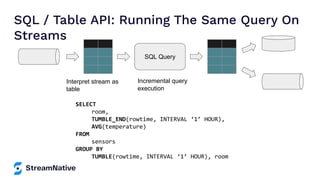
SQL / Table API: Running The Same Query On
Streams
SQL Query
Incremental query
execution
SELECT
room,
TUMBLE_END(rowtime, INTERVAL ‘1’ HOUR),
AVG(temperature)
FROM
sensors
GROUP BY
TUMBLE(rowtime, INTERVAL ‘1’ HOUR), room
Interpret stream as
table
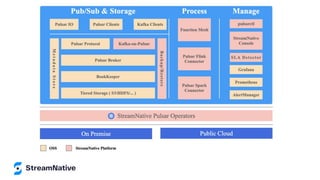
StreamNative
Cloud
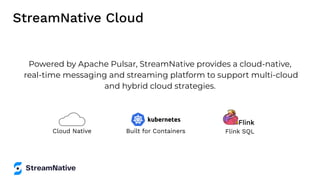
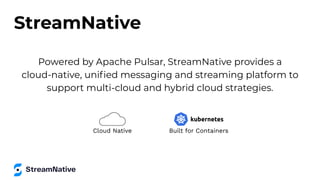
Powered by Apache Pulsar, StreamNative provides a cloud-native,
real-time messaging and streaming platform to support multi-cloud
and hybrid cloud strategies.
Built for Containers
Cloud Native
StreamNative Cloud
Flink SQL
Powered by Apache Pulsar, StreamNative provides a
cloud-native, unified messaging and streaming platform to
support multi-cloud and hybrid cloud strategies.
Built for Containers
Cloud Native
StreamNative
APP Layer
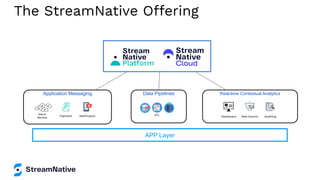
The StreamNative Offering
Application Messaging Data Pipelines Real-time Contextual Analytics
Micro
Service
Notification Dashboard Risk Control Auditing
Payment ETL
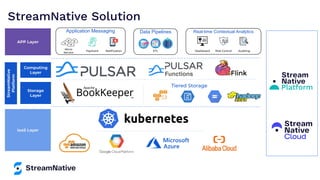
StreamNative Solution
Application Messaging Data Pipelines Real-time Contextual Analytics
Tiered Storage
APP Layer
Computing
Layer
Storage
Layer
StreamNative
Platform
IaaS Layer
Micro
Service
Notification Dashboard Risk Control Auditing
Payment ETL
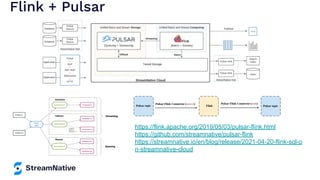
Flink + Pulsar
https://flink.apache.org/2019/05/03/pulsar-flink.html
https://github.com/streamnative/pulsar-flink
https://streamnative.io/en/blog/release/2021-04-20-flink-sql-o
n-streamnative-cloud
Apache NiFi
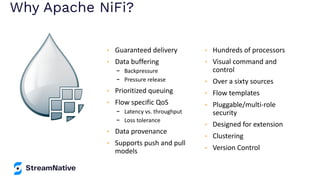
Why Apache NiFi?
• Guaranteed delivery
• Data buffering
- Backpressure
- Pressure release
• Prioritized queuing
• Flow specific QoS
- Latency vs. throughput
- Loss tolerance
• Data provenance
• Supports push and pull
models
• Hundreds of processors
• Visual command and
control
• Over a sixty sources
• Flow templates
• Pluggable/multi-role
security
• Designed for extension
• Clustering
• Version Control
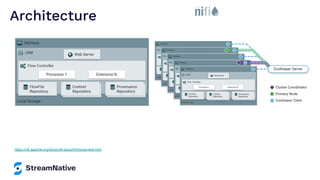
Architecture
https://nifi.apache.org/docs/nifi-docs/html/overview.html
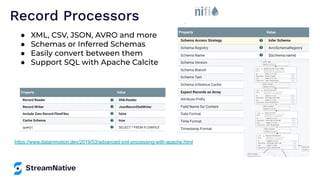
Record Processors
https://www.datainmotion.dev/2019/03/advanced-xml-processing-with-apache.html
● XML, CSV, JSON, AVRO and more
● Schemas or Inferred Schemas
● Easily convert between them
● Support SQL with Apache Calcite
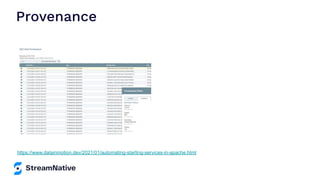
Provenance
https://www.datainmotion.dev/2021/01/automating-starting-services-in-apache.html
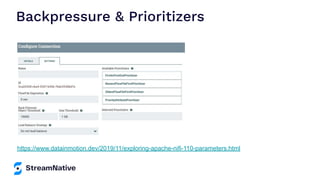
Backpressure & Prioritizers
https://www.datainmotion.dev/2019/11/exploring-apache-nifi-110-parameters.html
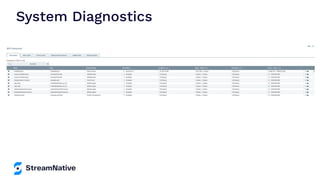
System Diagnostics
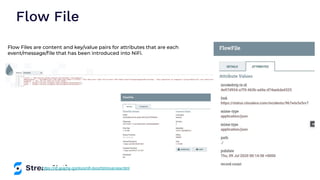
Flow File
https://nifi.apache.org/docs/nifi-docs/html/overview.html
Flow Files are content and key/value pairs for attributes that are each
event/message/file that has been introduced into NiFi.
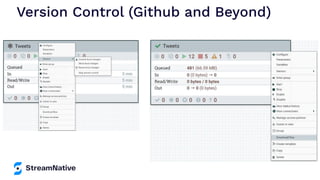
Version Control (Github and Beyond)
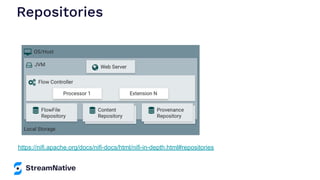
Repositories
https://nifi.apache.org/docs/nifi-docs/html/nifi-in-depth.html#repositories
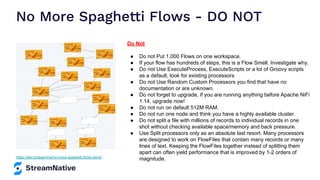
No More Spaghetti Flows - DO NOT
https://dev.to/tspannhw/no-more-spaghetti-flows-2emd
Do Not
● Do not Put 1,000 Flows on one workspace.
● If your flow has hundreds of steps, this is a Flow Smell. Investigate why.
● Do not Use ExecuteProcess, ExecuteScripts or a lot of Groovy scripts
as a default, look for existing processors
● Do not Use Random Custom Processors you find that have no
documentation or are unknown.
● Do not forget to upgrade, if you are running anything before Apache NiFi
1.14, upgrade now!
● Do not run on default 512M RAM.
● Do not run one node and think you have a highly available cluster.
● Do not split a file with millions of records to individual records in one
shot without checking available space/memory and back pressure.
● Use Split processors only as an absolute last resort. Many processors
are designed to work on FlowFiles that contain many records or many
lines of text. Keeping the FlowFiles together instead of splitting them
apart can often yield performance that is improved by 1-2 orders of
magnitude.
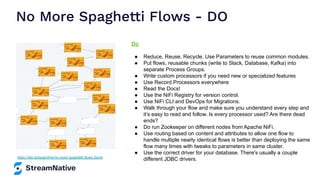
No More Spaghetti Flows - DO
https://dev.to/tspannhw/no-more-spaghetti-flows-2emd
Do
● Reduce, Reuse, Recycle. Use Parameters to reuse common modules.
● Put flows, reusable chunks (write to Slack, Database, Kafka) into
separate Process Groups.
● Write custom processors if you need new or specialized features
● Use Record Processors everywhere
● Read the Docs!
● Use the NiFi Registry for version control.
● Use NiFi CLI and DevOps for Migrations.
● Walk through your flow and make sure you understand every step and
it’s easy to read and follow. Is every processor used? Are there dead
ends?
● Do run Zookeeper on different nodes from Apache NiFi.
● Use routing based on content and attributes to allow one flow to
handle multiple nearly identical flows is better than deploying the same
flow many times with tweaks to parameters in same cluster.
● Use the correct driver for your database. There's usually a couple
different JDBC drivers.
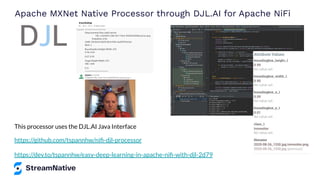
Apache MXNet Native Processor through DJL.AI for Apache NiFi
This processor uses the DJL.AI Java Interface
https://github.com/tspannhw/nifi-djl-processor
https://dev.to/tspannhw/easy-deep-learning-in-apache-nifi-with-djl-2d79
Use Cases
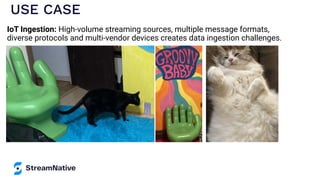
USE CASE
IoT Ingestion: High-volume streaming sources, multiple message formats,
diverse protocols and multi-vendor devices creates data ingestion challenges.
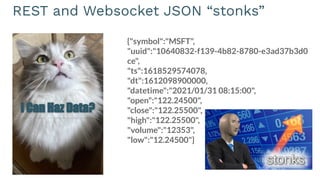
I Can Haz Data?
REST and Websocket JSON “stonks”
{"symbol":"MSFT",
"uuid":"10640832-f139-4b82-8780-e3ad37b3d0
ce",
"ts":1618529574078,
"dt":1612098900000,
"datetime":"2021/01/31 08:15:00",
"open":"122.24500",
"close":"122.25500",
"high":"122.25500",
"volume":"12353",
"low":"12.24500"}
Best Practice
Architectures
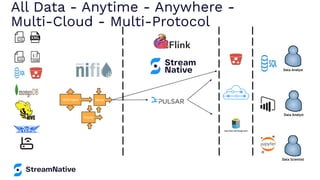
All Data - Anytime - Anywhere -
Multi-Cloud - Multi-Protocol
Multi-
inges
t
Multi-
inges
t
Multi-ingest Merge
Priority
StreamNative Hub
StreamNative Cloud
Unified Batch and Stream COMPUTING
Batch
(Batch + Stream)
Unified Batch and Stream STORAGE
Offload
(Queuing + Streaming)
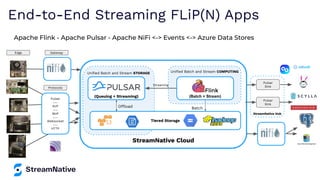
Apache Flink - Apache Pulsar - Apache NiFi <-> Events <-> Azure Data Stores
Tiered Storage
Pulsar
---
KoP
---
MoP
---
Websocket
---
HTTP
Pulsar
Sink
Pulsar
Sink
Streaming
Edge Gateway
Protocols
End-to-End Streaming FLiP(N) Apps
StreamNative Hub
StreamNative Cloud
Unified Batch and Stream COMPUTING
Batch
(Batch + Stream)
Unified Batch and Stream STORAGE
Offload
(Queuing + Streaming)
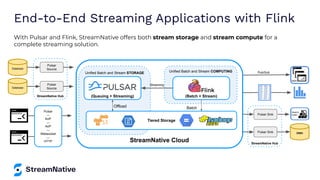
End-to-End Streaming Applications with Flink
With Pulsar and Flink, StreamNative offers both stream storage and stream compute for a
complete streaming solution.
Application
Application
Database
Database
DWH
Tiered Storage
Search
Index
Pulsar
---
KoP
---
AoP
---
Websocket
---
HTTP
StreamNative Hub
Pulsar
Source
Pulsar
Source
Pulsar Sink
Pulsar Sink
Apps
Streaming
Pub/Sub
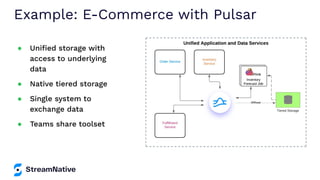
Example: E-Commerce with Pulsar
● Unified storage with
access to underlying
data
● Native tiered storage
● Single system to
exchange data
● Teams share toolset
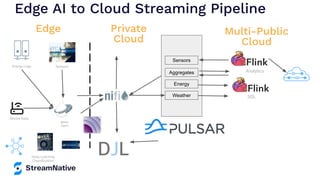
Edge AI to Cloud Streaming Pipeline
Device Data
Sensors
Energy Logs
Weather
Sensors
Aggregates
Energy
SQL
Analytics
MiNiFi
Agent
Deep Learning
Classification
Edge Private
Cloud
Multi-Public
Cloud
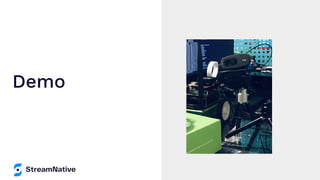
Demo
Demo Walkthrough
{"entriesAddedCounter":1,"numberOfEntries":1,"totalSize":651,"curre
ntLedgerEntries":1,"currentLedgerSize":651,"lastLedgerCreatedTim
estamp":"2021-09-13T16:13:06.6-04:00","waitingCursorsCount":0,"pe
ndingAddEntriesCount":0,"lastConfirmedEntry":"7076:0","state":"L
edgerOpened","ledgers":[{"ledgerId":7076,"entries":0,"size":0,"offloa
ded":false,"underReplicated":false}],"cursors":{},"schemaLedgers":[],
"compactedLedger":{"ledgerId":-1,"entries":-1,"size":-1,"offloaded":fal
se,"underReplicated":false}}
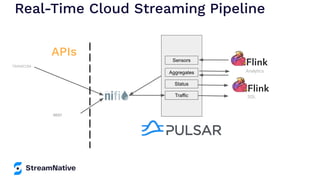
Real-Time Cloud Streaming Pipeline
TRANSCOM
Traffic
Sensors
Aggregates
Status
SQL
Analytics
APIs
REST
Wrap-Up
Connect with the Community & Stay Up-To-Date
● Join the Pulsar Slack channel - Apache-Pulsar.slack.com
● Follow @streamnativeio and @apache_pulsar on Twitter
● Subscribe to Monthly Pulsar Newsletter for major news, events,
project updates, and resources in the Pulsar community
● https://www.datainmotion.dev/2020/04/building-search-indexes-with-apache.html
● https://github.com/tspannhw/nifi-solr-example
● https://github.com/streamnative/pulsar-flink
● https://www.linkedin.com/pulse/2021-schedule-tim-spann/
● https://github.com/tspannhw/SpeakerProfile/blob/main/2021/talks/20210729_HailHydr
ate!FromStreamtoLake_TimSpann.pdf
● https://streamnative.io/en/blog/release/2021-04-20-flink-sql-on-streamnative-cloud
● https://docs.streamnative.io/cloud/stable/compute/flink-sql
Deeper Content
@PaasDev
https://www.pulsardeveloper.com/
timothyspann
Interested In Learning More?
Flink SQL Cookbook
The Github Source for Flink
SQL Demo
The GitHub Source for Demo
Manning's Apache Pulsar in
Action
O’Reilly Book
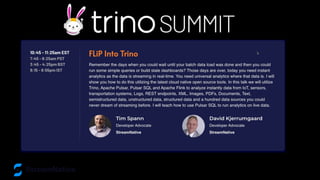
[10/21] Trino Summit
Resources Free eBooks Upcoming Events
71
Pulsar Summit Asia
November 20-21, 2021
Contact us at partners@pulsar-summit.org to become a sponsor or partner
Let’s Keep
in Touch!
Tim Spann
Developer Advocate
@PassDev
https://www.linkedin.com/in/timothyspann
https://github.com/tspannhw
Questions

Cloud lunch and learn real-time streaming in azure

  • 1.
    Real-Time Streaming inAzure Timothy Spann | Developer Advocate
  • 3.
    Tim Spann Developer Advocate ●https://www.datainmotion.dev/ ● https://github.com/tspannhw/SpeakerProfile ● https://dev.to/tspannhw ● https://sessionize.com/tspann/ DZone Zone Leader and Big Data MVB Data DJay
  • 4.
    Founded by theoriginal developers of Apache Pulsar and Apache BookKeeper, StreamNative builds a cloud-native event streaming platform that enables enterprises to easily access data as real-time event streams.
  • 5.
  • 6.
    Apache is anopen source, cloud-native distributed messaging and streaming platform.
  • 7.
    What are theBenefits of Pulsar? Data Durability Scalability Geo-Replication Multi-Tenancy Unified Messaging Model
  • 8.
  • 9.
    A Unified MessagingPlatform Message Queuing Data Streaming
  • 10.
    Messaging Messaging systems areideal for work queues that do not require tasks to be performed in a particular order—for example, sending one email message to many recipients. RabbitMQ and Amazon SQS are examples of popular queue-based message systems. Streaming Streaming works best in situations where the order of messages is important—for example, data ingestion. Kafka and Amazon Kinesis are examples of messaging systems that use streaming semantics for consuming messages. The Difference Between Messaging & Streaming
  • 11.
    Unified Messaging Model Streaming Messaging Producer 1 Producer2 Pulsar Topic/Partition m0 m1 m2 m3 m4 Consumer D-1 Consumer D-2 Consumer D-3 Subscription D < k 2 , v 1 > < k 2 , v 3 > <k3,v2> < k 1 , v 0 > < k 1 , v 4 > Key-Shared Consumer C-1 Consumer C-2 Consumer C-3 Subscription C m1 m2 m3 m4 m0 Shared Failover Consumer B-1 Consumer B-0 Subscription B m1 m2 m3 m4 m0 In case of failure in Consumer B-0 Consumer A-1 Consumer A-0 Subscription A m1 m2 m3 m4 m0 Exclusive X
  • 12.
    Pulsar is CloudNative ● Rebalance free architecture via separate compute and storage for easy scalability ● Built for Kubernetes, with production ready helm charts and Kubernetes operators ● Infinite streams by leveraging cost effective cloud-storage like S3, GCS, etc ● Supports a broad range of workloads and teams through unified messaging model
  • 13.
    Pulsar is builtfor easy scale-out. *Illustrations by Jack Vanlightly
  • 14.
  • 15.
    Key Milestones 2012 20162017 2018 2019 2020 Originally developed inside Yahoo! as “Cloud Messaging Service” Pulsar is committed to Open Source Pulsar is accepted into the Apache Software Foundation Pulsar becomes a Top-Level Project ● StreamNative is founded and seed round raised. ● Tencent adopts Pulsar for payment processing platform. ● BestPay adopts Pulsar for payment processing. ● Pulsar hits 200 contributors. ● 2 global Pulsar conferences, 80+ speakers, 1,500+ attendees ● Pulsar hits 340 contributors ● StreamNative and OVHCloud launch Kafka on Pulsar (KoP) ● StreamNative + China Mobile launch AMQP on Pulsar (AoP) ● Pulsar Ecosystem expands - StreamNative Hub launches ● StreamNative Cloud launches on GCP and Alibaba Cloud ● StreamNative customer adoption continues - new customers include Flipkart and Applied Materials ● Pulsar 2.7 + Transactions ● Pulsar Flink Connector 2.7 Major increase in adoption following TLP designation in 2018 2021 ● 3 global Pulsar conferences ● StreamNative hits 400 contributors (June). ● Pulsar surpasses Kafka in monthly active contributors. ● Pulsar 2.8 + Exactly-Once semantics ● StreamNative Platform launches
  • 16.
    Apache Pulsar Overview EnableGeo-Replicated Messaging ● Pub-Sub ● Geo-Replication ● Pulsar Functions ● Horizontal Scalability ● Multi-tenancy ● Tiered Persistent Storage ● Pulsar Connectors ● REST API ● CLI ● Many clients available ● Four Different Subscription Types ● Multi-Protocol Support ○ MQTT ○ AMQP ○ JMS ○ Kafka ○ ...
  • 17.
    What is thePulsar Ecosystem? ● Functions and Connectors ○ Functions: Lightweight stream processing ○ Connectors: Part of “Pulsar IO”, includes “Source” and “Sink” APIs ■ Files, Databases, Data tools, Cloud Services, etc ● Protocol Handlers ○ Allows Pulsar to handle additional protocols by an extendable API running in the broker ■ AoP (AMQP), KoP (Kafka), MoP (MQTT)
  • 18.
    What is thePulsar Ecosystem? (cont’d) ● Processing Engines ○ Supports modern processing engines ■ Flink and Spark, as well as Pulsar SQL (Presto/Trino) ● Offloaders ○ Allows data to be offloaded to cloud storage and used with existing Pulsar APIs ■ S3, GCP Cloud Storage, HDFS, File (NFS), Azure Blob Storage (in Pulsar 2.7.0)
  • 19.
    Pulsar Functions Provides asimple API to: ● Receive a message (consume) ● Process the message using your own code ● Send a message (produce) Takes care of the boilerplate code so there is no need to create producers and consumers.
  • 20.
    Moving Data Inand Out of Pulsar IO/Connectors are a simple way to integrate with external systems and move data in and out of Pulsar. ● Built on top of Pulsar Functions ● Built-in connectors - hub.streamnative.io Source Sink
  • 21.
    Use Azure BlobStoreoffloader with Pulsar https://pulsar.apache.org/docs/en/tiered-storage-azure/
  • 22.
    Pulsar SQL Presto/Trino workers canread segments directly from bookies (or offloaded storage) in parallel. Bookie 1 Segment 1 Producer Consumer Broker 1 Topic1-Part1 Broker 2 Topic1-Part2 Broker 3 Topic1-Part3 Segment 2 Segment 3 Segment 4 Segment X Segment 1 Segment 1 Segment 1 Segment 3 Segment 3 Segment 3 Segment 2 Segment 2 Segment 2 Segment 4 Segment 4 Segment 4 Segment X Segment X Segment X Bookie 2 Bookie 3 Query Coordinator ... ... SQL Worker SQL Worker SQL Worker SQL Worker Query Topic Metadata
  • 23.
    Query Your Topicswith Pulsar SQL (Trino)
  • 24.
  • 25.
    ● Unified computingengine ● Batch processing is a special case of stream processing ● Stateful processing ● Massive Scalability ● Flink SQL for queries, inserts against Pulsar Topics ● Streaming Analytics ● Continuous SQL ● Continuous ETL ● Complex Event Processing ● Standard SQL Powered by Apache Calcite Why Apache Flink?
  • 26.
    Apache Flink ● ApacheFlink is a distributed stream processing system. ● It is capable of providing high throughput, near real-time processing of streams from Pulsar. ● It is ideal for ambitious Stream Processing compared to Pulsar’s model of lightweight Stream Processing.
  • 27.
  • 28.
    ● Stream: Sequenceof data which is made available over time ● All computation processes chunks of data over time producing results over time → Stream processing ○ E.g. reading data from disks is done in streaming fashion ● Events can be of various forms ● Decisive difference: Is my stream bounded or not? Everything Is a Stream
  • 29.
    How Flink Works FlinkProvides an API for handling events and intermediate state and periodic snapshots to ensure consistency
  • 30.
    How Flink Works Flinkapps are composed of a graph of tasks which is executed in a distributed runtime
  • 31.
    How Flink Works Flinkprovides multiple APIs at different layers of abstraction
  • 32.
    SQL / TableAPI: Running The Same Query On Streams SQL Query Incremental query execution SELECT room, TUMBLE_END(rowtime, INTERVAL ‘1’ HOUR), AVG(temperature) FROM sensors GROUP BY TUMBLE(rowtime, INTERVAL ‘1’ HOUR), room Interpret stream as table
  • 33.
  • 34.
    Powered by ApachePulsar, StreamNative provides a cloud-native, real-time messaging and streaming platform to support multi-cloud and hybrid cloud strategies. Built for Containers Cloud Native StreamNative Cloud Flink SQL
  • 35.
    Powered by ApachePulsar, StreamNative provides a cloud-native, unified messaging and streaming platform to support multi-cloud and hybrid cloud strategies. Built for Containers Cloud Native StreamNative
  • 36.
    APP Layer The StreamNativeOffering Application Messaging Data Pipelines Real-time Contextual Analytics Micro Service Notification Dashboard Risk Control Auditing Payment ETL
  • 37.
    StreamNative Solution Application MessagingData Pipelines Real-time Contextual Analytics Tiered Storage APP Layer Computing Layer Storage Layer StreamNative Platform IaaS Layer Micro Service Notification Dashboard Risk Control Auditing Payment ETL
  • 40.
  • 41.
  • 42.
    Why Apache NiFi? •Guaranteed delivery • Data buffering - Backpressure - Pressure release • Prioritized queuing • Flow specific QoS - Latency vs. throughput - Loss tolerance • Data provenance • Supports push and pull models • Hundreds of processors • Visual command and control • Over a sixty sources • Flow templates • Pluggable/multi-role security • Designed for extension • Clustering • Version Control
  • 43.
  • 44.
    Record Processors https://www.datainmotion.dev/2019/03/advanced-xml-processing-with-apache.html ● XML,CSV, JSON, AVRO and more ● Schemas or Inferred Schemas ● Easily convert between them ● Support SQL with Apache Calcite
  • 45.
  • 46.
  • 47.
  • 48.
    Flow File https://nifi.apache.org/docs/nifi-docs/html/overview.html Flow Filesare content and key/value pairs for attributes that are each event/message/file that has been introduced into NiFi.
  • 49.
  • 50.
  • 51.
    No More SpaghettiFlows - DO NOT https://dev.to/tspannhw/no-more-spaghetti-flows-2emd Do Not ● Do not Put 1,000 Flows on one workspace. ● If your flow has hundreds of steps, this is a Flow Smell. Investigate why. ● Do not Use ExecuteProcess, ExecuteScripts or a lot of Groovy scripts as a default, look for existing processors ● Do not Use Random Custom Processors you find that have no documentation or are unknown. ● Do not forget to upgrade, if you are running anything before Apache NiFi 1.14, upgrade now! ● Do not run on default 512M RAM. ● Do not run one node and think you have a highly available cluster. ● Do not split a file with millions of records to individual records in one shot without checking available space/memory and back pressure. ● Use Split processors only as an absolute last resort. Many processors are designed to work on FlowFiles that contain many records or many lines of text. Keeping the FlowFiles together instead of splitting them apart can often yield performance that is improved by 1-2 orders of magnitude.
  • 52.
    No More SpaghettiFlows - DO https://dev.to/tspannhw/no-more-spaghetti-flows-2emd Do ● Reduce, Reuse, Recycle. Use Parameters to reuse common modules. ● Put flows, reusable chunks (write to Slack, Database, Kafka) into separate Process Groups. ● Write custom processors if you need new or specialized features ● Use Record Processors everywhere ● Read the Docs! ● Use the NiFi Registry for version control. ● Use NiFi CLI and DevOps for Migrations. ● Walk through your flow and make sure you understand every step and it’s easy to read and follow. Is every processor used? Are there dead ends? ● Do run Zookeeper on different nodes from Apache NiFi. ● Use routing based on content and attributes to allow one flow to handle multiple nearly identical flows is better than deploying the same flow many times with tweaks to parameters in same cluster. ● Use the correct driver for your database. There's usually a couple different JDBC drivers.
  • 54.
    Apache MXNet NativeProcessor through DJL.AI for Apache NiFi This processor uses the DJL.AI Java Interface https://github.com/tspannhw/nifi-djl-processor https://dev.to/tspannhw/easy-deep-learning-in-apache-nifi-with-djl-2d79
  • 55.
  • 56.
    USE CASE IoT Ingestion: High-volumestreaming sources, multiple message formats, diverse protocols and multi-vendor devices creates data ingestion challenges.
  • 57.
    I Can HazData? REST and Websocket JSON “stonks” {"symbol":"MSFT", "uuid":"10640832-f139-4b82-8780-e3ad37b3d0 ce", "ts":1618529574078, "dt":1612098900000, "datetime":"2021/01/31 08:15:00", "open":"122.24500", "close":"122.25500", "high":"122.25500", "volume":"12353", "low":"12.24500"}
  • 58.
  • 59.
    All Data -Anytime - Anywhere - Multi-Cloud - Multi-Protocol Multi- inges t Multi- inges t Multi-ingest Merge Priority
  • 60.
    StreamNative Hub StreamNative Cloud UnifiedBatch and Stream COMPUTING Batch (Batch + Stream) Unified Batch and Stream STORAGE Offload (Queuing + Streaming) Apache Flink - Apache Pulsar - Apache NiFi <-> Events <-> Azure Data Stores Tiered Storage Pulsar --- KoP --- MoP --- Websocket --- HTTP Pulsar Sink Pulsar Sink Streaming Edge Gateway Protocols End-to-End Streaming FLiP(N) Apps
  • 61.
    StreamNative Hub StreamNative Cloud UnifiedBatch and Stream COMPUTING Batch (Batch + Stream) Unified Batch and Stream STORAGE Offload (Queuing + Streaming) End-to-End Streaming Applications with Flink With Pulsar and Flink, StreamNative offers both stream storage and stream compute for a complete streaming solution. Application Application Database Database DWH Tiered Storage Search Index Pulsar --- KoP --- AoP --- Websocket --- HTTP StreamNative Hub Pulsar Source Pulsar Source Pulsar Sink Pulsar Sink Apps Streaming Pub/Sub
  • 62.
    Example: E-Commerce withPulsar ● Unified storage with access to underlying data ● Native tiered storage ● Single system to exchange data ● Teams share toolset
  • 63.
    Edge AI toCloud Streaming Pipeline Device Data Sensors Energy Logs Weather Sensors Aggregates Energy SQL Analytics MiNiFi Agent Deep Learning Classification Edge Private Cloud Multi-Public Cloud
  • 64.
  • 65.
  • 66.
    Real-Time Cloud StreamingPipeline TRANSCOM Traffic Sensors Aggregates Status SQL Analytics APIs REST
  • 67.
  • 68.
    Connect with theCommunity & Stay Up-To-Date ● Join the Pulsar Slack channel - Apache-Pulsar.slack.com ● Follow @streamnativeio and @apache_pulsar on Twitter ● Subscribe to Monthly Pulsar Newsletter for major news, events, project updates, and resources in the Pulsar community
  • 69.
    ● https://www.datainmotion.dev/2020/04/building-search-indexes-with-apache.html ● https://github.com/tspannhw/nifi-solr-example ●https://github.com/streamnative/pulsar-flink ● https://www.linkedin.com/pulse/2021-schedule-tim-spann/ ● https://github.com/tspannhw/SpeakerProfile/blob/main/2021/talks/20210729_HailHydr ate!FromStreamtoLake_TimSpann.pdf ● https://streamnative.io/en/blog/release/2021-04-20-flink-sql-on-streamnative-cloud ● https://docs.streamnative.io/cloud/stable/compute/flink-sql Deeper Content @PaasDev https://www.pulsardeveloper.com/ timothyspann
  • 70.
    Interested In LearningMore? Flink SQL Cookbook The Github Source for Flink SQL Demo The GitHub Source for Demo Manning's Apache Pulsar in Action O’Reilly Book [10/21] Trino Summit Resources Free eBooks Upcoming Events
  • 71.
    71 Pulsar Summit Asia November20-21, 2021 Contact us at partners@pulsar-summit.org to become a sponsor or partner
  • 74.
    Let’s Keep in Touch! TimSpann Developer Advocate @PassDev https://www.linkedin.com/in/timothyspann https://github.com/tspannhw
  • 75.