03-23-05July 2014
project – programme – portfolio management :project – programme – portfolio management :
Flight SFlight Sttimulatorimulator
Presented by Jan Biets
Jan_biets@hotmail.com Mechelen - Belgium
page 1 • view on reporting
Project management Office – setting up the ‘Measuring’-serviceProject management Office – setting up the ‘Measuring’-service July 2014 page 2 • KPI & KGI
Project Management!Project Management!
• Together with some other presentations:
– PMO as a Service
– Project Management Dynamics
– Graphical Project Reporting
– Setting up reporting & Tracking tool
– Project planning Logic, how to optimise your schedule
This presentation focuses' on performances and goals tracking
of your project , programme and portfolio management.
note:
•It is not the author’s intention to be aligned with whatever existing
methodology, nor framework;
•‘projects’– in this presentation, ‘projects’ can mean
projects, programme, or portfolio
Project management Office – setting up the ‘Measuring’-serviceProject management Office – setting up the ‘Measuring’-service July 2014 page 3 • PMO
Project Management KPI, KGI, and PQSi’s :Project Management KPI, KGI, and PQSi’s :
Flight “SFlight “Sttimulator” !imulator” !
• What is the purpose:
– TO KNOW ‘WHERE’ YOU ARE !
– Increase success rate of -strategically- projects;
– Decrease failure rate of -strategically- projects
– Improve - visual- reporting data;
– Improve baseline information to take decision upon;
– Improve communication, also to ‘non project management’-
skilled audience , i.e. executive management;
– Increase effort in strategically supportive projects; define
metrics for measuring progress/success/quality of balanced
scorecards;
– Order (go / kill ) strategically important projects;
• Very often lack of right information to be used by stakeholders to
have a clear understanding of the project status, progress , and
‘forecast’.
• Reason to take drastic, but un-rightful decisions, which can
endanger outcome of organisation’s strategy;
Project management Office – setting up the ‘Measuring’-serviceProject management Office – setting up the ‘Measuring’-service July 2014 page 4 • PMO
Project Management ‘s “BSC Service provider”Project Management ‘s “BSC Service provider”
project management
programme management
portfolio management, stakeholder, sponsor, shareholder, strategy,
Finance, HR… Management needs tools to report, to manage, to steer, to
decide.
To measure is to know
Control and improve
Identify the elements that have an impact on the outcome
‘the truth is out there” , or
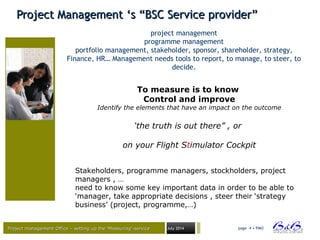
on your Flight Stimulator Cockpit
Stakeholders, programme managers, stockholders, project
managers , …
need to know some key important data in order to be able to
‘manager, take appropriate decisions , steer their ‘strategy
business’ (project, programme,…)
Project management Office – setting up the ‘Measuring’-serviceProject management Office – setting up the ‘Measuring’-service July 2014 page 5 • BSC
Flight SFlight Sttimulator, why?imulator, why?
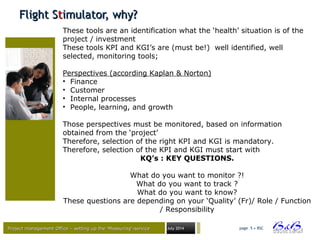
These tools are an identification what the ‘health’ situation is of the
project / investment
These tools KPI and KGI’s are (must be!) well identified, well
selected, monitoring tools;
Perspectives (according Kaplan & Norton)
• Finance
• Customer
• Internal processes
• People, learning, and growth
Those perspectives must be monitored, based on information
obtained from the ‘project’
Therefore, selection of the right KPI and KGI is mandatory.
Therefore, selection of the KPI and KGI must start with
KQ’s : KEY QUESTIONS.
What do you want to monitor ?!
What do you want to track ?
What do you want to know?
These questions are depending on your ‘Quality’ (Fr)/ Role / Function
/ Responsibility
Project management Office – setting up the ‘Measuring’-serviceProject management Office – setting up the ‘Measuring’-service July 2014 page 6 • BSC
Flight SFlight Sttimulator, how?imulator, how?
Measure is to know
Control and improve your project , programme , portfolio
Identify the elements that have an impact on the outcome:
First,
you design the ‘service’:
Define the most correct questions.
And,
get answers on KEY QUESTIONS ! [ KPQ and KPQ ]
How to perform?
What are the metrics to identify the performance ‘grade’
What Goals ?
What achievements ?
Secondly,
Where can I find the information , or data to measure the
specific metric
Project management Office – setting up the serviceProject management Office – setting up the service Maart 2009 page 7 • BSC
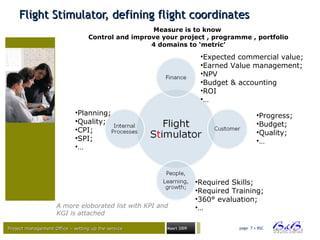
Flight Stimulator, defining flight coordinatesFlight Stimulator, defining flight coordinates
Measure is to know
Control and improve your project , programme , portfolio
4 domains to ‘metric’
•Progress;
•Budget;
•Quality;
•…
•Required Skills;
•Required Training;
•360° evaluation;
•…
•Expected commercial value;
•Earned Value management;
•NPV
•Budget & accounting
•ROI
•…
•Planning;
•Quality;
•CPI;
•SPI;
•…
A more eloborated list with KPI and
KGI is attached
Project management Office – setting up the ‘Measuring’-serviceProject management Office – setting up the ‘Measuring’-service July 2014 page 8 • View on Reporting
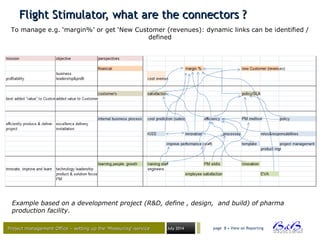
Flight Stimulator, what are the connectors ?Flight Stimulator, what are the connectors ?
Example based on a development project (R&D, define , design, and build) of pharma
production facility.
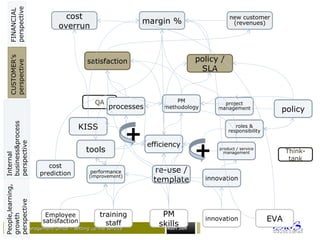
To manage e.g. ‘margin%’ or get ‘New Customer (revenues): dynamic links can be identified /
defined
Project management Office – setting up the serviceProject management Office – setting up the service Maart 2009
QA
training
staff
innovation
PM
skills
EVA
Employee
satisfaction
cost
prediction
KISS
efficiency
innovation
policy
PM
methodology
roles &
responsibility
product / service
management
re-use /
template
processes
performance
(improvement)
project
management
satisfaction policy /
SLA
cost
overrun
margin %
new customer
(revenues)
FINANCIAL
perspective
CUSTOMER’s
perspective
Internal
business&process
perspective
People,learning,
growth
perspective
tools
+
Think-
tank
+
Project management Office – setting up the serviceProject management Office – setting up the service Maart 2009 10
Project management Office – setting up the serviceProject management Office – setting up the service Maart 2009 11
Project management Office – setting up the serviceProject management Office – setting up the service Maart 2009
Internal business&processInternal business&process
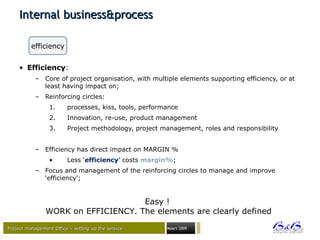
• Efficiency:
– Core of project organisation, with multiple elements supporting efficiency, or at
least having impact on;
– Reinforcing circles:
1. processes, kiss, tools, performance
2. Innovation, re-use, product management
3. Project methodology, project management, roles and responsibility
– Efficiency has direct impact on MARGIN %
• Less ‘efficiency’ costs margin%;
– Focus and management of the reinforcing circles to manage and improve
‘efficiency’;
efficiency
Easy !
WORK on EFFICIENCY. The elements are clearly defined
Project management Office – setting up the serviceProject management Office – setting up the service Maart 2009
Internal business&processInternal business&process
• For each of the steering for ‘margin%’, we have to identify the
elements that have impact on “margin%”;
• From bottom to top;
• Work on each of the steering elements:
– Identify actions that have positive impact;
– Measure (by well-defined KPI and KGI’s) the progress;
– PDCA : plan – do – check – (re-)act
– Set thresholds , target values for each of the KPI – ‘Flight Stimulator’;
Enjoy the Success
xyz
Project management Office – setting up the ‘Measuring’-serviceProject management Office – setting up the ‘Measuring’-service July 2014 page 14 • View on Reporting
set up BSC’s: very powerful toolset up BSC’s: very powerful tool
•Measuring is knowing;
•Define what information is required to be able to assess your project on
‘total project quality management’?;
•A ‘best’ tool is Balanced Scorecards (Kaplan/Norton);
•A well defined BSC allows a in-depth view on the projects, thus:
•Increasing organisation’s benefits of outcome of project (application);
•Increasing lessons learned for other project initiatives; your
organisation will improve project-ability behaviours;
•Decreasing failure rates of projects, and consequently , negative
impact on organisation’s strategy;
Reference to ‘Project Management Dynamics” @ SLIDESHARE.net
Abbreviations:
BSC - Balanced Scorecards (Kaplan & Norton)
Project management Office – setting up the ‘Measuring’-serviceProject management Office – setting up the ‘Measuring’-service July 2014 page 15 • View on Reporting
some interesting PM criteriasome interesting PM criteria
• There is a lot of –valuable - information available when executing
a project, but some interesting data has to be excavated, you
have to know where to find it, and what to do with;
– Time:
• Schedule (overall, per phase;)
• Schedule performance index [SPI]
– Finance
• How are we going against budget;
• Cost performance index [CPI];
• Earned value analysis [EVA/-M];
• Return on investment [ROI];
• Net present value [NPV];
• Expected commercial value [ECV];
criteria that constantly emerge (1/2) :
Abbreviations:
SPI - schedule performance index
CPI - cost performance index
Project management Office – setting up the ‘Measuring’-serviceProject management Office – setting up the ‘Measuring’-service July 2014 page 16 • View on Reporting
some interesting PM criteriasome interesting PM criteria
• There is a lot of –valuable - information available when executing
a project, but some interesting data has to be excavated, and you
have to know where to find it;
– Resources
• How much time are we spending on the project,
• How many resources we need (globally, per IT department,
roles);
• Do we use the available resources;
– Scope: Is the scope [creep] in line with expectations (?)/ (!);
– Quality (total quality project management – TQPM)
• Is the plan realistically built-up;
• Number of issues reported;
• Are we reviewing and fixing quality problems;
criteria that constantly emerge (2/2) :
note:
An organisation with project tradition, has advantages when building
up a project minded attitude and a benchmark data-warehouse to
assess the projects and improve the project’s success rate, thus
organisation’s strategy outcome.
Project management Office – setting up the ‘Measuring’-serviceProject management Office – setting up the ‘Measuring’-service July 2014 page 17 • View on Reporting
TIMETIME
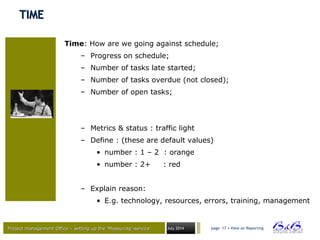
Time: How are we going against schedule;
– Progress on schedule;
– Number of tasks late started;
– Number of tasks overdue (not closed);
– Number of open tasks;
– Metrics & status : traffic light
– Define : (these are default values)
• number : 1 – 2 : orange
• number : 2+ : red
– Explain reason:
• E.g. technology, resources, errors, training, management
Project management Office – setting up the ‘Measuring’-serviceProject management Office – setting up the ‘Measuring’-service July 2014 page 18 • View on Reporting
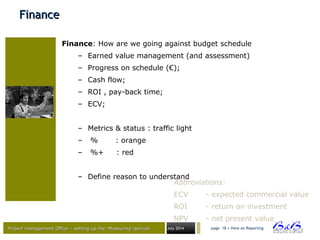
FinanceFinance
Finance: How are we going against budget schedule
– Earned value management (and assessment)
– Progress on schedule (€);
– Cash flow;
– ROI , pay-back time;
– ECV;
– Metrics & status : traffic light
– % : orange
– %+ : red
– Define reason to understand
Abbreviations:
ECV - expected commercial value
ROI - return on investment
NPV - net present value
Project management Office – setting up the serviceProject management Office – setting up the service Maart 2009 page 19 • View on Reporting
Rationale:
An important project quality success indication (PQSI) is the number of met requirements.
This can be:
Functional requirements , tangible and intangible, operations, up-time , availability, mean time
between failures, matching with technology policy, …
•Define clear user requirements
•Identify , quantify , ‘name it ! ‘
•List requirements;
•Build metrics;
•Test or assess during review meetings;
•Report;
•Validate the met requirements versus the requirements defined;
•Prioritise the application / project outcome;
•PDCA (plan-do-check-act);
•Set up improvement project.
TQPM –TQPM – meeting functional requirementsmeeting functional requirements
What is the scope of the project?!
What is quality / success rate of the project?
What is to be assessed during the project review meetings/process?
Project management Office – setting up the serviceProject management Office – setting up the service Maart 2009 page 20 • View on Reporting
METRICS : FINANCE - EVAMETRICS : FINANCE - EVA
What?
• Measure of project progress;
• Forecast completion date and final cost;
• Provide schedule and budget variances:
• By integrating 3 measurements, EVA provides consistent, numerical
indicator with which you can evaluate and compare projects.
Key:
• Where are we on schedule?
• Where are we on budget?
• Where are we on work accomplished?
Abbreviations:
EVA – Earned Value Analysis
Project management Office – setting up the serviceProject management Office – setting up the service Maart 2009 page 21 • View on Reporting
METRICS : FINANCE - EVAMETRICS : FINANCE - EVA
How?
• It compares the ‘planned’ amount of work with what has actually been
completed, to determine if COST , SCHEDULE, and WORK ACCOMPLISHED
are progressing as planned
• Work is ‘EARNED’ as it is … 100% completed
EVA gives a uniform unit of measure: € or man-days
EVA provides an ‘EARLY WARNING” for prompt corrective actions
Example:
30% time spent
30% € spent
Equals 30% work performed ?
Not necessarily !
Abbreviations:
EVA – Earned Value Analysis
Project management Office – setting up the serviceProject management Office – setting up the service Maart 2009 page 22 • View on Reporting
METRICS : FINANCE - EVAMETRICS : FINANCE - EVA
Abbreviations:
EVA – Earned Value Analysis
BCWS – budgeted cost of work performed
planned cost of the total amount of work scheduled
to be performed by milestone date
ACWP – actual cost of work performed
cost incurred to accomplish the work that has bee done to
date
BCWP – budgeted cost of work performed
planned (not actual) cost to complete the work that has
been done
Project management Office – setting up the serviceProject management Office – setting up the service Maart 2009 page 23 • View on Reporting
METRICS : FINANCE - EVAMETRICS : FINANCE - EVA
Some more abbreviations:
SV - Schedule Variance (BCWP – BCWS)
comparison of amount of work performed during a given
period of time to what was scheduled to be performed
Negative variance means that the project is behind
schedule
CV – Cost Variance (BCWP – ACWP)
comparison of the budgeted cost of work performed with
actual cost
negative variance means that the project is over budget
Example:
Schedule Variance = BCWP – BCWS
Cost Variance = BCWP - ACWP
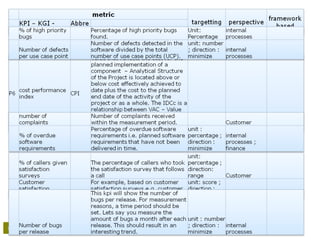
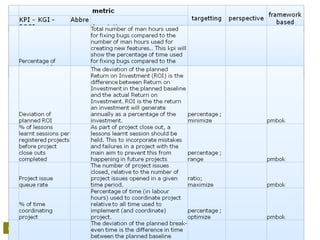
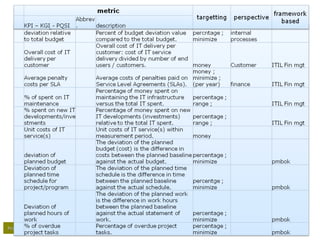
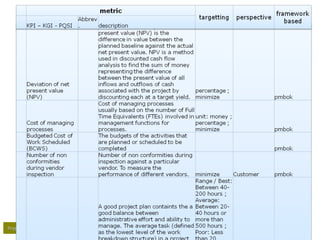
Project management Office – setting up the ‘Measuring’-serviceProject management Office – setting up the ‘Measuring’-service July 2014
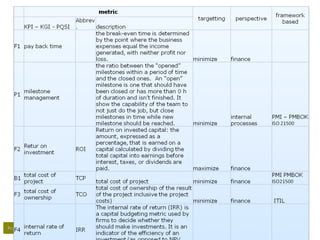
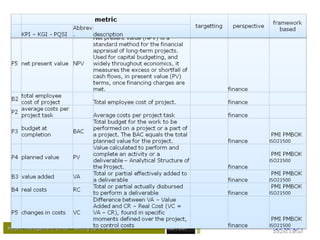
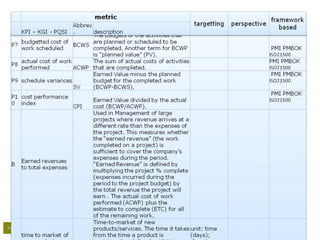
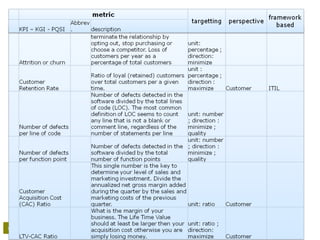
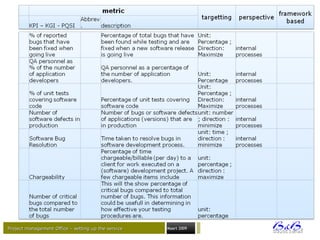
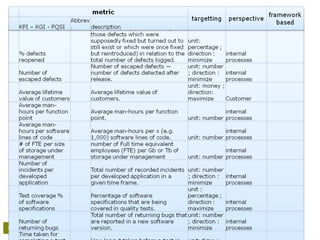
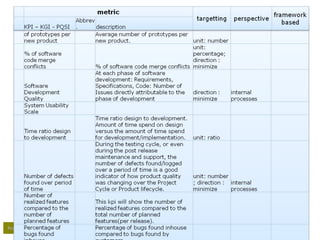
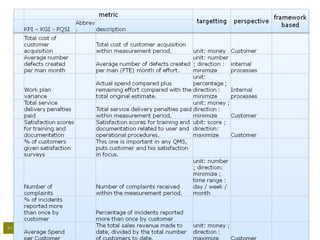
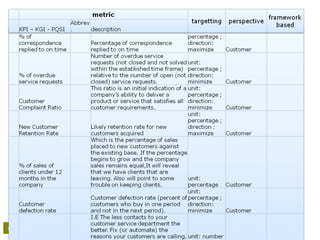
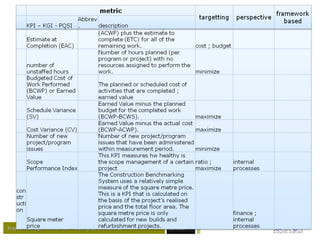
• Follows a listing of KP , KG and PQSI’s *
• On request, there is a list at your disposition of KP & KGI’s for Construction
Projects;
• On the Internet there are more overviews of KPI’s;
• There is a column attached with ‘framework / standard’ relation per KP, KG
and PQSI:
– ITIL
– ISO21500
– PMI – PMBOK
– PrinceII
– ValIT
– Cobit
*: project quality success indicator
page 24 • Set up BSC
Project management Office – setting up the serviceProject management Office – setting up the service Maart 2009
Project management Office – setting up the serviceProject management Office – setting up the service Maart 2009 page 39 • View on Reporting
Total Quality IT / asset Management : TCO of applications, infrastructure, andTotal Quality IT / asset Management : TCO of applications, infrastructure, and
maintenance related costs (existing IT-infrastructure)maintenance related costs (existing IT-infrastructure)
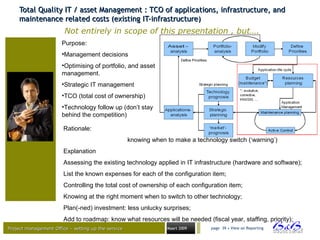
Rationale:
knowing when to make a technology switch (‘warning’)
Explanation
Assessing the existing technology applied in IT infrastructure (hardware and software);
List the known expenses for each of the configuration item;
Controlling the total cost of ownership of each configuration item;
Knowing at the right moment when to switch to other technology;
Plan(-ned) investment: less unlucky surprises;
Add to roadmap: know what resources will be needed (fiscal year, staffing, priority);
Purpose:
•Management decisions
•Optimising of portfolio, and asset
management.
•Strategic IT management
•TCO (total cost of ownership)
•Technology follow up (don’t stay
behind the competition)
Not entirely in scope of this presentation , but….
Project management Office – setting up the serviceProject management Office – setting up the service Maart 2009 page 40 • View on Reporting
TQPM :TQPM : Balanced scorecardBalanced scorecard (new product project selection)(new product project selection)
• Factor 1: strategic fit and importance
• Factor 2: product and competitive advantage
• Factor 3: market attractiveness
• Factor 4: core competencies leverage
• Factor 5: technical feasibility
• Factor 6: financial reward versus risk
Project management Office – setting up the serviceProject management Office – setting up the service Maart 2009 page 41 • View on Reporting
TQPM :TQPM : Balanced scorecardBalanced scorecard (new product project selection)(new product project selection)
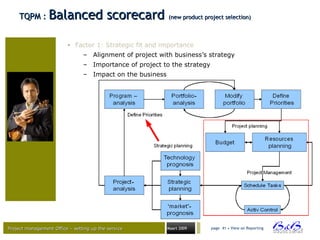
• Factor 1: Strategic fit and importance
– Alignment of project with business’s strategy
– Importance of project to the strategy
– Impact on the business
Project management Office – setting up the serviceProject management Office – setting up the service Maart 2009 page 42 • View on Reporting
TQPM :TQPM : Balanced scorecardBalanced scorecard (new product project selection)(new product project selection)
• Factor 2: product and competitive advantage
– Product delivers unique customer or user benefits
– Product offers customer / user excellent value for money
– Competitive rationale for project
– Positive customer / user feedback on product concept (concept test
results)
Driver:
ECV – expected commercial value
ROI – return on investment
Project management Office – setting up the serviceProject management Office – setting up the service Maart 2009 page 43 • View on Reporting
TQPM :TQPM : Balanced scorecardBalanced scorecard (new product project selection)(new product project selection)
• Factor 3: Market attractiveness
– Market size
– Market growth and future potential
– Margins earned by players in this market
– Competitiveness – how tough and intense
competition is
• Factor 4: core competencies leverage
– Project leverages our core competencies and
strengths in:
• Technology
• Production / operations
• Marketing
• Distribution / sales force
Project management Office – setting up the serviceProject management Office – setting up the service Maart 2009 page 44 • View on Reporting
TQPM :TQPM : Balanced scorecardBalanced scorecard (new product project selection)(new product project selection)
• Factor 5: Technical feasibility
– Size of technical gap
– Familiarity of technology to our business
– Newness of technology (base to embryonic)
– Technical complexity
– Technical results to date (proof of concept)
• Factor 6: financial reward versus risk
– Size of financial opportunity
– Financial return (npv , ecv)
– Productivity index
– Certainty of financial estimates
– Level of risk and ability to address risks
Abbreviations:
NPV – net present value
ECV – expected commercial value
Project management Office – setting up the serviceProject management Office – setting up the service Maart 2009 page 45 • View on Reporting
TQPM :TQPM : Balanced scorecardBalanced scorecard (new product project selection)(new product project selection)
Some ‘play-’rules:
• Projects are scored by the gatekeepers (senior management) at
the gate meeting using these six factors on a scorecard (0-10
scales);
• The scores are tallied, averaged across the evaluators, and
displayed for discussion;
• The project attractiveness score (PAS) is the weighted or un-
weighted addition of the scores, taken out of 100;
• A PAS score of 60/100 is usually required for a go decision.
Project management Office – setting up the serviceProject management Office – setting up the service Maart 2009 page 46 • View on Reporting
TQPM :TQPM : Balanced scorecardBalanced scorecard (new product project selection)(new product project selection)
Some ‘play-’rules:
• Projects are scored by the gatekeepers (senior management) at
the gate meeting using these six factors on a scorecard (0-10
scales);
• The scores are tallied, averaged across the evaluators, and
displayed for discussion;
• The project attractiveness score (PAS) is the weighted or
unweighted addition of the scores, taken out of 100;
• A PAS score of 60/100 is usually required for a go decision.
Project management Office – setting up the serviceProject management Office – setting up the service Maart 2009 page 47 • View on Reporting
Time is up. Much more to talk about this interesting topic….
Questions ?
Linkedin Jan Biets - Jan_biets@hotmail.com
? ?????? ? ?
Project management Office – setting up the serviceProject management Office – setting up the service Maart 2009 48
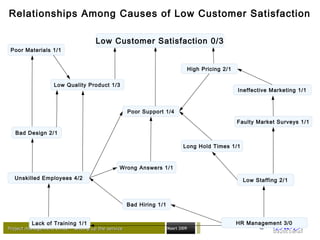
HR Management 3/0Lack of Training 1/1
Bad Hiring 1/1
Low Staffing 2/1Unskilled Employees 4/2
Bad Design 2/1
Wrong Answers 1/1
Poor Support 1/4
Long Hold Times 1/1
Faulty Market Surveys 1/1
Poor Materials 1/1
Low Quality Product 1/3
Ineffective Marketing 1/1
High Pricing 2/1
Relationships Among Causes of Low Customer Satisfaction
Low Customer Satisfaction 0/3

Project Management Flight stimulator 1.0

  • 1.
    03-23-05July 2014 project –programme – portfolio management :project – programme – portfolio management : Flight SFlight Sttimulatorimulator Presented by Jan Biets Jan_biets@hotmail.com Mechelen - Belgium page 1 • view on reporting
  • 2.
    Project management Office– setting up the ‘Measuring’-serviceProject management Office – setting up the ‘Measuring’-service July 2014 page 2 • KPI & KGI Project Management!Project Management! • Together with some other presentations: – PMO as a Service – Project Management Dynamics – Graphical Project Reporting – Setting up reporting & Tracking tool – Project planning Logic, how to optimise your schedule This presentation focuses' on performances and goals tracking of your project , programme and portfolio management. note: •It is not the author’s intention to be aligned with whatever existing methodology, nor framework; •‘projects’– in this presentation, ‘projects’ can mean projects, programme, or portfolio
  • 3.
    Project management Office– setting up the ‘Measuring’-serviceProject management Office – setting up the ‘Measuring’-service July 2014 page 3 • PMO Project Management KPI, KGI, and PQSi’s :Project Management KPI, KGI, and PQSi’s : Flight “SFlight “Sttimulator” !imulator” ! • What is the purpose: – TO KNOW ‘WHERE’ YOU ARE ! – Increase success rate of -strategically- projects; – Decrease failure rate of -strategically- projects – Improve - visual- reporting data; – Improve baseline information to take decision upon; – Improve communication, also to ‘non project management’- skilled audience , i.e. executive management; – Increase effort in strategically supportive projects; define metrics for measuring progress/success/quality of balanced scorecards; – Order (go / kill ) strategically important projects; • Very often lack of right information to be used by stakeholders to have a clear understanding of the project status, progress , and ‘forecast’. • Reason to take drastic, but un-rightful decisions, which can endanger outcome of organisation’s strategy;
  • 4.
    Project management Office– setting up the ‘Measuring’-serviceProject management Office – setting up the ‘Measuring’-service July 2014 page 4 • PMO Project Management ‘s “BSC Service provider”Project Management ‘s “BSC Service provider” project management programme management portfolio management, stakeholder, sponsor, shareholder, strategy, Finance, HR… Management needs tools to report, to manage, to steer, to decide. To measure is to know Control and improve Identify the elements that have an impact on the outcome ‘the truth is out there” , or on your Flight Stimulator Cockpit Stakeholders, programme managers, stockholders, project managers , … need to know some key important data in order to be able to ‘manager, take appropriate decisions , steer their ‘strategy business’ (project, programme,…)
  • 5.
    Project management Office– setting up the ‘Measuring’-serviceProject management Office – setting up the ‘Measuring’-service July 2014 page 5 • BSC Flight SFlight Sttimulator, why?imulator, why? These tools are an identification what the ‘health’ situation is of the project / investment These tools KPI and KGI’s are (must be!) well identified, well selected, monitoring tools; Perspectives (according Kaplan & Norton) • Finance • Customer • Internal processes • People, learning, and growth Those perspectives must be monitored, based on information obtained from the ‘project’ Therefore, selection of the right KPI and KGI is mandatory. Therefore, selection of the KPI and KGI must start with KQ’s : KEY QUESTIONS. What do you want to monitor ?! What do you want to track ? What do you want to know? These questions are depending on your ‘Quality’ (Fr)/ Role / Function / Responsibility
  • 6.
    Project management Office– setting up the ‘Measuring’-serviceProject management Office – setting up the ‘Measuring’-service July 2014 page 6 • BSC Flight SFlight Sttimulator, how?imulator, how? Measure is to know Control and improve your project , programme , portfolio Identify the elements that have an impact on the outcome: First, you design the ‘service’: Define the most correct questions. And, get answers on KEY QUESTIONS ! [ KPQ and KPQ ] How to perform? What are the metrics to identify the performance ‘grade’ What Goals ? What achievements ? Secondly, Where can I find the information , or data to measure the specific metric
  • 7.
    Project management Office– setting up the serviceProject management Office – setting up the service Maart 2009 page 7 • BSC Flight Stimulator, defining flight coordinatesFlight Stimulator, defining flight coordinates Measure is to know Control and improve your project , programme , portfolio 4 domains to ‘metric’ •Progress; •Budget; •Quality; •… •Required Skills; •Required Training; •360° evaluation; •… •Expected commercial value; •Earned Value management; •NPV •Budget & accounting •ROI •… •Planning; •Quality; •CPI; •SPI; •… A more eloborated list with KPI and KGI is attached
  • 8.
    Project management Office– setting up the ‘Measuring’-serviceProject management Office – setting up the ‘Measuring’-service July 2014 page 8 • View on Reporting Flight Stimulator, what are the connectors ?Flight Stimulator, what are the connectors ? Example based on a development project (R&D, define , design, and build) of pharma production facility. To manage e.g. ‘margin%’ or get ‘New Customer (revenues): dynamic links can be identified / defined
  • 9.
    Project management Office– setting up the serviceProject management Office – setting up the service Maart 2009 QA training staff innovation PM skills EVA Employee satisfaction cost prediction KISS efficiency innovation policy PM methodology roles & responsibility product / service management re-use / template processes performance (improvement) project management satisfaction policy / SLA cost overrun margin % new customer (revenues) FINANCIAL perspective CUSTOMER’s perspective Internal business&process perspective People,learning, growth perspective tools + Think- tank +
  • 10.
    Project management Office– setting up the serviceProject management Office – setting up the service Maart 2009 10
  • 11.
    Project management Office– setting up the serviceProject management Office – setting up the service Maart 2009 11
  • 12.
    Project management Office– setting up the serviceProject management Office – setting up the service Maart 2009 Internal business&processInternal business&process • Efficiency: – Core of project organisation, with multiple elements supporting efficiency, or at least having impact on; – Reinforcing circles: 1. processes, kiss, tools, performance 2. Innovation, re-use, product management 3. Project methodology, project management, roles and responsibility – Efficiency has direct impact on MARGIN % • Less ‘efficiency’ costs margin%; – Focus and management of the reinforcing circles to manage and improve ‘efficiency’; efficiency Easy ! WORK on EFFICIENCY. The elements are clearly defined
  • 13.
    Project management Office– setting up the serviceProject management Office – setting up the service Maart 2009 Internal business&processInternal business&process • For each of the steering for ‘margin%’, we have to identify the elements that have impact on “margin%”; • From bottom to top; • Work on each of the steering elements: – Identify actions that have positive impact; – Measure (by well-defined KPI and KGI’s) the progress; – PDCA : plan – do – check – (re-)act – Set thresholds , target values for each of the KPI – ‘Flight Stimulator’; Enjoy the Success xyz
  • 14.
    Project management Office– setting up the ‘Measuring’-serviceProject management Office – setting up the ‘Measuring’-service July 2014 page 14 • View on Reporting set up BSC’s: very powerful toolset up BSC’s: very powerful tool •Measuring is knowing; •Define what information is required to be able to assess your project on ‘total project quality management’?; •A ‘best’ tool is Balanced Scorecards (Kaplan/Norton); •A well defined BSC allows a in-depth view on the projects, thus: •Increasing organisation’s benefits of outcome of project (application); •Increasing lessons learned for other project initiatives; your organisation will improve project-ability behaviours; •Decreasing failure rates of projects, and consequently , negative impact on organisation’s strategy; Reference to ‘Project Management Dynamics” @ SLIDESHARE.net Abbreviations: BSC - Balanced Scorecards (Kaplan & Norton)
  • 15.
    Project management Office– setting up the ‘Measuring’-serviceProject management Office – setting up the ‘Measuring’-service July 2014 page 15 • View on Reporting some interesting PM criteriasome interesting PM criteria • There is a lot of –valuable - information available when executing a project, but some interesting data has to be excavated, you have to know where to find it, and what to do with; – Time: • Schedule (overall, per phase;) • Schedule performance index [SPI] – Finance • How are we going against budget; • Cost performance index [CPI]; • Earned value analysis [EVA/-M]; • Return on investment [ROI]; • Net present value [NPV]; • Expected commercial value [ECV]; criteria that constantly emerge (1/2) : Abbreviations: SPI - schedule performance index CPI - cost performance index
  • 16.
    Project management Office– setting up the ‘Measuring’-serviceProject management Office – setting up the ‘Measuring’-service July 2014 page 16 • View on Reporting some interesting PM criteriasome interesting PM criteria • There is a lot of –valuable - information available when executing a project, but some interesting data has to be excavated, and you have to know where to find it; – Resources • How much time are we spending on the project, • How many resources we need (globally, per IT department, roles); • Do we use the available resources; – Scope: Is the scope [creep] in line with expectations (?)/ (!); – Quality (total quality project management – TQPM) • Is the plan realistically built-up; • Number of issues reported; • Are we reviewing and fixing quality problems; criteria that constantly emerge (2/2) : note: An organisation with project tradition, has advantages when building up a project minded attitude and a benchmark data-warehouse to assess the projects and improve the project’s success rate, thus organisation’s strategy outcome.
  • 17.
    Project management Office– setting up the ‘Measuring’-serviceProject management Office – setting up the ‘Measuring’-service July 2014 page 17 • View on Reporting TIMETIME Time: How are we going against schedule; – Progress on schedule; – Number of tasks late started; – Number of tasks overdue (not closed); – Number of open tasks; – Metrics & status : traffic light – Define : (these are default values) • number : 1 – 2 : orange • number : 2+ : red – Explain reason: • E.g. technology, resources, errors, training, management
  • 18.
    Project management Office– setting up the ‘Measuring’-serviceProject management Office – setting up the ‘Measuring’-service July 2014 page 18 • View on Reporting FinanceFinance Finance: How are we going against budget schedule – Earned value management (and assessment) – Progress on schedule (€); – Cash flow; – ROI , pay-back time; – ECV; – Metrics & status : traffic light – % : orange – %+ : red – Define reason to understand Abbreviations: ECV - expected commercial value ROI - return on investment NPV - net present value
  • 19.
    Project management Office– setting up the serviceProject management Office – setting up the service Maart 2009 page 19 • View on Reporting Rationale: An important project quality success indication (PQSI) is the number of met requirements. This can be: Functional requirements , tangible and intangible, operations, up-time , availability, mean time between failures, matching with technology policy, … •Define clear user requirements •Identify , quantify , ‘name it ! ‘ •List requirements; •Build metrics; •Test or assess during review meetings; •Report; •Validate the met requirements versus the requirements defined; •Prioritise the application / project outcome; •PDCA (plan-do-check-act); •Set up improvement project. TQPM –TQPM – meeting functional requirementsmeeting functional requirements What is the scope of the project?! What is quality / success rate of the project? What is to be assessed during the project review meetings/process?
  • 20.
    Project management Office– setting up the serviceProject management Office – setting up the service Maart 2009 page 20 • View on Reporting METRICS : FINANCE - EVAMETRICS : FINANCE - EVA What? • Measure of project progress; • Forecast completion date and final cost; • Provide schedule and budget variances: • By integrating 3 measurements, EVA provides consistent, numerical indicator with which you can evaluate and compare projects. Key: • Where are we on schedule? • Where are we on budget? • Where are we on work accomplished? Abbreviations: EVA – Earned Value Analysis
  • 21.
    Project management Office– setting up the serviceProject management Office – setting up the service Maart 2009 page 21 • View on Reporting METRICS : FINANCE - EVAMETRICS : FINANCE - EVA How? • It compares the ‘planned’ amount of work with what has actually been completed, to determine if COST , SCHEDULE, and WORK ACCOMPLISHED are progressing as planned • Work is ‘EARNED’ as it is … 100% completed EVA gives a uniform unit of measure: € or man-days EVA provides an ‘EARLY WARNING” for prompt corrective actions Example: 30% time spent 30% € spent Equals 30% work performed ? Not necessarily ! Abbreviations: EVA – Earned Value Analysis
  • 22.
    Project management Office– setting up the serviceProject management Office – setting up the service Maart 2009 page 22 • View on Reporting METRICS : FINANCE - EVAMETRICS : FINANCE - EVA Abbreviations: EVA – Earned Value Analysis BCWS – budgeted cost of work performed planned cost of the total amount of work scheduled to be performed by milestone date ACWP – actual cost of work performed cost incurred to accomplish the work that has bee done to date BCWP – budgeted cost of work performed planned (not actual) cost to complete the work that has been done
  • 23.
    Project management Office– setting up the serviceProject management Office – setting up the service Maart 2009 page 23 • View on Reporting METRICS : FINANCE - EVAMETRICS : FINANCE - EVA Some more abbreviations: SV - Schedule Variance (BCWP – BCWS) comparison of amount of work performed during a given period of time to what was scheduled to be performed Negative variance means that the project is behind schedule CV – Cost Variance (BCWP – ACWP) comparison of the budgeted cost of work performed with actual cost negative variance means that the project is over budget Example: Schedule Variance = BCWP – BCWS Cost Variance = BCWP - ACWP
  • 24.
    Project management Office– setting up the ‘Measuring’-serviceProject management Office – setting up the ‘Measuring’-service July 2014 • Follows a listing of KP , KG and PQSI’s * • On request, there is a list at your disposition of KP & KGI’s for Construction Projects; • On the Internet there are more overviews of KPI’s; • There is a column attached with ‘framework / standard’ relation per KP, KG and PQSI: – ITIL – ISO21500 – PMI – PMBOK – PrinceII – ValIT – Cobit *: project quality success indicator page 24 • Set up BSC
  • 25.
    Project management Office– setting up the serviceProject management Office – setting up the service Maart 2009
  • 26.
    Project management Office– setting up the serviceProject management Office – setting up the service Maart 2009
  • 27.
    Project management Office– setting up the serviceProject management Office – setting up the service Maart 2009
  • 28.
    Project management Office– setting up the serviceProject management Office – setting up the service Maart 2009
  • 29.
    Project management Office– setting up the serviceProject management Office – setting up the service Maart 2009
  • 30.
    Project management Office– setting up the serviceProject management Office – setting up the service Maart 2009
  • 31.
    Project management Office– setting up the serviceProject management Office – setting up the service Maart 2009
  • 32.
    Project management Office– setting up the serviceProject management Office – setting up the service Maart 2009
  • 33.
    Project management Office– setting up the serviceProject management Office – setting up the service Maart 2009
  • 34.
    Project management Office– setting up the serviceProject management Office – setting up the service Maart 2009
  • 35.
    Project management Office– setting up the serviceProject management Office – setting up the service Maart 2009
  • 36.
    Project management Office– setting up the serviceProject management Office – setting up the service Maart 2009
  • 37.
    Project management Office– setting up the serviceProject management Office – setting up the service Maart 2009
  • 38.
    Project management Office– setting up the serviceProject management Office – setting up the service Maart 2009
  • 39.
    Project management Office– setting up the serviceProject management Office – setting up the service Maart 2009 page 39 • View on Reporting Total Quality IT / asset Management : TCO of applications, infrastructure, andTotal Quality IT / asset Management : TCO of applications, infrastructure, and maintenance related costs (existing IT-infrastructure)maintenance related costs (existing IT-infrastructure) Rationale: knowing when to make a technology switch (‘warning’) Explanation Assessing the existing technology applied in IT infrastructure (hardware and software); List the known expenses for each of the configuration item; Controlling the total cost of ownership of each configuration item; Knowing at the right moment when to switch to other technology; Plan(-ned) investment: less unlucky surprises; Add to roadmap: know what resources will be needed (fiscal year, staffing, priority); Purpose: •Management decisions •Optimising of portfolio, and asset management. •Strategic IT management •TCO (total cost of ownership) •Technology follow up (don’t stay behind the competition) Not entirely in scope of this presentation , but….
  • 40.
    Project management Office– setting up the serviceProject management Office – setting up the service Maart 2009 page 40 • View on Reporting TQPM :TQPM : Balanced scorecardBalanced scorecard (new product project selection)(new product project selection) • Factor 1: strategic fit and importance • Factor 2: product and competitive advantage • Factor 3: market attractiveness • Factor 4: core competencies leverage • Factor 5: technical feasibility • Factor 6: financial reward versus risk
  • 41.
    Project management Office– setting up the serviceProject management Office – setting up the service Maart 2009 page 41 • View on Reporting TQPM :TQPM : Balanced scorecardBalanced scorecard (new product project selection)(new product project selection) • Factor 1: Strategic fit and importance – Alignment of project with business’s strategy – Importance of project to the strategy – Impact on the business
  • 42.
    Project management Office– setting up the serviceProject management Office – setting up the service Maart 2009 page 42 • View on Reporting TQPM :TQPM : Balanced scorecardBalanced scorecard (new product project selection)(new product project selection) • Factor 2: product and competitive advantage – Product delivers unique customer or user benefits – Product offers customer / user excellent value for money – Competitive rationale for project – Positive customer / user feedback on product concept (concept test results) Driver: ECV – expected commercial value ROI – return on investment
  • 43.
    Project management Office– setting up the serviceProject management Office – setting up the service Maart 2009 page 43 • View on Reporting TQPM :TQPM : Balanced scorecardBalanced scorecard (new product project selection)(new product project selection) • Factor 3: Market attractiveness – Market size – Market growth and future potential – Margins earned by players in this market – Competitiveness – how tough and intense competition is • Factor 4: core competencies leverage – Project leverages our core competencies and strengths in: • Technology • Production / operations • Marketing • Distribution / sales force
  • 44.
    Project management Office– setting up the serviceProject management Office – setting up the service Maart 2009 page 44 • View on Reporting TQPM :TQPM : Balanced scorecardBalanced scorecard (new product project selection)(new product project selection) • Factor 5: Technical feasibility – Size of technical gap – Familiarity of technology to our business – Newness of technology (base to embryonic) – Technical complexity – Technical results to date (proof of concept) • Factor 6: financial reward versus risk – Size of financial opportunity – Financial return (npv , ecv) – Productivity index – Certainty of financial estimates – Level of risk and ability to address risks Abbreviations: NPV – net present value ECV – expected commercial value
  • 45.
    Project management Office– setting up the serviceProject management Office – setting up the service Maart 2009 page 45 • View on Reporting TQPM :TQPM : Balanced scorecardBalanced scorecard (new product project selection)(new product project selection) Some ‘play-’rules: • Projects are scored by the gatekeepers (senior management) at the gate meeting using these six factors on a scorecard (0-10 scales); • The scores are tallied, averaged across the evaluators, and displayed for discussion; • The project attractiveness score (PAS) is the weighted or un- weighted addition of the scores, taken out of 100; • A PAS score of 60/100 is usually required for a go decision.
  • 46.
    Project management Office– setting up the serviceProject management Office – setting up the service Maart 2009 page 46 • View on Reporting TQPM :TQPM : Balanced scorecardBalanced scorecard (new product project selection)(new product project selection) Some ‘play-’rules: • Projects are scored by the gatekeepers (senior management) at the gate meeting using these six factors on a scorecard (0-10 scales); • The scores are tallied, averaged across the evaluators, and displayed for discussion; • The project attractiveness score (PAS) is the weighted or unweighted addition of the scores, taken out of 100; • A PAS score of 60/100 is usually required for a go decision.
  • 47.
    Project management Office– setting up the serviceProject management Office – setting up the service Maart 2009 page 47 • View on Reporting Time is up. Much more to talk about this interesting topic…. Questions ? Linkedin Jan Biets - Jan_biets@hotmail.com ? ?????? ? ?
  • 48.
    Project management Office– setting up the serviceProject management Office – setting up the service Maart 2009 48 HR Management 3/0Lack of Training 1/1 Bad Hiring 1/1 Low Staffing 2/1Unskilled Employees 4/2 Bad Design 2/1 Wrong Answers 1/1 Poor Support 1/4 Long Hold Times 1/1 Faulty Market Surveys 1/1 Poor Materials 1/1 Low Quality Product 1/3 Ineffective Marketing 1/1 High Pricing 2/1 Relationships Among Causes of Low Customer Satisfaction Low Customer Satisfaction 0/3