(eBook PDF) PMP Project Management Professional Study Guide, Fifth Edition
(eBook PDF) PMP Project Management Professional Study Guide, Fifth Edition
(eBook PDF) PMP Project Management Professional Study Guide, Fifth Edition
(eBook PDF) PMP Project Management Professional Study Guide, Fifth Edition
(eBook PDF) PMP Project Management Professional Study Guide, Fifth Edition
1.
(eBook PDF) PMPProject Management Professional
Study Guide, Fifth Edition pdf download
https://ebooksecure.com/product/ebook-pdf-pmp-project-management-
professional-study-guide-fifth-edition/
Download more ebook from https://ebooksecure.com
2.
We believe theseproducts will be a great fit for you. Click
the link to download now, or visit ebooksecure.com
to discover even more!
(eBook PDF) LPIC-1: Linux Professional Institute
Certification Study Guide 4th Edition
http://ebooksecure.com/product/ebook-pdf-lpic-1-linux-
professional-institute-certification-study-guide-4th-edition/
(eBook PDF) Project Management Metrics, KPIs, and
Dashboards: A Guide to Measuring and Monitoring Project
Performance 3rd Edition
http://ebooksecure.com/product/ebook-pdf-project-management-
metrics-kpis-and-dashboards-a-guide-to-measuring-and-monitoring-
project-performance-3rd-edition/
(eBook PDF) A Guide to the Project Management Body of
Knowledge 6th Edition
http://ebooksecure.com/product/ebook-pdf-a-guide-to-the-project-
management-body-of-knowledge-6th-edition/
Risk Management Professional (PMI-RMP)® (Certification
Guide) 1st Edition - eBook PDF
https://ebooksecure.com/download/risk-management-professional-
pmi-rmp-certification-guide-ebook-pdf/
CONTENTS
Preface
Acknowledgments
Introduction
Exam Readiness Checklist
PartI
Project Initiation
1 Introducing Project Management
The PMBOK Guide, This Book, and the PMP Exam
All About the PMBOK Guide
All About This Book
All About the PMP Exam
Code of Ethics and Professional Conduct
Defining What a Project Is—and Is Not
Projects Create Unique Products, Services, or Results
Projects Are Temporary
Projects Change Things and Environments
Projects Create Business Value
Consider the Project Initiation Context
Defining Project Management
Tailoring the Project Process
Examining Related Areas of Project Management
Exploring Program Management
Consider Project Portfolio Management
Implementing Subprojects
Projects vs. Operations
Projects and Business Value
Revving Through the Project Life Cycle
10
8.
Working with aProject Life Cycle
Project Phase Deliverables
Defining Project Management Data and Information
Understanding Data and Information
Reviewing a Project Business Case
Creating a Project Benefits Management Plan
Certification Summary
Key Terms
Two-Minute Drill
Q&A Self Test
Self Test Answers
2 Managing Projects in Different Environments
Utilizing Enterprise Environmental Factors
Reviewing Internal Enterprise Environmental Factors
Reviewing External Enterprise Environmental Factors
Leveraging Organizational Process Assets
Recognizing Common Organizational Process Assets
Utilizing Organizational Knowledge Repositories
Working with Organizational Systems
Examine Organizational Governance Frameworks
Consider Portfolio, Programs, and Project Governance
Relying on General Management Skills
Considering Organizational Culture
Completing Projects in Different Organizational Structures
Working in an Organic, or a Simple, Structure
Managing Projects in Functional Organizations
Dealing with Multidivisional Structures
Managing in Matrix Structures
Serving in a Virtual Organization
Managing Projects in Hybrid Organizations
Operating Under Project Management Offices
Certification Summary
Key Terms
Two-Minute Drill
Q&A Self Test
Self Test Answers
11
9.
3 Serving asa Project Manager
Defining the Project Management Role
Leading the Project Team
Communicating Project Information
Negotiating Project Terms and Conditions
Active Problem Solving
Exploring the Project Manager Influence
Influencing the Project
Influencing the Organization
Managing Social, Economic, and Environmental Project
Influences
Considering International Influences
Reviewing Cultural and Industry Influences
Building the Project Management Competencies
Considering Your Skills and Competencies
Exploring the PMI Talent Triangle
Recognizing Politics in Project Management
Leading and Managing the Project
Exploring Leadership Styles
Applying a Leadership Personality
Performing Project Integration
Examining Process-Level Integration
Examining Cognitive-Level Integration
Examining Context-Level Integration
Certification Summary
Key Terms
Two-Minute Drill
Q&A Self Test
Self Test Answers
Part II
PMP Exam Essentials: Knowledge
4 Implementing Project Integration Management
Exploring Project Integration Management
Considering Trends for Project Integration Management
Tailoring Project Integration Management
Considering Project Integration Management in Agile
12
10.
Environments
Developing the ProjectCharter
Creating the Project Charter
Examining Benefit Measurement Methods
Examining Constrained Optimization Methods
Developing the Project Management Plan
Understanding the Project Plan’s Purpose
Preparing to Develop the Project Plan
Applying Tools and Techniques for Project Plan Development
Examining the Typical Project Plan
Directing and Managing the Project Work
Applying Corrective Action
Considering Preventive Actions
Managing Defect Repair
Managing Change Requests
Implementing Tools and Techniques for Project Execution
Examining the Outputs of Project Plan Execution
Managing Project Knowledge
Preparing to Manage Knowledge
Reviewing Knowledge Management Tools and Techniques
Reviewing the Results of Knowledge Management
Monitoring and Controlling the Project Work
Preparing for Monitoring and Controlling Processes
Creating Work Performance Information
Reviewing the Final Inputs for Monitoring and Controlling
Using Monitoring and Controlling Tools and Techniques
Examining the Results of Project Work
Performing Integrated Change Control
Implementing Tools and Techniques for Integrated Change
Control
Deciding on Project Changes
Revisiting Planning Processes
Evaluating the Outputs of Integrated Change Control
Closing the Project or Phase
Preparing to Close the Project or Phase
Closing the Project or Phase
Reviewing the Results of Project Closure
Certification Summary
13
11.
Key Terms
Two-Minute Drill
Q&ASelf Test
Self Test Answers
5 Managing the Project Scope
Exploring Project Scope Management
Tailoring Project Scope Management
Planning Project Scope Management
Project Scope vs. Product Scope
Creating the Scope Management Plan
Using Scope Planning Tools and Techniques
Creating the Scope Management Plan
Collecting and Eliciting Requirements
Interview the Stakeholders
Leading a Focus Group
Relying on Surveys
Leveraging Data Analysis
Making Group Decisions on Requirements
Using Group Decisions
Hosting a Requirements Workshop
Utilizing a Context Diagram
Creating Prototypes
Observing Stakeholders
Benchmarking the Requirements
Managing the Requirements
Defining the Project Scope
Examining the Inputs to Scope Definition
Consulting with Experts
Finding Alternatives
Facilitating Meetings and Workshops
Using Product Analysis
Examining the Project Scope Statement
Reviewing the Project Document Updates
Creating the Work Breakdown Structure
Using a Work Breakdown Structure Template
Decomposing the Project Deliverables
14
12.
Defining the ScopeBaseline
Validating the Scope
Examining the Inputs to Scope Validation
Inspecting the Project Work
Formally Accepting the Project Deliverables
Controlling the Scope
Examining the Inputs to Scope Control
Considering the Results of Controlling Scope
Certification Summary
Key Terms
Two-Minute Drill
Q&A Self Test
Self Test Answers
6 Introducing Project Schedule Management
Exploring Project Schedule Management
Tailoring Project Schedule Management
Considerations for Agile and Adaptive Environments
Creating the Schedule Management Plan
Building the Schedule Management Plan
Exploring the Schedule Management Plan
Defining the Activities
Getting to Work: Defining the Activities
Relying on Templates
Decomposing the Project Work Packages
Using Rolling Wave Planning
Using Planning Components
Compiling the Activity List
Documenting the Activity Attributes
Finalizing Activity Definition
Sequencing Activities
Considering the Inputs to Activity Sequencing
Creating Network Diagrams
Using the Precedence Diagramming Method
Determining the Activity Dependencies
Considering Leads and Lags
Utilizing Network Templates
15
13.
Examining the SequencingOutputs
Using a Project Network Diagram
Updating the Project Documents
Estimating Activity Durations
Considering the Activity Duration Estimates Inputs
Estimating the Project Work Considerations
Considering Resource Availability
Considering the Calendars
Creating a Resource Breakdown Structure
Updating the Activity List
Applying Expert Judgment
Creating an Analogy
Applying Parametric Estimates
Creating a Three-Point Estimate
Creating a Bottom-Up Estimate
Using the Delphi Technique
Using the Fist-to-Five Approach
Factoring in Reserve Time
Evaluating the Estimates
Developing the Schedule
Revisiting the Project Network Diagram
Relying on Activity Duration Estimates
Evaluating the Project Constraints
Reevaluating the Assumptions
Evaluating the Risk Management Register
Examining the Activity Attributes
Defining the Project Timeline
Performing Schedule Network Analysis
Calculating Float in a PND
Encountering Scheduling on the PMP Exam
Optimizing Resource Utilization
Applying Duration Compression
Using a Project Simulation
Using Project Management Software
Relying on a Project Coding Structure
Examining the Project Schedule
Utilizing the Schedule Management Plan
Updating the Resource Requirements
16
14.
Planning the Schedulein Agile Environments
Reviewing the Results of Developing the Schedule
Controlling the Schedule
Managing the Inputs to Schedule Control
Measuring Project Performance
Examining the Schedule Variance
Updating the Project Schedule
Applying Corrective Action
Writing the Lessons Learned
Certification Summary
Key Terms
Two-Minute Drill
Q&A Self Test
Self Test Answers
7 Introducing Project Cost Management
Exploring Project Cost Management
Tailoring the Project Cost Management Approach
Planning the Project Costs
Considering the Cost Planning Inputs
Creating the Cost Management Plan
Estimating the Project Costs
Considering the Cost Estimating Inputs
Estimating Project Costs
Using Analogous Estimating
Using Parametric Estimating
Using Bottom-Up Estimating
Creating a Three-Point Cost Estimate
Analyzing Data for Cost Estimating
Using Computer Software
Making Decisions in Cost Estimating
Analyzing Cost Estimating Results
Refining the Cost Estimates
Considering the Supporting Detail
Creating a Project Budget
Developing the Project Budget
Creating the Cost Baseline
17
15.
Establishing Project FundingRequirements
Implementing Cost Control
Considering Cost Control Inputs
Managing Changes to Costs
Measuring Project Performance
Finding the Variances
Calculating the Cost Performance Index
Finding the Schedule Performance Index
Preparing for the Estimate at Completion
Calculating the To-Complete Performance Index
Finding the Estimate to Complete
Finding the Variance at Completion
The Five EVM Formula Rules
Additional Planning
Using Computers
Considering the Cost Control Results
Creating Change Requests
Updating Lessons Learned
Certification Summary
Key Terms
Two-Minute Drill
Q&A Self Test
Self Test Answers
8 Introducing Project Quality Management
Looking at the Big Quality Picture
Accepting the Quality Management Approach
Quality vs. Grade
Implementing Quality Project Management
Tailoring Quality in Project Management
Considering Quality in Agile Environments
Preparing for Quality
Determining the Quality Policy
Reviewing the Scope Baseline
Consider Schedule and Costs
Reviewing the Standards and Regulations
Planning for Quality Management
18
16.
Applying Benchmarking Practices
Brainstormingand Interviews
Using a Benefit/Cost Analysis
Considering the Cost of Quality
Utilizing Multicriteria Decision Analysis Tools
Representing Data in Quality Management Planning
Planning for Testing and Inspection
Creating the Quality Management Plan
Identifying the Quality Metrics
Managing Quality
Preparing to Manage Quality
Managing Quality for a Project
Completing a Quality Audit
Utilizing the Design for X Approach
Implementing Problem-Solving Techniques
Reviewing the Results of Managing Quality
Implementing Control Quality
Preparing for Quality Control
Inspecting Results
Data Representation Tools
Creating a Control Chart
Creating Pareto Diagrams
Creating a Histogram
Creating a Run Chart
Creating a Scatter Diagram
Completing a Statistical Sampling
Revisiting Flowcharting
Applying Trend Analysis
The Results of Quality Control
Certification Summary
Key Terms
Two-Minute Drill
Q&A Self Test
Self Test Answers
9 Introducing Project Resource Management
Exploring Project Resource Management
19
17.
Reviewing Project ResourceManagement Foundations
Exploring Trends in Managing Resources
Preparing for Resource Planning
Identifying the Resource Requirements
Completing Organizational Planning
Charting the Project Resources
Creating the Role and Responsibility Assignments
Relying on Templates
Applying Resource Practices
Relating to Organizational Theories
Creating a Resource Management Plan
Creating a Team Charter
Estimating Project Activity Resources
Preparing to Estimate Activity Resources
Estimating the Resources for Activities
Reviewing the Results of Estimating Activity Resources
Acquiring the Project Resources
Preparing to Acquire Project Resources
Acquiring the Resources
Negotiating for Resources
Recruiting Project Team Members
Working with Preassigned Staff
Acquiring Human Resources
Working with Virtual Teams
Reviewing the Outputs of Acquiring Resources
Developing the Project Team
Preparing to Develop the Project Team
Dealing with Team Locales
Creating Team-Building Activities
Naturally Developing Project Teams
Relying on General Management Skills
Rewarding the Project Team
Training the Project Team
Completing Project Performance Appraisals
Examining the Results of Team Development
Managing the Project Team
Dealing with Team Disagreements
Controlling Resources
20
18.
Preparing to ControlResources
Reviewing the Tools and Techniques to Control Resources
Reviewing the Results of Controlling Resources
Certification Summary
Key Terms
Two-Minute Drill
Q&A Self Test
Self Test Answers
10 Introducing Project Communications Management
Communicating in Projects
Consider Communication Activities
Tailoring Communications in Project Management
Communicating in Agile Environments
Planning Communications
Considering the Project Management Plan and Charter
Leveraging Enterprise Environmental Factors
Identifying Communication Requirements
Exploring Communication Technologies
Examining Communication Skills
Creating Successful Communications
Creating the Communications Management Plan
Managing Project Communications
Exploring Communication Technology and Methods
Distributing Information
Examining the Results of Communication Management
Monitoring Project Communications
Preparing for Communications Monitoring
Reviewing the Monitoring Communications Tools and
Techniques
Reporting Project Performance
Reviewing Project Performance
Completing Trend Analysis
Examining the Results of Performance Reporting
Certification Summary
Key Terms
Two-Minute Drill
Q&A Self Test
21
19.
Self Test Answers
11Introducing Project Risk Management
Building a Strong Risk Understanding
Reviewing Project Risk Considerations
Tailoring Risk Management in Projects
Planning for Risk Management
Examining Stakeholder Tolerance
Relying on Risk Management Policies
Creating the Risk Management Plan
Examining the Risk Management Plan
Creating Risk Categories
Using a Risk Management Plan Template
Identifying Risks
Preparing for Risk Identification
Identifying the Project Risks
Reviewing Project Documents
Testing the Assumptions
Brainstorming the Project
Using Checklists
Identifying Risks Through Interviews
Analyzing SWOT
Utilizing Diagramming Techniques
Using Prompt Lists
Creating a Risk Register
Creating a Risk Report
Using Qualitative Risk Analysis
Preparing for Qualitative Risk Analysis
Completing Qualitative Analysis
Applying Probability and Impact
Creating a Probability-Impact Matrix
Building a Hierarchical Chart
Examining the Results of Qualitative Risk Analysis
Preparing for Quantitative Risk Analysis
Considering the Inputs for Quantitative Analysis
Interviewing Stakeholders and Experts
Applying Sensitivity Analysis
22
20.
Finding the ExpectedMonetary Value
Using a Decision Tree
Using a Project Simulation
Examining the Results of Quantitative Risk Analysis
Planning for Risk Responses
Preparing for Risk Response
Creating Risk Responses
Escalating the Risk Event
Avoiding the Negative Risk and Threats
Transferring the Negative Risk
Mitigating the Negative Risk
Managing the Positive Risks and Opportunities
Accepting a Risk
Creating a Project Contingency Response
Examining the Results of Risk Response Planning
Working with Residual Risks
Accounting for Secondary Risks
Creating Contracts for Risk Response
Justifying Risk Reduction
Updating the Project Plan
Implementing Risk Responses
Preparing to Implement Risk Responses
Reviewing the Tools and Techniques for Implementing Risk
Responses
Examining the Results of Implementing Risk Responses
Monitoring Risks
Preparing for Risk Monitoring
Completing Risk Monitoring
Completing Risk Response Audits
Completing Periodic Risk Reviews
Using Earned Value Analysis
Measuring Technical Performance
Completing Additional Risk Planning
Examining the Results of Risk Monitoring
Certification Summary
Key Terms
Two-Minute Drill
Q&A Self Test
23
21.
Self Test Answers
12Introducing Project Procurement Management
Building the Project Procurement Foundation
Considering Procurement Practices for Projects
Tailoring the Procurement Processes
Planning for Purchases
Evaluating the Market Conditions
Referring to the Scope Baseline
Relying on the Project Management Plan
Teaming with Other Organizations
Planning for the Project Requirements
Completing Procurement Planning
Determining to Make or Buy
Using Expert Judgment
Determining the Contract Type
Summary of Contract Types
Using the Statement of Work
Determining the Source Selection Criteria
Reviewing the Procurement Management Plan
Creating the Procurement Documents
Conducting Procurements
Procuring Goods and Services
Examining the Results of Contracting
Selecting the Seller
Preparing for Source Selection
Completing the Seller Selection Process
Examining the Results of Conducting Procurement
Controlling Procurements
Preparing for Contract Administration
Completing Contract Administration
Inspecting and Auditing the Procurement Process
Reviewing the Results of Procurement Control
Certification Summary
Key Terms
Two-Minute Drill
Q&A Self Test
24
22.
Self Test Answers
13Introducing Project Stakeholder Management
Building a Strong Stakeholder Management Foundation
Leading Stakeholder Management
Tailoring the Stakeholder Management Processes
Identifying the Project Stakeholders
Preparing for Stakeholder Identification
Performing Stakeholder Identification
Visualizing Stakeholder Influence
Reviewing the Results of Stakeholder Identification
Planning for Stakeholder Management
Organizing the Planning
Analyzing Stakeholder Engagement
Building the Stakeholder Management Plan
Managing Stakeholder Engagement
Engaging Stakeholders
Examining Results of Stakeholder Engagement
Monitoring Stakeholder Engagement
Taking Action for Stakeholder Engagement
Completing Stakeholder Engagement Monitoring
Reviewing the Results of Monitoring Stakeholder Engagement
Certification Summary
Key Terms
Two-Minute Drill
Q&A Self Test
Self Test Answers
14 The PMI Code of Ethics and Professional Conduct
Responsibilities to the Profession
Complying with Rules and Policies
Applying Honesty to the Profession
Advancing the Profession
Responsibilities to the Customer and to the Public
Enforcing Project Management Truth and Honesty
Eliminating Inappropriate Actions
Respecting Others
25
seen, less andless brilliant and more difficult to see in proportion to
their remoteness. And now we go further even than that. For within
the last thirty years the great science of astronomy has been
rejuvenated by the application of photography to its task. The
invention of the “dry” plate, a sensitive photographic plate which
does not spoil by prolonged exposure as the “wet” plate does,
enables the astronomer to keep his telescope fixed by slow-moving
clockwork on to a given region of the sky for four or five hours or
more, and the very faint stars, invisible by the aid of the most
powerful telescope—stars the light from which is so feeble that it
could not affect the plate in a few seconds or minutes, have time by
the continued action of their faint light to print themselves on the
plate and sign, as it were, a definite record of their existence for
man to see and measure, though they are themselves for ever
invisible to his eye. It is not possible to say how many may be
recorded in this way by photography; it depends on length of
exposure. But some thousands of millions of stars can certainly be
so recorded. These “unnumbered hosts” are of various degrees of
brightness, and by methods which astronomers have invented, but
cannot be described here, it is actually known how they differ in size
from one another (many are far bigger than our sun), and with
some approach to certainty, how far off they are. Stars of four, five,
ten, and more “light-years” away from us are well known.
Astronomers actually estimate the decreasing abundance in space of
stars as one passes from a sphere or spatial envelope of fifty light-
years’ distance to one of 250 light-years. Finally, reasons have been
given of late for considering many of the “photographic” stars to be
at a distance of 32,000 light-years. I will not produce the awful
figure in miles, but the reader can refer back to the number of billion
miles in a light-year! And what is beyond that? No one has seen, nor
can any one guess. We cannot imagine a limit to space; neither can
we imagine unending space dotted with an infinity of suns!
It is a legitimate and, indeed, a necessary inference, from what we
know of these millions of suns—intensely hot, light-giving spheres—
that they, too, like our own sun, are accompanied by much smaller
25.
bodies, planets whichcircle round them, as our sun’s planets circle
round him. Those planets have cooled down, as have those of the
solar system, and so do not give out light. In any case, they are too
small to be seen at so vast a distance. It is, on the whole, probable
that the changes on some—indeed, many—of these planets have led
to the production of living material similar to, but not necessarily
identical with, that on this earth. It is, on the whole, more likely than
not that there are intelligent beings existing on the planets of
thousands of suns invisible to our eyes: suns revealed only by the
print on a photographic plate of their light, which has taken
thousands of years to travel from the regions of unseen obscurity to
us. To have arrived by sober observation and reasoning at this
conception is, indeed, a tremendous flight of human thought and
ingenuity!
It is the courage, the audacity—one may almost call it the
superhuman calmness—of astronomers, in the face of this truly
overwhelming immensity—that not only redeems their study from
the oppressive and terrifying character with which it at first assails
the human spirit, but gives to their proceedings and discoveries, so
far as the ordinary man can follow them, an unequalled fascination.
The daring, the patience, the accuracy, and the supreme intellectual
gifts of the great astronomers rightly fill other men with pride in the
fact that there are human minds capable of revealing things of such
stupendous vastness and of indicating their order and relation to one
another. It is a splendid fact, and one which must give hope and
courage to all men, that the astronomer’s mind does not totter—it is
equal to his task. Astronomers are, in fact, triumphant: they are very
far indeed from suffering from the depression which Mr. Hardy’s
young star-gazer experienced.
Among the many conclusions of astronomers as to the movements
of the “heavenly bodies” none is more strange and mysterious in its
suggestion than that recently arrived at to the effect that in all this
vast array of millions of stars, the limits of which we can neither
discover nor imagine, there are two huge streams moving in
opposite directions, and in one or other all the stars are involved.
26.
Whence do theystart? Where are they going? There is no answer.
Another conclusion, which is arrived at quite simply by the
examination with the spectroscope of the light coming from the star
named Vega by astronomers, is that our sun and its attendant
planets are moving towards that star. It is true that it is many billions
of miles away from us, but we are rushing towards it somewhat
rapidly according to mundane notions—namely, at the rate of
nineteen miles a second! That, I think, is a fact likely to make the
sentimental young astronomer as miserable as any of the records of
immensity. In fact, the only comfort to be got in view of this fact is
in the enormous distances which separate us from other stars, and
the length of time which must elapse before any serious
consequence can ensue from this alarming career. And there is
further the probability that the general result of attractions and
repulsions in the vast roadway of space will, when the time comes,
take us safely past Vega, just as a motor-car passes safely through
the traffic and obstructing “refuges” and lamp-standards of the
London streets as you recline in it, abandoned to the natural forces
described as “chauffeurs.”
The spectroscope has done no less than photography to reanimate
the study of astronomy. The fact is that, with these two helping
means of observation, it has become possible for the ordinary man
to witness and appreciate some of the discoveries of astronomers,
though the true and accurate handling of all that is revealed
concerning the stars is essentially a matter of measurement, and
therefore only to be dealt with strictly by mathematicians. The desire
to obtain ever more and more accurate measurement of the
movement and the size of the heavenly bodies is the mainspring of
all astronomical discovery, and, indeed, the attempt to gain more
and more detailed measurement of the factors at work is the motive
—more or less immediate—of all accurate investigation of nature.
Recently the astronomers of the Royal Observatory at Greenwich
have photographed the new comet (the third of 1907) in a way in
which no comet has ever been photographed before. On many
consecutive nights for several weeks they were at work
27.
photographing it onthe dry plate, at intervals of two or three hours,
and the pictures obtained (which I have seen at the rooms of the
Royal Astronomical Society) show the most wonderful changes of
form of its tail, so that they look more like the record of the changes
of some living creature than those of a heavenly body. Already, in
October 1909, Halley’s comet, which has been anxiously awaited,
has been seen, though it is not expected to be bright and visible to
all until May 1910. Comets are among the exceptional delights of the
astronomer—that is to say, big comets, for two or three small
comets visible only by a telescope or by photography turn up every
year. Some comets are expected visitors, others make their
appearance quite casually, some because they apparently have no
regular period, some because that period is as yet undiscovered.
Edmund Halley was the first to discover the law of movement of a
comet and to predict the return in 1758 of that seen in 1682. He did
not live to witness the verification of his prediction. This comet, now
called Halley’s comet, was, he conjectured, the same which had
appeared in 1531 and in 1607. His prediction of its return proved to
be a year out (owing to perturbations caused by Neptune and
Uranus, two planets undiscovered in his day), but it appeared in
1759, and went round once again and reappeared in 1835, and now
is eagerly expected by astronomers to appear in full brilliancy in
1910. Its period is about seventy-five or seventy-six years.
28.
XXIV
COMETS
A comet isso called from the hair-like stream of light or “tail,” which
stretches to a greater or less length from its bright head or
“nucleus.” A large comet, when seen to greatest advantage, may
have a tail which stretches across one-third of the “vault of heaven,”
and may be reckoned by astronomers at as much as one hundred
and twenty million miles long. Donati’s comet—which some of my
readers will remember, as I do, when it visited us in 1858—was of
this imposing size. Halley’s comet, on the other hand, when it was
last “here,” namely, in 1835, showed a tail estimated by astronomers
to be fifty million miles long. The tail was more than twice as long
when Halley’s comet appeared in 1456. There was a big comet “on
view” in 1811—the year celebrated for its wine—and in recent times
a fine comet appeared in 1861, and another (Coggia’s comet) in
1874.
The ancient records of comets are naturally full of exaggeration. Up
to Milton’s time—two hundred and fifty years ago—they caused the
greatest terror and excitement by their sudden appearance in the
sky. This is due to the fact that mankind from the very earliest
periods of which we have record has not merely gazed at the “starry
host” by night in solemn wonder, but even in early prehistoric times
studied and watched the stars so as to know much of their
movements and regular comings and goings. The earliest priests,
the earliest “wise men,” were those who knew the stars and could fix
the seasons by their place; the earliest temples—Stonehenge, and
others older still—were star-temples or observatories, and their
priests were astronomers. To such a pitch did reverence for star-
29.
knowledge attain thatour ancestors confused the astral signs of
changing season and cycle with the cause itself of change, and
attributed all kinds of mundane events and each man’s fate to “the
influence of the stars.” Hence the sudden appearance of a flaming
comet was held to be a portent, and was always supposed either to
foretell or even to produce some very unpleasant event, such as a
big war or a pestilence, or the death of some one supposed to be of
consequence. The earliest Greek poetry enshrines the superstition,
which is handed on by Virgil, and finally by Milton. In Pope’s
translation of the Iliad we find the helmet of the terrible Achilles
described as shining
“Like the red star, that from his flaming hair
Shakes down diseases, pestilence, and war.”
And Milton, in 1665, in his Paradise Lost, wrote—
“On th’other side,
Incenst with indignation, Satan stood
Unterrifi’d; and like a comet burn’d,
That fires the length of Ophiuchus huge
In th’ Arctic sky, and from his horrid hair
Shakes pestilence and war.”
In this year of the celebration of the tercentenary of Milton’s birth, it
is not a little curious to find that John Milton, himself a scholar of St.
Paul’s School, wrote those lines when Edmund Halley, the future
Astronomer Royal, had just entered the same great school, then
standing in St. Paul’s Churchyard, as it did when I was “one of the
fishes,” and used to see men hanging in the Old Bailey—I once saw
five[5]—on Monday mornings as I passed on my way to the school.
To a Pauline it is not without significance that the return of Halley’s
comet is awaited within a year of Milton’s tercentenary, and that the
30.
greatest astronomer andthe greatest poet of their age were London
boys and Paulines.
Ancient records tell of comets of gigantic size, of the shape of a
sword, the head as big as the moon, and so on. There is no reason
to suppose that within historic times there have been any much
bigger than that of 1858. Milton, in the lines above quoted, was not
referring to an imaginary comet, but to one which actually did
appear when he was a boy of ten (1618), in the constellation called
Ophiuchus. It was of enormous size, the tail being recorded as
longer even than that of 1858. It was held responsible by educated
and learned men of the day for disasters. Evelyn says in his diary,
“The effects of that comet, 1618, still working in the prodigious
revolutions now beginning in Europe, especially in Germany.” The
comet of 1665 was, with equal assurance, regarded as the cause of
the Great Plague of London. In that year was published the first
number of the Philosophical Transactions of the Royal Society of
London, then recently founded “for the promotion of natural
knowledge.” It contains an account of a paper by a learned French
gentleman, M. Auzout, in which an attempt is made to predict the
movements among the stars of the comet of 1664. Astronomers had
long known and been able to predict the movements of the planets
and the swinging of the constellations, but, as the French author
observes, “all the world had been hitherto persuaded that the
motions of comets were so irregular that they could not be reduced
to any laws.” He also hoped, by examining the movements of the
comets of 1664 and 1665, to determine “the great question whether
the earth moves or not.” At that time the earth was “suspected” to
move round the sun, but no proof of that motion had been given. M.
Auzout did not succeed in his laudable attempt, simply because
Newton’s great discovery of the law of gravitation had not then been
made.
Edmund Halley was the intimate friend and passionate admirer of
Newton. He paid out of his own pocket for the publication of
Newton’s Principia by the Royal Society in 1686, the society having
expended all its available funds in printing a great work on Fishes
31.
(which shows howat the first, as now, the society cared for the
whole range of the study of Nature). Halley was able to show that
comets move regularly round the sun, in obedience to the same law
of gravitation which controls the movements of the planets and of
our earth itself; so that many of them are regular members of the
solar system. Halley especially calculated out the form of the orbit of
the comet of 1682 as an ellipse, and the time of its journey and
recurrence, or “period,” as it is called, which he showed to be about
seventy-five or seventy-six years. He predicted its recurrence in
1758. Halley died in 1742, at the ripe age of eighty-six, having,
amongst other good deeds, founded the Royal Society Club, which
still dines every Thursday in the session. His comet reappeared in
1759, a few months later than he had, owing to incomplete details
used in his calculation, expected; but the accuracy of his scheme of
its movement was demonstrated. It duly appeared again in 1835,
and it is now awaited in the spring of 1910. Halley himself had
identified his comet with that of 1607 and of 1531, and lately, by the
aid of records from an ancient seat of astronomical observation—
actually from China—it has been traced back to the month of May in
the year 240 b.c. It has caused consternation and terror times
enough since then, of some of which we have record. Finally, it has
become the leading instance of the triumph of scientific knowledge
and accuracy over ignorance and superstition. Halley’s comet caused
great alarm in Rome in the year 66 a.d. A thousand years later
(1066) it was seen when William the Conqueror was preparing to
descend on the coast of England, and is actually represented in the
Bayeux tapestry. A number of men are drawn (or rather “stitched”),
with fingers pointed and eyes raised to a shape in the sky which
resembles a star-fish with a large triangular-ribbed petticoat
attached to it, ending in eight flames or tongues (Fig. 45). The
picture is labelled “Isti mirant stella.” There is now no doubt, as
accurate calculations have demonstrated, that William the
Conqueror’s “star” was Halley’s comet—a fact which must give its
reappearance in 1910 an additional interest in the eyes of
Englishmen.
32.
The shape givento the representations of stars in old pictures and
engravings is a puzzle. Why do they represent a star by the shape of
a star-fish? No star ever looks like that, or produces a picture of that
shape on the retina. The thing is purely conventional. The shape
which we call “star-shaped”—a term we apply to flowers and other
things—is not in the least like a real star as seen by an unprejudiced
person. What one really sees is an ill-defined point of light. The
pretended conventional star of ancient drawings perhaps arose from
the simple artifice of picturing tongue-like flames around or upon
any representation of a fire or a source of light—“to show what it
was meant to be.” Then the notions of perfection and symmetry in
regard to the celestial bodies led to the “tongues” being arranged for
the purposes of draughtsmanship as perfectly symmetrical-pointed
rays of a six- or eight-limbed geometrical design—and latterly it is
possible that the mystical figure known as the “pentacle” was utilised
by astrologers and others as the emblem of a star. However they
arose, neither the weird and astonishing representations of
mediæval times nor the geometrical decorative “stars” of later date
seem to have any relation to an attempt to represent a star as it
really appears to the human eye and the interpreting brain behind it.
33.
Fig. 45.—Copied froma portion of the Bayeux Tapestry,
showing Harold’s men looking with superstitious wonder at
the comet which appeared in the heavens immediately
before the departure of William the Conqueror’s expedition
to England in a.d. 1066. That comet was none other than
Halley’s comet, and has now returned, and is visible from
the earth for the twelfth time since the Conquest. (From a
lecture on Halley’s comet, delivered in 1908, by Professor H.
H. Turner, F.R.S., Halley’s successor in Oxford, published by
the Clarendon Press.)
The orbits of comets, says Professor Turner, of Oxford, in a delightful
lecture delivered in Dublin in the summer of 1908, from which I have
culled many interesting facts and presented them to my readers,
“differ from those of the planets in being far more highly elliptical.
Our own path round the sun is nearly a circle, so that our distance
from him remains nearly the same all the year round; but the
distance of a comet from the sun varies greatly from ‘perihelion,’
when it is near, and consequently bright, to ‘aphelion,’ when he is so
distant and faint that we lose sight of him.” The sun is not at the
34.
centre of theellipse described by a comet’s path, but is quite near to
one end of it, so that comets approach the sun far more closely than
do the planets, some taking so close a turn round the sun that the
heat from it to which they are exposed is 2000 times as great as
that which the earth receives. If the orbit of a comet is really elliptic,
then there at last comes a time, though it may be only after
thousands of years, when the comet, having rounded the sun at
close quarters, and journeyed off into space, has his journey brought
to a turning-point at the other end of the ellipse, and begins to draw
near again, advancing towards the sun. The length of the orbit of
Halley’s comet is about 3255 million miles, and the breadth at its
broadest is about 800 million miles, and he takes about thirty-eight
years to travel the full length (along the curve) and thirty-eight years
to come back again! Other comets have other lengths and breadths
of orbit, and take longer or shorter periods to go round. But the
conditions of attraction affecting a comet may be such that the
return journey never occurs. They may be such that the comet goes
on indefinitely travelling away from our sun, until he is caught by
some other star, and his orbit changes its shape, with the new sun
as attracting centre. These are the “wandering comets” as distinct
from the “periodic comets,” which have been shown to conform to
Halley’s scheme of their movement and recurrence.
And now some one will ask, perhaps impatiently, “What, after all, is
a comet?” We have seen that many are continuously, and others
casually, members of the solar system. What do they consist of?
Spectrum-analysis shows that they consist chiefly of the chemical
element carbon.[6] Though they have weight, and are attracted by
the sun, yet they seem to be for all their size and terrifying shape
and glare incredibly light and airy things. Herschel declared that the
tail of a big comet probably consisted of but two or three pounds of
solid matter—diffused, rarefied, and luminous. And the head or
nucleus certainly does not weigh many hundreds of tons. In the
eighteenth century astronomers observed a comet pass right in
among the moons of the planet Jupiter. You might expect the moons
to be terribly knocked about by such an impact. They were not; they
35.
were not deflectedin the smallest appreciable degree from their
position and regular movement! One is naturally inclined to look
upon the tail of a comet as something like the smoke of a railway
engine trailing behind the advancing “head.” As a matter of fact, it
does not always trail behind, but is always turned away from the
sun, so that when the comet is travelling away from the sun the tail
is in front! It is now held that the tail is caused by the radiant energy
(light and heat) of the sun, blowing, as it were, the lighter particles
from the incandescent head, and causing them to spread out in a
long track of variable shape. The photographs of the third comet of
the year 1908 show that the tail can vary to an astonishing extent
and with great rapidity—that is to say, in four or five hours. It is seen
in those photographs as a scimitar-like curved blade, then with a
second head or nucleus behind the leading one, then actually bent
like the letter Z, and then divided into seven distinct diverging
“plumes,” and then it returns to its former simple shape—all in the
course of a few days. Astronomers have now shown that there is a
close connection between comets and the showers of “shooting
stars” or meteors which frequently strike the earth’s atmosphere. It
is considered probable that comets eventually break down into
streams of meteors, and that their “life” (if one may use that term)
is, relatively to that of other heavenly bodies (which are all
undergoing change and, in many cases, decay), not a very long one.
But there are no facts at present known which enable us to tell
whether a given comet is young or old, and it would have been a
decided shock had it been found that Halley’s comet, which has so
happily spent every seventy-sixth year with us for so many
centuries, had “burst up,” or by “indisposition” had been unable to
pay his usual visit as expected in 1910.
FOOTNOTES:
[5] The pirates of the Flowery Land.
[6] I am indebted to Mr. Rolston, of the Solar Physics Observatory,
South Kensington, for some information on this matter.
36.
Generally speaking, itappears that the spectra of these bodies
indicate carbon—in some form—as the principal constituent.
As to the particular form of carbon, there is still a considerable
doubt, so much that, in describing the spectrum of Morehouse’s
comet, Professor Frost says (Astrophysical Journal, xxix., p. 59,
1909):—“We avoid the still unsettled question of the ‘carbon’
bands (of the so-called ‘Swan’ spectrum) which have been so
often ascribed to a hydrocarbon, specifically acetylene, and we
use for them the simple designation ‘carbon.’”
In addition to this “carbon” there is the cyanogen spectrum
present in most cases.
Sodium and iron have been detected in the spectra of some few
comets, e.g. Wells (1882, ii.), whilst Holmes (1892) showed only
continuous spectrum.
An interesting suggestion is made by Newall, namely, that the
spectrum is not indicative of the comet’s composition, but of that
of the medium through which the body passes. Thus the
persistent identification of the cyanogen bands in cometary
spectra is attributed, primarily, to the “heating up” of cyanogen
existing, free, in circum-solar space.
Till 1907 most of the cometary spectrograms showed only the
“carbon” and cyanogen radiations, but in Daniel’s comet of that
year, and in Morehouse’s of 1909, other lines were detected for
which origins have not, as yet, been found.
Thus, some form of carbon + unknown + (occasionally) sodium
and iron seems to sum up our present knowledge of cometary
composition.
37.
XXV
ABOUT CHOLERA
What isthis terrible disease which every few years travels from the
banks of the Indian Ganges, where it is always present, and makes
its way to one or more of the great cities of Europe, killing its
thousands with horrifying rapidity? The word “cholera” is used by the
great Greek physician of antiquity, Hippocrates, and by his followers
down to the days of our own Sydenham, to describe a malady which
occurs commonly in summer, is often of severe character, but rarely
fatal, and is characterised by the exudation from the walls of the
intestine of copious fluid, usually accompanied by vomiting and
sometimes by “cramps.” This malady is now distinguished by
physicians as “simple cholera,” or European cholera, the last name
being misleading, since the disease occurs all over the world. It is
caused by a special microbe, which multiplies in the intestines and
produces a poison. Other microbes produce similar results. One
which causes luminosity in foul salt water has been found to produce
cholera-like results when cultivated in a state of purity and
swallowed by man. Other poisons besides those produced by
microbes set up a sort of “cholera” in animals and man. Drugs of
both mineral and vegetable origin have this effect, as every one
knows, and are used in small quantities to produce purging.
Microbes which are noted for other obvious effects which they
produce by the poisons they form in man’s intestines—such as the
microbe of typhoid fever—also produce cholera-like purging.
But the name “cholera,” or “the cholera,” is now applied without any
further qualification to what would be more correctly described as
“Indian cholera,” or “epidemic cholera.” It is a disease which first
38.
became known toEuropeans in India in 1817, less than a hundred
years ago. It resembles “simple” cholera in its general features, but
is usually much more violent in its attack, and often causes complete
collapse in two or three hours from its onset, and death in as many
more. The main point about it is, however, that it is a quickly
spreading “epidemic” disease; it invades a whole population, and
travels from place to place along definite routes. Although the
outbreak of cholera in India in 1817 was the first to attract the
attention of Europeans, it was nothing new in India, and was
recognised in distant ages by Hindu writers. Its usual name on the
delta of the Ganges is “medno-neidan.” Ninety per cent. of the
population perished of cholera in some districts of India in 1817, and
English troops were attacked by it with terrible results.
Cholera gradually made its way in subsequent years through Persia
to Russia, and at last to Western Europe; but it was not until late in
the year 1831 that Indian cholera arrived for the first time in
England, and in the following year it caused something like a panic.
There have been at least three subsequent outbursts of Indian
cholera (before that of the year 1908) which have reached Europe,
and two of these have reached England and caused profound alarm
and anxiety. That in 1854 reached us just before the Crimean War,
and caused such rapid and numerous deaths in London, especially in
the West End (St. James’s, Westminster), that the corpses were
removed in carts as in the days of the plague. It was then that the
Broad Street pump became famous, and the carefully demonstrated
history of a cesspool leaking into the well of the pump, of the
existence of a cholera patient in the house to which the cesspool
was attached and of the infection with cholera of healthy people who
sent all the way from Hampstead to fetch what they thought was the
beautifully pure, cool, and palatable water of Broad Street, St.
James’s, caused a most vivid and salutary impression on the public
mind. The “water-carriage” of the cholera infection was established
as a fact, and the subsequent abolition of surface wells and pumps,
as well as of cesspools, in London and other cities was the result.
Indeed, the active development of sanitation and sanitary measures
39.
of all kindsin Great Britain may be traced to the panic caused by the
cholera in 1854 and to the well-founded conviction that it was in the
power of the community, by the construction of sewers and the
provision of untainted water-supply, to protect itself against such
disaster in the future.
Years passed by, and still the actual germ of cholera was unknown.
In India it was not even admitted that its diffusion was especially
connected with water-supply. The methods of observing with the
microscope those minute swarming organisms which are called
“bacteria” became immensely improved. They were isolated,
cultivated in purity, and the activity of a vast number of different
kinds of different shapes, sizes, and modes of growth was
ascertained. They were distinguished according to their shape as
bacilli, spirilla, micrococci, and so on, and separate kinds were
characterised—one producing ordinary putrefaction, another the
souring of milk, another the “cheesing” of the same fluid, another
the destruction of teeth and of bone, another the terrible anthrax of
cattle or wool-sorters’ disease, another (a spiral thread in the blood
this!) the recurrent fever of East Europe—each producing its own
special poison or other chemical substance.
So it went on till Koch, of Berlin, discovered the bacillus of tubercle
and Hansen that of leprosy. Others had failed to find what Koch now
found as the result of a special mission on behalf of the German
Imperial Government to India (undertaken as nearly as I can
recollect about the year 1884)—namely, the living organism (Fig. 46)
which by its growth in man’s intestine causes Indian cholera. Koch
found a spiral threadlike “bacterium” in cholera patients, which
readily breaks up into little curved segments like a comma (each less
than the one ten-thousandth of an inch in length), and swarms by
the million in the intestines of such patients. He showed that it can
be cultivated in dilute gelatinised broth, and obtained in spoonfuls. It
was, however, only with great difficulty that he could produce
cholera in animals by administering this pure concentrated growth of
cholera germs to them.
40.
Then a mostcourageous thing was done. A great and very acute
investigator of cholera in Munich, Pettenkofer by name—who did not
believe that Koch’s comma-bacillus was really the effective germ of
cholera—himself swallowed a whole spoonful—many millions—of the
cultivated cholera germ. His assistants did the same—and none of
them suffered any ill effect! Few, if any, of the investigators of this
question gave up, as a consequence, their conviction that Koch’s
bacillus was the real and active cause of cholera. They supposed
that it must be necessary for the human intestine to be in a
favourable condition—an unhealthy condition—for the Koch’s bacillus
to multiply in it. It was by this time known that bacteria of all kinds
are exceedingly sensitive in regard to the acidity or alkalinity, the
oxygenation or de-oxygenation of the fluids and organic substances
in which they can, when exactly suited, multiply with tremendous
rapidity. Thus the tubercle bacillus cannot be cultivated on pure
blood-serum, but if a trace of glycerine be added to the serum the
tubercle bacillus grows, divides, multiplies like yeast in a brewing-
vat. A little later Pettenkofer’s audacious experiment was repeated
by Dr. Metchnikoff in Paris. He swallowed a cultivated mass of the
cholera germ on three successive days, and had no injurious result.
Others in his laboratory did the same, with the result of only a slight
intestinal disturbance. But of a dozen who thus put the matter to the
proof in the Institut Pasteur, one individual acquired an attack of true
Indian cholera, accompanied by all the most violent symptoms,
which very nearly caused his death. This experiment put an end to
all discussion, and demonstrated, once for all, that the comma-
bacillus (or spirillum) of Koch is really capable of producing Indian
cholera, and is the actual agent of this disease.
41.
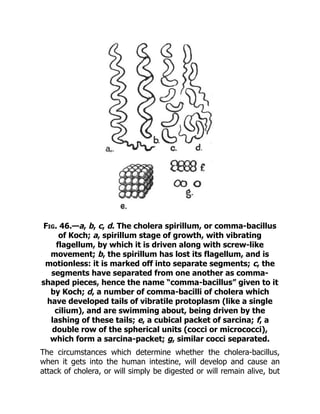
Fig. 46.—a, b,c, d. The cholera spirillum, or comma-bacillus
of Koch; a, spirillum stage of growth, with vibrating
flagellum, by which it is driven along with screw-like
movement; b, the spirillum has lost its flagellum, and is
motionless: it is marked off into separate segments; c, the
segments have separated from one another as comma-
shaped pieces, hence the name “comma-bacillus” given to it
by Koch; d, a number of comma-bacilli of cholera which
have developed tails of vibratile protoplasm (like a single
cilium), and are swimming about, being driven by the
lashing of these tails; e, a cubical packet of sarcina; f, a
double row of the spherical units (cocci or micrococci),
which form a sarcina-packet; g, similar cocci separated.
The circumstances which determine whether the cholera-bacillus,
when it gets into the human intestine, will develop and cause an
attack of cholera, or will simply be digested or will remain alive, but
42.
inactive, for atime, have yet to be exactly determined. Obviously a
knowledge of them must be of immense importance. Certain
experiments show that other minute parasitic organisms—especially
those called Sarcina (Fig. 46, e), which often, but by no means
always, are abundant in the human intestine—favour the growth of
the cholera-bacillus—in fact, prepare the ground or soil, as we may
call it, for that deadly organism. This has been shown experimentally
by sowing cholera-bacillus on plates of slightly acid gelatine, or jelly.
It will not grow on this, but if at certain points on the surface of the
jelly the Sarcina organism is planted, then it is found that all around
the points where the Sarcina is growing the cholera-bacillus also
flourishes and multiplies. And it seems probable that, just as there
are microbes which are adjuvant or helpful to the cholera microbe,
so there are others which are repressive or destructive of it. We
know that this is the case with regard to some other microbes—
namely, that a microbe which will flourish abundantly on a prepared
jelly if it is alone, is entirely repressed and arrested in its growth by
the presence of one other ascertained kind. It is, in fact, thus that
some of the commoner putrefactive kinds of microbes occurring in
river water are repressive of the typhoid-bacillus, which, if it should
get there, flourishes best in the purest water or in water containing
no other microbe. There is some ground for thinking that in certain
districts there may be microbes present which make their way into
the human intestine, and then actually repress the cholera-bacillus,
should it subsequently be taken in with food or water. It would, of
course, be of immense importance to discover such a microbe, if it
exist, and the inquiry is at the present moment proceeding in Paris.
A very striking and at first sight astonishing fact in regard to this
subject is that there are a very large number and variety of microbes
habitually present in the human digestive tract. There are so many
different kinds—differing altogether from one another in their
chemical action—which are present in greater or less abundance in
this tract from one end to the other, that no one is at present able to
say even approximately how many there are, nor to give anything
like a complete account of their properties. The fact is that their
43.
isolation and study,and the definite determination of their
properties, is not an easy job. Many workers are engaged on it, and
it will be years before the matter is threshed out. One most curious
result of these studies is that a person may have the cholera-bacillus
in his intestine—not growing with any activity, but still alive—and yet
be perfectly well. He can, therefore, carry the cholera-bacillus from
one locality to another and spread the disease, and yet be entirely
devoid of suspicion, free himself from disease, and certified as
healthy! The same is true of the bacillus of typhoid fever. Persons
who have had typhoid fever have been shown to retain the typhoid-
bacillus flourishing for as long as fourteen years afterwards in their
intestine, without any ill effects to themselves, and to have been the
constant source of infection and disease to those living in the same
house with them by spreading the bacillus. The classical case of this
is that of a woman who carried on a baker’s business at Strasburg.
Infection by and protection from microbes is by no means so simple
a thing as it is sometimes represented to be.
Now that we are quite sure as to Koch’s comma-bacillus, or spirillum,
being the definite poison-producing agent causing Indian cholera, it
is comparatively easy to understand its mode of dispersal and
infection, and consequently how to avoid its attack. It is cultivated in
the laboratories devoted to the study of such matters—kept in
confinement, so to speak, for ten years and more—and its properties
and conditions of life are well known. For instance, it is destroyed by
“dryness,” hence it cannot be carried in a living infective state as
“dust” in the air. It is also destroyed by exposure to a heat a good
deal below that of boiling water, so that water itself can be freed
from it by boiling, and food dipped in boiling (or nearly boiling)
water, or heated on a metal tray beneath which a spirit or gas flame
is burning, can be rendered safe just before it is swallowed, even
when cholera is rife in the neighbourhood. Ordinary lime is a great
destroyer of the bacillus, and can be used on a large scale to abolish
it in refuse.
When the cholera is near one cannot be too scrupulously clean. The
fingers must be carefully washed with antiseptic before a meal, and
44.
everything purified byheat only a few moments before being put
into the mouth, since flies and careless handling may soil food or
anything else exposed in a cool condition even for a few minutes. It
is best when cholera is actually present in the house or town in
which you live to swallow nothing which has been allowed to get
cool; everything should be heated and eaten when hot.
Mephistopheles, in Goethe’s Faust, complains of the swarming,
pullulating life on the earth. He—the great destroyer—says:
“How many have I sent to grass!
Yet young, fresh blood, do what I will
Keeps ever circulating still.
In water, in the earth, in air,
In wet, dry, cold—everywhere
Germs without number are unfurl’d,
And but for fire, and fire alone,
There would be nothing in the world
That I could truly call my own.”
The version is Sir Theodore Martin’s. Mephistopheles might be a
bacteriologist explaining the difficulty of dealing with disease germs.
In any case, it is the Mephistophelian spirit of annihilation, and flame
as its instrument, which man brings to his service in the contest with
cholera germs.
The great carriers of cholera are human beings themselves travelling
in caravans, pilgrimages, shiploads. For the fact has now been
established that a man may harbour inside him the cholera-bacillus
without its multiplying largely or rendering him seriously ill. Once it
is brought by such an individual into a favourable locality, it is spread
by water contaminated by him, and yet used for drink and domestic
purposes; and also it is spread by his touching things in which the
bacillus can grow, such as cooked food, fruits, etc., swallowed
subsequently by unsuspecting purchasers or employers. You have, in
order to avoid cholera (and similar infections), not only to have very
clean fingers yourself, but to see to it that your servants’ fingers are
45.
clean also, orelse that anything they touch is afterwards heated for
a few minutes to near boiling-point before you let it enter your
mouth. A little history illustrative of the need of this precaution is on
record. In Egypt during a recent outbreak of cholera there was a
very wealthy lady who lived alone in an isolated palace under the
charge of a physician. She had a delicate appetite; her food was
most carefully prepared. She drank and used only boiled sterilised
water; no one was allowed to approach her except her servants,
who never left the palace grounds, and were in good health. She
sickened of cholera and died. It was a puzzle as to how she had
acquired the infection. Her physician at last discovered that she daily
partook of cold chicken-broth, prepared carefully by her cook. The
cook, though practically well, was found to be infected with the
cholera-bacillus, which had probably lodged in his intestine some
weeks previously at the commencement of the outbreak of the
disease in Egypt. Though living in him the cholera-bacilli had not
found a favourable field of growth. This man in handling the cold
broth, the cloth used to rub the spoon with which it was stirred, or
the basin itself, had, it was found by making the actual experiment,
been able to transfer the minute bacillus to the cold broth, a most
favourable and nourishing medium for its growth, and so his isolated
carefully guarded employer received an abundant crop of the bacilli
and developed a fatal attack of cholera. Had the lady taken the broth
hot, there would have been no living cholera-bacillus in it, and if she
had thus guarded herself in regard to all food, by the use of heat
and great cleanliness, she would have escaped infection.
The most interesting development of knowledge and speculation
with regard to the microbes which infest the human intestine and
other regions of the human body is (as I mentioned above)
connected with the fact that one kind or species of microbe has the
power of favouring the growth of another, if present alongside of it,
and that another kind has the power of checking or antagonising its
growth. Thus common putrefactive microbes of river water are
hostile to the cholera-bacillus and to the typhoid-bacillus. Those
disease-producing bacilli live longest and best in very pure water!
46.
Thus, too, itis found that the microbe of sour milk—the lactic-
bacillus—is antagonistic to the common putrefactive microbe of the
intestinal contents—the well-known bacillus coli. In virtue of the acid
which it produces, the microbe of sour milk arrests the excessive
growth and activity of the putrefactive bacillus coli. Hence the utility
of sour milk in many cases of intestinal trouble. We contain within us
a microbian flora of such variety and abundance of kinds and so
nicely balanced in their antagonisms and co-operations in a healthy
man, that one cannot wonder at the timidity of the medical man
who hesitates to interfere with their conflicts and established modus
vivendi. Yet that seems to be the direction in which action will have
to be taken. It seems likely that in different localities—towns,
forests, highlands, lowlands, seaboards—there are prevalent
different microbes which enter the bodies of human visitors and act
as disturbers of the native microbian flora previously established in
the stranger.
That there are great differences in the microbian flora (including
herein minute moulds and fungi as well as bacteria) of different
localities, is shown by the great experiment of cheese-making which
mankind carries on. Each kind of cheese—Stilton, Cheshire, Dutch,
Roquefort, Gruyère, Gorgonzola, etc.—is the result of the combined
and successive action on milk of a vast number of microbes; and it is
the fact that the combination which produces any given kind of
cheese is only found and (unconsciously of the exact nature of what
he is doing) brought into activity by man at certain places. You
cannot make Cheshire cheese in France nor Gruyère in Cheshire, and
so on. It is suggested—and the matter is being pursued by
experiment and observation at the present time in France—that
possibly amongst the other things which go to make up the qualities
of the air which agrees or disagrees with one in any given locality—
are the local microbes. This must not be regarded as a conclusion
which has been fully worked out—it is an ingenious and promising
suggestion made by Metchnikoff as the result of some observations,
and will be fully inquired into. The fact which I have mentioned
above (p. 242)—that the presence of the microbe Sarcina favours
47.
the growth ofthe cholera-bacillus—indeed, enabling it to grow and
flourish in conditions in which it was inert until the Sarcina was
“sown” alongside of it—renders it worth investigating the question as
to whether there are “local” germs or microbes which in this or that
region are abundant and get into man’s food and drink, and so into
his intestine, and become established there, helping or antagonising
the growth of other microbes already there or subsequently
introduced. Thus, to the various considerations in regard to the “air”
of a locality, such as rarefaction, moisture, temperature, movement,
ozone, and the perfumes and exhalations of pine trees, rosemary,
and sweet-smelling grasses, which seem to be those which are the
most likely to affect the health of inhabitants and visitors, it is not
improbable that we must add the influence of an invisible local flora
of microbes. The inquiry is a long and laborious one, but it will be
carried through. The microbes, whether in air or water, or on the
surfaces of things, can be collected by washing them into warm
liquid gelatine. Then the gelatine is poured out on a plate, and
hardens as a thin sheet of jelly. This is protected from all further
contamination, and, after a few hours, each invisible microbe
embedded immovably in the jelly makes itself apparent. It multiplies
enormously whilst remaining stuck to one spot, and is no longer
invisible, but presents itself to the eye as a little sphere, or disc, of
characteristic shape, colour, and quality, consisting of many hundred
thousands of crowded microbes produced by the growth and division
of the original invisible one. Some dozens or some hundreds of little
growing “dots,” and of many various kinds, will thus reveal
themselves in the jelly according to the number and kinds of utterly
invisible parent microbes introduced by your “washings” into the
jelly. And so the investigator has the means of getting at each kind
of invisible microbe quite detached from the others, and of
separating it for further cultivation and experiment as to its chemical
and disease-producing qualities. These microbial gardens of jelly-
plates are, indeed, a wonderful revelation and a fitting “horticultural”
accompaniment to the dark and gloomy forests of rampant wild
microbes in our insides, where all are struggling for the soil, one
crushing out another by its sheer exuberance, a third choked by the
48.
encircling luxuriance ofa fourth, just as the trees, mosses, and
climbers of a tropical jungle are budding, pushing, grasping,
destroying one another in their irrepressible growth.
Pettenkofer, of Munich, when he found (as Metchnikoff did later) that
the cholera-bacillus could be swallowed in spoonfuls without
producing any harm, came to the conclusion that, though it was a
necessary agent of the disease “cholera,” yet that there was still an
unknown additional determining “cause” of a local character which
must be present in order to render the “cholera-bacillus” effective.
Metchnikoff is now seeking this “local” cause and parallel
antagonistic causes, in the microbian flora of localities which locally
effect an entry into the human body, and are, on the one hand,
“favourable,” or on the other hand “antagonistic.” Take as a concrete
example Versailles. When cholera has been rife in Paris, there has
been no cholera at Versailles. There is something at or about
Versailles which does not permit cholera to flourish in men who live
there. The guess—the hypothesis—which is being investigated at
this moment, is that there is possibly a microbe present at Versailles
which enters into the microbial jungle of the intestine of mankind
there, and is inimical to, repressive of, the cholera-bacillus when it
also arrives there. Similarly, the suggestion is entertained, and is
being experimentally tested, that there is in Paris a microbial
inhabitant of the intestine which is favourable to the energetic
growth of the cholera-bacillus when it puts in an appearance, but
that this favouring (as yet undetermined) microbe does not exist at
Versailles.
These imaginings and guesses as to favouring and antagonising
microbes must not be confused with the definitely ascertained facts
as to the cholera-bacillus. But they are quite sufficiently important
and probable to justify their narration to a discreet and sympathetic
public.
49.
XXVI
SEA-BREEZES, MOUNTAIN AIR,AND
OZONE
Fifty years ago people were very fond of talking about “ozone,” and
the word is popularly used nowadays to signify a mysterious
attribute of the air of the sea-coast or moorland without its real
significance being generally understood. When Sir Oliver Lodge the
other day warned people against hurting their nasal passages by
sniffing up an unduly strong dose of ozone produced by a special
ozone-making apparatus, I am inclined to think that most people
who read what he said wondered what “ozone” might be.
In the eighteenth century it was noticed that the sparks from a
frictional electrical machine are accompanied by a peculiar pungent
smell in the air. Many years after that, namely in 1840, the great
chemical experimenter, Schönbein, the friend and correspondent of
Faraday and discoverer of gun-cotton, found that the smell in
question is produced by a special gas, which is formed in the air
when electric discharges take place. He found that this gas was a
powerful oxydiser—would, in fact, oxydise iodide of potassium so as
to set free iodine—and thus its presence could be detected by
means of paper slips coated with a mixture of starch and iodide of
potassium. When they were exposed in air which contained even
minute traces of this strange gas they became purple-blue, owing to
the liberation of iodine and the formation of its well-known blue
combination with the starch. Schönbein found that in breezy, fresh
places his test-papers turned blue, and concluded from that
(confirmed by other evidence) that this smelling gas, to which he
gave the name ozone—which simply means “the smelling stuff”—is
50.
present in good,ordinary atmospheric air, as well as in artificially
“electrified” air. It is destroyed when such air is heated above the
boiling-point of water, and seems to be, as it were, “taken out” of
the air by all sorts of dead organic matter, so that it is not present in
the air of large cities. I remember that when I was a boy we used to
test the air for ozone with Schönbein’s papers (I am aware that their
colour change is not absolute proof of the presence of ozone, as
other oxydising gases might, if present, act in the same way), and
we used to find more ozone when a south-west wind was blowing
than in a north-easter!
Schönbein wrote sixty papers on ozone—but its real nature was
made out by others who succeeded him, chiefly by Andrews, of
Belfast, and Tait, of Edinburgh. It turns out that ozone is a
condensed form of the elemental gas oxygen—squeezed, as it were,
and literally “intensified,” so that three measures of oxygen gas
become only two of ozone. It very readily changes back again—two
measures of ozone expanding to form three of oxygen. It is
produced by the action of an electric discharge upon oxygen gas
driven over the discharge and in greatest quantity when that kind of
gently-buzzing electric spark which is called “the silent discharge” is
used. It can be produced in quantity by passing atmospheric air, or
better, pure dry oxygen gas through a glass tube in which such a
silent discharge is made to take place. As much as seventeen parts
in a hundred of the gas can be thus converted into “ozone,” and
some twenty years ago two French chemists succeeded in getting
even a larger proportion, and by submitting it to a tremendous
pressure at a temperature of 100 degrees below the freezing-point
of water, they obtained pure ozone as a transparent liquid. It was of
a dark indigo-blue colour, and somewhat dangerous and explosive
when the pressure under which it had formed was removed.
Ordinary oxygen gas has since then been also liquefied in the
laboratory: it is of a paler blue colour.
The “smell” which old writers had noticed and Schönbein had named
was thus actually obtained as a distinct blue liquid. It is this which,
though present only in minute quantities, gives special oxydising
51.
activity to freshair. When pure, or present even to the small extent
of 4 per cent. in air, ozone is a destructive agent, a sort of extra-
quality oxygen of triple instead of double power. Indiarubber is
rotted and destroyed by it in a few minutes—a sort of combustion or
quick oxydation taking place—and it is, of course, dangerous to the
softer parts of the human body, such as the air passages and lungs
and the eyes—when present in more than a minimal proportion. I
believe that no one has yet determined exactly how great a
percentage of ozone can be tolerated by a human being in the air
taken into the lungs. In ordinary fresh country or sea-coast air only
one part by measure in 700,000 has been found to be ozone, that is,
1/7000 per cent. But it is quite likely that much more is occasionally
present, since it is very difficult to arrange a satisfactory examination
of the air of any locality so as to determine how much ozone it
contains. It is said that at higher levels the atmosphere contains
more ozone than it does at lower levels.
It is not to be wondered at that ozone should thus have attracted
general attention and interest as the distinctive and specially active
agent present in the pure air of the sea-coast and the mountain-top.
People not infrequently, on arriving at the seaside, sniff up the
odours of decomposing seaweed (containing a little iodine), and
think they are smelling the “ozone.” It is doubtful whether enough
ozone is ever present in the atmosphere under simple natural
conditions to affect even a highly-sensitive nose. But it is easy to
produce enough by passing air over a silent electrical discharge to fill
a large room with its peculiar smell. Whether it really is of benefit to
the human being who inhales a properly limited percentage of it
seems not to have been clearly decided by experiment, although
both in London and the United States of America there are
enterprising medical men who are convinced of its value and are
using it. It would certainly seem that if the peculiar benefit which is
often derived from sea air or from mountain air is due to the
presence of this extra oxygen in such air, then nothing can be
simpler or more rational than to introduce the proper and useful
percentage of ozone into the air of specially-arranged chambers in
52.
London and otherlarge towns, so that we can visit or even inhabit
them and breathe ozonised air at will without going on a journey for
it.
But it is a remarkable fact that, as with various natural so-called
“mineral waters,” so with various “airs” which people find beneficial
—no one has yet clearly and decisively shown, in the first place,
whether they exert any chemical effect of a special kind on the
people who seem to benefit by drinking the one or breathing the
other; still less has any one shown what is the particular chemical
ingredient of the air or of the water of any given resort which exerts
the beneficial effect attributed to that air or that water.
The air in different localities differs most obviously and importantly
in four particulars, namely, as to whether it is still or windy, whether
it is cool or hot relatively to the local surface, whether it is heavy or
rarefied, whether it is dry or saturated with moisture. It is also an
important fact that the atmosphere consists of layers and currents
differing in these qualities, and that the higher layers can be reached
by ascending to high-lying lands. At the same time it seems that in a
flat country the ascent of a comparatively low hill brings you into a
layer or “stratum” of air differing more from that of the plain or
valley than would be the case were you to ascend to the same
height in a mountainous region. The seaside and the mountain may
owe the beneficial character of their air to some of the varying
qualities noted above. Chemical differences may or may not be
important, and seem hardly to have been as yet brought within the
range of accurate knowledge. Ozone may be more or less present,
so may perfumes and volatile oils, such as are given off by pine
trees, and there may be more or less minute quantities of carbonic
acid and of sulphurous acid, and still minuter quantities of the
newly-discovered gases—argon and helium—which, for all we know,
may have some effect on the human body. There seems to be a
great field open for accurate investigations in regard to the action
upon human health of all these varying conditions of the air. In the
meantime, we proceed by guesswork, and are influenced by
53.
tradition and beliefswhich are based on a sort of experience, but are
of a very vague and unsatisfactory description.
The case is much the same with regard to the natural waters of
celebrated resorts. So far as their chemical composition is known,
they can be manufactured and applied for drinking or bathing
anywhere. But minute quantities of certain gases and other elements
may be present in these natural waters and have escaped until now
the observation of the chemist, and it is possible, though not
demonstrated, that these rare chemical constituents may have some
action on those who drink or bathe in the water. Ever since the time
of the Romans natural mineral waters have been sought, and the
springs which discharge them have been frequented, not because
their chemical composition was known, but because experience
seemed to show that they produced a beneficial result. It can hardly
be doubted that the baths and springs frequented at the present day
are not so much themselves the cause of the benefit to the cure-
seekers as are the change of scene and diet, and the repose and
regular life willingly accepted by those who travel so far to reach
these springs.
With regard to ozone, there remains something more to be said,
namely, in regard to its application, in a far less diluted form than is
possible when it is taken into the lungs, to the destruction of
putrefying organic matter and putrefactive and disease-producing
bacteria. It is now some five or six years since air containing a high
percentage of ozone—produced by the action of the electric
discharge—was used for the purification of the water-supply of large
towns. It is a fact that river water into which such ozone containing
air is pumped becomes pure in the highest degree, in consequence
of the destruction by the ozone’s oxydising action, both of the
bacterial germs always present in vast numbers in river water and of
the organic matter on which the bacteria depend. This application of
ozone is in use in several large towns for the purification of drinking-
water, for which purpose it has very great advantages. It has also
been successfully used by Dr. Allen, the director of the Plymouth
Marine Laboratory, for keeping the water of the marine aquarium
54.
there in astate of purity and well charged with oxygen gas. A similar
use has been made of oxygen containing a considerable percentage
of ozone by enterprising surgeons for the cleansing of ulcer and
abscess. It is clear that such a gas may present mechanical
advantages over any liquid application.
Ozone is not, apparently, in favour or fashion with the general body
of medical practitioners at the present day, but possibly further
examination and determination of its physiological properties may
lead to its receiving more attention in medicine. Already the peroxide
of hydrogen—which is more or less correctly described as “ozonised
water,” and is used (under the name “Auricomous hair-wash”) to
change dark hair by its oxydising action to a golden tint—is used by
surgeons for washing out purulent wounds and abscess. Those who
use the gas itself only go a step further. Some day we may see a
more general use of ozone; on the other hand, it remains to be seen
by direct and accurate experiment whether its properties are as
valuable to man as we may hope they will prove to be.
55.
XXVII
OXYGEN GAS FORATHLETES AND
OTHERS
Since the preceding chapter on ozone was written I have learned
that this peculiar triple-condensed variety of oxygen (it is called by
chemists “O3” whereas ordinary oxygen is “O2”) is now being most
successfully applied to the purification of the water-supply of several
large cities. A notable case is that of the great winter resort, Nice.
Ozone gas is one of the most effective destroyers of organic impurity
known; it destroys both bacterial germs and the putrescible
impurities of water completely, and is itself converted in the process
into harmless health-giving oxygen, whilst the water is rendered
absolutely free of all germs. It is readily manufactured by treating
oxygen with the electric discharge, and is produced at a cost which
renders its use in water-purification an economical and financially
satisfactory method. The use of ozone gas as a medicinal application
to cavities in the living body in which disease-producing bacteria are
lodged is making progress. It has to be administered with great care
by a medical expert, and though there has been delay and
opposition on account of the novelty of the treatment, there are
signs that ozone will become established as a valuable therapeutic
agent. It is a singular fact that so little has been done of late by
scientific observers either as to the presence of ozone in the
atmosphere or as to the action of ozone on the healthy animal body
when present in minute quantity in the air taken into the lungs. The
general opinion appears to be that it is either altogether absent from
the atmosphere or present only in quantity so minute as to be
negligible from the point of view of the physiologist except in very
56.
high mountain regions,and there the exact quantity remains
undetermined. The only experiments in the last ten years on the
subject of its action on animals are some which led the inquirers to
the conclusion that constant exposure (in a closed chamber) to an
atmosphere containing 4 per cent. of ozone caused death after five
or six days by an inflammation of the lungs. Clearly it is desirable
that further investigation on this subject by competent authorities
should be made, and the effect of smaller quantities of ozone in the
air respired, whether continuously or at intervals, should be
ascertained.
The action of ordinary oxygen gas is a separate matter. The
atmosphere which we breathe consists of one part by volume of this
gas and of four parts of nitrogen gas. It is the oxygen which is
necessary to us and to all animals, and the nitrogen is merely an
inert diluting accompaniment of the essential oxygen gas. It is, of
course, easy to increase or to diminish the proportion of oxygen in
the air breathed accordingly as one introduces additional pure
oxygen or, on the other hand, diluting nitrogen into a collapsible bag
or sac from which one continuously draws breath. Such a bag can be
connected by a tube to a helmet or mask enveloping the head. The
expired air is discharged by a specially provided passage. It used to
be thought that it was dangerous to breathe pure undiluted oxygen,
although the proportion of oxygen to nitrogen in the air taken into
the lungs might be increased to as much as a half without injury,
and, indeed, with great benefit in some serious conditions of
collapse. Dr. Leonard Hill, F.R.S., of the London Hospital Medical
College, has, however, recently shown that oxygen gas, of 97 per
cent. purity, may be breathed continuously for as much as two hours
without any ill-effects or sense of inconvenience. Contrary to what
has been stated, it is neither exciting nor unpleasant. He has made
the experiment on himself and on some of his assistants, and in
doing so has made use of such an apparatus as that above-
mentioned—so as to ensure the in-take of undiluted oxygen.
Dr. Hill and Mr. Martin Flack have further found that the exhaustion
and labouring of the heart which is brought on by such special
57.
exertion as thatinvolved in running a hundred yards race or a
quarter-mile race, is almost completely avoided if the runner “fills his
lungs” with oxygen gas before starting. The runner takes the oxygen
gas into the lungs for some two or three minutes before starting to
race; of course, the lungs are not thus actually “filled” with oxygen,
but a much larger proportion of that gas is lodged in them than
when ordinary air is breathed, and a full supply is thus afforded to
the blood. The “distress” caused by violent athletic efforts appears to
be entirely due to the using up of the available oxygen by the
unusual activity of the muscles. The heart itself suffers most, the
breathing becomes laboured, and there is a sense of suffocation,
due simply to the urgent demand by the blood, heart and muscles
for more oxygen. If, therefore, we ensure that there is an extra
supply of pure oxygen in the lungs before the unusual effort is
made, we avert these distressing symptoms: the unusual quantity of
oxygen needed is ready for use. Dr. Hill himself and young men who
have tried the plan of inspiration of oxygen before a foot-race,
declare that they cannot believe that they are really running hard,
even when surpassing their usual performance. They come in at the
end of the quarter-mile, having beaten their record; and with no
sense of having made a special effort; they feel fresh and ready to
start again after more oxygen and a short rest. Moreover, the after-
effect on the muscles is stated to be such that “stiffness” and what
is called “grogginess” (due in ordinary circumstances to the retention
of lactic acid in the muscle) do not supervene.
Swimming and diving, as one would expect, are greatly affected by
the preliminary oxygen inhalation; the length of time during which
submersion can be endured without discomfort is doubled, and the
great effort of fast swimming rendered less rapidly exhausting.
Cycling uphill at a rapid pace becomes, according to Dr. Hill’s own
frequent experience, possible after oxygen inhalation when in
ordinary conditions it was impossible. Hockey players and boxers he
has found notably benefited by oxygen given both in the intervals of
and after the exercise. It is, of course, to be expected that a wider
practical application should be made of this simple method of
58.
increasing our powerof sustaining muscular effort, and of enduring
submersion. Dr. Hill suggests that the divers of the Mediterranean,
who, without any apparatus, plunge into the shallow sea and remain
below long enough to find, cut, and bring to the surface the valuable
sponges of commerce, might use the method of preliminary
inhalation of pure oxygen gas. He has also tried the method with a
young racehorse, but owing to the fact that the course run was only
a mile, and the animal perfectly fit and strong, he tells me that no
advantage was found to result from the inhalation. With an older
cart-horse somewhat tired by a day’s work—he obtained the most
satisfactory results, the animal becoming obviously recuperated and
working without distress.
The question has been raised as to whether the administration of
oxygen gas to a man or to a horse when about to run a race should
be considered as “doping.” It may perhaps be objected to by
sportsmen, as involving the provision of special apparatus which all
competitors would not be equally able to secure. But it is not
“doping,” since that applies to the use of a drug, which, whilst
exciting to violent effort, produces an injurious after-effect. Oxygen
is not in this category; to take an extra quantity of oxygen into the
lungs before starting on a race is no more unnatural or risky than to
take an extra drink of water into the stomach or to swallow meat
extract and such special preparations before or during a race. It
would be interesting to see whether a runner in the Marathon race
would (as Dr. Hill would expect) be greatly assisted if his trainer
carried with him a supply of pure oxygen, and from time to time
refreshed him with it. Football players might also be given oxygen at
half-time; an oxygenated team would, one surmises, beat its
uninspired competitors. A Fife team is reported to have done so. On
the roads favoured by cyclists one may expect hereafter to find at
the bottom of a long ascent hawkers of “breaths of oxygen”
provided with gas-bags and calling out “Buy the lady a breff, sir!” It
is, perhaps, worth noting that the relief afforded by oxygen-
breathing is no less definite when the gas is taken immediately after
a race or sustained effort than when used as a preliminary. The
















![knowledge attain that our ancestors confused the astral signs of
changing season and cycle with the cause itself of change, and
attributed all kinds of mundane events and each man’s fate to “the
influence of the stars.” Hence the sudden appearance of a flaming
comet was held to be a portent, and was always supposed either to
foretell or even to produce some very unpleasant event, such as a
big war or a pestilence, or the death of some one supposed to be of
consequence. The earliest Greek poetry enshrines the superstition,
which is handed on by Virgil, and finally by Milton. In Pope’s
translation of the Iliad we find the helmet of the terrible Achilles
described as shining
“Like the red star, that from his flaming hair
Shakes down diseases, pestilence, and war.”
And Milton, in 1665, in his Paradise Lost, wrote—
“On th’other side,
Incenst with indignation, Satan stood
Unterrifi’d; and like a comet burn’d,
That fires the length of Ophiuchus huge
In th’ Arctic sky, and from his horrid hair
Shakes pestilence and war.”
In this year of the celebration of the tercentenary of Milton’s birth, it
is not a little curious to find that John Milton, himself a scholar of St.
Paul’s School, wrote those lines when Edmund Halley, the future
Astronomer Royal, had just entered the same great school, then
standing in St. Paul’s Churchyard, as it did when I was “one of the
fishes,” and used to see men hanging in the Old Bailey—I once saw
five[5]—on Monday mornings as I passed on my way to the school.
To a Pauline it is not without significance that the return of Halley’s
comet is awaited within a year of Milton’s tercentenary, and that the](https://image.slidesharecdn.com/3498-250411000600-6f6583a7/85/eBook-PDF-PMP-Project-Management-Professional-Study-Guide-Fifth-Edition-29-320.jpg)
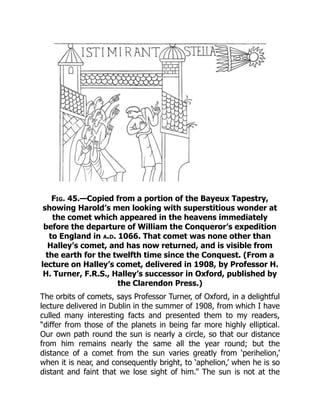
![centre of the ellipse described by a comet’s path, but is quite near to
one end of it, so that comets approach the sun far more closely than
do the planets, some taking so close a turn round the sun that the
heat from it to which they are exposed is 2000 times as great as
that which the earth receives. If the orbit of a comet is really elliptic,
then there at last comes a time, though it may be only after
thousands of years, when the comet, having rounded the sun at
close quarters, and journeyed off into space, has his journey brought
to a turning-point at the other end of the ellipse, and begins to draw
near again, advancing towards the sun. The length of the orbit of
Halley’s comet is about 3255 million miles, and the breadth at its
broadest is about 800 million miles, and he takes about thirty-eight
years to travel the full length (along the curve) and thirty-eight years
to come back again! Other comets have other lengths and breadths
of orbit, and take longer or shorter periods to go round. But the
conditions of attraction affecting a comet may be such that the
return journey never occurs. They may be such that the comet goes
on indefinitely travelling away from our sun, until he is caught by
some other star, and his orbit changes its shape, with the new sun
as attracting centre. These are the “wandering comets” as distinct
from the “periodic comets,” which have been shown to conform to
Halley’s scheme of their movement and recurrence.
And now some one will ask, perhaps impatiently, “What, after all, is
a comet?” We have seen that many are continuously, and others
casually, members of the solar system. What do they consist of?
Spectrum-analysis shows that they consist chiefly of the chemical
element carbon.[6] Though they have weight, and are attracted by
the sun, yet they seem to be for all their size and terrifying shape
and glare incredibly light and airy things. Herschel declared that the
tail of a big comet probably consisted of but two or three pounds of
solid matter—diffused, rarefied, and luminous. And the head or
nucleus certainly does not weigh many hundreds of tons. In the
eighteenth century astronomers observed a comet pass right in
among the moons of the planet Jupiter. You might expect the moons
to be terribly knocked about by such an impact. They were not; they](https://image.slidesharecdn.com/3498-250411000600-6f6583a7/85/eBook-PDF-PMP-Project-Management-Professional-Study-Guide-Fifth-Edition-34-320.jpg)
![were not deflected in the smallest appreciable degree from their
position and regular movement! One is naturally inclined to look
upon the tail of a comet as something like the smoke of a railway
engine trailing behind the advancing “head.” As a matter of fact, it
does not always trail behind, but is always turned away from the
sun, so that when the comet is travelling away from the sun the tail
is in front! It is now held that the tail is caused by the radiant energy
(light and heat) of the sun, blowing, as it were, the lighter particles
from the incandescent head, and causing them to spread out in a
long track of variable shape. The photographs of the third comet of
the year 1908 show that the tail can vary to an astonishing extent
and with great rapidity—that is to say, in four or five hours. It is seen
in those photographs as a scimitar-like curved blade, then with a
second head or nucleus behind the leading one, then actually bent
like the letter Z, and then divided into seven distinct diverging
“plumes,” and then it returns to its former simple shape—all in the
course of a few days. Astronomers have now shown that there is a
close connection between comets and the showers of “shooting
stars” or meteors which frequently strike the earth’s atmosphere. It
is considered probable that comets eventually break down into
streams of meteors, and that their “life” (if one may use that term)
is, relatively to that of other heavenly bodies (which are all
undergoing change and, in many cases, decay), not a very long one.
But there are no facts at present known which enable us to tell
whether a given comet is young or old, and it would have been a
decided shock had it been found that Halley’s comet, which has so
happily spent every seventy-sixth year with us for so many
centuries, had “burst up,” or by “indisposition” had been unable to
pay his usual visit as expected in 1910.
FOOTNOTES:
[5] The pirates of the Flowery Land.
[6] I am indebted to Mr. Rolston, of the Solar Physics Observatory,
South Kensington, for some information on this matter.](https://image.slidesharecdn.com/3498-250411000600-6f6583a7/85/eBook-PDF-PMP-Project-Management-Professional-Study-Guide-Fifth-Edition-35-320.jpg)