FLEXIBLE OLED DISPLAY
TECHNOLOGY FOR ELECTRO-
OPTICAL STIMULATION
G U I D E D B Y,
C E L I N E M A R Y S T U A R T
P R E S E N T E D B Y,
C H I N C H U T H O M A S
INTRODUCTION
 OPTOGENETICS: using light simulation controls the
excitation, inhibition or signaling pathways of genetically
modified neural tissue.
 Neurons are genetically modified using viral vector.
 Cells expressing Channelrhodopsin-2(ChR2) are activated by
blue light.
 Cells expressing Halorhodopsin are silenced by yellow light.
 Common approach done is to insert the exposed tip of fibre optic
cable into the brain tissue of an animal model.
 Newer approach replaces this fibre optic probe with
small array of discrete light emitting diode(LED).
 This approach eliminates the need for a permanent
opening in the cranium.
 One key limitation in this approach is the inability to
turn on individual pixels and also high power
consumption.
 Hence a new concept is introduced “FLEXIBLE OLED
COLOR DISPLAY”.
 They can be used on thin biocompatible plastic
substrate to selectively activate individual pixels.
OLED
 Organic light emitting diode.
 They are coated glass plates.
 Organic compounds used are
hydrocarbons.
 Fabricated on plastic substrate.
 these glass plates are tightly
sealed to provide protection
from moisture and oxygen.
 Plates are of thickness 1/1000th of human hair, providing
capability to bend over a wide variety of degrees.
 They doesn't produce heat when turned on.
 OLED technology produces self-luminous displays that
doesn't require backlighting and hence they are more power
efficient.
 OLED requires only less power, i.e. 2-10 v.
 They use substances that emit RED,GREEN and BLUE or
WHITE light.
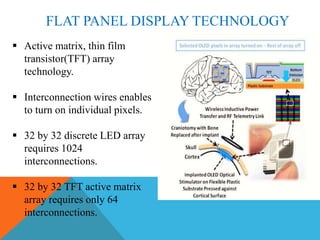
FLAT PANEL DISPLAY TECHNOLOGY
 Active matrix, thin film
transistor(TFT) array
technology.
 Interconnection wires enables
to turn on individual pixels.
 32 by 32 discrete LED array
requires 1024
interconnections.
 32 by 32 TFT active matrix
array requires only 64
interconnections.
FLEXIBLE OLED DISPLAY TECHNOLOGY
FOR OPTOGENETICS
 Discrete array LED consists of one LED per pixel.
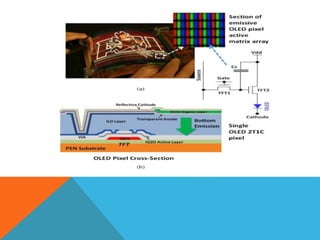
 Active matrix OLED displays consists of two TFT’s and
one capacitor(2TIC) per OLED pixel.
 OLED,TFT and pixel capacitor is integrated on the same
substrate.
 It emits bright light when a forward bias is applied
between a transparent anode and reflecting cathode.
 Conventional TFT-based flat panel OLED displays are
produced on fragile and rigid glass substrate.
 Fragile glass substrate is replaced by a flexible plastic
substrate of 125 micrometer thickness.
 Flexible OLED is very thin and transparent sheet of
plastic.
 Constructed by sequential layering and patterning Nano
scale thin films on its surface.
EXPERIMENTAL DETAILS AND
DEVICE FABRICATION
 the light emitted should be
bright enough to induce optical
stimulation.
 Blue light in the range 450-
460nm is the optimum
wavelength.
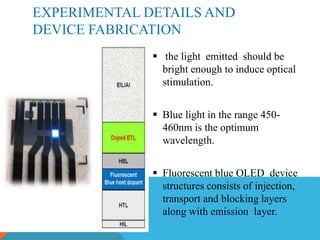
 Fluorescent blue OLED device
structures consists of injection,
transport and blocking layers
along with emission layer.
 Cathode used is a reflective aluminum surface and anode is a
transparent Indium Tin Oxide(ITO).
 Emissive layer used is a single host doped with a blue
fluorophore.
 Electroluminescence (EL) optical spectra is obtained using
Ocean optics HR4000 CG spectrometer.
 Luminance versus voltage (L-V) curve was collected using a
Newport optics 818-UV photodiode.
RESULTS AND DISCUSSION
High light intensity pulsed blue OLED
development
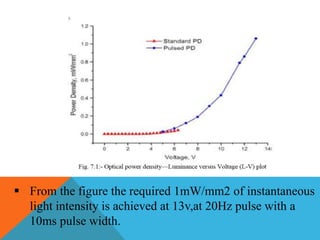
 A minimum of 1mW/mm2 of instantaneous
pulsed irradiance at a wavelength of 450nm
is required.
 The intensity is 0.1mW/mm2 for bottom-
emitting blue OLED at 7v DC bias condition.
 Pulsing the supply voltage of OLED.
 A thin 30 micro metre flexible metal foil is
bonded to the back of reflective cathode.
 From the figure the required 1mW/mm2 of instantaneous
light intensity is achieved at 13v,at 20Hz pulse with a
10ms pulse width.
Flexible OLED display biocompatibility
 Biocompatibility and long term in-vitro durability of flexible
OLED display were evaluated.
 Ability to grow immortalized epithelial cells on the surface of
full TFT-process plastic flexible display substrate.
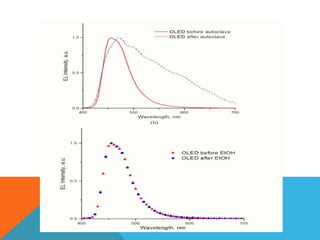
 Blue OLED’s requires ETHANOL(EtOH) sterilization. That
doesn't make any change in the optical characteristics.
 Operating temperature at the surface of the blue optical emitters
under 1mW/mm2 pulse mode should be compatible with the
living brain tissue.
ADVANTAGES
 Paper like readability.
 Thin, light form factor.
 Twistable
DISADVANTAGES
 Very low refresh rate.
 Very slow zoom.
 Ghost images
APPLICATIONS
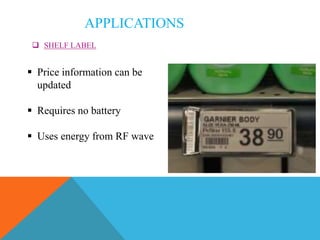
 SHELF LABEL
 Price information can be
updated
 Requires no battery
 Uses energy from RF wave
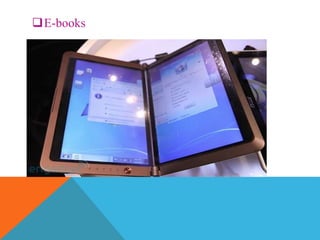
E-books
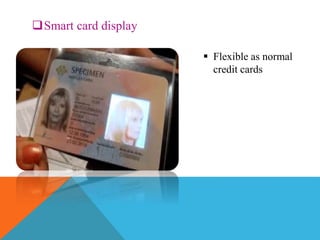
Smart card display
 Flexible as normal
credit cards
CONCLUSIONS
 Benefit to economy and simplify everyday life
 More applications in future.
 Additional modifications done to accelerate the
marketing.

Flexible oled display technology for electro optical stimulation

  • 1.
    FLEXIBLE OLED DISPLAY TECHNOLOGYFOR ELECTRO- OPTICAL STIMULATION G U I D E D B Y, C E L I N E M A R Y S T U A R T P R E S E N T E D B Y, C H I N C H U T H O M A S
  • 2.
    INTRODUCTION  OPTOGENETICS: usinglight simulation controls the excitation, inhibition or signaling pathways of genetically modified neural tissue.  Neurons are genetically modified using viral vector.  Cells expressing Channelrhodopsin-2(ChR2) are activated by blue light.  Cells expressing Halorhodopsin are silenced by yellow light.  Common approach done is to insert the exposed tip of fibre optic cable into the brain tissue of an animal model.
  • 3.
     Newer approachreplaces this fibre optic probe with small array of discrete light emitting diode(LED).  This approach eliminates the need for a permanent opening in the cranium.  One key limitation in this approach is the inability to turn on individual pixels and also high power consumption.  Hence a new concept is introduced “FLEXIBLE OLED COLOR DISPLAY”.  They can be used on thin biocompatible plastic substrate to selectively activate individual pixels.
  • 4.
    OLED  Organic lightemitting diode.  They are coated glass plates.  Organic compounds used are hydrocarbons.  Fabricated on plastic substrate.  these glass plates are tightly sealed to provide protection from moisture and oxygen.
  • 5.
     Plates areof thickness 1/1000th of human hair, providing capability to bend over a wide variety of degrees.  They doesn't produce heat when turned on.  OLED technology produces self-luminous displays that doesn't require backlighting and hence they are more power efficient.  OLED requires only less power, i.e. 2-10 v.  They use substances that emit RED,GREEN and BLUE or WHITE light.
  • 6.
    FLAT PANEL DISPLAYTECHNOLOGY  Active matrix, thin film transistor(TFT) array technology.  Interconnection wires enables to turn on individual pixels.  32 by 32 discrete LED array requires 1024 interconnections.  32 by 32 TFT active matrix array requires only 64 interconnections.
  • 7.
    FLEXIBLE OLED DISPLAYTECHNOLOGY FOR OPTOGENETICS  Discrete array LED consists of one LED per pixel.  Active matrix OLED displays consists of two TFT’s and one capacitor(2TIC) per OLED pixel.  OLED,TFT and pixel capacitor is integrated on the same substrate.  It emits bright light when a forward bias is applied between a transparent anode and reflecting cathode.
  • 8.
     Conventional TFT-basedflat panel OLED displays are produced on fragile and rigid glass substrate.  Fragile glass substrate is replaced by a flexible plastic substrate of 125 micrometer thickness.  Flexible OLED is very thin and transparent sheet of plastic.  Constructed by sequential layering and patterning Nano scale thin films on its surface.
  • 10.
    EXPERIMENTAL DETAILS AND DEVICEFABRICATION  the light emitted should be bright enough to induce optical stimulation.  Blue light in the range 450- 460nm is the optimum wavelength.  Fluorescent blue OLED device structures consists of injection, transport and blocking layers along with emission layer.
  • 11.
     Cathode usedis a reflective aluminum surface and anode is a transparent Indium Tin Oxide(ITO).  Emissive layer used is a single host doped with a blue fluorophore.  Electroluminescence (EL) optical spectra is obtained using Ocean optics HR4000 CG spectrometer.  Luminance versus voltage (L-V) curve was collected using a Newport optics 818-UV photodiode.
  • 12.
    RESULTS AND DISCUSSION Highlight intensity pulsed blue OLED development  A minimum of 1mW/mm2 of instantaneous pulsed irradiance at a wavelength of 450nm is required.  The intensity is 0.1mW/mm2 for bottom- emitting blue OLED at 7v DC bias condition.  Pulsing the supply voltage of OLED.  A thin 30 micro metre flexible metal foil is bonded to the back of reflective cathode.
  • 13.
     From thefigure the required 1mW/mm2 of instantaneous light intensity is achieved at 13v,at 20Hz pulse with a 10ms pulse width.
  • 14.
    Flexible OLED displaybiocompatibility  Biocompatibility and long term in-vitro durability of flexible OLED display were evaluated.  Ability to grow immortalized epithelial cells on the surface of full TFT-process plastic flexible display substrate.  Blue OLED’s requires ETHANOL(EtOH) sterilization. That doesn't make any change in the optical characteristics.  Operating temperature at the surface of the blue optical emitters under 1mW/mm2 pulse mode should be compatible with the living brain tissue.
  • 16.
    ADVANTAGES  Paper likereadability.  Thin, light form factor.  Twistable
  • 17.
    DISADVANTAGES  Very lowrefresh rate.  Very slow zoom.  Ghost images
  • 18.
    APPLICATIONS  SHELF LABEL Price information can be updated  Requires no battery  Uses energy from RF wave
  • 19.
  • 20.
    Smart card display Flexible as normal credit cards
  • 21.
    CONCLUSIONS  Benefit toeconomy and simplify everyday life  More applications in future.  Additional modifications done to accelerate the marketing.