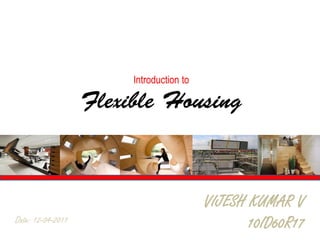
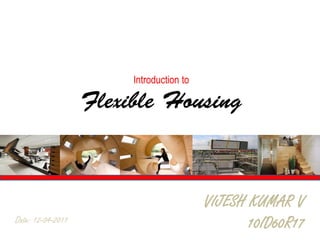
Introduction to
VIJESH KUMAR V
10ID60R17Date: 12-04-2011
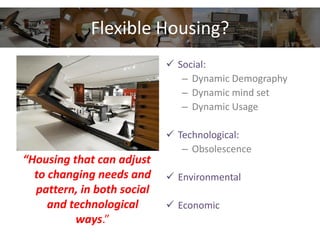
Flexible Housing?
“Housing that can adjust
to changing needs and
pattern, in both social
and technological
ways.”
 Social:
– Dynamic Demography
– Dynamic mind set
– Dynamic Usage
 Technological:
– Obsolescence
 Environmental
 Economic
Can you tell me Is there any person who satisfied with his home
during the time runs?
Certainly doesn’t. Why?
Do we have an answer?
Why we need?
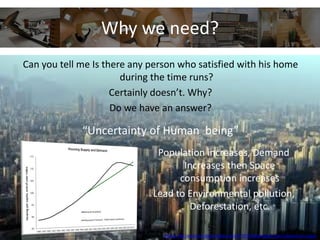
“Uncertainty of Human being”
Population increases, Demand
Increases then Space
consumption increases
Lead to Environmental pollution,
Deforestation, etc.
Source: http://economix.blogs.nytimes.com/2011/03/16/real-estate-crisis-it-depends-on-supply/
Solution?
“From now on, buildings will have
four dimensions, the fourth
dimension is ‘Time’ to become
part of architecture, buildings in
motion will shape the sky line of
our cities.“
Dr. Fisher
 Space inside Space
 Dynamic Consumption of
Space remedy
 Decrease in Space
Consumption over all
 Innovative Technology
Addition
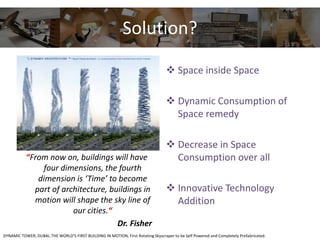
DYNAMIC TOWER, DUBAI, THE WORLD’S FIRST BUILDING IN MOTION, First Rotating Skyscraper to be Self Powered and Completely Prefabricated.
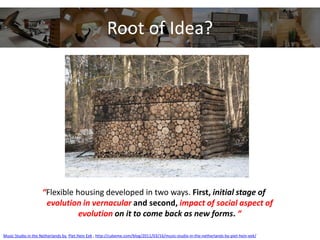
Root of Idea?
“Flexible housing developed in two ways. First, initial stage of
evolution in vernacular and second, impact of social aspect of
evolution on it to come back as new forms. “
Music Studio in the Netherlands by Piet Hein Eek , http://cubeme.com/blog/2011/03/16/music-studio-in-the-netherlands-by-piet-hein-eek/
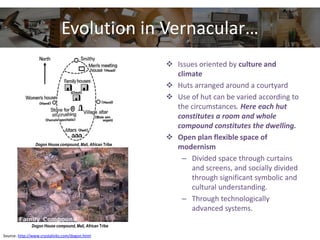
Evolution in Vernacular…
 Issues oriented by culture and
climate
 Huts arranged around a courtyard
 Use of hut can be varied according to
the circumstances. Here each hut
constitutes a room and whole
compound constitutes the dwelling.
 Open plan flexible space of
modernism
– Divided space through curtains
and screens, and socially divided
through significant symbolic and
cultural understanding.
– Through technologically
advanced systems.
Source: http://www.crystalinks.com/dogon.html
Dogon House compound, Mali, African Tribe
Impact of Social aspect of Evolution…
Peoples take decisions through
two aspects;
 Non Architects
 Architects
 Area available
 Future Changes
 Technological adaptation
 Change in number of users
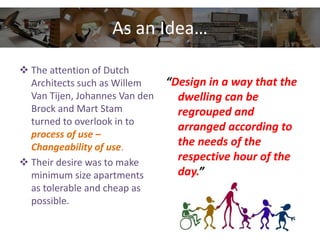
As an Idea…
 The attention of Dutch
Architects such as Willem
Van Tijen, Johannes Van den
Brock and Mart Stam
turned to overlook in to
process of use –
Changeability of use.
 Their desire was to make
minimum size apartments
as tolerable and cheap as
possible.
“Design in a way that the
dwelling can be
regrouped and
arranged according to
the needs of the
respective hour of the
day.”
History…
“A number of theoreticians and architects promoted
flexible housing from 1920 onwards. Modernist Architects
understood that a flexible approach could take care of a wider
range of occupants. Design of indeterminate open space was
possible because of the new constructional systems available
to the early Modernist architects, which allowed larger span
structures and light infill partitions.“
Some of the examples for modernist flexible housing are:
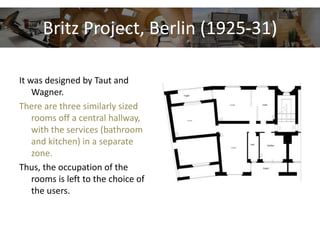
Britz Project, Berlin (1925-31)
It was designed by Taut and
Wagner.
There are three similarly sized
rooms off a central hallway,
with the services (bathroom
and kitchen) in a separate
zone.
Thus, the occupation of the
rooms is left to the choice of
the users.
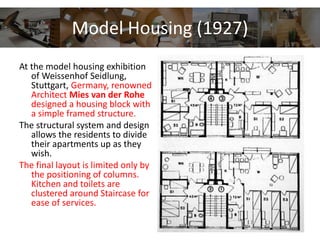
Model Housing (1927)
At the model housing exhibition
of Weissenhof Seidlung,
Stuttgart, Germany, renowned
Architect Mies van der Rohe
designed a housing block with
a simple framed structure.
The structural system and design
allows the residents to divide
their apartments up as they
wish.
The final layout is limited only by
the positioning of columns.
Kitchen and toilets are
clustered around Staircase for
ease of services.
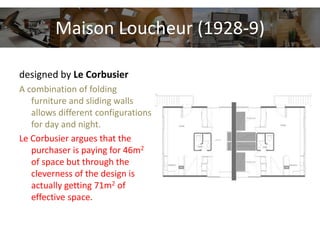
Maison Loucheur (1928-9)
designed by Le Corbusier
A combination of folding
furniture and sliding walls
allows different configurations
for day and night.
Le Corbusier argues that the
purchaser is paying for 46m2
of space but through the
cleverness of the design is
actually getting 71m2 of
effective space.
Prefabricated Homes in USA (1942)
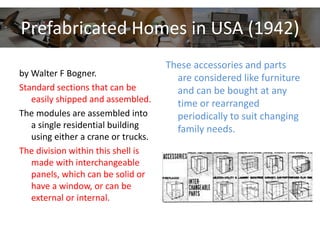
by Walter F Bogner.
Standard sections that can be
easily shipped and assembled.
The modules are assembled into
a single residential building
using either a crane or trucks.
The division within this shell is
made with interchangeable
panels, which can be solid or
have a window, or can be
external or internal.
These accessories and parts
are considered like furniture
and can be bought at any
time or rearranged
periodically to suit changing
family needs.
Extendible Houses in Netherland (1963)
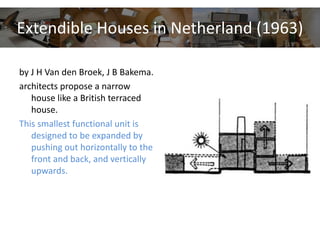
by J H Van den Broek, J B Bakema.
architects propose a narrow
house like a British terraced
house.
This smallest functional unit is
designed to be expanded by
pushing out horizontally to the
front and back, and vertically
upwards.
Growing Houses in Germany (1984)
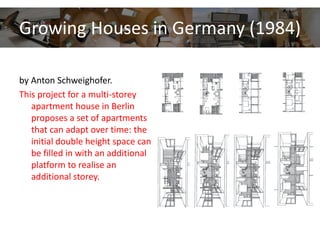
by Anton Schweighofer.
This project for a multi-storey
apartment house in Berlin
proposes a set of apartments
that can adapt over time: the
initial double height space can
be filled in with an additional
platform to realise an
additional storey.
Design qualities of Flexible homes...
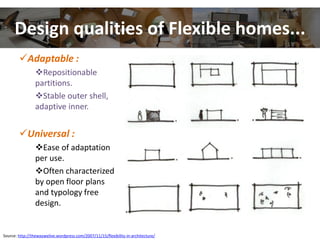
Adaptable :
Repositionable
partitions.
Stable outer shell,
adaptive inner.
Universal :
Ease of adaptation
per use.
Often characterized
by open floor plans
and typology free
design.
Source: http://thewaywelive.wordpress.com/2007/11/15/flexibility-in-architecture/
Design qualities of Flexible homes...
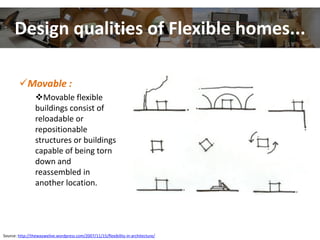
Movable :
Movable flexible
buildings consist of
reloadable or
repositionable
structures or buildings
capable of being torn
down and
reassembled in
another location.
Source: http://thewaywelive.wordpress.com/2007/11/15/flexibility-in-architecture/
Design qualities of Flexible homes...
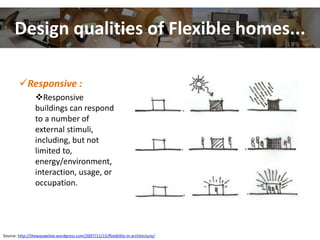
Responsive :
Responsive
buildings can respond
to a number of
external stimuli,
including, but not
limited to,
energy/environment,
interaction, usage, or
occupation.
Source: http://thewaywelive.wordpress.com/2007/11/15/flexibility-in-architecture/
Design qualities of Flexible homes...
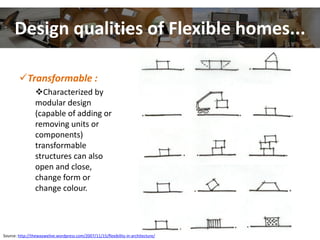
Transformable :
Characterized by
modular design
(capable of adding or
removing units or
components)
transformable
structures can also
open and close,
change form or
change colour.
Source: http://thewaywelive.wordpress.com/2007/11/15/flexibility-in-architecture/
Advantages…
 Remain in the same house through many lifestyle changes. Reduces the
running cost of building
 Allows more young households to enter the homeownership market
 May increase the amount of affordable rental stock
 Accessible for any type of users
 User the choice as to how they want to use spaces instead of
architecturally predetermining their lives
 Fulfil each occupant’s expectations’
 Simple materials in construction
 Flexible housing is in positive direction. Because it follows both
 Dynamic in nature
 User having a control over the environment is the key answer
Principles…
According to Jeremy Till and Tatjana Schneider, there are six
principles for flexible housing. They are:
 Space
 Construction
 Design for Adaptation
 Layers
 Typical Plan
 Services
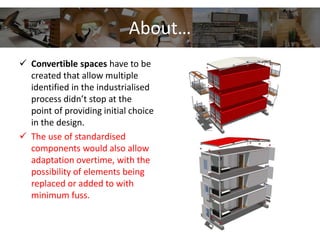
About…
 Convertible spaces have to be
created that allow multiple
identified in the industrialised
process didn’t stop at the
point of providing initial choice
in the design.
 The use of standardised
components would also allow
adaptation overtime, with the
possibility of elements being
replaced or added to with
minimum fuss.
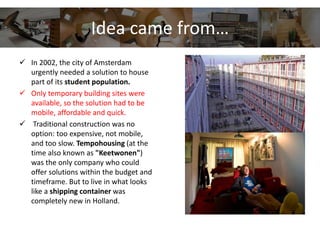
Idea came from…
 In 2002, the city of Amsterdam
urgently needed a solution to house
part of its student population.
 Only temporary building sites were
available, so the solution had to be
mobile, affordable and quick.
 Traditional construction was no
option: too expensive, not mobile,
and too slow. Tempohousing (at the
time also known as "Keetwonen")
was the only company who could
offer solutions within the budget and
timeframe. But to live in what looks
like a shipping container was
completely new in Holland.
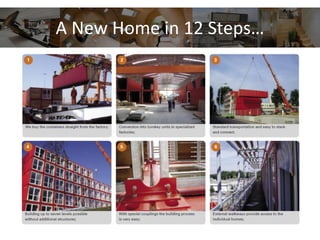
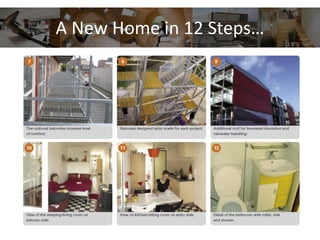
A New Home in 12 Steps…
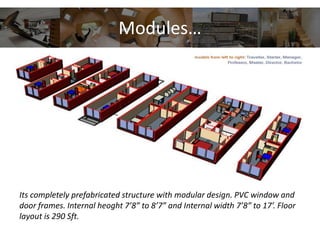
Modules…
Its completely prefabricated structure with modular design. PVC window and
door frames. Internal heoght 7’8” to 8’7” and Internal width 7’8” to 17’. Floor
layout is 290 Sft.
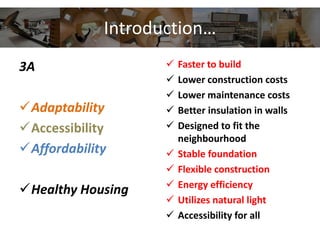
Introduction…
3A
Adaptability
Accessibility
Affordability
Healthy Housing
 Faster to build
 Lower construction costs
 Lower maintenance costs
 Better insulation in walls
 Designed to fit the
neighbourhood
 Stable foundation
 Flexible construction
 Energy efficiency
 Utilizes natural light
 Accessibility for all
Features as per CMHC…
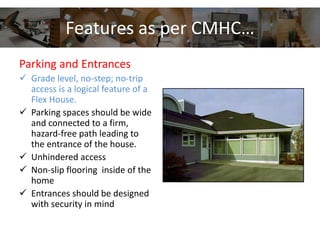
Parking and Entrances
 Grade level, no-step; no-trip
access is a logical feature of a
Flex House.
 Parking spaces should be wide
and connected to a firm,
hazard-free path leading to
the entrance of the house.
 Unhindered access
 Non-slip flooring inside of the
home
 Entrances should be designed
with security in mind
Features as per CMHC…
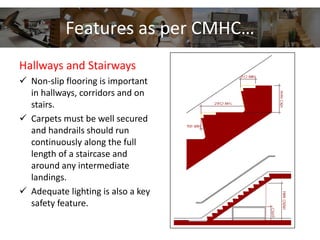
Hallways and Stairways
 Non-slip flooring is important
in hallways, corridors and on
stairs.
 Carpets must be well secured
and handrails should run
continuously along the full
length of a staircase and
around any intermediate
landings.
 Adequate lighting is also a key
safety feature.
Features as per CMHC…
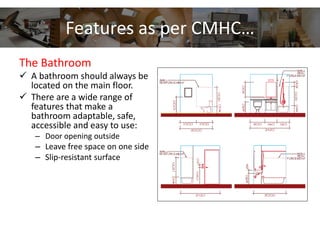
The Bathroom
 A bathroom should always be
located on the main floor.
 There are a wide range of
features that make a
bathroom adaptable, safe,
accessible and easy to use:
– Door opening outside
– Leave free space on one side
– Slip-resistant surface
Features as per CMHC…
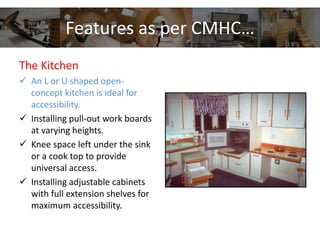
The Kitchen
 An L or U shaped open-
concept kitchen is ideal for
accessibility.
 Installing pull-out work boards
at varying heights.
 Knee space left under the sink
or a cook top to provide
universal access.
 Installing adjustable cabinets
with full extension shelves for
maximum accessibility.
Features as per CMHC…
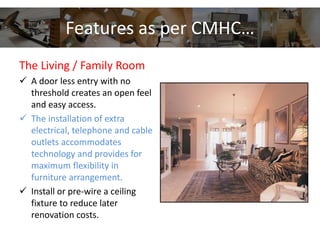
The Living / Family Room
 A door less entry with no
threshold creates an open feel
and easy access.
 The installation of extra
electrical, telephone and cable
outlets accommodates
technology and provides for
maximum flexibility in
furniture arrangement.
 Install or pre-wire a ceiling
fixture to reduce later
renovation costs.
Features as per CMHC…
The Bed Room
 At least one big bedroom, so
that can be changed to two in
future.
 Will require a door, window,
lights, electrical outlets and
closet space.
 Install multiple telephone
jacks and electrical outlets
 Bedroom and bathroom on
the ground floor meets the
needs of people with impaired
mobility.
The Laundry Room
 Should be located on the same
floor as the bedrooms and
bathroom.
 Dryers stacked over washers
 Non-slip flooring is essential.
 A balanced, wall-mounted
ironing board can be moved
out of the way when not being
used.
Features as per CMHC…
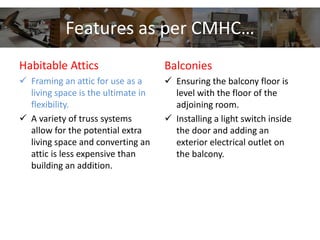
Habitable Attics
 Framing an attic for use as a
living space is the ultimate in
flexibility.
 A variety of truss systems
allow for the potential extra
living space and converting an
attic is less expensive than
building an addition.
Balconies
 Ensuring the balcony floor is
level with the floor of the
adjoining room.
 Installing a light switch inside
the door and adding an
exterior electrical outlet on
the balcony.
Conclusion from CMHC…
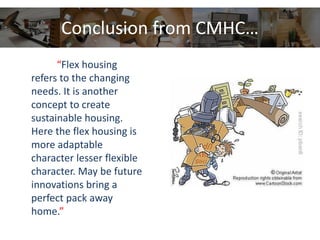
“Flex housing
refers to the changing
needs. It is another
concept to create
sustainable housing.
Here the flex housing is
more adaptable
character lesser flexible
character. May be future
innovations bring a
perfect pack away
home.”
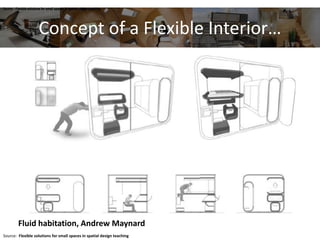
Concept of a Flexible Interior…
Source: Flexible solutions for small spaces in spatial design teaching
Source: Flexible solutions for small spaces in spatial design teachingSource: Flexible solutions for small spaces in spatial design teaching
Fluid habitation, Andrew Maynard
Disadvantages…
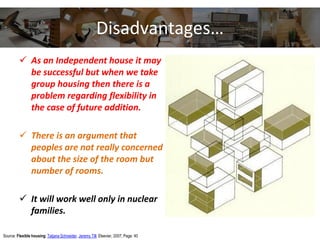
 As an Independent house it may
be successful but when we take
group housing then there is a
problem regarding flexibility in
the case of future addition.
 There is an argument that
peoples are not really concerned
about the size of the room but
number of rooms.
 It will work well only in nuclear
families.
Source: Flexible housing; Tatjana Schneider, Jeremy Till; Elsevier, 2007, Page: 40
 Flexible spaces and Non flexible spaces
 All spaces are flexible if we find out the loop holes in and adapt to the
right technology.
 This wider intent is examined by considering flexibility under issues of
Modernism, finance, participation, sustainability and technology in
much higher level.
 Flexible housing or are the peoples are adaptive to use it to that
situation Architect made for?
It may be possible in the future. Hence house as a market commodity – a
product.
 Dominance of rich people
 Peoples are more concerned about the economic situation rather than
anything else. If the flexible housing will come into picture wider then
peoples will be always ready to access it, may be more number of people
than expected.
Conclusion…
References…
 Flexible housing; Tatjana Schneider, Jeremy Till; Elsevier, 2007
 Flexible Housing the means to the end, Jeremy Till and Tatjana Schneide, arq . vol 9 . nos 3/4 . 2005
 http://www.cmhc-schl.gc.ca/en/inpr/afhoce/tore/afhoid/fite/remo/index.cfm : contains data for
advantages of flexible housing
 Flexible housing: opportunities and limits; Tatjana Schneider and Jeremy Till, theory, arq - vol 9. No 2.
2005, page: 157-166
 Flexible solutions for small spaces in spatial design teaching
asst.Prof. Didem Bedük Tuncel, Mimar Sinan Fine Arts University, Faculty of Architecture, Department of
Interior Architecture, Meclis-i Mebusan Cad. No:24 34427 – Fındıklı /•STANBUL/TURKEY
R.Asst.Hande Z.Altinok, Mimar Sinan Fine Arts University, Faculty of Architecture, Department of Interior
Architecture, Meclis-i Mebusan Cad. No:24 34427 –Fındıklı/İSTANBUL/TURKEY
 www.tempohousing.com
 http://thewaywelive.wordpress.com/2007/11/15/flexibility-in-architecture/
 http://archiguide.free.fr/AR/arsenehenry.htm
 http://www.cmhc.ca
Introduction to
VIJESH KUMAR V
10ID60R17Date: 12-04-2011

Flexible Housing

  • 1.
    Introduction to VIJESH KUMARV 10ID60R17Date: 12-04-2011
  • 2.
    Flexible Housing? “Housing thatcan adjust to changing needs and pattern, in both social and technological ways.”  Social: – Dynamic Demography – Dynamic mind set – Dynamic Usage  Technological: – Obsolescence  Environmental  Economic
  • 3.
    Can you tellme Is there any person who satisfied with his home during the time runs? Certainly doesn’t. Why? Do we have an answer? Why we need? “Uncertainty of Human being” Population increases, Demand Increases then Space consumption increases Lead to Environmental pollution, Deforestation, etc. Source: http://economix.blogs.nytimes.com/2011/03/16/real-estate-crisis-it-depends-on-supply/
  • 4.
    Solution? “From now on,buildings will have four dimensions, the fourth dimension is ‘Time’ to become part of architecture, buildings in motion will shape the sky line of our cities.“ Dr. Fisher  Space inside Space  Dynamic Consumption of Space remedy  Decrease in Space Consumption over all  Innovative Technology Addition DYNAMIC TOWER, DUBAI, THE WORLD’S FIRST BUILDING IN MOTION, First Rotating Skyscraper to be Self Powered and Completely Prefabricated.
  • 5.
    Root of Idea? “Flexiblehousing developed in two ways. First, initial stage of evolution in vernacular and second, impact of social aspect of evolution on it to come back as new forms. “ Music Studio in the Netherlands by Piet Hein Eek , http://cubeme.com/blog/2011/03/16/music-studio-in-the-netherlands-by-piet-hein-eek/
  • 6.
    Evolution in Vernacular… Issues oriented by culture and climate  Huts arranged around a courtyard  Use of hut can be varied according to the circumstances. Here each hut constitutes a room and whole compound constitutes the dwelling.  Open plan flexible space of modernism – Divided space through curtains and screens, and socially divided through significant symbolic and cultural understanding. – Through technologically advanced systems. Source: http://www.crystalinks.com/dogon.html Dogon House compound, Mali, African Tribe Dogon House compound, Mali, African Tribe
  • 7.
    Impact of Socialaspect of Evolution… Peoples take decisions through two aspects;  Non Architects  Architects  Area available  Future Changes  Technological adaptation  Change in number of users
  • 8.
    As an Idea… The attention of Dutch Architects such as Willem Van Tijen, Johannes Van den Brock and Mart Stam turned to overlook in to process of use – Changeability of use.  Their desire was to make minimum size apartments as tolerable and cheap as possible. “Design in a way that the dwelling can be regrouped and arranged according to the needs of the respective hour of the day.”
  • 9.
    History… “A number oftheoreticians and architects promoted flexible housing from 1920 onwards. Modernist Architects understood that a flexible approach could take care of a wider range of occupants. Design of indeterminate open space was possible because of the new constructional systems available to the early Modernist architects, which allowed larger span structures and light infill partitions.“ Some of the examples for modernist flexible housing are:
  • 10.
    Britz Project, Berlin(1925-31) It was designed by Taut and Wagner. There are three similarly sized rooms off a central hallway, with the services (bathroom and kitchen) in a separate zone. Thus, the occupation of the rooms is left to the choice of the users.
  • 11.
    Model Housing (1927) Atthe model housing exhibition of Weissenhof Seidlung, Stuttgart, Germany, renowned Architect Mies van der Rohe designed a housing block with a simple framed structure. The structural system and design allows the residents to divide their apartments up as they wish. The final layout is limited only by the positioning of columns. Kitchen and toilets are clustered around Staircase for ease of services.
  • 12.
    Maison Loucheur (1928-9) designedby Le Corbusier A combination of folding furniture and sliding walls allows different configurations for day and night. Le Corbusier argues that the purchaser is paying for 46m2 of space but through the cleverness of the design is actually getting 71m2 of effective space.
  • 13.
    Prefabricated Homes inUSA (1942) by Walter F Bogner. Standard sections that can be easily shipped and assembled. The modules are assembled into a single residential building using either a crane or trucks. The division within this shell is made with interchangeable panels, which can be solid or have a window, or can be external or internal. These accessories and parts are considered like furniture and can be bought at any time or rearranged periodically to suit changing family needs.
  • 14.
    Extendible Houses inNetherland (1963) by J H Van den Broek, J B Bakema. architects propose a narrow house like a British terraced house. This smallest functional unit is designed to be expanded by pushing out horizontally to the front and back, and vertically upwards.
  • 15.
    Growing Houses inGermany (1984) by Anton Schweighofer. This project for a multi-storey apartment house in Berlin proposes a set of apartments that can adapt over time: the initial double height space can be filled in with an additional platform to realise an additional storey.
  • 16.
    Design qualities ofFlexible homes... Adaptable : Repositionable partitions. Stable outer shell, adaptive inner. Universal : Ease of adaptation per use. Often characterized by open floor plans and typology free design. Source: http://thewaywelive.wordpress.com/2007/11/15/flexibility-in-architecture/
  • 17.
    Design qualities ofFlexible homes... Movable : Movable flexible buildings consist of reloadable or repositionable structures or buildings capable of being torn down and reassembled in another location. Source: http://thewaywelive.wordpress.com/2007/11/15/flexibility-in-architecture/
  • 18.
    Design qualities ofFlexible homes... Responsive : Responsive buildings can respond to a number of external stimuli, including, but not limited to, energy/environment, interaction, usage, or occupation. Source: http://thewaywelive.wordpress.com/2007/11/15/flexibility-in-architecture/
  • 19.
    Design qualities ofFlexible homes... Transformable : Characterized by modular design (capable of adding or removing units or components) transformable structures can also open and close, change form or change colour. Source: http://thewaywelive.wordpress.com/2007/11/15/flexibility-in-architecture/
  • 20.
    Advantages…  Remain inthe same house through many lifestyle changes. Reduces the running cost of building  Allows more young households to enter the homeownership market  May increase the amount of affordable rental stock  Accessible for any type of users  User the choice as to how they want to use spaces instead of architecturally predetermining their lives  Fulfil each occupant’s expectations’  Simple materials in construction  Flexible housing is in positive direction. Because it follows both  Dynamic in nature  User having a control over the environment is the key answer
  • 21.
    Principles… According to JeremyTill and Tatjana Schneider, there are six principles for flexible housing. They are:  Space  Construction  Design for Adaptation  Layers  Typical Plan  Services
  • 24.
    About…  Convertible spaceshave to be created that allow multiple identified in the industrialised process didn’t stop at the point of providing initial choice in the design.  The use of standardised components would also allow adaptation overtime, with the possibility of elements being replaced or added to with minimum fuss.
  • 25.
    Idea came from… In 2002, the city of Amsterdam urgently needed a solution to house part of its student population.  Only temporary building sites were available, so the solution had to be mobile, affordable and quick.  Traditional construction was no option: too expensive, not mobile, and too slow. Tempohousing (at the time also known as "Keetwonen") was the only company who could offer solutions within the budget and timeframe. But to live in what looks like a shipping container was completely new in Holland.
  • 26.
    A New Homein 12 Steps…
  • 27.
    A New Homein 12 Steps…
  • 28.
    Modules… Its completely prefabricatedstructure with modular design. PVC window and door frames. Internal heoght 7’8” to 8’7” and Internal width 7’8” to 17’. Floor layout is 290 Sft.
  • 30.
    Introduction… 3A Adaptability Accessibility Affordability Healthy Housing  Fasterto build  Lower construction costs  Lower maintenance costs  Better insulation in walls  Designed to fit the neighbourhood  Stable foundation  Flexible construction  Energy efficiency  Utilizes natural light  Accessibility for all
  • 31.
    Features as perCMHC… Parking and Entrances  Grade level, no-step; no-trip access is a logical feature of a Flex House.  Parking spaces should be wide and connected to a firm, hazard-free path leading to the entrance of the house.  Unhindered access  Non-slip flooring inside of the home  Entrances should be designed with security in mind
  • 32.
    Features as perCMHC… Hallways and Stairways  Non-slip flooring is important in hallways, corridors and on stairs.  Carpets must be well secured and handrails should run continuously along the full length of a staircase and around any intermediate landings.  Adequate lighting is also a key safety feature.
  • 33.
    Features as perCMHC… The Bathroom  A bathroom should always be located on the main floor.  There are a wide range of features that make a bathroom adaptable, safe, accessible and easy to use: – Door opening outside – Leave free space on one side – Slip-resistant surface
  • 34.
    Features as perCMHC… The Kitchen  An L or U shaped open- concept kitchen is ideal for accessibility.  Installing pull-out work boards at varying heights.  Knee space left under the sink or a cook top to provide universal access.  Installing adjustable cabinets with full extension shelves for maximum accessibility.
  • 35.
    Features as perCMHC… The Living / Family Room  A door less entry with no threshold creates an open feel and easy access.  The installation of extra electrical, telephone and cable outlets accommodates technology and provides for maximum flexibility in furniture arrangement.  Install or pre-wire a ceiling fixture to reduce later renovation costs.
  • 36.
    Features as perCMHC… The Bed Room  At least one big bedroom, so that can be changed to two in future.  Will require a door, window, lights, electrical outlets and closet space.  Install multiple telephone jacks and electrical outlets  Bedroom and bathroom on the ground floor meets the needs of people with impaired mobility. The Laundry Room  Should be located on the same floor as the bedrooms and bathroom.  Dryers stacked over washers  Non-slip flooring is essential.  A balanced, wall-mounted ironing board can be moved out of the way when not being used.
  • 37.
    Features as perCMHC… Habitable Attics  Framing an attic for use as a living space is the ultimate in flexibility.  A variety of truss systems allow for the potential extra living space and converting an attic is less expensive than building an addition. Balconies  Ensuring the balcony floor is level with the floor of the adjoining room.  Installing a light switch inside the door and adding an exterior electrical outlet on the balcony.
  • 38.
    Conclusion from CMHC… “Flexhousing refers to the changing needs. It is another concept to create sustainable housing. Here the flex housing is more adaptable character lesser flexible character. May be future innovations bring a perfect pack away home.”
  • 39.
    Concept of aFlexible Interior… Source: Flexible solutions for small spaces in spatial design teaching Source: Flexible solutions for small spaces in spatial design teachingSource: Flexible solutions for small spaces in spatial design teaching Fluid habitation, Andrew Maynard
  • 40.
    Disadvantages…  As anIndependent house it may be successful but when we take group housing then there is a problem regarding flexibility in the case of future addition.  There is an argument that peoples are not really concerned about the size of the room but number of rooms.  It will work well only in nuclear families. Source: Flexible housing; Tatjana Schneider, Jeremy Till; Elsevier, 2007, Page: 40
  • 41.
     Flexible spacesand Non flexible spaces  All spaces are flexible if we find out the loop holes in and adapt to the right technology.  This wider intent is examined by considering flexibility under issues of Modernism, finance, participation, sustainability and technology in much higher level.  Flexible housing or are the peoples are adaptive to use it to that situation Architect made for? It may be possible in the future. Hence house as a market commodity – a product.  Dominance of rich people  Peoples are more concerned about the economic situation rather than anything else. If the flexible housing will come into picture wider then peoples will be always ready to access it, may be more number of people than expected. Conclusion…
  • 42.
    References…  Flexible housing;Tatjana Schneider, Jeremy Till; Elsevier, 2007  Flexible Housing the means to the end, Jeremy Till and Tatjana Schneide, arq . vol 9 . nos 3/4 . 2005  http://www.cmhc-schl.gc.ca/en/inpr/afhoce/tore/afhoid/fite/remo/index.cfm : contains data for advantages of flexible housing  Flexible housing: opportunities and limits; Tatjana Schneider and Jeremy Till, theory, arq - vol 9. No 2. 2005, page: 157-166  Flexible solutions for small spaces in spatial design teaching asst.Prof. Didem Bedük Tuncel, Mimar Sinan Fine Arts University, Faculty of Architecture, Department of Interior Architecture, Meclis-i Mebusan Cad. No:24 34427 – Fındıklı /•STANBUL/TURKEY R.Asst.Hande Z.Altinok, Mimar Sinan Fine Arts University, Faculty of Architecture, Department of Interior Architecture, Meclis-i Mebusan Cad. No:24 34427 –Fındıklı/İSTANBUL/TURKEY  www.tempohousing.com  http://thewaywelive.wordpress.com/2007/11/15/flexibility-in-architecture/  http://archiguide.free.fr/AR/arsenehenry.htm  http://www.cmhc.ca
  • 43.
    Introduction to VIJESH KUMARV 10ID60R17Date: 12-04-2011