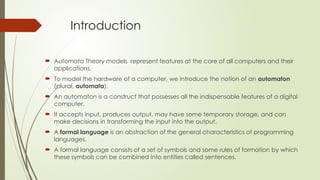
Introduction
Automata Theorymodels represent features at the core of all computers and their
applications.
To model the hardware of a computer, we introduce the notion of an automaton
(plural, automata).
An automaton is a construct that possesses all the indispensable features of a digital
computer.
It accepts input, produces output, may have some temporary storage, and can
make decisions in transforming the input into the output.
A formal language is an abstraction of the general characteristics of programming
languages.
A formal language consists of a set of symbols and some rules of formation by which
these symbols can be combined into entities called sentences.
3.
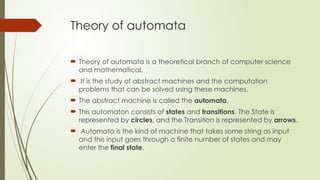
Theory of automata
Theory of automata is a theoretical branch of computer science
and mathematical.
It is the study of abstract machines and the computation
problems that can be solved using these machines.
The abstract machine is called the automata.
This automaton consists of states and transitions. The State is
represented by circles, and the Transition is represented by arrows.
Automata is the kind of machine that takes some string as input
and this input goes through a finite number of states and may
enter the final state.
4.
Basic Terminologies inAutomata Theory
The basic terminologies used in Automata Theory:- Alphabets, Strings, Languages, and
Grammar.
Symbols: Symbols are an entity or individual objects, which can be any letter,
alphabet or any picture. E.g.: 1, a, b, #
Alphabets: A finite set of non-empty symbols. It is denoted by ∑ (sigma).
Examples: ∑ = {a, b} is the binary alphabet
∑ = {A, B, C, D} is the set of uppercase letters
String: a finite collection of symbols from the alphabet. The string is denoted by w.
Example1: If ∑ = {a, b}, various string that can be generated from ∑ are {ab, aa, aaa, bb,
bbb, ba, aba.....}.
o A string with zero occurrences of symbols is known as an empty string. It is represented
by ε.
o The number of symbols in a string w is called the length of a string. It is denoted by |w|.
5.
Cont...
Example 2:
w = 010; Number of String |w| = 3
abcbz is a string over ? = {a, b, c, d… z}
11001011 is a string over ? = {0, 1}
)) ()(() is a string over ? = {(,)}
Language: A language is a collection of appropriate string. A language which is
formed over Σ can be Finite or Infinite.
Example: 1
L1 = {Set of string of length 2}, L1 = {aa, bb, ba, bb} Finite Language
Example: 2
L2 = {Set of all strings starts with 'a'}, L2= {a, aa, aaa, abb, abbb, ababb} Infinite
Language
6.
Cont...
Grammar
Agrammar defines a set of rules, and with the use of these
rules, valid sentences in a language are generated. Similar to
English language we have set of rules in automata, which
help us in creating sentences.
A popular way to derive a grammar recursively is phrase-
structure grammar.
7.
Finite Automata
Anautomaton with a finite number of states is called a Finite automaton.
Finite Automata can be classified into :
Deterministic finite automata, non-deterministic finite automata, Regular expression,
context-free grammar, context-free language, Push down automata, Turning
machines, etc.
Finite automata are used to recognize patterns.
It takes the string of symbol as input and changes its state accordingly. When the
desired symbol is found, then the transition occurs.
At the time of transition, the automata can either move to the next state or stay in
the same state.
Finite automata have two states, Accept state or Reject state. When the input string
is processed successfully, and the automata reached its final state, then it will
accept.
8.
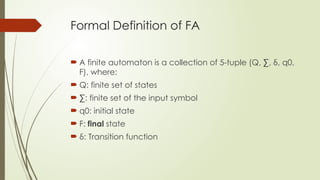
Formal Definition ofFA
A finite automaton is a collection of 5-tuple (Q, ∑, δ, q0,
F), where:
Q: finite set of states
∑: finite set of the input symbol
q0: initial state
F: final state
δ: Transition function
9.
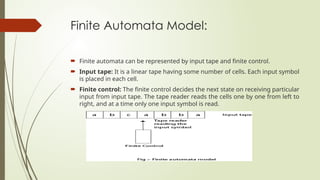
Finite Automata Model:
Finite automata can be represented by input tape and finite control.
Input tape: It is a linear tape having some number of cells. Each input symbol
is placed in each cell.
Finite control: The finite control decides the next state on receiving particular
input from input tape. The tape reader reads the cells one by one from left to
right, and at a time only one input symbol is read.
10.
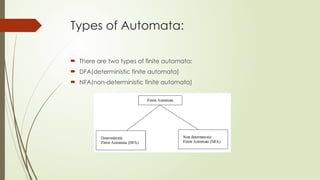
Types of Automata:
There are two types of finite automata:
DFA(deterministic finite automata)
NFA(non-deterministic finite automata)
11.
DFA vs NFA
1. DFA
DFA refers to deterministic finite automata. Deterministic refers to the uniqueness of the
computation. In the DFA, the machine goes to one state only for a particular input
character. DFA does not accept the null move.
2. NFA
NFA stands for non-deterministic finite automata. It is used to transmit any number of
states for a particular input. It can accept the null move.
Some important points about DFA and NFA:
1. Every DFA is NFA, but NFA is not DFA.
2. There can be multiple final states in both NFA and DFA.
3. DFA is used in Lexical Analysis in Compiler.
4. NFA is more of a theoretical concept.
12.
DFA (Deterministic finiteautomata)
• DFA refers to deterministic finite automata. Deterministic refers to the
uniqueness of the computation. The finite automata are called
deterministic finite automata if the machine is read an input string
one symbol at a time.
• In DFA, there is only one path for specific input from the current state
to the next state.
• DFA does not accept the null move, i.e., the DFA cannot change state
without any input character.
• DFA can contain multiple final states. It is used in Lexical Analysis in
Compiler.
13.
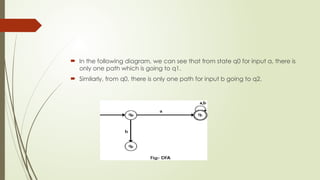
In thefollowing diagram, we can see that from state q0 for input a, there is
only one path which is going to q1.
Similarly, from q0, there is only one path for input b going to q2.
14.
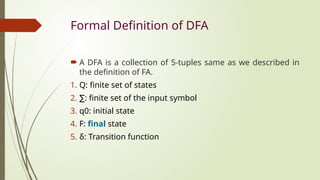
Formal Definition ofDFA
A DFA is a collection of 5-tuples same as we described in
the definition of FA.
1. Q: finite set of states
2. ∑: finite set of the input symbol
3. q0: initial state
4. F: final state
5. δ: Transition function
15.
Graphical Representation ofDFA
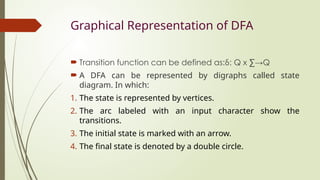
Transition function can be defined as:δ: Q x ∑→Q
A DFA can be represented by digraphs called state
diagram. In which:
1. The state is represented by vertices.
2. The arc labeled with an input character show the
transitions.
3. The initial state is marked with an arrow.
4. The final state is denoted by a double circle.
16.
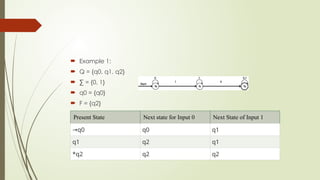
Example 1:
Q = {q0, q1, q2}
∑ = {0, 1}
q0 = {q0}
F = {q2}
Present State Next state for Input 0 Next State of Input 1
→q0 q0 q1
q1 q2 q1
*q2 q2 q2
17.
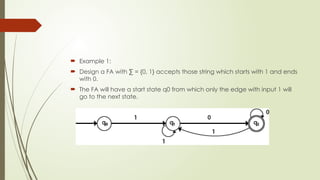
Example 1:
Design a FA with ∑ = {0, 1} accepts those string which starts with 1 and ends
with 0.
The FA will have a start state q0 from which only the edge with input 1 will
go to the next state.
18.
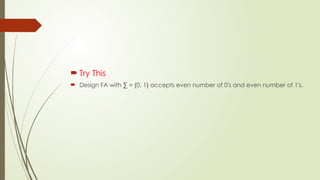
Try This
Design FA with ∑ = {0, 1} accepts even number of 0's and even number of 1's.
19.
NFA (Non-Deterministic finite
automata)
•NFA stands for non-deterministic finite automata. It is easy to construct an
NFA than DFA for a given regular language.
• The finite automata are called NFA when there exist many paths for specific
input from the current state to the next state.
• Every NFA is not DFA, but each NFA can be translated into DFA.
• NFA is defined in the same way as DFA but with the following two exceptions,
it contains multiple next states, and it contains ε transition.
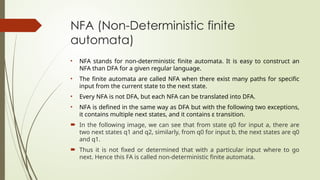
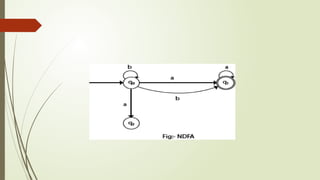
In the following image, we can see that from state q0 for input a, there are
two next states q1 and q2, similarly, from q0 for input b, the next states are q0
and q1.
Thus it is not fixed or determined that with a particular input where to go
next. Hence this FA is called non-deterministic finite automata.
21.
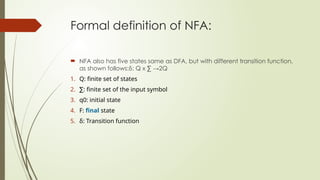
Formal definition ofNFA:
NFA also has five states same as DFA, but with different transition function,
as shown follows:δ: Q x ∑ →2Q
1. Q: finite set of states
2. ∑: finite set of the input symbol
3. q0: initial state
4. F: final state
5. δ: Transition function
22.
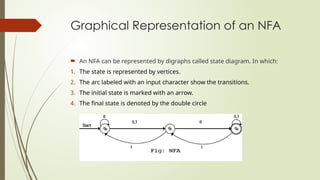
Graphical Representation ofan NFA
An NFA can be represented by digraphs called state diagram. In which:
1. The state is represented by vertices.
2. The arc labeled with an input character show the transitions.
3. The initial state is marked with an arrow.
4. The final state is denoted by the double circle
Conversion from NFAto DFA
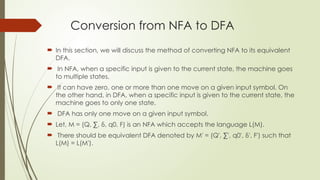
In this section, we will discuss the method of converting NFA to its equivalent
DFA.
In NFA, when a specific input is given to the current state, the machine goes
to multiple states.
It can have zero, one or more than one move on a given input symbol. On
the other hand, in DFA, when a specific input is given to the current state, the
machine goes to only one state.
DFA has only one move on a given input symbol.
Let, M = (Q, ∑, δ, q0, F) is an NFA which accepts the language L(M).
There should be equivalent DFA denoted by M' = (Q', ∑', q0', δ', F') such that
L(M) = L(M').
25.
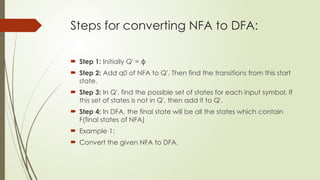
Steps for convertingNFA to DFA:
Step 1: Initially Q' = ϕ
Step 2: Add q0 of NFA to Q'. Then find the transitions from this start
state.
Step 3: In Q', find the possible set of states for each input symbol. If
this set of states is not in Q', then add it to Q'.
Step 4: In DFA, the final state will be all the states which contain
F(final states of NFA)
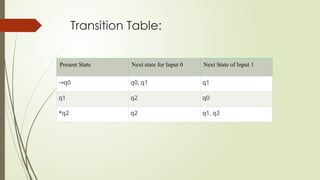
Example 1:
Convert the given NFA to DFA.

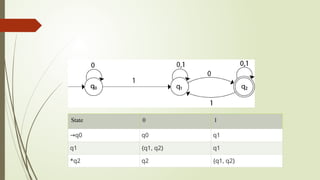
![NFA to DFA
State 0 1
→[q0] [q0] [q1]
[q1] [q1, q2] [q1]
*[q2] [q2] [q1, q2]
*[q1, q2] [q1, q2] [q1, q2]](https://image.slidesharecdn.com/introductiontoautomataandcomplexity-250912233323-725eb064/85/introduction-to-automata-and-complexity-pptx-27-320.jpg)