PC Repair Fundamentals
Objectives
• Learn about tools you’ll need as a PC support technician
• Learn how to develop a preventive maintenance plan and
  what to include in it
• Learn how to work inside a computer case
• Learn what happens when you first turn on a PC before the OS
  is loaded
• Learn how to approach and solve a PC problem
• Learn how to troubleshoot a failed boot before the OS is
  loaded


                              2
Introduction
• Basic repair skills
   – Developing a maintenance plan
   – Implementing a maintenance plan
   – Working inside a computer case
   – Following sequence of events that occur at startup
• Advanced repair skills
   – Using common-sense guidelines to solve problems
   – Interviewing a user
   – Determining if a problem occurs before or after boot
   – Troubleshooting and solving a problem of a failed boot

                               3
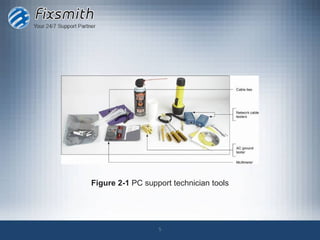
PC Support Technician Tools
• Help you maintain a computer
• Help you diagnose and repair computer problems
• Criteria for choosing tools:
   – Level of PC support you expect to provide
   – Amount of money you can spend
• Some essential tools:
   – Ground bracelet, ground mat, or ground gloves
   – Torx screwdriver set
   – Recovery CD, DVD, or floppy disk for target OS
• Store tools in toolbox for PC troubleshooting

                              4
Figure 2-1 PC support technician tools


                  5
Recovery CDs
• Used to boot a system
• Also used to repair and reinstall Windows
• Primary recovery CD sources
   – PC manufacturer (preferred)
   – Operating system distributor, such as Microsoft
• Some hard drives have a hidden recovery partitions
   – A hidden partition can be used to reinstall Windows
   – A utility for creating recovery CDs may be provided
   – Access hidden utilities by pressing a Fn key at startup


                                6
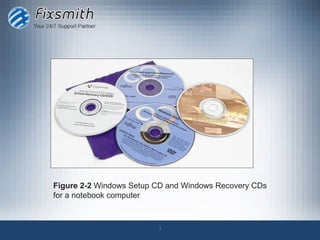
Figure 2-2 Windows Setup CD and Windows Recovery CDs
for a notebook computer


                         7
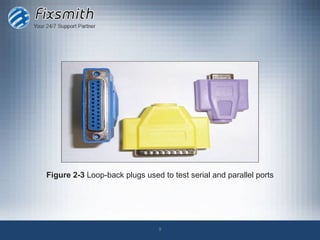
Loop-Back Plugs
• Used to test various ports
   – Some port types: serial, parallel, USB, network
• How to use a loop-back plug
   – Plug in the loop-back plug
   – Run the software that comes with the plug


                               8
Figure 2-3 Loop-back plugs used to test serial and parallel ports


                                9
Cleaning Pads and Solutions
• Various types are designed for specific uses
• Example: contact cleaner
   – Cleans contacts on expansion cards
• Warning: solutions may be flammable and/or toxic
• Sources of safety and emergency instructions:
   – Side of the can of solution
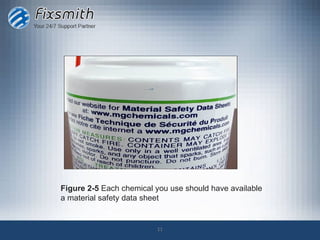
   – Material safety data sheet (MSDS)
• Adhere to safety procedures of your employer
   – Example: fill out an accident report (if required)


                                10
Figure 2-5 Each chemical you use should have available
a material safety data sheet


                         11
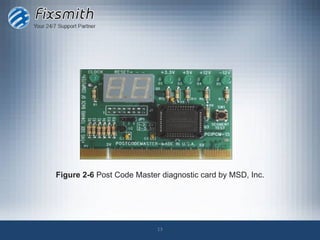
Post Diagnostic Cards
• Report computer errors and conflicts at POST
• How to use a POST diagnostic card:
   – Install card in an expansion slot on the motherboard
   – Attempt to boot your system
   – Record any error codes appearing in LED panel
   – Look up the entry associated with the error code
• Examples of Post diagnostic cards:
   – PCI Error Testing/Debug Card by Winic Corporation
   – POST card V3 by Unicore Software, Inc.
   – Post Code Master by MSD, Inc.

                              12
Figure 2-6 Post Code Master diagnostic card by MSD, Inc.


                           13
PC Preventive Maintenance
• Preventive maintenance reduces number of problems
• Goals of preventive maintenance plans:
   – Prevent failures
   – Reduce repair costs
   – Reduce downtimes
• Goal of disaster recovery plan: manage failures
• Some causes of PC failure: heat, dust, spills, viruses


                                14
PC is your Permanent Responsibility
• Tasks and procedures to prepare for troubleshooting
   – Keep good backups of data and system files
   – Document all setup changes, problems, and solutions
   – Protect the system against viruses and other attacks
      • Always use a firewall (software or hardware barrier)
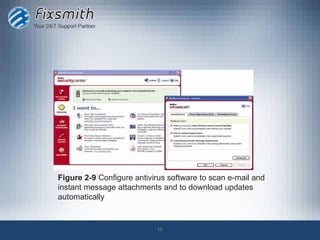
      • Install and run antivirus software
      • Keep Windows Updates current
   – Physically protect your equipment


                               15
Figure 2-9 Configure antivirus software to scan e-mail and
instant message attachments and to download updates
automatically


                           16
Preventive Maintenance Plan
• Plan based on history or pattern of malfunctions
   – Example: PCs in dusty areas need more maintenance
• Goals common to maintenance plans
   – Extend the working life of a PC
   – Anticipate problems that could disrupt service
   – Ensure data is secure and backed up
   – Provide support to PC users
• Basic steps involved in designing a plan
   – Define your overall goals
   – Incorporate procedures for achieving goals

                            17
Dealing with Dust
• Dust accumulates in layers over components
• Two major problems due to dust blankets
   – PC components directly overheat
   – Cooling fans jam, also resulting in overheating
• Maintenance task: remove the layer of dust
• Two tools used to remove dust:
   – Antistatic vacuum
   – Compressed air


                               18
Preparing a Computer for Shipping
• Adverse factors to consider:
   – Rough handling
   – Exposure to water, heat, and cold
   – Misplacement or theft of computer
• Some shipping guidelines to follow:
   – Backup the hard drive onto a backup medium
   – Remove inserted disks, tape cartridges, or CDs
   – Coil and secure all external cords
   – Separately wrap hardware components
   – Purchase insurance on the shipment

                              19
Disposing of Used Equipment
• Various guidelines for disposing of equipment:
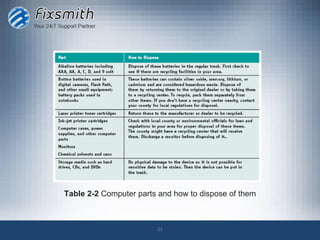
   – Table 2-2
   – Manufacturer documentation
   – Local environmental regulators
• Danger posed by monitors and power supplies
   – Residual charge in capacitors can cause shock
   – Modern devices discharge if unplugged for 60 minutes
   – Older devices may require discharge with a probe
• Destroy secondary storage devices with sensitive data


                               20
Table 2-2 Computer parts and how to dispose of them


                        21
How to Work Inside a Computer
• Objective: dismantle a computer, put it back together
• Some safety precautions to follow:
   – Make notes that will help you backtrack
   – Keep screws and spacers orderly
   – Do not stack boards on top of each other
   – Do not touch the chips on circuit boards
   – Do not use a graphite pencil to change DIP settings
   – Turn off the power, unplug and ground the computer
   – Do not remove covers of monitors or power supplies
   – Keep components away from hair and clothing

                              22
Static Electricity
• Build-up of charge due to absence of conductors
• Electrostatic discharge (ESD)
   – Due to dissimilar electrical surfaces making contact
   – Only 10 volts of ESD can damage PC components
   – Walking across carpet generates up to 12,000 volts
• Two types of damage: catastrophic and upset failure
• Tool and methods for grounding yourself and the PC
   – Ground bracelet, ground mats, static shielding bags,
      antistatic gloves
• If working inside a monitor, do not ground yourself

                               23
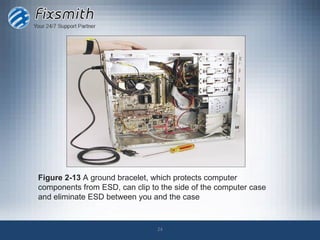
Figure 2-13 A ground bracelet, which protects computer
components from ESD, can clip to the side of the computer case
and eliminate ESD between you and the case


                                24
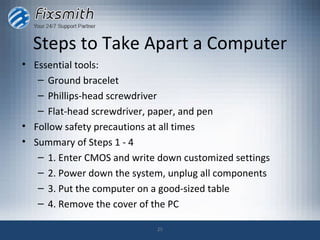
Steps to Take Apart a Computer
• Essential tools:
   – Ground bracelet
   – Phillips-head screwdriver
   – Flat-head screwdriver, paper, and pen
• Follow safety precautions at all times
• Summary of Steps 1 - 4
   – 1. Enter CMOS and write down customized settings
   – 2. Power down the system, unplug all components
   – 3. Put the computer on a good-sized table
   – 4. Remove the cover of the PC

                            25
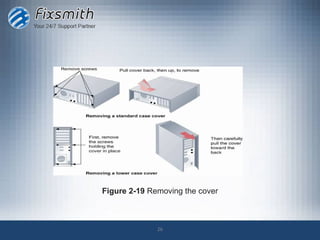
Figure 2-19 Removing the cover


              26
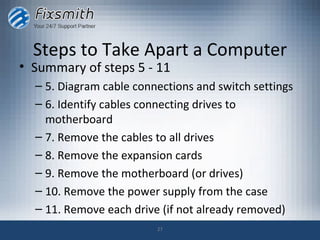
Steps to Take Apart a Computer
• Summary of steps 5 - 11
  – 5. Diagram cable connections and switch settings
  – 6. Identify cables connecting drives to
    motherboard
  – 7. Remove the cables to all drives
  – 8. Remove the expansion cards
  – 9. Remove the motherboard (or drives)
  – 10. Remove the power supply from the case
  – 11. Remove each drive (if not already removed)
                         27
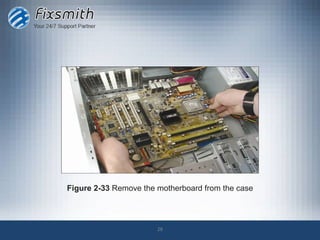
Figure 2-33 Remove the motherboard from the case


                       28
Put a Computer Back Together
• 1. Install power supply, drives, motherboard,
  cards
• 2. Connect all data and power cables
• 3. Plug in the keyboard, monitor, and mouse
• 4. Ask instructor to check work (if in a
  classroom)
• 5. Turn on the power and check PC functions

                       29
Understanding the Boot Process
• Key learning objectives
  – Know how to boot a PC
  – Understand what happens first when a PC is turned
    on
  – Understand how an operating system is loaded


                         30
Booting a Computer
• Process that drives a computer to a working
  state
• Hard (cold) boot: turn the power switch on
• Soft (warm) boot: allow the OS to reboot
• How to soft boot Windows XP
  – Click Start
  – Click Turn Off Computer
  – Click Restart

                         31
Hard Boot and a Soft Boot
• Hard boots are more stressful on machines
   – Power surges through system when PC is turned on
• Reasons to choose a soft boot over hard boot
   – Less stressful on the machine
   – Faster due to skipping initial steps
• Some computers have a soft and hard power switch
   – Soft power switch shuts down and restarts Windows
   – Hard power switch cuts power and restarts machine


                            32
BIOS Controls & Beginning of the
•
                Boot
  The startup BIOS gets a system up and running
• Four phases of the boot process:
  – BIOS runs the POST and assigns system resources
     • POST: power-on self test
  – BIOS searches for and loads an OS
  – OS configures system and completes its own
    loading
  – Application software is loaded and executed

                             33
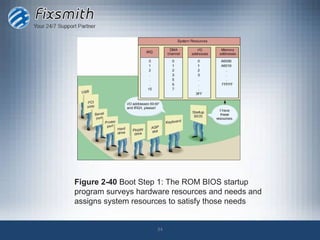
Figure 2-40 Boot Step 1: The ROM BIOS startup
program surveys hardware resources and needs and
assigns system resources to satisfy those needs


                     34
Changing the Boot Sequence
• BIOS looks to CMOS RAM to locate the OS
• Boot sequence: order of drives checked for an
  OS
• Change boot sequence using CMOS setup
  utilities
• Access CMOS setup utilities when PC is turned
  on
  – Example: press F8 before Windows screen
    appears
                        35
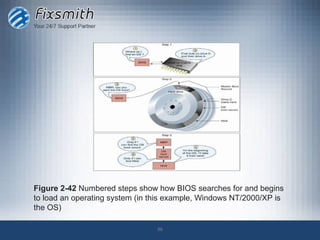
Figure 2-42 Numbered steps show how BIOS searches for and begins
to load an operating system (in this example, Windows NT/2000/XP is
the OS)

                                 36
How to Troubleshoot a PC Problem
• Assume the attitude of an investigator
• Do not compound the problem by your own
  actions
• Look at the problem as a learning opportunity
• Ask questions until you understand the
  problem
• Believe that you can solve the problem


                       37
Steps to Solving a PC Problem
• Key advice:
  – Ask good questions
  – Document the process
• Four-step problem solving process:
  – Step 1: Interview the user
  – Step 2: Back up data
  – Step 3: Solve the problem
  – Step 4: Verify the fix and document the solution

                          38
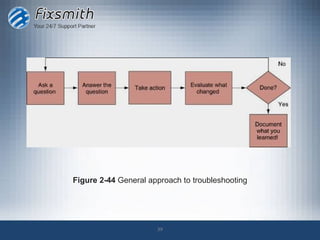
Figure 2-44 General approach to troubleshooting


                      39
Troubleshooting a Failed Boot
• It takes time to acquire troubleshooting skills
• Hands-on training: troubleshooting a failed
  boot


                        40
My Computer Won’t Boot
•   First step: maintain your calm
•   Second step: develop a game plan
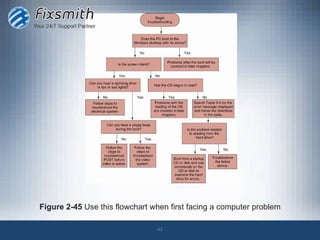
•   Figure 2-45 provides a procedure
•   Plan is driven by a set of yes-no questionsExample: Does the
    PC boot properly?
         • If no, troubleshooter is directed to another question
         • If yes, troubleshooter is directed to stop (for now)


                                41
Figure 2-45 Use this flowchart when first facing a computer problem

                                42
Major Subsystems Used For Booting
• Categories of troubleshooting steps in Figure
  2-45
  – The electrical subsystem
  – Essential hardware devices
     • The motherboard, memory, and the CPU
  – Video
  – Reading from the hard drive
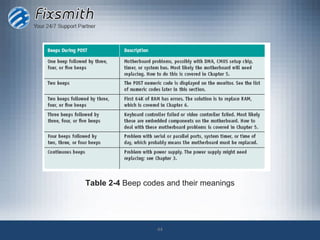
• Key aides: tables identifying error codes
                         43
Table 2-4 Beep codes and their meanings


                  44
Summary
• Some PC repair tools: recovery CDs, screwdrivers,
  POST, cleaning pads and solutions, diagnostic cards
• Preventive maintenance plans extend the life of a PC
• Follow an organization’s preventive maintenance
  plan, or develop one if it does not exist
• Computers present chemical and electrical hazards
• Protect components in case from ESD by grounding
  yourself and the PC


                           45
Summary
• Assembling and reassembling a PC prepares the
  technician for actual repair work
• Startup BIOS controls when the boot process begins
• Four step boot process: POST, loading the OS, OS
  initializing itself, loading and executing applications
• Expert troubleshooters ask good questions
• Before tackling a problem, develop a game plan


                            46

Fixsmith pc repair fundamentals

  • 1.
  • 2.
    Objectives • Learn abouttools you’ll need as a PC support technician • Learn how to develop a preventive maintenance plan and what to include in it • Learn how to work inside a computer case • Learn what happens when you first turn on a PC before the OS is loaded • Learn how to approach and solve a PC problem • Learn how to troubleshoot a failed boot before the OS is loaded 2
  • 3.
    Introduction • Basic repairskills – Developing a maintenance plan – Implementing a maintenance plan – Working inside a computer case – Following sequence of events that occur at startup • Advanced repair skills – Using common-sense guidelines to solve problems – Interviewing a user – Determining if a problem occurs before or after boot – Troubleshooting and solving a problem of a failed boot 3
  • 4.
    PC Support TechnicianTools • Help you maintain a computer • Help you diagnose and repair computer problems • Criteria for choosing tools: – Level of PC support you expect to provide – Amount of money you can spend • Some essential tools: – Ground bracelet, ground mat, or ground gloves – Torx screwdriver set – Recovery CD, DVD, or floppy disk for target OS • Store tools in toolbox for PC troubleshooting 4
  • 5.
    Figure 2-1 PCsupport technician tools 5
  • 6.
    Recovery CDs • Usedto boot a system • Also used to repair and reinstall Windows • Primary recovery CD sources – PC manufacturer (preferred) – Operating system distributor, such as Microsoft • Some hard drives have a hidden recovery partitions – A hidden partition can be used to reinstall Windows – A utility for creating recovery CDs may be provided – Access hidden utilities by pressing a Fn key at startup 6
  • 7.
    Figure 2-2 WindowsSetup CD and Windows Recovery CDs for a notebook computer 7
  • 8.
    Loop-Back Plugs • Usedto test various ports – Some port types: serial, parallel, USB, network • How to use a loop-back plug – Plug in the loop-back plug – Run the software that comes with the plug 8
  • 9.
    Figure 2-3 Loop-backplugs used to test serial and parallel ports 9
  • 10.
    Cleaning Pads andSolutions • Various types are designed for specific uses • Example: contact cleaner – Cleans contacts on expansion cards • Warning: solutions may be flammable and/or toxic • Sources of safety and emergency instructions: – Side of the can of solution – Material safety data sheet (MSDS) • Adhere to safety procedures of your employer – Example: fill out an accident report (if required) 10
  • 11.
    Figure 2-5 Eachchemical you use should have available a material safety data sheet 11
  • 12.
    Post Diagnostic Cards •Report computer errors and conflicts at POST • How to use a POST diagnostic card: – Install card in an expansion slot on the motherboard – Attempt to boot your system – Record any error codes appearing in LED panel – Look up the entry associated with the error code • Examples of Post diagnostic cards: – PCI Error Testing/Debug Card by Winic Corporation – POST card V3 by Unicore Software, Inc. – Post Code Master by MSD, Inc. 12
  • 13.
    Figure 2-6 PostCode Master diagnostic card by MSD, Inc. 13
  • 14.
    PC Preventive Maintenance •Preventive maintenance reduces number of problems • Goals of preventive maintenance plans: – Prevent failures – Reduce repair costs – Reduce downtimes • Goal of disaster recovery plan: manage failures • Some causes of PC failure: heat, dust, spills, viruses 14
  • 15.
    PC is yourPermanent Responsibility • Tasks and procedures to prepare for troubleshooting – Keep good backups of data and system files – Document all setup changes, problems, and solutions – Protect the system against viruses and other attacks • Always use a firewall (software or hardware barrier) • Install and run antivirus software • Keep Windows Updates current – Physically protect your equipment 15
  • 16.
    Figure 2-9 Configureantivirus software to scan e-mail and instant message attachments and to download updates automatically 16
  • 17.
    Preventive Maintenance Plan •Plan based on history or pattern of malfunctions – Example: PCs in dusty areas need more maintenance • Goals common to maintenance plans – Extend the working life of a PC – Anticipate problems that could disrupt service – Ensure data is secure and backed up – Provide support to PC users • Basic steps involved in designing a plan – Define your overall goals – Incorporate procedures for achieving goals 17
  • 18.
    Dealing with Dust •Dust accumulates in layers over components • Two major problems due to dust blankets – PC components directly overheat – Cooling fans jam, also resulting in overheating • Maintenance task: remove the layer of dust • Two tools used to remove dust: – Antistatic vacuum – Compressed air 18
  • 19.
    Preparing a Computerfor Shipping • Adverse factors to consider: – Rough handling – Exposure to water, heat, and cold – Misplacement or theft of computer • Some shipping guidelines to follow: – Backup the hard drive onto a backup medium – Remove inserted disks, tape cartridges, or CDs – Coil and secure all external cords – Separately wrap hardware components – Purchase insurance on the shipment 19
  • 20.
    Disposing of UsedEquipment • Various guidelines for disposing of equipment: – Table 2-2 – Manufacturer documentation – Local environmental regulators • Danger posed by monitors and power supplies – Residual charge in capacitors can cause shock – Modern devices discharge if unplugged for 60 minutes – Older devices may require discharge with a probe • Destroy secondary storage devices with sensitive data 20
  • 21.
    Table 2-2 Computerparts and how to dispose of them 21
  • 22.
    How to WorkInside a Computer • Objective: dismantle a computer, put it back together • Some safety precautions to follow: – Make notes that will help you backtrack – Keep screws and spacers orderly – Do not stack boards on top of each other – Do not touch the chips on circuit boards – Do not use a graphite pencil to change DIP settings – Turn off the power, unplug and ground the computer – Do not remove covers of monitors or power supplies – Keep components away from hair and clothing 22
  • 23.
    Static Electricity • Build-upof charge due to absence of conductors • Electrostatic discharge (ESD) – Due to dissimilar electrical surfaces making contact – Only 10 volts of ESD can damage PC components – Walking across carpet generates up to 12,000 volts • Two types of damage: catastrophic and upset failure • Tool and methods for grounding yourself and the PC – Ground bracelet, ground mats, static shielding bags, antistatic gloves • If working inside a monitor, do not ground yourself 23
  • 24.
    Figure 2-13 Aground bracelet, which protects computer components from ESD, can clip to the side of the computer case and eliminate ESD between you and the case 24
  • 25.
    Steps to TakeApart a Computer • Essential tools: – Ground bracelet – Phillips-head screwdriver – Flat-head screwdriver, paper, and pen • Follow safety precautions at all times • Summary of Steps 1 - 4 – 1. Enter CMOS and write down customized settings – 2. Power down the system, unplug all components – 3. Put the computer on a good-sized table – 4. Remove the cover of the PC 25
  • 26.
  • 27.
    Steps to TakeApart a Computer • Summary of steps 5 - 11 – 5. Diagram cable connections and switch settings – 6. Identify cables connecting drives to motherboard – 7. Remove the cables to all drives – 8. Remove the expansion cards – 9. Remove the motherboard (or drives) – 10. Remove the power supply from the case – 11. Remove each drive (if not already removed) 27
  • 28.
    Figure 2-33 Removethe motherboard from the case 28
  • 29.
    Put a ComputerBack Together • 1. Install power supply, drives, motherboard, cards • 2. Connect all data and power cables • 3. Plug in the keyboard, monitor, and mouse • 4. Ask instructor to check work (if in a classroom) • 5. Turn on the power and check PC functions 29
  • 30.
    Understanding the BootProcess • Key learning objectives – Know how to boot a PC – Understand what happens first when a PC is turned on – Understand how an operating system is loaded 30
  • 31.
    Booting a Computer •Process that drives a computer to a working state • Hard (cold) boot: turn the power switch on • Soft (warm) boot: allow the OS to reboot • How to soft boot Windows XP – Click Start – Click Turn Off Computer – Click Restart 31
  • 32.
    Hard Boot anda Soft Boot • Hard boots are more stressful on machines – Power surges through system when PC is turned on • Reasons to choose a soft boot over hard boot – Less stressful on the machine – Faster due to skipping initial steps • Some computers have a soft and hard power switch – Soft power switch shuts down and restarts Windows – Hard power switch cuts power and restarts machine 32
  • 33.
    BIOS Controls &Beginning of the • Boot The startup BIOS gets a system up and running • Four phases of the boot process: – BIOS runs the POST and assigns system resources • POST: power-on self test – BIOS searches for and loads an OS – OS configures system and completes its own loading – Application software is loaded and executed 33
  • 34.
    Figure 2-40 BootStep 1: The ROM BIOS startup program surveys hardware resources and needs and assigns system resources to satisfy those needs 34
  • 35.
    Changing the BootSequence • BIOS looks to CMOS RAM to locate the OS • Boot sequence: order of drives checked for an OS • Change boot sequence using CMOS setup utilities • Access CMOS setup utilities when PC is turned on – Example: press F8 before Windows screen appears 35
  • 36.
    Figure 2-42 Numberedsteps show how BIOS searches for and begins to load an operating system (in this example, Windows NT/2000/XP is the OS) 36
  • 37.
    How to Troubleshoota PC Problem • Assume the attitude of an investigator • Do not compound the problem by your own actions • Look at the problem as a learning opportunity • Ask questions until you understand the problem • Believe that you can solve the problem 37
  • 38.
    Steps to Solvinga PC Problem • Key advice: – Ask good questions – Document the process • Four-step problem solving process: – Step 1: Interview the user – Step 2: Back up data – Step 3: Solve the problem – Step 4: Verify the fix and document the solution 38
  • 39.
    Figure 2-44 Generalapproach to troubleshooting 39
  • 40.
    Troubleshooting a FailedBoot • It takes time to acquire troubleshooting skills • Hands-on training: troubleshooting a failed boot 40
  • 41.
    My Computer Won’tBoot • First step: maintain your calm • Second step: develop a game plan • Figure 2-45 provides a procedure • Plan is driven by a set of yes-no questionsExample: Does the PC boot properly? • If no, troubleshooter is directed to another question • If yes, troubleshooter is directed to stop (for now) 41
  • 42.
    Figure 2-45 Usethis flowchart when first facing a computer problem 42
  • 43.
    Major Subsystems UsedFor Booting • Categories of troubleshooting steps in Figure 2-45 – The electrical subsystem – Essential hardware devices • The motherboard, memory, and the CPU – Video – Reading from the hard drive • Key aides: tables identifying error codes 43
  • 44.
    Table 2-4 Beepcodes and their meanings 44
  • 45.
    Summary • Some PCrepair tools: recovery CDs, screwdrivers, POST, cleaning pads and solutions, diagnostic cards • Preventive maintenance plans extend the life of a PC • Follow an organization’s preventive maintenance plan, or develop one if it does not exist • Computers present chemical and electrical hazards • Protect components in case from ESD by grounding yourself and the PC 45
  • 46.
    Summary • Assembling andreassembling a PC prepares the technician for actual repair work • Startup BIOS controls when the boot process begins • Four step boot process: POST, loading the OS, OS initializing itself, loading and executing applications • Expert troubleshooters ask good questions • Before tackling a problem, develop a game plan 46