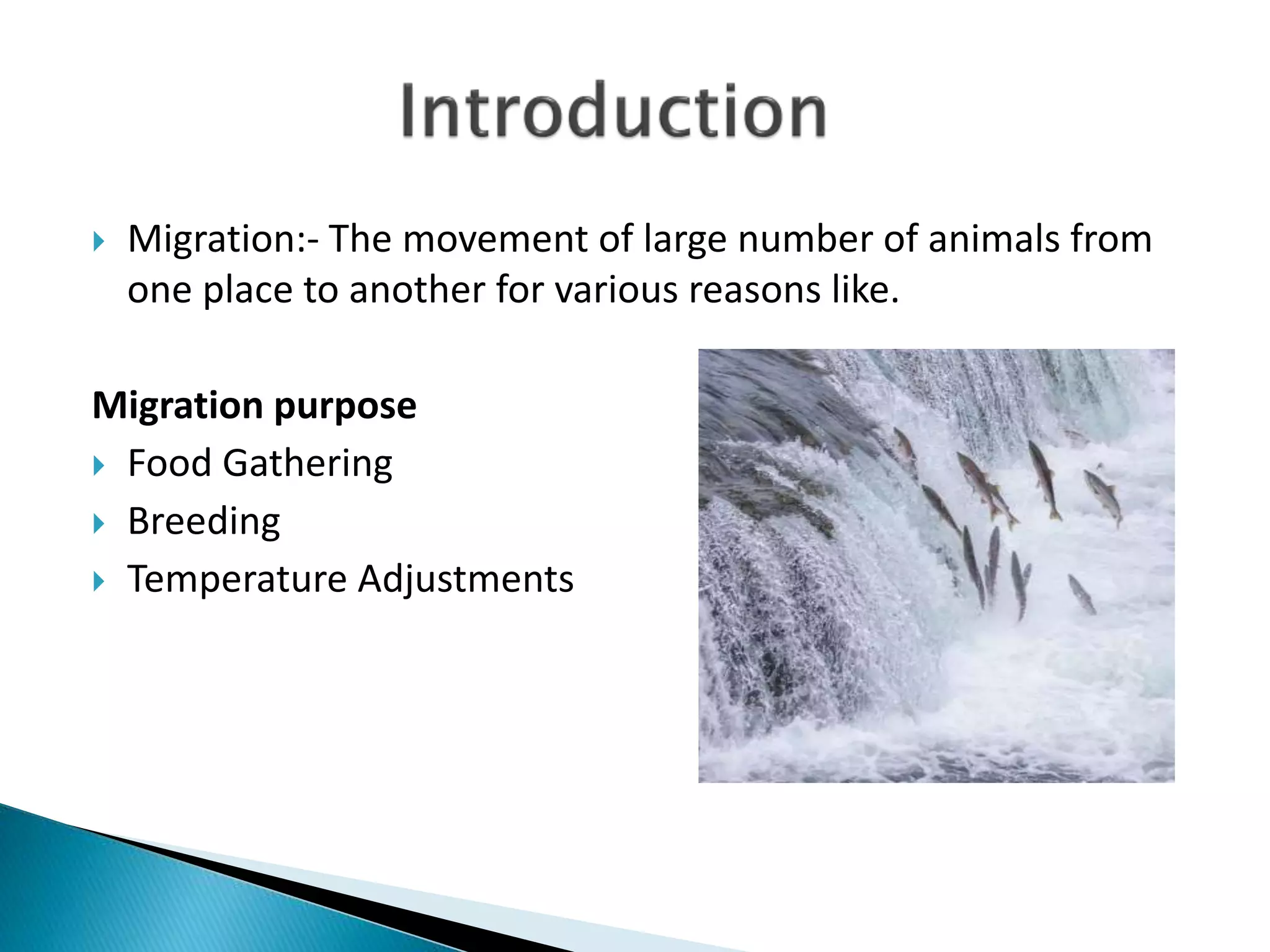
 Migration:- The movement of large number of animals from
one place to another for various reasons like.
Migration purpose
 Food Gathering
 Breeding
 Temperature Adjustments
SPAWNING MIGRATION
ANDROMOUS
DIADROMOUS OCEANODROMOUS
POTAMODROMOUS
CATADROMOUS
From sea
water to fresh
water
From fresh
water to sea
water
From one
fresh water
habitat to
another fresh
water
From sea
water to sea
water
 Heape (1961) – 4 primary ressons of fish migration
Gametic migration (Spawning /breeding migration )
 It occur during breeding season in search for the suitable
spawning ground.
 Better survival & proper development of egg /larva
Alimental of Feeding Migration :-
 Migration for search of feeding ground
 Due to shortage of food (Suitable/wintering )
 Better food facilities , better survival & fast growth
 Grow fast in size & mature & produce more eggs.
 Climate or Wintering Migration:-
 Migration in search for suitable climatic condition .
 Depends on fish condition and environment
 Osmo-regulatory or Protective Migration :-
 Migration for water and electrolytes balance from sea to fresh
water and vice- versa.
 These migration are not cyclical
Juvenile migration :
 It is larval migration from spawning ground to the feeding
habitats of their parent.
 It is the migration of fish between sea and fresh water.
 Most of the fishes are restricted to either fresh water or sea
water.
 Changes in habitat may causes osmotic imbalance in those
fishes.
 This migration is of two types-
1.Anadromous Migration
2.Catadromous Migration
 It is the migration of marine
fishes from sea to fresh water
for spawning.
 An Anadromous fish born in
fresh water, spends most of its
life in the sea and returns to
fresh water to spawn
 Adults usually die after
spawning
 Common examples – Salmon,
Hilsa, Sea lamprey.
 Catadromous fishes are once
which migrate from fresh water
into the sea to spawn
or
 Ones which stay entirely in fresh
water and migrate downstream
to spawn
 Best examples- eels of the genus
Anguilla, numbering 16 species,
the best –known of which are the
North American eel (A.rostrata)
and the European ell (A. anguilla)
Eel life cycle
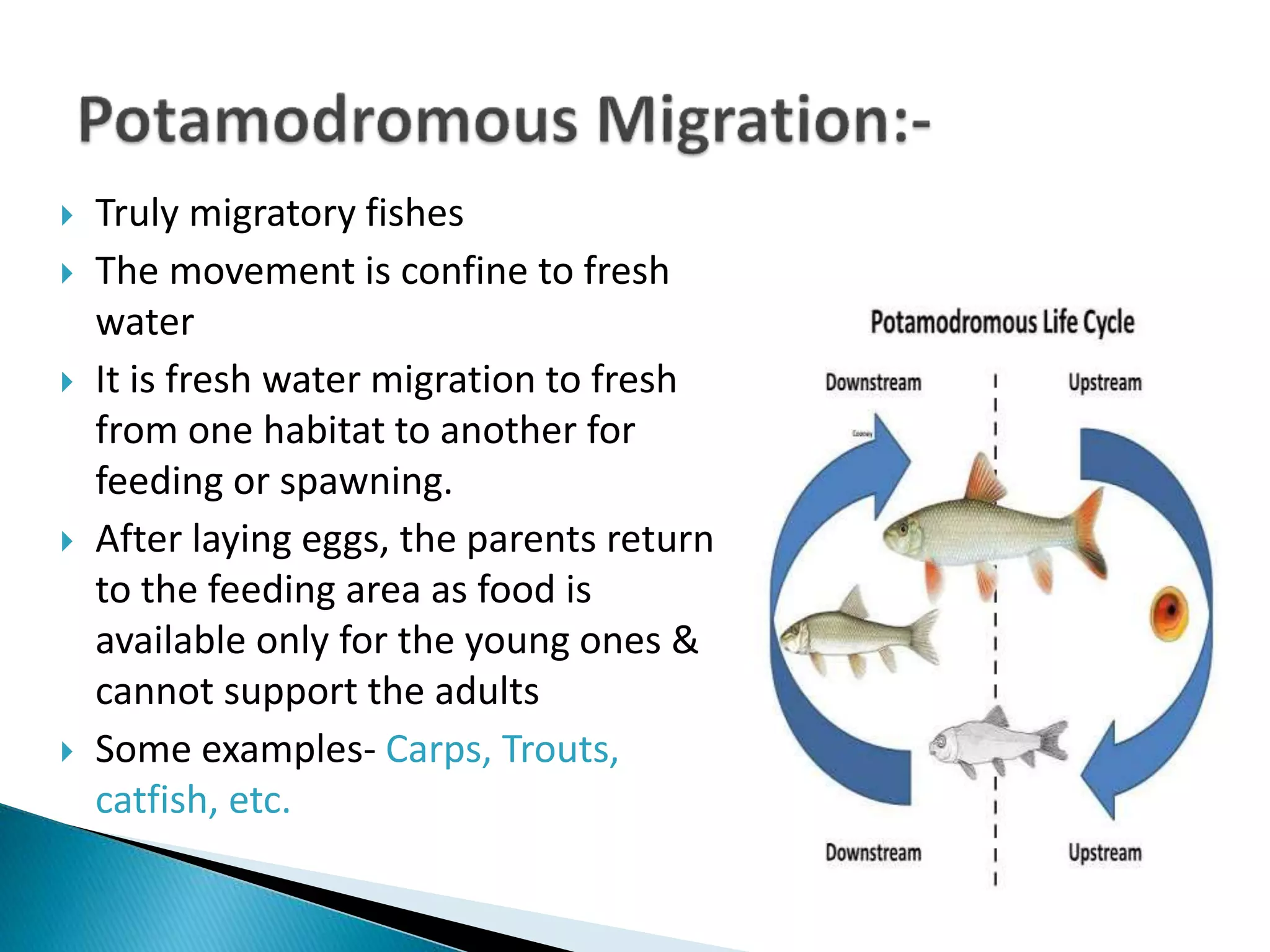
 Truly migratory fishes
 The movement is confine to fresh
water
 It is fresh water migration to fresh
from one habitat to another for
feeding or spawning.
 After laying eggs, the parents return
to the feeding area as food is
available only for the young ones &
cannot support the adults
 Some examples- Carps, Trouts,
catfish, etc.
 It is the migration of fish within
sea in search of suitable feeding
and spawning ground.
 Travel long distances with in sea
to spawn & return to the feeding
areas
 During migration these species
visit spawning areas, nursery
areas, feeding areas, winter area
etc.
 Examples- Mackerels, Tunas, Cod,
Herrings, etc.
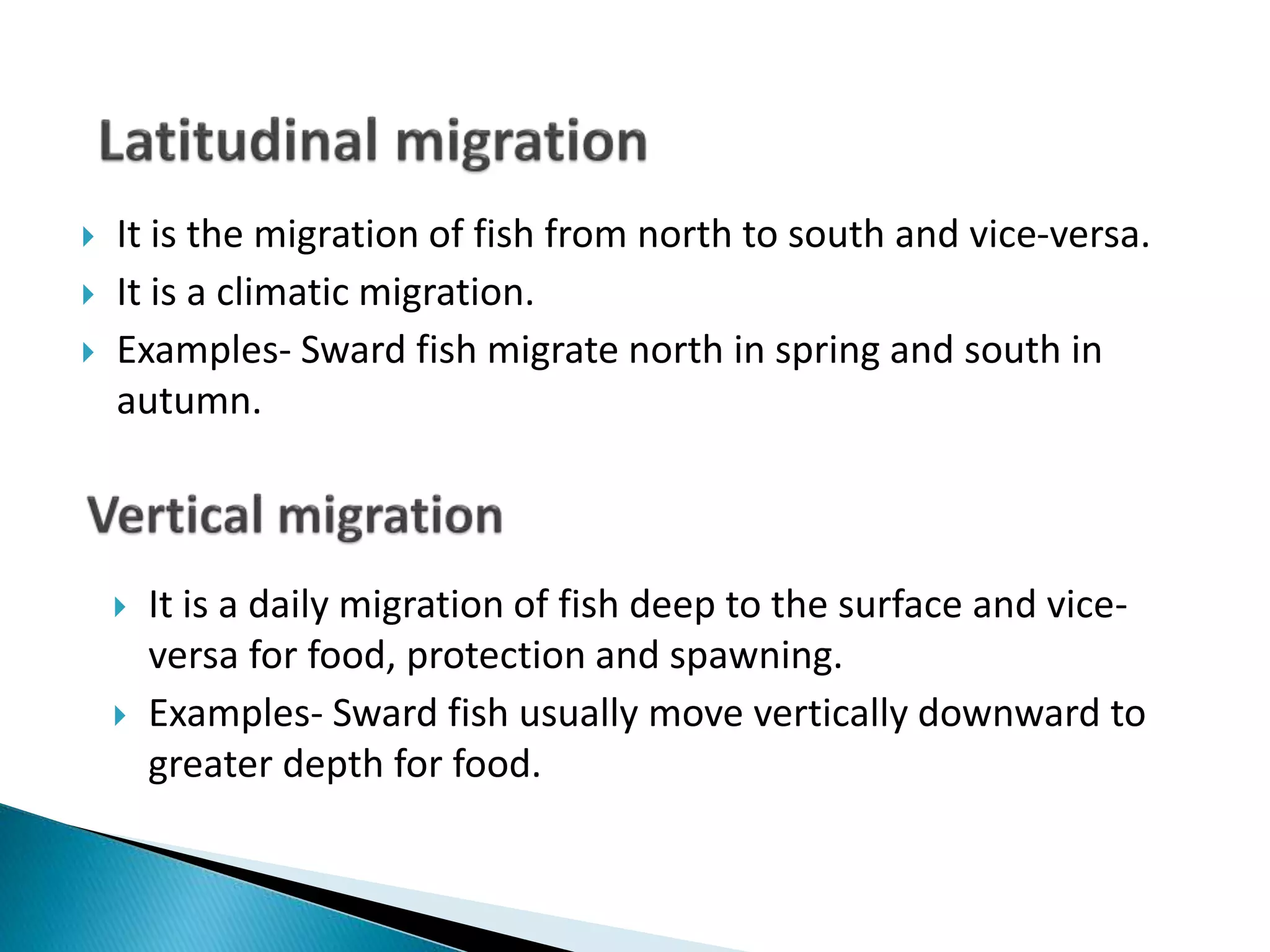
 It is the migration of fish from north to south and vice-versa.
 It is a climatic migration.
 Examples- Sward fish migrate north in spring and south in
autumn.
 It is a daily migration of fish deep to the surface and vice-
versa for food, protection and spawning.
 Examples- Sward fish usually move vertically downward to
greater depth for food.
 It is the migration of fish from water to land. However it is a
temporary migration.
 Examples- Eel migrate from one pond to another pond via
moist meadow grass.
 To find suitable feeding and spawning ground
 For protection from predators
 Survive from extreme climatic conditions
 Increases genetic diversity
 It is an adaptationl characters for survival and existences
Physical factors
 Temperature
 Light intensity
 Photoperiod
 Water current
 Turbidity
 Depth
Influenced by several Physical, Chemical, and Biological factors
Chemical factors
 pH
 Salinity
 Odour
 Taste of water
 Food
 Memory
 Stage of sexual maturity
 Predators and competitors
 Hormones
 Availability of food is the primary factor for the survival of
juveniles.
 Memory guides some species its own hatching & development
took place
 Fish ways commonly called fish ladders but also known as fish
pass or fish steps, is a structure on or around artificial and
natural barriers (such as dams, locks and weterfalls) to
facilitate diadromous fishes’ natural migration as well as
movements of potamodromous species.
 In 1852-1854, the Ballisodare Fish Pass was built in Country
Sligo, in Ireland, to draw salmon into a river that had not
supported a fishery.
 In 1880, the first fish ladder was built in Rhode Island United
States, on the Pawtuxet Falls Dam.
There are six main types of fish ways:
 Pool and weir
 Baffle fish way
 Fish elevator
 Rock-ramp fish way
 Vertical- slot fish passage
 Fish siphon
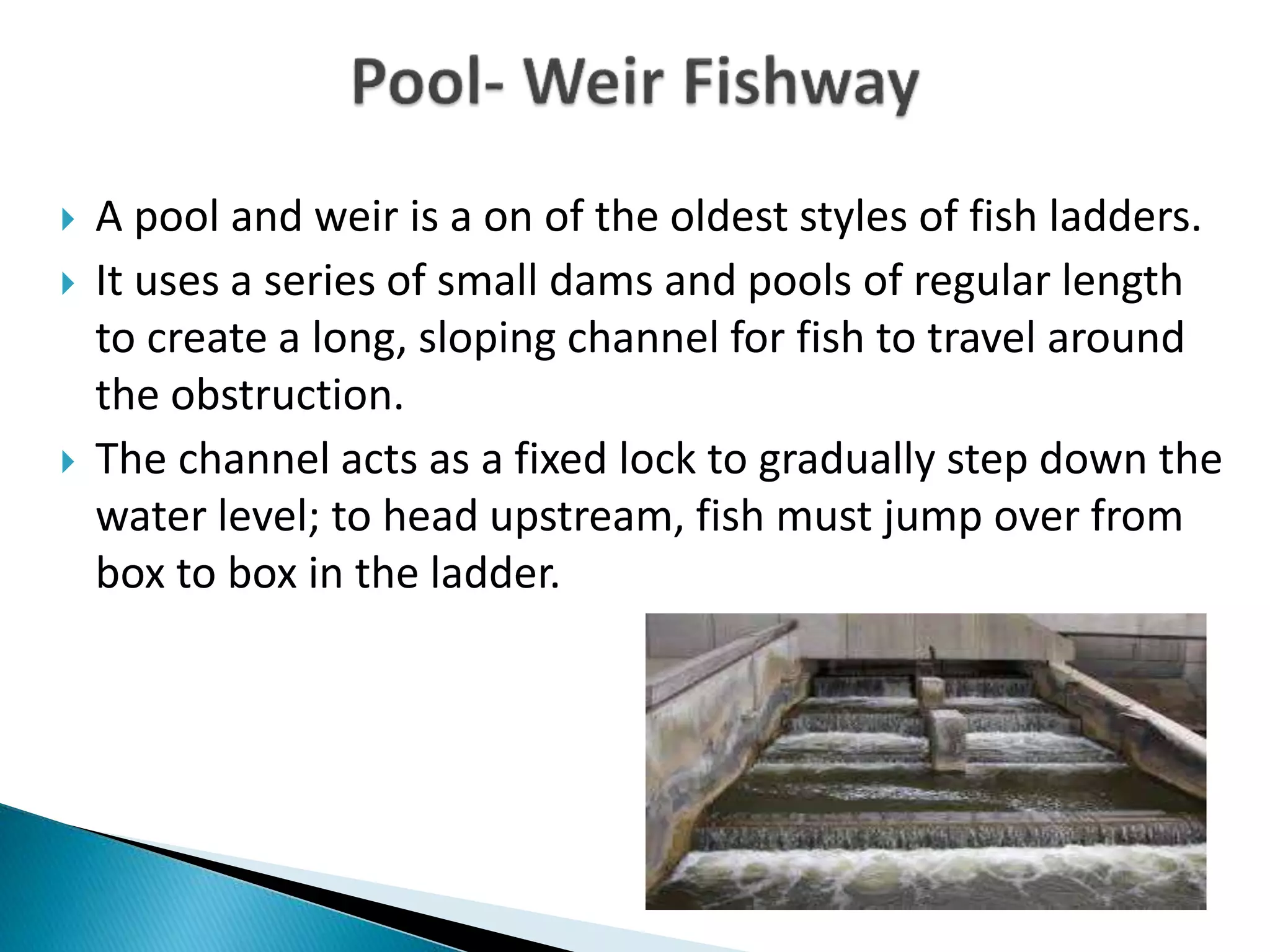
 A pool and weir is a on of the oldest styles of fish ladders.
 It uses a series of small dams and pools of regular length
to create a long, sloping channel for fish to travel around
the obstruction.
 The channel acts as a fixed lock to gradually step down the
water level; to head upstream, fish must jump over from
box to box in the ladder.
 A baffle fish way uses a series of symmetrical close-spaced
baffles in channel to redirect the flow of water, allowing fish to
swim around the barrier.
 Baffle fish ways need not have resting areas, although pools can
be included to provide a resting area or to reduce the velocity of
the flow.
 Baffles have been installed by Project Meitei in several
waterways in Nelson, New Zealand, to improve fish passage as
part of general environmental restoration.
 A fish elevator or fish lift, as its name implies, breaks with the
ladder design by providing a sort of elevator to carry fish over
a barrier.
 It is well suited to tall barriers. With a fish elevator, fish swim
into a collection area at the base of the obstruction.
 A rock-ramp fish way uses large rocks and timbers to create pools
and small falls that mimic natural structures.
 Because of the length of the channel needed for the ladder, such
structures are most appropriate for relatively short barriers.
 They have a significant advantage in that they can provide fish
spawning habitat.
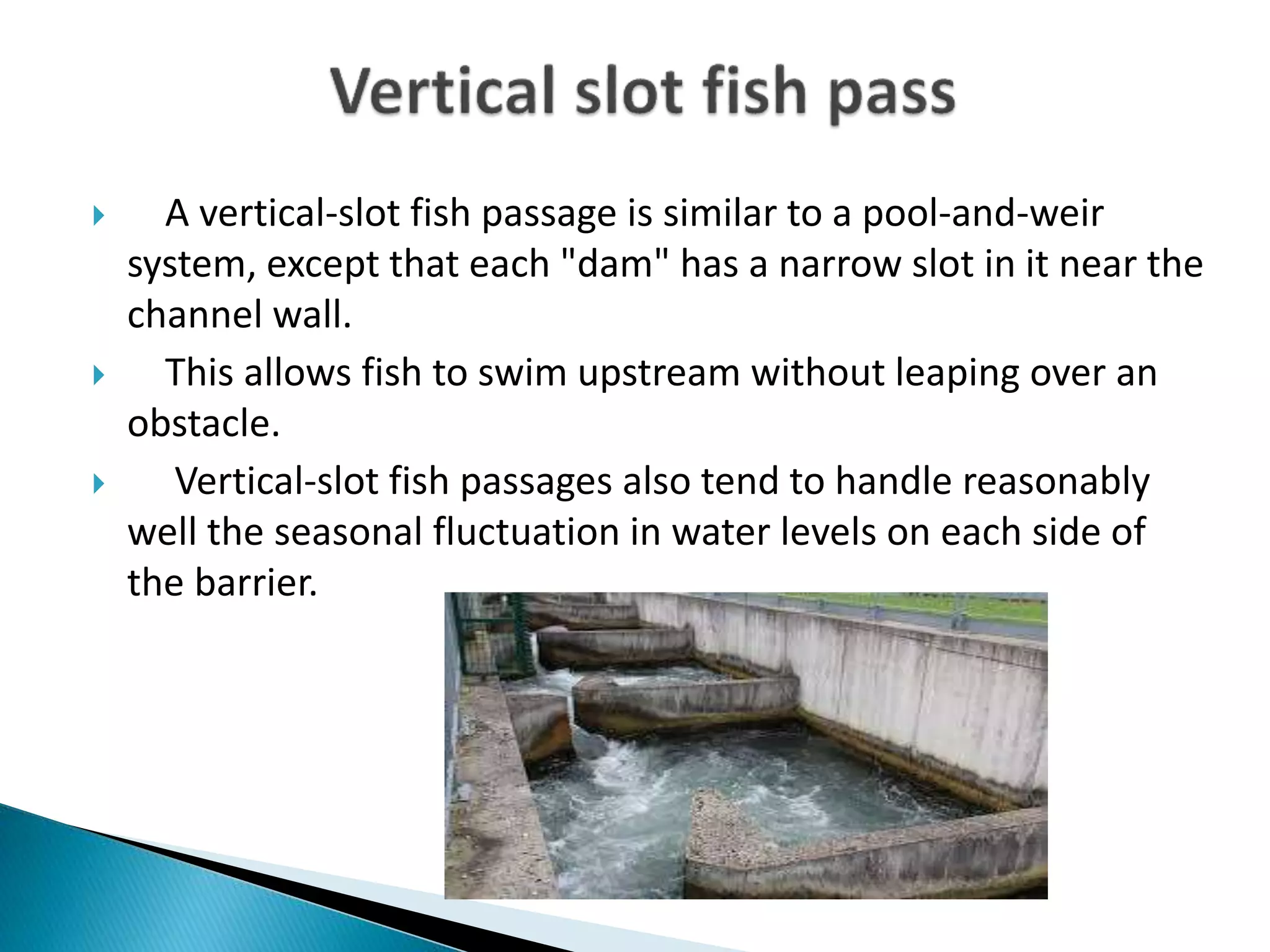
 A vertical-slot fish passage is similar to a pool-and-weir
system, except that each "dam" has a narrow slot in it near the
channel wall.
 This allows fish to swim upstream without leaping over an
obstacle.
 Vertical-slot fish passages also tend to handle reasonably
well the seasonal fluctuation in water levels on each side of
the barrier.
 The Fish lock: It is an arrangement for the regulation of flow
of water with the help of mechanical gates. The inflow and
outflow can be regulated thus providing fishes with the
passage to move either way.
 Fish ladders have a mixed record of effectiveness.
Effectiveness depends on the fish species' swimming
ability, and how the fish moves up and downstream.
 A fish passage that is designed to allow fish to pass
upstream may not allow passage downstream, for
instance.
 Fish passages do not always work.
 In practice a challenge is matching swimming
performance data to hydrodynamic measurements.
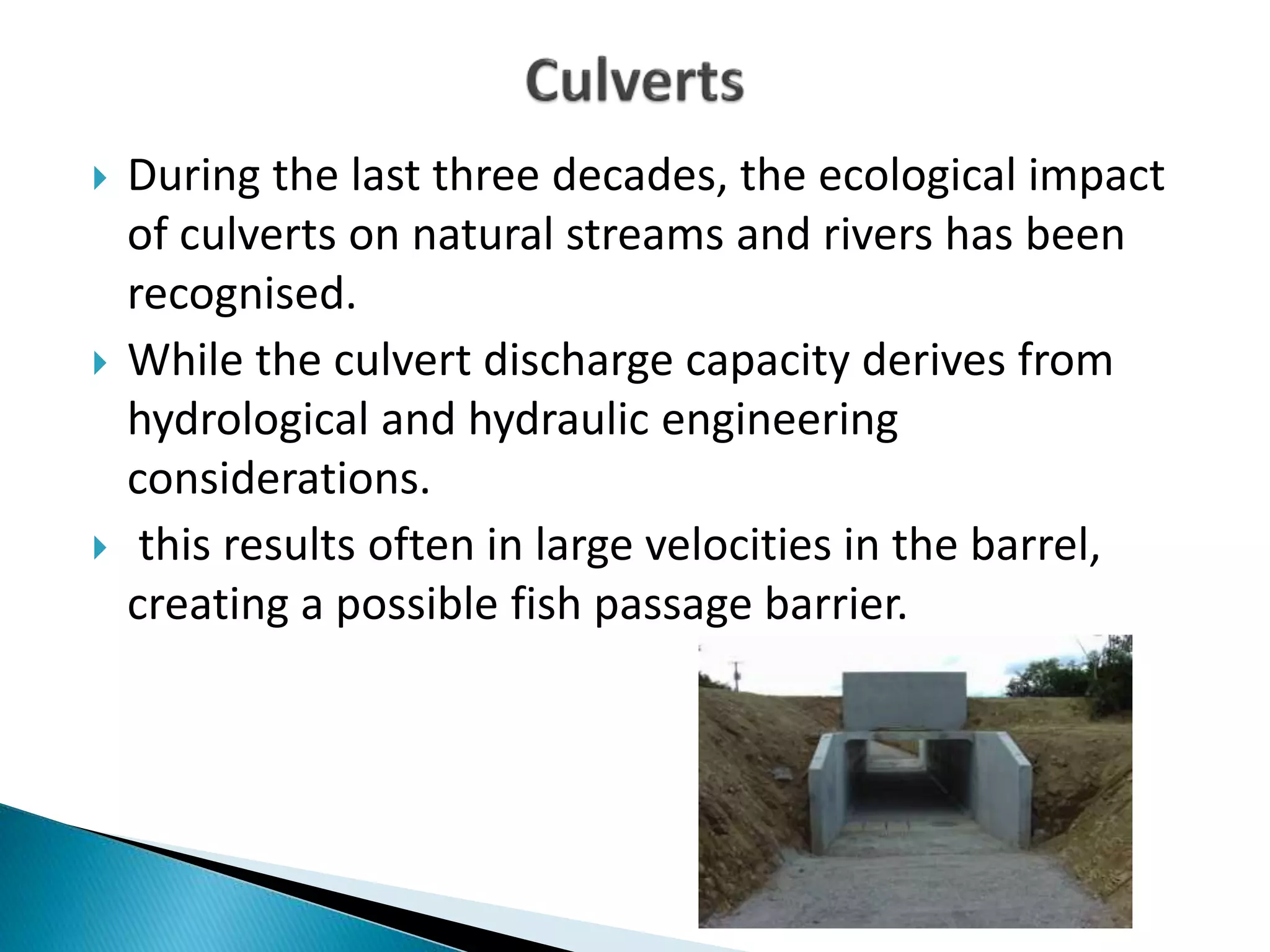
 During the last three decades, the ecological impact
of culverts on natural streams and rivers has been
recognised.
 While the culvert discharge capacity derives from
hydrological and hydraulic engineering
considerations.
 this results often in large velocities in the barrel,
creating a possible fish passage barrier.
Fish migration and different types of fish passes

Fish migration and different types of fish passes

  • 2.
     Migration:- Themovement of large number of animals from one place to another for various reasons like. Migration purpose  Food Gathering  Breeding  Temperature Adjustments
  • 3.
    SPAWNING MIGRATION ANDROMOUS DIADROMOUS OCEANODROMOUS POTAMODROMOUS CATADROMOUS Fromsea water to fresh water From fresh water to sea water From one fresh water habitat to another fresh water From sea water to sea water
  • 4.
     Heape (1961)– 4 primary ressons of fish migration Gametic migration (Spawning /breeding migration )  It occur during breeding season in search for the suitable spawning ground.  Better survival & proper development of egg /larva Alimental of Feeding Migration :-  Migration for search of feeding ground  Due to shortage of food (Suitable/wintering )  Better food facilities , better survival & fast growth  Grow fast in size & mature & produce more eggs.
  • 5.
     Climate orWintering Migration:-  Migration in search for suitable climatic condition .  Depends on fish condition and environment  Osmo-regulatory or Protective Migration :-  Migration for water and electrolytes balance from sea to fresh water and vice- versa.  These migration are not cyclical Juvenile migration :  It is larval migration from spawning ground to the feeding habitats of their parent.
  • 6.
     It isthe migration of fish between sea and fresh water.  Most of the fishes are restricted to either fresh water or sea water.  Changes in habitat may causes osmotic imbalance in those fishes.  This migration is of two types- 1.Anadromous Migration 2.Catadromous Migration
  • 7.
     It isthe migration of marine fishes from sea to fresh water for spawning.  An Anadromous fish born in fresh water, spends most of its life in the sea and returns to fresh water to spawn  Adults usually die after spawning  Common examples – Salmon, Hilsa, Sea lamprey.
  • 8.
     Catadromous fishesare once which migrate from fresh water into the sea to spawn or  Ones which stay entirely in fresh water and migrate downstream to spawn  Best examples- eels of the genus Anguilla, numbering 16 species, the best –known of which are the North American eel (A.rostrata) and the European ell (A. anguilla) Eel life cycle
  • 9.
     Truly migratoryfishes  The movement is confine to fresh water  It is fresh water migration to fresh from one habitat to another for feeding or spawning.  After laying eggs, the parents return to the feeding area as food is available only for the young ones & cannot support the adults  Some examples- Carps, Trouts, catfish, etc.
  • 10.
     It isthe migration of fish within sea in search of suitable feeding and spawning ground.  Travel long distances with in sea to spawn & return to the feeding areas  During migration these species visit spawning areas, nursery areas, feeding areas, winter area etc.  Examples- Mackerels, Tunas, Cod, Herrings, etc.
  • 11.
     It isthe migration of fish from north to south and vice-versa.  It is a climatic migration.  Examples- Sward fish migrate north in spring and south in autumn.  It is a daily migration of fish deep to the surface and vice- versa for food, protection and spawning.  Examples- Sward fish usually move vertically downward to greater depth for food.
  • 12.
     It isthe migration of fish from water to land. However it is a temporary migration.  Examples- Eel migrate from one pond to another pond via moist meadow grass.  To find suitable feeding and spawning ground  For protection from predators  Survive from extreme climatic conditions  Increases genetic diversity  It is an adaptationl characters for survival and existences
  • 13.
    Physical factors  Temperature Light intensity  Photoperiod  Water current  Turbidity  Depth Influenced by several Physical, Chemical, and Biological factors Chemical factors  pH  Salinity  Odour  Taste of water
  • 14.
     Food  Memory Stage of sexual maturity  Predators and competitors  Hormones  Availability of food is the primary factor for the survival of juveniles.  Memory guides some species its own hatching & development took place
  • 15.
     Fish wayscommonly called fish ladders but also known as fish pass or fish steps, is a structure on or around artificial and natural barriers (such as dams, locks and weterfalls) to facilitate diadromous fishes’ natural migration as well as movements of potamodromous species.
  • 16.
     In 1852-1854,the Ballisodare Fish Pass was built in Country Sligo, in Ireland, to draw salmon into a river that had not supported a fishery.  In 1880, the first fish ladder was built in Rhode Island United States, on the Pawtuxet Falls Dam.
  • 17.
    There are sixmain types of fish ways:  Pool and weir  Baffle fish way  Fish elevator  Rock-ramp fish way  Vertical- slot fish passage  Fish siphon
  • 18.
     A pooland weir is a on of the oldest styles of fish ladders.  It uses a series of small dams and pools of regular length to create a long, sloping channel for fish to travel around the obstruction.  The channel acts as a fixed lock to gradually step down the water level; to head upstream, fish must jump over from box to box in the ladder.
  • 19.
     A bafflefish way uses a series of symmetrical close-spaced baffles in channel to redirect the flow of water, allowing fish to swim around the barrier.  Baffle fish ways need not have resting areas, although pools can be included to provide a resting area or to reduce the velocity of the flow.  Baffles have been installed by Project Meitei in several waterways in Nelson, New Zealand, to improve fish passage as part of general environmental restoration.
  • 20.
     A fishelevator or fish lift, as its name implies, breaks with the ladder design by providing a sort of elevator to carry fish over a barrier.  It is well suited to tall barriers. With a fish elevator, fish swim into a collection area at the base of the obstruction.
  • 21.
     A rock-rampfish way uses large rocks and timbers to create pools and small falls that mimic natural structures.  Because of the length of the channel needed for the ladder, such structures are most appropriate for relatively short barriers.  They have a significant advantage in that they can provide fish spawning habitat.
  • 22.
     A vertical-slotfish passage is similar to a pool-and-weir system, except that each "dam" has a narrow slot in it near the channel wall.  This allows fish to swim upstream without leaping over an obstacle.  Vertical-slot fish passages also tend to handle reasonably well the seasonal fluctuation in water levels on each side of the barrier.
  • 23.
     The Fishlock: It is an arrangement for the regulation of flow of water with the help of mechanical gates. The inflow and outflow can be regulated thus providing fishes with the passage to move either way.
  • 24.
     Fish laddershave a mixed record of effectiveness. Effectiveness depends on the fish species' swimming ability, and how the fish moves up and downstream.  A fish passage that is designed to allow fish to pass upstream may not allow passage downstream, for instance.  Fish passages do not always work.  In practice a challenge is matching swimming performance data to hydrodynamic measurements.
  • 25.
     During thelast three decades, the ecological impact of culverts on natural streams and rivers has been recognised.  While the culvert discharge capacity derives from hydrological and hydraulic engineering considerations.  this results often in large velocities in the barrel, creating a possible fish passage barrier.