Submitted by
Geo Ben Kuriakose
•Migration can be defined as coordinated movement of fishes from
one habitat to another.
•These movements are often synchronous in nature. Approximately
2.3 percentages of all fish’s species undertake migrations.
•Many types of fish migrate on a regular basis, on time scales
ranging from daily to annually or longer, and over distances ranging
from a few meters, as in some coastal and stream dwelling fishes, to
thousands of kilometers, as in eel. There are both short distance and
long distance migrations.
•migrations allow fishes not only to exploit different food availabilities
and to adapt to environmental changes, but also to regulate
population density and widen their distribution.
•There are about 8,000 known species that migrate within lakes and
rivers, usually for food on daily basis as the convenience of food varies
from place to place and from season to season. Fishes also migrate to
lay their eggs in places where oxygen concentration in water is more
and where there is plenty of food for juveniles when they hatch from
eggs.
•In general, fish migrations are classified into three categories;
“Recruitment” migrations from juvenile nursery area to adult habitat,
Contranatant migrations between adult habitat and adult spawning
areas, and Drift or Denatant migrations from adult spawning area to
juvenile nursery area.
•These migrations form a migration loop.
•There must be very important initiation (triggering) and adaptation
mechanisms that make it possible for fish to migrate from juvenile
nursery area to adult habitat and from adult habitat to adult spawning
area, but many of these mechanisms remain a mystery.
•The recent rapid development in biotelemetry techniques, such as
ultrasonic and radio telemetry, data logging and pop-up satellite
telemetry, make it possible to investigate wild fish behavior both in
freshwater and seawater.
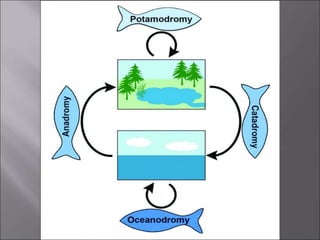
• Fish migration are classified or grouped into three categories based on
their relationship to fresh or sea water.
•OCEANODROMOUS: Occur entirely within sea water e.g. Tunas White
Sharks.
•POTAMODROMOUS: Occur entirely within fresh water e.g. Lake trout,
Lampreys.
•DIADROMOUS: Migrations that cross sea fresh water boundaries. e.g.
pacific salmonids, Onchorhychus sp.
•Diadromy is again divided into three subcategories anadromy,
catadromy, and amphidromy.
•Anadromy- Feeding and growth in saltwater adult moves to freshwater
e.g. Pacific Salmon
•Catadromy- Feeding and growth in freshwater, adult moves to sea water
e.g. eel.
 Migration is a complex syndrome of traits;
involves many physiological changes.
mainly endocrine system, biological clocks,
navigation mechanisms, specialized structures.
 ion regulation, osmo regulation, stress,
energetic, growth and reproduction, Stimulus
like changes in photoperiod, salinity and
sensory perception also aid in migration
• Originally it was believed that phenomenon involved in my migration mechanism
was a random search later on some directional bias was added this made the
prediction of migration much more accurate.
• migration is different in the open water and fluvial conditions. Migration in open
water is possible in 360 degrees and in the fluvial it is confined to a narrow
channel with or against the current termed positive or negative rheotaxis.
• In open water fishes were assumed to be using solar queues to orient during
migration (changes in suns azimuth) this theory brought forward the concept of
biological clock due to the fact that sun's measure changes during day and night.
 Ability of fishes to detect and discriminate between planepolarized light is also
studied for navigational physiology in migration.
 Fish has a percentage of plane polarized light in its highest 67% during dusk and
loss 40 percentage in the daylight.
 Another navigating theory is the theory of geomagnetic orientation studied in
Pacific Salmon and Eels which undergo long distance migration.When water
moves across the Earth's magnetic field It creates electric current that maybe
detected by fishes like rainbow Trout changes in intensity of magnetic field is
detected by distinct magnetic receptor cells located in the olfactory epithelium,
these cell contains magnetic crystals that have the ability to convert electric
current into sensory signal
 there are manyopposition to this theory claiming that it is impossible for fishes to
memorize such a map formed by sensory cells.
 Differences in water temperature and salinity create vertical layers in the water
 These layers has distinct origin and presumably with its own unique home stream
olfactory smell that fishes can identify, this plays an important role during final stages
of locating natal streams.
 migrating fishes prefer the vertical layers that have their home stream origin this
have been detected in behavioral studies of fishes like Atlantic Salmon and Pacific
Salmon.
 Navigation in fluvial habitats is less complicated than in open water here water current
is the primary orienting cue, hence migration here is result of fish orienting with the
current( negative rehotaxis) or against(positive).
 There is also overwhelming evidence that olfactory orientation is an important
componenet of navigation in fluvial migrants this was studied in pacific salmon and sea
lampreys, lampreys were attracted to streams with suitable spawning habitat by a
multicomponent bile acid pheromone released by larval lampreys.
 Long distance migrations especially upstream migrations in fluvial systems are
energetically demanding
 feeding during long distance migrations are rare most migration species of fishes
depend upon energy reserves that they accumulate in months preceding
migration.
 Another interesting fact is that in some species like pacific salmon and lampreys
the alimentary canal and digestive organs undergo atrophy so that precious
energy reserves are not wasted in maintaining these tissues that are inactive
during migration.
 There is also a post spawning death event in many migrating fishes it often
happens in semalparous species. It appears to involve a breakdown in
glucocorticoid regulation, resulting in highly elevated levels of circulated
corticosteroids and a consequent disruption of immune system functions. This
can be a part of rapid senescence program in fishes.
 Energy for migrating activity is stored as proteins carbohydrates and lipids. Lipids
are the most energy dense form of storage having twofold energy density than
protein and carbohydrates. Unlike for other vertebrates fish store lipids mainly in
a variety of tissues compared to adipose in humans. In fishes adipose like tisues
are found in viscera muscle tissues and liver. Many fishes also contain
subcutaneous layes of fat study of these tissues demonstrated that lipids
proteins and carbohydrates are depleted during long distance migrations.
Proteins and lipids breakdown to form carbs hence carb depletion is the least of
worries for proper physiological function during migration.
 Majority of energy mobilized during migration is used by muscles of locomotion
activity. Red muscles suited for powering slow and intermediate speed, high
endurance swimming while high speed swimming is facilitated by white muscles.
• Fishes display a wide variation in migration patterns however every species require
energy sources and metabolic mechanism in order to migrate successfully during
migration
• energy is required for a number of purposes these include muscle activity nervous
coordination, hormonal regulation, excretory process, ingestion, assimilation
respiration etc along with the energy for long distance migration.
• Gonad maturation also takes place during migration towards spawning grounds females
thus experience a cconsiderable energetic cost.
• diadromous species also has an increased demand on energy when they change salinity
environment.
• The required energy is supplied through catabolism of organic compounds. Some
migrants feed during migration while some completely depend upon stored reserves.
• Metabolism also depends on hormones mainly growth hormones.
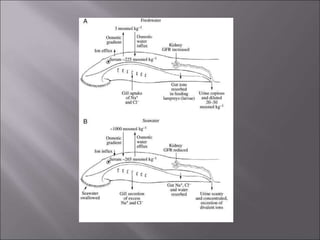
 Osmoregulation is physiological activity for proper maintenance of water
balance of the body tissues in fishes, whether they live in fresh marine or
brackish water as it is a physiological activity, very closely related to the
survival of fish in water
 three categories sea water, brackish water and fresh water depending on the
variation is salinity.
 osmoregulation is an important factor in migrating fishes in order to
complete the life cycle and different fishes show a Remarkable adaptation in
being able to migrate from sea to fresh water bodies or vice versa.
 Migration from river to sea and the sea to the river involves Crossing a
transitional Zone known as estuary. Where sea and river waters meet each
other and mix. The salinity of the zone is less than sea water, but higher than
freshwater this water is called brackish water. It is an important water body
for migratory fish. There they adapt themselves to their new environment.
 Till date two hormones are found To be very important For the Shift in
Osmoregulation From seawater to Fresh water or vice versa. One is Cortisol, a
Corticosteroid hormone Released from the Adrenal cortex. The other important
hormone is Prolactin
 Prolactin is a requirement for Fresh water life.
 Prolactin, induces the mucous secretion that covers Gill filaments and the body
surface Inhibiting Salt from Going out and water from entering in sea water.
 In anadromous fishes like salmon younglings cannot enter salt water until salt
secreting cells have developed in gills. When returning to freshwater adult
salmon exhibit a slight decrease in osmotic concentration of the blood.
 In catadromous fishes osmoregulation restores normal water and salt balance
like in eels. Eels are able to retain chloride to a remarkable degree and in
freshwater maintain their salt supply by absorbing salt from food and
reabsorbing practically all chloride contained to glomerular filterate in kidneys.
 A migrating fish requires a sophisticated sensory repertoire in order to
recognize various features along its migratory route.
 Fish orientation mechanism is based on sensory output, but the
physiological basis for sensory mechanism is not the same throughout life
cycle of migrating fishes.
 Sometimes such sensory mechanisms need to be activated or existing
mechanism be altered in some fashions such as to make sensory input
more acute or meaningful for migration.
 There is considerable evidence that fish uses olfactory cues to orient towards
their home site
 based on this a study on salmon indicated that it returns to spawning area
where the individual itself was born and not to where the parents returned.
When studies were conducted on migrating fishes olfaction using EEG response
to elucidate physiological alterations of olfactory perception.
 the result was the electrical activity in olfactory bulb of migrating fish like
salmon was much higher than that of non migrating fishes like rainbow trout’s
and goldfish.
 This high activity was also found in young salmon during time of imprinting.
 there is also a theory that increased gonadal activity in spawning season may
also affect olfaction.
• The sense of vision is important to migrating fish for schooling behavior, home site
recognition, food acquisition and possibly landmark recognition during movements within
lakes and streams.
• physiological alterations to vision at appropriate time of migration might improve chances of
fish to find food during migration or storing food before migration.
• In some species visual physiology alters during migration and different endocrine factors are
responsible for this.
• Diadromous fishes that migrate from one salinity to another require changes in visual
pigments to optimize visual activity and sensitivity.
• Pigment change porphyropsin to chyropsin type type occurs in Atlantic cells for easy
migration. There are many studies that thyroxin is responsible for converting porphyropsin to
rhodopsin.
• Changing light Levels are an important environmental stimulus for
migration activity
• In a population temperature can trigger and synchronize migratory activity
increases it can also be seen as a form of Thermal regulation Behavior.
• migration of fish, is also depend on moonlight (Lunar phasing)
The arguments put forward to the state that Upstream migration of lampreys
are highest in nights with little Moonlight.
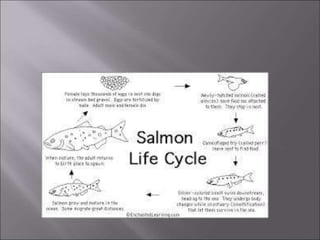
 Many salmon species are anadromous and migrate to sea at very precise times
of the year. Environmental cues initiate such migrations.
 Main factor for stimulation of smoltification is photoperiod.
 The transformation of parr to smolt is associated with a number of physiological,
behavioral and morphological changes.
 The feeding pattern changes and metabolism shifts to a catabolic function in
response to changing internal environments. The role of lipids is still not
understood well but it acts as a energy source.
 During smoltification swim bladder size increases and a decrease in body weight
to length occurs. At the time of smolitfication fish show restlessness and
sometimes become semi pelagic and show schooling behavior as they enter
stream towards sea migration.
 Fishes at this stage has affinity for higher salinity. Structural modifications of
smoltification include fin coloration, reduction in skin mucus, scale attachment,
change in head shape, and appearance of chloride cells in gills. Hormones are
prerequisites for smoltification especially thyroid gland for parr to smolt
transformations.
 Migration in salmon is closely related to gonadal maturation.
 Gonadal maturation is regulated by brain-pitutuary-gonadal axis.
 In salmon there are two types of gonadotropin releasing hormone (GnRH) those
being salmon GnRH and chicken GnRH in salmon brain.
 In particular salmon GnRH, olfactory system, terminal nerve and pre optic area
are considered to play an important role in homing migration
 gonadotropin induces steroid genesis in gonads and steroid hormones stimulate
gametogenesis
 Thyroid Hormone (T4) increases swimming activity and lipid mobilization.
Cortisol stimulates lipid metabolism and stimulates salt water tolerance
 . Human activities have a long history of interfering with fish migrations,
construction of dams and barriers make it impossible for fish to reach upstream.
 Toxicants and other chemical contaminants can disrupt physiological aspects of
fish migration.
 Contaminants may mask odor that some fish use to identify natal streams, some
toxicants can cause physical damage to lateral line system. Toxicants can reduce
metabolism limiting oxygen uptake reducing swimming performance all these
can lead to premature mortality.
 Migration can be defined as a coordinated movement of fishes from one habitat
to other for survival and it is synchronous in nature
 migration involves various physiological alterations each step in migration
involves changes in fish physiology.
 Migration involves orienting and navigating mechanisms called homing and
imprinting and differs with fish. Fishes use their own biological clock. Orientation
can be different in open water and fluvial waters.
 Fish gain energy for migrations either by feeding during migration or using
stored reserves mainly carbohydrates and lipids.
 Osmoregulation differs in catadromous, anadromous and diadromous fishes.
 Sensory physiology in migration is very important olfaction; vision without which
migration would be impossible. Similarly migration can be considered a
behavioral response to various environmental parameters.
 Physiology of pacific salmon can be studied to understand migrations on great
detail. Human activity also affects fish physiology and prevents migration when
needed.
 McDowall R.M. 1988. Diadomy in fishes: migrations between fresh water and
marine environments. Timber press 999 s.w. will shire, Portland. Oregon.
 Brian A Mckeown.1984.Fish migration, Timber press, Beaverton, USA
 Martyn C.Lucas and Etienne Baras 2001, Migration of freshwater fishes,
Blackwell science Ltd, Paris France
 Hiroshi Ueda, Katsumi Tsukamoto 2014 (1st edition) Physiology and ecology of
fish migration, CRC Press Taylor and Francis group New York.
Fish migration and its physiology reasons.

Fish migration and its physiology reasons.

  • 1.
  • 2.
    •Migration can bedefined as coordinated movement of fishes from one habitat to another. •These movements are often synchronous in nature. Approximately 2.3 percentages of all fish’s species undertake migrations. •Many types of fish migrate on a regular basis, on time scales ranging from daily to annually or longer, and over distances ranging from a few meters, as in some coastal and stream dwelling fishes, to thousands of kilometers, as in eel. There are both short distance and long distance migrations. •migrations allow fishes not only to exploit different food availabilities and to adapt to environmental changes, but also to regulate population density and widen their distribution.
  • 3.
    •There are about8,000 known species that migrate within lakes and rivers, usually for food on daily basis as the convenience of food varies from place to place and from season to season. Fishes also migrate to lay their eggs in places where oxygen concentration in water is more and where there is plenty of food for juveniles when they hatch from eggs. •In general, fish migrations are classified into three categories; “Recruitment” migrations from juvenile nursery area to adult habitat, Contranatant migrations between adult habitat and adult spawning areas, and Drift or Denatant migrations from adult spawning area to juvenile nursery area. •These migrations form a migration loop.
  • 4.
    •There must bevery important initiation (triggering) and adaptation mechanisms that make it possible for fish to migrate from juvenile nursery area to adult habitat and from adult habitat to adult spawning area, but many of these mechanisms remain a mystery. •The recent rapid development in biotelemetry techniques, such as ultrasonic and radio telemetry, data logging and pop-up satellite telemetry, make it possible to investigate wild fish behavior both in freshwater and seawater.
  • 6.
    • Fish migrationare classified or grouped into three categories based on their relationship to fresh or sea water. •OCEANODROMOUS: Occur entirely within sea water e.g. Tunas White Sharks. •POTAMODROMOUS: Occur entirely within fresh water e.g. Lake trout, Lampreys. •DIADROMOUS: Migrations that cross sea fresh water boundaries. e.g. pacific salmonids, Onchorhychus sp. •Diadromy is again divided into three subcategories anadromy, catadromy, and amphidromy. •Anadromy- Feeding and growth in saltwater adult moves to freshwater e.g. Pacific Salmon •Catadromy- Feeding and growth in freshwater, adult moves to sea water e.g. eel.
  • 8.
     Migration isa complex syndrome of traits; involves many physiological changes. mainly endocrine system, biological clocks, navigation mechanisms, specialized structures.  ion regulation, osmo regulation, stress, energetic, growth and reproduction, Stimulus like changes in photoperiod, salinity and sensory perception also aid in migration
  • 9.
    • Originally itwas believed that phenomenon involved in my migration mechanism was a random search later on some directional bias was added this made the prediction of migration much more accurate. • migration is different in the open water and fluvial conditions. Migration in open water is possible in 360 degrees and in the fluvial it is confined to a narrow channel with or against the current termed positive or negative rheotaxis. • In open water fishes were assumed to be using solar queues to orient during migration (changes in suns azimuth) this theory brought forward the concept of biological clock due to the fact that sun's measure changes during day and night.
  • 10.
     Ability offishes to detect and discriminate between planepolarized light is also studied for navigational physiology in migration.  Fish has a percentage of plane polarized light in its highest 67% during dusk and loss 40 percentage in the daylight.  Another navigating theory is the theory of geomagnetic orientation studied in Pacific Salmon and Eels which undergo long distance migration.When water moves across the Earth's magnetic field It creates electric current that maybe detected by fishes like rainbow Trout changes in intensity of magnetic field is detected by distinct magnetic receptor cells located in the olfactory epithelium, these cell contains magnetic crystals that have the ability to convert electric current into sensory signal  there are manyopposition to this theory claiming that it is impossible for fishes to memorize such a map formed by sensory cells.
  • 11.
     Differences inwater temperature and salinity create vertical layers in the water  These layers has distinct origin and presumably with its own unique home stream olfactory smell that fishes can identify, this plays an important role during final stages of locating natal streams.  migrating fishes prefer the vertical layers that have their home stream origin this have been detected in behavioral studies of fishes like Atlantic Salmon and Pacific Salmon.  Navigation in fluvial habitats is less complicated than in open water here water current is the primary orienting cue, hence migration here is result of fish orienting with the current( negative rehotaxis) or against(positive).  There is also overwhelming evidence that olfactory orientation is an important componenet of navigation in fluvial migrants this was studied in pacific salmon and sea lampreys, lampreys were attracted to streams with suitable spawning habitat by a multicomponent bile acid pheromone released by larval lampreys.
  • 12.
     Long distancemigrations especially upstream migrations in fluvial systems are energetically demanding  feeding during long distance migrations are rare most migration species of fishes depend upon energy reserves that they accumulate in months preceding migration.  Another interesting fact is that in some species like pacific salmon and lampreys the alimentary canal and digestive organs undergo atrophy so that precious energy reserves are not wasted in maintaining these tissues that are inactive during migration.  There is also a post spawning death event in many migrating fishes it often happens in semalparous species. It appears to involve a breakdown in glucocorticoid regulation, resulting in highly elevated levels of circulated corticosteroids and a consequent disruption of immune system functions. This can be a part of rapid senescence program in fishes.
  • 13.
     Energy formigrating activity is stored as proteins carbohydrates and lipids. Lipids are the most energy dense form of storage having twofold energy density than protein and carbohydrates. Unlike for other vertebrates fish store lipids mainly in a variety of tissues compared to adipose in humans. In fishes adipose like tisues are found in viscera muscle tissues and liver. Many fishes also contain subcutaneous layes of fat study of these tissues demonstrated that lipids proteins and carbohydrates are depleted during long distance migrations. Proteins and lipids breakdown to form carbs hence carb depletion is the least of worries for proper physiological function during migration.  Majority of energy mobilized during migration is used by muscles of locomotion activity. Red muscles suited for powering slow and intermediate speed, high endurance swimming while high speed swimming is facilitated by white muscles.
  • 14.
    • Fishes displaya wide variation in migration patterns however every species require energy sources and metabolic mechanism in order to migrate successfully during migration • energy is required for a number of purposes these include muscle activity nervous coordination, hormonal regulation, excretory process, ingestion, assimilation respiration etc along with the energy for long distance migration. • Gonad maturation also takes place during migration towards spawning grounds females thus experience a cconsiderable energetic cost. • diadromous species also has an increased demand on energy when they change salinity environment. • The required energy is supplied through catabolism of organic compounds. Some migrants feed during migration while some completely depend upon stored reserves. • Metabolism also depends on hormones mainly growth hormones.
  • 15.
     Osmoregulation isphysiological activity for proper maintenance of water balance of the body tissues in fishes, whether they live in fresh marine or brackish water as it is a physiological activity, very closely related to the survival of fish in water  three categories sea water, brackish water and fresh water depending on the variation is salinity.  osmoregulation is an important factor in migrating fishes in order to complete the life cycle and different fishes show a Remarkable adaptation in being able to migrate from sea to fresh water bodies or vice versa.  Migration from river to sea and the sea to the river involves Crossing a transitional Zone known as estuary. Where sea and river waters meet each other and mix. The salinity of the zone is less than sea water, but higher than freshwater this water is called brackish water. It is an important water body for migratory fish. There they adapt themselves to their new environment.
  • 16.
     Till datetwo hormones are found To be very important For the Shift in Osmoregulation From seawater to Fresh water or vice versa. One is Cortisol, a Corticosteroid hormone Released from the Adrenal cortex. The other important hormone is Prolactin  Prolactin is a requirement for Fresh water life.  Prolactin, induces the mucous secretion that covers Gill filaments and the body surface Inhibiting Salt from Going out and water from entering in sea water.  In anadromous fishes like salmon younglings cannot enter salt water until salt secreting cells have developed in gills. When returning to freshwater adult salmon exhibit a slight decrease in osmotic concentration of the blood.  In catadromous fishes osmoregulation restores normal water and salt balance like in eels. Eels are able to retain chloride to a remarkable degree and in freshwater maintain their salt supply by absorbing salt from food and reabsorbing practically all chloride contained to glomerular filterate in kidneys.
  • 18.
     A migratingfish requires a sophisticated sensory repertoire in order to recognize various features along its migratory route.  Fish orientation mechanism is based on sensory output, but the physiological basis for sensory mechanism is not the same throughout life cycle of migrating fishes.  Sometimes such sensory mechanisms need to be activated or existing mechanism be altered in some fashions such as to make sensory input more acute or meaningful for migration.
  • 19.
     There isconsiderable evidence that fish uses olfactory cues to orient towards their home site  based on this a study on salmon indicated that it returns to spawning area where the individual itself was born and not to where the parents returned. When studies were conducted on migrating fishes olfaction using EEG response to elucidate physiological alterations of olfactory perception.  the result was the electrical activity in olfactory bulb of migrating fish like salmon was much higher than that of non migrating fishes like rainbow trout’s and goldfish.  This high activity was also found in young salmon during time of imprinting.  there is also a theory that increased gonadal activity in spawning season may also affect olfaction.
  • 20.
    • The senseof vision is important to migrating fish for schooling behavior, home site recognition, food acquisition and possibly landmark recognition during movements within lakes and streams. • physiological alterations to vision at appropriate time of migration might improve chances of fish to find food during migration or storing food before migration. • In some species visual physiology alters during migration and different endocrine factors are responsible for this. • Diadromous fishes that migrate from one salinity to another require changes in visual pigments to optimize visual activity and sensitivity. • Pigment change porphyropsin to chyropsin type type occurs in Atlantic cells for easy migration. There are many studies that thyroxin is responsible for converting porphyropsin to rhodopsin.
  • 21.
    • Changing lightLevels are an important environmental stimulus for migration activity • In a population temperature can trigger and synchronize migratory activity increases it can also be seen as a form of Thermal regulation Behavior. • migration of fish, is also depend on moonlight (Lunar phasing) The arguments put forward to the state that Upstream migration of lampreys are highest in nights with little Moonlight.
  • 22.
     Many salmonspecies are anadromous and migrate to sea at very precise times of the year. Environmental cues initiate such migrations.  Main factor for stimulation of smoltification is photoperiod.  The transformation of parr to smolt is associated with a number of physiological, behavioral and morphological changes.  The feeding pattern changes and metabolism shifts to a catabolic function in response to changing internal environments. The role of lipids is still not understood well but it acts as a energy source.  During smoltification swim bladder size increases and a decrease in body weight to length occurs. At the time of smolitfication fish show restlessness and sometimes become semi pelagic and show schooling behavior as they enter stream towards sea migration.  Fishes at this stage has affinity for higher salinity. Structural modifications of smoltification include fin coloration, reduction in skin mucus, scale attachment, change in head shape, and appearance of chloride cells in gills. Hormones are prerequisites for smoltification especially thyroid gland for parr to smolt transformations.
  • 24.
     Migration insalmon is closely related to gonadal maturation.  Gonadal maturation is regulated by brain-pitutuary-gonadal axis.  In salmon there are two types of gonadotropin releasing hormone (GnRH) those being salmon GnRH and chicken GnRH in salmon brain.  In particular salmon GnRH, olfactory system, terminal nerve and pre optic area are considered to play an important role in homing migration  gonadotropin induces steroid genesis in gonads and steroid hormones stimulate gametogenesis  Thyroid Hormone (T4) increases swimming activity and lipid mobilization. Cortisol stimulates lipid metabolism and stimulates salt water tolerance
  • 25.
     . Humanactivities have a long history of interfering with fish migrations, construction of dams and barriers make it impossible for fish to reach upstream.  Toxicants and other chemical contaminants can disrupt physiological aspects of fish migration.  Contaminants may mask odor that some fish use to identify natal streams, some toxicants can cause physical damage to lateral line system. Toxicants can reduce metabolism limiting oxygen uptake reducing swimming performance all these can lead to premature mortality.
  • 26.
     Migration canbe defined as a coordinated movement of fishes from one habitat to other for survival and it is synchronous in nature  migration involves various physiological alterations each step in migration involves changes in fish physiology.  Migration involves orienting and navigating mechanisms called homing and imprinting and differs with fish. Fishes use their own biological clock. Orientation can be different in open water and fluvial waters.  Fish gain energy for migrations either by feeding during migration or using stored reserves mainly carbohydrates and lipids.  Osmoregulation differs in catadromous, anadromous and diadromous fishes.  Sensory physiology in migration is very important olfaction; vision without which migration would be impossible. Similarly migration can be considered a behavioral response to various environmental parameters.  Physiology of pacific salmon can be studied to understand migrations on great detail. Human activity also affects fish physiology and prevents migration when needed.
  • 27.
     McDowall R.M.1988. Diadomy in fishes: migrations between fresh water and marine environments. Timber press 999 s.w. will shire, Portland. Oregon.  Brian A Mckeown.1984.Fish migration, Timber press, Beaverton, USA  Martyn C.Lucas and Etienne Baras 2001, Migration of freshwater fishes, Blackwell science Ltd, Paris France  Hiroshi Ueda, Katsumi Tsukamoto 2014 (1st edition) Physiology and ecology of fish migration, CRC Press Taylor and Francis group New York.