Presented By :
Rajesh V. Chudasama
College of Fisheries Science, NAU
Navsari-396450
• Carangids forms one of the largest families of bony fishes,
wide distribution world over and is represented by about
146 species belonging to 32 genera.
• They are marine fishes found
the Atlantic, Indian and Pacific Oceans.
• Most species are fast-swimming predatory fishes that
hunt in the waters above reefs and in the open sea; some
dig in the sea floor for invertebrates.
Carangidae Family
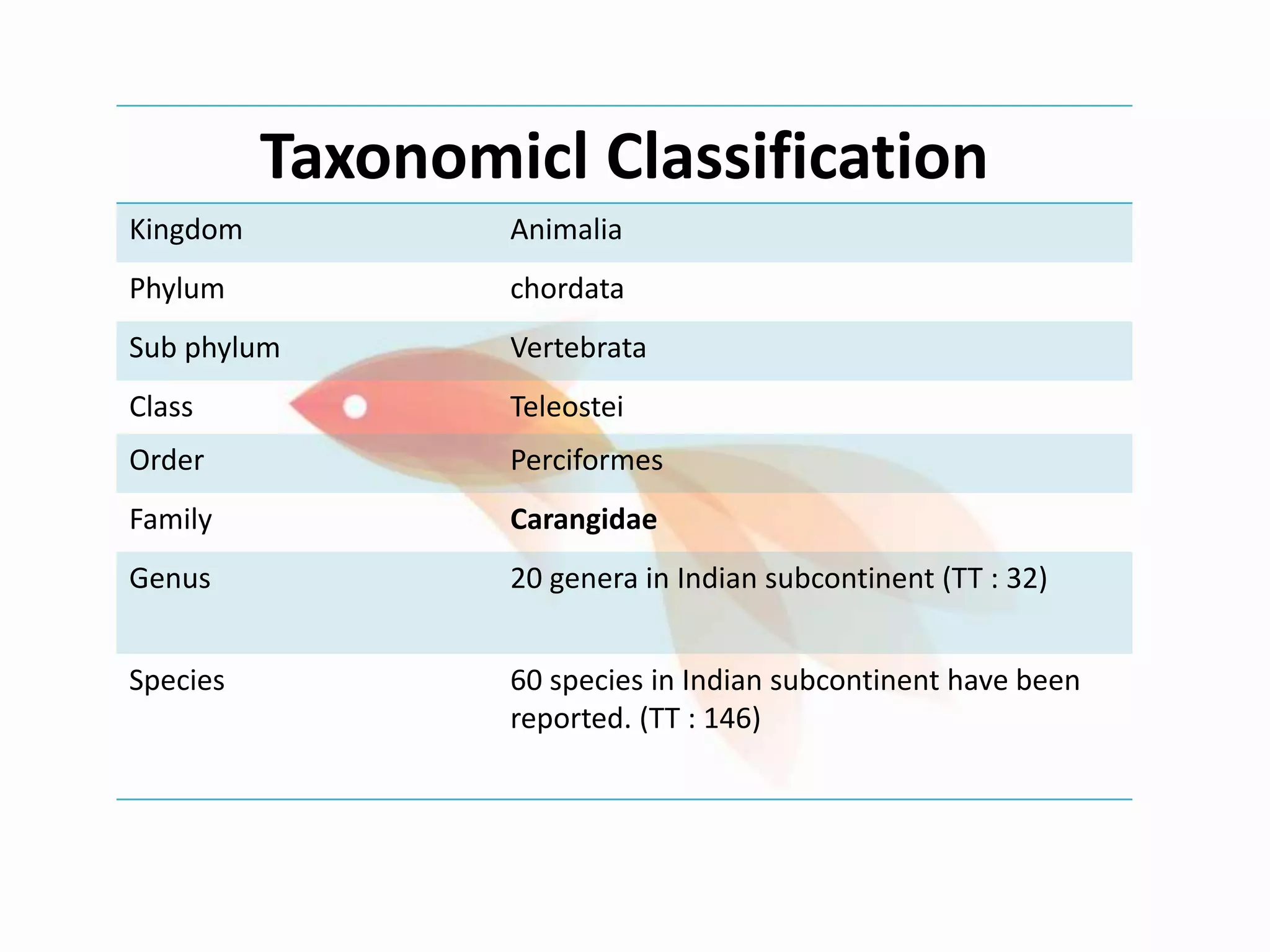
Taxonomicl Classification
Kingdom Animalia
Phylum chordata
Sub phylum Vertebrata
Class Teleostei
Order Perciformes
Family Carangidae
Genus 20 genera in Indian subcontinent (TT : 32)
Species 60 species in Indian subcontinent have been
reported. (TT : 146)
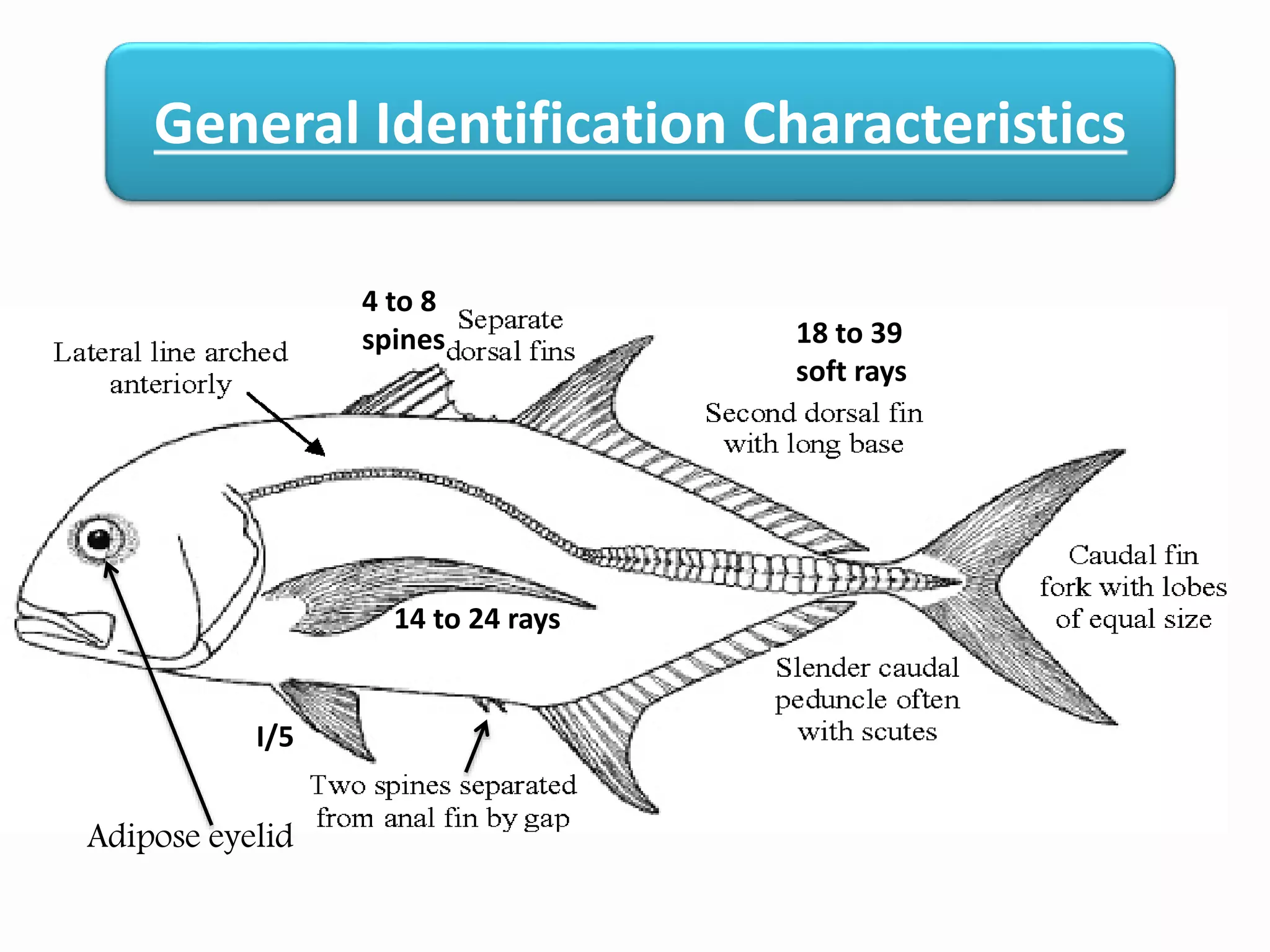
General Identification Characteristics
Adipose eyelid
4 to 8
spines 18 to 39
soft rays
14 to 24 rays
I/5
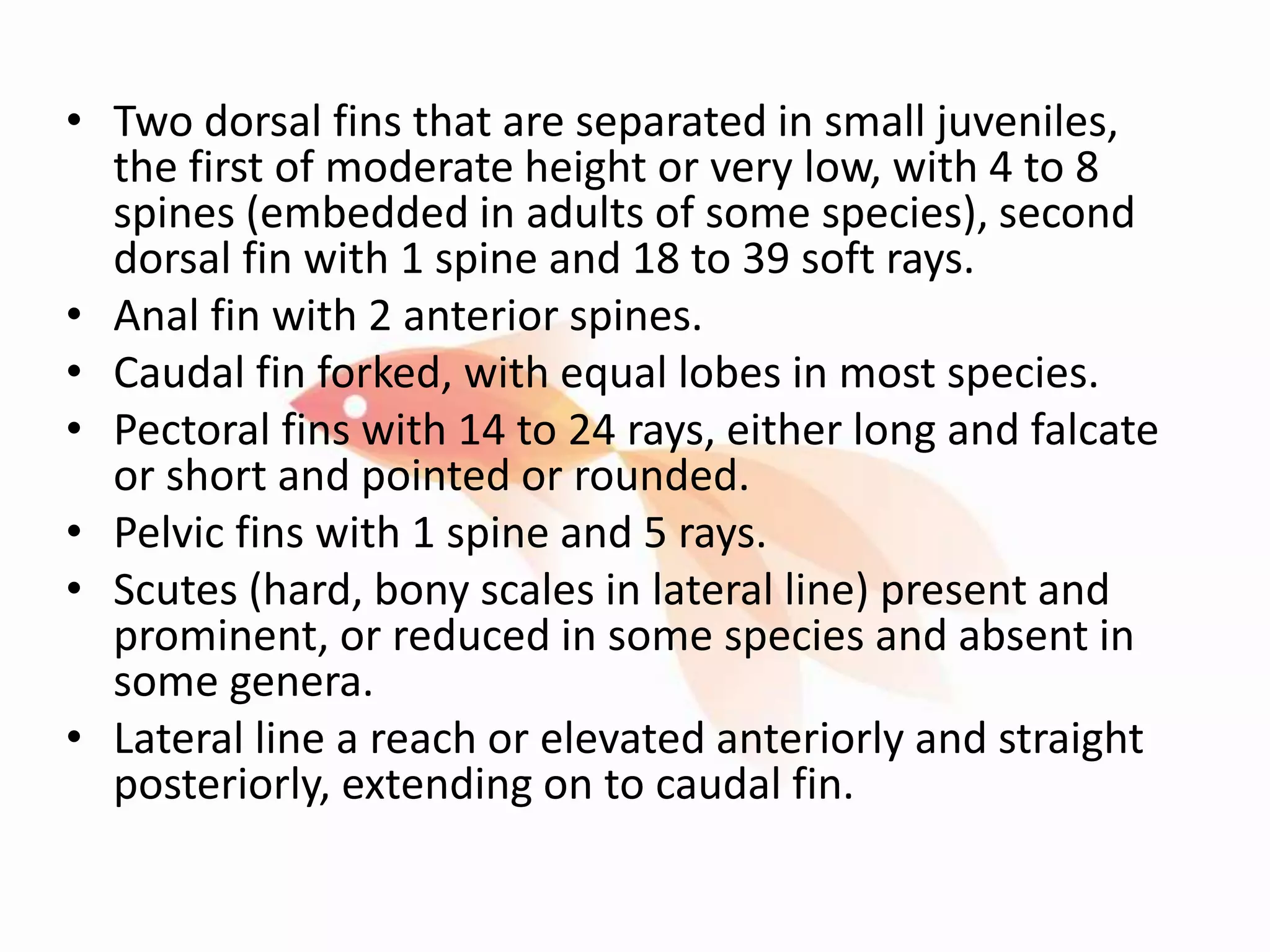
• Two dorsal fins that are separated in small juveniles,
the first of moderate height or very low, with 4 to 8
spines (embedded in adults of some species), second
dorsal fin with 1 spine and 18 to 39 soft rays.
• Anal fin with 2 anterior spines.
• Caudal fin forked, with equal lobes in most species.
• Pectoral fins with 14 to 24 rays, either long and falcate
or short and pointed or rounded.
• Pelvic fins with 1 spine and 5 rays.
• Scutes (hard, bony scales in lateral line) present and
prominent, or reduced in some species and absent in
some genera.
• Lateral line a reach or elevated anteriorly and straight
posteriorly, extending on to caudal fin.
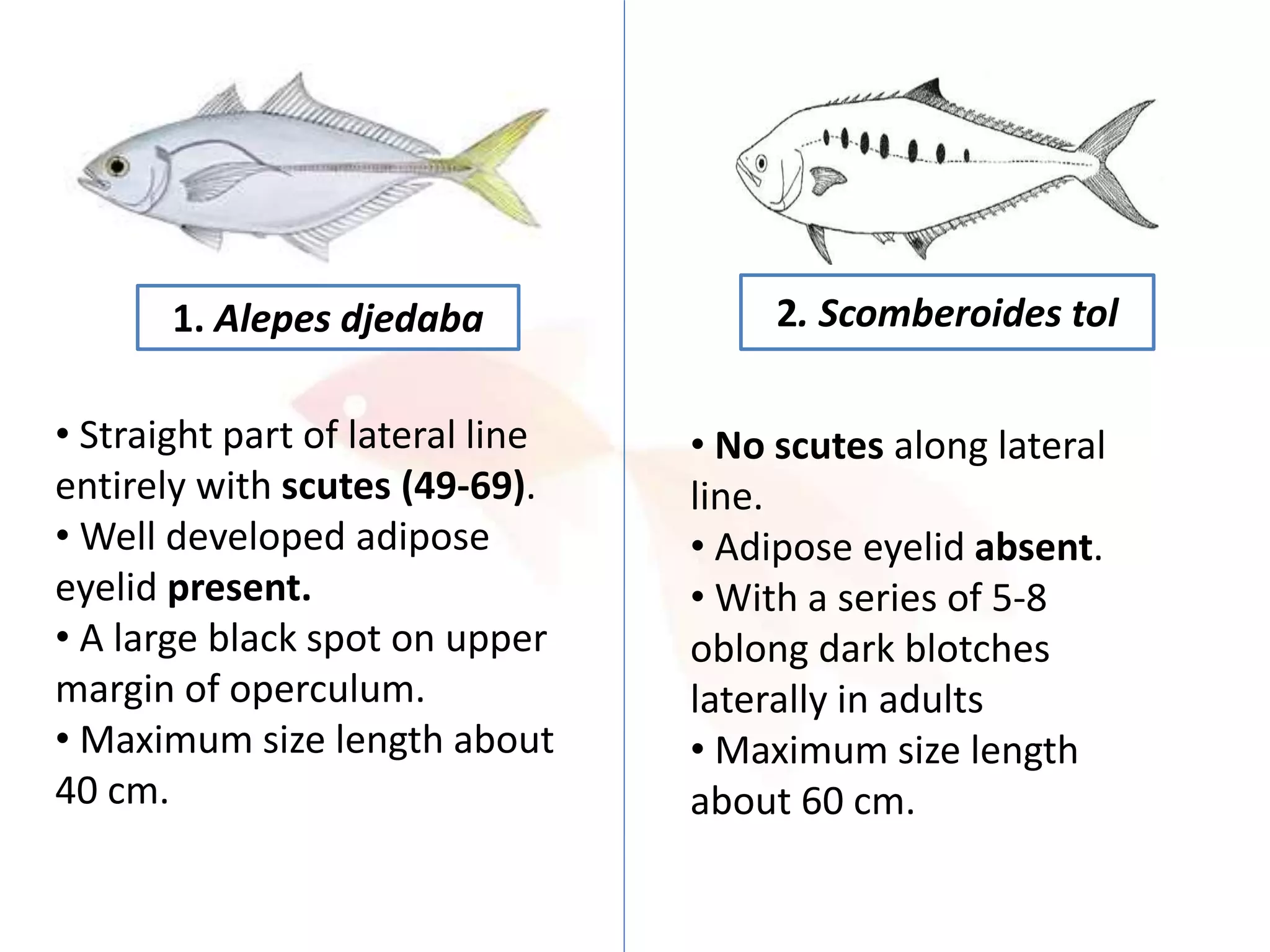
1. Alepes djedaba
• Straight part of lateral line
entirely with scutes (49-69).
• Well developed adipose
eyelid present.
• A large black spot on upper
margin of operculum.
• Maximum size length about
40 cm.
2. Scomberoides tol
• No scutes along lateral
line.
• Adipose eyelid absent.
• With a series of 5-8
oblong dark blotches
laterally in adults
• Maximum size length
about 60 cm.
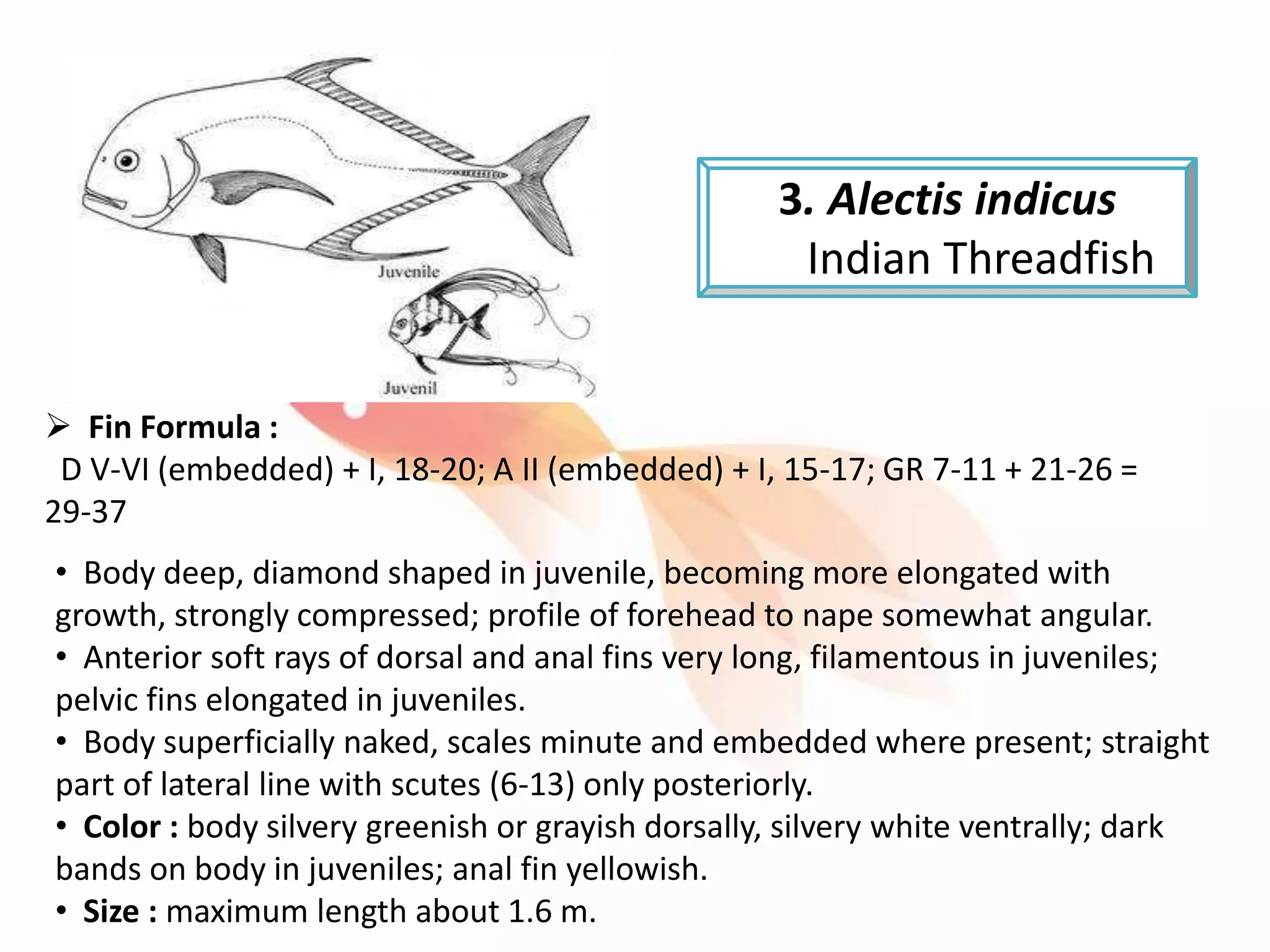
3. Alectis indicus
• Straight part of lateral line
with scutes (6-13) only
posteriorly.
• Anterior soft rays of dorsal
and anal fins very long,
filamentous in juveniles; pelvic
fins elongated in juveniles.
• Maximum size length about
1.6 m.
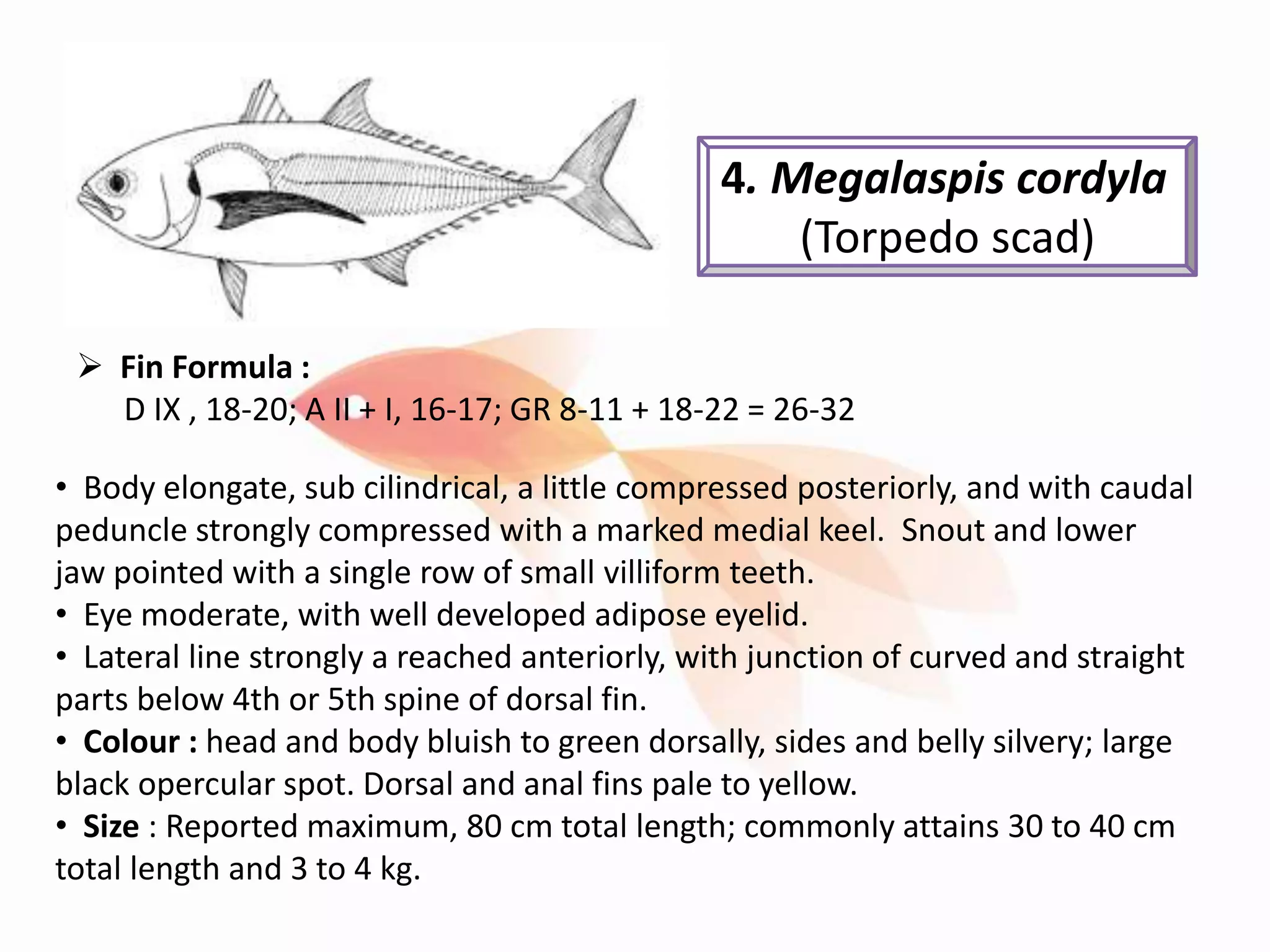
4. Megalaspis cordyla
• Lateral line strongly a reached
anteriorly, with junction of curved
and straight parts below 4th or 5th
spine of dorsal fin.
• Eye moderate, with well developed
adipose eyelid.
• The second dorsal fin with, posterior
7 to 9 rays consisting of detached
finlets and Anal fin with, posterior 8 to
10 rays consisting of detached finlets.
• Maximum size length about 80 cm.
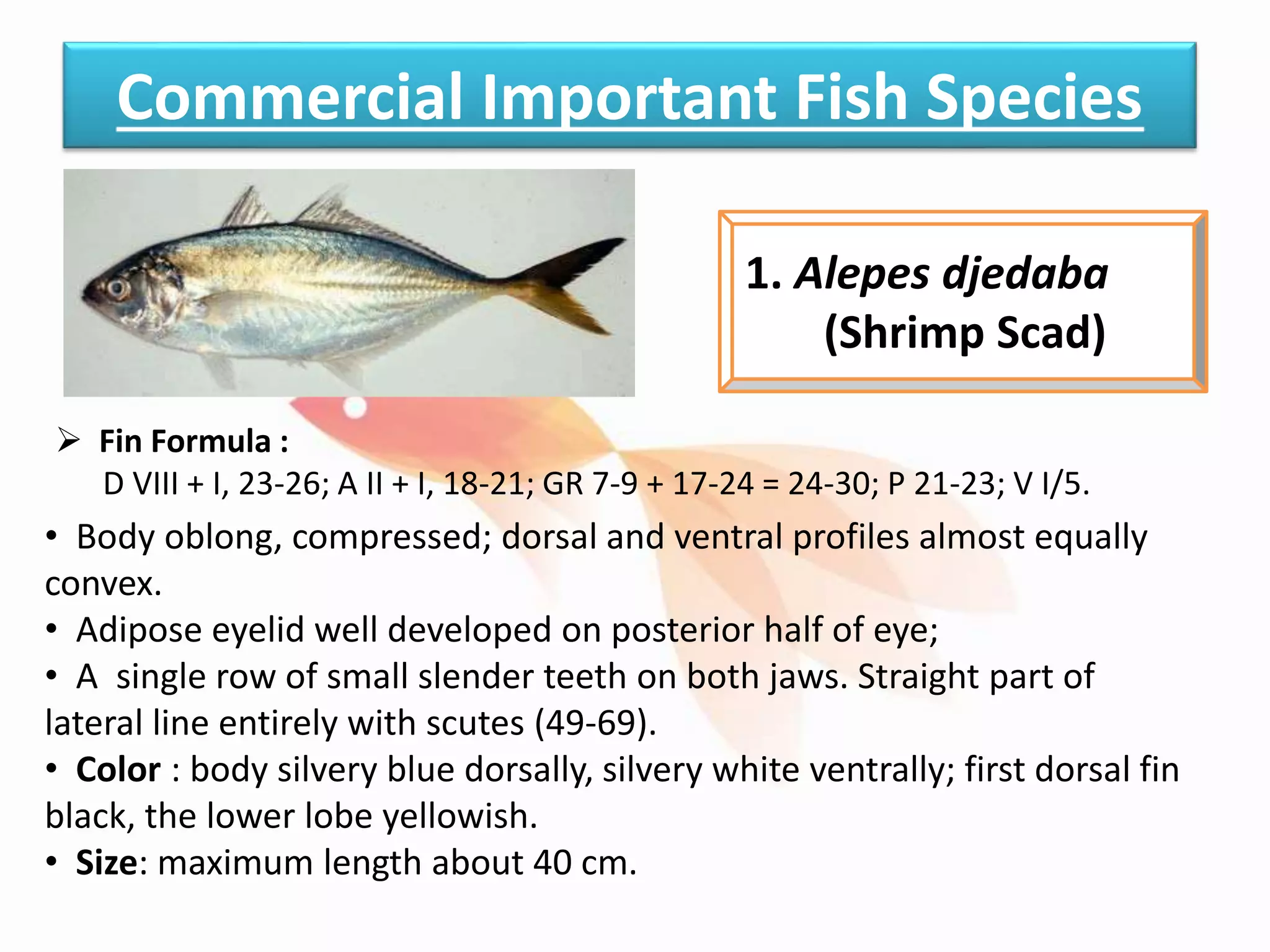
 Fin Formula :
D VIII + I, 23-26; A II + I, 18-21; GR 7-9 + 17-24 = 24-30; P 21-23; V I/5.
• Body oblong, compressed; dorsal and ventral profiles almost equally
convex.
• Adipose eyelid well developed on posterior half of eye;
• A single row of small slender teeth on both jaws. Straight part of
lateral line entirely with scutes (49-69).
• Color : body silvery blue dorsally, silvery white ventrally; first dorsal fin
black, the lower lobe yellowish.
• Size: maximum length about 40 cm.
Commercial Important Fish Species
1. Alepes djedaba
(Shrimp Scad)
 Fin Formula :
D VI-VII + I, 19-21; A II + I, 18-22; P 15-16; GR 4-7 + 17-20 = 21-26; V I/15;
C 17.
• Body elongate, strongly compressed.
• Hind tip of upper jaw not reaching to a vertical through posterior margin of
eye in adults.
• Dentary with 2 teeth rows separated by a shallow groove in adults, teeth in
both rows almost same sized.
• Body covered with slender, needle-like scales; no scutes along lateral line.
• Color : body blue-greenish gray dorsally, silvery white ventrally; lobe of
second dorsal fin black.
• Size : maximum length about 60 cm.
2. Scomberoides tol
(Needlescaled queenfish)
 Fin Formula :
D V-VI (embedded) + I, 18-20; A II (embedded) + I, 15-17; GR 7-11 + 21-26 =
29-37
• Body deep, diamond shaped in juvenile, becoming more elongated with
growth, strongly compressed; profile of forehead to nape somewhat angular.
• Anterior soft rays of dorsal and anal fins very long, filamentous in juveniles;
pelvic fins elongated in juveniles.
• Body superficially naked, scales minute and embedded where present; straight
part of lateral line with scutes (6-13) only posteriorly.
• Color : body silvery greenish or grayish dorsally, silvery white ventrally; dark
bands on body in juveniles; anal fin yellowish.
• Size : maximum length about 1.6 m.
3. Alectis indicus
Indian Threadfish
 Fin Formula :
D IX , 18-20; A II + I, 16-17; GR 8-11 + 18-22 = 26-32
• Body elongate, sub cilindrical, a little compressed posteriorly, and with caudal
peduncle strongly compressed with a marked medial keel. Snout and lower
jaw pointed with a single row of small villiform teeth.
• Eye moderate, with well developed adipose eyelid.
• Lateral line strongly a reached anteriorly, with junction of curved and straight
parts below 4th or 5th spine of dorsal fin.
• Colour : head and body bluish to green dorsally, sides and belly silvery; large
black opercular spot. Dorsal and anal fins pale to yellow.
• Size : Reported maximum, 80 cm total length; commonly attains 30 to 40 cm
total length and 3 to 4 kg.
4. Megalaspis cordyla
(Torpedo scad)
References
• https://www.kahaku.go.jp/research/db/zoology/Fishes_of_An
daman_Sea/contents/carangidae/top.html
• http://www.fao.org/fishery/species/3123/en
Fish family carangidae

Fish family carangidae

  • 1.
    Presented By : RajeshV. Chudasama College of Fisheries Science, NAU Navsari-396450
  • 2.
    • Carangids formsone of the largest families of bony fishes, wide distribution world over and is represented by about 146 species belonging to 32 genera. • They are marine fishes found the Atlantic, Indian and Pacific Oceans. • Most species are fast-swimming predatory fishes that hunt in the waters above reefs and in the open sea; some dig in the sea floor for invertebrates. Carangidae Family
  • 3.
    Taxonomicl Classification Kingdom Animalia Phylumchordata Sub phylum Vertebrata Class Teleostei Order Perciformes Family Carangidae Genus 20 genera in Indian subcontinent (TT : 32) Species 60 species in Indian subcontinent have been reported. (TT : 146)
  • 4.
    General Identification Characteristics Adiposeeyelid 4 to 8 spines 18 to 39 soft rays 14 to 24 rays I/5
  • 5.
    • Two dorsalfins that are separated in small juveniles, the first of moderate height or very low, with 4 to 8 spines (embedded in adults of some species), second dorsal fin with 1 spine and 18 to 39 soft rays. • Anal fin with 2 anterior spines. • Caudal fin forked, with equal lobes in most species. • Pectoral fins with 14 to 24 rays, either long and falcate or short and pointed or rounded. • Pelvic fins with 1 spine and 5 rays. • Scutes (hard, bony scales in lateral line) present and prominent, or reduced in some species and absent in some genera. • Lateral line a reach or elevated anteriorly and straight posteriorly, extending on to caudal fin.
  • 6.
    1. Alepes djedaba •Straight part of lateral line entirely with scutes (49-69). • Well developed adipose eyelid present. • A large black spot on upper margin of operculum. • Maximum size length about 40 cm. 2. Scomberoides tol • No scutes along lateral line. • Adipose eyelid absent. • With a series of 5-8 oblong dark blotches laterally in adults • Maximum size length about 60 cm.
  • 7.
    3. Alectis indicus •Straight part of lateral line with scutes (6-13) only posteriorly. • Anterior soft rays of dorsal and anal fins very long, filamentous in juveniles; pelvic fins elongated in juveniles. • Maximum size length about 1.6 m. 4. Megalaspis cordyla • Lateral line strongly a reached anteriorly, with junction of curved and straight parts below 4th or 5th spine of dorsal fin. • Eye moderate, with well developed adipose eyelid. • The second dorsal fin with, posterior 7 to 9 rays consisting of detached finlets and Anal fin with, posterior 8 to 10 rays consisting of detached finlets. • Maximum size length about 80 cm.
  • 8.
     Fin Formula: D VIII + I, 23-26; A II + I, 18-21; GR 7-9 + 17-24 = 24-30; P 21-23; V I/5. • Body oblong, compressed; dorsal and ventral profiles almost equally convex. • Adipose eyelid well developed on posterior half of eye; • A single row of small slender teeth on both jaws. Straight part of lateral line entirely with scutes (49-69). • Color : body silvery blue dorsally, silvery white ventrally; first dorsal fin black, the lower lobe yellowish. • Size: maximum length about 40 cm. Commercial Important Fish Species 1. Alepes djedaba (Shrimp Scad)
  • 9.
     Fin Formula: D VI-VII + I, 19-21; A II + I, 18-22; P 15-16; GR 4-7 + 17-20 = 21-26; V I/15; C 17. • Body elongate, strongly compressed. • Hind tip of upper jaw not reaching to a vertical through posterior margin of eye in adults. • Dentary with 2 teeth rows separated by a shallow groove in adults, teeth in both rows almost same sized. • Body covered with slender, needle-like scales; no scutes along lateral line. • Color : body blue-greenish gray dorsally, silvery white ventrally; lobe of second dorsal fin black. • Size : maximum length about 60 cm. 2. Scomberoides tol (Needlescaled queenfish)
  • 10.
     Fin Formula: D V-VI (embedded) + I, 18-20; A II (embedded) + I, 15-17; GR 7-11 + 21-26 = 29-37 • Body deep, diamond shaped in juvenile, becoming more elongated with growth, strongly compressed; profile of forehead to nape somewhat angular. • Anterior soft rays of dorsal and anal fins very long, filamentous in juveniles; pelvic fins elongated in juveniles. • Body superficially naked, scales minute and embedded where present; straight part of lateral line with scutes (6-13) only posteriorly. • Color : body silvery greenish or grayish dorsally, silvery white ventrally; dark bands on body in juveniles; anal fin yellowish. • Size : maximum length about 1.6 m. 3. Alectis indicus Indian Threadfish
  • 11.
     Fin Formula: D IX , 18-20; A II + I, 16-17; GR 8-11 + 18-22 = 26-32 • Body elongate, sub cilindrical, a little compressed posteriorly, and with caudal peduncle strongly compressed with a marked medial keel. Snout and lower jaw pointed with a single row of small villiform teeth. • Eye moderate, with well developed adipose eyelid. • Lateral line strongly a reached anteriorly, with junction of curved and straight parts below 4th or 5th spine of dorsal fin. • Colour : head and body bluish to green dorsally, sides and belly silvery; large black opercular spot. Dorsal and anal fins pale to yellow. • Size : Reported maximum, 80 cm total length; commonly attains 30 to 40 cm total length and 3 to 4 kg. 4. Megalaspis cordyla (Torpedo scad)
  • 12.