Carangids fishery in India
Introduction
• Carangids forms one of the largest families of bony
fishes, enjoying wide distribution world over and is
represented by about 140 species belonging to 32
genera.
• In the seas around Indian sub-continent, they are
represented by 60 species belonging to 20 genera
forming an assemblage of highly diverse group of fishes
with size varying from very small Seleroides leptolepis
measuring 18 cm to as big as the Chorenemus lyson
measuring 200 cm.
Taxonomic classification
Phylum – chordata
Sub phylum - Vertebrata
Super class - Gnathostomata
Grade - Teleosotmi
Sub grade - Actinopterygii
Class - Teleostei
Super order - Acanthopterygii
Order - Perciformes
Sub order - Percoidei
Family - Carangidae
Genus – 20 genera in Indian subcontinent
Species – 60 species in Indian subcontinent have been reported.
c
General identification characteristics
Caudal finPelvic fin
Scales
Scomberoide tala (barred queenfish)
Megalaspis cordyla (torpedo scad)
Carangids fishery
• Fishes of the family Carangidae are widely distributed along
both the coasts of India and their importance in the Indian
fishery is highly significant as they constitute nearly 5.8 %
(CMFRI – 2014-2015) of the annual marine fish landings in
India.
• 60 species belonging to 20 genera have been observed and
reported along the Indian coast.
• Carangids occupy 3rd in pelagic position rank next to oil
sardine, and mackerel and 4th in India marine landing next to
oil sardine, Indian mackerel, and perches ( CMFRI annual
report 2014- 015).
• They occur abundantly in shallow waters up to 80 m
depth along both the coasts supporting fisheries
almost round the year particularly along states of
Kerala, Karnataka, Tarnil Nadu and Andra Pradesh.
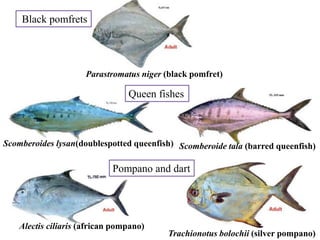
• The carangids are categorized into main sub groups
as Scad, Runners, Trevallies, Pilot fishes, Jacks,
Black pomfret, Queenfishes, Pompano and Darts.
Alepes kalla (banded scad)
Alepes melanoptera (blackfin scad)
Selar boops (oxeye scad) Decapterus macrosoma (shortfin scad)
Major subgroup belonging to different genera and
species of the family Carangidae from the Indian seas
Scad
Elagatis bipinnulata (rainbow runner)
Atropus atropus (cleft belly trevally)
Carangoids chryssophrys (longnose trevally)
Caranx melampygus (bluefin trevally) Caranx lugubris (black jack)
Runner
Trevally
Ulna mentalis (longrakered trevally) Gnathanodon speciosus (golden trevally)
Seriolina nigrofasciata (black banded trevally)
Naucrates ductor (pilot fish)
Seriola dumerili (greater amberjack) Uraspis uraspis (white mouth jack)
Pilot fishes Jack
Parastromatus niger (black pomfret)
Scomberoides lysan(doublespotted queenfish) Scomberoide tala (barred queenfish)
Alectis ciliaris (african pompano)
Trachionotus bolochii (silver pompano)
Black pomfrets
Queen fishes
Pompano and dart
• The commercial fishery is supported mainly by
Megalaspis cordyla, Decapterus russelli, Alepes
djedaba, Atule mate, selar crumenophthalmus.
Selaroides leptolepis, Caranx sexfaciatus., Carangoides
armatus.,Scomberoides tol., and Trachinotus mookalee.
Megalaspis cordyla (torpedo scad) Decapterus russelli ( Indian scad)
Alepes djedaba (shrimp scad) Atule mate (yellow tail scad)
Selar crumenophthalmus (big eye scad) Selaroides leptolepis (yellowstrip scad)
Caranx sexfaciatus (bigeye travally)
Carangoides armatus (long fin travally)
Scomberoides tol (needlescaled queenfish)
Trachinotus mookalee (indian pompano)
• The larger species of Trachinotus, Seriola and Caranx are
highly regarded as sport fish (FAO, 1984).
• Megalaspis cordyla and decapterus russelli contributed to
the carangid fishery all along the Indian coast.
• Alepes kalla and Atropus atropus formed good fisheries
along the southwest and northwest coasts respectively.
• Alepes djedaba and Atule mate formed a regional fishery in
Kerala.
• Carangoids armatus and Selaroides leptolepis constituted
the fishery in Tamil Nadu including Pondicherry.
Production status
Total marine landing 3.59 million tonne
Total pelagic production 2.05 mt. (57% )
carangids production 2.10 lakh ton (5.85% of total marine
and 10.24% of total pelagics
production.
Carangids position Ranked 3rd with 10.24% next to
mackerel 11.56% and oil sardine
26.6% respectively of total pelagic
production. Ranked 4th in total
marine landing.
Acc. To CMFRI annual report 2014-2015 :
West coast carangids contribution
East coast carangids contribution
total marine landing67% of
33 % of total marine landing
19%
48%
6%
27%
North West South West North East South East
Region-wise carangids contribution (in % of total
marine landing) 2014-2015 data
11%
7%
1%26%
20%
2%
1%
5%
17%
9%
1%
Gujrat
Maharashtra
Daman & Diu
Kerala
Karnataka
Goa
West Bengal
Odhisa
Tamil nadu
Andhra Pradesh
Pondicherry
State-wise carangids contribution in % of total marine landing in 2014-2015
State-wise ranking in carangids production in India (2014-15 data)
54446
41879
35946
23082
18816
14775
10494
3454 2690 2630 1958
0
10000
20000
30000
40000
50000
60000
Carangidsproduction(tones)
Gujrat
Karnatak
a
Kerala
Maharash
tra
Goa
Daman &
Diu
Horse Mackerel 7993 4694 2396 8017 938 796
Scad 3007 27762 38146 382 271 8
Leather Jacket 5853 705 171 1747 493 649
Other Carangid 6229 8718 13733 4629 1752 1177
0
5000
10000
15000
20000
25000
30000
35000
40000
45000Productionintonnes
Species-wise carangids production in west coast of
India(2014-2015)
Andhra
Pradesh
Odisha
Tamil
Nadu
West
Bengal
Pondicherr
y
Horse Mackerel 5244 4273 2041 1310 121
Scad 2971 153 12821 0 651
Leather Jacket 1413 2176 1720 169 145
Other Carangid 9188 3892 19364 479 1773
0
5000
10000
15000
20000
25000Productionintonnes
Species-wise carangids production in east coast of India 2014-2015
Sector-wise carangids contribution
• Carangids are extensively exploited by a multitude of
gears like trawls, drift gill nets, bottom set gillnets,
hooks & line, purse seine, ring seine, shore seine,
boat seine, bag nets, etc.
67%
11%
11%
8%
2% 1%
Differnt craft and gear % contribution in carangids catches (1998-
2000)
trawl
drift gill net
hook and line
purse seine
boat seine
bag net
44%
10%9%7%
31%
% contribution dominant spp. in trawl net
Decapterus dayi
Caranx para
Selar crumenothalums
Decapterus macrosoma
others
37%
8%
6%
4%
45%
% contribution of dominant spp.
in gill net
megalaspis cordyla
Scomberoides spp
Carangoides
gymnostehus
Caranx sexfasciatus
others
43%
16%
16%
2%
23%
% contribution of dominant
spp. in purse seine
Alepes djedaba
Caranx para
Decapterus
macrosoma
megalaspis
cordyla
others
Decadal annual landings(1950-2010)
Period Average
landings (tones)
% of total
landings
1950-1960 18254 2.78
1961-1970 22785 2.74
1971-1980 28552 2.27
1981-1990 85916 5.05
1991-2000 149604 6.21
2001-2010 140468 5.06
Production trend of carangids of 10 yr. (2005-2014)
year carangids production
(tones)
% contribution of
total marine landing
2005 133350 5.2 %
2006 142109 6.2%
2007 141567 4.9%
2008 149499 4.6%
2009 172989 5.4%
2010 166693 5.7%
2011 230645 6.0%
2012 216447 5.5%
2013 248336 6.5%
2014 210433 5.8%
0
50000
100000
150000
200000
250000
300000
2004 2006 2008 2010 2012 2014 2016
Productionintonnes
carangids production
tonn
Linear (carangids
production tonn)
PRODUCTION TREND OF CARANGIDS FROM 2005-2014
Biology
• Faster growth and short life span varying from 2 to 6 years
and prolonged spawning.
• Species are piscivorous and prefer to feed mostly on fishes
like anchovies, sardines, Thrissocles spp. Apogon spp.
silverbellies and ribbonfish among fishes, squids and
cuttlefishes among molluscs and prawns and crabs among
the crustaceans.
• The young ones prefer to feed more on prawns, squids and
anchovies and the adult mostly on fishes, molluscs and
crabs.
• Megalaspis cordyla fecundity 91854 to 324292
from Vizhinjam, spawning season from Apr.-Feb. and
peak: May to Aug, the length at first maturity 270 mm
at the age of 1.0 Year (Sreenivasan (1978) .
• Decapterus russelli fecundity 16388 to 107640 from
Kakinada, spawning season from Dec. to Aug. length
at first maturity 150 mm at the age of 1.0 year. Murty
(1991) .
Stock assessment
 Among the carangids species four of them that is Selaroides
leptolepis at tuticorin, decapterus macrosoma and Selar
crumenophthalmus at kakinada and and Caranx para at
mangalore are underfished.
 Species like Megalaspis cordyla is partially underfished along both
east and west coasts. However, there appear to be overfishing of the
species off Veraval and southwest region.
 Decapterus russelli indicated overexploitation off Kakinada. Others
like Alepes kalla along the southwest, and Alepes djedaba and Atule
mate along the Kerala coasts are over fished.
 Atropus atropus is optimally fished from the northwest region.
 Many carangid species form only a by-catch in almost
all the gears except in small meshed drift gill nets, boat
seine and shore seine. The landings by these gear are
negligible.
 In a situation like this, it is not only difficult but also not
possible to propose any specific regulatory measures
exclusively for judicious exploitation of carangid
resource.
 However, when certain fishery regulatory measures
either on the effort reduction or mesh size regulation for
increasing the size at first capture in order to ease the
higher fishing pressure are implemented, the same will
be equally beneficial to carangid resource also.
Conservation and management
CONCLUSION
 1950 – 1980 Slow progress of carangid fisheries.
 1985- 1995 A tremendous increase in the fishery could be
noticed.
 From 1995 production trend of carangids also exhibits
stagnation in increasing and decreasing trend.
 Many carangid species form only a by-catch in almost all the
gears except in small meshed drift gill nets, boat seine and
shore seine. The landings by these gears are negligible.
 Whereas, carangid fishery is sustained by many fast growing
species with short life span and that provides them better scope
to compete with other resources in the process of species
succession. This may be one of the reasons for a continued
increase in the over all carangid production in India.
References
• CMFRI, Annual Report 2005-2014. Central Marine Fisheries Research
Institute, Cochin.
• Mohamad Kasim. H. 2005 Status of the Fishery and Resource Characteristics
of Carangids along the Indian Coasts. The Seventh lndian Fisheries Forum
Proceedings,. Kochi. p. 7-14.
• Mohamad Kasim. H. Carangids. STATUS OF EXPLOITED MARINE
FISHERY RESOURCES OF INDIA, CMFRI, Cochin. p, 66-75.
• Murty V. Sriramachandra 1991. Observations on some aspects of biology
and population dynamics of the scad Decapterus russelll (Ruppell)
(Carangidae) in the trawling grounds off Kakinada. J. mar. blol. Ass. India.
1991, 3 3 (1&2): 396- 408.
• Radhakrishnan Nair. P.N., 2000. Carangid resources of India .Marine
Fisheries Research and Management. p. 317-348
• Rekha J. Nair*, Joshi. K. K, Somy Kuriakose and Geetha. P. M A Study on
the Diversity of Carangid Resources off Cochin, Kerala. Central Marine
Fisheries Research Institute. Cochin.
• Reuben'.S, Kasim. H. M, Sivakami. S, Radhakrishnan Nair. P. N, Kurup.
K.N, Sivadas. M" A Noble7. Somasekharan Nair. K. V' and Raiey. S. G
1992. Fishery, biology and stock assessment of carangid resources from the
Indian seas. Indian Journal of Fisheries; 39 (3,4) : 195-234,
• Sathianandan. T. V , Jayasankar. J, Somy Kuriakose, Mini. K. G and
Wilson T. Mathew. Indian Marine fishery resources: Optimistic present ,
challenging future. Indian J. Fish., 58(4) : 1-15, 2011.
• Sivakami. S, Radhakrishnan Nair. P. N, Jayaprakash. A. A, Kasim. H. M,
Yohannan. T. M, Sivadas. M, Said Koya. K. P and Seetha. P. K, 1996.
Distribution and abundance of carangids along the EEZ India.. Department of
Ocean Development, New Delhi. p 347-361.
• Sreenivasan. P.V. 1978. Observations on the fishery and biology of Megalaspis
cordyla (Linnaeus) at Vlzhinjam. Indian J. Fish; 25 (2,4): 122-140.
Thank you

Vivek kumar final credit seminar

  • 1.
  • 2.
    Introduction • Carangids formsone of the largest families of bony fishes, enjoying wide distribution world over and is represented by about 140 species belonging to 32 genera. • In the seas around Indian sub-continent, they are represented by 60 species belonging to 20 genera forming an assemblage of highly diverse group of fishes with size varying from very small Seleroides leptolepis measuring 18 cm to as big as the Chorenemus lyson measuring 200 cm.
  • 3.
    Taxonomic classification Phylum –chordata Sub phylum - Vertebrata Super class - Gnathostomata Grade - Teleosotmi Sub grade - Actinopterygii Class - Teleostei Super order - Acanthopterygii Order - Perciformes Sub order - Percoidei Family - Carangidae Genus – 20 genera in Indian subcontinent Species – 60 species in Indian subcontinent have been reported.
  • 4.
    c General identification characteristics CaudalfinPelvic fin Scales Scomberoide tala (barred queenfish) Megalaspis cordyla (torpedo scad)
  • 5.
    Carangids fishery • Fishesof the family Carangidae are widely distributed along both the coasts of India and their importance in the Indian fishery is highly significant as they constitute nearly 5.8 % (CMFRI – 2014-2015) of the annual marine fish landings in India. • 60 species belonging to 20 genera have been observed and reported along the Indian coast. • Carangids occupy 3rd in pelagic position rank next to oil sardine, and mackerel and 4th in India marine landing next to oil sardine, Indian mackerel, and perches ( CMFRI annual report 2014- 015).
  • 6.
    • They occurabundantly in shallow waters up to 80 m depth along both the coasts supporting fisheries almost round the year particularly along states of Kerala, Karnataka, Tarnil Nadu and Andra Pradesh. • The carangids are categorized into main sub groups as Scad, Runners, Trevallies, Pilot fishes, Jacks, Black pomfret, Queenfishes, Pompano and Darts.
  • 7.
    Alepes kalla (bandedscad) Alepes melanoptera (blackfin scad) Selar boops (oxeye scad) Decapterus macrosoma (shortfin scad) Major subgroup belonging to different genera and species of the family Carangidae from the Indian seas Scad
  • 8.
    Elagatis bipinnulata (rainbowrunner) Atropus atropus (cleft belly trevally) Carangoids chryssophrys (longnose trevally) Caranx melampygus (bluefin trevally) Caranx lugubris (black jack) Runner Trevally
  • 9.
    Ulna mentalis (longrakeredtrevally) Gnathanodon speciosus (golden trevally) Seriolina nigrofasciata (black banded trevally) Naucrates ductor (pilot fish) Seriola dumerili (greater amberjack) Uraspis uraspis (white mouth jack) Pilot fishes Jack
  • 10.
    Parastromatus niger (blackpomfret) Scomberoides lysan(doublespotted queenfish) Scomberoide tala (barred queenfish) Alectis ciliaris (african pompano) Trachionotus bolochii (silver pompano) Black pomfrets Queen fishes Pompano and dart
  • 11.
    • The commercialfishery is supported mainly by Megalaspis cordyla, Decapterus russelli, Alepes djedaba, Atule mate, selar crumenophthalmus. Selaroides leptolepis, Caranx sexfaciatus., Carangoides armatus.,Scomberoides tol., and Trachinotus mookalee. Megalaspis cordyla (torpedo scad) Decapterus russelli ( Indian scad)
  • 12.
    Alepes djedaba (shrimpscad) Atule mate (yellow tail scad) Selar crumenophthalmus (big eye scad) Selaroides leptolepis (yellowstrip scad)
  • 13.
    Caranx sexfaciatus (bigeyetravally) Carangoides armatus (long fin travally) Scomberoides tol (needlescaled queenfish) Trachinotus mookalee (indian pompano)
  • 14.
    • The largerspecies of Trachinotus, Seriola and Caranx are highly regarded as sport fish (FAO, 1984). • Megalaspis cordyla and decapterus russelli contributed to the carangid fishery all along the Indian coast. • Alepes kalla and Atropus atropus formed good fisheries along the southwest and northwest coasts respectively. • Alepes djedaba and Atule mate formed a regional fishery in Kerala. • Carangoids armatus and Selaroides leptolepis constituted the fishery in Tamil Nadu including Pondicherry.
  • 15.
    Production status Total marinelanding 3.59 million tonne Total pelagic production 2.05 mt. (57% ) carangids production 2.10 lakh ton (5.85% of total marine and 10.24% of total pelagics production. Carangids position Ranked 3rd with 10.24% next to mackerel 11.56% and oil sardine 26.6% respectively of total pelagic production. Ranked 4th in total marine landing. Acc. To CMFRI annual report 2014-2015 : West coast carangids contribution East coast carangids contribution total marine landing67% of 33 % of total marine landing
  • 16.
    19% 48% 6% 27% North West SouthWest North East South East Region-wise carangids contribution (in % of total marine landing) 2014-2015 data
  • 17.
    11% 7% 1%26% 20% 2% 1% 5% 17% 9% 1% Gujrat Maharashtra Daman & Diu Kerala Karnataka Goa WestBengal Odhisa Tamil nadu Andhra Pradesh Pondicherry State-wise carangids contribution in % of total marine landing in 2014-2015
  • 18.
    State-wise ranking incarangids production in India (2014-15 data) 54446 41879 35946 23082 18816 14775 10494 3454 2690 2630 1958 0 10000 20000 30000 40000 50000 60000 Carangidsproduction(tones)
  • 19.
    Gujrat Karnatak a Kerala Maharash tra Goa Daman & Diu Horse Mackerel7993 4694 2396 8017 938 796 Scad 3007 27762 38146 382 271 8 Leather Jacket 5853 705 171 1747 493 649 Other Carangid 6229 8718 13733 4629 1752 1177 0 5000 10000 15000 20000 25000 30000 35000 40000 45000Productionintonnes Species-wise carangids production in west coast of India(2014-2015)
  • 20.
    Andhra Pradesh Odisha Tamil Nadu West Bengal Pondicherr y Horse Mackerel 52444273 2041 1310 121 Scad 2971 153 12821 0 651 Leather Jacket 1413 2176 1720 169 145 Other Carangid 9188 3892 19364 479 1773 0 5000 10000 15000 20000 25000Productionintonnes Species-wise carangids production in east coast of India 2014-2015
  • 21.
    Sector-wise carangids contribution •Carangids are extensively exploited by a multitude of gears like trawls, drift gill nets, bottom set gillnets, hooks & line, purse seine, ring seine, shore seine, boat seine, bag nets, etc. 67% 11% 11% 8% 2% 1% Differnt craft and gear % contribution in carangids catches (1998- 2000) trawl drift gill net hook and line purse seine boat seine bag net
  • 22.
    44% 10%9%7% 31% % contribution dominantspp. in trawl net Decapterus dayi Caranx para Selar crumenothalums Decapterus macrosoma others 37% 8% 6% 4% 45% % contribution of dominant spp. in gill net megalaspis cordyla Scomberoides spp Carangoides gymnostehus Caranx sexfasciatus others 43% 16% 16% 2% 23% % contribution of dominant spp. in purse seine Alepes djedaba Caranx para Decapterus macrosoma megalaspis cordyla others
  • 23.
    Decadal annual landings(1950-2010) PeriodAverage landings (tones) % of total landings 1950-1960 18254 2.78 1961-1970 22785 2.74 1971-1980 28552 2.27 1981-1990 85916 5.05 1991-2000 149604 6.21 2001-2010 140468 5.06
  • 25.
    Production trend ofcarangids of 10 yr. (2005-2014) year carangids production (tones) % contribution of total marine landing 2005 133350 5.2 % 2006 142109 6.2% 2007 141567 4.9% 2008 149499 4.6% 2009 172989 5.4% 2010 166693 5.7% 2011 230645 6.0% 2012 216447 5.5% 2013 248336 6.5% 2014 210433 5.8%
  • 26.
    0 50000 100000 150000 200000 250000 300000 2004 2006 20082010 2012 2014 2016 Productionintonnes carangids production tonn Linear (carangids production tonn) PRODUCTION TREND OF CARANGIDS FROM 2005-2014
  • 27.
    Biology • Faster growthand short life span varying from 2 to 6 years and prolonged spawning. • Species are piscivorous and prefer to feed mostly on fishes like anchovies, sardines, Thrissocles spp. Apogon spp. silverbellies and ribbonfish among fishes, squids and cuttlefishes among molluscs and prawns and crabs among the crustaceans. • The young ones prefer to feed more on prawns, squids and anchovies and the adult mostly on fishes, molluscs and crabs.
  • 28.
    • Megalaspis cordylafecundity 91854 to 324292 from Vizhinjam, spawning season from Apr.-Feb. and peak: May to Aug, the length at first maturity 270 mm at the age of 1.0 Year (Sreenivasan (1978) . • Decapterus russelli fecundity 16388 to 107640 from Kakinada, spawning season from Dec. to Aug. length at first maturity 150 mm at the age of 1.0 year. Murty (1991) .
  • 29.
    Stock assessment  Amongthe carangids species four of them that is Selaroides leptolepis at tuticorin, decapterus macrosoma and Selar crumenophthalmus at kakinada and and Caranx para at mangalore are underfished.  Species like Megalaspis cordyla is partially underfished along both east and west coasts. However, there appear to be overfishing of the species off Veraval and southwest region.  Decapterus russelli indicated overexploitation off Kakinada. Others like Alepes kalla along the southwest, and Alepes djedaba and Atule mate along the Kerala coasts are over fished.  Atropus atropus is optimally fished from the northwest region.
  • 30.
     Many carangidspecies form only a by-catch in almost all the gears except in small meshed drift gill nets, boat seine and shore seine. The landings by these gear are negligible.  In a situation like this, it is not only difficult but also not possible to propose any specific regulatory measures exclusively for judicious exploitation of carangid resource.  However, when certain fishery regulatory measures either on the effort reduction or mesh size regulation for increasing the size at first capture in order to ease the higher fishing pressure are implemented, the same will be equally beneficial to carangid resource also. Conservation and management
  • 31.
    CONCLUSION  1950 –1980 Slow progress of carangid fisheries.  1985- 1995 A tremendous increase in the fishery could be noticed.  From 1995 production trend of carangids also exhibits stagnation in increasing and decreasing trend.  Many carangid species form only a by-catch in almost all the gears except in small meshed drift gill nets, boat seine and shore seine. The landings by these gears are negligible.  Whereas, carangid fishery is sustained by many fast growing species with short life span and that provides them better scope to compete with other resources in the process of species succession. This may be one of the reasons for a continued increase in the over all carangid production in India.
  • 32.
    References • CMFRI, AnnualReport 2005-2014. Central Marine Fisheries Research Institute, Cochin. • Mohamad Kasim. H. 2005 Status of the Fishery and Resource Characteristics of Carangids along the Indian Coasts. The Seventh lndian Fisheries Forum Proceedings,. Kochi. p. 7-14. • Mohamad Kasim. H. Carangids. STATUS OF EXPLOITED MARINE FISHERY RESOURCES OF INDIA, CMFRI, Cochin. p, 66-75. • Murty V. Sriramachandra 1991. Observations on some aspects of biology and population dynamics of the scad Decapterus russelll (Ruppell) (Carangidae) in the trawling grounds off Kakinada. J. mar. blol. Ass. India. 1991, 3 3 (1&2): 396- 408. • Radhakrishnan Nair. P.N., 2000. Carangid resources of India .Marine Fisheries Research and Management. p. 317-348
  • 33.
    • Rekha J.Nair*, Joshi. K. K, Somy Kuriakose and Geetha. P. M A Study on the Diversity of Carangid Resources off Cochin, Kerala. Central Marine Fisheries Research Institute. Cochin. • Reuben'.S, Kasim. H. M, Sivakami. S, Radhakrishnan Nair. P. N, Kurup. K.N, Sivadas. M" A Noble7. Somasekharan Nair. K. V' and Raiey. S. G 1992. Fishery, biology and stock assessment of carangid resources from the Indian seas. Indian Journal of Fisheries; 39 (3,4) : 195-234, • Sathianandan. T. V , Jayasankar. J, Somy Kuriakose, Mini. K. G and Wilson T. Mathew. Indian Marine fishery resources: Optimistic present , challenging future. Indian J. Fish., 58(4) : 1-15, 2011. • Sivakami. S, Radhakrishnan Nair. P. N, Jayaprakash. A. A, Kasim. H. M, Yohannan. T. M, Sivadas. M, Said Koya. K. P and Seetha. P. K, 1996. Distribution and abundance of carangids along the EEZ India.. Department of Ocean Development, New Delhi. p 347-361. • Sreenivasan. P.V. 1978. Observations on the fishery and biology of Megalaspis cordyla (Linnaeus) at Vlzhinjam. Indian J. Fish; 25 (2,4): 122-140.
  • 34.