WHY
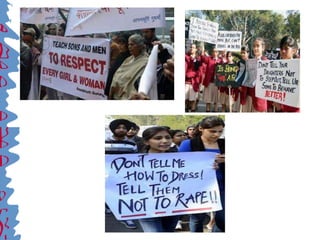
On January 24th, 2011, a representative of the Toronto Police gave shocking insight into the Force’s
view of sexual assault by stating: “women should avoid dressing like sluts in order not to be
victimized”.
India:
On 6 February 2009 in an incident of moral policing a group of men who claimed to
belong to Sri Ram Sena attacked a group of women in Mangalore, India
The Pink Chaddi Campaign (or Pink Underwear Campaign) is a nonviolent protest
movement launched by Consortium of Pub-Going, Loose and Forward Women[1] in
February 2009 in response to notable incidences of violent conservative and right-wing
activism against perceived violations of Indian culture
•Besharmi Morcha, also known as "Slutwalk arthaat Besharmi Morcha" is the Indian
equivalent of Slutwalk..
•The first Besharmi Morcha took place in Bhopal on 17 July 2011,followed by Besharmi
Morcha Delhi on 31 July 2011. Besharmi Morcha Lucknow took place on 21 Aug 2011.
•observed since in the early
1900's, a time of great
expansion and turbulence in the
industrialized world - the rise of
radical ideologies.
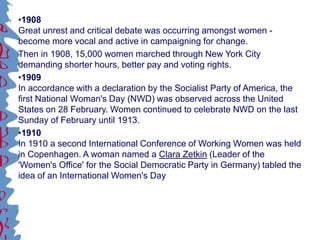
•1908
Great unrest and critical debate was occurring amongst women -
become more vocal and active in campaigning for change.
Then in 1908, 15,000 women marched through New York City
demanding shorter hours, better pay and voting rights.
•1909
In accordance with a declaration by the Socialist Party of America, the
first National Woman's Day (NWD) was observed across the United
States on 28 February. Women continued to celebrate NWD on the last
Sunday of February until 1913.
•1910
In 1910 a second International Conference of Working Women was held
in Copenhagen. A woman named a Clara Zetkin (Leader of the
'Women's Office' for the Social Democratic Party in Germany) tabled the
idea of an International Women's Day
•1913-1914
On the eve of World War I campaigning for peace, Russian women observed
their first International Women's Day on the last Sunday in February 1913.
In 1914 further women across Europe held rallies to campaign against the
war and to express women's solidarity.
•1917
On the last Sunday of February, Russian women began a strike for "bread and
peace" in response to the death over 2 million Russian soldiers in war.
Opposed by political leaders the women continued to strike until four days
later the Czar was forced to abdicate and the provisional Government granted
women the right to vote. The date the women's strike commenced was
Sunday 23 February on the Julian calendar then in use in Russia. This day on
the Gregorian calendar in use elsewhere was 8 March.
•1918 - 1999
Since its birth in the socialist movement, International Women's Day has
grown to become a global day of recognition and celebration across
developed and developing countries alike.
1975 was designated as 'International Women's Year' by the United Nations.
•Is it a movement, a theory, a fad or
a fashion statement
•You need to answer that!
FEMINISM
•Political stance, a movement – of late
much theorizing and it’s a sub discipline
– a theory
•Not coherent because different strands
– its promoting changes and changing
shapes itself.
•Through out its plurality – one obvious
and overarching goal – to end men’s
systematic domination.
•In theory –understand, explain and
challenges that domination and aim to
end it.
•Identify ways in which dominant
conception and practice of knowledge
attribution, acquisition & justification
systematically disadvantaged women &
subordinate groups & strives to reform
these conceptions
•Feminism is both an intellectual
commitment and a political movement
that seeks justice for women and the
end of sexism in all forms. However,
there are many different kinds of
feminism.
•Feminist movement has evolved –
conveniently into three broad phase
•I: Late 19th and early 20th Century- between
the two WW – also in the context of the
industrial revolution
•Early Liberal : Concern with equal rights of
women: Political & Economic
•1920 turning point: Right to Vote in US
•II : emerged 1960’s and 1970’s – post
war period – marked by much
disagreement – various strands evolved
– as Vicky Randall – a period of :Crisis
of Identity.
•III: Mid 1990’s onward – Post Modern
Feminism
•Note: Dividing into phase does not
mean that women’s voice did not exist
earlier
Women voice did exist:
Mary Astell (1666 –1731)
A Serious Proposal to the Ladies,
for the Advancement of Their True
and Greatest Interest (1694)
A Serious Proposal, Part II (1697),
Emphasized on the need for education.
women to have the same opportunity as men to spend
eternity in heaven with God, and she believed that for this
they needed to be educated and to understand their
experiences.
Astell suggests extending women's career options
beyond mother and nun.
1792- Mary Wollstonecraft – Vindication of the right of
women – insisted on the common capacity of women to
engage in rational thought
Another point in History – Seneca Fall, 1848
Catalyst for the emergence of the Suffrage movement.
•A postcard from 1913 depicts a cartoon of a girl scolding a
boy about women not being allowed to vote.
•First WW: National Women’s Party – Alice
Paul introduced militant tactics.
•National American Women’s Suffrage
Association (NAWSA) – Carrie Chapman
Catt –President and Anna Howard Shaw
carried the struggle till US 19th
Amendment, 1920, - Women right to Vote
Germany has established “Equal, universal,
secret direct franchise”, the senate has denied
equal universal suffrage to America. Which is
more of a Democracy, Germany or America?
Banner carried during picketing of the
White House, October, 23, 1918
•Second Wave Feminism
•Identity Crisis
Emergence of
Black Feminism
Marxist Feminism
Three concern:
• Patriarchy
•Private – Public dichotomy
• Sex – Gender Debate
However they are inter-related
Gerda Lerner's Views
•Historian - defines patriarchy : "the manifestation
and institutionalisation of male dominance over
women and children in the family and the extension
of male dominance
Views of Kate Millet
•Kate Millet, one of the earliest radical feminist to
use the term in the 1970s, developed on
• argues that through out history the relationship
between the sexes has been one of domination
and subordination, in which men have exercised
domination - through
a) social authority b) economic force
• patriarchy as a system - establish men's power
over women – it is not an individual phenomenon,
but is part of a structure.
•Strategies Changed – political agenda
remained the same
•Gender was recast in political theory –
by substituting power and domination
for achievement and superiority
•Translated women’s unequal role in
terms of subordination, powerlessness
and oppression
•Negative experience of women who
could not fit their gender stereotypes or
value their inferiority was not personal
–
•Was the individual to be blamed for
being women –its the political
relationship with men – calls for
consciousness raising and adult
socialisation.
•Third Wave: accepts every group
experience is unique and need to be voiced
•Takes from deconstructionist – impact on
literature, language and media
•Essence of deconstruction:
all identities are socially constructed in terms
of a discourse which reflects the perspective
and interest of the dominant group while
subordinates the rest.
•Strategy: deconstruct the discourse
while privileging ones own oppressed
identity
•Not only reveal the misogynist
agenda – masculinity – but liberate
women’s voice and experience
•Extreme standpoint:
‘Political lesbianism’- only way out –
celibacy or lesbianism.
Implication:
Some believe – its revolutionary and will
shake/change the edifice of traditional
pol.sci.
- Mistrust it as a mere ideology –
rationalising a particular interest and has
no intellectual importance ...
Each project is Essential
• First enables feminist to mobilise and
bring issues such as rape, violence into the
open and revealing the power relationship
underlying them
• Women are important
• They have been systematically
subordinated to male power and interest –
this is rooted in the sexual division of labour
within and outside the family
•Women must discover and free
themselves and abandon the rational
mode of thinking
Life on the Planet is born of Woman
Adrienne Rich

Feminism.ppt

  • 1.
    WHY On January 24th,2011, a representative of the Toronto Police gave shocking insight into the Force’s view of sexual assault by stating: “women should avoid dressing like sluts in order not to be victimized”. India: On 6 February 2009 in an incident of moral policing a group of men who claimed to belong to Sri Ram Sena attacked a group of women in Mangalore, India The Pink Chaddi Campaign (or Pink Underwear Campaign) is a nonviolent protest movement launched by Consortium of Pub-Going, Loose and Forward Women[1] in February 2009 in response to notable incidences of violent conservative and right-wing activism against perceived violations of Indian culture •Besharmi Morcha, also known as "Slutwalk arthaat Besharmi Morcha" is the Indian equivalent of Slutwalk.. •The first Besharmi Morcha took place in Bhopal on 17 July 2011,followed by Besharmi Morcha Delhi on 31 July 2011. Besharmi Morcha Lucknow took place on 21 Aug 2011.
  • 4.
    •observed since inthe early 1900's, a time of great expansion and turbulence in the industrialized world - the rise of radical ideologies.
  • 5.
    •1908 Great unrest andcritical debate was occurring amongst women - become more vocal and active in campaigning for change. Then in 1908, 15,000 women marched through New York City demanding shorter hours, better pay and voting rights. •1909 In accordance with a declaration by the Socialist Party of America, the first National Woman's Day (NWD) was observed across the United States on 28 February. Women continued to celebrate NWD on the last Sunday of February until 1913. •1910 In 1910 a second International Conference of Working Women was held in Copenhagen. A woman named a Clara Zetkin (Leader of the 'Women's Office' for the Social Democratic Party in Germany) tabled the idea of an International Women's Day
  • 6.
    •1913-1914 On the eveof World War I campaigning for peace, Russian women observed their first International Women's Day on the last Sunday in February 1913. In 1914 further women across Europe held rallies to campaign against the war and to express women's solidarity. •1917 On the last Sunday of February, Russian women began a strike for "bread and peace" in response to the death over 2 million Russian soldiers in war. Opposed by political leaders the women continued to strike until four days later the Czar was forced to abdicate and the provisional Government granted women the right to vote. The date the women's strike commenced was Sunday 23 February on the Julian calendar then in use in Russia. This day on the Gregorian calendar in use elsewhere was 8 March. •1918 - 1999 Since its birth in the socialist movement, International Women's Day has grown to become a global day of recognition and celebration across developed and developing countries alike. 1975 was designated as 'International Women's Year' by the United Nations.
  • 7.
    •Is it amovement, a theory, a fad or a fashion statement •You need to answer that!
  • 8.
    FEMINISM •Political stance, amovement – of late much theorizing and it’s a sub discipline – a theory •Not coherent because different strands – its promoting changes and changing shapes itself.
  • 9.
    •Through out itsplurality – one obvious and overarching goal – to end men’s systematic domination. •In theory –understand, explain and challenges that domination and aim to end it.
  • 10.
    •Identify ways inwhich dominant conception and practice of knowledge attribution, acquisition & justification systematically disadvantaged women & subordinate groups & strives to reform these conceptions
  • 11.
    •Feminism is bothan intellectual commitment and a political movement that seeks justice for women and the end of sexism in all forms. However, there are many different kinds of feminism.
  • 12.
    •Feminist movement hasevolved – conveniently into three broad phase •I: Late 19th and early 20th Century- between the two WW – also in the context of the industrial revolution •Early Liberal : Concern with equal rights of women: Political & Economic •1920 turning point: Right to Vote in US
  • 13.
    •II : emerged1960’s and 1970’s – post war period – marked by much disagreement – various strands evolved – as Vicky Randall – a period of :Crisis of Identity. •III: Mid 1990’s onward – Post Modern Feminism •Note: Dividing into phase does not mean that women’s voice did not exist earlier
  • 14.
    Women voice didexist: Mary Astell (1666 –1731) A Serious Proposal to the Ladies, for the Advancement of Their True and Greatest Interest (1694) A Serious Proposal, Part II (1697), Emphasized on the need for education. women to have the same opportunity as men to spend eternity in heaven with God, and she believed that for this they needed to be educated and to understand their experiences. Astell suggests extending women's career options beyond mother and nun.
  • 15.
    1792- Mary Wollstonecraft– Vindication of the right of women – insisted on the common capacity of women to engage in rational thought Another point in History – Seneca Fall, 1848 Catalyst for the emergence of the Suffrage movement.
  • 16.
    •A postcard from1913 depicts a cartoon of a girl scolding a boy about women not being allowed to vote.
  • 17.
    •First WW: NationalWomen’s Party – Alice Paul introduced militant tactics. •National American Women’s Suffrage Association (NAWSA) – Carrie Chapman Catt –President and Anna Howard Shaw carried the struggle till US 19th Amendment, 1920, - Women right to Vote
  • 18.
    Germany has established“Equal, universal, secret direct franchise”, the senate has denied equal universal suffrage to America. Which is more of a Democracy, Germany or America? Banner carried during picketing of the White House, October, 23, 1918
  • 19.
    •Second Wave Feminism •IdentityCrisis Emergence of Black Feminism Marxist Feminism
  • 20.
    Three concern: • Patriarchy •Private– Public dichotomy • Sex – Gender Debate However they are inter-related
  • 21.
    Gerda Lerner's Views •Historian- defines patriarchy : "the manifestation and institutionalisation of male dominance over women and children in the family and the extension of male dominance
  • 22.
    Views of KateMillet •Kate Millet, one of the earliest radical feminist to use the term in the 1970s, developed on • argues that through out history the relationship between the sexes has been one of domination and subordination, in which men have exercised domination - through a) social authority b) economic force • patriarchy as a system - establish men's power over women – it is not an individual phenomenon, but is part of a structure.
  • 23.
    •Strategies Changed –political agenda remained the same •Gender was recast in political theory – by substituting power and domination for achievement and superiority •Translated women’s unequal role in terms of subordination, powerlessness and oppression
  • 24.
    •Negative experience ofwomen who could not fit their gender stereotypes or value their inferiority was not personal – •Was the individual to be blamed for being women –its the political relationship with men – calls for consciousness raising and adult socialisation.
  • 25.
    •Third Wave: acceptsevery group experience is unique and need to be voiced •Takes from deconstructionist – impact on literature, language and media •Essence of deconstruction: all identities are socially constructed in terms of a discourse which reflects the perspective and interest of the dominant group while subordinates the rest.
  • 26.
    •Strategy: deconstruct thediscourse while privileging ones own oppressed identity •Not only reveal the misogynist agenda – masculinity – but liberate women’s voice and experience
  • 27.
    •Extreme standpoint: ‘Political lesbianism’-only way out – celibacy or lesbianism.
  • 28.
    Implication: Some believe –its revolutionary and will shake/change the edifice of traditional pol.sci. - Mistrust it as a mere ideology – rationalising a particular interest and has no intellectual importance ...
  • 29.
    Each project isEssential • First enables feminist to mobilise and bring issues such as rape, violence into the open and revealing the power relationship underlying them • Women are important • They have been systematically subordinated to male power and interest – this is rooted in the sexual division of labour within and outside the family
  • 30.
    •Women must discoverand free themselves and abandon the rational mode of thinking
  • 31.
    Life on thePlanet is born of Woman Adrienne Rich