Topic 1 - Introduction
To Office
Management
OFFICE
ADMINISTRATION 1
(DPK10023)
LEARNING OUTCOME
•
•
•
Carry out the key office activities in an organization
Ascertain office management in an organization
• Allocate administrative office management functions
LEARNING OUTCOME
Definition of Office
• According to Denyer: “Office is a place
where clerical operations are carried on.
It is not a mere place but a place with
various activities.”
• Mills and Standingford – The purpose of
office has been defined as the providing
of service of communication and record.
The office collects information about the
various activities of the organization
from both internal and external sources,
the structure of relationships and
responsibilities, authorities and duties by
means of which the work to be done by
the personnel and means to do it are
brought together and coordinated.
Significance of Office
• Plan its operations intelligently
• Puts its plans into effect surely
• Follow their progress currently
• Determine their effectiveness
promptly
• Appraise the results without
delay
• Coordinate all the activities
of the business
END OF
SUB-
TOPIC 1.1
Topic 1 - Introduction
To Office
Management
OFFICE
ADMINISTRATION 1
(DPK10023)
LEARNING OUTCOME
1.2 Carry out the key office activities in
an organization
Main/Key Objectives of an Office
 To plan activities of office
and ensure their execution.
 To coordinate the activities
of the various departments.
 To preserve all the records of
the business.
 To maintain books of accounts,
registers, books, statutory and
non- statutory registers, etc. of
business.
TYPES OF AN
ALTERNATIVES OFFICE
• Virtual Office
• Mobile Office
• Home Office
TYPES OF AN
ALTERNATIVES OFFICE
• Virtual Office
• The term virtual refers to a representation
of something, not something you can see
or touch.
• The virtual office is a setting that allows
you to perform work activities as you
would in a traditional office.
• Some offices employ virtual assistant.
• Virtual assistant is a worker who
performs task normally handled by a
secretary or administrative assistant
• How virtual office can benefit
organization?
TYPES OF AN
ALTERNATIVES OFFICE
• Mobile Office
• This office temporarily located at a
particular site or that can move from
place to place.
• One type of mobile office are offices set
up at construction sites and manned
by office staff.
• Another type of mobile office is the
non- territorial workspace.
• Non-territorial workspace are available on
an assignment basis. They are not
assigned to anyone permanently.
TYPES OF AN
ALTERNATIVES OFFICE
• Home Office
• A space within a person’s home that is
used
to perform office tasks.
• Many people who work in home offices
are self-employed. They also called a
freelancer.
• Freelancers may occasionally meet with
customers or clients in person, however
they may communicate primarily by e-mail,
telephone and mail.
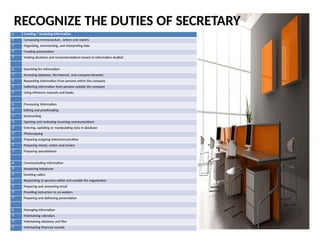
RECOGNIZE THE DUTIES OF SECRETARY
1. Creating / Analyzing Information
 Composing memorandum , letters and reports
 Organizing, summarizing, and interpreting data
 Creating presentation
 Making decisions and recommendations based on information studied
2. Searching for Information
 Accessing database, the internet, and company intranets
 Requesting information from persons within the company
 Gathering information from persons outside the company
 Using reference manuals and books
3. Processing Information
 Editing and proofreading
 Keyboarding
 Opening and reviewing incoming communications
 Entering, updating or manipulating data in database
 Photocopying
 Preparing outgoing telecommunication
 Preparing checks, orders and invoice
 Preparing spreadsheets
4. Communicating Information
 Answering telephone
 Greeting callers
 Responding to persons within and outside the organization
 Preparing and answering email
 Providing instruction to co-workers
 Preparing and delivering presentation
5. Managing information
 Maintaining calendars
 Maintaining database and files
 Maintaining financial records
THE BEHAVIORS AND ATTITUDES
NEEDED AS AN
PROFESSIONAL OFFICE
SECRETARY
• Cooperation
• Loyalty
• Continued Learning
• Confidentiality
• Sharing Information
• Accepting Responsibility
for Mistakes
THE BEHAVIORS AND ATTITUDES
NEEDED AS AN
PROFESSIONAL OFFICE
SECRETARY
• Cooperation
• The heart of a strong work ethic
is cooperativeness.
• A cooperative worker is willing to
participate in what needs to be done
to achieve a goal.
• Professional workers are cooperative
and flexible.
THE BEHAVIORS AND ATTITUDES
NEEDED AS AN
PROFESSIONAL OFFICE
SECRETARY
• Loyalty
• Professionals are loyal to the company
and to their workgroup or
department.
• Being loyal means supporting the
efforts of the company and
workgroup
• A loyal employee does not make
unfavourable remarks about the
company or work group outside
the group
THE BEHAVIORS AND ATTITUDES
NEEDED AS AN
PROFESSIONAL OFFICE
SECRETARY
• Continued Learning
• Professionals are open to change.
• Some changes may be needed to
adapt to new technology.
• As companies change, managers do not
always know what new skills each
employee needs to learn.
• As an office professional, you are
expected to show a willingness to
learn and to improve your
understanding or skills that relate to
your job.
THE BEHAVIORS AND ATTITUDES
NEEDED AS AN
PROFESSIONAL OFFICE
SECRETARY
• Confidentiality
• Professionals know how to treat
confidential information.
• Workers will want to be sure you
understand what aspects of your work
are confidential.
• Revealing confidential data may cause
harm to the company or its
employees or customers.
THE BEHAVIORS AND ATTITUDES
NEEDED AS AN
PROFESSIONAL OFFICE
SECRETARY
• Sharing information
• Professionals share information in
appropriate ways.
• Information is often shared informally
in a company.
• The informal network by which
employees share information is
sometimes called the ‘grapevine’.
• Some informal communication
can be
good.
• Employees are naturally interested in
the plans and events that affect the
company and its employees.
THE BEHAVIORS AND ATTITUDES
NEEDED AS AN
PROFESSIONAL OFFICE
SECRETARY
• Accepting Responsibility for Mistake
• People are not perfect, they
make mistake.
• Even with your best efforts,
however you will still make
mistakes.
• When you make a mistake, accept
responsibility for the error as soon as
you realize it was made.
• Apologize and take steps to correct the
error immediately so that co-workers
will not make decisions or plans based
on incorrect information.
• Learn from mistake to help avoid
making a similar error in the future.
END OF
SUB-
TOPIC 1.2
Topic 1 - Introduction
To Office
Management
OFFICE
ADMINISTRATION 1
(DPK10023)
LEARNING OUTCOME
1.3 Ascertain office management in
an organization
Definition of Office Management
 Terry : “Office Management can be defined
as a task of planning, coordinating and
motivating the efforts of others towards the
specific objectives in the office.”
 Mills & Standingford : “The art of guiding the
personnel of the office in the use of
materials, methods, machines and
equipment appropriate to their environment
in order to achieve its specified purpose.”
 Leffingwell & Robinson : “Office Management
as a function is that branch of the art and
science of management which is concerned
with efficient performance of office work,
whenever and wherever that work is done.”
Elements of Office
Management
Purpose
Means
Personnel
Environment
 Purpose - Clear cut objectives/ goals of an
organization will definitely provide proper
direction to ensure implementation on plans,
policies, programmes, and budgets.
 Means - The means are necessary in order to
carryout the various activities like filing ,
copying, records retrieval and disposal,
processing of incoming and outgoing mail,
communication and management information
system.
* The term “means” include forms, stationary,
furniture, premises, equipment's, etc as well as
methods and techniques of performing office
activities.
 Personnel - Personnel otherwise known as
human resources are a very significant part of
management.
 The office manager has to ensure
implementation of plans, and policies pertaining
to effective recruitment and selection of right
persons for the right job.
 Environment - Office environment has an
important bearing on the efficiency of
employees.
 Office environment comprises of lighting,
ventilation and temperature control ,interior
decoration ,office furniture ,security, safety
sanitary arrangements, etc.
Functions Of Management
Planning
Organizing
Staffing
Coordinating
Directing
Controlling
Budgeting
 Planning
- It is first and foremost function of office
management.
- In the words, “planning is deciding in
advance what is to- be done”.
- It involves the selection of objectives,
policies, producers and programmes for
“
attaining enterprise goals.
 Organizing
- It involves the establishment of an
organisation structure through
determination and grouping of activities, the
assignment of activities to the specific
departments and individuals, defining role
and establishing relationships, the
delegation of authority.
 Staffing
- Staffing is an executive function which
involves the recruitment, selection,
training, placement, compensating
promotion and demotion and finally the
retirement of an employee.
- The aim of staffing is to take the right
man for the right job.
 Coordinating
- The process of coordination involves
synchronising individual actions with the
goals of the enterprise.
- The best coordination occur when
individuals see how their jobs contribute
to the dominant goals of the enterprise.
 Directing
• Directing means moving to action and supplying
simulative power of group of people
• It imparts instructions, communicates their
orders, rules and decisions; motivates, provides
leadership and guidance, supervises their work
and behavior, and inspires them towards
improved performance.
 Controlling
• In an undertaking control consists in verifying
whether everything occurs in conformity with
the plan adopted, the instruction issued and
principles issued.
• It measures performance against goals and
plans.
 Budgeting
• A budget is an estimate of income and
expenditure for a define period, expressed
in terms of numerical units.
• Budgeting is required prior to carrying out
office operation
• It is impossible to see into the future,
forecasting is based on the past event and
the estimating of likely trends arising out
of these events
LEARNING OUTCOME
1.4 Allocate administrative office management
functions
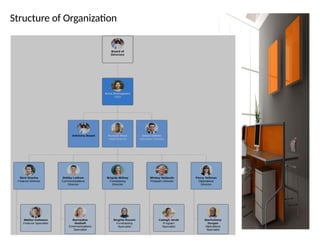
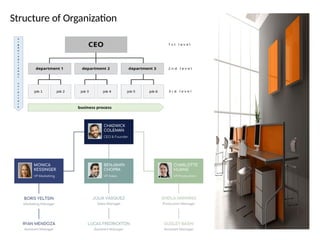
• Different types of employees work at
various levels in companies.
• Employees must know who is responsible
for each activity and know what authority
each person has.
• Knowing how a company is structured will
give you a better understanding of how it
operates.
• Many companies prepare a chart that
shows positions in order of rank of
authority.
Structure of Organization
 Board of Director
• Many large corporations have boards of directors.
Publicly owned corporations must have such boards.
• Owners (shareholders) elect members of the board
of directors.
• The board sets the policies that guide senior
managers in directing the company.
• Generally, some senior managers of the company
are board members.
• Some members of the board of directors are not
employees of the company.
• These directors are expected to provide guidance
and make decisions that will serve the company's
best interests.
Structure of Organization
 Management Employees
i. Senior Management
- Persons who give direction in carrying out the policies
of the board of directors are called senior managers or
top management.
- The CEO, the president, the chief operating officer
(COO), and the chief financial officer (CFO) are
generally included in this group.
ii. Middle management
- Managers who direct the daily activities of a company
are called middle management.
Structure of Organization
 Department Employees
 In many companies, employees are organized in
departments or teams that relate to the functions of
the company.
 These functions may include finance and accounting,
communications, sales and marketing, information
technology, legal services, and human resources.
 The size of the company influences the types of
workers needed.
 In a small company, a single person may perform
several functions.
 In a large company, one person probably would not
have the range of duties and authority that is common
in a small company.
Effective Management Techniques
Set a goals and clear directions
Delegate work and responsibilities
Encourage employees
Recognize problem
Reward employees
Be mentor
Give review
Be kind and tolerate
Managing change
Listen to your employees
Effective Management Techniques
Set a goals and clear directions
- Define your organization goals
- Make a list for all the different
things that need to be done along
with the action’s employees must
take
- Without defining and enforcing
the organization goals, there is no
clear direction of what everyone
should be working towards.
Effective Management Techniques
Delegate work and responsibilities
- The workload has to be shared
with others.
- Delegates work and
responsibilities according to
employee’s strength or weakness
- Let employees to develop their
own good work habits and
leadership skills.
Effective Management Techniques
Encourage employees
- Setting deadlines and goals helps
employees to keep focused, and
busy and motivates them to do
their work.
- Each employee has to be talked
about the company’s goals and
work individual goals directly
linked with organization goals.
Effective Management Techniques
Recognize problems
- The manager should know about
personality conflicts, lagging
productivity or other problems
occurs in organization.
- The manager should stay tuned
to their employees to ensure that
all the problems can be solve
immediately before they escalate.
Effective Management Techniques
Reward Employees
- Rewards employees such as
increase their monthly salary,
giving bonus, or recognition
- Do it in front other employees to
motivate them to perform better
in the future
Effective Management Techniques
Be a Mentor
- Manager should set an example
in terms of behavior
- One of the greatest gifts to
employees is sharing his/her
(manager) knowledge and
experience
- Showing employees how to do it
is more effective than just talking
through it.
Effective Management Techniques
Give Review
- Employees need feedback about
their performance to improve
their skills and grow
professionally.
- A formal review program has to
be setup and performance
appraisal are given once or twice
a year
Effective Management Techniques
Be Kind and Tolerate
- Family emergencies, illnesses and
other unexpected events always
arise among employees, so
manager must get used to it.
- Manager should show employees
some consideration by being
more flexible with work hours
and time off, so that employees
can tend to solve their
emergencies
Effective Management Techniques
Managing Change
- The internet and information
technology have changed the
structure of many businesses.
- To help employees go through
transition, manager should take a
proactive role in managing and
communicating change among
their staff.
Effective Management Techniques
Listen to your employees
- Manager can encourage
employees to provide feedback
through email or the company
internet.
- This shows them that they care
about employee’s feedback to
show their thoughts and opinion
- It will also make employees feel
appreciated and acknowledge
END OF TOPIC
1

Chapter 1_Introduction to office Management (1).pptx

  • 1.
    Topic 1 -Introduction To Office Management OFFICE ADMINISTRATION 1 (DPK10023)
  • 2.
    LEARNING OUTCOME • • • Carry outthe key office activities in an organization Ascertain office management in an organization • Allocate administrative office management functions
  • 3.
  • 4.
    Definition of Office •According to Denyer: “Office is a place where clerical operations are carried on. It is not a mere place but a place with various activities.” • Mills and Standingford – The purpose of office has been defined as the providing of service of communication and record. The office collects information about the various activities of the organization from both internal and external sources, the structure of relationships and responsibilities, authorities and duties by means of which the work to be done by the personnel and means to do it are brought together and coordinated.
  • 5.
    Significance of Office •Plan its operations intelligently • Puts its plans into effect surely • Follow their progress currently • Determine their effectiveness promptly • Appraise the results without delay • Coordinate all the activities of the business
  • 6.
  • 7.
    Topic 1 -Introduction To Office Management OFFICE ADMINISTRATION 1 (DPK10023)
  • 8.
    LEARNING OUTCOME 1.2 Carryout the key office activities in an organization
  • 9.
    Main/Key Objectives ofan Office  To plan activities of office and ensure their execution.  To coordinate the activities of the various departments.  To preserve all the records of the business.  To maintain books of accounts, registers, books, statutory and non- statutory registers, etc. of business.
  • 10.
    TYPES OF AN ALTERNATIVESOFFICE • Virtual Office • Mobile Office • Home Office
  • 11.
    TYPES OF AN ALTERNATIVESOFFICE • Virtual Office • The term virtual refers to a representation of something, not something you can see or touch. • The virtual office is a setting that allows you to perform work activities as you would in a traditional office. • Some offices employ virtual assistant. • Virtual assistant is a worker who performs task normally handled by a secretary or administrative assistant • How virtual office can benefit organization?
  • 12.
    TYPES OF AN ALTERNATIVESOFFICE • Mobile Office • This office temporarily located at a particular site or that can move from place to place. • One type of mobile office are offices set up at construction sites and manned by office staff. • Another type of mobile office is the non- territorial workspace. • Non-territorial workspace are available on an assignment basis. They are not assigned to anyone permanently.
  • 13.
    TYPES OF AN ALTERNATIVESOFFICE • Home Office • A space within a person’s home that is used to perform office tasks. • Many people who work in home offices are self-employed. They also called a freelancer. • Freelancers may occasionally meet with customers or clients in person, however they may communicate primarily by e-mail, telephone and mail.
  • 14.
    RECOGNIZE THE DUTIESOF SECRETARY 1. Creating / Analyzing Information  Composing memorandum , letters and reports  Organizing, summarizing, and interpreting data  Creating presentation  Making decisions and recommendations based on information studied 2. Searching for Information  Accessing database, the internet, and company intranets  Requesting information from persons within the company  Gathering information from persons outside the company  Using reference manuals and books 3. Processing Information  Editing and proofreading  Keyboarding  Opening and reviewing incoming communications  Entering, updating or manipulating data in database  Photocopying  Preparing outgoing telecommunication  Preparing checks, orders and invoice  Preparing spreadsheets 4. Communicating Information  Answering telephone  Greeting callers  Responding to persons within and outside the organization  Preparing and answering email  Providing instruction to co-workers  Preparing and delivering presentation 5. Managing information  Maintaining calendars  Maintaining database and files  Maintaining financial records
  • 15.
    THE BEHAVIORS ANDATTITUDES NEEDED AS AN PROFESSIONAL OFFICE SECRETARY • Cooperation • Loyalty • Continued Learning • Confidentiality • Sharing Information • Accepting Responsibility for Mistakes
  • 16.
    THE BEHAVIORS ANDATTITUDES NEEDED AS AN PROFESSIONAL OFFICE SECRETARY • Cooperation • The heart of a strong work ethic is cooperativeness. • A cooperative worker is willing to participate in what needs to be done to achieve a goal. • Professional workers are cooperative and flexible.
  • 17.
    THE BEHAVIORS ANDATTITUDES NEEDED AS AN PROFESSIONAL OFFICE SECRETARY • Loyalty • Professionals are loyal to the company and to their workgroup or department. • Being loyal means supporting the efforts of the company and workgroup • A loyal employee does not make unfavourable remarks about the company or work group outside the group
  • 18.
    THE BEHAVIORS ANDATTITUDES NEEDED AS AN PROFESSIONAL OFFICE SECRETARY • Continued Learning • Professionals are open to change. • Some changes may be needed to adapt to new technology. • As companies change, managers do not always know what new skills each employee needs to learn. • As an office professional, you are expected to show a willingness to learn and to improve your understanding or skills that relate to your job.
  • 19.
    THE BEHAVIORS ANDATTITUDES NEEDED AS AN PROFESSIONAL OFFICE SECRETARY • Confidentiality • Professionals know how to treat confidential information. • Workers will want to be sure you understand what aspects of your work are confidential. • Revealing confidential data may cause harm to the company or its employees or customers.
  • 20.
    THE BEHAVIORS ANDATTITUDES NEEDED AS AN PROFESSIONAL OFFICE SECRETARY • Sharing information • Professionals share information in appropriate ways. • Information is often shared informally in a company. • The informal network by which employees share information is sometimes called the ‘grapevine’. • Some informal communication can be good. • Employees are naturally interested in the plans and events that affect the company and its employees.
  • 21.
    THE BEHAVIORS ANDATTITUDES NEEDED AS AN PROFESSIONAL OFFICE SECRETARY • Accepting Responsibility for Mistake • People are not perfect, they make mistake. • Even with your best efforts, however you will still make mistakes. • When you make a mistake, accept responsibility for the error as soon as you realize it was made. • Apologize and take steps to correct the error immediately so that co-workers will not make decisions or plans based on incorrect information. • Learn from mistake to help avoid making a similar error in the future.
  • 22.
  • 23.
    Topic 1 -Introduction To Office Management OFFICE ADMINISTRATION 1 (DPK10023)
  • 24.
    LEARNING OUTCOME 1.3 Ascertainoffice management in an organization
  • 25.
    Definition of OfficeManagement  Terry : “Office Management can be defined as a task of planning, coordinating and motivating the efforts of others towards the specific objectives in the office.”  Mills & Standingford : “The art of guiding the personnel of the office in the use of materials, methods, machines and equipment appropriate to their environment in order to achieve its specified purpose.”  Leffingwell & Robinson : “Office Management as a function is that branch of the art and science of management which is concerned with efficient performance of office work, whenever and wherever that work is done.”
  • 26.
  • 27.
     Purpose -Clear cut objectives/ goals of an organization will definitely provide proper direction to ensure implementation on plans, policies, programmes, and budgets.  Means - The means are necessary in order to carryout the various activities like filing , copying, records retrieval and disposal, processing of incoming and outgoing mail, communication and management information system. * The term “means” include forms, stationary, furniture, premises, equipment's, etc as well as methods and techniques of performing office activities.
  • 28.
     Personnel -Personnel otherwise known as human resources are a very significant part of management.  The office manager has to ensure implementation of plans, and policies pertaining to effective recruitment and selection of right persons for the right job.  Environment - Office environment has an important bearing on the efficiency of employees.  Office environment comprises of lighting, ventilation and temperature control ,interior decoration ,office furniture ,security, safety sanitary arrangements, etc.
  • 29.
  • 30.
     Planning - Itis first and foremost function of office management. - In the words, “planning is deciding in advance what is to- be done”. - It involves the selection of objectives, policies, producers and programmes for “ attaining enterprise goals.  Organizing - It involves the establishment of an organisation structure through determination and grouping of activities, the assignment of activities to the specific departments and individuals, defining role and establishing relationships, the delegation of authority.
  • 31.
     Staffing - Staffingis an executive function which involves the recruitment, selection, training, placement, compensating promotion and demotion and finally the retirement of an employee. - The aim of staffing is to take the right man for the right job.  Coordinating - The process of coordination involves synchronising individual actions with the goals of the enterprise. - The best coordination occur when individuals see how their jobs contribute to the dominant goals of the enterprise.
  • 32.
     Directing • Directingmeans moving to action and supplying simulative power of group of people • It imparts instructions, communicates their orders, rules and decisions; motivates, provides leadership and guidance, supervises their work and behavior, and inspires them towards improved performance.  Controlling • In an undertaking control consists in verifying whether everything occurs in conformity with the plan adopted, the instruction issued and principles issued. • It measures performance against goals and plans.
  • 33.
     Budgeting • Abudget is an estimate of income and expenditure for a define period, expressed in terms of numerical units. • Budgeting is required prior to carrying out office operation • It is impossible to see into the future, forecasting is based on the past event and the estimating of likely trends arising out of these events
  • 34.
    LEARNING OUTCOME 1.4 Allocateadministrative office management functions
  • 35.
    • Different typesof employees work at various levels in companies. • Employees must know who is responsible for each activity and know what authority each person has. • Knowing how a company is structured will give you a better understanding of how it operates. • Many companies prepare a chart that shows positions in order of rank of authority. Structure of Organization
  • 36.
  • 37.
  • 38.
    Structure of Organization Board of Director • Many large corporations have boards of directors. Publicly owned corporations must have such boards. • Owners (shareholders) elect members of the board of directors. • The board sets the policies that guide senior managers in directing the company. • Generally, some senior managers of the company are board members. • Some members of the board of directors are not employees of the company. • These directors are expected to provide guidance and make decisions that will serve the company's best interests.
  • 39.
    Structure of Organization Management Employees i. Senior Management - Persons who give direction in carrying out the policies of the board of directors are called senior managers or top management. - The CEO, the president, the chief operating officer (COO), and the chief financial officer (CFO) are generally included in this group. ii. Middle management - Managers who direct the daily activities of a company are called middle management.
  • 40.
    Structure of Organization Department Employees  In many companies, employees are organized in departments or teams that relate to the functions of the company.  These functions may include finance and accounting, communications, sales and marketing, information technology, legal services, and human resources.  The size of the company influences the types of workers needed.  In a small company, a single person may perform several functions.  In a large company, one person probably would not have the range of duties and authority that is common in a small company.
  • 41.
    Effective Management Techniques Seta goals and clear directions Delegate work and responsibilities Encourage employees Recognize problem Reward employees Be mentor Give review Be kind and tolerate Managing change Listen to your employees
  • 42.
    Effective Management Techniques Seta goals and clear directions - Define your organization goals - Make a list for all the different things that need to be done along with the action’s employees must take - Without defining and enforcing the organization goals, there is no clear direction of what everyone should be working towards.
  • 43.
    Effective Management Techniques Delegatework and responsibilities - The workload has to be shared with others. - Delegates work and responsibilities according to employee’s strength or weakness - Let employees to develop their own good work habits and leadership skills.
  • 44.
    Effective Management Techniques Encourageemployees - Setting deadlines and goals helps employees to keep focused, and busy and motivates them to do their work. - Each employee has to be talked about the company’s goals and work individual goals directly linked with organization goals.
  • 45.
    Effective Management Techniques Recognizeproblems - The manager should know about personality conflicts, lagging productivity or other problems occurs in organization. - The manager should stay tuned to their employees to ensure that all the problems can be solve immediately before they escalate.
  • 46.
    Effective Management Techniques RewardEmployees - Rewards employees such as increase their monthly salary, giving bonus, or recognition - Do it in front other employees to motivate them to perform better in the future
  • 47.
    Effective Management Techniques Bea Mentor - Manager should set an example in terms of behavior - One of the greatest gifts to employees is sharing his/her (manager) knowledge and experience - Showing employees how to do it is more effective than just talking through it.
  • 48.
    Effective Management Techniques GiveReview - Employees need feedback about their performance to improve their skills and grow professionally. - A formal review program has to be setup and performance appraisal are given once or twice a year
  • 49.
    Effective Management Techniques BeKind and Tolerate - Family emergencies, illnesses and other unexpected events always arise among employees, so manager must get used to it. - Manager should show employees some consideration by being more flexible with work hours and time off, so that employees can tend to solve their emergencies
  • 50.
    Effective Management Techniques ManagingChange - The internet and information technology have changed the structure of many businesses. - To help employees go through transition, manager should take a proactive role in managing and communicating change among their staff.
  • 51.
    Effective Management Techniques Listento your employees - Manager can encourage employees to provide feedback through email or the company internet. - This shows them that they care about employee’s feedback to show their thoughts and opinion - It will also make employees feel appreciated and acknowledge
  • 52.