ZABEEL
MANAGEMENT
ACADEMY
Certified
EXECUTIVE Secretary
/ Administrator
UNITED ARAB EMIRATES
MINISTRY OF EDUCATION
PROFESSIONAL
EXECUTIVE SECRETARY
OFFICE ADMINISTRATOR
EXECUTIVE Secretary – INTRODUCTion:
Operational and Business management is growing exponentially and there are high demand for multitalented
secretaries with expertise in a range of skills.
Definition
“ A secretary shall be defined as an executive assistant who possesses a mastery of office skills, demonstrates the
ability to assume responsibility without direct supervision, exercises initiative and judgment, and make decisions
within the scope of assigned authority”
(Webster’s new world Secretarial handbook, Prentice-Hall, New York,1989,p.4)
Learning from a well reputed institute, is what every executive desires. The Executive Secretary/Administrator
Training Course offered by Zabeel Institute ensures that our students gain expertise practical and theoretical
knowledge, along with efficient administration and secretarial skills, which helps them to be successful in any
industry, thereby increasing their career opportunities.
COURSE Objective
The Objective Of the course is to provides a comprehensive education and enhance the knowledge of those
candidates who are in general administration, projects , secretaries etc. By completing the Professional execu-
tive Secretary course, students will understand:
Duties of administrative assistant, time management, Scheduling appointments, Organizational structure,
Minutes, Memorandums, Improve office efficiency, handle office stress, handle work related problems, Oral
communication, mail processing, understanding the technologies in the office, record management, plan for
meetings, Conferences, supporting your Manager, Diary Management, Streamlining the office, business skills
Communication & business writing skills, Office Administration.
Certification Benefits
A professional certification shows employers, clients and associates that you are committed as a professional
and that you have an internationally recognized mark of excellence.
• Capability to assume greater responsibility • Recognition and respect from employers & peers
• Career advancement • Potential pay and bonus increases
• Increase in confidence and self-esteem • Greater assurance of employability
COURSE Coverage
MODULE 1: ExeCUTIVE Secretary
Level 1 ExeCUTIVE Secretary/Office Administrator (18 Hrs.)
1: Office Management 2: Skills for Administrative Assistants
3: Business Documentation Skills 4: Business Correspondence
Level 2 Advanced Management Skills for Executive Secretaries/Office Administrators (12 Hrs.)
1. Organizational Planning 2. Advanced Communication
3. Advanced Administration 4. Team Skills
MODULE 2: E-Office for EXECUTIVES.
MODULE 3: DOCUMent Control.
Other COURSES SUITable for ExeCUTIVE Secretaries:-
 Shorthand  Business English
 Financial Accounting  Presentation Skills for Executives
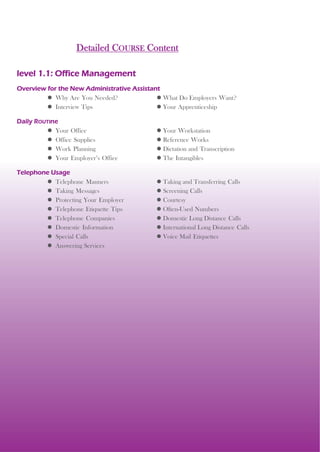
Detailed COURSE Content
level 1.1: Office Management
Overview for the New Administrative Assistant
 Why Are You Needed?  What Do Employers Want?
 Interview Tips  Your Apprenticeship
Daily ROUTIne
 Your Office  Your Workstation
 Office Supplies  Reference Works
 Work Planning  Dictation and Transcription
 Your Employer’s Office  The Intangibles
Telephone Usage
 Telephone Manners  Taking and Transferring Calls
 Taking Messages  Screening Calls
 Protecting Your Employer  Courtesy
 Telephone Etiquette Tips  Often-Used Numbers
 Telephone Companies  Domestic Long Distance Calls
 Domestic Information  International Long Distance Calls
 Special Calls  Voice Mail Etiquettes
 Answering Services
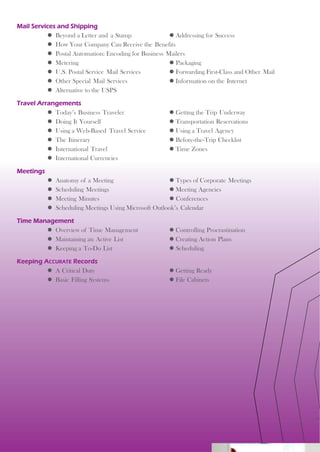
Mail Services and Shipping
 Beyond a Letter and a Stamp  Addressing for Success
 How Your Company Can Receive the Benefits
 Postal Automation: Encoding for Business Mailers
 Metering  Packaging
 U.S. Postal Service Mail Services  Forwarding First-Class and Other Mail
 Other Special Mail Services  Information on the Internet
 Alternative to the USPS
Travel Arrangements
 Today’s Business Traveler  Getting the Trip Underway
 Doing It Yourself  Transportation Reservations
 Using a Web-Based Travel Service  Using a Travel Agency
 The Itinerary  Before-the-Trip Checklist
 International Travel  Time Zones
 International Currencies
Meetings
 Anatomy of a Meeting  Types of Corporate Meetings
 Scheduling Meetings  Meeting Agencies
 Meeting Minutes  Conferences
 Scheduling Meetings Using Microsoft Outlook’s Calendar
Time Management
 Overview of Time Management  Controlling Procrastination
 Maintaining an Active List  Creating Action Plans
 Keeping a To-Do List  Scheduling
Keeping ACCURATE Records
 A Critical Duty  Getting Ready
 Basic Filling Systems  File Cabinets
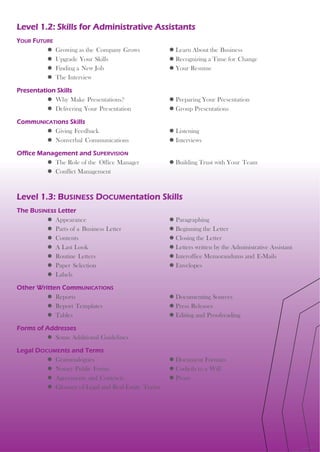
Level 1.2: Skills for Administrative Assistants
YOUR FUTURE
 Growing as the Company Grows  Learn About the Business
 Upgrade Your Skills  Recognizing a Time for Change
 Finding a New Job  Your Resume
 The Interview
Presentation Skills
 Why Make Presentations?  Preparing Your Presentation
 Delivering Your Presentation  Group Presentations
CommUNICATIons Skills
 Giving Feedback  Listening
 Nonverbal Communications  Interviews
Office Management and SUPERVISION
 The Role of the Office Manager  Building Trust with Your Team
 Conflict Management
Level 1.3: BUSINESS DOCUMentation Skills
The BUSINEss Letter
 Appearance  Paragraphing
 Parts of a Business Letter  Beginning the Letter
 Contents  Closing the Letter
 A Last Look  Letters written by the Administrative Assistant
 Routine Letters  Interoffice Memorandums and E-Mails
 Paper Selection  Envelopes
 Labels
Other Written CommUNICATIONS
 Reports  Documenting Sources
 Report Templates  Press Releases
 Tables  Editing and Proofreading
Forms of Addresses
 Some Additional Guidelines
Legal DOCUMEnts and Terms
 Grammalogues  Document Formats
 Notary Public Forms  Codicils to a Will
 Agreements and Contracts  Proxy
 Glossary of Legal and Real Estate Terms
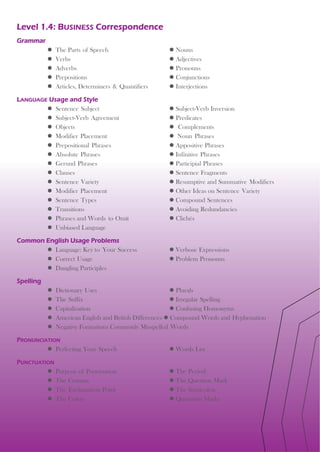
Level 1.4: BUSINESS Correspondence
Grammar
 The Parts of Speech  Nouns
 Verbs  Adjectives
 Adverbs  Pronouns
 Prepositions  Conjunctions
 Articles, Determiners & Quantifiers  Interjections
LANGUAGE Usage and Style
 Sentence Subject  Subject-Verb Inversion
 Subject-Verb Agreement  Predicates
 Objects  Complements
 Modifier Placement  Noun Phrases
 Prepositional Phrases  Appositive Phrases
 Absolute Phrases  Infinitive Phrases
 Gerund Phrases  Participial Phrases
 Clauses  Sentence Fragments
 Sentence Variety  Resumptive and Summative Modifiers
 Modifier Placement  Other Ideas on Sentence Variety
 Sentence Types  Compound Sentences
 Transitions  Avoiding Redundancies
 Phrases and Words to Omit  Clichés
 Unbiased Language
Common English Usage Problems
 Language: Key to Your Success  Verbose Expressions
 Correct Usage  Problem Pronouns
 Dangling Participles
Spelling
 Dictionary Uses  Plurals
 The Suffix  Irregular Spelling
 Capitalization  Confusing Homonyms
 American English and British Differences  Compound Words and Hyphenation
 Negative Formations Commonly Misspelled Words
PRONUNCIATION
 Perfecting Your Speech  Words List
PUNCTUATION
 Purpose of Punctuation  The Period
 The Comma  The Question Mark
 The Exclamation Point  The Semicolon
 The Colon  Quotation Marks
NUMerals
 Italics  The Apostrophe
 The Dash  Ellipses
 Parentheses  Brackets
 The Hyphen  The Slash
 Words or Figures?  Dollars and Cents
 Time  Dates
 The Hyphen  Ages
 Dimensions  Weights and Measures
 Percentages  Page Numbering
 The Abbreviation for Number  Plurals of Numbers
 Roman Numerals
Level 2: Advanced Management Skills for EXECUTIVE Secretaries/Office Administrator
Level 2.1: Organizational Planning
 Critical thinking and decision making  Strategic planning
 Communicating mission and values  Allocating resources
Level 2.2: Advanced CommUNICATION
 Nonverbal  Presentation techniques
 Legal issues  Professional protocol
Level 2.3: Advanced Administration
 Mentoring and training  Conducting research
 Coordinating projects  Delegating and empowering
Level 2.4: Team Skills
 Team building and leading  Group problem solving
 Resolving conflict  Conducting meetings
MODULE 2: E-Office for EXECUTIVE Secretary
 Keyboard Speed Development
 Advanced MS Word (Text Production, Word Processing and Graphics)
 Advanced MS Excel (Spreadsheets, Charts and Graphics)
 Microsoft PowerPoint (Computerized Presentations)
 Disk and file management (Microsoft Windows)
 Usage of Internet
 E-mail using Microsoft Outlook
Effective utilization of Microsoft Office Applications in a modern office.
Desk Top Information Management using Microsoft Outlook 2003.
PC Hardware familiarization, Local Area Networking & Internet sharing techniques.
Trouble shooting of common errors in Windows and applications.
Do it your self / Data back up solutions / Live assignments.
MODULE 3: DOCUMENT Control
Storage: Where will we keep our documents? How much can we spend to store them?
Retrieval: How can people find needed documents? How much time can be spent looking for them?
What technology options are available for retrieval?
Filling: How do we organize our documents? How do we ensure documents are filed appropriately?
Storage: How do we protect against the loss, tampering or destruction of documents? How do we keep
sensitive information hidden?
DISTRIBUTION: How do we get documents into the hands of people who need them? How much can we
spend to distribute the documents?
OUR Accreditations:
UNITED ARAB EMIRATES
MINISTRY OF EDUCATION

Executive Secretary Training Course in Dubai

  • 1.
  • 2.
    PROFESSIONAL EXECUTIVE SECRETARY OFFICE ADMINISTRATOR EXECUTIVESecretary – INTRODUCTion: Operational and Business management is growing exponentially and there are high demand for multitalented secretaries with expertise in a range of skills. Definition “ A secretary shall be defined as an executive assistant who possesses a mastery of office skills, demonstrates the ability to assume responsibility without direct supervision, exercises initiative and judgment, and make decisions within the scope of assigned authority” (Webster’s new world Secretarial handbook, Prentice-Hall, New York,1989,p.4) Learning from a well reputed institute, is what every executive desires. The Executive Secretary/Administrator Training Course offered by Zabeel Institute ensures that our students gain expertise practical and theoretical knowledge, along with efficient administration and secretarial skills, which helps them to be successful in any industry, thereby increasing their career opportunities. COURSE Objective The Objective Of the course is to provides a comprehensive education and enhance the knowledge of those candidates who are in general administration, projects , secretaries etc. By completing the Professional execu- tive Secretary course, students will understand: Duties of administrative assistant, time management, Scheduling appointments, Organizational structure, Minutes, Memorandums, Improve office efficiency, handle office stress, handle work related problems, Oral communication, mail processing, understanding the technologies in the office, record management, plan for meetings, Conferences, supporting your Manager, Diary Management, Streamlining the office, business skills Communication & business writing skills, Office Administration. Certification Benefits A professional certification shows employers, clients and associates that you are committed as a professional and that you have an internationally recognized mark of excellence. • Capability to assume greater responsibility • Recognition and respect from employers & peers • Career advancement • Potential pay and bonus increases • Increase in confidence and self-esteem • Greater assurance of employability
  • 3.
    COURSE Coverage MODULE 1:ExeCUTIVE Secretary Level 1 ExeCUTIVE Secretary/Office Administrator (18 Hrs.) 1: Office Management 2: Skills for Administrative Assistants 3: Business Documentation Skills 4: Business Correspondence Level 2 Advanced Management Skills for Executive Secretaries/Office Administrators (12 Hrs.) 1. Organizational Planning 2. Advanced Communication 3. Advanced Administration 4. Team Skills MODULE 2: E-Office for EXECUTIVES. MODULE 3: DOCUMent Control. Other COURSES SUITable for ExeCUTIVE Secretaries:-  Shorthand  Business English  Financial Accounting  Presentation Skills for Executives
  • 4.
    Detailed COURSE Content level1.1: Office Management Overview for the New Administrative Assistant  Why Are You Needed?  What Do Employers Want?  Interview Tips  Your Apprenticeship Daily ROUTIne  Your Office  Your Workstation  Office Supplies  Reference Works  Work Planning  Dictation and Transcription  Your Employer’s Office  The Intangibles Telephone Usage  Telephone Manners  Taking and Transferring Calls  Taking Messages  Screening Calls  Protecting Your Employer  Courtesy  Telephone Etiquette Tips  Often-Used Numbers  Telephone Companies  Domestic Long Distance Calls  Domestic Information  International Long Distance Calls  Special Calls  Voice Mail Etiquettes  Answering Services
  • 5.
    Mail Services andShipping  Beyond a Letter and a Stamp  Addressing for Success  How Your Company Can Receive the Benefits  Postal Automation: Encoding for Business Mailers  Metering  Packaging  U.S. Postal Service Mail Services  Forwarding First-Class and Other Mail  Other Special Mail Services  Information on the Internet  Alternative to the USPS Travel Arrangements  Today’s Business Traveler  Getting the Trip Underway  Doing It Yourself  Transportation Reservations  Using a Web-Based Travel Service  Using a Travel Agency  The Itinerary  Before-the-Trip Checklist  International Travel  Time Zones  International Currencies Meetings  Anatomy of a Meeting  Types of Corporate Meetings  Scheduling Meetings  Meeting Agencies  Meeting Minutes  Conferences  Scheduling Meetings Using Microsoft Outlook’s Calendar Time Management  Overview of Time Management  Controlling Procrastination  Maintaining an Active List  Creating Action Plans  Keeping a To-Do List  Scheduling Keeping ACCURATE Records  A Critical Duty  Getting Ready  Basic Filling Systems  File Cabinets
  • 6.
    Level 1.2: Skillsfor Administrative Assistants YOUR FUTURE  Growing as the Company Grows  Learn About the Business  Upgrade Your Skills  Recognizing a Time for Change  Finding a New Job  Your Resume  The Interview Presentation Skills  Why Make Presentations?  Preparing Your Presentation  Delivering Your Presentation  Group Presentations CommUNICATIons Skills  Giving Feedback  Listening  Nonverbal Communications  Interviews Office Management and SUPERVISION  The Role of the Office Manager  Building Trust with Your Team  Conflict Management Level 1.3: BUSINESS DOCUMentation Skills The BUSINEss Letter  Appearance  Paragraphing  Parts of a Business Letter  Beginning the Letter  Contents  Closing the Letter  A Last Look  Letters written by the Administrative Assistant  Routine Letters  Interoffice Memorandums and E-Mails  Paper Selection  Envelopes  Labels Other Written CommUNICATIONS  Reports  Documenting Sources  Report Templates  Press Releases  Tables  Editing and Proofreading Forms of Addresses  Some Additional Guidelines Legal DOCUMEnts and Terms  Grammalogues  Document Formats  Notary Public Forms  Codicils to a Will  Agreements and Contracts  Proxy  Glossary of Legal and Real Estate Terms
  • 7.
    Level 1.4: BUSINESSCorrespondence Grammar  The Parts of Speech  Nouns  Verbs  Adjectives  Adverbs  Pronouns  Prepositions  Conjunctions  Articles, Determiners & Quantifiers  Interjections LANGUAGE Usage and Style  Sentence Subject  Subject-Verb Inversion  Subject-Verb Agreement  Predicates  Objects  Complements  Modifier Placement  Noun Phrases  Prepositional Phrases  Appositive Phrases  Absolute Phrases  Infinitive Phrases  Gerund Phrases  Participial Phrases  Clauses  Sentence Fragments  Sentence Variety  Resumptive and Summative Modifiers  Modifier Placement  Other Ideas on Sentence Variety  Sentence Types  Compound Sentences  Transitions  Avoiding Redundancies  Phrases and Words to Omit  Clichés  Unbiased Language Common English Usage Problems  Language: Key to Your Success  Verbose Expressions  Correct Usage  Problem Pronouns  Dangling Participles Spelling  Dictionary Uses  Plurals  The Suffix  Irregular Spelling  Capitalization  Confusing Homonyms  American English and British Differences  Compound Words and Hyphenation  Negative Formations Commonly Misspelled Words PRONUNCIATION  Perfecting Your Speech  Words List PUNCTUATION  Purpose of Punctuation  The Period  The Comma  The Question Mark  The Exclamation Point  The Semicolon  The Colon  Quotation Marks
  • 8.
    NUMerals  Italics The Apostrophe  The Dash  Ellipses  Parentheses  Brackets  The Hyphen  The Slash  Words or Figures?  Dollars and Cents  Time  Dates  The Hyphen  Ages  Dimensions  Weights and Measures  Percentages  Page Numbering  The Abbreviation for Number  Plurals of Numbers  Roman Numerals Level 2: Advanced Management Skills for EXECUTIVE Secretaries/Office Administrator Level 2.1: Organizational Planning  Critical thinking and decision making  Strategic planning  Communicating mission and values  Allocating resources Level 2.2: Advanced CommUNICATION  Nonverbal  Presentation techniques  Legal issues  Professional protocol Level 2.3: Advanced Administration  Mentoring and training  Conducting research  Coordinating projects  Delegating and empowering Level 2.4: Team Skills  Team building and leading  Group problem solving  Resolving conflict  Conducting meetings MODULE 2: E-Office for EXECUTIVE Secretary  Keyboard Speed Development  Advanced MS Word (Text Production, Word Processing and Graphics)  Advanced MS Excel (Spreadsheets, Charts and Graphics)  Microsoft PowerPoint (Computerized Presentations)  Disk and file management (Microsoft Windows)  Usage of Internet  E-mail using Microsoft Outlook
  • 9.
    Effective utilization ofMicrosoft Office Applications in a modern office. Desk Top Information Management using Microsoft Outlook 2003. PC Hardware familiarization, Local Area Networking & Internet sharing techniques. Trouble shooting of common errors in Windows and applications. Do it your self / Data back up solutions / Live assignments. MODULE 3: DOCUMENT Control Storage: Where will we keep our documents? How much can we spend to store them? Retrieval: How can people find needed documents? How much time can be spent looking for them? What technology options are available for retrieval? Filling: How do we organize our documents? How do we ensure documents are filed appropriately? Storage: How do we protect against the loss, tampering or destruction of documents? How do we keep sensitive information hidden? DISTRIBUTION: How do we get documents into the hands of people who need them? How much can we spend to distribute the documents? OUR Accreditations: UNITED ARAB EMIRATES MINISTRY OF EDUCATION