TKT Course

Teaching Competency Verification
 B.A. English Language Teaching
What is the Teaching Knowledge Test?
• Test developed by Cambridge ESOL for
  teachers of English to speakers of other
  languages.
• Tests candidates’ knowledge of concepts
  related to language, its use the background to
  and practice of language teaching and
  learning.
What is the TKT Course?
• Introducing S to concepts & terms about teaching
  and learning
• Introducing S to the main current theories,
  approaches & activities in ELT & assess their
  usefulness for the classroom
• Sharing resources some of the many resources
  available or T’s
• Providing materials & activites that give T
  opportunities for professional development by
  exploring concepts being introduced
Who is the TKT Course written for??
• Readers intending to take TKT
• Readers following introductory teacher
  development courses in TEFL or retraining to
  become ESOL teachers
• Readers working by themselves to improve their
  knowledge of ELT
• Readers who have not started teaching yet, and
  readers who are already teaching in primary or
  secondary schools
• Both L1 and L2 speakers of English
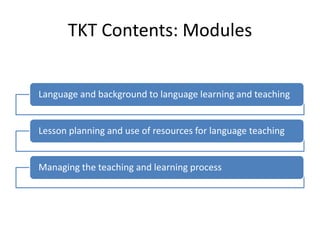
TKT Contents: Modules


Language and background to language learning and teaching


Lesson planning and use of resources for language teaching


Managing the teaching and learning process
Module 1: Language and background
  to language learning and teaching
• Part 1: describing language and language skills
  (grammar, lexis, phonology, functions, reading,
  etc.)
• Part 2: Background to language learning
  (motivation, exposure and focus on form, role of
  error, L1-L2 learning differences, S needs, etc.)
• Part 3; background to language teaching
  (presentation techniques, assessment, practice
  activities, etc.)
Module 2: Lesson planning and use of
  resources for language teaching
• Part 1: Planning and preparing a
  lesson/sequence of lessons (components of a
  lesson plan, selecting plans, choosing
  assessment activities, etc.)
• Part 2: Selection and use of resources and
  materials (consulting reference resources,
  coursebooks, teaching aids, etc.)
Module 3: managing the teaching and
          learning process
• Part 1: teachers’ and learners’ language in the
  classroom (using language
  appropiately, categorizing learners’
  mistakes, functions of learner language, etc.)
• Part 2: Classroom management (teacher
  roles, grouping learners, correcting
  learners, giving feedback, etc.)

TKT presentation

  • 1.
    TKT Course Teaching CompetencyVerification B.A. English Language Teaching
  • 2.
    What is theTeaching Knowledge Test? • Test developed by Cambridge ESOL for teachers of English to speakers of other languages. • Tests candidates’ knowledge of concepts related to language, its use the background to and practice of language teaching and learning.
  • 3.
    What is theTKT Course? • Introducing S to concepts & terms about teaching and learning • Introducing S to the main current theories, approaches & activities in ELT & assess their usefulness for the classroom • Sharing resources some of the many resources available or T’s • Providing materials & activites that give T opportunities for professional development by exploring concepts being introduced
  • 4.
    Who is theTKT Course written for?? • Readers intending to take TKT • Readers following introductory teacher development courses in TEFL or retraining to become ESOL teachers • Readers working by themselves to improve their knowledge of ELT • Readers who have not started teaching yet, and readers who are already teaching in primary or secondary schools • Both L1 and L2 speakers of English
  • 5.
    TKT Contents: Modules Languageand background to language learning and teaching Lesson planning and use of resources for language teaching Managing the teaching and learning process
  • 6.
    Module 1: Languageand background to language learning and teaching • Part 1: describing language and language skills (grammar, lexis, phonology, functions, reading, etc.) • Part 2: Background to language learning (motivation, exposure and focus on form, role of error, L1-L2 learning differences, S needs, etc.) • Part 3; background to language teaching (presentation techniques, assessment, practice activities, etc.)
  • 7.
    Module 2: Lessonplanning and use of resources for language teaching • Part 1: Planning and preparing a lesson/sequence of lessons (components of a lesson plan, selecting plans, choosing assessment activities, etc.) • Part 2: Selection and use of resources and materials (consulting reference resources, coursebooks, teaching aids, etc.)
  • 8.
    Module 3: managingthe teaching and learning process • Part 1: teachers’ and learners’ language in the classroom (using language appropiately, categorizing learners’ mistakes, functions of learner language, etc.) • Part 2: Classroom management (teacher roles, grouping learners, correcting learners, giving feedback, etc.)