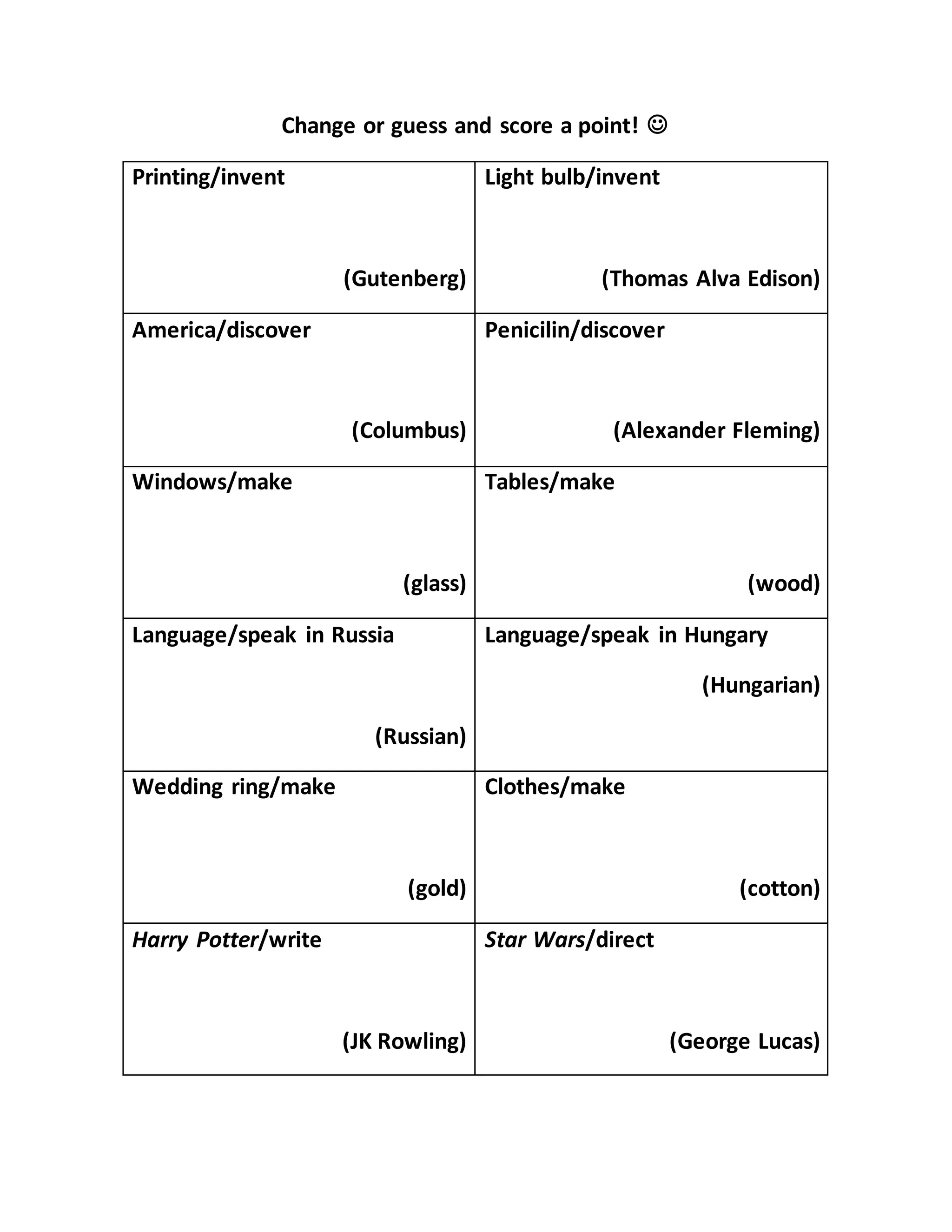
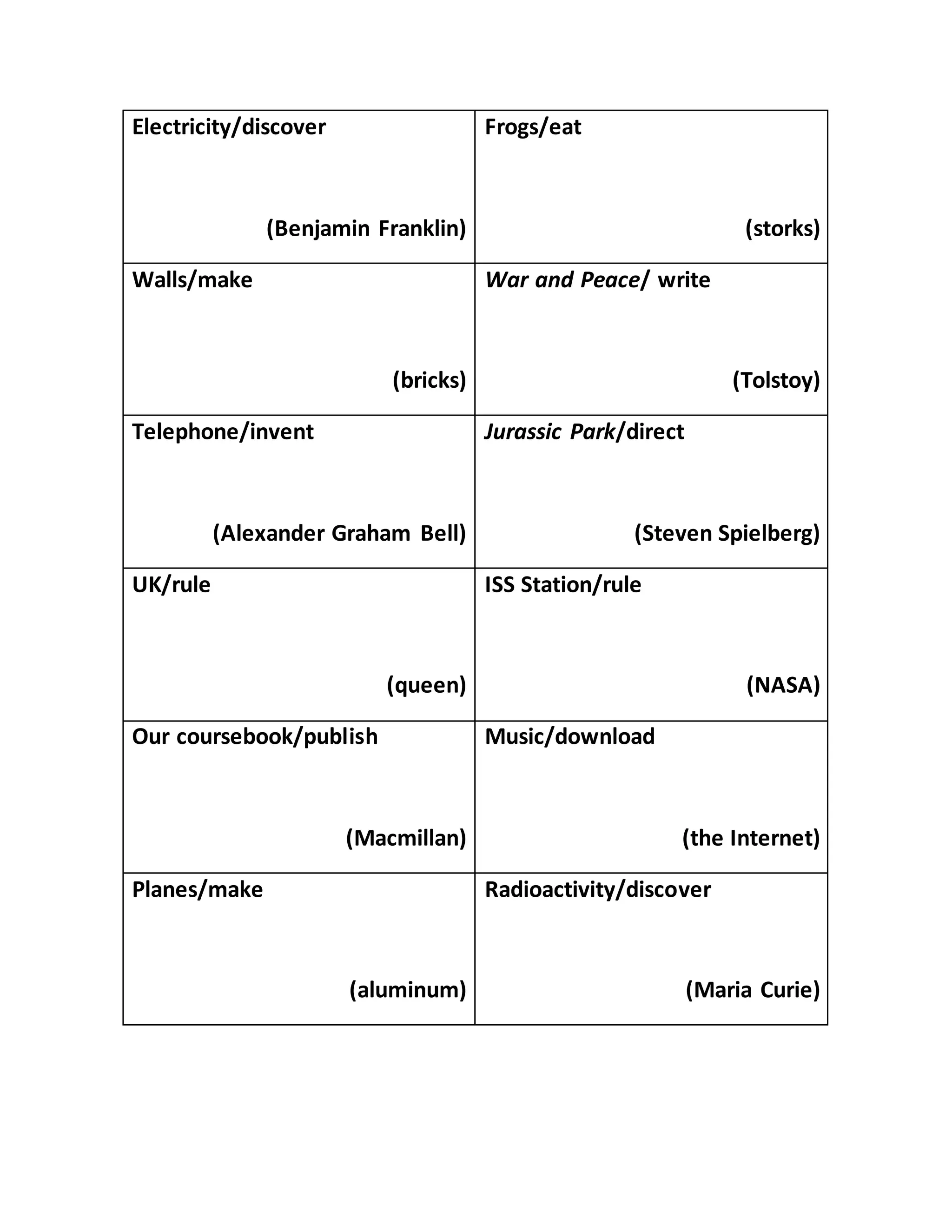
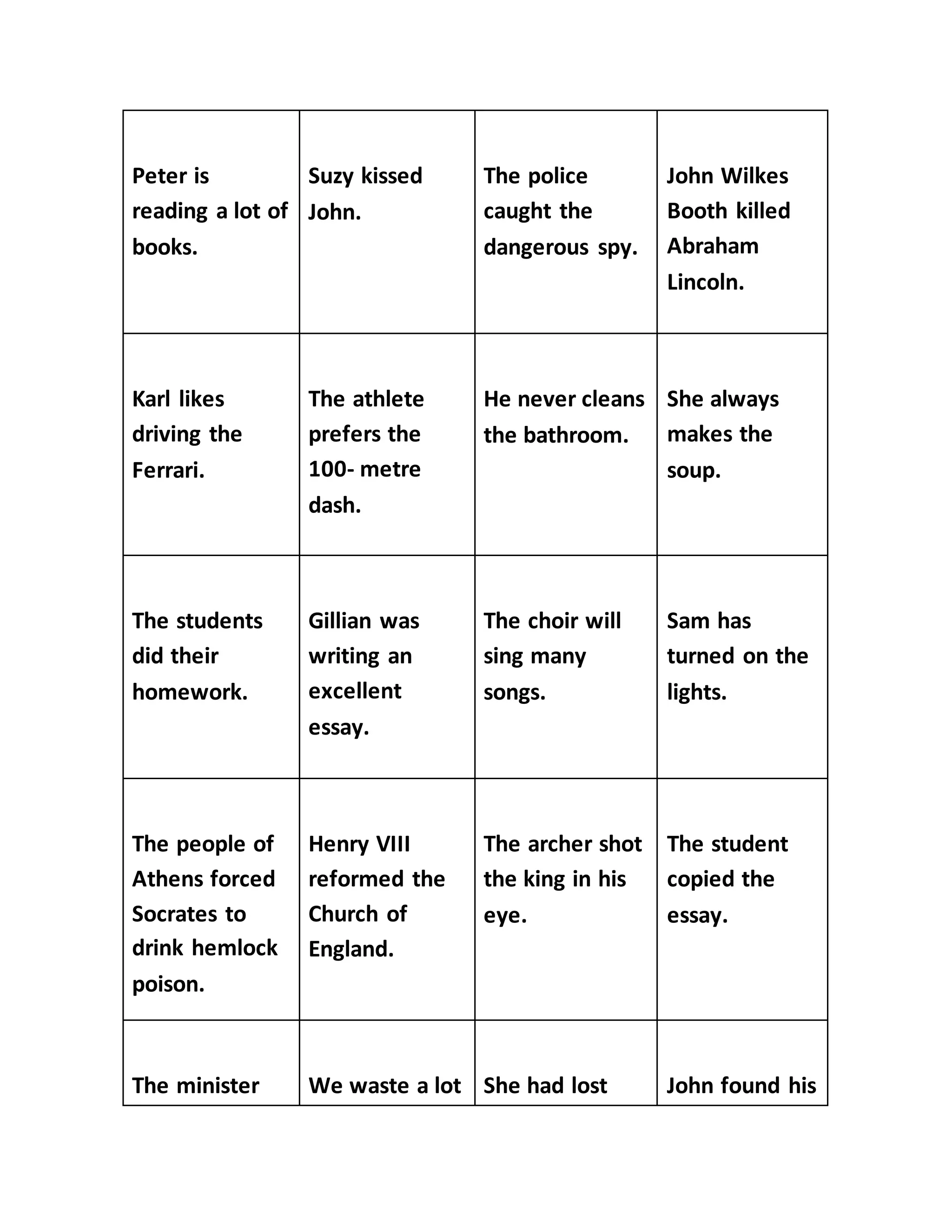
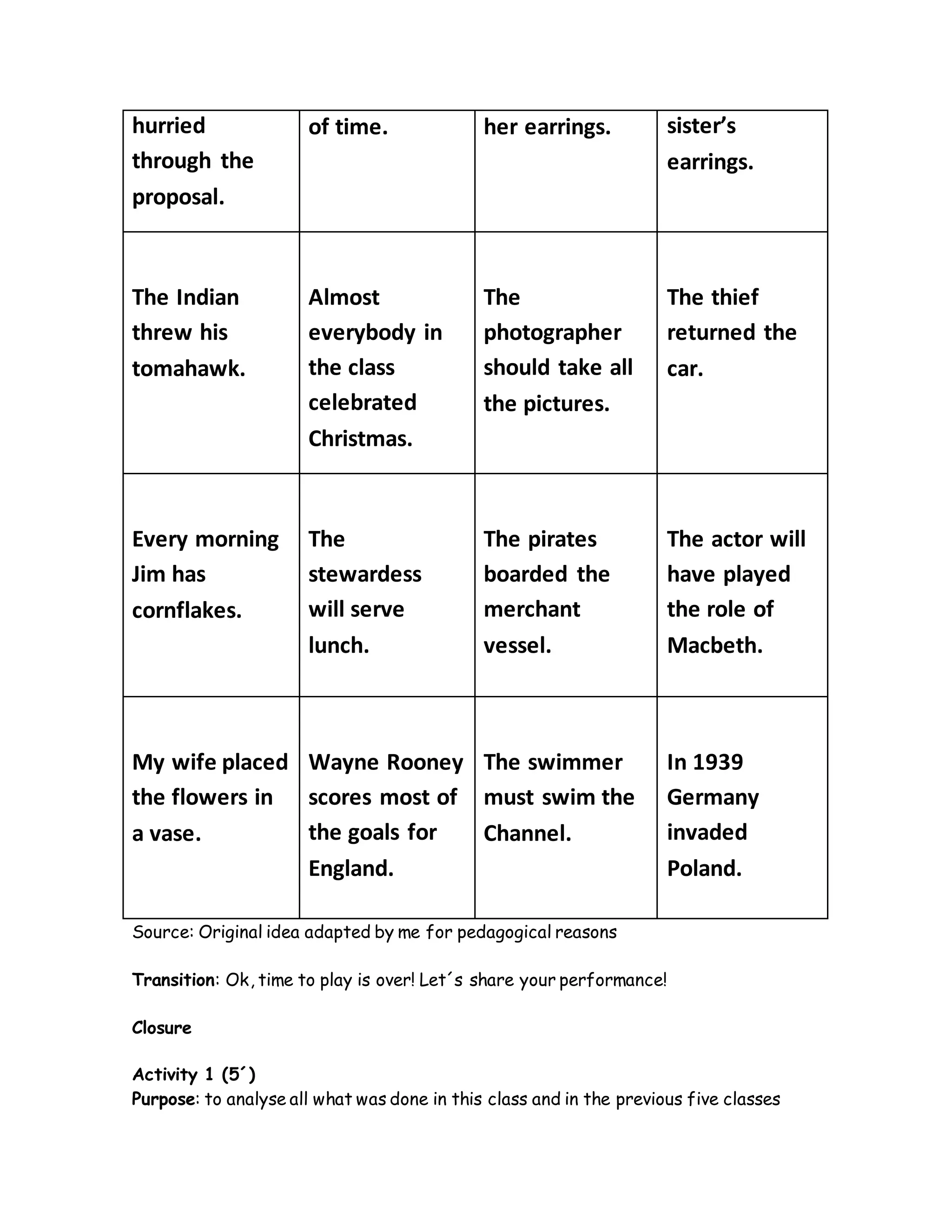
Taller de Práctica Docente 2015
Tutora: Prof. Cecilia A. Zemborain
Co- tutora:Prof. Graciela Inés Manzur
Lesson Plans – Practicum – Third Period
I.F.D.C. LenguasVivas
ALUMNA PRACTICANTE: Paula Schulze
Compañera que revisó el plan: Myriam Tielve
Período de Práctica: Tercero – Nivel Secundario
Institución Educativa: Colegio Bilingüe Neuquén
Dirección:Los Álamos 700, Neuquén
Sala/Grado/Año: 4to año
Cantidad de alumnos: 19
Nivel Lingüístico del curso: Intermedio alto
Tipo de Planificación: Clase
UnidadTemática: Naturaleza y Energía
Clase N°: 1
Fecha: 27/09/2015
Hora: 11 – 12.20
Duración de la clase: 80 minutos
Fecha de la primera entrega: 16/09/2015
 Teaching Points:
Definite article
Revising tenses: Simple present, present continuous, simple past, past continuous, past perfect,
present perfect, present perfect continuous, future will and going to, future progressive
(affirmative, interrogative, negative forms) before introducing the next teaching topic that is
Reported speech
 Aims and goals:
During this lesson, learners will be able to…
 Develop their listening and speaking skills by talking about their language learning process.
 Develop their writing skill by writing sentences related to their experience with the language.
 Develop their oral production to talk about their learning experience of the target language.
 Develop the acquisition of instances in which the definite article has to be used
 Language focus:
LEXIS FUNCTION STRUCTURES PRONUNCIATION
REVISION Native speaker Identifying
and naming
different
tenses
Different
tense forms
Wh questions
and
Yes/No
questions using
different
Recognition and
use of the sounds
/ði/
in the when
pronounced in a
stressed position
/ðə/ in the when
tenses pronounced in a
unstressed position
NEW Actions:
To sit for an
exam
Talking about
the uses of the
definite article
Recognition and
use of the word
/sə(r)ˈtɪfɪkət/ in
certificate
 Teaching approach: The Natural Approach as the students are expected to interact with the
teacher and peers in a natural way promoting in this way the communicative abilities. Since language
and vocabulary are of principal importance for this approach and to acquire the language, I will
encourage the students to concentrate mainly on the understanding of the message rather on the
target language specifically. Consequently, learners are also expected to acquire language in a free-
stress classroom environment. Besides, the PPP method will be used as well to introduce the target
structure.
 Integrating skills: during this class students will develop their listening skill while listening to the
teacher and to their mates. They will also integrate reading and writing when they are asked to
write sentences about their language learning process and then read them aloud. Their conceptual
thinking will also be developed while analyzing the uses of the definite article.
 Materials and resources:copies on tenses and sentences- posters with triggering questions -
markers for the board
 Pedagogical use of ICT in class: In this lesson we will not work with ICT support.
 Seating arrangements: The students will be sitting in lines of 4 or 5 desks. It must be said that
each student has a favorite place within the class. As for this first class, there will not be changes
in the sitting arrangement.
 Cooperative work: sts will work in pairs to discuss about the forms, functions and example of given
sentences in order to complete a chart.
 Possible problems/difficulties and their solutions during the class: as it is the first class I will
give to the sts, I hope I will manage to do all the activities planned. Either the sts may feel shy with
the new teacher or relaxed and so they may take their time to work. So I will be checking time
during the whole class. Because of the free conversation that will take place, I will also be ready to
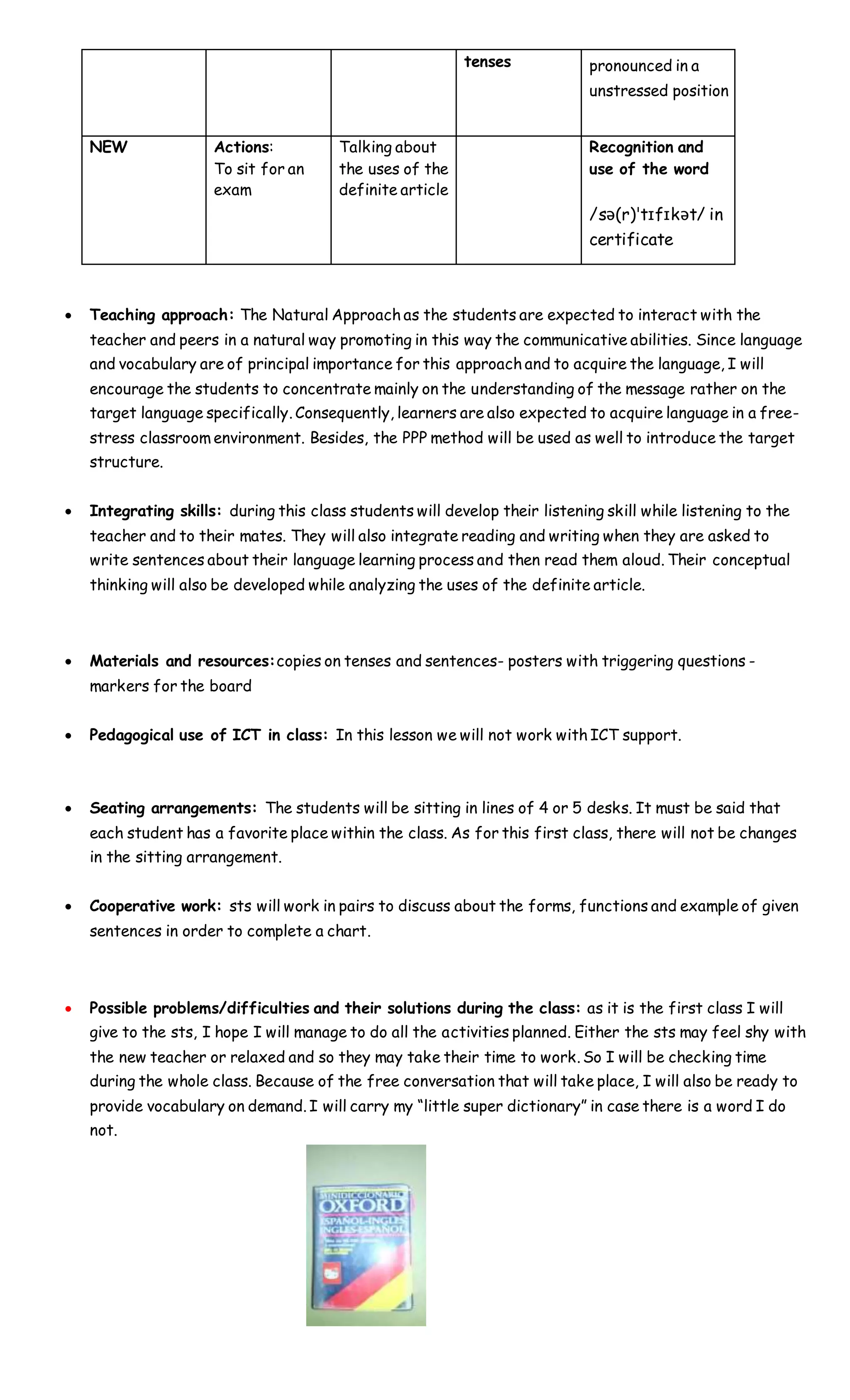
provide vocabulary on demand. I will carry my “little super dictionary” in case there is a word I do
not.
If the definition is not provided either I will ask the sts to search on their cell phones, or I will write
the word down to bring the answer on the following class.
I´m also worried about the balance I have to reach in my classes between the communicative and the
training abilities they must acquire for the FCE.
 Potential problems students may have with the language: Students may find it difficult to
complete the tenses chart. If that is the case I will prompt or model the answers.
 Assessment: I will assess learners’ comprehension and understanding through their oral
interactions, and their participation and development during the activities.
Routine: 5´
Purpose: to greet students and get them into a positive mood to start the lesson.
I will greet the sts, ask them how they feel and then I will tell them again what will be my role in
the classes to come (the teacher, Miss Valeria, had already introduced me when I went to observe
the class for the 1st
time). At that time students were told that they had been selected for their
positive and working attitude as well as for their handling of the target language. 
I will write the date on the blackboard (this is the teacher´s routine so I will stick to it) if the
previous teacher hasn´t done it yet. All the teachers in the school are supposed to write the date
in English although his/ her subject may not be that one.
Transition: Let´s get ready to talk about ourselves and our relationship with the English language.
Warm up: 15´
Purpose: to recall previous knowledge about individual English learning experiences and set the
context.
T: ok sts. You are going to divide into 4 groups of 4 (16 sts ) and 1 group of 3 students. On each
wall of the classroom I´m going to display some questions about you and the language and I want
you stand up, visit one poster at a time and discuss the questions with the members of your group.
When I tell you, you have to move to the next poster please.
I will give them 2 minutes in each post.
The questions and the posters will be numbered because of the retelling activity later, I think,
this will help. I´m going to display these questions; the tenses are not going to be included.
Before starting the activity I´m also going to remind sts to speak L2.
POSTER 1
1. Do you study English every day? (simple present)Does anyone in your class study English
every day? Why/Why not? How?
2. Are you thinking in English now? Why? Why not?
POSTER 2
3. What part of your brain do you think is working? (present continuous)
4. Have you ever studied English abroad? (Present perfect)
5. Have you been training hard for the FCE? (present perfect continuous)
POSTER 3
6. Are you going to sit for the FCE? Why? /why not?(future tense- going to)
7. What do you think we will learn today? (future – will)
POSTER 4
8. In 2 months you are finishing the school year. Do you think you will have done your best as
regards English? How? (Future perfect)
9. How long approximately will you have been speaking in English by the end of this morning? Is
it too much?
And by the end of the school-week, how long will you have been speaking English?(future
progressive)
POSTER 5
10. Were you speaking in English while I was writing the date? (past continuous)
11. Did you have a native teacher? Who? Where? What was he/she like? (simple past)
12. In 2013 some of you sat for the PET exam. Had you done a previous test to that one? Which
one? Why not? (past perfect)
GREEN = PRESENT tenses
BLUE = future tenses
RED = past tenses
While students are answering the questions, I will walk around paying attention more on the
content of what is being answered than on the tense the sts are using unless there is a
communication break or misunderstanding in, in that case I will prompt or provide some words,
expressions or tenses.
Once the sts have visited all the posters, I’ll ask them to go back to their places.
Transition: very good! You have sort of flown over your English learning experience! Why don´t we
listen to some of your answers?
Communicative Activity: 10´
Purpose: to express sts´experiences of the target language
I will take the 5 posters to the front and I will stick them on the board.
T: so, who would like to share the answer for question number 1?
While sts are sharing their answers with the whole class, I will encourage the sts to use the
tenses used in each question.I will also prompt or provide words on demand.
Transition: great! Let´s concentrate on a different aspect of the language!
Activity 1:20´
Purpose: to recall previous knowledge about tenses
T: So let´s have a look at the different posters again but now concentrate on the tenses of the
questions. Do they refer to past, present or future aspects of your language learning development?
Sts: All of them!
T: Great! So which poster refers to past experiences?
Sts:Poster 5
T:Which poster refers to present experiences?
Sts:Posters 1 and 2
T: Finally, which poster refers to future experiences?
Sts: Posters 3 and 4
T: Awesome!
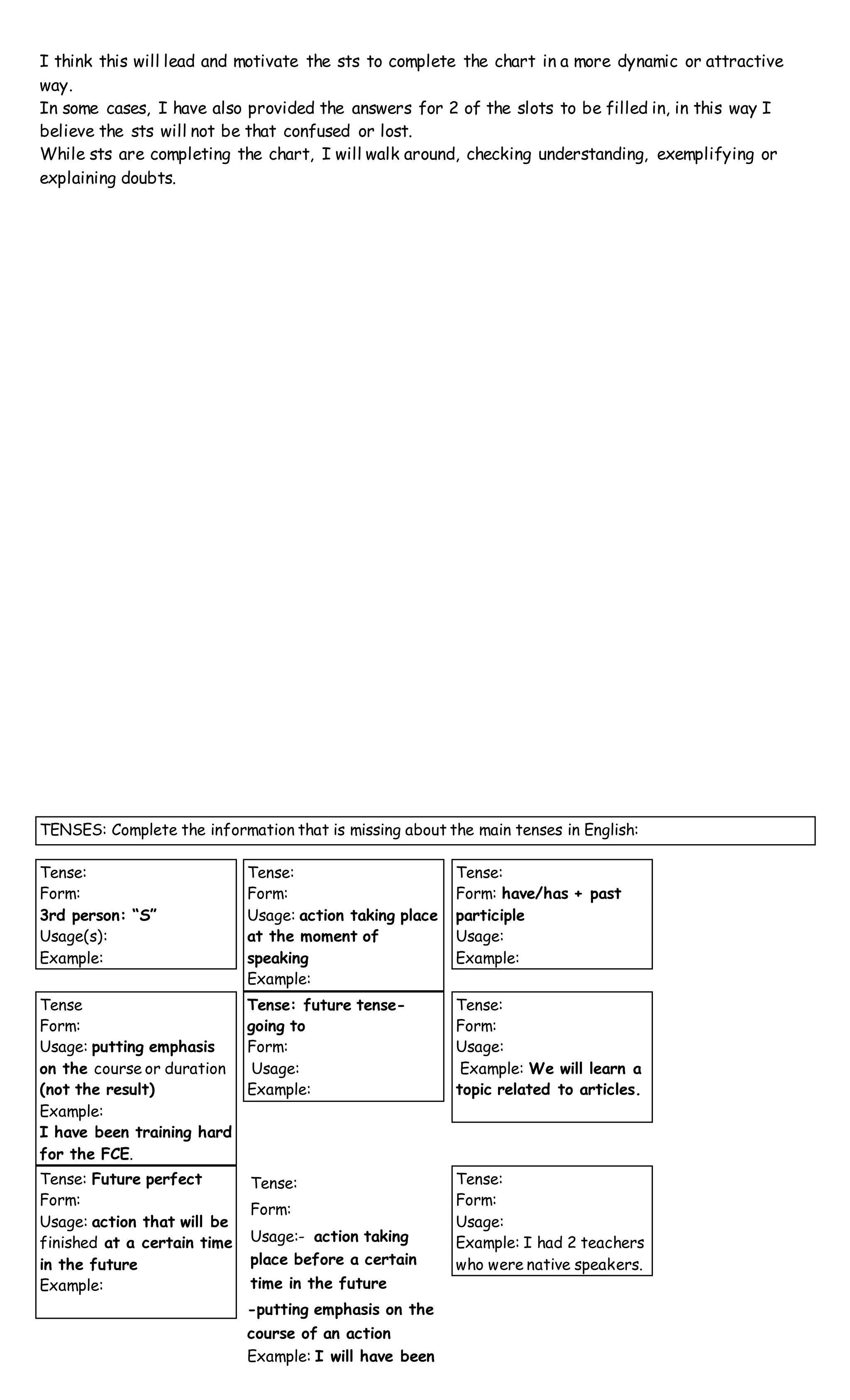
Then, I will deliver some copies and I will ask the sts to complete the following chart in pairs; the
examples they provide must be their personal answers of the questions on the posters.
T: Ok, let´s get down to business and complete the chart in pairs!
I will provide some information that will be in the copy in bold as shown below.
I think this will lead and motivate the sts to complete the chart in a more dynamic or attractive
way.
In some cases, I have also provided the answers for 2 of the slots to be filled in, in this way I
believe the sts will not be that confused or lost.
While sts are completing the chart, I will walk around, checking understanding, exemplifying or
explaining doubts.
TENSES: Complete the information that is missing about the main tenses in English:
Tense:
Form:
3rd person: “S”
Usage(s):
Example:
Tense:
Form:
Usage: action taking place
at the moment of
speaking
Example:
Tense:
Form: have/has + past
participle
Usage:
Example:
Tense
Form:
Usage: putting emphasis
on the course or duration
(not the result)
Example:
I have been training hard
for the FCE.
Tense: future tense-
going to
Form:
Usage:
Example:
Tense:
Form:
Usage:
Example: We will learn a
topic related to articles.
Tense: Future perfect
Form:
Usage: action that will be
finished at a certain time
in the future
Example:
Tense:
Form:
Usage:- action taking
place before a certain
time in the future
-putting emphasis on the
course of an action
Example: I will have been
Tense:
Form:
Usage:
Example: I had 2 teachers
who were native speakers.
speaking about 8 hours.
Tense:
Form:
Usage:
Example: I was speaking
in Spanish while you were
writing the date.
Tense:
Form: had + past
participle
Usage:
Example:
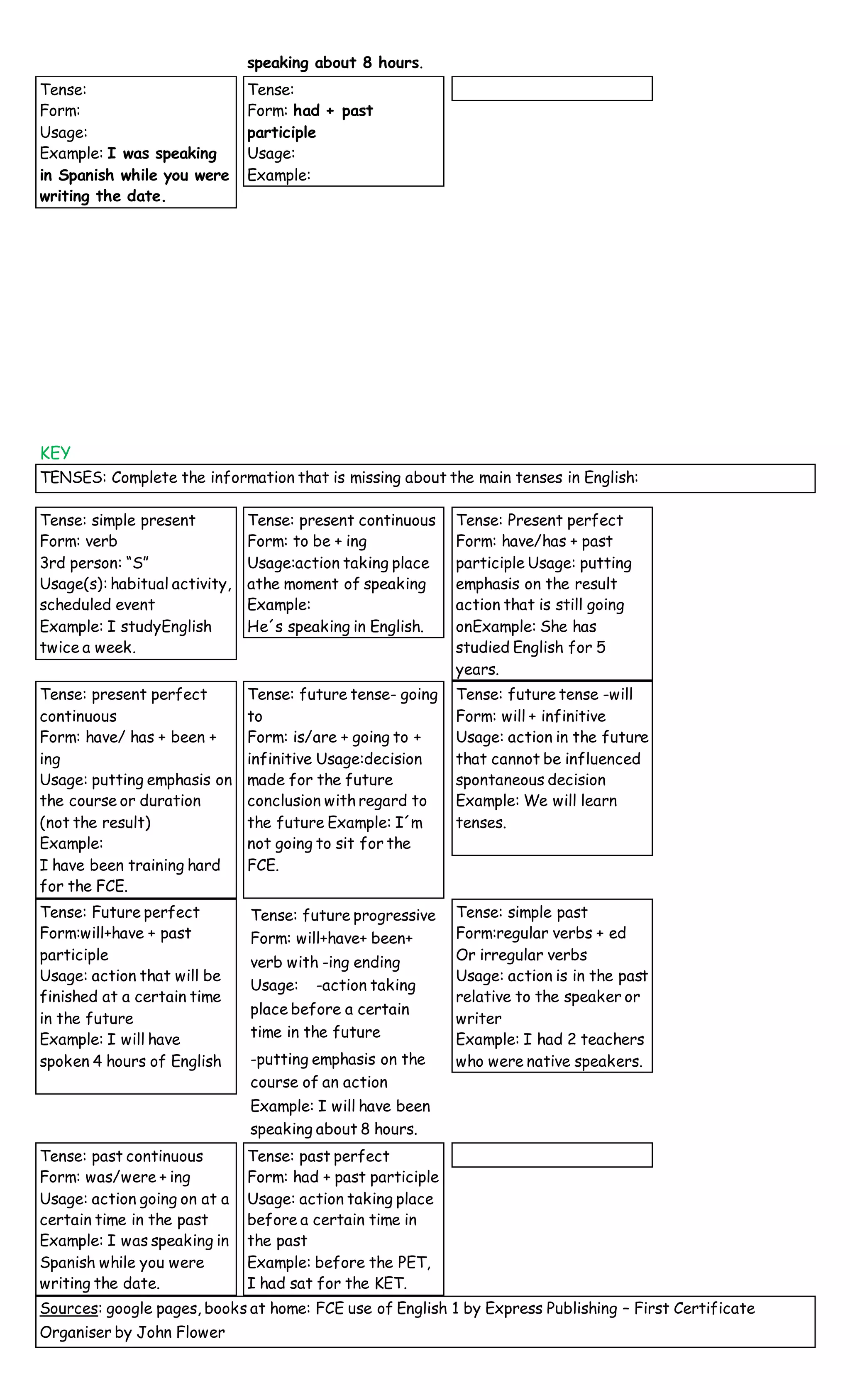
KEY
TENSES: Complete the information that is missing about the main tenses in English:
Tense: simple present
Form: verb
3rd person: “S”
Usage(s): habitual activity,
scheduled event
Example: I studyEnglish
twice a week.
Tense: present continuous
Form: to be + ing
Usage:action taking place
athe moment of speaking
Example:
He´s speaking in English.
Tense: Present perfect
Form: have/has + past
participle Usage: putting
emphasis on the result
action that is still going
onExample: She has
studied English for 5
years.
Tense: present perfect
continuous
Form: have/ has + been +
ing
Usage: putting emphasis on
the course or duration
(not the result)
Example:
I have been training hard
for the FCE.
Tense: future tense- going
to
Form: is/are + going to +
infinitive Usage:decision
made for the future
conclusion with regard to
the future Example: I´m
not going to sit for the
FCE.
Tense: future tense -will
Form: will + infinitive
Usage: action in the future
that cannot be influenced
spontaneous decision
Example: We will learn
tenses.
Tense: Future perfect
Form:will+have + past
participle
Usage: action that will be
finished at a certain time
in the future
Example: I will have
spoken 4 hours of English
 Tense: future progressive
Form: will+have+ been+
verb with -ing ending
Usage: -action taking
place before a certain
time in the future
-putting emphasis on the
course of an action
Example: I will have been
speaking about 8 hours.
Tense: simple past
Form:regular verbs + ed
Or irregular verbs
Usage: action is in the past
relative to the speaker or
writer
Example: I had 2 teachers
who were native speakers.
Tense: past continuous
Form: was/were + ing
Usage: action going on at a
certain time in the past
Example: I was speaking in
Spanish while you were
writing the date.
Tense: past perfect
Form: had + past participle
Usage: action taking place
before a certain time in
the past
Example: before the PET,
I had sat for the KET.
Sources: google pages, books at home: FCE use of English 1 by Express Publishing – First Certificate
Organiser by John Flower
After sts have completed the chart, I will ask some volunteers to tell the sections they have completed.
Transition: Excellent! How about connecting your language processes with the brain specifically!
Presentation
Activity 1: 15´
Purpose: to set the context and introduce the target structure
I will clean the board from the posters and I will deliver another copy with these sentences. Then
I will ask them to think about these assertions.
1. One of the most significant changes affecting the English language over the last 10 years is the
growing presence of spoken forms while many less examples of the written forms.
2. The scientists have developed procedures to understand the way the human brain works.
3. Considerable progress has been made over the last decade toward improved techniques to study the
human brain and how it works while learning.
4. The revolution of this study area has become especially appealing for educators as well as others
professionals.
5. The most relevant aspect about the brain and its functioning is that almost everything is under
scrutiny to scientists in different fields.
6. The head of the neuroscience department, Dr Grace said that we are still far from understanding
the functions of the brain circuits yet.
Source: I have invented most of the sentences although I have helped myself with the corpora:
http://corpus.byu.edu/coca/x.asp?r1=&w=1093&h=614
T: Did you know about them?
Sts: I knew the scientists are studying the brain in deep.
T: Great, it´s true! Notice that I have underlined some of the phrases in these assertions. Can you
guess why? Why are they important?
Sts: They have the article/ word “the”. They talk about something specific.
T: yes, all these sentences refer to the brain, the language, specific scientists, they refer to
something specific or unique. That is why we talk about the “definite article”.
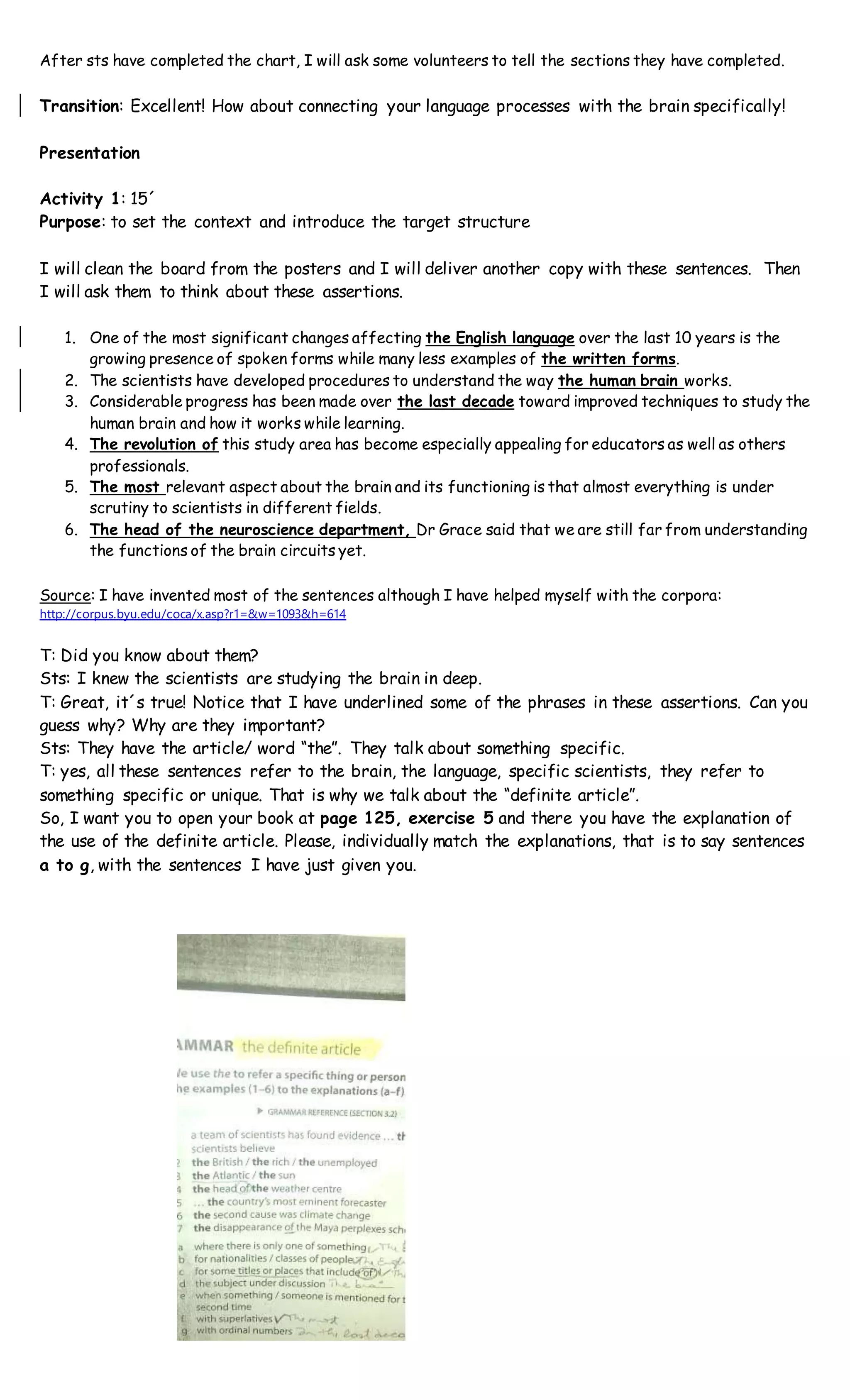
So, I want you to open your book at page 125, exercise 5 and there you have the explanation of
the use of the definite article. Please, individually match the explanations, that is to say sentences
a to g, with the sentences I have just given you.
Source: Spotlight to FCE by Alastair Lan; Cengage Learning; National Geographic Learning (2014).
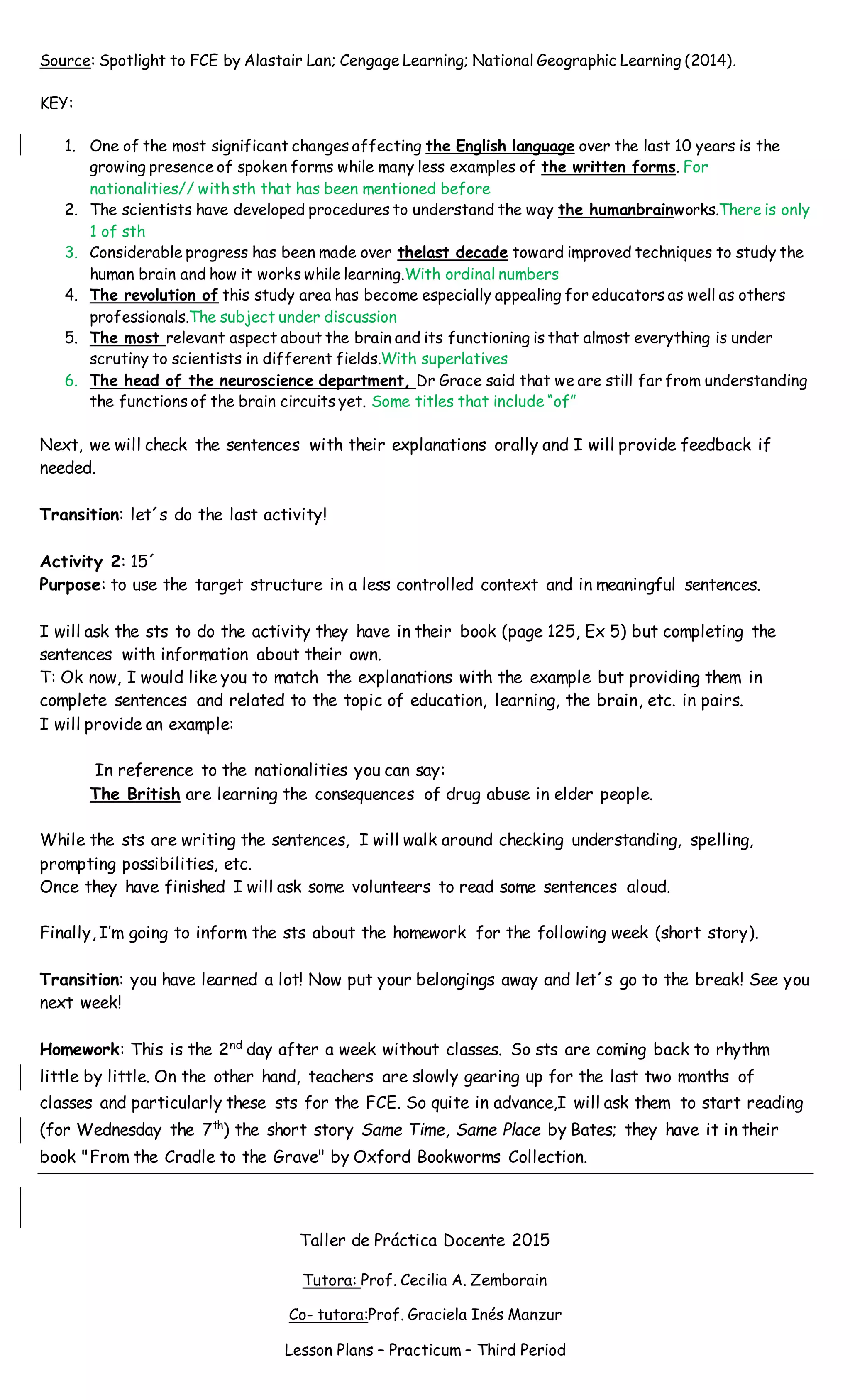
KEY:
1. One of the most significant changes affecting the English language over the last 10 years is the
growing presence of spoken forms while many less examples of the written forms. For
nationalities// with sth that has been mentioned before
2. The scientists have developed procedures to understand the way the humanbrainworks.There is only
1 of sth
3. Considerable progress has been made over thelast decade toward improved techniques to study the
human brain and how it works while learning.With ordinal numbers
4. The revolution of this study area has become especially appealing for educators as well as others
professionals.The subject under discussion
5. The most relevant aspect about the brain and its functioning is that almost everything is under
scrutiny to scientists in different fields.With superlatives
6. The head of the neuroscience department, Dr Grace said that we are still far from understanding
the functions of the brain circuits yet. Some titles that include “of”
Next, we will check the sentences with their explanations orally and I will provide feedback if
needed.
Transition: let´s do the last activity!
Activity 2: 15´
Purpose: to use the target structure in a less controlled context and in meaningful sentences.
I will ask the sts to do the activity they have in their book (page 125, Ex 5) but completing the
sentences with information about their own.
T: Ok now, I would like you to match the explanations with the example but providing them in
complete sentences and related to the topic of education, learning, the brain, etc. in pairs.
I will provide an example:
In reference to the nationalities you can say:
The British are learning the consequences of drug abuse in elder people.
While the sts are writing the sentences, I will walk around checking understanding, spelling,
prompting possibilities, etc.
Once they have finished I will ask some volunteers to read some sentences aloud.
Finally, I’m going to inform the sts about the homework for the following week (short story).
Transition: you have learned a lot! Now put your belongings away and let´s go to the break! See you
next week!
Homework: This is the 2nd
day after a week without classes. So sts are coming back to rhythm
little by little. On the other hand, teachers are slowly gearing up for the last two months of
classes and particularly these sts for the FCE. So quite in advance,I will ask them to start reading
(for Wednesday the 7th
) the short story Same Time, Same Place by Bates; they have it in their
book "From the Cradle to the Grave" by Oxford Bookworms Collection.
Taller de Práctica Docente 2015
Tutora: Prof. Cecilia A. Zemborain
Co- tutora:Prof. Graciela Inés Manzur
Lesson Plans – Practicum – Third Period
I.F.D.C. LenguasVivas
ALUMNA PRACTICANTE: Paula Schulze
Compañera que revisó el plan: Myriam Tielve
Período de Práctica: Tercero – Nivel Secundario
Institución Educativa: Colegio Bilingüe Neuquén
Dirección:Los Álamos 700, Neuquén
Sala/Grado/Año: 4to año
Cantidad de alumnos: 19
Nivel Lingüístico del curso: Intermedio alto
Tipo de Planificación: Clase
Unidad Temática: Noticias y medios de comunicación
Clase N°: 2
Fecha: 5/10/2015
Hora: 11 – 12.20
Duración de la clase: 80 minutos
Fecha de la primera entrega: 30/09/2015
 Teaching Points:
Reported speech
Revising topic: Definite article
 Aims and goals:
During this lesson, learners will be able to…
 Develop their listening and speaking skills by talking about recent news.
 Develop their writing skill by writing a possible dialogue between famous people.
 Develop their language awareness to use reporting structures and verbs
 Language focus:
LEXIS FUNCTION STRUCTURES PRONUNCIATION
REVISION Vocabulary
that may
come out
during the
activities:
-News
-Pieces of
news
-To drown
-Refugee
-To give a
speech
-Toxic
gasses or
fumes
presidential
candidates
Talking
about the
uses of the
definite
article
Recognition and
use of the sounds
/ði/
in the when
pronounced in a
stressed position
and before vowels
/ðə/ in the when
pronounced in a
unstressed position
I presented this
during the last
class, so I would
like to check if the
sts use these
sounds in different
contexts.
NEW Reporting
verbs:
Presume,
recollect,
maintain,
assume
Talking
about what
someone has
said using
different
reporting
verbs
Changes that
occur in
pronouns
tenses and
time
expressions
in reported
speech
Recognition and
use of the sounds
/prɪˈzjuːm/ in
presume
/draʊnd/ in
drowned
/meɪnˈteɪn/ or
/mənˈteɪn/ in
maintain
 Teaching approach: The Natural Approach as the students are expected to interact with the
teacher and peers in a natural way promoting in this way the communicative abilities. Since language
and vocabulary are of principal importance for this approach and to acquire the language, I will
encourage the students to concentrate mainly on the understanding of the message rather on the
target language specifically. Consequently, learners are also expected to acquire language in a free-
stress classroom environment. Besides, the PPP method will be used as well to introduce the target
structure.
 Integrating skills: during this class students will integrate their speaking and listening skills to
improve their aural comprehension and production. They will also integrate reading and writing when
they are asked to write a dialogue and then read it aloud. Their conceptual thinking will also be
developed while analyzing the uses of the reported speech.
 Materials and resources: copies – OHP – colored copies of famous people - markers for the board,
my laptop
 Pedagogical use of ICT in class: In this lesson the OHP will be used to support visual stimulus for
discussion and for the students to invent a dialogue.
 Seating arrangements: The students will get in groups of 4 for the 1st
and last activities. In
between they will work in pairs as well.
 Cooperative work: sts will work in pairs to consider perspectives about latest pieces of news and
about the content of the dialogues they will invent and they will agree on how to transfer a direct
speech dialogue into an indirect speech paragraph. Besides, they will have to consider which
reporting verbs to include.
 Possible problems/difficulties and their solutions during the class: I will carry my dictionary as in
the previous class. I have focused on the main aspects of reported speech so reporting questions or
instances in which reported speech do not occur have been left aside.
 Potential problems students may have with the language: Students may find it difficult to turn
the dialogue into reported speech if this is the case I will prompt or model the answers. I will also
encourage the sts to have the grammar charts at hand.
 Assessment: I will assess learners’ comprehension and understanding through their oral
interactions, and their participation and development during the activities.
Routine: 5´
Purpose: to greet students and get them into a positive mood to start the lesson.
I will write the date on the blackboard (this is the teacher´s routine so I will stick to it) once I
have elicited it from sts.
Transition: let´s get ready to talk about the latest news!
Warm up: 10´
Purpose: to recall previous knowledge about latest news in the media and set the context
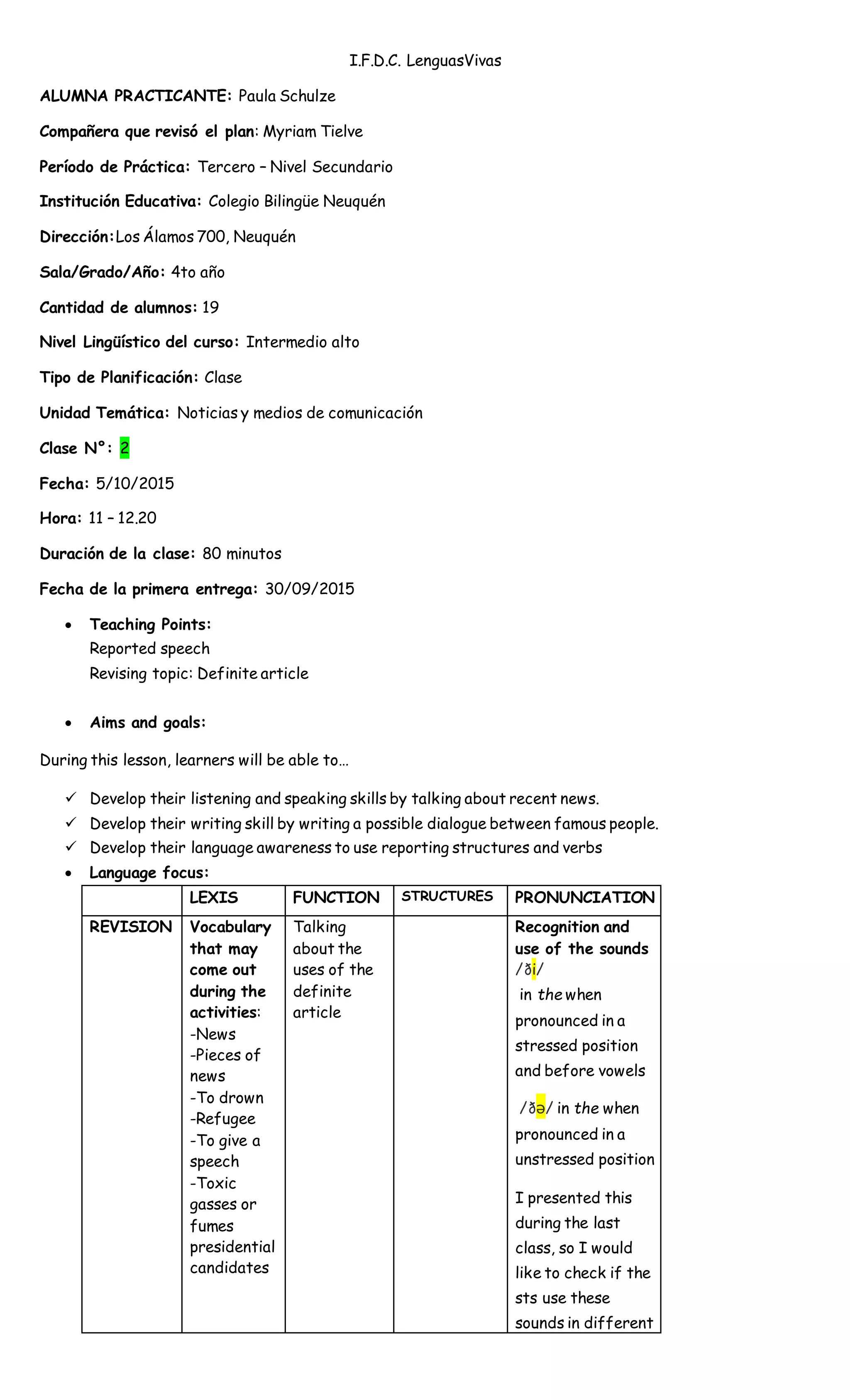
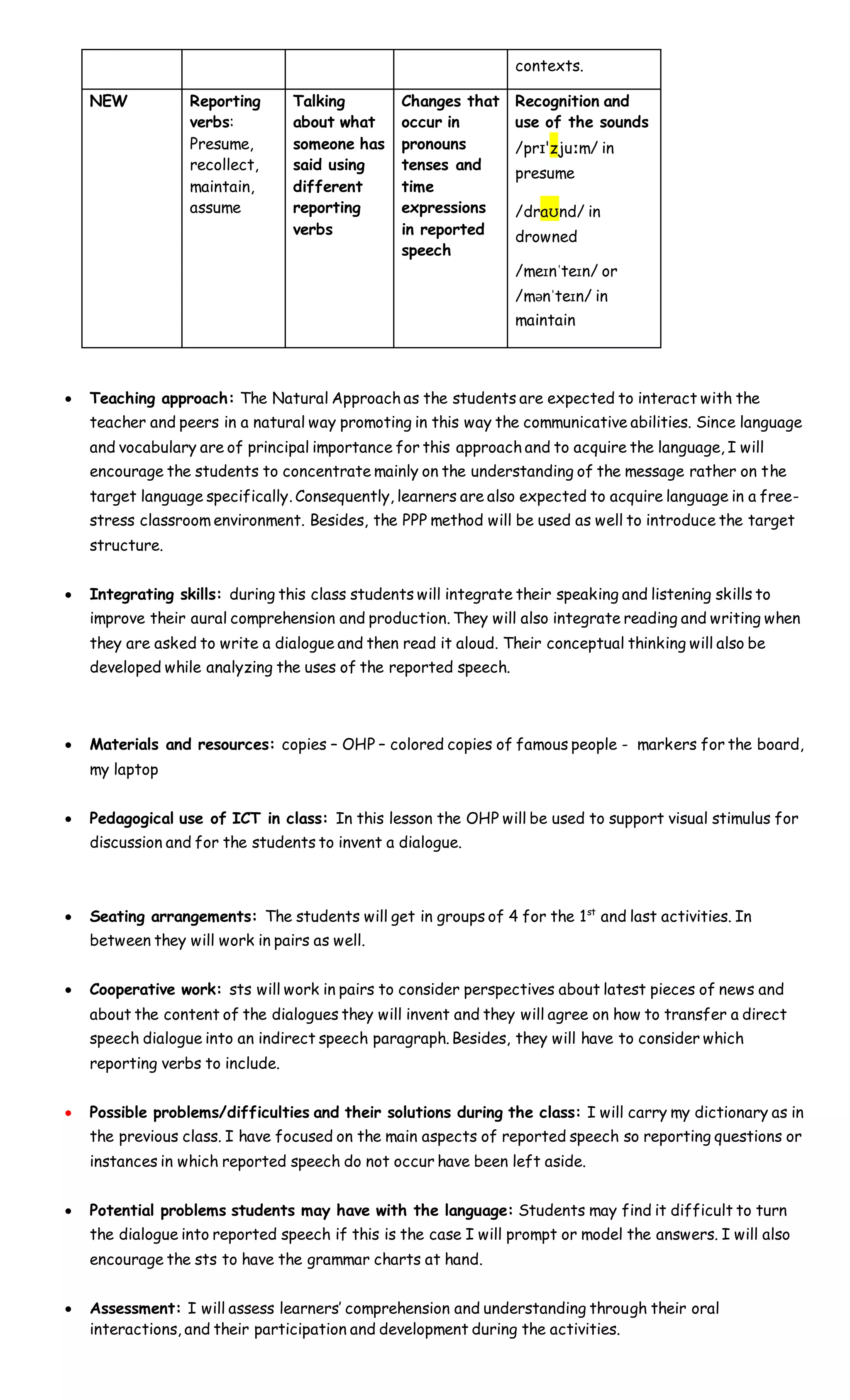
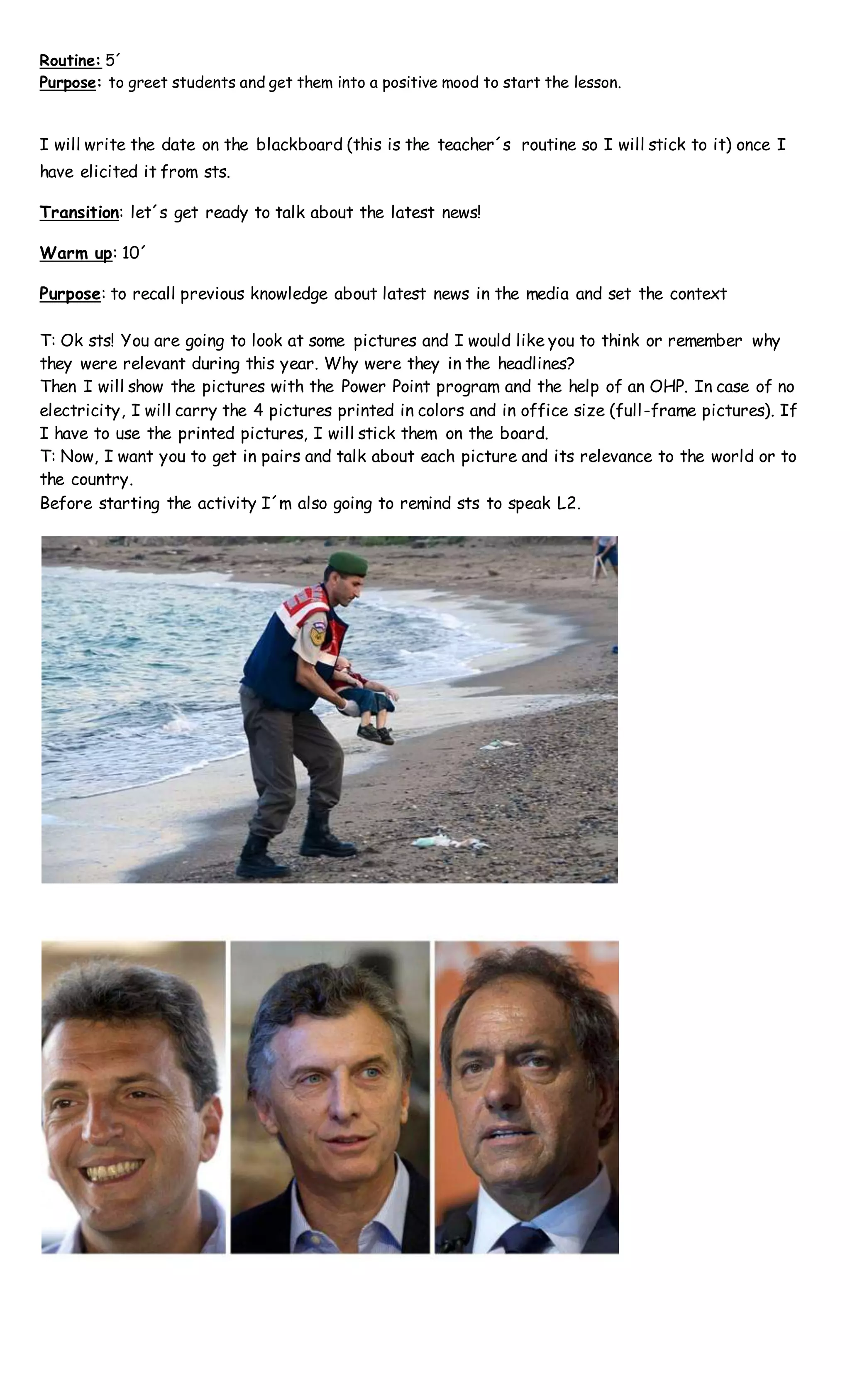
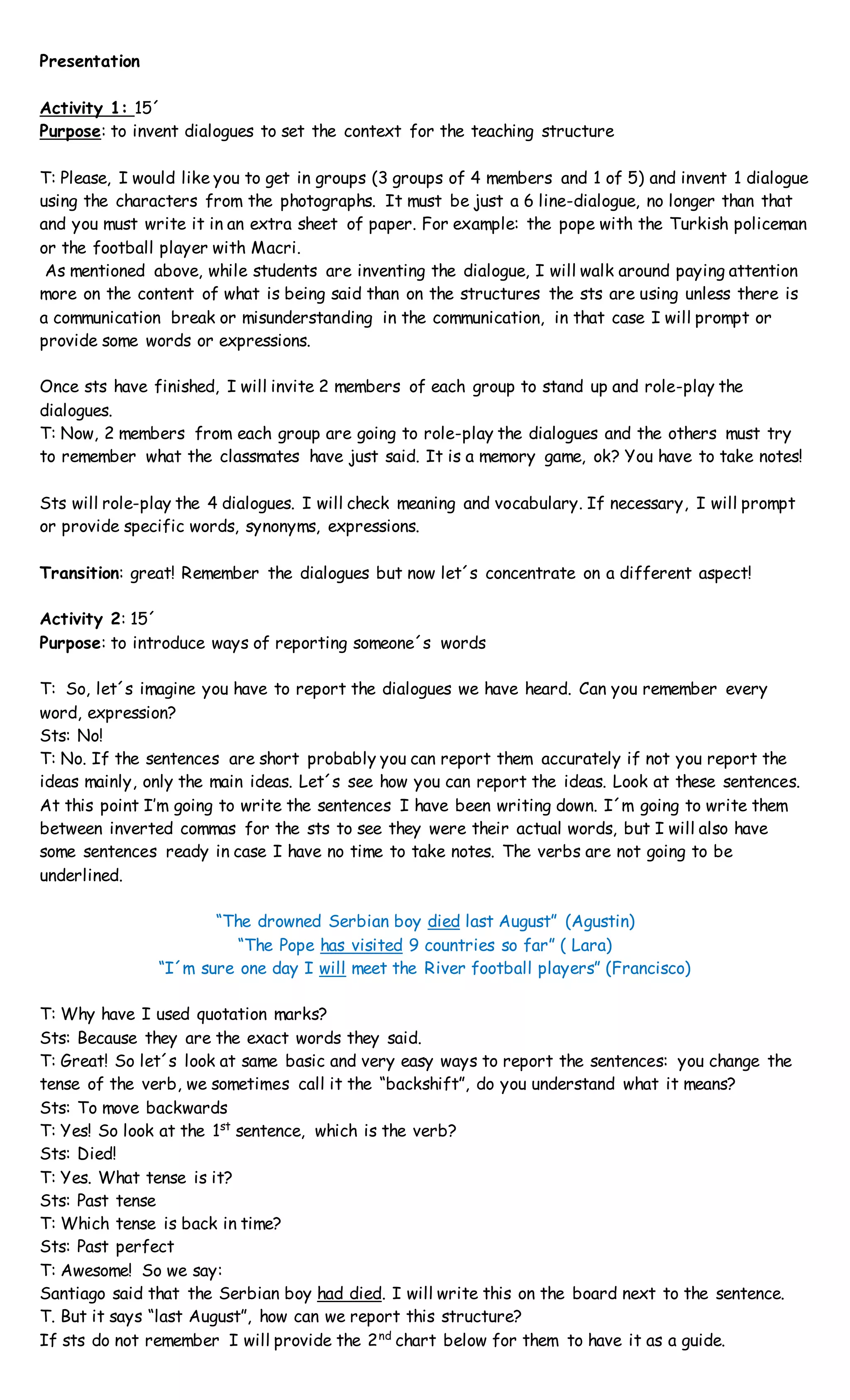
T: Ok sts! You are going to look at some pictures and I would like you to think or remember why
they were relevant during this year. Why were they in the headlines?
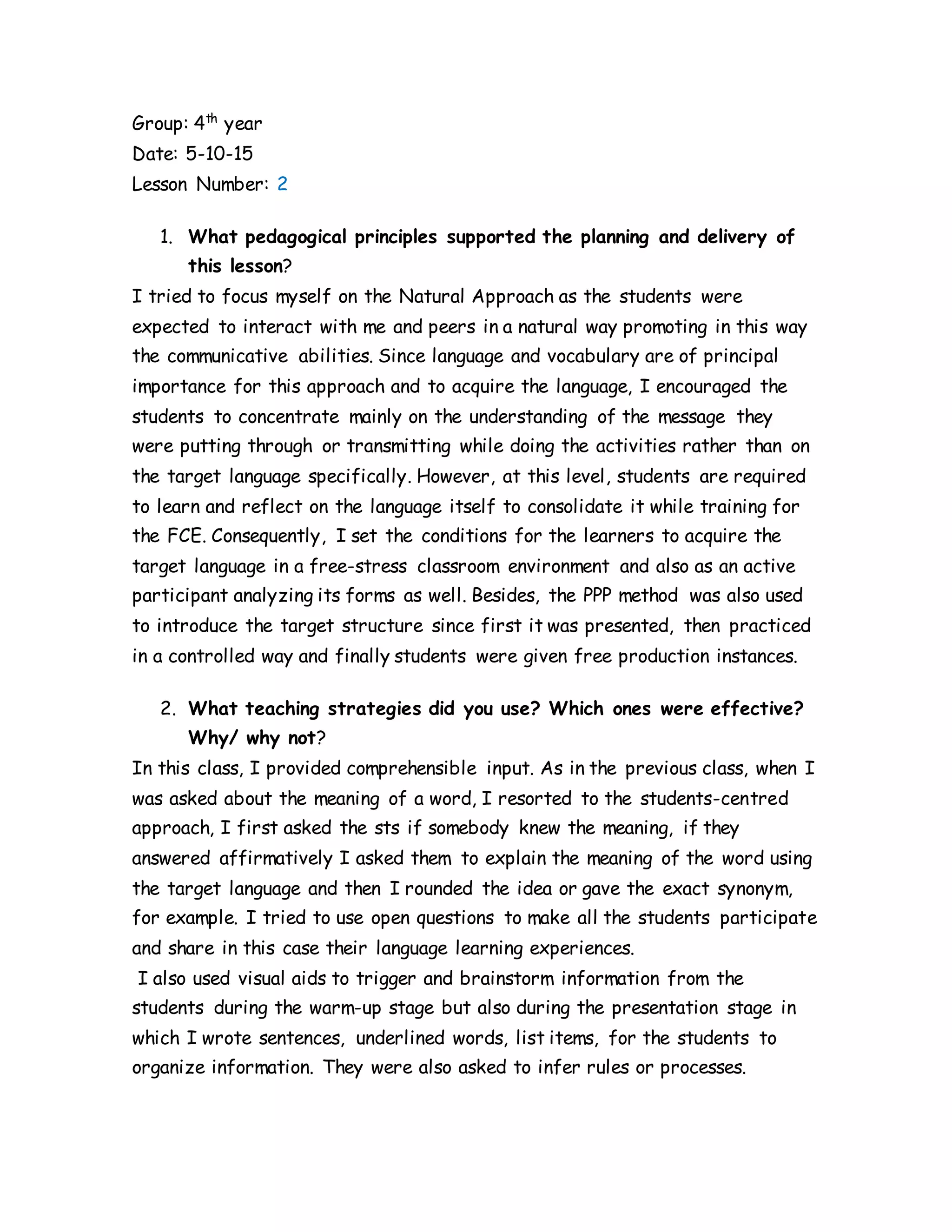
Then I will show the pictures with the Power Point program and the help of an OHP. In case of no
electricity, I will carry the 4 pictures printed in colors and in office size (full-frame pictures). If
I have to use the printed pictures, I will stick them on the board.
T: Now, I want you to get in pairs and talk about each picture and its relevance to the world or to
the country.
Before starting the activity I´m also going to remind sts to speak L2.
Source:Google images
During this and the following exercise, I’m going to take notes of exact sentences that some sts
use.
While students are answering the questions, I will walk around paying attention more on the
content of what is being answered than on the structures the sts are using unless there is a
communication breakdown or misunderstanding in the communication, in that case I will prompt or
provide some words, expressions or tenses.
T: Now, tell me who are the characters in each picture?In picture 1?
Sts: The Serbian boy and the policeman who rescued him
T: In the 2nd
picture?
Sts: Macri, Massa and Scioli
T: What about picture 3?
Sts: The football players from River (I´m sure the sts will know their names)
T: And in the last picture?
Sts: The Pope
T: Can you tell me why have they been in the headlines lately?
Once the sts have expressed and shared their perspectives I will say:
Transition: very good! What if we invite them to talk?
Presentation
Activity 1: 15´
Purpose: to invent dialogues to set the context for the teaching structure
T: Please, I would like you to get in groups (3 groups of 4 members and 1 of 5) and invent 1 dialogue
using the characters from the photographs. It must be just a 6 line-dialogue, no longer than that
and you must write it in an extra sheet of paper. For example: the pope with the Turkish policeman
or the football player with Macri.
As mentioned above, while students are inventing the dialogue, I will walk around paying attention
more on the content of what is being said than on the structures the sts are using unless there is
a communication break or misunderstanding in the communication, in that case I will prompt or
provide some words or expressions.
Once sts have finished, I will invite 2 members of each group to stand up and role-play the
dialogues.
T: Now, 2 members from each group are going to role-play the dialogues and the others must try
to remember what the classmates have just said. It is a memory game, ok? You have to take notes!
Sts will role-play the 4 dialogues. I will check meaning and vocabulary. If necessary, I will prompt
or provide specific words, synonyms, expressions.
Transition: great! Remember the dialogues but now let´s concentrate on a different aspect!
Activity 2: 15´
Purpose: to introduce ways of reporting someone´s words
T: So, let´s imagine you have to report the dialogues we have heard. Can you remember every
word, expression?
Sts: No!
T: No. If the sentences are short probably you can report them accurately if not you report the
ideas mainly, only the main ideas. Let´s see how you can report the ideas. Look at these sentences.
At this point I’m going to write the sentences I have been writing down. I´m going to write them
between inverted commas for the sts to see they were their actual words, but I will also have
some sentences ready in case I have no time to take notes. The verbs are not going to be
underlined.
“The drowned Serbian boy died last August” (Agustin)
“The Pope has visited 9 countries so far” ( Lara)
“I´m sure one day I will meet the River football players” (Francisco)
T: Why have I used quotation marks?
Sts: Because they are the exact words they said.
T: Great! So let´s look at same basic and very easy ways to report the sentences: you change the
tense of the verb, we sometimes call it the “backshift”, do you understand what it means?
Sts: To move backwards
T: Yes! So look at the 1st
sentence, which is the verb?
Sts: Died!
T: Yes. What tense is it?
Sts: Past tense
T: Which tense is back in time?
Sts: Past perfect
T: Awesome! So we say:
Santiago said that the Serbian boy had died. I will write this on the board next to the sentence.
T. But it says “last August”, how can we report this structure?
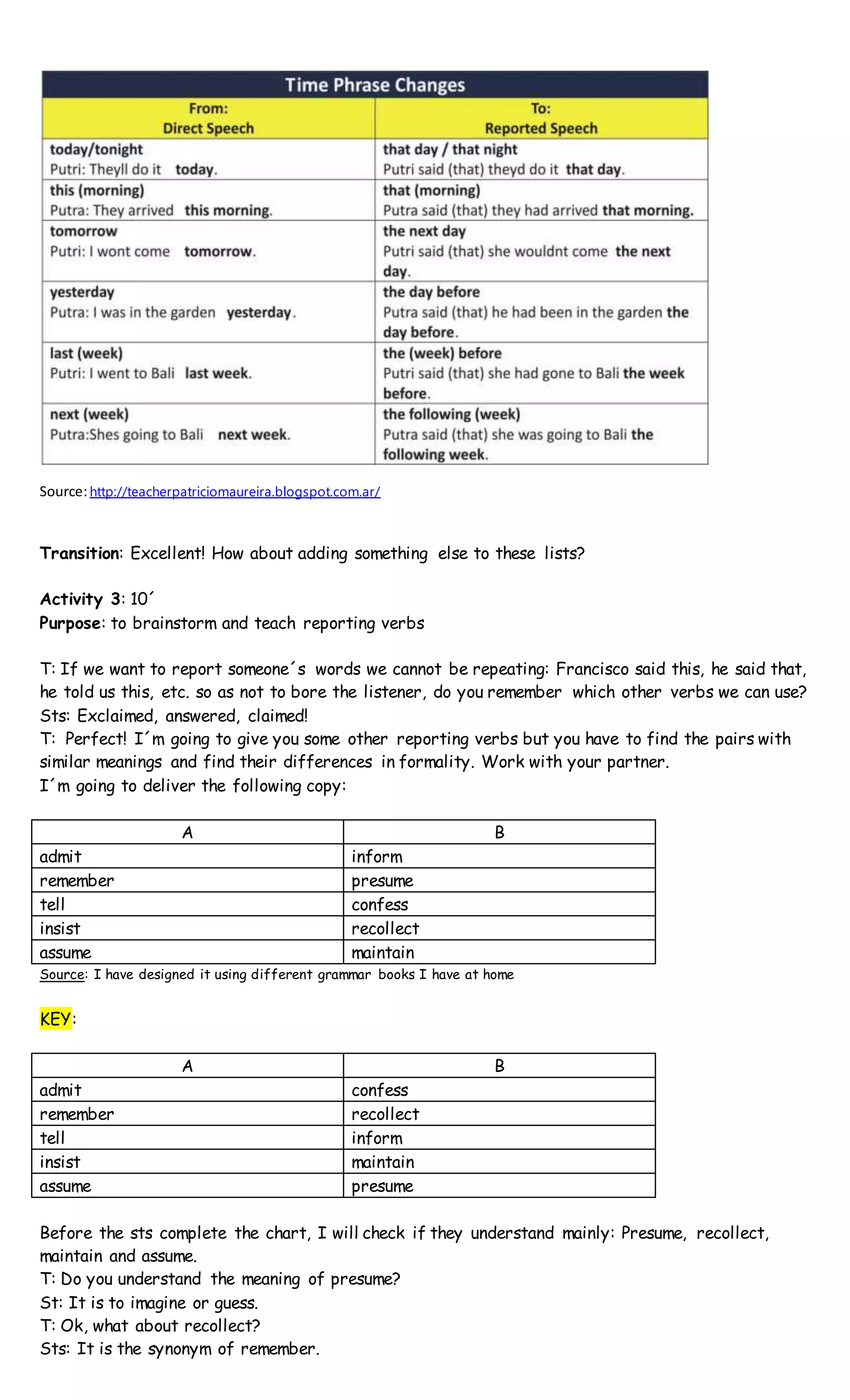
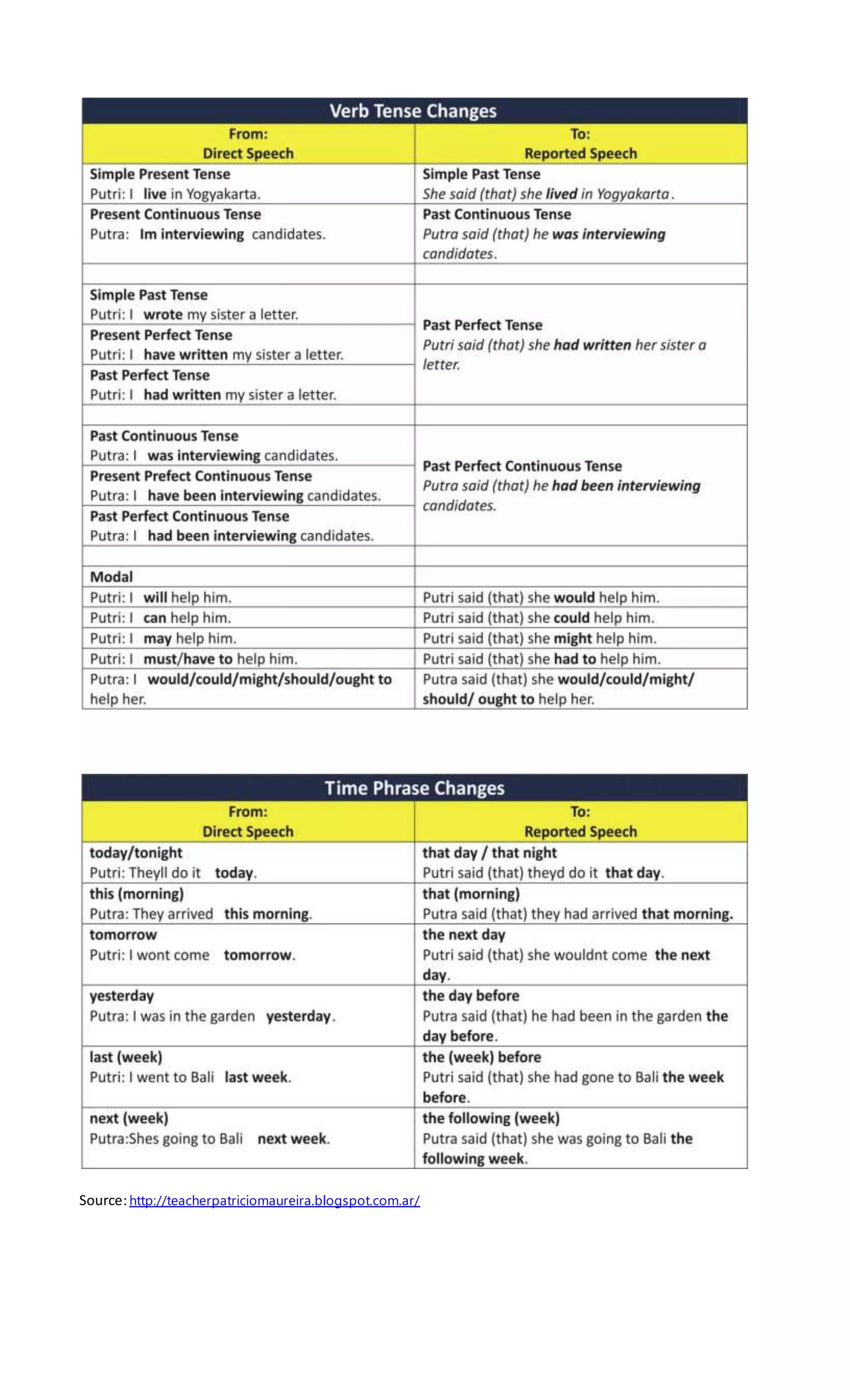
If sts do not remember I will provide the 2nd
chart below for them to have it as a guide.
Sts: The previous August. So we say:
Santiago said that the Serbian boy had died the previous August. I will complete the sentence on
the board.
T: Perfect! Now, who would like to do the 2nd
sentence?
St 1: Lara said the Pope had visited 9 countries so far.
T: Excellent! And the last one? Can anyone try?
If there are no volunteers, I will provide the following copy for the sts to use as a guide. I will give
them time to read through the notes and I will ask again for the last sentence.
St 2: Francisco said he was sure he would meet the River football player same day.
T: Does the pronoun “I” of the original sentence remains the same?
Sts: No, it changes to “he”.
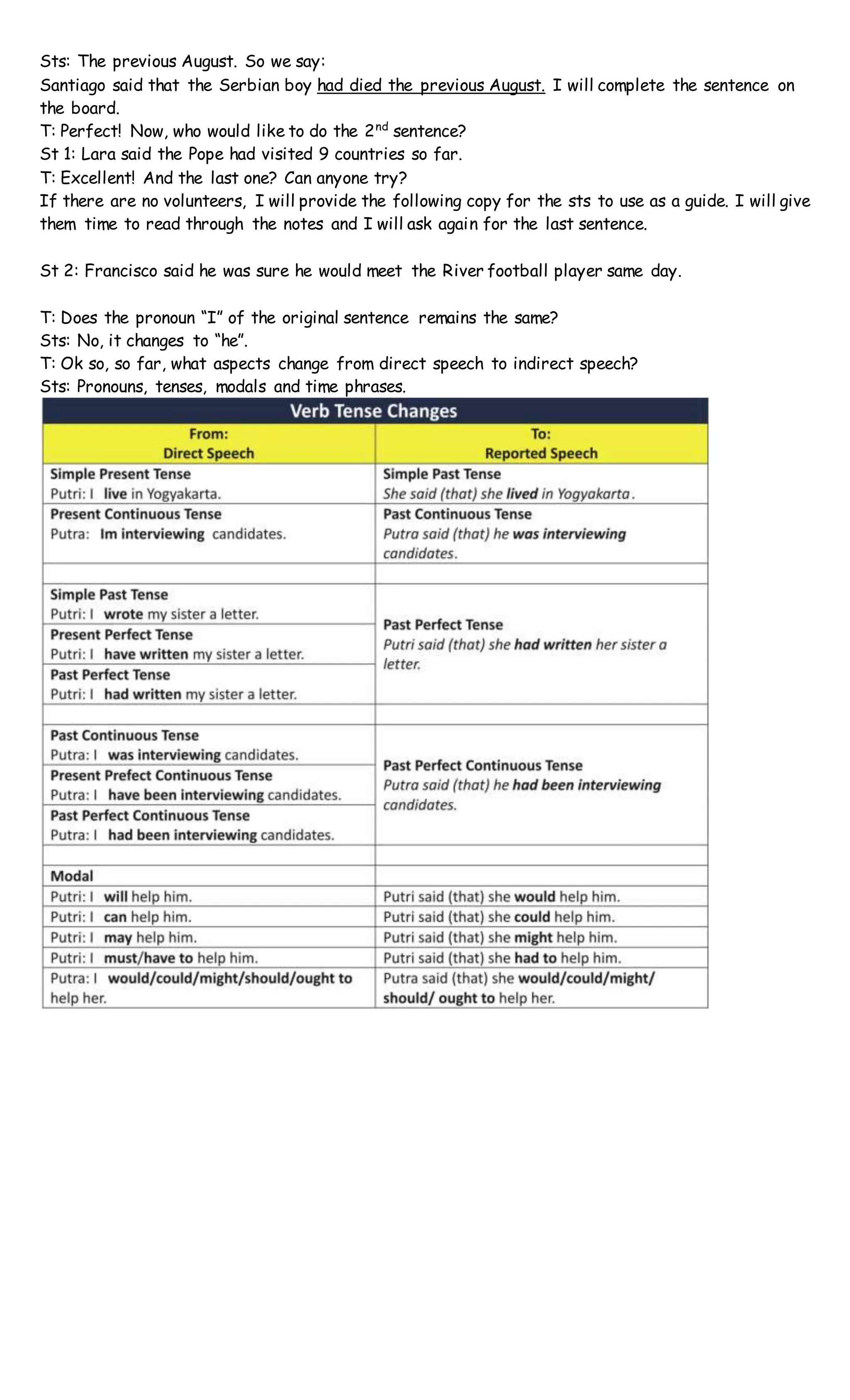
T: Ok so, so far, what aspects change from direct speech to indirect speech?
Sts: Pronouns, tenses, modals and time phrases.
Source:http://teacherpatriciomaureira.blogspot.com.ar/
Transition: Excellent! How about adding something else to these lists?
Activity 3: 10´
Purpose: to brainstorm and teach reporting verbs
T: If we want to report someone´s words we cannot be repeating: Francisco said this, he said that,
he told us this, etc. so as not to bore the listener, do you remember which other verbs we can use?
Sts: Exclaimed, answered, claimed!
T: Perfect! I´m going to give you some other reporting verbs but you have to find the pairs with
similar meanings and find their differences in formality. Work with your partner.
I´m going to deliver the following copy:
A B
admit inform
remember presume
tell confess
insist recollect
assume maintain
Source: I have designed it using different grammar books I have at home
KEY:
A B
admit confess
remember recollect
tell inform
insist maintain
assume presume
Before the sts complete the chart, I will check if they understand mainly: Presume, recollect,
maintain and assume.
T: Do you understand the meaning of presume?
St: It is to imagine or guess.
T: Ok, what about recollect?
Sts: It is the synonym of remember.
T: Or recall or think back. Very good! And maintain what´s the meaning of this verb in this
context? Probably this word is not well known for the sts so I will explain its meaning like this:
T: It means to claim, to assert. So you can say,
The accused maintained he was innocent.
Then I will give the sts some minutes to complete the chart.
T: Now, who can read the pairs?
After checking the answers I will ask about the formality of the verbs.
T: Which are more formal?
Sts: The ones in column B.
T: Yes! But let´s leave this chart open in case other verbs appear!
Transition: let´s see how much you brain can remember!
Activity 4: 15´
Purpose: to use the target structure in a less controlled and meaningful context.
T: Now, working in the same group you were before, you have to try to report one of your
classmates´ dialogues. You have to use as many reporting verbs as you can. Don´t forget to resort
to the notes you took and the copies I have given you!
While the sts are writing the dialogues, I will walk around checking understanding, use of reporting
speech and verbs, prompting possibilities, etc.
Once they have finished I will ask some volunteers to read the 5 dialogues aloud.
Transition: Excellent! Let´s do the last activity!
Activity 5: 10´
Purpose: to recall the theory the sts have seen in this class while using the definite article
T: Working in the same group I want you to write 2 golden rules specific about reported speech.
Choose 2 of these expressions to write the rules:
I will write these opening expressions on the board:
 The tenses, time phrases, pronouns are ……
 The verb(s)……
 The reporting verb(s)……
The different groups will read out their golden rules and if there is time I or a volunteer will write
them on the board (or on a poster “cartulina” to leave it in the classroom) like this:
Rule # 1:
Rule # 2:
Rule # 3, etc.
Then I will tell them about the next-class quiz.
T: As you have just summarized in these 3 golden rules, you have learned a lot today so I think it
will be good for you to go over this topic at home and so next class we are going to have a quiz. So
you can check how is your learning process going on, consider it a self-evaluation. And don´t forget
to read the story “Same place, same time” and bring the mate and cookies!
When sts have the “literature morning” they bring “los mates” and some cookies to share while
working on the story of the day. I will also tell the sts what will be quiz about and ask for queries.
T: Now put your belongings away and let´s go to the break! See you next week!
Taller de Práctica Docente 2015
Tutora: Prof. Cecilia A. Zemborain
Co- tutora: Prof. Graciela Inés Manzur
Lesson Plans – Practicum – Third Period
I.F.D.C. LenguasVivas
ALUMNA PRACTICANTE: Paula Schulze
Compañera que revisó el plan: Myriam Tielve
Período de Práctica: Tercero – Nivel Secundario
Institución Educativa: Colegio Bilingüe Neuquén
Dirección:Los Álamos 700, Neuquén
Sala/Grado/Año: 4to año
Cantidad de alumnos: 19
Nivel Lingüístico del curso: Intermedio alto
Tipo de Planificación: Clase
UnidadTemática: La soledad
Clase N°: 3
Fecha: 13/10/2015
Hora: 11 – 12.20
Duración de la clase: 80 minutos
Fecha de la primera entrega: 7/10/15
 Teaching Points:
Vocabulary from the short story “Same time, same place” by Bates
Revising topic: Reported speech
 Aims and goals:
During this lesson, learners will be able to…
 Develop their listening and speaking skills by talking about different and diverse perspectives
involved in the topic.
 Develop their writing skill at the time of noting down characters’ traits
 Develop their reading skill by understanding and decoding given phrases
 Language focus:
LEXIS FUNCTION STRUCTURES PRONUNCIATION
REVISION Possible vocabulary
that may appear:
Well off
To live on a pension
Feel lonely
Pathetic personality
Feel sympathy for
To accept/ refuse
so´s proposal
Talk about
diverse
perspectives
Changes that
occur in
pronouns
tenses and
time
expressions
in reported
speech
I have a car.
Recognition and
use of the words
/maɪˈnjuːt/ (adj)
minute
/ˈhɒmˌbɜː(r)ɡ/ (n)
homburg
He said he had
a car.
NEW Vocabulary:
- a thorn in someone
flesh
-To keep up
appearances
-A rummage sale
-To fall to pieces
-A mere kennel 7
feet by 10
-By Jove!
-With considerable
diffidence
-To look after
someone
-At dead on twelve
-To do sth like fury
-To draw someone´s
pension
-To hiss at each
other
-To struggle to do
sth.
-Talk about
diverse
perspectives
considering
one´s point
of view
-Talk about
what someone
has said using
different
reporting
verbs
Recognition and
use of the vowel
sounds
/əˈpɪərəns/ like in
Appearance
/ˈrʌmɪdʒ/ like in
rummage sale
 Teaching approach: The Natural Approach as the students are expected to interact with the
teacher and peers in a natural way promoting in this way the communicative abilities. Since language
and vocabulary are of principal importance for this approach and to acquire the language, at times, I
will encourage the students to concentrate mainly on the understanding of the message rather on
the target language specifically. Consequently, learners are also expected to acquire language in a
free-stress classroom environment. Besides, the PPP method will be used as well to introduce the
target structure.
 Integrating skills: during this class students will develop their listening skill while listening to the
teacher and to their mates. They will also integrate reading and writing when they are asked to
write sentences based on facts from the story and then read them aloud. Different learning styles
are also taken into account when including a listening activity for auditory learners and a concept
map for visual and logical students.
 Materials and resources: story handout – cd player – cd- markers for the board- copies – slips of
paper – my laptop
 Pedagogical use of ICT in class: In this lesson we will work with ICT support to assess sts´
listening skill during the quiz.
 Seating arrangements: The students will be sitting in lines of 4 or 5 desks but at times they will
move places to work in groups or pairs as requested by the activity proposed.
 Cooperative work: sts will work in pairs to discuss and agree on the main features or main
similarities between the main characters of the story.
 Possible problems/difficulties and their solutions during the class: in the last activity sts may
include questions that later on have to be reported by peers, as this hasn´t been taught yet, I will
prompt the possibilities. Example:
St1 why did you leave? Where do you live?
T: he asked her why she had left or where she lived
 Potential problems students may have with the language: Students may find it difficult to
understand the ending of the story; in this case I will lead the sts with open questions for their
comprehension and production stages.
 Assessment: I will assess learners’ comprehension and understanding through their oral
interactions, and their participation and development during the activities.
Routine: 5´
Purpose: to greet students and get them into a positive mood to start the lesson.
I will ask the sts the date and write it on the blackboard (this is the teacher´s routine so I will
stick to it).
Transition: How if we have the quiz on reported speech first and then we plunge into the short
story?
Activity 1: 15´
Purpose: to introduce a context while listening to a journalist´s report for sts´ self-assessment on
reported speech.
I have chosen the material from the st´s book as suggested by the teacher so as to work on
material the sts already have.
T: Ok sts. You are going to listen to a journalist reporting on a problem in education. While doing
so, you have to complete a gapped text and then do 3 exercises on reported speech. I´m going to
play the CD twice. The answers must be on an extra sheet of paper and don’t forget to write down
your names and use legible handwriting.
So open your book at page 131 and go to exercise 7. What shall we do 1st
with the text?
Sts: read it through
T: Great! You will have a quick look and try to predict the words that may go in the gaps. I will give
you some minutes for you to do so before the 1st
listening.
In case of electricity problems, I will read the script of the interview changing tones of voice
while reading the different characters’ words.
Script:
KEY:
Listening activity:
1) Twenty
2) Headmaster
3) Spelling
4) Technique
5) Pupils
6) The wrong vowels
7) Full stops
8) Minister
9) Union
10)muscles
The follow-up exercises:
Source:SpotlighttoFCE byAlastairLan; Cengage Learning;National GeographicLearning(2015).
KEY: Exercises 8,9 and 10
T: Ok, now I want you to exchange the answer sheet with your nearby classmate to do peer-
correction. Once you have your classmate´s sheet of paper, have a look at his/her answers. Is
there anything you do not understand? This is the time to ask.
I will give the sts some time to do this. I will do so in order to have objective or accurate
corrections.
T: So now, let´s check the answers together. Take a color pen or pencil to write the ticks or
corrections if needed.
T: Who can read the article with the missing information?
Then T and sts will check the answers orally. Once finished, sts will give the answer sheet back to
his/her owner with the corrections done and a score provided using this technique of percentage:
21/21 (there are 21 blanks to be filled in).
Then I will collect the answer sheets and give them to the class teacher.
T: How was your performance? Do you feel secure about this topic or do you feel you have to
practice it a bit more? If so, which aspects? If sts come out with doubts about the topic I can
prepare some extra exercises or another presentation as well.
Transition: Very good! Talking about speech, how if we see what the story´s characters have to
tell us?
Activity 1: 5´
Purpose: to introduce a 1st
discussion about the short story
T: Please, would you take the short story Same Time, Same Place by Bates? (sts have it in their
book "From the Cradle to the Grave" by Oxford Bookworms Collection. A copy is included below).
And get ready to indulge yourself in some “mates” and some cookies!
Now, throughout some comprehension questions I would like to get the sts hooked on the story´s
analysis.
T: How did you like the story?
St 1: I liked it very much although there are only 2 main characters.
T: Yes! Do you remember their names?
Sts: Miss Doris Treadwell and Harry Mr. Thornhill.
T: Do you understand the meanings of “tread” and “thorn”?
Sts: A step and a spine
T: Ok so, do these names have any reference to the story? What is the possible relation of their
names and their relation? How are their names related to their relations?
Sts: Yes, because she was sure about her lifestyle and he appeared in her life as a spine.
T: Yes, and he became a thorn in her flesh. (I will write the expression on the board). Do you
agree?
Sts: Yes!
T: Do you think the main character was happy or wanted to believe she was happy?
Sts: She was really happy and the presence of Mr. Thornhill disturbed that happiness.
T: How old is Miss Treadwell?
Sts: She is in her late fifties.
T: Do you think she had ever been married? Why?
Sts: Probably she had been because she was not afraid of sitting next to Mr. Thornhill the 1st
time
she saw him in the park.
Transition: let´s see how the author describes the characters’ personalities!
Activity 2: 15´
Purpose: to introduce and analyze in context the language used by the author
T: I will deliver a photocopy with vocabulary or expressions from the short story. You have to get
in pairs and find these expressions in the story. Then rephrase them in your own words.
The purpose of the activity is to focus on particular features of the language, its use and meaning.
I have selected the phrases I think will better help the sts to analyze the characters’ attitudes or
personalities.
I will not include the definitions in the sts´ copies.
1. To keep up appearances =to pretend that everything is good,for example with your marriage or your
financial situation,even though you are having problems
2. A rummage sale = (Am E) an event where people raise moneyby selling old clothes and other things that
you no longer want, sold to raise money.The British word is jumble sale.
3. To fall to pieces =to be in a very bad condition because ofbeing old or badly made
4. A mere kennel 7 feet by 10 = very small building where a dog sleeps
5. By Jove! =used for emphasizing whatyou are saying or for expressing surprise
6. With considerable diffidence = not confident or shy
7. To look after someone /something = to take care of someone or something and make certain that
they have everything they need
8. At dead on twelve = at exactly 12 p.m.
9. To do sth like fury = to do something with a lot of energy and determination
10. To draw someone´s pension = to receive money regularly after he/she has stopped working
because oftheir age,paid either by their companyor by the government
11. To hiss at each other = to complain in a softvoice
12. To struggle to do sth. = to try hard to do something thatyou find very difficult
Source: http://www.macmillandictionary.com/dictionary/british/
Once the sts have finished we will discuss the meaning of those given expressions in relation to
the context given in the story. We will not analyze the characters yet.
Transition: Let´s use all these expressions to describe the singular main characters!
Activity 3: 20´
Purpose: to compare and contrast the main characters of the story
I will prepare some signs (similar to the one sts use to write their names) with a number on them,
from 1 to 6 so as to organize the following activity.
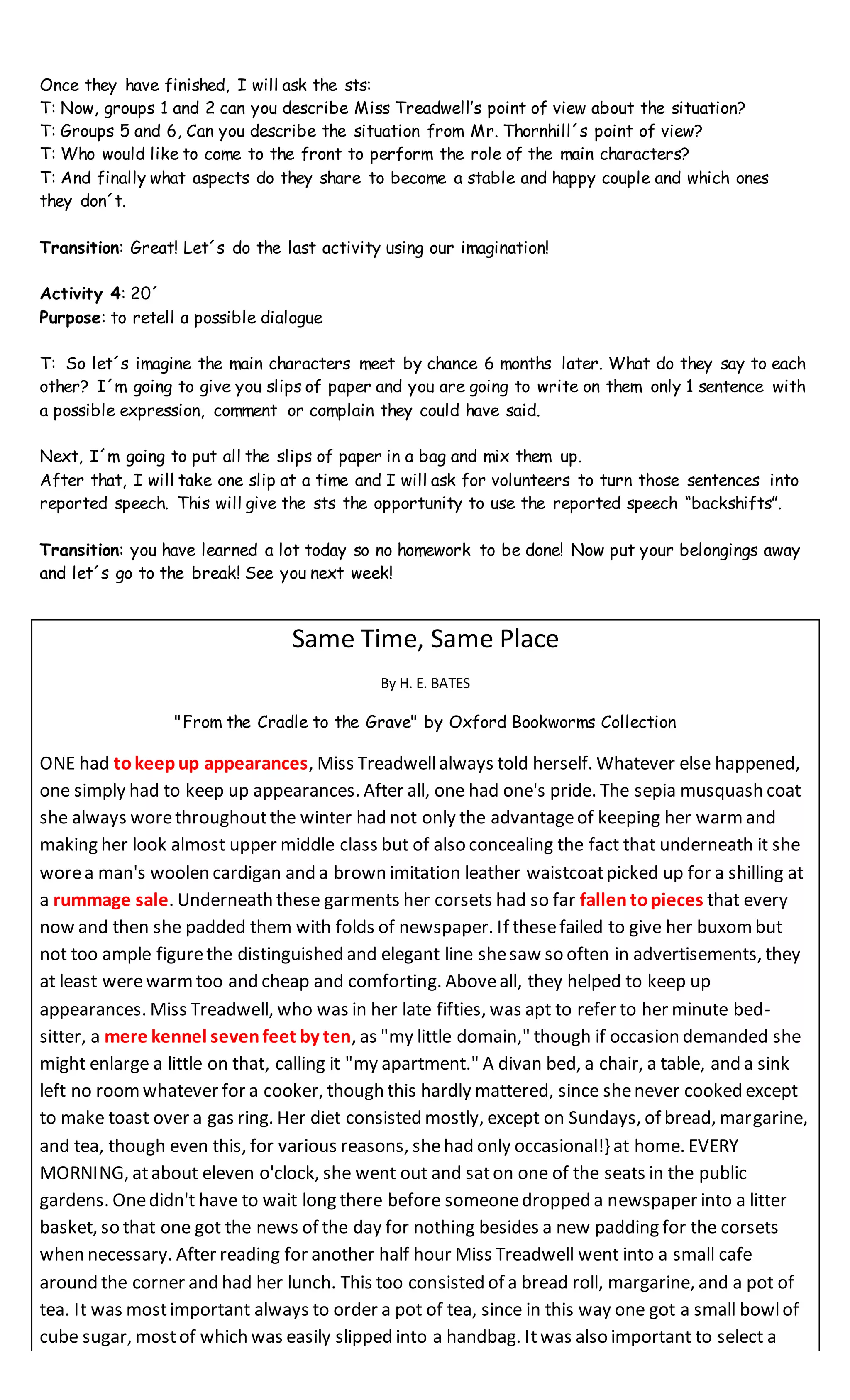
T: I will name the sts to get in 5 groups of 3 and 1 of 4 members (there will be 6 groups); you will
have to complete the following concept map, but:
 2 groups will describe Miss Doris Treadwell, GROUPS 1&2
 2 groups will describe Mr. Harry Thornhill GROUPS 5&6
 2 groups will describe the similarities and differences between both characters. GROUPS
3&4
GROUPS 1&2 GROUPS 3&4 GROUPS 5&6
CHARCATERISTICS SIMILARITIES OR CHARCATERISTICS
DIFFERENCES
T: In all cases, the descriptions must be only supported trough the evidence you have in your
story, no presuppositions or feelings you have towards them; only facts.
Remember you can take the dictionaries if you want.
Sts have a locker in their classroom with all their English-English dictionaries in and they take
them when in need.
T: What concrete aspects can we take into account to compare or contrast them?
Sts: Appearances, habits, apartments, their exact words or thoughts.
T: Perfect! Get down to business!
While sts are doing this activity I will walk around checking their analysis, prompting vocabulary,
encouraging the use of the new expressions and checking they are supporting their choices on
facts.
After that, I will ask the groups to share the aspects they had examined. The others will have to
complete the concept map while listening to their classmates. The 2nd
group will also be asked to
pay attention to the facts the 1st
group lists so as not to repeat given information.
I have chosen this way because if sts fill in the whole chart directly, at the time of the retelling
they do not pay attention to their peers because they have already answered or covered all the
stages of the map. In this way they will have only 1 section of the concept map completed
therefore they will have to pay attention to their peers’ retelling.
Miss
Treadwell
Mr. Thornhill
Once they have finished, I will ask the sts:
T: Now, groups 1 and 2 can you describe Miss Treadwell’s point of view about the situation?
T: Groups 5 and 6, Can you describe the situation from Mr. Thornhill´s point of view?
T: Who would like to come to the front to perform the role of the main characters?
T: And finally what aspects do they share to become a stable and happy couple and which ones
they don´t.
Transition: Great! Let´s do the last activity using our imagination!
Activity 4: 20´
Purpose: to retell a possible dialogue
T: So let´s imagine the main characters meet by chance 6 months later. What do they say to each
other? I´m going to give you slips of paper and you are going to write on them only 1 sentence with
a possible expression, comment or complain they could have said.
Next, I´m going to put all the slips of paper in a bag and mix them up.
After that, I will take one slip at a time and I will ask for volunteers to turn those sentences into
reported speech. This will give the sts the opportunity to use the reported speech “backshifts”.
Transition: you have learned a lot today so no homework to be done! Now put your belongings away
and let´s go to the break! See you next week!
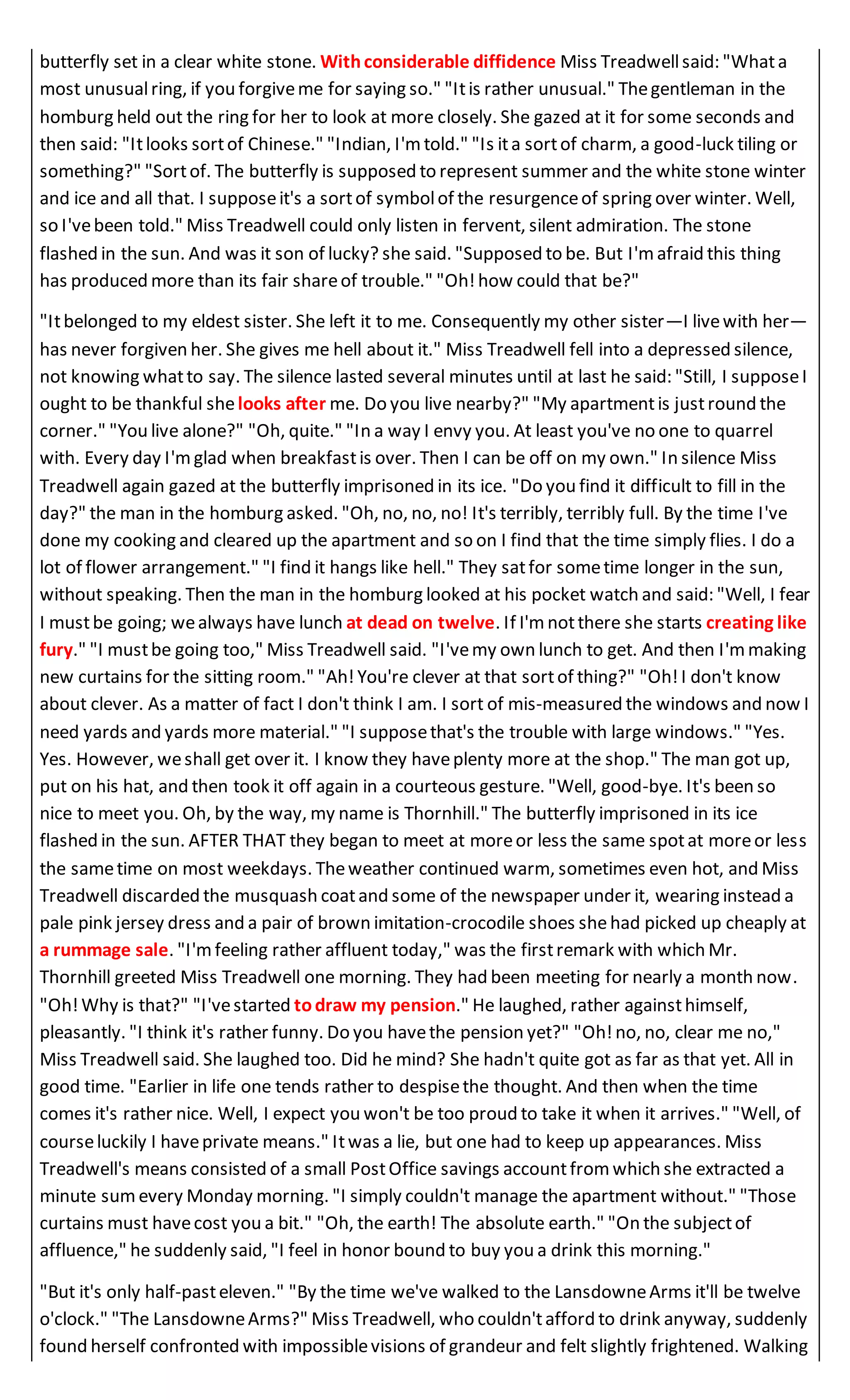
Same Time, Same Place
By H. E. BATES
"From the Cradle to the Grave" by Oxford Bookworms Collection
ONE had tokeepup appearances, Miss Treadwellalways told herself. Whatever else happened,
one simply had to keep up appearances. After all, one had one's pride. The sepia musquash coat
she always worethroughoutthe winter had not only the advantageof keeping her warmand
making her look almost upper middle class but of also concealing the fact that underneath it she
worea man's woolen cardigan and a brown imitation leather waistcoatpicked up for a shilling at
a rummage sale. Underneath these garments her corsets had so far fallen topieces that every
now and then she padded them with folds of newspaper. If thesefailed to give her buxombut
not too ample figurethe distinguished and elegant line shesaw so often in advertisements, they
at least werewarmtoo and cheap and comforting. Aboveall, they helped to keep up
appearances. Miss Treadwell, who was in her late fifties, was apt to refer to her minute bed-
sitter, a mere kennel sevenfeet by ten, as "my little domain," though if occasion demanded she
might enlarge a little on that, calling it "my apartment." A divan bed, a chair, a table, and a sink
left no roomwhatever for a cooker, though this hardly mattered, since shenever cooked except
to make toast over a gas ring. Her diet consisted mostly, except on Sundays, of bread, margarine,
and tea, though even this, for various reasons, shehad only occasional!} at home. EVERY
MORNING, atabout eleven o'clock, she went out and saton one of the seats in the public
gardens. Onedidn't have to wait long there before someonedropped a newspaper into a litter
basket, so that one got the news of the day for nothing besides a new padding for the corsets
when necessary. After reading for another half hour Miss Treadwell went into a small cafe
around the corner and had her lunch. This too consisted of a bread roll, margarine, and a pot of
tea. It was mostimportant always to order a pot of tea, since in this way one got a small bowlof
cube sugar, mostof which was easily slipped into a handbag. Itwas also important to select a
table wheresomeone else had recently been eating. In this way one quite often found two or
three pennies or even sixpence left under a plate and uncollected by a busy waitress. After lunch
she always wentback to the gardens to visit the Public Ladies. Itwas quite extraordinary what
one sometimes found in the Public Ladies. Frequently someonehad forgotten a lipstick, a
powder compact, a comb, a box of eye shadow. OnceMiss Treadwell had actually found a small
handbag containing, among other things, a bottle of peroxide. With the use of this she suddenly
went sensationally and almost youthfully blonde, thus keeping up appearances dramatically. She
had learned other tricks by experience: for example, that late on Saturday afternoons onecould
buy, for a few pence, bags of unsold cakes that wouldn'tkeep in the shops until Monday, or bags
of broken biscuits that made a delicious Sunday treat if you put them in a bowland poured a
layer of thin hot chocolate over them. There were also flowers: sometimes as you walked
through the street marketyou came across a whole box of them, daffodils or roses or carnations
or gladioli, that had dropped froma truck and nobody had ever bothered to pick up. A few
swiftly snatched-up stalks turned the bed-sitter into a little paradise. SOONAFTERthe incident of
the peroxide that had turned her a light youthful blonde and helped to keep up her appearances
so dramatically, shewas sitting in the public gardens on an April morning. The day was suddenly
and unusually hot; tulips that had been mere half-green buds the day before werenow
becoming, every moment, moreand more like shimmering open wineglasses of pink and scarlet
and yellow; an occasionalwhite or yellow butterfly skimmed through the many wide yellow
trumpets of daffodils under trembling pink canopies of cherry blossom. Allthe many seats in the
gardens werecrowded. Itwas very much a morning when appearances mattered. The only place
she could find to sit down was next to a gentleman who, because of the sudden April heat, had
taken off his black homburg and laid it on the seat beside him. As Miss Treadwell approached he
removed the hat and balanced it on his knee. His hair was a smooth iron gray. This alone would
not have confirmed him as a gentleman, but the homburg hat most certainly did. Men who wore
homburgs werealways gentlemen. Alter studying his newspaper in concentrated silence for
another five minutes, he folded it up and laid that too on the seat beside him. Unwilling to
appeal- too eager, Miss Treadwell waited some further minutes before saying: "I hopeyou won't
think me rude, l)iit 1 wonder—could I take a tiny glance at your newspaper? I couldn'tget one
this morning." "Ob, by all means. By all means. Take it, please. I'vefinished with it anyway." "Oh,
T didn't mean to take it altogether." "Oh, do!I'vefinished the crossword. And onceI'vefinished
that I'mnot interested. Do you do the crossword?" No, Miss Treadwellhad to confess, shenever
did the crossword. Shesupposed shewasn'tclever enough for that. "Nor was I, this morning.
There was a devil of a clue and the only word that fitted was 'poitivene.' Had
"And what on earth is it?" "It's a sortof chrysanthemum." "Isit, by Jove! How ever did you
know?" Miss Treadwellsaid shehad seen them on the market flower stalls, labeled. There was
another one called rayonante. Shealways thought they weresuch pretty names, she said, and
the gentleman in the homburg gave her a long friendly blue-eyed stareof admiration.
me stuck for an hour. Do you know what a poitivene is?" Miss Treadwell suddenly felt flattered
and very pleased with herself. Yes, she said, as a matter of fact she did.
SII.KXCK camebetween them for some few minutes after this, until finally the gentleman in the
homburg said: "What a beautiful morning." "Lovely. Spring at last." "Spring at last." Miss
Treadwell now opened the paper and pretended to read it without actually seeing a single word.
At the same time the gentleman in the homburg extended a hand and laid it on the paper and
said: "Thecartoon's rather good today. Pagefive. Allow me." As the gentleman in the homburg
turned the pages of the paper, Miss Treadwell suddenly noticed an extraordinary thing. On the
third finger of his left hand lie was wearing a lather large ring. Itwas in the shape of a turquoise
butterfly set in a clear white stone. Withconsiderable diffidence Miss Treadwellsaid: "Whata
most unusualring, if you forgiveme for saying so." "Itis rather unusual." Thegentleman in the
homburg held out the ring for her to look at more closely. She gazed at it for some seconds and
then said: "Itlooks sortof Chinese." "Indian, I'm told." "Is ita sortof charm, a good-luck tiling or
something?" "Sortof. The butterfly is supposed to represent summer and the white stone winter
and ice and all that. I supposeit's a sortof symbolof the resurgenceof spring over winter. Well,
so I'vebeen told." Miss Treadwell could only listen in fervent, silent admiration. The stone
flashed in the sun. And was it son of lucky? she said. "Supposed to be. But I'm afraid this thing
has produced more than its fair shareof trouble." "Oh!how could that be?"
"Itbelonged to my eldest sister. She left it to me. Consequently my other sister—I livewith her—
has never forgiven her. She gives me hell about it." Miss Treadwell fell into a depressed silence,
not knowing whatto say. The silence lasted several minutes until at last he said: "Still, I supposeI
ought to be thankful shelooks after me. Do you live nearby?" "My apartmentis justround the
corner." "You live alone?" "Oh, quite." "In a way I envy you. At least you've no one to quarrel
with. Every day I'mglad when breakfastis over. Then I can be off on my own." In silence Miss
Treadwell again gazed at the butterfly imprisoned in its ice. "Do you find it difficult to fill in the
day?" the man in the homburg asked. "Oh, no, no, no! It's terribly, terribly full. By the time I've
done my cooking and cleared up the apartment and so on I find that the time simply flies. I do a
lot of flower arrangement." "I find it hangs like hell." They satfor sometime longer in the sun,
without speaking. Then the man in the homburg looked at his pocket watch and said: "Well, I fear
I mustbe going; wealways have lunch at dead on twelve. If I'm notthere she starts creating like
fury." "I mustbe going too," Miss Treadwell said. "I'vemy own lunch to get. And then I'mmaking
new curtains for the sitting room." "Ah!You're clever at that sortof thing?" "Oh!I don't know
about clever. As a matter of fact I don't think I am. I sort of mis-measured the windows and now I
need yards and yards more material." "I supposethat's the trouble with large windows." "Yes.
Yes. However, weshall get over it. I know they haveplenty more at the shop." The man got up,
put on his hat, and then took it off again in a courteous gesture. "Well, good-bye. It's been so
nice to meet you. Oh, by the way, my name is Thornhill." The butterfly imprisoned in its ice
flashed in the sun. AFTER THAT they began to meet at moreor less the same spotat moreor less
the sametime on most weekdays. Theweather continued warm, sometimes even hot, and Miss
Treadwell discarded the musquash coatand some of the newspaper under it, wearing instead a
pale pink jersey dress and a pair of brown imitation-crocodile shoes shehad picked up cheaply at
a rummage sale. "I'mfeeling rather affluent today," was the firstremark with which Mr.
Thornhill greeted Miss Treadwell one morning. They had been meeting for nearly a month now.
"Oh!Why is that?" "I'vestarted todraw my pension." He laughed, rather againsthimself,
pleasantly. "I think it's rather funny. Do you havethe pension yet?" "Oh!no, no, clear me no,"
Miss Treadwell said. She laughed too. Did he mind? She hadn't quite got as far as that yet. All in
good time. "Earlier in life one tends rather to despisethe thought. And then when the time
comes it's rather nice. Well, I expect you won't be too proud to take it when it arrives." "Well, of
courseluckily I haveprivate means." Itwas a lie, but one had to keep up appearances. Miss
Treadwell's means consisted of a small PostOffice savings accountfrom which she extracted a
minute sum every Monday morning. "I simply couldn't manage the apartment without." "Those
curtains must havecost you a bit." "Oh, the earth! The absolute earth." "On the subjectof
affluence," he suddenly said, "I feel in honor bound to buy you a drink this morning."
"But it's only half-pasteleven." "By the time we've walked to the LansdowneArms it'll be twelve
o'clock." "The LansdowneArms?" Miss Treadwell, who couldn'tafford to drink anyway, suddenly
found herself confronted with impossiblevisions of grandeur and felt slightly frightened. Walking
across the public gardens, shekept her hands tightly folded in front of her in case one or moreof
the newspapers should slip and fall down. In the bar of the LansdowneArms, everything was
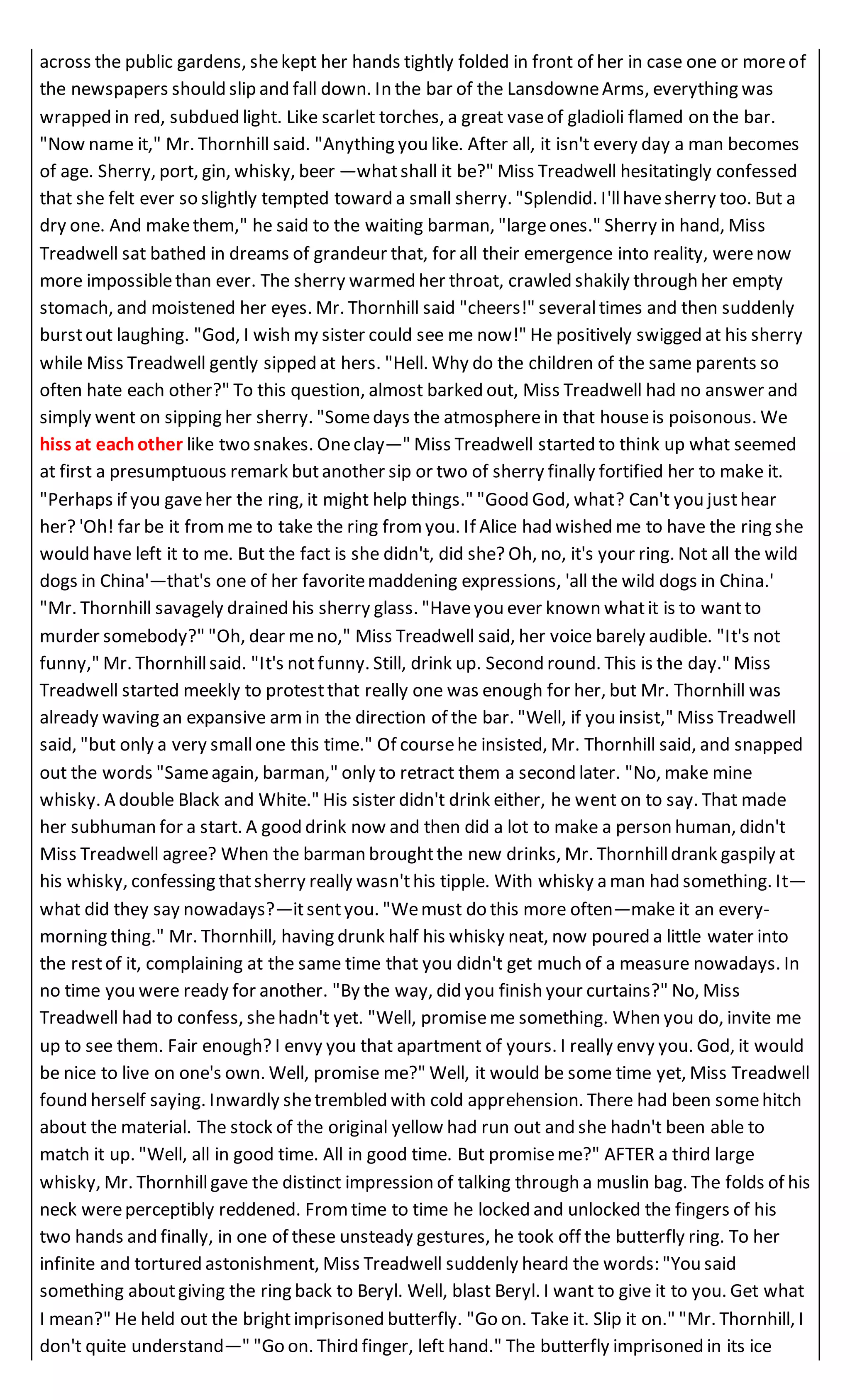
wrapped in red, subdued light. Like scarlet torches, a great vaseof gladioli flamed on the bar.
"Now name it," Mr. Thornhill said. "Anything you like. After all, it isn't every day a man becomes
of age. Sherry, port, gin, whisky, beer —whatshall it be?" Miss Treadwell hesitatingly confessed
that she felt ever so slightly tempted toward a small sherry. "Splendid. I'llhavesherry too. But a
dry one. And makethem," he said to the waiting barman, "largeones." Sherry in hand, Miss
Treadwell sat bathed in dreams of grandeur that, for all their emergence into reality, werenow
more impossiblethan ever. The sherry warmed her throat, crawled shakily through her empty
stomach, and moistened her eyes. Mr. Thornhill said "cheers!" severaltimes and then suddenly
burstout laughing. "God, I wish my sister could see me now!" He positively swigged at his sherry
while Miss Treadwell gently sipped at hers. "Hell. Why do the children of the same parents so
often hate each other?" To this question, almost barked out, Miss Treadwell had no answer and
simply went on sipping her sherry. "Somedays the atmospherein that houseis poisonous. We
hiss at eachother like two snakes. Oneclay—" Miss Treadwell started to think up what seemed
at first a presumptuous remark butanother sip or two of sherry finally fortified her to make it.
"Perhaps if you gaveher the ring, it might help things." "Good God, what? Can't you justhear
her? 'Oh! far be it fromme to take the ring from you. If Alice had wished me to have the ring she
would have left it to me. But the fact is she didn't, did she? Oh, no, it's your ring. Not all the wild
dogs in China'—that's one of her favoritemaddening expressions, 'all the wild dogs in China.'
"Mr. Thornhill savagely drained his sherry glass. "Haveyou ever known whatit is to wantto
murder somebody?" "Oh, dear meno," Miss Treadwell said, her voice barely audible. "It's not
funny," Mr. Thornhillsaid. "It's notfunny. Still, drink up. Second round. This is the day." Miss
Treadwell started meekly to protestthat really one was enough for her, but Mr. Thornhill was
already waving an expansive armin the direction of the bar. "Well, if you insist," Miss Treadwell
said, "but only a very smallone this time." Of coursehe insisted, Mr. Thornhill said, and snapped
out the words "Sameagain, barman," only to retract them a second later. "No, make mine
whisky. A double Black and White." His sister didn't drink either, he went on to say. That made
her subhuman for a start. A good drink now and then did a lot to make a person human, didn't
Miss Treadwell agree? When the barman broughtthe new drinks, Mr. Thornhilldrank gaspily at
his whisky, confessing thatsherry really wasn'this tipple. With whisky a man had something. It—
what did they say nowadays?—itsentyou. "Wemust do this more often—make it an every-
morning thing." Mr. Thornhill, having drunk half his whisky neat, now poured a little water into
the restof it, complaining at the same time that you didn't get much of a measure nowadays. In
no time you were ready for another. "By the way, did you finish your curtains?" No, Miss
Treadwell had to confess, shehadn't yet. "Well, promiseme something. When you do, invite me
up to see them. Fair enough? I envy you that apartment of yours. I really envy you. God, it would
be nice to live on one's own. Well, promise me?" Well, it would be some time yet, Miss Treadwell
found herself saying. Inwardly shetrembled with cold apprehension. There had been somehitch
about the material. The stock of the original yellow had run out and she hadn't been able to
match it up. "Well, all in good time. All in good time. But promiseme?" AFTER a third large
whisky, Mr. Thornhillgave the distinct impression of talking through a muslin bag. The folds of his
neck wereperceptibly reddened. Fromtime to time he locked and unlocked the fingers of his
two hands and finally, in one of these unsteady gestures, he took off the butterfly ring. To her
infinite and tortured astonishment, Miss Treadwell suddenly heard the words: "You said
something aboutgiving the ring back to Beryl. Well, blast Beryl. I want to give it to you. Get what
I mean?" He held out the brightimprisoned butterfly. "Go on. Take it. Slip it on." "Mr. Thornhill, I
don't quite understand—" "Go on. Third finger, left hand." The butterfly imprisoned in its ice
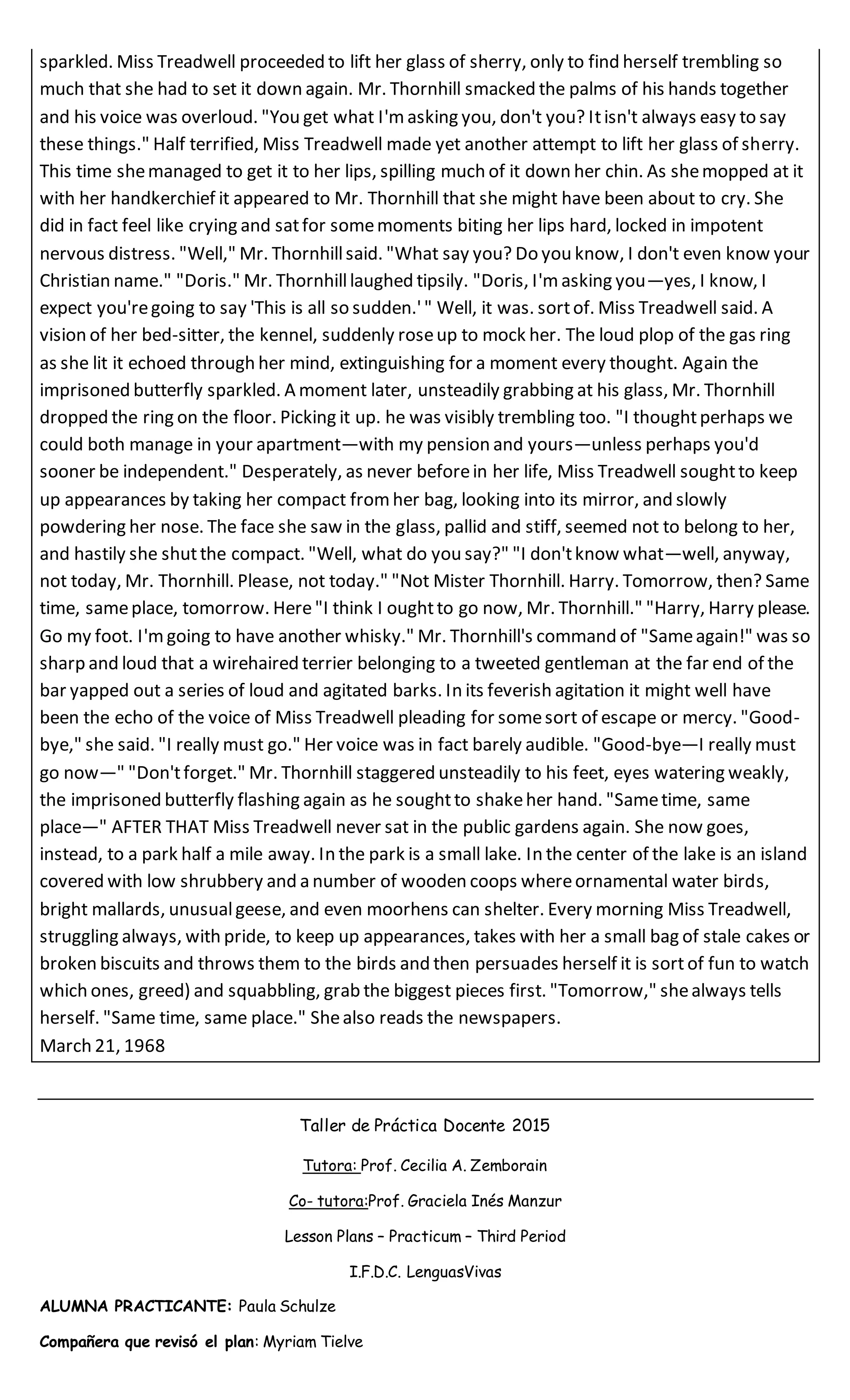
sparkled. Miss Treadwell proceeded to lift her glass of sherry, only to find herself trembling so
much that she had to set it down again. Mr. Thornhill smacked the palms of his hands together
and his voice was overloud. "You get what I'm asking you, don't you? Itisn't always easy to say
these things." Half terrified, Miss Treadwell made yet another attempt to lift her glass of sherry.
This time shemanaged to get it to her lips, spilling much of it down her chin. As shemopped at it
with her handkerchief it appeared to Mr. Thornhill that she might have been about to cry. She
did in fact feel like crying and satfor somemoments biting her lips hard, locked in impotent
nervous distress. "Well," Mr. Thornhillsaid. "What say you? Do you know, I don't even know your
Christian name." "Doris." Mr. Thornhilllaughed tipsily. "Doris, I'm asking you—yes, I know, I
expect you'regoing to say 'This is all so sudden.'" Well, it was. sortof. Miss Treadwell said. A
vision of her bed-sitter, the kennel, suddenly roseup to mock her. The loud plop of the gas ring
as she lit it echoed through her mind, extinguishing for a moment every thought. Again the
imprisoned butterfly sparkled. A moment later, unsteadily grabbing at his glass, Mr. Thornhill
dropped the ring on the floor. Picking it up. he was visibly trembling too. "I thoughtperhaps we
could both manage in your apartment—with my pension and yours—unless perhaps you'd
sooner be independent." Desperately, as never beforein her life, Miss Treadwell soughtto keep
up appearances by taking her compact from her bag, looking into its mirror, and slowly
powdering her nose. The face she saw in the glass, pallid and stiff, seemed not to belong to her,
and hastily she shutthe compact. "Well, what do you say?" "I don'tknow what—well, anyway,
not today, Mr. Thornhill. Please, not today." "Not Mister Thornhill. Harry. Tomorrow, then? Same
time, sameplace, tomorrow. Here"I think I oughtto go now, Mr. Thornhill." "Harry, Harry please.
Go my foot. I'mgoing to have another whisky." Mr. Thornhill's command of "Sameagain!" was so
sharp and loud that a wirehaired terrier belonging to a tweeted gentleman at the far end of the
bar yapped out a series of loud and agitated barks. In its feverish agitation it might well have
been the echo of the voice of Miss Treadwell pleading for somesort of escape or mercy. "Good-
bye," she said. "I really must go." Her voice was in fact barely audible. "Good-bye—I really must
go now—" "Don'tforget." Mr. Thornhill staggered unsteadily to his feet, eyes watering weakly,
the imprisoned butterfly flashing again as he soughtto shakeher hand. "Sametime, same
place—" AFTER THAT Miss Treadwell never sat in the public gardens again. She now goes,
instead, to a park half a mile away. In the park is a small lake. In the center of the lake is an island
covered with low shrubbery and a number of wooden coops whereornamental water birds,
bright mallards, unusualgeese, and even moorhens can shelter. Every morning Miss Treadwell,
struggling always, with pride, to keep up appearances, takes with her a small bag of stale cakes or
broken biscuits and throws them to the birds and then persuades herself it is sort of fun to watch
which ones, greed) and squabbling, grab the biggest pieces first. "Tomorrow," shealways tells
herself. "Same time, same place." Shealso reads the newspapers.
March 21, 1968
Taller de Práctica Docente 2015
Tutora: Prof. Cecilia A. Zemborain
Co- tutora:Prof. Graciela Inés Manzur
Lesson Plans – Practicum – Third Period
I.F.D.C. LenguasVivas
ALUMNA PRACTICANTE: Paula Schulze
Compañera que revisó el plan: Myriam Tielve
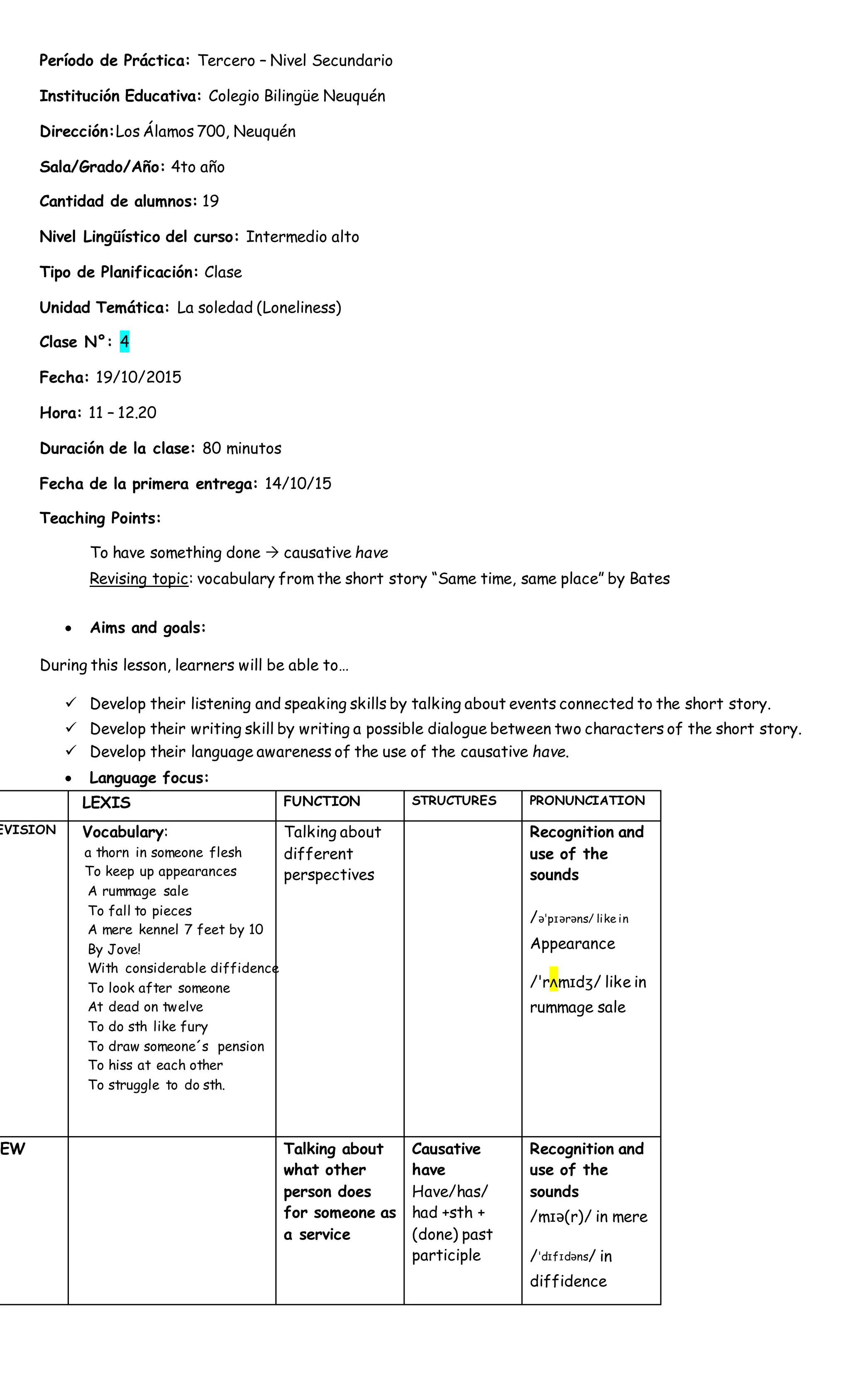
Período de Práctica: Tercero – Nivel Secundario
Institución Educativa: Colegio Bilingüe Neuquén
Dirección:Los Álamos 700, Neuquén
Sala/Grado/Año: 4to año
Cantidad de alumnos: 19
Nivel Lingüístico del curso: Intermedio alto
Tipo de Planificación: Clase
Unidad Temática: La soledad (Loneliness)
Clase N°: 4
Fecha: 19/10/2015
Hora: 11 – 12.20
Duración de la clase: 80 minutos
Fecha de la primera entrega: 14/10/15
Teaching Points:
To have something done  causative have
Revising topic: vocabulary from the short story “Same time, same place” by Bates
 Aims and goals:
During this lesson, learners will be able to…
 Develop their listening and speaking skills by talking about events connected to the short story.
 Develop their writing skill by writing a possible dialogue between two characters of the short story.
 Develop their language awareness of the use of the causative have.
 Language focus:
LEXIS FUNCTION STRUCTURES PRONUNCIATION
EVISION Vocabulary:
a thorn in someone flesh
To keep up appearances
A rummage sale
To fall to pieces
A mere kennel 7 feet by 10
By Jove!
With considerable diffidence
To look after someone
At dead on twelve
To do sth like fury
To draw someone´s pension
To hiss at each other
To struggle to do sth.
Talking about
different
perspectives
Recognition and
use of the
sounds
/əˈpɪərəns/ like in
Appearance
/ˈrʌmɪdʒ/ like in
rummage sale
NEW Talking about
what other
person does
for someone as
a service
Causative
have
Have/has/
had +sth +
(done) past
participle
Recognition and
use of the
sounds
/mɪə(r)/ in mere
/ˈdɪfɪdəns/ in
diffidence
 Teaching approach: The Natural Approach as the students are expected to interact with the
teacher and peers in a natural way promoting in this way the communicative abilities. Since language
and vocabulary are of principal importance for this approach and to acquire the language, I will
encourage the students to concentrate mainly on the understanding of the message rather on the
target language specifically. Consequently, learners are also expected to acquire language in a free-
stress classroom environment. Besides, the PPP method will be used as well to introduce the target
structure.
 Integrating skills: during this class students will integrate their speaking and listening skills to
improve their aural comprehension and production. They will also integrate reading and writing when
they are asked to write a dialogue and then read it aloud. Their conceptual thinking will also be
developed while analyzing the uses of the causative have.
 Materials and resources: color markers for the board, my laptop, photocopy, slip of paper
 Pedagogical use of ICT in class: In this lesson we will not work with ICT support or resources.
 Seating arrangements: The students will get in 4 groups to work in the same way during the whole
class.
 Cooperative work: sts will work in pairs to reason with evidence the changes the main characters of
the story may have undergone. They will also consider perspectives about the content of the
dialogues they will invent. Besides they will agree on how to include causative have in them.
 Possible problems/difficulties and their solutions during the class: I will carry my dictionary as in
the previous class. I have focused on causative “have” in passive voice. I have left aside the
causative “get” or the use of the active causative have such as in: I had the plumber fix the pipes.
 Potential problems students may have with the language: Students may find it difficult to include
the causative have in the last dialogue. If this is the case I will prompt or model some suggestions or
situations. I will also encourage the sts to have the grammar pattern at hand.
 Assessment: I will assess learners’ comprehension and understanding through their oral
interactions, and their participation and development during the activities.
Routine: 5´
Purpose: to greet students and get them into a positive mood to start the lesson.
I will elicit the date from the sts and write it on the board.
Transition: let´s get ready to talk about the short story!
Warm up: 5´
Purpose: to recall previous knowledge about vocabulary from the story and set the context
T: Ok sts! Do you remember the story we read last class? What was its name?
Sts: Same time, same place.
T: Who were the main characters?
Sts: Mr. Thornhill and Miss Treadwell.
T: What was mainly the story about? What was the main conflict?
Sts: Two elderly people; one feels lonely and the other one alone.
T: If you had to summarize the topic of the story, which one could be? Why?
Sts: Loneliness, because each of them is going through their life´s sufferings but in different
ways. Each of them has different perspectives about being alone, but each of them has
difficulties.
T: Do you remember that we also worked on some expressions?
Sts: Yes!
Transition: What if we revise those expressions?
Presentation
Activity 1: 25´
Purpose: to recall the vocabulary introduced during the previous class.
T: Do you like competitions?
Sts: Yes!
T: Ok, I’m going to give you 1 minute to have a look at the 12 expressions we worked on the other
class, for you to remember them. Then we are going to play a game!
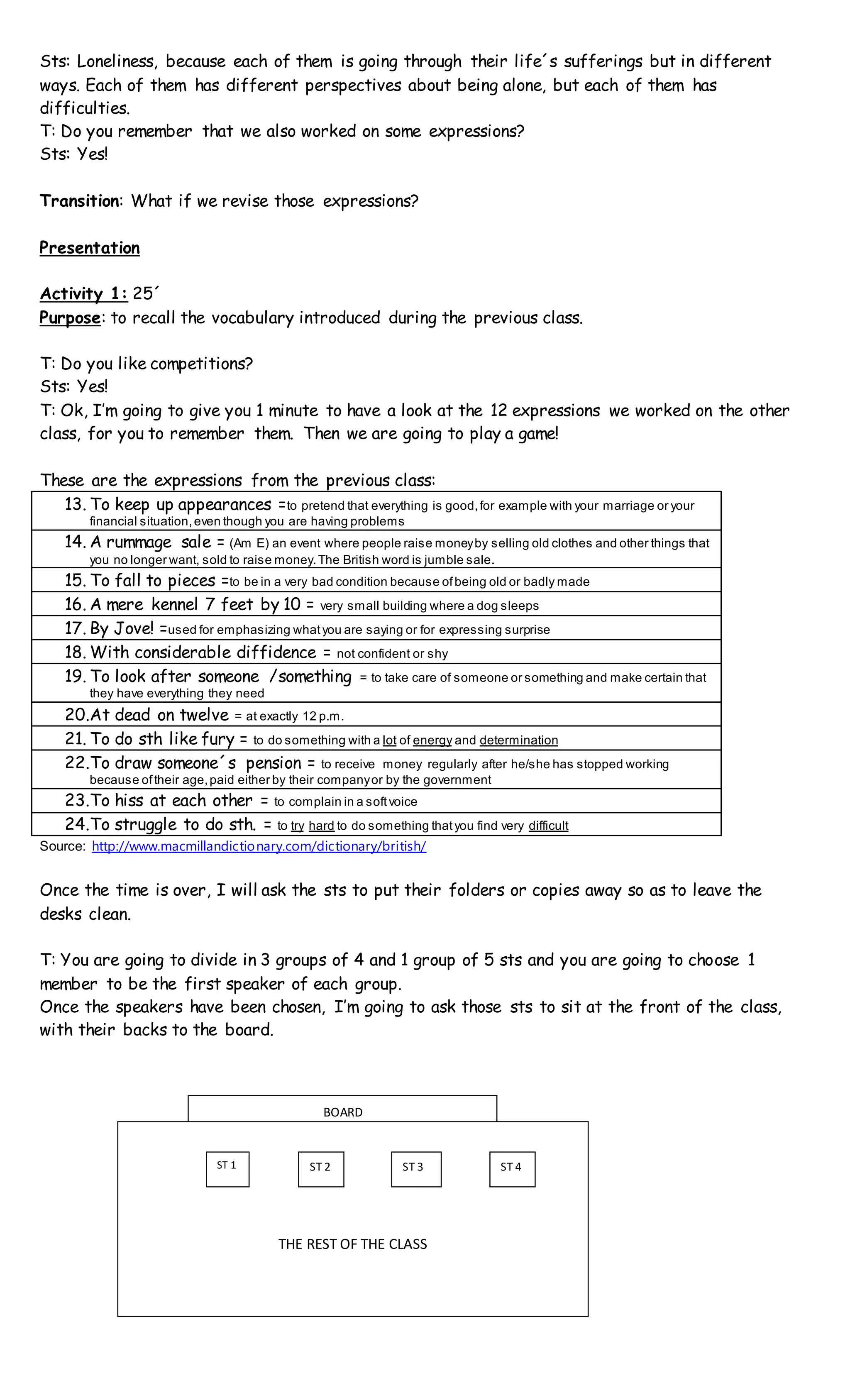
These are the expressions from the previous class:
13. To keep up appearances =to pretend that everything is good,for example with your marriage or your
financial situation,even though you are having problems
14. A rummage sale = (Am E) an event where people raise moneyby selling old clothes and other things that
you no longer want, sold to raise money.The British word is jumble sale.
15. To fall to pieces =to be in a very bad condition because ofbeing old or badly made
16. A mere kennel 7 feet by 10 = very small building where a dog sleeps
17. By Jove! =used for emphasizing whatyou are saying or for expressing surprise
18. With considerable diffidence = not confident or shy
19. To look after someone /something = to take care of someone or something and make certain that
they have everything they need
20.At dead on twelve = at exactly 12 p.m.
21. To do sth like fury = to do something with a lot of energy and determination
22.To draw someone´s pension = to receive money regularly after he/she has stopped working
because oftheir age,paid either by their companyor by the government
23.To hiss at each other = to complain in a softvoice
24.To struggle to do sth. = to try hard to do something thatyou find very difficult
Source: http://www.macmillandictionary.com/dictionary/british/
Once the time is over, I will ask the sts to put their folders or copies away so as to leave the
desks clean.
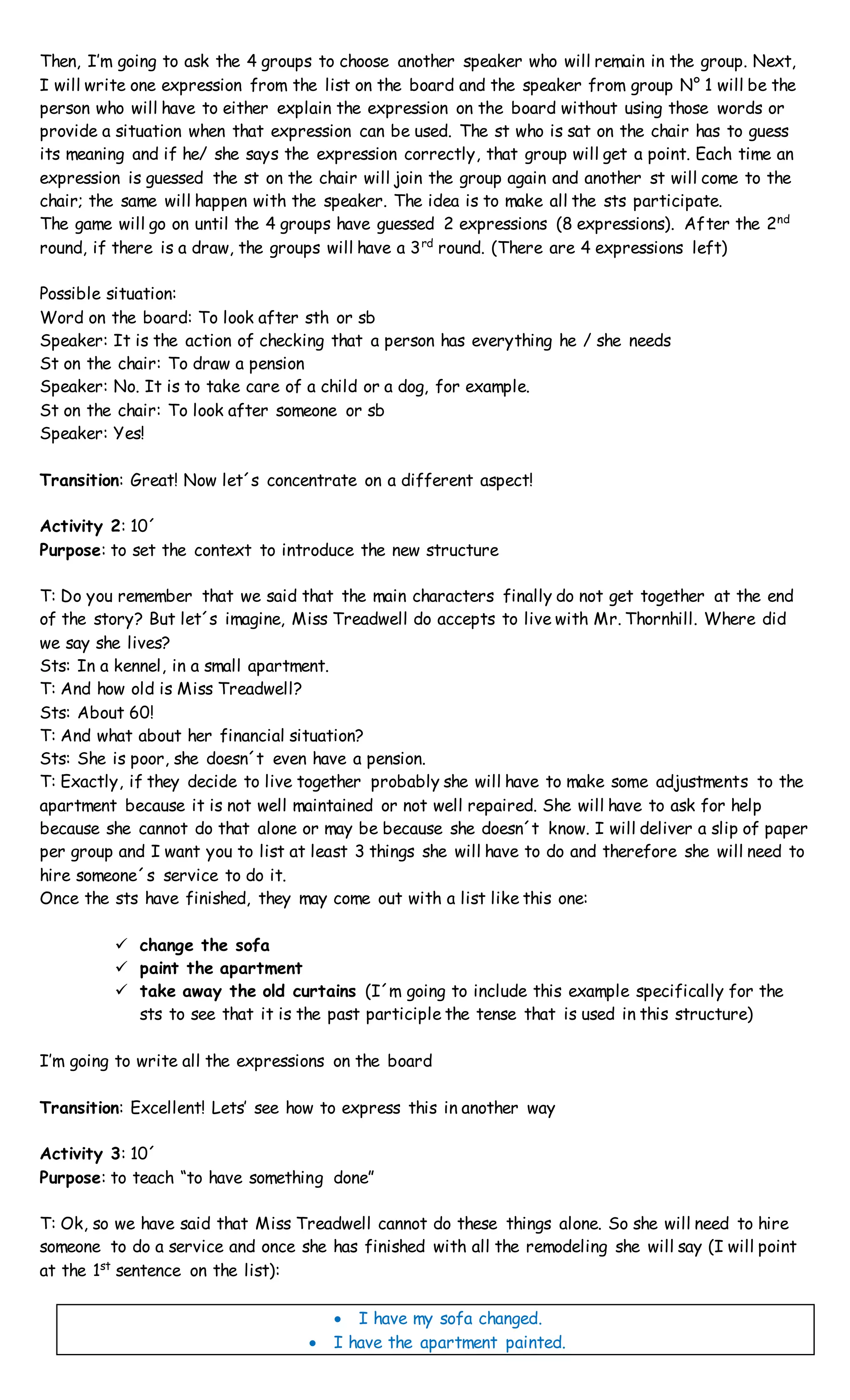
T: You are going to divide in 3 groups of 4 and 1 group of 5 sts and you are going to choose 1
member to be the first speaker of each group.
Once the speakers have been chosen, I’m going to ask those sts to sit at the front of the class,
with their backs to the board.
THE REST OF THE CLASS
ST 1 ST 2 ST 3 ST 4
BOARD
Then, I’m going to ask the 4 groups to choose another speaker who will remain in the group. Next,
I will write one expression from the list on the board and the speaker from group N° 1 will be the
person who will have to either explain the expression on the board without using those words or
provide a situation when that expression can be used. The st who is sat on the chair has to guess
its meaning and if he/ she says the expression correctly, that group will get a point. Each time an
expression is guessed the st on the chair will join the group again and another st will come to the
chair; the same will happen with the speaker. The idea is to make all the sts participate.
The game will go on until the 4 groups have guessed 2 expressions (8 expressions). After the 2nd
round, if there is a draw, the groups will have a 3rd
round. (There are 4 expressions left)
Possible situation:
Word on the board: To look after sth or sb
Speaker: It is the action of checking that a person has everything he / she needs
St on the chair: To draw a pension
Speaker: No. It is to take care of a child or a dog, for example.
St on the chair: To look after someone or sb
Speaker: Yes!
Transition: Great! Now let´s concentrate on a different aspect!
Activity 2: 10´
Purpose: to set the context to introduce the new structure
T: Do you remember that we said that the main characters finally do not get together at the end
of the story? But let´s imagine, Miss Treadwell do accepts to live with Mr. Thornhill. Where did
we say she lives?
Sts: In a kennel, in a small apartment.
T: And how old is Miss Treadwell?
Sts: About 60!
T: And what about her financial situation?
Sts: She is poor, she doesn´t even have a pension.
T: Exactly, if they decide to live together probably she will have to make some adjustments to the
apartment because it is not well maintained or not well repaired. She will have to ask for help
because she cannot do that alone or may be because she doesn´t know. I will deliver a slip of paper
per group and I want you to list at least 3 things she will have to do and therefore she will need to
hire someone´s service to do it.
Once the sts have finished, they may come out with a list like this one:
 change the sofa
 paint the apartment
 take away the old curtains (I´m going to include this example specifically for the
sts to see that it is the past participle the tense that is used in this structure)
I’m going to write all the expressions on the board
Transition: Excellent! Lets’ see how to express this in another way
Activity 3: 10´
Purpose: to teach “to have something done”
T: Ok, so we have said that Miss Treadwell cannot do these things alone. So she will need to hire
someone to do a service and once she has finished with all the remodeling she will say (I will point
at the 1st
sentence on the list):
 I have my sofa changed.
 I have the apartment painted.
 I have the old curtains taken away.
I will write these sentences next to the stem ones using another color.
T: Therefore, when we talk about services we pay someone else to do, we use the causative have.
I´ll write this as a title.
T: Now, have a look at the sentences in blue. I will give you 1 minute to find the grammar pattern
used in this new structure. I will give you the 1st
words:
And I will hand in this chart to each sts for them to complete it.
This grammar explanations make it a CLT plan.
CAUSATIVE HAVE
He /They + …………………… + ……………………… + ………………………
KEY
He /They + has/ have + something + past participle
Once the sts have finished with the grammar chart, we will check it all together and I will tell
them:
T: Let´s consider the 3rd sentence again. (As stated before, I will choose this sentence to make it
clear the use of the past participle). If Miss Treadwell talks about the past, how can she say it?
Sts: I had my curtains taken away.
In case sts do not know how to answer I will prompt: is it correct to say I have my curtains taken
away if she talks about the past?
T: What if she considers asking for that service in the future?
Sts: I will have my curtains taken.
T: What if she has already planned it?
Sts: I’m going to have the curtains taken.
T: Fantastic, I will include these possibilities in the pattern chart as well. I will write them on the
board.
Transition: Let´s include someone else in this situation!
Development
Activity 4: 20´
Purpose: to use the target structure in a less controlled and meaningful context.
T: So we have imagined that Mr. Thornhill and Miss Treadwell start living together. Who has been
left alone in an apartment?
Sts: Mr. Thornhill´s sister!
T: Yes! How old do you think she is?
Sts: Probably older than her brother.
T: Right! Let´s imagine the sister is chatting with a friend after a year that Mr. Thornhill has left
the apartment. I want you to work in the same groups and invent a short dialogue, no more than 10
lines, in which you include at least 3 services she has hired or she will hire and she tells her friend
about them. Don´t forget to use the pattern that is on the board.
Probable answers:
I have had my bedroom redecorated.
I have my brother´s pictures taken away.
I will have the old furniture taken.
While students are inventing the dialogue, I will walk around paying attention to the content of
what is being said but mainly to the structures the sts are using. If there is a communication
breakdown or misunderstanding in the communication, in that case I will prompt or provide some
words or expressions. In this activity I can also pay attention to the use of indirect sentences as
the students have already worked with them.
Once sts have finished, I will invite 2 members of each group to stand up and role-play the
dialogues so as to check their understanding of the target structure.
Transition: Excellent! I will give you the last activity!
Activity 5: 5´
Purpose: to explain the homework for next class
T: For next class, I want you to complete 3 short activities you have in your book on page 141.
There you have a grammar section and you have to do exercises 9, 10 and 11! They have to do with
causative have as well.
Activities:
KEY to exercises
Ex 9
1. b
2. a
Ex 10
Ex 11
It is an activity in which sts have to provide personal information.
T: Now put your belongings away and let´s go to the break! See you next week!
Taller de Práctica Docente 2015
Tutora: Prof. Cecilia A. Zemborain
Co- tutora: Prof. Graciela Inés Manzur
Lesson Plans – Practicum – Third Period
I.F.D.C. LenguasVivas
ALUMNA PRACTICANTE: Paula Schulze
Compañera que revisó el plan: Myriam Tielve
Período de Práctica: Tercero – Nivel Secundario
Institución Educativa: Colegio Bilingüe Neuquén
Dirección:Los Álamos 700, Neuquén
Sala/Grado/Año: 4to año
Cantidad de alumnos: 19
Nivel Lingüístico del curso: Intermedio alto
Tipo de Planificación: Clase
Unidad Temática: La moda por disfrazarse /The cosplay Craze
Clase N°: 5
Fecha: 21/10/2015
Hora: 8:40 a 10:10
Duración de la clase: 80 minutos
Fecha de la primera entrega: 17/10/15
 Teaching Points:
Passive Voice
Revising topic: causative have
 Aims and goals:
During this lesson, learners will be able to…
 Develop their listening and speaking skills by talking about different and diverse perspectives
involved in the topic.
 Develop their writing skill at the time of noting down their presuppositions about a word.
 Develop their reading skill by understanding the passage and getting from the context the meaning
of new words.
 Language focus:
LEXIS FUNCTION STRUCTURES PRONUNCIATION
REVISION Possible vocabulary
that may appear:
Costume
Fad
(latest)fashion
To be in fashion
To be out of fashion
To put on clothes
Fancy dress
Talk about
what other
person does
for someone
as a service
Changes that
occur when
using
causative have
Have/has/ had
+sth + (done)
past participle
Recognition and
use of the words
/ˈkɒstjuːm/
Costume
/səʊ/ to sew
/kləʊðz/ clothes
NEW Vocabulary:
From the article, sts
may not know some
of these words:
Craze
cosplay
Geeky
Major
Garment
To leap
To twirl
-Talk about
diverse
perspectives
considering
one´s point of
view
- To show
interest in sth
or someone
that
experiences the
action rather
than the
performer of
the action
Changes that
occur in
tenses
in passive
voice
People from
different
countries follow
the cosplay
craze.
(active voice)
The cosplay
craze is
followed by
people from
different
countries.
(passive voice)
Recognition and
use of the words
/ˈkɒspleɪ/ Cosplay
/kreɪz/ craze
/ˈmeɪdʒə(r)/
major (n)
 Teaching approach: The Natural Approach as the students are expected to interact with the
teacher and peers in a natural way promoting in this way the communicative abilities. Since language
and vocabulary are of principal importance for this approach and to acquire the language, at times, I
will encourage the students to concentrate mainly on the understanding of the message rather on
the target language specifically. Consequently, learners are also expected to acquire language in a
free-stress classroom environment. Besides, the PPP method will be used as well to introduce the
target structure.
 Integrating skills: during this class students will improve their listening skill while listening to the
teacher and to their mates. At the same time, they will also develop their reading and speaking
fluency sharing a specific feeling, exchanging points of view and also at the time of completing a
specific task.
 Materials and resources: coursebook - markers for the board- copies – my laptop – poster – post-
its
 Pedagogical use of ICT in class: In this lesson we will not work with ICT support.
 Seating arrangements: The students will be sitting in lines of 4 or 5 desks but at times they will
move places to work in groups or pairs as requested by the activity proposed.
 Cooperative work: sts will work in pairs to discuss and agree on the main idea of a paragraph and to
fulfill a specific task.
 Possible problems/difficulties and their solutions during the class: in the last activity sts may
have problems at the time of choosing the correct verb tense, I will suggest looking for the answer
in the chart I gave them during my 1st
class. It was a class about tenses. Example:
St1: “will have finished”, is it in the “will” future?
 Potential problems students may have with the language: Students may find it confusing how to
express their thought in the activity they have to guess the meaning of “cosplay”, if this is the case
I will ask them questions.
Example:
T: What representation or visual image comes to your mind when you say “cosplay”?
 Assessment: I will assess learners’ comprehension and understanding through their oral
interactions, and their participation and development during the activities.
Routine: 5´
Purpose: to greet students and get them into a positive mood to start the lesson.
I will elicit the date from the sts and ask one of them to write it on the board.
Warm-up:
Activity 1: 10´
Transition: let´s check altogether the homework you had to do at home.
As done in the 3rd
class after the quiz on reported speech, I will tell the sts:
T: Ok, now I want you to open your book at page 141 so as to check the homework, exercises 9, 10 and 11.
Activities:
Source: Spotlight to FCE by Alastair Lan; Cengage Learning; National Geographic Learning (2015).
All the students have the book so the material for them is completely legible.
KEY to exercises
Ex 9
3. b
4. a
Ex 10
Ex 11
It is an activity in which sts have to provide personal information.
T: Please, exchange your coursebooks or the paper with the answers with your nearby classmate to do peer-
correction. Once you have your classmate´s sheet of paper, have a look at his/her answers. Is there
anything you do not understand? This is the time to ask.
I will give the sts some time to do this. I will do so in order to have objective or accurate corrections.
T: So now, let´s check the answers together. Take a color pen or pencil to write the ticks or corrections if
needed.
T: Who can read the answers for the 1st
exercise?
Then T and sts will check the answers orally. While correcting the exercises, I will recall the causative
structure or ask the sts to provide some extra examples if needed.
The last activity is open to sts´ personal answers so I will ask them to discuss their lists with a partner.
Then I will ask for some volunteers to share their classmates´ answers:
Possible answers:
This morning, I had the breakfast prepared by my mother
Yesterday, I had the school uniform ironed by my eldest sister.
Once finished, sts will give the answer sheet back to his/her owner with the corrections done and a score
provided using this technique of percentage: 8/8 (there are 8 blanks to be filled in). Only the 1st
2
exercises will be considered.
Then I will collect the answer sheets and give them to the class teacher if she needs to check the students’
performance or a mark for the booklet (libreta de notas).
T: How was your performance? Do you feel secure about this topic or do you feel you have to practice it a
bit more? If so, which aspects? If sts come out with doubts about the topic I can prepare some extra
exercises or another presentation as well.
Transition: Very good! Let´s see if you know this word
Presentation
Activity 1: 15´
Purpose: to introduce the topic
I have chosen the material from the st´s book as suggested by the teacher so as to work on material the
sts already have.
T: Ok sts. Have you ever heard the word Cosplay?
Sts: No!
If some sts answer affirmatively or they have a presupposition, I will tell them not to tell its meaning so as
not to spoil the following activity and meanwhile confirm their idea.
The purpose of the following activity is to arouse curiosity and interest and also for the students to
activate previous knowledge, explore ideas and connect the senses with their thoughts as they are using the
target language.
I will take a poster with a huge X in the middle and there will be 4 questions in the poster, in the middle the
word (cosplay) will be written as follows:
It looks like…
It sounds like… COSPLAY It feels like…
I want to know…
The questions will be covered (except the key word). I will deliver some post-its and 1 by one I will uncover
the questions anticlockwise, starting by it feels like. I will give time in between for the sts to answer them
on their post-its. Each answer should be on a different piece of paper. I will encourage them to do this
activity in silence.
Once the last question is uncovered, I will ask some volunteers to share their ideas. I will not ask each st
because if not I will run out of time for the following activities.
Possible answers:
It feels like something durable, rough, irregular.
It looks like a game.
It sounds like a cough.
I want to know its purpose, whatit is made of.
While reading the answers aloud, each st is going to stand up and stick their post-its on the poster; each
answer under each question.
Transition: Very good! Let´s find out what it is!
Activity 2: 20´
Purpose: to set the context to introduce the target structure
T: So open your course book at page 143. Have a look at the photograph and the title. What do you think
cosplay can be related to?
Sts: Dressing up!
T: Ok, you are on the right track! So now, read the headline under the picture!
2 a : a head of a newspaper story or article usually printed in large type and giving the gist of the story or article that follows
http://www.merriam-webster.com/dictionary/headline
In the photograph, it cannot be seen, but under the photograph there are 3 sentences summarizing the
paragraph and giving the definition of cosplay.
It says:
Cosplay is short for costume play, one of the latest fashion crazes. It comes from Japan where people
dress up as their favorite fantasy or science-fiction characters from Manga (Japanese comic books) and
Anime (Japanese animated films). Our reporter Tamsin Harper meets some its British fans.
Full Definition of HEADLINE
Source: Spotlight to FCE by Alastair Lan; Cengage Learning; National Geographic Learning (2015).
All the students have the book so the material for them is completely legible.
I will give some minutes for the sts to scan the paragraph under the picture and check their predictions.
T: What is the meaning of cosplay?
Sts: To dress up in costumes.
Full definition of COSPLAY
short for 'costume play': an activity in which people dress up as characters from books or films, often acting out
role plays. People who do this are called 'cosplayers', and the activity is called 'cosplaying'
Full definition of CRAZE
something that suddenly becomes very popular, but for only a short time craze for: the craze for Irish music
http://www.macmillandictionary.com/dictionary/british/cosplay
T: What do you think “the cosplay craze” means?
Sts: That they are crazy or very fan of dressing up!
T: Yes, it means that it is popular but for a short time.
T: So now, the article is divided into 7 paragraphs. I want you to get in 7 groups ( 5 groups of 3 and 1 group
of 4). I´m going to give each group the number of the paragraph you have to work with. Then you have to
summarize in no more than 2 sentences the main ideas of the passage. If there is a word you cannot grasp
or understand its meaning from the context, take a dictionary from the locker. You have 2 minutes to do
so.
While sts are doing this activity I will walk around checking their analysis, prompting vocabulary,
encouraging the use of correct expressions and checking they are summing up the main ideas as well.
After that, I will ask the groups to share the aspects they had summarized from each paragraph. I will not
devote too much time to the article itself because if not there won’t be enough time for the following
activities relevant to the target structure that has to be taught.
T: How about Argentina, is Cosplay popular? Why?
Sts: No, I haven´t heard of it before.
Transition: Let´s use all these information to refer to all this specifically!
Development
Activity 3: 10´
Purpose: to introduce the target structure
T: So, we have been talking about Cospaly, have we talked about someone in particular?
Sts: No!
T: Therefore mainly we have talked about the action; we have focused on the action of dressing up. Do you
remember what structure this is?
Sts: Passive voice!
T: Perfect! If I say (I will write these sentences on the board):
People from different countries follow the cosplay craze.
The cosplay craze is followed by people from different countries.
T: Which are the verbs or verb phrases in the sentences?
Sts: Follow and is followed.
I will underline them.
T: What is the difference between the 1st
and the 2nd
sentence?
Sts: The 1st
one is in the active voice and the 2nd
one is in the passive.
T: How is the passive formed?
Sts: The verb “to be”, the past participle and “by”.
I will write it on the board under the sentences like this:
Subject + Verb “be” + past participle + (by someone)
T: Perfect! Can we change the tense of the auxiliary be?
Sts: Yes!
T: According to what?
Sts: According to the tense of the action.
T: Do we always need to state the doer of the action?
Sts: No!
T: Exactly, can we choose to include the agent or doer of the action?
Sts: no!
T: We do not include it when it is not important or the agent is obvious.
Can we use modals?
Sts: Yes!
Transition: Let´s put all this information into practice
Activity 4: 20´
Purpose: to use the target structure in a controlled context
T: Open your book again at page 142 and do activities 5 and 6 that have to do with this topic. You have 5
minutes.
In the 1st
exercise, sts have to identify which sentence is active and which one passive.
In the 2nd
exercise, students have to identify the verb form of the given sentences and then complete the
second sentence using a form of the passive.
Source: Spotlight to FCE by Alastair Lan; Cengage Learning; National Geographic Learning (2015).
All the students have the book so the material for them is completely legible.
KEY
Exercise 5:
1 b 2a
Exercise 6
Source: Spotlight to FCE by Alastair Lan; Cengage Learning; National Geographic Learning (2015).
Once all the sts have finished, we will check the sentences orally and if questions are raised I will foster
the classmates to decide on the correct answer. I will monitor them.
Transition: Pay attention. One last thing!
T: As this is an important topic and it is going to be included in the FCE we have to know if you have it clear.
So next class, you will have a quiz for you to know how well you know about this topic.
Taller de Práctica Docente 2015
Tutora: Prof. Cecilia A. Zemborain
Co- tutora: Prof. Graciela Inés Manzur
Lesson Plans – Practicum – Third Period
I.F.D.C. LenguasVivas
ALUMNA PRACTICANTE: Paula Schulze
Compañera que revisó el plan: Myriam Tielve
Período de Práctica: Tercero – Nivel Secundario
Institución Educativa: Colegio Bilingüe Neuquén
Dirección:Los Álamos 700, Neuquén
Sala/Grado/Año: 4to año
Cantidad de alumnos: 19
Nivel Lingüístico del curso: Intermedio alto
Tipo de Planificación: Clase
Unidad Temática: Revisando Conocimientos / Desandando caminos recorridos
Clase N°: 6
Fecha: 28/10/2015
Hora: 8:40 a 10:10
Duración de la clase: 80 minutos
Fecha de la primera entrega: 24/10/15
 Revising topics: reported speech and passive voice
 Aims and goals:
During this lesson, learners will be able to…
 Develop their listening and speaking skills by talking about different and diverse perspectives
involved in the activities proposed in the stations.
 Develop their reading skill by understanding the instructions to fulfill the tasks.
 Use specific structures (passive voice and reported speech) to convey ideas more accurately.
 Language focus:
LEXIS FUNCTION STRUCTURES PRONUNCIATI
ON
REVISION Possible
vocabulary
that may
appear:
Die/dice
To throw the
dice
- To show interest
in sth. or someone
that experiences
the action rather
than the
performer of the
action
-To talk about
what someone has
said using
different reporting
verbs
-To express and
add information
when required
Changes that occur
in tenses
in passive voice
People from different
countries follow the
cosplay craze.
(active voice)
The cosplay craze is
followed by people
from different
countries.
(passive voice)
Changes that occur
in pronouns tenses
and time
expressions
in reported speech
“Tomorrow, I will
study”.
He promised that he
would study the
following day.
Recognition
and use of the
words
/ˈdai/ die (n)
/ daɪs/ dice
(plural)
NEW Vocabulary:
From the
games, sts may
not know some
of these words:
To be doomed
to do sth
To stuff
To blow off
To enjoin sb
from sth
Hemlock
Recognition
and use of the
words
/ɪnˈdʒɔɪn/
To enjoin
 Teaching approach: The Natural Approach as the students are expected to interact with the
teacher and peers in a natural way promoting in this way the communicative abilities. Since language
and vocabulary are of principal importance for this approach and to acquire the language, at times, I
will encourage the students to concentrate mainly on the understanding of the message rather on
the target language specifically. Consequently, learners are also expected to acquire language in a
free-stress classroom environment. Besides, the PPP method will be used as well to revise the target
structures. The Communicative Approach will also be used since the target structures will be revised
from their communicative functions as well.
 Integrating skills: during this class students will improve their listening skill while listening to the
teacher and to their mates. At the same time, they will also develop their reading and speaking
fluency sharing specific information, exchanging points of view and discussing at the time of
achieving the games aims. Therefore the 4 macro skills will be integrated unconsciously while having
fun.
Materials and resources: markers for the board- slips of paper with quotations and names of famous
people, backshift charts (game 1) – my laptop – Board game on reported speech, copies with backshift
changes, a die and 5 counters (game 2) – role-play cards(game 3) – cards (game 4) – printed instructions for
each game – cell phone to check the time
 Pedagogical use of ICT in class: In this lesson we will not work with ICT support.
 Seating arrangements: The students will move their desks and therefore change places to work in
groups as required by the activities proposed.
 Cooperative work: sts will work in groups to discuss, agree and check the different tasks to fulfill
the games aims.
 Possible problems/difficulties and their solutions during the class: in the first activity sts may
have problems at the time of choosing the correct verb tense for the reporting sentence, I will
suggest looking for the answer in the chart I gave them during my 2nd
class. It was a class about
tenses. Example:
St1: “will have finished”, is it in the “would have finished”?
 Potential problems students may have with the language: Students may find it confusing how to
play the game once they receive a new one. If so I will remind them that the instructions are written
at the back of the games.
 Assessment: I will assess learners’ comprehension and understanding through their oral
interactions, and their participation and development during the different activities.
Routine: 2´
Purpose: to greet students and get them into a positive mood to start the lesson.
I will elicit the date from the sts and ask one of them to write it on the board and chat about their school-
week and the radio program.
Transition: What if I tell you the activities I have planned for today?
Warm-up:
Activity 1: 4´
Purpose: to uncover the reasons for learning passive voice and reported speech
I have thought of starting with a short discussion/debate about the importance of the revision of the
target structures because the activities that follow rely mainly on the sts´ autonomy and so I want to make
it clear that they are having fun with the activities but mainly it is a challenge since they are constructing
knowledge at their pace and for their self-awareness, profit, knowledge and interest.
T: Do you remember that in the last class I told you to revise passive voice and reported speech? Why do
you think so? What do you think was the purpose of it?
Sts: They are included in the test.
T: Yes, but why should they be learnt apart from the FCE?
Sts: They are useful to speak!
T: Sure! And it is mainly used in the written form. Besides you know that handling different structures or a
proficient level of English helps you express your opinions, feelings, ideas in a clearer way,
T: What about in the years to come? How can these structures help you at the university, for example?
Sts: We can find a better job. At the university we can read from different sources, etc.
T: Ok. It is not just because of the test! So now that you understand their importance, who should “assess”
your performance on those specific topics?
Sts: You!
T: Only me?
Sts: And ourselves!
T: Exactly! It is mainly you the ones who have to know how you can improve in the use of the language
incorporating these new structures. I have thought of practicing these structures in an autonomous way, I
mean you analyzing how well you are doing handling the structures. I have prepared 4 instances to check the
structures; let´s consider them 4 self-assessment instances! Besides, you are going to work in groups so
commit to the topic you have been given and concentrate you and your on that aim, ok?
Transition: Now we are going to refresh the purpose of using each structure and their grammar pattern!
Activity 2 (10´)
Purpose: to recap on the usage and grammar patterns of the structures
As the sts have already mentioned the usage and patterns of reported speech and passive voice, I will write
them on the board so while they are playing the games, if in doubt they have a reliable source to check
apart from their peers and teacher.
T: Let´s start with reported speech. When do we use this structure?
Sts: To report someone´s words
T: Can you provide a sentence?
Sts: Martin said that his weekend had been fantastic.
T: OK. Which other verbs apart from tell and say can you use to report someone´s words?
Sts: Exclaim, admit, and confess.
T: When we report an utterance, what elements from the sentence change?
Sts: Pronouns, time expressions, tense
T: Very good! What about when reporting a question? Can you provide a question?
Sts: How was your weekend?
T: What aspect changes?
Sts: We invert the subject and the verb.
On the boar I will write:
Reporting someone´s words
“My weekend was fantastic”
He exclaimed/admitted /confessed that his weekend had been fantastic.
How was your weekend?
He asked me how my weekend had been.
T: Now, let´s pass on to the 2nd
structure, passive voice. When do we use it?
Sts: When we want to focus on the action more than the thing or person performing the action.
T: Can you provide an example in the active voice so that then we turn it into the passive?
Sts: The janitors /cleaning ladies cleaned the classroom windows this morning.
T: Can you turn it into the passive?
Sts: The classroom windows were cleaned by the janitors/ cleaning ladies this morning.
T: Which is the grammar pattern of this structure?
Sts: Subject + be + past participle and the doer
T: Great!
I will write this on the board:
Passive Voice
Active: The janitors /cleaning ladies cleaned the classroom windows this morning.
Passive: The classroom windows were cleaned by the janitors/ cleaning ladies this morning.
Subject + Verb “be” + past participle + (by someone)
At first I thought of bringing 2 posters with these sentences already written but I think it is more
profitable for the sts if they remember the patterns through my leading questions.
Transition: Let´s have some fun!
Introduction
Activity 1 (5´)
Purpose: to give the instructions about the games/ stations
T: Ok, please get in 3 groups of 5 (15) and 1 group of 4: 19 sts. Each group will receive an activity and you
have 12 minutes to do it. Are you ready?
Sts: Yes!
I will explain all the activities that will be in each of the 4 stations and then I will visit each group again
checking they have understood the instructions.
I will try not to call them games but instead stations as I feel that if I call them games the sts will take
the activities in a more relaxed way and with not so much commitment.
Every 12 minutes I will tell the sts that the time is over and they should give their activity to the people on
their right no matter in which stage of the activity they are. Each activity will be in a plastic bag. I think
this way will be better than making the sts move, they will lose less time.
Sources:
As regards all the following games, I have relied on my classmates personal “game banks” (Myriam mainly)
but I have adjusted all of them to make them suitable for this group´s needs and characteristics.
Transition: Very good! Let´s be the drivers/key players of your own learning experience!
Development/ Practice
Activity 1: 12´
Purpose: to report famous people´s words
STATION 1: Famous Quotes
Instructions:
First, you have to match the quotes with the people you think said them.
Secondly, you have to put them into indirect speech.
Finally, you have to discuss with your partners whether you agree with the quotes and
say why you do or you don´t.
For the purpose of checking the correct answer 1 player at a time will have the chart with the backshift
possibilities and after each correct answer the chart has to be given to the following player.
a. Honoré de Balzac (writer) b. Bible (Saint Paul)
c. Buddha d. Winston Churchill
e. Albert Einstein f. Mahatma Gandhi
g. Johann Wolfgang von Goethe h. Friedrich Nietzsche
i. Mohammad j. Nelson Mandela
1. “When a man sits with a pretty girl for an hour, it seems like a minute. But let
him sit on a hot stove for a minute-and it's longer than any hour. That's relativity.”
_________________________________________________________________
_________________________________________________________________
_________________________________________________________________
_________________________________________________________________
2. “Those that fail to learn from history are doomed to repeat it.”
_________________________________________________________________
_________________________________________________________________
_________________________________________________________________
3. “All greatness in the world came about because someone did more than he
had to do.”
_________________________________________________________________
_________________________________________________________________
_________________________________________________________________
4. “What we think, we become.”
_________________________________________________________________
_________________________________________________________________
_________________________________________________________________
5. “I do not want my house to be walled in on all sides and my windows to be
stuffed. I want the cultures of all the lands to be blown about my house as
freely as possible. But I refuse to be blown off my feet by any.”
_________________________________________________________________
_________________________________________________________________
6. “Your god is dead and only the ignorant weep. And if you claim there is a hell,
then we shall meet there”
_________________________________________________________________
_________________________________________________________________
_________________________________________________________________
7. “It is easier to be a lover than a husband for the simple reason that it is more
difficult to be witty every day than to produce the occasional clever remark”
_________________________________________________________________
_________________________________________________________________
_________________________________________________________________
8. “Let there be work, bread, water and salt for all.”
_________________________________________________________________
_________________________________________________________________
_________________________________________________________________
9. “God enjoins you to treat women well, for they are your mothers, daughters,
aunts”
_________________________________________________________________
_________________________________________________________________
_________________________________________________________________
10. Be not righteous overmuch!
_________________________________________________________________
The key will not be provided to the sts until the matching has been done.
Famous Quotes (KEY)
1) e
2) d
3) g
4) c
5) f
6) h
7) a
8) j
9) i
10) b
As the key to the quotations, I will provide the sts with the charts with the “backshifts” of tenses
and time expressions shown below, under Station 2 .
The quotations and the names will be on slips of paper in 2 different plastic bags to make it easier
for the sts to do the matching and besides in this way they do not have to write anything.
Instructions will be written on a slip of paper.
Activity 2 (12´)
Purpose: to report someone’s words
In this activity sts have to report not only sentences but also questions and commands.
I will provide 5 counters and a die.
STATION 2: the Reported Speech board game
Instructions:
The first player has to roll the die and move the counter. Then he/she has to turn to indirect
speech the utterance where they land. If they answer correctly they stay in that place if not they
move backwards to the place where they were. For the purpose of checking the correct answer 1
player at a time will have the chart with the backshift possibilities and after each correct answer
the chart has to be given to the following player. Have fun! 
These instructions will be written on the other side of the board game.
Below, there are the charts with examples of the backshifts used in reported speech. One st at a
time will have it to check his /her classmates´ performance.
Source:http://teacherpatriciomaureira.blogspot.com.ar/
1
START
2
Jack asked:
“Is he
tall?”
3
Susan told
me:”Bill lives
in London.”
4
Jane
advised:
” Go home.”
13
GO BACK 5
SPACES!
14
The teacher
told us: “I will
be here at 8.”
15
I insisted:
“We will
leave
tomorrow.”
16
Dorothy told
us:”You can
play here.”
5
Peter told
me: “This
week, I have
been
swimming
intensively.”
12
Jack asked:
“Where can I
leave my
bag?”
17
My friend
said:”I was in
the pub
yesterday.”
51
FINISH
6
I exclaimed:
”I have to
go.”
7Jill told
Pete:”I am
reading
now.”
8
Joe said:
”Two months
ago,I was a
driver.”
9
Mary said:“I
have never
eaten snake.”
10
Suzy
asked
us:
“Is
Peter
at
home?”
11
FREE!!!
18The doctor
admitted:”Your
arm is broken
now.”
50
He said:“I
will play
football
tomorrow.”
19
FREE!!!
49
I encouraged
:” He was
playing
well.”
20
Jack said:”I will
go home
tonight.”
48
FREE!!!
38
GO BACK 5
SPACES!!!
37Jack told
us:” I will
play tennis
tomorrow.”
36
I exclaimed: I
am watching
the news
now.”
35They
agreed:”We
don’t go out.”
34
He said:“This
is my friend
Peter.”
33
FREE!!!
32
They asked:”
Is Our car
broken?”
31You told
me:”I will
lend you the
money.”
21
I said:”I will be
doingmy
homework.”
47
She said:”I
will bethe
first.”
39
Jill said:”I
don’t do the
shopping.”
30They
said:”We
want to be
friends.”
22
Rick told us:”I
have worked
as a waiter.”
46
I said:”I will
be the first.”
40
The student
said:“This
game is OK.”
THE
REPORTED
SPEECH
BOARD
GAME
29
I exclaimed: “Be
careful”
23
He said:”I’m
going to eat.”
45
He said:”I
have never
been here.”
41
I said:”I am
hungry
now.”
28 We said:“We need
to buy some clothes.”
24
Pete told me:
“I worked in
London.”
44
I said:”I will
be there
tonight.”
43
GO
FORWARD
5 SPACES!
42
Adam said:”I
love Eve.”
27
He said,“I am
busy.”
26
He said:“I
can do
this.”
25
GO BACK 8
SPACES!
Cecilia: this board game does not appear so neatly and on 1 page here but I have it in
another document and it is ok. I´m planning to ask at the photocopy shop to print it
on 1 sheet of paper bigger than the “oficio” one. I think it is A3.
Activity 3 (12´)
Purpose: to change the focus of the attention
STATION 3: BLAME SOMEONE ELSE!
Instructions:
This is a role-play to practice the passive voice (either past simple passive or present
perfect passive). You have to choose a pair:
Mother/father vs. son/daughter
Boss – employee
Teacher – pupil
Then, for example, Student A plays the role of an infuriated parent, boss or teacher
and student B is the delinquent son/ employee or pupil who has to think of excuses.
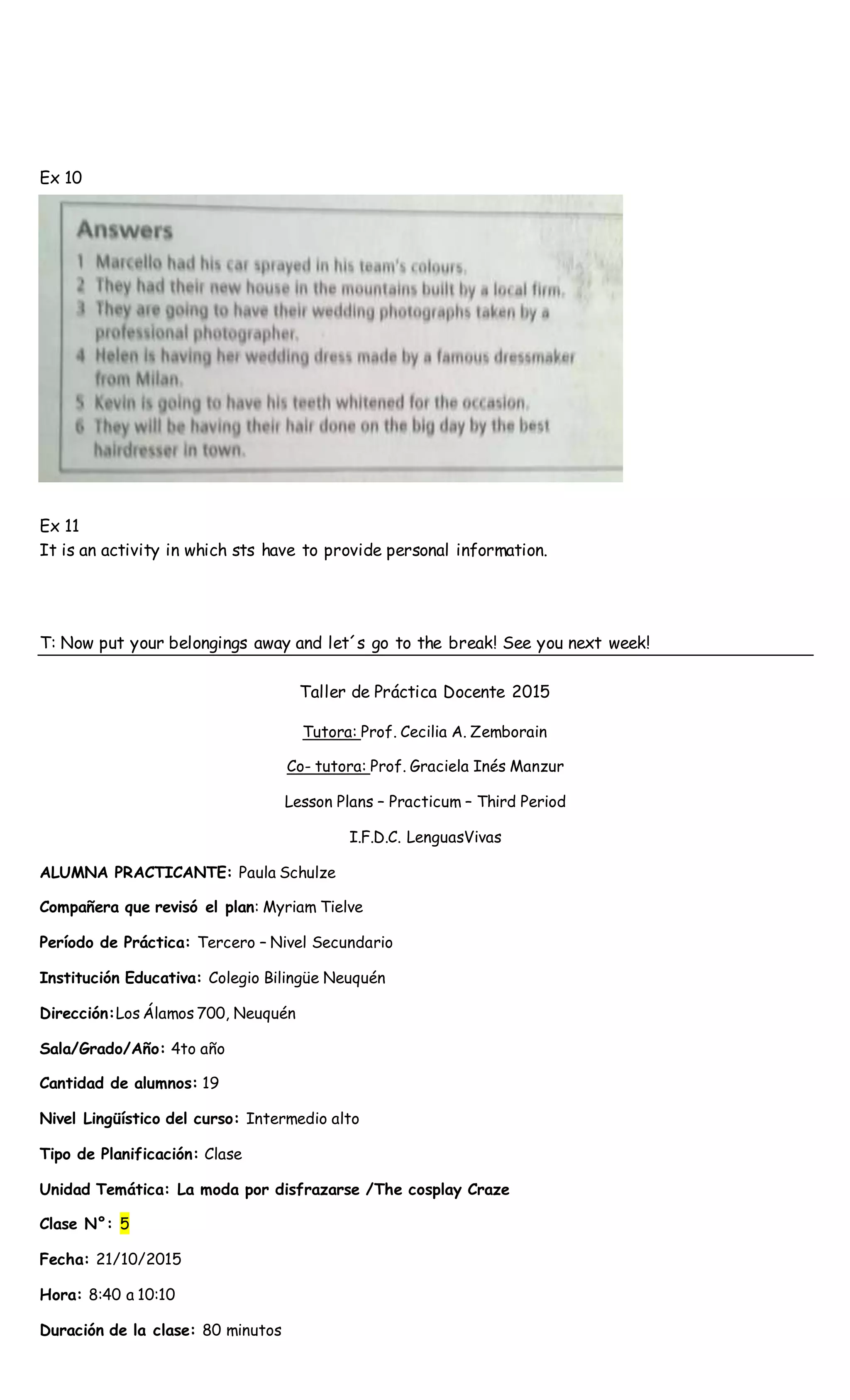
Example:
Student A: "Was it you who spilt the coffee?"
Student B: "No, mum, honestly, it was spilt by our cat when it was chasing a fly".
Use your imagination and have fun!
These instructions will be written on a slip of paper for the sts have it clear what
they have to do in this station and have a first example as a guide.
Mother/ father
Somebody broke your tablet
Somebody let your pet bird out of cage
Somebody scribbled on the wallpaper
Somebody spilt cola on the sofa
Somebody used your make-up/ shaving kit
You suspect your naughty child. Make him/her
confess.
Son/ daughter
You broke your parent’s tablet
You let your pet bird out of cage
You scribbled on the wallpaper
You spilt cola on the sofa
You used your parent’s make-up/ shaving kit
But you shouldn’t confess! Try to make your parent
believe it was done by somebody else.
Boss
Somebody searched through your things
Employee
You searched through your boss’s things
Somebody sent you a junk email
Somebody stole your favorite pen
Somebody hacked your computer
Somebody brought you flowers you are allergic to
You suspect one of your employees. Make
him/her confess.
You sent him/her a junk email
You stole his/her favorite pen
You hacked his/her computer
You brought him/her flowers he/she is allergic to
But you shouldn’t confess! Try to make your boss
believe it was done by somebody else.
Teacher
Somebody put the drawing-pin on you chair
Somebody took the markers
Somebody wrote in the class journal
Somebody wrote a bad word on the board
Somebody sent you a mocking love-note
You suspect your worst pupil. Make him/her
confess
Pupil
You put the drawing-pin on your teacher’s chair
You took the markers
You wrote in the class journal
You wrote a bad word on the board
You sent your teacher a mocking love-note
But you shouldn’t confess! Try to make your teacher
believe it was done by somebody else.
Source: Original idea adapted by me for pedagogical reasons
Activity 4 (12´)
Purpose: to elaborate sentences into the passive voice and guess the answers.
STATION 4: Change or guess and score a point! 
Instructions:
It is a game to practice passive structures. Cards will be distributed among the
students.
If they get a card with isolated words they have to create a sentence using the
words given (in passive) to give some kind of hint to his/her peers.
For example:
Student A: Facebook was invented by him.
Student B: Mark Zuckerberg invented facebook!
The rest of the ss need to guess what/who it is. The right answers are given in
brackets.
If the player just has a sentence in the card, he/she has to turn it to the passive
voice.
If the player gets the correct answers, she/he gets 1 point and the following student
starts.
Change or guess and score a point! 
Printing/invent
(Gutenberg)
Light bulb/invent
(Thomas Alva Edison)
America/discover
(Columbus)
Penicilin/discover
(Alexander Fleming)
Windows/make
(glass)
Tables/make
(wood)
Language/speak in Russia
(Russian)
Language/speak in Hungary
(Hungarian)
Wedding ring/make
(gold)
Clothes/make
(cotton)
Harry Potter/write
(JK Rowling)
Star Wars/direct
(George Lucas)
Electricity/discover
(Benjamin Franklin)
Frogs/eat
(storks)
Walls/make
(bricks)
War and Peace/ write
(Tolstoy)
Telephone/invent
(Alexander Graham Bell)
Jurassic Park/direct
(Steven Spielberg)
UK/rule
(queen)
ISS Station/rule
(NASA)
Our coursebook/publish
(Macmillan)
Music/download
(the Internet)
Planes/make
(aluminum)
Radioactivity/discover
(Maria Curie)
Peter is
reading a lot of
books.
Suzy kissed
John.
The police
caught the
dangerous spy.
John Wilkes
Booth killed
Abraham
Lincoln.
Karl likes
driving the
Ferrari.
The athlete
prefers the
100- metre
dash.
He never cleans
the bathroom.
She always
makes the
soup.
The students
did their
homework.
Gillian was
writing an
excellent
essay.
The choir will
sing many
songs.
Sam has
turned on the
lights.
The people of
Athens forced
Socrates to
drink hemlock
poison.
Henry VIII
reformed the
Church of
England.
The archer shot
the king in his
eye.
The student
copied the
essay.
The minister We waste a lot She had lost John found his
hurried
through the
proposal.
of time. her earrings. sister’s
earrings.
The Indian
threw his
tomahawk.
Almost
everybody in
the class
celebrated
Christmas.
The
photographer
should take all
the pictures.
The thief
returned the
car.
Every morning
Jim has
cornflakes.
The
stewardess
will serve
lunch.
The pirates
boarded the
merchant
vessel.
The actor will
have played
the role of
Macbeth.
My wife placed
the flowers in
a vase.
Wayne Rooney
scores most of
the goals for
England.
The swimmer
must swim the
Channel.
In 1939
Germany
invaded
Poland.
Source: Original idea adapted by me for pedagogical reasons
Transition: Ok, time to play is over! Let´s share your performance!
Closure
Activity 1 (5´)
Purpose: to analyse all what was done in this class and in the previous five classes
T: Well tell me which was the easiest activity? And the funniest one?
Sts: The first one was difficult. The one about blaming someone was funny!
T: Well, you know this is my last class so first of all I would like to thank Miss Valeria
and her company and then you for your patience but specially your hard work. So I
have brought sth sweet to share. I will deliver some bono-bons. And now, let´s have a
round of applause to all of us! 
Have an excellent performance in the FCE!
Trainee´s name: Paula Schulze
Practicum Level: Secondary Level
Group: 4th
year
Date: 29-09-15
Lesson Number: 1
1. What pedagogical principles supported the planning and delivery of
this lesson?
I tried to focus myself on the Natural Approach as the students were
expected to interact with me and peers in a natural way promoting in this way
the communicative abilities. Since language and vocabulary are of principal
importance for this approach and to acquire the language, I encouraged the
students to concentrate mainly on the understanding of the message they
were putting through or transmitting while doing the activities rather than on
the target language specifically. Although at this level students are required
to learn and reflect on the language to consolidate it while training for the
FCE. Consequently, I set the conditions for the learners to acquire the
language in a free-stress classroom environment and analyze its forms as well.
Besides, the PPP method was also used to introduce the target structure since
first it was presented then practiced in a controlled way and finally students
were given by the teacher free production instances.
2. What teaching strategies did you use? Which ones were effective?
Why/ why not?
In this class, the instructions were given all in the target language and it was
not necessary neither to repeat them before doing the tasks neither to use
the mother tongue to check or confirm for example anything. When I was
asked about the meaning of a word, I first asked the sts if somebody knew
the meaning, if they answered affirmatively I asked them to explain the
meaning of the word using the target language and then I rounded the idea or
gave the exact synonym, for example. I tried to use open questions to make all
the students participate and share in this case their language learning
experiences.
3. How did the students react to your teaching, to the activities and
the materials? How did they react to the lesson?
The students were very active at the time of working. The followed all the
instructions but I felt they found the sequence of activities very
demanding (revision of 11 tenses and teaching of the definite article). But
all of them were closely involved and engaged in the activities provided
even with the 1st
one in which they had to stand up and visit 5 posters they
used the L2 to perform the activity and they respected they turns as well.
Great pictures!!! :)
I felt the teaching of the structure was really scaffolded, I mean, it was a
smooth process from the introduction, the revision activities to get to the
teaching point. And finally I felt very happy with the time managing since
there were 2 minutes left and I used them to go over all the aspects we
had seen. I also worked on the pronunciation of words: certificate and
“the” in isolation and before vowels. This was apparently new for the
students. I did not have the chance to introduce any phonetic symbol,
probably in the subsequent classes since I think at this level they should
know them to take the advantage of the pronunciation sections in their
dictionaries.
4. What aspects of the lesson do you consider successful?
In this opportunity, the time management was almost perfect as well as the
pace of the activities. There were no behavioral problems at all, that is
something I always worry about. Besides, there was little talking in
Spanish, the expected one, we can say.
At the very beginning of the lesson I told the sts that I was nervous, like
how they may feel before a test or oral presentation, because the class
was a test for me and that was the reason why the class was being
recorded. I told them this because I was really a bit tense and in case they
noticed it I wanted them to understand why I was feeling in that way.
5. What aspects of your lesson require change / improvement?
For this very first class, I cannot mention something that did not work as
planned. All the sequences were followed like I had imagined. Probably, I
should learn the students’ names to make them all participate. As expected,
some of them were more active than others; probably because of their
personality or level of English.
Another aspect that you mentioned in my previous videos and that I should
improve is that sometimes I echo students’ answers with no pedagogical
reason; I think that I keep on doing this. 
6. What do you find useful of this lesson that will help you plan the
next one?
Students are very willing to participate but it is not like in primary that
everybody puts up their hands. At this level they are a bit more reluctant
but when asked for answers or examples they all participated. That really
helps me to think of interesting activities to perform next class. I also had
enough time to tell them the homework (to read the short story).
7. Any comments or observations you would like to share may be added
here.
All the students were respectful and very collaborative throughout the class.
Even the interaction between peers was positive because they used the target
language.
Throughout the 1st
activity I made the students reflect on the never ending
process that learning a language is and also on the level they have achieved
after so many years of learning and that being able to sit for the FCE is a
sample of the work done.
Trainee´s name: Paula Schulze
Practicum Level: Secondary Level
Group: 4th
year
Date: 5-10-15
Lesson Number: 2
1. What pedagogical principles supported the planning and delivery of
this lesson?
I tried to focus myself on the Natural Approach as the students were
expected to interact with me and peers in a natural way promoting in this way
the communicative abilities. Since language and vocabulary are of principal
importance for this approach and to acquire the language, I encouraged the
students to concentrate mainly on the understanding of the message they
were putting through or transmitting while doing the activities rather than on
the target language specifically. However, at this level, students are required
to learn and reflect on the language itself to consolidate it while training for
the FCE. Consequently, I set the conditions for the learners to acquire the
target language in a free-stress classroom environment and also as an active
participant analyzing its forms as well. Besides, the PPP method was also used
to introduce the target structure since first it was presented, then practiced
in a controlled way and finally students were given free production instances.
2. What teaching strategies did you use? Which ones were effective?
Why/ why not?
In this class, I provided comprehensible input. As in the previous class, when I
was asked about the meaning of a word, I resorted to the students-centred
approach, I first asked the sts if somebody knew the meaning, if they
answered affirmatively I asked them to explain the meaning of the word using
the target language and then I rounded the idea or gave the exact synonym,
for example. I tried to use open questions to make all the students participate
and share in this case their language learning experiences.
I also used visual aids to trigger and brainstorm information from the
students during the warm-up stage but also during the presentation stage in
which I wrote sentences, underlined words, list items, for the students to
organize information. They were also asked to infer rules or processes.
The pictures were 1st
shown with the help of the OHP but then I turned it off
because I had to use the board and so I stuck the same pictures on the board
to remain there throughout the class.
Pictures used during the warm-up stage
3. How did the students react to your teaching, to the activities and
the materials? How did they react to the lesson?
Once again, the students were very active at the time of working. They
followed all the instructions and fulfilled all the tasks proposed. All of
them were closely involved and engaged in the activities provided. This time
before starting the class, I asked the students, as I had done in primary,
to write their names on a sort of signs. As it had happened before I felt
much better being able to call the students by their names especially in
those cases that they were reluctant to talk, for example.
Signs with names on.
Besides their level of English allowed the students to expose their cultural
o personal experiences and ideas freely as it happened when they had to
guess why I had chosen some given famous people.
I felt the teaching of the target structure (reported speech) was really
scaffolded, but the topic is too broad so as to cover it in one class. For
example, I could not teach how to report questions. But I have to say we
focused on key concepts of the topic. Finally, like before, I felt very happy
with the time management since there were 2 minutes left and I used them
to go over all the aspects of reported speech we had seen. This time, there
was no opportunity to work on the pronunciation of some words.
4. What aspects of the lesson do you consider successful?
In this opportunity, the time management was almost perfect as well as the
pace of the activities. There were no behavioral problems at all, that is
something I always worry about. Besides, there was little talking in
Spanish, the expected one, we can say.
At the very beginning of the lesson I told the students to write their
names on signs. I had already asked the teacher how they liked to be
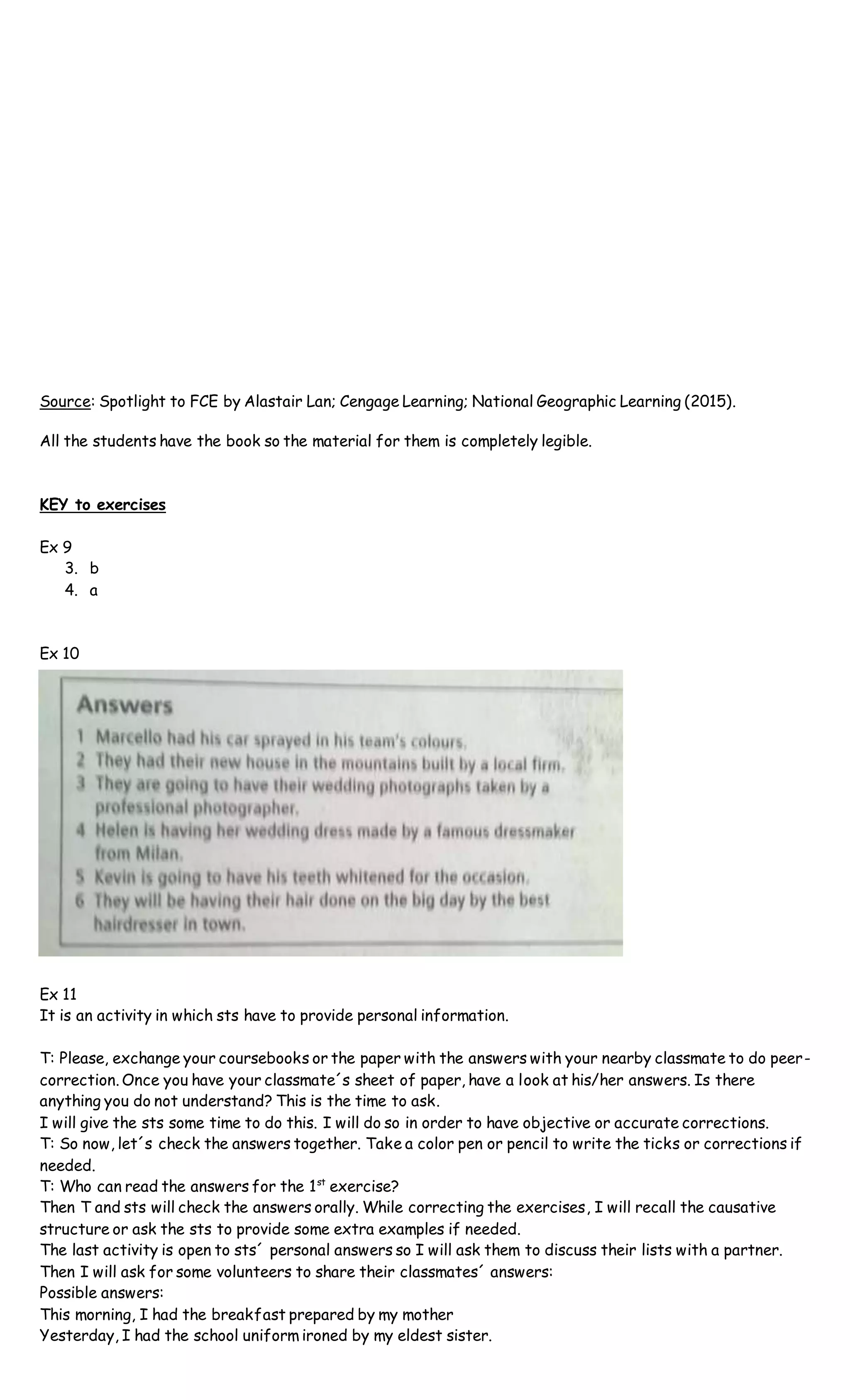
called. And something funny happened: One of the students wrote Alberto
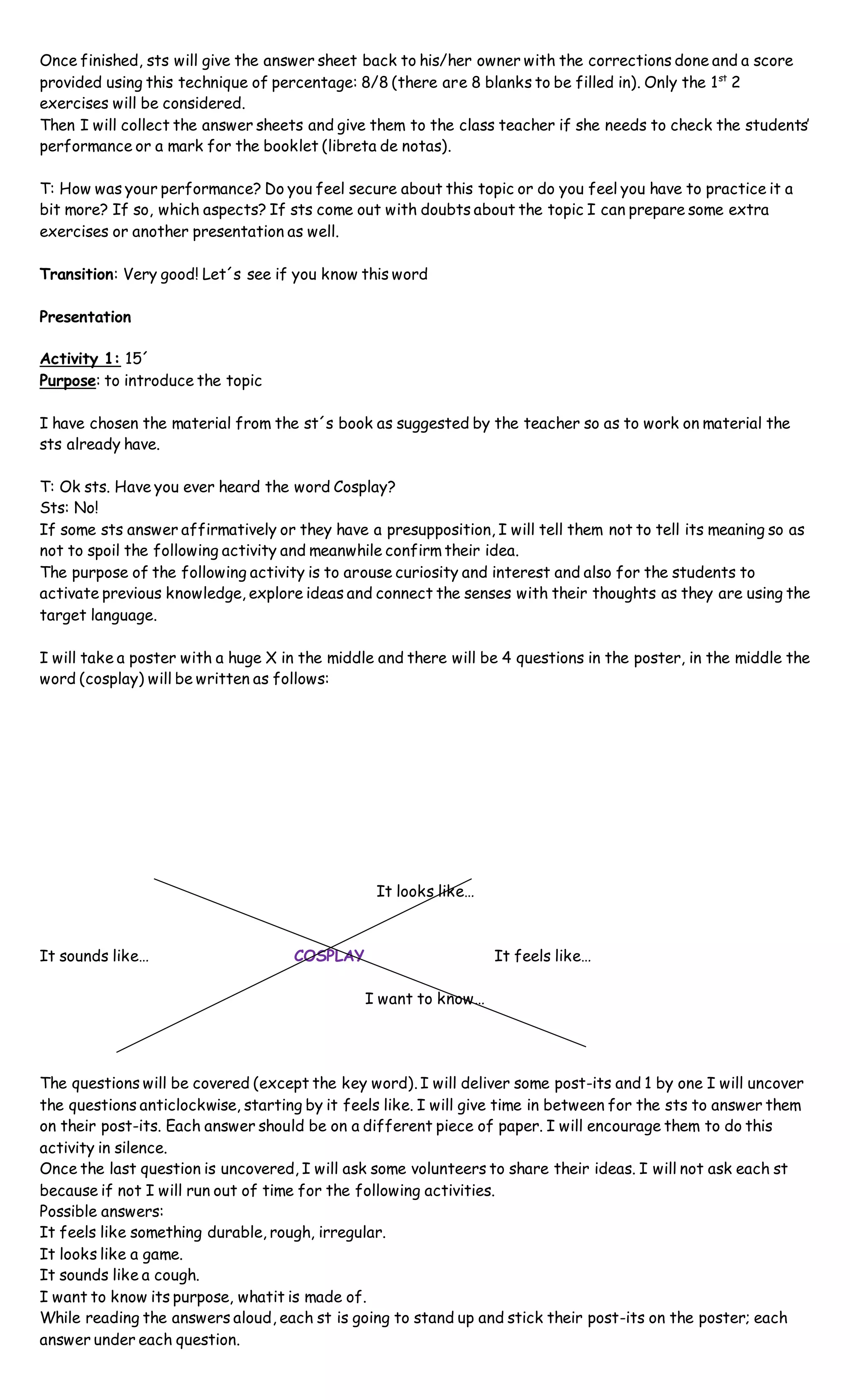
on the sign but I knew he liked to be called Abi so I did so. By the middle
of the class, apparently he could not hold his intrigue anymore and asked
me how I had known his nickname was Abi!
5. What aspects of your lesson require change / improvement?
I have learned that a “polished” plan almost guarantees the success of the
class. In this case, probably my expectations were too high as regards the
practice of the target language, I mean the sequence was perfect but I should
have devoted more time to the practice of the reported speech. Hopefully, we
will do so next class.
6. What do you find useful of this lesson that will help you plan the
next one?
Students are very willing to participate but it is not like in primary that
everybody puts up their hands. At this level they are a bit more reluctant
but when asked for answers or examples they all participated. That really
helps me to think of interesting activities to perform next class. I also had
enough time to tell them the homework (to read the short story and what
the quiz will be about).
7. Any comments or observations you would like to share may be added
here.
All the students were respectful and very collaborative throughout the class.
Even the interaction between peers was positive because they used the target
language most of the time therefore the working atmosphere is a really good
one.
3rd Class
13-10-15
1. What pedagogical principles supported the planning and
delivery of these lessons?
As in the previous classes both planning and delivery of the class
were supported by the Natural approach as students were mainly
invited to interact with peers and teacher in a natural way, as done
when using their native language. As before, based on the
Communicative approach, the focus was firstly and mainly on the
message the students wanted to put through and secondly on the
language structure itself unless there was a communication
breakthrough. However at this level, students were asked to
analyze the language specifically as in the case of new structures
that were presented during this class.
2. Which teaching strategies did you use? Which ones were
effective? Why/ Why not?
During this class I tried to resort to visual images asking the
students to complete a concept map, I think this is helpful for
visual learners specially but very productive for most of them as
they had to concentrate on some data specifically. Students were
also asked to link their previous knowledge with the new structures
they were studying like providing examples or situations from
“their world” in which they could be used but during this activity
they also developed their awareness on some aspects of the
language as well. Large amount of interaction between peers was a
must and so I felt it become a student- centered classroom most
of the time.
3. How did the students react to your teaching, to the
activities and the material? How did they react to the lesson?
During this lesson, and as before, the students worked really well.
This time the quiz on reported speech took longer time than I had
planned therefore there were 2 activities left aside. They were
enthusiastic at the time of sharing their points of view as regards
the main characters of the short story they had to read at home.
Everybody brought the short story and the course book. At the
time of completing the mind map, they did it extensively showing
they had read the story more than once and as asked they
supported their choices on facts. It made me feel great that they
had read the story deeply because the topics I had prepared could
be discussed and different points of view were considered as I
expected.
Asking the students to infer the meaning of given phrases from
the short story was also very useful for the students, it was easier
for them to get the meaning of most of the phrases at once.
4. What aspects of your lesson require change of improvement?
In this opportunity, the time management was not as good as during
the previous class. There were 2 reasons: the students came late
from the break and the quiz and discussion took longer than
expected. All the same I feel the activities done were
accomplished based on pedagogical reasons. When they had to
complete part of the concept map the students were active
participants either to agree or not among themselves but based on
the evidence from the story.
5. What do you find useful of this lesson that will help you plan
the next one?
Probably, during the class, I was noticing the students wouldn't do
all the exercises as I had planned because we were running out of
time. So, now, thinking backwards, I should have stopped the
students completing the concept map so as to round off all the
activities they had done during the class. I mean, to spend some
minutes to mention the structures they had seen or results we had
agreed on as regards the characters.
6. Any comments or observations you would like to share should
be added here.
I'm still happily surprised to see the students interacting at all
times in the target language. Today, even when they were doing
some jokes because of a word they found in the dictionary, the
comments were done in English.
During the first 20 minutes of the class, the students underwent a
self-assessment activity, I also called it quiz at first, but as the
teacher told me she did not need the marks I made a point of
analysing the students´ performance individually and as to evaluate
what they knew about the grammar topic seen in the previous class
(reported speech).
4th class
19-10-15
1. What pedagogical principals supported the planning and
delivery of this lesson?
The planning and delivery of this lesson were supported mainly by
the communicative language teaching (CLT) approach as I wanted
the learners to communicate effectively and convey real messages.
Mainly I feel the pedagogical support provided the students with
the scaffold and tools to achieve what was being asked.
2. What teaching strategies did you use? which ones were
effective? why/why not?
I used the board to do a sort of visual display as regards
vocabulary, given points for the groups and grammar form of the
target structure. I used it more than during the previous classes.
The variety of activities provided were also good for the sts to
firstly grasp then describe and finally use the target structure
(causative have).
3. How did the students react to your teaching, to the
activities and the materials? how did they react to the lesson?
Well, this was the 4th lesson with the sts so I´m already feeling
comfortable with them and apparently they also like the activities
I propose since they get engaged quickly. Nevertheless and
surprisingly, today they were a bit distracted but the reason is
that some of these sts have been chosen to have a school radio, so
they are the speakers/announcers during the breaks. Today it was
their first day and so they were very enthusiastic with that so, for
example, when they had to think the dialogues in pairs I heard
some people talking in Spanish about the radio program. During the
previous classes, there had been very little Spanish among them.
Even some sts left the class sort of 10 minutes earlier to have the
radio ready for the break time (external factors!).
4. What aspects of the lesson do you consider successful?
The sts enjoyed the game very much, but by the end there were 2
groups left and the one made up by boys wanted to win and so they
broke some rules (they peeped at their copies), the girls from the
other group noticed that and so they finished the game reluctantly.
Now, that I think backwards I could have taken them a point off.
In fact, it were the girls who told me about the peeping, I did not
see the boys doing so.
Once again, I had time to devote the last minutes to cover the
activities we had done giving emphasis on the purpose of those
activities, the reason why we had done them. I think they like it
and it is profitable for them to consider what aspects or topics
they have learned, practiced, remembered.
On the other hand, I think the game in itself was a peer-work since
sts of each group had to find the words, expressions to help their
speaker say the exact words aloud. And they really tried hard to
make the speakers find the correct expressions!
Like in the previous classes, after explaining the tasks sts had to
do, I asked a volunteer to repeat the instructions since this time
they were more complicated than just “complete the sentences”. It
is really good for the learners to recap the mains steps to follow,
also for retelling and summarizing as well.
5. What aspects of the lesson require change/improvement?
While the sts were working on the dialogue they had to invent, the
class teacher told me that the sentences I had written on the
blackboard (they had been dictated by the sts) could be used to do
a controlled practice of the target structure, causative have.
Therefore when the sts finished role-playing the dialogues I went
back to those expressions on the board and ask some sts to “turn”
them into the causative have structure. Now, I think I could have
done this before the sts role-played the dialogues. All the same it
worked as a summary or rounding off of the taught structure
before finishing the class.
6. What do you find useful of this lesson that will help you plan
the next one?
Like before I feel the practicum is going pretty well. Of course,
there are always things to polish but, all in all, this third period of
the practicum is great. Every class is a challenge in itself,
especially the planning period. However, I feel that when the plan
is well-prepared although there may be some unexpected events
everything runs smoothly. As regards my role, little by little i tend
to make the sts answer, explain, recap etc turning the class ia a
real student-centre one. Having the role of mediator is still not
that easy for me!
The students are also very productive and that really helps.
The variety of activities was also ok in relation to the time I had
and the teaching points sts had to practice.
7. Any comments or observations you would like to share?
The class teacher really helped me with her comment during the
class because I could focus on the aspect she considered was not
properly presented (some expressions written on the board could
not be included in the “service” category, therefore some
“causative have” sentences sounded like forced.
Example,
I had written on the board:
-take a new mattress from the street... (because the character
was poor)
Probably, for this, the character would not ask someone to provide
that service.
So, I asked the sts to focus again on those actions written on the
board and to consider which ones were really the one the character
had to hire a service. Now, fewer expressions were left on the
board and those were turned into the “causative have” structure. I
think made it clear for everybody.
I want to make it clear that the teacher's comment was
respectful and done when the sts were working on something else.
She is very responsible and professional so I do not want to make
any mistakes and at times when I realize she is there watching my
class I get lost and I have to focus myself but I feel this is part of
this period and her comments are really welcome. Her feedbacks,
in the forms she has to fill in, are really extensive and none of the
other observers had been so meticulous at the time of doing the
peer observation.
--------------------------------------------------------------------------------------
5th CLASS
16-10-15
The pedagogical principles that supported the planning and
delivery of this lesson were coherent with the previous ones in
which I focused on the Communicative and Natural approaches. The
first one because I aimed the learners will grasp and use the
functions of the structure taught (passive voice, emphasis on the
action rather than on the doer of the action) and the latter
because my attitude was to use the language exposing the students
to comprehensible input according to their level and interests.
The teaching strategies I used this time were related to the topic
to be taught, so while planning I thought an explanation and
exemplification would be ok to present and define the grammar
structure. But I also fostered an eliciting stage asking questions
or prompting answers for the controlled practice step; it also
helped me to check understanding. The context “Cosplay craze” was
fantastic to present the topic because the article was mainly
focused on this new fashion/ practice.
I think they were effective enough for the “lower” sts to grasp or
understand the new grammar structure in this first teaching class
and for the advanced sts to clarify its meaning and use.
The students reacted in a very confident way to my teaching, the
activities and material providing examples and some of them
consolidating or checking information they knew. They also
participated actively at the time of discussing the reasons why
people dress up like characters. Besides, I found the transition
stages were great to grasp the students´interest and motivation
as the 1st activity in which they had to guess what Cosplay was
slowly shifted to the 2nd activity in which they have to read an
article. The sts also enjoyed reading a paragraph per group and in
this way they also payed attention to the rest of the article when
they were summarized by the other groups.
The aspects of the lesson that I consider successful are the
variety of the activities proposed because students worked
individually, in groups, they stood up to stick their thoughts about
Cosplay, they wrote, listened to each other, discussed, I mean, in
80 minutes we covered several skills and students were able to use
the language in different contexts.
The aspects of this lesson that require change can be the
instance in which sts had to share their thoughts about the new
word “cosplay”. Instead of waiting for their turn to speak and come
to the front to stick their papers, they did not wait but stood up
and were eager to stick their thoughts instead of talking and then
sticking the paper.
So it was a bit disorganized but the sts were involved in the
activity indeed!
Something that I found useful this time to plan the next lesson
was that being more incisive is better. I mean, at the time of
asking questions about their opinion I used more thought provoking
questions : What makes you say that? what evidence do you have to
support that answer? are you sure the writer expresses that idea?
how do you know? and they certainly triggered better discussions
or answers and besides sts had to resort to the target language or
structures at times. After some of the activities, I made the sts
reflect on the purpose of the activities we had done for me to
define if it had been clear the purpose of doing them.
The comment I would like to share is that I felt confident with
the teaching. Again, having a solid plan because of the time I had
devoted to its analysis and production, really bear fruit! It is
strange because the more you know the group it should be easier to
plan but, on the other hand, it happens to me that I want to include
more elaborate activities or have the “surprise” factor in the class.
Guidelines for the last journal entry: How good it sounds! :)
6th Class
28-10-15
. To what extent has this experience helped you in your teaching
development?
It is true that the teaching experience is a never ending one, but
there are certainly intensive moments as these last classes in
which I have felt the learning experience has become a memorable
and vivid one. In my case, the level I had to teach and the teacher
who was observing my classes were really demanding so both
aspects helped me positively to give my best. I had to prepare the
classes in an accurate and well-planned way, it is not that I hadn't
done that before but here I felt the external pressure was
greater. One of the characteristics of teenagers is that they
challenge and question teachers so one of my fears was their
attitude towards my capacity to handle the class and to cope with
the language itself. As a mother of a teenager I also know that
they tend to have incisive comments at times with their teachers.
Finally, and thinking backwards, every period of the practicum
stage helped me to learn or adjust my knowledge and my teaching
experience as well.
• What have you learnt about this age group?
Mainly that they are always analyzing what your proposals are and
also that they are always open to negotiate for example as regards
some rules in the class, course of actions in a given situation. They
are very enthusiastic at the time of debating and confronting
points of view and they like sharing their experience and knowledge
of the world.
• What do you think you still need to learn about students this age?
It is always better to strike a balance between learning and having
fun, probably that is something I should think about. I felt I
consider them grown ups and so I forgot they also like to have fun,
make jokes and play games. In fact, the last class that included a
circuit of 4 stations and a game in each one was a complete
success. They wanted to keep on playing and even asked me to
extend the playing time!
• Did you do some research on this age group before you started
teaching these students?
I did a research when I had to prepare the “informe de grupo”. It
was very useful in fact in the 3 periods of the practicum because
they gave me an idea of what cognitive and social characteristics
the learners have; a relevant aspects for teachers at the time of
thinking activities or also to foresee possible problems that may
come up.
• How did your previous knowledge help you plan your lessons and
teach your classes?
Both in primary and secondary levels, I had already taught so I had
a previous Knowledge as regards the experience of working with
those students. That teacher background knowledge helped me to
feel secure and confident with the learners and the target
language as well.
However, I knew nothing about teaching in kinder, probably
because I always knew I was not fond of working with young
learners. So, at that level I had to do a double effort because I
had to confront my likes with the obligation of doing the practicum
at that level.
• What new pedagogical knowledge did you acquire?
Two pedagogical knowledges come to my mind: the first one has to
do with the use of the time. Telling the students they have certain
minutes to accomplish the activity , for example, really helps both
the teacher and the learners. The second one has to do with
devoting time in class to the metacognitive aspects: giving the
learners time to analyse what they have learned, why they have
done those activities and what they “take” from that class. This
can include telling the aims of the class at the beginning so as to
help them check if they have fulfilled the aims at the end of the
class.
• What relevance did you give to pedagogical decisions while
planning and teaching your lessons and when reflecting upon them?
As I have mentioned before, I have understood how a well
developed plan almost grants a successful class. Once the teacher
knows her students´interests, time management, and content of
what has to be taught, the way those aspects are displayed or
considered are crucial.
• To what extent and in what ways has keeping a teaching journal
deepened your knowledge and improved your teaching practice?
Frankly, it happened to me that it was difficult to find the time to
sit in order to write about the class I had given some hours before.
After considering this sort of rejection, I understood that I did
not want to reflect on them as it was a time to examine not only
the good aspects but to go deeper to search for attitudes or forms
to be improved. Luckily, once I sat to write them, the experience
became easier and I reflected on the pedagogical knowledge, the
content knowledge, the situation itself and other aspects such as
the technological issue, which in my case was a defiance as well.

Tpd schulze secondary- all plans & all journals

  • 1.
    Taller de PrácticaDocente 2015 Tutora: Prof. Cecilia A. Zemborain Co- tutora:Prof. Graciela Inés Manzur Lesson Plans – Practicum – Third Period I.F.D.C. LenguasVivas ALUMNA PRACTICANTE: Paula Schulze Compañera que revisó el plan: Myriam Tielve Período de Práctica: Tercero – Nivel Secundario Institución Educativa: Colegio Bilingüe Neuquén Dirección:Los Álamos 700, Neuquén Sala/Grado/Año: 4to año Cantidad de alumnos: 19 Nivel Lingüístico del curso: Intermedio alto Tipo de Planificación: Clase UnidadTemática: Naturaleza y Energía Clase N°: 1 Fecha: 27/09/2015 Hora: 11 – 12.20 Duración de la clase: 80 minutos Fecha de la primera entrega: 16/09/2015  Teaching Points: Definite article Revising tenses: Simple present, present continuous, simple past, past continuous, past perfect, present perfect, present perfect continuous, future will and going to, future progressive (affirmative, interrogative, negative forms) before introducing the next teaching topic that is Reported speech  Aims and goals: During this lesson, learners will be able to…  Develop their listening and speaking skills by talking about their language learning process.  Develop their writing skill by writing sentences related to their experience with the language.  Develop their oral production to talk about their learning experience of the target language.  Develop the acquisition of instances in which the definite article has to be used  Language focus: LEXIS FUNCTION STRUCTURES PRONUNCIATION REVISION Native speaker Identifying and naming different tenses Different tense forms Wh questions and Yes/No questions using different Recognition and use of the sounds /ði/ in the when pronounced in a stressed position /ðə/ in the when
  • 2.
    tenses pronounced ina unstressed position NEW Actions: To sit for an exam Talking about the uses of the definite article Recognition and use of the word /sə(r)ˈtɪfɪkət/ in certificate  Teaching approach: The Natural Approach as the students are expected to interact with the teacher and peers in a natural way promoting in this way the communicative abilities. Since language and vocabulary are of principal importance for this approach and to acquire the language, I will encourage the students to concentrate mainly on the understanding of the message rather on the target language specifically. Consequently, learners are also expected to acquire language in a free- stress classroom environment. Besides, the PPP method will be used as well to introduce the target structure.  Integrating skills: during this class students will develop their listening skill while listening to the teacher and to their mates. They will also integrate reading and writing when they are asked to write sentences about their language learning process and then read them aloud. Their conceptual thinking will also be developed while analyzing the uses of the definite article.  Materials and resources:copies on tenses and sentences- posters with triggering questions - markers for the board  Pedagogical use of ICT in class: In this lesson we will not work with ICT support.  Seating arrangements: The students will be sitting in lines of 4 or 5 desks. It must be said that each student has a favorite place within the class. As for this first class, there will not be changes in the sitting arrangement.  Cooperative work: sts will work in pairs to discuss about the forms, functions and example of given sentences in order to complete a chart.  Possible problems/difficulties and their solutions during the class: as it is the first class I will give to the sts, I hope I will manage to do all the activities planned. Either the sts may feel shy with the new teacher or relaxed and so they may take their time to work. So I will be checking time during the whole class. Because of the free conversation that will take place, I will also be ready to provide vocabulary on demand. I will carry my “little super dictionary” in case there is a word I do not.
  • 3.
    If the definitionis not provided either I will ask the sts to search on their cell phones, or I will write the word down to bring the answer on the following class. I´m also worried about the balance I have to reach in my classes between the communicative and the training abilities they must acquire for the FCE.  Potential problems students may have with the language: Students may find it difficult to complete the tenses chart. If that is the case I will prompt or model the answers.  Assessment: I will assess learners’ comprehension and understanding through their oral interactions, and their participation and development during the activities. Routine: 5´ Purpose: to greet students and get them into a positive mood to start the lesson. I will greet the sts, ask them how they feel and then I will tell them again what will be my role in the classes to come (the teacher, Miss Valeria, had already introduced me when I went to observe the class for the 1st time). At that time students were told that they had been selected for their positive and working attitude as well as for their handling of the target language.  I will write the date on the blackboard (this is the teacher´s routine so I will stick to it) if the previous teacher hasn´t done it yet. All the teachers in the school are supposed to write the date in English although his/ her subject may not be that one. Transition: Let´s get ready to talk about ourselves and our relationship with the English language. Warm up: 15´ Purpose: to recall previous knowledge about individual English learning experiences and set the context. T: ok sts. You are going to divide into 4 groups of 4 (16 sts ) and 1 group of 3 students. On each wall of the classroom I´m going to display some questions about you and the language and I want you stand up, visit one poster at a time and discuss the questions with the members of your group. When I tell you, you have to move to the next poster please. I will give them 2 minutes in each post. The questions and the posters will be numbered because of the retelling activity later, I think, this will help. I´m going to display these questions; the tenses are not going to be included. Before starting the activity I´m also going to remind sts to speak L2. POSTER 1 1. Do you study English every day? (simple present)Does anyone in your class study English every day? Why/Why not? How? 2. Are you thinking in English now? Why? Why not? POSTER 2 3. What part of your brain do you think is working? (present continuous) 4. Have you ever studied English abroad? (Present perfect) 5. Have you been training hard for the FCE? (present perfect continuous) POSTER 3 6. Are you going to sit for the FCE? Why? /why not?(future tense- going to) 7. What do you think we will learn today? (future – will) POSTER 4 8. In 2 months you are finishing the school year. Do you think you will have done your best as regards English? How? (Future perfect)
  • 4.
    9. How longapproximately will you have been speaking in English by the end of this morning? Is it too much? And by the end of the school-week, how long will you have been speaking English?(future progressive) POSTER 5 10. Were you speaking in English while I was writing the date? (past continuous) 11. Did you have a native teacher? Who? Where? What was he/she like? (simple past) 12. In 2013 some of you sat for the PET exam. Had you done a previous test to that one? Which one? Why not? (past perfect) GREEN = PRESENT tenses BLUE = future tenses RED = past tenses While students are answering the questions, I will walk around paying attention more on the content of what is being answered than on the tense the sts are using unless there is a communication break or misunderstanding in, in that case I will prompt or provide some words, expressions or tenses. Once the sts have visited all the posters, I’ll ask them to go back to their places. Transition: very good! You have sort of flown over your English learning experience! Why don´t we listen to some of your answers? Communicative Activity: 10´ Purpose: to express sts´experiences of the target language I will take the 5 posters to the front and I will stick them on the board. T: so, who would like to share the answer for question number 1? While sts are sharing their answers with the whole class, I will encourage the sts to use the tenses used in each question.I will also prompt or provide words on demand. Transition: great! Let´s concentrate on a different aspect of the language! Activity 1:20´ Purpose: to recall previous knowledge about tenses T: So let´s have a look at the different posters again but now concentrate on the tenses of the questions. Do they refer to past, present or future aspects of your language learning development? Sts: All of them! T: Great! So which poster refers to past experiences? Sts:Poster 5 T:Which poster refers to present experiences? Sts:Posters 1 and 2 T: Finally, which poster refers to future experiences? Sts: Posters 3 and 4 T: Awesome! Then, I will deliver some copies and I will ask the sts to complete the following chart in pairs; the examples they provide must be their personal answers of the questions on the posters. T: Ok, let´s get down to business and complete the chart in pairs! I will provide some information that will be in the copy in bold as shown below.
  • 5.
    I think thiswill lead and motivate the sts to complete the chart in a more dynamic or attractive way. In some cases, I have also provided the answers for 2 of the slots to be filled in, in this way I believe the sts will not be that confused or lost. While sts are completing the chart, I will walk around, checking understanding, exemplifying or explaining doubts. TENSES: Complete the information that is missing about the main tenses in English: Tense: Form: 3rd person: “S” Usage(s): Example: Tense: Form: Usage: action taking place at the moment of speaking Example: Tense: Form: have/has + past participle Usage: Example: Tense Form: Usage: putting emphasis on the course or duration (not the result) Example: I have been training hard for the FCE. Tense: future tense- going to Form: Usage: Example: Tense: Form: Usage: Example: We will learn a topic related to articles. Tense: Future perfect Form: Usage: action that will be finished at a certain time in the future Example: Tense: Form: Usage:- action taking place before a certain time in the future -putting emphasis on the course of an action Example: I will have been Tense: Form: Usage: Example: I had 2 teachers who were native speakers.
  • 6.
    speaking about 8hours. Tense: Form: Usage: Example: I was speaking in Spanish while you were writing the date. Tense: Form: had + past participle Usage: Example: KEY TENSES: Complete the information that is missing about the main tenses in English: Tense: simple present Form: verb 3rd person: “S” Usage(s): habitual activity, scheduled event Example: I studyEnglish twice a week. Tense: present continuous Form: to be + ing Usage:action taking place athe moment of speaking Example: He´s speaking in English. Tense: Present perfect Form: have/has + past participle Usage: putting emphasis on the result action that is still going onExample: She has studied English for 5 years. Tense: present perfect continuous Form: have/ has + been + ing Usage: putting emphasis on the course or duration (not the result) Example: I have been training hard for the FCE. Tense: future tense- going to Form: is/are + going to + infinitive Usage:decision made for the future conclusion with regard to the future Example: I´m not going to sit for the FCE. Tense: future tense -will Form: will + infinitive Usage: action in the future that cannot be influenced spontaneous decision Example: We will learn tenses. Tense: Future perfect Form:will+have + past participle Usage: action that will be finished at a certain time in the future Example: I will have spoken 4 hours of English  Tense: future progressive Form: will+have+ been+ verb with -ing ending Usage: -action taking place before a certain time in the future -putting emphasis on the course of an action Example: I will have been speaking about 8 hours. Tense: simple past Form:regular verbs + ed Or irregular verbs Usage: action is in the past relative to the speaker or writer Example: I had 2 teachers who were native speakers. Tense: past continuous Form: was/were + ing Usage: action going on at a certain time in the past Example: I was speaking in Spanish while you were writing the date. Tense: past perfect Form: had + past participle Usage: action taking place before a certain time in the past Example: before the PET, I had sat for the KET. Sources: google pages, books at home: FCE use of English 1 by Express Publishing – First Certificate Organiser by John Flower
  • 7.
    After sts havecompleted the chart, I will ask some volunteers to tell the sections they have completed. Transition: Excellent! How about connecting your language processes with the brain specifically! Presentation Activity 1: 15´ Purpose: to set the context and introduce the target structure I will clean the board from the posters and I will deliver another copy with these sentences. Then I will ask them to think about these assertions. 1. One of the most significant changes affecting the English language over the last 10 years is the growing presence of spoken forms while many less examples of the written forms. 2. The scientists have developed procedures to understand the way the human brain works. 3. Considerable progress has been made over the last decade toward improved techniques to study the human brain and how it works while learning. 4. The revolution of this study area has become especially appealing for educators as well as others professionals. 5. The most relevant aspect about the brain and its functioning is that almost everything is under scrutiny to scientists in different fields. 6. The head of the neuroscience department, Dr Grace said that we are still far from understanding the functions of the brain circuits yet. Source: I have invented most of the sentences although I have helped myself with the corpora: http://corpus.byu.edu/coca/x.asp?r1=&w=1093&h=614 T: Did you know about them? Sts: I knew the scientists are studying the brain in deep. T: Great, it´s true! Notice that I have underlined some of the phrases in these assertions. Can you guess why? Why are they important? Sts: They have the article/ word “the”. They talk about something specific. T: yes, all these sentences refer to the brain, the language, specific scientists, they refer to something specific or unique. That is why we talk about the “definite article”. So, I want you to open your book at page 125, exercise 5 and there you have the explanation of the use of the definite article. Please, individually match the explanations, that is to say sentences a to g, with the sentences I have just given you.
  • 8.
    Source: Spotlight toFCE by Alastair Lan; Cengage Learning; National Geographic Learning (2014). KEY: 1. One of the most significant changes affecting the English language over the last 10 years is the growing presence of spoken forms while many less examples of the written forms. For nationalities// with sth that has been mentioned before 2. The scientists have developed procedures to understand the way the humanbrainworks.There is only 1 of sth 3. Considerable progress has been made over thelast decade toward improved techniques to study the human brain and how it works while learning.With ordinal numbers 4. The revolution of this study area has become especially appealing for educators as well as others professionals.The subject under discussion 5. The most relevant aspect about the brain and its functioning is that almost everything is under scrutiny to scientists in different fields.With superlatives 6. The head of the neuroscience department, Dr Grace said that we are still far from understanding the functions of the brain circuits yet. Some titles that include “of” Next, we will check the sentences with their explanations orally and I will provide feedback if needed. Transition: let´s do the last activity! Activity 2: 15´ Purpose: to use the target structure in a less controlled context and in meaningful sentences. I will ask the sts to do the activity they have in their book (page 125, Ex 5) but completing the sentences with information about their own. T: Ok now, I would like you to match the explanations with the example but providing them in complete sentences and related to the topic of education, learning, the brain, etc. in pairs. I will provide an example: In reference to the nationalities you can say: The British are learning the consequences of drug abuse in elder people. While the sts are writing the sentences, I will walk around checking understanding, spelling, prompting possibilities, etc. Once they have finished I will ask some volunteers to read some sentences aloud. Finally, I’m going to inform the sts about the homework for the following week (short story). Transition: you have learned a lot! Now put your belongings away and let´s go to the break! See you next week! Homework: This is the 2nd day after a week without classes. So sts are coming back to rhythm little by little. On the other hand, teachers are slowly gearing up for the last two months of classes and particularly these sts for the FCE. So quite in advance,I will ask them to start reading (for Wednesday the 7th ) the short story Same Time, Same Place by Bates; they have it in their book "From the Cradle to the Grave" by Oxford Bookworms Collection. Taller de Práctica Docente 2015 Tutora: Prof. Cecilia A. Zemborain Co- tutora:Prof. Graciela Inés Manzur Lesson Plans – Practicum – Third Period
  • 9.
    I.F.D.C. LenguasVivas ALUMNA PRACTICANTE:Paula Schulze Compañera que revisó el plan: Myriam Tielve Período de Práctica: Tercero – Nivel Secundario Institución Educativa: Colegio Bilingüe Neuquén Dirección:Los Álamos 700, Neuquén Sala/Grado/Año: 4to año Cantidad de alumnos: 19 Nivel Lingüístico del curso: Intermedio alto Tipo de Planificación: Clase Unidad Temática: Noticias y medios de comunicación Clase N°: 2 Fecha: 5/10/2015 Hora: 11 – 12.20 Duración de la clase: 80 minutos Fecha de la primera entrega: 30/09/2015  Teaching Points: Reported speech Revising topic: Definite article  Aims and goals: During this lesson, learners will be able to…  Develop their listening and speaking skills by talking about recent news.  Develop their writing skill by writing a possible dialogue between famous people.  Develop their language awareness to use reporting structures and verbs  Language focus: LEXIS FUNCTION STRUCTURES PRONUNCIATION REVISION Vocabulary that may come out during the activities: -News -Pieces of news -To drown -Refugee -To give a speech -Toxic gasses or fumes presidential candidates Talking about the uses of the definite article Recognition and use of the sounds /ði/ in the when pronounced in a stressed position and before vowels /ðə/ in the when pronounced in a unstressed position I presented this during the last class, so I would like to check if the sts use these sounds in different
  • 10.
    contexts. NEW Reporting verbs: Presume, recollect, maintain, assume Talking about what someonehas said using different reporting verbs Changes that occur in pronouns tenses and time expressions in reported speech Recognition and use of the sounds /prɪˈzjuːm/ in presume /draʊnd/ in drowned /meɪnˈteɪn/ or /mənˈteɪn/ in maintain  Teaching approach: The Natural Approach as the students are expected to interact with the teacher and peers in a natural way promoting in this way the communicative abilities. Since language and vocabulary are of principal importance for this approach and to acquire the language, I will encourage the students to concentrate mainly on the understanding of the message rather on the target language specifically. Consequently, learners are also expected to acquire language in a free- stress classroom environment. Besides, the PPP method will be used as well to introduce the target structure.  Integrating skills: during this class students will integrate their speaking and listening skills to improve their aural comprehension and production. They will also integrate reading and writing when they are asked to write a dialogue and then read it aloud. Their conceptual thinking will also be developed while analyzing the uses of the reported speech.  Materials and resources: copies – OHP – colored copies of famous people - markers for the board, my laptop  Pedagogical use of ICT in class: In this lesson the OHP will be used to support visual stimulus for discussion and for the students to invent a dialogue.  Seating arrangements: The students will get in groups of 4 for the 1st and last activities. In between they will work in pairs as well.  Cooperative work: sts will work in pairs to consider perspectives about latest pieces of news and about the content of the dialogues they will invent and they will agree on how to transfer a direct speech dialogue into an indirect speech paragraph. Besides, they will have to consider which reporting verbs to include.  Possible problems/difficulties and their solutions during the class: I will carry my dictionary as in the previous class. I have focused on the main aspects of reported speech so reporting questions or instances in which reported speech do not occur have been left aside.  Potential problems students may have with the language: Students may find it difficult to turn the dialogue into reported speech if this is the case I will prompt or model the answers. I will also encourage the sts to have the grammar charts at hand.  Assessment: I will assess learners’ comprehension and understanding through their oral interactions, and their participation and development during the activities.
  • 11.
    Routine: 5´ Purpose: togreet students and get them into a positive mood to start the lesson. I will write the date on the blackboard (this is the teacher´s routine so I will stick to it) once I have elicited it from sts. Transition: let´s get ready to talk about the latest news! Warm up: 10´ Purpose: to recall previous knowledge about latest news in the media and set the context T: Ok sts! You are going to look at some pictures and I would like you to think or remember why they were relevant during this year. Why were they in the headlines? Then I will show the pictures with the Power Point program and the help of an OHP. In case of no electricity, I will carry the 4 pictures printed in colors and in office size (full-frame pictures). If I have to use the printed pictures, I will stick them on the board. T: Now, I want you to get in pairs and talk about each picture and its relevance to the world or to the country. Before starting the activity I´m also going to remind sts to speak L2.
  • 12.
    Source:Google images During thisand the following exercise, I’m going to take notes of exact sentences that some sts use. While students are answering the questions, I will walk around paying attention more on the content of what is being answered than on the structures the sts are using unless there is a communication breakdown or misunderstanding in the communication, in that case I will prompt or provide some words, expressions or tenses. T: Now, tell me who are the characters in each picture?In picture 1? Sts: The Serbian boy and the policeman who rescued him T: In the 2nd picture? Sts: Macri, Massa and Scioli T: What about picture 3? Sts: The football players from River (I´m sure the sts will know their names) T: And in the last picture? Sts: The Pope T: Can you tell me why have they been in the headlines lately? Once the sts have expressed and shared their perspectives I will say: Transition: very good! What if we invite them to talk?
  • 13.
    Presentation Activity 1: 15´ Purpose:to invent dialogues to set the context for the teaching structure T: Please, I would like you to get in groups (3 groups of 4 members and 1 of 5) and invent 1 dialogue using the characters from the photographs. It must be just a 6 line-dialogue, no longer than that and you must write it in an extra sheet of paper. For example: the pope with the Turkish policeman or the football player with Macri. As mentioned above, while students are inventing the dialogue, I will walk around paying attention more on the content of what is being said than on the structures the sts are using unless there is a communication break or misunderstanding in the communication, in that case I will prompt or provide some words or expressions. Once sts have finished, I will invite 2 members of each group to stand up and role-play the dialogues. T: Now, 2 members from each group are going to role-play the dialogues and the others must try to remember what the classmates have just said. It is a memory game, ok? You have to take notes! Sts will role-play the 4 dialogues. I will check meaning and vocabulary. If necessary, I will prompt or provide specific words, synonyms, expressions. Transition: great! Remember the dialogues but now let´s concentrate on a different aspect! Activity 2: 15´ Purpose: to introduce ways of reporting someone´s words T: So, let´s imagine you have to report the dialogues we have heard. Can you remember every word, expression? Sts: No! T: No. If the sentences are short probably you can report them accurately if not you report the ideas mainly, only the main ideas. Let´s see how you can report the ideas. Look at these sentences. At this point I’m going to write the sentences I have been writing down. I´m going to write them between inverted commas for the sts to see they were their actual words, but I will also have some sentences ready in case I have no time to take notes. The verbs are not going to be underlined. “The drowned Serbian boy died last August” (Agustin) “The Pope has visited 9 countries so far” ( Lara) “I´m sure one day I will meet the River football players” (Francisco) T: Why have I used quotation marks? Sts: Because they are the exact words they said. T: Great! So let´s look at same basic and very easy ways to report the sentences: you change the tense of the verb, we sometimes call it the “backshift”, do you understand what it means? Sts: To move backwards T: Yes! So look at the 1st sentence, which is the verb? Sts: Died! T: Yes. What tense is it? Sts: Past tense T: Which tense is back in time? Sts: Past perfect T: Awesome! So we say: Santiago said that the Serbian boy had died. I will write this on the board next to the sentence. T. But it says “last August”, how can we report this structure? If sts do not remember I will provide the 2nd chart below for them to have it as a guide.
  • 14.
    Sts: The previousAugust. So we say: Santiago said that the Serbian boy had died the previous August. I will complete the sentence on the board. T: Perfect! Now, who would like to do the 2nd sentence? St 1: Lara said the Pope had visited 9 countries so far. T: Excellent! And the last one? Can anyone try? If there are no volunteers, I will provide the following copy for the sts to use as a guide. I will give them time to read through the notes and I will ask again for the last sentence. St 2: Francisco said he was sure he would meet the River football player same day. T: Does the pronoun “I” of the original sentence remains the same? Sts: No, it changes to “he”. T: Ok so, so far, what aspects change from direct speech to indirect speech? Sts: Pronouns, tenses, modals and time phrases.
  • 15.
    Source:http://teacherpatriciomaureira.blogspot.com.ar/ Transition: Excellent! Howabout adding something else to these lists? Activity 3: 10´ Purpose: to brainstorm and teach reporting verbs T: If we want to report someone´s words we cannot be repeating: Francisco said this, he said that, he told us this, etc. so as not to bore the listener, do you remember which other verbs we can use? Sts: Exclaimed, answered, claimed! T: Perfect! I´m going to give you some other reporting verbs but you have to find the pairs with similar meanings and find their differences in formality. Work with your partner. I´m going to deliver the following copy: A B admit inform remember presume tell confess insist recollect assume maintain Source: I have designed it using different grammar books I have at home KEY: A B admit confess remember recollect tell inform insist maintain assume presume Before the sts complete the chart, I will check if they understand mainly: Presume, recollect, maintain and assume. T: Do you understand the meaning of presume? St: It is to imagine or guess. T: Ok, what about recollect? Sts: It is the synonym of remember.
  • 16.
    T: Or recallor think back. Very good! And maintain what´s the meaning of this verb in this context? Probably this word is not well known for the sts so I will explain its meaning like this: T: It means to claim, to assert. So you can say, The accused maintained he was innocent. Then I will give the sts some minutes to complete the chart. T: Now, who can read the pairs? After checking the answers I will ask about the formality of the verbs. T: Which are more formal? Sts: The ones in column B. T: Yes! But let´s leave this chart open in case other verbs appear! Transition: let´s see how much you brain can remember! Activity 4: 15´ Purpose: to use the target structure in a less controlled and meaningful context. T: Now, working in the same group you were before, you have to try to report one of your classmates´ dialogues. You have to use as many reporting verbs as you can. Don´t forget to resort to the notes you took and the copies I have given you! While the sts are writing the dialogues, I will walk around checking understanding, use of reporting speech and verbs, prompting possibilities, etc. Once they have finished I will ask some volunteers to read the 5 dialogues aloud. Transition: Excellent! Let´s do the last activity! Activity 5: 10´ Purpose: to recall the theory the sts have seen in this class while using the definite article T: Working in the same group I want you to write 2 golden rules specific about reported speech. Choose 2 of these expressions to write the rules: I will write these opening expressions on the board:  The tenses, time phrases, pronouns are ……  The verb(s)……  The reporting verb(s)…… The different groups will read out their golden rules and if there is time I or a volunteer will write them on the board (or on a poster “cartulina” to leave it in the classroom) like this: Rule # 1: Rule # 2: Rule # 3, etc. Then I will tell them about the next-class quiz. T: As you have just summarized in these 3 golden rules, you have learned a lot today so I think it will be good for you to go over this topic at home and so next class we are going to have a quiz. So you can check how is your learning process going on, consider it a self-evaluation. And don´t forget to read the story “Same place, same time” and bring the mate and cookies! When sts have the “literature morning” they bring “los mates” and some cookies to share while working on the story of the day. I will also tell the sts what will be quiz about and ask for queries.
  • 17.
    T: Now putyour belongings away and let´s go to the break! See you next week! Taller de Práctica Docente 2015 Tutora: Prof. Cecilia A. Zemborain Co- tutora: Prof. Graciela Inés Manzur Lesson Plans – Practicum – Third Period I.F.D.C. LenguasVivas ALUMNA PRACTICANTE: Paula Schulze Compañera que revisó el plan: Myriam Tielve Período de Práctica: Tercero – Nivel Secundario Institución Educativa: Colegio Bilingüe Neuquén Dirección:Los Álamos 700, Neuquén Sala/Grado/Año: 4to año Cantidad de alumnos: 19 Nivel Lingüístico del curso: Intermedio alto Tipo de Planificación: Clase UnidadTemática: La soledad Clase N°: 3 Fecha: 13/10/2015 Hora: 11 – 12.20 Duración de la clase: 80 minutos Fecha de la primera entrega: 7/10/15  Teaching Points: Vocabulary from the short story “Same time, same place” by Bates Revising topic: Reported speech  Aims and goals: During this lesson, learners will be able to…  Develop their listening and speaking skills by talking about different and diverse perspectives involved in the topic.  Develop their writing skill at the time of noting down characters’ traits  Develop their reading skill by understanding and decoding given phrases  Language focus: LEXIS FUNCTION STRUCTURES PRONUNCIATION REVISION Possible vocabulary that may appear: Well off To live on a pension Feel lonely Pathetic personality Feel sympathy for To accept/ refuse so´s proposal Talk about diverse perspectives Changes that occur in pronouns tenses and time expressions in reported speech I have a car. Recognition and use of the words /maɪˈnjuːt/ (adj) minute /ˈhɒmˌbɜː(r)ɡ/ (n) homburg
  • 18.
    He said hehad a car. NEW Vocabulary: - a thorn in someone flesh -To keep up appearances -A rummage sale -To fall to pieces -A mere kennel 7 feet by 10 -By Jove! -With considerable diffidence -To look after someone -At dead on twelve -To do sth like fury -To draw someone´s pension -To hiss at each other -To struggle to do sth. -Talk about diverse perspectives considering one´s point of view -Talk about what someone has said using different reporting verbs Recognition and use of the vowel sounds /əˈpɪərəns/ like in Appearance /ˈrʌmɪdʒ/ like in rummage sale  Teaching approach: The Natural Approach as the students are expected to interact with the teacher and peers in a natural way promoting in this way the communicative abilities. Since language and vocabulary are of principal importance for this approach and to acquire the language, at times, I will encourage the students to concentrate mainly on the understanding of the message rather on the target language specifically. Consequently, learners are also expected to acquire language in a free-stress classroom environment. Besides, the PPP method will be used as well to introduce the target structure.  Integrating skills: during this class students will develop their listening skill while listening to the teacher and to their mates. They will also integrate reading and writing when they are asked to write sentences based on facts from the story and then read them aloud. Different learning styles are also taken into account when including a listening activity for auditory learners and a concept map for visual and logical students.  Materials and resources: story handout – cd player – cd- markers for the board- copies – slips of paper – my laptop  Pedagogical use of ICT in class: In this lesson we will work with ICT support to assess sts´ listening skill during the quiz.  Seating arrangements: The students will be sitting in lines of 4 or 5 desks but at times they will move places to work in groups or pairs as requested by the activity proposed.  Cooperative work: sts will work in pairs to discuss and agree on the main features or main similarities between the main characters of the story.  Possible problems/difficulties and their solutions during the class: in the last activity sts may include questions that later on have to be reported by peers, as this hasn´t been taught yet, I will prompt the possibilities. Example:
  • 19.
    St1 why didyou leave? Where do you live? T: he asked her why she had left or where she lived  Potential problems students may have with the language: Students may find it difficult to understand the ending of the story; in this case I will lead the sts with open questions for their comprehension and production stages.  Assessment: I will assess learners’ comprehension and understanding through their oral interactions, and their participation and development during the activities. Routine: 5´ Purpose: to greet students and get them into a positive mood to start the lesson. I will ask the sts the date and write it on the blackboard (this is the teacher´s routine so I will stick to it). Transition: How if we have the quiz on reported speech first and then we plunge into the short story? Activity 1: 15´ Purpose: to introduce a context while listening to a journalist´s report for sts´ self-assessment on reported speech. I have chosen the material from the st´s book as suggested by the teacher so as to work on material the sts already have. T: Ok sts. You are going to listen to a journalist reporting on a problem in education. While doing so, you have to complete a gapped text and then do 3 exercises on reported speech. I´m going to play the CD twice. The answers must be on an extra sheet of paper and don’t forget to write down your names and use legible handwriting. So open your book at page 131 and go to exercise 7. What shall we do 1st with the text? Sts: read it through T: Great! You will have a quick look and try to predict the words that may go in the gaps. I will give you some minutes for you to do so before the 1st listening. In case of electricity problems, I will read the script of the interview changing tones of voice while reading the different characters’ words.
  • 20.
    Script: KEY: Listening activity: 1) Twenty 2)Headmaster 3) Spelling 4) Technique 5) Pupils 6) The wrong vowels 7) Full stops 8) Minister 9) Union 10)muscles The follow-up exercises:
  • 21.
    Source:SpotlighttoFCE byAlastairLan; CengageLearning;National GeographicLearning(2015). KEY: Exercises 8,9 and 10 T: Ok, now I want you to exchange the answer sheet with your nearby classmate to do peer- correction. Once you have your classmate´s sheet of paper, have a look at his/her answers. Is there anything you do not understand? This is the time to ask. I will give the sts some time to do this. I will do so in order to have objective or accurate corrections. T: So now, let´s check the answers together. Take a color pen or pencil to write the ticks or corrections if needed. T: Who can read the article with the missing information? Then T and sts will check the answers orally. Once finished, sts will give the answer sheet back to his/her owner with the corrections done and a score provided using this technique of percentage: 21/21 (there are 21 blanks to be filled in). Then I will collect the answer sheets and give them to the class teacher. T: How was your performance? Do you feel secure about this topic or do you feel you have to practice it a bit more? If so, which aspects? If sts come out with doubts about the topic I can prepare some extra exercises or another presentation as well. Transition: Very good! Talking about speech, how if we see what the story´s characters have to tell us?
  • 22.
    Activity 1: 5´ Purpose:to introduce a 1st discussion about the short story T: Please, would you take the short story Same Time, Same Place by Bates? (sts have it in their book "From the Cradle to the Grave" by Oxford Bookworms Collection. A copy is included below). And get ready to indulge yourself in some “mates” and some cookies! Now, throughout some comprehension questions I would like to get the sts hooked on the story´s analysis. T: How did you like the story? St 1: I liked it very much although there are only 2 main characters. T: Yes! Do you remember their names? Sts: Miss Doris Treadwell and Harry Mr. Thornhill. T: Do you understand the meanings of “tread” and “thorn”? Sts: A step and a spine T: Ok so, do these names have any reference to the story? What is the possible relation of their names and their relation? How are their names related to their relations? Sts: Yes, because she was sure about her lifestyle and he appeared in her life as a spine. T: Yes, and he became a thorn in her flesh. (I will write the expression on the board). Do you agree? Sts: Yes! T: Do you think the main character was happy or wanted to believe she was happy? Sts: She was really happy and the presence of Mr. Thornhill disturbed that happiness. T: How old is Miss Treadwell? Sts: She is in her late fifties. T: Do you think she had ever been married? Why? Sts: Probably she had been because she was not afraid of sitting next to Mr. Thornhill the 1st time she saw him in the park. Transition: let´s see how the author describes the characters’ personalities! Activity 2: 15´ Purpose: to introduce and analyze in context the language used by the author T: I will deliver a photocopy with vocabulary or expressions from the short story. You have to get in pairs and find these expressions in the story. Then rephrase them in your own words. The purpose of the activity is to focus on particular features of the language, its use and meaning. I have selected the phrases I think will better help the sts to analyze the characters’ attitudes or personalities. I will not include the definitions in the sts´ copies. 1. To keep up appearances =to pretend that everything is good,for example with your marriage or your financial situation,even though you are having problems 2. A rummage sale = (Am E) an event where people raise moneyby selling old clothes and other things that you no longer want, sold to raise money.The British word is jumble sale. 3. To fall to pieces =to be in a very bad condition because ofbeing old or badly made 4. A mere kennel 7 feet by 10 = very small building where a dog sleeps 5. By Jove! =used for emphasizing whatyou are saying or for expressing surprise 6. With considerable diffidence = not confident or shy 7. To look after someone /something = to take care of someone or something and make certain that they have everything they need 8. At dead on twelve = at exactly 12 p.m. 9. To do sth like fury = to do something with a lot of energy and determination 10. To draw someone´s pension = to receive money regularly after he/she has stopped working because oftheir age,paid either by their companyor by the government 11. To hiss at each other = to complain in a softvoice
  • 23.
    12. To struggleto do sth. = to try hard to do something thatyou find very difficult Source: http://www.macmillandictionary.com/dictionary/british/ Once the sts have finished we will discuss the meaning of those given expressions in relation to the context given in the story. We will not analyze the characters yet. Transition: Let´s use all these expressions to describe the singular main characters! Activity 3: 20´ Purpose: to compare and contrast the main characters of the story I will prepare some signs (similar to the one sts use to write their names) with a number on them, from 1 to 6 so as to organize the following activity. T: I will name the sts to get in 5 groups of 3 and 1 of 4 members (there will be 6 groups); you will have to complete the following concept map, but:  2 groups will describe Miss Doris Treadwell, GROUPS 1&2  2 groups will describe Mr. Harry Thornhill GROUPS 5&6  2 groups will describe the similarities and differences between both characters. GROUPS 3&4 GROUPS 1&2 GROUPS 3&4 GROUPS 5&6 CHARCATERISTICS SIMILARITIES OR CHARCATERISTICS DIFFERENCES T: In all cases, the descriptions must be only supported trough the evidence you have in your story, no presuppositions or feelings you have towards them; only facts. Remember you can take the dictionaries if you want. Sts have a locker in their classroom with all their English-English dictionaries in and they take them when in need. T: What concrete aspects can we take into account to compare or contrast them? Sts: Appearances, habits, apartments, their exact words or thoughts. T: Perfect! Get down to business! While sts are doing this activity I will walk around checking their analysis, prompting vocabulary, encouraging the use of the new expressions and checking they are supporting their choices on facts. After that, I will ask the groups to share the aspects they had examined. The others will have to complete the concept map while listening to their classmates. The 2nd group will also be asked to pay attention to the facts the 1st group lists so as not to repeat given information. I have chosen this way because if sts fill in the whole chart directly, at the time of the retelling they do not pay attention to their peers because they have already answered or covered all the stages of the map. In this way they will have only 1 section of the concept map completed therefore they will have to pay attention to their peers’ retelling. Miss Treadwell Mr. Thornhill
  • 24.
    Once they havefinished, I will ask the sts: T: Now, groups 1 and 2 can you describe Miss Treadwell’s point of view about the situation? T: Groups 5 and 6, Can you describe the situation from Mr. Thornhill´s point of view? T: Who would like to come to the front to perform the role of the main characters? T: And finally what aspects do they share to become a stable and happy couple and which ones they don´t. Transition: Great! Let´s do the last activity using our imagination! Activity 4: 20´ Purpose: to retell a possible dialogue T: So let´s imagine the main characters meet by chance 6 months later. What do they say to each other? I´m going to give you slips of paper and you are going to write on them only 1 sentence with a possible expression, comment or complain they could have said. Next, I´m going to put all the slips of paper in a bag and mix them up. After that, I will take one slip at a time and I will ask for volunteers to turn those sentences into reported speech. This will give the sts the opportunity to use the reported speech “backshifts”. Transition: you have learned a lot today so no homework to be done! Now put your belongings away and let´s go to the break! See you next week! Same Time, Same Place By H. E. BATES "From the Cradle to the Grave" by Oxford Bookworms Collection ONE had tokeepup appearances, Miss Treadwellalways told herself. Whatever else happened, one simply had to keep up appearances. After all, one had one's pride. The sepia musquash coat she always worethroughoutthe winter had not only the advantageof keeping her warmand making her look almost upper middle class but of also concealing the fact that underneath it she worea man's woolen cardigan and a brown imitation leather waistcoatpicked up for a shilling at a rummage sale. Underneath these garments her corsets had so far fallen topieces that every now and then she padded them with folds of newspaper. If thesefailed to give her buxombut not too ample figurethe distinguished and elegant line shesaw so often in advertisements, they at least werewarmtoo and cheap and comforting. Aboveall, they helped to keep up appearances. Miss Treadwell, who was in her late fifties, was apt to refer to her minute bed- sitter, a mere kennel sevenfeet by ten, as "my little domain," though if occasion demanded she might enlarge a little on that, calling it "my apartment." A divan bed, a chair, a table, and a sink left no roomwhatever for a cooker, though this hardly mattered, since shenever cooked except to make toast over a gas ring. Her diet consisted mostly, except on Sundays, of bread, margarine, and tea, though even this, for various reasons, shehad only occasional!} at home. EVERY MORNING, atabout eleven o'clock, she went out and saton one of the seats in the public gardens. Onedidn't have to wait long there before someonedropped a newspaper into a litter basket, so that one got the news of the day for nothing besides a new padding for the corsets when necessary. After reading for another half hour Miss Treadwell went into a small cafe around the corner and had her lunch. This too consisted of a bread roll, margarine, and a pot of tea. It was mostimportant always to order a pot of tea, since in this way one got a small bowlof cube sugar, mostof which was easily slipped into a handbag. Itwas also important to select a
  • 25.
    table wheresomeone elsehad recently been eating. In this way one quite often found two or three pennies or even sixpence left under a plate and uncollected by a busy waitress. After lunch she always wentback to the gardens to visit the Public Ladies. Itwas quite extraordinary what one sometimes found in the Public Ladies. Frequently someonehad forgotten a lipstick, a powder compact, a comb, a box of eye shadow. OnceMiss Treadwell had actually found a small handbag containing, among other things, a bottle of peroxide. With the use of this she suddenly went sensationally and almost youthfully blonde, thus keeping up appearances dramatically. She had learned other tricks by experience: for example, that late on Saturday afternoons onecould buy, for a few pence, bags of unsold cakes that wouldn'tkeep in the shops until Monday, or bags of broken biscuits that made a delicious Sunday treat if you put them in a bowland poured a layer of thin hot chocolate over them. There were also flowers: sometimes as you walked through the street marketyou came across a whole box of them, daffodils or roses or carnations or gladioli, that had dropped froma truck and nobody had ever bothered to pick up. A few swiftly snatched-up stalks turned the bed-sitter into a little paradise. SOONAFTERthe incident of the peroxide that had turned her a light youthful blonde and helped to keep up her appearances so dramatically, shewas sitting in the public gardens on an April morning. The day was suddenly and unusually hot; tulips that had been mere half-green buds the day before werenow becoming, every moment, moreand more like shimmering open wineglasses of pink and scarlet and yellow; an occasionalwhite or yellow butterfly skimmed through the many wide yellow trumpets of daffodils under trembling pink canopies of cherry blossom. Allthe many seats in the gardens werecrowded. Itwas very much a morning when appearances mattered. The only place she could find to sit down was next to a gentleman who, because of the sudden April heat, had taken off his black homburg and laid it on the seat beside him. As Miss Treadwell approached he removed the hat and balanced it on his knee. His hair was a smooth iron gray. This alone would not have confirmed him as a gentleman, but the homburg hat most certainly did. Men who wore homburgs werealways gentlemen. Alter studying his newspaper in concentrated silence for another five minutes, he folded it up and laid that too on the seat beside him. Unwilling to appeal- too eager, Miss Treadwell waited some further minutes before saying: "I hopeyou won't think me rude, l)iit 1 wonder—could I take a tiny glance at your newspaper? I couldn'tget one this morning." "Ob, by all means. By all means. Take it, please. I'vefinished with it anyway." "Oh, T didn't mean to take it altogether." "Oh, do!I'vefinished the crossword. And onceI'vefinished that I'mnot interested. Do you do the crossword?" No, Miss Treadwellhad to confess, shenever did the crossword. Shesupposed shewasn'tclever enough for that. "Nor was I, this morning. There was a devil of a clue and the only word that fitted was 'poitivene.' Had "And what on earth is it?" "It's a sortof chrysanthemum." "Isit, by Jove! How ever did you know?" Miss Treadwellsaid shehad seen them on the market flower stalls, labeled. There was another one called rayonante. Shealways thought they weresuch pretty names, she said, and the gentleman in the homburg gave her a long friendly blue-eyed stareof admiration. me stuck for an hour. Do you know what a poitivene is?" Miss Treadwell suddenly felt flattered and very pleased with herself. Yes, she said, as a matter of fact she did. SII.KXCK camebetween them for some few minutes after this, until finally the gentleman in the homburg said: "What a beautiful morning." "Lovely. Spring at last." "Spring at last." Miss Treadwell now opened the paper and pretended to read it without actually seeing a single word. At the same time the gentleman in the homburg extended a hand and laid it on the paper and said: "Thecartoon's rather good today. Pagefive. Allow me." As the gentleman in the homburg turned the pages of the paper, Miss Treadwell suddenly noticed an extraordinary thing. On the third finger of his left hand lie was wearing a lather large ring. Itwas in the shape of a turquoise
  • 26.
    butterfly set ina clear white stone. Withconsiderable diffidence Miss Treadwellsaid: "Whata most unusualring, if you forgiveme for saying so." "Itis rather unusual." Thegentleman in the homburg held out the ring for her to look at more closely. She gazed at it for some seconds and then said: "Itlooks sortof Chinese." "Indian, I'm told." "Is ita sortof charm, a good-luck tiling or something?" "Sortof. The butterfly is supposed to represent summer and the white stone winter and ice and all that. I supposeit's a sortof symbolof the resurgenceof spring over winter. Well, so I'vebeen told." Miss Treadwell could only listen in fervent, silent admiration. The stone flashed in the sun. And was it son of lucky? she said. "Supposed to be. But I'm afraid this thing has produced more than its fair shareof trouble." "Oh!how could that be?" "Itbelonged to my eldest sister. She left it to me. Consequently my other sister—I livewith her— has never forgiven her. She gives me hell about it." Miss Treadwell fell into a depressed silence, not knowing whatto say. The silence lasted several minutes until at last he said: "Still, I supposeI ought to be thankful shelooks after me. Do you live nearby?" "My apartmentis justround the corner." "You live alone?" "Oh, quite." "In a way I envy you. At least you've no one to quarrel with. Every day I'mglad when breakfastis over. Then I can be off on my own." In silence Miss Treadwell again gazed at the butterfly imprisoned in its ice. "Do you find it difficult to fill in the day?" the man in the homburg asked. "Oh, no, no, no! It's terribly, terribly full. By the time I've done my cooking and cleared up the apartment and so on I find that the time simply flies. I do a lot of flower arrangement." "I find it hangs like hell." They satfor sometime longer in the sun, without speaking. Then the man in the homburg looked at his pocket watch and said: "Well, I fear I mustbe going; wealways have lunch at dead on twelve. If I'm notthere she starts creating like fury." "I mustbe going too," Miss Treadwell said. "I'vemy own lunch to get. And then I'mmaking new curtains for the sitting room." "Ah!You're clever at that sortof thing?" "Oh!I don't know about clever. As a matter of fact I don't think I am. I sort of mis-measured the windows and now I need yards and yards more material." "I supposethat's the trouble with large windows." "Yes. Yes. However, weshall get over it. I know they haveplenty more at the shop." The man got up, put on his hat, and then took it off again in a courteous gesture. "Well, good-bye. It's been so nice to meet you. Oh, by the way, my name is Thornhill." The butterfly imprisoned in its ice flashed in the sun. AFTER THAT they began to meet at moreor less the same spotat moreor less the sametime on most weekdays. Theweather continued warm, sometimes even hot, and Miss Treadwell discarded the musquash coatand some of the newspaper under it, wearing instead a pale pink jersey dress and a pair of brown imitation-crocodile shoes shehad picked up cheaply at a rummage sale. "I'mfeeling rather affluent today," was the firstremark with which Mr. Thornhill greeted Miss Treadwell one morning. They had been meeting for nearly a month now. "Oh!Why is that?" "I'vestarted todraw my pension." He laughed, rather againsthimself, pleasantly. "I think it's rather funny. Do you havethe pension yet?" "Oh!no, no, clear me no," Miss Treadwell said. She laughed too. Did he mind? She hadn't quite got as far as that yet. All in good time. "Earlier in life one tends rather to despisethe thought. And then when the time comes it's rather nice. Well, I expect you won't be too proud to take it when it arrives." "Well, of courseluckily I haveprivate means." Itwas a lie, but one had to keep up appearances. Miss Treadwell's means consisted of a small PostOffice savings accountfrom which she extracted a minute sum every Monday morning. "I simply couldn't manage the apartment without." "Those curtains must havecost you a bit." "Oh, the earth! The absolute earth." "On the subjectof affluence," he suddenly said, "I feel in honor bound to buy you a drink this morning." "But it's only half-pasteleven." "By the time we've walked to the LansdowneArms it'll be twelve o'clock." "The LansdowneArms?" Miss Treadwell, who couldn'tafford to drink anyway, suddenly found herself confronted with impossiblevisions of grandeur and felt slightly frightened. Walking
  • 27.
    across the publicgardens, shekept her hands tightly folded in front of her in case one or moreof the newspapers should slip and fall down. In the bar of the LansdowneArms, everything was wrapped in red, subdued light. Like scarlet torches, a great vaseof gladioli flamed on the bar. "Now name it," Mr. Thornhill said. "Anything you like. After all, it isn't every day a man becomes of age. Sherry, port, gin, whisky, beer —whatshall it be?" Miss Treadwell hesitatingly confessed that she felt ever so slightly tempted toward a small sherry. "Splendid. I'llhavesherry too. But a dry one. And makethem," he said to the waiting barman, "largeones." Sherry in hand, Miss Treadwell sat bathed in dreams of grandeur that, for all their emergence into reality, werenow more impossiblethan ever. The sherry warmed her throat, crawled shakily through her empty stomach, and moistened her eyes. Mr. Thornhill said "cheers!" severaltimes and then suddenly burstout laughing. "God, I wish my sister could see me now!" He positively swigged at his sherry while Miss Treadwell gently sipped at hers. "Hell. Why do the children of the same parents so often hate each other?" To this question, almost barked out, Miss Treadwell had no answer and simply went on sipping her sherry. "Somedays the atmospherein that houseis poisonous. We hiss at eachother like two snakes. Oneclay—" Miss Treadwell started to think up what seemed at first a presumptuous remark butanother sip or two of sherry finally fortified her to make it. "Perhaps if you gaveher the ring, it might help things." "Good God, what? Can't you justhear her? 'Oh! far be it fromme to take the ring from you. If Alice had wished me to have the ring she would have left it to me. But the fact is she didn't, did she? Oh, no, it's your ring. Not all the wild dogs in China'—that's one of her favoritemaddening expressions, 'all the wild dogs in China.' "Mr. Thornhill savagely drained his sherry glass. "Haveyou ever known whatit is to wantto murder somebody?" "Oh, dear meno," Miss Treadwell said, her voice barely audible. "It's not funny," Mr. Thornhillsaid. "It's notfunny. Still, drink up. Second round. This is the day." Miss Treadwell started meekly to protestthat really one was enough for her, but Mr. Thornhill was already waving an expansive armin the direction of the bar. "Well, if you insist," Miss Treadwell said, "but only a very smallone this time." Of coursehe insisted, Mr. Thornhill said, and snapped out the words "Sameagain, barman," only to retract them a second later. "No, make mine whisky. A double Black and White." His sister didn't drink either, he went on to say. That made her subhuman for a start. A good drink now and then did a lot to make a person human, didn't Miss Treadwell agree? When the barman broughtthe new drinks, Mr. Thornhilldrank gaspily at his whisky, confessing thatsherry really wasn'this tipple. With whisky a man had something. It— what did they say nowadays?—itsentyou. "Wemust do this more often—make it an every- morning thing." Mr. Thornhill, having drunk half his whisky neat, now poured a little water into the restof it, complaining at the same time that you didn't get much of a measure nowadays. In no time you were ready for another. "By the way, did you finish your curtains?" No, Miss Treadwell had to confess, shehadn't yet. "Well, promiseme something. When you do, invite me up to see them. Fair enough? I envy you that apartment of yours. I really envy you. God, it would be nice to live on one's own. Well, promise me?" Well, it would be some time yet, Miss Treadwell found herself saying. Inwardly shetrembled with cold apprehension. There had been somehitch about the material. The stock of the original yellow had run out and she hadn't been able to match it up. "Well, all in good time. All in good time. But promiseme?" AFTER a third large whisky, Mr. Thornhillgave the distinct impression of talking through a muslin bag. The folds of his neck wereperceptibly reddened. Fromtime to time he locked and unlocked the fingers of his two hands and finally, in one of these unsteady gestures, he took off the butterfly ring. To her infinite and tortured astonishment, Miss Treadwell suddenly heard the words: "You said something aboutgiving the ring back to Beryl. Well, blast Beryl. I want to give it to you. Get what I mean?" He held out the brightimprisoned butterfly. "Go on. Take it. Slip it on." "Mr. Thornhill, I don't quite understand—" "Go on. Third finger, left hand." The butterfly imprisoned in its ice
  • 28.
    sparkled. Miss Treadwellproceeded to lift her glass of sherry, only to find herself trembling so much that she had to set it down again. Mr. Thornhill smacked the palms of his hands together and his voice was overloud. "You get what I'm asking you, don't you? Itisn't always easy to say these things." Half terrified, Miss Treadwell made yet another attempt to lift her glass of sherry. This time shemanaged to get it to her lips, spilling much of it down her chin. As shemopped at it with her handkerchief it appeared to Mr. Thornhill that she might have been about to cry. She did in fact feel like crying and satfor somemoments biting her lips hard, locked in impotent nervous distress. "Well," Mr. Thornhillsaid. "What say you? Do you know, I don't even know your Christian name." "Doris." Mr. Thornhilllaughed tipsily. "Doris, I'm asking you—yes, I know, I expect you'regoing to say 'This is all so sudden.'" Well, it was. sortof. Miss Treadwell said. A vision of her bed-sitter, the kennel, suddenly roseup to mock her. The loud plop of the gas ring as she lit it echoed through her mind, extinguishing for a moment every thought. Again the imprisoned butterfly sparkled. A moment later, unsteadily grabbing at his glass, Mr. Thornhill dropped the ring on the floor. Picking it up. he was visibly trembling too. "I thoughtperhaps we could both manage in your apartment—with my pension and yours—unless perhaps you'd sooner be independent." Desperately, as never beforein her life, Miss Treadwell soughtto keep up appearances by taking her compact from her bag, looking into its mirror, and slowly powdering her nose. The face she saw in the glass, pallid and stiff, seemed not to belong to her, and hastily she shutthe compact. "Well, what do you say?" "I don'tknow what—well, anyway, not today, Mr. Thornhill. Please, not today." "Not Mister Thornhill. Harry. Tomorrow, then? Same time, sameplace, tomorrow. Here"I think I oughtto go now, Mr. Thornhill." "Harry, Harry please. Go my foot. I'mgoing to have another whisky." Mr. Thornhill's command of "Sameagain!" was so sharp and loud that a wirehaired terrier belonging to a tweeted gentleman at the far end of the bar yapped out a series of loud and agitated barks. In its feverish agitation it might well have been the echo of the voice of Miss Treadwell pleading for somesort of escape or mercy. "Good- bye," she said. "I really must go." Her voice was in fact barely audible. "Good-bye—I really must go now—" "Don'tforget." Mr. Thornhill staggered unsteadily to his feet, eyes watering weakly, the imprisoned butterfly flashing again as he soughtto shakeher hand. "Sametime, same place—" AFTER THAT Miss Treadwell never sat in the public gardens again. She now goes, instead, to a park half a mile away. In the park is a small lake. In the center of the lake is an island covered with low shrubbery and a number of wooden coops whereornamental water birds, bright mallards, unusualgeese, and even moorhens can shelter. Every morning Miss Treadwell, struggling always, with pride, to keep up appearances, takes with her a small bag of stale cakes or broken biscuits and throws them to the birds and then persuades herself it is sort of fun to watch which ones, greed) and squabbling, grab the biggest pieces first. "Tomorrow," shealways tells herself. "Same time, same place." Shealso reads the newspapers. March 21, 1968 Taller de Práctica Docente 2015 Tutora: Prof. Cecilia A. Zemborain Co- tutora:Prof. Graciela Inés Manzur Lesson Plans – Practicum – Third Period I.F.D.C. LenguasVivas ALUMNA PRACTICANTE: Paula Schulze Compañera que revisó el plan: Myriam Tielve
  • 29.
    Período de Práctica:Tercero – Nivel Secundario Institución Educativa: Colegio Bilingüe Neuquén Dirección:Los Álamos 700, Neuquén Sala/Grado/Año: 4to año Cantidad de alumnos: 19 Nivel Lingüístico del curso: Intermedio alto Tipo de Planificación: Clase Unidad Temática: La soledad (Loneliness) Clase N°: 4 Fecha: 19/10/2015 Hora: 11 – 12.20 Duración de la clase: 80 minutos Fecha de la primera entrega: 14/10/15 Teaching Points: To have something done  causative have Revising topic: vocabulary from the short story “Same time, same place” by Bates  Aims and goals: During this lesson, learners will be able to…  Develop their listening and speaking skills by talking about events connected to the short story.  Develop their writing skill by writing a possible dialogue between two characters of the short story.  Develop their language awareness of the use of the causative have.  Language focus: LEXIS FUNCTION STRUCTURES PRONUNCIATION EVISION Vocabulary: a thorn in someone flesh To keep up appearances A rummage sale To fall to pieces A mere kennel 7 feet by 10 By Jove! With considerable diffidence To look after someone At dead on twelve To do sth like fury To draw someone´s pension To hiss at each other To struggle to do sth. Talking about different perspectives Recognition and use of the sounds /əˈpɪərəns/ like in Appearance /ˈrʌmɪdʒ/ like in rummage sale NEW Talking about what other person does for someone as a service Causative have Have/has/ had +sth + (done) past participle Recognition and use of the sounds /mɪə(r)/ in mere /ˈdɪfɪdəns/ in diffidence
  • 30.
     Teaching approach:The Natural Approach as the students are expected to interact with the teacher and peers in a natural way promoting in this way the communicative abilities. Since language and vocabulary are of principal importance for this approach and to acquire the language, I will encourage the students to concentrate mainly on the understanding of the message rather on the target language specifically. Consequently, learners are also expected to acquire language in a free- stress classroom environment. Besides, the PPP method will be used as well to introduce the target structure.  Integrating skills: during this class students will integrate their speaking and listening skills to improve their aural comprehension and production. They will also integrate reading and writing when they are asked to write a dialogue and then read it aloud. Their conceptual thinking will also be developed while analyzing the uses of the causative have.  Materials and resources: color markers for the board, my laptop, photocopy, slip of paper  Pedagogical use of ICT in class: In this lesson we will not work with ICT support or resources.  Seating arrangements: The students will get in 4 groups to work in the same way during the whole class.  Cooperative work: sts will work in pairs to reason with evidence the changes the main characters of the story may have undergone. They will also consider perspectives about the content of the dialogues they will invent. Besides they will agree on how to include causative have in them.  Possible problems/difficulties and their solutions during the class: I will carry my dictionary as in the previous class. I have focused on causative “have” in passive voice. I have left aside the causative “get” or the use of the active causative have such as in: I had the plumber fix the pipes.  Potential problems students may have with the language: Students may find it difficult to include the causative have in the last dialogue. If this is the case I will prompt or model some suggestions or situations. I will also encourage the sts to have the grammar pattern at hand.  Assessment: I will assess learners’ comprehension and understanding through their oral interactions, and their participation and development during the activities. Routine: 5´ Purpose: to greet students and get them into a positive mood to start the lesson. I will elicit the date from the sts and write it on the board. Transition: let´s get ready to talk about the short story! Warm up: 5´ Purpose: to recall previous knowledge about vocabulary from the story and set the context T: Ok sts! Do you remember the story we read last class? What was its name? Sts: Same time, same place. T: Who were the main characters? Sts: Mr. Thornhill and Miss Treadwell. T: What was mainly the story about? What was the main conflict? Sts: Two elderly people; one feels lonely and the other one alone. T: If you had to summarize the topic of the story, which one could be? Why?
  • 31.
    Sts: Loneliness, becauseeach of them is going through their life´s sufferings but in different ways. Each of them has different perspectives about being alone, but each of them has difficulties. T: Do you remember that we also worked on some expressions? Sts: Yes! Transition: What if we revise those expressions? Presentation Activity 1: 25´ Purpose: to recall the vocabulary introduced during the previous class. T: Do you like competitions? Sts: Yes! T: Ok, I’m going to give you 1 minute to have a look at the 12 expressions we worked on the other class, for you to remember them. Then we are going to play a game! These are the expressions from the previous class: 13. To keep up appearances =to pretend that everything is good,for example with your marriage or your financial situation,even though you are having problems 14. A rummage sale = (Am E) an event where people raise moneyby selling old clothes and other things that you no longer want, sold to raise money.The British word is jumble sale. 15. To fall to pieces =to be in a very bad condition because ofbeing old or badly made 16. A mere kennel 7 feet by 10 = very small building where a dog sleeps 17. By Jove! =used for emphasizing whatyou are saying or for expressing surprise 18. With considerable diffidence = not confident or shy 19. To look after someone /something = to take care of someone or something and make certain that they have everything they need 20.At dead on twelve = at exactly 12 p.m. 21. To do sth like fury = to do something with a lot of energy and determination 22.To draw someone´s pension = to receive money regularly after he/she has stopped working because oftheir age,paid either by their companyor by the government 23.To hiss at each other = to complain in a softvoice 24.To struggle to do sth. = to try hard to do something thatyou find very difficult Source: http://www.macmillandictionary.com/dictionary/british/ Once the time is over, I will ask the sts to put their folders or copies away so as to leave the desks clean. T: You are going to divide in 3 groups of 4 and 1 group of 5 sts and you are going to choose 1 member to be the first speaker of each group. Once the speakers have been chosen, I’m going to ask those sts to sit at the front of the class, with their backs to the board. THE REST OF THE CLASS ST 1 ST 2 ST 3 ST 4 BOARD
  • 32.
    Then, I’m goingto ask the 4 groups to choose another speaker who will remain in the group. Next, I will write one expression from the list on the board and the speaker from group N° 1 will be the person who will have to either explain the expression on the board without using those words or provide a situation when that expression can be used. The st who is sat on the chair has to guess its meaning and if he/ she says the expression correctly, that group will get a point. Each time an expression is guessed the st on the chair will join the group again and another st will come to the chair; the same will happen with the speaker. The idea is to make all the sts participate. The game will go on until the 4 groups have guessed 2 expressions (8 expressions). After the 2nd round, if there is a draw, the groups will have a 3rd round. (There are 4 expressions left) Possible situation: Word on the board: To look after sth or sb Speaker: It is the action of checking that a person has everything he / she needs St on the chair: To draw a pension Speaker: No. It is to take care of a child or a dog, for example. St on the chair: To look after someone or sb Speaker: Yes! Transition: Great! Now let´s concentrate on a different aspect! Activity 2: 10´ Purpose: to set the context to introduce the new structure T: Do you remember that we said that the main characters finally do not get together at the end of the story? But let´s imagine, Miss Treadwell do accepts to live with Mr. Thornhill. Where did we say she lives? Sts: In a kennel, in a small apartment. T: And how old is Miss Treadwell? Sts: About 60! T: And what about her financial situation? Sts: She is poor, she doesn´t even have a pension. T: Exactly, if they decide to live together probably she will have to make some adjustments to the apartment because it is not well maintained or not well repaired. She will have to ask for help because she cannot do that alone or may be because she doesn´t know. I will deliver a slip of paper per group and I want you to list at least 3 things she will have to do and therefore she will need to hire someone´s service to do it. Once the sts have finished, they may come out with a list like this one:  change the sofa  paint the apartment  take away the old curtains (I´m going to include this example specifically for the sts to see that it is the past participle the tense that is used in this structure) I’m going to write all the expressions on the board Transition: Excellent! Lets’ see how to express this in another way Activity 3: 10´ Purpose: to teach “to have something done” T: Ok, so we have said that Miss Treadwell cannot do these things alone. So she will need to hire someone to do a service and once she has finished with all the remodeling she will say (I will point at the 1st sentence on the list):  I have my sofa changed.  I have the apartment painted.
  • 33.
     I havethe old curtains taken away. I will write these sentences next to the stem ones using another color. T: Therefore, when we talk about services we pay someone else to do, we use the causative have. I´ll write this as a title. T: Now, have a look at the sentences in blue. I will give you 1 minute to find the grammar pattern used in this new structure. I will give you the 1st words: And I will hand in this chart to each sts for them to complete it. This grammar explanations make it a CLT plan. CAUSATIVE HAVE He /They + …………………… + ……………………… + ……………………… KEY He /They + has/ have + something + past participle Once the sts have finished with the grammar chart, we will check it all together and I will tell them: T: Let´s consider the 3rd sentence again. (As stated before, I will choose this sentence to make it clear the use of the past participle). If Miss Treadwell talks about the past, how can she say it? Sts: I had my curtains taken away. In case sts do not know how to answer I will prompt: is it correct to say I have my curtains taken away if she talks about the past? T: What if she considers asking for that service in the future? Sts: I will have my curtains taken. T: What if she has already planned it? Sts: I’m going to have the curtains taken. T: Fantastic, I will include these possibilities in the pattern chart as well. I will write them on the board. Transition: Let´s include someone else in this situation! Development Activity 4: 20´ Purpose: to use the target structure in a less controlled and meaningful context. T: So we have imagined that Mr. Thornhill and Miss Treadwell start living together. Who has been left alone in an apartment? Sts: Mr. Thornhill´s sister! T: Yes! How old do you think she is? Sts: Probably older than her brother. T: Right! Let´s imagine the sister is chatting with a friend after a year that Mr. Thornhill has left the apartment. I want you to work in the same groups and invent a short dialogue, no more than 10 lines, in which you include at least 3 services she has hired or she will hire and she tells her friend about them. Don´t forget to use the pattern that is on the board.
  • 34.
    Probable answers: I havehad my bedroom redecorated. I have my brother´s pictures taken away. I will have the old furniture taken. While students are inventing the dialogue, I will walk around paying attention to the content of what is being said but mainly to the structures the sts are using. If there is a communication breakdown or misunderstanding in the communication, in that case I will prompt or provide some words or expressions. In this activity I can also pay attention to the use of indirect sentences as the students have already worked with them. Once sts have finished, I will invite 2 members of each group to stand up and role-play the dialogues so as to check their understanding of the target structure. Transition: Excellent! I will give you the last activity! Activity 5: 5´ Purpose: to explain the homework for next class T: For next class, I want you to complete 3 short activities you have in your book on page 141. There you have a grammar section and you have to do exercises 9, 10 and 11! They have to do with causative have as well. Activities: KEY to exercises Ex 9 1. b 2. a
  • 35.
    Ex 10 Ex 11 Itis an activity in which sts have to provide personal information. T: Now put your belongings away and let´s go to the break! See you next week! Taller de Práctica Docente 2015 Tutora: Prof. Cecilia A. Zemborain Co- tutora: Prof. Graciela Inés Manzur Lesson Plans – Practicum – Third Period I.F.D.C. LenguasVivas ALUMNA PRACTICANTE: Paula Schulze Compañera que revisó el plan: Myriam Tielve Período de Práctica: Tercero – Nivel Secundario Institución Educativa: Colegio Bilingüe Neuquén Dirección:Los Álamos 700, Neuquén Sala/Grado/Año: 4to año Cantidad de alumnos: 19 Nivel Lingüístico del curso: Intermedio alto Tipo de Planificación: Clase Unidad Temática: La moda por disfrazarse /The cosplay Craze Clase N°: 5 Fecha: 21/10/2015 Hora: 8:40 a 10:10 Duración de la clase: 80 minutos
  • 36.
    Fecha de laprimera entrega: 17/10/15  Teaching Points: Passive Voice Revising topic: causative have  Aims and goals: During this lesson, learners will be able to…  Develop their listening and speaking skills by talking about different and diverse perspectives involved in the topic.  Develop their writing skill at the time of noting down their presuppositions about a word.  Develop their reading skill by understanding the passage and getting from the context the meaning of new words.  Language focus: LEXIS FUNCTION STRUCTURES PRONUNCIATION REVISION Possible vocabulary that may appear: Costume Fad (latest)fashion To be in fashion To be out of fashion To put on clothes Fancy dress Talk about what other person does for someone as a service Changes that occur when using causative have Have/has/ had +sth + (done) past participle Recognition and use of the words /ˈkɒstjuːm/ Costume /səʊ/ to sew /kləʊðz/ clothes NEW Vocabulary: From the article, sts may not know some of these words: Craze cosplay Geeky Major Garment To leap To twirl -Talk about diverse perspectives considering one´s point of view - To show interest in sth or someone that experiences the action rather than the performer of the action Changes that occur in tenses in passive voice People from different countries follow the cosplay craze. (active voice) The cosplay craze is followed by people from different countries. (passive voice) Recognition and use of the words /ˈkɒspleɪ/ Cosplay /kreɪz/ craze /ˈmeɪdʒə(r)/ major (n)  Teaching approach: The Natural Approach as the students are expected to interact with the teacher and peers in a natural way promoting in this way the communicative abilities. Since language and vocabulary are of principal importance for this approach and to acquire the language, at times, I will encourage the students to concentrate mainly on the understanding of the message rather on the target language specifically. Consequently, learners are also expected to acquire language in a free-stress classroom environment. Besides, the PPP method will be used as well to introduce the target structure.
  • 37.
     Integrating skills:during this class students will improve their listening skill while listening to the teacher and to their mates. At the same time, they will also develop their reading and speaking fluency sharing a specific feeling, exchanging points of view and also at the time of completing a specific task.  Materials and resources: coursebook - markers for the board- copies – my laptop – poster – post- its  Pedagogical use of ICT in class: In this lesson we will not work with ICT support.  Seating arrangements: The students will be sitting in lines of 4 or 5 desks but at times they will move places to work in groups or pairs as requested by the activity proposed.  Cooperative work: sts will work in pairs to discuss and agree on the main idea of a paragraph and to fulfill a specific task.  Possible problems/difficulties and their solutions during the class: in the last activity sts may have problems at the time of choosing the correct verb tense, I will suggest looking for the answer in the chart I gave them during my 1st class. It was a class about tenses. Example: St1: “will have finished”, is it in the “will” future?  Potential problems students may have with the language: Students may find it confusing how to express their thought in the activity they have to guess the meaning of “cosplay”, if this is the case I will ask them questions. Example: T: What representation or visual image comes to your mind when you say “cosplay”?  Assessment: I will assess learners’ comprehension and understanding through their oral interactions, and their participation and development during the activities. Routine: 5´ Purpose: to greet students and get them into a positive mood to start the lesson. I will elicit the date from the sts and ask one of them to write it on the board. Warm-up: Activity 1: 10´ Transition: let´s check altogether the homework you had to do at home. As done in the 3rd class after the quiz on reported speech, I will tell the sts: T: Ok, now I want you to open your book at page 141 so as to check the homework, exercises 9, 10 and 11. Activities:
  • 38.
    Source: Spotlight toFCE by Alastair Lan; Cengage Learning; National Geographic Learning (2015). All the students have the book so the material for them is completely legible. KEY to exercises Ex 9 3. b 4. a Ex 10 Ex 11 It is an activity in which sts have to provide personal information. T: Please, exchange your coursebooks or the paper with the answers with your nearby classmate to do peer- correction. Once you have your classmate´s sheet of paper, have a look at his/her answers. Is there anything you do not understand? This is the time to ask. I will give the sts some time to do this. I will do so in order to have objective or accurate corrections. T: So now, let´s check the answers together. Take a color pen or pencil to write the ticks or corrections if needed. T: Who can read the answers for the 1st exercise? Then T and sts will check the answers orally. While correcting the exercises, I will recall the causative structure or ask the sts to provide some extra examples if needed. The last activity is open to sts´ personal answers so I will ask them to discuss their lists with a partner. Then I will ask for some volunteers to share their classmates´ answers: Possible answers: This morning, I had the breakfast prepared by my mother Yesterday, I had the school uniform ironed by my eldest sister.
  • 39.
    Once finished, stswill give the answer sheet back to his/her owner with the corrections done and a score provided using this technique of percentage: 8/8 (there are 8 blanks to be filled in). Only the 1st 2 exercises will be considered. Then I will collect the answer sheets and give them to the class teacher if she needs to check the students’ performance or a mark for the booklet (libreta de notas). T: How was your performance? Do you feel secure about this topic or do you feel you have to practice it a bit more? If so, which aspects? If sts come out with doubts about the topic I can prepare some extra exercises or another presentation as well. Transition: Very good! Let´s see if you know this word Presentation Activity 1: 15´ Purpose: to introduce the topic I have chosen the material from the st´s book as suggested by the teacher so as to work on material the sts already have. T: Ok sts. Have you ever heard the word Cosplay? Sts: No! If some sts answer affirmatively or they have a presupposition, I will tell them not to tell its meaning so as not to spoil the following activity and meanwhile confirm their idea. The purpose of the following activity is to arouse curiosity and interest and also for the students to activate previous knowledge, explore ideas and connect the senses with their thoughts as they are using the target language. I will take a poster with a huge X in the middle and there will be 4 questions in the poster, in the middle the word (cosplay) will be written as follows: It looks like… It sounds like… COSPLAY It feels like… I want to know… The questions will be covered (except the key word). I will deliver some post-its and 1 by one I will uncover the questions anticlockwise, starting by it feels like. I will give time in between for the sts to answer them on their post-its. Each answer should be on a different piece of paper. I will encourage them to do this activity in silence. Once the last question is uncovered, I will ask some volunteers to share their ideas. I will not ask each st because if not I will run out of time for the following activities. Possible answers: It feels like something durable, rough, irregular. It looks like a game. It sounds like a cough. I want to know its purpose, whatit is made of. While reading the answers aloud, each st is going to stand up and stick their post-its on the poster; each answer under each question.
  • 40.
    Transition: Very good!Let´s find out what it is! Activity 2: 20´ Purpose: to set the context to introduce the target structure T: So open your course book at page 143. Have a look at the photograph and the title. What do you think cosplay can be related to? Sts: Dressing up! T: Ok, you are on the right track! So now, read the headline under the picture! 2 a : a head of a newspaper story or article usually printed in large type and giving the gist of the story or article that follows http://www.merriam-webster.com/dictionary/headline In the photograph, it cannot be seen, but under the photograph there are 3 sentences summarizing the paragraph and giving the definition of cosplay. It says: Cosplay is short for costume play, one of the latest fashion crazes. It comes from Japan where people dress up as their favorite fantasy or science-fiction characters from Manga (Japanese comic books) and Anime (Japanese animated films). Our reporter Tamsin Harper meets some its British fans. Full Definition of HEADLINE Source: Spotlight to FCE by Alastair Lan; Cengage Learning; National Geographic Learning (2015). All the students have the book so the material for them is completely legible. I will give some minutes for the sts to scan the paragraph under the picture and check their predictions. T: What is the meaning of cosplay? Sts: To dress up in costumes. Full definition of COSPLAY short for 'costume play': an activity in which people dress up as characters from books or films, often acting out role plays. People who do this are called 'cosplayers', and the activity is called 'cosplaying' Full definition of CRAZE something that suddenly becomes very popular, but for only a short time craze for: the craze for Irish music http://www.macmillandictionary.com/dictionary/british/cosplay
  • 41.
    T: What doyou think “the cosplay craze” means? Sts: That they are crazy or very fan of dressing up! T: Yes, it means that it is popular but for a short time. T: So now, the article is divided into 7 paragraphs. I want you to get in 7 groups ( 5 groups of 3 and 1 group of 4). I´m going to give each group the number of the paragraph you have to work with. Then you have to summarize in no more than 2 sentences the main ideas of the passage. If there is a word you cannot grasp or understand its meaning from the context, take a dictionary from the locker. You have 2 minutes to do so. While sts are doing this activity I will walk around checking their analysis, prompting vocabulary, encouraging the use of correct expressions and checking they are summing up the main ideas as well. After that, I will ask the groups to share the aspects they had summarized from each paragraph. I will not devote too much time to the article itself because if not there won’t be enough time for the following activities relevant to the target structure that has to be taught. T: How about Argentina, is Cosplay popular? Why? Sts: No, I haven´t heard of it before. Transition: Let´s use all these information to refer to all this specifically! Development Activity 3: 10´ Purpose: to introduce the target structure T: So, we have been talking about Cospaly, have we talked about someone in particular? Sts: No! T: Therefore mainly we have talked about the action; we have focused on the action of dressing up. Do you remember what structure this is? Sts: Passive voice! T: Perfect! If I say (I will write these sentences on the board): People from different countries follow the cosplay craze. The cosplay craze is followed by people from different countries. T: Which are the verbs or verb phrases in the sentences? Sts: Follow and is followed. I will underline them. T: What is the difference between the 1st and the 2nd sentence? Sts: The 1st one is in the active voice and the 2nd one is in the passive. T: How is the passive formed? Sts: The verb “to be”, the past participle and “by”. I will write it on the board under the sentences like this: Subject + Verb “be” + past participle + (by someone) T: Perfect! Can we change the tense of the auxiliary be? Sts: Yes! T: According to what? Sts: According to the tense of the action. T: Do we always need to state the doer of the action? Sts: No! T: Exactly, can we choose to include the agent or doer of the action? Sts: no! T: We do not include it when it is not important or the agent is obvious. Can we use modals? Sts: Yes!
  • 42.
    Transition: Let´s putall this information into practice Activity 4: 20´ Purpose: to use the target structure in a controlled context T: Open your book again at page 142 and do activities 5 and 6 that have to do with this topic. You have 5 minutes. In the 1st exercise, sts have to identify which sentence is active and which one passive. In the 2nd exercise, students have to identify the verb form of the given sentences and then complete the second sentence using a form of the passive. Source: Spotlight to FCE by Alastair Lan; Cengage Learning; National Geographic Learning (2015). All the students have the book so the material for them is completely legible. KEY Exercise 5: 1 b 2a
  • 43.
    Exercise 6 Source: Spotlightto FCE by Alastair Lan; Cengage Learning; National Geographic Learning (2015). Once all the sts have finished, we will check the sentences orally and if questions are raised I will foster the classmates to decide on the correct answer. I will monitor them. Transition: Pay attention. One last thing! T: As this is an important topic and it is going to be included in the FCE we have to know if you have it clear. So next class, you will have a quiz for you to know how well you know about this topic. Taller de Práctica Docente 2015 Tutora: Prof. Cecilia A. Zemborain Co- tutora: Prof. Graciela Inés Manzur Lesson Plans – Practicum – Third Period I.F.D.C. LenguasVivas ALUMNA PRACTICANTE: Paula Schulze Compañera que revisó el plan: Myriam Tielve Período de Práctica: Tercero – Nivel Secundario Institución Educativa: Colegio Bilingüe Neuquén Dirección:Los Álamos 700, Neuquén Sala/Grado/Año: 4to año Cantidad de alumnos: 19 Nivel Lingüístico del curso: Intermedio alto Tipo de Planificación: Clase Unidad Temática: Revisando Conocimientos / Desandando caminos recorridos Clase N°: 6 Fecha: 28/10/2015 Hora: 8:40 a 10:10 Duración de la clase: 80 minutos Fecha de la primera entrega: 24/10/15  Revising topics: reported speech and passive voice  Aims and goals:
  • 44.
    During this lesson,learners will be able to…  Develop their listening and speaking skills by talking about different and diverse perspectives involved in the activities proposed in the stations.  Develop their reading skill by understanding the instructions to fulfill the tasks.  Use specific structures (passive voice and reported speech) to convey ideas more accurately.  Language focus: LEXIS FUNCTION STRUCTURES PRONUNCIATI ON REVISION Possible vocabulary that may appear: Die/dice To throw the dice - To show interest in sth. or someone that experiences the action rather than the performer of the action -To talk about what someone has said using different reporting verbs -To express and add information when required Changes that occur in tenses in passive voice People from different countries follow the cosplay craze. (active voice) The cosplay craze is followed by people from different countries. (passive voice) Changes that occur in pronouns tenses and time expressions in reported speech “Tomorrow, I will study”. He promised that he would study the following day. Recognition and use of the words /ˈdai/ die (n) / daɪs/ dice (plural) NEW Vocabulary: From the games, sts may not know some of these words: To be doomed to do sth To stuff To blow off To enjoin sb from sth Hemlock Recognition and use of the words /ɪnˈdʒɔɪn/ To enjoin  Teaching approach: The Natural Approach as the students are expected to interact with the teacher and peers in a natural way promoting in this way the communicative abilities. Since language and vocabulary are of principal importance for this approach and to acquire the language, at times, I will encourage the students to concentrate mainly on the understanding of the message rather on the target language specifically. Consequently, learners are also expected to acquire language in a free-stress classroom environment. Besides, the PPP method will be used as well to revise the target structures. The Communicative Approach will also be used since the target structures will be revised from their communicative functions as well.  Integrating skills: during this class students will improve their listening skill while listening to the teacher and to their mates. At the same time, they will also develop their reading and speaking fluency sharing specific information, exchanging points of view and discussing at the time of achieving the games aims. Therefore the 4 macro skills will be integrated unconsciously while having fun.
  • 45.
    Materials and resources:markers for the board- slips of paper with quotations and names of famous people, backshift charts (game 1) – my laptop – Board game on reported speech, copies with backshift changes, a die and 5 counters (game 2) – role-play cards(game 3) – cards (game 4) – printed instructions for each game – cell phone to check the time  Pedagogical use of ICT in class: In this lesson we will not work with ICT support.  Seating arrangements: The students will move their desks and therefore change places to work in groups as required by the activities proposed.  Cooperative work: sts will work in groups to discuss, agree and check the different tasks to fulfill the games aims.  Possible problems/difficulties and their solutions during the class: in the first activity sts may have problems at the time of choosing the correct verb tense for the reporting sentence, I will suggest looking for the answer in the chart I gave them during my 2nd class. It was a class about tenses. Example: St1: “will have finished”, is it in the “would have finished”?  Potential problems students may have with the language: Students may find it confusing how to play the game once they receive a new one. If so I will remind them that the instructions are written at the back of the games.  Assessment: I will assess learners’ comprehension and understanding through their oral interactions, and their participation and development during the different activities. Routine: 2´ Purpose: to greet students and get them into a positive mood to start the lesson. I will elicit the date from the sts and ask one of them to write it on the board and chat about their school- week and the radio program. Transition: What if I tell you the activities I have planned for today? Warm-up: Activity 1: 4´ Purpose: to uncover the reasons for learning passive voice and reported speech I have thought of starting with a short discussion/debate about the importance of the revision of the target structures because the activities that follow rely mainly on the sts´ autonomy and so I want to make it clear that they are having fun with the activities but mainly it is a challenge since they are constructing knowledge at their pace and for their self-awareness, profit, knowledge and interest. T: Do you remember that in the last class I told you to revise passive voice and reported speech? Why do you think so? What do you think was the purpose of it? Sts: They are included in the test. T: Yes, but why should they be learnt apart from the FCE? Sts: They are useful to speak! T: Sure! And it is mainly used in the written form. Besides you know that handling different structures or a proficient level of English helps you express your opinions, feelings, ideas in a clearer way, T: What about in the years to come? How can these structures help you at the university, for example? Sts: We can find a better job. At the university we can read from different sources, etc.
  • 46.
    T: Ok. Itis not just because of the test! So now that you understand their importance, who should “assess” your performance on those specific topics? Sts: You! T: Only me? Sts: And ourselves! T: Exactly! It is mainly you the ones who have to know how you can improve in the use of the language incorporating these new structures. I have thought of practicing these structures in an autonomous way, I mean you analyzing how well you are doing handling the structures. I have prepared 4 instances to check the structures; let´s consider them 4 self-assessment instances! Besides, you are going to work in groups so commit to the topic you have been given and concentrate you and your on that aim, ok? Transition: Now we are going to refresh the purpose of using each structure and their grammar pattern! Activity 2 (10´) Purpose: to recap on the usage and grammar patterns of the structures As the sts have already mentioned the usage and patterns of reported speech and passive voice, I will write them on the board so while they are playing the games, if in doubt they have a reliable source to check apart from their peers and teacher. T: Let´s start with reported speech. When do we use this structure? Sts: To report someone´s words T: Can you provide a sentence? Sts: Martin said that his weekend had been fantastic. T: OK. Which other verbs apart from tell and say can you use to report someone´s words? Sts: Exclaim, admit, and confess. T: When we report an utterance, what elements from the sentence change? Sts: Pronouns, time expressions, tense T: Very good! What about when reporting a question? Can you provide a question? Sts: How was your weekend? T: What aspect changes? Sts: We invert the subject and the verb. On the boar I will write: Reporting someone´s words “My weekend was fantastic” He exclaimed/admitted /confessed that his weekend had been fantastic. How was your weekend? He asked me how my weekend had been. T: Now, let´s pass on to the 2nd structure, passive voice. When do we use it? Sts: When we want to focus on the action more than the thing or person performing the action. T: Can you provide an example in the active voice so that then we turn it into the passive? Sts: The janitors /cleaning ladies cleaned the classroom windows this morning. T: Can you turn it into the passive? Sts: The classroom windows were cleaned by the janitors/ cleaning ladies this morning. T: Which is the grammar pattern of this structure? Sts: Subject + be + past participle and the doer T: Great! I will write this on the board: Passive Voice Active: The janitors /cleaning ladies cleaned the classroom windows this morning. Passive: The classroom windows were cleaned by the janitors/ cleaning ladies this morning. Subject + Verb “be” + past participle + (by someone) At first I thought of bringing 2 posters with these sentences already written but I think it is more profitable for the sts if they remember the patterns through my leading questions. Transition: Let´s have some fun!
  • 47.
    Introduction Activity 1 (5´) Purpose:to give the instructions about the games/ stations T: Ok, please get in 3 groups of 5 (15) and 1 group of 4: 19 sts. Each group will receive an activity and you have 12 minutes to do it. Are you ready? Sts: Yes! I will explain all the activities that will be in each of the 4 stations and then I will visit each group again checking they have understood the instructions. I will try not to call them games but instead stations as I feel that if I call them games the sts will take the activities in a more relaxed way and with not so much commitment. Every 12 minutes I will tell the sts that the time is over and they should give their activity to the people on their right no matter in which stage of the activity they are. Each activity will be in a plastic bag. I think this way will be better than making the sts move, they will lose less time. Sources: As regards all the following games, I have relied on my classmates personal “game banks” (Myriam mainly) but I have adjusted all of them to make them suitable for this group´s needs and characteristics.
  • 48.
    Transition: Very good!Let´s be the drivers/key players of your own learning experience! Development/ Practice Activity 1: 12´ Purpose: to report famous people´s words STATION 1: Famous Quotes Instructions: First, you have to match the quotes with the people you think said them. Secondly, you have to put them into indirect speech. Finally, you have to discuss with your partners whether you agree with the quotes and say why you do or you don´t. For the purpose of checking the correct answer 1 player at a time will have the chart with the backshift possibilities and after each correct answer the chart has to be given to the following player. a. Honoré de Balzac (writer) b. Bible (Saint Paul) c. Buddha d. Winston Churchill e. Albert Einstein f. Mahatma Gandhi g. Johann Wolfgang von Goethe h. Friedrich Nietzsche i. Mohammad j. Nelson Mandela 1. “When a man sits with a pretty girl for an hour, it seems like a minute. But let him sit on a hot stove for a minute-and it's longer than any hour. That's relativity.” _________________________________________________________________ _________________________________________________________________ _________________________________________________________________ _________________________________________________________________ 2. “Those that fail to learn from history are doomed to repeat it.” _________________________________________________________________ _________________________________________________________________ _________________________________________________________________ 3. “All greatness in the world came about because someone did more than he had to do.” _________________________________________________________________ _________________________________________________________________ _________________________________________________________________ 4. “What we think, we become.” _________________________________________________________________ _________________________________________________________________ _________________________________________________________________ 5. “I do not want my house to be walled in on all sides and my windows to be stuffed. I want the cultures of all the lands to be blown about my house as freely as possible. But I refuse to be blown off my feet by any.” _________________________________________________________________ _________________________________________________________________ 6. “Your god is dead and only the ignorant weep. And if you claim there is a hell, then we shall meet there” _________________________________________________________________ _________________________________________________________________ _________________________________________________________________ 7. “It is easier to be a lover than a husband for the simple reason that it is more difficult to be witty every day than to produce the occasional clever remark” _________________________________________________________________ _________________________________________________________________ _________________________________________________________________ 8. “Let there be work, bread, water and salt for all.” _________________________________________________________________ _________________________________________________________________
  • 49.
    _________________________________________________________________ 9. “God enjoinsyou to treat women well, for they are your mothers, daughters, aunts” _________________________________________________________________ _________________________________________________________________ _________________________________________________________________ 10. Be not righteous overmuch! _________________________________________________________________ The key will not be provided to the sts until the matching has been done. Famous Quotes (KEY) 1) e 2) d 3) g 4) c 5) f 6) h 7) a 8) j 9) i 10) b As the key to the quotations, I will provide the sts with the charts with the “backshifts” of tenses and time expressions shown below, under Station 2 . The quotations and the names will be on slips of paper in 2 different plastic bags to make it easier for the sts to do the matching and besides in this way they do not have to write anything. Instructions will be written on a slip of paper. Activity 2 (12´) Purpose: to report someone’s words In this activity sts have to report not only sentences but also questions and commands. I will provide 5 counters and a die. STATION 2: the Reported Speech board game Instructions: The first player has to roll the die and move the counter. Then he/she has to turn to indirect speech the utterance where they land. If they answer correctly they stay in that place if not they move backwards to the place where they were. For the purpose of checking the correct answer 1 player at a time will have the chart with the backshift possibilities and after each correct answer the chart has to be given to the following player. Have fun!  These instructions will be written on the other side of the board game. Below, there are the charts with examples of the backshifts used in reported speech. One st at a time will have it to check his /her classmates´ performance.
  • 50.
  • 51.
    1 START 2 Jack asked: “Is he tall?” 3 Susantold me:”Bill lives in London.” 4 Jane advised: ” Go home.” 13 GO BACK 5 SPACES! 14 The teacher told us: “I will be here at 8.” 15 I insisted: “We will leave tomorrow.” 16 Dorothy told us:”You can play here.” 5 Peter told me: “This week, I have been swimming intensively.” 12 Jack asked: “Where can I leave my bag?” 17 My friend said:”I was in the pub yesterday.” 51 FINISH 6 I exclaimed: ”I have to go.” 7Jill told Pete:”I am reading now.” 8 Joe said: ”Two months ago,I was a driver.” 9 Mary said:“I have never eaten snake.” 10 Suzy asked us: “Is Peter at home?” 11 FREE!!! 18The doctor admitted:”Your arm is broken now.” 50 He said:“I will play football tomorrow.” 19 FREE!!!
  • 52.
    49 I encouraged :” Hewas playing well.” 20 Jack said:”I will go home tonight.” 48 FREE!!! 38 GO BACK 5 SPACES!!! 37Jack told us:” I will play tennis tomorrow.” 36 I exclaimed: I am watching the news now.” 35They agreed:”We don’t go out.” 34 He said:“This is my friend Peter.” 33 FREE!!! 32 They asked:” Is Our car broken?” 31You told me:”I will lend you the money.” 21 I said:”I will be doingmy homework.” 47 She said:”I will bethe first.” 39 Jill said:”I don’t do the shopping.” 30They said:”We want to be friends.” 22 Rick told us:”I have worked as a waiter.” 46 I said:”I will be the first.” 40 The student said:“This game is OK.” THE REPORTED SPEECH BOARD GAME 29 I exclaimed: “Be careful” 23 He said:”I’m going to eat.” 45 He said:”I have never been here.” 41 I said:”I am hungry now.” 28 We said:“We need to buy some clothes.” 24 Pete told me: “I worked in London.” 44 I said:”I will be there tonight.” 43 GO FORWARD 5 SPACES! 42 Adam said:”I love Eve.” 27 He said,“I am busy.” 26 He said:“I can do this.” 25 GO BACK 8 SPACES!
  • 53.
    Cecilia: this boardgame does not appear so neatly and on 1 page here but I have it in another document and it is ok. I´m planning to ask at the photocopy shop to print it on 1 sheet of paper bigger than the “oficio” one. I think it is A3. Activity 3 (12´) Purpose: to change the focus of the attention STATION 3: BLAME SOMEONE ELSE! Instructions: This is a role-play to practice the passive voice (either past simple passive or present perfect passive). You have to choose a pair: Mother/father vs. son/daughter Boss – employee Teacher – pupil Then, for example, Student A plays the role of an infuriated parent, boss or teacher and student B is the delinquent son/ employee or pupil who has to think of excuses. Example: Student A: "Was it you who spilt the coffee?" Student B: "No, mum, honestly, it was spilt by our cat when it was chasing a fly". Use your imagination and have fun! These instructions will be written on a slip of paper for the sts have it clear what they have to do in this station and have a first example as a guide. Mother/ father Somebody broke your tablet Somebody let your pet bird out of cage Somebody scribbled on the wallpaper Somebody spilt cola on the sofa Somebody used your make-up/ shaving kit You suspect your naughty child. Make him/her confess. Son/ daughter You broke your parent’s tablet You let your pet bird out of cage You scribbled on the wallpaper You spilt cola on the sofa You used your parent’s make-up/ shaving kit But you shouldn’t confess! Try to make your parent believe it was done by somebody else. Boss Somebody searched through your things Employee You searched through your boss’s things
  • 54.
    Somebody sent youa junk email Somebody stole your favorite pen Somebody hacked your computer Somebody brought you flowers you are allergic to You suspect one of your employees. Make him/her confess. You sent him/her a junk email You stole his/her favorite pen You hacked his/her computer You brought him/her flowers he/she is allergic to But you shouldn’t confess! Try to make your boss believe it was done by somebody else. Teacher Somebody put the drawing-pin on you chair Somebody took the markers Somebody wrote in the class journal Somebody wrote a bad word on the board Somebody sent you a mocking love-note You suspect your worst pupil. Make him/her confess Pupil You put the drawing-pin on your teacher’s chair You took the markers You wrote in the class journal You wrote a bad word on the board You sent your teacher a mocking love-note But you shouldn’t confess! Try to make your teacher believe it was done by somebody else. Source: Original idea adapted by me for pedagogical reasons Activity 4 (12´) Purpose: to elaborate sentences into the passive voice and guess the answers. STATION 4: Change or guess and score a point!  Instructions: It is a game to practice passive structures. Cards will be distributed among the students. If they get a card with isolated words they have to create a sentence using the words given (in passive) to give some kind of hint to his/her peers. For example: Student A: Facebook was invented by him. Student B: Mark Zuckerberg invented facebook! The rest of the ss need to guess what/who it is. The right answers are given in brackets. If the player just has a sentence in the card, he/she has to turn it to the passive voice. If the player gets the correct answers, she/he gets 1 point and the following student starts.
  • 55.
    Change or guessand score a point!  Printing/invent (Gutenberg) Light bulb/invent (Thomas Alva Edison) America/discover (Columbus) Penicilin/discover (Alexander Fleming) Windows/make (glass) Tables/make (wood) Language/speak in Russia (Russian) Language/speak in Hungary (Hungarian) Wedding ring/make (gold) Clothes/make (cotton) Harry Potter/write (JK Rowling) Star Wars/direct (George Lucas)
  • 56.
    Electricity/discover (Benjamin Franklin) Frogs/eat (storks) Walls/make (bricks) War andPeace/ write (Tolstoy) Telephone/invent (Alexander Graham Bell) Jurassic Park/direct (Steven Spielberg) UK/rule (queen) ISS Station/rule (NASA) Our coursebook/publish (Macmillan) Music/download (the Internet) Planes/make (aluminum) Radioactivity/discover (Maria Curie)
  • 57.
    Peter is reading alot of books. Suzy kissed John. The police caught the dangerous spy. John Wilkes Booth killed Abraham Lincoln. Karl likes driving the Ferrari. The athlete prefers the 100- metre dash. He never cleans the bathroom. She always makes the soup. The students did their homework. Gillian was writing an excellent essay. The choir will sing many songs. Sam has turned on the lights. The people of Athens forced Socrates to drink hemlock poison. Henry VIII reformed the Church of England. The archer shot the king in his eye. The student copied the essay. The minister We waste a lot She had lost John found his
  • 58.
    hurried through the proposal. of time.her earrings. sister’s earrings. The Indian threw his tomahawk. Almost everybody in the class celebrated Christmas. The photographer should take all the pictures. The thief returned the car. Every morning Jim has cornflakes. The stewardess will serve lunch. The pirates boarded the merchant vessel. The actor will have played the role of Macbeth. My wife placed the flowers in a vase. Wayne Rooney scores most of the goals for England. The swimmer must swim the Channel. In 1939 Germany invaded Poland. Source: Original idea adapted by me for pedagogical reasons Transition: Ok, time to play is over! Let´s share your performance! Closure Activity 1 (5´) Purpose: to analyse all what was done in this class and in the previous five classes
  • 59.
    T: Well tellme which was the easiest activity? And the funniest one? Sts: The first one was difficult. The one about blaming someone was funny! T: Well, you know this is my last class so first of all I would like to thank Miss Valeria and her company and then you for your patience but specially your hard work. So I have brought sth sweet to share. I will deliver some bono-bons. And now, let´s have a round of applause to all of us!  Have an excellent performance in the FCE! Trainee´s name: Paula Schulze Practicum Level: Secondary Level Group: 4th year Date: 29-09-15 Lesson Number: 1 1. What pedagogical principles supported the planning and delivery of this lesson? I tried to focus myself on the Natural Approach as the students were expected to interact with me and peers in a natural way promoting in this way the communicative abilities. Since language and vocabulary are of principal importance for this approach and to acquire the language, I encouraged the students to concentrate mainly on the understanding of the message they were putting through or transmitting while doing the activities rather than on the target language specifically. Although at this level students are required to learn and reflect on the language to consolidate it while training for the FCE. Consequently, I set the conditions for the learners to acquire the language in a free-stress classroom environment and analyze its forms as well. Besides, the PPP method was also used to introduce the target structure since first it was presented then practiced in a controlled way and finally students were given by the teacher free production instances. 2. What teaching strategies did you use? Which ones were effective? Why/ why not? In this class, the instructions were given all in the target language and it was not necessary neither to repeat them before doing the tasks neither to use the mother tongue to check or confirm for example anything. When I was
  • 60.
    asked about themeaning of a word, I first asked the sts if somebody knew the meaning, if they answered affirmatively I asked them to explain the meaning of the word using the target language and then I rounded the idea or gave the exact synonym, for example. I tried to use open questions to make all the students participate and share in this case their language learning experiences. 3. How did the students react to your teaching, to the activities and the materials? How did they react to the lesson? The students were very active at the time of working. The followed all the instructions but I felt they found the sequence of activities very demanding (revision of 11 tenses and teaching of the definite article). But all of them were closely involved and engaged in the activities provided even with the 1st one in which they had to stand up and visit 5 posters they used the L2 to perform the activity and they respected they turns as well.
  • 61.
    Great pictures!!! :) Ifelt the teaching of the structure was really scaffolded, I mean, it was a smooth process from the introduction, the revision activities to get to the teaching point. And finally I felt very happy with the time managing since there were 2 minutes left and I used them to go over all the aspects we had seen. I also worked on the pronunciation of words: certificate and “the” in isolation and before vowels. This was apparently new for the students. I did not have the chance to introduce any phonetic symbol, probably in the subsequent classes since I think at this level they should know them to take the advantage of the pronunciation sections in their dictionaries. 4. What aspects of the lesson do you consider successful? In this opportunity, the time management was almost perfect as well as the pace of the activities. There were no behavioral problems at all, that is something I always worry about. Besides, there was little talking in Spanish, the expected one, we can say. At the very beginning of the lesson I told the sts that I was nervous, like how they may feel before a test or oral presentation, because the class
  • 62.
    was a testfor me and that was the reason why the class was being recorded. I told them this because I was really a bit tense and in case they noticed it I wanted them to understand why I was feeling in that way. 5. What aspects of your lesson require change / improvement? For this very first class, I cannot mention something that did not work as planned. All the sequences were followed like I had imagined. Probably, I should learn the students’ names to make them all participate. As expected, some of them were more active than others; probably because of their personality or level of English. Another aspect that you mentioned in my previous videos and that I should improve is that sometimes I echo students’ answers with no pedagogical reason; I think that I keep on doing this.  6. What do you find useful of this lesson that will help you plan the next one? Students are very willing to participate but it is not like in primary that everybody puts up their hands. At this level they are a bit more reluctant but when asked for answers or examples they all participated. That really helps me to think of interesting activities to perform next class. I also had enough time to tell them the homework (to read the short story). 7. Any comments or observations you would like to share may be added here. All the students were respectful and very collaborative throughout the class. Even the interaction between peers was positive because they used the target language. Throughout the 1st activity I made the students reflect on the never ending process that learning a language is and also on the level they have achieved after so many years of learning and that being able to sit for the FCE is a sample of the work done. Trainee´s name: Paula Schulze Practicum Level: Secondary Level
  • 63.
    Group: 4th year Date: 5-10-15 LessonNumber: 2 1. What pedagogical principles supported the planning and delivery of this lesson? I tried to focus myself on the Natural Approach as the students were expected to interact with me and peers in a natural way promoting in this way the communicative abilities. Since language and vocabulary are of principal importance for this approach and to acquire the language, I encouraged the students to concentrate mainly on the understanding of the message they were putting through or transmitting while doing the activities rather than on the target language specifically. However, at this level, students are required to learn and reflect on the language itself to consolidate it while training for the FCE. Consequently, I set the conditions for the learners to acquire the target language in a free-stress classroom environment and also as an active participant analyzing its forms as well. Besides, the PPP method was also used to introduce the target structure since first it was presented, then practiced in a controlled way and finally students were given free production instances. 2. What teaching strategies did you use? Which ones were effective? Why/ why not? In this class, I provided comprehensible input. As in the previous class, when I was asked about the meaning of a word, I resorted to the students-centred approach, I first asked the sts if somebody knew the meaning, if they answered affirmatively I asked them to explain the meaning of the word using the target language and then I rounded the idea or gave the exact synonym, for example. I tried to use open questions to make all the students participate and share in this case their language learning experiences. I also used visual aids to trigger and brainstorm information from the students during the warm-up stage but also during the presentation stage in which I wrote sentences, underlined words, list items, for the students to organize information. They were also asked to infer rules or processes.
  • 64.
    The pictures were1st shown with the help of the OHP but then I turned it off because I had to use the board and so I stuck the same pictures on the board to remain there throughout the class. Pictures used during the warm-up stage 3. How did the students react to your teaching, to the activities and the materials? How did they react to the lesson? Once again, the students were very active at the time of working. They followed all the instructions and fulfilled all the tasks proposed. All of them were closely involved and engaged in the activities provided. This time before starting the class, I asked the students, as I had done in primary, to write their names on a sort of signs. As it had happened before I felt much better being able to call the students by their names especially in those cases that they were reluctant to talk, for example.
  • 65.
    Signs with nameson. Besides their level of English allowed the students to expose their cultural o personal experiences and ideas freely as it happened when they had to guess why I had chosen some given famous people. I felt the teaching of the target structure (reported speech) was really scaffolded, but the topic is too broad so as to cover it in one class. For example, I could not teach how to report questions. But I have to say we focused on key concepts of the topic. Finally, like before, I felt very happy with the time management since there were 2 minutes left and I used them to go over all the aspects of reported speech we had seen. This time, there was no opportunity to work on the pronunciation of some words.
  • 66.
    4. What aspectsof the lesson do you consider successful? In this opportunity, the time management was almost perfect as well as the pace of the activities. There were no behavioral problems at all, that is something I always worry about. Besides, there was little talking in Spanish, the expected one, we can say. At the very beginning of the lesson I told the students to write their names on signs. I had already asked the teacher how they liked to be called. And something funny happened: One of the students wrote Alberto on the sign but I knew he liked to be called Abi so I did so. By the middle of the class, apparently he could not hold his intrigue anymore and asked me how I had known his nickname was Abi! 5. What aspects of your lesson require change / improvement? I have learned that a “polished” plan almost guarantees the success of the class. In this case, probably my expectations were too high as regards the practice of the target language, I mean the sequence was perfect but I should have devoted more time to the practice of the reported speech. Hopefully, we will do so next class. 6. What do you find useful of this lesson that will help you plan the next one? Students are very willing to participate but it is not like in primary that everybody puts up their hands. At this level they are a bit more reluctant but when asked for answers or examples they all participated. That really helps me to think of interesting activities to perform next class. I also had enough time to tell them the homework (to read the short story and what the quiz will be about). 7. Any comments or observations you would like to share may be added here. All the students were respectful and very collaborative throughout the class. Even the interaction between peers was positive because they used the target
  • 67.
    language most ofthe time therefore the working atmosphere is a really good one. 3rd Class 13-10-15 1. What pedagogical principles supported the planning and delivery of these lessons? As in the previous classes both planning and delivery of the class were supported by the Natural approach as students were mainly invited to interact with peers and teacher in a natural way, as done when using their native language. As before, based on the Communicative approach, the focus was firstly and mainly on the message the students wanted to put through and secondly on the language structure itself unless there was a communication breakthrough. However at this level, students were asked to analyze the language specifically as in the case of new structures that were presented during this class. 2. Which teaching strategies did you use? Which ones were effective? Why/ Why not? During this class I tried to resort to visual images asking the students to complete a concept map, I think this is helpful for visual learners specially but very productive for most of them as they had to concentrate on some data specifically. Students were also asked to link their previous knowledge with the new structures they were studying like providing examples or situations from
  • 68.
    “their world” inwhich they could be used but during this activity they also developed their awareness on some aspects of the language as well. Large amount of interaction between peers was a must and so I felt it become a student- centered classroom most of the time. 3. How did the students react to your teaching, to the activities and the material? How did they react to the lesson? During this lesson, and as before, the students worked really well. This time the quiz on reported speech took longer time than I had planned therefore there were 2 activities left aside. They were enthusiastic at the time of sharing their points of view as regards the main characters of the short story they had to read at home. Everybody brought the short story and the course book. At the time of completing the mind map, they did it extensively showing they had read the story more than once and as asked they supported their choices on facts. It made me feel great that they had read the story deeply because the topics I had prepared could be discussed and different points of view were considered as I expected. Asking the students to infer the meaning of given phrases from the short story was also very useful for the students, it was easier for them to get the meaning of most of the phrases at once. 4. What aspects of your lesson require change of improvement? In this opportunity, the time management was not as good as during the previous class. There were 2 reasons: the students came late from the break and the quiz and discussion took longer than expected. All the same I feel the activities done were
  • 69.
    accomplished based onpedagogical reasons. When they had to complete part of the concept map the students were active participants either to agree or not among themselves but based on the evidence from the story. 5. What do you find useful of this lesson that will help you plan the next one? Probably, during the class, I was noticing the students wouldn't do all the exercises as I had planned because we were running out of time. So, now, thinking backwards, I should have stopped the students completing the concept map so as to round off all the activities they had done during the class. I mean, to spend some minutes to mention the structures they had seen or results we had agreed on as regards the characters. 6. Any comments or observations you would like to share should be added here. I'm still happily surprised to see the students interacting at all times in the target language. Today, even when they were doing some jokes because of a word they found in the dictionary, the comments were done in English. During the first 20 minutes of the class, the students underwent a self-assessment activity, I also called it quiz at first, but as the teacher told me she did not need the marks I made a point of analysing the students´ performance individually and as to evaluate what they knew about the grammar topic seen in the previous class (reported speech).
  • 70.
    4th class 19-10-15 1. Whatpedagogical principals supported the planning and delivery of this lesson? The planning and delivery of this lesson were supported mainly by the communicative language teaching (CLT) approach as I wanted the learners to communicate effectively and convey real messages. Mainly I feel the pedagogical support provided the students with the scaffold and tools to achieve what was being asked. 2. What teaching strategies did you use? which ones were effective? why/why not? I used the board to do a sort of visual display as regards vocabulary, given points for the groups and grammar form of the target structure. I used it more than during the previous classes. The variety of activities provided were also good for the sts to firstly grasp then describe and finally use the target structure (causative have). 3. How did the students react to your teaching, to the activities and the materials? how did they react to the lesson? Well, this was the 4th lesson with the sts so I´m already feeling comfortable with them and apparently they also like the activities I propose since they get engaged quickly. Nevertheless and surprisingly, today they were a bit distracted but the reason is that some of these sts have been chosen to have a school radio, so they are the speakers/announcers during the breaks. Today it was their first day and so they were very enthusiastic with that so, for example, when they had to think the dialogues in pairs I heard
  • 71.
    some people talkingin Spanish about the radio program. During the previous classes, there had been very little Spanish among them. Even some sts left the class sort of 10 minutes earlier to have the radio ready for the break time (external factors!). 4. What aspects of the lesson do you consider successful? The sts enjoyed the game very much, but by the end there were 2 groups left and the one made up by boys wanted to win and so they broke some rules (they peeped at their copies), the girls from the other group noticed that and so they finished the game reluctantly. Now, that I think backwards I could have taken them a point off. In fact, it were the girls who told me about the peeping, I did not see the boys doing so. Once again, I had time to devote the last minutes to cover the activities we had done giving emphasis on the purpose of those activities, the reason why we had done them. I think they like it and it is profitable for them to consider what aspects or topics they have learned, practiced, remembered. On the other hand, I think the game in itself was a peer-work since sts of each group had to find the words, expressions to help their speaker say the exact words aloud. And they really tried hard to make the speakers find the correct expressions! Like in the previous classes, after explaining the tasks sts had to do, I asked a volunteer to repeat the instructions since this time they were more complicated than just “complete the sentences”. It is really good for the learners to recap the mains steps to follow, also for retelling and summarizing as well. 5. What aspects of the lesson require change/improvement?
  • 72.
    While the stswere working on the dialogue they had to invent, the class teacher told me that the sentences I had written on the blackboard (they had been dictated by the sts) could be used to do a controlled practice of the target structure, causative have. Therefore when the sts finished role-playing the dialogues I went back to those expressions on the board and ask some sts to “turn” them into the causative have structure. Now, I think I could have done this before the sts role-played the dialogues. All the same it worked as a summary or rounding off of the taught structure before finishing the class. 6. What do you find useful of this lesson that will help you plan the next one? Like before I feel the practicum is going pretty well. Of course, there are always things to polish but, all in all, this third period of the practicum is great. Every class is a challenge in itself, especially the planning period. However, I feel that when the plan is well-prepared although there may be some unexpected events everything runs smoothly. As regards my role, little by little i tend to make the sts answer, explain, recap etc turning the class ia a real student-centre one. Having the role of mediator is still not that easy for me! The students are also very productive and that really helps. The variety of activities was also ok in relation to the time I had and the teaching points sts had to practice. 7. Any comments or observations you would like to share? The class teacher really helped me with her comment during the class because I could focus on the aspect she considered was not
  • 73.
    properly presented (someexpressions written on the board could not be included in the “service” category, therefore some “causative have” sentences sounded like forced. Example, I had written on the board: -take a new mattress from the street... (because the character was poor) Probably, for this, the character would not ask someone to provide that service. So, I asked the sts to focus again on those actions written on the board and to consider which ones were really the one the character had to hire a service. Now, fewer expressions were left on the board and those were turned into the “causative have” structure. I think made it clear for everybody. I want to make it clear that the teacher's comment was respectful and done when the sts were working on something else. She is very responsible and professional so I do not want to make any mistakes and at times when I realize she is there watching my class I get lost and I have to focus myself but I feel this is part of this period and her comments are really welcome. Her feedbacks, in the forms she has to fill in, are really extensive and none of the other observers had been so meticulous at the time of doing the peer observation. -------------------------------------------------------------------------------------- 5th CLASS 16-10-15
  • 74.
    The pedagogical principlesthat supported the planning and delivery of this lesson were coherent with the previous ones in which I focused on the Communicative and Natural approaches. The first one because I aimed the learners will grasp and use the functions of the structure taught (passive voice, emphasis on the action rather than on the doer of the action) and the latter because my attitude was to use the language exposing the students to comprehensible input according to their level and interests. The teaching strategies I used this time were related to the topic to be taught, so while planning I thought an explanation and exemplification would be ok to present and define the grammar structure. But I also fostered an eliciting stage asking questions or prompting answers for the controlled practice step; it also helped me to check understanding. The context “Cosplay craze” was fantastic to present the topic because the article was mainly focused on this new fashion/ practice. I think they were effective enough for the “lower” sts to grasp or understand the new grammar structure in this first teaching class and for the advanced sts to clarify its meaning and use. The students reacted in a very confident way to my teaching, the activities and material providing examples and some of them consolidating or checking information they knew. They also participated actively at the time of discussing the reasons why people dress up like characters. Besides, I found the transition stages were great to grasp the students´interest and motivation as the 1st activity in which they had to guess what Cosplay was slowly shifted to the 2nd activity in which they have to read an article. The sts also enjoyed reading a paragraph per group and in
  • 75.
    this way theyalso payed attention to the rest of the article when they were summarized by the other groups. The aspects of the lesson that I consider successful are the variety of the activities proposed because students worked individually, in groups, they stood up to stick their thoughts about Cosplay, they wrote, listened to each other, discussed, I mean, in 80 minutes we covered several skills and students were able to use the language in different contexts. The aspects of this lesson that require change can be the instance in which sts had to share their thoughts about the new word “cosplay”. Instead of waiting for their turn to speak and come to the front to stick their papers, they did not wait but stood up and were eager to stick their thoughts instead of talking and then sticking the paper. So it was a bit disorganized but the sts were involved in the activity indeed! Something that I found useful this time to plan the next lesson was that being more incisive is better. I mean, at the time of asking questions about their opinion I used more thought provoking questions : What makes you say that? what evidence do you have to support that answer? are you sure the writer expresses that idea? how do you know? and they certainly triggered better discussions or answers and besides sts had to resort to the target language or structures at times. After some of the activities, I made the sts reflect on the purpose of the activities we had done for me to define if it had been clear the purpose of doing them. The comment I would like to share is that I felt confident with the teaching. Again, having a solid plan because of the time I had
  • 76.
    devoted to itsanalysis and production, really bear fruit! It is strange because the more you know the group it should be easier to plan but, on the other hand, it happens to me that I want to include more elaborate activities or have the “surprise” factor in the class. Guidelines for the last journal entry: How good it sounds! :) 6th Class 28-10-15 . To what extent has this experience helped you in your teaching development? It is true that the teaching experience is a never ending one, but there are certainly intensive moments as these last classes in which I have felt the learning experience has become a memorable and vivid one. In my case, the level I had to teach and the teacher who was observing my classes were really demanding so both aspects helped me positively to give my best. I had to prepare the classes in an accurate and well-planned way, it is not that I hadn't done that before but here I felt the external pressure was greater. One of the characteristics of teenagers is that they challenge and question teachers so one of my fears was their attitude towards my capacity to handle the class and to cope with the language itself. As a mother of a teenager I also know that they tend to have incisive comments at times with their teachers. Finally, and thinking backwards, every period of the practicum stage helped me to learn or adjust my knowledge and my teaching experience as well. • What have you learnt about this age group?
  • 77.
    Mainly that theyare always analyzing what your proposals are and also that they are always open to negotiate for example as regards some rules in the class, course of actions in a given situation. They are very enthusiastic at the time of debating and confronting points of view and they like sharing their experience and knowledge of the world. • What do you think you still need to learn about students this age? It is always better to strike a balance between learning and having fun, probably that is something I should think about. I felt I consider them grown ups and so I forgot they also like to have fun, make jokes and play games. In fact, the last class that included a circuit of 4 stations and a game in each one was a complete success. They wanted to keep on playing and even asked me to extend the playing time! • Did you do some research on this age group before you started teaching these students? I did a research when I had to prepare the “informe de grupo”. It was very useful in fact in the 3 periods of the practicum because they gave me an idea of what cognitive and social characteristics the learners have; a relevant aspects for teachers at the time of thinking activities or also to foresee possible problems that may come up. • How did your previous knowledge help you plan your lessons and teach your classes? Both in primary and secondary levels, I had already taught so I had a previous Knowledge as regards the experience of working with those students. That teacher background knowledge helped me to feel secure and confident with the learners and the target language as well.
  • 78.
    However, I knewnothing about teaching in kinder, probably because I always knew I was not fond of working with young learners. So, at that level I had to do a double effort because I had to confront my likes with the obligation of doing the practicum at that level. • What new pedagogical knowledge did you acquire? Two pedagogical knowledges come to my mind: the first one has to do with the use of the time. Telling the students they have certain minutes to accomplish the activity , for example, really helps both the teacher and the learners. The second one has to do with devoting time in class to the metacognitive aspects: giving the learners time to analyse what they have learned, why they have done those activities and what they “take” from that class. This can include telling the aims of the class at the beginning so as to help them check if they have fulfilled the aims at the end of the class. • What relevance did you give to pedagogical decisions while planning and teaching your lessons and when reflecting upon them? As I have mentioned before, I have understood how a well developed plan almost grants a successful class. Once the teacher knows her students´interests, time management, and content of what has to be taught, the way those aspects are displayed or considered are crucial. • To what extent and in what ways has keeping a teaching journal deepened your knowledge and improved your teaching practice? Frankly, it happened to me that it was difficult to find the time to sit in order to write about the class I had given some hours before. After considering this sort of rejection, I understood that I did not want to reflect on them as it was a time to examine not only
  • 79.
    the good aspectsbut to go deeper to search for attitudes or forms to be improved. Luckily, once I sat to write them, the experience became easier and I reflected on the pedagogical knowledge, the content knowledge, the situation itself and other aspects such as the technological issue, which in my case was a defiance as well.