F I R S T A I D : -
Dressing and Bandages
D R E S S I N G
• It is a protective covering of a wound.
• This can be done by some medicine or without
medicine for the soakage of drained material
P U R P O S E O F
D R E S S I N G
• To prevent infection
• To prevent further complication
• To absorb any blood or discharge
• To promote healing
T Y P E S O F
D R E S S I N G
• 1. Medicated : This type of dressing contains medicine on
it to prevent any multiplication of microorganisms on the
wound and to cover the wound. These may or may not
contain adhesive material on it. Also called prepared
dressing .
• 2. Non-medicated : This type does not have any medicine
on it. These can be used to cover up the large wound.
These may include gauze piece,clean handkerchief, etc
• 3. Dry-dressing : In these types of dressing dry clean
absorbent material is used to cover the wound. These
maybe medicated or non-medicated
• 4. Wet-dressing : If the wound is infected ,wet dressings
are often used to soften the wound and discharge. Heat
can also be applied locally to area by means of wet
dressing. The dressing can be moistened by warm
saline.
• 5. Pressure-dressing: The dressing is done to apply
pressure on any area that is bleeding so as to control
bleeding
B A N D A G E S
• A bandage is a piece of material used either to
support a medical device such as
a dressing or splint, or on its own to provide
support to or to restrict the movement of a part
of the body. When used with a dressing, the
dressing is applied directly on a wound, and a
bandage used to hold the dressing in place.
Other bandages are used without dressings,
such as elastic bandages that are used to
reduce swelling or provide support to a sprained
ankle. Tight bandages can be used to slow
blood flow to an extremity, such as when a leg
or arm is bleeding heavily.
T Y P E S O F B A N D A G E S
There are different types of bandages mainly:-
Gauze or roller bandages
Triangular bandage
Multitailed bandages
G A U Z E
B A N D A G E
( C O M M O N
G A U Z E
R O L L E R
B A N D A G E )
• The most common type of bandage is the
gauze bandage, a woven strip of material with a
Telfa absorbent barrier to prevent adhering to
wounds. A gauze bandage can come in any
number of widths and lengths and can be used
for almost any bandage application, including
holding a dressing in place
A D H E S I V E
B A N D A G E
• An adhesive bandage, also called a sticking
plaster, medical plaster, or simply plaste.It is a
small medical dressing used for injuries not
serious enough to require a full-size bandage.
• The adhesive bandage protects the wound and
scab from friction, bacteria, damage, and dirt.
Thus, the healing process of the body is less
disturbed. Some of the dressings
have antiseptic properties. An additional
function is to hold the two cut ends of the skin
together to make the healing process faster
L I Q U I D
B A N D A G E
• Liquid bandage is a topical skin treatment for
minor cuts and sores that is sold by several
companies. The products are mixtures of
chemicals which create a polymeric layer which
binds to the skin. This protects the wound by
keeping dirt and germs out, and keeping
moisture in
C O M P R E S S I O
N B A N D A G E
• Short stretch compression bandages are applied to a
limb (usually for treatment of lymphedema or venous
ulcers). This type of bandage is capable of shortening
around the limb after application and is therefore not
exerting ever-increasing pressure during inactivity. This
dynamic is called resting pressure and is considered safe
and comfortable for long-term treatment. Conversely, the
stability of the bandage creates a very high resistance to
stretch when pressure is applied through internal muscle
contraction and joint movement. This force is called
working pressure.
• Long stretch compression bandages have long stretch
properties, meaning their high compressive power can be
easily adjusted. However, they also have a very high
resting pressure and must be removed at night or if the
patient is in a resting position.
T R I A N G U L A R
B A N D A G E
• Also known as a cravat bandage, a triangular
bandage is a piece of cloth put into a right-
angled triangle, and often provided with safety
pins to secure it in place. It can be used fully
unrolled as a sling, folded as a normal bandage,
or for specialized applications, as on the head.
One advantage of this type of bandage is that it
can be makeshift and made from a fabric scrap
or a piece of clothing. The Boy Scouts
popularized use of this bandage in many of their
first aid lessons, as a part of the uniform is a
"neckerchief" that can easily be folded to form a
cravat.
T U B E
B A N D A G E
• A tube bandage is applied using an applicator,
and is woven in a continuous circle. It is used to
hold dressings or splints on to limbs, or to
provide support to sprains and strains, so that it
stops bleeding.
K I R I G A M I
B A N D A G E
• A new type of bandage was invented in 2016;
inspired by the art of kirigami, it uses parallel
slits to better fit areas of the body that bend.
The bandages have been produced.
P L A S T E R O F
P A R I S
B A N D A G E S
To immobilize joint or limb fractures.
Applied as a slab, splint or full
cylindrical cast.
H O W T O
A P P LY
B A N D A G E S : -
• Covering a break in the skin helps to control
bleeding and protect against infection.
Dressings are pads of gauze or cloth that can
be placed directly against the wound to absorb
blood and other fluids. Cloth bandages cover
dressings and hold them in place.
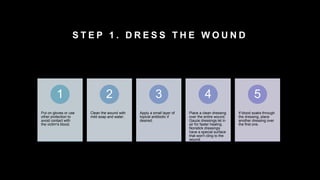
S T E P 1 . D R E S S T H E W O U N D
Put on gloves or use
other protection to
avoid contact with
the victim's blood.
1
Clean the wound with
mild soap and water.
2
Apply a small layer of
topical antibiotic if
desired.
3
Place a clean dressing
over the entire wound.
Gauze dressings let in
air for faster healing.
Nonstick dressings
have a special surface
that won't cling to the
wound.
4
If blood soaks through
the dressing, place
another dressing over
the first one.
5
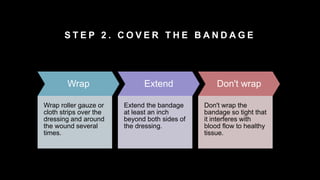
S T E P 2 . C O V E R T H E B A N D A G E
Wrap
Wrap roller gauze or
cloth strips over the
dressing and around
the wound several
times.
Extend
Extend the bandage
at least an inch
beyond both sides of
the dressing.
Don't wrap
Don't wrap the
bandage so tight that
it interferes with
blood flow to healthy
tissue.
S T E P 3 .
S E C U R E T H E
B A N D A G E
• Tie or tape the bandage in place.
• Don't secure the bandage so tight that fingers or
toes become pale or blue.
S T E P 4 . C H E C K C I R C U L AT I O N
Check circulation in the area below the bandage after several minutes and
again after several hours. If circulation is poor, the skin may look pale or blue or
feel cold. Signs of poor circulation also include numbness and tingling.
If circulation is reduced, loosen the bandage immediately. If symptoms continue,
seek medical attention.
A P P LY I N G R O L L E R B A N D A G E
1.Circular bandage
2. Spiral bandage
3. Oblique bandage
4.Recurrent bandage of head with one
Bandage
A P P LY I N G R O L L E R B A N D A G E
5. Recurrent bandage of head with two
bandages
6. Crossed bandage of one eye
7.Crossed bandage of both eye
8.Bandage of jaw( Modified gibson bandage)
A P P LY I N G R O L L E R B A N D A G E
9.spica of shoulder
10 . Figure of eight of clavical
11. Velpeau
12. Figure of eight of hand
A P P LY I N G
R O L L E R
B A N D A G E
• 13. Figure of eight of forearm
• 14 . Spiral reverse of Forearm
• 15. Figure of eight of elbow and front of elbow
bandage
• 16. Recurrent bandage of stump
A P P LY I N G R O L L E R
B A N D A G E
17. Demigauntlet bandage and
Gauntlet bandage
18. Complete bandage of hand
and finger bandage
19. Spica of foot
20 . Figure of eight of foot with
heel exposed
A P P LY I N G
T R I A N G U L
A R A N D
C R AVAT
B A N D A G E
S
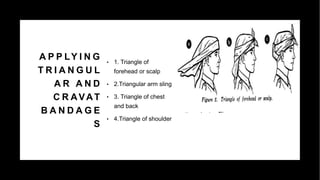
• 1. Triangle of
forehead or scalp
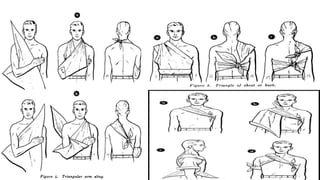
• 2.Triangular arm sling
• 3. Triangle of chest
and back
• 4.Triangle of shoulder
A P P LY I N G
T R I A N G U L A R
A N D C R AVAT
B A N D A G E S
• 5. Triangle of hip
• 6. Triangle of foot
• 7. Triangle of hand
• 8.Cravat of head or ear
A P P LY I N G T R I A N G U L A R A N D C R A V A T
B A N D A G E S
9 .cravat of jaw
10. Cravat bandage of eye
11. Shoulder armpit cravat
12. Cravat of elbow
A P P LY I N G
T R I A N G U L A R
A N D C R AVAT
B A N D A G E S
• 13. Cravat of leg
• 14. Cravat of palm of hand
• 15. Cravat of knee
A P P LY I N G TA I L E D B A N D A G E S
1. T- bandage of the scalp
2 Double T- bandage of the chest
3. Four tailed bandage of the nose
4 . Four tailed bandage of the jaw
S P L I N T I N G

First aid , bandage and dressing

  • 1.
    F I RS T A I D : - Dressing and Bandages
  • 2.
    D R ES S I N G • It is a protective covering of a wound. • This can be done by some medicine or without medicine for the soakage of drained material
  • 3.
    P U RP O S E O F D R E S S I N G • To prevent infection • To prevent further complication • To absorb any blood or discharge • To promote healing
  • 4.
    T Y PE S O F D R E S S I N G • 1. Medicated : This type of dressing contains medicine on it to prevent any multiplication of microorganisms on the wound and to cover the wound. These may or may not contain adhesive material on it. Also called prepared dressing . • 2. Non-medicated : This type does not have any medicine on it. These can be used to cover up the large wound. These may include gauze piece,clean handkerchief, etc • 3. Dry-dressing : In these types of dressing dry clean absorbent material is used to cover the wound. These maybe medicated or non-medicated • 4. Wet-dressing : If the wound is infected ,wet dressings are often used to soften the wound and discharge. Heat can also be applied locally to area by means of wet dressing. The dressing can be moistened by warm saline. • 5. Pressure-dressing: The dressing is done to apply pressure on any area that is bleeding so as to control bleeding
  • 5.
    B A ND A G E S • A bandage is a piece of material used either to support a medical device such as a dressing or splint, or on its own to provide support to or to restrict the movement of a part of the body. When used with a dressing, the dressing is applied directly on a wound, and a bandage used to hold the dressing in place. Other bandages are used without dressings, such as elastic bandages that are used to reduce swelling or provide support to a sprained ankle. Tight bandages can be used to slow blood flow to an extremity, such as when a leg or arm is bleeding heavily.
  • 6.
    T Y PE S O F B A N D A G E S There are different types of bandages mainly:- Gauze or roller bandages Triangular bandage Multitailed bandages
  • 7.
    G A UZ E B A N D A G E ( C O M M O N G A U Z E R O L L E R B A N D A G E ) • The most common type of bandage is the gauze bandage, a woven strip of material with a Telfa absorbent barrier to prevent adhering to wounds. A gauze bandage can come in any number of widths and lengths and can be used for almost any bandage application, including holding a dressing in place
  • 8.
    A D HE S I V E B A N D A G E • An adhesive bandage, also called a sticking plaster, medical plaster, or simply plaste.It is a small medical dressing used for injuries not serious enough to require a full-size bandage. • The adhesive bandage protects the wound and scab from friction, bacteria, damage, and dirt. Thus, the healing process of the body is less disturbed. Some of the dressings have antiseptic properties. An additional function is to hold the two cut ends of the skin together to make the healing process faster
  • 9.
    L I QU I D B A N D A G E • Liquid bandage is a topical skin treatment for minor cuts and sores that is sold by several companies. The products are mixtures of chemicals which create a polymeric layer which binds to the skin. This protects the wound by keeping dirt and germs out, and keeping moisture in
  • 10.
    C O MP R E S S I O N B A N D A G E • Short stretch compression bandages are applied to a limb (usually for treatment of lymphedema or venous ulcers). This type of bandage is capable of shortening around the limb after application and is therefore not exerting ever-increasing pressure during inactivity. This dynamic is called resting pressure and is considered safe and comfortable for long-term treatment. Conversely, the stability of the bandage creates a very high resistance to stretch when pressure is applied through internal muscle contraction and joint movement. This force is called working pressure. • Long stretch compression bandages have long stretch properties, meaning their high compressive power can be easily adjusted. However, they also have a very high resting pressure and must be removed at night or if the patient is in a resting position.
  • 11.
    T R IA N G U L A R B A N D A G E • Also known as a cravat bandage, a triangular bandage is a piece of cloth put into a right- angled triangle, and often provided with safety pins to secure it in place. It can be used fully unrolled as a sling, folded as a normal bandage, or for specialized applications, as on the head. One advantage of this type of bandage is that it can be makeshift and made from a fabric scrap or a piece of clothing. The Boy Scouts popularized use of this bandage in many of their first aid lessons, as a part of the uniform is a "neckerchief" that can easily be folded to form a cravat.
  • 12.
    T U BE B A N D A G E • A tube bandage is applied using an applicator, and is woven in a continuous circle. It is used to hold dressings or splints on to limbs, or to provide support to sprains and strains, so that it stops bleeding.
  • 13.
    K I RI G A M I B A N D A G E • A new type of bandage was invented in 2016; inspired by the art of kirigami, it uses parallel slits to better fit areas of the body that bend. The bandages have been produced.
  • 14.
    P L AS T E R O F P A R I S B A N D A G E S To immobilize joint or limb fractures. Applied as a slab, splint or full cylindrical cast.
  • 15.
    H O WT O A P P LY B A N D A G E S : - • Covering a break in the skin helps to control bleeding and protect against infection. Dressings are pads of gauze or cloth that can be placed directly against the wound to absorb blood and other fluids. Cloth bandages cover dressings and hold them in place.
  • 16.
    S T EP 1 . D R E S S T H E W O U N D Put on gloves or use other protection to avoid contact with the victim's blood. 1 Clean the wound with mild soap and water. 2 Apply a small layer of topical antibiotic if desired. 3 Place a clean dressing over the entire wound. Gauze dressings let in air for faster healing. Nonstick dressings have a special surface that won't cling to the wound. 4 If blood soaks through the dressing, place another dressing over the first one. 5
  • 17.
    S T EP 2 . C O V E R T H E B A N D A G E Wrap Wrap roller gauze or cloth strips over the dressing and around the wound several times. Extend Extend the bandage at least an inch beyond both sides of the dressing. Don't wrap Don't wrap the bandage so tight that it interferes with blood flow to healthy tissue.
  • 18.
    S T EP 3 . S E C U R E T H E B A N D A G E • Tie or tape the bandage in place. • Don't secure the bandage so tight that fingers or toes become pale or blue.
  • 19.
    S T EP 4 . C H E C K C I R C U L AT I O N Check circulation in the area below the bandage after several minutes and again after several hours. If circulation is poor, the skin may look pale or blue or feel cold. Signs of poor circulation also include numbness and tingling. If circulation is reduced, loosen the bandage immediately. If symptoms continue, seek medical attention.
  • 20.
    A P PLY I N G R O L L E R B A N D A G E 1.Circular bandage 2. Spiral bandage 3. Oblique bandage 4.Recurrent bandage of head with one Bandage
  • 21.
    A P PLY I N G R O L L E R B A N D A G E 5. Recurrent bandage of head with two bandages 6. Crossed bandage of one eye 7.Crossed bandage of both eye 8.Bandage of jaw( Modified gibson bandage)
  • 22.
    A P PLY I N G R O L L E R B A N D A G E 9.spica of shoulder 10 . Figure of eight of clavical 11. Velpeau 12. Figure of eight of hand
  • 23.
    A P PLY I N G R O L L E R B A N D A G E • 13. Figure of eight of forearm • 14 . Spiral reverse of Forearm • 15. Figure of eight of elbow and front of elbow bandage • 16. Recurrent bandage of stump
  • 24.
    A P PLY I N G R O L L E R B A N D A G E 17. Demigauntlet bandage and Gauntlet bandage 18. Complete bandage of hand and finger bandage 19. Spica of foot 20 . Figure of eight of foot with heel exposed
  • 25.
    A P PLY I N G T R I A N G U L A R A N D C R AVAT B A N D A G E S • 1. Triangle of forehead or scalp • 2.Triangular arm sling • 3. Triangle of chest and back • 4.Triangle of shoulder
  • 27.
    A P PLY I N G T R I A N G U L A R A N D C R AVAT B A N D A G E S • 5. Triangle of hip • 6. Triangle of foot • 7. Triangle of hand • 8.Cravat of head or ear
  • 28.
    A P PLY I N G T R I A N G U L A R A N D C R A V A T B A N D A G E S 9 .cravat of jaw 10. Cravat bandage of eye 11. Shoulder armpit cravat 12. Cravat of elbow
  • 29.
    A P PLY I N G T R I A N G U L A R A N D C R AVAT B A N D A G E S • 13. Cravat of leg • 14. Cravat of palm of hand • 15. Cravat of knee
  • 30.
    A P PLY I N G TA I L E D B A N D A G E S 1. T- bandage of the scalp 2 Double T- bandage of the chest 3. Four tailed bandage of the nose 4 . Four tailed bandage of the jaw
  • 31.
    S P LI N T I N G