• The properbandaging and dressing that is properly applied
can aid materially in the recovery of a casualty. A carelessly
or improperly applied bandage can cause discomfort to the
patient; in many instances, it may expose the wound to the
danger of infection; it may even imperil the life of the
casualty. It is essential, therefore, to become familiar with
the various bandages and dressing and be able to apply them
properly.
3.
What is Dressing?
•Adressing is a piece of sterile
cloth that covers a wound to
prevent infection and/or stop
bleeding.
4.
Techniques in Applyinga Dressing
• 1. Wash hands and wear gloves, if possible.
• 2. Unwrap the dressing as close to the wound as possible. Be sure not
to touch the wound.
• 3. Skin is not sterile. If the dressing slips over the victim's skin while
you are trying to position it, discard and use a fresh one.
• 4. Place the dressing over the wound.
• 5. Use a dressing that is large enough to extend at least 1 inch beyond
the edges of the wound.
• 6. If body tissues or organs are exposed, cover the wound with a
dressing that will stick.
• 7. Then secure the dressing with a bandage or adhesive tape.
5.
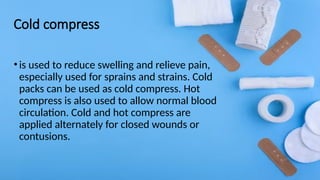
Cold compress
•is usedto reduce swelling and relieve pain,
especially used for sprains and strains. Cold
packs can be used as cold compress. Hot
compress is also used to allow normal blood
circulation. Cold and hot compress are
applied alternately for closed wounds or
contusions.
6.
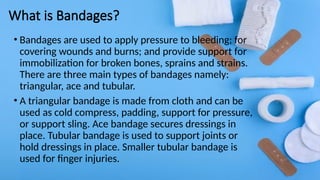
What is Bandages?
•Bandages are used to apply pressure to bleeding; for
covering wounds and burns; and provide support for
immobilization for broken bones, sprains and strains.
There are three main types of bandages namely:
triangular, ace and tubular.
• A triangular bandage is made from cloth and can be
used as cold compress, padding, support for pressure,
or support sling. Ace bandage secures dressings in
place. Tubular bandage is used to support joints or
hold dressings in place. Smaller tubular bandage is
used for finger injuries.
7.
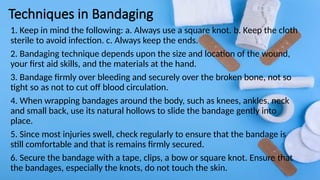
Techniques in Bandaging
1.Keep in mind the following: a. Always use a square knot. b. Keep the cloth
sterile to avoid infection. c. Always keep the ends.
2. Bandaging technique depends upon the size and location of the wound,
your first aid skills, and the materials at the hand.
3. Bandage firmly over bleeding and securely over the broken bone, not so
tight so as not to cut off blood circulation.
4. When wrapping bandages around the body, such as knees, ankles, neck
and small back, use its natural hollows to slide the bandage gently into
place.
5. Since most injuries swell, check regularly to ensure that the bandage is
still comfortable and that is remains firmly secured.
6. Secure the bandage with a tape, clips, a bow or square knot. Ensure that
the bandages, especially the knots, do not touch the skin.
8.
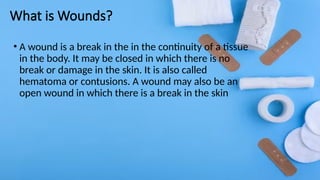
What is Wounds?
•A wound is a break in the in the continuity of a tissue
in the body. It may be closed in which there is no
break or damage in the skin. It is also called
hematoma or contusions. A wound may also be an
open wound in which there is a break in the skin
9.
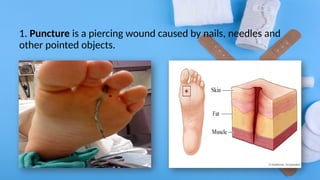
1. Puncture isa piercing wound caused by nails, needles and
other pointed objects.
10.
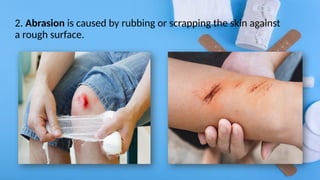
2. Abrasion iscaused by rubbing or scrapping the skin against
a rough surface.
11.
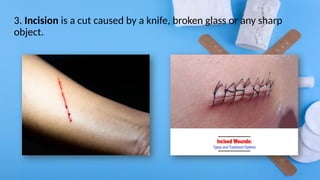
3. Incision isa cut caused by a knife, broken glass or any sharp
object.
12.
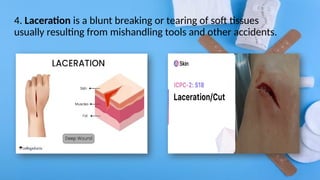
4. Laceration isa blunt breaking or tearing of soft tissues
usually resulting from mishandling tools and other accidents.
13.
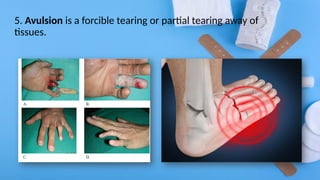
5. Avulsion isa forcible tearing or partial tearing away of
tissues.
14.
How to ManageWounds?
A. For management for the hematoma, we use the mnemonic
RICE Method:
1. Resting the injured part
2. Ice application
3. Compression
4. Elevation
15.
B. First Aidfor Open Wounds with Severe Bleeding
1. Wear gloves and remove or cut clothing as necessary to
expose the wound.
2. Control bleeding by applying direct pressure.
3. Elevate the injured part above the heart except for eye injury
and wounds with embedded objects.
4. Cover wound with sterile dressing and bandage.
5. Care for shock and Consult a physician immediately.