Term Project Presentation by :
Hitesh
Arjun
Kingsley
Tareq

ISSM564-Firewall Fundamentals

1
In our presentation we will introduce :
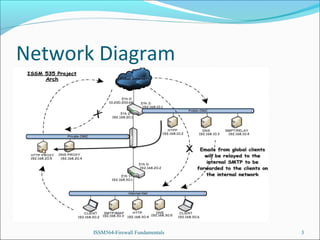
Our network and firewall architecture.
Then we will go over the public DMZ and the first packet
filter .
3. Last but not least we will give a brief explanations of our
private DMZ .
4. Finally we will introduce our internal network with the
possible attacks and the rules we will use in our packet
filter`s iptables to harden our network and system
against these attacks .
1.
2.

ISSM564-Firewall Fundamentals

2
Network Diagram

ISSM564-Firewall Fundamentals

3
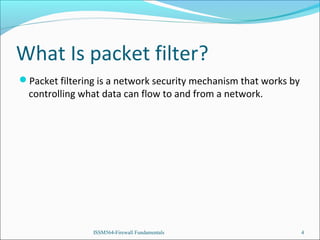
What Is packet filter?
Packet filtering is a network security mechanism that works by

controlling what data can flow to and from a network.

ISSM564-Firewall Fundamentals

4
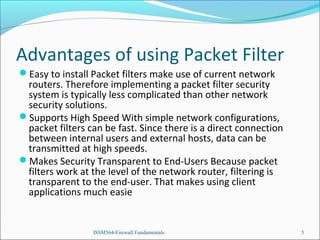
Advantages of using Packet Filter
Easy to install Packet filters make use of current network

routers. Therefore implementing a packet filter security
system is typically less complicated than other network
security solutions.
Supports High Speed With simple network configurations,
packet filters can be fast. Since there is a direct connection
between internal users and external hosts, data can be
transmitted at high speeds.
Makes Security Transparent to End-Users Because packet
filters work at the level of the network router, filtering is
transparent to the end-user. That makes using client
applications much easie

ISSM564-Firewall Fundamentals

5
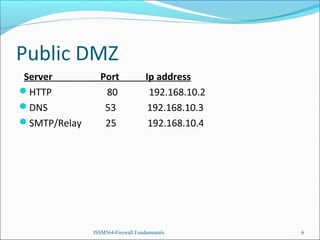
Public DMZ
Server
HTTP
DNS
SMTP/Relay

Port
80
53
25

Ip address
192.168.10.2
192.168.10.3
192.168.10.4

ISSM564-Firewall Fundamentals

6
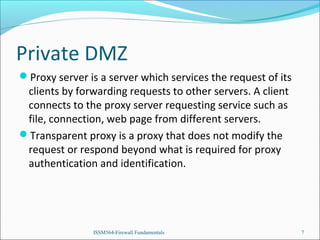
Private DMZ
Proxy server is a server which services the request of its

clients by forwarding requests to other servers. A client
connects to the proxy server requesting service such as
file, connection, web page from different servers.
Transparent proxy is a proxy that does not modify the
request or respond beyond what is required for proxy
authentication and identification.

ISSM564-Firewall Fundamentals

7
Packet Filter 1
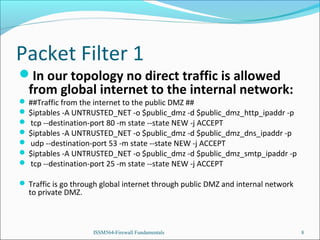
In our topology no direct traffic is allowed

from global internet to the internal network:

 ##Traffic from the internet to the public DMZ ##
 $iptables -A UNTRUSTED_NET -o $public_dmz -d $public_dmz_http_ipaddr -p
 tcp --destination-port 80 -m state --state NEW -j ACCEPT
 $iptables -A UNTRUSTED_NET -o $public_dmz -d $public_dmz_dns_ipaddr -p
 udp --destination-port 53 -m state --state NEW -j ACCEPT
 $iptables -A UNTRUSTED_NET -o $public_dmz -d $public_dmz_smtp_ipaddr -p
 tcp --destination-port 25 -m state --state NEW -j ACCEPT
 Traffic is go through global internet through public DMZ and internal network

to private DMZ.

ISSM564-Firewall Fundamentals

8
Packet Filter 1
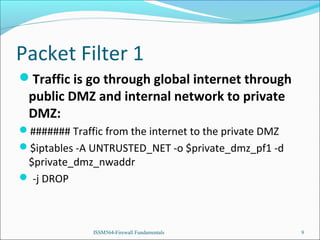
Traffic is go through global internet through

public DMZ and internal network to private
DMZ:

####### Traffic from the internet to the private DMZ
$iptables -A UNTRUSTED_NET -o $private_dmz_pf1 -d

$private_dmz_nwaddr
 -j DROP

ISSM564-Firewall Fundamentals

9
Tweaks we will use to prevent
possible attacks :
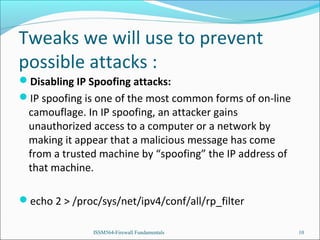
Disabling IP Spoofing attacks:
IP spoofing is one of the most common forms of on-line

camouflage. In IP spoofing, an attacker gains
unauthorized access to a computer or a network by
making it appear that a malicious message has come
from a trusted machine by “spoofing” the IP address of
that machine.

echo 2 > /proc/sys/net/ipv4/conf/all/rp_filter
ISSM564-Firewall Fundamentals

10
Tweaks we will use to prevent
possible attacks :
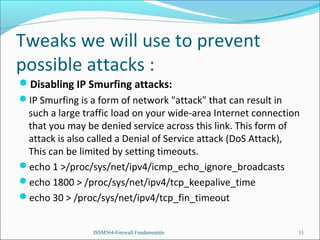
Disabling IP Smurfing attacks:
IP Smurfing is a form of network "attack" that can result in

such a large traffic load on your wide-area Internet connection
that you may be denied service across this link. This form of
attack is also called a Denial of Service attack (DoS Attack),
This can be limited by setting timeouts.
echo 1 >/proc/sys/net/ipv4/icmp_echo_ignore_broadcasts
echo 1800 > /proc/sys/net/ipv4/tcp_keepalive_time
echo 30 > /proc/sys/net/ipv4/tcp_fin_timeout
ISSM564-Firewall Fundamentals

11
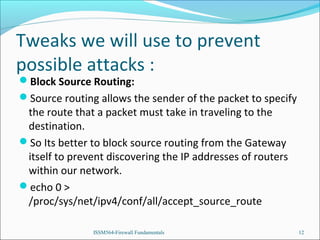
Tweaks we will use to prevent
possible attacks :
Block Source Routing:

Source routing allows the sender of the packet to specify

the route that a packet must take in traveling to the
destination.
So Its better to block source routing from the Gateway
itself to prevent discovering the IP addresses of routers
within our network.
echo 0 >
/proc/sys/net/ipv4/conf/all/accept_source_route
ISSM564-Firewall Fundamentals

12
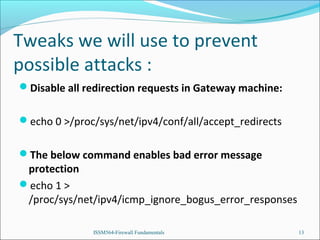
Tweaks we will use to prevent
possible attacks :
Disable all redirection requests in Gateway machine:
echo 0 >/proc/sys/net/ipv4/conf/all/accept_redirects
The below command enables bad error message

protection
echo 1 >
/proc/sys/net/ipv4/icmp_ignore_bogus_error_responses
ISSM564-Firewall Fundamentals

13
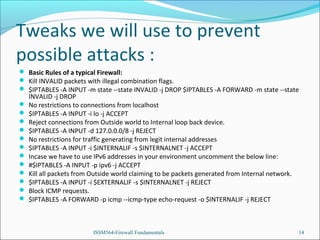
Tweaks we will use to prevent
possible attacks :
 Basic Rules of a typical Firewall:
 Kill INVALID packets with illegal combination flags.
 $IPTABLES -A INPUT -m state --state INVALID -j DROP $IPTABLES -A FORWARD -m state --state













INVALID -j DROP
No restrictions to connections from localhost
$IPTABLES -A INPUT -i lo -j ACCEPT
Reject connections from Outside world to Internal loop back device.
$IPTABLES -A INPUT -d 127.0.0.0/8 -j REJECT
No restrictions for traffic generating from legit internal addresses
$IPTABLES -A INPUT -i $INTERNALIF -s $INTERNALNET -j ACCEPT
Incase we have to use IPv6 addresses in your environment uncomment the below line:
#$IPTABLES -A INPUT -p ipv6 -j ACCEPT
Kill all packets from Outside world claiming to be packets generated from Internal network.
$IPTABLES -A INPUT -i $EXTERNALIF -s $INTERNALNET -j REJECT
Block ICMP requests.
$IPTABLES -A FORWARD -p icmp --icmp-type echo-request -o $INTERNALIF -j REJECT

ISSM564-Firewall Fundamentals

14
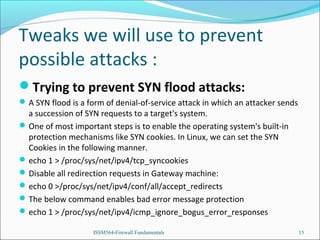
Tweaks we will use to prevent
possible attacks :
Trying to prevent SYN flood attacks:
 A SYN flood is a form of denial-of-service attack in which an attacker sends

a succession of SYN requests to a target's system.
 One of most important steps is to enable the operating system's built-in
protection mechanisms like SYN cookies. In Linux, we can set the SYN
Cookies in the following manner.
 echo 1 > /proc/sys/net/ipv4/tcp_syncookies
 Disable all redirection requests in Gateway machine:
 echo 0 >/proc/sys/net/ipv4/conf/all/accept_redirects
 The below command enables bad error message protection
 echo 1 > /proc/sys/net/ipv4/icmp_ignore_bogus_error_responses
ISSM564-Firewall Fundamentals

15
Tweaks we will use to prevent
possible attacks :
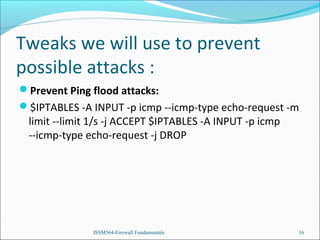
Prevent Ping flood attacks:
$IPTABLES -A INPUT -p icmp --icmp-type echo-request -m

limit --limit 1/s -j ACCEPT $IPTABLES -A INPUT -p icmp
--icmp-type echo-request -j DROP

ISSM564-Firewall Fundamentals

16

Firewall arch by Tareq Hanaysha

  • 1.
    Term Project Presentationby : Hitesh Arjun Kingsley Tareq ISSM564-Firewall Fundamentals 1
  • 2.
    In our presentationwe will introduce : Our network and firewall architecture. Then we will go over the public DMZ and the first packet filter . 3. Last but not least we will give a brief explanations of our private DMZ . 4. Finally we will introduce our internal network with the possible attacks and the rules we will use in our packet filter`s iptables to harden our network and system against these attacks . 1. 2. ISSM564-Firewall Fundamentals 2
  • 3.
  • 4.
    What Is packetfilter? Packet filtering is a network security mechanism that works by controlling what data can flow to and from a network. ISSM564-Firewall Fundamentals 4
  • 5.
    Advantages of usingPacket Filter Easy to install Packet filters make use of current network routers. Therefore implementing a packet filter security system is typically less complicated than other network security solutions. Supports High Speed With simple network configurations, packet filters can be fast. Since there is a direct connection between internal users and external hosts, data can be transmitted at high speeds. Makes Security Transparent to End-Users Because packet filters work at the level of the network router, filtering is transparent to the end-user. That makes using client applications much easie ISSM564-Firewall Fundamentals 5
  • 6.
  • 7.
    Private DMZ Proxy serveris a server which services the request of its clients by forwarding requests to other servers. A client connects to the proxy server requesting service such as file, connection, web page from different servers. Transparent proxy is a proxy that does not modify the request or respond beyond what is required for proxy authentication and identification. ISSM564-Firewall Fundamentals 7
  • 8.
    Packet Filter 1 Inour topology no direct traffic is allowed from global internet to the internal network:  ##Traffic from the internet to the public DMZ ##  $iptables -A UNTRUSTED_NET -o $public_dmz -d $public_dmz_http_ipaddr -p  tcp --destination-port 80 -m state --state NEW -j ACCEPT  $iptables -A UNTRUSTED_NET -o $public_dmz -d $public_dmz_dns_ipaddr -p  udp --destination-port 53 -m state --state NEW -j ACCEPT  $iptables -A UNTRUSTED_NET -o $public_dmz -d $public_dmz_smtp_ipaddr -p  tcp --destination-port 25 -m state --state NEW -j ACCEPT  Traffic is go through global internet through public DMZ and internal network to private DMZ. ISSM564-Firewall Fundamentals 8
  • 9.
    Packet Filter 1 Trafficis go through global internet through public DMZ and internal network to private DMZ: ####### Traffic from the internet to the private DMZ $iptables -A UNTRUSTED_NET -o $private_dmz_pf1 -d $private_dmz_nwaddr  -j DROP ISSM564-Firewall Fundamentals 9
  • 10.
    Tweaks we willuse to prevent possible attacks : Disabling IP Spoofing attacks: IP spoofing is one of the most common forms of on-line camouflage. In IP spoofing, an attacker gains unauthorized access to a computer or a network by making it appear that a malicious message has come from a trusted machine by “spoofing” the IP address of that machine. echo 2 > /proc/sys/net/ipv4/conf/all/rp_filter ISSM564-Firewall Fundamentals 10
  • 11.
    Tweaks we willuse to prevent possible attacks : Disabling IP Smurfing attacks: IP Smurfing is a form of network "attack" that can result in such a large traffic load on your wide-area Internet connection that you may be denied service across this link. This form of attack is also called a Denial of Service attack (DoS Attack), This can be limited by setting timeouts. echo 1 >/proc/sys/net/ipv4/icmp_echo_ignore_broadcasts echo 1800 > /proc/sys/net/ipv4/tcp_keepalive_time echo 30 > /proc/sys/net/ipv4/tcp_fin_timeout ISSM564-Firewall Fundamentals 11
  • 12.
    Tweaks we willuse to prevent possible attacks : Block Source Routing: Source routing allows the sender of the packet to specify the route that a packet must take in traveling to the destination. So Its better to block source routing from the Gateway itself to prevent discovering the IP addresses of routers within our network. echo 0 > /proc/sys/net/ipv4/conf/all/accept_source_route ISSM564-Firewall Fundamentals 12
  • 13.
    Tweaks we willuse to prevent possible attacks : Disable all redirection requests in Gateway machine: echo 0 >/proc/sys/net/ipv4/conf/all/accept_redirects The below command enables bad error message protection echo 1 > /proc/sys/net/ipv4/icmp_ignore_bogus_error_responses ISSM564-Firewall Fundamentals 13
  • 14.
    Tweaks we willuse to prevent possible attacks :  Basic Rules of a typical Firewall:  Kill INVALID packets with illegal combination flags.  $IPTABLES -A INPUT -m state --state INVALID -j DROP $IPTABLES -A FORWARD -m state --state             INVALID -j DROP No restrictions to connections from localhost $IPTABLES -A INPUT -i lo -j ACCEPT Reject connections from Outside world to Internal loop back device. $IPTABLES -A INPUT -d 127.0.0.0/8 -j REJECT No restrictions for traffic generating from legit internal addresses $IPTABLES -A INPUT -i $INTERNALIF -s $INTERNALNET -j ACCEPT Incase we have to use IPv6 addresses in your environment uncomment the below line: #$IPTABLES -A INPUT -p ipv6 -j ACCEPT Kill all packets from Outside world claiming to be packets generated from Internal network. $IPTABLES -A INPUT -i $EXTERNALIF -s $INTERNALNET -j REJECT Block ICMP requests. $IPTABLES -A FORWARD -p icmp --icmp-type echo-request -o $INTERNALIF -j REJECT ISSM564-Firewall Fundamentals 14
  • 15.
    Tweaks we willuse to prevent possible attacks : Trying to prevent SYN flood attacks:  A SYN flood is a form of denial-of-service attack in which an attacker sends a succession of SYN requests to a target's system.  One of most important steps is to enable the operating system's built-in protection mechanisms like SYN cookies. In Linux, we can set the SYN Cookies in the following manner.  echo 1 > /proc/sys/net/ipv4/tcp_syncookies  Disable all redirection requests in Gateway machine:  echo 0 >/proc/sys/net/ipv4/conf/all/accept_redirects  The below command enables bad error message protection  echo 1 > /proc/sys/net/ipv4/icmp_ignore_bogus_error_responses ISSM564-Firewall Fundamentals 15
  • 16.
    Tweaks we willuse to prevent possible attacks : Prevent Ping flood attacks: $IPTABLES -A INPUT -p icmp --icmp-type echo-request -m limit --limit 1/s -j ACCEPT $IPTABLES -A INPUT -p icmp --icmp-type echo-request -j DROP ISSM564-Firewall Fundamentals 16