Unit 5: Firearm Evidence
Dr. Shayani Ghosh
Assistant Professor
Kristu Jayanti College
Why and when is firearms evidence
examined?
• Firearms evidence can usually be found at any crime scene where a weapon has been fired.
• When evidence such as shot shell casings, cartridge cases, bullets and slugs is found at a
crime scene—or recovered from victims, buildings, furniture, vehicles, trees, etc.
• When a firearm is recovered, the examiner can either identify or eliminate it as the firearm
used in the crime, provided that
(1) it still fires and
(2) there is evidence such as a cartridge case or bullet for comparison.
• In addition, GSR, powder burns
test Exhibit
• The identification of firearms ammunition is carried out by comparison with test exhibits
• A number of test Cartridges are fired in such cases before the acceptable test exhibit is
obtained
• The ammunition of same make and batch is used for test firing.
• In defective, damage firearms, charge of the cartridge is reduced before it is fired for test
purposes
test Exhibit
• If firearms cannot be used for test firing, then cast of the relevant part is made in a suitable
medium.
• Materials : Lead, silicon rubber, etc.
Test bullets
• Materials such as rags, paraffin, soap have been used in test firing to obtain
test bullet.
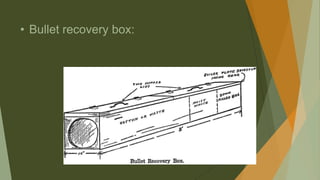
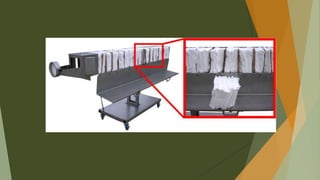
• Bullet recovery box: Divided into compartments, separated by filter paper
sheets.
• Compartments are filled with clean cotton
• There is a lid at the top which is lifted when the bullet is to be located in the
box after firing
• One side is open, forming front face of the box
• Bullet recovery box:
Bullet recovery Water tank
• typically oriented horizontally and measured approximately ten feet long and five feet
high
• Water filled the tank to just below the firing port
• firing port angled to facilitate shooting diagonally from the top edge of one end of the
tank to the bottom of the opposite end
• bullet should travel a minimum of ten to twelve feet on the diagonal
Test marks from smooth bore
• Basic requirement is that the projectile should carry marks from the whole surface of
the barrel
• Achieved by pushing a tight fitting slug made of lead through the barrel without
circular motion
• Slug carries all the marks of bore surface of the barrel
Test marks from smooth bore
By examining wadding materials, the examiner may be able to determine
• the gauge of the shotgun
• the manufacturer or marketer
• A range of possible shot sizes based on impressions in the shot shell wad
• individual characteristics (in some cases)
Examination
Physical Examination:
• Cleaned
• Visual examination: Position and size of firing pin, breech face, other marks
• Gross characteristic indentation, allows elimination of suspected exhibit
• Cliber, no. of L&G, depth, width, direction
Examination
Stereomicroscope:
• Three dimensional image
• Perception of depth is better
• The cartridge case examination by Stereo microscope is very much superior analysis
Comparison microscope
• Side by side analysis
• Two microscopes connected by an optical bridge, enabling two objects to be viewed
simultaneously
• Optical bridge consist of a series of lens and mirror that brings two images together
under a single eyepiece
• A line in the middle separate the view field into two parts
Comparison microscope
• The images from the comparison instrument can also be transferred to a computer monitor, television
screen or sent via the Internet to a remote computer.
• Philip O. Gravelle developed the comparison microscope for the identification of
fired bullets and cartridge cases with the support and guidance of Major Calvin H. Goddard.
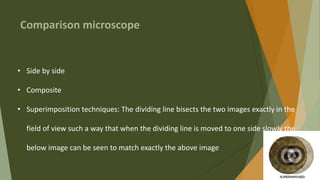
Comparison microscope
• Side by side
• Composite
• Superimposition techniques: The dividing line bisects the two images exactly in the
field of view such a way that when the dividing line is moved to one side slowly the
below image can be seen to match exactly the above image
Scanning Electron Microscope
A beam of the electrons is impinged on the surface. The extent, direction and intensity of
secondary electrons emitted by the surface depends of the questioned surface area and the
original beam.
• Examination of all sort of microscopic surface characteristics
• Examination of marks on fired ammunition (pin marks, extractor marks, ejector marks, marks
on bullet
• Examination of GSR, gunshot injuries, range of fire
• Scanning electron microscopy and energy dispersive X-ray spectroscopy (SEM/EDX), trace
deposits on the discharged bullet and the intermediate target,
Striagraphy
Study and compare the striations found on bullets: Striagraphy
• A very fine stylus, tip diameter <0.0002 cm, rest on a bullet
• The bullet slowly rotates slowly at the rate of one-tenth revolution per minute
• The angular speed is synchronized with the angular speed of drum carrying the chart
paper
• The tip of the stylus moves up and down according to the striations on the surface of
bullets
• Up-and-down movement is amplified and recorded on a graph paper
country made firearms
• Improvised Firearms, home-made forearms, zip guns, pipe guns, etc.
• Made illegally, improvised by culprits from readily available materials
• Non-standard, non-tested, non-worthy
• Classification: reference to ammunition used in them
according to the manner in which they are fired
• They are largely smooth bore barrels
country made firearms: Usual Parts
• Barrel:
The diameter of the bore/caliber may not corresponds to that of a standard firearms
The bore surface is never smooth
Thickness of barrel wall differs from one firearm to another
Loose and non-uniform barrel
The bore of the barrel can be oversized, undersized, same size with respect to the bullet
country made firearms: Usual Parts
• Chamber:
Doesn’t have specially made chamber, barrel ends serves as chamber
Sometimes the bore diameter is more than the base diameter
Don’t have proper dimensions, no proper arrangements for seating cartridge
correctly
Loose chamber causes cartridge burst
country made firearms: Usual Parts
• Action:
Hammer is cocked manually
Firing pin is more or less a headless nail
Often longer than needed and can pierce the percussion cap
Backward leakage of gases
Unique impact of base and sides of case
In some cases, firing pin continues to be pressed against the case as there is no spring
action to take it back
Evaluation
• Cartridge-firearm linkage
• Bullet-firearm linkage
• Buckshot-firearm linkage
• Wad-firearm linkage
Evaluation
• Power charge needs to be reduced
• Jammed bullet or cartridge cases can be cocked manually with the help of a hammer
• Imprinting the damaged part of the firearm part with suitable materials like Plasticine,
Kerr’s Dental mass, cellulose acetate solutions
• Bullets can be pushed through the barrel with great force, if firing pin, or cocking
mechanism doesn’t work
• Smoke may deposit in cushion wads, may carry irregularities of the barrel

Firearms as evidence

  • 1.
    Unit 5: FirearmEvidence Dr. Shayani Ghosh Assistant Professor Kristu Jayanti College
  • 2.
    Why and whenis firearms evidence examined? • Firearms evidence can usually be found at any crime scene where a weapon has been fired. • When evidence such as shot shell casings, cartridge cases, bullets and slugs is found at a crime scene—or recovered from victims, buildings, furniture, vehicles, trees, etc. • When a firearm is recovered, the examiner can either identify or eliminate it as the firearm used in the crime, provided that (1) it still fires and (2) there is evidence such as a cartridge case or bullet for comparison. • In addition, GSR, powder burns
  • 3.
    test Exhibit • Theidentification of firearms ammunition is carried out by comparison with test exhibits • A number of test Cartridges are fired in such cases before the acceptable test exhibit is obtained • The ammunition of same make and batch is used for test firing. • In defective, damage firearms, charge of the cartridge is reduced before it is fired for test purposes
  • 4.
    test Exhibit • Iffirearms cannot be used for test firing, then cast of the relevant part is made in a suitable medium. • Materials : Lead, silicon rubber, etc.
  • 5.
    Test bullets • Materialssuch as rags, paraffin, soap have been used in test firing to obtain test bullet. • Bullet recovery box: Divided into compartments, separated by filter paper sheets. • Compartments are filled with clean cotton • There is a lid at the top which is lifted when the bullet is to be located in the box after firing • One side is open, forming front face of the box
  • 6.
  • 8.
    Bullet recovery Watertank • typically oriented horizontally and measured approximately ten feet long and five feet high • Water filled the tank to just below the firing port • firing port angled to facilitate shooting diagonally from the top edge of one end of the tank to the bottom of the opposite end • bullet should travel a minimum of ten to twelve feet on the diagonal
  • 10.
    Test marks fromsmooth bore • Basic requirement is that the projectile should carry marks from the whole surface of the barrel • Achieved by pushing a tight fitting slug made of lead through the barrel without circular motion • Slug carries all the marks of bore surface of the barrel
  • 11.
    Test marks fromsmooth bore By examining wadding materials, the examiner may be able to determine • the gauge of the shotgun • the manufacturer or marketer • A range of possible shot sizes based on impressions in the shot shell wad • individual characteristics (in some cases)
  • 12.
    Examination Physical Examination: • Cleaned •Visual examination: Position and size of firing pin, breech face, other marks • Gross characteristic indentation, allows elimination of suspected exhibit • Cliber, no. of L&G, depth, width, direction
  • 13.
    Examination Stereomicroscope: • Three dimensionalimage • Perception of depth is better • The cartridge case examination by Stereo microscope is very much superior analysis
  • 14.
    Comparison microscope • Sideby side analysis • Two microscopes connected by an optical bridge, enabling two objects to be viewed simultaneously • Optical bridge consist of a series of lens and mirror that brings two images together under a single eyepiece • A line in the middle separate the view field into two parts
  • 15.
    Comparison microscope • Theimages from the comparison instrument can also be transferred to a computer monitor, television screen or sent via the Internet to a remote computer. • Philip O. Gravelle developed the comparison microscope for the identification of fired bullets and cartridge cases with the support and guidance of Major Calvin H. Goddard.
  • 16.
    Comparison microscope • Sideby side • Composite • Superimposition techniques: The dividing line bisects the two images exactly in the field of view such a way that when the dividing line is moved to one side slowly the below image can be seen to match exactly the above image
  • 18.
    Scanning Electron Microscope Abeam of the electrons is impinged on the surface. The extent, direction and intensity of secondary electrons emitted by the surface depends of the questioned surface area and the original beam. • Examination of all sort of microscopic surface characteristics • Examination of marks on fired ammunition (pin marks, extractor marks, ejector marks, marks on bullet • Examination of GSR, gunshot injuries, range of fire • Scanning electron microscopy and energy dispersive X-ray spectroscopy (SEM/EDX), trace deposits on the discharged bullet and the intermediate target,
  • 19.
    Striagraphy Study and comparethe striations found on bullets: Striagraphy • A very fine stylus, tip diameter <0.0002 cm, rest on a bullet • The bullet slowly rotates slowly at the rate of one-tenth revolution per minute • The angular speed is synchronized with the angular speed of drum carrying the chart paper • The tip of the stylus moves up and down according to the striations on the surface of bullets • Up-and-down movement is amplified and recorded on a graph paper
  • 20.
  • 21.
    country made firearms •Improvised Firearms, home-made forearms, zip guns, pipe guns, etc. • Made illegally, improvised by culprits from readily available materials • Non-standard, non-tested, non-worthy • Classification: reference to ammunition used in them according to the manner in which they are fired • They are largely smooth bore barrels
  • 22.
    country made firearms:Usual Parts • Barrel: The diameter of the bore/caliber may not corresponds to that of a standard firearms The bore surface is never smooth Thickness of barrel wall differs from one firearm to another Loose and non-uniform barrel The bore of the barrel can be oversized, undersized, same size with respect to the bullet
  • 23.
    country made firearms:Usual Parts • Chamber: Doesn’t have specially made chamber, barrel ends serves as chamber Sometimes the bore diameter is more than the base diameter Don’t have proper dimensions, no proper arrangements for seating cartridge correctly Loose chamber causes cartridge burst
  • 24.
    country made firearms:Usual Parts • Action: Hammer is cocked manually Firing pin is more or less a headless nail Often longer than needed and can pierce the percussion cap Backward leakage of gases Unique impact of base and sides of case In some cases, firing pin continues to be pressed against the case as there is no spring action to take it back
  • 25.
    Evaluation • Cartridge-firearm linkage •Bullet-firearm linkage • Buckshot-firearm linkage • Wad-firearm linkage
  • 26.
    Evaluation • Power chargeneeds to be reduced • Jammed bullet or cartridge cases can be cocked manually with the help of a hammer • Imprinting the damaged part of the firearm part with suitable materials like Plasticine, Kerr’s Dental mass, cellulose acetate solutions • Bullets can be pushed through the barrel with great force, if firing pin, or cocking mechanism doesn’t work • Smoke may deposit in cushion wads, may carry irregularities of the barrel

Editor's Notes

  • #3 An Examiner Can Analyze It To Determine The Type Of Firearm used. The Examiner Can Also Compare Shotshell casings, Cartridge Cases And Bullets From Different Crime Scenes To Determine If a common Firearm Was used. In addition to obvious types of firearms evidence, the evidence left behind could include gunshot residue and powder burns. Examiners can use this evidence to determine distances involved in shootings so they can reconstruct the incident. This can be used to support or refute an account of the shooting.
  • #4 Ordinarily one or more test cartridges are fired for this purpose. The number of test CC is not important, the limiting factor is the clarity of the marks. Suppose it is obtained in the first cartridge case, second one may not be necessary Sometimes when same company is not possible, then similar one is taken
  • #5 Lead piece pressed with sufficient force or struck against relevant surfaces
  • #6 Reduction of power charge is necessary , danger of dispersion or piercing.
  • #7 New Mexico Police for testing high speed ammunition The traditional cotton box is usually constructed of wood or one-eighth to one-quarter inch thick metal plates. The box is typically approximately ten feet long and eighteen inches high and wide, with a hinged lid on the top and a firing port at one end. The box is filled with cotton waste material that decelerates bullets fired through the port.
  • #8 Cotton prevents marks from mutilation and slows down the velocity Cotton balss protect the bullets from mutilation Reduces velocity With high velocity, there may be probability of deflaction piercing the box also Sometimes, projectiles of the correct diameter pushed through the barrel have been found to be equally clear with reliable results.
  • #11  Achieved by pushing a tight fitting slug made of lead, 2cm long through the barrel without circular motion Slug of appropriate sizes are prepared by pouring molten lead in a specially improvised mould or in the tubular portion of metallic cartridge case of required diameter
  • #13 Dust and dirt are removed with cotton swab Grease can be cleaned with PE Dil AA and Dil HCl can also be used to clean surfaces whenever necessary Normal odinary light in allowed to fall in various angle
  • #14 Steromicroscope : shape and size of any article or surface can be perceived better in two ways, rather than one, giving a 3-D effect
  • #15 One don’t have to memorize the marks and compare easily
  • #16 In 1920s American Army Colonel Calvin Goddard (1891–1955) who was working for the Bureau of Forensic Ballistics of the City of New York.
  • #17 In 1920s American Army Colonel Calvin Goddard (1891–1955) who was working for the Bureau of Forensic Ballistics of the City of New York. Marks in the matching positions are photographed Side by side: non- striated marks Composite match: striated marks, corresponding marks are bought together at dividing line. Strations marks on one side of dividing line show continuity across the dividing line, if straitions are from one and the same source C and T are superimposed and matched. 3 exposures are captured. First records the match of the marks side by side. The second and third record the superimposed one.
  • #20 The comparison of the graphs on the test and crime exhibits indicates identity or non-identity of the common source of striations The deep scored bullet marked and a lightly marked bullet from the same firearm will give graphs which will apparently look different Difference will make convincing to court difficult Needs comparison and second evaluation Deformed bullet have difficulty for comparision The contour study is limited to one circular line on the bullet. Accidental marks alongwith this line will accentuate the difference.
  • #22 according to the manner in which they are fired: handguns, shoulder guns They are largely smooth bore barrels, though some handguns do carry rifling marks
  • #23 Barrel: Non-standard, iron or steel pipe Barrels are intended to fire 12 bore firearms ammunition or .303 cartridges The diameter of the bore/caliber seldom corresponds to that of a standard firearms: varies fron1 cm to 2.5cm usually The bore surface is never smooth. Vary from one point to another in same barrel. Have ridges and valleys, protusions,pills Interestingly the weapon becomes less dangerous to the victim as th ammunition does not acquire the intended velocity. Both aim and range suffers drastically
  • #24 Doesn’t have specially made chamber, barrel ends serves as chamber, and no special provision or separation of the chamber from the barrel bore Sometimes the bore diameter is more than the base diameter special arrangement is made to prevent the slippage of cartridge in the barrel. Sometimes by even wrapping a piece of cloth or paper around the cartridge case If Exist, they Don’t have proper dimensions, no proper arrangements for seating cartridge correctly A tight chamber imprints the chamber irregularities on the cartridge tube which facilitate their identification
  • #25 Action: Hammer, trigger, firing pin: important part of the action mechanism When trigger is pressed it releases the hammer and the spring makes the hammer strike the firing pin with a considerable force, firing pin is pushed forward and strike the percussion cap, thus exploding the cartridge