Cracking the Case: Microstamping Joshua Horwitz Educational Fund to Stop Gun Violence [email_address]
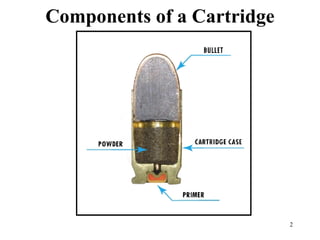
Components of a Cartridge
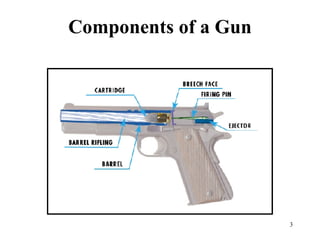
Components of a Gun
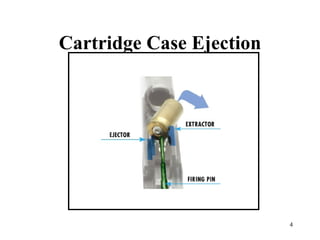
Cartridge Case Ejection
Too Many Cold Cases… On May 7, 2006, a young man was shot and killed while walking in a restaurant parking lot.  Law enforcement found two shell casings and have no leads. On July 28, 2005, a 14-year old boy and his 18 year old brother were shot and killed in a mini-mart just down the street from their home.  Law enforcement found four shell casings at the scene and have no leads. In 2000 a man coming home from work was flagged down by a woman apparently in distress by the side of the road.  When he went to help her, two men tried to rob him.  When he ran, they shot and killed him.  Three shell casings.  No leads. During 2006 in Boston,   out of 1,301 shootings cases, cartridge  casings were the only evidence recovered in 636 (i.e., crime guns  were not found).  Microstamping could have provided substantive  leads in these cases, nearly half the total. Los Angeles County Sheriff Lee Baca’s office provided the following examples where microstamping could have aided an investigation
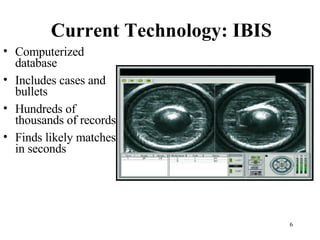
Current Technology: IBIS Computerized database Includes cases and bullets Hundreds of thousands of records Finds likely matches in seconds Top candidates reviewed by trained examiner
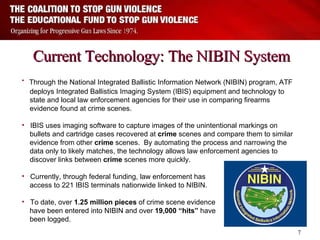
Current Technology: The NIBIN System Through the National Integrated Ballistic Information Network (NIBIN) program, ATF  deploys Integrated Ballistics Imaging System (IBIS) equipment and technology to  state and local law enforcement agencies for their use in comparing firearms  evidence found at crime scenes.   IBIS uses imaging software to capture images of the unintentional markings on  bullets and cartridge cases recovered at  crime  scenes and compare them to similar  evidence from other  crime  scenes.  By automating the process and narrowing the  data only to likely matches, the technology allows law enforcement agencies to  discover links between  crime  scenes more quickly.   Currently, through federal funding, law enforcement has  access to 221 IBIS terminals nationwide linked to NIBIN. To date, over  1.25 million pieces  of crime scene evidence  have been entered into NIBIN and over  19,000 “hits”  have  been logged.
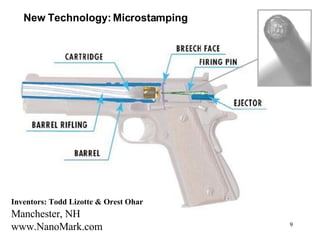
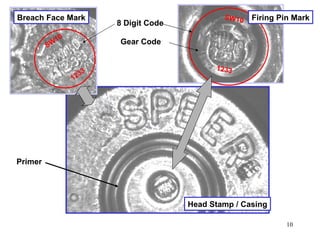
The Next Stage in the Evolution of Ballistics Identification Technology: Microstamping Microstamping inserts microscopic codes into the firing chamber of a firearm that transfer the make, model and serial number to expended cartridges. This means that the  cartridge cases themselves will yield important information without the need to consult a database or imaging system that may or may not contain a match . Cartridges recovered at crime scenes will provide valuable investigative leads. No new bureaucracy, personnel, training or budgeting is needed to stand up  microstamping technology.   It would stand up on the existing ATF trace system. The costs of creating a microstamping system would be borne  by the gun industry and their customers, not the general public.  On a per-unit basis, cost estimates range between 15 cents and $1.        Microstamping would  not  create a new federal database. 
New Technology: Microstamping Inventors: Todd Lizotte & Orest Ohar  Manchester, NH www.NanoMark.com
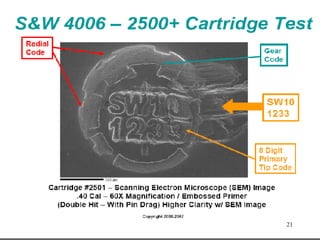
8 Digit Code SW10 1233 SW10 1233 Breach Face Mark Firing Pin Mark Gear Code Head Stamp / Casing Primer
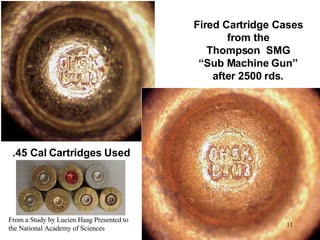
Fired Cartridge Cases from the Thompson  SMG “ Sub Machine Gun” after 2500 rds. From a Study by Lucien Haag Presented to the National Academy of Sciences .45 Cal Cartridges Used
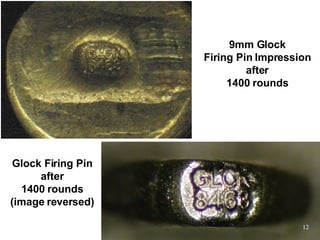
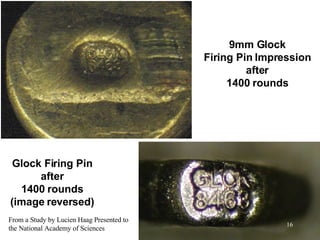
9mm Glock Firing Pin Impression after 1400 rounds Glock Firing Pin after 1400 rounds (image reversed)
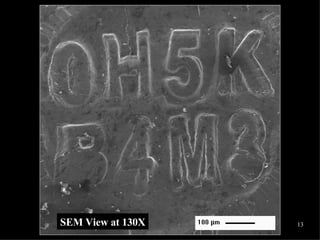
SEM View at 130X
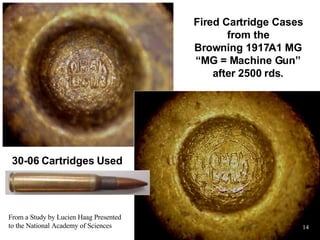
Fired Cartridge Cases from the Browning 1917A1 MG “ MG = Machine Gun” after 2500 rds. 30-06 Cartridges Used From a Study by Lucien Haag Presented to the National Academy of Sciences
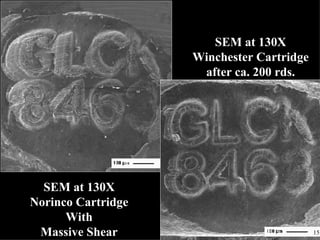
SEM at 130X Norinco Cartridge With Massive Shear SEM at 130X Winchester Cartridge after ca. 200 rds.
9mm Glock Firing Pin Impression after 1400 rounds Glock Firing Pin after 1400 rounds (image reversed) From a Study by Lucien Haag Presented to the National Academy of Sciences
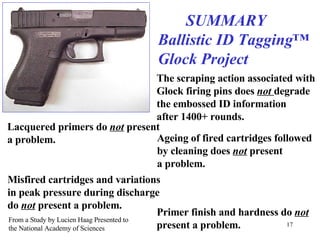
SUMMARY Ballistic ID Tagging™ Glock Project The scraping action associated with Glock firing pins does  not  degrade the embossed ID information after 1400+ rounds. Lacquered primers do  not  present a problem. Ageing of fired cartridges followed by cleaning does  not  present a problem. Misfired cartridges and variations in peak pressure during discharge do  not  present a problem. Primer finish and hardness do  not   present a problem. From a Study by Lucien Haag Presented to the National Academy of Sciences
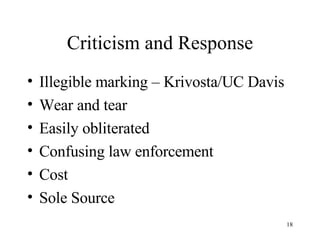
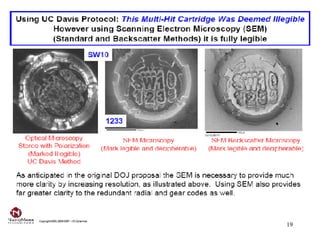
Criticism and Response Illegible marking – Krivosta/UC Davis Wear and tear Easily obliterated Confusing law enforcement  Cost Sole Source
  Screen clipping taken: 11/19/2007, 12:29 PM    
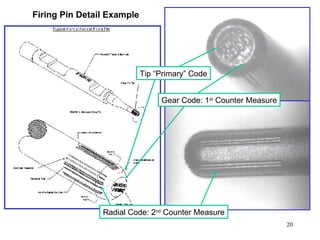
Firing Pin Detail Example Tip “Primary” Code Radial Code: 2 nd  Counter Measure Gear Code: 1 st  Counter Measure
Microstamping
Microstamping
Microstamping

Microstamping

  • 1.
    Cracking the Case:Microstamping Joshua Horwitz Educational Fund to Stop Gun Violence [email_address]
  • 2.
    Components of aCartridge
  • 3.
  • 4.
  • 5.
    Too Many ColdCases… On May 7, 2006, a young man was shot and killed while walking in a restaurant parking lot.  Law enforcement found two shell casings and have no leads. On July 28, 2005, a 14-year old boy and his 18 year old brother were shot and killed in a mini-mart just down the street from their home.  Law enforcement found four shell casings at the scene and have no leads. In 2000 a man coming home from work was flagged down by a woman apparently in distress by the side of the road.  When he went to help her, two men tried to rob him.  When he ran, they shot and killed him.  Three shell casings.  No leads. During 2006 in Boston, out of 1,301 shootings cases, cartridge casings were the only evidence recovered in 636 (i.e., crime guns were not found). Microstamping could have provided substantive leads in these cases, nearly half the total. Los Angeles County Sheriff Lee Baca’s office provided the following examples where microstamping could have aided an investigation
  • 6.
    Current Technology: IBISComputerized database Includes cases and bullets Hundreds of thousands of records Finds likely matches in seconds Top candidates reviewed by trained examiner
  • 7.
    Current Technology: TheNIBIN System Through the National Integrated Ballistic Information Network (NIBIN) program, ATF deploys Integrated Ballistics Imaging System (IBIS) equipment and technology to state and local law enforcement agencies for their use in comparing firearms evidence found at crime scenes.  IBIS uses imaging software to capture images of the unintentional markings on bullets and cartridge cases recovered at crime scenes and compare them to similar evidence from other crime scenes.  By automating the process and narrowing the data only to likely matches, the technology allows law enforcement agencies to discover links between crime scenes more quickly.  Currently, through federal funding, law enforcement has access to 221 IBIS terminals nationwide linked to NIBIN. To date, over 1.25 million pieces of crime scene evidence have been entered into NIBIN and over 19,000 “hits” have been logged.
  • 8.
    The Next Stagein the Evolution of Ballistics Identification Technology: Microstamping Microstamping inserts microscopic codes into the firing chamber of a firearm that transfer the make, model and serial number to expended cartridges. This means that the cartridge cases themselves will yield important information without the need to consult a database or imaging system that may or may not contain a match . Cartridges recovered at crime scenes will provide valuable investigative leads. No new bureaucracy, personnel, training or budgeting is needed to stand up microstamping technology.   It would stand up on the existing ATF trace system. The costs of creating a microstamping system would be borne by the gun industry and their customers, not the general public. On a per-unit basis, cost estimates range between 15 cents and $1.    Microstamping would not create a new federal database. 
  • 9.
    New Technology: MicrostampingInventors: Todd Lizotte & Orest Ohar Manchester, NH www.NanoMark.com
  • 10.
    8 Digit CodeSW10 1233 SW10 1233 Breach Face Mark Firing Pin Mark Gear Code Head Stamp / Casing Primer
  • 11.
    Fired Cartridge Casesfrom the Thompson SMG “ Sub Machine Gun” after 2500 rds. From a Study by Lucien Haag Presented to the National Academy of Sciences .45 Cal Cartridges Used
  • 12.
    9mm Glock FiringPin Impression after 1400 rounds Glock Firing Pin after 1400 rounds (image reversed)
  • 13.
  • 14.
    Fired Cartridge Casesfrom the Browning 1917A1 MG “ MG = Machine Gun” after 2500 rds. 30-06 Cartridges Used From a Study by Lucien Haag Presented to the National Academy of Sciences
  • 15.
    SEM at 130XNorinco Cartridge With Massive Shear SEM at 130X Winchester Cartridge after ca. 200 rds.
  • 16.
    9mm Glock FiringPin Impression after 1400 rounds Glock Firing Pin after 1400 rounds (image reversed) From a Study by Lucien Haag Presented to the National Academy of Sciences
  • 17.
    SUMMARY Ballistic IDTagging™ Glock Project The scraping action associated with Glock firing pins does not degrade the embossed ID information after 1400+ rounds. Lacquered primers do not present a problem. Ageing of fired cartridges followed by cleaning does not present a problem. Misfired cartridges and variations in peak pressure during discharge do not present a problem. Primer finish and hardness do not present a problem. From a Study by Lucien Haag Presented to the National Academy of Sciences
  • 18.
    Criticism and ResponseIllegible marking – Krivosta/UC Davis Wear and tear Easily obliterated Confusing law enforcement Cost Sole Source
  • 19.
      Screen clippingtaken: 11/19/2007, 12:29 PM    
  • 20.
    Firing Pin DetailExample Tip “Primary” Code Radial Code: 2 nd Counter Measure Gear Code: 1 st Counter Measure