DeepLearning-Based Fire andSmokeDetection
System
Presented by
S.AbijahRoseline
Paperid. 1354
Department ofComputational Intelligence
SRMInstitute ofScienceand Technology- Kattankulathur Campus
Chennai, India
22-02-2024
Outline
• Introduction
• Fire/Smoke Detection System
• Motivation
• Literature Survey
• Proposed Model
• Dataset
• Experimental Study and Results
• Conclusion and Futureworks
• References
2
Introduction
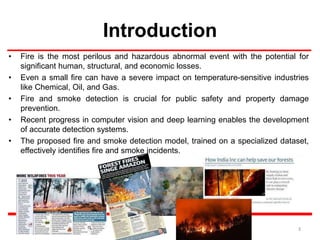
• Fire is the most perilous and hazardous abnormal event with the potential for
significant human, structural, and economic losses.
• Even a small fire can have a severe impact on temperature-sensitive industries
like Chemical, Oil, and Gas.
• Fire and smoke detection is crucial for public safety and property damage
prevention.
• Recent progress in computer vision and deep learning enables the development
of accurate detection systems.
• The proposed fire and smoke detection model, trained on a specialized dataset,
effectively identifies fire and smoke incidents.
3
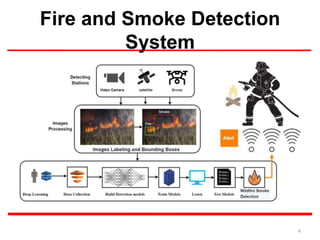
Fire and Smoke Detection
System
4
Motivation
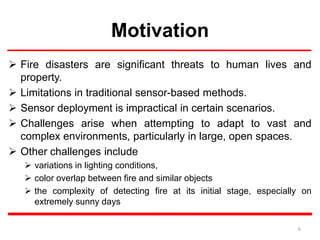
 Fire disasters are significant threats to human lives and
property.
 Limitations in traditional sensor-based methods.
 Sensor deployment is impractical in certain scenarios.
 Challenges arise when attempting to adapt to vast and
complex environments, particularly in large, open spaces.
 Other challenges include
 variations in lighting conditions,
 color overlap between fire and similar objects
 the complexity of detecting fire at its initial stage, especially on
extremely sunny days
6
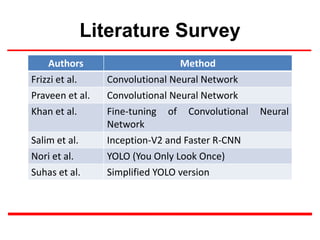
Literature Survey
Authors Method
Frizzi et al. Convolutional Neural Network
Praveen et al. Convolutional Neural Network
Khan et al. Fine-tuning of Convolutional Neural
Network
Salim et al. Inception-V2 and Faster R-CNN
Nori et al. YOLO (You Only Look Once)
Suhas et al. Simplified YOLO version
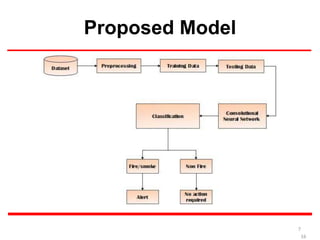
Proposed Model
7
16
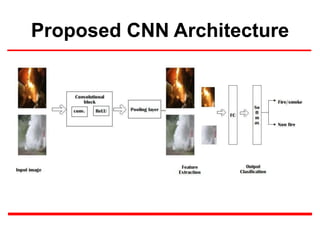
Proposed CNN Architecture
• Architecture includes convolutional layers for feature
extraction, capturing corners and edges.
• Rectified Linear Unit (ReLU) activation nullifies negative
inputs in the convolutional layer.
• Pooling layers optimize efficiency, reducing spatial
volume after convolution.
• Max pooling operates independently between
convolution layers on each feature map.
• Fully connected layers and softmax/logistic layer for
image classification and final output.
Dataset
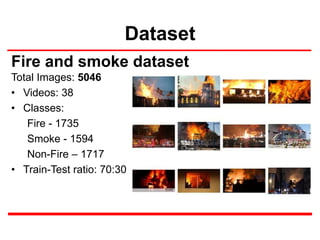
Fire and smoke dataset
Total Images: 5046
• Videos: 38
• Classes:
Fire - 1735
Smoke - 1594
Non-Fire – 1717
• Train-Test ratio: 70:30
Experimental Setup
• Software
– Python framework
– Keras and Tensorflow deep learning library
• Hardware
– Windows 10 operating system utilizing a Ryzen 5
processor
– AMD Graphics 3500U GPU
– minimum of 8GB RAM
19
Experimental Objectives
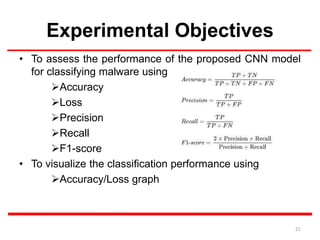
• To assess the performance of the proposed CNN model
for classifying malware using
Accuracy
Loss
Precision
Recall
F1-score
• To visualize the classification performance using
Accuracy/Loss graph
21
Experimental Results
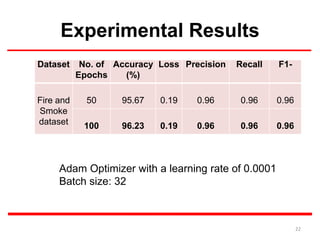
Dataset No. of
Epochs
Accuracy
(%)
Loss Precision Recall F1-
Fire and
Smoke
dataset
50 95.67 0.19 0.96 0.96 0.96
100 96.23 0.19 0.96 0.96 0.96
22
Adam Optimizer with a learning rate of 0.0001
Batch size: 32
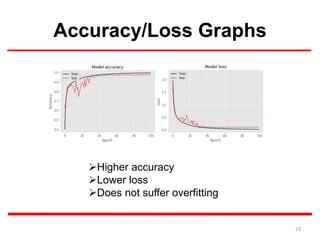
Accuracy/Loss Graphs
Higher accuracy
Lower loss
Does not suffer overfitting
23
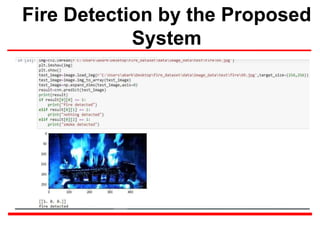
Fire Detection by the Proposed
System
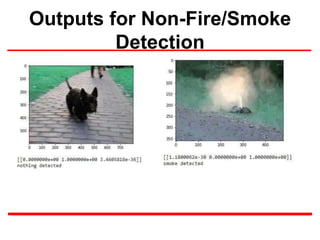
Outputs for Non-Fire/Smoke
Detection
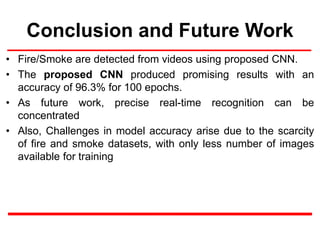
Conclusion and Future Work
• Fire/Smoke are detected from videos using proposed CNN.
• The proposed CNN produced promising results with an
accuracy of 96.3% for 100 epochs.
• As future work, precise real-time recognition can be
concentrated
• Also, Challenges in model accuracy arise due to the scarcity
of fire and smoke datasets, with only less number of images
available for training
[1] Sebastien Frizzi,Rabeb Kaabi, Moez Bouchouicha,Jean-Marc Ginoux, Eric Moreau and
Farhat Fnaiech. ”convolutional neural network for video fire and smoke detection”. IEEE
conference, pp.877-882, 2016.
[2] Praveen Sankarasubramanian and Dr. Ganesh.E.N. ”CNN based Intelligent Framework to
Predict and Detect Fire”. vol.20:pp.755–772, 2022.
[3] Khan muhammad , jamil ahmad,irfan mehmood , seungmin rho andsung wook baik.
”Convolutional Neural Networks Based Fire Detection in Surveillance Videos”. IEEE
conference, vol.6:pp.18174–18183, 2018.
[4] Senthilnayaki, B., Venkatalakshami, K., Dharanyadevi, P., Nivetha, G., & Devi, A. (2022,
March). An efficient medical image encryption using magic square and PSO. In 2022
International Conference on Smart Technologies and Systems for Next Generation Computing
(ICSTSN) (pp. 1-5). IEEE
[5] Salim Said AL-Ghadani and Jayakumari.c. ”Innovating Fire Detection System Fire using
Artificial Intelligence by Image Processing”. International Journal of Innovative Technology and
Exploring Engineering (IJITEE) ISSN: 2278-3075 (Online), vol.9:pp.349–356, 2020.
[6] Ruba Nori.R, Rabah N. Farhan and Safaa Hussein Abed. ”Indoor and outdoor fire
localization using YOLO algorithm”. Journal of Physics:Conference Series, pp.1-10, 2021.
18
References
References
[7] Xiaojun Bai and Zongxin Wang. ”A research on forest fire detection technology based on
deep learning”. International Conference on Computer Network, Electronic and Automation
(ICCNEA), pp.85-90, 2021.
[8] Senthilnayaki B, Rajeswary C, Nivetha G, Dharanyadevi P, Mahalakshmi G and Devi A ,
"Traffic Sign Prediction and Classification Using Image Processing Techniques," 2022
International Conference on Smart Technologies and Systems for Next Generation Computing
(ICSTSN), Villupuram, India, 2022, pp. 1-5, doi: 10.1109/ICSTSN53084.2022.9761286.
[9] Dongqing Shen, Xin Chen, Minh Nguyen and Wei Qi Yan. ”Flame detection using deep
learning”. 4th International Conference on Control, Automation and Robotics, pp.416-420,
2018.
[10] Senthilnayaki, B., Keerthana, S., & Sowmya, H. (2021). Automatic License Plate
Detection And Recognition. International Advanced Research Journal in Science, Engineering
and Technology, 8(8), 22-26.
[11] Turgay Celik, Huseyin Ozkaramanlı and Hasan Demirel. ”Fire and smoke detection
without sensors”. 15th European Signal Processing Conference (EUSIPCO), pp.1794-1798,
2007.
[12] Suhas G , Chetan Kumar, Abhishek B S, Digvijay Gowda K A and Prajwal R. ”Fire
Detection Using Deep Learning”. International Journal of Progressive Research in Science
and Engineering, Vol.1:pp.1–5, 2020.
28
Thank You

Fire smoke detection using Convolutional

  • 1.
    DeepLearning-Based Fire andSmokeDetection System Presentedby S.AbijahRoseline Paperid. 1354 Department ofComputational Intelligence SRMInstitute ofScienceand Technology- Kattankulathur Campus Chennai, India 22-02-2024
  • 2.
    Outline • Introduction • Fire/SmokeDetection System • Motivation • Literature Survey • Proposed Model • Dataset • Experimental Study and Results • Conclusion and Futureworks • References 2
  • 3.
    Introduction • Fire isthe most perilous and hazardous abnormal event with the potential for significant human, structural, and economic losses. • Even a small fire can have a severe impact on temperature-sensitive industries like Chemical, Oil, and Gas. • Fire and smoke detection is crucial for public safety and property damage prevention. • Recent progress in computer vision and deep learning enables the development of accurate detection systems. • The proposed fire and smoke detection model, trained on a specialized dataset, effectively identifies fire and smoke incidents. 3
  • 4.
    Fire and SmokeDetection System 4
  • 5.
    Motivation  Fire disastersare significant threats to human lives and property.  Limitations in traditional sensor-based methods.  Sensor deployment is impractical in certain scenarios.  Challenges arise when attempting to adapt to vast and complex environments, particularly in large, open spaces.  Other challenges include  variations in lighting conditions,  color overlap between fire and similar objects  the complexity of detecting fire at its initial stage, especially on extremely sunny days 6
  • 6.
    Literature Survey Authors Method Frizziet al. Convolutional Neural Network Praveen et al. Convolutional Neural Network Khan et al. Fine-tuning of Convolutional Neural Network Salim et al. Inception-V2 and Faster R-CNN Nori et al. YOLO (You Only Look Once) Suhas et al. Simplified YOLO version
  • 7.
  • 8.
  • 9.
    Proposed CNN Architecture •Architecture includes convolutional layers for feature extraction, capturing corners and edges. • Rectified Linear Unit (ReLU) activation nullifies negative inputs in the convolutional layer. • Pooling layers optimize efficiency, reducing spatial volume after convolution. • Max pooling operates independently between convolution layers on each feature map. • Fully connected layers and softmax/logistic layer for image classification and final output.
  • 10.
    Dataset Fire and smokedataset Total Images: 5046 • Videos: 38 • Classes: Fire - 1735 Smoke - 1594 Non-Fire – 1717 • Train-Test ratio: 70:30
  • 11.
    Experimental Setup • Software –Python framework – Keras and Tensorflow deep learning library • Hardware – Windows 10 operating system utilizing a Ryzen 5 processor – AMD Graphics 3500U GPU – minimum of 8GB RAM 19
  • 12.
    Experimental Objectives • Toassess the performance of the proposed CNN model for classifying malware using Accuracy Loss Precision Recall F1-score • To visualize the classification performance using Accuracy/Loss graph 21
  • 13.
    Experimental Results Dataset No.of Epochs Accuracy (%) Loss Precision Recall F1- Fire and Smoke dataset 50 95.67 0.19 0.96 0.96 0.96 100 96.23 0.19 0.96 0.96 0.96 22 Adam Optimizer with a learning rate of 0.0001 Batch size: 32
  • 14.
    Accuracy/Loss Graphs Higher accuracy Lowerloss Does not suffer overfitting 23
  • 15.
    Fire Detection bythe Proposed System
  • 16.
  • 17.
    Conclusion and FutureWork • Fire/Smoke are detected from videos using proposed CNN. • The proposed CNN produced promising results with an accuracy of 96.3% for 100 epochs. • As future work, precise real-time recognition can be concentrated • Also, Challenges in model accuracy arise due to the scarcity of fire and smoke datasets, with only less number of images available for training
  • 18.
    [1] Sebastien Frizzi,RabebKaabi, Moez Bouchouicha,Jean-Marc Ginoux, Eric Moreau and Farhat Fnaiech. ”convolutional neural network for video fire and smoke detection”. IEEE conference, pp.877-882, 2016. [2] Praveen Sankarasubramanian and Dr. Ganesh.E.N. ”CNN based Intelligent Framework to Predict and Detect Fire”. vol.20:pp.755–772, 2022. [3] Khan muhammad , jamil ahmad,irfan mehmood , seungmin rho andsung wook baik. ”Convolutional Neural Networks Based Fire Detection in Surveillance Videos”. IEEE conference, vol.6:pp.18174–18183, 2018. [4] Senthilnayaki, B., Venkatalakshami, K., Dharanyadevi, P., Nivetha, G., & Devi, A. (2022, March). An efficient medical image encryption using magic square and PSO. In 2022 International Conference on Smart Technologies and Systems for Next Generation Computing (ICSTSN) (pp. 1-5). IEEE [5] Salim Said AL-Ghadani and Jayakumari.c. ”Innovating Fire Detection System Fire using Artificial Intelligence by Image Processing”. International Journal of Innovative Technology and Exploring Engineering (IJITEE) ISSN: 2278-3075 (Online), vol.9:pp.349–356, 2020. [6] Ruba Nori.R, Rabah N. Farhan and Safaa Hussein Abed. ”Indoor and outdoor fire localization using YOLO algorithm”. Journal of Physics:Conference Series, pp.1-10, 2021. 18 References
  • 19.
    References [7] Xiaojun Baiand Zongxin Wang. ”A research on forest fire detection technology based on deep learning”. International Conference on Computer Network, Electronic and Automation (ICCNEA), pp.85-90, 2021. [8] Senthilnayaki B, Rajeswary C, Nivetha G, Dharanyadevi P, Mahalakshmi G and Devi A , "Traffic Sign Prediction and Classification Using Image Processing Techniques," 2022 International Conference on Smart Technologies and Systems for Next Generation Computing (ICSTSN), Villupuram, India, 2022, pp. 1-5, doi: 10.1109/ICSTSN53084.2022.9761286. [9] Dongqing Shen, Xin Chen, Minh Nguyen and Wei Qi Yan. ”Flame detection using deep learning”. 4th International Conference on Control, Automation and Robotics, pp.416-420, 2018. [10] Senthilnayaki, B., Keerthana, S., & Sowmya, H. (2021). Automatic License Plate Detection And Recognition. International Advanced Research Journal in Science, Engineering and Technology, 8(8), 22-26. [11] Turgay Celik, Huseyin Ozkaramanlı and Hasan Demirel. ”Fire and smoke detection without sensors”. 15th European Signal Processing Conference (EUSIPCO), pp.1794-1798, 2007. [12] Suhas G , Chetan Kumar, Abhishek B S, Digvijay Gowda K A and Prajwal R. ”Fire Detection Using Deep Learning”. International Journal of Progressive Research in Science and Engineering, Vol.1:pp.1–5, 2020. 28
  • 20.