
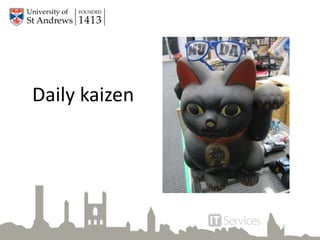
Daily Kaizen
Fin Miller: Change Manager
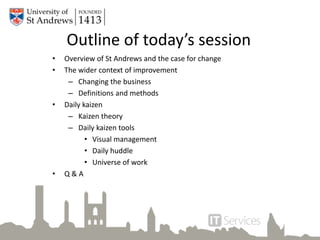
Outline of today’s session
• Overview of St Andrews and the case for change
• The wider context of improvement
– Changing the business
– Definitions and methods
• Daily kaizen
– Kaizen theory
– Daily kaizen tools
• Visual management
• Daily huddle
• Universe of work
• Q & A
University of St Andrews
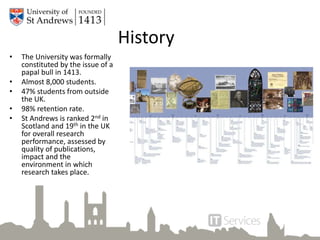
History
• The University was formally
constituted by the issue of a
papal bull in 1413.
• Almost 8,000 students.
• 47% students from outside
the UK.
• 98% retention rate.
• St Andrews is ranked 2nd in
Scotland and 19th in the UK
for overall research
performance, assessed by
quality of publications,
impact and the
environment in which
research takes place.
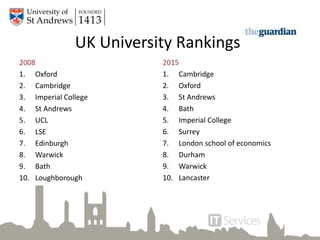
UK University Rankings
2008
1. Oxford
2. Cambridge
3. Imperial College
4. St Andrews
5. UCL
6. LSE
7. Edinburgh
8. Warwick
9. Bath
10. Loughborough
2015
1. Cambridge
2. Oxford
3. St Andrews
4. Bath
5. Imperial College
6. Surrey
7. London school of economics
8. Durham
9. Warwick
10. Lancaster
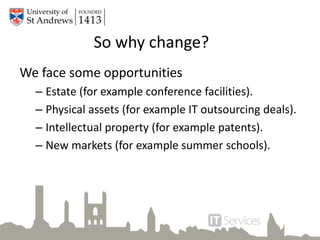
So why change?
We face some opportunities
– Estate (for example conference facilities).
– Physical assets (for example IT outsourcing deals).
– Intellectual property (for example patents).
– New markets (for example summer schools).
So why change?
We face some challenges
– Fragmentation (for example data centre
management).
– Devolved control (for example budget).
– Complexity (for example IT supporting schools,
units and commercial services).
– Funding (for example REF).
So why change?
HEIs are not great at differentiation
– Where does the institution derive its identity?
– Where does it invest the most and receive the greatest
return?
– What is the University’s unique core business?
– How is the market changing around us?
Do we need to change in answer to these fundamental
questions?
But what does this mean?
• It means we can improve.
• It means we need to improve.
• And begs the question…how do we improve?
• Especially with a high level of devolution
where change struggles to be mandated from
the top.
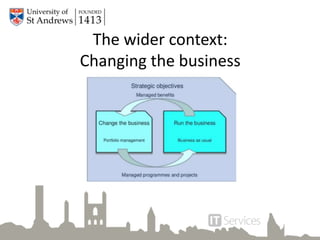
The wider context:
Changing the business
BaU definition
• The way the business normally/currently
achieves its strategic objectives.
• Also referred to as ‘running the business’
Portfolio definition
• The totality of an organisation’s investment
(or segment thereof) in the changes required
to achieve its strategic objectives.
Programme definition
• A temporary, flexible, organisation structure
created to coordinate, direct and oversee the
implementation of a set of related projects
and activities in order to deliver outcomes and
benefits related to the organisation’s strategic
objectives.
Project definition
• A temporary organisation that is created for the
purpose of delivering one or more business products
according to an agreed business case.
– It is temporary in that it has a defined beginning and end in time, and
therefore defined scope and resources.
– It is unique in that it is not a routine operation (i.e. BaU), but a specific
set of operations designed to accomplish a singular goal. A project
team often includes people who don’t usually work together.
In summary
– The need for change is identified by comparing business as
usual performance to the achievement of strategic objectives.
– Changes are planned through portfolio management and
delivered via projects and programmes of varying size, nature
and complexity.
– This delivery changes our BaU and results in the realisation of
benefits that allow us to achieve strategic objectives.
Fundamentally, projects and programmes are the means by which
a business adapts what it does in order to meet the challenges of
its competitive environment. And portfolio management is the
planning of those.
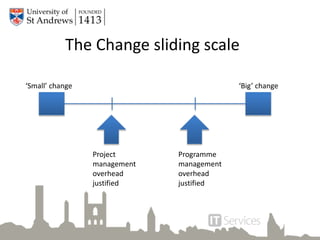
The Change sliding scale
Project
management
overhead
justified
‘Small’ change ‘Big’ change
Programme
management
overhead
justified
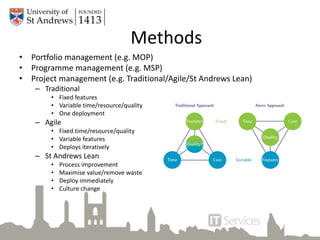
Methods
• Portfolio management (e.g. MOP)
• Programme management (e.g. MSP)
• Project management (e.g. Traditional/Agile/St Andrews Lean)
– Traditional
• Fixed features
• Variable time/resource/quality
• One deployment
– Agile
• Fixed time/resource/quality
• Variable features
• Deploys iteratively
– St Andrews Lean
• Process improvement
• Maximise value/remove waste
• Deploy immediately
• Culture change
However….
• Today we are not looking at portfolio, programme and project
management (i.e. ‘big change’)
• We are looking at Daily kaizen (i.e. ‘small change’)
• But, they are related to one another in many ways, not least:
– Neither are BaU
– Both require planning and delivery
– Both use the same finite resource
– Both aim to deliver benefits that enable the achievement of strategic
objectives
Daily kaizen
Kaizen theory
• Japanese kaizen consultants don’t like the word
Lean (and they don’t hide it).
• They refer to kaizen.
• Some translate ‘kaizen’ as:
– Continuous improvement (taken from the words ‘Kai‘
that means continuous and ‘zen‘ that means
improvement)
– Change for the better (‘kai‘ to mean change and ‘zen‘
to mean good, or for the better)
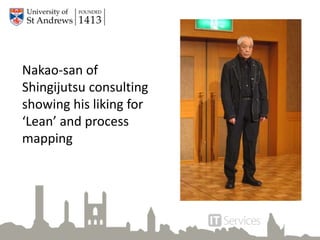
Nakao-san of
Shingijutsu consulting
showing his liking for
‘Lean’ and process
mapping
Continuous Improvement
• Always looking for better ways to do
things
Respect for People
• “make every effort to understand each
other… [to] maximise individual and
team performance”
Toyota
W&J - 2 Fundamentals
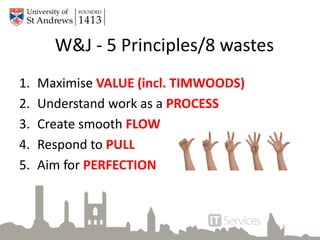
W&J - 5 Principles/8 wastes
1. Maximise VALUE (incl. TIMWOODS)
2. Understand work as a PROCESS
3. Create smooth FLOW
4. Respond to PULL
5. Aim for PERFECTION
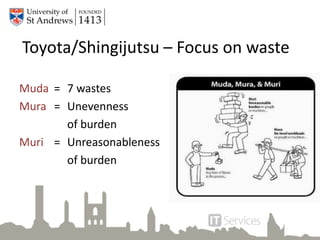
Toyota/Shingijutsu – Focus on waste
Muda = 7 wastes
Mura = Unevenness
of burden
Muri = Unreasonableness
of burden
Monden’s challenging translation
Professor Monden, says in Toyota Production System (first edition, 1983, page
2):
“…although cost-reduction is the system’s most important goal, it must
achieve three other sub-goals in order to achieve its primary objective.
They include:
1. Quantity control, which enables the system to adapt to daily and monthly
fluctuations in demand in terms of quantities and variety;
2. Quality assurance, which assures that each process will supply only good
units to subsequent processes;
3. Respect-for-humanity, which must be cultivated while the system utilizes
the human resources to obtain its cost objectives.
Professor Monden, goes on to say:
“It should be emphasized here that these three goals cannot exist
independently or be achieved independently without influencing each other
or the primary goal of cost reduction.
It is a special feature of the Toyota production system that the primary goal
cannot be achieved without realisation of the subgoals and vice versa.
All goals are outputs of the same system; with productivity as the ultimate
purpose and guiding concept, the Toyota production system strives to realise
each of the goals for which it has been designed.”
Monden’s challenging translation
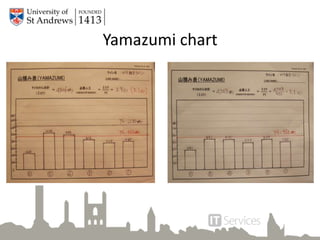
Yamazumi chart
• The scope of shopfloor kaizen includes the removal
of waste and the reordering of value adding steps.
It does not include the redesign, removal or
addition of value adding steps.
• Often the addition of new value (for example
redesigning a car) involves significant stakeholder
engagement, requirements gathering, market
analysis, etc.
Value vs waste
Kaizen theory
• The point of shopfloor kaizen then, is to:
– Remove waste (muda, mura, muri)
– Establish/improve the standard work
– Support/encourage a culture of waste
removal/continuous improvement
Manufacturing v HE
• Manufacturing production lines:
– Process does not equal the service which does not equal the product.
• HE ‘production lines’:
– Often the process does equal the service which does equal the product.
• To increase complexity, HE staff (operators):
– Run the process
– Design the process/service/product
– And sometimes are the owners.
• This raises an interesting question?
– Can we manoeuvre shopfloor kaizen to not only look at waste removal but
also look at redesigning, removing or adding value?
• Visual management
– Kaizen action sheet (KAS)
– Kaizen board
• Daily huddle
– Complexity model
– Genba
• Improvement time
– Universe of work
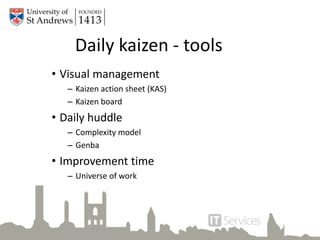
Daily kaizen - tools
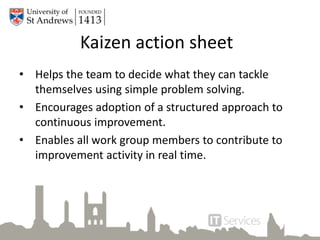
Kaizen action sheet
• Helps the team to decide what they can tackle
themselves using simple problem solving.
• Encourages adoption of a structured approach to
continuous improvement.
• Enables all work group members to contribute to
improvement activity in real time.
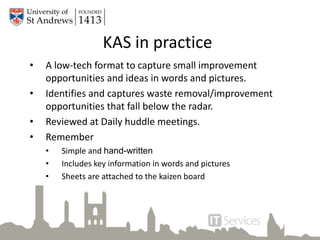
KAS in practice
• A low-tech format to capture small improvement
opportunities and ideas in words and pictures.
• Identifies and captures waste removal/improvement
opportunities that fall below the radar.
• Reviewed at Daily huddle meetings.
• Remember
• Simple and hand-written
• Includes key information in words and pictures
• Sheets are attached to the kaizen board
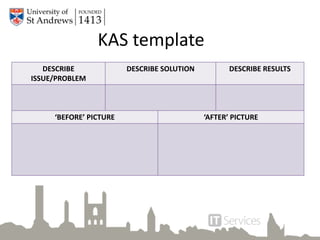
KAS template
DESCRIBE
ISSUE/PROBLEM
DESCRIBE SOLUTION DESCRIBE RESULTS
‘BEFORE’ PICTURE ‘AFTER’ PICTURE
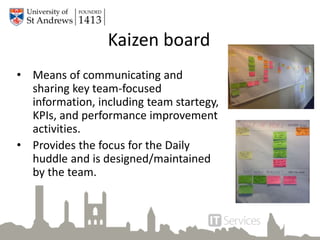
Kaizen board
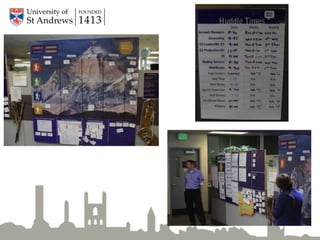
• Means of communicating and
sharing key team-focused
information, including team startegy,
KPIs, and performance improvement
activities.
• Provides the focus for the Daily
huddle and is designed/maintained
by the team.
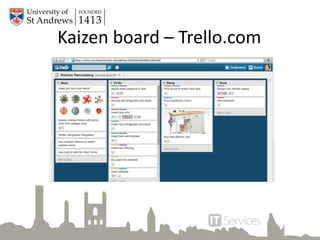
Kaizen board – Trello.com
Daily huddle
• A short, all staff mandatory meeting to focus the
team on what’s important and how they will work
together to achieve outcomes.
• Builds team ethos and provides the forum to identify
improvement opportunities (small and big).
• Held standing in front of the kaizen board.
• Maximum of 10 minutes.
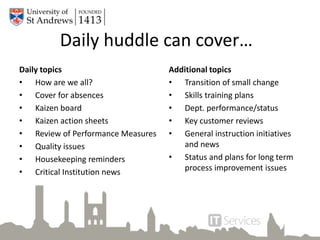
Daily huddle can cover…
Daily topics
• How are we all?
• Cover for absences
• Kaizen board
• Kaizen action sheets
• Review of Performance Measures
• Quality issues
• Housekeeping reminders
• Critical Institution news
Additional topics
• Transition of small change
• Skills training plans
• Dept. performance/status
• Key customer reviews
• General instruction initiatives
and news
• Status and plans for long term
process improvement issues
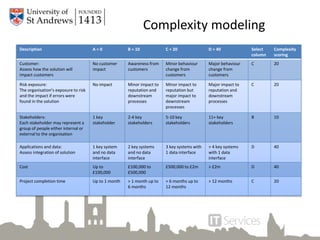
Complexity modeling
Description A = 0 B = 10 C = 20 D = 40 Select
column
Complexity
scoring
Customer:
Assess how the solution will
impact customers
No customer
impact
Awareness from
customers
Minor behaviour
change from
customers
Major behaviour
change from
customers
C 20
Risk exposure:
The organisation’s exposure to risk
and the impact if errors were
found in the solution
No impact Minor impact to
reputation and
downstream
processes
Minor impact to
reputation but
major impact to
downstream
processes
Major impact to
reputation and
downstream
processes
C 20
Stakeholders:
Each stakeholder may represent a
group of people either internal or
external to the organisation
1 key
stakeholder
2-4 key
stakeholders
5-10 key
stakeholders
11+ key
stakeholders
B 10
Applications and data:
Assess integration of solution
1 key system
and no data
interface
2 key systems
and no data
interface
3 key systems with
1 data interface
> 4 key systems
with 1 data
interface
D 40
Cost Up to
£100,000
£100,000 to
£500,000
£500,000 to £2m > £2m D 40
Project completion time Up to 1 month > 1 month up to
6 months
> 6 months up to
12 months
> 12 months C 20
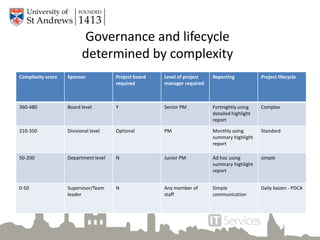
Governance and lifecycle
determined by complexity
Complexity score Sponsor Project board
required
Level of project
manager required
Reporting Project lifecycle
360-480 Board level Y Senior PM Fortnightly using
detailed highlight
report
Complex
210-350 Divisional level Optional PM Monthly using
summary highlight
report
Standard
50-200 Department level N Junior PM Ad hoc using
summary highlight
report
simple
0-50 Supervisor/Team
leader
N Any member of
staff
Simple
communication
Daily kaizen - PDCA
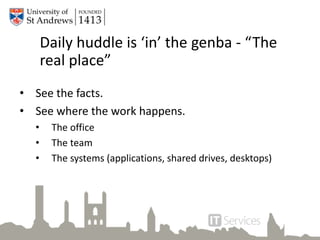
Daily huddle is ‘in’ the genba - “The
real place”
• See the facts.
• See where the work happens.
• The office
• The team
• The systems (applications, shared drives, desktops)
PDCA
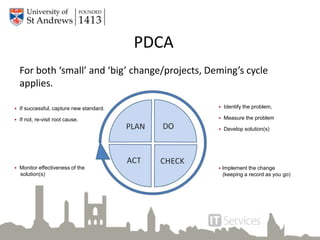
For both ‘small’ and ‘big’ change/projects, Deming’s cycle
applies.
 If successful, capture new standard.
 If not, re-visit root cause.
 Monitor effectiveness of the
solution(s)
 Identify the problem,
 Measure the problem
 Develop solution(s)
 Implement the change
(keeping a record as you go)
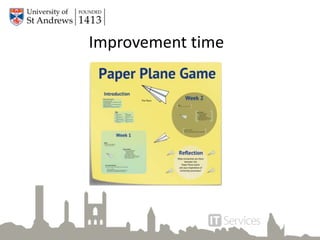
Improvement time
Here is Edward Bear, coming downstairs now, bump, bump, bump, on the back of his head
behind Christopher Robin.
It is, as far as he knows, the only way of coming downstairs, but sometimes he feels that
there really is another way, if only he could stop bumping for a moment and think of it.
A. A. Milne
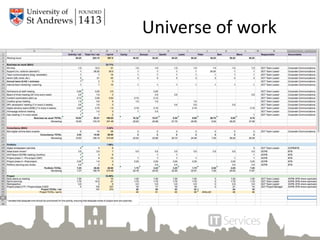
Universe of work
Daily kaizen management
• For daily kaizen, management is local and
follows the Toyota shop floor model:
–Supervisor (80%)
–Team leader (20%)
–Operator (5%)
How to implement daily kaizen?
“Management have to recognise the need for
significant change and must be willing to change
everything. The top leader is the change owner and
must be fully committed.”
Chihiro Nakao, FOM
How to implement daily
kaizen?
• Implementing these tools is itself changing the
business and needs to be managed
appropriately.
• Drop the idea into a complexity model and
determine the correct approach to ensure
success.
Why do daily kaizen?
"People need aligned and purposeful goals alongside the
ability to affect change and see progress. Basically, give staff
the ownership to innovate but also the feedback
mechanisms that show them if their ideas are working. Not
forgetting the safety to take risks, make mistakes and grow.”
Mike Martyn, Shingo Prize winner
Any questions?

Finlay Miller - Daily Kaizen

  • 1.
  • 2.
    Outline of today’ssession • Overview of St Andrews and the case for change • The wider context of improvement – Changing the business – Definitions and methods • Daily kaizen – Kaizen theory – Daily kaizen tools • Visual management • Daily huddle • Universe of work • Q & A
  • 3.
  • 4.
    History • The Universitywas formally constituted by the issue of a papal bull in 1413. • Almost 8,000 students. • 47% students from outside the UK. • 98% retention rate. • St Andrews is ranked 2nd in Scotland and 19th in the UK for overall research performance, assessed by quality of publications, impact and the environment in which research takes place.
  • 5.
    UK University Rankings 2008 1.Oxford 2. Cambridge 3. Imperial College 4. St Andrews 5. UCL 6. LSE 7. Edinburgh 8. Warwick 9. Bath 10. Loughborough 2015 1. Cambridge 2. Oxford 3. St Andrews 4. Bath 5. Imperial College 6. Surrey 7. London school of economics 8. Durham 9. Warwick 10. Lancaster
  • 6.
    So why change? Weface some opportunities – Estate (for example conference facilities). – Physical assets (for example IT outsourcing deals). – Intellectual property (for example patents). – New markets (for example summer schools).
  • 7.
    So why change? Weface some challenges – Fragmentation (for example data centre management). – Devolved control (for example budget). – Complexity (for example IT supporting schools, units and commercial services). – Funding (for example REF).
  • 8.
    So why change? HEIsare not great at differentiation – Where does the institution derive its identity? – Where does it invest the most and receive the greatest return? – What is the University’s unique core business? – How is the market changing around us? Do we need to change in answer to these fundamental questions?
  • 9.
    But what doesthis mean? • It means we can improve. • It means we need to improve. • And begs the question…how do we improve? • Especially with a high level of devolution where change struggles to be mandated from the top.
  • 10.
  • 11.
    BaU definition • Theway the business normally/currently achieves its strategic objectives. • Also referred to as ‘running the business’
  • 12.
    Portfolio definition • Thetotality of an organisation’s investment (or segment thereof) in the changes required to achieve its strategic objectives.
  • 13.
    Programme definition • Atemporary, flexible, organisation structure created to coordinate, direct and oversee the implementation of a set of related projects and activities in order to deliver outcomes and benefits related to the organisation’s strategic objectives.
  • 14.
    Project definition • Atemporary organisation that is created for the purpose of delivering one or more business products according to an agreed business case. – It is temporary in that it has a defined beginning and end in time, and therefore defined scope and resources. – It is unique in that it is not a routine operation (i.e. BaU), but a specific set of operations designed to accomplish a singular goal. A project team often includes people who don’t usually work together.
  • 15.
    In summary – Theneed for change is identified by comparing business as usual performance to the achievement of strategic objectives. – Changes are planned through portfolio management and delivered via projects and programmes of varying size, nature and complexity. – This delivery changes our BaU and results in the realisation of benefits that allow us to achieve strategic objectives. Fundamentally, projects and programmes are the means by which a business adapts what it does in order to meet the challenges of its competitive environment. And portfolio management is the planning of those.
  • 16.
    The Change slidingscale Project management overhead justified ‘Small’ change ‘Big’ change Programme management overhead justified
  • 17.
    Methods • Portfolio management(e.g. MOP) • Programme management (e.g. MSP) • Project management (e.g. Traditional/Agile/St Andrews Lean) – Traditional • Fixed features • Variable time/resource/quality • One deployment – Agile • Fixed time/resource/quality • Variable features • Deploys iteratively – St Andrews Lean • Process improvement • Maximise value/remove waste • Deploy immediately • Culture change
  • 18.
    However…. • Today weare not looking at portfolio, programme and project management (i.e. ‘big change’) • We are looking at Daily kaizen (i.e. ‘small change’) • But, they are related to one another in many ways, not least: – Neither are BaU – Both require planning and delivery – Both use the same finite resource – Both aim to deliver benefits that enable the achievement of strategic objectives
  • 19.
  • 20.
    Kaizen theory • Japanesekaizen consultants don’t like the word Lean (and they don’t hide it). • They refer to kaizen. • Some translate ‘kaizen’ as: – Continuous improvement (taken from the words ‘Kai‘ that means continuous and ‘zen‘ that means improvement) – Change for the better (‘kai‘ to mean change and ‘zen‘ to mean good, or for the better)
  • 21.
    Nakao-san of Shingijutsu consulting showinghis liking for ‘Lean’ and process mapping
  • 22.
    Continuous Improvement • Alwayslooking for better ways to do things Respect for People • “make every effort to understand each other… [to] maximise individual and team performance” Toyota W&J - 2 Fundamentals
  • 23.
    W&J - 5Principles/8 wastes 1. Maximise VALUE (incl. TIMWOODS) 2. Understand work as a PROCESS 3. Create smooth FLOW 4. Respond to PULL 5. Aim for PERFECTION
  • 24.
    Toyota/Shingijutsu – Focuson waste Muda = 7 wastes Mura = Unevenness of burden Muri = Unreasonableness of burden
  • 25.
    Monden’s challenging translation ProfessorMonden, says in Toyota Production System (first edition, 1983, page 2): “…although cost-reduction is the system’s most important goal, it must achieve three other sub-goals in order to achieve its primary objective. They include: 1. Quantity control, which enables the system to adapt to daily and monthly fluctuations in demand in terms of quantities and variety; 2. Quality assurance, which assures that each process will supply only good units to subsequent processes; 3. Respect-for-humanity, which must be cultivated while the system utilizes the human resources to obtain its cost objectives.
  • 26.
    Professor Monden, goeson to say: “It should be emphasized here that these three goals cannot exist independently or be achieved independently without influencing each other or the primary goal of cost reduction. It is a special feature of the Toyota production system that the primary goal cannot be achieved without realisation of the subgoals and vice versa. All goals are outputs of the same system; with productivity as the ultimate purpose and guiding concept, the Toyota production system strives to realise each of the goals for which it has been designed.” Monden’s challenging translation
  • 27.
  • 28.
    • The scopeof shopfloor kaizen includes the removal of waste and the reordering of value adding steps. It does not include the redesign, removal or addition of value adding steps. • Often the addition of new value (for example redesigning a car) involves significant stakeholder engagement, requirements gathering, market analysis, etc. Value vs waste
  • 29.
    Kaizen theory • Thepoint of shopfloor kaizen then, is to: – Remove waste (muda, mura, muri) – Establish/improve the standard work – Support/encourage a culture of waste removal/continuous improvement
  • 30.
    Manufacturing v HE •Manufacturing production lines: – Process does not equal the service which does not equal the product. • HE ‘production lines’: – Often the process does equal the service which does equal the product. • To increase complexity, HE staff (operators): – Run the process – Design the process/service/product – And sometimes are the owners. • This raises an interesting question? – Can we manoeuvre shopfloor kaizen to not only look at waste removal but also look at redesigning, removing or adding value?
  • 31.
    • Visual management –Kaizen action sheet (KAS) – Kaizen board • Daily huddle – Complexity model – Genba • Improvement time – Universe of work Daily kaizen - tools
  • 32.
    Kaizen action sheet •Helps the team to decide what they can tackle themselves using simple problem solving. • Encourages adoption of a structured approach to continuous improvement. • Enables all work group members to contribute to improvement activity in real time.
  • 33.
    KAS in practice •A low-tech format to capture small improvement opportunities and ideas in words and pictures. • Identifies and captures waste removal/improvement opportunities that fall below the radar. • Reviewed at Daily huddle meetings. • Remember • Simple and hand-written • Includes key information in words and pictures • Sheets are attached to the kaizen board
  • 34.
    KAS template DESCRIBE ISSUE/PROBLEM DESCRIBE SOLUTIONDESCRIBE RESULTS ‘BEFORE’ PICTURE ‘AFTER’ PICTURE
  • 35.
    Kaizen board • Meansof communicating and sharing key team-focused information, including team startegy, KPIs, and performance improvement activities. • Provides the focus for the Daily huddle and is designed/maintained by the team.
  • 37.
    Kaizen board –Trello.com
  • 38.
    Daily huddle • Ashort, all staff mandatory meeting to focus the team on what’s important and how they will work together to achieve outcomes. • Builds team ethos and provides the forum to identify improvement opportunities (small and big). • Held standing in front of the kaizen board. • Maximum of 10 minutes.
  • 39.
    Daily huddle cancover… Daily topics • How are we all? • Cover for absences • Kaizen board • Kaizen action sheets • Review of Performance Measures • Quality issues • Housekeeping reminders • Critical Institution news Additional topics • Transition of small change • Skills training plans • Dept. performance/status • Key customer reviews • General instruction initiatives and news • Status and plans for long term process improvement issues
  • 40.
    Complexity modeling Description A= 0 B = 10 C = 20 D = 40 Select column Complexity scoring Customer: Assess how the solution will impact customers No customer impact Awareness from customers Minor behaviour change from customers Major behaviour change from customers C 20 Risk exposure: The organisation’s exposure to risk and the impact if errors were found in the solution No impact Minor impact to reputation and downstream processes Minor impact to reputation but major impact to downstream processes Major impact to reputation and downstream processes C 20 Stakeholders: Each stakeholder may represent a group of people either internal or external to the organisation 1 key stakeholder 2-4 key stakeholders 5-10 key stakeholders 11+ key stakeholders B 10 Applications and data: Assess integration of solution 1 key system and no data interface 2 key systems and no data interface 3 key systems with 1 data interface > 4 key systems with 1 data interface D 40 Cost Up to £100,000 £100,000 to £500,000 £500,000 to £2m > £2m D 40 Project completion time Up to 1 month > 1 month up to 6 months > 6 months up to 12 months > 12 months C 20
  • 41.
    Governance and lifecycle determinedby complexity Complexity score Sponsor Project board required Level of project manager required Reporting Project lifecycle 360-480 Board level Y Senior PM Fortnightly using detailed highlight report Complex 210-350 Divisional level Optional PM Monthly using summary highlight report Standard 50-200 Department level N Junior PM Ad hoc using summary highlight report simple 0-50 Supervisor/Team leader N Any member of staff Simple communication Daily kaizen - PDCA
  • 42.
    Daily huddle is‘in’ the genba - “The real place” • See the facts. • See where the work happens. • The office • The team • The systems (applications, shared drives, desktops)
  • 43.
    PDCA For both ‘small’and ‘big’ change/projects, Deming’s cycle applies.  If successful, capture new standard.  If not, re-visit root cause.  Monitor effectiveness of the solution(s)  Identify the problem,  Measure the problem  Develop solution(s)  Implement the change (keeping a record as you go)
  • 44.
  • 45.
    Here is EdwardBear, coming downstairs now, bump, bump, bump, on the back of his head behind Christopher Robin. It is, as far as he knows, the only way of coming downstairs, but sometimes he feels that there really is another way, if only he could stop bumping for a moment and think of it. A. A. Milne
  • 46.
  • 47.
    Daily kaizen management •For daily kaizen, management is local and follows the Toyota shop floor model: –Supervisor (80%) –Team leader (20%) –Operator (5%)
  • 48.
    How to implementdaily kaizen? “Management have to recognise the need for significant change and must be willing to change everything. The top leader is the change owner and must be fully committed.” Chihiro Nakao, FOM
  • 49.
    How to implementdaily kaizen? • Implementing these tools is itself changing the business and needs to be managed appropriately. • Drop the idea into a complexity model and determine the correct approach to ensure success.
  • 50.
    Why do dailykaizen? "People need aligned and purposeful goals alongside the ability to affect change and see progress. Basically, give staff the ownership to innovate but also the feedback mechanisms that show them if their ideas are working. Not forgetting the safety to take risks, make mistakes and grow.” Mike Martyn, Shingo Prize winner
  • 51.