UNIVERSITY OF CALIFORNIA,
IRVINE
Controllers for Systems with Bounded
Actuators:
Modeling and control of an F-16 aircraft
THESIS
submitted in partial satisfaction of the requirements
for the degree of
MASTER OF SCIENCE
in Mechanical and Aerospace Engineering
by
Albert Farré Gabernet
Thesis Committee:
Professor Faryar Jabbari, Chair
Professor Kenneth Mease
Professor James E. Bobrow
2007
c
°2007 Albert Farre Gabernet
The thesis of Albert Farré Gabernet is approved:
Committee Chair
University of California, Irvine
2007
ii
Table of Contents
List of Figures vi
List of Tables ix
List of Notations x
Acknowledgements xii
Abstract of the Thesis xiii
1 Introduction 1
2 Modeling of an F-16 aircraft 4
2.1 Nonlinear 6 degree-of-freedom aircraft model . . . . . . . . . . . . . . 4
2.1.1 Engine model . . . . . . . . . . . . . . . . . . . . . . . . . . . 8
2.2 Longitudinal model . . . . . . . . . . . . . . . . . . . . . . . . . . . . 13
2.2.1 Aircraft description . . . . . . . . . . . . . . . . . . . . . . . . 14
2.2.2 Aerodynamic data . . . . . . . . . . . . . . . . . . . . . . . . 15
2.3 Linear model . . . . . . . . . . . . . . . . . . . . . . . . . . . . . . . 16
2.3.1 Obtention of an initial condition . . . . . . . . . . . . . . . . . 16
2.3.2 Linearizing around the initial condition . . . . . . . . . . . . . 18
iii
2.4 Validation . . . . . . . . . . . . . . . . . . . . . . . . . . . . . . . . . 18
3 Linear Parameter Varying (LPV) systems 35
3.1 LPV basics . . . . . . . . . . . . . . . . . . . . . . . . . . . . . . . . 36
3.2 LPV model of the F-16 aircraft . . . . . . . . . . . . . . . . . . . . . 37
4 Controller design 45
4.1 Saturation control background . . . . . . . . . . . . . . . . . . . . . . 45
4.2 Anti-saturation LMIs: basic equations . . . . . . . . . . . . . . . . . 48
4.2.1 LMI introduction . . . . . . . . . . . . . . . . . . . . . . . . . 49
4.2.2 Invariant-set LMI . . . . . . . . . . . . . . . . . . . . . . . . . 50
4.2.3 Constraint LMI . . . . . . . . . . . . . . . . . . . . . . . . . . 52
4.2.4 Performance LMI . . . . . . . . . . . . . . . . . . . . . . . . . 53
4.3 Scheduling design technique . . . . . . . . . . . . . . . . . . . . . . . 54
4.3.1 Conservatism associated with the design technique . . . . . . 55
4.3.2 Gain scheduling technique to overcome conservatism . . . . . 58
4.4 Approach for tracking of general signals . . . . . . . . . . . . . . . . . 61
5 Simulations 64
5.1 Problems setup . . . . . . . . . . . . . . . . . . . . . . . . . . . . . . 65
5.1.1 Inclusion of the elevator actuator . . . . . . . . . . . . . . . . 65
5.1.2 Turbulence model for the altitude hold problem . . . . . . . . 67
5.1.3 Rearranging the equations for the tracking problem . . . . . . 69
5.1.4 Adjusting the controller design technique . . . . . . . . . . . . 73
5.2 Altitude hold . . . . . . . . . . . . . . . . . . . . . . . . . . . . . . . 78
5.3 Tracking . . . . . . . . . . . . . . . . . . . . . . . . . . . . . . . . . . 82
iv
6 Conclusions 107
Bibliography 110
v
List of Figures
2.1 Definition of roll, yaw and pitch angles and main control surfaces in a
general aircraft . . . . . . . . . . . . . . . . . . . . . . . . . . . . . . 5
2.2 Definition of axes and aerodynamic angles (obtained from [13]) . . . . 6
2.3 Scheme of the engine model used with the functions TGEAR, PDOT
and THRUST. Dashed circles show the inputs, plain circles show the
outputs. . . . . . . . . . . . . . . . . . . . . . . . . . . . . . . . . . . 9
2.4 Relationship between the throttle setting and the engine power level.
Note the change in slope around δth = 0.77 . . . . . . . . . . . . . . . 11
2.5 Scheme of the thrust vectoring and its relevant angles . . . . . . . . . 12
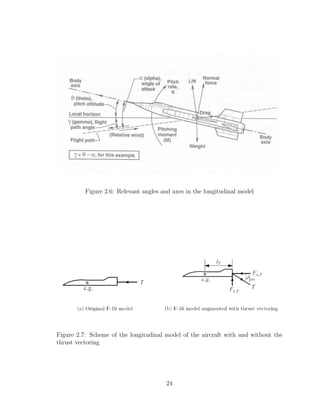
2.6 Relevant angles and axes in the longitudinal model . . . . . . . . . . 24
2.7 Scheme of the longitudinal model of the aircraft with and without the
thrust vectoring . . . . . . . . . . . . . . . . . . . . . . . . . . . . . . 24
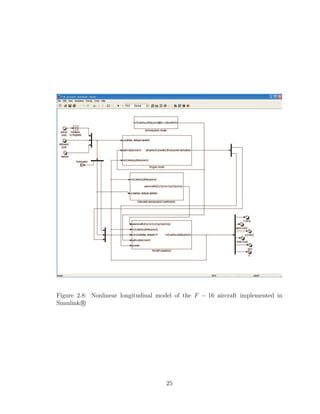
2.8 Nonlinear longitudinal model of the F − 16 aircraft implemented in
Simulink r
° . . . . . . . . . . . . . . . . . . . . . . . . . . . . . . . . . 25
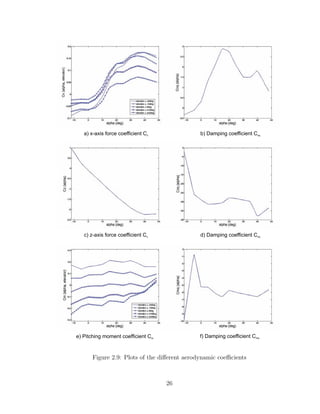
2.9 Plots of the different aerodynamic coefficients . . . . . . . . . . . . . 26
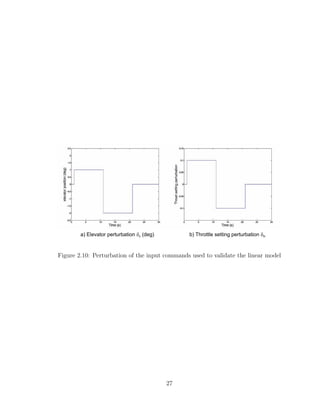
2.10 Perturbation of the input commands used to validate the linear model 27
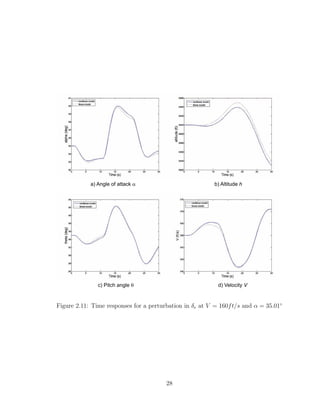
2.11 Time responses for a perturbation in δe at V = 160ft/s and α = 35.01◦
28
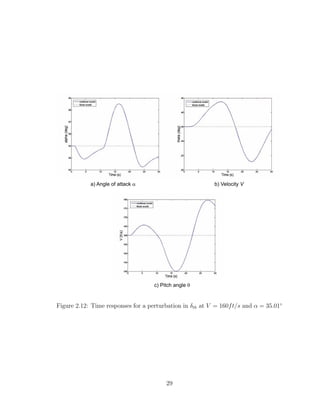
2.12 Time responses for a perturbation in δth at V = 160ft/s and α = 35.01◦
29
2.13 Perturbation of the input commands used to validate the linear model
without engine . . . . . . . . . . . . . . . . . . . . . . . . . . . . . . 30
2.14 Time responses for a perturbation in δe at V = 160ft/s and α = 35.01◦
(linearization without the engine model) . . . . . . . . . . . . . . . . 31
2.15 Time responses for a perturbation in T at V = 160ft/s and α = 35.01◦
(linearization without the engine model) . . . . . . . . . . . . . . . . 32
2.16 Time responses for a perturbation in δe at V = 200ft/s and α = 22.46◦
(linearization without the engine model) . . . . . . . . . . . . . . . . 33
2.17 Time responses for a perturbation in T at V = 200ft/s and α = 22.46◦
(linearization without the engine model) . . . . . . . . . . . . . . . . 34
vi
3.1 Scheme of the LPV model . . . . . . . . . . . . . . . . . . . . . . . . 38
3.2 Time responses for a perturbation in δe at V = 180ft/s and α = 33.5◦
(linear system obtained using an LPV model) . . . . . . . . . . . . . 42
3.3 Time responses for a perturbation in δe at V = 180ft/s and α = 33.5◦
(linear system obtained using an LPV model) . . . . . . . . . . . . . 43
3.4 Extended scheme of the LPV model, in which the LPV region consists
on different squares with coincident sides . . . . . . . . . . . . . . . . 44
4.1 Plot of the saturation effect . . . . . . . . . . . . . . . . . . . . . . . 46
4.2 Scheme of a plant with an open loop controller and a representation of
the actuator. The actuator is represented by a saturation block and a
delay transfer function . . . . . . . . . . . . . . . . . . . . . . . . . . 47
4.3 Estimate for the smallest invariant set associated with ωmax without
actuator limits (large ellipsoid) and ωnom (small ellipsoid) for Knom.
Parallel lines show region where Knom is not saturated (figure obtained
from [17]) . . . . . . . . . . . . . . . . . . . . . . . . . . . . . . . . . 56
4.4 Importance of the condition (4.24). On the left, the system may find a
way to escape the safe controller and therefore it may become uncon-
trollable. On the right, this possibility does not exist. . . . . . . . . . 57
4.5 Invariant set associated with ωmax and Ksafe compared to linear case
(figure obtained from [17]) . . . . . . . . . . . . . . . . . . . . . . . . 58
5.1 Scheme of the elevator actuator . . . . . . . . . . . . . . . . . . . . . 66
5.2 Bode plot of the elevator actuator . . . . . . . . . . . . . . . . . . . . 68
5.3 Probability of exceedance of turbulence intensity as a function of altitude 70
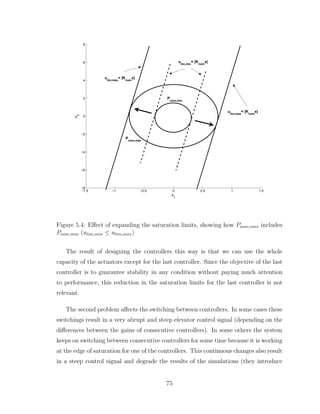
5.4 Effect of expanding the saturation limits, showing how Pnom,max in-
cludes Pnom,min (ulim,min ≤ ulim,max) . . . . . . . . . . . . . . . . . . . 75
5.5 Plot of the wind velocity obtained from a moderate disturbance and
the open loop response (altitude) of the linear model of the aircraft to
this disturbance . . . . . . . . . . . . . . . . . . . . . . . . . . . . . . 80
5.6 Plot of the wind velocity obtained from a moderate disturbance and
the closed loop response (altitude) of the linear model of the aircraft
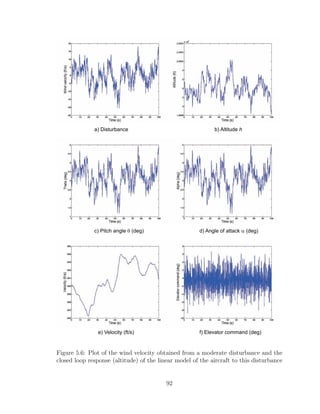
to this disturbance . . . . . . . . . . . . . . . . . . . . . . . . . . . . 92
vii
5.7 Plot of the wind velocity obtained from an extreme disturbance and
the closed loop response (altitude) of the linear model of the aircraft
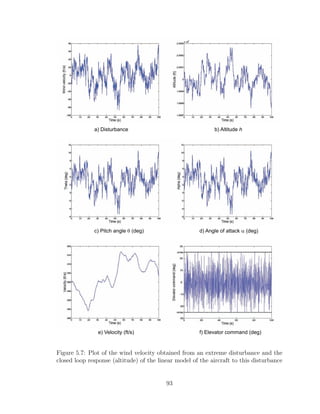
to this disturbance . . . . . . . . . . . . . . . . . . . . . . . . . . . . 93
5.8 Effect of the transfer function in (5.27) to the commanded flight path
angle γcmd (the amplitude of γcmd may vary depending on the case of
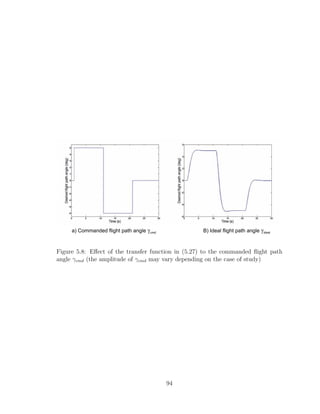
study) . . . . . . . . . . . . . . . . . . . . . . . . . . . . . . . . . . . 94
5.9 Nonlinear ±1.5◦
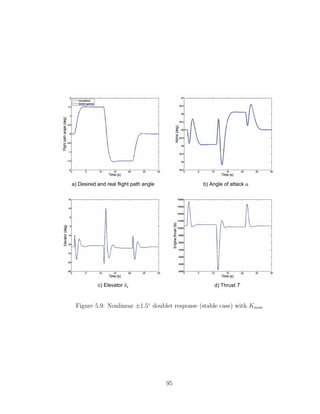
doublet response (stable case) with Knom . . . . . . 95
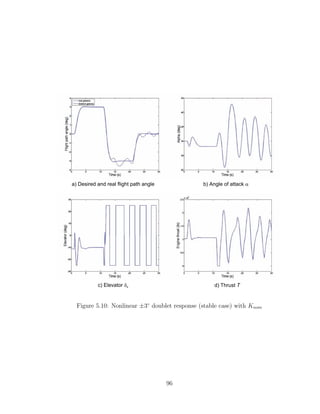
5.10 Nonlinear ±3◦
doublet response (stable case) with Knom . . . . . . . 96
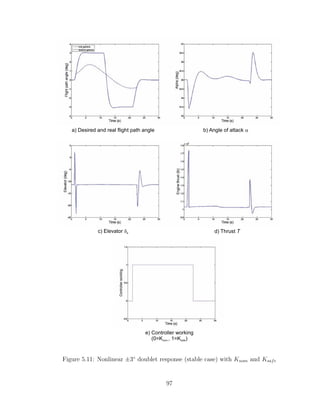
5.11 Nonlinear ±3◦
doublet response (stable case) with Knom and Ksafe . . 97
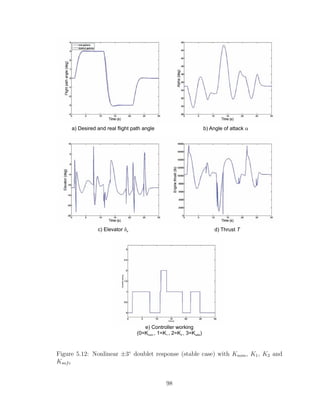
5.12 Nonlinear ±3◦
doublet response (stable case) with Knom, K1, K2 and
Ksafe . . . . . . . . . . . . . . . . . . . . . . . . . . . . . . . . . . . . 98
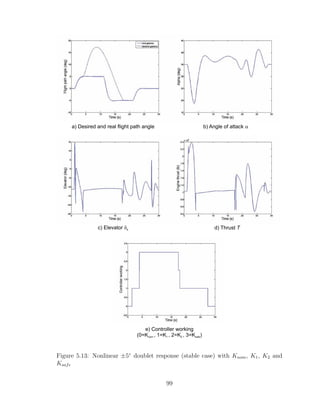
5.13 Nonlinear ±5◦
doublet response (stable case) with Knom, K1, K2 and
Ksafe . . . . . . . . . . . . . . . . . . . . . . . . . . . . . . . . . . . . 99
5.14 For comparison purposes: nonlinear ±1◦
doublet response (stable case)
with an LTI nominal controller (extracted from [13]) . . . . . . . . . 100
5.15 For comparison purposes: nonlinear ±2◦
doublet response (stable case)
with/without an LTI antiwindup compensator (extracted from [13]) . 101
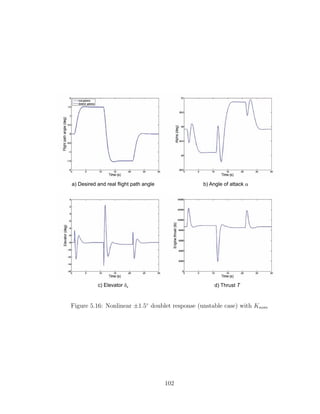
5.16 Nonlinear ±1.5◦
doublet response (unstable case) with Knom . . . . . 102
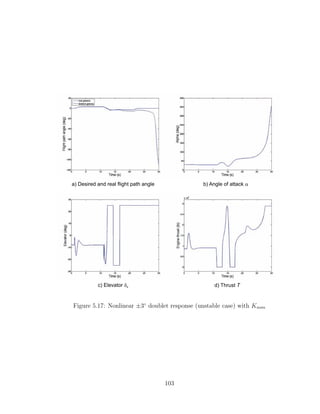
5.17 Nonlinear ±3◦
doublet response (unstable case) with Knom . . . . . . 103
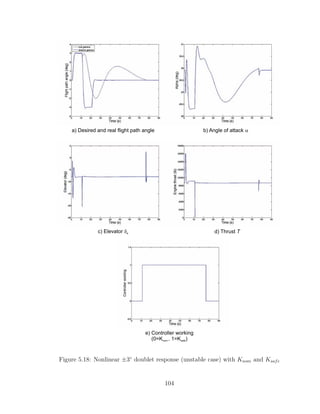
5.18 Nonlinear ±3◦
doublet response (unstable case) with Knom and Ksafe 104
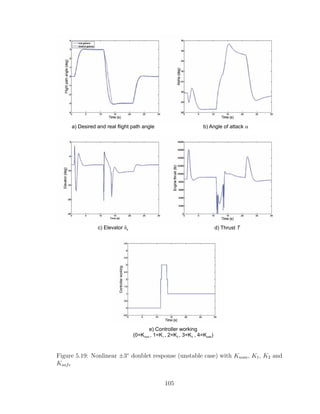
5.19 Nonlinear ±3◦
doublet response (unstable case) with Knom, K1, K2
and Ksafe . . . . . . . . . . . . . . . . . . . . . . . . . . . . . . . . . 105
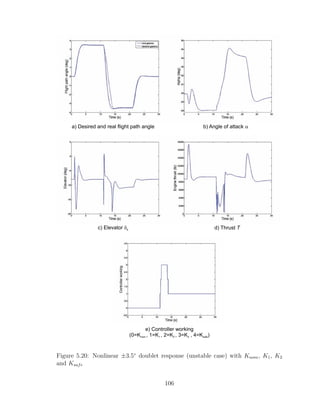
5.20 Nonlinear ±3.5◦
doublet response (unstable case) with Knom, K1, K2
and Ksafe . . . . . . . . . . . . . . . . . . . . . . . . . . . . . . . . . 106
viii
List of Tables
2.1 Mass and geometric properties of the aircraft . . . . . . . . . . . . . . 15
2.2 Models of the control actuators . . . . . . . . . . . . . . . . . . . . . 15
2.3 Engine thrust saturation limits . . . . . . . . . . . . . . . . . . . . . 21
5.1 Maximum peak values of the disturbance for a ±5◦
doublet . . . . . . 85
5.2 Maximum peak values of the disturbance for a ±3.5◦
doublet . . . . . 89
ix
List of Notations
U component of velocity along x body axis (ft/s)
V component of velocity along y body axis (ft/s)
W component of velocity along z body axis (ft/s)
P roll rate about x body axis (rad/s)
Q or q pitch rate about y body axis (rad/s)
R yaw rate about z body axis (rad/s)
FG
x ,FG
y ,FG
z gravitational forces along x, y, z body axes (lb)
FA
x ,FA
y ,FA
z aerodynamic forces along x, y, z body axes (lb)
FT
x ,FT
y ,FT
z propulsive forces along x, y, z body axes (lb)
Fx,Fy,Fz total forces along x, y, z body axes (lb)
m mass of the aircraft (slug)
W weight of the aircraft (lb)
θ angle (pitch) of the aircraft body axes relative to a
plane normal to the earth radius at the point the aircraft
is at(local horizon) (rad)
φ angle (roll) of the aircraft (rad)
ψ angle (yaw) of the aircraft that corresponds to the
true heading of the aircraft (rad)
θ,φ,ψ Euler angles (rad)
Jx moment of inertia about x body axis (slug · ft2
)
Jy moment of inertia about y body axis (slug · ft2
)
Jz moment of inertia about z body axis (slug · ft2
)
Jxz cross product of inertia about x and y axes (slug · ft2
)
MT
x , MT
y , MT
z moments produced by the propulsive forces
about the body axes (slug · ft)
MA
x , MA
y , MT
z moments produced by the aerodynamic forces
about the body axes (slug · ft)
Mx, My, Mz resultant of moments about the body axes (slug · ft)
pN geographic coordinate (corresponding to the geographic
coordinate system) that aligns north (ft)
pE geographic coordinate (corresponding to the geographic
coordinate system) that aligns east (ft)
h altitude of the aircraft (ft)
g constant of gravity (ft/s2
)
q̄ dynamic pressure (lb/ft2
)
x
S wing area (ft)
T thrust force (lb)
b wing span (ft)
c̄ mean aerodynamic chord of the wing (ft)
Cl,t total rolling moment coefficient
Cm,t total pitching moment coefficient
Cn,t total yawing moment coefficient
Cx,t total force coefficient in x body axis
Cy,t total force coefficient in y body axis
Cz,t total force coefficient in z body axis
VT true velocity of the aircraft (ft/s)
α angle of attack angle, considered one of the aerodynamic angles (rad)
β sideslip angle, considered one of the aerodynamic angles (rad)
Cm pitching moment coefficient about y body axis
Cmq pitching moment derivative with respect to the pitch rate (rad−1
)
Cx aerodynamic force coefficient in x body axis
Cxq aerodynamic stability derivative along x axis with respect
to pitch rate (rad−1
)
Cz aerodynamic force coefficient in z body axis
Czq aerodynamic stability derivative along z axis with respect
to pitch rate (rad−1
)
δth throttle setting (one of the control surfaces of the aircraft)
δe elevator angle (one of the control surfaces of the aircraft) (rad)
δptv angle (pitch) of the thrust force with the xy body plane
due to thrust vectoring (rad)
δytv angle (yaw) of the thrust force with the xz body plane
due to thrust vectoring (rad)
lT distance between the aircraft center of gravity and the point of
application of the engine thrust force (ft)
xcg coordinates of the center of gravity of the aircraft (ft)
xcg,ref reference position of the center of gravity of the aircraft
for aerodynamic data (ft)
γ flight path angle (rad)
∆ distance between the reference and the actual position of the
center of gravity (ft)
xT coordinates of the point of application of the engine thrust force (ft)
xi
Acknowledgments
I would like to thank my advisor Professor Faryar Jabbari for his support during my
study, his advice and his dedication. Equally, I would like to thank Mr. Pete Balsells
for offering me the opportunity to come to the University of California, Irvine to
pursue graduate studies through the Balsells Fellowship Program.
Also, I would like to thank Professor Roger Rangel for his support and dedication
as the Director of the Balsells Fellowship Program and to the members of the Control
Lab for their help and hospitality. Thanks also to the rest of my committee members,
Professor Kenneth Mease and Professor James E. Bobrow.
Finally, special thanks to my family for their unconditional support and to all my
friends in the US who made my stay in California so special.
xii
Abstract of the Thesis
Controllers for Systems with Bounded Actuators:
Modeling and control of an F-16 aircraft
by
Albert Farré Gabernet
Master of Science in Mechanical and Aerospace Engineering
University of California, Irvine, 2007
Professor Faryar Jabbari, Chair
Actuator capacity limitation has been a major topic of control research in recent
decades and plays a major role in the flight control system design area, specially
in the high angle of attack region. The development of linear matrix inequalities
(LMIs) and other optimization techniques provided a new framework that facilitates
the design of controllers dealing with saturation, making it easier to obtain stability
and performance guarantees for the designed controllers. These saturation techniques
can be classified into two groups: anti-windup and direct approach. Recently, a new
method combining both groups has been proposed in [17] for the disturbance atten-
uation problem, although it can be easily extended to include the tracking problem.
This thesis will show the potential of this new combined technique applied to com-
mon aircraft problems (altitude hold and tracking a reference command) in which
saturation problems have been reported.
xiii
Chapter 1
Introduction
Actuator capacity limitation has been a major topic of research in recent decades.
Saturation occurs when an actuator reaches its maximum magnitude or rate capacity
and is not able to provide the desired control demands of the compensator. The result
of actuator saturation is a degraded performance of the system and often the system
is driven to instability.
One field in which saturation plays a main role is flight control system design,
specially in the high angle of attack region. High angle of attack flight is used to
reduce the landing distance, to avoid collision with the terrain when following and in
evasive maneuvers, among others. The saturation of the control surfaces in this region
compromise these desirable properties, often severely, with catastrophic outcomes.
Another well known problem related to saturation in aircrafts is the pilot induced
oscillation (PIO), attributed to the magnitude and rate limitation of control surface
deflectors.
Historically, most of the techniques used to deal with saturation were based on
ad hoc techniques, often relying on practical experience. These techniques required
extensive simulations and testing, which was both expensive and time consuming, be-
cause they did not provide rigorous stability and performance guarantees. Recently,
1
the development of linear matrix inequalities (LMIs) and other optimization tech-
niques have provided a framework in which the stability and performance guarantees
are more rigorous than in the past.
The techniques used to deal with saturation can be classified into two groups. The
first group uses the so-called anti-windup scheme, which consists on an augmentation
on top of a nominal controller that was designed without taking saturation into ac-
count. Once the nominal controller saturates, the anti-windup scheme tries to modify
the value of the control signal such that the closed loop system behaves well. It is
the most extended approach to avoid saturation problems in control design, specially
in cases in which saturation is not likely to occur because the nominal controller is
used most of the time. The second group can be called the direct approach method,
in which saturation of the controller is taken into account from the beginning of the
design process. In this approach, controllers are designed in order to avoid saturation
even for the worst-case scenario (e.g. worst case disturbance). Since this worst case
may not occur, it is usually a conservative method.
Recently, a new method combining both design schemes has been proposed in [17]
for the disturbance attenuation problem. The main advantage of this method is that
it can be applied to unstable systems and that it can be extended, in a straightforward
fashion, to include some level of controller scheduling in order to reduce conservatism.
Therefore, the objective of this thesis is to demonstrate the potential of this new
method applied to flight control system design. Two main maneuvers are simulated
with the objective to saturate the control surfaces and check the performance of this
new technique: altitude hold (disturbance attenuation problem) and flight path angle
tracking (model following problem).
This thesis is organized as follows.
In chapter 2 a longitudinal nonlinear model of an F −16 aircraft is developed and
implemented using Matlab r
° and Simulink r
°. The equations used and the assump-
tions considered are shown, as well as the linearization and validation processes.
2
Chapter 3 explains the linear parameter varying systems concept (LPV) and dis-
cusses its usefulness to extend the linear models obtained in the previous chapter.
Basically, it allows to obtain a model of the airplane not only about one equilibrium
point but also about a region delimited by different equlibrium points.
Chapter 4 gives an introduction to linear matrix inequalities (LMIs) and discusses
the conservatism of the direct approach. Then, the new technique combining anti-
windup and direct approach is shown, extending it with scheduling in order to reduce
conservatism. This technique is also extended to include the tracking problem.
Finally, chapter 5 shows the results obtained in the simulations and chapter 6
gives the main conclusions of this thesis.
3
Chapter 2
Modeling of an F-16 aircraft
Modeling is one of the most important parts in control engineering. It allows to
mathematically represent the desired system and simulate it via appropriate simula-
tion programs. This way, computer simulations can be run and the controllers can
be tested.
In this section, a nonlinear model of an F-16 aircraft will be studied. First, a
general 6 degree-of-freedom (DOF) model is shown and then reduced to a decoupled
longitudinal 3 DOF model.
2.1 Nonlinear 6 degree-of-freedom aircraft model
According to [18] and [13], the equations of motion of an aircraft in the body-fixed
reference axes can be expressed as:
4
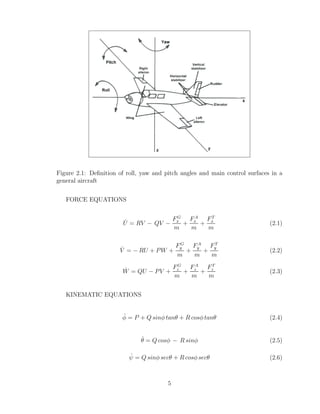
Figure 2.1: Definition of roll, yaw and pitch angles and main control surfaces in a
general aircraft
FORCE EQUATIONS
U̇ = RV − QV −
FG
x
m
+
FA
x
m
+
FT
x
m
(2.1)
V̇ = − RU + PW +
FG
y
m
+
FA
y
m
+
FT
y
m
(2.2)
Ẇ = QU − PV +
FG
z
m
+
FA
z
m
+
FT
z
m
(2.3)
KINEMATIC EQUATIONS
φ̇ = P + Q sinφ tanθ + R cosφ tanθ (2.4)
θ̇ = Q cosφ − R sinφ (2.5)
ψ̇ = Q sinφ secθ + R cosφ secθ (2.6)
5
Figure 2.2: Definition of axes and aerodynamic angles (obtained from [13])
MOMENT EQUATIONS
ΓṖ = Jxz(Jx − Jy + Jz)PQ − [Jz(Jz − Jy) + J2
xz]QR + JzMx + JxzMz (2.7)
JyQ̇ = (Jz − Jx)PR − Jxz(P2
− R2
) + My (2.8)
ΓṘ = [(Jx − Jy)Jx + J2
xz]PQ − Jxz(Jx − Jy + Jz)QR + JxzMx + JxMz (2.9)
Γ = JxJz − J2
xz (2.10)
NAVIGATION EQUATIONS
ṗN = Ucθcψ + V (sφsθcψ − cφsψ) + W(sφsψ + cφsθcψ) (2.11)
ṗE = Ucθcψ + V (cφcψ + sφsθsψ) + W(cφsθsψ − sφcψ) (2.12)
ḣ = Usθ − V sφcθ − Wcφcθ (2.13)
6
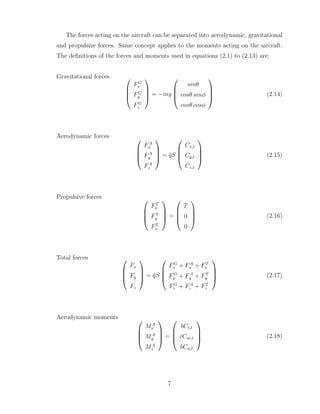
The forces acting on the aircraft can be separated into aerodynamic, gravitational
and propulsive forces. Same concept applies to the moments acting on the aircraft.
The definitions of the forces and moments used in equations (2.1) to (2.13) are:
Gravitational forces 



FG
x
FG
y
FG
z



 = −mg




sinθ
cosθ sinφ
cosθ cosφ



 (2.14)
Aerodynamic forces 



FA
x
FA
y
FA
z



 = q̄S




Cx,t
Cy,t
Cz,t



 (2.15)
Propulsive forces 



FT
x
FT
y
FT
z



 =




T
0
0



 (2.16)
Total forces 



Fx
Fy
Fz



 = q̄S




FG
x + FA
x + FT
x
FG
y + FA
y + FT
y
FG
z + FA
z + FT
z



 (2.17)
Aerodynamic moments 



MA
x
MA
y
MA
z



 =




bCl,t
c̄Cm,t
bCn,t



 (2.18)
7
For purposes of linearizing the equations of motion and studying the dynamic
behavior, it is recommended to have the velocity equations expressed in wind or
stability axes variables, which are the true airspeed and the aerodynamic angles of
the aircraft axes with respect to the wind axes (VT , α and β) (2.19)-(2.21). The
stability reference frame is an special frame fixed in the body that is used in the
study of small deviations from a nominal flight condition. It differs from the body
frame shown in (2.2) because the x-axis is chosen as the projection of the aircraft
true velocity into the plane defined by the body axes XZ (the y-axis of this stability
frame coincides with the body y-axis). The wind frame has its x-axis in the direction
of the aircraft’s true velocity and the z-axis is the same as the body z-axis.
VT =
√
U2 + V 2 + W2 (2.19)
α = tan−1
³W
U
´
(2.20)
β = sin−1
³ V
VT
´
(2.21)
Using the definitions (2.19) to (2.21), we can rewrite the force equations (2.1) to
(2.3) with the new states:
˙
VT =
1
m
(Fxcα cβ + Fysβ + Fzcβ sα) (2.22)
β̇ =
1
mVT
(−Fxcα sβ + Fycβ − Fzsα sβ) + P sα − R cα (2.23)
α̇ =
1
mVT
³
− Fx
sα
cβ
+ Fz
cα
cβ
´
− P cα tanβ + Q − R sα tanβ (2.24)
2.1.1 Engine model
The engine of an F-16 aircraft is an afterburning turbofan engine. A model of this
engine is included in [12] and can be also found in [18]. A scheme of this model is
8
Throttle
setting dth
Function
TGEAR
Commanded
power level cpow
Actual power
level pow
Function
PDOT
Altitude h
Mach number
mach
Function
THRUST
Power derivative
pow
Engine thrust
T
Figure 2.3: Scheme of the engine model used with the functions TGEAR, PDOT
and THRUST. Dashed circles show the inputs, plain circles show the outputs.
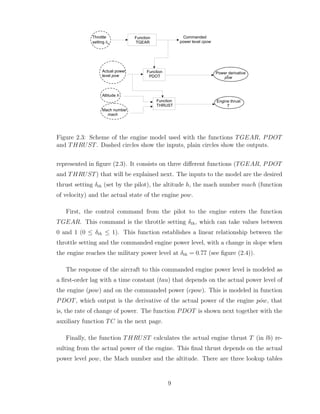
represented in figure (2.3). It consists on three different functions (TGEAR, PDOT
and THRUST) that will be explained next. The inputs to the model are the desired
thrust setting δth (set by the pilot), the altitude h, the mach number mach (function
of velocity) and the actual state of the engine pow.
First, the control command from the pilot to the engine enters the function
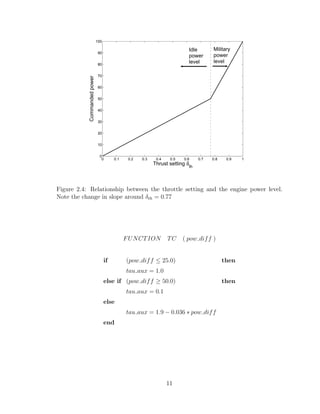
TGEAR. This command is the throttle setting δth, which can take values between
0 and 1 (0 ≤ δth ≤ 1). This function establishes a linear relationship between the
throttle setting and the commanded engine power level, with a change in slope when
the engine reaches the military power level at δth = 0.77 (see figure (2.4)).
The response of the aircraft to this commanded engine power level is modeled as
a first-order lag with a time constant (tau) that depends on the actual power level of
the engine (pow) and on the commanded power (cpow). This is modeled in function
PDOT, which output is the derivative of the actual power of the engine ˙
pow, that
is, the rate of change of power. The function PDOT is shown next together with the
auxiliary function TC in the next page.
Finally, the function THRUST calculates the actual engine thrust T (in lb) re-
sulting from the actual power of the engine. This final thrust depends on the actual
power level pow, the Mach number and the altitude. There are three lookup tables
9
containing this data, depending on the power level at which the engine is working:
idle, military or maximum. These tables can be found in [18].
Since the final thrust depends on the actual power level, the actual power level
has to be included in the state vector of the system. This state is called pow, is
dimensionless and ranges from 0 to 100. The variations in time of pow depend on the
thrust setting δth set by the pilot and the algorithm in function PDOT.
FUNCTION PDOT ( cpow , pow )
if (cpow ≥ 50.0) then
if (pow ≥ 50.0) then
tau = 5.0
paux = cpow
else
paux = 60.0
tau = tc(paux − pow)
end
else
if (pow ≥ 50.0) then
tau = 5.0
paux = 40.0
else
paux = cpow
tau = tc(paux − pow)
end
end
10
0 0.1 0.2 0.3 0.4 0.5 0.6 0.7 0.8 0.9 1
0
10
20
30
40
50
60
70
80
90
100
Thrust setting δth
Commanded
power
Idle
power
level
Military
power
level
Figure 2.4: Relationship between the throttle setting and the engine power level.
Note the change in slope around δth = 0.77
FUNCTION TC ( pow diff )
if (pow diff ≤ 25.0) then
tau aux = 1.0
else if (pow diff ≥ 50.0) then
tau aux = 0.1
else
tau aux = 1.9 − 0.036 ∗ pow diff
end
11
Figure 2.5: Scheme of the thrust vectoring and its relevant angles
Thrust vectoring model
In the high angle of attack region, the usual control surfaces of the aircraft may not
be sufficient to control the aircraft and obtain the desired performance. Vectoring
the thrust is one option to extend the capabilities of the aircraft in this region.
Usually, the thrust of the engine is directed through the body x-axis. Therefore,
the propulsive force of the engine has only one component in this axis, having no
effect on the other axes (check equation (2.16)). By vectoring the thrust, we are able
to direct this propulsive thrust into any direction. The main benefit is that now the
propulsive force of the engine has components in all the body axes, obtaining a better
performance of the engine for the same amount of thrust.
Considering a deflection of the thrust vector in the pitch (δptv) and yaw (δytv)
planes as in figure (2.5), the new propulsive forces can be written as (2.25)(according
to [13]). These new components of the propulsive forces also produce moments along
the yaw and pitch axes, with a moment arm of lT = xcg − xT (2.26).
12
Propulsive forces with thrust vectoring become




FT
x
FT
y
FT
z



 = T




cosδptv sinδytv
sinδytv
−sinδptv cosδytv



 (2.25)
Propulsive moments due to thrust vectoring become




MT
x
MT
y
MT
z



 =




0
lT FT
z
lT FT
y



 (2.26)
2.2 Longitudinal model
In this section we will present the actual model that we implemented for the simula-
tions. It is based on the fact that, under certain conditions, the equations of motion
can be decoupled a longitudinal mode (motion in the vertical plane) and into a lateral
mode (motion in the horizontal plane). These conditions are:
• The aircraft is on a wings-level steady-state flight condition (implies φ = 0).
• The sideslip angle is very small ( β ≃ 0 ).
• the roll and yaw rates (P and R) are small.
Assuming these assumptions hold and including the thrust vectoring system seen
before (δytv = 0 due to the longitudinal assumptions), the state variables are
x = [ VT α q θ pow h ]T
13
and the equations of motion can be rewritten as follows:
˙
VT =
q̄Sc̄
2mVT
[Cxq(α)cos(α) + Czq(α)sin(α)]q − gsin(θ − α) +
+
q̄S
m
(Cx(α, δe)cos(α) + Cz(α, δe)sin(α)) +
T
m
cos(α + δptv) (2.27)
α̇ = [1 +
q̄Sc̄
2mV 2
T
(Czq(α)cos(α) − Cxq(α)sin(α))]q +
g
VT
cos(θ − α) +
+
q̄S
mVT
(Cz(α, δe)cos(α) − Cx(α, δe)sin(α)) −
−
T
mVT
sin(α + δptv) (2.28)
q̇ =
q̄Sc̄
2JyVT
[c̄Cmq(α) + ∆Czq(α)]q +
+
q̄Sc̄
Jy
[Cm(α, δe) +
∆
c̄
Cz(α, δe)] −
lT T
Jy
sin(δptv) (2.29)
θ̇ = q (2.30)
ḣ = VT cosα sinθ − VT sinα cosθ (2.31)
The time derivative of the state pow has been presented in section 2.1.1, where the
function PDOT calculates the time derivative of pow as a function of itself and the
commanded power level set by the pilot. Information about the engine can obtained
from a more detailed model of the engine, available in [12]. Figure (2.8) shows the
implemented F − 16 aircraft model in Simulink r
°.
2.2.1 Aircraft description
The parameters used to implement the model of the F-16 aircraft are shown in table
(2.1).
The aircraft longitudinal model uses three different actuators. The first one cor-
responds to the elevator angle δe, which mainly affects the value of the aerodynamic
coefficients. The second one is the thrust setting δth, that affects the value of the
motor thrust T. The third one, δptv is the vectoring angle of the thrust. Table (2.2)
14
Table 2.1: Mass and geometric properties of the aircraft
Parameter Value
Weight W (lb) 20500
Wing area S (ft2
) 300
Mean aerodynamic chord c̄ (ft) 11.32
Reference cg location xcg,ref (ft) 0.35c̄
Moment of inertia Jy (slug ft2
) 55814
Table 2.2: Models of the control actuators
Actuators Position limit Rate limit Time constant
Elevator δe ±25◦
60◦
/s 0.0495s
Thrust vectoring δptv ±17◦
60◦
/s 0.07s
shows the relevant parameters of these actuators. The response of the elevator and
the thrust vectoring actuators is modeled in both cases as first-order systems.
In this master’s thesis, the delay in the response of the elevator (with a time
constant of 0.0495 s) is considered in the simulations and the design of the con-
trollers. However, the thrust vectoring actuator will not be considered, although it is
introduced in the model for further simulations and investigations.
2.2.2 Aerodynamic data
The aerodynamic data used in this thesis was obtained in a series of wind tunnel tests
on a subscale model of an F-16 airplane ([12]). This data consists on 50 look-up tables
and covers a wide range of angle of attack and of sideslip angle (−20◦ ≤ α ≤ 90◦
and
−30◦ ≤ β ≤ 30◦
). However the actual techniques for modeling in the poststall region
are not accurate, so the reduced data presented in [18] is used.
This reduced data (10 look-up tables) covers a range for the angle of attack be-
tween −10 and 45 degrees and the dependence on β has been approximated in some
cases. The number of look-up tables is finally reduced to 4 by considering only the
15
relevant data for the longitudinal model of the aircraft.
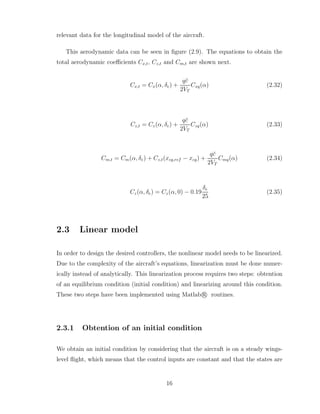
This aerodynamic data can be seen in figure (2.9). The equations to obtain the
total aerodynamic coefficients Cx,t, Cz,t and Cm,t are shown next.
Cx,t = Cx(α, δe) +
qc̄
2VT
Cxq(α) (2.32)
Cz,t = Cz(α, δe) +
qc̄
2VT
Czq(α) (2.33)
Cm,t = Cm(α, δe) + Cz,t(xcg,ref − xcg) +
qc̄
2VT
Cmq(α) (2.34)
Cz(α, δe) = Cz(α, 0) − 0.19
δe
25
(2.35)
2.3 Linear model
In order to design the desired controllers, the nonlinear model needs to be linearized.
Due to the complexity of the aircraft’s equations, linearization must be done numer-
ically instead of analytically. This linearization process requires two steps: obtention
of an equilibrium condition (initial condition) and linearizing around this condition.
These two steps have been implemented using Matlab r
° routines.
2.3.1 Obtention of an initial condition
We obtain an initial condition by considering that the aircraft is on a steady wings-
level flight, which means that the control inputs are constant and that the states are
16
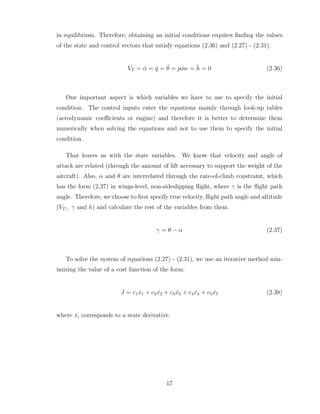
in equilibrium. Therefore, obtaining an initial conditions requires finding the values
of the state and control vectors that satisfy equations (2.36) and (2.27) - (2.31).
˙
VT = α̇ = q̇ = θ̇ = ˙
pow = ḣ = 0 (2.36)
One important aspect is which variables we have to use to specify the initial
condition. The control inputs enter the equations mainly through look-up tables
(aerodynamic coefficients or engine) and therefore it is better to determine them
numerically when solving the equations and not to use them to specify the initial
condition.
That leaves us with the state variables. We know that velocity and angle of
attack are related (through the amount of lift necessary to support the weight of the
aircraft). Also, α and θ are interrelated through the rate-of-climb constraint, which
has the form (2.37) in wings-level, non-sideslipping flight, where γ is the flight path
angle. Therefore, we choose to first specify true velocity, flight path angle and altitude
(VT , γ and h) and calculate the rest of the variables from them.
γ = θ − α (2.37)
To solve the system of equations (2.27) - (2.31), we use an iterative method min-
imizing the value of a cost function of the form:
J = c1 ˙
x1 + c2 ˙
x2 + c3 ˙
x3 + c4 ˙
x4 + c5 ˙
x5 (2.38)
where ẋi corresponds to a state derivative.
17
2.3.2 Linearizing around the initial condition
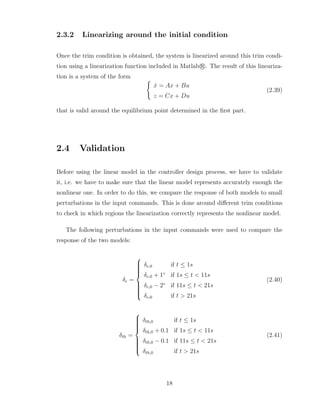
Once the trim condition is obtained, the system is linearized around this trim condi-
tion using a linearization function included in Matlab r
°. The result of this lineariza-
tion is a system of the form (
ẋ = Ax + Bu
z = Cx + Du
(2.39)
that is valid around the equilibrium point determined in the first part.
2.4 Validation
Before using the linear model in the controller design process, we have to validate
it, i.e. we have to make sure that the linear model represents accurately enough the
nonlinear one. In order to do this, we compare the response of both models to small
perturbations in the input commands. This is done around different trim conditions
to check in which regions the linearization correctly represents the nonlinear model.
The following perturbations in the input commands were used to compare the
response of the two models:
δe =













δe,0 if t ≤ 1s
δe,0 + 1◦
if 1s ≤ t < 11s
δe,0 − 2◦
if 11s ≤ t < 21s
δe,0 if t > 21s
(2.40)
δth =









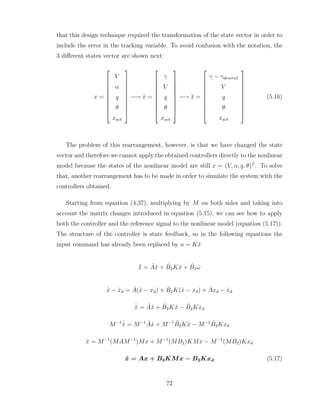




δth,0 if t ≤ 1s
δth,0 + 0.1 if 1s ≤ t < 11s
δth,0 − 0.1 if 11s ≤ t < 21s
δth,0 if t > 21s
(2.41)
18
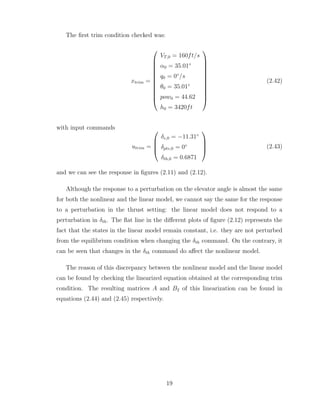
The first trim condition checked was:
xtrim =












VT,0 = 160ft/s
α0 = 35.01◦
q0 = 0◦
/s
θ0 = 35.01◦
pow0 = 44.62
h0 = 3420ft












(2.42)
with input commands
utrim =




δe,0 = −11.31◦
δptv,0 = 0◦
δth,0 = 0.6871



 (2.43)
and we can see the response in figures (2.11) and (2.12).
Although the response to a perturbation on the elevator angle is almost the same
for both the nonlinear and the linear model, we cannot say the same for the response
to a perturbation in the thrust setting: the linear model does not respond to a
perturbation in δth. The flat line in the different plots of figure (2.12) represents the
fact that the states in the linear model remain constant, i.e. they are not perturbed
from the equilibrium condition when changing the δth command. On the contrary, it
can be seen that changes in the δth command do affect the nonlinear model.
The reason of this discrepancy between the nonlinear model and the linear model
can be found by checking the linearized equation obtained at the corresponding trim
condition. The resulting matrices A and B2 of this linearization can be found in
equations (2.44) and (2.45) respectively.
19
A =





















−0.1656 −10.7137 −7.2815 −32.1740 0 3.951e − 4
−0.0018 −0.0981 0.9276 0 0 4.2663e − 6
0 −0.6252 −0.4673 0 0 0
0 0 1.0000 0 0 0
0 0 0 0 −1.0000 0
0 −160.0000 0 160.0000 0 0





















(2.44)
B2 =












−4.0478 −9.2839 0
−0.0253 −0.0828 0
−0.8992 −1.8471 0
0 0 0
0 0 64.9400
0 0 0












(2.45)
From the B matrix we can see that the thrust setting δth (3rd column) only affects
the pow state (4th row). Then, by checking the A matrix, it can be seen that the pow
state (4th column and row) only affects itself, having no effect on the other states.
Therefore, a change in the thrust setting produces a change in the pow state, but this
change does not translate into changes in the other states. The pow state is decoupled
and this is the reason why the linear model does not follow the nonlinear model for
changes in δth.
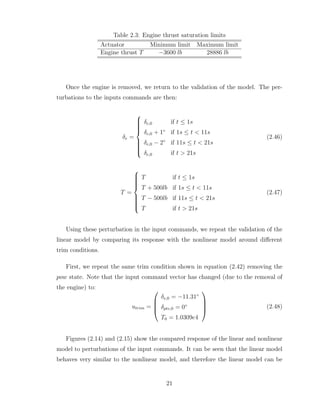
In order to avoid this problem, the engine model has to be removed from the
general nonlinear aircraft model. Then, the control input δth disappears and is sub-
stituted by T (engine thrust). This means that our control signal is directly the
output of the engine. Table (2.3) shows the physical limitations of the engine thrust
T [18], that will be used in the simulations chapters to determine whether the thrust
actuator is saturated or not. We will not consider any delay effects in the thrust,
since we interpret that they depend on the engine model.
20
Table 2.3: Engine thrust saturation limits
Actuator Minimum limit Maximum limit
Engine thrust T −3600 lb 28886 lb
Once the engine is removed, we return to the validation of the model. The per-
turbations to the inputs commands are then:
δe =













δe,0 if t ≤ 1s
δe,0 + 1◦
if 1s ≤ t < 11s
δe,0 − 2◦
if 11s ≤ t < 21s
δe,0 if t > 21s
(2.46)
T =













T if t ≤ 1s
T + 500lb if 1s ≤ t < 11s
T − 500lb if 11s ≤ t < 21s
T if t > 21s
(2.47)
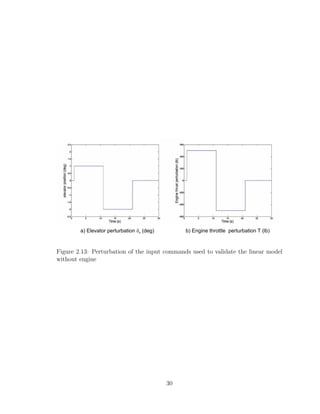
Using these perturbation in the input commands, we repeat the validation of the
linear model by comparing its response with the nonlinear model around different
trim conditions.
First, we repeat the same trim condition shown in equation (2.42) removing the
pow state. Note that the input command vector has changed (due to the removal of
the engine) to:
utrim =




δe,0 = −11.31◦
δptv,0 = 0◦
T0 = 1.0309e4



 (2.48)
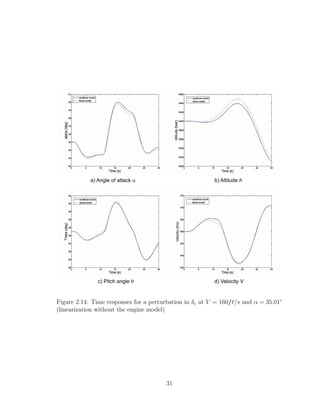
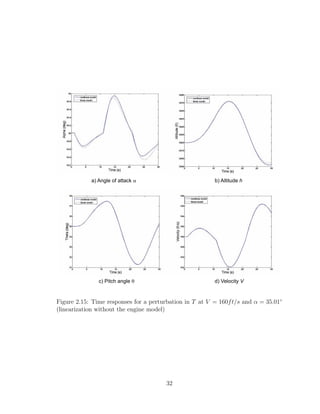
Figures (2.14) and (2.15) show the compared response of the linear and nonlinear
model to perturbations of the input commands. It can be seen that the linear model
behaves very similar to the nonlinear model, and therefore the linear model can be
21
considered a good approximation around the equilibrium conditions of (2.42).
Finally, we compare the behavior of both models around another equilibrium
condition:
xtrim =










VT,0 = 200ft/s
α0 = 22.46◦
q0 = 0◦
/s
θ0 = 22.46◦
h0 = 3000ft










(2.49)
with input commands
utrim =




δe,0 = −6.97◦
δptv,0 = 0◦
T0 = 6.1259e3



 (2.50)
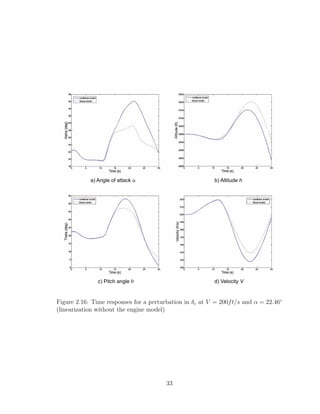
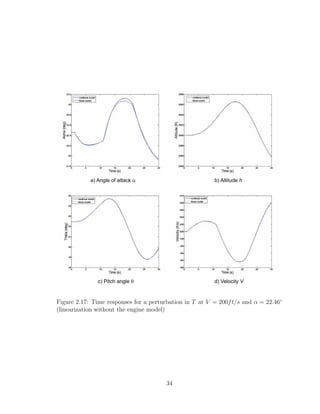
Figures (2.16) and (2.17) show the results. Although the response to the pertur-
bation in the thrust force T is similar in both models, we cannot say the same for the
response to an elevator perturbation.
As seen in (2.16), the response of the nonlinear and the linear model are quite
different. This difference is due to the fact that the linearization point in this case is
around α = 21◦
. In this region, there is a major change in the aerodynamic behavior
of the aircraft: it changes from low-angle of attack to high-angle of attack. This
change can be seen in the aerodynamic data presented in figure (2.9): there is a
major change in the slope of the some aerodynamic coefficients (Cx, Cxq and Cz)
around this region.
Consequently, after linearizing the nonlinear model around different points, we
can determine that the linear model is a good representation of the nonlinear model
as long as
- changes in the angle of attack α are small, and
- the model stays away from the region around α ≃ 21◦
or other regions where
there is a significant change in the aerodynamic behavior of the aircraft (i.e.
22
regions where there is a major change in the slope of the aerodynamic coeffi-
cients)
Two regions in which there are not significant changes in the aerodynamic coefficients
and that are representative of the behavior of the aircraft when linearized about them
are:
• −5◦
≤ α ≤ 15◦
• 25◦
≤ α ≤ 40◦
23
Figure 2.6: Relevant angles and axes in the longitudinal model
Figure 2.7: Scheme of the longitudinal model of the aircraft with and without the
thrust vectoring
24
Figure 2.8: Nonlinear longitudinal model of the F − 16 aircraft implemented in
Simulink r
°
25
a) x-axis force coefficient Cx b) Damping coefficient Cxq
d) Damping coefficient Czq
e) Pitching moment coefficient Cm f) Damping coefficient Cmq
c) z-axis force coefficient Cz
Figure 2.9: Plots of the different aerodynamic coefficients
26
a) Elevator perturbation (deg)
de b) Throttle setting perturbation th
d
Figure 2.10: Perturbation of the input commands used to validate the linear model
27
a) Angle of attack a b) Altitude h
c) Pitch angle q d) Velocity V
Figure 2.11: Time responses for a perturbation in δe at V = 160ft/s and α = 35.01◦
28
a) Angle of attack a b) Velocity V
c) Pitch angle q
Figure 2.12: Time responses for a perturbation in δth at V = 160ft/s and α = 35.01◦
29
a) Elevator perturbation (deg)
de b) Engine throttle perturbation T (lb)
Figure 2.13: Perturbation of the input commands used to validate the linear model
without engine
30
a) Angle of attack a b) Altitude h
c) Pitch angle q d) Velocity V
Figure 2.14: Time responses for a perturbation in δe at V = 160ft/s and α = 35.01◦
(linearization without the engine model)
31
a) Angle of attack a b) Altitude h
c) Pitch angle q d) Velocity V
Figure 2.15: Time responses for a perturbation in T at V = 160ft/s and α = 35.01◦
(linearization without the engine model)
32
a) Angle of attack a b) Altitude h
c) Pitch angle q d) Velocity V
Figure 2.16: Time responses for a perturbation in δe at V = 200ft/s and α = 22.46◦
(linearization without the engine model)
33
a) Angle of attack a b) Altitude h
c) Pitch angle q d) Velocity V
Figure 2.17: Time responses for a perturbation in T at V = 200ft/s and α = 22.46◦
(linearization without the engine model)
34
Chapter 3
Linear Parameter Varying (LPV)
systems
One of the main problems in modeling real life systems is the presence of uncer-
tainties because it affects the validity of the model. Out of the two main families of
linear systems uncertainties (dynamical input-output and state space uncertainties,
[1]), state space uncertainties are particularly interesting.
State space uncertainties arise due to the fact that the physical parameters on
which the system depends may vary with time, and they directly affect the state
space matrices. The wider the operating envelope of the system, the more the pa-
rameter (and consequently the system matrices) change. This often makes the system
nonlinear, since the variation depends on the value of the states.
An example of state space uncertainty would be the weight of an aircraft. During
flight, fuel is burned and the weight of the airplane is reduced, changing the state
space matrices.
35
One of the most popular methods to overcome this nonlinearities in controller
design is gain scheduling. This technique constructs a nonlinear controller by in-
terpolating in some manner (e.g. switching or linear combination) between a set
of linear time invariant controllers. Each linear controller is designed to meet the
requirements of stability and performance about an equilibrium point in which the
system may operate.
This technique linearizes the plant around different equilibrium points (corre-
sponding to different values of the uncertain physical parameters) and then uses
linear techniques to design controllers in these different conditions. These controllers
are designed separately and the final controller is either a linear combination of them
or a switching law involving them (that is, use each controller in a region around its
design point and switch to another controller when it leaves this region).
Gain scheduling, however, has one main drawback: it can not guarantee overall
performance or stability of the overall system of controllers other than at the design
points. For example, switching from one controller to another can drive the system
unstable even though were dealing with an stable system. This is specially critical
when the systems parameters change quickly and typically requires a great deal of
simulations to check if the resulting closed loop system is stable.
The desire of being able to guarantee performance and stability over all the per-
formance envelope of the system lead to the development of linear parameter varying
(LPV) control techniques.
3.1 LPV basics
A Linear Parameter Varying (LPV) system is a class of finite dimensional linear
systems of the form
(
˙
x(t) = A(ρ(t))x(t) + B(ρ(t))u(t)
z(t) = C(ρ(t))x(t) + D(ρ(t))u(t)
(3.1)
36
where A ǫ ℜ nxn
, B ǫ ℜ mxn
and ρ(t) is a time-varying parameter vector (scheduling
vector) not known in advanced although it can be measured in real time and it
moves inside a certain bounded region P known a priori. If the scheduling vector
ρ(t) includes some of the states of the system, then we have a quasi-LPV (qLPV)
system. The LPV framework takes advantage of the fact that although the future
evolution of the scheduling vector is unknown, the relationship between ρ(t) and the
system matrices is known. The LPV controller can be then designed according to
this relationship.
The LPV controller design technique allows us to design the controllers only in
the corner points of the scheduling region P with its corresponding stability and
performance requirements and then it guarantees that these requirements will be
fulfilled in all the performance envelope [1], [11].
One of the main difficulties in using the LPV controller design techniques is that
the system must be written in an LPV form (equation 3.1). There are three main
methods to obtain approximated LPV models:
- Jacobian Linearization
- State Transformation
- Function Substitution
More information on the advantages and disadvantages of the different methods
and how they work can be found in [3].
3.2 LPV model of the F-16 aircraft
Obtaining an LPV model of the longitudinal model of the F-16 aircraft following the
directions in [3] is very complicated because of the complexity of the equations of
motion. In this section, we show how we obtained an approximated LPV model of
the aircraft and its validation through simulation.
37
a
V
Vmin
Vmax
amin amax
1 2
3
4
r = [A( ) , B( ), , ]
1 C( ) D( )
r r r r
1 1 1 1
r = [A( ) , B( ), , ]
2 C( ) D( )
r r r r
2 2 2 2
r = [A( ) , B( ), , ]
3 C( ) D( )
r r r r
3 3 3 3
r = [A( ) , B( ), , ]
4 C( ) D( )
r r r r
4 4 4 4
C
Figure 3.1: Scheme of the LPV model
First, the scheduling vector ρ(t) must be specified. For the F-16 aircraft model,
velocity VT and angle of attack α are chosen, which are the most common choices for
the longitudinal motion of an aircraft ([3], [13]). Then, the envelope of interest (call
it ℘ region) is chosen, that is, maximum and minimum values for ρ(t) = [VT , α]T
are
specified.
Let’s consider that
VT,min ≤ VT (t) ≤ VT,max
αmin ≤ α ≤ αmax
and therefore ℘ is a convex region with the following corners (see figure 3.1)
ρ1 = [VT,min αmin]T
ρ2 = [VT,min αmax]T
ρ3 = [VT,max αmax]T
ρ4 = [VT,max αmin]T
The nonlinear model is then linearized around the corner points (that is, linearized
around the trim conditions specified by ρ1, ρ2, ρ3 and ρ4), obtaining 4 different linear
systems with its corresponding state space matrices ([Ai, Bi, Ci, Di] for i = 1, . . . , 4).
38
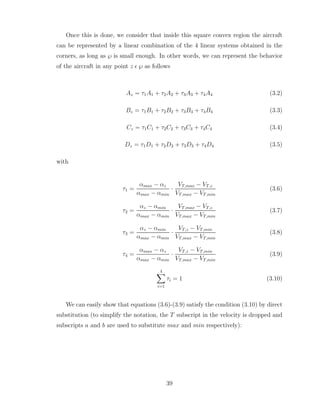
Once this is done, we consider that inside this square convex region the aircraft
can be represented by a linear combination of the 4 linear systems obtained in the
corners, as long as ℘ is small enough. In other words, we can represent the behavior
of the aircraft in any point z ǫ ℘ as follows
Az = τ1A1 + τ2A2 + τ3A3 + τ4A4 (3.2)
Bz = τ1B1 + τ2B2 + τ3B3 + τ4B4 (3.3)
Cz = τ1C1 + τ2C2 + τ3C3 + τ4C4 (3.4)
Dz = τ1D1 + τ2D2 + τ3D3 + τ4D4 (3.5)
with
τ1 =
αmax − αz
αmax − αmin
·
VT,max − VT,z
VT,max − VT,min
(3.6)
τ2 =
αz − αmin
αmax − αmin
·
VT,max − VT,z
VT,max − VT,min
(3.7)
τ3 =
αz − αmin
αmax − αmin
·
VT,z − VT,min
VT,max − VT,min
(3.8)
τ4 =
αmax − αz
αmax − αmin
·
VT,z − VT,min
VT,max − VT,min
(3.9)
4
X
i=1
τi = 1 (3.10)
We can easily show that equations (3.6)-(3.9) satisfy the condition (3.10) by direct
substitution (to simplify the notation, the T subscript in the velocity is dropped and
subscripts a and b are used to substitute max and min respectively):
39
P4
i=1 τi = τ1 + τ2 + τ3 + τ4 = 1
αa−αb
· 1
Va−Vb
[(αa − αz)(Va − Vz) +
+ (αz − αb)(Va − Vz) + (αz − αb)(Vz − Vb) + (αa − αz)(Vz − Vb)] =
= 1
αa−αb
· 1
Va−Vb
[αaVa − αaVz − αzVa + αzVz + αzVa − αzVz − αbVa +
+ αbVz + αzVz − αzVb − αbVz + αbVb + αaVz − αaVb − αzVz + αzVb] =
= 1
αa−αb
· 1
Va−Vb
[(αa − αb) · (Va − Vb)] = 1
Similarly, it can be shown that on each corner of the LPV region (figure (3.1)) the
value of τi corresponding to that corner is 1 while the rest of them have a 0 value.
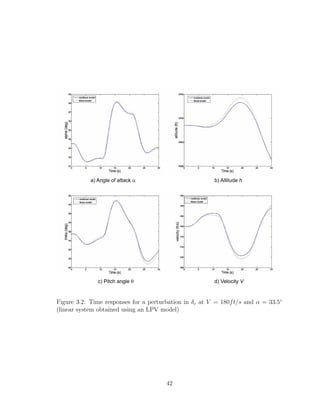
To validate this method to obtain an LPV model, we have to compare the behav-
ior of the nonlinear model inside the selected LPV region with the behavior of the
approximated system (3.2)-(3.5). For this validation, we use the same method as in
section 2.4, that is, check the response of both systems to perturbations in the input
commands (δe and T).
To check the region bounded by
160ft/s ≤ VT (t) ≤ 200ft/s (3.11)
32◦
≤ α ≤ 35◦
(3.12)
we simulate the behavior of the nonlinear model in the middle of this zone, that is,
in the trim condition obtained by imposing
VT,Z = 180ft/s (3.13)
αZ = 33.5◦
(3.14)
40
and compare it to the behavior of the plant represented in (3.2)-(3.5) with
τ1 = 0.25
τ2 = 0.25
τ3 = 0.25
τ4 = 0.25
Note that this point is located in the middle of the square defined by ρ1, ρ2, ρ3
and ρ4, that is, it corresponds to the point C in figure (3.1). Figures 3.2 and 3.3 show
the results.
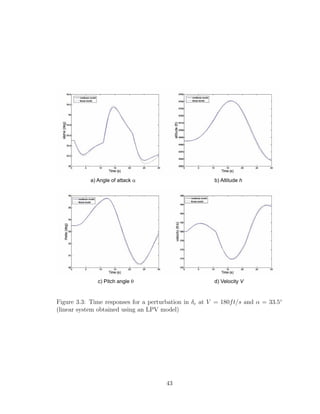
We can see that the approximated linear system behaves quite similar to the
nonlinear system, and therefore this method is validated. The same method has
been used to validate the LPV concept in the region bounded by (3.15) and (3.16),
obtaining similar results.
500ft/s ≤ VT (t) ≤ 550ft/s (3.15)
3◦
≤ α ≤ 8◦
(3.16)
It is important, however, to keep in mind the linearization restrictions commented
in section 2.4 and also that the LPV region has to be small enough for the method to
be valid. This fact may present a problem: the region may be too small to include the
movements of the aircraft. In other words, if the region defined by the LPV corners
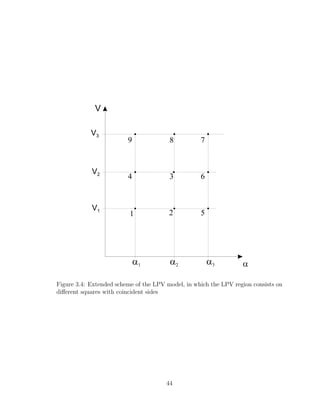
is small, the aircraft may leave it during its trajectory. An option to solve this is to
expand the LPV model as in figure (3.4). Inside each square we use its four corners
to obtain the LPV approximated model, so when the aircraft moves from one square
to the other we just need to change two of the corners and the model will still be
valid [20].
41
a) Angle of attack a b) Altitude h
c) Pitch angle q d) Velocity V
Figure 3.2: Time responses for a perturbation in δe at V = 180ft/s and α = 33.5◦
(linear system obtained using an LPV model)
42
a) Angle of attack a b) Altitude h
c) Pitch angle q d) Velocity V
Figure 3.3: Time responses for a perturbation in δe at V = 180ft/s and α = 33.5◦
(linear system obtained using an LPV model)
43
a
V
V2
V3
a1 a2
V1
a3
1 2 5
6
7
8
9
4 3
Figure 3.4: Extended scheme of the LPV model, in which the LPV region consists on
different squares with coincident sides
44
Chapter 4
Controller design
4.1 Saturation control background
Actuator saturation has always been a main issue in all engineering fields [9]. It is
probably the most important and dangerous nonlinearity present in any system with
actuators and there are many research projects trying to avoid the problems it causes.
Forgetting to consider it in the controller design can lead to a major degradation of
the system’s performance or, in the worst case, can drive the system unstable (even
for open-loop stable systems).
Saturation occurs often in real life problems because actuators have an inherent
limited capacity and therefore they cannot always provide the action that is required
from them. In other words, actuator saturation means that there is a difference
between the input command to the actuator and its output, that is, when the actuator
reaches its capacity limitation. This limitation can lead to instability.
Equation (4.1) and figure (4.1) show the usual characterization of saturation ef-
fects, being y the actuator input, u the actuator output and umax (umin) the maximum
(minimum) capacity of the actuator.
45
u =







umax if umax ≤ y
y if umin ≤ y < umax
umin if y ≤ umin
(4.1)
Figure 4.1: Plot of the saturation effect
Figure (4.2) shows the scheme of a plant with an open loop controller and a
representation of the actuator. This representation includes a delay (usually due to
mechanical limitations) and a saturation block. This block introduces the saturation
effects described in (4.1). The delay is often modeled as a first order transfer function.
In the flight control world, saturation has been linked to the failure of several
aircrafts [4],[13]. Also, saturation plays a main role in the pilot in-the-loop oscillations
(PIO) [2] and in manual flight control situations, specially in high angle of attack
conditions [4], [15]. Usually, there have been two main approaches to the design of
46
Plant
SATURATION
BLOCK
Controller Delay
Saturation
input
y
Sat.
Output
u
ACTUATOR REPRESENTATION
Figure 4.2: Scheme of a plant with an open loop controller and a representation of
the actuator. The actuator is represented by a saturation block and a delay transfer
function
controllers dealing with saturation.
The first approach takes saturation into account for the design of the controllers
from the beginning of the design process. Usually, this means designing a controller
that is guaranteed not to saturate under any conditions. It is a rather conservative
approach, since the controller will be designed for the worst-case scenario (although
this scenario may never occur) and it involves the combination of various requirements
[10], [17].
The second approach (known as anti-windup) focuses on the design of the best
possible controller even though it may saturate. Once saturation occurs, modifications
to this controller are applied in order to return the system to the non-saturated status.
The main advantage is that is less conservative than the previous method, since a
more aggressive controller is used most of the time. One drawback of this method is
the fact that most anti-windup techniques require an stable open-loop plant, which
is not always the case [4], [14].
For more information on saturation, the reader is referred to [9].
47
4.2 Anti-saturation LMIs: basic equations
Consider the following open loop system
(
ẋ = Ax + B1ω + B2u
z = Cx + D1ω + D2u
(4.2)
where x is the state vector, z is the controlled output, u is the control input and ω is
the disturbance. The state space matrix A can be stable or unstable, depending on
the points about which the model is linearized.
In this thesis only state feedback is considered (4.3), which implies that all the
states can be measured. Assuming that all the states are available is not unusual in
research in flight control [18]. The gain of the controller is represented by K. Using
state feedback, equation (4.2) can be rewritten as (4.4).
u = Kx (4.3)
(
ẋ = (A + B2K)x + B1ω = ACLx + B1ω
z = (C + D2K)x + D1ω
(4.4)
For the disturbance ω, different bounds can be used. In this thesis, we will consider
that we known its peak value (4.5). This is a rather conservative bound, because it
refers to the maximum possible peak value that might occur, but most probably the
disturbance value will be considerably less than this peak value during most or all
of the time. How to reduce this conservatism using a scheduling technique will be
discussed later (section 4.3).
ωT
(t)ω(t) ≤ ω2
max (4.5)
There are three basic constraints to consider when designing controllers that take
saturation nonlinearity into account while responding to a disturbance:
48
• Invariant-set
This is the set that the state vector can not leave given any initial conditions
inside it, considering the above limits on the disturbance applied.
• Constraint (actuator saturation)
Inside the invariant set, the controller can not be saturated.
• Performance
The effects of the disturbance on the controlled output have to be as small as
possible (i.e. the performance has to be as good as possible).
Next, we will express these three constraints mathematically in the form of linear
matrix inequalities (LMIs). In order to do that we will use the Lyapunov function
(4.6), where P is a positive definite matrix and x is the system’s state vector. Al-
though P can be any positive definite matrix, in this thesis we will consider P to be
constant.
V = xT
Px (4.6)
Also, we will use the concept of ellipsoids to define the shape of the different sets
in which the state vector can move. An ellipsoid is defined by two parameters: a
matrix P and a constant C, such that
ε{P, C} = {x | xT
Px < C2
} (4.7)
4.2.1 LMI introduction
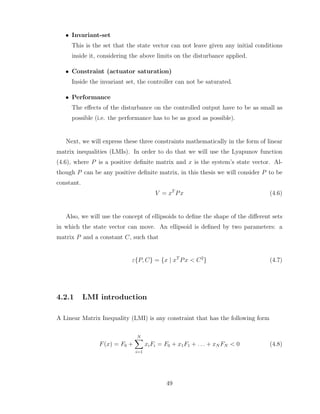
A Linear Matrix Inequality (LMI) is any constraint that has the following form
F(x) = F0 +
N
X
i=1
xiFi = F0 + x1F1 + . . . + xN FN < 0 (4.8)
49
where x = (x1, . . . , xN )T
ǫ ℜN
is a vector of unknown variables (the decision or op-
timization variables) and Fi for i = 0, . . . , N are known symmetric matrices. As
long as x enters linearly or affinely in (4.8), the search for a solution is convex. That
means that (4.8) can be solved numerically using very efficiently using optimization
methods, having the guarantee that a solution will be found if it exists.
The importance of Linear Matrix Inequalities and LMI techniques in the control
design area is that a variety of analysis and synthesis problems can be manipulated
until they are in the form of (4.8), or its related form
minimize cT
x subject to F(x) > 0 (4.9)
One example of this manipulation is shown next (corresponds to the basic Lya-
punov stability problem): the system (4.10) is stable if and only if there exists a pos-
itive definite matrix P > 0 such that (4.11) is verified. Equation (4.11) corresponds
to a simple convex search in P, easily done with the software available nowadays.
(
ẋ = Ax
x(0) = x0
(4.10)
PA + AT
P < 0 (4.11)
For more information on LMIs and the software used to solve them, the reader is
referred to [7] [5].
4.2.2 Invariant-set LMI
Remember that we want the state vector to always remain inside an invariant set,
which we define using the ellipsoid ε(P, ωmax) (4.7). This will happen if we can find
a P > 0 such that V̇ ≤ 0 for all states outside of the invariant set. We want to
50
stay inside the invariant set even when there is a perturbation applied to the system,
which can be written mathematically as
V̇ + α(V − ω2
max) < 0 (4.12)
It can be seen that V ≤ ω2
max is an attractive invariant set. The boundary of
the region corresponds to V = ω2
max. Outside this boundary, we’ve got V̇ < 0 and
therefore if you start outside you are attracted to the invariant set. If you are inside,
V̇ can be positive but in the boundary V̇ = 0, which means that we can not leave
the ellipsoid.
So the problem of finding an invariant-set becomes the problem of finding a con-
stant P > 0 matrix (recall that V = xT
Px) that satisfies (4.12). We can rewrite
(4.12) as a linear matrix inequality and then as a matrix expression as follows:
V̇ + α(V − ω2
max) < 0
ẋT
Px + xT
Pẋ + α(xT
Px − ω2
max) < 0
[(A + B2K)x + B1ω]T
Px + xT
P[(A + B2K)x + B1ω] + α(xT
Px − ω2
max) < 0
xT
(AT
P + PA)x + xT
(KT
BT
2 P + PB2K)x + ωT
BT
1 Px + xT
PB1ω − αω2
max < 0
Ã
AT
P + PA + KT
BT
2 P + PB2K + αP PB1
BT
1 P −αI
!
< 0 (4.13)
However, P and K do not show up linearly in the equation (4.13), which makes it
difficult to solve. We can transform it into a convex search by pre and post multiplying
by Ã
P−1
0
0 I
!
51
and by considering
Q = P−1
, F = KQ
The final LMI form of the invariant-set equation is shown in (4.14). This linear
matrix inequality guarantees that the states will remain inside the ellipsoid defined
by P as long as the maximum peak of the disturbance is ω2
max. Given a value for
ω2
max, hence, the objective would be to minimize P such that the value of the control
input is as small as possible (and therefore we avoid saturation).
Ã
(AT
Q + QA + F T
BT
2 + B2F + αQ) B1
BT
1 −αI
!
< 0 (4.14)
4.2.3 Constraint LMI
We do not want the controller to saturate inside the ellipsoid ε(P, ωmax) that defines
the previous invariant set. Mathematically, this condition is expressed by
| u |2
< u2
lim
ω2
max | u |2
< ω2
maxu2
lim
uT ω2
max
u2
lim
u < ω2
max (4.15)
Recalling from the previous sections that V ≤ ω2
max and that u = Kx, we can rewrite
(4.15) in an LMI form:
uT ω2
max
u2
lim
u < V
xT
[KT ω2
max
u2
lim
K]x < xT
Px
KT ω2
max
u2
lim
K < P
52
Ã
P KT
K
u2
lim
ω2
max
I
!
> 0
Repeating the last steps of last section, we obtain the final LMI for non saturation:


Q F T
F
u2
lim
ω2
max

 > 0 (4.16)
Given a positive definite P matrix, the objective is to maximize the value of ω2
max
inside the ellipsoid created by P, making sure that at all times the control input is
non saturated.
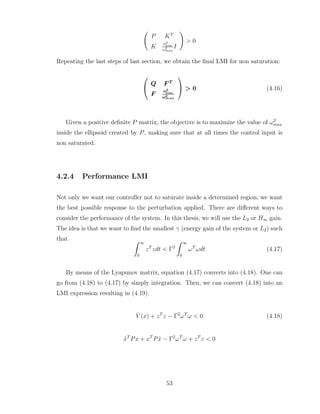
4.2.4 Performance LMI
Not only we want our controller not to saturate inside a determined region, we want
the best possible response to the perturbation applied. There are different ways to
consider the performance of the system. In this thesis, we will use the L2 or H∞ gain.
The idea is that we want to find the smallest γ (energy gain of the system or L2) such
that Z ∞
0
zT
zdt < Γ2
Z ∞
0
ωT
ωdt (4.17)
By means of the Lyapunov matrix, equation (4.17) converts into (4.18). One can
go from (4.18) to (4.17) by simply integration. Then, we can convert (4.18) into an
LMI expression resulting in (4.19).
V̇ (x) + zT
z − Γ2
ωT
ω < 0 (4.18)
ẋT
Px + xT
Pẋ − Γ2
ωT
ω + zT
z < 0
53
[ACLx + B1ω]T
Px + xT
P[ACLx + B1ω] − Γ2
ωT
ω +
+ [(C + D2K)x + D1ω]T
[(C + D2K)x + D1ω] < 0 (4.19)
Considering it as a product of a matrix with two vectors and applying the Schur
complement, we get the expression in (4.20). Again, we apply the steps of the end
of section 4.2.2 in order to obtain the final form of the performance linear matrix
inequality (4.21).




P−1
AT
CL + ACLP−1
B1 P−1
(CT
+ KT
DT
2 )
BT
1 −ΓI DT
1
(C + D2K)P−1
D1 −ΓI



 < 0 (4.20)




QAT
+ AQ + B2F + F T
BT
2 B1 QCT
+ F T
DT
2
BT
1 −ΓI DT
1
CQ + D2F DT
1 −ΓI



 < 0 (4.21)
So, by minimizing the variable Γ we are minimizing the effect of the disturbance
on the controlled output, that is, we are maximizing the performance.
4.3 Scheduling design technique
As mentioned in the previous sections of this chapter, the main problem of considering
the saturation effects at the beginning of the design problem is conservatism, that is,
the obtention of a controller that is valid when the maximum disturbance is applied
but probably will have a poor performance during the rest of the time.
54
In this section, the causes of this conservatism are briefly shown and a gain-
scheduling technique to overcome it is presented. The reader can find detailed expla-
nations of this technique in [17].
4.3.1 Conservatism associated with the design technique
Lets consider that a nominal state-feedback controller Knom is available for the open
loop system (4.22). Also, lets consider that the maximum peak bound value of the
disturbance is known (equation (4.23)). Although it is very unlikely, this maximum
peak value could occur and therefore a controller that does not saturate under ωmax
must be designed.







ẋ = Ax + B1ω + B2u
z = Cx + D1ω + D2u
y = x
(4.22)
ωT
(t)ω(t) ≤ ω2
max (4.23)
Using system analysis LMIs, we can determine the invariant set ellipsoid associ-
ated with ω2
max and Knom, which is ε(Pnom, ωmax) = {x | xT
Pnomx ≤ ω2
max}. This
ellipsoid includes all the possible values that the state vector can take under ω2
max
and the controller Knom. Figure (4.3) shows an scheme of this invariant set ellipsoid
together with the region in which u = Knomx avoids saturation (region between the
parallel lines). Also, a smaller invariant set is shown, which represents the maximum
peak value of the disturbance (ωnom) that Knom can stand without saturating.
The objective is then to design a controller Ksafe that provides a safe override for
the nominal controller. Providing a safe override means that:
- Ksafe does not saturate even for the worst case disturbance
55
−1.5 −1 −0.5 0 0.5 1 1.5
−8
−6
−4
−2
0
2
4
6
8
x
1
x
2
w
max
Linear Region
Linear Region
Linear Region
w
nom
Figure 4.3: Estimate for the smallest invariant set associated with ωmax without
actuator limits (large ellipsoid) and ωnom (small ellipsoid) for Knom. Parallel lines
show region where Knom is not saturated (figure obtained from [17])
- The invariant set associated with Ksafe and ωmax (ε(Psafe, ωmax)) completely
includes the invariant set associated with Knom and ωmax (ε(Pnom, ωmax)), that
is,
Psafe < Pnom (4.24)
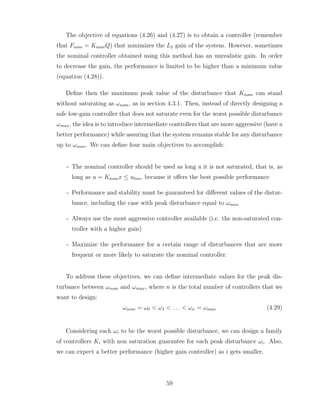
Condition (4.24) is necessary because otherwise the state vector may follow some
trajectories which lead outside the safe invariant set (see figure (4.4))and therefore
we have no stability guarantee Ksafe (it may saturate). If we consider Q = P−1
,
condition (4.24) converts into
Qsafe > Qnom (4.25)
Using then LMIs (4.14), (4.16) and (4.21) together with the inclusion condition
(4.25) we obtain a safe controller Ksafe with guarantee that it will not saturate even
for the worst possible disturbance and therefore guaranteeing that the system will
always remain stable.
56
x1
x2
Psafe
Pnom
|u |=K x
max nom
|u |=K x
max safe
x1
x2
Psafe
Pnom
|u |=K x
max nom
|u |=K x
max safe
a) P does not include
e( safe max
, )
w nom
e(P , )
wmax b) s
e( e(
P include P
safe max max
, ) , )
w w
nom
Figure 4.4: Importance of the condition (4.24). On the left, the system may find a
way to escape the safe controller and therefore it may become uncontrollable. On the
right, this possibility does not exist.
The main problem of this approach, as said before, is conservatism. The invariant-
set ellipsoid ε(Psafe, ωmax) obtained from solving the LMIs system can be much larger
than necessary (see figure (4.5)). The bigger the ellipsoid, the lower the gain of Ksafe
and therefore the lower the performance of the controller.
Basically, using this technique we may end up with a stability guarantee but with
a very low performance for values of the disturbance lower than ωmax. Since ωmax
is very unlikely to occur, most of the time we may be using a controller much more
conservative than necessary. How to improve the overall performance is an important
issue shown next.
57
−15 −10 −5 0 5 10 15
−30
−20
−10
0
10
20
30
x
1
x
2
Linear
case
K1
bound
K
1
bound
Figure 4.5: Invariant set associated with ωmax and Ksafe compared to linear case
(figure obtained from [17])
4.3.2 Gain scheduling technique to overcome conservatism
To overcome the conservatism seen in the previous subsection, controller scheduling
is introduced. Consider first a nominal controller (Knom), which in this thesis is
designed solving the following system of LMIs:




AQ + QAT
+ B2Fnom + FT
nomBT
2 B1 QiCT
1 + FT
nomDT
2
BT
1 −ΓiI DT
1
CQ + D2Fnom D1 −ΓiI



 (4.26)
Q > 0 (4.27)
Γ > Γmin (4.28)
58
The objective of equations (4.26) and (4.27) is to obtain a controller (remember
that Fnom = KnomQ) that minimizes the L2 gain of the system. However, sometimes
the nominal controller obtained using this method has an unrealistic gain. In order
to decrease the gain, the performance is limited to be higher than a minimum value
(equation (4.28)).
Define then the maximum peak value of the disturbance that Knom can stand
without saturating as ωnom, as in section 4.3.1. Then, instead of directly designing a
safe low-gain controller that does not saturate even for the worst possible disturbance
ωmax, the idea is to introduce intermediate controllers that are more aggressive (have a
better performance) while assuring that the system remains stable for any disturbance
up to ωmax. We can define four main objectives to accomplish:
- The nominal controller should be used as long a it is not saturated, that is, as
long as u = Knomx ≤ ulim, because it offers the best possible performance
- Performance and stability must be guaranteed for different values of the distur-
bance, including the case with peak disturbance equal to ωmax
- Always use the most aggressive controller available (i.e. the non-saturated con-
troller with a higher gain)
- Maximize the performance for a certain range of disturbances that are more
frequent or more likely to saturate the nominal controller.
To address these objectives, we can define intermediate values for the peak dis-
turbance between ωnom and ωmax, where n is the total number of controllers that we
want to design:
ωnom = ω0 < ω1 < . . . < ωn = ωmax (4.29)
Considering each ωi to be the worst possible disturbance, we can design a family
of controllers Ki with non saturation guarantee for each peak disturbance ωi. Also,
we can expect a better performance (higher gain controller) as i gets smaller.
59
The way this family of controllers works is that the controller with a higher gain
(lower i) that is not saturated is the one to be used. If the disturbance gets worse
and Ki saturates, then we switch to the following available lower gain controller (we
increase i) that is not saturated, until we reach Kn = Ksafe. The controller Ksafe
is designed using ωmax and therefore will never saturate. By contrary, if at any time
there are higher gain controllers (smaller i than the one we are using) that are not
saturated, we switch back to them. That guarantees that we are always using the
most aggressive controller available.
The last thing to do is guarantee that the switching is safe, that is, that the chang-
ing from Ki to Kj does not drive the system unstable. To do that, we have to make
sure that the invariant set associated with each intermediate controller includes the
previous ellipsoids (the ellipsoids corresponding to lower i controllers), as explained
at the end of the previous subsection.
Expressing everything mathematically, we can find the set of controllers by mini-
mizing
J =
N
X
1
ciΓi (4.30)
subject to the following constraints:
Ã
AT
Qi + QiA + FT
i BT
2 + B2Fi + αiQi B1
BT
1 P −αiI
!
< 0 (4.31)


Qi FT
i
Fi
u2
lim
ω2
i
I

 > 0 (4.32)




QiAT
+ AQi + B2Fi + FT
i BT
2 B1 QiCT
+ FT
i DT
2
BT
1 −ΓiI DT
1
CQi + D2Fi D1 −ΓiI



 < 0 (4.33)
Qi−1 < Qi (4.34)
60
From this system of equations we can obtain Qi and Ki (Fi = KiQi) for the
disturbance values in (4.29). That means that we have a family of controllers that
guarantee stability up to ωmax with an overall performance equal to J.
This method solves all the controllers at the same time and allows to maximize
the performance for a desired range of disturbances (because they are more common
for example) by adequately changing the parameters ci in equation (4.30). If this
constraint in the performance is not needed, we can solve individually for each con-
troller (making sure that its ellipsoid includes the previous ellipsoids). For example,
if we want to design the fourth scheduled controller K4, the LMIs to solve are (4.31)
to (4.34) with i = 4. Note that Qi−1 (Q3 in this example) includes all the previous Q
matrices (Qnom, Q1 and Q2) and so does Qi because of LMI (4.34).
Once all the controllers are obtained, the following algorithm is used to decide
which one is actually giving feedback to the system:
if | Knom x | ≤ ulim then
u = Knom x
else if | K1 x | ≤ ulim then
u = K1 x
.
.
.
.
.
.
.
.
.
else if | Kn−1 x | ≤ ulim then
u = Kn−1 x
else
u = Kn x = Ksafe x
end
4.4 Approach for tracking of general signals
A common problem in aircraft control design is tracking of an unknown time-varying
signal, such as the pilot command. It is a very interesting problem because it usually
involves some degree of actuator saturation, specially when flying under high angle
61
of attack conditions, and therefore it will be considered in this thesis.
To use the controller design method presented in the previous sections, however,
some changes need to be made, because it is based on the disturbance attenuation
problem, not in the tracking one (see section 4.2). To address this problem, we will
use the method proposed in [8], that re-writes the tracking problem in a disturbance
attenuation way by reducing the norm of the error between the tracking signal (ref-
erence) and the controlled output.
As it will be shown next, this method introduces the tracking error into the state
vector and considers the tracking reference as a disturbance. By using L2 gain, it
minimizes the effect of the disturbance on the states, and therefore it minimizes the
tracking error independently of the disturbance (reference signal).
Let’s consider the following system, where xd is the vector we want to track
(reference signal): 






˙
x̂ = Âx̂ + B̂2u
ŷ = Cx̂ + D̂12u = [I 0]x̂ = x̂1
e = ŷ − xd = x̂1 − xd
(4.35)
Considering the error as a state,
x̄ =
"
x̂1
x̂2
#
−
"
x̂d
0
#
=
"
x̂1 − x̂d
x̂2
#
=
"
e
x̂2
#
(4.36)
we get the following system
˙
x̄ = Âx̄ + B̂2u −
"
ẋd
0
#
+
"
Â11
Â21
#
xd (4.37)
= Âx̄ + B̂2u +
"
Â11 −I
Â21 0
# "
xd
ẋd
#
(4.38)
= Âx̄ + B̂2u + B̂1ω (4.39)
that has the general form seen in equation (4.2) with the disturbance vector defined
62
as ω = [xd ẋd]T
. Therefore, the maximum peak value for the disturbance can be
defined as
ωT
ω ≤ ω2
max
[xd ẋd]
"
xd
˙
xd
#
≤ ω2
max
x2
d + ẋ2
d ≤ ω2
max
Considering then xd,max and ẋd,max to be the maximum values for xd and ẋd
respectively for all t > 0, we obtain the following estimate for the maximum peak
value:
x2
d,max + ẋ2
d,max ≤ ω2
max (4.40)
63
Chapter 5
Simulations
In the previous chapters, we have validated the model of the F-16 aircraft and
we have presented the method we will use to avoid saturation. In this chapter, we
want to apply the anti-saturation methods seen in chapter 4 to the aircraft model.
In order to do that, we need to design a maneuver that involves saturation of the
control inputs. Two different maneuvers have been considered:
- Altitude hold autopilot
- Tracking a desired trajectory for the flight path angle
In section 5.1 we will specify some aspects of the work previous to the design
of the controllers and the simulations, which include some adjustments made to the
technique shown in 4.3.2. In section 5.2 we will apply this method to the altitude
hold problem and in section 5.3 we will show the application to the tracking problem.
64
5.1 Problems setup
In this section we introduce some aspects that required special attention during the
preparation of the aircraft simulations.
5.1.1 Inclusion of the elevator actuator
As explained in the modeling section 2.2.1 (specifically in table (2.2)), the elevator is
considered as a saturation block plus a first order system, which represents the delay
due to physical limitations. The time constant of this first order system is 0.0495 sec
[13] and the corresponding transfer function and state space representation of the
elevator is:
Gact(s) =
20.2
s + 20.2
(5.1)
(
ẋact = Aactxact + B2,actuact = −20.2xact + 20.2uδe
yact = δe = Cactxact = xact
(5.2)
where uδe is the control command referring to the elevator (output of the con-
troller) and δe is the actual input to the aircraft’s plant. Note that the state space
representation has been chosen in order to have δe equal to the state of the actua-
tor. This has been done in order to include the elevator actuator state (xact) in the
aircraft’s state vector, shown next. First, we show the initial aircraft’s plant, then
we change the state vector including xact and finally we show the equations of the
augmented system.







ẋ = Ax + [B21 B22]
Ã
δe
T
!
y = Cx
(5.3)
65
xaug =
Ã
x
xact
!
(5.4)







ẋaug =
Ã
A B21Cact
0 Aact
! Ã
x
xact
!
+
Ã
0 B22
Bact 0
! Ã
uδe
uT
!
yaug = Cxaug
(5.5)
The reason to include the actuator state into the plant model is to be able to
represent the actuator dynamics and therefore obtaining a more realistic model.
Another consequence of including the elevator actuator delay in the model is that
we have to consider which signal we are going to bound: the input to the actuator
transfer function or the input to the plant. Saturation takes places between the
delay block and the system’s plant, so the signal δe is the one that cannot exceed
the saturation limits. However, we decide to bound the signal entering the actuator
delay, that is, we decide to bound uδe (see figure (5.1)).
Plant
SATURATION
BLOCK
Controller Delay
Ude
ELEVATOR ACTUATOR REPRESENTATION
de de,sat
Figure 5.1: Scheme of the elevator actuator
To do that, the peak to peak gain if the delay associated with the actuator must
be one (maximum value of the output equals the input) or less than one (in which
case we are introducing some conservatism). It cannot be greater than one because
then, even though the input to the actuator delay is bounded, the output can be
larger than the input and therefore greater than the saturation limits. The peak to
66
peak gain is checked next.
Gact(s) =
20.2
s + 20.2
→ g(t) = 20.2e−20.2t
Peak to peak gain :
R ∞
0
| g(t) | dt =
R ∞
0
20.2e−20.2t
dt
= 20.2 −1
20.2
e−20.2t
|∞
0
= 1.
We can see that the peak to peak gain is 1 and therefore we can limit the signal
before the actuator delay without the risk of getting unstable. However, when check-
ing the Bode plot of the elevator’s transfer function (figure (5.2)) we can see that the
energy gain is 0 dB for low frequencies but it diminishes for higher frequencies. This
means that for higher frequencies the output of the actuator delay is smaller than the
input, and therefore we are adding some conservatism.
5.1.2 Turbulence model for the altitude hold problem
For the first simulation (altitude hold), we need to model the effects of wind distur-
bance. According to [16], the effects of the turbulence are introduced to the equations
of motion of the aircraft by means of its velocity components: longitudinal, horizontal
and vertical. Also according to [16], the effect of the turbulence velocities produces
changes in the aerodynamic forces and moments acting on the airplane. Therefore,
they enter the equations of motion of the aircraft only through the aerodynamic terms
and not the inertial terms.
For altitude hold purposes, the component that mostly affects the response of
the aircraft is the vertical velocity (wg). Since the three gust components can be
considered separately due to the linearity of the system, we will only consider the
vertical component of the gust.
67
10
0
10
1
10
2
10
3
−35
−30
−25
−20
−15
−10
−5
0
5
Magnitude
(dB)
Bode Diagram of the actuator dynamics
Frequency (rad/sec)
Figure 5.2: Bode plot of the elevator actuator
Using small-angle approximation, the angle of attack to be used in the aerody-
namic terms of the equations of motion is:
αA = α + αg (5.6)
with
αg = −
wg
V
(5.7)
where wg is the vertical component of the wind velocity, V is the ground velocity of
the aircraft and αg is the effect of turbulence in the angle of attack for aerodynamic
purposes.
68
The wind turbulence model is obtained from [6]. In the military references, both
the Dryden and the Von Karman spectral representations are used in order to generate
turbulence. Band-limited white noise is filtered by filters derivated from both spectral
representations, obtaining the desired component of the wind turbulence.
In this thesis, the Von Karman representation will be used in order to obtain the
vertical component of the wind turbulence wg. The Von Karman spectra is
Φwg (ω) = σ2
w
Lw
π
1 + 8
3
(1.339Lw
ω
V
)2
[1 + (1.339Lw
ω
V
)2]
11
6
(5.8)
and the continuous filter obtained from it is
Hwg (s) =
σω
q
Lω
V
(1 + 2.7478Lω
V
s + 0.3398(Lω
V
)2
s2
)
1 + 2.9958Lω
V
s + 1.9754(Lω
V
)2s2 + 0.1539(Lω
V
)3s3
(5.9)
where Lw is the scale of vertical turbulence, σw is the vertical gust intensity and
ω is the frequency. For an altitude greater than 2000 ft the length of the vertical
turbulence is Lw = 2500 ft [6].
The turbulence intensities are defined in the diagram shown in figure (5.3) [6].
This diagram shows the probability of exceeding a determinate value of turbulence
amplitude intensity as a function of altitude. For example, for an altitude around
15000 ft there is a slight probability (10−2
) of having a turbulence amplitude larger
than 5 ft/s.
5.1.3 Rearranging the equations for the tracking problem
In order to use the controller design approach to the tracking problem presented in
4.4, the variable that we want to follow the tracking command must be part of the
state vector. The state vector and state space model of the F − 16 that we will
initially consider for the tracking problem is
69
Figure 5.3: Probability of exceedance of turbulence intensity as a function of altitude
(
ẋ = Ax + B2u
y = Cx + D12u
(5.10)
x =










V
α
q
θ
xact










(5.11)
Note that we have incorporated the state of the actuator (as explained in section
5.1.2) and that we no longer consider altitude as a state, which is a common assump-
tion in aircraft tracking problems [13] because its effect on the rest of states is very
small. Also, in the initial simulations altitude remained almost constant so it was
removed from the states for the sake of simplicity of the model.
70
In this thesis we will work on tracking the flight path angle γ, defined as
γ = θ − α (5.12)
However, the flight path angle doesn’t appear explicitly on the state vector (
equation 5.11), so we cannot directly apply the controller design approach presented
in 4.4. To apply it, we need to do a coordinate transformation in order to introduce
γ into the state vector. This coordinate transformation is done by means of the
transformation matrix M.
M =










0 −1 0 1 0
1 0 0 0 0
0 0 1 0 0
0 0 0 1 0
0 0 0 0 1










(5.13)
x̂ = Mx =










0 −1 0 1 0
1 0 0 0 0
0 0 1 0 0
0 0 0 1 0
0 0 0 0 1




















V
α
q
θ
xact










=










γ
V
q
θ
xact










(5.14)
The initial state space system in (5.10) is then transformed into the system in
(5.15), which has the same form as in equation (4.35) of section 4.4.
(
˙
x̂ = Mẋ = MAM−1
x̂ + MB2u = Âx̂ + B̂2u
ŷ = Ĉx̂ + D̂12u
(5.15)
Consequently, now we can use the scheduling design technique to obtain the differ-
ent controllers to correctly track the reference signal without saturating. Remember
71
that this design technique required the transformation of the state vector in order to
include the error in the tracking variable. To avoid confusion with the notation, the
3 different states vector are shown next:
x =










V
α
q
θ
xact










−→ x̂ =










γ
V
q
θ
xact










−→ x̄ =










γ − γdesired
V
q
θ
xact










(5.16)
The problem of this rearrangement, however, is that we have changed the state
vector and therefore we cannot apply the obtained controllers directly to the nonlinear
model because the states of the nonlinear model are still x = (V, α, q, θ)T
. To solve
that, another rearrangement has to be made in order to simulate the system with the
controllers obtained.
Starting from equation (4.37), multiplying by M on both sides and taking into
account the matrix changes introduced in equation (5.15), we can see how to apply
both the controller and the reference signal to the nonlinear model (equation (5.17)).
The structure of the controller is state feedback, so in the following equations the
input command has already been replaced by u = Kx̄
˙
x̄ = Âx̄ + B̂2Kx̄ + B̂1ω
˙
x̂ − ẋd = Â(x̂ − xd) + B̂2K(x̂ − xd) + Âxd − ẋd
˙
x̂ = Âx̂ + B̂2Kx̂ − B̂2Kxd
M−1 ˙
x̂ = M−1
Âx̂ + M−1
B̂2Kx̂ − M−1
B̂2Kxd
ẋ = M−1
(MAM−1
)Mx + M−1
(MB2)KMx − M−1
(MB2)Kxd
ẋ = Ax + B2KMx − B2Kxd (5.17)
72
5.1.4 Adjusting the controller design technique
When applying the controller design technique shown in 4.3.2 to the aircraft problems
two main problems showed up: one involving conservatism and the other one involving
the switching between controllers. In order to solve them, we had to adjust the
technique as follows.
The first problem is associated with conservatism of the controllers and is due to
the fact that the saturation limits in the aircraft problems are not symmetric due
to the trim values of the actuators. In other words, imagine that we linearize the
aircraft around a certain equilibrium condition and the trim value for the elevator
is δe,0 = 10◦
. The elevator has a saturation limit of 25◦
, which means that we have
non-symmetric bounds for the saturation of the elevator: we have a positive limit of
15◦
(ulim,min in this case) and a negative limit of −35◦
(ulim,max in this case).
In the constraint LMI (equation (4.16)), however, there is only one possible value
for the saturation limit (ulim), that is, the saturation limits must be symmetric (the
absolute value of the negative limit and the positive one must be the same).
The objective of the scheduling method is to avoid saturation at all costs and
consequently it seems logic to choose ulim to be the smallest value (in absolute terms)
so that we can guarantee that if the disturbance stays between the appropriate limits
(ωi for Ki) the controller Ki will not saturate. Doing so, however, we are introducing
an important amount of conservatism because we are reducing the actual limits of
the actuator.
Continuing with the example above, choosing ulim = 15◦
means that we are
reducing the elevator signal to
−5◦
≤ δe ≤ 25◦
and therefore we are not using its full capacity because we switch to a lower gain
controller when δe < −5◦
even though the elevator is not saturated.
73
To avoid this conservative effect and use all the capacity of the actuators, we
slightly change the design of the controllers as follows:
- The design of the nominal controller is not affected, because it is designed
without taking saturation into account. However, in the analysis part we will
solve the constraint and invariant-set LMIs with the two different values for ulim
(ulim,min and ulim,max). We obtain then two values for the maximum peak value
disturbance that the nominal controller can stand without saturating (ωnom,min
and ωnom,max). The guaranteed peak value for which the nominal controller will
never saturate is ωnom,min. We calculate then the ellipsoid associated with Knom
and ωnom,max (Pnom,max), which will be used in the next step. We do not need
to calculate the ellipsoid associated with Knom and ωnom,min because it will be
included inside Pnom,max (since we are just expanding the saturation limits, see
figure (5.4)).
- To design the first scheduled controller K1, we have to impose the ellipsoid
associated with K1 and ω1 ( P1) to include Pnom,max. This way we are making
sure that when the elevator reaches saturation (with the real values) the system
will still be inside P1: even though Knom may saturate inside Pnom,max when
reaching ulim,min, the system will still be inside P1 and we will still have control
of the system.
- To design the controllers from K2 to Kn−1, we will use the largest limit (in
the example would be 35◦
) as ulim. No matter where we saturate then, the
system will always be inside the following ellipsoid (there is no need to switch
controllers on the edge of the ellipsoid, we can change inside its limits).
- The design of the last controller (Kn = Ksafe), however, must be conservative
because we have to guarantee that it will never saturate even for the worst case.
Therefore, ulim must be the smallest value (in the example would be 15◦
). If
the largest value were chosen, there is a possibility that we may saturate inside
the ellipsoid associated with Kn and ωmax. Since this is the last controller, we
can’t switch anymore and the system may go out of control.
74
−1.5 −1 −0.5 0 0.5 1 1.5
−8
−6
−4
−2
0
2
4
6
8
x1
x
2
ulim,max
= |Knom
x|
Pnom,min
ulim,max
= |Knom
x|
ulim,min
= |Knom
x|
Pnom,max
Figure 5.4: Effect of expanding the saturation limits, showing how Pnom,max includes
Pnom,min (ulim,min ≤ ulim,max)
The result of designing the controllers this way is that we can use the whole
capacity of the actuators except for the last controller. Since the objective of the last
controller is to guarantee stability in any condition without paying much attention
to performance, this reduction in the saturation limits for the last controller is not
relevant.
The second problem affects the switching between controllers. In some cases these
switchings result in a very abrupt and steep elevator control signal (depending on the
differences between the gains of consecutive controllers). In some others the system
keeps on switching between consecutive controllers for some time because it is working
at the edge of saturation for one of the controllers. This continuous changes also result
in a steep control signal and degrade the results of the simulations (they introduce
75
numerical problems too).
To avoid this problem, two changes are introduced in the switching algorithm
shown in section 4.3.2. This changes apply when the system is switching from a low-
gain controller to a higher-gain controller (that is, decreasing i). The reason to apply
this changes only in this case is because when we switch from a high-gain controller
(Khigh) to a lower-gain controller (Klow) we are avoiding the system to saturate, that
is, to leave the corresponding ellipsoid. It is an emergency situation to avoid the
possibility of the system going out of control.
On the contrary, when switching from Klow to a Khigh we are still inside the
ellipsoid associated with the low-gain controller and therefore the system is always
under control. We can delay the switch between the controllers to make sure the
system enters the ellipsoid associated with the higher gain controller instead of the
system getting stuck in the edge of the ellipsoid. Therefore, the objective of the
changes introduced is to delay the switching:
- First, we want to make sure that we switch when the system is inside the higher-
gain ellipsoid instead of just being on the edge. To accomplish this, we reduce
the saturation limit for the higher gain controller when working with the lower
gain one. In other words, instead of switching when Khigh x < 25◦
(for the
elevator) we switch when Khigh x < (25 − ǫ)◦
.
- Second, we want to avoid abrupt changes between controllers. To accomplish
it, we limit the rate of change of the elevator control signal when switching from
Klow to Khigh. We limit this rate as follows (all the matrices and vectors are
available in real time):
u̇ = K ẋ = K [Ax + B2Kx + B1ω] < tan(̺)
In the simulations of this thesis, we used a value of ǫ = 0.5◦
for the elevator and of
ǫ = 100 lb for the thrust. Also, we used a value of ̺ = 86◦
. Taking into account this
changes, the switching algorithms were changed. Next we can see the algorithm used
76
when only the elevator is used (no thrust), which is the case for the altitude problem.
The cnt variable contains information about the actual controller being used (cnt = 0
when we are using the nominal controller, cnt = n when we use the safe controller).
FOR ALTITUDE HOLD (only ELEVATOR is used)
if (| Knom x + δe,0 | ≤ 25◦
) & cnt = 0 then
u = Knom x
cnt = 0
else if (| Knom x + δe,0 | ≤ 24.5◦
) & u̇ < tan(86◦
) & cnt > 0 then
u = Knom x
cnt = 0
else if (| K1 x + δe,0 | ≤ 25◦
) & cnt < 2 then
u = K1 x
cnt = 1
else if (| K1 x + δe,0 | ≤ 24.5◦
) & u̇ < tan(86◦
) & cnt > 1 then
u = K1 x
cnt = 1
.
.
.
.
.
.
.
.
.
else if (| Kn−1 x + δe,0 | ≤ 25◦
) & cnt < n then
u = Kn−1 x
cnt = n − 1
else if (| Kn−1 x + δe,0 | ≤ 24.5◦
) & u̇ < tan(86◦
) & cnt > n − 1 then
u = Kn−1 x
cnt = n − 1
else
u = Kn x = Ksafe x
cnt = n
end
77
5.2 Altitude hold
The first maneuver that we will use to check the performance of the scheduling con-
troller design technique consists on an altitude hold autopilot. Some examples of
controller design for this autopilot maneuver can be found in [18].
The objective is that the controller must maintain the same altitude independently
of the wind conditions (turbulence). This turbulence basically effects the aerodynamic
coefficients of the airplane, as explained in section 5.1.2 together with the turbulence
model used. According to the design guidelines provided in [18], this altitude hold is
designed also trying to keep the value of θ constant.
The first step is to choose a trim condition in which we want to work. A pilot
usually wants to use the autopilot for altitude hold in cruise flight conditions, that
is, in low angle of attack conditions. It would not make sense to try to keep altitude
constant when flying in a high angle of attack position, mainly because there would
be a huge drag force and it would result in a waste of fuel. The trim condition chosen,
together with the matrices resulting from the linearization and used in the controller
design are shown next.
x0 =












V = 600ft/s
α = 2.68◦
q = 0 rad/s
θ = 2.68◦
h = 20000ft
xact = 0












(5.18)
u0 =







δe = 3.88◦
δptv = 0◦
T = 2207.8 lb
ω = 0 ft/s







(5.19)
78
ẋ = 10−1












−9.968e − 2 −8.378 −7.546 −321.7 1.013e − 3 64.50
−1.778e − 3 −6.502 9.483 0 1.806e − 5 −7.881e − 1
≃ 0 62.84 −6.884 0 ≃ 0 −76.57
0 0 10 0 0 0
≃ 0 −5999 0 5999 0 0
0 0 0 0 0 −202












x +
+ 10−3












1.396
1.084
−1.047
0
0
0












ω +












0
0
0
0
0
20.2












uδe (5.20)
y =
Ã
θ
h
!
=
Ã
0 0 0 1 0 0
0 0 0 0 1 0
!
x (5.21)
This condition is obtained using a relative position of the center of gravity of
xcg = 0.35c̄, which coincides with the reference value xcg,ref = 0.35c̄. This position
is chosen because we assume the aircraft to be on a cruise flight with no changes in
the load that could move the center of gravity from its reference position. Also, in
the altitude hold maneuver only the elevator is considered [18]. We assume that on
a cruise flight the engine is working at the maximum performance level in order to
save fuel and therefore it will not be used to attenuate wind disturbances in order to
keep altitude constant (instead, it would be used to change altitudes for example).
Initially, we check the response of the linear model of the aircraft without any
controller to a moderate disturbance (probability of exceedance of high-altitude in-
tensity = 10e−3
). To obtain the disturbance, a Von Karman wind turbulence model
included in the Simulink Aerospace Blockset r
° is used. The resulting wind veloc-
ity (disturbance signal) and the altitude response are shown in figure (5.5). We can
clearly see that the airplane goes unstable, so there is a need of a controller that deals
79
with the wind disturbance applied.
a) Disturbance w b) Altitude h
Figure 5.5: Plot of the wind velocity obtained from a moderate disturbance and the
open loop response (altitude) of the linear model of the aircraft to this disturbance
A very high-gain nominal controller is then designed. Although the values may
be somewhat higher than usual, the objective is to saturate so there is a need for a
safe controller to guarantee stability. Also, in case the safe controller is too conser-
vative the objective is to check the scheduling approach presented in section 4.3.2 to
improve the overall performance of the system. The values of the nominal controller
Knom (obtained using the LMI system (4.26)-(4.28) without taking saturation into
consideration), its performance (Perfnom) and the maximum peak value of the dis-
turbance (ωnom) that it can stand without saturating (theoretically, obtained from
solving the LMIs) are shown in (5.22), (5.23) and (5.24), respectively.
Knom = [ 8.0831 · 10−3
− 299.8368 6.4759 333.4070 1.6589 0 ] (5.22)
Γnom = 0.06244 (5.23)
ωnom = 0.1308 ft/s (5.24)
The response of the aircraft with the nominal controller to the same disturbance
applied before (for a longer period of time, exactly 100 seconds) can be checked in
figure (5.6). Note that the values for the states shown include the trim values of
80
(5.18) and (5.19) in order to make them physically meaningful. In figure (5.6) we can
see that the response of the aircraft is quite good, with a maximum change in θ of
approximately ±2◦
and in altitude h of approximately ±1 ft. Also, we can observe
that the elevator takes values between −9◦
and 6◦
, which is far from the saturation
limit of | umax |= 25◦
.
Therefore, we need to use a worse disturbance in order to saturate the elevator.
We decide to use the worst possible case, that is, a probability of exceedance of high-
altitude intensity equal to 10−6
. Figure (5.7) shows the results obtained. Altitude
remains again almost constant, with a maximum change of ±3 ft, while θ has a
maximum change of ±9◦
. This change in θ is probably too high, but we can see that
the elevator signal does not saturate (it reaches the saturation limits a few times but
does not seem to saturate).
Another important aspect to take into account is the difference between the theo-
retical value of the maximum peak disturbance ωnom that the nominal controller can
stand without saturating and the real value at which it saturates. The analysis of
the nominal controller predicted that the maximum peak disturbance value that the
nominal controller could stand without saturating is ωnom = 0.1308ft/s (equation
(5.24)), while simulations showed that the controller is about to saturate for a dis-
turbance with a maximum peak value of ω ≃ 80ft/s. This is a clear example of the
conservatism associated with using the worst-case scenario guarantee: there might
be a signal with a maximum value of ωnom = 0.1308ft/s that saturates the nominal
controller (e.g. a constant disturbance of value equal to ωnom) but the wind model
used to obtain the disturbance signal is not this worst scenario case and therefore the
controller is able to stand a higher maximum peak value of the disturbance.
Due to these facts, we decide not to apply the scheduling controller design ap-
proach to the altitude hold problem and apply it to the tracking problem, shown in
next section.
81
5.3 Tracking
In the previous section we have seen that saturation is not a big issue in the altitude
hold autopilot problem. However, research has been done about saturation of the
actuators of an aircraft during the tracking of trajectories [13]. Therefore, the next
step is to design a tracking maneuver for the flight path angle (γ = θ − α) following
the scheduling design method discussed in 4.3. The changes in the equations in order
to apply this method have been discussed in 4.4 and 5.1.3.
In this tracking problem, altitude will no longer be considered a state of the system
[13]. It will be considered a constant input to the system, and therefore the state
vector from now on is (including the actuator state):
x =










V
α
q
θ
xact










(5.25)
The objective is to track the flight path angle reference command with a maximum
steady state error of 1.25%. This tracking problem is often formulated as a model-
following problem, according to [13], where an ideal second order model is to be
followed,where γcmd is the reference command and γideal is the ideal response that
should be obtained from the aircraft model.
γideal
γcmd
=
w2
ideal
s2 + 2ζidealwideals + w2
ideal
(5.26)
The parameters in 5.26 must be chosen according to the desired flying qualities.
A natural frequency of 1.5rad/s and a damping ratio of 0.8 are chosen [13], obtaining
82
the following ideal model:
γideal
γcmd
=
2.25
s2 + 2.4s + 2.25
(5.27)
The control inputs used for the simulations are the elevator and the engine thrust,
i.e. u = [δe T]T
. The saturation limits for the elevator can be seen in table 2.2.
The saturation limits for the thrust are deduced from the engine model presented in
[18], and presented in table 2.3. Although the engine model shows that the engine
can provide negative thrust, this is only possible in specific conditions: relatively
low altitude (below 30000/; ft), high Mach number (higher than 0.6) and the engine
working on the idle regime. Since during the tracking of a reference flight path angle
the engine is more likely to be working on the military or maximum regime and the
conditions chosen for the simulations have a low Mach number (around 0.1) we will
consider that the engine cannot provide negative thrust, that is, we cannot obtain
negative values for T. Therefore the actual saturation limits for the thrust actuator
are the ones in (5.28).
0 lb ≤ T ≤ 28886 lb (5.28)
The controller design method that we will use requires the setting of the maximum
peak value of the disturbance, for which we will guarantee that the aircraft will not
saturate and will remain stable. The reference signal to track is γideal, which is the
output of the second order system in (5.27). Assuming that the input to this filter is
a step of amplitude A, we can easily obtain the time expression for both γideal and
γ̇ideal and its maximum value given the input step:
γideal = A[1 − e−ξωnt
(cosωdt +
ξ
p
(1 − ξ2)
sinωdt)] (5.29)
˙
γideal = A[sinωdt
ωn
p
1 − ξ2
e−ξωnt
] (5.30)
83
Two different cases will be shown: an stable and an unstable case. The reason
is to show that this technique can be applied independently of the stability of the
open loop system (which depends on the linearization conditions). In both cases,
the equilibrium conditions have been obtained using a center of gravity position of
xcg = 0.3c̄ (the same one used in [13]) and the nonlinear model has been used in the
simulations. Also, in order to compare the results with [13] a doublet will be used as
the reference signal (γcmd). The response of the second order system (5.27) to this
doublet will be the ideal signal to track (γideal). The differences between γcmd and
γideal can be checked in figure (5.8).
Case 1: Stable plant (V=160 ft/s, α = 35.01◦
)
The equilibrium conditions for this case are:
x0 =










V = 160 ft/s
α = 35.01◦
q = 0 rad/s
θ = 35.01◦
xact = 0










(5.31)
u0 =







h = 3420 ft
δe = −11.31◦
δptv = 0rad/s
T = 10309 lb







(5.32)
In this example the objective will be to track a ±3◦
flight path angle doublet,
although we want to guarantee that the aircraft will remain stable up to a maximum
peak disturbance in the flight path angle of ±5◦
. Table (5.1) shows the maximum
values of γideal and γ̇ideal for a ±5◦
doublet, which are then used to calculate the
maximum peak value of the disturbance/tracking reference signal. These values were
obtained by manually inspecting their plots.
84
Table 5.1: Maximum peak values of the disturbance for a ±5◦
doublet
Variable Maximum value
| γideal,max | 0.0899
| γ̇ideal,max | 0.1077
ωmax
√
0.08992 + 0.10772 = 0.14 rad
Four different controllers (Knom, K1, K2 and Ksafe) are designed. Equations
(5.33)-(5.36) show the values of these controllers and their maximum peak disturbance
values. It can be noted that the safe controller (Ksafe) is designed such that there is
a guarantee that it will not saturate for a value greater or equal than the maximum
disturbance peak value that we are expecting (ωmax in table (5.1)). The intermediate
values for the maximum peak disturbances ω1 and ω2 are chosen by trial and error
method in order to obtain a good tracking. Note that Knom is designed without
considering the state of the actuator (i.e. the last column of (5.33) is 0). Since the
objective of the thesis is to design the safer controllers (K1, K2 and so on) on top of
Knom (which is considered to be given) this assumption does not affect the results.















Knom =




1.814 · 103 −7.775 · 10−1 2.221 · 101 3.233 · 101 0
−1.9491 · 106 8.339 · 102 −4.318 · 104 −6.542 · 104 0




ωnom = 1.211 · 10−3 rad
(5.33)















K1 =




1.693 · 102 −1.370 · 10−2 −6.681 · 10−2 −6.059 · 10−1 −1.333 · 10−1
−4.922 · 106 −3.608 · 102 −2.967 · 104 −3.670 · 104 −2.676 · 103




ω1 = 5 · 10−3 rad
(5.34)
85















K2 =




−1.583 · 101 −4.070 · 10−3 5.562 · 10−1 1.979 · 10−1 −4.212 · 10−2
−7.089 · 105 −2.578 · 102 −1.670 · 104 −1.636 · 104 −7.886 · 101




ω2 = 2 · 10−2 rad
(5.35)















Ksafe =




−1.937 · 10−2 −3.571 · 10−4 2.362 · 10−2 1.322 · 10−2 −9.976 · 10−4
−2.541 · 103 −1.488 · 101 5.110 · 102 5.585 · 102 −2.245 · 101




ω2 = 1.45 · 10−1 rad
(5.36)
Different conditions are checked in this case by tracking reference signals of dif-
ferent amplitude. We start by introducing a reference signal of ±1.5◦
to check the
performance of the nominal controller Knom. The results are shown in figure (5.9).
The tracking is accurate and there is no saturation of the nominal controller, therefore
there is no need to switch to the lower-gain controllers.
Since we want to saturate the controller to be able to check the scheduling con-
troller design technique, we have to increase the amplitude of the reference signal.
Around an amplitude of ±1.8◦
the nominal controller starts to saturate, but this sat-
uration does not affect the quality of the tracking. We choose then a reference signal
with an amplitude of ±3◦
. Figure (5.10) shows the response of the aircraft using only
the nominal controller: saturation occurs and the performance gets worse because of
that. Since we are working on an stable equilibrium condition the system does not
get unstable in this simulation, but there is no guarantee of this fact: we need to use
other controllers that guarantee stability.
At this point, figures (5.11) and (5.12) justify the use of intermediate controllers
instead of just switching between the Knom and Ksafe (the one designed to stand the
predicted worst case disturbance). On one hand, figure (5.11) shows the nonlinear
response of the aircraft by only switching between Knom and Ksafe. On the other
86
hand, figure (5.12) shows the nonlinear response by using the 4 controllers introduced
before (the variable controller on the bottom plot shows which controller is active,
i.e. the non saturated controller with a higher gain). Although saturation does not
occur in any of the two situations, it can be clearly seen that the tracking in the
second situation is much better than in the first one, which is the key aspect of this
new technique being tested.
In the first situation, only the nominal controller and the safe controller are avail-
able, therefore when the nominal controller saturates we must switch to the safe
controller, no matter the level of the disturbance and if the nominal controller is
highly or just slightly saturated. This controller has a low gain and its performance
is not optimal, since it is designed to guarantee stability even for the worst-case sce-
nario and in that case performance is not the main concern. Instead, in the second
situation we do not have to only switch between the nominal and the safe controller
because there are the intermediate controllers also available. These controllers are
designed considering different levels of disturbance, and have intermediate gains and
performances between the nominal and the safe controller. For a low level of dis-
turbance we can continue using high gain controllers (e.g. K1 or K2) with a very
good performance while we still have the safe controller on top of them to guarantee
stability in case the worst-case scenario shows up.
Finally, figure (5.13) shows the response of the nonlinear aircraft to a ±5◦
doublet
as the reference flight path angle, which is the worst-case scenario considered in the
controller design. The objective is to show that stability is guaranteed even in this
worst-case scenario, although the tracking is not optimal. However, this is not a big
concern since the priority in a high angle of attack situation is to guarantee stability
and not tracking quality, which is a priority in the low angle of attack region [19].
The results from [13] in the same equilibrium condition can be seen in figures
(5.14) and (5.15) in order to compare them with the results from this thesis. It can
be seen that when the tracking signal has a small amplitude (±1◦
doublet in [13],
±1.5◦
in this thesis) the nominal controllers do not saturate and the performances are
practically the same (compare figures (5.9) and (5.14)). Then a ±2◦
doublet is used in
[13] to check the performance of their anti-windup controller, while in this thesis the
87
response to a ±3◦
doublet is shown. In both cases the quality of the tracking is very
similar (compare figures (5.12) and (5.15)) when usually the larger the disturbance
the poorer the quality of the tracking. This shows the potential of the scheduling
approach discussed in section 4.3.2: we can provide accurate tracking for larger levels
of the disturbance/reference tracking signal because we have intermediate controllers
available designed to stand different levels of disturbance.
Case 2: Unstable plant (V=165 ft/s, α = 29.92◦
)
The equilibrium conditions for this case are:
x0 =










V = 165 ft/s
α = 29.92◦
q = 0 rad/s
θ = 29.92◦
xact = 0










(5.37)
u0 =







h = 400 ft
δe = −7.95◦
δptv = 0rad/s
T = 8699 lb







(5.38)
Again, the objective will be to track a ±3◦
flight path angle doublet but we want
to guarantee that the aircraft will remain stable up to a maximum peak disturbance
in the flight path angle of ±3.5◦
. Table (5.2) shows the maximum values of γideal and
γ̇ideal obtained from a ±3.5◦
doublet reference signal as well as the maximum peak
value of the disturbance/reference tracking signal that results from them. These
values were obtained by manually inspecting their plots.
In this case, five different controllers (Knom, K1, K2, K3 and Ksafe) are designed.
Equations (5.39)-(5.43) show the values of these controllers and their maximum peak
88
Table 5.2: Maximum peak values of the disturbance for a ±3.5◦
doublet
Variable Maximum value
| γideal,max | 0.0629
| γ̇ideal,max | 0.0747
ωmax
√
0.06292 + 0.07472 = 0.098 rad
disturbance values. It can be noted that the safe controller (Ksafe) is designed such
that there is a guarantee that it will not saturate for a value greater or equal than
the maximum disturbance peak value that we are expecting. The maximum peak
value of the ±3.5◦
doublet is ωmax = 0.098 rad and we choose to design the safe
controller with ωsafe = 0.1 rad ≥ ωmax. The intermediate values for the maximum
peak disturbances ω1, ω2 and ω3 are chosen by trial and error method in order to
obtain a good tracking. Note also that an extra intermediate controller is needed
with respect to the previous stable case in order to improve the overall performance
of the switching controllers system.















Knom =




1.204 · 103 −7.204 · 10−1 2.889 · 101 6.177 · 101 0
−2.4098 · 106 9.187 · 102 −5.897 · 104 −1.360 · 105 0




ωnom = 2.511 · 10−3 rad
(5.39)















K1 =




5.048 1.569 · 10−2 2.669 4.244 −1.232 · 10−1
−1.775 · 106 −4.937 · 102 −4.923 · 104 −1.019 · 105 4.077




ω1 = 1.5 · 10−2 rad
(5.40)
89















K2 =




2.039 · 10−1 2.273 · 10−3 1.103 1.336 −5.930 · 10−2
−6.561 · 105 −3.262 · 102 −2.513 · 104 −5.011 · 104 2.883 · 102




ω2 = 2.6 · 10−2 rad
(5.41)















K3 =




8.197 · 10−1 1.606 · 10−3 8.081 · 10−1 8.965 · 10−1 −4.311 · 10−2
−2.408 · 105 −2.485 · 102 −1.903 · 104 −3.171 · 104 6.380 · 102




ω3 = 3.2 · 10−2 rad
(5.42)















Ksafe =




−1.410 · 10−2 −1.489 · 10−4 7.773 · 10−2 4.929 · 10−2 −4.387 · 10−3
−5.603 · 102 −5.032 1.884 · 103 1.249 · 103 −1.062 · 102




ωsafe = 1 · 10−1 rad
(5.43)
As in the previous case, different conditions are checked by tracking reference
signals of different amplitude. We start by introducing a reference signal of ±1.5◦
to
check the performance of the nominal controller Knom. The results are shown in figure
(5.16). The tracking is accurate and there is no saturation of the nominal controller,
therefore there is no need to switch to the lower-gain controllers.
Following the same steps as in the stable case, we increase the amplitude of the
reference signal to ±3◦
. Figure (5.17) shows the response of the aircraft using only
the nominal controller: saturation occurs and the system gets unstable.
At this point, figures (5.18) and (5.19) justify the use of intermediate controllers
instead of just switching between the Knom and Ksafe (the one designed to stand the
predicted worst case disturbance). On one hand, figure (5.18) shows the nonlinear
response of the aircraft by only switching between Knom and Ksafe. On the other
90
hand, figure (5.19) shows the nonlinear response by using the 5 controllers introduced
before. Although saturation does not occur in any of the two situations, it can be
clearly seen that the tracking in the second situation is much better than in the first
one. More than tracking, in the plot with only Knom and Ksafe we make sure that
the system does not get unstable.
Finally, figure (5.20) shows the response of the nonlinear aircraft to a ±3.5◦
dou-
blet as the reference flight path angle, which is the worst-case scenario considered in
the controllers design. We can see that the safe controller is not required and the
tracking is good. This shows the conservatism of using the maximum peak value
as an indication of the worst-possible disturbance: we are guaranteed that the con-
troller will not saturate for this maximum value, but actually it may not saturate
for a larger value. This scheduling technique takes advantage of this fact and does
not switch until the controllers saturate, not when they are theoretically supposed to
saturate.
91
a) Disturbance b) Altitude h
c) Pitch angle (deg)
q d) Angle of attack (deg)
a
e) Velocity (ft/s) f) Elevator command (deg)
Figure 5.6: Plot of the wind velocity obtained from a moderate disturbance and the
closed loop response (altitude) of the linear model of the aircraft to this disturbance
92
a) Disturbance b) Altitude h
c) Pitch angle (deg)
q d) Angle of attack (deg)
a
e) Velocity (ft/s) f) Elevator command (deg)
Figure 5.7: Plot of the wind velocity obtained from an extreme disturbance and the
closed loop response (altitude) of the linear model of the aircraft to this disturbance
93
a) Commanded flight path angle gcmd B) Ideal ideal
flight path angle g
Figure 5.8: Effect of the transfer function in (5.27) to the commanded flight path
angle γcmd (the amplitude of γcmd may vary depending on the case of study)
94
a) Desired and real flight path angle b) Angle of attack a
c) Elevator de d) Thrust T
Figure 5.9: Nonlinear ±1.5◦
doublet response (stable case) with Knom
95
a) Desired and real flight path angle b) Angle of attack a
c) Elevator de d) Thrust T
Figure 5.10: Nonlinear ±3◦
doublet response (stable case) with Knom
96
a) Desired and real flight path angle b) Angle of attack a
c) Elevator de d) Thrust T
e) Controller working
(0=K , 1=K )
nom safe
Figure 5.11: Nonlinear ±3◦
doublet response (stable case) with Knom and Ksafe
97
a) Desired and real flight path angle b) Angle of attack a
c) Elevator de d) Thrust T
e) Controller working
(0=K , 1=K , 2=K , 3=K )
nom 1 2 safe
Figure 5.12: Nonlinear ±3◦
doublet response (stable case) with Knom, K1, K2 and
Ksafe
98
a) Desired and real flight path angle b) Angle of attack a
c) Elevator de d) Thrust T
e) Controller working
(0=K , 1=K , 2=K , 3=K )
nom 1 2 safe
Figure 5.13: Nonlinear ±5◦
doublet response (stable case) with Knom, K1, K2 and
Ksafe
99
Figure 5.14: For comparison purposes: nonlinear ±1◦
doublet response (stable case)
with an LTI nominal controller (extracted from [13])
100
Figure 5.15: For comparison purposes: nonlinear ±2◦
doublet response (stable case)
with/without an LTI antiwindup compensator (extracted from [13])
101
a) Desired and real flight path angle b) Angle of attack a
c) Elevator de d) Thrust T
Figure 5.16: Nonlinear ±1.5◦
doublet response (unstable case) with Knom
102
a) Desired and real flight path angle b) Angle of attack a
c) Elevator de d) Thrust T
Figure 5.17: Nonlinear ±3◦
doublet response (unstable case) with Knom
103
a) Desired and real flight path angle b) Angle of attack a
c) Elevator de d) Thrust T
e) Controller working
(0=K , 1=K )
nom safe
Figure 5.18: Nonlinear ±3◦
doublet response (unstable case) with Knom and Ksafe
104
a) Desired and real flight path angle b) Angle of attack a
c) Elevator de d) Thrust T
e) Controller working
(0=K , 1=K , 2=K , 3=K , 4=K )
nom 1 2 3 safe
Figure 5.19: Nonlinear ±3◦
doublet response (unstable case) with Knom, K1, K2 and
Ksafe
105
a) Desired and real flight path angle b) Angle of attack a
c) Elevator de d) Thrust T
e) Controller working
(0=K , 1=K , 2=K , 3=K , 4=K )
nom 1 2 3 safe
Figure 5.20: Nonlinear ±3.5◦
doublet response (unstable case) with Knom, K1, K2
and Ksafe
106
Chapter 6
Conclusions
The structure of this study has mainly followed the structure of [13] to be able to
qualitatively compare the results obtained using a regular anti-windup approach and
the new technique combining both anti-windup and direct approach methods.
The nonlinear longitudinal model of an F − 16 aircraft has been developed and
implemented in this thesis. Although it has not been used, the model includes the
possibility to vector the thrust, which probably can improve the performance of the
aircraft in the high angle of attack region. To be able to use linear techniques in the
design of the controller, this model has been linearized and validated about different
equilibrium conditions. The results of the validation process showed that the linear
model is a good representation of the nonlinear model as long as changes in the
aerodynamic behavior of the aircraft are small, that is, as long as changes in the
angle of attack are small and the aircraft stays outside the transient region between
low and high angle of attack behavior (around 20◦
).
The main problem of using linear methods to design the controllers is that they will
only work while the linear model accurately represents the real nonlinear model, which
is basically in a small region about the equilibrium condition used in the linearization
process. This drawback is especially important in flight control system design since
107
the aircraft must operate in very different conditions (low-high altitude, low-high an-
gle of attack) in which the behavior of the aircraft can dramatically change. One
option to overcome this problem may be the concept of linear parameter varying sys-
tems (LPV). In this thesis it has been shown that an approximated LPV model of the
aircraft can be easily obtained about a small region defined by different equilibrium
points and that this approximated LPV model adequately represents the behavior of
the nonlinear model inside that zone. By adequately choosing the equilibrium points
that define the LPV region in which the aircraft can operate, e.g. by choosing more
points where the behavior of the aircraft changes the most and less points where the
behavior of the aircraft is quite constant, probably most of the operating range of the
aircraft can be covered. That may simplify the controller design process since we can
design the controllers for the whole LPV region instead of designing them point by
point.
Also, the method combining the anti-windup and the direct approach methods
has been discussed. The main source of conservatism in the direct approach has been
pointed out: designing the controller taking into account the worst case scenario
(worst case disturbance) even though it may never occur produces very conservative
results with a poor performance. To solve this problem a scheduling approach has
been used, designing different controllers taking into account different levels of dis-
turbance up to the worst case disturbance. Therefore, the system is always using the
highest gain controller available for the level of disturbance that the aircraft is fac-
ing and performance is greatly improved. In addition, an extension of the combined
method to include the tracking problem has been shown.
Different results have been obtained from the simulations. In the altitude hold
case, we have not been able to apply the combined technique to design the safe
controllers because of the conservatism associated to the use of the worst peak value
as a measure of the disturbance. The predicted value of the disturbance (using LMI
analysis) that the nominal controller was able to stand was much smaller than the
value at which the nominal controller actually saturated. This actual value of the
disturbance was almost the maximum disturbance level that can be obtained from the
wind disturbance model used, which means that increasing it would lead to unrealistic
108
results (exaggerated velocity of the wind). This case was then dropped in order to
focus the efforts on the tracking case.
The results on the tracking case have been very positive. The anti-windup con-
cept included in the combined technique allows the nominal controller to work most
of the time, since we do not switch until it is saturated. Given the fact that this
controller has the desired performance and properties, the more we use it the better
the overall performance. Also, the scheduling concept has been very useful to improve
the overall performance of the system, since it allowed to use more aggressive con-
trollers depending on the level of the disturbance instead of just using a low-gain safe
controller anytime that the nominal controller was saturated. The results obtained
from the stable case can be compared to the ones in [13] showing a similar degree of
performance. In addition, using this technique has allowed us to check an unstable
case showing that the results are also quite desirable.
Further work in this area would be to use output feedback instead of state feed-
back, which would take into account that not all the states of the system may be
available. In addition, using output feedback would allow to consider also rate limits
in the controller signal, specially important since the results obtained in this thesis
show steep command signals that may be problematic when considering rate satura-
tion.
109
Bibliography
[1] Francesco Amato. Robust Control of Linear Systems Subject to Uncertain Time-
Varying Parameters. Springer, first edition, 2005.
[2] Francesco Amato, Raffaele Iervolino, Stefano Scala, and Leopoldo Verde. Cate-
gory ii pilot-in-the-loop oscillations analysis from robust stability methods. Jour-
nal of Guidance, Control and Dynamics, pages 531–538, 2001.
[3] Gary Balas and Andres Marcos. Linear parameter varying modeling of the boeing
747-100/200 longitudinal motion. AIAA Guidance, Navigation, and Control
Conference and Exhibit, Montreal, Canada, 2001.
[4] C. Barbu, R. Reginatto, A.R. Teel, and L. Zaccarian. Anti-windup design for
manual flight control. Proceedings of the American Control Conference San
Diego, California, 1999.
[5] Stephen Boyd, Laurent El Ghaoui, Eric Feron, and Venkataramanan Balakr-
ishnan. Linear Matrix Inequalities in System and Control Theory. Society for
Industrial and Applied Mathematics (SIAM), first edition, 1994.
[6] Stacey Gage. Creating a unified graphical wind turbulence model from multiple
specifications. AIAA Modeling and Simulation Technologies Conference and
Exhibit, Austin, TX, 2003.
[7] Pascal Gahinet, Arkadi Nemirovski, Alan J. Laub, and Mahmoud Chilali. LMI
Control Toolbox, first edition, 1995.
110
[8] Faryar Jabbari and Jin-Hoon Kim. A scheduling approach for tracking of general
signals. 2006.
[9] Vikram Kapila and Karolos M. Grigoriadis et altri. Actuator Saturation Control.
Control Engineering Series, first edition, 2002.
[10] Emre Köse and Faryar Jabbari. Scheduled controller for linear systems with
bounded actuators. Automatica, 39:1377–1387, 2003.
[11] I. Emre Köse. Parameter-varying control techniques applied to nonlinear sys-
tems: a general framework. 2000.
[12] Nguyen L.T., Ogburn M.E., Gillert W.P., and et altri. Simulator study of
stall/post-stall characteristics of a fighter airplane with relaxed longitudinal
static stability. NASA Technical Paper 1538, 1979.
[13] Bei Lu. Linear Parameter-Varying Control of An F-16 Aircraft at High Angle of
Attack. PhD thesis, North Carolina State University, 2004.
[14] Eric F. Mulder, Mayuresh V. Kothare, and Manfred Morari. Multivariable anti-
windup controller synthesis using linear matrix inequalities. Automatica, pages
1407–1416, 2001.
[15] William C. Reigelsperger and Siva S. Banda. Nonlinear simulation of a modified
f-16 with full-envelope control laws. Control Engineering Practice, pages 309–320,
1998.
[16] Jan Roskam. Airplane flight dynamics and automatic flight controls. Roskam
Aviation and Engineering Corporation, first edition, 1979.
[17] Solmaz Sajjadi-Kia and Faryar Jabbari. Use of scheduling for anti-windup con-
troller design. 2007.
[18] Brian L. Stevens and Frank L. Lewis. Aircraft Control and Simulation. John
Wiley and Sons INC., second edition, 2003.
[19] Fen Wu, Ashok Gopalarathnam, and Sungwan Kim. Post-stall aerodynamic
modeling and gain-scheduled control design. AIAA Guidance, Navigation, and
Control Conference and Exhibit, San Francisco, CA, 2005.
111
[20] Zhongwei Yu, Huitang Chen, and Peng yung Woo. Gain scheduled linear pa-
rameter varying h∞ control based on lmi approach for a robotic manipulator.
Journal of Robotic Systems, pages 585–593, 2002.
112

MSthesis control for system s with bounded actuators.pdf

  • 1.
    UNIVERSITY OF CALIFORNIA, IRVINE Controllersfor Systems with Bounded Actuators: Modeling and control of an F-16 aircraft THESIS submitted in partial satisfaction of the requirements for the degree of MASTER OF SCIENCE in Mechanical and Aerospace Engineering by Albert Farré Gabernet Thesis Committee: Professor Faryar Jabbari, Chair Professor Kenneth Mease Professor James E. Bobrow 2007
  • 2.
  • 3.
    The thesis ofAlbert Farré Gabernet is approved: Committee Chair University of California, Irvine 2007 ii
  • 4.
    Table of Contents Listof Figures vi List of Tables ix List of Notations x Acknowledgements xii Abstract of the Thesis xiii 1 Introduction 1 2 Modeling of an F-16 aircraft 4 2.1 Nonlinear 6 degree-of-freedom aircraft model . . . . . . . . . . . . . . 4 2.1.1 Engine model . . . . . . . . . . . . . . . . . . . . . . . . . . . 8 2.2 Longitudinal model . . . . . . . . . . . . . . . . . . . . . . . . . . . . 13 2.2.1 Aircraft description . . . . . . . . . . . . . . . . . . . . . . . . 14 2.2.2 Aerodynamic data . . . . . . . . . . . . . . . . . . . . . . . . 15 2.3 Linear model . . . . . . . . . . . . . . . . . . . . . . . . . . . . . . . 16 2.3.1 Obtention of an initial condition . . . . . . . . . . . . . . . . . 16 2.3.2 Linearizing around the initial condition . . . . . . . . . . . . . 18 iii
  • 5.
    2.4 Validation .. . . . . . . . . . . . . . . . . . . . . . . . . . . . . . . . 18 3 Linear Parameter Varying (LPV) systems 35 3.1 LPV basics . . . . . . . . . . . . . . . . . . . . . . . . . . . . . . . . 36 3.2 LPV model of the F-16 aircraft . . . . . . . . . . . . . . . . . . . . . 37 4 Controller design 45 4.1 Saturation control background . . . . . . . . . . . . . . . . . . . . . . 45 4.2 Anti-saturation LMIs: basic equations . . . . . . . . . . . . . . . . . 48 4.2.1 LMI introduction . . . . . . . . . . . . . . . . . . . . . . . . . 49 4.2.2 Invariant-set LMI . . . . . . . . . . . . . . . . . . . . . . . . . 50 4.2.3 Constraint LMI . . . . . . . . . . . . . . . . . . . . . . . . . . 52 4.2.4 Performance LMI . . . . . . . . . . . . . . . . . . . . . . . . . 53 4.3 Scheduling design technique . . . . . . . . . . . . . . . . . . . . . . . 54 4.3.1 Conservatism associated with the design technique . . . . . . 55 4.3.2 Gain scheduling technique to overcome conservatism . . . . . 58 4.4 Approach for tracking of general signals . . . . . . . . . . . . . . . . . 61 5 Simulations 64 5.1 Problems setup . . . . . . . . . . . . . . . . . . . . . . . . . . . . . . 65 5.1.1 Inclusion of the elevator actuator . . . . . . . . . . . . . . . . 65 5.1.2 Turbulence model for the altitude hold problem . . . . . . . . 67 5.1.3 Rearranging the equations for the tracking problem . . . . . . 69 5.1.4 Adjusting the controller design technique . . . . . . . . . . . . 73 5.2 Altitude hold . . . . . . . . . . . . . . . . . . . . . . . . . . . . . . . 78 5.3 Tracking . . . . . . . . . . . . . . . . . . . . . . . . . . . . . . . . . . 82 iv
  • 6.
  • 7.
    List of Figures 2.1Definition of roll, yaw and pitch angles and main control surfaces in a general aircraft . . . . . . . . . . . . . . . . . . . . . . . . . . . . . . 5 2.2 Definition of axes and aerodynamic angles (obtained from [13]) . . . . 6 2.3 Scheme of the engine model used with the functions TGEAR, PDOT and THRUST. Dashed circles show the inputs, plain circles show the outputs. . . . . . . . . . . . . . . . . . . . . . . . . . . . . . . . . . . 9 2.4 Relationship between the throttle setting and the engine power level. Note the change in slope around δth = 0.77 . . . . . . . . . . . . . . . 11 2.5 Scheme of the thrust vectoring and its relevant angles . . . . . . . . . 12 2.6 Relevant angles and axes in the longitudinal model . . . . . . . . . . 24 2.7 Scheme of the longitudinal model of the aircraft with and without the thrust vectoring . . . . . . . . . . . . . . . . . . . . . . . . . . . . . . 24 2.8 Nonlinear longitudinal model of the F − 16 aircraft implemented in Simulink r ° . . . . . . . . . . . . . . . . . . . . . . . . . . . . . . . . . 25 2.9 Plots of the different aerodynamic coefficients . . . . . . . . . . . . . 26 2.10 Perturbation of the input commands used to validate the linear model 27 2.11 Time responses for a perturbation in δe at V = 160ft/s and α = 35.01◦ 28 2.12 Time responses for a perturbation in δth at V = 160ft/s and α = 35.01◦ 29 2.13 Perturbation of the input commands used to validate the linear model without engine . . . . . . . . . . . . . . . . . . . . . . . . . . . . . . 30 2.14 Time responses for a perturbation in δe at V = 160ft/s and α = 35.01◦ (linearization without the engine model) . . . . . . . . . . . . . . . . 31 2.15 Time responses for a perturbation in T at V = 160ft/s and α = 35.01◦ (linearization without the engine model) . . . . . . . . . . . . . . . . 32 2.16 Time responses for a perturbation in δe at V = 200ft/s and α = 22.46◦ (linearization without the engine model) . . . . . . . . . . . . . . . . 33 2.17 Time responses for a perturbation in T at V = 200ft/s and α = 22.46◦ (linearization without the engine model) . . . . . . . . . . . . . . . . 34 vi
  • 8.
    3.1 Scheme ofthe LPV model . . . . . . . . . . . . . . . . . . . . . . . . 38 3.2 Time responses for a perturbation in δe at V = 180ft/s and α = 33.5◦ (linear system obtained using an LPV model) . . . . . . . . . . . . . 42 3.3 Time responses for a perturbation in δe at V = 180ft/s and α = 33.5◦ (linear system obtained using an LPV model) . . . . . . . . . . . . . 43 3.4 Extended scheme of the LPV model, in which the LPV region consists on different squares with coincident sides . . . . . . . . . . . . . . . . 44 4.1 Plot of the saturation effect . . . . . . . . . . . . . . . . . . . . . . . 46 4.2 Scheme of a plant with an open loop controller and a representation of the actuator. The actuator is represented by a saturation block and a delay transfer function . . . . . . . . . . . . . . . . . . . . . . . . . . 47 4.3 Estimate for the smallest invariant set associated with ωmax without actuator limits (large ellipsoid) and ωnom (small ellipsoid) for Knom. Parallel lines show region where Knom is not saturated (figure obtained from [17]) . . . . . . . . . . . . . . . . . . . . . . . . . . . . . . . . . 56 4.4 Importance of the condition (4.24). On the left, the system may find a way to escape the safe controller and therefore it may become uncon- trollable. On the right, this possibility does not exist. . . . . . . . . . 57 4.5 Invariant set associated with ωmax and Ksafe compared to linear case (figure obtained from [17]) . . . . . . . . . . . . . . . . . . . . . . . . 58 5.1 Scheme of the elevator actuator . . . . . . . . . . . . . . . . . . . . . 66 5.2 Bode plot of the elevator actuator . . . . . . . . . . . . . . . . . . . . 68 5.3 Probability of exceedance of turbulence intensity as a function of altitude 70 5.4 Effect of expanding the saturation limits, showing how Pnom,max in- cludes Pnom,min (ulim,min ≤ ulim,max) . . . . . . . . . . . . . . . . . . . 75 5.5 Plot of the wind velocity obtained from a moderate disturbance and the open loop response (altitude) of the linear model of the aircraft to this disturbance . . . . . . . . . . . . . . . . . . . . . . . . . . . . . . 80 5.6 Plot of the wind velocity obtained from a moderate disturbance and the closed loop response (altitude) of the linear model of the aircraft to this disturbance . . . . . . . . . . . . . . . . . . . . . . . . . . . . 92 vii
  • 9.
    5.7 Plot ofthe wind velocity obtained from an extreme disturbance and the closed loop response (altitude) of the linear model of the aircraft to this disturbance . . . . . . . . . . . . . . . . . . . . . . . . . . . . 93 5.8 Effect of the transfer function in (5.27) to the commanded flight path angle γcmd (the amplitude of γcmd may vary depending on the case of study) . . . . . . . . . . . . . . . . . . . . . . . . . . . . . . . . . . . 94 5.9 Nonlinear ±1.5◦ doublet response (stable case) with Knom . . . . . . 95 5.10 Nonlinear ±3◦ doublet response (stable case) with Knom . . . . . . . 96 5.11 Nonlinear ±3◦ doublet response (stable case) with Knom and Ksafe . . 97 5.12 Nonlinear ±3◦ doublet response (stable case) with Knom, K1, K2 and Ksafe . . . . . . . . . . . . . . . . . . . . . . . . . . . . . . . . . . . . 98 5.13 Nonlinear ±5◦ doublet response (stable case) with Knom, K1, K2 and Ksafe . . . . . . . . . . . . . . . . . . . . . . . . . . . . . . . . . . . . 99 5.14 For comparison purposes: nonlinear ±1◦ doublet response (stable case) with an LTI nominal controller (extracted from [13]) . . . . . . . . . 100 5.15 For comparison purposes: nonlinear ±2◦ doublet response (stable case) with/without an LTI antiwindup compensator (extracted from [13]) . 101 5.16 Nonlinear ±1.5◦ doublet response (unstable case) with Knom . . . . . 102 5.17 Nonlinear ±3◦ doublet response (unstable case) with Knom . . . . . . 103 5.18 Nonlinear ±3◦ doublet response (unstable case) with Knom and Ksafe 104 5.19 Nonlinear ±3◦ doublet response (unstable case) with Knom, K1, K2 and Ksafe . . . . . . . . . . . . . . . . . . . . . . . . . . . . . . . . . 105 5.20 Nonlinear ±3.5◦ doublet response (unstable case) with Knom, K1, K2 and Ksafe . . . . . . . . . . . . . . . . . . . . . . . . . . . . . . . . . 106 viii
  • 10.
    List of Tables 2.1Mass and geometric properties of the aircraft . . . . . . . . . . . . . . 15 2.2 Models of the control actuators . . . . . . . . . . . . . . . . . . . . . 15 2.3 Engine thrust saturation limits . . . . . . . . . . . . . . . . . . . . . 21 5.1 Maximum peak values of the disturbance for a ±5◦ doublet . . . . . . 85 5.2 Maximum peak values of the disturbance for a ±3.5◦ doublet . . . . . 89 ix
  • 11.
    List of Notations Ucomponent of velocity along x body axis (ft/s) V component of velocity along y body axis (ft/s) W component of velocity along z body axis (ft/s) P roll rate about x body axis (rad/s) Q or q pitch rate about y body axis (rad/s) R yaw rate about z body axis (rad/s) FG x ,FG y ,FG z gravitational forces along x, y, z body axes (lb) FA x ,FA y ,FA z aerodynamic forces along x, y, z body axes (lb) FT x ,FT y ,FT z propulsive forces along x, y, z body axes (lb) Fx,Fy,Fz total forces along x, y, z body axes (lb) m mass of the aircraft (slug) W weight of the aircraft (lb) θ angle (pitch) of the aircraft body axes relative to a plane normal to the earth radius at the point the aircraft is at(local horizon) (rad) φ angle (roll) of the aircraft (rad) ψ angle (yaw) of the aircraft that corresponds to the true heading of the aircraft (rad) θ,φ,ψ Euler angles (rad) Jx moment of inertia about x body axis (slug · ft2 ) Jy moment of inertia about y body axis (slug · ft2 ) Jz moment of inertia about z body axis (slug · ft2 ) Jxz cross product of inertia about x and y axes (slug · ft2 ) MT x , MT y , MT z moments produced by the propulsive forces about the body axes (slug · ft) MA x , MA y , MT z moments produced by the aerodynamic forces about the body axes (slug · ft) Mx, My, Mz resultant of moments about the body axes (slug · ft) pN geographic coordinate (corresponding to the geographic coordinate system) that aligns north (ft) pE geographic coordinate (corresponding to the geographic coordinate system) that aligns east (ft) h altitude of the aircraft (ft) g constant of gravity (ft/s2 ) q̄ dynamic pressure (lb/ft2 ) x
  • 12.
    S wing area(ft) T thrust force (lb) b wing span (ft) c̄ mean aerodynamic chord of the wing (ft) Cl,t total rolling moment coefficient Cm,t total pitching moment coefficient Cn,t total yawing moment coefficient Cx,t total force coefficient in x body axis Cy,t total force coefficient in y body axis Cz,t total force coefficient in z body axis VT true velocity of the aircraft (ft/s) α angle of attack angle, considered one of the aerodynamic angles (rad) β sideslip angle, considered one of the aerodynamic angles (rad) Cm pitching moment coefficient about y body axis Cmq pitching moment derivative with respect to the pitch rate (rad−1 ) Cx aerodynamic force coefficient in x body axis Cxq aerodynamic stability derivative along x axis with respect to pitch rate (rad−1 ) Cz aerodynamic force coefficient in z body axis Czq aerodynamic stability derivative along z axis with respect to pitch rate (rad−1 ) δth throttle setting (one of the control surfaces of the aircraft) δe elevator angle (one of the control surfaces of the aircraft) (rad) δptv angle (pitch) of the thrust force with the xy body plane due to thrust vectoring (rad) δytv angle (yaw) of the thrust force with the xz body plane due to thrust vectoring (rad) lT distance between the aircraft center of gravity and the point of application of the engine thrust force (ft) xcg coordinates of the center of gravity of the aircraft (ft) xcg,ref reference position of the center of gravity of the aircraft for aerodynamic data (ft) γ flight path angle (rad) ∆ distance between the reference and the actual position of the center of gravity (ft) xT coordinates of the point of application of the engine thrust force (ft) xi
  • 13.
    Acknowledgments I would liketo thank my advisor Professor Faryar Jabbari for his support during my study, his advice and his dedication. Equally, I would like to thank Mr. Pete Balsells for offering me the opportunity to come to the University of California, Irvine to pursue graduate studies through the Balsells Fellowship Program. Also, I would like to thank Professor Roger Rangel for his support and dedication as the Director of the Balsells Fellowship Program and to the members of the Control Lab for their help and hospitality. Thanks also to the rest of my committee members, Professor Kenneth Mease and Professor James E. Bobrow. Finally, special thanks to my family for their unconditional support and to all my friends in the US who made my stay in California so special. xii
  • 14.
    Abstract of theThesis Controllers for Systems with Bounded Actuators: Modeling and control of an F-16 aircraft by Albert Farré Gabernet Master of Science in Mechanical and Aerospace Engineering University of California, Irvine, 2007 Professor Faryar Jabbari, Chair Actuator capacity limitation has been a major topic of control research in recent decades and plays a major role in the flight control system design area, specially in the high angle of attack region. The development of linear matrix inequalities (LMIs) and other optimization techniques provided a new framework that facilitates the design of controllers dealing with saturation, making it easier to obtain stability and performance guarantees for the designed controllers. These saturation techniques can be classified into two groups: anti-windup and direct approach. Recently, a new method combining both groups has been proposed in [17] for the disturbance atten- uation problem, although it can be easily extended to include the tracking problem. This thesis will show the potential of this new combined technique applied to com- mon aircraft problems (altitude hold and tracking a reference command) in which saturation problems have been reported. xiii
  • 15.
    Chapter 1 Introduction Actuator capacitylimitation has been a major topic of research in recent decades. Saturation occurs when an actuator reaches its maximum magnitude or rate capacity and is not able to provide the desired control demands of the compensator. The result of actuator saturation is a degraded performance of the system and often the system is driven to instability. One field in which saturation plays a main role is flight control system design, specially in the high angle of attack region. High angle of attack flight is used to reduce the landing distance, to avoid collision with the terrain when following and in evasive maneuvers, among others. The saturation of the control surfaces in this region compromise these desirable properties, often severely, with catastrophic outcomes. Another well known problem related to saturation in aircrafts is the pilot induced oscillation (PIO), attributed to the magnitude and rate limitation of control surface deflectors. Historically, most of the techniques used to deal with saturation were based on ad hoc techniques, often relying on practical experience. These techniques required extensive simulations and testing, which was both expensive and time consuming, be- cause they did not provide rigorous stability and performance guarantees. Recently, 1
  • 16.
    the development oflinear matrix inequalities (LMIs) and other optimization tech- niques have provided a framework in which the stability and performance guarantees are more rigorous than in the past. The techniques used to deal with saturation can be classified into two groups. The first group uses the so-called anti-windup scheme, which consists on an augmentation on top of a nominal controller that was designed without taking saturation into ac- count. Once the nominal controller saturates, the anti-windup scheme tries to modify the value of the control signal such that the closed loop system behaves well. It is the most extended approach to avoid saturation problems in control design, specially in cases in which saturation is not likely to occur because the nominal controller is used most of the time. The second group can be called the direct approach method, in which saturation of the controller is taken into account from the beginning of the design process. In this approach, controllers are designed in order to avoid saturation even for the worst-case scenario (e.g. worst case disturbance). Since this worst case may not occur, it is usually a conservative method. Recently, a new method combining both design schemes has been proposed in [17] for the disturbance attenuation problem. The main advantage of this method is that it can be applied to unstable systems and that it can be extended, in a straightforward fashion, to include some level of controller scheduling in order to reduce conservatism. Therefore, the objective of this thesis is to demonstrate the potential of this new method applied to flight control system design. Two main maneuvers are simulated with the objective to saturate the control surfaces and check the performance of this new technique: altitude hold (disturbance attenuation problem) and flight path angle tracking (model following problem). This thesis is organized as follows. In chapter 2 a longitudinal nonlinear model of an F −16 aircraft is developed and implemented using Matlab r ° and Simulink r °. The equations used and the assump- tions considered are shown, as well as the linearization and validation processes. 2
  • 17.
    Chapter 3 explainsthe linear parameter varying systems concept (LPV) and dis- cusses its usefulness to extend the linear models obtained in the previous chapter. Basically, it allows to obtain a model of the airplane not only about one equilibrium point but also about a region delimited by different equlibrium points. Chapter 4 gives an introduction to linear matrix inequalities (LMIs) and discusses the conservatism of the direct approach. Then, the new technique combining anti- windup and direct approach is shown, extending it with scheduling in order to reduce conservatism. This technique is also extended to include the tracking problem. Finally, chapter 5 shows the results obtained in the simulations and chapter 6 gives the main conclusions of this thesis. 3
  • 18.
    Chapter 2 Modeling ofan F-16 aircraft Modeling is one of the most important parts in control engineering. It allows to mathematically represent the desired system and simulate it via appropriate simula- tion programs. This way, computer simulations can be run and the controllers can be tested. In this section, a nonlinear model of an F-16 aircraft will be studied. First, a general 6 degree-of-freedom (DOF) model is shown and then reduced to a decoupled longitudinal 3 DOF model. 2.1 Nonlinear 6 degree-of-freedom aircraft model According to [18] and [13], the equations of motion of an aircraft in the body-fixed reference axes can be expressed as: 4
  • 19.
    Figure 2.1: Definitionof roll, yaw and pitch angles and main control surfaces in a general aircraft FORCE EQUATIONS U̇ = RV − QV − FG x m + FA x m + FT x m (2.1) V̇ = − RU + PW + FG y m + FA y m + FT y m (2.2) Ẇ = QU − PV + FG z m + FA z m + FT z m (2.3) KINEMATIC EQUATIONS φ̇ = P + Q sinφ tanθ + R cosφ tanθ (2.4) θ̇ = Q cosφ − R sinφ (2.5) ψ̇ = Q sinφ secθ + R cosφ secθ (2.6) 5
  • 20.
    Figure 2.2: Definitionof axes and aerodynamic angles (obtained from [13]) MOMENT EQUATIONS ΓṖ = Jxz(Jx − Jy + Jz)PQ − [Jz(Jz − Jy) + J2 xz]QR + JzMx + JxzMz (2.7) JyQ̇ = (Jz − Jx)PR − Jxz(P2 − R2 ) + My (2.8) ΓṘ = [(Jx − Jy)Jx + J2 xz]PQ − Jxz(Jx − Jy + Jz)QR + JxzMx + JxMz (2.9) Γ = JxJz − J2 xz (2.10) NAVIGATION EQUATIONS ṗN = Ucθcψ + V (sφsθcψ − cφsψ) + W(sφsψ + cφsθcψ) (2.11) ṗE = Ucθcψ + V (cφcψ + sφsθsψ) + W(cφsθsψ − sφcψ) (2.12) ḣ = Usθ − V sφcθ − Wcφcθ (2.13) 6
  • 21.
    The forces actingon the aircraft can be separated into aerodynamic, gravitational and propulsive forces. Same concept applies to the moments acting on the aircraft. The definitions of the forces and moments used in equations (2.1) to (2.13) are: Gravitational forces     FG x FG y FG z     = −mg     sinθ cosθ sinφ cosθ cosφ     (2.14) Aerodynamic forces     FA x FA y FA z     = q̄S     Cx,t Cy,t Cz,t     (2.15) Propulsive forces     FT x FT y FT z     =     T 0 0     (2.16) Total forces     Fx Fy Fz     = q̄S     FG x + FA x + FT x FG y + FA y + FT y FG z + FA z + FT z     (2.17) Aerodynamic moments     MA x MA y MA z     =     bCl,t c̄Cm,t bCn,t     (2.18) 7
  • 22.
    For purposes oflinearizing the equations of motion and studying the dynamic behavior, it is recommended to have the velocity equations expressed in wind or stability axes variables, which are the true airspeed and the aerodynamic angles of the aircraft axes with respect to the wind axes (VT , α and β) (2.19)-(2.21). The stability reference frame is an special frame fixed in the body that is used in the study of small deviations from a nominal flight condition. It differs from the body frame shown in (2.2) because the x-axis is chosen as the projection of the aircraft true velocity into the plane defined by the body axes XZ (the y-axis of this stability frame coincides with the body y-axis). The wind frame has its x-axis in the direction of the aircraft’s true velocity and the z-axis is the same as the body z-axis. VT = √ U2 + V 2 + W2 (2.19) α = tan−1 ³W U ´ (2.20) β = sin−1 ³ V VT ´ (2.21) Using the definitions (2.19) to (2.21), we can rewrite the force equations (2.1) to (2.3) with the new states: ˙ VT = 1 m (Fxcα cβ + Fysβ + Fzcβ sα) (2.22) β̇ = 1 mVT (−Fxcα sβ + Fycβ − Fzsα sβ) + P sα − R cα (2.23) α̇ = 1 mVT ³ − Fx sα cβ + Fz cα cβ ´ − P cα tanβ + Q − R sα tanβ (2.24) 2.1.1 Engine model The engine of an F-16 aircraft is an afterburning turbofan engine. A model of this engine is included in [12] and can be also found in [18]. A scheme of this model is 8
  • 23.
    Throttle setting dth Function TGEAR Commanded power levelcpow Actual power level pow Function PDOT Altitude h Mach number mach Function THRUST Power derivative pow Engine thrust T Figure 2.3: Scheme of the engine model used with the functions TGEAR, PDOT and THRUST. Dashed circles show the inputs, plain circles show the outputs. represented in figure (2.3). It consists on three different functions (TGEAR, PDOT and THRUST) that will be explained next. The inputs to the model are the desired thrust setting δth (set by the pilot), the altitude h, the mach number mach (function of velocity) and the actual state of the engine pow. First, the control command from the pilot to the engine enters the function TGEAR. This command is the throttle setting δth, which can take values between 0 and 1 (0 ≤ δth ≤ 1). This function establishes a linear relationship between the throttle setting and the commanded engine power level, with a change in slope when the engine reaches the military power level at δth = 0.77 (see figure (2.4)). The response of the aircraft to this commanded engine power level is modeled as a first-order lag with a time constant (tau) that depends on the actual power level of the engine (pow) and on the commanded power (cpow). This is modeled in function PDOT, which output is the derivative of the actual power of the engine ˙ pow, that is, the rate of change of power. The function PDOT is shown next together with the auxiliary function TC in the next page. Finally, the function THRUST calculates the actual engine thrust T (in lb) re- sulting from the actual power of the engine. This final thrust depends on the actual power level pow, the Mach number and the altitude. There are three lookup tables 9
  • 24.
    containing this data,depending on the power level at which the engine is working: idle, military or maximum. These tables can be found in [18]. Since the final thrust depends on the actual power level, the actual power level has to be included in the state vector of the system. This state is called pow, is dimensionless and ranges from 0 to 100. The variations in time of pow depend on the thrust setting δth set by the pilot and the algorithm in function PDOT. FUNCTION PDOT ( cpow , pow ) if (cpow ≥ 50.0) then if (pow ≥ 50.0) then tau = 5.0 paux = cpow else paux = 60.0 tau = tc(paux − pow) end else if (pow ≥ 50.0) then tau = 5.0 paux = 40.0 else paux = cpow tau = tc(paux − pow) end end 10
  • 25.
    0 0.1 0.20.3 0.4 0.5 0.6 0.7 0.8 0.9 1 0 10 20 30 40 50 60 70 80 90 100 Thrust setting δth Commanded power Idle power level Military power level Figure 2.4: Relationship between the throttle setting and the engine power level. Note the change in slope around δth = 0.77 FUNCTION TC ( pow diff ) if (pow diff ≤ 25.0) then tau aux = 1.0 else if (pow diff ≥ 50.0) then tau aux = 0.1 else tau aux = 1.9 − 0.036 ∗ pow diff end 11
  • 26.
    Figure 2.5: Schemeof the thrust vectoring and its relevant angles Thrust vectoring model In the high angle of attack region, the usual control surfaces of the aircraft may not be sufficient to control the aircraft and obtain the desired performance. Vectoring the thrust is one option to extend the capabilities of the aircraft in this region. Usually, the thrust of the engine is directed through the body x-axis. Therefore, the propulsive force of the engine has only one component in this axis, having no effect on the other axes (check equation (2.16)). By vectoring the thrust, we are able to direct this propulsive thrust into any direction. The main benefit is that now the propulsive force of the engine has components in all the body axes, obtaining a better performance of the engine for the same amount of thrust. Considering a deflection of the thrust vector in the pitch (δptv) and yaw (δytv) planes as in figure (2.5), the new propulsive forces can be written as (2.25)(according to [13]). These new components of the propulsive forces also produce moments along the yaw and pitch axes, with a moment arm of lT = xcg − xT (2.26). 12
  • 27.
    Propulsive forces withthrust vectoring become     FT x FT y FT z     = T     cosδptv sinδytv sinδytv −sinδptv cosδytv     (2.25) Propulsive moments due to thrust vectoring become     MT x MT y MT z     =     0 lT FT z lT FT y     (2.26) 2.2 Longitudinal model In this section we will present the actual model that we implemented for the simula- tions. It is based on the fact that, under certain conditions, the equations of motion can be decoupled a longitudinal mode (motion in the vertical plane) and into a lateral mode (motion in the horizontal plane). These conditions are: • The aircraft is on a wings-level steady-state flight condition (implies φ = 0). • The sideslip angle is very small ( β ≃ 0 ). • the roll and yaw rates (P and R) are small. Assuming these assumptions hold and including the thrust vectoring system seen before (δytv = 0 due to the longitudinal assumptions), the state variables are x = [ VT α q θ pow h ]T 13
  • 28.
    and the equationsof motion can be rewritten as follows: ˙ VT = q̄Sc̄ 2mVT [Cxq(α)cos(α) + Czq(α)sin(α)]q − gsin(θ − α) + + q̄S m (Cx(α, δe)cos(α) + Cz(α, δe)sin(α)) + T m cos(α + δptv) (2.27) α̇ = [1 + q̄Sc̄ 2mV 2 T (Czq(α)cos(α) − Cxq(α)sin(α))]q + g VT cos(θ − α) + + q̄S mVT (Cz(α, δe)cos(α) − Cx(α, δe)sin(α)) − − T mVT sin(α + δptv) (2.28) q̇ = q̄Sc̄ 2JyVT [c̄Cmq(α) + ∆Czq(α)]q + + q̄Sc̄ Jy [Cm(α, δe) + ∆ c̄ Cz(α, δe)] − lT T Jy sin(δptv) (2.29) θ̇ = q (2.30) ḣ = VT cosα sinθ − VT sinα cosθ (2.31) The time derivative of the state pow has been presented in section 2.1.1, where the function PDOT calculates the time derivative of pow as a function of itself and the commanded power level set by the pilot. Information about the engine can obtained from a more detailed model of the engine, available in [12]. Figure (2.8) shows the implemented F − 16 aircraft model in Simulink r °. 2.2.1 Aircraft description The parameters used to implement the model of the F-16 aircraft are shown in table (2.1). The aircraft longitudinal model uses three different actuators. The first one cor- responds to the elevator angle δe, which mainly affects the value of the aerodynamic coefficients. The second one is the thrust setting δth, that affects the value of the motor thrust T. The third one, δptv is the vectoring angle of the thrust. Table (2.2) 14
  • 29.
    Table 2.1: Massand geometric properties of the aircraft Parameter Value Weight W (lb) 20500 Wing area S (ft2 ) 300 Mean aerodynamic chord c̄ (ft) 11.32 Reference cg location xcg,ref (ft) 0.35c̄ Moment of inertia Jy (slug ft2 ) 55814 Table 2.2: Models of the control actuators Actuators Position limit Rate limit Time constant Elevator δe ±25◦ 60◦ /s 0.0495s Thrust vectoring δptv ±17◦ 60◦ /s 0.07s shows the relevant parameters of these actuators. The response of the elevator and the thrust vectoring actuators is modeled in both cases as first-order systems. In this master’s thesis, the delay in the response of the elevator (with a time constant of 0.0495 s) is considered in the simulations and the design of the con- trollers. However, the thrust vectoring actuator will not be considered, although it is introduced in the model for further simulations and investigations. 2.2.2 Aerodynamic data The aerodynamic data used in this thesis was obtained in a series of wind tunnel tests on a subscale model of an F-16 airplane ([12]). This data consists on 50 look-up tables and covers a wide range of angle of attack and of sideslip angle (−20◦ ≤ α ≤ 90◦ and −30◦ ≤ β ≤ 30◦ ). However the actual techniques for modeling in the poststall region are not accurate, so the reduced data presented in [18] is used. This reduced data (10 look-up tables) covers a range for the angle of attack be- tween −10 and 45 degrees and the dependence on β has been approximated in some cases. The number of look-up tables is finally reduced to 4 by considering only the 15
  • 30.
    relevant data forthe longitudinal model of the aircraft. This aerodynamic data can be seen in figure (2.9). The equations to obtain the total aerodynamic coefficients Cx,t, Cz,t and Cm,t are shown next. Cx,t = Cx(α, δe) + qc̄ 2VT Cxq(α) (2.32) Cz,t = Cz(α, δe) + qc̄ 2VT Czq(α) (2.33) Cm,t = Cm(α, δe) + Cz,t(xcg,ref − xcg) + qc̄ 2VT Cmq(α) (2.34) Cz(α, δe) = Cz(α, 0) − 0.19 δe 25 (2.35) 2.3 Linear model In order to design the desired controllers, the nonlinear model needs to be linearized. Due to the complexity of the aircraft’s equations, linearization must be done numer- ically instead of analytically. This linearization process requires two steps: obtention of an equilibrium condition (initial condition) and linearizing around this condition. These two steps have been implemented using Matlab r ° routines. 2.3.1 Obtention of an initial condition We obtain an initial condition by considering that the aircraft is on a steady wings- level flight, which means that the control inputs are constant and that the states are 16
  • 31.
    in equilibrium. Therefore,obtaining an initial conditions requires finding the values of the state and control vectors that satisfy equations (2.36) and (2.27) - (2.31). ˙ VT = α̇ = q̇ = θ̇ = ˙ pow = ḣ = 0 (2.36) One important aspect is which variables we have to use to specify the initial condition. The control inputs enter the equations mainly through look-up tables (aerodynamic coefficients or engine) and therefore it is better to determine them numerically when solving the equations and not to use them to specify the initial condition. That leaves us with the state variables. We know that velocity and angle of attack are related (through the amount of lift necessary to support the weight of the aircraft). Also, α and θ are interrelated through the rate-of-climb constraint, which has the form (2.37) in wings-level, non-sideslipping flight, where γ is the flight path angle. Therefore, we choose to first specify true velocity, flight path angle and altitude (VT , γ and h) and calculate the rest of the variables from them. γ = θ − α (2.37) To solve the system of equations (2.27) - (2.31), we use an iterative method min- imizing the value of a cost function of the form: J = c1 ˙ x1 + c2 ˙ x2 + c3 ˙ x3 + c4 ˙ x4 + c5 ˙ x5 (2.38) where ẋi corresponds to a state derivative. 17
  • 32.
    2.3.2 Linearizing aroundthe initial condition Once the trim condition is obtained, the system is linearized around this trim condi- tion using a linearization function included in Matlab r °. The result of this lineariza- tion is a system of the form ( ẋ = Ax + Bu z = Cx + Du (2.39) that is valid around the equilibrium point determined in the first part. 2.4 Validation Before using the linear model in the controller design process, we have to validate it, i.e. we have to make sure that the linear model represents accurately enough the nonlinear one. In order to do this, we compare the response of both models to small perturbations in the input commands. This is done around different trim conditions to check in which regions the linearization correctly represents the nonlinear model. The following perturbations in the input commands were used to compare the response of the two models: δe =              δe,0 if t ≤ 1s δe,0 + 1◦ if 1s ≤ t < 11s δe,0 − 2◦ if 11s ≤ t < 21s δe,0 if t > 21s (2.40) δth =              δth,0 if t ≤ 1s δth,0 + 0.1 if 1s ≤ t < 11s δth,0 − 0.1 if 11s ≤ t < 21s δth,0 if t > 21s (2.41) 18
  • 33.
    The first trimcondition checked was: xtrim =             VT,0 = 160ft/s α0 = 35.01◦ q0 = 0◦ /s θ0 = 35.01◦ pow0 = 44.62 h0 = 3420ft             (2.42) with input commands utrim =     δe,0 = −11.31◦ δptv,0 = 0◦ δth,0 = 0.6871     (2.43) and we can see the response in figures (2.11) and (2.12). Although the response to a perturbation on the elevator angle is almost the same for both the nonlinear and the linear model, we cannot say the same for the response to a perturbation in the thrust setting: the linear model does not respond to a perturbation in δth. The flat line in the different plots of figure (2.12) represents the fact that the states in the linear model remain constant, i.e. they are not perturbed from the equilibrium condition when changing the δth command. On the contrary, it can be seen that changes in the δth command do affect the nonlinear model. The reason of this discrepancy between the nonlinear model and the linear model can be found by checking the linearized equation obtained at the corresponding trim condition. The resulting matrices A and B2 of this linearization can be found in equations (2.44) and (2.45) respectively. 19
  • 34.
    A =                      −0.1656 −10.7137−7.2815 −32.1740 0 3.951e − 4 −0.0018 −0.0981 0.9276 0 0 4.2663e − 6 0 −0.6252 −0.4673 0 0 0 0 0 1.0000 0 0 0 0 0 0 0 −1.0000 0 0 −160.0000 0 160.0000 0 0                      (2.44) B2 =             −4.0478 −9.2839 0 −0.0253 −0.0828 0 −0.8992 −1.8471 0 0 0 0 0 0 64.9400 0 0 0             (2.45) From the B matrix we can see that the thrust setting δth (3rd column) only affects the pow state (4th row). Then, by checking the A matrix, it can be seen that the pow state (4th column and row) only affects itself, having no effect on the other states. Therefore, a change in the thrust setting produces a change in the pow state, but this change does not translate into changes in the other states. The pow state is decoupled and this is the reason why the linear model does not follow the nonlinear model for changes in δth. In order to avoid this problem, the engine model has to be removed from the general nonlinear aircraft model. Then, the control input δth disappears and is sub- stituted by T (engine thrust). This means that our control signal is directly the output of the engine. Table (2.3) shows the physical limitations of the engine thrust T [18], that will be used in the simulations chapters to determine whether the thrust actuator is saturated or not. We will not consider any delay effects in the thrust, since we interpret that they depend on the engine model. 20
  • 35.
    Table 2.3: Enginethrust saturation limits Actuator Minimum limit Maximum limit Engine thrust T −3600 lb 28886 lb Once the engine is removed, we return to the validation of the model. The per- turbations to the inputs commands are then: δe =              δe,0 if t ≤ 1s δe,0 + 1◦ if 1s ≤ t < 11s δe,0 − 2◦ if 11s ≤ t < 21s δe,0 if t > 21s (2.46) T =              T if t ≤ 1s T + 500lb if 1s ≤ t < 11s T − 500lb if 11s ≤ t < 21s T if t > 21s (2.47) Using these perturbation in the input commands, we repeat the validation of the linear model by comparing its response with the nonlinear model around different trim conditions. First, we repeat the same trim condition shown in equation (2.42) removing the pow state. Note that the input command vector has changed (due to the removal of the engine) to: utrim =     δe,0 = −11.31◦ δptv,0 = 0◦ T0 = 1.0309e4     (2.48) Figures (2.14) and (2.15) show the compared response of the linear and nonlinear model to perturbations of the input commands. It can be seen that the linear model behaves very similar to the nonlinear model, and therefore the linear model can be 21
  • 36.
    considered a goodapproximation around the equilibrium conditions of (2.42). Finally, we compare the behavior of both models around another equilibrium condition: xtrim =           VT,0 = 200ft/s α0 = 22.46◦ q0 = 0◦ /s θ0 = 22.46◦ h0 = 3000ft           (2.49) with input commands utrim =     δe,0 = −6.97◦ δptv,0 = 0◦ T0 = 6.1259e3     (2.50) Figures (2.16) and (2.17) show the results. Although the response to the pertur- bation in the thrust force T is similar in both models, we cannot say the same for the response to an elevator perturbation. As seen in (2.16), the response of the nonlinear and the linear model are quite different. This difference is due to the fact that the linearization point in this case is around α = 21◦ . In this region, there is a major change in the aerodynamic behavior of the aircraft: it changes from low-angle of attack to high-angle of attack. This change can be seen in the aerodynamic data presented in figure (2.9): there is a major change in the slope of the some aerodynamic coefficients (Cx, Cxq and Cz) around this region. Consequently, after linearizing the nonlinear model around different points, we can determine that the linear model is a good representation of the nonlinear model as long as - changes in the angle of attack α are small, and - the model stays away from the region around α ≃ 21◦ or other regions where there is a significant change in the aerodynamic behavior of the aircraft (i.e. 22
  • 37.
    regions where thereis a major change in the slope of the aerodynamic coeffi- cients) Two regions in which there are not significant changes in the aerodynamic coefficients and that are representative of the behavior of the aircraft when linearized about them are: • −5◦ ≤ α ≤ 15◦ • 25◦ ≤ α ≤ 40◦ 23
  • 38.
    Figure 2.6: Relevantangles and axes in the longitudinal model Figure 2.7: Scheme of the longitudinal model of the aircraft with and without the thrust vectoring 24
  • 39.
    Figure 2.8: Nonlinearlongitudinal model of the F − 16 aircraft implemented in Simulink r ° 25
  • 40.
    a) x-axis forcecoefficient Cx b) Damping coefficient Cxq d) Damping coefficient Czq e) Pitching moment coefficient Cm f) Damping coefficient Cmq c) z-axis force coefficient Cz Figure 2.9: Plots of the different aerodynamic coefficients 26
  • 41.
    a) Elevator perturbation(deg) de b) Throttle setting perturbation th d Figure 2.10: Perturbation of the input commands used to validate the linear model 27
  • 42.
    a) Angle ofattack a b) Altitude h c) Pitch angle q d) Velocity V Figure 2.11: Time responses for a perturbation in δe at V = 160ft/s and α = 35.01◦ 28
  • 43.
    a) Angle ofattack a b) Velocity V c) Pitch angle q Figure 2.12: Time responses for a perturbation in δth at V = 160ft/s and α = 35.01◦ 29
  • 44.
    a) Elevator perturbation(deg) de b) Engine throttle perturbation T (lb) Figure 2.13: Perturbation of the input commands used to validate the linear model without engine 30
  • 45.
    a) Angle ofattack a b) Altitude h c) Pitch angle q d) Velocity V Figure 2.14: Time responses for a perturbation in δe at V = 160ft/s and α = 35.01◦ (linearization without the engine model) 31
  • 46.
    a) Angle ofattack a b) Altitude h c) Pitch angle q d) Velocity V Figure 2.15: Time responses for a perturbation in T at V = 160ft/s and α = 35.01◦ (linearization without the engine model) 32
  • 47.
    a) Angle ofattack a b) Altitude h c) Pitch angle q d) Velocity V Figure 2.16: Time responses for a perturbation in δe at V = 200ft/s and α = 22.46◦ (linearization without the engine model) 33
  • 48.
    a) Angle ofattack a b) Altitude h c) Pitch angle q d) Velocity V Figure 2.17: Time responses for a perturbation in T at V = 200ft/s and α = 22.46◦ (linearization without the engine model) 34
  • 49.
    Chapter 3 Linear ParameterVarying (LPV) systems One of the main problems in modeling real life systems is the presence of uncer- tainties because it affects the validity of the model. Out of the two main families of linear systems uncertainties (dynamical input-output and state space uncertainties, [1]), state space uncertainties are particularly interesting. State space uncertainties arise due to the fact that the physical parameters on which the system depends may vary with time, and they directly affect the state space matrices. The wider the operating envelope of the system, the more the pa- rameter (and consequently the system matrices) change. This often makes the system nonlinear, since the variation depends on the value of the states. An example of state space uncertainty would be the weight of an aircraft. During flight, fuel is burned and the weight of the airplane is reduced, changing the state space matrices. 35
  • 50.
    One of themost popular methods to overcome this nonlinearities in controller design is gain scheduling. This technique constructs a nonlinear controller by in- terpolating in some manner (e.g. switching or linear combination) between a set of linear time invariant controllers. Each linear controller is designed to meet the requirements of stability and performance about an equilibrium point in which the system may operate. This technique linearizes the plant around different equilibrium points (corre- sponding to different values of the uncertain physical parameters) and then uses linear techniques to design controllers in these different conditions. These controllers are designed separately and the final controller is either a linear combination of them or a switching law involving them (that is, use each controller in a region around its design point and switch to another controller when it leaves this region). Gain scheduling, however, has one main drawback: it can not guarantee overall performance or stability of the overall system of controllers other than at the design points. For example, switching from one controller to another can drive the system unstable even though were dealing with an stable system. This is specially critical when the systems parameters change quickly and typically requires a great deal of simulations to check if the resulting closed loop system is stable. The desire of being able to guarantee performance and stability over all the per- formance envelope of the system lead to the development of linear parameter varying (LPV) control techniques. 3.1 LPV basics A Linear Parameter Varying (LPV) system is a class of finite dimensional linear systems of the form ( ˙ x(t) = A(ρ(t))x(t) + B(ρ(t))u(t) z(t) = C(ρ(t))x(t) + D(ρ(t))u(t) (3.1) 36
  • 51.
    where A ǫℜ nxn , B ǫ ℜ mxn and ρ(t) is a time-varying parameter vector (scheduling vector) not known in advanced although it can be measured in real time and it moves inside a certain bounded region P known a priori. If the scheduling vector ρ(t) includes some of the states of the system, then we have a quasi-LPV (qLPV) system. The LPV framework takes advantage of the fact that although the future evolution of the scheduling vector is unknown, the relationship between ρ(t) and the system matrices is known. The LPV controller can be then designed according to this relationship. The LPV controller design technique allows us to design the controllers only in the corner points of the scheduling region P with its corresponding stability and performance requirements and then it guarantees that these requirements will be fulfilled in all the performance envelope [1], [11]. One of the main difficulties in using the LPV controller design techniques is that the system must be written in an LPV form (equation 3.1). There are three main methods to obtain approximated LPV models: - Jacobian Linearization - State Transformation - Function Substitution More information on the advantages and disadvantages of the different methods and how they work can be found in [3]. 3.2 LPV model of the F-16 aircraft Obtaining an LPV model of the longitudinal model of the F-16 aircraft following the directions in [3] is very complicated because of the complexity of the equations of motion. In this section, we show how we obtained an approximated LPV model of the aircraft and its validation through simulation. 37
  • 52.
    a V Vmin Vmax amin amax 1 2 3 4 r= [A( ) , B( ), , ] 1 C( ) D( ) r r r r 1 1 1 1 r = [A( ) , B( ), , ] 2 C( ) D( ) r r r r 2 2 2 2 r = [A( ) , B( ), , ] 3 C( ) D( ) r r r r 3 3 3 3 r = [A( ) , B( ), , ] 4 C( ) D( ) r r r r 4 4 4 4 C Figure 3.1: Scheme of the LPV model First, the scheduling vector ρ(t) must be specified. For the F-16 aircraft model, velocity VT and angle of attack α are chosen, which are the most common choices for the longitudinal motion of an aircraft ([3], [13]). Then, the envelope of interest (call it ℘ region) is chosen, that is, maximum and minimum values for ρ(t) = [VT , α]T are specified. Let’s consider that VT,min ≤ VT (t) ≤ VT,max αmin ≤ α ≤ αmax and therefore ℘ is a convex region with the following corners (see figure 3.1) ρ1 = [VT,min αmin]T ρ2 = [VT,min αmax]T ρ3 = [VT,max αmax]T ρ4 = [VT,max αmin]T The nonlinear model is then linearized around the corner points (that is, linearized around the trim conditions specified by ρ1, ρ2, ρ3 and ρ4), obtaining 4 different linear systems with its corresponding state space matrices ([Ai, Bi, Ci, Di] for i = 1, . . . , 4). 38
  • 53.
    Once this isdone, we consider that inside this square convex region the aircraft can be represented by a linear combination of the 4 linear systems obtained in the corners, as long as ℘ is small enough. In other words, we can represent the behavior of the aircraft in any point z ǫ ℘ as follows Az = τ1A1 + τ2A2 + τ3A3 + τ4A4 (3.2) Bz = τ1B1 + τ2B2 + τ3B3 + τ4B4 (3.3) Cz = τ1C1 + τ2C2 + τ3C3 + τ4C4 (3.4) Dz = τ1D1 + τ2D2 + τ3D3 + τ4D4 (3.5) with τ1 = αmax − αz αmax − αmin · VT,max − VT,z VT,max − VT,min (3.6) τ2 = αz − αmin αmax − αmin · VT,max − VT,z VT,max − VT,min (3.7) τ3 = αz − αmin αmax − αmin · VT,z − VT,min VT,max − VT,min (3.8) τ4 = αmax − αz αmax − αmin · VT,z − VT,min VT,max − VT,min (3.9) 4 X i=1 τi = 1 (3.10) We can easily show that equations (3.6)-(3.9) satisfy the condition (3.10) by direct substitution (to simplify the notation, the T subscript in the velocity is dropped and subscripts a and b are used to substitute max and min respectively): 39
  • 54.
    P4 i=1 τi =τ1 + τ2 + τ3 + τ4 = 1 αa−αb · 1 Va−Vb [(αa − αz)(Va − Vz) + + (αz − αb)(Va − Vz) + (αz − αb)(Vz − Vb) + (αa − αz)(Vz − Vb)] = = 1 αa−αb · 1 Va−Vb [αaVa − αaVz − αzVa + αzVz + αzVa − αzVz − αbVa + + αbVz + αzVz − αzVb − αbVz + αbVb + αaVz − αaVb − αzVz + αzVb] = = 1 αa−αb · 1 Va−Vb [(αa − αb) · (Va − Vb)] = 1 Similarly, it can be shown that on each corner of the LPV region (figure (3.1)) the value of τi corresponding to that corner is 1 while the rest of them have a 0 value. To validate this method to obtain an LPV model, we have to compare the behav- ior of the nonlinear model inside the selected LPV region with the behavior of the approximated system (3.2)-(3.5). For this validation, we use the same method as in section 2.4, that is, check the response of both systems to perturbations in the input commands (δe and T). To check the region bounded by 160ft/s ≤ VT (t) ≤ 200ft/s (3.11) 32◦ ≤ α ≤ 35◦ (3.12) we simulate the behavior of the nonlinear model in the middle of this zone, that is, in the trim condition obtained by imposing VT,Z = 180ft/s (3.13) αZ = 33.5◦ (3.14) 40
  • 55.
    and compare itto the behavior of the plant represented in (3.2)-(3.5) with τ1 = 0.25 τ2 = 0.25 τ3 = 0.25 τ4 = 0.25 Note that this point is located in the middle of the square defined by ρ1, ρ2, ρ3 and ρ4, that is, it corresponds to the point C in figure (3.1). Figures 3.2 and 3.3 show the results. We can see that the approximated linear system behaves quite similar to the nonlinear system, and therefore this method is validated. The same method has been used to validate the LPV concept in the region bounded by (3.15) and (3.16), obtaining similar results. 500ft/s ≤ VT (t) ≤ 550ft/s (3.15) 3◦ ≤ α ≤ 8◦ (3.16) It is important, however, to keep in mind the linearization restrictions commented in section 2.4 and also that the LPV region has to be small enough for the method to be valid. This fact may present a problem: the region may be too small to include the movements of the aircraft. In other words, if the region defined by the LPV corners is small, the aircraft may leave it during its trajectory. An option to solve this is to expand the LPV model as in figure (3.4). Inside each square we use its four corners to obtain the LPV approximated model, so when the aircraft moves from one square to the other we just need to change two of the corners and the model will still be valid [20]. 41
  • 56.
    a) Angle ofattack a b) Altitude h c) Pitch angle q d) Velocity V Figure 3.2: Time responses for a perturbation in δe at V = 180ft/s and α = 33.5◦ (linear system obtained using an LPV model) 42
  • 57.
    a) Angle ofattack a b) Altitude h c) Pitch angle q d) Velocity V Figure 3.3: Time responses for a perturbation in δe at V = 180ft/s and α = 33.5◦ (linear system obtained using an LPV model) 43
  • 58.
    a V V2 V3 a1 a2 V1 a3 1 25 6 7 8 9 4 3 Figure 3.4: Extended scheme of the LPV model, in which the LPV region consists on different squares with coincident sides 44
  • 59.
    Chapter 4 Controller design 4.1Saturation control background Actuator saturation has always been a main issue in all engineering fields [9]. It is probably the most important and dangerous nonlinearity present in any system with actuators and there are many research projects trying to avoid the problems it causes. Forgetting to consider it in the controller design can lead to a major degradation of the system’s performance or, in the worst case, can drive the system unstable (even for open-loop stable systems). Saturation occurs often in real life problems because actuators have an inherent limited capacity and therefore they cannot always provide the action that is required from them. In other words, actuator saturation means that there is a difference between the input command to the actuator and its output, that is, when the actuator reaches its capacity limitation. This limitation can lead to instability. Equation (4.1) and figure (4.1) show the usual characterization of saturation ef- fects, being y the actuator input, u the actuator output and umax (umin) the maximum (minimum) capacity of the actuator. 45
  • 60.
    u =        umax ifumax ≤ y y if umin ≤ y < umax umin if y ≤ umin (4.1) Figure 4.1: Plot of the saturation effect Figure (4.2) shows the scheme of a plant with an open loop controller and a representation of the actuator. This representation includes a delay (usually due to mechanical limitations) and a saturation block. This block introduces the saturation effects described in (4.1). The delay is often modeled as a first order transfer function. In the flight control world, saturation has been linked to the failure of several aircrafts [4],[13]. Also, saturation plays a main role in the pilot in-the-loop oscillations (PIO) [2] and in manual flight control situations, specially in high angle of attack conditions [4], [15]. Usually, there have been two main approaches to the design of 46
  • 61.
    Plant SATURATION BLOCK Controller Delay Saturation input y Sat. Output u ACTUATOR REPRESENTATION Figure4.2: Scheme of a plant with an open loop controller and a representation of the actuator. The actuator is represented by a saturation block and a delay transfer function controllers dealing with saturation. The first approach takes saturation into account for the design of the controllers from the beginning of the design process. Usually, this means designing a controller that is guaranteed not to saturate under any conditions. It is a rather conservative approach, since the controller will be designed for the worst-case scenario (although this scenario may never occur) and it involves the combination of various requirements [10], [17]. The second approach (known as anti-windup) focuses on the design of the best possible controller even though it may saturate. Once saturation occurs, modifications to this controller are applied in order to return the system to the non-saturated status. The main advantage is that is less conservative than the previous method, since a more aggressive controller is used most of the time. One drawback of this method is the fact that most anti-windup techniques require an stable open-loop plant, which is not always the case [4], [14]. For more information on saturation, the reader is referred to [9]. 47
  • 62.
    4.2 Anti-saturation LMIs:basic equations Consider the following open loop system ( ẋ = Ax + B1ω + B2u z = Cx + D1ω + D2u (4.2) where x is the state vector, z is the controlled output, u is the control input and ω is the disturbance. The state space matrix A can be stable or unstable, depending on the points about which the model is linearized. In this thesis only state feedback is considered (4.3), which implies that all the states can be measured. Assuming that all the states are available is not unusual in research in flight control [18]. The gain of the controller is represented by K. Using state feedback, equation (4.2) can be rewritten as (4.4). u = Kx (4.3) ( ẋ = (A + B2K)x + B1ω = ACLx + B1ω z = (C + D2K)x + D1ω (4.4) For the disturbance ω, different bounds can be used. In this thesis, we will consider that we known its peak value (4.5). This is a rather conservative bound, because it refers to the maximum possible peak value that might occur, but most probably the disturbance value will be considerably less than this peak value during most or all of the time. How to reduce this conservatism using a scheduling technique will be discussed later (section 4.3). ωT (t)ω(t) ≤ ω2 max (4.5) There are three basic constraints to consider when designing controllers that take saturation nonlinearity into account while responding to a disturbance: 48
  • 63.
    • Invariant-set This isthe set that the state vector can not leave given any initial conditions inside it, considering the above limits on the disturbance applied. • Constraint (actuator saturation) Inside the invariant set, the controller can not be saturated. • Performance The effects of the disturbance on the controlled output have to be as small as possible (i.e. the performance has to be as good as possible). Next, we will express these three constraints mathematically in the form of linear matrix inequalities (LMIs). In order to do that we will use the Lyapunov function (4.6), where P is a positive definite matrix and x is the system’s state vector. Al- though P can be any positive definite matrix, in this thesis we will consider P to be constant. V = xT Px (4.6) Also, we will use the concept of ellipsoids to define the shape of the different sets in which the state vector can move. An ellipsoid is defined by two parameters: a matrix P and a constant C, such that ε{P, C} = {x | xT Px < C2 } (4.7) 4.2.1 LMI introduction A Linear Matrix Inequality (LMI) is any constraint that has the following form F(x) = F0 + N X i=1 xiFi = F0 + x1F1 + . . . + xN FN < 0 (4.8) 49
  • 64.
    where x =(x1, . . . , xN )T ǫ ℜN is a vector of unknown variables (the decision or op- timization variables) and Fi for i = 0, . . . , N are known symmetric matrices. As long as x enters linearly or affinely in (4.8), the search for a solution is convex. That means that (4.8) can be solved numerically using very efficiently using optimization methods, having the guarantee that a solution will be found if it exists. The importance of Linear Matrix Inequalities and LMI techniques in the control design area is that a variety of analysis and synthesis problems can be manipulated until they are in the form of (4.8), or its related form minimize cT x subject to F(x) > 0 (4.9) One example of this manipulation is shown next (corresponds to the basic Lya- punov stability problem): the system (4.10) is stable if and only if there exists a pos- itive definite matrix P > 0 such that (4.11) is verified. Equation (4.11) corresponds to a simple convex search in P, easily done with the software available nowadays. ( ẋ = Ax x(0) = x0 (4.10) PA + AT P < 0 (4.11) For more information on LMIs and the software used to solve them, the reader is referred to [7] [5]. 4.2.2 Invariant-set LMI Remember that we want the state vector to always remain inside an invariant set, which we define using the ellipsoid ε(P, ωmax) (4.7). This will happen if we can find a P > 0 such that V̇ ≤ 0 for all states outside of the invariant set. We want to 50
  • 65.
    stay inside theinvariant set even when there is a perturbation applied to the system, which can be written mathematically as V̇ + α(V − ω2 max) < 0 (4.12) It can be seen that V ≤ ω2 max is an attractive invariant set. The boundary of the region corresponds to V = ω2 max. Outside this boundary, we’ve got V̇ < 0 and therefore if you start outside you are attracted to the invariant set. If you are inside, V̇ can be positive but in the boundary V̇ = 0, which means that we can not leave the ellipsoid. So the problem of finding an invariant-set becomes the problem of finding a con- stant P > 0 matrix (recall that V = xT Px) that satisfies (4.12). We can rewrite (4.12) as a linear matrix inequality and then as a matrix expression as follows: V̇ + α(V − ω2 max) < 0 ẋT Px + xT Pẋ + α(xT Px − ω2 max) < 0 [(A + B2K)x + B1ω]T Px + xT P[(A + B2K)x + B1ω] + α(xT Px − ω2 max) < 0 xT (AT P + PA)x + xT (KT BT 2 P + PB2K)x + ωT BT 1 Px + xT PB1ω − αω2 max < 0 à AT P + PA + KT BT 2 P + PB2K + αP PB1 BT 1 P −αI ! < 0 (4.13) However, P and K do not show up linearly in the equation (4.13), which makes it difficult to solve. We can transform it into a convex search by pre and post multiplying by à P−1 0 0 I ! 51
  • 66.
    and by considering Q= P−1 , F = KQ The final LMI form of the invariant-set equation is shown in (4.14). This linear matrix inequality guarantees that the states will remain inside the ellipsoid defined by P as long as the maximum peak of the disturbance is ω2 max. Given a value for ω2 max, hence, the objective would be to minimize P such that the value of the control input is as small as possible (and therefore we avoid saturation). Ã (AT Q + QA + F T BT 2 + B2F + αQ) B1 BT 1 −αI ! < 0 (4.14) 4.2.3 Constraint LMI We do not want the controller to saturate inside the ellipsoid ε(P, ωmax) that defines the previous invariant set. Mathematically, this condition is expressed by | u |2 < u2 lim ω2 max | u |2 < ω2 maxu2 lim uT ω2 max u2 lim u < ω2 max (4.15) Recalling from the previous sections that V ≤ ω2 max and that u = Kx, we can rewrite (4.15) in an LMI form: uT ω2 max u2 lim u < V xT [KT ω2 max u2 lim K]x < xT Px KT ω2 max u2 lim K < P 52
  • 67.
    Ã P KT K u2 lim ω2 max I ! > 0 Repeatingthe last steps of last section, we obtain the final LMI for non saturation:   Q F T F u2 lim ω2 max   > 0 (4.16) Given a positive definite P matrix, the objective is to maximize the value of ω2 max inside the ellipsoid created by P, making sure that at all times the control input is non saturated. 4.2.4 Performance LMI Not only we want our controller not to saturate inside a determined region, we want the best possible response to the perturbation applied. There are different ways to consider the performance of the system. In this thesis, we will use the L2 or H∞ gain. The idea is that we want to find the smallest γ (energy gain of the system or L2) such that Z ∞ 0 zT zdt < Γ2 Z ∞ 0 ωT ωdt (4.17) By means of the Lyapunov matrix, equation (4.17) converts into (4.18). One can go from (4.18) to (4.17) by simply integration. Then, we can convert (4.18) into an LMI expression resulting in (4.19). V̇ (x) + zT z − Γ2 ωT ω < 0 (4.18) ẋT Px + xT Pẋ − Γ2 ωT ω + zT z < 0 53
  • 68.
    [ACLx + B1ω]T Px+ xT P[ACLx + B1ω] − Γ2 ωT ω + + [(C + D2K)x + D1ω]T [(C + D2K)x + D1ω] < 0 (4.19) Considering it as a product of a matrix with two vectors and applying the Schur complement, we get the expression in (4.20). Again, we apply the steps of the end of section 4.2.2 in order to obtain the final form of the performance linear matrix inequality (4.21).     P−1 AT CL + ACLP−1 B1 P−1 (CT + KT DT 2 ) BT 1 −ΓI DT 1 (C + D2K)P−1 D1 −ΓI     < 0 (4.20)     QAT + AQ + B2F + F T BT 2 B1 QCT + F T DT 2 BT 1 −ΓI DT 1 CQ + D2F DT 1 −ΓI     < 0 (4.21) So, by minimizing the variable Γ we are minimizing the effect of the disturbance on the controlled output, that is, we are maximizing the performance. 4.3 Scheduling design technique As mentioned in the previous sections of this chapter, the main problem of considering the saturation effects at the beginning of the design problem is conservatism, that is, the obtention of a controller that is valid when the maximum disturbance is applied but probably will have a poor performance during the rest of the time. 54
  • 69.
    In this section,the causes of this conservatism are briefly shown and a gain- scheduling technique to overcome it is presented. The reader can find detailed expla- nations of this technique in [17]. 4.3.1 Conservatism associated with the design technique Lets consider that a nominal state-feedback controller Knom is available for the open loop system (4.22). Also, lets consider that the maximum peak bound value of the disturbance is known (equation (4.23)). Although it is very unlikely, this maximum peak value could occur and therefore a controller that does not saturate under ωmax must be designed.        ẋ = Ax + B1ω + B2u z = Cx + D1ω + D2u y = x (4.22) ωT (t)ω(t) ≤ ω2 max (4.23) Using system analysis LMIs, we can determine the invariant set ellipsoid associ- ated with ω2 max and Knom, which is ε(Pnom, ωmax) = {x | xT Pnomx ≤ ω2 max}. This ellipsoid includes all the possible values that the state vector can take under ω2 max and the controller Knom. Figure (4.3) shows an scheme of this invariant set ellipsoid together with the region in which u = Knomx avoids saturation (region between the parallel lines). Also, a smaller invariant set is shown, which represents the maximum peak value of the disturbance (ωnom) that Knom can stand without saturating. The objective is then to design a controller Ksafe that provides a safe override for the nominal controller. Providing a safe override means that: - Ksafe does not saturate even for the worst case disturbance 55
  • 70.
    −1.5 −1 −0.50 0.5 1 1.5 −8 −6 −4 −2 0 2 4 6 8 x 1 x 2 w max Linear Region Linear Region Linear Region w nom Figure 4.3: Estimate for the smallest invariant set associated with ωmax without actuator limits (large ellipsoid) and ωnom (small ellipsoid) for Knom. Parallel lines show region where Knom is not saturated (figure obtained from [17]) - The invariant set associated with Ksafe and ωmax (ε(Psafe, ωmax)) completely includes the invariant set associated with Knom and ωmax (ε(Pnom, ωmax)), that is, Psafe < Pnom (4.24) Condition (4.24) is necessary because otherwise the state vector may follow some trajectories which lead outside the safe invariant set (see figure (4.4))and therefore we have no stability guarantee Ksafe (it may saturate). If we consider Q = P−1 , condition (4.24) converts into Qsafe > Qnom (4.25) Using then LMIs (4.14), (4.16) and (4.21) together with the inclusion condition (4.25) we obtain a safe controller Ksafe with guarantee that it will not saturate even for the worst possible disturbance and therefore guaranteeing that the system will always remain stable. 56
  • 71.
    x1 x2 Psafe Pnom |u |=K x maxnom |u |=K x max safe x1 x2 Psafe Pnom |u |=K x max nom |u |=K x max safe a) P does not include e( safe max , ) w nom e(P , ) wmax b) s e( e( P include P safe max max , ) , ) w w nom Figure 4.4: Importance of the condition (4.24). On the left, the system may find a way to escape the safe controller and therefore it may become uncontrollable. On the right, this possibility does not exist. The main problem of this approach, as said before, is conservatism. The invariant- set ellipsoid ε(Psafe, ωmax) obtained from solving the LMIs system can be much larger than necessary (see figure (4.5)). The bigger the ellipsoid, the lower the gain of Ksafe and therefore the lower the performance of the controller. Basically, using this technique we may end up with a stability guarantee but with a very low performance for values of the disturbance lower than ωmax. Since ωmax is very unlikely to occur, most of the time we may be using a controller much more conservative than necessary. How to improve the overall performance is an important issue shown next. 57
  • 72.
    −15 −10 −50 5 10 15 −30 −20 −10 0 10 20 30 x 1 x 2 Linear case K1 bound K 1 bound Figure 4.5: Invariant set associated with ωmax and Ksafe compared to linear case (figure obtained from [17]) 4.3.2 Gain scheduling technique to overcome conservatism To overcome the conservatism seen in the previous subsection, controller scheduling is introduced. Consider first a nominal controller (Knom), which in this thesis is designed solving the following system of LMIs:     AQ + QAT + B2Fnom + FT nomBT 2 B1 QiCT 1 + FT nomDT 2 BT 1 −ΓiI DT 1 CQ + D2Fnom D1 −ΓiI     (4.26) Q > 0 (4.27) Γ > Γmin (4.28) 58
  • 73.
    The objective ofequations (4.26) and (4.27) is to obtain a controller (remember that Fnom = KnomQ) that minimizes the L2 gain of the system. However, sometimes the nominal controller obtained using this method has an unrealistic gain. In order to decrease the gain, the performance is limited to be higher than a minimum value (equation (4.28)). Define then the maximum peak value of the disturbance that Knom can stand without saturating as ωnom, as in section 4.3.1. Then, instead of directly designing a safe low-gain controller that does not saturate even for the worst possible disturbance ωmax, the idea is to introduce intermediate controllers that are more aggressive (have a better performance) while assuring that the system remains stable for any disturbance up to ωmax. We can define four main objectives to accomplish: - The nominal controller should be used as long a it is not saturated, that is, as long as u = Knomx ≤ ulim, because it offers the best possible performance - Performance and stability must be guaranteed for different values of the distur- bance, including the case with peak disturbance equal to ωmax - Always use the most aggressive controller available (i.e. the non-saturated con- troller with a higher gain) - Maximize the performance for a certain range of disturbances that are more frequent or more likely to saturate the nominal controller. To address these objectives, we can define intermediate values for the peak dis- turbance between ωnom and ωmax, where n is the total number of controllers that we want to design: ωnom = ω0 < ω1 < . . . < ωn = ωmax (4.29) Considering each ωi to be the worst possible disturbance, we can design a family of controllers Ki with non saturation guarantee for each peak disturbance ωi. Also, we can expect a better performance (higher gain controller) as i gets smaller. 59
  • 74.
    The way thisfamily of controllers works is that the controller with a higher gain (lower i) that is not saturated is the one to be used. If the disturbance gets worse and Ki saturates, then we switch to the following available lower gain controller (we increase i) that is not saturated, until we reach Kn = Ksafe. The controller Ksafe is designed using ωmax and therefore will never saturate. By contrary, if at any time there are higher gain controllers (smaller i than the one we are using) that are not saturated, we switch back to them. That guarantees that we are always using the most aggressive controller available. The last thing to do is guarantee that the switching is safe, that is, that the chang- ing from Ki to Kj does not drive the system unstable. To do that, we have to make sure that the invariant set associated with each intermediate controller includes the previous ellipsoids (the ellipsoids corresponding to lower i controllers), as explained at the end of the previous subsection. Expressing everything mathematically, we can find the set of controllers by mini- mizing J = N X 1 ciΓi (4.30) subject to the following constraints: Ã AT Qi + QiA + FT i BT 2 + B2Fi + αiQi B1 BT 1 P −αiI ! < 0 (4.31)   Qi FT i Fi u2 lim ω2 i I   > 0 (4.32)     QiAT + AQi + B2Fi + FT i BT 2 B1 QiCT + FT i DT 2 BT 1 −ΓiI DT 1 CQi + D2Fi D1 −ΓiI     < 0 (4.33) Qi−1 < Qi (4.34) 60
  • 75.
    From this systemof equations we can obtain Qi and Ki (Fi = KiQi) for the disturbance values in (4.29). That means that we have a family of controllers that guarantee stability up to ωmax with an overall performance equal to J. This method solves all the controllers at the same time and allows to maximize the performance for a desired range of disturbances (because they are more common for example) by adequately changing the parameters ci in equation (4.30). If this constraint in the performance is not needed, we can solve individually for each con- troller (making sure that its ellipsoid includes the previous ellipsoids). For example, if we want to design the fourth scheduled controller K4, the LMIs to solve are (4.31) to (4.34) with i = 4. Note that Qi−1 (Q3 in this example) includes all the previous Q matrices (Qnom, Q1 and Q2) and so does Qi because of LMI (4.34). Once all the controllers are obtained, the following algorithm is used to decide which one is actually giving feedback to the system: if | Knom x | ≤ ulim then u = Knom x else if | K1 x | ≤ ulim then u = K1 x . . . . . . . . . else if | Kn−1 x | ≤ ulim then u = Kn−1 x else u = Kn x = Ksafe x end 4.4 Approach for tracking of general signals A common problem in aircraft control design is tracking of an unknown time-varying signal, such as the pilot command. It is a very interesting problem because it usually involves some degree of actuator saturation, specially when flying under high angle 61
  • 76.
    of attack conditions,and therefore it will be considered in this thesis. To use the controller design method presented in the previous sections, however, some changes need to be made, because it is based on the disturbance attenuation problem, not in the tracking one (see section 4.2). To address this problem, we will use the method proposed in [8], that re-writes the tracking problem in a disturbance attenuation way by reducing the norm of the error between the tracking signal (ref- erence) and the controlled output. As it will be shown next, this method introduces the tracking error into the state vector and considers the tracking reference as a disturbance. By using L2 gain, it minimizes the effect of the disturbance on the states, and therefore it minimizes the tracking error independently of the disturbance (reference signal). Let’s consider the following system, where xd is the vector we want to track (reference signal):        ˙ x̂ = Âx̂ + B̂2u ŷ = Cx̂ + D̂12u = [I 0]x̂ = x̂1 e = ŷ − xd = x̂1 − xd (4.35) Considering the error as a state, x̄ = " x̂1 x̂2 # − " x̂d 0 # = " x̂1 − x̂d x̂2 # = " e x̂2 # (4.36) we get the following system ˙ x̄ = Âx̄ + B̂2u − " ẋd 0 # + " Â11 Â21 # xd (4.37) = Âx̄ + B̂2u + " Â11 −I Â21 0 # " xd ẋd # (4.38) = Âx̄ + B̂2u + B̂1ω (4.39) that has the general form seen in equation (4.2) with the disturbance vector defined 62
  • 77.
    as ω =[xd ẋd]T . Therefore, the maximum peak value for the disturbance can be defined as ωT ω ≤ ω2 max [xd ẋd] " xd ˙ xd # ≤ ω2 max x2 d + ẋ2 d ≤ ω2 max Considering then xd,max and ẋd,max to be the maximum values for xd and ẋd respectively for all t > 0, we obtain the following estimate for the maximum peak value: x2 d,max + ẋ2 d,max ≤ ω2 max (4.40) 63
  • 78.
    Chapter 5 Simulations In theprevious chapters, we have validated the model of the F-16 aircraft and we have presented the method we will use to avoid saturation. In this chapter, we want to apply the anti-saturation methods seen in chapter 4 to the aircraft model. In order to do that, we need to design a maneuver that involves saturation of the control inputs. Two different maneuvers have been considered: - Altitude hold autopilot - Tracking a desired trajectory for the flight path angle In section 5.1 we will specify some aspects of the work previous to the design of the controllers and the simulations, which include some adjustments made to the technique shown in 4.3.2. In section 5.2 we will apply this method to the altitude hold problem and in section 5.3 we will show the application to the tracking problem. 64
  • 79.
    5.1 Problems setup Inthis section we introduce some aspects that required special attention during the preparation of the aircraft simulations. 5.1.1 Inclusion of the elevator actuator As explained in the modeling section 2.2.1 (specifically in table (2.2)), the elevator is considered as a saturation block plus a first order system, which represents the delay due to physical limitations. The time constant of this first order system is 0.0495 sec [13] and the corresponding transfer function and state space representation of the elevator is: Gact(s) = 20.2 s + 20.2 (5.1) ( ẋact = Aactxact + B2,actuact = −20.2xact + 20.2uδe yact = δe = Cactxact = xact (5.2) where uδe is the control command referring to the elevator (output of the con- troller) and δe is the actual input to the aircraft’s plant. Note that the state space representation has been chosen in order to have δe equal to the state of the actua- tor. This has been done in order to include the elevator actuator state (xact) in the aircraft’s state vector, shown next. First, we show the initial aircraft’s plant, then we change the state vector including xact and finally we show the equations of the augmented system.        ẋ = Ax + [B21 B22] Ã δe T ! y = Cx (5.3) 65
  • 80.
    xaug = Ã x xact ! (5.4)        ẋaug = Ã AB21Cact 0 Aact ! Ã x xact ! + Ã 0 B22 Bact 0 ! Ã uδe uT ! yaug = Cxaug (5.5) The reason to include the actuator state into the plant model is to be able to represent the actuator dynamics and therefore obtaining a more realistic model. Another consequence of including the elevator actuator delay in the model is that we have to consider which signal we are going to bound: the input to the actuator transfer function or the input to the plant. Saturation takes places between the delay block and the system’s plant, so the signal δe is the one that cannot exceed the saturation limits. However, we decide to bound the signal entering the actuator delay, that is, we decide to bound uδe (see figure (5.1)). Plant SATURATION BLOCK Controller Delay Ude ELEVATOR ACTUATOR REPRESENTATION de de,sat Figure 5.1: Scheme of the elevator actuator To do that, the peak to peak gain if the delay associated with the actuator must be one (maximum value of the output equals the input) or less than one (in which case we are introducing some conservatism). It cannot be greater than one because then, even though the input to the actuator delay is bounded, the output can be larger than the input and therefore greater than the saturation limits. The peak to 66
  • 81.
    peak gain ischecked next. Gact(s) = 20.2 s + 20.2 → g(t) = 20.2e−20.2t Peak to peak gain : R ∞ 0 | g(t) | dt = R ∞ 0 20.2e−20.2t dt = 20.2 −1 20.2 e−20.2t |∞ 0 = 1. We can see that the peak to peak gain is 1 and therefore we can limit the signal before the actuator delay without the risk of getting unstable. However, when check- ing the Bode plot of the elevator’s transfer function (figure (5.2)) we can see that the energy gain is 0 dB for low frequencies but it diminishes for higher frequencies. This means that for higher frequencies the output of the actuator delay is smaller than the input, and therefore we are adding some conservatism. 5.1.2 Turbulence model for the altitude hold problem For the first simulation (altitude hold), we need to model the effects of wind distur- bance. According to [16], the effects of the turbulence are introduced to the equations of motion of the aircraft by means of its velocity components: longitudinal, horizontal and vertical. Also according to [16], the effect of the turbulence velocities produces changes in the aerodynamic forces and moments acting on the airplane. Therefore, they enter the equations of motion of the aircraft only through the aerodynamic terms and not the inertial terms. For altitude hold purposes, the component that mostly affects the response of the aircraft is the vertical velocity (wg). Since the three gust components can be considered separately due to the linearity of the system, we will only consider the vertical component of the gust. 67
  • 82.
    10 0 10 1 10 2 10 3 −35 −30 −25 −20 −15 −10 −5 0 5 Magnitude (dB) Bode Diagram ofthe actuator dynamics Frequency (rad/sec) Figure 5.2: Bode plot of the elevator actuator Using small-angle approximation, the angle of attack to be used in the aerody- namic terms of the equations of motion is: αA = α + αg (5.6) with αg = − wg V (5.7) where wg is the vertical component of the wind velocity, V is the ground velocity of the aircraft and αg is the effect of turbulence in the angle of attack for aerodynamic purposes. 68
  • 83.
    The wind turbulencemodel is obtained from [6]. In the military references, both the Dryden and the Von Karman spectral representations are used in order to generate turbulence. Band-limited white noise is filtered by filters derivated from both spectral representations, obtaining the desired component of the wind turbulence. In this thesis, the Von Karman representation will be used in order to obtain the vertical component of the wind turbulence wg. The Von Karman spectra is Φwg (ω) = σ2 w Lw π 1 + 8 3 (1.339Lw ω V )2 [1 + (1.339Lw ω V )2] 11 6 (5.8) and the continuous filter obtained from it is Hwg (s) = σω q Lω V (1 + 2.7478Lω V s + 0.3398(Lω V )2 s2 ) 1 + 2.9958Lω V s + 1.9754(Lω V )2s2 + 0.1539(Lω V )3s3 (5.9) where Lw is the scale of vertical turbulence, σw is the vertical gust intensity and ω is the frequency. For an altitude greater than 2000 ft the length of the vertical turbulence is Lw = 2500 ft [6]. The turbulence intensities are defined in the diagram shown in figure (5.3) [6]. This diagram shows the probability of exceeding a determinate value of turbulence amplitude intensity as a function of altitude. For example, for an altitude around 15000 ft there is a slight probability (10−2 ) of having a turbulence amplitude larger than 5 ft/s. 5.1.3 Rearranging the equations for the tracking problem In order to use the controller design approach to the tracking problem presented in 4.4, the variable that we want to follow the tracking command must be part of the state vector. The state vector and state space model of the F − 16 that we will initially consider for the tracking problem is 69
  • 84.
    Figure 5.3: Probabilityof exceedance of turbulence intensity as a function of altitude ( ẋ = Ax + B2u y = Cx + D12u (5.10) x =           V α q θ xact           (5.11) Note that we have incorporated the state of the actuator (as explained in section 5.1.2) and that we no longer consider altitude as a state, which is a common assump- tion in aircraft tracking problems [13] because its effect on the rest of states is very small. Also, in the initial simulations altitude remained almost constant so it was removed from the states for the sake of simplicity of the model. 70
  • 85.
    In this thesiswe will work on tracking the flight path angle γ, defined as γ = θ − α (5.12) However, the flight path angle doesn’t appear explicitly on the state vector ( equation 5.11), so we cannot directly apply the controller design approach presented in 4.4. To apply it, we need to do a coordinate transformation in order to introduce γ into the state vector. This coordinate transformation is done by means of the transformation matrix M. M =           0 −1 0 1 0 1 0 0 0 0 0 0 1 0 0 0 0 0 1 0 0 0 0 0 1           (5.13) x̂ = Mx =           0 −1 0 1 0 1 0 0 0 0 0 0 1 0 0 0 0 0 1 0 0 0 0 0 1                     V α q θ xact           =           γ V q θ xact           (5.14) The initial state space system in (5.10) is then transformed into the system in (5.15), which has the same form as in equation (4.35) of section 4.4. ( ˙ x̂ = Mẋ = MAM−1 x̂ + MB2u = Âx̂ + B̂2u ŷ = Ĉx̂ + D̂12u (5.15) Consequently, now we can use the scheduling design technique to obtain the differ- ent controllers to correctly track the reference signal without saturating. Remember 71
  • 86.
    that this designtechnique required the transformation of the state vector in order to include the error in the tracking variable. To avoid confusion with the notation, the 3 different states vector are shown next: x =           V α q θ xact           −→ x̂ =           γ V q θ xact           −→ x̄ =           γ − γdesired V q θ xact           (5.16) The problem of this rearrangement, however, is that we have changed the state vector and therefore we cannot apply the obtained controllers directly to the nonlinear model because the states of the nonlinear model are still x = (V, α, q, θ)T . To solve that, another rearrangement has to be made in order to simulate the system with the controllers obtained. Starting from equation (4.37), multiplying by M on both sides and taking into account the matrix changes introduced in equation (5.15), we can see how to apply both the controller and the reference signal to the nonlinear model (equation (5.17)). The structure of the controller is state feedback, so in the following equations the input command has already been replaced by u = Kx̄ ˙ x̄ = Âx̄ + B̂2Kx̄ + B̂1ω ˙ x̂ − ẋd = Â(x̂ − xd) + B̂2K(x̂ − xd) + Âxd − ẋd ˙ x̂ = Âx̂ + B̂2Kx̂ − B̂2Kxd M−1 ˙ x̂ = M−1 Âx̂ + M−1 B̂2Kx̂ − M−1 B̂2Kxd ẋ = M−1 (MAM−1 )Mx + M−1 (MB2)KMx − M−1 (MB2)Kxd ẋ = Ax + B2KMx − B2Kxd (5.17) 72
  • 87.
    5.1.4 Adjusting thecontroller design technique When applying the controller design technique shown in 4.3.2 to the aircraft problems two main problems showed up: one involving conservatism and the other one involving the switching between controllers. In order to solve them, we had to adjust the technique as follows. The first problem is associated with conservatism of the controllers and is due to the fact that the saturation limits in the aircraft problems are not symmetric due to the trim values of the actuators. In other words, imagine that we linearize the aircraft around a certain equilibrium condition and the trim value for the elevator is δe,0 = 10◦ . The elevator has a saturation limit of 25◦ , which means that we have non-symmetric bounds for the saturation of the elevator: we have a positive limit of 15◦ (ulim,min in this case) and a negative limit of −35◦ (ulim,max in this case). In the constraint LMI (equation (4.16)), however, there is only one possible value for the saturation limit (ulim), that is, the saturation limits must be symmetric (the absolute value of the negative limit and the positive one must be the same). The objective of the scheduling method is to avoid saturation at all costs and consequently it seems logic to choose ulim to be the smallest value (in absolute terms) so that we can guarantee that if the disturbance stays between the appropriate limits (ωi for Ki) the controller Ki will not saturate. Doing so, however, we are introducing an important amount of conservatism because we are reducing the actual limits of the actuator. Continuing with the example above, choosing ulim = 15◦ means that we are reducing the elevator signal to −5◦ ≤ δe ≤ 25◦ and therefore we are not using its full capacity because we switch to a lower gain controller when δe < −5◦ even though the elevator is not saturated. 73
  • 88.
    To avoid thisconservative effect and use all the capacity of the actuators, we slightly change the design of the controllers as follows: - The design of the nominal controller is not affected, because it is designed without taking saturation into account. However, in the analysis part we will solve the constraint and invariant-set LMIs with the two different values for ulim (ulim,min and ulim,max). We obtain then two values for the maximum peak value disturbance that the nominal controller can stand without saturating (ωnom,min and ωnom,max). The guaranteed peak value for which the nominal controller will never saturate is ωnom,min. We calculate then the ellipsoid associated with Knom and ωnom,max (Pnom,max), which will be used in the next step. We do not need to calculate the ellipsoid associated with Knom and ωnom,min because it will be included inside Pnom,max (since we are just expanding the saturation limits, see figure (5.4)). - To design the first scheduled controller K1, we have to impose the ellipsoid associated with K1 and ω1 ( P1) to include Pnom,max. This way we are making sure that when the elevator reaches saturation (with the real values) the system will still be inside P1: even though Knom may saturate inside Pnom,max when reaching ulim,min, the system will still be inside P1 and we will still have control of the system. - To design the controllers from K2 to Kn−1, we will use the largest limit (in the example would be 35◦ ) as ulim. No matter where we saturate then, the system will always be inside the following ellipsoid (there is no need to switch controllers on the edge of the ellipsoid, we can change inside its limits). - The design of the last controller (Kn = Ksafe), however, must be conservative because we have to guarantee that it will never saturate even for the worst case. Therefore, ulim must be the smallest value (in the example would be 15◦ ). If the largest value were chosen, there is a possibility that we may saturate inside the ellipsoid associated with Kn and ωmax. Since this is the last controller, we can’t switch anymore and the system may go out of control. 74
  • 89.
    −1.5 −1 −0.50 0.5 1 1.5 −8 −6 −4 −2 0 2 4 6 8 x1 x 2 ulim,max = |Knom x| Pnom,min ulim,max = |Knom x| ulim,min = |Knom x| Pnom,max Figure 5.4: Effect of expanding the saturation limits, showing how Pnom,max includes Pnom,min (ulim,min ≤ ulim,max) The result of designing the controllers this way is that we can use the whole capacity of the actuators except for the last controller. Since the objective of the last controller is to guarantee stability in any condition without paying much attention to performance, this reduction in the saturation limits for the last controller is not relevant. The second problem affects the switching between controllers. In some cases these switchings result in a very abrupt and steep elevator control signal (depending on the differences between the gains of consecutive controllers). In some others the system keeps on switching between consecutive controllers for some time because it is working at the edge of saturation for one of the controllers. This continuous changes also result in a steep control signal and degrade the results of the simulations (they introduce 75
  • 90.
    numerical problems too). Toavoid this problem, two changes are introduced in the switching algorithm shown in section 4.3.2. This changes apply when the system is switching from a low- gain controller to a higher-gain controller (that is, decreasing i). The reason to apply this changes only in this case is because when we switch from a high-gain controller (Khigh) to a lower-gain controller (Klow) we are avoiding the system to saturate, that is, to leave the corresponding ellipsoid. It is an emergency situation to avoid the possibility of the system going out of control. On the contrary, when switching from Klow to a Khigh we are still inside the ellipsoid associated with the low-gain controller and therefore the system is always under control. We can delay the switch between the controllers to make sure the system enters the ellipsoid associated with the higher gain controller instead of the system getting stuck in the edge of the ellipsoid. Therefore, the objective of the changes introduced is to delay the switching: - First, we want to make sure that we switch when the system is inside the higher- gain ellipsoid instead of just being on the edge. To accomplish this, we reduce the saturation limit for the higher gain controller when working with the lower gain one. In other words, instead of switching when Khigh x < 25◦ (for the elevator) we switch when Khigh x < (25 − ǫ)◦ . - Second, we want to avoid abrupt changes between controllers. To accomplish it, we limit the rate of change of the elevator control signal when switching from Klow to Khigh. We limit this rate as follows (all the matrices and vectors are available in real time): u̇ = K ẋ = K [Ax + B2Kx + B1ω] < tan(̺) In the simulations of this thesis, we used a value of ǫ = 0.5◦ for the elevator and of ǫ = 100 lb for the thrust. Also, we used a value of ̺ = 86◦ . Taking into account this changes, the switching algorithms were changed. Next we can see the algorithm used 76
  • 91.
    when only theelevator is used (no thrust), which is the case for the altitude problem. The cnt variable contains information about the actual controller being used (cnt = 0 when we are using the nominal controller, cnt = n when we use the safe controller). FOR ALTITUDE HOLD (only ELEVATOR is used) if (| Knom x + δe,0 | ≤ 25◦ ) & cnt = 0 then u = Knom x cnt = 0 else if (| Knom x + δe,0 | ≤ 24.5◦ ) & u̇ < tan(86◦ ) & cnt > 0 then u = Knom x cnt = 0 else if (| K1 x + δe,0 | ≤ 25◦ ) & cnt < 2 then u = K1 x cnt = 1 else if (| K1 x + δe,0 | ≤ 24.5◦ ) & u̇ < tan(86◦ ) & cnt > 1 then u = K1 x cnt = 1 . . . . . . . . . else if (| Kn−1 x + δe,0 | ≤ 25◦ ) & cnt < n then u = Kn−1 x cnt = n − 1 else if (| Kn−1 x + δe,0 | ≤ 24.5◦ ) & u̇ < tan(86◦ ) & cnt > n − 1 then u = Kn−1 x cnt = n − 1 else u = Kn x = Ksafe x cnt = n end 77
  • 92.
    5.2 Altitude hold Thefirst maneuver that we will use to check the performance of the scheduling con- troller design technique consists on an altitude hold autopilot. Some examples of controller design for this autopilot maneuver can be found in [18]. The objective is that the controller must maintain the same altitude independently of the wind conditions (turbulence). This turbulence basically effects the aerodynamic coefficients of the airplane, as explained in section 5.1.2 together with the turbulence model used. According to the design guidelines provided in [18], this altitude hold is designed also trying to keep the value of θ constant. The first step is to choose a trim condition in which we want to work. A pilot usually wants to use the autopilot for altitude hold in cruise flight conditions, that is, in low angle of attack conditions. It would not make sense to try to keep altitude constant when flying in a high angle of attack position, mainly because there would be a huge drag force and it would result in a waste of fuel. The trim condition chosen, together with the matrices resulting from the linearization and used in the controller design are shown next. x0 =             V = 600ft/s α = 2.68◦ q = 0 rad/s θ = 2.68◦ h = 20000ft xact = 0             (5.18) u0 =        δe = 3.88◦ δptv = 0◦ T = 2207.8 lb ω = 0 ft/s        (5.19) 78
  • 93.
    ẋ = 10−1             −9.968e− 2 −8.378 −7.546 −321.7 1.013e − 3 64.50 −1.778e − 3 −6.502 9.483 0 1.806e − 5 −7.881e − 1 ≃ 0 62.84 −6.884 0 ≃ 0 −76.57 0 0 10 0 0 0 ≃ 0 −5999 0 5999 0 0 0 0 0 0 0 −202             x + + 10−3             1.396 1.084 −1.047 0 0 0             ω +             0 0 0 0 0 20.2             uδe (5.20) y = Ã θ h ! = Ã 0 0 0 1 0 0 0 0 0 0 1 0 ! x (5.21) This condition is obtained using a relative position of the center of gravity of xcg = 0.35c̄, which coincides with the reference value xcg,ref = 0.35c̄. This position is chosen because we assume the aircraft to be on a cruise flight with no changes in the load that could move the center of gravity from its reference position. Also, in the altitude hold maneuver only the elevator is considered [18]. We assume that on a cruise flight the engine is working at the maximum performance level in order to save fuel and therefore it will not be used to attenuate wind disturbances in order to keep altitude constant (instead, it would be used to change altitudes for example). Initially, we check the response of the linear model of the aircraft without any controller to a moderate disturbance (probability of exceedance of high-altitude in- tensity = 10e−3 ). To obtain the disturbance, a Von Karman wind turbulence model included in the Simulink Aerospace Blockset r ° is used. The resulting wind veloc- ity (disturbance signal) and the altitude response are shown in figure (5.5). We can clearly see that the airplane goes unstable, so there is a need of a controller that deals 79
  • 94.
    with the winddisturbance applied. a) Disturbance w b) Altitude h Figure 5.5: Plot of the wind velocity obtained from a moderate disturbance and the open loop response (altitude) of the linear model of the aircraft to this disturbance A very high-gain nominal controller is then designed. Although the values may be somewhat higher than usual, the objective is to saturate so there is a need for a safe controller to guarantee stability. Also, in case the safe controller is too conser- vative the objective is to check the scheduling approach presented in section 4.3.2 to improve the overall performance of the system. The values of the nominal controller Knom (obtained using the LMI system (4.26)-(4.28) without taking saturation into consideration), its performance (Perfnom) and the maximum peak value of the dis- turbance (ωnom) that it can stand without saturating (theoretically, obtained from solving the LMIs) are shown in (5.22), (5.23) and (5.24), respectively. Knom = [ 8.0831 · 10−3 − 299.8368 6.4759 333.4070 1.6589 0 ] (5.22) Γnom = 0.06244 (5.23) ωnom = 0.1308 ft/s (5.24) The response of the aircraft with the nominal controller to the same disturbance applied before (for a longer period of time, exactly 100 seconds) can be checked in figure (5.6). Note that the values for the states shown include the trim values of 80
  • 95.
    (5.18) and (5.19)in order to make them physically meaningful. In figure (5.6) we can see that the response of the aircraft is quite good, with a maximum change in θ of approximately ±2◦ and in altitude h of approximately ±1 ft. Also, we can observe that the elevator takes values between −9◦ and 6◦ , which is far from the saturation limit of | umax |= 25◦ . Therefore, we need to use a worse disturbance in order to saturate the elevator. We decide to use the worst possible case, that is, a probability of exceedance of high- altitude intensity equal to 10−6 . Figure (5.7) shows the results obtained. Altitude remains again almost constant, with a maximum change of ±3 ft, while θ has a maximum change of ±9◦ . This change in θ is probably too high, but we can see that the elevator signal does not saturate (it reaches the saturation limits a few times but does not seem to saturate). Another important aspect to take into account is the difference between the theo- retical value of the maximum peak disturbance ωnom that the nominal controller can stand without saturating and the real value at which it saturates. The analysis of the nominal controller predicted that the maximum peak disturbance value that the nominal controller could stand without saturating is ωnom = 0.1308ft/s (equation (5.24)), while simulations showed that the controller is about to saturate for a dis- turbance with a maximum peak value of ω ≃ 80ft/s. This is a clear example of the conservatism associated with using the worst-case scenario guarantee: there might be a signal with a maximum value of ωnom = 0.1308ft/s that saturates the nominal controller (e.g. a constant disturbance of value equal to ωnom) but the wind model used to obtain the disturbance signal is not this worst scenario case and therefore the controller is able to stand a higher maximum peak value of the disturbance. Due to these facts, we decide not to apply the scheduling controller design ap- proach to the altitude hold problem and apply it to the tracking problem, shown in next section. 81
  • 96.
    5.3 Tracking In theprevious section we have seen that saturation is not a big issue in the altitude hold autopilot problem. However, research has been done about saturation of the actuators of an aircraft during the tracking of trajectories [13]. Therefore, the next step is to design a tracking maneuver for the flight path angle (γ = θ − α) following the scheduling design method discussed in 4.3. The changes in the equations in order to apply this method have been discussed in 4.4 and 5.1.3. In this tracking problem, altitude will no longer be considered a state of the system [13]. It will be considered a constant input to the system, and therefore the state vector from now on is (including the actuator state): x =           V α q θ xact           (5.25) The objective is to track the flight path angle reference command with a maximum steady state error of 1.25%. This tracking problem is often formulated as a model- following problem, according to [13], where an ideal second order model is to be followed,where γcmd is the reference command and γideal is the ideal response that should be obtained from the aircraft model. γideal γcmd = w2 ideal s2 + 2ζidealwideals + w2 ideal (5.26) The parameters in 5.26 must be chosen according to the desired flying qualities. A natural frequency of 1.5rad/s and a damping ratio of 0.8 are chosen [13], obtaining 82
  • 97.
    the following idealmodel: γideal γcmd = 2.25 s2 + 2.4s + 2.25 (5.27) The control inputs used for the simulations are the elevator and the engine thrust, i.e. u = [δe T]T . The saturation limits for the elevator can be seen in table 2.2. The saturation limits for the thrust are deduced from the engine model presented in [18], and presented in table 2.3. Although the engine model shows that the engine can provide negative thrust, this is only possible in specific conditions: relatively low altitude (below 30000/; ft), high Mach number (higher than 0.6) and the engine working on the idle regime. Since during the tracking of a reference flight path angle the engine is more likely to be working on the military or maximum regime and the conditions chosen for the simulations have a low Mach number (around 0.1) we will consider that the engine cannot provide negative thrust, that is, we cannot obtain negative values for T. Therefore the actual saturation limits for the thrust actuator are the ones in (5.28). 0 lb ≤ T ≤ 28886 lb (5.28) The controller design method that we will use requires the setting of the maximum peak value of the disturbance, for which we will guarantee that the aircraft will not saturate and will remain stable. The reference signal to track is γideal, which is the output of the second order system in (5.27). Assuming that the input to this filter is a step of amplitude A, we can easily obtain the time expression for both γideal and γ̇ideal and its maximum value given the input step: γideal = A[1 − e−ξωnt (cosωdt + ξ p (1 − ξ2) sinωdt)] (5.29) ˙ γideal = A[sinωdt ωn p 1 − ξ2 e−ξωnt ] (5.30) 83
  • 98.
    Two different caseswill be shown: an stable and an unstable case. The reason is to show that this technique can be applied independently of the stability of the open loop system (which depends on the linearization conditions). In both cases, the equilibrium conditions have been obtained using a center of gravity position of xcg = 0.3c̄ (the same one used in [13]) and the nonlinear model has been used in the simulations. Also, in order to compare the results with [13] a doublet will be used as the reference signal (γcmd). The response of the second order system (5.27) to this doublet will be the ideal signal to track (γideal). The differences between γcmd and γideal can be checked in figure (5.8). Case 1: Stable plant (V=160 ft/s, α = 35.01◦ ) The equilibrium conditions for this case are: x0 =           V = 160 ft/s α = 35.01◦ q = 0 rad/s θ = 35.01◦ xact = 0           (5.31) u0 =        h = 3420 ft δe = −11.31◦ δptv = 0rad/s T = 10309 lb        (5.32) In this example the objective will be to track a ±3◦ flight path angle doublet, although we want to guarantee that the aircraft will remain stable up to a maximum peak disturbance in the flight path angle of ±5◦ . Table (5.1) shows the maximum values of γideal and γ̇ideal for a ±5◦ doublet, which are then used to calculate the maximum peak value of the disturbance/tracking reference signal. These values were obtained by manually inspecting their plots. 84
  • 99.
    Table 5.1: Maximumpeak values of the disturbance for a ±5◦ doublet Variable Maximum value | γideal,max | 0.0899 | γ̇ideal,max | 0.1077 ωmax √ 0.08992 + 0.10772 = 0.14 rad Four different controllers (Knom, K1, K2 and Ksafe) are designed. Equations (5.33)-(5.36) show the values of these controllers and their maximum peak disturbance values. It can be noted that the safe controller (Ksafe) is designed such that there is a guarantee that it will not saturate for a value greater or equal than the maximum disturbance peak value that we are expecting (ωmax in table (5.1)). The intermediate values for the maximum peak disturbances ω1 and ω2 are chosen by trial and error method in order to obtain a good tracking. Note that Knom is designed without considering the state of the actuator (i.e. the last column of (5.33) is 0). Since the objective of the thesis is to design the safer controllers (K1, K2 and so on) on top of Knom (which is considered to be given) this assumption does not affect the results.                Knom =     1.814 · 103 −7.775 · 10−1 2.221 · 101 3.233 · 101 0 −1.9491 · 106 8.339 · 102 −4.318 · 104 −6.542 · 104 0     ωnom = 1.211 · 10−3 rad (5.33)                K1 =     1.693 · 102 −1.370 · 10−2 −6.681 · 10−2 −6.059 · 10−1 −1.333 · 10−1 −4.922 · 106 −3.608 · 102 −2.967 · 104 −3.670 · 104 −2.676 · 103     ω1 = 5 · 10−3 rad (5.34) 85
  • 100.
                   K2 =     −1.583 ·101 −4.070 · 10−3 5.562 · 10−1 1.979 · 10−1 −4.212 · 10−2 −7.089 · 105 −2.578 · 102 −1.670 · 104 −1.636 · 104 −7.886 · 101     ω2 = 2 · 10−2 rad (5.35)                Ksafe =     −1.937 · 10−2 −3.571 · 10−4 2.362 · 10−2 1.322 · 10−2 −9.976 · 10−4 −2.541 · 103 −1.488 · 101 5.110 · 102 5.585 · 102 −2.245 · 101     ω2 = 1.45 · 10−1 rad (5.36) Different conditions are checked in this case by tracking reference signals of dif- ferent amplitude. We start by introducing a reference signal of ±1.5◦ to check the performance of the nominal controller Knom. The results are shown in figure (5.9). The tracking is accurate and there is no saturation of the nominal controller, therefore there is no need to switch to the lower-gain controllers. Since we want to saturate the controller to be able to check the scheduling con- troller design technique, we have to increase the amplitude of the reference signal. Around an amplitude of ±1.8◦ the nominal controller starts to saturate, but this sat- uration does not affect the quality of the tracking. We choose then a reference signal with an amplitude of ±3◦ . Figure (5.10) shows the response of the aircraft using only the nominal controller: saturation occurs and the performance gets worse because of that. Since we are working on an stable equilibrium condition the system does not get unstable in this simulation, but there is no guarantee of this fact: we need to use other controllers that guarantee stability. At this point, figures (5.11) and (5.12) justify the use of intermediate controllers instead of just switching between the Knom and Ksafe (the one designed to stand the predicted worst case disturbance). On one hand, figure (5.11) shows the nonlinear response of the aircraft by only switching between Knom and Ksafe. On the other 86
  • 101.
    hand, figure (5.12)shows the nonlinear response by using the 4 controllers introduced before (the variable controller on the bottom plot shows which controller is active, i.e. the non saturated controller with a higher gain). Although saturation does not occur in any of the two situations, it can be clearly seen that the tracking in the second situation is much better than in the first one, which is the key aspect of this new technique being tested. In the first situation, only the nominal controller and the safe controller are avail- able, therefore when the nominal controller saturates we must switch to the safe controller, no matter the level of the disturbance and if the nominal controller is highly or just slightly saturated. This controller has a low gain and its performance is not optimal, since it is designed to guarantee stability even for the worst-case sce- nario and in that case performance is not the main concern. Instead, in the second situation we do not have to only switch between the nominal and the safe controller because there are the intermediate controllers also available. These controllers are designed considering different levels of disturbance, and have intermediate gains and performances between the nominal and the safe controller. For a low level of dis- turbance we can continue using high gain controllers (e.g. K1 or K2) with a very good performance while we still have the safe controller on top of them to guarantee stability in case the worst-case scenario shows up. Finally, figure (5.13) shows the response of the nonlinear aircraft to a ±5◦ doublet as the reference flight path angle, which is the worst-case scenario considered in the controller design. The objective is to show that stability is guaranteed even in this worst-case scenario, although the tracking is not optimal. However, this is not a big concern since the priority in a high angle of attack situation is to guarantee stability and not tracking quality, which is a priority in the low angle of attack region [19]. The results from [13] in the same equilibrium condition can be seen in figures (5.14) and (5.15) in order to compare them with the results from this thesis. It can be seen that when the tracking signal has a small amplitude (±1◦ doublet in [13], ±1.5◦ in this thesis) the nominal controllers do not saturate and the performances are practically the same (compare figures (5.9) and (5.14)). Then a ±2◦ doublet is used in [13] to check the performance of their anti-windup controller, while in this thesis the 87
  • 102.
    response to a±3◦ doublet is shown. In both cases the quality of the tracking is very similar (compare figures (5.12) and (5.15)) when usually the larger the disturbance the poorer the quality of the tracking. This shows the potential of the scheduling approach discussed in section 4.3.2: we can provide accurate tracking for larger levels of the disturbance/reference tracking signal because we have intermediate controllers available designed to stand different levels of disturbance. Case 2: Unstable plant (V=165 ft/s, α = 29.92◦ ) The equilibrium conditions for this case are: x0 =           V = 165 ft/s α = 29.92◦ q = 0 rad/s θ = 29.92◦ xact = 0           (5.37) u0 =        h = 400 ft δe = −7.95◦ δptv = 0rad/s T = 8699 lb        (5.38) Again, the objective will be to track a ±3◦ flight path angle doublet but we want to guarantee that the aircraft will remain stable up to a maximum peak disturbance in the flight path angle of ±3.5◦ . Table (5.2) shows the maximum values of γideal and γ̇ideal obtained from a ±3.5◦ doublet reference signal as well as the maximum peak value of the disturbance/reference tracking signal that results from them. These values were obtained by manually inspecting their plots. In this case, five different controllers (Knom, K1, K2, K3 and Ksafe) are designed. Equations (5.39)-(5.43) show the values of these controllers and their maximum peak 88
  • 103.
    Table 5.2: Maximumpeak values of the disturbance for a ±3.5◦ doublet Variable Maximum value | γideal,max | 0.0629 | γ̇ideal,max | 0.0747 ωmax √ 0.06292 + 0.07472 = 0.098 rad disturbance values. It can be noted that the safe controller (Ksafe) is designed such that there is a guarantee that it will not saturate for a value greater or equal than the maximum disturbance peak value that we are expecting. The maximum peak value of the ±3.5◦ doublet is ωmax = 0.098 rad and we choose to design the safe controller with ωsafe = 0.1 rad ≥ ωmax. The intermediate values for the maximum peak disturbances ω1, ω2 and ω3 are chosen by trial and error method in order to obtain a good tracking. Note also that an extra intermediate controller is needed with respect to the previous stable case in order to improve the overall performance of the switching controllers system.                Knom =     1.204 · 103 −7.204 · 10−1 2.889 · 101 6.177 · 101 0 −2.4098 · 106 9.187 · 102 −5.897 · 104 −1.360 · 105 0     ωnom = 2.511 · 10−3 rad (5.39)                K1 =     5.048 1.569 · 10−2 2.669 4.244 −1.232 · 10−1 −1.775 · 106 −4.937 · 102 −4.923 · 104 −1.019 · 105 4.077     ω1 = 1.5 · 10−2 rad (5.40) 89
  • 104.
                   K2 =     2.039 ·10−1 2.273 · 10−3 1.103 1.336 −5.930 · 10−2 −6.561 · 105 −3.262 · 102 −2.513 · 104 −5.011 · 104 2.883 · 102     ω2 = 2.6 · 10−2 rad (5.41)                K3 =     8.197 · 10−1 1.606 · 10−3 8.081 · 10−1 8.965 · 10−1 −4.311 · 10−2 −2.408 · 105 −2.485 · 102 −1.903 · 104 −3.171 · 104 6.380 · 102     ω3 = 3.2 · 10−2 rad (5.42)                Ksafe =     −1.410 · 10−2 −1.489 · 10−4 7.773 · 10−2 4.929 · 10−2 −4.387 · 10−3 −5.603 · 102 −5.032 1.884 · 103 1.249 · 103 −1.062 · 102     ωsafe = 1 · 10−1 rad (5.43) As in the previous case, different conditions are checked by tracking reference signals of different amplitude. We start by introducing a reference signal of ±1.5◦ to check the performance of the nominal controller Knom. The results are shown in figure (5.16). The tracking is accurate and there is no saturation of the nominal controller, therefore there is no need to switch to the lower-gain controllers. Following the same steps as in the stable case, we increase the amplitude of the reference signal to ±3◦ . Figure (5.17) shows the response of the aircraft using only the nominal controller: saturation occurs and the system gets unstable. At this point, figures (5.18) and (5.19) justify the use of intermediate controllers instead of just switching between the Knom and Ksafe (the one designed to stand the predicted worst case disturbance). On one hand, figure (5.18) shows the nonlinear response of the aircraft by only switching between Knom and Ksafe. On the other 90
  • 105.
    hand, figure (5.19)shows the nonlinear response by using the 5 controllers introduced before. Although saturation does not occur in any of the two situations, it can be clearly seen that the tracking in the second situation is much better than in the first one. More than tracking, in the plot with only Knom and Ksafe we make sure that the system does not get unstable. Finally, figure (5.20) shows the response of the nonlinear aircraft to a ±3.5◦ dou- blet as the reference flight path angle, which is the worst-case scenario considered in the controllers design. We can see that the safe controller is not required and the tracking is good. This shows the conservatism of using the maximum peak value as an indication of the worst-possible disturbance: we are guaranteed that the con- troller will not saturate for this maximum value, but actually it may not saturate for a larger value. This scheduling technique takes advantage of this fact and does not switch until the controllers saturate, not when they are theoretically supposed to saturate. 91
  • 106.
    a) Disturbance b)Altitude h c) Pitch angle (deg) q d) Angle of attack (deg) a e) Velocity (ft/s) f) Elevator command (deg) Figure 5.6: Plot of the wind velocity obtained from a moderate disturbance and the closed loop response (altitude) of the linear model of the aircraft to this disturbance 92
  • 107.
    a) Disturbance b)Altitude h c) Pitch angle (deg) q d) Angle of attack (deg) a e) Velocity (ft/s) f) Elevator command (deg) Figure 5.7: Plot of the wind velocity obtained from an extreme disturbance and the closed loop response (altitude) of the linear model of the aircraft to this disturbance 93
  • 108.
    a) Commanded flightpath angle gcmd B) Ideal ideal flight path angle g Figure 5.8: Effect of the transfer function in (5.27) to the commanded flight path angle γcmd (the amplitude of γcmd may vary depending on the case of study) 94
  • 109.
    a) Desired andreal flight path angle b) Angle of attack a c) Elevator de d) Thrust T Figure 5.9: Nonlinear ±1.5◦ doublet response (stable case) with Knom 95
  • 110.
    a) Desired andreal flight path angle b) Angle of attack a c) Elevator de d) Thrust T Figure 5.10: Nonlinear ±3◦ doublet response (stable case) with Knom 96
  • 111.
    a) Desired andreal flight path angle b) Angle of attack a c) Elevator de d) Thrust T e) Controller working (0=K , 1=K ) nom safe Figure 5.11: Nonlinear ±3◦ doublet response (stable case) with Knom and Ksafe 97
  • 112.
    a) Desired andreal flight path angle b) Angle of attack a c) Elevator de d) Thrust T e) Controller working (0=K , 1=K , 2=K , 3=K ) nom 1 2 safe Figure 5.12: Nonlinear ±3◦ doublet response (stable case) with Knom, K1, K2 and Ksafe 98
  • 113.
    a) Desired andreal flight path angle b) Angle of attack a c) Elevator de d) Thrust T e) Controller working (0=K , 1=K , 2=K , 3=K ) nom 1 2 safe Figure 5.13: Nonlinear ±5◦ doublet response (stable case) with Knom, K1, K2 and Ksafe 99
  • 114.
    Figure 5.14: Forcomparison purposes: nonlinear ±1◦ doublet response (stable case) with an LTI nominal controller (extracted from [13]) 100
  • 115.
    Figure 5.15: Forcomparison purposes: nonlinear ±2◦ doublet response (stable case) with/without an LTI antiwindup compensator (extracted from [13]) 101
  • 116.
    a) Desired andreal flight path angle b) Angle of attack a c) Elevator de d) Thrust T Figure 5.16: Nonlinear ±1.5◦ doublet response (unstable case) with Knom 102
  • 117.
    a) Desired andreal flight path angle b) Angle of attack a c) Elevator de d) Thrust T Figure 5.17: Nonlinear ±3◦ doublet response (unstable case) with Knom 103
  • 118.
    a) Desired andreal flight path angle b) Angle of attack a c) Elevator de d) Thrust T e) Controller working (0=K , 1=K ) nom safe Figure 5.18: Nonlinear ±3◦ doublet response (unstable case) with Knom and Ksafe 104
  • 119.
    a) Desired andreal flight path angle b) Angle of attack a c) Elevator de d) Thrust T e) Controller working (0=K , 1=K , 2=K , 3=K , 4=K ) nom 1 2 3 safe Figure 5.19: Nonlinear ±3◦ doublet response (unstable case) with Knom, K1, K2 and Ksafe 105
  • 120.
    a) Desired andreal flight path angle b) Angle of attack a c) Elevator de d) Thrust T e) Controller working (0=K , 1=K , 2=K , 3=K , 4=K ) nom 1 2 3 safe Figure 5.20: Nonlinear ±3.5◦ doublet response (unstable case) with Knom, K1, K2 and Ksafe 106
  • 121.
    Chapter 6 Conclusions The structureof this study has mainly followed the structure of [13] to be able to qualitatively compare the results obtained using a regular anti-windup approach and the new technique combining both anti-windup and direct approach methods. The nonlinear longitudinal model of an F − 16 aircraft has been developed and implemented in this thesis. Although it has not been used, the model includes the possibility to vector the thrust, which probably can improve the performance of the aircraft in the high angle of attack region. To be able to use linear techniques in the design of the controller, this model has been linearized and validated about different equilibrium conditions. The results of the validation process showed that the linear model is a good representation of the nonlinear model as long as changes in the aerodynamic behavior of the aircraft are small, that is, as long as changes in the angle of attack are small and the aircraft stays outside the transient region between low and high angle of attack behavior (around 20◦ ). The main problem of using linear methods to design the controllers is that they will only work while the linear model accurately represents the real nonlinear model, which is basically in a small region about the equilibrium condition used in the linearization process. This drawback is especially important in flight control system design since 107
  • 122.
    the aircraft mustoperate in very different conditions (low-high altitude, low-high an- gle of attack) in which the behavior of the aircraft can dramatically change. One option to overcome this problem may be the concept of linear parameter varying sys- tems (LPV). In this thesis it has been shown that an approximated LPV model of the aircraft can be easily obtained about a small region defined by different equilibrium points and that this approximated LPV model adequately represents the behavior of the nonlinear model inside that zone. By adequately choosing the equilibrium points that define the LPV region in which the aircraft can operate, e.g. by choosing more points where the behavior of the aircraft changes the most and less points where the behavior of the aircraft is quite constant, probably most of the operating range of the aircraft can be covered. That may simplify the controller design process since we can design the controllers for the whole LPV region instead of designing them point by point. Also, the method combining the anti-windup and the direct approach methods has been discussed. The main source of conservatism in the direct approach has been pointed out: designing the controller taking into account the worst case scenario (worst case disturbance) even though it may never occur produces very conservative results with a poor performance. To solve this problem a scheduling approach has been used, designing different controllers taking into account different levels of dis- turbance up to the worst case disturbance. Therefore, the system is always using the highest gain controller available for the level of disturbance that the aircraft is fac- ing and performance is greatly improved. In addition, an extension of the combined method to include the tracking problem has been shown. Different results have been obtained from the simulations. In the altitude hold case, we have not been able to apply the combined technique to design the safe controllers because of the conservatism associated to the use of the worst peak value as a measure of the disturbance. The predicted value of the disturbance (using LMI analysis) that the nominal controller was able to stand was much smaller than the value at which the nominal controller actually saturated. This actual value of the disturbance was almost the maximum disturbance level that can be obtained from the wind disturbance model used, which means that increasing it would lead to unrealistic 108
  • 123.
    results (exaggerated velocityof the wind). This case was then dropped in order to focus the efforts on the tracking case. The results on the tracking case have been very positive. The anti-windup con- cept included in the combined technique allows the nominal controller to work most of the time, since we do not switch until it is saturated. Given the fact that this controller has the desired performance and properties, the more we use it the better the overall performance. Also, the scheduling concept has been very useful to improve the overall performance of the system, since it allowed to use more aggressive con- trollers depending on the level of the disturbance instead of just using a low-gain safe controller anytime that the nominal controller was saturated. The results obtained from the stable case can be compared to the ones in [13] showing a similar degree of performance. In addition, using this technique has allowed us to check an unstable case showing that the results are also quite desirable. Further work in this area would be to use output feedback instead of state feed- back, which would take into account that not all the states of the system may be available. In addition, using output feedback would allow to consider also rate limits in the controller signal, specially important since the results obtained in this thesis show steep command signals that may be problematic when considering rate satura- tion. 109
  • 124.
    Bibliography [1] Francesco Amato.Robust Control of Linear Systems Subject to Uncertain Time- Varying Parameters. Springer, first edition, 2005. [2] Francesco Amato, Raffaele Iervolino, Stefano Scala, and Leopoldo Verde. Cate- gory ii pilot-in-the-loop oscillations analysis from robust stability methods. Jour- nal of Guidance, Control and Dynamics, pages 531–538, 2001. [3] Gary Balas and Andres Marcos. Linear parameter varying modeling of the boeing 747-100/200 longitudinal motion. AIAA Guidance, Navigation, and Control Conference and Exhibit, Montreal, Canada, 2001. [4] C. Barbu, R. Reginatto, A.R. Teel, and L. Zaccarian. Anti-windup design for manual flight control. Proceedings of the American Control Conference San Diego, California, 1999. [5] Stephen Boyd, Laurent El Ghaoui, Eric Feron, and Venkataramanan Balakr- ishnan. Linear Matrix Inequalities in System and Control Theory. Society for Industrial and Applied Mathematics (SIAM), first edition, 1994. [6] Stacey Gage. Creating a unified graphical wind turbulence model from multiple specifications. AIAA Modeling and Simulation Technologies Conference and Exhibit, Austin, TX, 2003. [7] Pascal Gahinet, Arkadi Nemirovski, Alan J. Laub, and Mahmoud Chilali. LMI Control Toolbox, first edition, 1995. 110
  • 125.
    [8] Faryar Jabbariand Jin-Hoon Kim. A scheduling approach for tracking of general signals. 2006. [9] Vikram Kapila and Karolos M. Grigoriadis et altri. Actuator Saturation Control. Control Engineering Series, first edition, 2002. [10] Emre Köse and Faryar Jabbari. Scheduled controller for linear systems with bounded actuators. Automatica, 39:1377–1387, 2003. [11] I. Emre Köse. Parameter-varying control techniques applied to nonlinear sys- tems: a general framework. 2000. [12] Nguyen L.T., Ogburn M.E., Gillert W.P., and et altri. Simulator study of stall/post-stall characteristics of a fighter airplane with relaxed longitudinal static stability. NASA Technical Paper 1538, 1979. [13] Bei Lu. Linear Parameter-Varying Control of An F-16 Aircraft at High Angle of Attack. PhD thesis, North Carolina State University, 2004. [14] Eric F. Mulder, Mayuresh V. Kothare, and Manfred Morari. Multivariable anti- windup controller synthesis using linear matrix inequalities. Automatica, pages 1407–1416, 2001. [15] William C. Reigelsperger and Siva S. Banda. Nonlinear simulation of a modified f-16 with full-envelope control laws. Control Engineering Practice, pages 309–320, 1998. [16] Jan Roskam. Airplane flight dynamics and automatic flight controls. Roskam Aviation and Engineering Corporation, first edition, 1979. [17] Solmaz Sajjadi-Kia and Faryar Jabbari. Use of scheduling for anti-windup con- troller design. 2007. [18] Brian L. Stevens and Frank L. Lewis. Aircraft Control and Simulation. John Wiley and Sons INC., second edition, 2003. [19] Fen Wu, Ashok Gopalarathnam, and Sungwan Kim. Post-stall aerodynamic modeling and gain-scheduled control design. AIAA Guidance, Navigation, and Control Conference and Exhibit, San Francisco, CA, 2005. 111
  • 126.
    [20] Zhongwei Yu,Huitang Chen, and Peng yung Woo. Gain scheduled linear pa- rameter varying h∞ control based on lmi approach for a robotic manipulator. Journal of Robotic Systems, pages 585–593, 2002. 112