Assessment of the applicability of XFEM in Abaqus
for modeling crack growth in rubber
Luigi Gigliotti
Supervisor: Dr. Martin Kroon
Master Thesis
Stockholm, Sweden 2012
KTH School of Engineering Sciences
Department of Solid Mechanics
Royal Institute of Technology
SE-100 44 Stockholm - Sweden
Abstract
The eXtended Finite Element Method is a partition of unity based method, particularly suitable for modelling
crack propagation phenomena, without knowing a priori the crack path. Its numerical implementation is mostly
achieved with stand-alone codes.
The implementation of the eXtended Finite Element Method in commercial FEA softwares is still limited,
and the most famous one including such capabilities is AbaqusTM
. However, due to its relatively recent intro-
duction, XFEM technique in Abaqus has been proved to provide trustable results only in few simple benchmark
problems involving linear elastic material models.
In this work, we present an assessment of the applicability of the eXtendend Finite Element Method in
Abaqus, to deal with fracture mechanics problems of rubber-like materials. Results are provided for both
Neo-Hookean and Arruda-Boyce material models, under plane strain conditions.
In the first part of this work, a static analysis for the pure Mode-I and for a 45o
mixed-Mode load condition,
whose objective has been to evaluate the ability of the XFEM technique in Abaqus, to correctly model the stress
and displacement fields around a crack tip, has been performed. Outcomes from XFEM analysis with coarse
meshes have been compared with the analogous ones obtained with highly refined standard FEM discretizations.
Noteworthy, despite the remarkable level of accuracy in analyzing the displacement field at the crack tip,
concerning the stress field, the adoption of the XFEM provides no benefits, if compared to the standard FEM
formulation. The only remarkable advantage is the possibility to discretize the model without the mesh con-
forming the crack geometry.
Furthermore, the dynamic process of crack propagation has been analyzed by means of the XFEM. A 45o
mixed-Mode and a 30o
mixed-Mode load condition are analyzed. In particular, three fundamental aspects of
the crack propagation phenomenon have been investigated, i.e. the instant at which a pre-existing crack starts
to propagate within the body under the applied boundary conditions, the crack propagation direction and the
predicted crack propagation speeds.
According to the obtained results, the most influent parameters are thought to be the elements size at the
crack tip h and the applied displacement rate v. Severe difficulties have been faced to attain convergence. Some
reasonable motivations of the unsatisfactory convergence behaviour are proposed.
Keywords: Fracture Mechanics; eXtended Finite Element Method; Rubber-like materials; Abaqus
Acknowledgements
Now that my master thesis work is completed, there are many people whom I wish to acknowledge.
First of all, my deepest gratitude goes to my supervisor Dr. Martin Kroon for his guidance, interesting cues
and for giving me the possibility to work with him.
Secondly, I am grateful to Dr. Artem Kulachenko for his suggestions and stimulating discussions.
My ”big brother” PhD student Jacopo Biasetti deserves a special thanks for being my scientific mentor and,
most of all my friend, during my period at the Solid Mechanics Department of the Royal Institute of Technology
(KTH).
Last but not least, I will never be sufficiently thankful to my family for their constant support and encour-
agement during my studies.
Stockholm, June 2012
Luigi Gigliotti
Contents
Abstract . . . . . . . . . . . . . . . . . . . . . . . . . . . . . . . . . . . . . . . . . . . . . . . . . . . . . i
Acknowledgements . . . . . . . . . . . . . . . . . . . . . . . . . . . . . . . . . . . . . . . . . . . . . . . ii
Motivation and outline . . . . . . . . . . . . . . . . . . . . . . . . . . . . . . . . . . . . . . . . . . . . . iv
1 Fundamentals: literature review and basic concepts 1
1.1 Rubber elasticity . . . . . . . . . . . . . . . . . . . . . . . . . . . . . . . . . . . . . . . . . . . . . 1
1.1.1 Kinematics of large displacements . . . . . . . . . . . . . . . . . . . . . . . . . . . . . . . 1
1.1.2 Hyperelastic materials . . . . . . . . . . . . . . . . . . . . . . . . . . . . . . . . . . . . . . 7
1.1.3 Isotropic Hyperelastic material models . . . . . . . . . . . . . . . . . . . . . . . . . . . . . 9
1.2 Fracture Mechanics of Rubber . . . . . . . . . . . . . . . . . . . . . . . . . . . . . . . . . . . . . . 11
1.2.1 Fracture mechanics approach . . . . . . . . . . . . . . . . . . . . . . . . . . . . . . . . . . 11
1.2.2 Stress around the crack tip . . . . . . . . . . . . . . . . . . . . . . . . . . . . . . . . . . . 13
1.2.3 Tearing energy . . . . . . . . . . . . . . . . . . . . . . . . . . . . . . . . . . . . . . . . . . 14
1.2.4 Qualitative observation of the tearing process . . . . . . . . . . . . . . . . . . . . . . . . . 15
1.2.5 Tearing energy for different geometries . . . . . . . . . . . . . . . . . . . . . . . . . . . . . 15
1.3 eXtended Finite Element Method . . . . . . . . . . . . . . . . . . . . . . . . . . . . . . . . . . . . 18
1.3.1 Introduction . . . . . . . . . . . . . . . . . . . . . . . . . . . . . . . . . . . . . . . . . . . 18
1.3.2 Partition of unity . . . . . . . . . . . . . . . . . . . . . . . . . . . . . . . . . . . . . . . . . 19
1.3.3 eXtended Finite Element Method . . . . . . . . . . . . . . . . . . . . . . . . . . . . . . . . 20
1.3.4 XFEM implementation in ABAQUS . . . . . . . . . . . . . . . . . . . . . . . . . . . . . . 27
1.3.5 Limitations of the use of XFEM within Abaqus . . . . . . . . . . . . . . . . . . . . . . . . 27
2 Problem formulation 29
2.1 Geometrical model . . . . . . . . . . . . . . . . . . . . . . . . . . . . . . . . . . . . . . . . . . . . 29
2.2 Solution procedure . . . . . . . . . . . . . . . . . . . . . . . . . . . . . . . . . . . . . . . . . . . . 29
2.3 Static Analysis . . . . . . . . . . . . . . . . . . . . . . . . . . . . . . . . . . . . . . . . . . . . . . 30
2.4 Dynamic Analysis . . . . . . . . . . . . . . . . . . . . . . . . . . . . . . . . . . . . . . . . . . . . 31
2.5 Damage parameters . . . . . . . . . . . . . . . . . . . . . . . . . . . . . . . . . . . . . . . . . . . 32
3 Numerical results - Static Analysis 35
3.1 Stress field around the crack tip . . . . . . . . . . . . . . . . . . . . . . . . . . . . . . . . . . . . . 36
3.1.1 Pure Mode-I loading condition . . . . . . . . . . . . . . . . . . . . . . . . . . . . . . . . . 36
3.1.2 Mixed-Mode loading condition . . . . . . . . . . . . . . . . . . . . . . . . . . . . . . . . . 38
3.2 Displacement field around the crack tip . . . . . . . . . . . . . . . . . . . . . . . . . . . . . . . . 39
3.2.1 Pure Mode-I loading condition . . . . . . . . . . . . . . . . . . . . . . . . . . . . . . . . . 39
3.2.2 Mixed-Mode loading condition . . . . . . . . . . . . . . . . . . . . . . . . . . . . . . . . . 41
4 Numerical results - Dynamic Analysis 45
4.1 Convergence criteria for nonlinear problems . . . . . . . . . . . . . . . . . . . . . . . . . . . . . . 45
4.1.1 Line search algorithm . . . . . . . . . . . . . . . . . . . . . . . . . . . . . . . . . . . . . . 47
4.2 Crack propagation instant . . . . . . . . . . . . . . . . . . . . . . . . . . . . . . . . . . . . . . . . 47
4.3 Crack propagation angle . . . . . . . . . . . . . . . . . . . . . . . . . . . . . . . . . . . . . . . . . 50
4.4 Crack propagation speed . . . . . . . . . . . . . . . . . . . . . . . . . . . . . . . . . . . . . . . . . 53
4.5 Remarks on convergence behaviour . . . . . . . . . . . . . . . . . . . . . . . . . . . . . . . . . . . 62
5 Summary 65
Bibliography 67
Motivation and outline
The aim of the study in the present master thesis has been to assess the applicability of the XFEM implementation in
the commercial FEA software Abaqus, to handle fracture mechanics problems in rubber-like materials. In particular,
we focus on the capabilities of XFEM analyses with coarse meshes, to correctly model the stress and displacement fields
around the crack tip under pure Mode-I and under a 45o
mixed-Mode load condition in static problems. Such abilities
have been investigated in crack growth processes as well, and the effects of the most relevant parameters are emphasized.
The introduction of the eXtended Finite Element Method (XFEM) represents undoubtedly, the major breakthrough
in the computational fracture mechanics field, made in the last years. It is a suitable method to model the propagation
of strong and weak discontinuities. The concept behind such technique is to enrich the space of standard polynomial
basis functions with discontinuous basis functions, in order to represent the presence of the discontinuity, and with
singular basis functions in order to capture the singularity in the stress field. By utilizing such method, the remeshing
procedure of conventional finite element methods, is no more needed. Therefore, the related computational burden
and results projection errors are avoided. For moving discontinuities treated with the XFEM, the crack will follow a
solution-dependent path. Despite these advantages, the XFEM are numerically implemented mostly by means of stand-
alone codes. However, during the last years an increasing number of commercial FEA software are adopting the XFEM
technique; among these, the most famous and widely employed is Abaqus, produced by the Dassault Syst`emes S.A..
The implementation of XFEM in Abaqus is a work in progress and its applicability has been still evaluated only for
particularly simple fracture mechanics problems in plane stress conditions and for isotropic linear elastic materials. No
attempts have been made in considering more complex load conditions and/or material models. This work aims, at least
to some extent, at limiting the lack of knowledge in this field. For these reasons, the application of XFEM in Abaqus to
model crack growth phenomena in rubber-like materials, has been investigated.
This report is organized as follows. In Chapter 1, a background of the arguments closely related to the present work,
is provided. A short review of the continuum mechanics approach for rubber elasticity, along with concepts of fracture
mechanics for rubber is given. Both theoretical and practical foundations of the eXtended Finite Element Method are
presented. In conclusion of this chapter, the application of such method to large strains problems and the main features
of its implementation in Abaqus are discussed.
In Chapter 2, the problem formulation at hand is presented. Furthermore, details about the performed numerical
simulations are provided.
Numerical results of the static analysis are summarized in Chapter 3. The outcomes from coarse XFEM discretiza-
tions are compared to those obtained with the standard FEM approach, in order to evaluate their ability to deal with
fracture mechanics problems in rubber-like materials.
In conclusion, numerical results of the crack growth phenomenon in rubber, analyzed by means of the XFEM technique
in Abaqus are presented and discussed in Chapter 4. Three fundamental aspects of the crack propagation process are
investigated, i.e. the instant in which the pre-existing crack starts to propagate under the prescribed loading conditions,
the direction of crack propagation and its speed. At the end of this chapter, conclusive remarks on the convergence
behaviour in numerical simulations of crack growth phenomena by utilizing the eXtended Finite Element Method are,
indicated.
iv
Chapter 1
Fundamentals: literature review and
basic concepts
1.1 Rubber elasticity
Rubber-like materials, such as rubber itself, soft tissues etc, can be appropriately described by virtue of a well-know
theory in the continuum mechanics framework, named Hyperelasticity Theory. For this purpose, in this section the
fundamental aspects of this theory - albeit limited to the case of isotropic and incompressible material - as well as
finite displacements and deformations theory will be expounded [1]. Lastly, a description of the hyperelastic constitutive
models adopted in this work is proposed.
1.1.1 Kinematics of large displacements
The main goal of the kinematics theory, is to study and describe the motion of a deformable body, i.e to determine its
successive configurations under a general defined load condition, as function of the pseudo-time t.
A deformable body, within the framework of 3D Euclidean space, R3
, can be regarded as a set of interacting particles
embedded in the domain Ω ∈ R3
(see Fig. 1.1). The boundary of this latter, often referred to as Γ = ∂Ω is split up in two
different parts, Γu along which the displacement values are prescribed and Γσ where the stress component values have to
be imposed. A problem is said to be well-posed if these two different boundary conditions are not applied simultaneously
on the same portion of frontier. Moreover, the boundary Γ should be characterized by a sufficient smoothness (at least
piece-wise), in order to define uniquely the outward unit normal vector n; last but not least, it must be highlighted that,
a unique solution of the boundary value problem is achievable only if Γu = ∅, such that all the rigid body motions are
eliminated.
Figure 1.1: Initial and deformed configurations of a solid deformable body in 3D Euclidean space.
Among all possible configurations assumed by a deformable body during its motion, of particular importance is the
reference (or undeformed) configuration Ω, defined at a fixed reference time and depicted in Fig. 1.1 with the
dashed line. With excess of meticulousness, it is worth noting that a so-called initial configuration at initial time t = 0,
can be defined and that, whilst for static problems such configuration coincides with the reference one, in dynamics the
initial configuration is often not chosen as the reference configuration. In the reference configuration, every particles of
1
2 L. Gigliotti CHAPTER 1. FUNDAMENTALS: LITERATURE REVIEW AND BASIC CONCEPTS
the deformable body are solely identified by the position vector (or referential position) x defined as follows
x = xiei → x =


x1
x2
x3

 (1.1)
where ei represent the basis vectors of the employed coordinate system. The motion of a body from its reference
configuration is easily interpretable as the evolution of its particles and its resulting position at the instant of time t is
given by the relation
xϕ
= ϕt(x) (1.2)
At this point, the major difference with respect to the case of small displacements starts to play a significant role.
Indeed, in case of deformable body, it is required to take account of two sets of coordinates for two different configurations,
i.e. the initial configuration Ω and the so-called current (or deformed) configuration Ωϕ
(” = ϕ(Ω)”). Under these
assumptions, it is now straightforward to write the position vectors for any particles constituting the deformable body
in both its reference and current configurations:
x = xiei ; xϕ
= xϕ
i eϕ
i (1.3)
being ei and eϕ
i the unit base vectors in reference and current configuration, respectively. Within the framework of
geometrically nonlinear theory, in which large displacements and large displacement gradients are involved, the simpli-
fication used in the linear theory, namely that not only the two base vectors are coincident, but also the two sets of
coordinates in both reference and current configurations, can no longer be exploited. In this regard, it is then required
to uniquely define the configuration with respect to which, the boundary value problem will be formulated.
For this aim, the choice has to be made between the Lagrangian formulation in which all the unknowns are referred
to the coordinates xi
1
in the reference configuration and the Eulerian formulation, in which specularly, the unknowns
are supposed to depend upon the coordinates xϕ
i
2
in the deformed configuration. In fluid mechanics problems the most
appropriate formulation is the Eulerian one, simply because the only configuration of interest is the deformed one and, at
least for Newtonian fluids, the constitutive behaviour is not dependent upon the deformation trajectory; on the contrary,
the Lagrangian formulation appears to be better suitable for solid mechanics problems since it refers to the current
configuration. Furthermore, as it is necessary to consider the complete deformation trajectory, it is hence possible to
define the corresponding evolution of internal variables and resulting values of stress within solid materials. Of particular
interest is a mixed formulation called arbitrary Eulerian-Lagrangian formulation, especially well suitable for interaction
problems, such as fluid-structure interaction; in this case, the fluid motion will be described by the Eulerian formulation
while the solid evolution by the Lagrangian one.
1.1.1.1 Deformation gradient
The motion of all particles of a deformable body might be described by means of the point transformation xϕ
= ϕ(x); ∀x ∈
Ω.
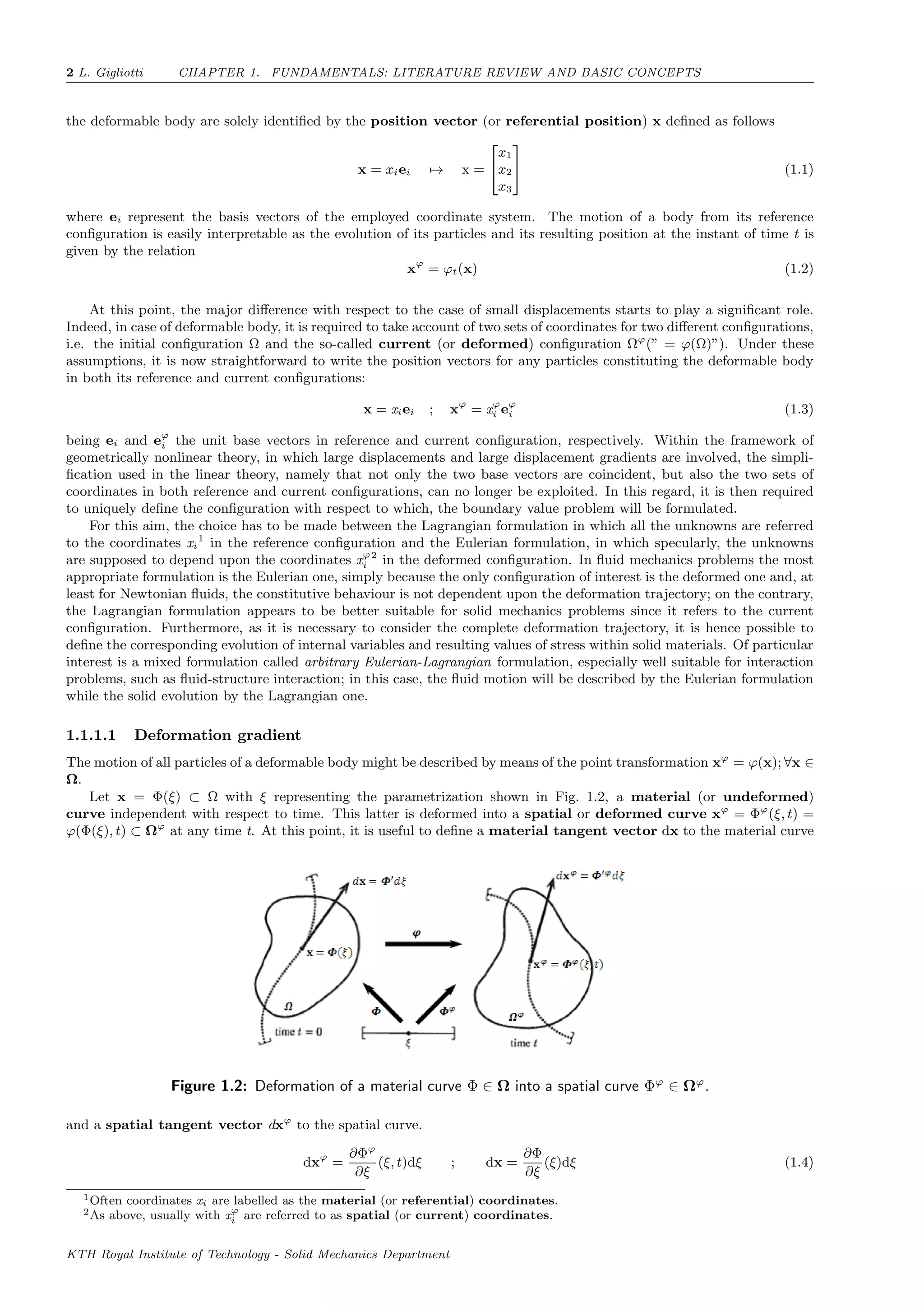
Let x = Φ(ξ) ⊂ Ω with ξ representing the parametrization shown in Fig. 1.2, a material (or undeformed)
curve independent with respect to time. This latter is deformed into a spatial or deformed curve xϕ
= Φϕ
(ξ, t) =
ϕ(Φ(ξ), t) ⊂ Ωϕ
at any time t. At this point, it is useful to define a material tangent vector dx to the material curve
Figure 1.2: Deformation of a material curve Φ ∈ Ω into a spatial curve Φϕ
∈ Ωϕ
.
and a spatial tangent vector dxϕ
to the spatial curve.
dxϕ
=
∂Φϕ
∂ξ
(ξ, t)dξ ; dx =
∂Φ
∂ξ
(ξ)dξ (1.4)
1Often coordinates xi are labelled as the material (or referential) coordinates.
2As above, usually with xϕ
i are referred to as spatial (or current) coordinates.
KTH Royal Institute of Technology - Solid Mechanics Department
1.1. RUBBER ELASTICITY L. Gigliotti 3
The tangent vectors dx and dxϕ
are usually labelled as material (or undeformed) line element and spatial (or
deformed) line element, respectively. Furthermore, for any motion taking place in the Euclidean space, a large
displacement vector can be introduced as follows
d(x) = xϕ
⇔ di(x) = ϕjδij − xi (1.5)
According to Fig. 1.3, and by means of basic notions of algebra of tensors, it is possible to infer that:
Figure 1.3: Total displacement field.
xϕ
+ dxϕ
= x + dx + d(x + dx) =⇒ dxϕ
= dx + d(x + dx) − d(x) (1.6)
The term d(x + dx) can be computed by exploiting Taylor series formula, and truncating them after the linear term:
d(x + dx) = d(x) + d(x)dx + o( dx ) (1.7)
where, d is the large displacement gradient, or in index notation
di(x + dx) = di(x) +
∂di
∂xi
(x)dxi + o( dx ) (1.8)
At this point, it is sufficient to compare Eq. 1.6 and Eq. 1.7, to express the spatial tangent vector dxϕ
as function of its
corresponding material tangent vector and of the two-point tensor F named as deformation gradient tensor:
dxϕ
= (I + d)
F
dx ⇒ dxϕ
= Fdx ; [F]ij :=
∂xi
∂xj
+
∂di
∂xj
=
∂ϕi
∂xj
(1.9)
or alternatively,
F =
∂ϕi
∂xj
eϕ
i ⊗ ej ; F = ϕ ⊗ (1.10)
with the gradient operator = ∂
∂xj
ei.
It is a painless task to demonstrate how the deformation gradient, not only provides the mapping of a generic
(infinitesimal) material tangent vector into the relative spatial tangent vector, but also controls the transformation of an
infinitesimal surface element or an infinitesimal volume element (see Fig. 1.4).
Figure 1.4: Transformation of infinitesimal surface and volume elements between initial and deformed
configuration.
KTH Royal Institute of Technology - Solid Mechanics Department
4 L. Gigliotti CHAPTER 1. FUNDAMENTALS: LITERATURE REVIEW AND BASIC CONCEPTS
Let dA be an infinitesimal surface element, constructed as the vector product of two infinitesimal reciprocally orthog-
onal vectors, dx and dy; the outward normal vector is, as usual, defined as n = (dx × dy)/ dx × dy . By means of the
deformation gradient F, the new extension and orientation in the space of the surface element can be easily determined
dAϕ
nϕ
:= dxϕ
× dyϕ
= (Fdx) × (Fdy) = (det [F] F−T
)(dx × dy)
dAn
= dA(cof [F])n (1.11)
which is often referred to as Nanson’s formula.
Once the Nanson’s formula has been derived, it is straightforward to obtain the analogous relation for the change of an
infinitesimal volume element occurring between the initial and the deformed configuration. Describing the infinitesimal
volume element in the material configuration as the scalar product between an infinitesimal surface element dAϕ
and
the infinitesimal vector dzϕ
and exploiting results in Eq. 1.11, the following relation holds
dV ϕ
:= dzϕ
· dAnϕ
= Fdz · JF−T
dAn = Jdz · dAn = JdA (1.12)
in which J = det [F] is well-known as the Jacobian determinant (or volume ratio).
As stated in Eq. 1.9, the deformation gradient F, is a linear transformation of an infinitesimal material vector dx into
its relative spatial dxϕ
; such transformation affects all parameters characterizing a vector, its modulus, direction and
orientation. However, the deformation is related only to the change in length of an infinitesimal vector, and therefore,
it results to be handy to consider the so-called polar decomposition, by virtue of which the deformation gradient can
be written as a multiplicative split between an orthogonal tensor R, an isometric transformation which only changes the
direction and orientation of a vector, and a symmetric, positive-definite stretch tensor U that provides the measure of
large deformation.
F = RU ; RT
= R−1
; UT
= U ; dxϕ
= Ux (1.13)
In other words, the symmetric tensor U, yet referred in literature to as the right (or material) stretch tensor,
produces a deformed vector that remains in the initial configuration (no large rotations). In index notation, the large
rotations tensor R, and the right stretch tensor U, can be respectively expressed as follows
R = Rijeϕ
i ⊗ ej ; U = Uijei ⊗ ej (1.14)
An alternative form of the polar decomposition can be provided, by simply inverting the order of the above mentioned
transformations and introducing the so-called left(or spatial) stretch tensor V
F = VR ; V = Vijeϕ
i ⊗ eϕ
j (1.15)
In such case, a large rotation, represented by R, is followed by a large deformation (tensor V).
1.1.1.2 Strain measures
Theoretically, apart form the right and the left stretch tensors U and V, an infinite number of other deformation measures
can be defined; indeed, unlike displacements, which are measurable quantities, strains are based on a concept that is
introduced as a simplification for the large deformation analysis.
From a computational point of view, the choice or U or V to calculate the stress values is not the most appropriate
one, as it requires, first, to perform the polar decomposition of the deformation gradient. Hence, it is necessary to
introduce deformation measures that can directly, without any further computations, provide information about the
deformation state.
We may consider two neighbouring points defined by their position vectors x and y in the material description; with
reference to Fig. 1.5 on the next page, it is possible to describe the relation between these two, sufficiently close points,
i.e.
y = y + (x − x) = x + y − x
y − x
y − x
= x + dx (1.16)
dx = dεa and dε = y − x , a =
y − x
y − x
(1.17)
In the above equations, it is clear that the length of the material line element dx is denoted by the scalar value dε
and that the unit vector a, with a = 1, represents the direction of the aforesaid vector at the given position in the
reference configuration. As stated in Eq. 1.9, the deformation gradient F allows to linearly approximate a vector dx in
the material description, with its corresponding vector dxϕ
in the spatial description. The smaller the vector dx, the
better the approximation.
At this point, it is then possible to define the stretch vector λa, in the direction of the unit vector a and at the point
x ∈ Ω as
λa(x, t) = F(x, t)a (1.18)
with its modulus λ known as stretch ratio or just stretch. This latter is a measure of how much the unit vector a has
been stretched. In relation to its value, λ < 1, λ = 1 or λ > 1, the line element is said to be compressed, unstretched
KTH Royal Institute of Technology - Solid Mechanics Department
1.1. RUBBER ELASTICITY L. Gigliotti 5
Figure 1.5: Deformation of a material line element with length dε into a spatial element with length
λdε.
or extended, respectively. Computing the square of the stretch ratio λ, the definition of the right Cauchy-Green
tensor C is introduced
λ2
= λa · λa = Fa · Fa = a · FT
Fa = a · Ca ,
C = FT
F or CIJ = FiI FiJ
(1.19)
Often the tensor C is also referred to as the Green deformation tensor and it should be highlighted that, since the
tensor C operate solely on material vectors, it is denoted as a material deformation tensor. Moreover, C is symmetric
and positive definite ∀x ∈ Ω:
C = FT
F = (FT
F)T
= CT
and u · Cu > 0 ∀u = 0 (1.20)
The inverse of the right Cauchy-Green tensor is the well-known Piola deformation tensor B, i.e. B = C−1
.
To conclude the roundup of material deformation tensors, the definition of the commonly used Green-Lagrange
strain tensor E, is here provided:
1
2
(λdε)2
− dε2
= 1
2
(dεa) · FT
F (dεa) − dε2
= dx · Edx ,
E = 1
2
FT
F − I = 1
2
(C − I) or EIJ = 1
2
(FiI FiJ − δIJ )
(1.21)
whose symmetrical nature is obvious, given the symmetry of C and I. In an analogous manner of the one shown above,
it is possible to describe deformation measures in spatial configuration, too; the stretch vector λaϕ in the direction of
aϕ
, for each xϕ
∈ Ω might thus be define as:
λ−1
aϕ (xϕ
, t) = F−1
(xϕ
, t)aϕ
(1.22)
where, the norm of the inverse stretch vector λ−1
aϕ is called inverse stretch ratio λ−1
or simply inverse stretch.
Moreover, the unit vector aϕ
may be interpreted as a spatial vector, characterizing the direction of a spatial line element
dxϕ
. By virtue of Eq. 1.22, computing the square of the inverse stretch ratio, i.e.
λ−2
= λ−1
aϕ · λ−1
aϕ = F−1
a · F−1
a = a · F−T
F−1
a = a · b−1
a (1.23)
where b is the left Cauchy-Green tensor, sometimes referred to as the Finger deformation tensor
b = FFT
or bij = FiI FjI (1.24)
Like its corresponding tensor in the material configuration, the Green deformation tensor, the left Cauchy-Green tensor
b is symmetric and positive definite ∀xϕ
∈ Ω:
b = FFT
= (FT
F)T
= bT
and u · bu > 0 ∀u = 0 (1.25)
Last but not least, the well-known symmetric Euler-Almansi strain tensor e is here introduced:
1
2
[d˜ε2
− (λ−1
d˜ε)2
] =
1
2
[d˜ε2
− (d˜εa) · F−T
F−1
(d˜εa)] = dxϕ
· edxϕ
,
e =
1
2
(I − F−T
F−1
) or eij =
1
2
(δij − F−1
Ki F−1
Kj )
(1.26)
where the scalar value d˜ε is the (spatial) length of a spatial line element dxϕ
= xϕ
− yϕ
.
KTH Royal Institute of Technology - Solid Mechanics Department
6 L. Gigliotti CHAPTER 1. FUNDAMENTALS: LITERATURE REVIEW AND BASIC CONCEPTS
1.1.1.3 Stress measures
During a particular transformation, the motion and deformation which take place, make a portion of material interact
with the rest of the interior part of the body. These interactions give rise to stresses, physically forces per unit area,
which are responsible of the deformation of material.
Given a deformable body occupying an arbitrary region Ω in the Euclidean space, whose boundary is the surface
∂Ω at the specific time t, let us assume that two types of arbitrary forces, somehow distributed, act respectively on the
boundary surface (external forces) and on an imaginary internal surface (internal forces).
Let the body be completely cut by a plane surface; thereby the interaction between the two different portions of the
body is represented by forces transmitted across the (internal) plane surface. Under the action of this system of forces,
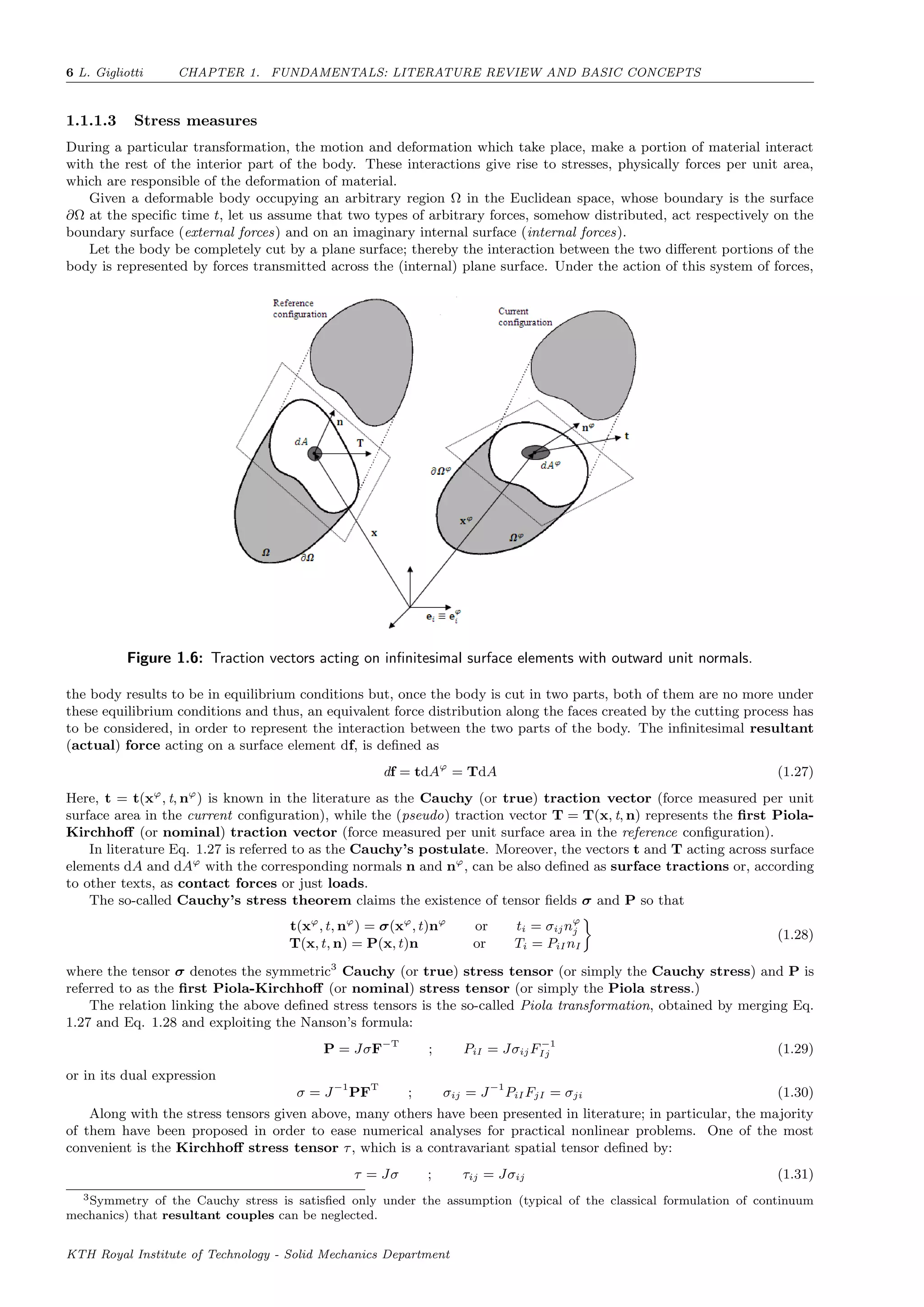
Figure 1.6: Traction vectors acting on infinitesimal surface elements with outward unit normals.
the body results to be in equilibrium conditions but, once the body is cut in two parts, both of them are no more under
these equilibrium conditions and thus, an equivalent force distribution along the faces created by the cutting process has
to be considered, in order to represent the interaction between the two parts of the body. The infinitesimal resultant
(actual) force acting on a surface element df, is defined as
df = tdAϕ
= TdA (1.27)
Here, t = t(xϕ
, t, nϕ
) is known in the literature as the Cauchy (or true) traction vector (force measured per unit
surface area in the current configuration), while the (pseudo) traction vector T = T(x, t, n) represents the first Piola-
Kirchhoff (or nominal) traction vector (force measured per unit surface area in the reference configuration).
In literature Eq. 1.27 is referred to as the Cauchy’s postulate. Moreover, the vectors t and T acting across surface
elements dA and dAϕ
with the corresponding normals n and nϕ
, can be also defined as surface tractions or, according
to other texts, as contact forces or just loads.
The so-called Cauchy’s stress theorem claims the existence of tensor fields σ and P so that
t(xϕ
, t, nϕ
) = σ(xϕ
, t)nϕ
or ti = σijnϕ
j
T(x, t, n) = P(x, t)n or Ti = PiI nI
(1.28)
where the tensor σ denotes the symmetric3
Cauchy (or true) stress tensor (or simply the Cauchy stress) and P is
referred to as the first Piola-Kirchhoff (or nominal) stress tensor (or simply the Piola stress.)
The relation linking the above defined stress tensors is the so-called Piola transformation, obtained by merging Eq.
1.27 and Eq. 1.28 and exploiting the Nanson’s formula:
P = JσF−T
; PiI = JσijF−1
Ij (1.29)
or in its dual expression
σ = J−1
PFT
; σij = J−1
PiI FjI = σji (1.30)
Along with the stress tensors given above, many others have been presented in literature; in particular, the majority
of them have been proposed in order to ease numerical analyses for practical nonlinear problems. One of the most
convenient is the Kirchhoff stress tensor τ, which is a contravariant spatial tensor defined by:
τ = Jσ ; τij = Jσij (1.31)
3Symmetry of the Cauchy stress is satisfied only under the assumption (typical of the classical formulation of continuum
mechanics) that resultant couples can be neglected.
KTH Royal Institute of Technology - Solid Mechanics Department
1.1. RUBBER ELASTICITY L. Gigliotti 7
In addition, the so-called second Piola-Kirchhoff stress tensor S has been proposed, especially for its noticeable
usefulness in the computational mechanics field, as well as for the formulation of constitutive equations; this contravariant
material tensor does not have any physical interpretation in terms of surface tractions and it can be easily computed by
applying the pull-back operation on the contravariant spatial tensor τ:
S = F−1
τF−T
or SIJ = F−1
Ii F−1
Jj τij (1.32)
The second Piola-Kirchhoff stress tensor S can be, moreover, related to the Cauchy stress tensor by exploiting Eqs.
1.29, 1.32 and 1.31:
S = JF−1
σF−T
= F−1
P = ST
or SIJ = JF−1
Ii F−1
Jj σij = F−1
Ii PiJ = SJI (1.33)
as consequence, the fundamental relationship between the first Piola-Kirchhoff stress tensor P and the symmetric second
Piola-Kirchhoff stress tensor S is found, i.e.
P = FS or PiI = FiJ SJI (1.34)
A plethora of other stress tensors can be found in literature; among them the Biot stress tensor TB, the symmetryc
corotated Cauchy stress tensor σu and the Mandel stress tensor Σ deserve to be mentioned [2].
1.1.2 Hyperelastic materials
The correct formulation of constitutive theories for different kinds of material, is a very important matter in continuum
mechanics, in particular with regards to the description of nonlinear materials, such as rubber-like ones.
The branch of continuum mechanics, which provides the formulation of constitutive equations for that category of ma-
terials which can sustain to large deformations, is called finite (hyper)elasticity theory or just finite (hyper)elasticity.
In this theory, the existence of the so-called Helmoltz free-energy function Ψ, defined per unit reference volume or
alternately per unit mass, is postulated. In the most general case, the Helmoltz free-energy function is a scalar-
valued function of the tensor F and of the position of the particular point within the body. Restricting the analysis
to the case of homogeneous material, the energy solely depends on the deformation gradient F, and as such, it is often
referred to as strain-energy function or stored-energy function Ψ = Ψ(F). By virtue of what has been shown in
the previous section, the strain energy function Ψ can be expressed as function of several other deformation tensors, e.g.
the right Cauchy-Green tensor C, the left Cauchy-Green tensor b.
A hyperelastic material, or Green-elastic material, is a subclass of elastic materials for which the relation expressed
in Eq. 1.35 holds
P = G(F) =
∂Ψ(F)
∂F
or PiI =
∂Ψ
∂FiI
(1.35)
Many other reduced forms of constitutive equations, equivalent to the latter, for hyperelastic materials at finite strains
can be derived; while not wishing to report here all the different forms available in literature, consider for this purpose,
the derivative with respect to time of the strain energy function Ψ(F):
˙Ψ = tr
∂Ψ(F)
∂F
T
˙F = tr
∂Ψ(C)
∂C
˙C =
= tr
∂Ψ(C)
∂C
˙FT
F + FT ˙F = 2tr
∂Ψ(C)
∂C
FT ˙F
(1.36)
Given the symmetry of the tensor C, and the resulting symmetry of the tensor valued scalar function Ψ(C), it follows
immediately that:
∂Ψ(F)
∂F
T
= 2
∂Ψ(C)
∂C
FT
(1.37)
1.1.2.1 Isotropic hyperelastic materials
Within the context of hyperelasticity, a typology of materials of unquestionable importance, of which rubber is one of
the most representative examples, consists of the so-called isotropic materials. From a physical point of view, the
property of isotropy is nothing more than the independence in the response of the material, in terms of stress-strain
relations, with respect to the particular direction considered.
Let us consider a point within an elastic, deformable body occupying the region Ω and identified by its position
vector x. Furthermore, let the body, in the reference configuration, undergo a translational motion represented by the
vector c and rotated through the orthogonal tensor Q (see Fig. 1.7 on the following page):
x∗
= c + Qx (1.38)
The deformation gradient F that links the material configuration Ω∗
, to the spatial configuration Ωϕ∗
might be computed
KTH Royal Institute of Technology - Solid Mechanics Department
8 L. Gigliotti CHAPTER 1. FUNDAMENTALS: LITERATURE REVIEW AND BASIC CONCEPTS
Figure 1.7: Rigid-body motion superimposed on the reference configuration.
by making use of the chain rule and Eq. 1.38, leading to
F =
∂xϕ
∂x
=
∂xϕ
∂x∗
Q = F∗
Q or FiI =
∂xϕ
i
∂xI
=
∂xϕ
i
∂x∗
J
QJI = F∗
iJ QJI (1.39)
A material is said to be isotropic if, and only if, the strain energies defined with respect to the deformation gradients F
and F∗
are the same for all orthogonal vectors Q; thus, it might be written that:
Ψ(F) = Ψ(F∗
) = Ψ(FQT
) (1.40)
which is the unavoidable condition to refer to a material as isotropic.
Ψ(C) = Ψ(F∗T
F∗
) = Ψ(QFT
FQT
) = Ψ(C∗
) (1.41)
Hence, if this latter relation is valid for all symmetric tensors C and all orthogonal tensors Q, the strain energy function
Ψ(C), is a scalar-valued isotropic tensor function solely of the tensor C. Under these assumption, the strain energy
might be expressed in terms of its invariants, i.e. Ψ = Ψ [I1 (C) , I2 (C) I3 (C)] or, equivalently, of its principal stretches
Ψ = Ψ (C) = Ψ [λ1, λ2, λ3].
1.1.2.2 Incompressible hyperelastic materials
A category of rubber-like materials widely used in practical applications and therefore particularly attractive, especially
with regard to the corresponding computational analysis by means of numerical codes, are the so-called incompressible
materials, which can sustain finite strains without show any considerable volume changes. In reference to Eq. 1.12, it
might to be stated that, the incompressibility constraint can be expressed as:
J = 1 (1.42)
The incompressibility constraint is widely known in literature as an internal constraint and a material subjected to
such constraint is called constrained material. In order to derive constitutive equations for a general incompressible
material, it is necessary to postulate the existence of a particular strain energy function:
Ψ = Ψ(F) − p(J − 1) (1.43)
defined exclusively for J = det(F) = 1. In such expression, the scalar parameter p, is referred to as Lagrange multiplier,
whose value can be determined by solving the equations of equilibrium. As proven in the previous sections, it is sufficient,
assuming that this is possible, to differentiate the strain energy function in Eq. 1.43 with respect to the deformation
gradient F, to obtain the three fundamental constitutive equations in terms of the first and the second Piola-Kirchhoff
stresses, i.e. P and S, and of the Cauchy stress tensor σ. For the particular case of incompressible materials, they may
be written as
P = −pP−T
+
∂Ψ(F)
∂F
S = −pF−1
F−T
+ F−1 ∂Ψ(F)
∂F
= −pC−1
+ 2
∂Ψ(C)
∂C
σ = −pI +
∂Ψ(F)
∂F
FT
= −pI + F
∂Ψ(F)
∂F
T
(1.44)
KTH Royal Institute of Technology - Solid Mechanics Department
1.1. RUBBER ELASTICITY L. Gigliotti 9
Additionally, it has been demonstrated formerly that, in the case of isotropic material, the strain energy function can
be expressed as function of the right Cauchy Green tensor C, the left Cauchy-Green tensor b and their invariants.
However, if the material is at the same time incompressible and isotropic, it is also true that I3 = det C = det b = 1
and consequently, the third invariant is no longer an independent deformation variable like I1 and I2. Consequently, the
relation stated in 1.43 can be reformulated as follows
Ψ = Ψ [I1(C), I2(C)] −
1
2
p(I3 − 1) = Ψ [I1(b), I2(b)] −
1
2
p(I3 − 1) (1.45)
Thus, the associated constitutive equations are written as
S = 2
∂Ψ(I1, (I1)
∂C
−
∂[p(I3 − 1)]
∂C
= −pC−1
+ 2
∂Ψ
∂I1
+ I1
∂Ψ
∂I2
I − 2
∂Ψ
∂I2
C
σ = −pI + 2
∂Ψ
∂I1
+ I1
∂Ψ
∂I2
b − 2
∂Ψ
∂I2
b2
= −pI + 2
∂Ψ
∂I1
b − 2
∂Ψ
∂I2
b−1
(1.46)
Lastly, if the strain energy function is expressed as a function of the three principal stretches λi, it holds that
Si = −
1
λ2
i
p +
1
λi
∂Ψ
∂λi
, i = 1, 2, 3 (1.47)
Pi = −
1
λi
p +
∂Ψ
∂λi
, i = 1, 2, 3 (1.48)
σi = −p + λi
∂Ψ
∂λi
, i = 1, 2, 3 (1.49)
for whom the constraint of incompressibility, i.e. J = 1 takes the following form:
λ1λ3λ3 = 1 (1.50)
1.1.3 Isotropic Hyperelastic material models
Due to the greater difficulty in the mathematical treatment of hyperelastic materials, there are several examples in
literature about possible forms of strain energy functions for compressible, as well as for incompressible materials.
In the following sections, the two models adopted in the present work, i.e. the Arruda-Boyce and the Neo-
Hookean model, will be described. It must be stressed however that, exclusively isotropic incompressible material
models under isothermal regime have been treated. Many other models have been proposed in literature, e.g. Ogden
model [4, 5] , Mooney-Rivlin model, [11], Yeoh model [16], Kilian-Van der Waals model [20] among the most
famous.
1.1.3.1 Neo-Hookean model
The Neo-Hookean model [6] can be referred to as a particular case of the Ogden model. Its mathematical expression is
the following one
Ψ = c1 λ2
1 + λ2
2 + λ2
3 − 3 = c1 (I1 − 3) (1.51)
By virtue of the consistency condition [7], it follows that
Ψ =
µ
2
λ2
1 + λ2
2 + λ2
3 − 3 (1.52)
where µ indicates the shear modulus in the reference configuration.
The neo-Hookean model, firstly proposed by Ronald Rivlin in 1948, is similar to the Hooke’s law adopted for linear
materials; indeed, the stress-strain relationship is initially linear while at a certain point the curve will level out. The
principal drawback of such model is its inability to predict accurately the behaviour of rubber-like materials for strains
larger then 20% and for biaxal stress states.
It can now be proven that, even if from a mathematical point of view, the Neo-Hookean model may be seen as the
simplest case of the Ogden model, it might be also justified within the context of the Gaussian statistical theory[8, 9]
of elasticity, which is based on the assumption that only small strains will be involved in the course of the deformation4
.
Briefly, rubber-like materials are made up of long-chain molecules, producing one giant molecule, referred to as molecular
4This fact is a further validation of the adequacy of neo-Hookean model for strains up to 20%; the more refined non-Gaussian
statistical theory, of which an example is based on the Langevin distribution function is needed, in order to obtain a more
accurate model for large strains.
KTH Royal Institute of Technology - Solid Mechanics Department
10 L. Gigliotti CHAPTER 1. FUNDAMENTALS: LITERATURE REVIEW AND BASIC CONCEPTS
network [10]; starting from the Boltzmann principle, and under the assumptions of incompressible material and affine
motion, the entropy change of this network, generated by the motion, can be readily computed as function of the number
N of chains in a unit volume of the network itself and of the principal stretches λi, i = 1, 2, 3
∆η = −
1
2
Nκ
r2
0in
r2
out
λ2
1 + λ2
2 + λ2
3 − 3 (1.53)
where κ = 1.38 · 10−23
Nm/K is the well-known Boltzmann’s constant; at the same time, the parameter r2
out and
r2
0in are the mean square value of the end-to-end distance of detached chains and of the end-to-end distance of cross-
linked chains in the network, respectively. For isothermal processes ˙Θ = 0 , the Legendre transformation leads to
the following expression for the Helmholtz free-energy function
Ψ =
1
2
NκΘ
r2
0in
r2
out
λ2
1 + λ2
2 + λ2
3 − 3 (1.54)
In conclusion, if the shear modulus µ is expressed as proportional to the concentration of chains N, it holds that:
µ = NκΘ
r2
0in
r2
out
(1.55)
By virtue of this latter result, the equivalence between Eqs. 1.51 and 1.54 is demonstrated.
1.1.3.2 Arruda-Boyce model
The second material model adopted in this work for modeling the response of rubber-like materials is the Arruda-Boyce
model [14], proposed in 1993; in this model, also known as the eight-chain model, the assumption that the molecular
network structure can be regarded as a representing cubic unit volume in which, eight chains are distributed along the
diagonal directions towards its eight corners, is made. The Arruda-Boyce model is particularly suitable to characterize
properties of carbon-black filled rubber vulcanizates; such a notable category of elastomers are reinforced with fillers like
carbon black or silica obtaining thus, a significant improvement in terms of tensile and tear strength, as well as abrasion
resistance. By virtue of these reasons, the stress-strain relation is tremendously nonlinear (stiffening effect) at the large
strains.
Unlike the neo-Hookean model, the Arruda-Boyce model is based on the non-Gaussian statistical theory [15]
and consequently is adequate to approximate the finite extensibility of rubber-like materials as well as the upturn effect
at higher strain levels. The strain energy function for the model considered herein, may be presented as
Ψ = NκΘ
√
n βλchain −
√
n ln
sinh β
β
(1.56)
The coefficients in the above written equation, are easily defined as follows
λchain = I1/3 and β = L−1 λchain
√
n
(1.57)
where, L is known as Langevin function; obviously, for computational reasons the latter function is approximated
with a Taylor series expansion. By making use of the first five terms of the Taylor expansion of the Langevin function,
a different analytical expression is given by
Ψ = c1
1
2
(I1 − 3)
1
20λ2
m
I2
1 − 9 +
11
1050λ4
m
I3
1 − 27 +
19
7000λ6
m
I4
1 − 81 +
519
673750λ8
m
I5
1 − 243 (1.58)
where λm is referred to as locking stretch, representing the stretch value at which the slope of the stress-strain curve
will rise significantly and thus, where the polymer chain network becomes locked. The consistency condition allows to
define the constant c1 as
c1 =
µ
1 + 3
5λ2
m
+ 99
175λ4
m
+ 513
875λ6
m
+ 42039
67375λ8
m
(1.59)
Lastly, it ought to be stressed that the strain energy function in the Arruda-Boyce model depends only upon the
first invariant I1; from a physical point of view, this means that the eight chains stretch uniformly along all directions
when subjected to a general deformation state.
A comparison of the quality of approximation for different material models is depicted in Fig. 1.8 on the next page;
according to this plot, it is inferable that not all material models show the same level of accuracy in predicting the
stress-strain behavior of rubber-like materials. In particular, some models, i.e. Neo-Hookean model and Mooney-Rivlin
model, exhibit the incapacity to model the stiffening effect at the high strains.
KTH Royal Institute of Technology - Solid Mechanics Department
1.2. FRACTURE MECHANICS OF RUBBER L. Gigliotti 11
Figure 1.8: Stress-strain curves for uniaxial extension conditions - Comparison among various hypere-
lastic material models.
1.2 Fracture Mechanics of Rubber
The extension of fracture mechanics concepts to elastomers has always represented a problem of major interest, since
the first work in this field has been presented by Rivlin and Thomas in 1952 [21]. In this cornerstone work the authors
have shown how large deformations of rubber render the solution of the boundary value problem of a cracked body
made of rubber, a quite compounded task. By virtue of the aforementioned nonlinear nature of constitutive models
and due to the capacity of rubber-like materials to undergo finite deformations, LEFM results cannot be, without prior
modifications, extended to this category of materials and thus, a slightly different approach has to be adopted. In this
section, some of the most relevant results achieved in the fracture mechanics of elastomers field, along with experimental
results, are briefly described and discussed.
1.2.1 Fracture mechanics approach
The introduction of fracture mechanics concepts goes back to Griffith’s experimental work on the strength of glass [22].
Griffith noticed that the characteristic tensile strength of the material was highly affected by the dimensions of the
component; by virtue of these observations, he pointed out that the variability of tensile strength should be related to
something different than a simple inherent material property. Previously, Inglis had demonstrated that the common
design procedure based on the theoretical strength of solid, was no longer adapt and that this material property should
have been reduced, in order to take into account the presence of flaws within the component5
.
Griffith [22] hypothesized that, in an analogous manner of liquids, solid surfaces are characterized by surface tension.
Having this borne in mind, for the propagation of a crack, or in order to increase its surface area, it is necessary that
the surface tension, related to the new propagated surface, is less than the energy furnished from the external loads, or
internally released. Alternatively, the Griffith-Irwin-Orowan theory [24] [25] [26] claims that a crack will run through a
solid deformable body, as soon as the input energy-rate surmounts the dissipated plastic-energy; denoting with W the
work done by the external forces, with Ue
s and Up
s the elastic and the plastic part of the total strain energy, respectively,
and with UΓ the surface tension energy, we may write thus
∂W
∂a
=
∂Ue
s
∂a
+
∂Up
s
∂a
+
∂UΓ
∂a
(1.60)
This expression might then be rewritten in terms of the potential energy Π = Ue
s − W, i.e.
−
∂Π
∂a
=
∂Up
s
∂a
+
∂UΓ
∂a
(1.61)
5In other words, the comparison ought to be made between the theoretical tensile strength and the concentrated stress and not
with the average stress computed by using the usual solid mechanics theory, based on the assumption of the absence of internal
defects.
KTH Royal Institute of Technology - Solid Mechanics Department
12 L. Gigliotti CHAPTER 1. FUNDAMENTALS: LITERATURE REVIEW AND BASIC CONCEPTS
which represents a stability criterion stating that, the decreasing rate of potential energy during crack growth must
equal the rate of dissipated energy in plastic deformation and crack propagation. Furthermore, Irwin demonstrated
that the input energy rate for an infinitesimal crack propagation, is independent of the load application modalities, e.g.
fixed-grip condition or fixed-force condition, and it is referred to as strain-energy release rate G, for a unit length increase
in the crack extension.
For the particular case of brittle materials, the plastic term Up
s vanishes and the following expression might be
deduced:
G = −
∂Π
∂a
= 2γs (1.62)
where γs is the surface energy and the term 2 is easily justified given the presence of two crack surfaces.
In one of his successive works, Griffith computed, in the case of an infinite plate with a central crack of length 2a
subjected to uniaxial tensile load (see Fig. 1.9), the strain energy needed to propagate the crack, showing that it is equal
to the energy needed to close the crack under the action of the acting stress
Figure 1.9: Infinite plate with central crack of length 2a, subjected to an uniaxial stress state.
Π = 4
a
0
σuy (x) dx =
πσ2
a2
2E
⇒ G = −
∂Π
∂a
=
πaσ2
E
(1.63)
where the coefficient E is defined below
E =



E Plane stress
E
1−ν2 Plane strain
(1.64)
being E the Young’s modulus.
Combining Eqs. 1.62 and 1.63 it is straightforward to obtain the critical stress for cracking as
σcr =
2E γs
πa
(1.65)
and the critical stress intensity factor KC
6
is given by
KC = σcr
√
πa (1.66)
The crack growth stability may be assessed by simply considering the second derivative of (Π + UΓ); namely, the
crack propagation will be unstable or stable, when the energy at equilibrium assumes its maximum or minimum value,
respectively [27]
∂2
(Π + UΓ)
∂a2
=



< 0 unstable fracture
= 0 stable fracture
> 0 neutral equilibrium
(1.67)
With certain modifications, in order to consider their different behaviour, e.g. the plastic deformation area in the
vicinity of the crack tip, Griffith theory has been extended to fracture processes of metallic materials. Hence, LEFM
became a powerful tool for post-mortem analysis to predict metals fracture, to characterize fatigue crack extension rate,
along with the identification of the threshold or lower bound below which fatigue and stable crack growth will not occur.
6According to some authors KC is referred to as fracture toughness.
KTH Royal Institute of Technology - Solid Mechanics Department
1.2. FRACTURE MECHANICS OF RUBBER L. Gigliotti 13
1.2.2 Stress around the crack tip
At this point, it is worthwhile to provide a concise description of the crack behaviour. Albeit in practical applications,
extremely complicated load conditions may occur in presence of a crack, all of these can be considered as a combination
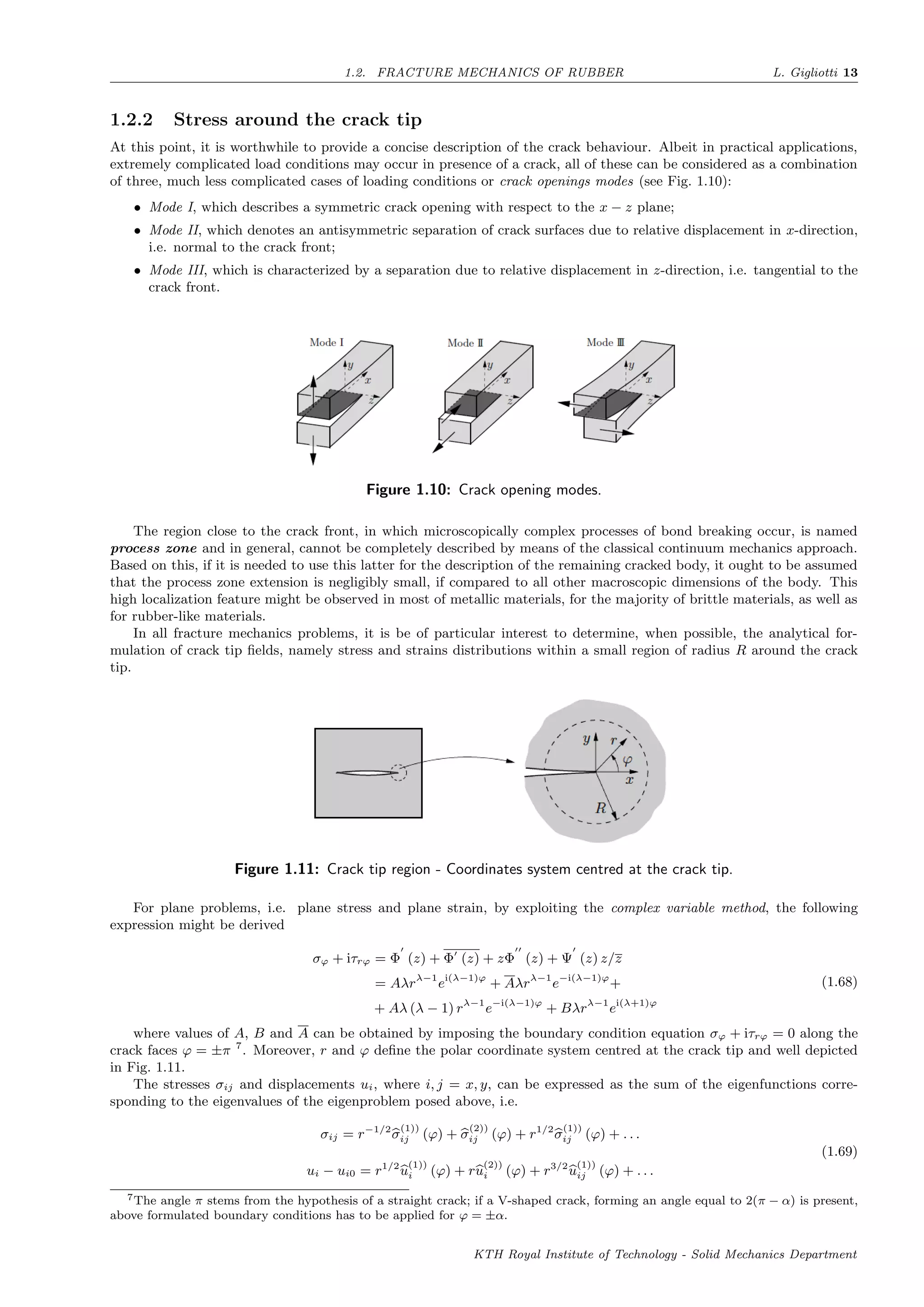
of three, much less complicated cases of loading conditions or crack openings modes (see Fig. 1.10):
• Mode I, which describes a symmetric crack opening with respect to the x − z plane;
• Mode II, which denotes an antisymmetric separation of crack surfaces due to relative displacement in x-direction,
i.e. normal to the crack front;
• Mode III, which is characterized by a separation due to relative displacement in z-direction, i.e. tangential to the
crack front.
Figure 1.10: Crack opening modes.
The region close to the crack front, in which microscopically complex processes of bond breaking occur, is named
process zone and in general, cannot be completely described by means of the classical continuum mechanics approach.
Based on this, if it is needed to use this latter for the description of the remaining cracked body, it ought to be assumed
that the process zone extension is negligibly small, if compared to all other macroscopic dimensions of the body. This
high localization feature might be observed in most of metallic materials, for the majority of brittle materials, as well as
for rubber-like materials.
In all fracture mechanics problems, it is be of particular interest to determine, when possible, the analytical for-
mulation of crack tip fields, namely stress and strains distributions within a small region of radius R around the crack
tip.
Figure 1.11: Crack tip region - Coordinates system centred at the crack tip.
For plane problems, i.e. plane stress and plane strain, by exploiting the complex variable method, the following
expression might be derived
σϕ + iτrϕ = Φ (z) + Φ (z) + zΦ (z) + Ψ (z) z/z
= Aλrλ−1
ei(λ−1)ϕ
+ Aλrλ−1
e−i(λ−1)ϕ
+
+ Aλ (λ − 1) rλ−1
e−i(λ−1)ϕ
+ Bλrλ−1
ei(λ+1)ϕ
(1.68)
where values of A, B and A can be obtained by imposing the boundary condition equation σϕ + iτrϕ = 0 along the
crack faces ϕ = ±π 7
. Moreover, r and ϕ define the polar coordinate system centred at the crack tip and well depicted
in Fig. 1.11.
The stresses σij and displacements ui, where i, j = x, y, can be expressed as the sum of the eigenfunctions corre-
sponding to the eigenvalues of the eigenproblem posed above, i.e.
σij = r−1/2
σ
(1))
ij (ϕ) + σ
(2))
ij (ϕ) + r1/2
σ
(1))
ij (ϕ) + . . .
ui − ui0 = r1/2
u
(1))
i (ϕ) + ru
(2))
i (ϕ) + r3/2
u
(1))
ij (ϕ) + . . .
(1.69)
7The angle π stems from the hypothesis of a straight crack; if a V-shaped crack, forming an angle equal to 2(π − α) is present,
above formulated boundary conditions has to be applied for ϕ = ±α.
KTH Royal Institute of Technology - Solid Mechanics Department
14 L. Gigliotti CHAPTER 1. FUNDAMENTALS: LITERATURE REVIEW AND BASIC CONCEPTS
Here, ui0 represents an eventual rigid body motion while, for r → 0, the dominating term is the first one and thus
a singularity in the stress field is obtained at the crack tip. A widely adopted procedure is to split the symmetric sin-
gular field, corresponding to Mode-I crack opening, from the antisymmetric one, related to the Mode-II crack opening.
According to this latter consideration, stress and displacement fields at the crack tip for both Mode-I and Mode-II can
be written as follows
Mode-I :



σx
σy
τxy



= KI√
2πr
cos (ϕ/2)



1 − sin(ϕ/2) sin(3ϕ/2)
1 + sin(ϕ/2) sin(3ϕ/2)
sin(ϕ/2) cos(3ϕ/2)



u
v
= KI
2G
r
2π
(κ − cos (ϕ))
cos(ϕ/2)
sin(ϕ/2)
(1.70)
Mode-II :



σx
σy
τxy



= KII√
2πr



− sin(ϕ/2)[2 + cos(ϕ/2) cos(3ϕ/2)]
sin(ϕ/2) cos(ϕ/2) cos(3ϕ/2)
cos(ϕ/2)[1 − sin(ϕ/2) sin(3ϕ/2)]



u
v
= KII
2G
r
2π
sin(ϕ/2)[κ + 2 + cos(ϕ)]
cos(ϕ/2)[κ − 2 + cos(ϕ)]
(1.71)
where
plane stress : κ = 3 − 4ν, σz = 0
plane strain : κ = (3 − ν)/(1 + ν), σz = ν(σx + σy)
(1.72)
According to Eqs. 1.70 and 1.71, the amplitude of the crack tip fields is controlled by the stress-intensity factors
KI and KII ; their values depend on the geometry of the body, including the crack geometry, and on its load conditions.
Indeed, provided the stresses and deformations are known, it is possible to determine the K-values: for example, from
Eqs. 1.70 and 1.71 one might infer that
KI = limr→0
√
2πrσy (ϕ = 0) , and KII = limr→0
√
2πrτxy (ϕ = 0) (1.73)
In conclusion, it ought to be stressed that for larger distances from the crack tip, the higher terms in Eq. 1.69 cannot
be neglected and the effect of remaining eigenvalues has to be taken into account. Moreover, it has been observed that,
in most of the crack problems the characteristic stress singularity is of the order r−1/2
; however,different singularity
orders for the stress field might also come to light. As general remark, the stress singularities are of the type σij ∼ rλ−1
,
having denoted with λ the smallest eigenvalue in the eigenproblem formulated in Eq. 1.68.
1.2.3 Tearing energy
Theoretically, Griffith’s approach is suitable to predict the fracture mechanics behaviour of elastomers, since no limitations
to small strains or linear elastic material response have been made in its derivation. Many attempts have been carried
out throughout the years, to find a criterion for the crack propagation in rubber-like materials; however this task is
characterized by overwhelming mathematical difficulties in determining the stress field in a cracked body made of an
elastic material, due to large deformations at the crack tip prior failure. In addition, since high stresses developed are
bounded within a limited region surrounding the crack tip, their experimental measurements cannot be promptly carried
out.
Based on thermodynamic considerations, Griffith theory describes the quasi-static crack propagation as a reversible
process; on the other hand, for rubber-like materials the decrease of elastic strain energy is balanced not only by the
increase of the surface free energy of the cracked body, as hypothesized for brittle materials, but it is also partially
converted into other forms of energy, i.e. irreversible deformations of the material. Such other forms of dissipated energy
appear to be relevant only in proximity of the crack tip, i.e. in portions of material, relatively small if compared to the
overall dimensions of the component. It has been observed that, for a thin sheet of a rubber-like material, in which the
initial crack length is large if compared to its thickness, such energy losses are proportional to the rise of crack length.
In addition, they are readily computable just as function of the deformation state in the neighbourhood of the crack
tip at the tearing instant, while basically independent of the specimen type and geometry, and of the particular manner
in which the deforming forces are applied to the cracked body. Even if a slight dependence with the shape of the crack
tip is observed, such energy is a characteristic property of the tearing process of rubber-like materials.
Let us deform, under fixed-grip conditions, a thin sheet of rubber-like material cut by a crack of length a and whose
thickness is t. In order to observe the crack length increases of da, a work Tcr t da has to be done, where Tcr is the
critical energy for tearing and is a characteristic property of the material:
KTH Royal Institute of Technology - Solid Mechanics Department
1.2. FRACTURE MECHANICS OF RUBBER L. Gigliotti 15
Tcr = −
1
t
∂Us
∂a l
(1.74)
In the above expression, the suffix l indicates that the differentiation is performed with constant displacement of
the portions of the boundary which are not force-free. Physically, the critical energy for tearing Tcr represents the
whole dissipated energy as result of fracture propagation (of which, in certain cases, surface tension may be a minor
component). Therefore, this critical energy has to be compared with the tearing energy calculated from the deformation
state at the crack tip and whose value, as function of the notch tip diameter d is written as
T = d
π
2
0
U0
s cos (θ) dθ (1.75)
where, the term U0
s is the strain energy density at the notch tip for θ = 0.
Lastly, if the average strain energy density Ub
s is introduced, Eq. 1.75 is simplified as follows
T ∼= d Ub
s (1.76)
where the linear correlation of T with the notch diameter d is proven.
Concerning the physical meaning of Ub
s , this can be interpreted as the energy required to fracture a unit volume under
simple tension conditions and therefore, it is an intrinsic material property.
1.2.4 Qualitative observation of the tearing process
In [21], a formidable number of experiments have been carried out, in order to assess the effectiveness of the tearing
criterion expressed in Eq. 1.74; further information regarding vulcanizate materials adopted and experimental modalities
are given in the cited work. Irreversible behaviour is observed exclusively within the neighbourhood region of the crack
tip, where the material undergoes large deformations; in addition, if experimental tests are performed at a sufficiently
slow rate of deformation, these are not affected by the test speed.
To present a qualitative description of the tearing process, we may now consider a thin sheet of vulcanizate in which a
pre-existent crack is present. Experimental observations show how, even relatively small forces lead to considerable values
of the tearing energy and, in addition, the tearing process ceases as soon as the deformation process is interrupted. The
crack propagation process can be readily described since its earlier stages: as the deformation continues, the crack grows
up to a few hundredths of millimetres. Once this condition is reached, catastrophic failure occurs and the crack length
abruptly grows by a few millimetres. Such propagation mechanism is repeated as the deformation further increases,
leading to a catastrophic rupture of the cracked body.
As always, in fracture mechanics analysis, noticeable information might be deduced from the observation of the crack
tip geometry. In the process of crack growth in elastomers, during the stages preceding the catastrophic rupture, the
crack tip is initially blunted, whilst, as the tragic rupture occurs, the crack tip assumes an increasingly irregular shape.
Last but not least, it has to be stressed that the instant at which the catastrophic rupture commences, is by definition,
taken as the tearing point.
1.2.5 Tearing energy for different geometries
1.2.5.1 The trousers test-piece
The trousers specimen (see Fig. 1.12) has been widely used for the determination of out-of-plane mode-III critical tearing
energy for elastomers. Historically, is one of the first specimens introduced for the determination of fracture properties
of elastomers.
Figure 1.12: Trousers test-piece.
The energy balance in the specimen might be written as
∂W
∂a
=
∂T
∂a
+
∂Us
∂a
(1.77)
KTH Royal Institute of Technology - Solid Mechanics Department
16 L. Gigliotti CHAPTER 1. FUNDAMENTALS: LITERATURE REVIEW AND BASIC CONCEPTS
where W is the work done by the applied forces, T is the energy required for tearing and Us is the total internal
strain energy.
Next, assuming that the stretch ratio λ in the specimen, whose thickness is indicated with t and the width with w,
is equal to λ = 1 + (u/L) ≥ 1 under the applied force F, Eq. 1.77 can be reformulated as follows
2Fλ = Tt + Ψwt (1.78)
In addition, since λ = 1 in the reference configuration, according to the normalization condition, the strain energy
Ψ vanishes; therefore, the following expression of the tearing energy T may be inferred
T =
2F
t
(1.79)
showing the linear dependence of the tearing energy on the applied force F.
1.2.5.2 The constrained tension (shear) specimen
This specimen, also called pure shear test-piece [28], is constituted of a long strip of (rubber-like) materials which contains
a symmetrically located cut (see Fig. 1.13). Let the strip be clamped along its parallel sides, and make them move apart
of a distance v0 in the y-direction, in correspondence of which the material starts to crack and then held at this position.
Figure 1.13: Constrained tension (shear) specimen.
If both the strip and the crack are sufficiently long, three different regions are distinguished, namely:
• Region 1, which remains unstressed and whose related strain energy U1
s vanishes;
• Region 2, the region containing the crack-tip and in which the strain energy U2
s is an unknown complicated function
of x and y;
• Region 3, characterized by an uniform stress distribution and within which, the strain energy U3
s = U0
s is constant.
The constant strain energy U0
s might be computed as function of the relative clamp displacement v0 and of constitutive
material properties. At this point, it is worthwhile remarking on that, as the crack propagates by a certain length da,
Region 2 simply moves with the crack tip while the strain energy value U2
s remains constant. In other words, the
extension of the unstressed Region 1 grows whereas contemporary, Region 2 becomes larger as the crack propagates.
The net variation of the overall strain energy Us is given by
dUs = −U0
s h t da (1.80)
By virtue of Eq. 1.74, together with Eq. 1.80, the expression of the tearing energy expression in the case of constrained
tension (shear) specimen is obtained
T = −
1
t
∂Us
∂a l
= U0
s h (1.81)
1.2.5.3 The tensile strip specimen
Another well-known specimen adopted for the characterization of fracture mechanics properties of rubber-like materials,
is the tensile strip specimen. This specimen, consists in a thin sheet of rubber, containing a crack, whose length a is
small if compared to the length L of the test piece. The strain distribution in a small region surrounding the crack tip
is inhomogeneous, while in the center of the sheet, far from the crack tip, the specimen might be reasonably assumed to
be in simple extension conditions. In addition, the region indicated in Fig. 1.14 on the next page with A, namely the
area at the intersection of the cut and the free edge of the specimen, results to be unstretched.
Given the complexity of the strain distribution around the crack tip, in [21] dimensional considerations allow us to
state that, if a test piece is cut by an ideally sharp crack in its undeformed configuration, the variation in the elastically
stored energy due to its presence, will be proportional to a2
. Such evidence is strictly valid only for ideally sharp crack
and semi-infinite sheet, but it can be easily extended for other practical cases, provided that the radius of curvature at
the notch is small if compared with the crack length a. The variation of such elastically stored energy, caused by the
introduction of the crack in the specimen is expressed by the following relation
KTH Royal Institute of Technology - Solid Mechanics Department
1.2. FRACTURE MECHANICS OF RUBBER L. Gigliotti 17
Figure 1.14: Tensile strip specimen with a crack of length a.
Us − Us = k a2
t (1.82)
where the elastically stored energy in the absence of the crack is denoted by Us and the constant of proportionality
k is function of the extension rate λ. The proportionality between Us − Us and the thickness t holds only if plane stress
conditions are employed, i.e. t a.
At this point, it is straightforward to observe that, given the proportionality of the specimen elongation with λ − 1,
the energy variation Us −Us will be proportional to (λ−1)2
or, in other words, to the strain energy density Ψ. By virtue
of the above considerations, Eq. 1.82 can be reformulated as
Us − Us = ka2
tΨ (1.83)
where k is a function of λ.
By differentiating Eq. 1.83 with respect to the crack length a, finally the expression of the tearing energy for the
tensile strip specimen get the form
−
∂Us
∂a l
= 2kΨat ⇒ T = −
1
t
∂Us
∂a l
= 2kΨa (1.84)
Concerning the dependance of the constant k with the extension rate λ, several experiments and FEA simulations
have been performed [30, 31] showing the proportionality of k with the inverse of the square root of λ, through the
constant π, i.e.
k =
3
√
λ
(1.85)
Although the three test specimens presented so far, are widely used in experimental procedures, compression and
shear are encountered much more often in engineering applications, because under these load conditions rubber-like
materials can be fully used without risks of crack growth.
1.2.5.4 The simple shear test-piece
A mathematically simple expression for the tearing energy T in simple shear specimens (see Fig. 1.15) has the form
T = kΨh (1.86)
Figure 1.15: Simple shear test-piece with an edge crack.
KTH Royal Institute of Technology - Solid Mechanics Department
18 L. Gigliotti CHAPTER 1. FUNDAMENTALS: LITERATURE REVIEW AND BASIC CONCEPTS
In such case, the constant of proportionality k, commonly assumes the value of 0.4, but its range of variation is
between 0.2 and 1.0, depending on the configuration and size of the crack. In practical situations, it is really demanding
to carry out simple shear experiments since, as the crack grows, it tends to change direction to Mode-I crack opening. In
addition, relation Eq. 1.80 holds only if the crack is short, and this implies difficulties in the determination of the stress
concentration.
1.2.5.5 The uniaxial compression test piece
Uniaxial compression specimen slightly differs from those discussed in the previous sections; indeed, the strain distribution
is highly inhomogeneous even without cracks within the component. For the strain energy Ψ of such test-piece, provided
strains are often small enough, the following linear approximation holds
Ψ =
1
2
Ece2
c (1.87)
where e2
c is the compressive strain, while the compression modulus Ec is defined as
Ec = 2G 1 + 2S2
(1.88)
where G is the small strain shear modulus.
The factor S in Eq. 1.88 referred to as a shape factor, is the ratio between the loaded area and the force-free
surface, i.e.
S =
πD2
/4
πDh
=
D
4h
(1.89)
According to [29], when a bonded rubber unit is cyclically loaded in compression, an approximately parabolic surface
is generated and the crack initiates at the intersection of such surface with the core of the specimen (see Fig. 1.16)
Figure 1.16: Typical stages of crack growth in compression: a) unstrained b) compressed - crack
initiation at bond edges c) compressed - bulge separate from core d) unstrained - showing parabolic
crack locus.
Under these assumptions, the tearing energy for uniaxial compression test-piece is given by the approximated ex-
pression, valid for S > 0.5 and strains below 50%
T =
1
2
Ψh =
1
4
Ece2
ch (1.90)
1.3 eXtended Finite Element Method
1.3.1 Introduction
Results presented in the previous section, concerning the analytical treatments of fracture mechanics problems are
affected by certain limitations, among which the most constraining are undoubtedly the following ones:
• The material domain is always considered infinite, in order to neglect edge effects in the mathematical derivation
of stress and displacement distributions;
• In the majority of cases, the material is assumed to be homogeneous and isotropic;
• Only simple boundary conditions are considered.
However, it is easy to guess that in practical problems of complex structures, containing defects of finite sizes, subject
to complicated boundary conditions and whose material properties are much more complicated than those related to the
ideal linear, homogeneous and isotropic material model, a satisfactory fracture mechanics analysis can be carried out
exclusively by means of numerical methods. Among these, the most widely adopted in practical engineering applications
is the finite element method [33]; for this reason, several software packages based on the FEM technique have been
developed throughout the years [34]. Although the finite element method has shown to be particularly well-suited for
fracture mechanics problems [35, 36, 37], the non-smooth crack tip fields in terms of stresses and strains can be captured
KTH Royal Institute of Technology - Solid Mechanics Department
1.3. EXTENDED FINITE ELEMENT METHOD L. Gigliotti 19
only by a locally refined mesh. This leads to an abrupt increase of the number of degrees of freedom and such defect is
worsened in 3D-problems. Concerning the crack propagation analysis, it still remains a challenge for several industrial
modelling problems. Indeed, since it is required to the FEM discretization to conform the discontinuity, for modelling
evolving discontinuities, the mesh has to be regenerated at each time step. This means that the solution has to be re-
projected for each time step on the updated mesh, causing a dramatic rise in terms of computational costs and to a loss
of the quality of results [38]. Because of these limitations, several numerical approaches to analyze fracture mechanics
problems have been proposed during last years. The method based on the quarter-point finite element method [39], the
enriched finite element method [40, 41], the integral equation method [42], the boundary collocation method [43], the
dislocation method [44, 45], the boundary finite element method [46], the body force method [47] and mesh-free methods
[48, 49], e.g. free-element Galerkin method [50, 51], represent the most valuable examples. In order to overcome the need
of remeshing, different techniques have been introduced over the last decades, e.g. the incorporation of a discontinuous
mode on an element level [52], a moving mesh technique [53] and an enrichment technique, based on the partition of
unity, later referred to as the eXtended Finite Element Method (XFEM) [54, 56, 55].
1.3.2 Partition of unity
Given a C∞
manifold M, with an open cover Ui, a partition of unity subject this latter, is a collection of n nonnegative,
smooth functions fi such that, their support is included in Ui and the following relation holds
n
i=1
fi(x) = 1 (1.91)
Often it is required that, the cover Ui have compact closure, which can be interpreted as finite, or bounded, open
sets. If this condition is locally verified, any point x in M has only finitely many i with fi(x) = 0. It can be easily
demonstrated that, the sum in Eq. 1.91 does not have to be identically unity to work; indeed, for any arbitrary function
ψ(x) it is verified that
n
i=1
fi(x)ψ(x) = ψ(x) (1.92)
Furthermore, it might be inferred that the partition of unity property is also satisfied by the set of isoparametric
finite element shape functions Nj. i.e.
m
j=1
Nj(x) = 1 (1.93)
1.3.2.1 Partition of unity finite element method
To increase the order of completeness of a finite element approximation, the so-called enrichment procedure may be
exploited. In other words, the accuracy of solution can be ameliorated, by simply including in the finite element
discretization, the a priori analytical solution of the problem. For instance, in fracture mechanics problems, an improve-
ment in predicting crack tip fields is achieved, if the analytical crack tip solution is included in the framework of the
isoparametric finite element discretization. Computationally, this involves an increase in number of the nodal degrees of
freedom.
The partition of unity finite element method (PUFEM) [57] [58], using the concept of enrichment functions along
with the partition of unity property in Eq. 1.93, allows to obtain the following approximation of the displacement within
a finite element
uh
(x) =
m
j=1
Nj(x) uj +
n
i=1
pi(x)aji (1.94)
where, pi(x) are the enrichment functions and aji are the additional unknowns or degrees of freedom associated to
the enriched solution. With m and n the total number of nodes of each finite element and the number of enrichment
functions pi, are indicated.
By virtue of Eqs.1.92 and 1.93, for an enriched node xk, Eq. 1.94 might be written as
uh
(xk) = uk +
n
i=1
pi(xk)aji (1.95)
which is clearly not a plausible solution. To overcome this defect and satisfy interpolation at nodal point, i.e.
uh
(xi) = ui, a slightly modified expression for the enriched displacement field is proposed below
uh
(x) =
m
j=1
Nj(x) uj +
n
i=1
(pi(x) − pi(xj)) aji (1.96)
KTH Royal Institute of Technology - Solid Mechanics Department
20 L. Gigliotti CHAPTER 1. FUNDAMENTALS: LITERATURE REVIEW AND BASIC CONCEPTS
1.3.2.2 Generalized finite element method
A breakthrough in increasing the order of completeness of a finite element discretization is provided by the so-called
generalized finite element method (GFEM) [59, 60], in which two separate shape functions are employed for the ordinary
and for the enriched part of the finite element approximation, i.e.
uh
(x) =
m
j=1
Nj(x)uj +
m
j=1
Nj(x)
n
i=1
pi(x)aji (1.97)
where Nj(x) are the shape functions associated with the enrichment basis functions pi(x).
For the reason explained in the previous section, Eq. 1.97 should be modified as follows
uh
(x) =
m
j=1
Nj(x)uj +
m
j=1
Nj(x)
n
i=1
(pi(x) − pi(xj)) aji (1.98)
1.3.3 eXtended Finite Element Method
The eXtended Finite Element Method is a partition of unity based method in which, as for PUFEM and GFEM, the
classical finite element approximation is enhanced by means of enrichment functions. However, in PUFEM and GFEM,
the enrichment procedure involves the entire domain, whilst it is employed on a local level for the XFEM. Thus, only
nodes close to the crack tip, as well as the ones required for the correct localization of the crack, are enriched. This
evidently entails a tremendous computational advantage.
The XFEM method was firstly introduced by Belytsckho and Black in 1999 [61]. Their work, in which a method for
enriching finite element approximation in such a way that crack growth problems can be solved with minimal remeshing,
represents a milestone in the XFEM history. Later on, much more elegant formulations, including the asymptotic near-tip
field and the Heaviside function H(x) in the enrichment scheme, have been proposed [62, 63, 64]8
. The eXtended Finite
Element method, furthermore, has been demonstrated to be well suited for three dimensional crack modelling [65]. In
this latter work, geometric issues associated with the representation of the crack and the enrichment of the finite element
approximation have been addressed. A major step forward has been then achieved when a generalized methodology for
representing discontinuities, located within the domain indipendetely from the mesh grid, has been proposed [66, 62]. In
such manner, the eXtended Finite Element Method allows to alleviate much of the burden related to the mesh generation,
as the finite element mesh is not supposed to conform the crack geometry anymore. This represents certainly, one of the
major advantages provided by the XFEM usage. The XFEM capabilities can be extended if employed in conjunction
with the Level Set Method (LSM) [67, 68, 69]. Such method permits to represent the crack position, as well as the
location of crack tips. Within this context, the XFEM has also been employed in concert with a particular type of level
set method named Fast Marching Method [70, 71]. Accuracy, stability and convergence of XFEM, along with difficulties
in using the standard Gaussian quadrature have been investigated [72, 73]; a solution to this latter drawback has been
proposed in [74].
1.3.3.1 Enrichment functions
In two-dimensional problems, crack modelling is obtained by means of two different types of enrichment functions:
• The Heaviside function
The Heaviside function H(x), is employed to enrich elements completely cut by the crack. The splitting of the
domain by the crack, causes a jump in the displacement field and the Heaviside function provides a tremendously
simple mathematical tool to model such behaviour.
Given a continuous curve Γ, representing a crack within the deformable body Ω, let us consider a point x (x, y) ∈ Ω.
The whole aim is to determine the position of such point with respect to the crack location. In this context, if the
closest point belonging to Γ is denoted with x (x, y) and the outward normal vector to Γ in x with n (see Fig. 1.17
on the facing page), the Heaviside function might be defined as follows
H (x, y) =
1 for (x − x) · n > 0
−1 for (x − x) · n < 0
(1.99)
If no unique normal is defined, then the H(x) function will assume a positive value if (x − x) belong to the con of
normals in x (see Fig. 1.17 on the next page)
• Asymptotic near-tip field functions
In case of not completely cracked element, the Heaviside function cannot be used to approximate the displacement
field over the entire element domain, since the element contains the crack tip. In [51] it has been proven that
the displacement field from LEFM theory in Eqs. 1.70 and 1.71, is included within the span of the following four
functions, expressed in terms of the local crack tip coordinate system (r, θ)
{Fi(r, θ)}4
i=1 =
√
r cos θ
2
,
√
r sin θ
2
,
√
r sin θ
2
sin (θ)
√
r cos θ
2
sin (θ) (1.100)
8In [64], the name eXtended Finite Element Method has been used for the first time.
KTH Royal Institute of Technology - Solid Mechanics Department
1.3. EXTENDED FINITE ELEMENT METHOD L. Gigliotti 21
(a) Smooth crack. (b) Kink crack.
Figure 1.17: Evaluation of the Heaviside function.
By using the enrichment functions in Eq. 1.100, four different additional degrees of freedom in each direction
for each node are added to those related to the standard finite element discretization. It should be stressed that
among the aforementioned enriching functions (see Fig. 1.18), only the second term
√
r sin θ
2
is discontinuous
along crack surfaces and hence, is responsible of the discontinuity in the approximation along the crack. The
remaining three functions are used to enhance the solution approximation in the neighborhood of the crack tip.
(a)
√
r cos θ
2
. (b)
√
r sin θ
2
.
(c)
√
r sin θ
2
sin (θ). (d)
√
r cos θ
2
sin (θ)
Figure 1.18: Near-tip enrichment functions.
Lastly, it should be highlighted that, referring to Eq. 1.100, the required singularity in the stress field, of order
1√
r
is, therefore, readily introduced.
By virtue of the above discussed enrichment functions, the following expression for the XFEM approximation might
be formulated
uh
(x) = uF EM (x) + uENR (x) =
=
i∈I
Ni (x) ui +
j∈J
Nj [H (x)] aj +
k∈K1
Nk (x)
4
l=1
bl1
k F1
l (x) +
+
k∈K2
Nk (x)
4
l=1
bl2
k F2
l (x)
(1.101)
or, to eliminate the lack of interpolation property
KTH Royal Institute of Technology - Solid Mechanics Department
22 L. Gigliotti CHAPTER 1. FUNDAMENTALS: LITERATURE REVIEW AND BASIC CONCEPTS
uh
(x) =
i∈I
Ni (x) ui +
j∈J
Nj [H (x) − H (xj)] aj +
+
k∈K1
Nk (x)
4
l=1
bl1
k F1
l (x) − F1
l (xk) +
k∈K2
Nk (x)
4
l=1
bl2
k F2
l (x) − F2
l (xk)
(1.102)
where, J indicates the set of nodes whose support domain is completely cut by the crack and thus enriched with
the Heaviside function H (x), K1 and K1 are the sets of nodes associated with the crack tips 1 and 2 in their influence
domain, respectively, and whose respective crack tip enrichment functions are F1
l (x) and F2
l (x). Moreover, ui are
the standard degrees of freedom, while aj, bl1
k and bl2
k indicate the vectors of additional nodal degrees of freedom for
modelling crack faces and the two crack tips, respectively.
1.3.3.2 Level set method for modelling discontinuities
In several cases, numerical simulations involve time-varying objects, like curves and surfaces on a fixed cartesian grid, e.g.
interfaces, discontinuities, etc. Their modelling and tracking is particularly cumbersome and is based on the complex
mathematical procedure denominated parametrization.
The Level Set Method [68] (often abbreviated as LSM) is an elegant numerical technique that allows to get over
these difficulties. The key-point of such method is to represent discontinuities as a zero level set function. For this
purpose, to fully characterize a crack, two different level set functions are defined
1. A normal level set function, ϕ (x)
2. A tangential level function, ψ (x).
At this point, for the evaluation of the signed distance functions, let Γc be the crack surface (see Fig. 1.19) and x the
point in which it is sought to evaluate the ϕ (x) function. In an analogous manner of what done in the foregoing section,
the normal level set function might be defined as
ϕ = (x − x) · n (1.103)
where x and n assume the previously stated meanings (see Fig. 1.17 on the preceding page) 9
.
Figure 1.19: Construction of level set functions.
In Fig. 1.20 on the next page, the plot of the normal signed function ϕ (x) for an interior crack is provided.
The tangential level set function ψ (x) is computed by finding the minimum signed distance to the normal at the
crack tip; in case of an interior crack, two different functions can be individuated. However, a unique tangential level set
function can be defined as
ψ (x) = max {ψ1 (x) , ψ2 (x)} (1.104)
In conclusion, referring to Fig. 1.19, it may be written what follows
for x ∈ Γcr ϕ (x = 0) and ψ (x ≤ 0)
for x ∈ Γtip ϕ (x = 0) and ψ (x = 0)
(1.105)
9According to the definition given in Eq.1.103, in case of interior crack, the normal level set function is computable only within
the region delimited by the normals to the crack tips; in order to define ϕ (x) over the whole domain, both crack tips should be
virtually extended.
KTH Royal Institute of Technology - Solid Mechanics Department
1.3. EXTENDED FINITE ELEMENT METHOD L. Gigliotti 23
(a) 2D contour of ϕ (x). (b) 3D contour of ϕ (x).
Figure 1.20: Normal level set function ϕ (x) for an interior crack.
(a) 2D contour of ψ (x). (b) 3D contour of ψ (x).
Figure 1.21: Tangential level set function ψ (x) for an interior crack.
where Γtip indicates the crack tips location.
1.3.3.3 Blending elements
Discussing different methods exploiting the partition of unity property, e.g. PUFEM and GFEM, the advantage in
terms of computational cost related to the XFEM has been introduced. Indeed, unlike PUFEM and GFEM, in XFEM
the enriching functions are introduced only in a local part of the domain, in order to capture the non-smooth solution
characteristics. Elements, whose all nodes have been enriched are named reproducing elements since they allow to
reproduce the enrichment functions exactly. Besides these, there are the so-called blending elements, whose role is to
blend the enriched sub-domain with the rest of the domain, where, being the solution smooth, standard (not enriched)
finite elements are employed. Only some of nodes in blending elements are enriched. Enriched finite elements, blending
elements and standard finite elements partition the whole domain in three different parts, an enriched domain, a blending
domain and a standard domain, respectively, as shown in Fig. 1.22 on the next page.
Two important drawbacks affect blending elements, i.e.
• Enrichment functions cannot be reproduced exactly in blending elements, since the partition of unity property is
not satisfied within them;
• These elements produce unwanted terms in the approximation, which cannot be compensated by the FE part; for
instance, if the enrichment introduces non-linear terms, a linear function can no longer be approximated within
blending elements.
Unlike the first one, which does not represent a dramatic problem in the XFEM, the second drawback implies a
significant reduction of the convergence rate for general enrichment functions [72]; thus, suboptimal rate of convergence
in XFEM may be caused by problems in blending elements [73]. A relatively straightforward method to circumvent
this defect is to exploit a blending ramp function R over the transition region connecting domains with and without
enrichment, i.e.
uh
(x) = uF EM
(x) + RuENR
(x) (1.106)
KTH Royal Institute of Technology - Solid Mechanics Department
24 L. Gigliotti CHAPTER 1. FUNDAMENTALS: LITERATURE REVIEW AND BASIC CONCEPTS
Figure 1.22: Standard, enriched and blending elements.
where R is set equal to 1 on the enrichment boundary, and equal to 0 on the standard finite element discretization
boundary. This linear blending function R ensures the continuity in the displacement field but not in the strain field. To
achieve this latter, higher order blending functions should be used. Other approaches prescribe to use enhanced strain
techniques or p-refinement in blending elements [75], or to adjust the order of the FE shape functions depending on the
enrichment [76]. Recently, an interesting solution has been proposed in [77]; in particular, in this work the enrichment
functions have been modified such that they vanish in standard elements, unchanged in elements with all their nodes
being enriched and continuously varying within blending elements. In such approach all nodes of blending elements are
enriched.
1.3.3.4 XFEM discretization
Consider a regular region Ω bounded by a smooth curve ∂Ω in the reference configuration, and let this latter be split
in two portions, namely ∂Ωt and ∂Ωu. Essential boundary conditions are imposed on ∂Ωu while traction boundary
conditions are applied along ∂Ωt. Let the region Ω be cut by a crack, whose surfaces ∂Ωcr are traction free. The strong
form of the initial boundary value problem can be written as
DivP + Bf = ρ0¨u in Ω
u = u on ∂Ωu
PN = o on ∂Ωcr
PN = T on ∂Ωt
(1.107)
where Bf and ρ0¨u denote the reference body force and the inertia force per unite reference volume, respectively, N
the outward unit normal to ∂Ω, u the prescribed displacement vector and T the prescribed first Piola-Kirchhoff traction
vector.
The displacement field u must satisfy all the essential boundary conditions and the smoothness property, so that u
is continuous C0
in Ω, i.e.
u ∈ U, U = u|u ∈ C0
except on ∂Ωcr , u = u on ∂Ωu (1.108)
At the same time, test functions δv are defined by
δv ∈ U0, U0 = δv|δv ∈ C0
except on ∂Ωcr , δv = 0 on ∂Ωu (1.109)
Thus, using the above concepts, the weak form of the equilibrium equation and traction boundary conditions might
be formulated as
Ω
S : δE dV =
Ω
(Bf − ρ0¨u) · δu dV +
∂Ωt
T · δu dA (1.110)
In engineering problems, the nonlinear boundary-value problem in Eq. 1.110 is numerically solved by means of
the iterative procedure known as Newton-Raphson method. The main idea behind such method is to linearize all
quantities associated with the problem at hand, replacing it with a series of linear problems, whose resolution is much
more undemanding. The linearization procedure is the foundation of finite element methods [33, 78]. Here we present the
XFEM discretization of problem in Eq. 1.110 for the particular case of hybrid elements and incompressible hyperelastic
material model. Hybrid elements use the well-known in computational mechanics field Hu-Washizu mixed form [79, 80].
The resulting elements exhibit the capabilities to overcome the locking effects. In such elements the strain and/or stress
field is interpolated independently of the displacement field. The utilization of mixed forms is particularly profitable
for constrained problems. In addition, the incompressibility constrained is modeled by making use of the Lagrange
multipliers (Cfr. Sec. 1.1.2.2).
The resulting linearized equations, may be expressed as follows
KTH Royal Institute of Technology - Solid Mechanics Department
1.3. EXTENDED FINITE ELEMENT METHOD L. Gigliotti 25
J GT
G 0
δuh
δp
=
−rv − GT
pv
−GT
∆u
h
v
(1.111)
In the above matrix relation, the Jacobian matrix J, and the matrix G can be respectively written as
J =
sD
β∆t2
M + Kint
+ Kext
, G =
∂g
∂u
(1.112)
We first consider the J matrix. In the first term on the RSH, which is present only in dynamic problems, β is the
parameter of the Newmark β-method, M is the mass matrix and ∆t is the time step increment. The second and the
third term are respectively the tangent stiffness matrices for internal and external nodal forces; this latter can be
easily expressed as Kext
= ∂fext
∂u
.
In the supposition that only one crack tip is present within the body, the vector of nodal parameters uh
is defined
as follows
uh
= {u a b1 b2 b3 b4}T
(1.113)
Concerning the global tangent stiffness matrix for internal forces Kint
and the global vector of external forces fext
,
these are obtained by assembling the tangent stiffness matrix for internal forces Kint e
ij and the vector of external forces
fext e
i for each element e of the XFEM discretization, i.e.
Kint e
ij =


Kuu
ij Kua
ij Kub
ij
Kau
ij Kaa
ij Kab
ij
Kbu
ij Kba
ij Kbb
ij

 (1.114)
fext e
i = fu
i fa
i fb1
i fb2
i fb3
i fb4
i
T
(1.115)
with
Krs
ij =
Ωe
[(Br
i )T
: CSE
: Bs
j + I(Br
i )T
: (S − pC−1
) : Bs
j ]dΩ , r, s = u, a, b (1.116)
fu
i = ∂Ωe
t
Nift
dA + Ωe
t
Nifb
dV
fa
i = ∂Ωe
t
NiHft
dA + Ωe
t
NiHfb
dV
fbα
i = ∂Ωe
t
NiFαft
dA + Ωe
t
NiFαfb
dV , α = 1, 2, 3 and 4
(1.117)
In Eq. 1.116, CSE
is a forth order tensor often referred to as tangent modulus tensor defined through the relation
˙S = CSE
: ˙E, while B is the shape function derivatives matrix, i.e.
Bu
i =


Ni,x 0
0 Ni,y
Ni,y Ni,x

 (1.118)
Ba
i =


[Ni(H(ξ) − H(ξi))],x 0
0 [Ni(H(ξ) − H(ξi))],y
[Ni(H(ξ) − H(ξi))],y [Ni(H(ξ) − H(ξi))],x

 (1.119)
Bb
i = Bb1
i Bb2
i Bb3
i Bb4
i
Bbα
i =


[Ni (Fα − Fαi)],x 0
0 [Ni (Fα − Fαi)],y
[Ni (Fα − Fαi)],y [Ni (Fα − Fαi)],x

 , α = 1, 2, 3 and 4
(1.120)
where ξ is the local curvilinear (mapping) coordinate system. In addition, B represents the column matrix of
derivatives of shape functions I given by [B]iI = ∂NI
∂xi
in the reference configuration.
Furthermore, in Eq. 1.111, p is the Lagrangian multipliers vector, δuh
is the incremental displacement in the iterative
Newton procedure, ∆uh
the step increment and δp the virtual pressure field. Concerning the Lagrange multipliers
method, G is the matrix of material derivatives of constraints, i.e. G = ∂g
∂u
. In conclusion, r is the residual column
matrix and the subscript v represent the iteration number. In this formulation the Lagrange multiplier p can be regarded
as the physical hydrostatic pressure.
The above discussed formulation leads to a two-fields mixed finite element implementation in which the displacement
field and the hydrostatic pressure are treated as independent field variables. Lastly, it is fundamental to highlight
that such formulation requires to consider an additional numbers of unknown, i.e. equal to the number of Lagrange
multipliers sought. Along with the additional DOFs introduced by the XFEM technique, this renders the treatment of
incompressible materials with such method, extremely costly from a computational perspective.
KTH Royal Institute of Technology - Solid Mechanics Department
26 L. Gigliotti CHAPTER 1. FUNDAMENTALS: LITERATURE REVIEW AND BASIC CONCEPTS
1.3.3.5 Numerical integration and convergence
Though the Gauss quadrature has been proven to be exact for polynomial integrands, for non-polynomial ones it may
cause a reduction in the accuracy of results. Introducing an arbitrary oriented discontinuity in the finite element
discretization transforms displacements and stresses into highly non-linear fields which cannot be correctly integrated.
To circumvent such problems, a subtriangulation procedure (see Fig. 1.23), in which elements edges conform the crack
faces has been proposed [62]; within these elements the standard Gauss integration procedure might be exploited.
Figure 1.23: Subtriangulation of elements cut by a crack.
It has to be highlighted that, for elements containing the crack, therefore including the singular stress field at the
crack tip, this procedure might result to be inaccurate if Gauss points of sub-triangles are too close at the crack tip.
Crack modeling with the standard finite element method, is performed by re-meshing the domain so that elements
boundaries match the crack geometry; furthermore, new created elements have to be well conditioned and not badly
shaped. Accordingly, re-meshing procedure is a cumbersome and computationally costly operation. On the contrary,
since the sub-triangulation is performed only for integration purposes, no additional degrees of freedom are added to the
system and, sub-triangles are not forced to be well shaped.
It is worth mentioning that an alternative method based on the elimination of quadrature sub-elements has been
recently proposed [74]. In such approach, rather then partition elements cut by a crack, discontinuous non-differentiable
functions are replaced with equivalent polynomial functions and consequently the Gauss quadrature can be carried out
over the whole element. Although this method would allow a sensible reduction in terms of computational costs, it is
still affected by some drawbacks, e.g. it is limited to element completely cut by a straight crack, no additional rules
are prescribed for elements containing the crack tip and even if the solution is accurate for triangular and tetrahedral
elements, difficulties are still encountered in dealing with quadrilateral elements.
In conclusion, as previously stated, the XFEM method ensures more accurate results than classical FEM one.
However, the rate of convergence does not improve as the mesh parameter h goes to zero due to the presence of the
singularity [73] and it is lower than the one expected by using the classical FEM method in smooth problems10
. Several
methods have been proposed during last decades to achieve an optimal rate of convergence, e.g. XFEM with a fixed
enrichment area, high-order XFEM [72, 81] as well as a modified construction of blending elements. In [82] the robustness
of the method has been enhanced by means of a new integration quadrature for asymptotic functions and implementing
a preconditioning scheme adapted to enrichment functions.
1.3.3.6 XFEM for finite strain fracture mechanics
Numerical methods based of the Finite Element Method, devoted to the computational analysis of crack propagation
phenomena in non-linear fracture mechanics is still an open problem [83, 84].
Even more cumbersome is the application of the eXtended Finite Element Method to large strain problems; indeed,
very few works have been intended to extend the XFEM capabilities to materials exhibiting a nonlinear behaviour
and able to undergo large deformations, especially if associated with the volumetric incompressibility constraint. The
satisfaction of such constraint within the enriched approximation is thought to be, in this context, the most difficult
issue and requires to be further investigated. For this purpose, the enrichment of a standard biquadratic-displacement
bilinear pressure for node quadrilateral element has been proposed [85]. Nevertheless, even if very good results have been
achieved in terms of stress and displacement fields prediction, the extent to which the incompressibility limit has been
satisfied ought to be better examined. A procedure to model the crack growth with a cohesive law on the discontinuity
surfaces has been developed, for compressible hyperelastic materials, in [86]. The incompressibility limit, along with the
high stress localization at the crack tip, has been proven to lead to severe problems of mesh locking. In [88] a method
to circumvent this drawback has been proposed. More in detail, in such work, shear locking in Mindlin-Reissner plate
fracture has been reduced, but not completely eliminated, by enriching the four-node T1 element of Hughes and Tezduyar
[87]. An enhanced assumed strain method to circumvent locking issue occurring in plane strain problems and eliminate
the spurious stress oscillations along the failure surface in nearly incompressible materials has been developed in [90].
The analysis of the asymptotic displacement field near the crack tip in plane stress conditions for a Neo-Hookean
material model has been performed in [89], where the importance of the right choice for the singularity enriching functions
10It has been proven that the rate of convergence is of order
√
h.
KTH Royal Institute of Technology - Solid Mechanics Department
1.3. EXTENDED FINITE ELEMENT METHOD L. Gigliotti 27
has been investigated. In particular, with reference to this work, it must be stressed that, as expected, the best choice
for the enrichment functions is the one based on the analytical results. Moreover, the authors pointed out that due to
the blunting process, it is better to avoid the enrichment rather then use an inappropriately chosen enrichment function.
The high-speed crack growth in rubber-like materials, including the inertia effects, viscoelasticity and finite strains
in plane stress conditions has been analyzed by using the extended finite element method in [91].
1.3.4 XFEM implementation in ABAQUS
The first formulation of the eXtended Finite Element Method goes back to the 1999 and, due to this, there is a shortage
of commercial codes that have implemented such method. However, seeing the enormous capabilities provided by the
XFEM implementation, among which the most important one is undoubtedly that the mesh has not to conform exactly
the crack surfaces, several attempts have been done throughout the years to include them in both, stand-alone codes and
multi-purpose commercial FEM softwares. Among these latter, the most famous ones are undoubtedly LS-DYNA and
Abaqus [92], though other minor codes like ASTER and Morfeo include analogous facilities. The core implementation
of XFEM is available in ANSYS, nevertheless it is still not available for the user. This can be justified by the still poor
quality of such implementation.
XFEM functionalities appear for the first time within the Abaqus/CAE framework, in 2009 with the Abaqus 6.9
release [93]. The XFEM implementation in Abaqus/Standard is based on the phantom nodes method [94, 95]; in such
method, these phantom nodes are superposed to the standard ones, to reproduce the presence of the discontinuity.
Roughly speaking, phantom nodes are tied to their corresponding real nodes when the enriched element is intact. This
situation holds until the element is not cut by a crack; as soon as the element is cracked, it is divided in two separate
parts, each of them including both real and phantom nodes (see Fig. 1.24).
Figure 1.24: Phantom nodes method.
In particular, the separation procedure occurs when the equivalent strain energy release rate exceeds the critical
strain energy release rate at the crack tip in an enriched element. Once this condition has been satisfied, every phantom
node is no more restrained to its corresponding real one and thus, they can freely move apart.
1.3.5 Limitations of the use of XFEM within Abaqus
As aforementioned, due to its relatively recent introduction, the XFEM implementation in Abaqus is still affected by
certain relevant limitations [96]. Among the most important, we may list the following ones:
• Only General Static and Implicit Dynamic analyses can be performed;
• Only linear continuum elements can be used, with or without reduced integration;
• Parallel processing of elements is not allowed;
• Fatigue crack growth phenomenon cannot be modeled;
• Only single or non-interacting cracks can be contained in the domain;
• No crack branching;
• A crack cannot turn more than 90 degrees within an element;
• Still not available in Abaqus/Explicit.
In addition to this, it is of remarkable concern to analyze the enrichment procedure of the nodes executed in Abaqus.
Briefly, Abaqus/Standard distinguishes between two kinds of crack which could be present within a certain domain, i.e.
stationary cracks and propagating cracks. It appears obvious that in the first case the crack is not allowed to propagate
within the body and only a static analysis might be carried out.
For stationary cracks, the crack tip can be located wherever within an element whilst, for a propagating crack it is
required that the crack itself, completely cut an element and, as consequence, the crack tip cannot be located everywhere
in the model but only along an element edge. Under these considerations, it may be inferred that, once a crack starts to
propagate, it will keep cutting completely each of the elements that it will go through. In other words, in a propagating
cracks, the crack tip motion cannot arrest within an element.
KTH Royal Institute of Technology - Solid Mechanics Department
28 L. Gigliotti CHAPTER 1. FUNDAMENTALS: LITERATURE REVIEW AND BASIC CONCEPTS
(a) Propagating cracks. (b) Stationary cracks.
Figure 1.25: Enrichment procedure in Abaqus/Standard.
The main difference between the aforementioned cases of propagating and stationary cracks, is in the enrichment
procedure; more in detail, it is different the number of enriched nodes and the enrichment functions adopted.
For the propagating cracks typology, the asymptotic near-tip singularity functions are not included in the enrichment
scheme and only the Heaviside function is used; in this way, as seen before, the crack can be located everywhere in the
model while the crack tip is forced to lie on an element edge11
. On the other hand, for a stationary crack both Heaviside
and crack tip singularity functions are included in the XFEM discretization. According to what depicted in Fig. 1.25,
the nodes of the elements completely cut by the crack are enriched only with the Heaviside function, while the single
element containing the crack tip has its nodes enriched with both the Heaviside function and the asymptotic near-tip
singularity functions. In order to improve the accuracy of results, it is possible to enrich, logically only with the near-tip
singularity functions, also a certain number of elements within the distance named as enrichment radius Renr and
defined by the user. The higher the number of elements included within the enrichment area, the higher the accuracy
and the computational cost. It ought to be stressed that, all nodes of all elements included within Renr are enriched.
In [97], an analysis of the accuracy of results provided by Abaqus for an isotropic linear elastic material and for
different enrichment discretizations has been performed; in particular, this work has been devoted to investigate the
effects of the asymptotic near-tip field functions on the quality of the results.
Unfortunately, analyses including stationary cracks can be performed only with linear elastic material models in
Abaqus/Standard. For all other kinds of material models, including then, hyperelastic ones as well, only propagating
cracks can be used.
In conclusion, the crack surfaces and the crack tip location in Abaqus are indentified with a numerical procedure
based on the Level Set Method (Cfr. Sec. 1.3.3.2). Once the mesh discretization has been created, each node of the finite
element grid is characterized with its three coordinates with respect the global coordinate system and two additional
parameters, called PHILSM and PSILSM. These parameters are nonzero only for the enriched elements and they
might be easily interpreted as the nodal coordinates of the enriched nodes in a coordinate system centred at the crack
tip and whose axes are, respectively, tangent and normal to the crack surfaces at the crack tip. If the crack surfaces lie
along element edges, it might result, for an enriched node, that the PSILSM coordinate is equal to zero; since this would
imply that the node would have not to be enriched, by default, Abaqus slightly shifts the location of the crack surfaces
in order to maintain the enrichment scheme unchanged, without excessively modify the problem formulation 12
.
11Referring to the Abaqus’s User Manual, this is justified by the fact that, including the crack tip singularity functions also for
propagating cracks, would require to keep tracking for every instant the exact location of the crack tip, leading therefore, to an
abnormal computational cost.
12For the Abaqus 6.10 release used in this work, the crack is shifted of a distance equal to one thousandth of the characteristic
element length at the crack tip.
KTH Royal Institute of Technology - Solid Mechanics Department
Chapter 2
Problem formulation
2.1 Geometrical model
In the present work, a single edge notched specimen, whose geometrical scheme is proposed in Fig. 2.1 has been employed
to perform the numerical analyses. It consists of a sheet of rubber-like material and its dimensions are indicated in
Tab. 2.1. The specimen is subjected to a prescribed displacement u, applied to both its bottom and top edges and in all
simulations carried out, the model is assumed to be under plane strain condition.
SINGLE EDGE NOTCHED SPECIMEN
a w h
(m) (m) (m)
0.5 1 1
Table 2.1: Dimension of the geometrical model.
(a) Mode-I crack opening. (b) 45o mixed-Mode crack opening.
Figure 2.1: Geometrical model and crack opening modes for the static analysis.
2.2 Solution procedure
Firstly, a static analysis devoted to the evaluation of the capabilities of XFEM in Abaqus to determine the correct stress
and displacement fields around the crack tip has been performed. For this purpose, the reference solutions has been
obtained by means of a standard FEM analysis with a sufficiently refined mesh. Then, this has been compared with
the outcomes of the XFEM analysis with a coarse mesh to evaluate the accuracy of results. Successively, in the second
part of this work, instead, the aim has been to assess the applicability of XFEM in Abaqus for modelling crack growth
processes in rubber-like materials. In particular, the XFEM capabilities have been evaluated in terms of their ability to
predict the instant of crack propagation, the crack propagation angle and crack speeds.
29
30 L. Gigliotti CHAPTER 2. PROBLEM FORMULATION
2.3 Static Analysis
In the static analysis, two different load conditions have been analyzed, i.e. crack opening Mode-I and a mixed-Mode
crack opening, in which the prescribed displacement is applied on a 45o
-direction with respect to the top and bottom
edges (see Fig. 2.1 on the previous page).
A 3D model with only one layer of elements in the out-of-plane direction has been considered, constraining the
displacement in the aforementioned direction and ensuring in this way the required plane strain condition. Concerning
the pure Mode-I load condition, both left and right edge have been further constrained in the x-direction; as can be
easily guessed, such constrain cannot be applied when the 45o
mixed-Mode load condition is considered. As regards to
the standard refined FEM mesh, the discretization shown in Fig. 2.2 has been adopted. It is worth mentioning that the
characteristic length of the elements around the crack tip h is equal to 1 mm. Moreover, two different types of elements
have been considered, leading to the two separate cases listed below:
• FEMQUAD: 11200 C3D20H hexagonal elements mesh (quadratic interpolation), resulting in a total number of
282409 degrees of freedom,
• FEMLIN: 11200 C3D8H hexagonal elements mesh (linear interpolation), resulting in a total number of 79366
degrees of freedom.
Hybrid elements have been used to avoid the volumetric locking effect occurring in low-order elements applied to
nearly incompressible materials in plane strain conditions. Very often, the stress singularity around the crack tip in
fracture mechanics problems, is modeled by using in this area, the so called quarter node singular elements. The
basic idea behind such methodology is to improve the capability of a standard finite element discretization, by shifting
the midside node of those elements close to the crack tip of a certain distance, depending on the expected singularity
order. Nevertheless, for large strain finite element analysis, singular elements are not recommended. For these reasons,
they have been not used in this work.
(a) FEM discretization for the whole model. (b) FEM discretization around the crack tip.
Figure 2.2: FEM discretization for the static analysis - The red line represents the crack location.
It has to be highlighted that, the above listed number of DOFs, comprises the number of any Lagrange multiplier
variable present in the model as well. It is readily explicable that, the quadratic elements FEM discretization has been
adopted to obtain the reference solution of the problem at hand, whilst the linear elements FEM discretization is required
to compare the outcomes of XFEM analysis with the standard FEM one, at the same order of element interpolation.
The XFEM analysis, on the other hand, has been performed by using four different meshes, i.e.
• XFEM1: 100 x 100 C3D8H hexagonal elements mesh, resulting in a total number of 142412 degrees of freedom,
with h = 10−2
m at the crack tip.
• XFEM2: 200 x 200 C3D8H hexagonal elements mesh, resulting in a total number of 564812 degrees of freedom,
with h = 5 · 10−3
m at the crack tip
• XFEM3: 100 x 101 C3D8H hexagonal elements mesh, resulting in a total number of 143824 degrees of freedom,
with h = 9.90099 · 10−3
m at the crack tip.
• XFEM4: 200 x 201 C3D8H hexagonal elements mesh, resulting in a total number of 567264 degrees of freedom,
with h = 4.97512 · 10−3
m at the crack tip.
Noteworthy is that when setting mesh parameters, no efforts have been devoted to increase the mesh density around
the crack tip, in accordance to the purpose of this work.
In the first two discretizations, labelled with XFEM1 and XFEM2 crack faces lie along the element edges, as in
the FEM analysis, while for the meshes XFEM3 and XFEM4, a certain number of elements, equal to 50 and to 100,
respectively, is completely cut by the crack.
KTH Royal Institute of Technology - Solid Mechanics Department
2.4. DYNAMIC ANALYSIS L. Gigliotti 31
Two different material models have been considered, the Arruda-Boyce model and the Neo-Hookean model. Material
coefficients of both the hyperelastic models may be computed directly in Abaqus/Standard, providing experimental
stress-strain data. Results obtained from three different experimental tests, i.e. uniaxial, equibiaxial and planar test, can
be provided in the Abaqus/Standard environment; material constants will then be calculated by means of a nonlinear
least-square procedure, which minimizes the relative error in stress. Here, experimental uniaxial test data in [12] are
used, and the result of such fitting procedure is depicted in Fig. 2.3.
Figure 2.3: Fitting of uniaxial test data with the Arruda-Boyce and Neo-Hookean model in Abaqus.
2.4 Dynamic Analysis
The dynamic analysis has been carried out, with the same geometric model adopted for the static analysis. The assumed
material model is the Arruda-Boyce, whose parameters are the ones computed in previous section. Two different loading
conditions have been examined in the dynamic analysis; however, in this case, the pure crack opening Mode-I has not
been taken into account, but in addition to the 45o
mixed-Mode, a 30o
mixed-Mode has been analyzed (see Fig. 2.4).
Figure 2.4: 30o
mixed-Mode crack opening.
In order to evaluate the mesh-dependence of the solution, five different discretizations, with decreasing characteristic
element dimension h at the crack tip, have been used, i.e.
• XFEMD1: 2541 C3D8H hexagonal elements mesh, resulting in a total number of 36090 degrees of freedom, with
h = 4.76193 · 10−3
m at the crack tip,
• XFEMD2: 4061 C3D8H hexagonal elements mesh, resulting in a total number of 57610 degrees of freedom, h =
3, 22580 · 10−3
m at the crack tip,
KTH Royal Institute of Technology - Solid Mechanics Department
32 L. Gigliotti CHAPTER 2. PROBLEM FORMULATION
• XFEMD3: 5781 C3D8H hexagonal elements mesh, resulting in a total number of 81930 degrees of freedom, h =
2, 43902 · 10−3
m at the crack tip,
• XFEMD4: 7701 C3D8H hexagonal elements mesh, resulting in a total number of 109050 degrees of freedom,
h = 1, 96078 · 10−3
m at the crack tip,
• XFEMD5: 20301 C3D8H hexagonal elements mesh, resulting in a total number of 286650 degrees of freedom,
h = 0, 99009 · 10−3
m at the crack tip.
For graphical reasons, only the first discretization is shown herein in Fig. 2.5; in all other cases, the discretization
scheme is analogous, while the level of refinement at the crack tip is different.
(a) XFEM discretization for the whole model. (b) XFEM discretization around the crack tip.
Figure 2.5: XFEM discretization for the dynamic analysis.
2.5 Damage parameters
In order to observe the expected crack growth phenomenon, damage initiation and propagation criteria had to be defined.
For the prediction of damage initiation in the enriched region, the Abaqus/Standard User’s Manual suggests to use either
the Maximum principal stress damage criterion or the Maximum principal strain damage criterion; in this
work, the first criterion has been adopted. More in detail, it assumes that a crack will nucleate within the body as soon
as the ratio
f =
σmax
σo
max
(2.1)
reaches a value equal to 1. In Eq. 2.1, σo
max represents the maximum allowable principal stress, while the symbol
indicates the Macaulay brackets, used to signify that a purely compressive stress state does not lead to any damage
initiation. Such criteria, define the conditions at which an internal defect will nucleate within the body. However, in
the geometric model adopted, an internal defect is already present. As consequence, under these conditions, the value of
the principal stress does not play a relevant role for the crack propagation analysis. For this reason, its value has been
set equal to 5.57 MPa, corresponding to the highest stress value observed in the stress-strain relation in Fig. 2.3 on the
preceding page. In this way, the remote possibility that another crack had nucleated under the applied loads is avoided.
Much more important is the damage propagation criterion in the case of pre-existing cracks. In such criterion, a scalar
variable D is introduced to represent the overall damage in the material, due to all the active deformation mechanisms.
Its value evolves monotonically from 0 up to 1, where the failure process is completed. For the characterization of the
damage evolution, it is required to define, firstly, the dissipated energy due to failure GC
and afterwards, the damage
variable D evolution, between the initiation of damage and the final complete failure.
The energy-based model for the damage evolution here considered, is based on the calculation of the energy dissipated
during the damage process, named as fracture energy. In case of mixed-Mode loading conditions, several models have
been proposed to calculate the equivalent fracture energy. In the present work, the BK mixed-mode fracture criterion,
presented by Benzeggagh and Kenane in [98] has been adopted. According to such model, particularly suitable when
the critical fracture energies during separation purely along the first and the second shear directions are the same, the
equivalent fracture energy is equal to
GC
equiv = GC
n + GC
s − GC
n
GS
GT
η
(2.2)
where, GS = Gs + Gt, GT = Gn + GS, while η is a material parameter. As clear, the fracture energy (per unit area)
is computed as function of the fracture energy in the normal mode GC
n , in the first shear mode GC
s and in the second
KTH Royal Institute of Technology - Solid Mechanics Department
2.5. DAMAGE PARAMETERS L. Gigliotti 33
shear mode GC
t ; under the assumption of isotropic material model, these components have been considered, all of them,
equal to 5 kJ/m2
.
Concerning the damage variable D, an exponential model to describe its evolution has been adopted. In particular,
according to such model, the following relation holds
D =
δf
m
δo
m
Teff
GC − Go
dδ (2.3)
in which, Teff indicates the effective traction, as well as the δ is the effective displacement. In addition, Go represents
the elastic energy at damage initiation, while δo
m and δf
m are the effective displacement at complete failure and the effective
displacement at damage initiation, respectively (see Fig. 2.6).
Figure 2.6: Exponential damage evolution.
The fracture energy can thus, be regarded as a property of the cohesive interaction and it is equal to the area under
the traction-separation curve depicted in Fig. 2.6.
The last step to complete the description of damage evolution model, is to specify the crack propagation direction,
once that the fracture criterion has been satisfied. In this work, the crack propagation has been thought to occur,
normally to the maximum tangential stress direction. The unstable nature of the crack propagation in rubber-like
material, along with the nonlinearity of the Arruda-Boyce material model, often leads to severe convergence difficulties
in Abaqus/Standard, especially due to the stiffness degradation associated with the damage. For these reasons, a localized
damping might be readily included in the numerical model by using the viscous regularization technique, obtaining that
the positiveness of the tangent stiffness matrix is ensured for small enough time increments. Such regularization process,
predicts to adopt a so-called viscous stiffness degradation variable Dv, defined as
˙Dv =
1
µ
(D − Dv) (2.4)
where µ is the relaxation time of the viscous system, while D, as stated above, is the damage variable computed in
the inviscid model (Cfr. Eq. 2.3). Having borne in mind that an excessive viscous stabilization might have a negative
influence on the solution, leading in the worst cases to non-physically admissible results, the key-rule for the choice of a
feasible value of the viscosity coefficient µ, is to limit as far as possible the approximated amount of energy associated with
the viscous regularization over the whole model1
. A value of µ = 10−5
s is thought to do not strongly affect the solution
with respect to case with no stabilization, and to guarantee a significant improvement in the analysis performance, in
terms of reduction of the CPU-time, wall clock time and number of increments required to complete the analysis2
.
1The energy associated with the viscous regularization is available with the output variable ALLVD in Abaqus/Standard.
2The CPU-time, the wall clock time and the number of increments required to perform an entire simulation are provided in the
.dat and in the .sta files.
KTH Royal Institute of Technology - Solid Mechanics Department
34 L. Gigliotti CHAPTER 2. PROBLEM FORMULATION
KTH Royal Institute of Technology - Solid Mechanics Department
Chapter 3
Numerical results - Static Analysis
In the present work, a static analysis is devoted to the determination of the stress and displacement fields around the
crack tip for a stationary crack, within a rubber-like material. These have been evaluated along two different directions,
coincident with the x and y-axis of the coordinate system centred at the crack tip in the reference configuration (see
Fig. 3.1).
Figure 3.1: Local coordinate system centred at the crack tip.
In particular, the stress component along the y-direction σy, and the in-plane displacements ux and uy have been
considered as outcomes of such analysis. The prescribed displacement at the top and bottom edges has been set equal
to u = 10−2
m for the crack opening Mode-I, while for the 45o
mixed-Mode crack opening, a displacement of u = 10−2
m
has been applied in both x and y-direction.
It is worthwhile noting that analyses with discontinuities, like those involving fracture mechanics problems, are
numerically cumbersome in Abaqus/Standard and the default time integration scheme may lead to premature cutbacks
and terminations, requiring thus to be treated with special carefulness. Fortunately, the Abaqus User’s Manual provides
clear information and useful hints to avoid the majority of these drawbacks. More in detail, to speed the convergence
rate up, time incrementation parameters are thought to be the first ones to be modified. These improve the convergence
behaviour in those cases in which the convergence is nonquadratic or when it is initially nonmonotonic. Nonmonotically
decreasing residuals are the result of several interacting nonlinearities, e.g., nonlinear material behavior, high stress
localization and friction. In addition, if the Jacobian is not exact, due to complex material models, nonquadratic
converge rates may appear. Whether residuals increase in two consecutive iterations after I0 equilibrium iterations, as
default configuration, Abaqus/Standard interrupts the iterative process and reduces the time step increment. A further
check is performed on the so-called logarithmic convergence rate after IR equilibrium iterations. Furthermore, it might
result useful to increase the maximum possible number of attempts for each iteration IA. In Tab. 3.1 default values,
together with modified ones of such parameters, are listed.
I0 IR IA
Abaqus Default 4 8 5
Discontinuous analysis 8 10 20
Table 3.1: Time incrementation scheme controls.
A further remedy exploited to avoid nonquadratic rate of convergence, is to utilize the unsymmetric equation solver
for the step.
35
36 L. Gigliotti CHAPTER 3. NUMERICAL RESULTS - STATIC ANALYSIS
3.1 Stress field around the crack tip
3.1.1 Pure Mode-I loading condition
A comparison between results obtained by means of the XFEM analysis and the FEM one, might readily be performed
with reference to Fig. 3.2. Here the stress component σy, as function of the distance from the crack tip in the reference
configuration is provided in the case of Arruda-Boyde material model. It is worthwhile noting that for all results shown
in this work, distances has to be intended in the reference configuration, unless otherwise specified. Qualitatively, it
is observable that, along both x and y-direction, by using the XFEM, it is not possible to properly describe the stress
singularity at the crack tip, even if compared to the FEM analysis with first-order elements.
(a) Stress component σy evaluated along the x-direction starting
from the crack tip.
(b) Stress component σy evaluated along the y-direction
starting from the crack tip.
Figure 3.2: XFEM and standard FEM analysis of the stress field around the crack tip - Pure Mode-I.
Interestingly, it might be inferred that crack tip position within the mesh grid seems to play an important role.
Indeed, whether a node is located in correspondence of the crack tip, a better evaluation of the stress singularity and
of the highest stress value is attainable. Such consideration holds for both analyzed directions. Furthermore, when the
crack tip is not located at any vertex, the stress distribution along the normal direction to the crack surfaces, experiences
a plateau once the distance from the crack tip is less then the half of the characteristic element dimension h. These last
remarks are strictly connected to the Abaqus/standard limits in performing the required computations to visualize the
results stored in the output database, as well as in the averaging results procedure.
In the Abaqus/CAE environment, similarly to all the Finite Element commercial softwares, results stored in the
output database are conveniently divided in node-based quantities, e.g. displacements, velocities, and element-based
quantities like stresses and strains. The visualization of node-based quantities is quite simple, since it does not require
anything more than the values of such variables at the specified nodes, along with the global coordinate system or an
user-defined one. Quite more demanding is instead, the situation for the element-based field output variables. These
are stored in the output file in correspondence of the element nodes, centroid of integration points and, to perform the
plotting procedure, results are read for all the elements connected to all required nodes. Thus, if a node is shared by
two or more elements, an appropriate averaging procedure is required. For this aim, a user-defined threshold value has
to be compared to a relative node variation over the active region, defined as follows
Relative nodal variation =
Maximum at a node − Minimum at a node
Maximum over active regions − Minimum over active regions
(3.1)
If the relative nodal variation in correspondence of a node is less than the specified averaging threshold, values of
contributing elements are averaged at the considered node, otherwise, no averaging occurs. The higher the threshold
value, the more the discontinuities relative to results across the model are smoothen out. Once the averaging process
has been completed, in order to obtain the results along paths including points whose location does not coincide with
any nodes, Abaqus/CAE computes their values by means of an interpolation procedure. The values at the nodes
are interpolated to the required locations through a geometric approximation of the element’s shape. Such numerical
procedures may not be controlled or modified by the user. It is never overemphasized that the averaging process strongly
influence the correct visualization of results. Indeed, path points at nodal locations receive multiple contributions
producing then multiple data pairs if an inadequate value of the averaging threshold is set. Intuitively, such behaviour
leads to a dramatic loss of accuracy, especially in those regions characterized by discontinuities and high gradients of the
KTH Royal Institute of Technology - Solid Mechanics Department
3.1. STRESS FIELD AROUND THE CRACK TIP L. Gigliotti 37
field outputs. Having the above considerations borne in mind, and given the symmetry of the stress field with respect
to the crack surface, the plateau experienced along the y-direction might be easily justified.
Figure 3.3: Stress values interpolation across the crack surfaces.
Abaqus/CAE linearly interpolates the stress values between the two closest nodes to the crack tip, but since these
values are equal, the interpolation returns a constant stress value. Thus, the addition of a node exactly located at the
crack tip improves such interpolation procedure. Nevertheless, as suggested in [100], for coarse meshes, the condition
number of the system grows if compared to the case where the fracture surfaces do not lie along the edges of the elements.
Lastly, referring to Fig. 3.2 on the facing page, it should be highlighted that, for the direction parallel to crack
surfaces, the XFEM analysis results, strongly deviate from those provided by the FEM analysis at a distance from the
crack tip of 10−2
m. Such distance is halved for the direction normal to the crack tip.
Even if the results discussed above concern the Arruda-Boyce material model, exactly the same considerations are
valid for the case of Neo-Hookean material model.
According to Eq. 1.69, the stress field can be expresses as function of the distance in the reference configuration
from the crack tip r, i.e. σij ∼ r−α
. Based on this, a quantitative analysis of the ability of XFEM to describe the
stress field around the crack tip can be carried out. In fact, the correct evaluation of the exponent in the stress-distance
relation might be used as indicator of quality of the analysis. The closer the numerically evaluated exponent to the
analytical value, i.e. 0.5, the higher is the approximation accuracy1
. Results of such analysis are listed in Tab. 3.2 for
the Arruda-Boyce material model and in Tab. 3.3 for the Neo-Hookean model.
ARRUDA-BOYCE
x-direction y-direction
FEM1 FEM2 XFEM1 XFEM2 XFEM3 XFEM4 FEM1 FEM2 XFEM1 XFEM2 XFEM3 XFEM4
α 0.5 0.446 0.312 0.357 0.239 0.331 0.5 0.451 0.356 0.399 0.27 0.352
R2 (0.9963) (0.9914) (0.842) (0.9089) (0.7876) (0.8843) (0.9964) (0.9735) (0.8903) (0.8081) (0.7351) (0.8462)
Table 3.2: Fitting procedure of the σy stress results for the Arruda-Boyce material model along both
x and y-direction - Pure Mode-I.
NEO-HOOKEAN
x-direction y-direction
FEM1 FEM2 XFEM1 XFEM2 XFEM3 XFEM4 FEM1 FEM2 XFEM1 XFEM2 XFEM3 XFEM4
α 0.5 0.459 0.323 0.338 0.251 0.345 0.499 0.470 0.362 0.403 0.289 0.367
R2 (0.9975) (0.9911) (0.8519) (0.9089) (0.7752) (0.8917) (0.9981) (0.9819) (0.8957) (0.8074) (0.7637) (0.8571)
Table 3.3: Fitting procedure of the σy stress results for the Neo-Hookean material model along both
x and y-direction - Pure Mode-I.
1For the incompressible plane strain case, theoretical results can be found in [101].
KTH Royal Institute of Technology - Solid Mechanics Department
38 L. Gigliotti CHAPTER 3. NUMERICAL RESULTS - STATIC ANALYSIS
In both Tabs. 3.2 on the previous page and 3.3 on the preceding page, in addition to the exponent α, the square
of the Pearson product-moment correlation coefficient R is provided. According to such numerical results, all the
above mentioned considerations are confirmed. Note that the approximation of the stress field obtained by using the
Neo-Hookean material model is slightly better than the one obtained with the Arruda-Boyce model. As seen before, one
of the main drawbacks of the XFEM analysis is the excessive inaccuracy to predict the highest stress values at the crack
tip. In Fig. 3.4, a comparison between results obtained with a standard FEM discretization and a XFEM one in terms
of such quantity, is given.
Figure 3.4: Evaluation of the σy values at the crack tip.
Once again, the advantage to have the crack tip located in correspondence of a node, is highlighted.
3.1.2 Mixed-Mode loading condition
The analysis of results executed in the previous section, is readily extended to the case of 45o
mixed-Mode crack opening
conditions. Similarly to above, the stress component σy distribution with respect to the distance from the crack tip,
is represented in Fig. 3.5 on the facing page. Actually, even if the XFEM with coarse meshes still do not represent a
reliable tool for modelling the singular stress field at the crack tip, a slightly better approximation respect to the pure
Mode-I case is obtained. If the highest stresses computed at the crack tip are analyzed (see Fig. 3.5 on the next page), as
done for the pure Mode-I condition, it is straightforward to point out that values provided by the XFEM discretizations
are closer, in this case, to those obtained by means of the first-order FEM analysis.
Furthermore, the evaluation of the exponent in the stress-distance relation has been performed also in this case (see
Tab. 3.4 and Tab. 3.5 on the next page).
ARRUDA-BOYCE
x-direction y-direction
FEM1 FEM2 XFEM1 XFEM2 XFEM3 XFEM4 FEM1 FEM2 XFEM1 XFEM2 XFEM3 XFEM4
α 0.499 0.441 0.356 0.4012 0.247 0.339 0.5 0.443 0.358 0.399 0.252 0.344
R2 (0.9961) (0.9907) (0.863) (0.9089) (0.7869) (0.8834) (0.9957) (0.9699) (0.8911) (0.8074) (0.7362) (0.8501)
Table 3.4: Fitting procedure of the σy stress results for the Arruda-Boyce material model along both
x and y-direction - 45o
mixed-Mode.
It is clear for results presented in this section that using the XFEM no enhancements in terms of approximation of
the stress field at the crack tip are achieved. In particular, the inability of coarse meshes to adequately model sharp
gradients is evident. However, for structures including geometrically complex defects, the possibility to locate them
independently from the underlying discretization is unquestionable.
KTH Royal Institute of Technology - Solid Mechanics Department
3.2. DISPLACEMENT FIELD AROUND THE CRACK TIP L. Gigliotti 39
(a) Stress component σy evaluated along the x-direction starting
from the crack tip.
(b) Stress component σy evaluated along the y-direction start-
ing from the crack tip.
Figure 3.5: XFEM and standard FEM analysis of the stress field around the crack tip - 45o
mixed-Mode.
NEO-HOOKEAN
x-direction y-direction
FEM1 FEM2 XFEM1 XFEM2 XFEM3 XFEM4 FEM1 FEM2 XFEM1 XFEM2 XFEM3 XFEM4
α 0.5 0.455 0.367 0.410 0.264 0.358 0.501 0.468 0.369 0.415 0.285 0.362
R2 (0.99685) (0.9924) (0.8508) (0.9112) (0.8002) (0.9112) (0.9979) (0.9723) (0.8956) (0.8135) (0.7602) (0.8346)
Table 3.5: Fitting procedure of the σy stress results for the Neo-Hookean material model along both
x and y-direction - 45o
mixed-Mode.
3.2 Displacement field around the crack tip
3.2.1 Pure Mode-I loading condition
In Fig. 3.6 on the following page, we plot the uy displacement along the horizontal direction, for the Arruda-Boyce
material model. Notable is that, in this case, position the crack tip in correspondence of a node is not anymore the most
convenient choice. Indeed, although discretizations XFEM3 and XFEM4 provide an extremely accurate approximation
of the displacement field, whether the crack tip is located in correspondence of a node, severe oscillations can be observed
and the predicted displacement at the crack tip is completely uncorrect. In addition, also for larger distances from the
crack, discretizations XFEM1 and XFEM2 are not able to correctly calculate displacement values2
. The higher quality
of the displacement approximation obtained by using discretizations XFEM3 and XFEM4 is indisputable.
Furthermore, even if only the two cases in which the crack surfaces cut the elements edges, are compared with the FEM
approximations, spurious oscillations in the displacement values at the crack tip are still present (see Fig. 3.7 on the next
page).
Nevertheless, their magnitude is significatively small if compared with those estimated the previous case. Such oscillations
along with the difficulties in predicting the correct value of uy displacement at the crack tip, render the XFEM analysis
a non-reliable tool to model the displacement field in such area, if compared to the standard FEM analysis.
In Tab. 3.6 on the following page, the uy displacements at the crack tip are listed for both Arruda-Boyce and
Neo-Hookean models; it deserves to be mentioned that, the maximum predicted displacement value, and thus the less
accurate one, provided that the exact solution is zero, is about nine orders of magnitude larger than the displacement
value calculated with the second-order FEM analysis.
Next, the ux displacement along the horizontal direction is analyzed is plotted in Fig. 3.8 on page 41. From this
figure one can see that, despite the overall trend is extremely well described by means of the XFEM analyses, such
2Such behaviour is completely unexpected; indeed, given the high distance from the crack tip, the effect of XFEM enriched area
was not thought to be so relevant.
KTH Royal Institute of Technology - Solid Mechanics Department
40 L. Gigliotti CHAPTER 3. NUMERICAL RESULTS - STATIC ANALYSIS
Figure 3.6: uy displacement along the x-direction starting from the crack tip - Arruda-Boyce material
model - Pure Mode-I.
Figure 3.7: uy displacement along the x-direction starting from the crack tip - Comparison between
the FEM analysis and the discretizations XFEM3 and XFEM4 - Arruda-Boyce material model - Pure
Mode-I.
uy DISPLACEMENT AT THE CRACK TIP.
ARRUDA-BOYCE
FEM1 FEM2 XFEM1 XFEM2 XFEM3 XFEM4
3.963 · 10−13 m 7.3039 · 10−12 m −1.9298 · 10−4 m −1.24231 · 10−4 m 2.0373 · 10−9 m 3.7835 · 10−9 m
NEO-HOOKEAN
FEM1 FEM2 XFEM1 XFEM2 XFEM3 XFEM4
−1.6512 · 10−13 m −2.8277 · 10−12 m −1.9307 · 10−4 m −1.2453 · 10−4 m −2.0372 · 10−9 m 3.7544 · 10−9 m
Table 3.6: uy displacement at the crack tip for the Arruda-Boyce and Neo-Hookean material model -
Pure Mode-I.
accuracy decreases when the length scale considered is reduced. It may be highlighted that, in case of crack tip located
in correspondence of a node, an overestimation of the horizontal displacement at the crack tip itself is observed. Contem-
porarily, an exactly specular behaviour is noticed when the crack tip lies along an element edge. Moreover, in this case a
severely discontinuous trend is observed. Again, the linear interpolation within elements of coarse XFEM discretizations,
strongly affects the accuracy of results. Noteworthy is that, with the finer discretizations, i.e. XFEM2 and XFEM4, the
displacement at the crack tip is really close to that computed by means of the FEM analysis. For the actual values of
KTH Royal Institute of Technology - Solid Mechanics Department
3.2. DISPLACEMENT FIELD AROUND THE CRACK TIP L. Gigliotti 41
computed displacements at the crack tip, refer to Tab. 3.7.
(a) ux displacement evaluated along the x-direction
starting from the crack tip.
(b) Detail of ux displacement field along the x-direction
within the region close to the crack tip.
Figure 3.8: XFEM and standard FEM analysis of the ux displacement around the crack tip - Pure
Mode-I.
uy DISPLACEMENT AT THE CRACK TIP.
ARRUDA-BOYCE
FEM1 FEM2 XFEM1 XFEM2 XFEM3 XFEM4
6.252 · 10−3 m 6.196 · 10−3 m −6.004 · 10−3 m 6.131 · 10−3 m 6.485 · 10−3 m 6.316 · 10−3 m
NEO-HOOKEAN
FEM1 FEM2 XFEM1 XFEM2 XFEM3 XFEM4
6.273 · 10−3 m −6.208 · 10−3 m −6.004 · 10−3 m −6.132 · 10−3 m −6.486 · 10−3 m −6.318 · 10−3 m
Table 3.7: ux displacement at the crack tip for the Arruda-Boyce and Neo-Hookean material model -
Pure Mode-I.
Furthermore, the uy displacement as function of the distance from the crack tip along the vertical direction is
discussed. What claimed about the uy displacement along the horizontal direction holds in this case, too. Indeed, by
means of the XFEM analysis, even if with a coarse mesh, it is possible to predict the correct trend of the displacement.
Again, in the area close to the crack tip and thus, where the presence of the enriched elements is more relevant, a
significant loss of accuracy is predicted (see Fig. 3.9 on the next page).
According to Eq. 1.69, the displacement field around the crack tip may be expressed as function of the distance
from the crack tip itself in the reference configuration, i.e. ui ∼ rβ
. As done in the previous section, we may consider
the computed exponent β as an index of the approximation quality. Numerical results are gathered in Tab. 3.8 on the
following page for the Arruda-Boyce and Neo-Hookean material models.
Clearly, what has been inferred by referring to Fig. 3.9 on the next page, is confirmed by numerical results. A poor
accuracy, represented by lower values of the correlation factors is obtained with coarser mesh. Notwithstanding this,
the above discussed limits, finer XFEM discretizations provides highly accurate results. Furthermore, discretizations
XFEM1 and XFEM2 tend to overestimate the singular behaviour of the displacement field.
3.2.2 Mixed-Mode loading condition
In this section, we focus the attention, on the ux and uy displacements for the crack opening mixed-Mode, along the
vertical direction. Firstly, in Fig. 3.10 on page 43 the ux displacement in case of Arruda Boyce material model is shown.
KTH Royal Institute of Technology - Solid Mechanics Department
42 L. Gigliotti CHAPTER 3. NUMERICAL RESULTS - STATIC ANALYSIS
(a) uy displacement evaluated along the y-direction
starting from the crack tip.
(b) Detail of uy displacement field along the y-direction
within the region close to the crack tip.
Figure 3.9: XFEM and standard FEM analysis of the uy displacement around the crack tip - Pure
Mode-I.
uy DISPLACEMENT - VERTICAL DIRECTION
ARRUDA-BOYCE NEO-HOOKEAN
FEM1 FEM2 XFEM1 XFEM2 XFEM3 XFEM4 FEM1 FEM2 XFEM1 XFEM2 XFEM3 XFEM4
α 0.4989 0.4917 0.5212 0.5115 0.4872 0.4901 0.5003 0.4952 0.5203 0.5132 0.4876 0.4908
R2 (0.9994) (1) (0.8116) (0.9559) (0.8741) (0.9983) (0.9991) (0.9985) (0.7956) (0.9275) (0.8874) (0.9991)
Table 3.8: Fitting procedure of the uy displacement results along the y-direction starting from the
crack tip - Pure Mode-I.
In an analogous manner of above, the overall trend of the displacement field is accurately approximate even with coarser
meshes while, the presence of the enriched elements along with a non-appropriate elements dimensions, leads to some
approximation difficulties at the crack tip. In order to confirm this, in Tab. 3.9, values of displacements at the crack
tip evaluated with the different discretizations are given. Particularly noteworthy is that discretizations XFEM1 and
XFEM2 overestimate the displacement value at the crack tip, while, if discretizations XFEM3 and XFEM4 are used, an
underestimation of this quantity is observed.
ux DISPLACEMENT AT THE CRACK TIP
ARRUDA-BOYCE
FEM1 FEM2 XFEM1 XFEM2 XFEM3 XFEM4
−1.2057 · 10−3 m −1.2211 · 10−3 m −1.3918 · 10−3 m −1.3352 · 10−3 m −9.1760 · 10−4 m −1.0339 · 10−3 m
NEO-HOOKEAN
FEM1 FEM2 XFEM1 XFEM2 XFEM3 XFEM4
−1.2031 · 10−3 m −1.2198 · 10−3 m −1.3918 · 10−3 m −1.3352 · 10−3 m −9.1750 · 10−4 m −1.0338 · 10−3 m
Table 3.9: ux displacement at the crack tip for the Arruda-Boyce and Neo-Hookean material model -
45o
mixed-Mode.
Furthermore, referring to Fig. 3.10 on the facing page, a peak is observed in the ux displacement distribution at
KTH Royal Institute of Technology - Solid Mechanics Department
3.2. DISPLACEMENT FIELD AROUND THE CRACK TIP L. Gigliotti 43
(a) ux displacement evaluated along the y-direction
starting from the crack tip.
(b) Detail of ux displacement field along the y-direction
within the region close to the crack tip.
Figure 3.10: XFEM and standard FEM analysis of the ux displacement around the crack tip - 45o
mixed-Mode.
a distance of about 5 · 10−2
m from the top edge of the rubber-sheet. Such peak is well-described by means of all
considered discretizations, including coarser XFEM ones3
. No additional information can be inferred by the analysis of
the ux displacement along the vertical direction. However, for sake of clarity, its trend as function of the distance from
the crack tip is shown in Fig. 3.11 on the next page.
uy DISPLACEMENT AT THE CRACK TIP
ARRUDA-BOYCE
FEM1 FEM2 XFEM1 XFEM2 XFEM3 XFEM4
−6.1644 · 10−4 m −6.1421 · 10−4 m −6.6488 · 10−4 m −6.6676 · 10−4 m −4.7410 · 10−4 m −5, 2175 · 10−4 m
NEO-HOOKEAN
FEM1 FEM2 XFEM1 XFEM2 XFEM3 XFEM4
−6.1582 · 10−4 m −6.1392 · 10−3 m −6.6487 · 10−4 m −6.6653 · 10−4 m −4.7396 · 10−4 m −5.2163 · 10−4 m
Table 3.10: uy displacement at the crack tip for the Arruda-Boyce and Neo-Hookean material model
- 45o
mixed-Mode.
If results provided in Tab. 3.10 are compared to those listed in Tab. 3.9 on the facing page, both the underestimation
and the overestimation of the crack tip displacement, obtained with discretizations XFEM3-XFEM4 and with discretiza-
tions XFEM1-XFEM2 respectively, is confirmed. It is nevertheless true that, concerning the ux displacement along the
vertical direction, such effects are comparable. Contrary to this, for the uy displacement the underestimation effect is
much more relevant. As conclusive remark, once again the exponent β of the displacement-distance relation has been
computed and results of such analysis are given in tabular form (see Tab. 3.11 on the next page).
3This is not not surprising, since in this area, the discretization is a standard FEM one; in addition, such region is far from the
enriched zone and thus its effect on the results is negligible.
KTH Royal Institute of Technology - Solid Mechanics Department
44 L. Gigliotti CHAPTER 3. NUMERICAL RESULTS - STATIC ANALYSIS
(a) uy displacement evaluated along the y-direction
starting from the crack tip.
(b) Detail of uy displacement field along the y-direction
within the region close to the crack tip.
Figure 3.11: XFEM and standard FEM analysis of the uy displacement around the crack tip - 45o
mixed-Mode.
uy DISPLACEMENT - VERTICAL DIRECTION
ARRUDA-BOYCE NEO-HOOKEAN
FEM1 FEM2 XFEM1 XFEM2 XFEM3 XFEM4 FEM1 FEM2 XFEM1 XFEM2 XFEM3 XFEM4
α 0.4985 0.4901 0.5198 0.5128 0.4847 0.4914 0.5006 0.4937 0.5154 0.5102 0.4896 0.4939
R2 (0.9991) (1) (0.8109) (0.9543) (0.8798) (0.9857) (0.9998) (0.9954) (0.8016) (0.9312) (0.8943) (0.9898)
Table 3.11: Fitting procedure of the uy displacement results along the y-direction starting from the
crack tip - 45o
mixed-Mode.
KTH Royal Institute of Technology - Solid Mechanics Department
Chapter 4
Numerical results - Dynamic Analysis
In this second part of the present work, the capabilities of the XFEM in Abaqus have been investigated. The analysis of
the crack propagation phenomenon in rubber-like materials, by using the XFEM technique, has proved to be an arduous
task. This is thought to be mainly due, to the still poor implementation of the XFEM capabilities, along with the
well-established numerical difficulties encountered when fracture mechanics problems are analyzed by using numerical
methods. In particular, tremendous convergence difficulties have been faced and still unsatisfactory results in performing
numerical simulations of the crack growth process have been obtained. Only few elements can be cracked before the
simulation is aborted and there seems to be no correlation with the crack length; in other words, the highest number of
cracked elements does not depend on the level of refinement at the crack tip.
Notwithstanding these problems, three fundamental aspects of the crack propagation phenomenon have been inves-
tigated, i.e. the instant at which, under the applied boundary conditions, the pre-existing crack starts to propagate, the
crack propagation angle and the crack propagation speed. For this aim, the above discussed discretizations have been
employed (Cfr. Sec. 2.4). The choice to use discretizations in which the crack is not aligned with the elements edges, has
been somehow forced. Indeed, even with extreme modifications (sometimes almost non-realistic) of the time integration
scheme and of convergence parameters, it has been impossible to observe any crack growth in case of crack surfaces lying
along elements edges. Likely, this stems from the presence of the node in correspondence of the crack tip and thus, from
the resulting poorly conditioned problem (Cfr. Sec. 3.1.1). Furthermore, both the effects of the applied displacement
and of the applied displacement rate have been taken into account.
4.1 Convergence criteria for nonlinear problems
As first attempt, the crack propagation phenomenon has been analyzed by means of a Static stress/displacement analysis.
However, likely due to the unstable nature of the crack propagation process, by utilizing such typology of analysis it has
been not possible to observe any crack propagation and furthermore, no simulations have been successfully completed.
The Newton-Raphson method employed in Abaqus/Standard, when unstable processes are considered, often shows
severe problems in reaching the convergence. However, these shortcomings are partially enhanced in dynamic problems
by the introduction of the mass matrix M, which is an additional positive term to the Jacobian. In such way, the Jacobian
is thus slightly more positive and inertia effects help to regularize unstable behaviours1
. Based on these considerations,
an implicit dynamic analysis has been performed2
.
Interestingly, what has been regarded as a limit, i.e. the possibility to use only linear elements, in this case is
transformed into an advantage. Indeed, in large-deformation problems higher-order elements are affected by a rapid loss
of accuracy, since the Jacobian determinant can be easily become negative at quadrature points, causing the abortion
of calculations and high local inaccuracies. Thus, the implementation of higher-order XFEM could not lead to any
significant enhancement.
Noteworthy is that, for all simulations performed, the maximum time step increment has been set equal to 0.1% of
the whole simulation time3
. By starting from zero, the applied displacement is linearly ramped over the step, until the
prescribed value at the bottom ant top edge has not been reached.
In Abaqus/Standard, dynamic problems might be classified within three categories, i.e. transient fidelity applications,
moderate dissipation applications and quasi-static applications. The Hilbert-Hughes-Taylor time integration method
[102] is used for transient fidelity and moderate dissipation applications while the backward Euler operator is employed
if the application is identified as quasi-static. Concerning this latter, it should be stressed that its application in Abaqus,
requires a particular carefulness, because it automatically induces a 5% numerical damping and this value cannot be
modified by the user. Especially for this last reason, the Hilbert-Hughes-Taylor method has been used and its coefficients
have been tuned to attain a moderate numerical damping, which should help convergence and at the same time, not
1The density of rubber-like material has been set equal to 1000 kg/m3.
2The principal advantage of this method is that it is unconditionally stable and thus no limitations exist on the size of time
increment used for the integration.
3Comprehensive discussion on the correct choice of the maximum time step increment is provided on the Abaqus User’s Manual
(Cfr. Sec. 7.1.1).
45
46 L. Gigliotti CHAPTER 4. NUMERICAL RESULTS - DYNAMIC ANALYSIS
overly affect the physical formulation of the problem at hand 4
. The HHT method provides for the definition of three
different parameters, α, β and γ. In order to let the method satisfy the stability and order properties [103], these
parameters are not independent of each other, but the following relationships hold
γ = 1−2α
2
; β = (1−α)2
4
(4.1)
Consequently, it is sufficient to modify only the parameter α to obtain different levels of numerical damping. The
choice of α equal to 0, leads to the simple trapezoidal method and therefore, no numerical damping is introduced. On
the other hand, the maximum numerical damping, i.e. 6%, is obtained for α = −1/3. For a comprehensive discussion on
the appropriate values of HHT-method parameters, refer to [104]. The values of such coefficients, utilized in this work
are listed in Tab. 4.1.
HILBERT-HUGHES-TAYLOR METHOD COEFFICIENTS
β γ α
0.3025 0.6 −0.1
Table 4.1: Modified parameters for the Hilbert-Hughes-Taylor operator.
In addition to the introduction of numerical damping, the time implementation scheme has been adjusted analogously
to the static analysis discussed in the previous chapter. Furthermore, the Criterion for residual forces for nonlinear
problems and the Criterion for displacement correction in nonlinear problems have been modified. In order to
explain these latter modifications, let us denote with α the characteristic field related to a particular problem, e.g. the
displacement field in stress analyses. The parameters commonly used to determine whether an increment has converged
or not, are the following ones:
rα
max , the largest residual for the equilibrium equation of the field α;
∆uα
max , the maximum variation of the nodal variable during the increment;
cα
max , the largest correction executed during the current Newton iteration on any variable of type α;
ej
, the greatest error in the particular j-constraint type, e.g. volumetric strain compatibility in problems involving
hybrid elements;
qα
(t) , the magnitude of the conjugate flux to the field α, e.g. force flux for the displacement field, at any time t; it
represents a spatial average flux over the entire domain, and it is defined a follows
qα
(t)
def
=
E
e=1
Ne
ne=1
Nα
ne
i=1 |q|α
i,ne
+ i=1
Nα
ef
|q|α,ef
i
E
e=1
Ne
ne=1 Nα
ne
+ Nα
ef
(4.2)
where E is number of elements of the whole model, Ne is the number of nodes of the element e, Nα
ne
indicates the
number of α-DOFs at the node ne of the element e, |q|α
i,ne
represents the magnitude of the flux that the element
e applies at its i-th α-DOF at its ne-th node at the specified time t, Nα
ef denotes the number of external fluxes for
the α-field and lastly, |q|α,ef
i is the amplitude of the i-th external flux for the α-field;
qα
(t) , the overall time-averaged value of the conjugate flux to the field α; such averaging is performed over the whole
step, i.e.
qα
(t)
def
=
1
Nt
Nt
i=1
qα
(ti) (4.3)
in which Nt indicates the total number of increments made hitherto in the step, including the current one as well.
For many practical applications, the following condition on the error in the residuals is introduced
rα
max ≤ Rα
nqα
(4.4)
Once the Eq. 4.4 is satisfied, the solution is accepted as converged if the largest correction to the solution cα
max is
smaller than the greatest variation in the solution variable ∆uα
max, i.e.
cα
max ≤ Cα
n ∆uα
max. (4.5)
Coefficients Rα
n and Cα
n control the criterion for residual forces for nonlinear problems and the criterion for displace-
ment correction in nonlinear problems, respectively, provided that the considered displacement field α, is the displacement
one. In Tab. 4.2 on the next page, both default and updated values of such parameters are given.
4The HHT method is an extension of the Newmark β method.
KTH Royal Institute of Technology - Solid Mechanics Department
4.2. CRACK PROPAGATION INSTANT L. Gigliotti 47
Rα
n Cα
n
Abaqus Default 5 · 10−3 10−2
User controls 10−2 2 · 10−2
Table 4.2: Criteria for nonlinear problems controls.
4.1.1 Line search algorithm
Apart from modifying the aforementioned coefficients, in order to ameliorate the convergence and increase the robustness
of Newton-Raphson method, the line search algorithm has been included in the analysis. The main idea behind such
algorithm is that, although the direction predicted by the ordinary Newton-Raphson method ∆d often is a good one
towards the correct solution, the step size ∆d frequently is not the optimal one.
In the line search algorithm, the minimization of a measure of residuals, along the line d = dold +λ∆d, is sought. The
parameter λ defines the position along the line d, while dold is the last iterate. In nonlinear problems characterized by
sharp discontinuities in the solution, the line search method represents a powerful tool to reduce the number of iterations
and cutbacks, resulting thus in a reduction of computational cost.
An aggressive line searching has been utilized in this work. In particular, the maximum number of line search
iterations allowed, Nls
, is 10, while the accuracy in the line scale factor ηls
employed, has been considered equal to 10−2
.
4.2 Crack propagation instant
In this section, the instant at which the pre-existing crack starts to propagate within the structure is studied by using
the XFEM technique. As previously stated, in Abaqus/Standard a crack can propagate only by completely cutting each
element that it goes through. Based on this, the crack propagation instant tcrack is defined as the instant at which
the first element is cut by the advancing crack. Such value has been calculated with a precision up to a thousandth of
second5
.
First of all, an iterative procedure has been devoted to identify the value of displacement which causes the crack to
propagate only within a single element. The instant of time at which this occurs is referred to as a reference crack
propagation instant tcrack. Such procedure has been performed by utilizing the discretization XFEMD5. Furthermore,
it has been observed that, whether the crack crosses just one element, the simulations are able to terminate reaching the
convergence. Provided this, the calculated value of the reference crack propagation instant can be correctly evaluated.
Difficulties are encountered when the applied displacement rises and when coarser mesh at the crack tip are employed.
Concerning the applied displacement, five different values have been considered, starting from 3 · 10−2
m up to a value
of 5 · 10−2
m, while keeping the velocity at which it is applied, at the constant value of v = 10−3
m/s. The fulfillment of
quasi-static conditions, has been kept under control by verifying the value of the total kinematic energy of the model6
.
In order to assess the influence of the applied displacement as well as of the element size at the crack tip, on the correct
determination of the parameter at hand, the percent error, defined as follows, has been exploited
Error [%] =
tcrack − tcrack
tcrack
· 100 (4.6)
Such quantity is shown in Fig. 4.1 on the following page as function of the applied displacement u and for different
elements sizes h at the crack tip.
It can be easily seen that, in this case, the effect of the applied displacement is almost inexistent since the percentage
error remains constant with the applied displacement.
As expected, it is noted that the element size, on the contrary, strongly affects the results. Such statement is further
confirmed referring to Fig. 4.2 on the next page. Here, the percentage of error as function of the element size at the
crack tip h is depicted for both mixed-Mode load conditions analyzed. An almost linear trend can be easily noticed,
although a slight deviation is observed in correspondence of intermediate values, i.e. for h ≈ 2 · 10−2
m. In both cases,
a portion of the graph has been shown with an higher level of detail, in order to visualize the, albeit slight, influence of
the applied displacement.
So far, we have considered a constant applied displacement velocity of 10−3
m/s. We may now analyze the effect of
such quantity on the evaluation of the crack propagation instant. In Fig. 4.3 on page 49 the evolution of the percentage
error defined above, is presented. In all cases, the applied displacement rate v is, on purpose, higher than v. Compare
such figure with the analogous one regarding the influence of the applied displacement. Note that although the results are
almost identical, a slight dependence on the applied displacement rate v is detected. Especially for coarser discretizations
at the crack tip, the higher the applied displacement rate v, the higher the percentage error.
5The small size of the time step increments during the crack propagation process allow us to achieve such high level of accuracy.
6Furthermore, information indicating whether the quasi-static conditions are satisfied or not, are provided in the .dat
Abaqus/CAE file.
KTH Royal Institute of Technology - Solid Mechanics Department
48 L. Gigliotti CHAPTER 4. NUMERICAL RESULTS - DYNAMIC ANALYSIS
Figure 4.1: Crack propagation instant tcrack as function of the applied displacement at the top and
bottom edges. Data relative to the 45o
mixed-Mode are depicted with solid lines while the dotted ones
represent the data for the 30o
mixed-Mode - Applied displacement rate equal to 10−3
m/s.
(a) 45o mixed-Mode. (b) 30o mixed-Mode.
Figure 4.2: Influence of the element size at the crack tip h on the correct determination of the crack
propagation instant - Applied displacement rate equal to 10−3
m/s.
The percentage error in the determination of tcrack as function of the elements size at the crack tip is plotted in
Fig. 4.4 on page 49. The trend is equivalent to the one observed so far. Furthermore, the slightly more relevant influence
of the applied displacement rate v with respect to the applied displacement u, on the percentage error, is clearer.
KTH Royal Institute of Technology - Solid Mechanics Department
4.2. CRACK PROPAGATION INSTANT L. Gigliotti 49
Figure 4.3: Crack propagation instant tcrack as function of the applied displacement rate. Data relative
to the 45o
mixed-Mode are depicted with solid lines while dotted ones represent the data for the 30o
mixed-Mode - Applied displacement rate equal to 10−3
m/s.
(a) 45o mixed-Mode. (b) 30o mixed-Mode.
Figure 4.4: Influence of the element size at the crack tip h on the correct determination of the crack
propagation instant.
KTH Royal Institute of Technology - Solid Mechanics Department
50 L. Gigliotti CHAPTER 4. NUMERICAL RESULTS - DYNAMIC ANALYSIS
4.3 Crack propagation angle
Once the crack has started, the direction in which it will propagate is of tremendous interest in practical engineering
applications. In this case, no reference solution exists since, as already stated, simulations in which the convergence
is achieved are those where just a single element as been cracked. One single element cracked has been thought to do
not provide any valuable information about the correct direction of crack propagation. Thus, in this section, results are
provided in terms of real angles. In order to uniquely identify the crack growth direction, the local coordinate system
adopted and how the crack angle has been defined, is depicted in Fig. 4.5.
Figure 4.5: Local coordinate system centred at the crack tip and crack propagation angle α.
In Fig. 4.6, the crack propagation angle α, as function of the applied displacement is shown. Clearly, no dependance
on this latter is observed and such remark is valid for both examined loading conditions. On the contrary, the mesh size
at the crack tip seems to strongly affect the correct prediction of the crack propagation angle. Coarser discretizations
tend to overestimate it, if compared to the denser ones.
Figure 4.6: Crack propagation angle as function of the applied displacement for several elements size at
the crack tip. Solid lines are relative to the 45o
mixed-Mode while dashed ones, to the 30o
mixed-Mode
- Applied displacement rate equal to 10−3
m/s.
A more detailed description of the dependance of α on the mesh size at the crack tip is depicted in Fig. 4.7 on
the facing page. A roughly linear trend is observed and the overestimation of the crack propagation angle with coarser
discretizations is confirmed.
As last observation, it might be pointed out that the influence of the mesh size is comparable for the 45o
mixed-Mode
and for the 30o
mixed-Mode. Indeed, the crack propagation angles predicted with the discretization XFEMD1 and with
the XFEMD5 one, differ at the most, of the 20.21% and 20.34% for the 45o
mixed-Mode and for the 30o
mixed-Mode,
respectively.
We may now plot the predicted crack propagation angle as function of the applied displacement rate v. It can be
KTH Royal Institute of Technology - Solid Mechanics Department
4.3. CRACK PROPAGATION ANGLE L. Gigliotti 51
Figure 4.7: Crack propagation angle as function of the elements size at the crack tip h for several
values of the applied displacement. At the top, crack propagation angles for the 45o
mixed-Mode while
at the bottom for the 30o
mixed-Mode - Applied displacement rate equal to 10−3
m/s.
seen that the even in this case, the direction of the crack propagation is almost independent from the velocity at which
bottom and top edges are moved.
In addition, a linear trend with respect to the mesh size at the crack tip is predicted, in this case as well (see Fig. 4.9 on
the next page). Lastly, for excess of meticulousness, it is observed that the characteristic knee in the crack angle - mesh
size relation is located in correspondence of two different values of elements size at the crack tip h. In particular, it is
positioned at h ≈ 2 · 10−2
m when different values of the applied displacement are considered and at h ≈ 2.5 · 10−2
m,
when, on the other hand, different values of the applied displacement rate are considered. Such behaviour would need
to be further investigated.
Interestingly, the applied displacement rate, the more pronounced the influence of the mesh size at the crack tip on the
predicted crack propagation angle. By referring to Tab. 4.3, it may be readily noticed that, if the applied displacement
rate is increased, the percentage difference between results obtained with the most dense discretization, XFEMD1, and
with the most coarse one, XFEMD5, also augments.
MESH SIZE EFFECT ON THE COMPUTED CRACK PROPAGATION ANGLE
45o mixed-Mode
10−3 m/s 1.15 · 10−3 m/s 1.35 · 10−3 m/s 1.54 · 10−3 m/s 1.73 · 10−3 m/s 1.92 · 10−3 m/s
20.21% 20.56% 20.98% 22.03% 23.87% 25.91%
30o mixed-Mode
10−3 m/s 1.15 · 10−3 m/s 1.35 · 10−3 m/s 1.54 · 10−3 m/s 1.73 · 10−3 m/s 1.92 · 10−3 m/s
20.34% 20.86% 21.12% 22.37% 23.43% 25.51%
Table 4.3: Percentage difference between the computed crack propagation angle with the XFEMD1 and
XFEMD5 discretizations, for both 45o
mixed-Mode and 30o
mixed-Mode. In both case, an increment
of roughly 5% is obtained if the applied displacement rate is almost doubled.
KTH Royal Institute of Technology - Solid Mechanics Department
52 L. Gigliotti CHAPTER 4. NUMERICAL RESULTS - DYNAMIC ANALYSIS
Figure 4.8: Crack propagation angle as function of the applied displacement rate for several elements
size at the crack tip. Solid lines are relative to the 45o
mixed-Mode while dashed ones, to the 30o
mixed-Mode.
Figure 4.9: Crack propagation angle as function of the elements size at the crack tip h for seral values
of the applied displacement rate. At the top, crack propagation angles for the 45o
mixed-Mode while
at the bottom for the 30o
mixed-Mode.
KTH Royal Institute of Technology - Solid Mechanics Department
4.4. CRACK PROPAGATION SPEED L. Gigliotti 53
4.4 Crack propagation speed
Along with the triggering instant and the crack propagation direction, the third parameter of interest when crack growth
phenomena are analyzed, is the speed at which the crack propagates within the component. In this section, the evaluation
of such parameter has been studied for the 45o
mixed-Mode loading condition and, as seen previously, the effects of the
applied displacement, applied displacement rate and mesh size at the crack tip have been investigated.
Since the crack can propagate only by cutting completely each element, the crack propagation phenomenon can be
regarded as a discrete process. Based on this consideration, it is fundamental to clearly identify in which points and/or
instants the crack propagation speeds are evaluated.
For this purpose, consider Fig. 4.10. Here the value of the equivalent von Mises stress at the crack tip, as function
of the current value of the applied displacement, is depicted.
Figure 4.10: Equivalent von Mises stress at the crack tip as the applied displacement at the bottom
and top edges varies. Note the sharp drop representing the instant at which the crack starts to advance.
The equivalent von Mises stress increases with the applied displacement as far as the fracture criterion defined so far
(Cfr. Sec. 2.5) is not satisfied. At this point, the stress value sharply decreases within one single time step increment;
such sudden drop clearly represents the triggering instant of the crack propagation. Thus, the crack propagation process
might be observed in terms of the evolution of the equivalent stress at the crack tip. Every time the von-Mises stress
experiences a decrement analogous to that one shown in Fig. 4.10, it represents that the crack has gone through one
more element. As example of what stated in the previous lines, we may now plot the evolution of the von-Mises stress
at the crack tip as function of the current applied displacement during the load process (see Fig. 4.11 on page 55).
Particularly noteworthy is the fact that, whenever the defect is propagated through the next element, in terms of
stress-state at the crack tip, it is like if the structure was undamaged but with a pre-existing defect, whose geometry is
determined by the previous load history. Such crack, however, is no longer, as before, initially stress-free, but subjected
to a stress level equal to that one present at the instant in which the crack has gone through the previous element along
its path. It can be easily seen that the load history in subsequent time steps is completely independent of what occurred
in the previous stages, except with regard to the initial value of the equivalent stress at the crack tip. In addition, it is
evident (see Fig. 4.11 on page 55) as, the evolution of the stress state at the crack tip is a particularly smooth function of
the current applied displacement and no glaring deviations from the main trend are detectable. The analysis devoted to
the evaluation of the propagation speed of the crack through the structure is of major concern. Such analysis, however,
as already stressed, is strongly limited by the small number of elements that can be cracked before simulations fail. The
speed at which an element has been crossed by the defect, is defined as the ratio between the length of the crack in the
element itself, and the time interval between the relative minimum and maximum, of the portion of the loading curve,
corresponding to the cracked element at hand (see Fig. 4.12 on page 56).
In Fig. 4.13 on page 57, the crack propagation speed vcrack as function of the current applied displacement for
different mesh sizes at the crack tip is presented.
In accordance with numerical results shown in the previous sections, in the present analysis the effect of the applied
displacement has been considered to be negligible small. Interestingly, with the increase of the applied displacement along
both the top and the bottom edge, the value of crack propagation speed increases quite abruptly. In these conditions, it
is intuitive to perceive that the process of crack propagation becomes rapidly unstable.
The effect of the elements size at the crack tip, can be further investigated by analyzing the crack propagation speed
values after the crack itself has crossed n elements. In Fig. 4.14 on page 58, the trend of vcrack after n = 2, 3, 4, 5 cracked
elements, as function of the mesh size at the crack tip, is displayed.
KTH Royal Institute of Technology - Solid Mechanics Department
54 L. Gigliotti CHAPTER 4. NUMERICAL RESULTS - DYNAMIC ANALYSIS
One can clearly deduce that in all cases analyzed, coarser meshes tend to underestimate the value of the crack propagation
speed. This effect is much more pronounced as the lower vcrack itself, i.e. when the crack is starting to propagate. The
percentage variation, between the values calculated by using the most dense mesh XFEMD5 or the most coarse one
XFEMD1, is given in Tab. 4.4.
MESH SIZE INFLUENCE ON vcrack
n = 2 n = 3 n = 4 n = 5
48.56% 40.54% 32.17% 19.02%
Table 4.4: Influence of the mesh size on vcrack. The percentage differences listed are relative to the
variation of the crack propagation speeds predicted with discretizations XFEMD1 and XFEMD5.
Observe that the crack propagation speed has not exceeded in any case the velocity of 50 m/s. This latter is
considered a threshold value above which, the effects of inertia can no longer be neglected [105]. As conclusion of
the present work, the influence of the applied displacement rate on the estimated crack propagation speed is studied.
Following the same procedure adopted so far, consider the evolution of the equivalent von-Mises stress at the crack tip
as function of the applied current displacement (see Fig. 4.15 on page 59) for a value of the applied displacement rate
equal to 1.92 · 10−3
m/s and for five different element sizes at the crack tip7
. Compare this result with that one shown
in Fig. 4.11 on the facing page. In this case, one can observe how the trend is not completely uniform, showing on the
contrary, a highly irregular behaviour.
Therefore, increasing the applied displacement rate, an additional source of instability of the model is introduced. Likely,
this is due to the fact that, if the specimen is loaded with a higher velocity, the inertia effects ca no longer be neglected.
In order to better characterize such unstable behaviour, it is sufficient to evaluate the kinetic energy of the whole
model and compare it to its total internal energy. To fulfil the quasi-static conditions, the kinetic energy should remain
below the 5% of the internal energy during the majority of the analysis. Such condition, as already stated, is completely
satisfied for an applied displacement rate equal to 10−3
m/s. However, when higher values are considered, even if this
condition continues to be met, the threshold value of 5% becomes progressively closer during some steps, and such
situation is thought to lead to a further model instability.
Nevertheless, in Fig. 4.16 on page 60 the crack propagation speed as function of the current applied displacement
and for five different element sizes at the crack tip, is presented. It is confirmed that, as the displacement at the bottom
and top edge increases, the vcrack rises dramatically up to values higher then those observed in the previous case, for an
applied displacement rate of 10−3
m/s. These higher values are obviously ascribable to the increased applied displacement
rate. Also in this case, the coarser the mesh the lower the computed crack propagation speed.
In conclusion, we present the evolution of the crack propagation speed as function of the applied displacement rate.
This is shown in Fig. 4.17 on page 61 for four different time steps, namely, after that 2,3,4 and 5 elements have been
completely cracked. As expected, increasing the applied displacement rate, we observe a growth in terms of crack
propagation speed. Moreover, the higher the number of cracked elements and therefore, the predicted propagation
speed, the more pronounced this effect. It seems to be not possible to extrapolate a common trend in all four depicted
cases, however, a nearly parabolic relationship between the applied displacement rate and the crack propagation speed,
is thought to be the most reasonable.
In confirmation of what stated above, regarding the no longer negligible inertia effects, note that for applied displace-
ment rate values equal to 1.73 · 10−3
m/s and 1.92 · 10−3
m/s, the threshold value of 50 m/s for the crack propagation
speed has been exceeded, i.e. 57.691 m/s and 66.043 m/s respectively. In case of applied displacement rate equal to
1.54 · 10−3
m/s, a very close value, equal to 48.021 m/s, is obtained.
7Exactly as above, only a particular example has been shown for graphical reasons.
KTH Royal Institute of Technology - Solid Mechanics Department
4.4. CRACK PROPAGATION SPEED L. Gigliotti 55
(a) XFEMD5. (b) XFEMD4.
(c) XFEMD3. (d) XFEMD2.
(e) XFEMD1.
Figure 4.11: Equivalent von Mises stress at the crack tip as the applied displacement at the bottom
and top edges varies, for five different element sizes at the crack tip - Applied displacement rate equal
to 10−3
m/s.
KTH Royal Institute of Technology - Solid Mechanics Department
56 L. Gigliotti CHAPTER 4. NUMERICAL RESULTS - DYNAMIC ANALYSIS
Figure 4.12: Evaluation of the crack propagation speed. The time period during which the crack should
progressively propagate through the element, is highlighted in the circle boxes - Applied displacement
rate equal to 10−3
m/s.
KTH Royal Institute of Technology - Solid Mechanics Department
4.4. CRACK PROPAGATION SPEED L. Gigliotti 57
(a) XFEMD5. (b) XFEMD4.
(c) XFEMD3. (d) XFEMD2.
(e) XFEMD1.
Figure 4.13: Crack propagation speed vcrack as the applied displacement at the bottom and top edges
varies, for five different element sizes at the crack tip.
KTH Royal Institute of Technology - Solid Mechanics Department
58 L. Gigliotti CHAPTER 4. NUMERICAL RESULTS - DYNAMIC ANALYSIS
Figure 4.14: Crack propagation speed as function of the element size at the crack tip. Speed values
after 4 and 5 cracked elements are depicted in dashed lines while solid lines represent speed values for
2 and 3 cracked elements - Applied displacement rate equal to 10−3
m/s.
KTH Royal Institute of Technology - Solid Mechanics Department
4.4. CRACK PROPAGATION SPEED L. Gigliotti 59
(a) XFEMD5. (b) XFEMD4.
(c) XFEMD3. (d) XFEMD2.
(e) XFEMD1.
Figure 4.15: Equivalent von Mises stress at the crack tip as the applied displacement at the bottom
and top edges varies, for five different element sizes at the crack tip - Applied displacement rate equal
to 1.92 · 10−3
m/s.
KTH Royal Institute of Technology - Solid Mechanics Department
60 L. Gigliotti CHAPTER 4. NUMERICAL RESULTS - DYNAMIC ANALYSIS
(a) XFEMD5. (b) XFEMD4.
(c) XFEMD3. (d) XFEMD2.
(e) XFEMD1.
Figure 4.16: Crack propagation speed vcrack as the applied displacement at the bottom and top
edges varies, for five different element sizes at the crack tip - Applied displacement rate equal to
1.92 · 10−3
m/s.
KTH Royal Institute of Technology - Solid Mechanics Department
4.4. CRACK PROPAGATION SPEED L. Gigliotti 61
Figure 4.17: Crack propagation speed as function of the applied displacement rate. Speed values after
4 and 5 cracked elements are depicted in dashed lines while, solid ones represent speed values for 2 and
3 cracked elements - Discretization XFEMD5.
KTH Royal Institute of Technology - Solid Mechanics Department
62 L. Gigliotti CHAPTER 4. NUMERICAL RESULTS - DYNAMIC ANALYSIS
4.5 Remarks on convergence behaviour
As conclusion, it is worthwhile to comment on the convergence behaviour of the performedsimulations. The scenario is the
following one. The complete convergence is achieved only when the finest discretization is used, the applied displacement
rate is maintained equal to 10−3
m/s and the displacement is such that only one element has been completely cracked,
namely 2.8 · 10−2
m and 2.6 · 10−2
m, for the 45o
mixed-Mode and for the 30o
mixed-Mode, respectively. In all other
cases, it has been not possible to complete the simulations successfully. Moreover, the analysis of residuals, clearly
reveals that the time step increments remain constant to their initial value until the crack propagation criterion (Cfr.
Sec. 2.5) is not satisfied. At this point, the time step increments sharply decrease for two reasons: firstly, it can happens
that convergence is not obtained within the maximum number of iterations allowed for a single step or, secondly, the
computed rate of convergence is too low and the convergence is judged unlikely.
Successively, the appropriate value of the time step increment is reached and thus the simulation can proceed. It
has to be stressed that this value is much smaller than those observed before the crack starts to propagate. During
the crack growth process, the aforementioned time-length of the step increment is kept almost constant and no relevant
variations are observed. Such condition holds until, suddenly, a second sharp decrease in terms of time step increment
occurs. However, at this point this latter is already small enough and a further reduction makes the simulation to exit
automatically with an error. The one described above, is the list of subsequent events occurring in all the carried out
simulations, with no exceptions.
Such difficulties might stem from the limited capacity of most of the elements to sustain distortion without causing
a degradation of performance or failure. These limitations to deal with large distortions are particularly evident in the
case of nonlinear analyses, including large deformations and material nonlinearities, performed with Lagrangian meshes.
Thus, the XFEM implementation is thought to further reduce the element capabilities to tolerate large distortions.
An efficient method to circumvent such shortcomings, or at least to reduce them, is to extend the XFEM capabilities
to the Arbitrary Lagrangian Eulerian formulation [106, 107, 108, 109]. Often, the main cause of the failure of simulations
is the excessive value of distortion of the elements nearby the crack tip; this would require a remeshing procedure,
which is not permitted when XFEM technique is used8
. Meanwhile material motions does not lead to any distortion
in Eulerian finite elements. However, the treatment of constitutive equations and of moving boundaries and interfaces,
e.g. crack surfaces is cumbersome with pure Eulerian finite elements. The ALE formulation is an hybrid technique in
which the advantages of both Lagrangian and Eulerian formulations are combined, while trying to limit as far as possible
their relative disadvantages. It is opinion of the author of this thesis that, the extension of XFEM capabilities to the
ALE formulation in Abaqus/Standard could represent a major step forward to enhance the capabilities of the XFEM
technique to model the crack growth process in materials that can undergo large deformations.
Furthermore, consider the convergence behaviour of iterations performed with the Newton-Raphson method. Roughly
speaking, fundamental conditions for a quadratic rate of convergence ought to be satisfied, i.e. a sufficient smoothness
of the Jacobian matrix J as function of u is needed and, moreover, J should be regular and well conditioned over the
whole domain in the displacement space of the iterative procedure.
It is straightforward to observe that, both such conditions are not met in the problem at hand. In particular, it is
evident that the Jacobian matrix is not only a non-smooth function of u but actually is a discontinuous one within the
enriched elements9
. Therefore, the regularity condition is also not satisfied for the enriched elements. Such considerations
are thought to be among the principal reasons of the lack of convergence faced for the crack propagation analysis.
It has been verified that the Arruda-Boyce material model employed in this section, is stable over the entire considered
range of strains. However, material instabilities may rise also in presence of a localized growth of deformation, as that one
occurring at the crack tip during crack propagation processes. Such phenomenon is known in literature as localization.
This localization phenomenon, results in the formation of slender bands of intense deformation called shear bands10
,
which can be interpreted as the result of material instability in the shear component. Analogously, fracture can be
seen as the result of material instability in the normal direction to the discontinuity surfaces in pure Mode-I or in the
tangential direction in pure Mode-II.
As highlighted in [37], fracture cannot be numerically modeled without difficulties. Indeed, such phenomenon includes
most of the shortcoming related to material instabilities, i.e. localization to a set of measure for rate-independent material
models, zero energy dissipation11
as well as absence of a length scale. The Abaqus/Standard implementation of XFEM
is thought to be still not able to handle such problems.
Analogous convergence difficulties to those encountered in this work, have been faced in [91]. However, in such work,
these shortcoming have been circumvented by adopting a modified scheme of the Newton-Raphson method. It stands to
reason, given the purpose of the present work, such approach has not be here employed.
In [72], has been observed that the convergence rate for the classical XFEM method is of the order
√
h. In addition
to this, in [110] and [111] detailed analyses of the convergence of assumed strain methods have been performed, in the
cases of compressible and incompressible materials. The established a priori error estimate for displacements leads to
a linear rate of convergence. Further works dealing with the rate of convergence for hybrid elements can be found in
literature [112] [113].
All in all, the severe convergence difficulties encountered are reasonably ascribable to the coexistence of several
factors, i.e. fracture mechanics problem, high level of deformation, plane strain conditions, complex material model,
8In addition, the main peculiarity of the XFEM technique would be not exploited.
9Recall Eq. 1.102 and that
dH(x)
dx
= δ(x), where δ(x) is the Dirac delta function.
10The name shear bands stems from the fact that often the deformation mode in these bands of high deformation is shear.
11This, in particular, is thought to be the most relevant drawback, since fracture process leads to significant energy dissipation.
KTH Royal Institute of Technology - Solid Mechanics Department
4.5. REMARKS ON CONVERGENCE BEHAVIOUR L. Gigliotti 63
incompressibility constraint along with the still poor implementation of the XFEM technique in Abaqus.
KTH Royal Institute of Technology - Solid Mechanics Department
64 L. Gigliotti CHAPTER 4. NUMERICAL RESULTS - DYNAMIC ANALYSIS
KTH Royal Institute of Technology - Solid Mechanics Department
Chapter 5
Summary
The work presented in this thesis aims at assessing the capabilities of the XFEM implementation in the commercial FEA
software Abaqus for modelling crack growth phenomena in rubber-like materials.
The ability of the eXtended Finite Element Method in Abaqus to evaluate the correct displacement and stress fields
at the crack tip in a single edge notched specimen of rubber in plane strain conditions has been assessed. For this
purpose, a comparison between results obtained by means of a standard FEM analysis with an highly refined mesh at
the crack tip and the outcomes of an XFEM analysis performed with coarser discretizations, has been carried out.The
Arruda-Boyce and the Neo-Hookean material models have been considered. The analysis has been performed for two
different load conditions, a pure Mode-I load condition and a 45o
mixed-Mode one.
Results of such analysis, clearly reveal the inaccuracy of the XFEM used with coarse meshes, in predicting the
singularity in the stress field at the crack tip. Such limit is readily attributable to the non-refined discretization at the
crack tip and to the visualization procedures performed in Abaqus for element-based variables in first-order continuum
elements. Furthermore, it is not overemphasized that both the stress distribution around the crack tip and its highest
values cannot be correctly predicted by means of an XFEM analysis performed with coarse meshes.
It has been highlighted the apparently major role played by the location of the crack tip within the discretization
grid. Locate the tip in correspondence of a node guarantees an higher level of accuracy with respect to the case in which
it is positioned along an element edge in terms of stress values.
Relevant shortcomings are still observed concerning the displacement field prediction at the crack tip. However, much
more accurate results than those related to the stress field can be obtained. In this case, the displacement trend can be
predict with an high level of accuracy and no glaring deviations with respect to the standard FEM analysis results are
detectable.
As seen for the previous case, the position of the crack tip within the mesh grid is of major concern for the determi-
nation of the displacement field, as well. Noteworthy is that in this case, if a node is located at the crack tip, due to the
subsequent high condition number of the system, oscillatory trends are observed especially within the area close to the
crack tip. Such behaviour requires to be further investigated.
In addition, it ought to be emphasized that, for both stress and displacement fields, slightly more accurate results
are obtained when the Neo-Hookean material model is adopted.
All in all, results of the static analysis here briefly summarized, allow to draw the following conclusion. In order
to correctly model the stress and displacement fields around the crack tip, the XFEM technique in Abaqus does not
represent, at the moment, an advantage if compared to the standard FEM approach. Although, the possibility to locate
the crack within the structure, independently from the underlying discretization grid, is an unquestionable benefit.
The capabilities of the eXtended Finite Element Method implementation in Abaqus for modelling crack propagation
phenomena in rubber-like materials have analyzed in terms of the three fundamental aspects of the crack propagation
process, i.e. the instant at which the pre-existing crack will start to propagate, the crack propagation path and the
speed at which the crack will propagate. Two different mixed-mode load conditions have been analyzed, namely a 45o
mixed-Mode and a 30o
mixed-Mode. Concerning the hyperelastic material model, in the dynamic analysis only the
Arruda-Boyce one has been considered.
Severe convergence difficulties have been encountered and the complete convergence has been attained only if the
applied displacement at the top and bottom edges, is such that one single element is cut by the propagating crack. In
addition, very few elements can be cut by the advancing crack before simulations are aborted because of the inability of
the solution to converge. The major causes of these difficulties may be related to the inadequacy of the Newton-Raphson
method to deal with sharp gradients and discontinuities in the displacement field, to the suboptimal rate of convergence
of the XFEM and to the coexistence of several factors, plane strain conditions, incompressibility constraint, high strain
localization, complex material models among the most relevant.
Results of this analysis show that the applied displacement rate v has a slight influence on the correct prediction of
both the crack propagation angle and crack propagation instant. On the contrary, these latter exhibit an almost linear
dependance with the elements size at the crack tip.
Much more demanding has been the analysis of the crack propagation speed. Due to the enrichment procedure
performed in Abaqus, the crack can propagate within the structure, only by completely cutting each element that it
65
66 L. Gigliotti CHAPTER 5. SUMMARY
encounters on its path. Hence, the crack propagation can be regarded as a discrete process and it has been analyzed
with reference to the time evolution of the equivalent von Mises stress at the crack tip.
The applied displacement rate has proven, together with the inertia effects for crack propagation speed higher than
50 m/s, to be of remarkable concern for the analysis stability.
Noteworthy, as expected, increasing the applied displacement rate, the crack propagation speed rises as well. It is
worthwhile to mention that, the higher the crack propagation speed, the more evident is the effect of such parameter.
In addition, regarding the influence of the elements size at the crack tip, an underestimation of the crack propagation
speed is observed if coarser meshes are used. For lower values of the crack propagation speed, the influence of the
discretization refinement at the crack tip is much more pronounced and an almost linear trend with respect to the
elements size might be observed.
Bearing in mind what presented in this work, it is possible to claim that the implementation of the eXtended Finite
Element Method in Abaqus is still too poor for providing an acceptable level of accuracy in the analysis of fracture
mechanics problems involving rubber-like materials. Such limitations are emphasized when dynamic fracture mechanics
phenomena are investigated.
Major shortcomings related to the use of the XFEM technique within the framework of a multi-purpose commercial
FEA software are detectable and even worsened by factors that are known to entail enormous difficulties in numerical
analyses.
For these reasons, further enhancements of the XFEM implementation in Abaqus are considered essential to suc-
cessfully extend the enormous capabilities of such technique to the numerical analysis of fracture mechanics problems in
rubber-like materials.
KTH Royal Institute of Technology - Solid Mechanics Department
Bibliography
[1] Ibrahimbegovic, A., Nonlinear Solid Mechanics: Theoretical Formulation and Finite Element Solution Methods,
Springer, 2008.
[2] Holzapfel, G.A., Nonlinear Solid Mechanics: A Continuum Approach for Engineering, John Wiley & Sons Ltd,
Chichester, 2000.
[3] Treloar, L.R.G., The Physics of rubber elasticity, 3rd
edition, Clarendon Press, Oxford,1975.
[4] Ogden, R.W., Large Deformation Isotropic Elasticity - On the Correlation of Theory and Experiment for Incom-
pressible Rubberlike Solids, Proceedings of the Royal Society of London. Series A, Mathematical and Physical
Sciences, 1972, A326 (1567), 565-584.
[5] Ogden, R.W., The elasticity of a network of long chain molecules. I and II, Transactions of the Faraday Society,
1943, 39, 36-41 and 241-246.
[6] Rivlin, R.S., Large elastic deformations of isotropic materials. IV. Further developments of the general theory,
Philosophical Transactions of the Royal Society of London, 1948, A241 (835), 379-397.
[7] Ogden, R.W., Non-linear elastic Deformations, Dover, New York, 1997.
[8] Flory, P.J., Principles of Polymer Chemistry, Cornell University Press, Ithaca, 1953.
[9] Flory, P.J., Statistical Mechanics of Chain Molecules, Interscience, 1969.
[10] Kuhn, R.S., Grun, F., Beziehungen zwischen elastischen Konstanten und Dehnungsdoppelbrechung hochelastischer
Stoffe, Kolloid-Zeitschrift, 1942, 101, 248-271.
[11] Mooney, M., A theory of large elastic deformation, Journal of Applied Physics, 1940, 11(9), 582-592.
[12] Treloar, L.R.G., A theory of large elastic deformation, Transaction of Faraday Society, 1944, 40, 59-70.
[13] Jones, D.F., Treloar, L.R.G., The properties of rubber in pure homogeneous strain, Journal of Physics D: Applied
Physics, 1944, 8 (11), 007, 1285-1304.
[14] Arruda, E.M., Boyce, M.C., A three-dimensional constitutive model for the large stretch behaviour of rubber elastic
materials, Journal of the Mechanics and Physics of Solids, 1993, 41 (2), 389-412.
[15] Mark, J.E., Erman, B., Rubberlike Elasticity a Molecular Primer, John Wiley & Sons Ltd, New York, 1993.
[16] Yeoh, O.H, Characterization of elastic properties of carbon black-filled rubber vulcanizates, Rubber Chemistry and
Technology, 1990, 63 , 792-805.
[17] Kawabata, S., Kawai, H., Strain energy density functions of rubber vulcanizates from biaxial extension, Advances
in Polymer Science, 1977, 24, Springer-Verlag, Berlin, 90-124.
[18] Seki, W., Fukahori, Y., Iseda, Y., Matsunaga, T., Large-deformation finite-element analysis for multilayer elas-
tomeric bearings, Rubber Chemistry and Technology, 1987, 60, 856-869.
[19] Gent, A.N., A new constitutive relation for rubber, Rubber Chemistry and Technology, 1996, 69, 59-61.
[20] Kilian, H.G., Equation of State of Real Networks, Polymer, 1981, 22, 209-216.
[21] Rivlin, R.S., Thomas, A.G., Rupture of rubber I. Characteristic energy for tearing, Journal of Polymer Science
1952, 10(3), 291-318.
[22] Griffith, A.A., The phenomena of rupture and flow in solids, Philosophical Transactions of the Royal Society A:
Mathematical, Physical and Engineering, Delft, 1921, 221, 163-197.
[23] Griffith, A.A., The theory of rupture, Proceedings of First International Congress of Applied Mechanics, Eds.
Biezeno and Burgers, Waltman, 1924, 55-63.
[24] Irwin, G.R., Kies, J., Fracturing and fracture dynamics, Welding Journal Research Supplement, 1952.
[25] Orowan, E., Fundamentals of brittle behaviour of metals, Fatigue and Fracture of Metals, John Wiley & Sons Ltd,
New York, 1993, 139-167.
[26] Irwin, G.R. Fracture, Handbook of Physics, 1958, 6, 551-590.
[27] Gdoutos, E.E., Daniel, I.M., Schubel, P., Fracture mechanics of rubber, Mechanics, Automatic controls and
Robotics, Facta Universitatis 2003, 3(13), 497-510.
67
68 L. Gigliotti BIBLIOGRAPHY
[28] Procedures of Army Symposium on Solid Mechanics - Case Studies on Structural Integrity and Reliability, AMMRC
MS 78-3 1978, Army Materials and Mechanic Research Center.
[29] Stevenson, A., A fracture mechanics study of the fatigue of rubber in compression, International Journal of
Fracture, 1983, 23, 47-59.
[30] Greensmith, H.W., Rupture of Rubber. Part 8: Comparisons of Tear and Tensile Rupture Measurements, Journal
of applied Polymer Science, 1960, 21, 175.
[31] Lindley, P.B., Engineering Design with Natural Rubber, MRPRA, 1974.
[32] Lindley, P.B., Fatigue and Fracture of Elastomers, Master Thesis Report TVSM-5078, University of Lund 1998.
[33] Zienkiewicz, O.C., Taylor, R.L., The Finite Element Method, Vols. 1-3, Butterworth-Heinemann, Oxford 2000.
[34] http://homepage.usask.ca/~ijm451/finite/fe_resources/node139.html
[35] Atluri, S.N., Computational methods in mechanics - Vol.2 Computational methods in the mechanics of fracture,
Mechanics and Mathematics Methods, North-Holland 1986.
[36] Liebowitz, H., Sandhu, J.S., Lee, J.D. Menandro, F.C.M., Computational fracture mechanics: research and ap-
plication, Engineering fracture mechanics, 1995, 50, 653-670.
[37] Belytschko, T., Liu, W.K., Moran, B., Nonlinear Finite Element methods for Continua and Structures, John
Wiley & Sons Ltd, Chichester 2000.
[38] Tong, P., Pian, T.H., On the convergence of finite element method for problems with singularities, International
Journal of Solid Structures, 1973, 9, 313-321.
[39] Henshell, R., Shaw, K., Crack tip finite elements are unnecessary, International journal of numerical methods in
engineering, 1975, 9, 495-507.
[40] Benzley, S.E., Representation of singularities with isoparametric finite elements, International journal of numerical
methods in engineering, 1975, 8, 537-545.
[41] Gifforrd, J., Hilton, P., Stress intesity factors by enriched finite elements, Engineering Fracture Mechanics, 1978,
10, 485-496.
[42] Sneddon, I., Integral transform methods, Method of analysis adn solutions of crack problems,
Nordho International, Leyden, 1973.
[43] Newman, J., An improved method of collocation for the stress analysis of cracked plates with various shaped
boundaries, Technical Report TN D-6376, NASA, 1971.
[44] Obata, M., Nemat-Nasser, S., Gata, Y., Branched cracks in anisotropic elastic solids, Journal of applied mechanics
transactions ASME, 1989, 56(4), 858-864.
[45] Chen, Y., Hasebe, N., New integration scheme for the branch crack problem, Engineering Fracture Mechanics,
1995, 52(2), 791-801.
[46] Cruse, T., Boundary element analysis in computational mechanics, Kluwer, Dordrecht, 1988.
[47] Nisitani, H., Body force method for determination of the stress intensity factor, Journal of Aeronutical Society of
India, 1997, 37, 21-41 [Special Issue in Fracture Mechanics].
[48] Babuˇska, I., Banerjee, U., Osborne, E.J., Survey of meshless and generalized finte element methods: A unified
approach, Acta Numerica, 2003.
[49] Belytschko, T., Krongauz, Y., Organ, D., Fleming, M., Krysl, P., Meshless method: An overview and recente
developments,Computer Methods for Applied Mechanical Engineering, 1996, 139, 3-47.
[50] Belytschko, T., Lu, Y., Gu, L., Element-free Galerkin methods, International journal of numerical methods in
engineering, 1994, 37, 229-256.
[51] Fleming, M., Chu, Y.A., Moran, B., Belytschko, T., Enriched element-free Galerkin methods for crack tip fields
Element-free Galerkin methods,International journal for numerical methods in engineering, 1997, 40(8), 1483-
1504.
[52] Oliver, J., Continuum modeling of strong discontinuities in solid mechanics using damage models, Computational
Mechanics Journal, 1995, 17, 49-61.
[53] Rashid, M., The arbitrary local mesh refinement method: an alternative to remeshing for crack propagation
analysis, Computational methods for applied mechanical engineering, 1998, 154, 133-150.
[54] Mohammadi, S., Extended Finite Element Method for Fracture Analysis of Structures, Blackwell Publishing Ltd,
Oxford, 2008.
[55] Abdelaziz, Y., Hamouine, A., A survey of the extended finite element method, Computers and Structures, 2007,
86, 1141-1151.
[56] Karihaloo, B.L., Xiao, Q.Z., Modelling of stationary and growing cracks in FE framework wothout remeshing: a
state-of-the-art review, Computers and Structures, 2003, 81, 119-129.
[57] Melenk, J.M., Babuˇsska, I., The partition of unity finite element method: basic theory and applications, Compu-
tational methods for applied mechanical engineering, 1996, 139, 289-314.
KTH Royal Institute of Technology - Solid Mechanics Department
BIBLIOGRAPHY L. Gigliotti 69
[58] Gasser, T.C., Holzapfel, G.A., Modeling 3D crack propagation in unreinforced concrete using PUFEM, Computa-
tional methods for applied mechanical engineering, 2005, 194, 2859-2896.
[59] Strouboulis, T., Copps, K., The generalized finite element method, Computational methods for applied mechanical
engineering, 2001, 190, 4081-4193.
[60] Duarte, C., Babuˇska, I., Pden, J., Generalized finite element methods for three dimensional structural mechanics
problems, Computers and structures, 2000, 77, 215-232.
[61] Belytschko, T., Black, T., Elastic crack growth in finite elements with minimal remeshing, International Journal
for Numerical Methods in Engineering, 1999, 45, 601-620.
[62] Dolbow, J., An extended finite element method with discontinuous enrichment for applied mechanics, PhD Thesis,
Northwestern University, 1999.
[63] Dolbow, J., M¨oes, N., Belytschko, T., Discontinuous enrichment infinite elements with a partition of unity method,
Finite Elements in Analysis and Design, 2000, 36(3-4), 235-260.
[64] M¨oes, N., Dolbow, J., Belytschko, T., A finite element method for crack growth without remeshing, International
Journal for Numerical Methods in Engineering, 1999, 46, 131-150.
[65] Sukumar, N., M¨oes, N., Moran, B., Belytschko, T., Extended finite element method for three dimensional crack
modelling, International Journal for Numerical Methods in Engineering, 2000, 48, 1549-1570.
[66] Belytschko, T., M¨oes, N., Usui, S., Parimi, C., Arbitrary discontinuities in finite elements, International Journal
for Numerical Methods in Engineering, 2001, 50, 993-1013.
[67] Stolarska, M., Chopp, D.L., M¨oes, N., Belytschko, T., Modelling crack growth by level sets in the extended finite
element method, International Journal for Numerical Methods in Engineering, 2001, 51, 943-960.
[68] Osher, S., Sethian, J., Fronts propagating with curvature dependent speed: algorithms based on Hamilton-Jacobi
formulations, Journal of Computational Physics, 1988, 89(1), 12-49.
[69] Ventura, G., Budyn, E., Belytschko, T., Vector level sets for description of propagating crack in finite elements,
International Journal for Numerical Methods in Engineering, 2003, 58, 1571-1592.
[70] Sukumar, N., Chopp, D.L., Moran, B., Extended finite element method and fast marching method for three-
dimensional fatigue crack propagation, Engineering Fracture Mechanics, 2003, 70, 29-48.
[71] Chopp, D.L., Sukumar, N., Fatigue crack propagation of multiple coplanar cracks with the coupled extended finite
element/fast marching method, International Journal for Engineering Science, 2003, 41, 845-869.
[72] Laborde, P., Pommier, J., Renard, Y., Sala¨un, M., High-order finite element method for cracked domains, Inter-
national Journal for Numerical Methods in Engineering, 2005, 64, 354-381.
[73] Stazi, F.L., Budyn, E., Chessa, J., Belytschko, T., An extended finite element method for crack problems with
curvature, Computational Mechanics, 2003, 31, 38-48.
[74] Ventura, G., On elimination of quadrature subcells for discontinuous functions in the extended finite element
method, International Journal for Numerical Methods in Engineering, 2006, 66, 761-795.
[75] Chessa, J., Wang, H., Belytschko, T., On the construction of blending elements for local partition of unity enriched
finite elements, International Journal for Numerical Methods in Engineering, 2003, 57, 1015-1038.
[76] Chessa, J., The XFEM for free surface and two phases flow problems, Dissertation, Northwestern University,
2003.
[77] Fries, T.P., A corrected XFEM approximation without problems in blending elements, International Journal for
Numerical Methods in Engineering, 2008, 75, 503-532.
[78] Bathe, K.J., Finite Element Procedures, Prentice-Hall, Englewood Cliffs, NJ, 1996.
[79] Hu, H., On some variational principles in the theory of elasticiy and the theory of plasticity, Scientia Sinica, 1955,
4, 33-54.
[80] Washizu, K., Variational methods in elasticity and plasticity, Pergamon Press, 3rd
Ed., 1982.
[81] Xiao, Q.Z., Karihaloo, B.L., Improving the accuracy of XFEM crack tip fields using higher order quadrature
and statically admissible stress recovery, International Journal for Numerical Methods in Engineering, 2008, 66,
1378-1410.
[82] Bechet, E., Minnebo, H., M¨oes, N., Burgardt, B., Improved implementation and robustness study of the XFEM
method for stress analysis around crack, International Journal for Numerical Methods in Engineering, 2008, 64(8),
1033-1056.
[83] Charrier, P., Kuczynski, E.O., Verron, E., Marckmann, G., Gornet, L., Chagnon, G., Theoretical and numeri-
cal limitations for the simulation of crack propagation in natural rubber componenents, Constitutive Models for
Rubber III, Busfield & M¨uhr (Eds) 2003.
[84] Timbrell, C., Wiehahn, M., Cook, G., Simulation of crack propagation in rubber, Constitutive Models for Rubber
III, Busfield & M¨uhr (Eds) 2003.
KTH Royal Institute of Technology - Solid Mechanics Department
70 L. Gigliotti BIBLIOGRAPHY
[85] Wagner, G.J., M¨oes, N., Liu, W.K., Belytschko T., The extended finite element method for rigid particles in Stokes
flow, International Journal for Numerical Methods in Engineering, 2001, 51, 293-313.
[86] Wells, G.N., de Borst, R., Sluys, L.J., A consistent geometrically non-linear approach for delamination, Interna-
tional Journal for Numerical Methods in Engineering, 2002, 54(9), 1333-1355.
[87] Hughes, T.J.R., Tezduyar, T.E., Finite elements based upon Midlin plate-theory with particular reference to the
4-node bilinear isoparametric element, Journal of Applied Mechanics, 1981, 48(3), 587-596.
[88] Dolbow, J., M¨oes, N., Belytsckho, T., Modeling fracture in Midlin-Reissner plates with the extended finite element
method, International Journal of Solids and Structures, 2000, 37, 587-596.
[89] Legrain, G., M¨oes, N., Verron, E., Stress analysis around crack tips in finite strain problems using the eXtended
finite element method, International Journal for Numerical Methods in Engineering, 2005, 63, 290-314.
[90] Dolbow, J.E., Devan, A., Enrichment of enhanced assumed strain approximations for representing strong dis-
continuities: addressing volumetric incompressibility and the discontinuous patch test, International Journal for
Numerical Methods in Engineering, 2004, 59, 47-67.
[91] Kroon, M., Dynamic steady-state analysis of crack propagation in rubber-like solids using an extended finite
element method., Computational Mechanics, 2012, 49(1), 73-86.
[92] Hibbit, D., Karlsson, B., Sorensen, P., Inc. ABAQUS/Standard User’s Manual, Ver. 6.10, Pawtucket, Rhode
Island, 2004.
[93] Dassault Syst`emes, Abaqus 6.9 Overview - June 2009, 2009, available at http://abaqusdoc.ucalgary.ca/v6.9/
books/rnb/default.htm
[94] Hansbo, A., Hansbo, P., A finite element method for the dimulations of strong and weak discontinuities in solid
mechanics, Computer Methods in Applied Mechanics and Engineering, 2004, 193, 3524-3540.
[95] Song, J.H., Areias, P.M.A., Belytsckho, T., A method for dynamic crack and shear band propagation with phantom
nodes, International Journal for Numerical Methods in Engineering, 2006, 67, 868-893.
[96] http://www.matthewpais.com/abaqus
[97] Giner, E., Sukumar, N., Tarancon, J., Fuenmayor, F., An Abaqus implementation of the eXtended Dinite Element
Method, Engineering Fracture Mechanics, 2009, 76(3), 347-368.
[98] Benzeggagh, M.L., Kenane, M., Measurement of Mixed-Mode delamination Fracture Toughness Unidirectional
Glass/Epoxy composites with Mixed-Mode bending apparatus, Composites Science and Technology, 1996, 56, 439-
449.
[99] Krueger, R., The Virtual Crack Closure Technique: History, Approach and Applications, NASA/CR-2002-211628,
ICASE Report No.2002-10, 2002.
[100] Pais, M.J., Variable amplitude fatigue analysis using surrogate models and exact XFEM analysis, PhD Disserta-
tion, University of Florida, 2011.
[101] Stephenson, R.A., The equilibrium field near the tip of a crack for finite plane strain of incompressible elastic
materials, Journal of Elasticity, 1982, 12(1), 65-99.
[102] Hilbert, H.M., Hughes, T.J.R., Taylor, R.L., Improved numerical dissipation for time integration algorithms n
structural dynamics, Easrthquake Engineering and Structural Dynamics, 1977, 5, 283-292.
[103] Grossberg, R., Lessmann, O., Remarks on local stability and the local order property, Department of Mathematical
Sciences, Carnegie Mellon University, 1988, Reserch report No. 98-220., available at http://repository.cmu.
edu/math/626
[104] Czekanski, A., El-Abbasi, N., Meguid, S.A., Optimal time integration parameters for elastodynamic contact prob-
lems, Communications in Numerical Methods in Engineering, 2001, 17, 379-384.
[105] Kroon, M., Stedy-state crack growth in rubber-like solids, International Journal of Fracture, 2011, 169, 49-60.
[106] Belytschko, T., Kennedy, J.M., Computer models for subassembly simulation, Nuclear Engineering Design, 1978,
49, 17-38.
[107] Hughes, T.J.R., Liu, W.K., Zimmerman, T.K., Lagrangian-Eulerian finite element formulation for incompressible
viscous flows, Computer Methods in Applied Mechanics and Engineering, 1981, 29, 329-349.
[108] Liu, W.K., Belytschko, T., Chang, H., An arbitrary Lagrangian-Eulerian finite element method for path-dependent
materials, Computer Methods in Applied Mechanics and Engineering, 1986, 58, 227-246.
[109] Benson, D.J., An efficient, accurate simple ALE method for nonlinear finite element programs, Computer Methods
in Applied Mechanics and Engineering, 1989, 72, 205-350.
[110] Reddy, B.D., Simo, J.C., Stability and convergence of a class of enhanced strain methods, SIAM Journal on
Numerical Analysis, 1995, 32, 1705-1728.
[111] Simo, J.C., Rifai, M.S., A class of assumed strain methods and the method of incompatible nodes, International
Journal for Numerical Methods in Engineering, 1990, 29, 1595-1638.
[112] Lamichhane, P., Reddy, B.D., Wohlmuth, I., Convergence in the incompressible limit of finite element approxi-
mations based on the Hu-Washizu formulation, Journal Numerische Mathematik, 2006, 104(2), 151-175.
[113] Fortin, M., An analysis of the convergence of mixed finite element methods, RAIRO - Analyse num´erique, 1977,
11(4), 341-354.
KTH Royal Institute of Technology - Solid Mechanics Department

FULLTEXT01

  • 1.
    Assessment of theapplicability of XFEM in Abaqus for modeling crack growth in rubber Luigi Gigliotti Supervisor: Dr. Martin Kroon Master Thesis Stockholm, Sweden 2012 KTH School of Engineering Sciences Department of Solid Mechanics Royal Institute of Technology SE-100 44 Stockholm - Sweden
  • 3.
    Abstract The eXtended FiniteElement Method is a partition of unity based method, particularly suitable for modelling crack propagation phenomena, without knowing a priori the crack path. Its numerical implementation is mostly achieved with stand-alone codes. The implementation of the eXtended Finite Element Method in commercial FEA softwares is still limited, and the most famous one including such capabilities is AbaqusTM . However, due to its relatively recent intro- duction, XFEM technique in Abaqus has been proved to provide trustable results only in few simple benchmark problems involving linear elastic material models. In this work, we present an assessment of the applicability of the eXtendend Finite Element Method in Abaqus, to deal with fracture mechanics problems of rubber-like materials. Results are provided for both Neo-Hookean and Arruda-Boyce material models, under plane strain conditions. In the first part of this work, a static analysis for the pure Mode-I and for a 45o mixed-Mode load condition, whose objective has been to evaluate the ability of the XFEM technique in Abaqus, to correctly model the stress and displacement fields around a crack tip, has been performed. Outcomes from XFEM analysis with coarse meshes have been compared with the analogous ones obtained with highly refined standard FEM discretizations. Noteworthy, despite the remarkable level of accuracy in analyzing the displacement field at the crack tip, concerning the stress field, the adoption of the XFEM provides no benefits, if compared to the standard FEM formulation. The only remarkable advantage is the possibility to discretize the model without the mesh con- forming the crack geometry. Furthermore, the dynamic process of crack propagation has been analyzed by means of the XFEM. A 45o mixed-Mode and a 30o mixed-Mode load condition are analyzed. In particular, three fundamental aspects of the crack propagation phenomenon have been investigated, i.e. the instant at which a pre-existing crack starts to propagate within the body under the applied boundary conditions, the crack propagation direction and the predicted crack propagation speeds. According to the obtained results, the most influent parameters are thought to be the elements size at the crack tip h and the applied displacement rate v. Severe difficulties have been faced to attain convergence. Some reasonable motivations of the unsatisfactory convergence behaviour are proposed. Keywords: Fracture Mechanics; eXtended Finite Element Method; Rubber-like materials; Abaqus
  • 4.
    Acknowledgements Now that mymaster thesis work is completed, there are many people whom I wish to acknowledge. First of all, my deepest gratitude goes to my supervisor Dr. Martin Kroon for his guidance, interesting cues and for giving me the possibility to work with him. Secondly, I am grateful to Dr. Artem Kulachenko for his suggestions and stimulating discussions. My ”big brother” PhD student Jacopo Biasetti deserves a special thanks for being my scientific mentor and, most of all my friend, during my period at the Solid Mechanics Department of the Royal Institute of Technology (KTH). Last but not least, I will never be sufficiently thankful to my family for their constant support and encour- agement during my studies. Stockholm, June 2012 Luigi Gigliotti
  • 5.
    Contents Abstract . .. . . . . . . . . . . . . . . . . . . . . . . . . . . . . . . . . . . . . . . . . . . . . . . . . . . i Acknowledgements . . . . . . . . . . . . . . . . . . . . . . . . . . . . . . . . . . . . . . . . . . . . . . . ii Motivation and outline . . . . . . . . . . . . . . . . . . . . . . . . . . . . . . . . . . . . . . . . . . . . . iv 1 Fundamentals: literature review and basic concepts 1 1.1 Rubber elasticity . . . . . . . . . . . . . . . . . . . . . . . . . . . . . . . . . . . . . . . . . . . . . 1 1.1.1 Kinematics of large displacements . . . . . . . . . . . . . . . . . . . . . . . . . . . . . . . 1 1.1.2 Hyperelastic materials . . . . . . . . . . . . . . . . . . . . . . . . . . . . . . . . . . . . . . 7 1.1.3 Isotropic Hyperelastic material models . . . . . . . . . . . . . . . . . . . . . . . . . . . . . 9 1.2 Fracture Mechanics of Rubber . . . . . . . . . . . . . . . . . . . . . . . . . . . . . . . . . . . . . . 11 1.2.1 Fracture mechanics approach . . . . . . . . . . . . . . . . . . . . . . . . . . . . . . . . . . 11 1.2.2 Stress around the crack tip . . . . . . . . . . . . . . . . . . . . . . . . . . . . . . . . . . . 13 1.2.3 Tearing energy . . . . . . . . . . . . . . . . . . . . . . . . . . . . . . . . . . . . . . . . . . 14 1.2.4 Qualitative observation of the tearing process . . . . . . . . . . . . . . . . . . . . . . . . . 15 1.2.5 Tearing energy for different geometries . . . . . . . . . . . . . . . . . . . . . . . . . . . . . 15 1.3 eXtended Finite Element Method . . . . . . . . . . . . . . . . . . . . . . . . . . . . . . . . . . . . 18 1.3.1 Introduction . . . . . . . . . . . . . . . . . . . . . . . . . . . . . . . . . . . . . . . . . . . 18 1.3.2 Partition of unity . . . . . . . . . . . . . . . . . . . . . . . . . . . . . . . . . . . . . . . . . 19 1.3.3 eXtended Finite Element Method . . . . . . . . . . . . . . . . . . . . . . . . . . . . . . . . 20 1.3.4 XFEM implementation in ABAQUS . . . . . . . . . . . . . . . . . . . . . . . . . . . . . . 27 1.3.5 Limitations of the use of XFEM within Abaqus . . . . . . . . . . . . . . . . . . . . . . . . 27 2 Problem formulation 29 2.1 Geometrical model . . . . . . . . . . . . . . . . . . . . . . . . . . . . . . . . . . . . . . . . . . . . 29 2.2 Solution procedure . . . . . . . . . . . . . . . . . . . . . . . . . . . . . . . . . . . . . . . . . . . . 29 2.3 Static Analysis . . . . . . . . . . . . . . . . . . . . . . . . . . . . . . . . . . . . . . . . . . . . . . 30 2.4 Dynamic Analysis . . . . . . . . . . . . . . . . . . . . . . . . . . . . . . . . . . . . . . . . . . . . 31 2.5 Damage parameters . . . . . . . . . . . . . . . . . . . . . . . . . . . . . . . . . . . . . . . . . . . 32 3 Numerical results - Static Analysis 35 3.1 Stress field around the crack tip . . . . . . . . . . . . . . . . . . . . . . . . . . . . . . . . . . . . . 36 3.1.1 Pure Mode-I loading condition . . . . . . . . . . . . . . . . . . . . . . . . . . . . . . . . . 36 3.1.2 Mixed-Mode loading condition . . . . . . . . . . . . . . . . . . . . . . . . . . . . . . . . . 38 3.2 Displacement field around the crack tip . . . . . . . . . . . . . . . . . . . . . . . . . . . . . . . . 39 3.2.1 Pure Mode-I loading condition . . . . . . . . . . . . . . . . . . . . . . . . . . . . . . . . . 39 3.2.2 Mixed-Mode loading condition . . . . . . . . . . . . . . . . . . . . . . . . . . . . . . . . . 41 4 Numerical results - Dynamic Analysis 45 4.1 Convergence criteria for nonlinear problems . . . . . . . . . . . . . . . . . . . . . . . . . . . . . . 45 4.1.1 Line search algorithm . . . . . . . . . . . . . . . . . . . . . . . . . . . . . . . . . . . . . . 47 4.2 Crack propagation instant . . . . . . . . . . . . . . . . . . . . . . . . . . . . . . . . . . . . . . . . 47 4.3 Crack propagation angle . . . . . . . . . . . . . . . . . . . . . . . . . . . . . . . . . . . . . . . . . 50 4.4 Crack propagation speed . . . . . . . . . . . . . . . . . . . . . . . . . . . . . . . . . . . . . . . . . 53 4.5 Remarks on convergence behaviour . . . . . . . . . . . . . . . . . . . . . . . . . . . . . . . . . . . 62 5 Summary 65 Bibliography 67
  • 6.
    Motivation and outline Theaim of the study in the present master thesis has been to assess the applicability of the XFEM implementation in the commercial FEA software Abaqus, to handle fracture mechanics problems in rubber-like materials. In particular, we focus on the capabilities of XFEM analyses with coarse meshes, to correctly model the stress and displacement fields around the crack tip under pure Mode-I and under a 45o mixed-Mode load condition in static problems. Such abilities have been investigated in crack growth processes as well, and the effects of the most relevant parameters are emphasized. The introduction of the eXtended Finite Element Method (XFEM) represents undoubtedly, the major breakthrough in the computational fracture mechanics field, made in the last years. It is a suitable method to model the propagation of strong and weak discontinuities. The concept behind such technique is to enrich the space of standard polynomial basis functions with discontinuous basis functions, in order to represent the presence of the discontinuity, and with singular basis functions in order to capture the singularity in the stress field. By utilizing such method, the remeshing procedure of conventional finite element methods, is no more needed. Therefore, the related computational burden and results projection errors are avoided. For moving discontinuities treated with the XFEM, the crack will follow a solution-dependent path. Despite these advantages, the XFEM are numerically implemented mostly by means of stand- alone codes. However, during the last years an increasing number of commercial FEA software are adopting the XFEM technique; among these, the most famous and widely employed is Abaqus, produced by the Dassault Syst`emes S.A.. The implementation of XFEM in Abaqus is a work in progress and its applicability has been still evaluated only for particularly simple fracture mechanics problems in plane stress conditions and for isotropic linear elastic materials. No attempts have been made in considering more complex load conditions and/or material models. This work aims, at least to some extent, at limiting the lack of knowledge in this field. For these reasons, the application of XFEM in Abaqus to model crack growth phenomena in rubber-like materials, has been investigated. This report is organized as follows. In Chapter 1, a background of the arguments closely related to the present work, is provided. A short review of the continuum mechanics approach for rubber elasticity, along with concepts of fracture mechanics for rubber is given. Both theoretical and practical foundations of the eXtended Finite Element Method are presented. In conclusion of this chapter, the application of such method to large strains problems and the main features of its implementation in Abaqus are discussed. In Chapter 2, the problem formulation at hand is presented. Furthermore, details about the performed numerical simulations are provided. Numerical results of the static analysis are summarized in Chapter 3. The outcomes from coarse XFEM discretiza- tions are compared to those obtained with the standard FEM approach, in order to evaluate their ability to deal with fracture mechanics problems in rubber-like materials. In conclusion, numerical results of the crack growth phenomenon in rubber, analyzed by means of the XFEM technique in Abaqus are presented and discussed in Chapter 4. Three fundamental aspects of the crack propagation process are investigated, i.e. the instant in which the pre-existing crack starts to propagate under the prescribed loading conditions, the direction of crack propagation and its speed. At the end of this chapter, conclusive remarks on the convergence behaviour in numerical simulations of crack growth phenomena by utilizing the eXtended Finite Element Method are, indicated. iv
  • 7.
    Chapter 1 Fundamentals: literaturereview and basic concepts 1.1 Rubber elasticity Rubber-like materials, such as rubber itself, soft tissues etc, can be appropriately described by virtue of a well-know theory in the continuum mechanics framework, named Hyperelasticity Theory. For this purpose, in this section the fundamental aspects of this theory - albeit limited to the case of isotropic and incompressible material - as well as finite displacements and deformations theory will be expounded [1]. Lastly, a description of the hyperelastic constitutive models adopted in this work is proposed. 1.1.1 Kinematics of large displacements The main goal of the kinematics theory, is to study and describe the motion of a deformable body, i.e to determine its successive configurations under a general defined load condition, as function of the pseudo-time t. A deformable body, within the framework of 3D Euclidean space, R3 , can be regarded as a set of interacting particles embedded in the domain Ω ∈ R3 (see Fig. 1.1). The boundary of this latter, often referred to as Γ = ∂Ω is split up in two different parts, Γu along which the displacement values are prescribed and Γσ where the stress component values have to be imposed. A problem is said to be well-posed if these two different boundary conditions are not applied simultaneously on the same portion of frontier. Moreover, the boundary Γ should be characterized by a sufficient smoothness (at least piece-wise), in order to define uniquely the outward unit normal vector n; last but not least, it must be highlighted that, a unique solution of the boundary value problem is achievable only if Γu = ∅, such that all the rigid body motions are eliminated. Figure 1.1: Initial and deformed configurations of a solid deformable body in 3D Euclidean space. Among all possible configurations assumed by a deformable body during its motion, of particular importance is the reference (or undeformed) configuration Ω, defined at a fixed reference time and depicted in Fig. 1.1 with the dashed line. With excess of meticulousness, it is worth noting that a so-called initial configuration at initial time t = 0, can be defined and that, whilst for static problems such configuration coincides with the reference one, in dynamics the initial configuration is often not chosen as the reference configuration. In the reference configuration, every particles of 1
  • 8.
    2 L. GigliottiCHAPTER 1. FUNDAMENTALS: LITERATURE REVIEW AND BASIC CONCEPTS the deformable body are solely identified by the position vector (or referential position) x defined as follows x = xiei → x =   x1 x2 x3   (1.1) where ei represent the basis vectors of the employed coordinate system. The motion of a body from its reference configuration is easily interpretable as the evolution of its particles and its resulting position at the instant of time t is given by the relation xϕ = ϕt(x) (1.2) At this point, the major difference with respect to the case of small displacements starts to play a significant role. Indeed, in case of deformable body, it is required to take account of two sets of coordinates for two different configurations, i.e. the initial configuration Ω and the so-called current (or deformed) configuration Ωϕ (” = ϕ(Ω)”). Under these assumptions, it is now straightforward to write the position vectors for any particles constituting the deformable body in both its reference and current configurations: x = xiei ; xϕ = xϕ i eϕ i (1.3) being ei and eϕ i the unit base vectors in reference and current configuration, respectively. Within the framework of geometrically nonlinear theory, in which large displacements and large displacement gradients are involved, the simpli- fication used in the linear theory, namely that not only the two base vectors are coincident, but also the two sets of coordinates in both reference and current configurations, can no longer be exploited. In this regard, it is then required to uniquely define the configuration with respect to which, the boundary value problem will be formulated. For this aim, the choice has to be made between the Lagrangian formulation in which all the unknowns are referred to the coordinates xi 1 in the reference configuration and the Eulerian formulation, in which specularly, the unknowns are supposed to depend upon the coordinates xϕ i 2 in the deformed configuration. In fluid mechanics problems the most appropriate formulation is the Eulerian one, simply because the only configuration of interest is the deformed one and, at least for Newtonian fluids, the constitutive behaviour is not dependent upon the deformation trajectory; on the contrary, the Lagrangian formulation appears to be better suitable for solid mechanics problems since it refers to the current configuration. Furthermore, as it is necessary to consider the complete deformation trajectory, it is hence possible to define the corresponding evolution of internal variables and resulting values of stress within solid materials. Of particular interest is a mixed formulation called arbitrary Eulerian-Lagrangian formulation, especially well suitable for interaction problems, such as fluid-structure interaction; in this case, the fluid motion will be described by the Eulerian formulation while the solid evolution by the Lagrangian one. 1.1.1.1 Deformation gradient The motion of all particles of a deformable body might be described by means of the point transformation xϕ = ϕ(x); ∀x ∈ Ω. Let x = Φ(ξ) ⊂ Ω with ξ representing the parametrization shown in Fig. 1.2, a material (or undeformed) curve independent with respect to time. This latter is deformed into a spatial or deformed curve xϕ = Φϕ (ξ, t) = ϕ(Φ(ξ), t) ⊂ Ωϕ at any time t. At this point, it is useful to define a material tangent vector dx to the material curve Figure 1.2: Deformation of a material curve Φ ∈ Ω into a spatial curve Φϕ ∈ Ωϕ . and a spatial tangent vector dxϕ to the spatial curve. dxϕ = ∂Φϕ ∂ξ (ξ, t)dξ ; dx = ∂Φ ∂ξ (ξ)dξ (1.4) 1Often coordinates xi are labelled as the material (or referential) coordinates. 2As above, usually with xϕ i are referred to as spatial (or current) coordinates. KTH Royal Institute of Technology - Solid Mechanics Department
  • 9.
    1.1. RUBBER ELASTICITYL. Gigliotti 3 The tangent vectors dx and dxϕ are usually labelled as material (or undeformed) line element and spatial (or deformed) line element, respectively. Furthermore, for any motion taking place in the Euclidean space, a large displacement vector can be introduced as follows d(x) = xϕ ⇔ di(x) = ϕjδij − xi (1.5) According to Fig. 1.3, and by means of basic notions of algebra of tensors, it is possible to infer that: Figure 1.3: Total displacement field. xϕ + dxϕ = x + dx + d(x + dx) =⇒ dxϕ = dx + d(x + dx) − d(x) (1.6) The term d(x + dx) can be computed by exploiting Taylor series formula, and truncating them after the linear term: d(x + dx) = d(x) + d(x)dx + o( dx ) (1.7) where, d is the large displacement gradient, or in index notation di(x + dx) = di(x) + ∂di ∂xi (x)dxi + o( dx ) (1.8) At this point, it is sufficient to compare Eq. 1.6 and Eq. 1.7, to express the spatial tangent vector dxϕ as function of its corresponding material tangent vector and of the two-point tensor F named as deformation gradient tensor: dxϕ = (I + d) F dx ⇒ dxϕ = Fdx ; [F]ij := ∂xi ∂xj + ∂di ∂xj = ∂ϕi ∂xj (1.9) or alternatively, F = ∂ϕi ∂xj eϕ i ⊗ ej ; F = ϕ ⊗ (1.10) with the gradient operator = ∂ ∂xj ei. It is a painless task to demonstrate how the deformation gradient, not only provides the mapping of a generic (infinitesimal) material tangent vector into the relative spatial tangent vector, but also controls the transformation of an infinitesimal surface element or an infinitesimal volume element (see Fig. 1.4). Figure 1.4: Transformation of infinitesimal surface and volume elements between initial and deformed configuration. KTH Royal Institute of Technology - Solid Mechanics Department
  • 10.
    4 L. GigliottiCHAPTER 1. FUNDAMENTALS: LITERATURE REVIEW AND BASIC CONCEPTS Let dA be an infinitesimal surface element, constructed as the vector product of two infinitesimal reciprocally orthog- onal vectors, dx and dy; the outward normal vector is, as usual, defined as n = (dx × dy)/ dx × dy . By means of the deformation gradient F, the new extension and orientation in the space of the surface element can be easily determined dAϕ nϕ := dxϕ × dyϕ = (Fdx) × (Fdy) = (det [F] F−T )(dx × dy) dAn = dA(cof [F])n (1.11) which is often referred to as Nanson’s formula. Once the Nanson’s formula has been derived, it is straightforward to obtain the analogous relation for the change of an infinitesimal volume element occurring between the initial and the deformed configuration. Describing the infinitesimal volume element in the material configuration as the scalar product between an infinitesimal surface element dAϕ and the infinitesimal vector dzϕ and exploiting results in Eq. 1.11, the following relation holds dV ϕ := dzϕ · dAnϕ = Fdz · JF−T dAn = Jdz · dAn = JdA (1.12) in which J = det [F] is well-known as the Jacobian determinant (or volume ratio). As stated in Eq. 1.9, the deformation gradient F, is a linear transformation of an infinitesimal material vector dx into its relative spatial dxϕ ; such transformation affects all parameters characterizing a vector, its modulus, direction and orientation. However, the deformation is related only to the change in length of an infinitesimal vector, and therefore, it results to be handy to consider the so-called polar decomposition, by virtue of which the deformation gradient can be written as a multiplicative split between an orthogonal tensor R, an isometric transformation which only changes the direction and orientation of a vector, and a symmetric, positive-definite stretch tensor U that provides the measure of large deformation. F = RU ; RT = R−1 ; UT = U ; dxϕ = Ux (1.13) In other words, the symmetric tensor U, yet referred in literature to as the right (or material) stretch tensor, produces a deformed vector that remains in the initial configuration (no large rotations). In index notation, the large rotations tensor R, and the right stretch tensor U, can be respectively expressed as follows R = Rijeϕ i ⊗ ej ; U = Uijei ⊗ ej (1.14) An alternative form of the polar decomposition can be provided, by simply inverting the order of the above mentioned transformations and introducing the so-called left(or spatial) stretch tensor V F = VR ; V = Vijeϕ i ⊗ eϕ j (1.15) In such case, a large rotation, represented by R, is followed by a large deformation (tensor V). 1.1.1.2 Strain measures Theoretically, apart form the right and the left stretch tensors U and V, an infinite number of other deformation measures can be defined; indeed, unlike displacements, which are measurable quantities, strains are based on a concept that is introduced as a simplification for the large deformation analysis. From a computational point of view, the choice or U or V to calculate the stress values is not the most appropriate one, as it requires, first, to perform the polar decomposition of the deformation gradient. Hence, it is necessary to introduce deformation measures that can directly, without any further computations, provide information about the deformation state. We may consider two neighbouring points defined by their position vectors x and y in the material description; with reference to Fig. 1.5 on the next page, it is possible to describe the relation between these two, sufficiently close points, i.e. y = y + (x − x) = x + y − x y − x y − x = x + dx (1.16) dx = dεa and dε = y − x , a = y − x y − x (1.17) In the above equations, it is clear that the length of the material line element dx is denoted by the scalar value dε and that the unit vector a, with a = 1, represents the direction of the aforesaid vector at the given position in the reference configuration. As stated in Eq. 1.9, the deformation gradient F allows to linearly approximate a vector dx in the material description, with its corresponding vector dxϕ in the spatial description. The smaller the vector dx, the better the approximation. At this point, it is then possible to define the stretch vector λa, in the direction of the unit vector a and at the point x ∈ Ω as λa(x, t) = F(x, t)a (1.18) with its modulus λ known as stretch ratio or just stretch. This latter is a measure of how much the unit vector a has been stretched. In relation to its value, λ < 1, λ = 1 or λ > 1, the line element is said to be compressed, unstretched KTH Royal Institute of Technology - Solid Mechanics Department
  • 11.
    1.1. RUBBER ELASTICITYL. Gigliotti 5 Figure 1.5: Deformation of a material line element with length dε into a spatial element with length λdε. or extended, respectively. Computing the square of the stretch ratio λ, the definition of the right Cauchy-Green tensor C is introduced λ2 = λa · λa = Fa · Fa = a · FT Fa = a · Ca , C = FT F or CIJ = FiI FiJ (1.19) Often the tensor C is also referred to as the Green deformation tensor and it should be highlighted that, since the tensor C operate solely on material vectors, it is denoted as a material deformation tensor. Moreover, C is symmetric and positive definite ∀x ∈ Ω: C = FT F = (FT F)T = CT and u · Cu > 0 ∀u = 0 (1.20) The inverse of the right Cauchy-Green tensor is the well-known Piola deformation tensor B, i.e. B = C−1 . To conclude the roundup of material deformation tensors, the definition of the commonly used Green-Lagrange strain tensor E, is here provided: 1 2 (λdε)2 − dε2 = 1 2 (dεa) · FT F (dεa) − dε2 = dx · Edx , E = 1 2 FT F − I = 1 2 (C − I) or EIJ = 1 2 (FiI FiJ − δIJ ) (1.21) whose symmetrical nature is obvious, given the symmetry of C and I. In an analogous manner of the one shown above, it is possible to describe deformation measures in spatial configuration, too; the stretch vector λaϕ in the direction of aϕ , for each xϕ ∈ Ω might thus be define as: λ−1 aϕ (xϕ , t) = F−1 (xϕ , t)aϕ (1.22) where, the norm of the inverse stretch vector λ−1 aϕ is called inverse stretch ratio λ−1 or simply inverse stretch. Moreover, the unit vector aϕ may be interpreted as a spatial vector, characterizing the direction of a spatial line element dxϕ . By virtue of Eq. 1.22, computing the square of the inverse stretch ratio, i.e. λ−2 = λ−1 aϕ · λ−1 aϕ = F−1 a · F−1 a = a · F−T F−1 a = a · b−1 a (1.23) where b is the left Cauchy-Green tensor, sometimes referred to as the Finger deformation tensor b = FFT or bij = FiI FjI (1.24) Like its corresponding tensor in the material configuration, the Green deformation tensor, the left Cauchy-Green tensor b is symmetric and positive definite ∀xϕ ∈ Ω: b = FFT = (FT F)T = bT and u · bu > 0 ∀u = 0 (1.25) Last but not least, the well-known symmetric Euler-Almansi strain tensor e is here introduced: 1 2 [d˜ε2 − (λ−1 d˜ε)2 ] = 1 2 [d˜ε2 − (d˜εa) · F−T F−1 (d˜εa)] = dxϕ · edxϕ , e = 1 2 (I − F−T F−1 ) or eij = 1 2 (δij − F−1 Ki F−1 Kj ) (1.26) where the scalar value d˜ε is the (spatial) length of a spatial line element dxϕ = xϕ − yϕ . KTH Royal Institute of Technology - Solid Mechanics Department
  • 12.
    6 L. GigliottiCHAPTER 1. FUNDAMENTALS: LITERATURE REVIEW AND BASIC CONCEPTS 1.1.1.3 Stress measures During a particular transformation, the motion and deformation which take place, make a portion of material interact with the rest of the interior part of the body. These interactions give rise to stresses, physically forces per unit area, which are responsible of the deformation of material. Given a deformable body occupying an arbitrary region Ω in the Euclidean space, whose boundary is the surface ∂Ω at the specific time t, let us assume that two types of arbitrary forces, somehow distributed, act respectively on the boundary surface (external forces) and on an imaginary internal surface (internal forces). Let the body be completely cut by a plane surface; thereby the interaction between the two different portions of the body is represented by forces transmitted across the (internal) plane surface. Under the action of this system of forces, Figure 1.6: Traction vectors acting on infinitesimal surface elements with outward unit normals. the body results to be in equilibrium conditions but, once the body is cut in two parts, both of them are no more under these equilibrium conditions and thus, an equivalent force distribution along the faces created by the cutting process has to be considered, in order to represent the interaction between the two parts of the body. The infinitesimal resultant (actual) force acting on a surface element df, is defined as df = tdAϕ = TdA (1.27) Here, t = t(xϕ , t, nϕ ) is known in the literature as the Cauchy (or true) traction vector (force measured per unit surface area in the current configuration), while the (pseudo) traction vector T = T(x, t, n) represents the first Piola- Kirchhoff (or nominal) traction vector (force measured per unit surface area in the reference configuration). In literature Eq. 1.27 is referred to as the Cauchy’s postulate. Moreover, the vectors t and T acting across surface elements dA and dAϕ with the corresponding normals n and nϕ , can be also defined as surface tractions or, according to other texts, as contact forces or just loads. The so-called Cauchy’s stress theorem claims the existence of tensor fields σ and P so that t(xϕ , t, nϕ ) = σ(xϕ , t)nϕ or ti = σijnϕ j T(x, t, n) = P(x, t)n or Ti = PiI nI (1.28) where the tensor σ denotes the symmetric3 Cauchy (or true) stress tensor (or simply the Cauchy stress) and P is referred to as the first Piola-Kirchhoff (or nominal) stress tensor (or simply the Piola stress.) The relation linking the above defined stress tensors is the so-called Piola transformation, obtained by merging Eq. 1.27 and Eq. 1.28 and exploiting the Nanson’s formula: P = JσF−T ; PiI = JσijF−1 Ij (1.29) or in its dual expression σ = J−1 PFT ; σij = J−1 PiI FjI = σji (1.30) Along with the stress tensors given above, many others have been presented in literature; in particular, the majority of them have been proposed in order to ease numerical analyses for practical nonlinear problems. One of the most convenient is the Kirchhoff stress tensor τ, which is a contravariant spatial tensor defined by: τ = Jσ ; τij = Jσij (1.31) 3Symmetry of the Cauchy stress is satisfied only under the assumption (typical of the classical formulation of continuum mechanics) that resultant couples can be neglected. KTH Royal Institute of Technology - Solid Mechanics Department
  • 13.
    1.1. RUBBER ELASTICITYL. Gigliotti 7 In addition, the so-called second Piola-Kirchhoff stress tensor S has been proposed, especially for its noticeable usefulness in the computational mechanics field, as well as for the formulation of constitutive equations; this contravariant material tensor does not have any physical interpretation in terms of surface tractions and it can be easily computed by applying the pull-back operation on the contravariant spatial tensor τ: S = F−1 τF−T or SIJ = F−1 Ii F−1 Jj τij (1.32) The second Piola-Kirchhoff stress tensor S can be, moreover, related to the Cauchy stress tensor by exploiting Eqs. 1.29, 1.32 and 1.31: S = JF−1 σF−T = F−1 P = ST or SIJ = JF−1 Ii F−1 Jj σij = F−1 Ii PiJ = SJI (1.33) as consequence, the fundamental relationship between the first Piola-Kirchhoff stress tensor P and the symmetric second Piola-Kirchhoff stress tensor S is found, i.e. P = FS or PiI = FiJ SJI (1.34) A plethora of other stress tensors can be found in literature; among them the Biot stress tensor TB, the symmetryc corotated Cauchy stress tensor σu and the Mandel stress tensor Σ deserve to be mentioned [2]. 1.1.2 Hyperelastic materials The correct formulation of constitutive theories for different kinds of material, is a very important matter in continuum mechanics, in particular with regards to the description of nonlinear materials, such as rubber-like ones. The branch of continuum mechanics, which provides the formulation of constitutive equations for that category of ma- terials which can sustain to large deformations, is called finite (hyper)elasticity theory or just finite (hyper)elasticity. In this theory, the existence of the so-called Helmoltz free-energy function Ψ, defined per unit reference volume or alternately per unit mass, is postulated. In the most general case, the Helmoltz free-energy function is a scalar- valued function of the tensor F and of the position of the particular point within the body. Restricting the analysis to the case of homogeneous material, the energy solely depends on the deformation gradient F, and as such, it is often referred to as strain-energy function or stored-energy function Ψ = Ψ(F). By virtue of what has been shown in the previous section, the strain energy function Ψ can be expressed as function of several other deformation tensors, e.g. the right Cauchy-Green tensor C, the left Cauchy-Green tensor b. A hyperelastic material, or Green-elastic material, is a subclass of elastic materials for which the relation expressed in Eq. 1.35 holds P = G(F) = ∂Ψ(F) ∂F or PiI = ∂Ψ ∂FiI (1.35) Many other reduced forms of constitutive equations, equivalent to the latter, for hyperelastic materials at finite strains can be derived; while not wishing to report here all the different forms available in literature, consider for this purpose, the derivative with respect to time of the strain energy function Ψ(F): ˙Ψ = tr ∂Ψ(F) ∂F T ˙F = tr ∂Ψ(C) ∂C ˙C = = tr ∂Ψ(C) ∂C ˙FT F + FT ˙F = 2tr ∂Ψ(C) ∂C FT ˙F (1.36) Given the symmetry of the tensor C, and the resulting symmetry of the tensor valued scalar function Ψ(C), it follows immediately that: ∂Ψ(F) ∂F T = 2 ∂Ψ(C) ∂C FT (1.37) 1.1.2.1 Isotropic hyperelastic materials Within the context of hyperelasticity, a typology of materials of unquestionable importance, of which rubber is one of the most representative examples, consists of the so-called isotropic materials. From a physical point of view, the property of isotropy is nothing more than the independence in the response of the material, in terms of stress-strain relations, with respect to the particular direction considered. Let us consider a point within an elastic, deformable body occupying the region Ω and identified by its position vector x. Furthermore, let the body, in the reference configuration, undergo a translational motion represented by the vector c and rotated through the orthogonal tensor Q (see Fig. 1.7 on the following page): x∗ = c + Qx (1.38) The deformation gradient F that links the material configuration Ω∗ , to the spatial configuration Ωϕ∗ might be computed KTH Royal Institute of Technology - Solid Mechanics Department
  • 14.
    8 L. GigliottiCHAPTER 1. FUNDAMENTALS: LITERATURE REVIEW AND BASIC CONCEPTS Figure 1.7: Rigid-body motion superimposed on the reference configuration. by making use of the chain rule and Eq. 1.38, leading to F = ∂xϕ ∂x = ∂xϕ ∂x∗ Q = F∗ Q or FiI = ∂xϕ i ∂xI = ∂xϕ i ∂x∗ J QJI = F∗ iJ QJI (1.39) A material is said to be isotropic if, and only if, the strain energies defined with respect to the deformation gradients F and F∗ are the same for all orthogonal vectors Q; thus, it might be written that: Ψ(F) = Ψ(F∗ ) = Ψ(FQT ) (1.40) which is the unavoidable condition to refer to a material as isotropic. Ψ(C) = Ψ(F∗T F∗ ) = Ψ(QFT FQT ) = Ψ(C∗ ) (1.41) Hence, if this latter relation is valid for all symmetric tensors C and all orthogonal tensors Q, the strain energy function Ψ(C), is a scalar-valued isotropic tensor function solely of the tensor C. Under these assumption, the strain energy might be expressed in terms of its invariants, i.e. Ψ = Ψ [I1 (C) , I2 (C) I3 (C)] or, equivalently, of its principal stretches Ψ = Ψ (C) = Ψ [λ1, λ2, λ3]. 1.1.2.2 Incompressible hyperelastic materials A category of rubber-like materials widely used in practical applications and therefore particularly attractive, especially with regard to the corresponding computational analysis by means of numerical codes, are the so-called incompressible materials, which can sustain finite strains without show any considerable volume changes. In reference to Eq. 1.12, it might to be stated that, the incompressibility constraint can be expressed as: J = 1 (1.42) The incompressibility constraint is widely known in literature as an internal constraint and a material subjected to such constraint is called constrained material. In order to derive constitutive equations for a general incompressible material, it is necessary to postulate the existence of a particular strain energy function: Ψ = Ψ(F) − p(J − 1) (1.43) defined exclusively for J = det(F) = 1. In such expression, the scalar parameter p, is referred to as Lagrange multiplier, whose value can be determined by solving the equations of equilibrium. As proven in the previous sections, it is sufficient, assuming that this is possible, to differentiate the strain energy function in Eq. 1.43 with respect to the deformation gradient F, to obtain the three fundamental constitutive equations in terms of the first and the second Piola-Kirchhoff stresses, i.e. P and S, and of the Cauchy stress tensor σ. For the particular case of incompressible materials, they may be written as P = −pP−T + ∂Ψ(F) ∂F S = −pF−1 F−T + F−1 ∂Ψ(F) ∂F = −pC−1 + 2 ∂Ψ(C) ∂C σ = −pI + ∂Ψ(F) ∂F FT = −pI + F ∂Ψ(F) ∂F T (1.44) KTH Royal Institute of Technology - Solid Mechanics Department
  • 15.
    1.1. RUBBER ELASTICITYL. Gigliotti 9 Additionally, it has been demonstrated formerly that, in the case of isotropic material, the strain energy function can be expressed as function of the right Cauchy Green tensor C, the left Cauchy-Green tensor b and their invariants. However, if the material is at the same time incompressible and isotropic, it is also true that I3 = det C = det b = 1 and consequently, the third invariant is no longer an independent deformation variable like I1 and I2. Consequently, the relation stated in 1.43 can be reformulated as follows Ψ = Ψ [I1(C), I2(C)] − 1 2 p(I3 − 1) = Ψ [I1(b), I2(b)] − 1 2 p(I3 − 1) (1.45) Thus, the associated constitutive equations are written as S = 2 ∂Ψ(I1, (I1) ∂C − ∂[p(I3 − 1)] ∂C = −pC−1 + 2 ∂Ψ ∂I1 + I1 ∂Ψ ∂I2 I − 2 ∂Ψ ∂I2 C σ = −pI + 2 ∂Ψ ∂I1 + I1 ∂Ψ ∂I2 b − 2 ∂Ψ ∂I2 b2 = −pI + 2 ∂Ψ ∂I1 b − 2 ∂Ψ ∂I2 b−1 (1.46) Lastly, if the strain energy function is expressed as a function of the three principal stretches λi, it holds that Si = − 1 λ2 i p + 1 λi ∂Ψ ∂λi , i = 1, 2, 3 (1.47) Pi = − 1 λi p + ∂Ψ ∂λi , i = 1, 2, 3 (1.48) σi = −p + λi ∂Ψ ∂λi , i = 1, 2, 3 (1.49) for whom the constraint of incompressibility, i.e. J = 1 takes the following form: λ1λ3λ3 = 1 (1.50) 1.1.3 Isotropic Hyperelastic material models Due to the greater difficulty in the mathematical treatment of hyperelastic materials, there are several examples in literature about possible forms of strain energy functions for compressible, as well as for incompressible materials. In the following sections, the two models adopted in the present work, i.e. the Arruda-Boyce and the Neo- Hookean model, will be described. It must be stressed however that, exclusively isotropic incompressible material models under isothermal regime have been treated. Many other models have been proposed in literature, e.g. Ogden model [4, 5] , Mooney-Rivlin model, [11], Yeoh model [16], Kilian-Van der Waals model [20] among the most famous. 1.1.3.1 Neo-Hookean model The Neo-Hookean model [6] can be referred to as a particular case of the Ogden model. Its mathematical expression is the following one Ψ = c1 λ2 1 + λ2 2 + λ2 3 − 3 = c1 (I1 − 3) (1.51) By virtue of the consistency condition [7], it follows that Ψ = µ 2 λ2 1 + λ2 2 + λ2 3 − 3 (1.52) where µ indicates the shear modulus in the reference configuration. The neo-Hookean model, firstly proposed by Ronald Rivlin in 1948, is similar to the Hooke’s law adopted for linear materials; indeed, the stress-strain relationship is initially linear while at a certain point the curve will level out. The principal drawback of such model is its inability to predict accurately the behaviour of rubber-like materials for strains larger then 20% and for biaxal stress states. It can now be proven that, even if from a mathematical point of view, the Neo-Hookean model may be seen as the simplest case of the Ogden model, it might be also justified within the context of the Gaussian statistical theory[8, 9] of elasticity, which is based on the assumption that only small strains will be involved in the course of the deformation4 . Briefly, rubber-like materials are made up of long-chain molecules, producing one giant molecule, referred to as molecular 4This fact is a further validation of the adequacy of neo-Hookean model for strains up to 20%; the more refined non-Gaussian statistical theory, of which an example is based on the Langevin distribution function is needed, in order to obtain a more accurate model for large strains. KTH Royal Institute of Technology - Solid Mechanics Department
  • 16.
    10 L. GigliottiCHAPTER 1. FUNDAMENTALS: LITERATURE REVIEW AND BASIC CONCEPTS network [10]; starting from the Boltzmann principle, and under the assumptions of incompressible material and affine motion, the entropy change of this network, generated by the motion, can be readily computed as function of the number N of chains in a unit volume of the network itself and of the principal stretches λi, i = 1, 2, 3 ∆η = − 1 2 Nκ r2 0in r2 out λ2 1 + λ2 2 + λ2 3 − 3 (1.53) where κ = 1.38 · 10−23 Nm/K is the well-known Boltzmann’s constant; at the same time, the parameter r2 out and r2 0in are the mean square value of the end-to-end distance of detached chains and of the end-to-end distance of cross- linked chains in the network, respectively. For isothermal processes ˙Θ = 0 , the Legendre transformation leads to the following expression for the Helmholtz free-energy function Ψ = 1 2 NκΘ r2 0in r2 out λ2 1 + λ2 2 + λ2 3 − 3 (1.54) In conclusion, if the shear modulus µ is expressed as proportional to the concentration of chains N, it holds that: µ = NκΘ r2 0in r2 out (1.55) By virtue of this latter result, the equivalence between Eqs. 1.51 and 1.54 is demonstrated. 1.1.3.2 Arruda-Boyce model The second material model adopted in this work for modeling the response of rubber-like materials is the Arruda-Boyce model [14], proposed in 1993; in this model, also known as the eight-chain model, the assumption that the molecular network structure can be regarded as a representing cubic unit volume in which, eight chains are distributed along the diagonal directions towards its eight corners, is made. The Arruda-Boyce model is particularly suitable to characterize properties of carbon-black filled rubber vulcanizates; such a notable category of elastomers are reinforced with fillers like carbon black or silica obtaining thus, a significant improvement in terms of tensile and tear strength, as well as abrasion resistance. By virtue of these reasons, the stress-strain relation is tremendously nonlinear (stiffening effect) at the large strains. Unlike the neo-Hookean model, the Arruda-Boyce model is based on the non-Gaussian statistical theory [15] and consequently is adequate to approximate the finite extensibility of rubber-like materials as well as the upturn effect at higher strain levels. The strain energy function for the model considered herein, may be presented as Ψ = NκΘ √ n βλchain − √ n ln sinh β β (1.56) The coefficients in the above written equation, are easily defined as follows λchain = I1/3 and β = L−1 λchain √ n (1.57) where, L is known as Langevin function; obviously, for computational reasons the latter function is approximated with a Taylor series expansion. By making use of the first five terms of the Taylor expansion of the Langevin function, a different analytical expression is given by Ψ = c1 1 2 (I1 − 3) 1 20λ2 m I2 1 − 9 + 11 1050λ4 m I3 1 − 27 + 19 7000λ6 m I4 1 − 81 + 519 673750λ8 m I5 1 − 243 (1.58) where λm is referred to as locking stretch, representing the stretch value at which the slope of the stress-strain curve will rise significantly and thus, where the polymer chain network becomes locked. The consistency condition allows to define the constant c1 as c1 = µ 1 + 3 5λ2 m + 99 175λ4 m + 513 875λ6 m + 42039 67375λ8 m (1.59) Lastly, it ought to be stressed that the strain energy function in the Arruda-Boyce model depends only upon the first invariant I1; from a physical point of view, this means that the eight chains stretch uniformly along all directions when subjected to a general deformation state. A comparison of the quality of approximation for different material models is depicted in Fig. 1.8 on the next page; according to this plot, it is inferable that not all material models show the same level of accuracy in predicting the stress-strain behavior of rubber-like materials. In particular, some models, i.e. Neo-Hookean model and Mooney-Rivlin model, exhibit the incapacity to model the stiffening effect at the high strains. KTH Royal Institute of Technology - Solid Mechanics Department
  • 17.
    1.2. FRACTURE MECHANICSOF RUBBER L. Gigliotti 11 Figure 1.8: Stress-strain curves for uniaxial extension conditions - Comparison among various hypere- lastic material models. 1.2 Fracture Mechanics of Rubber The extension of fracture mechanics concepts to elastomers has always represented a problem of major interest, since the first work in this field has been presented by Rivlin and Thomas in 1952 [21]. In this cornerstone work the authors have shown how large deformations of rubber render the solution of the boundary value problem of a cracked body made of rubber, a quite compounded task. By virtue of the aforementioned nonlinear nature of constitutive models and due to the capacity of rubber-like materials to undergo finite deformations, LEFM results cannot be, without prior modifications, extended to this category of materials and thus, a slightly different approach has to be adopted. In this section, some of the most relevant results achieved in the fracture mechanics of elastomers field, along with experimental results, are briefly described and discussed. 1.2.1 Fracture mechanics approach The introduction of fracture mechanics concepts goes back to Griffith’s experimental work on the strength of glass [22]. Griffith noticed that the characteristic tensile strength of the material was highly affected by the dimensions of the component; by virtue of these observations, he pointed out that the variability of tensile strength should be related to something different than a simple inherent material property. Previously, Inglis had demonstrated that the common design procedure based on the theoretical strength of solid, was no longer adapt and that this material property should have been reduced, in order to take into account the presence of flaws within the component5 . Griffith [22] hypothesized that, in an analogous manner of liquids, solid surfaces are characterized by surface tension. Having this borne in mind, for the propagation of a crack, or in order to increase its surface area, it is necessary that the surface tension, related to the new propagated surface, is less than the energy furnished from the external loads, or internally released. Alternatively, the Griffith-Irwin-Orowan theory [24] [25] [26] claims that a crack will run through a solid deformable body, as soon as the input energy-rate surmounts the dissipated plastic-energy; denoting with W the work done by the external forces, with Ue s and Up s the elastic and the plastic part of the total strain energy, respectively, and with UΓ the surface tension energy, we may write thus ∂W ∂a = ∂Ue s ∂a + ∂Up s ∂a + ∂UΓ ∂a (1.60) This expression might then be rewritten in terms of the potential energy Π = Ue s − W, i.e. − ∂Π ∂a = ∂Up s ∂a + ∂UΓ ∂a (1.61) 5In other words, the comparison ought to be made between the theoretical tensile strength and the concentrated stress and not with the average stress computed by using the usual solid mechanics theory, based on the assumption of the absence of internal defects. KTH Royal Institute of Technology - Solid Mechanics Department
  • 18.
    12 L. GigliottiCHAPTER 1. FUNDAMENTALS: LITERATURE REVIEW AND BASIC CONCEPTS which represents a stability criterion stating that, the decreasing rate of potential energy during crack growth must equal the rate of dissipated energy in plastic deformation and crack propagation. Furthermore, Irwin demonstrated that the input energy rate for an infinitesimal crack propagation, is independent of the load application modalities, e.g. fixed-grip condition or fixed-force condition, and it is referred to as strain-energy release rate G, for a unit length increase in the crack extension. For the particular case of brittle materials, the plastic term Up s vanishes and the following expression might be deduced: G = − ∂Π ∂a = 2γs (1.62) where γs is the surface energy and the term 2 is easily justified given the presence of two crack surfaces. In one of his successive works, Griffith computed, in the case of an infinite plate with a central crack of length 2a subjected to uniaxial tensile load (see Fig. 1.9), the strain energy needed to propagate the crack, showing that it is equal to the energy needed to close the crack under the action of the acting stress Figure 1.9: Infinite plate with central crack of length 2a, subjected to an uniaxial stress state. Π = 4 a 0 σuy (x) dx = πσ2 a2 2E ⇒ G = − ∂Π ∂a = πaσ2 E (1.63) where the coefficient E is defined below E =    E Plane stress E 1−ν2 Plane strain (1.64) being E the Young’s modulus. Combining Eqs. 1.62 and 1.63 it is straightforward to obtain the critical stress for cracking as σcr = 2E γs πa (1.65) and the critical stress intensity factor KC 6 is given by KC = σcr √ πa (1.66) The crack growth stability may be assessed by simply considering the second derivative of (Π + UΓ); namely, the crack propagation will be unstable or stable, when the energy at equilibrium assumes its maximum or minimum value, respectively [27] ∂2 (Π + UΓ) ∂a2 =    < 0 unstable fracture = 0 stable fracture > 0 neutral equilibrium (1.67) With certain modifications, in order to consider their different behaviour, e.g. the plastic deformation area in the vicinity of the crack tip, Griffith theory has been extended to fracture processes of metallic materials. Hence, LEFM became a powerful tool for post-mortem analysis to predict metals fracture, to characterize fatigue crack extension rate, along with the identification of the threshold or lower bound below which fatigue and stable crack growth will not occur. 6According to some authors KC is referred to as fracture toughness. KTH Royal Institute of Technology - Solid Mechanics Department
  • 19.
    1.2. FRACTURE MECHANICSOF RUBBER L. Gigliotti 13 1.2.2 Stress around the crack tip At this point, it is worthwhile to provide a concise description of the crack behaviour. Albeit in practical applications, extremely complicated load conditions may occur in presence of a crack, all of these can be considered as a combination of three, much less complicated cases of loading conditions or crack openings modes (see Fig. 1.10): • Mode I, which describes a symmetric crack opening with respect to the x − z plane; • Mode II, which denotes an antisymmetric separation of crack surfaces due to relative displacement in x-direction, i.e. normal to the crack front; • Mode III, which is characterized by a separation due to relative displacement in z-direction, i.e. tangential to the crack front. Figure 1.10: Crack opening modes. The region close to the crack front, in which microscopically complex processes of bond breaking occur, is named process zone and in general, cannot be completely described by means of the classical continuum mechanics approach. Based on this, if it is needed to use this latter for the description of the remaining cracked body, it ought to be assumed that the process zone extension is negligibly small, if compared to all other macroscopic dimensions of the body. This high localization feature might be observed in most of metallic materials, for the majority of brittle materials, as well as for rubber-like materials. In all fracture mechanics problems, it is be of particular interest to determine, when possible, the analytical for- mulation of crack tip fields, namely stress and strains distributions within a small region of radius R around the crack tip. Figure 1.11: Crack tip region - Coordinates system centred at the crack tip. For plane problems, i.e. plane stress and plane strain, by exploiting the complex variable method, the following expression might be derived σϕ + iτrϕ = Φ (z) + Φ (z) + zΦ (z) + Ψ (z) z/z = Aλrλ−1 ei(λ−1)ϕ + Aλrλ−1 e−i(λ−1)ϕ + + Aλ (λ − 1) rλ−1 e−i(λ−1)ϕ + Bλrλ−1 ei(λ+1)ϕ (1.68) where values of A, B and A can be obtained by imposing the boundary condition equation σϕ + iτrϕ = 0 along the crack faces ϕ = ±π 7 . Moreover, r and ϕ define the polar coordinate system centred at the crack tip and well depicted in Fig. 1.11. The stresses σij and displacements ui, where i, j = x, y, can be expressed as the sum of the eigenfunctions corre- sponding to the eigenvalues of the eigenproblem posed above, i.e. σij = r−1/2 σ (1)) ij (ϕ) + σ (2)) ij (ϕ) + r1/2 σ (1)) ij (ϕ) + . . . ui − ui0 = r1/2 u (1)) i (ϕ) + ru (2)) i (ϕ) + r3/2 u (1)) ij (ϕ) + . . . (1.69) 7The angle π stems from the hypothesis of a straight crack; if a V-shaped crack, forming an angle equal to 2(π − α) is present, above formulated boundary conditions has to be applied for ϕ = ±α. KTH Royal Institute of Technology - Solid Mechanics Department
  • 20.
    14 L. GigliottiCHAPTER 1. FUNDAMENTALS: LITERATURE REVIEW AND BASIC CONCEPTS Here, ui0 represents an eventual rigid body motion while, for r → 0, the dominating term is the first one and thus a singularity in the stress field is obtained at the crack tip. A widely adopted procedure is to split the symmetric sin- gular field, corresponding to Mode-I crack opening, from the antisymmetric one, related to the Mode-II crack opening. According to this latter consideration, stress and displacement fields at the crack tip for both Mode-I and Mode-II can be written as follows Mode-I :    σx σy τxy    = KI√ 2πr cos (ϕ/2)    1 − sin(ϕ/2) sin(3ϕ/2) 1 + sin(ϕ/2) sin(3ϕ/2) sin(ϕ/2) cos(3ϕ/2)    u v = KI 2G r 2π (κ − cos (ϕ)) cos(ϕ/2) sin(ϕ/2) (1.70) Mode-II :    σx σy τxy    = KII√ 2πr    − sin(ϕ/2)[2 + cos(ϕ/2) cos(3ϕ/2)] sin(ϕ/2) cos(ϕ/2) cos(3ϕ/2) cos(ϕ/2)[1 − sin(ϕ/2) sin(3ϕ/2)]    u v = KII 2G r 2π sin(ϕ/2)[κ + 2 + cos(ϕ)] cos(ϕ/2)[κ − 2 + cos(ϕ)] (1.71) where plane stress : κ = 3 − 4ν, σz = 0 plane strain : κ = (3 − ν)/(1 + ν), σz = ν(σx + σy) (1.72) According to Eqs. 1.70 and 1.71, the amplitude of the crack tip fields is controlled by the stress-intensity factors KI and KII ; their values depend on the geometry of the body, including the crack geometry, and on its load conditions. Indeed, provided the stresses and deformations are known, it is possible to determine the K-values: for example, from Eqs. 1.70 and 1.71 one might infer that KI = limr→0 √ 2πrσy (ϕ = 0) , and KII = limr→0 √ 2πrτxy (ϕ = 0) (1.73) In conclusion, it ought to be stressed that for larger distances from the crack tip, the higher terms in Eq. 1.69 cannot be neglected and the effect of remaining eigenvalues has to be taken into account. Moreover, it has been observed that, in most of the crack problems the characteristic stress singularity is of the order r−1/2 ; however,different singularity orders for the stress field might also come to light. As general remark, the stress singularities are of the type σij ∼ rλ−1 , having denoted with λ the smallest eigenvalue in the eigenproblem formulated in Eq. 1.68. 1.2.3 Tearing energy Theoretically, Griffith’s approach is suitable to predict the fracture mechanics behaviour of elastomers, since no limitations to small strains or linear elastic material response have been made in its derivation. Many attempts have been carried out throughout the years, to find a criterion for the crack propagation in rubber-like materials; however this task is characterized by overwhelming mathematical difficulties in determining the stress field in a cracked body made of an elastic material, due to large deformations at the crack tip prior failure. In addition, since high stresses developed are bounded within a limited region surrounding the crack tip, their experimental measurements cannot be promptly carried out. Based on thermodynamic considerations, Griffith theory describes the quasi-static crack propagation as a reversible process; on the other hand, for rubber-like materials the decrease of elastic strain energy is balanced not only by the increase of the surface free energy of the cracked body, as hypothesized for brittle materials, but it is also partially converted into other forms of energy, i.e. irreversible deformations of the material. Such other forms of dissipated energy appear to be relevant only in proximity of the crack tip, i.e. in portions of material, relatively small if compared to the overall dimensions of the component. It has been observed that, for a thin sheet of a rubber-like material, in which the initial crack length is large if compared to its thickness, such energy losses are proportional to the rise of crack length. In addition, they are readily computable just as function of the deformation state in the neighbourhood of the crack tip at the tearing instant, while basically independent of the specimen type and geometry, and of the particular manner in which the deforming forces are applied to the cracked body. Even if a slight dependence with the shape of the crack tip is observed, such energy is a characteristic property of the tearing process of rubber-like materials. Let us deform, under fixed-grip conditions, a thin sheet of rubber-like material cut by a crack of length a and whose thickness is t. In order to observe the crack length increases of da, a work Tcr t da has to be done, where Tcr is the critical energy for tearing and is a characteristic property of the material: KTH Royal Institute of Technology - Solid Mechanics Department
  • 21.
    1.2. FRACTURE MECHANICSOF RUBBER L. Gigliotti 15 Tcr = − 1 t ∂Us ∂a l (1.74) In the above expression, the suffix l indicates that the differentiation is performed with constant displacement of the portions of the boundary which are not force-free. Physically, the critical energy for tearing Tcr represents the whole dissipated energy as result of fracture propagation (of which, in certain cases, surface tension may be a minor component). Therefore, this critical energy has to be compared with the tearing energy calculated from the deformation state at the crack tip and whose value, as function of the notch tip diameter d is written as T = d π 2 0 U0 s cos (θ) dθ (1.75) where, the term U0 s is the strain energy density at the notch tip for θ = 0. Lastly, if the average strain energy density Ub s is introduced, Eq. 1.75 is simplified as follows T ∼= d Ub s (1.76) where the linear correlation of T with the notch diameter d is proven. Concerning the physical meaning of Ub s , this can be interpreted as the energy required to fracture a unit volume under simple tension conditions and therefore, it is an intrinsic material property. 1.2.4 Qualitative observation of the tearing process In [21], a formidable number of experiments have been carried out, in order to assess the effectiveness of the tearing criterion expressed in Eq. 1.74; further information regarding vulcanizate materials adopted and experimental modalities are given in the cited work. Irreversible behaviour is observed exclusively within the neighbourhood region of the crack tip, where the material undergoes large deformations; in addition, if experimental tests are performed at a sufficiently slow rate of deformation, these are not affected by the test speed. To present a qualitative description of the tearing process, we may now consider a thin sheet of vulcanizate in which a pre-existent crack is present. Experimental observations show how, even relatively small forces lead to considerable values of the tearing energy and, in addition, the tearing process ceases as soon as the deformation process is interrupted. The crack propagation process can be readily described since its earlier stages: as the deformation continues, the crack grows up to a few hundredths of millimetres. Once this condition is reached, catastrophic failure occurs and the crack length abruptly grows by a few millimetres. Such propagation mechanism is repeated as the deformation further increases, leading to a catastrophic rupture of the cracked body. As always, in fracture mechanics analysis, noticeable information might be deduced from the observation of the crack tip geometry. In the process of crack growth in elastomers, during the stages preceding the catastrophic rupture, the crack tip is initially blunted, whilst, as the tragic rupture occurs, the crack tip assumes an increasingly irregular shape. Last but not least, it has to be stressed that the instant at which the catastrophic rupture commences, is by definition, taken as the tearing point. 1.2.5 Tearing energy for different geometries 1.2.5.1 The trousers test-piece The trousers specimen (see Fig. 1.12) has been widely used for the determination of out-of-plane mode-III critical tearing energy for elastomers. Historically, is one of the first specimens introduced for the determination of fracture properties of elastomers. Figure 1.12: Trousers test-piece. The energy balance in the specimen might be written as ∂W ∂a = ∂T ∂a + ∂Us ∂a (1.77) KTH Royal Institute of Technology - Solid Mechanics Department
  • 22.
    16 L. GigliottiCHAPTER 1. FUNDAMENTALS: LITERATURE REVIEW AND BASIC CONCEPTS where W is the work done by the applied forces, T is the energy required for tearing and Us is the total internal strain energy. Next, assuming that the stretch ratio λ in the specimen, whose thickness is indicated with t and the width with w, is equal to λ = 1 + (u/L) ≥ 1 under the applied force F, Eq. 1.77 can be reformulated as follows 2Fλ = Tt + Ψwt (1.78) In addition, since λ = 1 in the reference configuration, according to the normalization condition, the strain energy Ψ vanishes; therefore, the following expression of the tearing energy T may be inferred T = 2F t (1.79) showing the linear dependence of the tearing energy on the applied force F. 1.2.5.2 The constrained tension (shear) specimen This specimen, also called pure shear test-piece [28], is constituted of a long strip of (rubber-like) materials which contains a symmetrically located cut (see Fig. 1.13). Let the strip be clamped along its parallel sides, and make them move apart of a distance v0 in the y-direction, in correspondence of which the material starts to crack and then held at this position. Figure 1.13: Constrained tension (shear) specimen. If both the strip and the crack are sufficiently long, three different regions are distinguished, namely: • Region 1, which remains unstressed and whose related strain energy U1 s vanishes; • Region 2, the region containing the crack-tip and in which the strain energy U2 s is an unknown complicated function of x and y; • Region 3, characterized by an uniform stress distribution and within which, the strain energy U3 s = U0 s is constant. The constant strain energy U0 s might be computed as function of the relative clamp displacement v0 and of constitutive material properties. At this point, it is worthwhile remarking on that, as the crack propagates by a certain length da, Region 2 simply moves with the crack tip while the strain energy value U2 s remains constant. In other words, the extension of the unstressed Region 1 grows whereas contemporary, Region 2 becomes larger as the crack propagates. The net variation of the overall strain energy Us is given by dUs = −U0 s h t da (1.80) By virtue of Eq. 1.74, together with Eq. 1.80, the expression of the tearing energy expression in the case of constrained tension (shear) specimen is obtained T = − 1 t ∂Us ∂a l = U0 s h (1.81) 1.2.5.3 The tensile strip specimen Another well-known specimen adopted for the characterization of fracture mechanics properties of rubber-like materials, is the tensile strip specimen. This specimen, consists in a thin sheet of rubber, containing a crack, whose length a is small if compared to the length L of the test piece. The strain distribution in a small region surrounding the crack tip is inhomogeneous, while in the center of the sheet, far from the crack tip, the specimen might be reasonably assumed to be in simple extension conditions. In addition, the region indicated in Fig. 1.14 on the next page with A, namely the area at the intersection of the cut and the free edge of the specimen, results to be unstretched. Given the complexity of the strain distribution around the crack tip, in [21] dimensional considerations allow us to state that, if a test piece is cut by an ideally sharp crack in its undeformed configuration, the variation in the elastically stored energy due to its presence, will be proportional to a2 . Such evidence is strictly valid only for ideally sharp crack and semi-infinite sheet, but it can be easily extended for other practical cases, provided that the radius of curvature at the notch is small if compared with the crack length a. The variation of such elastically stored energy, caused by the introduction of the crack in the specimen is expressed by the following relation KTH Royal Institute of Technology - Solid Mechanics Department
  • 23.
    1.2. FRACTURE MECHANICSOF RUBBER L. Gigliotti 17 Figure 1.14: Tensile strip specimen with a crack of length a. Us − Us = k a2 t (1.82) where the elastically stored energy in the absence of the crack is denoted by Us and the constant of proportionality k is function of the extension rate λ. The proportionality between Us − Us and the thickness t holds only if plane stress conditions are employed, i.e. t a. At this point, it is straightforward to observe that, given the proportionality of the specimen elongation with λ − 1, the energy variation Us −Us will be proportional to (λ−1)2 or, in other words, to the strain energy density Ψ. By virtue of the above considerations, Eq. 1.82 can be reformulated as Us − Us = ka2 tΨ (1.83) where k is a function of λ. By differentiating Eq. 1.83 with respect to the crack length a, finally the expression of the tearing energy for the tensile strip specimen get the form − ∂Us ∂a l = 2kΨat ⇒ T = − 1 t ∂Us ∂a l = 2kΨa (1.84) Concerning the dependance of the constant k with the extension rate λ, several experiments and FEA simulations have been performed [30, 31] showing the proportionality of k with the inverse of the square root of λ, through the constant π, i.e. k = 3 √ λ (1.85) Although the three test specimens presented so far, are widely used in experimental procedures, compression and shear are encountered much more often in engineering applications, because under these load conditions rubber-like materials can be fully used without risks of crack growth. 1.2.5.4 The simple shear test-piece A mathematically simple expression for the tearing energy T in simple shear specimens (see Fig. 1.15) has the form T = kΨh (1.86) Figure 1.15: Simple shear test-piece with an edge crack. KTH Royal Institute of Technology - Solid Mechanics Department
  • 24.
    18 L. GigliottiCHAPTER 1. FUNDAMENTALS: LITERATURE REVIEW AND BASIC CONCEPTS In such case, the constant of proportionality k, commonly assumes the value of 0.4, but its range of variation is between 0.2 and 1.0, depending on the configuration and size of the crack. In practical situations, it is really demanding to carry out simple shear experiments since, as the crack grows, it tends to change direction to Mode-I crack opening. In addition, relation Eq. 1.80 holds only if the crack is short, and this implies difficulties in the determination of the stress concentration. 1.2.5.5 The uniaxial compression test piece Uniaxial compression specimen slightly differs from those discussed in the previous sections; indeed, the strain distribution is highly inhomogeneous even without cracks within the component. For the strain energy Ψ of such test-piece, provided strains are often small enough, the following linear approximation holds Ψ = 1 2 Ece2 c (1.87) where e2 c is the compressive strain, while the compression modulus Ec is defined as Ec = 2G 1 + 2S2 (1.88) where G is the small strain shear modulus. The factor S in Eq. 1.88 referred to as a shape factor, is the ratio between the loaded area and the force-free surface, i.e. S = πD2 /4 πDh = D 4h (1.89) According to [29], when a bonded rubber unit is cyclically loaded in compression, an approximately parabolic surface is generated and the crack initiates at the intersection of such surface with the core of the specimen (see Fig. 1.16) Figure 1.16: Typical stages of crack growth in compression: a) unstrained b) compressed - crack initiation at bond edges c) compressed - bulge separate from core d) unstrained - showing parabolic crack locus. Under these assumptions, the tearing energy for uniaxial compression test-piece is given by the approximated ex- pression, valid for S > 0.5 and strains below 50% T = 1 2 Ψh = 1 4 Ece2 ch (1.90) 1.3 eXtended Finite Element Method 1.3.1 Introduction Results presented in the previous section, concerning the analytical treatments of fracture mechanics problems are affected by certain limitations, among which the most constraining are undoubtedly the following ones: • The material domain is always considered infinite, in order to neglect edge effects in the mathematical derivation of stress and displacement distributions; • In the majority of cases, the material is assumed to be homogeneous and isotropic; • Only simple boundary conditions are considered. However, it is easy to guess that in practical problems of complex structures, containing defects of finite sizes, subject to complicated boundary conditions and whose material properties are much more complicated than those related to the ideal linear, homogeneous and isotropic material model, a satisfactory fracture mechanics analysis can be carried out exclusively by means of numerical methods. Among these, the most widely adopted in practical engineering applications is the finite element method [33]; for this reason, several software packages based on the FEM technique have been developed throughout the years [34]. Although the finite element method has shown to be particularly well-suited for fracture mechanics problems [35, 36, 37], the non-smooth crack tip fields in terms of stresses and strains can be captured KTH Royal Institute of Technology - Solid Mechanics Department
  • 25.
    1.3. EXTENDED FINITEELEMENT METHOD L. Gigliotti 19 only by a locally refined mesh. This leads to an abrupt increase of the number of degrees of freedom and such defect is worsened in 3D-problems. Concerning the crack propagation analysis, it still remains a challenge for several industrial modelling problems. Indeed, since it is required to the FEM discretization to conform the discontinuity, for modelling evolving discontinuities, the mesh has to be regenerated at each time step. This means that the solution has to be re- projected for each time step on the updated mesh, causing a dramatic rise in terms of computational costs and to a loss of the quality of results [38]. Because of these limitations, several numerical approaches to analyze fracture mechanics problems have been proposed during last years. The method based on the quarter-point finite element method [39], the enriched finite element method [40, 41], the integral equation method [42], the boundary collocation method [43], the dislocation method [44, 45], the boundary finite element method [46], the body force method [47] and mesh-free methods [48, 49], e.g. free-element Galerkin method [50, 51], represent the most valuable examples. In order to overcome the need of remeshing, different techniques have been introduced over the last decades, e.g. the incorporation of a discontinuous mode on an element level [52], a moving mesh technique [53] and an enrichment technique, based on the partition of unity, later referred to as the eXtended Finite Element Method (XFEM) [54, 56, 55]. 1.3.2 Partition of unity Given a C∞ manifold M, with an open cover Ui, a partition of unity subject this latter, is a collection of n nonnegative, smooth functions fi such that, their support is included in Ui and the following relation holds n i=1 fi(x) = 1 (1.91) Often it is required that, the cover Ui have compact closure, which can be interpreted as finite, or bounded, open sets. If this condition is locally verified, any point x in M has only finitely many i with fi(x) = 0. It can be easily demonstrated that, the sum in Eq. 1.91 does not have to be identically unity to work; indeed, for any arbitrary function ψ(x) it is verified that n i=1 fi(x)ψ(x) = ψ(x) (1.92) Furthermore, it might be inferred that the partition of unity property is also satisfied by the set of isoparametric finite element shape functions Nj. i.e. m j=1 Nj(x) = 1 (1.93) 1.3.2.1 Partition of unity finite element method To increase the order of completeness of a finite element approximation, the so-called enrichment procedure may be exploited. In other words, the accuracy of solution can be ameliorated, by simply including in the finite element discretization, the a priori analytical solution of the problem. For instance, in fracture mechanics problems, an improve- ment in predicting crack tip fields is achieved, if the analytical crack tip solution is included in the framework of the isoparametric finite element discretization. Computationally, this involves an increase in number of the nodal degrees of freedom. The partition of unity finite element method (PUFEM) [57] [58], using the concept of enrichment functions along with the partition of unity property in Eq. 1.93, allows to obtain the following approximation of the displacement within a finite element uh (x) = m j=1 Nj(x) uj + n i=1 pi(x)aji (1.94) where, pi(x) are the enrichment functions and aji are the additional unknowns or degrees of freedom associated to the enriched solution. With m and n the total number of nodes of each finite element and the number of enrichment functions pi, are indicated. By virtue of Eqs.1.92 and 1.93, for an enriched node xk, Eq. 1.94 might be written as uh (xk) = uk + n i=1 pi(xk)aji (1.95) which is clearly not a plausible solution. To overcome this defect and satisfy interpolation at nodal point, i.e. uh (xi) = ui, a slightly modified expression for the enriched displacement field is proposed below uh (x) = m j=1 Nj(x) uj + n i=1 (pi(x) − pi(xj)) aji (1.96) KTH Royal Institute of Technology - Solid Mechanics Department
  • 26.
    20 L. GigliottiCHAPTER 1. FUNDAMENTALS: LITERATURE REVIEW AND BASIC CONCEPTS 1.3.2.2 Generalized finite element method A breakthrough in increasing the order of completeness of a finite element discretization is provided by the so-called generalized finite element method (GFEM) [59, 60], in which two separate shape functions are employed for the ordinary and for the enriched part of the finite element approximation, i.e. uh (x) = m j=1 Nj(x)uj + m j=1 Nj(x) n i=1 pi(x)aji (1.97) where Nj(x) are the shape functions associated with the enrichment basis functions pi(x). For the reason explained in the previous section, Eq. 1.97 should be modified as follows uh (x) = m j=1 Nj(x)uj + m j=1 Nj(x) n i=1 (pi(x) − pi(xj)) aji (1.98) 1.3.3 eXtended Finite Element Method The eXtended Finite Element Method is a partition of unity based method in which, as for PUFEM and GFEM, the classical finite element approximation is enhanced by means of enrichment functions. However, in PUFEM and GFEM, the enrichment procedure involves the entire domain, whilst it is employed on a local level for the XFEM. Thus, only nodes close to the crack tip, as well as the ones required for the correct localization of the crack, are enriched. This evidently entails a tremendous computational advantage. The XFEM method was firstly introduced by Belytsckho and Black in 1999 [61]. Their work, in which a method for enriching finite element approximation in such a way that crack growth problems can be solved with minimal remeshing, represents a milestone in the XFEM history. Later on, much more elegant formulations, including the asymptotic near-tip field and the Heaviside function H(x) in the enrichment scheme, have been proposed [62, 63, 64]8 . The eXtended Finite Element method, furthermore, has been demonstrated to be well suited for three dimensional crack modelling [65]. In this latter work, geometric issues associated with the representation of the crack and the enrichment of the finite element approximation have been addressed. A major step forward has been then achieved when a generalized methodology for representing discontinuities, located within the domain indipendetely from the mesh grid, has been proposed [66, 62]. In such manner, the eXtended Finite Element Method allows to alleviate much of the burden related to the mesh generation, as the finite element mesh is not supposed to conform the crack geometry anymore. This represents certainly, one of the major advantages provided by the XFEM usage. The XFEM capabilities can be extended if employed in conjunction with the Level Set Method (LSM) [67, 68, 69]. Such method permits to represent the crack position, as well as the location of crack tips. Within this context, the XFEM has also been employed in concert with a particular type of level set method named Fast Marching Method [70, 71]. Accuracy, stability and convergence of XFEM, along with difficulties in using the standard Gaussian quadrature have been investigated [72, 73]; a solution to this latter drawback has been proposed in [74]. 1.3.3.1 Enrichment functions In two-dimensional problems, crack modelling is obtained by means of two different types of enrichment functions: • The Heaviside function The Heaviside function H(x), is employed to enrich elements completely cut by the crack. The splitting of the domain by the crack, causes a jump in the displacement field and the Heaviside function provides a tremendously simple mathematical tool to model such behaviour. Given a continuous curve Γ, representing a crack within the deformable body Ω, let us consider a point x (x, y) ∈ Ω. The whole aim is to determine the position of such point with respect to the crack location. In this context, if the closest point belonging to Γ is denoted with x (x, y) and the outward normal vector to Γ in x with n (see Fig. 1.17 on the facing page), the Heaviside function might be defined as follows H (x, y) = 1 for (x − x) · n > 0 −1 for (x − x) · n < 0 (1.99) If no unique normal is defined, then the H(x) function will assume a positive value if (x − x) belong to the con of normals in x (see Fig. 1.17 on the next page) • Asymptotic near-tip field functions In case of not completely cracked element, the Heaviside function cannot be used to approximate the displacement field over the entire element domain, since the element contains the crack tip. In [51] it has been proven that the displacement field from LEFM theory in Eqs. 1.70 and 1.71, is included within the span of the following four functions, expressed in terms of the local crack tip coordinate system (r, θ) {Fi(r, θ)}4 i=1 = √ r cos θ 2 , √ r sin θ 2 , √ r sin θ 2 sin (θ) √ r cos θ 2 sin (θ) (1.100) 8In [64], the name eXtended Finite Element Method has been used for the first time. KTH Royal Institute of Technology - Solid Mechanics Department
  • 27.
    1.3. EXTENDED FINITEELEMENT METHOD L. Gigliotti 21 (a) Smooth crack. (b) Kink crack. Figure 1.17: Evaluation of the Heaviside function. By using the enrichment functions in Eq. 1.100, four different additional degrees of freedom in each direction for each node are added to those related to the standard finite element discretization. It should be stressed that among the aforementioned enriching functions (see Fig. 1.18), only the second term √ r sin θ 2 is discontinuous along crack surfaces and hence, is responsible of the discontinuity in the approximation along the crack. The remaining three functions are used to enhance the solution approximation in the neighborhood of the crack tip. (a) √ r cos θ 2 . (b) √ r sin θ 2 . (c) √ r sin θ 2 sin (θ). (d) √ r cos θ 2 sin (θ) Figure 1.18: Near-tip enrichment functions. Lastly, it should be highlighted that, referring to Eq. 1.100, the required singularity in the stress field, of order 1√ r is, therefore, readily introduced. By virtue of the above discussed enrichment functions, the following expression for the XFEM approximation might be formulated uh (x) = uF EM (x) + uENR (x) = = i∈I Ni (x) ui + j∈J Nj [H (x)] aj + k∈K1 Nk (x) 4 l=1 bl1 k F1 l (x) + + k∈K2 Nk (x) 4 l=1 bl2 k F2 l (x) (1.101) or, to eliminate the lack of interpolation property KTH Royal Institute of Technology - Solid Mechanics Department
  • 28.
    22 L. GigliottiCHAPTER 1. FUNDAMENTALS: LITERATURE REVIEW AND BASIC CONCEPTS uh (x) = i∈I Ni (x) ui + j∈J Nj [H (x) − H (xj)] aj + + k∈K1 Nk (x) 4 l=1 bl1 k F1 l (x) − F1 l (xk) + k∈K2 Nk (x) 4 l=1 bl2 k F2 l (x) − F2 l (xk) (1.102) where, J indicates the set of nodes whose support domain is completely cut by the crack and thus enriched with the Heaviside function H (x), K1 and K1 are the sets of nodes associated with the crack tips 1 and 2 in their influence domain, respectively, and whose respective crack tip enrichment functions are F1 l (x) and F2 l (x). Moreover, ui are the standard degrees of freedom, while aj, bl1 k and bl2 k indicate the vectors of additional nodal degrees of freedom for modelling crack faces and the two crack tips, respectively. 1.3.3.2 Level set method for modelling discontinuities In several cases, numerical simulations involve time-varying objects, like curves and surfaces on a fixed cartesian grid, e.g. interfaces, discontinuities, etc. Their modelling and tracking is particularly cumbersome and is based on the complex mathematical procedure denominated parametrization. The Level Set Method [68] (often abbreviated as LSM) is an elegant numerical technique that allows to get over these difficulties. The key-point of such method is to represent discontinuities as a zero level set function. For this purpose, to fully characterize a crack, two different level set functions are defined 1. A normal level set function, ϕ (x) 2. A tangential level function, ψ (x). At this point, for the evaluation of the signed distance functions, let Γc be the crack surface (see Fig. 1.19) and x the point in which it is sought to evaluate the ϕ (x) function. In an analogous manner of what done in the foregoing section, the normal level set function might be defined as ϕ = (x − x) · n (1.103) where x and n assume the previously stated meanings (see Fig. 1.17 on the preceding page) 9 . Figure 1.19: Construction of level set functions. In Fig. 1.20 on the next page, the plot of the normal signed function ϕ (x) for an interior crack is provided. The tangential level set function ψ (x) is computed by finding the minimum signed distance to the normal at the crack tip; in case of an interior crack, two different functions can be individuated. However, a unique tangential level set function can be defined as ψ (x) = max {ψ1 (x) , ψ2 (x)} (1.104) In conclusion, referring to Fig. 1.19, it may be written what follows for x ∈ Γcr ϕ (x = 0) and ψ (x ≤ 0) for x ∈ Γtip ϕ (x = 0) and ψ (x = 0) (1.105) 9According to the definition given in Eq.1.103, in case of interior crack, the normal level set function is computable only within the region delimited by the normals to the crack tips; in order to define ϕ (x) over the whole domain, both crack tips should be virtually extended. KTH Royal Institute of Technology - Solid Mechanics Department
  • 29.
    1.3. EXTENDED FINITEELEMENT METHOD L. Gigliotti 23 (a) 2D contour of ϕ (x). (b) 3D contour of ϕ (x). Figure 1.20: Normal level set function ϕ (x) for an interior crack. (a) 2D contour of ψ (x). (b) 3D contour of ψ (x). Figure 1.21: Tangential level set function ψ (x) for an interior crack. where Γtip indicates the crack tips location. 1.3.3.3 Blending elements Discussing different methods exploiting the partition of unity property, e.g. PUFEM and GFEM, the advantage in terms of computational cost related to the XFEM has been introduced. Indeed, unlike PUFEM and GFEM, in XFEM the enriching functions are introduced only in a local part of the domain, in order to capture the non-smooth solution characteristics. Elements, whose all nodes have been enriched are named reproducing elements since they allow to reproduce the enrichment functions exactly. Besides these, there are the so-called blending elements, whose role is to blend the enriched sub-domain with the rest of the domain, where, being the solution smooth, standard (not enriched) finite elements are employed. Only some of nodes in blending elements are enriched. Enriched finite elements, blending elements and standard finite elements partition the whole domain in three different parts, an enriched domain, a blending domain and a standard domain, respectively, as shown in Fig. 1.22 on the next page. Two important drawbacks affect blending elements, i.e. • Enrichment functions cannot be reproduced exactly in blending elements, since the partition of unity property is not satisfied within them; • These elements produce unwanted terms in the approximation, which cannot be compensated by the FE part; for instance, if the enrichment introduces non-linear terms, a linear function can no longer be approximated within blending elements. Unlike the first one, which does not represent a dramatic problem in the XFEM, the second drawback implies a significant reduction of the convergence rate for general enrichment functions [72]; thus, suboptimal rate of convergence in XFEM may be caused by problems in blending elements [73]. A relatively straightforward method to circumvent this defect is to exploit a blending ramp function R over the transition region connecting domains with and without enrichment, i.e. uh (x) = uF EM (x) + RuENR (x) (1.106) KTH Royal Institute of Technology - Solid Mechanics Department
  • 30.
    24 L. GigliottiCHAPTER 1. FUNDAMENTALS: LITERATURE REVIEW AND BASIC CONCEPTS Figure 1.22: Standard, enriched and blending elements. where R is set equal to 1 on the enrichment boundary, and equal to 0 on the standard finite element discretization boundary. This linear blending function R ensures the continuity in the displacement field but not in the strain field. To achieve this latter, higher order blending functions should be used. Other approaches prescribe to use enhanced strain techniques or p-refinement in blending elements [75], or to adjust the order of the FE shape functions depending on the enrichment [76]. Recently, an interesting solution has been proposed in [77]; in particular, in this work the enrichment functions have been modified such that they vanish in standard elements, unchanged in elements with all their nodes being enriched and continuously varying within blending elements. In such approach all nodes of blending elements are enriched. 1.3.3.4 XFEM discretization Consider a regular region Ω bounded by a smooth curve ∂Ω in the reference configuration, and let this latter be split in two portions, namely ∂Ωt and ∂Ωu. Essential boundary conditions are imposed on ∂Ωu while traction boundary conditions are applied along ∂Ωt. Let the region Ω be cut by a crack, whose surfaces ∂Ωcr are traction free. The strong form of the initial boundary value problem can be written as DivP + Bf = ρ0¨u in Ω u = u on ∂Ωu PN = o on ∂Ωcr PN = T on ∂Ωt (1.107) where Bf and ρ0¨u denote the reference body force and the inertia force per unite reference volume, respectively, N the outward unit normal to ∂Ω, u the prescribed displacement vector and T the prescribed first Piola-Kirchhoff traction vector. The displacement field u must satisfy all the essential boundary conditions and the smoothness property, so that u is continuous C0 in Ω, i.e. u ∈ U, U = u|u ∈ C0 except on ∂Ωcr , u = u on ∂Ωu (1.108) At the same time, test functions δv are defined by δv ∈ U0, U0 = δv|δv ∈ C0 except on ∂Ωcr , δv = 0 on ∂Ωu (1.109) Thus, using the above concepts, the weak form of the equilibrium equation and traction boundary conditions might be formulated as Ω S : δE dV = Ω (Bf − ρ0¨u) · δu dV + ∂Ωt T · δu dA (1.110) In engineering problems, the nonlinear boundary-value problem in Eq. 1.110 is numerically solved by means of the iterative procedure known as Newton-Raphson method. The main idea behind such method is to linearize all quantities associated with the problem at hand, replacing it with a series of linear problems, whose resolution is much more undemanding. The linearization procedure is the foundation of finite element methods [33, 78]. Here we present the XFEM discretization of problem in Eq. 1.110 for the particular case of hybrid elements and incompressible hyperelastic material model. Hybrid elements use the well-known in computational mechanics field Hu-Washizu mixed form [79, 80]. The resulting elements exhibit the capabilities to overcome the locking effects. In such elements the strain and/or stress field is interpolated independently of the displacement field. The utilization of mixed forms is particularly profitable for constrained problems. In addition, the incompressibility constrained is modeled by making use of the Lagrange multipliers (Cfr. Sec. 1.1.2.2). The resulting linearized equations, may be expressed as follows KTH Royal Institute of Technology - Solid Mechanics Department
  • 31.
    1.3. EXTENDED FINITEELEMENT METHOD L. Gigliotti 25 J GT G 0 δuh δp = −rv − GT pv −GT ∆u h v (1.111) In the above matrix relation, the Jacobian matrix J, and the matrix G can be respectively written as J = sD β∆t2 M + Kint + Kext , G = ∂g ∂u (1.112) We first consider the J matrix. In the first term on the RSH, which is present only in dynamic problems, β is the parameter of the Newmark β-method, M is the mass matrix and ∆t is the time step increment. The second and the third term are respectively the tangent stiffness matrices for internal and external nodal forces; this latter can be easily expressed as Kext = ∂fext ∂u . In the supposition that only one crack tip is present within the body, the vector of nodal parameters uh is defined as follows uh = {u a b1 b2 b3 b4}T (1.113) Concerning the global tangent stiffness matrix for internal forces Kint and the global vector of external forces fext , these are obtained by assembling the tangent stiffness matrix for internal forces Kint e ij and the vector of external forces fext e i for each element e of the XFEM discretization, i.e. Kint e ij =   Kuu ij Kua ij Kub ij Kau ij Kaa ij Kab ij Kbu ij Kba ij Kbb ij   (1.114) fext e i = fu i fa i fb1 i fb2 i fb3 i fb4 i T (1.115) with Krs ij = Ωe [(Br i )T : CSE : Bs j + I(Br i )T : (S − pC−1 ) : Bs j ]dΩ , r, s = u, a, b (1.116) fu i = ∂Ωe t Nift dA + Ωe t Nifb dV fa i = ∂Ωe t NiHft dA + Ωe t NiHfb dV fbα i = ∂Ωe t NiFαft dA + Ωe t NiFαfb dV , α = 1, 2, 3 and 4 (1.117) In Eq. 1.116, CSE is a forth order tensor often referred to as tangent modulus tensor defined through the relation ˙S = CSE : ˙E, while B is the shape function derivatives matrix, i.e. Bu i =   Ni,x 0 0 Ni,y Ni,y Ni,x   (1.118) Ba i =   [Ni(H(ξ) − H(ξi))],x 0 0 [Ni(H(ξ) − H(ξi))],y [Ni(H(ξ) − H(ξi))],y [Ni(H(ξ) − H(ξi))],x   (1.119) Bb i = Bb1 i Bb2 i Bb3 i Bb4 i Bbα i =   [Ni (Fα − Fαi)],x 0 0 [Ni (Fα − Fαi)],y [Ni (Fα − Fαi)],y [Ni (Fα − Fαi)],x   , α = 1, 2, 3 and 4 (1.120) where ξ is the local curvilinear (mapping) coordinate system. In addition, B represents the column matrix of derivatives of shape functions I given by [B]iI = ∂NI ∂xi in the reference configuration. Furthermore, in Eq. 1.111, p is the Lagrangian multipliers vector, δuh is the incremental displacement in the iterative Newton procedure, ∆uh the step increment and δp the virtual pressure field. Concerning the Lagrange multipliers method, G is the matrix of material derivatives of constraints, i.e. G = ∂g ∂u . In conclusion, r is the residual column matrix and the subscript v represent the iteration number. In this formulation the Lagrange multiplier p can be regarded as the physical hydrostatic pressure. The above discussed formulation leads to a two-fields mixed finite element implementation in which the displacement field and the hydrostatic pressure are treated as independent field variables. Lastly, it is fundamental to highlight that such formulation requires to consider an additional numbers of unknown, i.e. equal to the number of Lagrange multipliers sought. Along with the additional DOFs introduced by the XFEM technique, this renders the treatment of incompressible materials with such method, extremely costly from a computational perspective. KTH Royal Institute of Technology - Solid Mechanics Department
  • 32.
    26 L. GigliottiCHAPTER 1. FUNDAMENTALS: LITERATURE REVIEW AND BASIC CONCEPTS 1.3.3.5 Numerical integration and convergence Though the Gauss quadrature has been proven to be exact for polynomial integrands, for non-polynomial ones it may cause a reduction in the accuracy of results. Introducing an arbitrary oriented discontinuity in the finite element discretization transforms displacements and stresses into highly non-linear fields which cannot be correctly integrated. To circumvent such problems, a subtriangulation procedure (see Fig. 1.23), in which elements edges conform the crack faces has been proposed [62]; within these elements the standard Gauss integration procedure might be exploited. Figure 1.23: Subtriangulation of elements cut by a crack. It has to be highlighted that, for elements containing the crack, therefore including the singular stress field at the crack tip, this procedure might result to be inaccurate if Gauss points of sub-triangles are too close at the crack tip. Crack modeling with the standard finite element method, is performed by re-meshing the domain so that elements boundaries match the crack geometry; furthermore, new created elements have to be well conditioned and not badly shaped. Accordingly, re-meshing procedure is a cumbersome and computationally costly operation. On the contrary, since the sub-triangulation is performed only for integration purposes, no additional degrees of freedom are added to the system and, sub-triangles are not forced to be well shaped. It is worth mentioning that an alternative method based on the elimination of quadrature sub-elements has been recently proposed [74]. In such approach, rather then partition elements cut by a crack, discontinuous non-differentiable functions are replaced with equivalent polynomial functions and consequently the Gauss quadrature can be carried out over the whole element. Although this method would allow a sensible reduction in terms of computational costs, it is still affected by some drawbacks, e.g. it is limited to element completely cut by a straight crack, no additional rules are prescribed for elements containing the crack tip and even if the solution is accurate for triangular and tetrahedral elements, difficulties are still encountered in dealing with quadrilateral elements. In conclusion, as previously stated, the XFEM method ensures more accurate results than classical FEM one. However, the rate of convergence does not improve as the mesh parameter h goes to zero due to the presence of the singularity [73] and it is lower than the one expected by using the classical FEM method in smooth problems10 . Several methods have been proposed during last decades to achieve an optimal rate of convergence, e.g. XFEM with a fixed enrichment area, high-order XFEM [72, 81] as well as a modified construction of blending elements. In [82] the robustness of the method has been enhanced by means of a new integration quadrature for asymptotic functions and implementing a preconditioning scheme adapted to enrichment functions. 1.3.3.6 XFEM for finite strain fracture mechanics Numerical methods based of the Finite Element Method, devoted to the computational analysis of crack propagation phenomena in non-linear fracture mechanics is still an open problem [83, 84]. Even more cumbersome is the application of the eXtended Finite Element Method to large strain problems; indeed, very few works have been intended to extend the XFEM capabilities to materials exhibiting a nonlinear behaviour and able to undergo large deformations, especially if associated with the volumetric incompressibility constraint. The satisfaction of such constraint within the enriched approximation is thought to be, in this context, the most difficult issue and requires to be further investigated. For this purpose, the enrichment of a standard biquadratic-displacement bilinear pressure for node quadrilateral element has been proposed [85]. Nevertheless, even if very good results have been achieved in terms of stress and displacement fields prediction, the extent to which the incompressibility limit has been satisfied ought to be better examined. A procedure to model the crack growth with a cohesive law on the discontinuity surfaces has been developed, for compressible hyperelastic materials, in [86]. The incompressibility limit, along with the high stress localization at the crack tip, has been proven to lead to severe problems of mesh locking. In [88] a method to circumvent this drawback has been proposed. More in detail, in such work, shear locking in Mindlin-Reissner plate fracture has been reduced, but not completely eliminated, by enriching the four-node T1 element of Hughes and Tezduyar [87]. An enhanced assumed strain method to circumvent locking issue occurring in plane strain problems and eliminate the spurious stress oscillations along the failure surface in nearly incompressible materials has been developed in [90]. The analysis of the asymptotic displacement field near the crack tip in plane stress conditions for a Neo-Hookean material model has been performed in [89], where the importance of the right choice for the singularity enriching functions 10It has been proven that the rate of convergence is of order √ h. KTH Royal Institute of Technology - Solid Mechanics Department
  • 33.
    1.3. EXTENDED FINITEELEMENT METHOD L. Gigliotti 27 has been investigated. In particular, with reference to this work, it must be stressed that, as expected, the best choice for the enrichment functions is the one based on the analytical results. Moreover, the authors pointed out that due to the blunting process, it is better to avoid the enrichment rather then use an inappropriately chosen enrichment function. The high-speed crack growth in rubber-like materials, including the inertia effects, viscoelasticity and finite strains in plane stress conditions has been analyzed by using the extended finite element method in [91]. 1.3.4 XFEM implementation in ABAQUS The first formulation of the eXtended Finite Element Method goes back to the 1999 and, due to this, there is a shortage of commercial codes that have implemented such method. However, seeing the enormous capabilities provided by the XFEM implementation, among which the most important one is undoubtedly that the mesh has not to conform exactly the crack surfaces, several attempts have been done throughout the years to include them in both, stand-alone codes and multi-purpose commercial FEM softwares. Among these latter, the most famous ones are undoubtedly LS-DYNA and Abaqus [92], though other minor codes like ASTER and Morfeo include analogous facilities. The core implementation of XFEM is available in ANSYS, nevertheless it is still not available for the user. This can be justified by the still poor quality of such implementation. XFEM functionalities appear for the first time within the Abaqus/CAE framework, in 2009 with the Abaqus 6.9 release [93]. The XFEM implementation in Abaqus/Standard is based on the phantom nodes method [94, 95]; in such method, these phantom nodes are superposed to the standard ones, to reproduce the presence of the discontinuity. Roughly speaking, phantom nodes are tied to their corresponding real nodes when the enriched element is intact. This situation holds until the element is not cut by a crack; as soon as the element is cracked, it is divided in two separate parts, each of them including both real and phantom nodes (see Fig. 1.24). Figure 1.24: Phantom nodes method. In particular, the separation procedure occurs when the equivalent strain energy release rate exceeds the critical strain energy release rate at the crack tip in an enriched element. Once this condition has been satisfied, every phantom node is no more restrained to its corresponding real one and thus, they can freely move apart. 1.3.5 Limitations of the use of XFEM within Abaqus As aforementioned, due to its relatively recent introduction, the XFEM implementation in Abaqus is still affected by certain relevant limitations [96]. Among the most important, we may list the following ones: • Only General Static and Implicit Dynamic analyses can be performed; • Only linear continuum elements can be used, with or without reduced integration; • Parallel processing of elements is not allowed; • Fatigue crack growth phenomenon cannot be modeled; • Only single or non-interacting cracks can be contained in the domain; • No crack branching; • A crack cannot turn more than 90 degrees within an element; • Still not available in Abaqus/Explicit. In addition to this, it is of remarkable concern to analyze the enrichment procedure of the nodes executed in Abaqus. Briefly, Abaqus/Standard distinguishes between two kinds of crack which could be present within a certain domain, i.e. stationary cracks and propagating cracks. It appears obvious that in the first case the crack is not allowed to propagate within the body and only a static analysis might be carried out. For stationary cracks, the crack tip can be located wherever within an element whilst, for a propagating crack it is required that the crack itself, completely cut an element and, as consequence, the crack tip cannot be located everywhere in the model but only along an element edge. Under these considerations, it may be inferred that, once a crack starts to propagate, it will keep cutting completely each of the elements that it will go through. In other words, in a propagating cracks, the crack tip motion cannot arrest within an element. KTH Royal Institute of Technology - Solid Mechanics Department
  • 34.
    28 L. GigliottiCHAPTER 1. FUNDAMENTALS: LITERATURE REVIEW AND BASIC CONCEPTS (a) Propagating cracks. (b) Stationary cracks. Figure 1.25: Enrichment procedure in Abaqus/Standard. The main difference between the aforementioned cases of propagating and stationary cracks, is in the enrichment procedure; more in detail, it is different the number of enriched nodes and the enrichment functions adopted. For the propagating cracks typology, the asymptotic near-tip singularity functions are not included in the enrichment scheme and only the Heaviside function is used; in this way, as seen before, the crack can be located everywhere in the model while the crack tip is forced to lie on an element edge11 . On the other hand, for a stationary crack both Heaviside and crack tip singularity functions are included in the XFEM discretization. According to what depicted in Fig. 1.25, the nodes of the elements completely cut by the crack are enriched only with the Heaviside function, while the single element containing the crack tip has its nodes enriched with both the Heaviside function and the asymptotic near-tip singularity functions. In order to improve the accuracy of results, it is possible to enrich, logically only with the near-tip singularity functions, also a certain number of elements within the distance named as enrichment radius Renr and defined by the user. The higher the number of elements included within the enrichment area, the higher the accuracy and the computational cost. It ought to be stressed that, all nodes of all elements included within Renr are enriched. In [97], an analysis of the accuracy of results provided by Abaqus for an isotropic linear elastic material and for different enrichment discretizations has been performed; in particular, this work has been devoted to investigate the effects of the asymptotic near-tip field functions on the quality of the results. Unfortunately, analyses including stationary cracks can be performed only with linear elastic material models in Abaqus/Standard. For all other kinds of material models, including then, hyperelastic ones as well, only propagating cracks can be used. In conclusion, the crack surfaces and the crack tip location in Abaqus are indentified with a numerical procedure based on the Level Set Method (Cfr. Sec. 1.3.3.2). Once the mesh discretization has been created, each node of the finite element grid is characterized with its three coordinates with respect the global coordinate system and two additional parameters, called PHILSM and PSILSM. These parameters are nonzero only for the enriched elements and they might be easily interpreted as the nodal coordinates of the enriched nodes in a coordinate system centred at the crack tip and whose axes are, respectively, tangent and normal to the crack surfaces at the crack tip. If the crack surfaces lie along element edges, it might result, for an enriched node, that the PSILSM coordinate is equal to zero; since this would imply that the node would have not to be enriched, by default, Abaqus slightly shifts the location of the crack surfaces in order to maintain the enrichment scheme unchanged, without excessively modify the problem formulation 12 . 11Referring to the Abaqus’s User Manual, this is justified by the fact that, including the crack tip singularity functions also for propagating cracks, would require to keep tracking for every instant the exact location of the crack tip, leading therefore, to an abnormal computational cost. 12For the Abaqus 6.10 release used in this work, the crack is shifted of a distance equal to one thousandth of the characteristic element length at the crack tip. KTH Royal Institute of Technology - Solid Mechanics Department
  • 35.
    Chapter 2 Problem formulation 2.1Geometrical model In the present work, a single edge notched specimen, whose geometrical scheme is proposed in Fig. 2.1 has been employed to perform the numerical analyses. It consists of a sheet of rubber-like material and its dimensions are indicated in Tab. 2.1. The specimen is subjected to a prescribed displacement u, applied to both its bottom and top edges and in all simulations carried out, the model is assumed to be under plane strain condition. SINGLE EDGE NOTCHED SPECIMEN a w h (m) (m) (m) 0.5 1 1 Table 2.1: Dimension of the geometrical model. (a) Mode-I crack opening. (b) 45o mixed-Mode crack opening. Figure 2.1: Geometrical model and crack opening modes for the static analysis. 2.2 Solution procedure Firstly, a static analysis devoted to the evaluation of the capabilities of XFEM in Abaqus to determine the correct stress and displacement fields around the crack tip has been performed. For this purpose, the reference solutions has been obtained by means of a standard FEM analysis with a sufficiently refined mesh. Then, this has been compared with the outcomes of the XFEM analysis with a coarse mesh to evaluate the accuracy of results. Successively, in the second part of this work, instead, the aim has been to assess the applicability of XFEM in Abaqus for modelling crack growth processes in rubber-like materials. In particular, the XFEM capabilities have been evaluated in terms of their ability to predict the instant of crack propagation, the crack propagation angle and crack speeds. 29
  • 36.
    30 L. GigliottiCHAPTER 2. PROBLEM FORMULATION 2.3 Static Analysis In the static analysis, two different load conditions have been analyzed, i.e. crack opening Mode-I and a mixed-Mode crack opening, in which the prescribed displacement is applied on a 45o -direction with respect to the top and bottom edges (see Fig. 2.1 on the previous page). A 3D model with only one layer of elements in the out-of-plane direction has been considered, constraining the displacement in the aforementioned direction and ensuring in this way the required plane strain condition. Concerning the pure Mode-I load condition, both left and right edge have been further constrained in the x-direction; as can be easily guessed, such constrain cannot be applied when the 45o mixed-Mode load condition is considered. As regards to the standard refined FEM mesh, the discretization shown in Fig. 2.2 has been adopted. It is worth mentioning that the characteristic length of the elements around the crack tip h is equal to 1 mm. Moreover, two different types of elements have been considered, leading to the two separate cases listed below: • FEMQUAD: 11200 C3D20H hexagonal elements mesh (quadratic interpolation), resulting in a total number of 282409 degrees of freedom, • FEMLIN: 11200 C3D8H hexagonal elements mesh (linear interpolation), resulting in a total number of 79366 degrees of freedom. Hybrid elements have been used to avoid the volumetric locking effect occurring in low-order elements applied to nearly incompressible materials in plane strain conditions. Very often, the stress singularity around the crack tip in fracture mechanics problems, is modeled by using in this area, the so called quarter node singular elements. The basic idea behind such methodology is to improve the capability of a standard finite element discretization, by shifting the midside node of those elements close to the crack tip of a certain distance, depending on the expected singularity order. Nevertheless, for large strain finite element analysis, singular elements are not recommended. For these reasons, they have been not used in this work. (a) FEM discretization for the whole model. (b) FEM discretization around the crack tip. Figure 2.2: FEM discretization for the static analysis - The red line represents the crack location. It has to be highlighted that, the above listed number of DOFs, comprises the number of any Lagrange multiplier variable present in the model as well. It is readily explicable that, the quadratic elements FEM discretization has been adopted to obtain the reference solution of the problem at hand, whilst the linear elements FEM discretization is required to compare the outcomes of XFEM analysis with the standard FEM one, at the same order of element interpolation. The XFEM analysis, on the other hand, has been performed by using four different meshes, i.e. • XFEM1: 100 x 100 C3D8H hexagonal elements mesh, resulting in a total number of 142412 degrees of freedom, with h = 10−2 m at the crack tip. • XFEM2: 200 x 200 C3D8H hexagonal elements mesh, resulting in a total number of 564812 degrees of freedom, with h = 5 · 10−3 m at the crack tip • XFEM3: 100 x 101 C3D8H hexagonal elements mesh, resulting in a total number of 143824 degrees of freedom, with h = 9.90099 · 10−3 m at the crack tip. • XFEM4: 200 x 201 C3D8H hexagonal elements mesh, resulting in a total number of 567264 degrees of freedom, with h = 4.97512 · 10−3 m at the crack tip. Noteworthy is that when setting mesh parameters, no efforts have been devoted to increase the mesh density around the crack tip, in accordance to the purpose of this work. In the first two discretizations, labelled with XFEM1 and XFEM2 crack faces lie along the element edges, as in the FEM analysis, while for the meshes XFEM3 and XFEM4, a certain number of elements, equal to 50 and to 100, respectively, is completely cut by the crack. KTH Royal Institute of Technology - Solid Mechanics Department
  • 37.
    2.4. DYNAMIC ANALYSISL. Gigliotti 31 Two different material models have been considered, the Arruda-Boyce model and the Neo-Hookean model. Material coefficients of both the hyperelastic models may be computed directly in Abaqus/Standard, providing experimental stress-strain data. Results obtained from three different experimental tests, i.e. uniaxial, equibiaxial and planar test, can be provided in the Abaqus/Standard environment; material constants will then be calculated by means of a nonlinear least-square procedure, which minimizes the relative error in stress. Here, experimental uniaxial test data in [12] are used, and the result of such fitting procedure is depicted in Fig. 2.3. Figure 2.3: Fitting of uniaxial test data with the Arruda-Boyce and Neo-Hookean model in Abaqus. 2.4 Dynamic Analysis The dynamic analysis has been carried out, with the same geometric model adopted for the static analysis. The assumed material model is the Arruda-Boyce, whose parameters are the ones computed in previous section. Two different loading conditions have been examined in the dynamic analysis; however, in this case, the pure crack opening Mode-I has not been taken into account, but in addition to the 45o mixed-Mode, a 30o mixed-Mode has been analyzed (see Fig. 2.4). Figure 2.4: 30o mixed-Mode crack opening. In order to evaluate the mesh-dependence of the solution, five different discretizations, with decreasing characteristic element dimension h at the crack tip, have been used, i.e. • XFEMD1: 2541 C3D8H hexagonal elements mesh, resulting in a total number of 36090 degrees of freedom, with h = 4.76193 · 10−3 m at the crack tip, • XFEMD2: 4061 C3D8H hexagonal elements mesh, resulting in a total number of 57610 degrees of freedom, h = 3, 22580 · 10−3 m at the crack tip, KTH Royal Institute of Technology - Solid Mechanics Department
  • 38.
    32 L. GigliottiCHAPTER 2. PROBLEM FORMULATION • XFEMD3: 5781 C3D8H hexagonal elements mesh, resulting in a total number of 81930 degrees of freedom, h = 2, 43902 · 10−3 m at the crack tip, • XFEMD4: 7701 C3D8H hexagonal elements mesh, resulting in a total number of 109050 degrees of freedom, h = 1, 96078 · 10−3 m at the crack tip, • XFEMD5: 20301 C3D8H hexagonal elements mesh, resulting in a total number of 286650 degrees of freedom, h = 0, 99009 · 10−3 m at the crack tip. For graphical reasons, only the first discretization is shown herein in Fig. 2.5; in all other cases, the discretization scheme is analogous, while the level of refinement at the crack tip is different. (a) XFEM discretization for the whole model. (b) XFEM discretization around the crack tip. Figure 2.5: XFEM discretization for the dynamic analysis. 2.5 Damage parameters In order to observe the expected crack growth phenomenon, damage initiation and propagation criteria had to be defined. For the prediction of damage initiation in the enriched region, the Abaqus/Standard User’s Manual suggests to use either the Maximum principal stress damage criterion or the Maximum principal strain damage criterion; in this work, the first criterion has been adopted. More in detail, it assumes that a crack will nucleate within the body as soon as the ratio f = σmax σo max (2.1) reaches a value equal to 1. In Eq. 2.1, σo max represents the maximum allowable principal stress, while the symbol indicates the Macaulay brackets, used to signify that a purely compressive stress state does not lead to any damage initiation. Such criteria, define the conditions at which an internal defect will nucleate within the body. However, in the geometric model adopted, an internal defect is already present. As consequence, under these conditions, the value of the principal stress does not play a relevant role for the crack propagation analysis. For this reason, its value has been set equal to 5.57 MPa, corresponding to the highest stress value observed in the stress-strain relation in Fig. 2.3 on the preceding page. In this way, the remote possibility that another crack had nucleated under the applied loads is avoided. Much more important is the damage propagation criterion in the case of pre-existing cracks. In such criterion, a scalar variable D is introduced to represent the overall damage in the material, due to all the active deformation mechanisms. Its value evolves monotonically from 0 up to 1, where the failure process is completed. For the characterization of the damage evolution, it is required to define, firstly, the dissipated energy due to failure GC and afterwards, the damage variable D evolution, between the initiation of damage and the final complete failure. The energy-based model for the damage evolution here considered, is based on the calculation of the energy dissipated during the damage process, named as fracture energy. In case of mixed-Mode loading conditions, several models have been proposed to calculate the equivalent fracture energy. In the present work, the BK mixed-mode fracture criterion, presented by Benzeggagh and Kenane in [98] has been adopted. According to such model, particularly suitable when the critical fracture energies during separation purely along the first and the second shear directions are the same, the equivalent fracture energy is equal to GC equiv = GC n + GC s − GC n GS GT η (2.2) where, GS = Gs + Gt, GT = Gn + GS, while η is a material parameter. As clear, the fracture energy (per unit area) is computed as function of the fracture energy in the normal mode GC n , in the first shear mode GC s and in the second KTH Royal Institute of Technology - Solid Mechanics Department
  • 39.
    2.5. DAMAGE PARAMETERSL. Gigliotti 33 shear mode GC t ; under the assumption of isotropic material model, these components have been considered, all of them, equal to 5 kJ/m2 . Concerning the damage variable D, an exponential model to describe its evolution has been adopted. In particular, according to such model, the following relation holds D = δf m δo m Teff GC − Go dδ (2.3) in which, Teff indicates the effective traction, as well as the δ is the effective displacement. In addition, Go represents the elastic energy at damage initiation, while δo m and δf m are the effective displacement at complete failure and the effective displacement at damage initiation, respectively (see Fig. 2.6). Figure 2.6: Exponential damage evolution. The fracture energy can thus, be regarded as a property of the cohesive interaction and it is equal to the area under the traction-separation curve depicted in Fig. 2.6. The last step to complete the description of damage evolution model, is to specify the crack propagation direction, once that the fracture criterion has been satisfied. In this work, the crack propagation has been thought to occur, normally to the maximum tangential stress direction. The unstable nature of the crack propagation in rubber-like material, along with the nonlinearity of the Arruda-Boyce material model, often leads to severe convergence difficulties in Abaqus/Standard, especially due to the stiffness degradation associated with the damage. For these reasons, a localized damping might be readily included in the numerical model by using the viscous regularization technique, obtaining that the positiveness of the tangent stiffness matrix is ensured for small enough time increments. Such regularization process, predicts to adopt a so-called viscous stiffness degradation variable Dv, defined as ˙Dv = 1 µ (D − Dv) (2.4) where µ is the relaxation time of the viscous system, while D, as stated above, is the damage variable computed in the inviscid model (Cfr. Eq. 2.3). Having borne in mind that an excessive viscous stabilization might have a negative influence on the solution, leading in the worst cases to non-physically admissible results, the key-rule for the choice of a feasible value of the viscosity coefficient µ, is to limit as far as possible the approximated amount of energy associated with the viscous regularization over the whole model1 . A value of µ = 10−5 s is thought to do not strongly affect the solution with respect to case with no stabilization, and to guarantee a significant improvement in the analysis performance, in terms of reduction of the CPU-time, wall clock time and number of increments required to complete the analysis2 . 1The energy associated with the viscous regularization is available with the output variable ALLVD in Abaqus/Standard. 2The CPU-time, the wall clock time and the number of increments required to perform an entire simulation are provided in the .dat and in the .sta files. KTH Royal Institute of Technology - Solid Mechanics Department
  • 40.
    34 L. GigliottiCHAPTER 2. PROBLEM FORMULATION KTH Royal Institute of Technology - Solid Mechanics Department
  • 41.
    Chapter 3 Numerical results- Static Analysis In the present work, a static analysis is devoted to the determination of the stress and displacement fields around the crack tip for a stationary crack, within a rubber-like material. These have been evaluated along two different directions, coincident with the x and y-axis of the coordinate system centred at the crack tip in the reference configuration (see Fig. 3.1). Figure 3.1: Local coordinate system centred at the crack tip. In particular, the stress component along the y-direction σy, and the in-plane displacements ux and uy have been considered as outcomes of such analysis. The prescribed displacement at the top and bottom edges has been set equal to u = 10−2 m for the crack opening Mode-I, while for the 45o mixed-Mode crack opening, a displacement of u = 10−2 m has been applied in both x and y-direction. It is worthwhile noting that analyses with discontinuities, like those involving fracture mechanics problems, are numerically cumbersome in Abaqus/Standard and the default time integration scheme may lead to premature cutbacks and terminations, requiring thus to be treated with special carefulness. Fortunately, the Abaqus User’s Manual provides clear information and useful hints to avoid the majority of these drawbacks. More in detail, to speed the convergence rate up, time incrementation parameters are thought to be the first ones to be modified. These improve the convergence behaviour in those cases in which the convergence is nonquadratic or when it is initially nonmonotonic. Nonmonotically decreasing residuals are the result of several interacting nonlinearities, e.g., nonlinear material behavior, high stress localization and friction. In addition, if the Jacobian is not exact, due to complex material models, nonquadratic converge rates may appear. Whether residuals increase in two consecutive iterations after I0 equilibrium iterations, as default configuration, Abaqus/Standard interrupts the iterative process and reduces the time step increment. A further check is performed on the so-called logarithmic convergence rate after IR equilibrium iterations. Furthermore, it might result useful to increase the maximum possible number of attempts for each iteration IA. In Tab. 3.1 default values, together with modified ones of such parameters, are listed. I0 IR IA Abaqus Default 4 8 5 Discontinuous analysis 8 10 20 Table 3.1: Time incrementation scheme controls. A further remedy exploited to avoid nonquadratic rate of convergence, is to utilize the unsymmetric equation solver for the step. 35
  • 42.
    36 L. GigliottiCHAPTER 3. NUMERICAL RESULTS - STATIC ANALYSIS 3.1 Stress field around the crack tip 3.1.1 Pure Mode-I loading condition A comparison between results obtained by means of the XFEM analysis and the FEM one, might readily be performed with reference to Fig. 3.2. Here the stress component σy, as function of the distance from the crack tip in the reference configuration is provided in the case of Arruda-Boyde material model. It is worthwhile noting that for all results shown in this work, distances has to be intended in the reference configuration, unless otherwise specified. Qualitatively, it is observable that, along both x and y-direction, by using the XFEM, it is not possible to properly describe the stress singularity at the crack tip, even if compared to the FEM analysis with first-order elements. (a) Stress component σy evaluated along the x-direction starting from the crack tip. (b) Stress component σy evaluated along the y-direction starting from the crack tip. Figure 3.2: XFEM and standard FEM analysis of the stress field around the crack tip - Pure Mode-I. Interestingly, it might be inferred that crack tip position within the mesh grid seems to play an important role. Indeed, whether a node is located in correspondence of the crack tip, a better evaluation of the stress singularity and of the highest stress value is attainable. Such consideration holds for both analyzed directions. Furthermore, when the crack tip is not located at any vertex, the stress distribution along the normal direction to the crack surfaces, experiences a plateau once the distance from the crack tip is less then the half of the characteristic element dimension h. These last remarks are strictly connected to the Abaqus/standard limits in performing the required computations to visualize the results stored in the output database, as well as in the averaging results procedure. In the Abaqus/CAE environment, similarly to all the Finite Element commercial softwares, results stored in the output database are conveniently divided in node-based quantities, e.g. displacements, velocities, and element-based quantities like stresses and strains. The visualization of node-based quantities is quite simple, since it does not require anything more than the values of such variables at the specified nodes, along with the global coordinate system or an user-defined one. Quite more demanding is instead, the situation for the element-based field output variables. These are stored in the output file in correspondence of the element nodes, centroid of integration points and, to perform the plotting procedure, results are read for all the elements connected to all required nodes. Thus, if a node is shared by two or more elements, an appropriate averaging procedure is required. For this aim, a user-defined threshold value has to be compared to a relative node variation over the active region, defined as follows Relative nodal variation = Maximum at a node − Minimum at a node Maximum over active regions − Minimum over active regions (3.1) If the relative nodal variation in correspondence of a node is less than the specified averaging threshold, values of contributing elements are averaged at the considered node, otherwise, no averaging occurs. The higher the threshold value, the more the discontinuities relative to results across the model are smoothen out. Once the averaging process has been completed, in order to obtain the results along paths including points whose location does not coincide with any nodes, Abaqus/CAE computes their values by means of an interpolation procedure. The values at the nodes are interpolated to the required locations through a geometric approximation of the element’s shape. Such numerical procedures may not be controlled or modified by the user. It is never overemphasized that the averaging process strongly influence the correct visualization of results. Indeed, path points at nodal locations receive multiple contributions producing then multiple data pairs if an inadequate value of the averaging threshold is set. Intuitively, such behaviour leads to a dramatic loss of accuracy, especially in those regions characterized by discontinuities and high gradients of the KTH Royal Institute of Technology - Solid Mechanics Department
  • 43.
    3.1. STRESS FIELDAROUND THE CRACK TIP L. Gigliotti 37 field outputs. Having the above considerations borne in mind, and given the symmetry of the stress field with respect to the crack surface, the plateau experienced along the y-direction might be easily justified. Figure 3.3: Stress values interpolation across the crack surfaces. Abaqus/CAE linearly interpolates the stress values between the two closest nodes to the crack tip, but since these values are equal, the interpolation returns a constant stress value. Thus, the addition of a node exactly located at the crack tip improves such interpolation procedure. Nevertheless, as suggested in [100], for coarse meshes, the condition number of the system grows if compared to the case where the fracture surfaces do not lie along the edges of the elements. Lastly, referring to Fig. 3.2 on the facing page, it should be highlighted that, for the direction parallel to crack surfaces, the XFEM analysis results, strongly deviate from those provided by the FEM analysis at a distance from the crack tip of 10−2 m. Such distance is halved for the direction normal to the crack tip. Even if the results discussed above concern the Arruda-Boyce material model, exactly the same considerations are valid for the case of Neo-Hookean material model. According to Eq. 1.69, the stress field can be expresses as function of the distance in the reference configuration from the crack tip r, i.e. σij ∼ r−α . Based on this, a quantitative analysis of the ability of XFEM to describe the stress field around the crack tip can be carried out. In fact, the correct evaluation of the exponent in the stress-distance relation might be used as indicator of quality of the analysis. The closer the numerically evaluated exponent to the analytical value, i.e. 0.5, the higher is the approximation accuracy1 . Results of such analysis are listed in Tab. 3.2 for the Arruda-Boyce material model and in Tab. 3.3 for the Neo-Hookean model. ARRUDA-BOYCE x-direction y-direction FEM1 FEM2 XFEM1 XFEM2 XFEM3 XFEM4 FEM1 FEM2 XFEM1 XFEM2 XFEM3 XFEM4 α 0.5 0.446 0.312 0.357 0.239 0.331 0.5 0.451 0.356 0.399 0.27 0.352 R2 (0.9963) (0.9914) (0.842) (0.9089) (0.7876) (0.8843) (0.9964) (0.9735) (0.8903) (0.8081) (0.7351) (0.8462) Table 3.2: Fitting procedure of the σy stress results for the Arruda-Boyce material model along both x and y-direction - Pure Mode-I. NEO-HOOKEAN x-direction y-direction FEM1 FEM2 XFEM1 XFEM2 XFEM3 XFEM4 FEM1 FEM2 XFEM1 XFEM2 XFEM3 XFEM4 α 0.5 0.459 0.323 0.338 0.251 0.345 0.499 0.470 0.362 0.403 0.289 0.367 R2 (0.9975) (0.9911) (0.8519) (0.9089) (0.7752) (0.8917) (0.9981) (0.9819) (0.8957) (0.8074) (0.7637) (0.8571) Table 3.3: Fitting procedure of the σy stress results for the Neo-Hookean material model along both x and y-direction - Pure Mode-I. 1For the incompressible plane strain case, theoretical results can be found in [101]. KTH Royal Institute of Technology - Solid Mechanics Department
  • 44.
    38 L. GigliottiCHAPTER 3. NUMERICAL RESULTS - STATIC ANALYSIS In both Tabs. 3.2 on the previous page and 3.3 on the preceding page, in addition to the exponent α, the square of the Pearson product-moment correlation coefficient R is provided. According to such numerical results, all the above mentioned considerations are confirmed. Note that the approximation of the stress field obtained by using the Neo-Hookean material model is slightly better than the one obtained with the Arruda-Boyce model. As seen before, one of the main drawbacks of the XFEM analysis is the excessive inaccuracy to predict the highest stress values at the crack tip. In Fig. 3.4, a comparison between results obtained with a standard FEM discretization and a XFEM one in terms of such quantity, is given. Figure 3.4: Evaluation of the σy values at the crack tip. Once again, the advantage to have the crack tip located in correspondence of a node, is highlighted. 3.1.2 Mixed-Mode loading condition The analysis of results executed in the previous section, is readily extended to the case of 45o mixed-Mode crack opening conditions. Similarly to above, the stress component σy distribution with respect to the distance from the crack tip, is represented in Fig. 3.5 on the facing page. Actually, even if the XFEM with coarse meshes still do not represent a reliable tool for modelling the singular stress field at the crack tip, a slightly better approximation respect to the pure Mode-I case is obtained. If the highest stresses computed at the crack tip are analyzed (see Fig. 3.5 on the next page), as done for the pure Mode-I condition, it is straightforward to point out that values provided by the XFEM discretizations are closer, in this case, to those obtained by means of the first-order FEM analysis. Furthermore, the evaluation of the exponent in the stress-distance relation has been performed also in this case (see Tab. 3.4 and Tab. 3.5 on the next page). ARRUDA-BOYCE x-direction y-direction FEM1 FEM2 XFEM1 XFEM2 XFEM3 XFEM4 FEM1 FEM2 XFEM1 XFEM2 XFEM3 XFEM4 α 0.499 0.441 0.356 0.4012 0.247 0.339 0.5 0.443 0.358 0.399 0.252 0.344 R2 (0.9961) (0.9907) (0.863) (0.9089) (0.7869) (0.8834) (0.9957) (0.9699) (0.8911) (0.8074) (0.7362) (0.8501) Table 3.4: Fitting procedure of the σy stress results for the Arruda-Boyce material model along both x and y-direction - 45o mixed-Mode. It is clear for results presented in this section that using the XFEM no enhancements in terms of approximation of the stress field at the crack tip are achieved. In particular, the inability of coarse meshes to adequately model sharp gradients is evident. However, for structures including geometrically complex defects, the possibility to locate them independently from the underlying discretization is unquestionable. KTH Royal Institute of Technology - Solid Mechanics Department
  • 45.
    3.2. DISPLACEMENT FIELDAROUND THE CRACK TIP L. Gigliotti 39 (a) Stress component σy evaluated along the x-direction starting from the crack tip. (b) Stress component σy evaluated along the y-direction start- ing from the crack tip. Figure 3.5: XFEM and standard FEM analysis of the stress field around the crack tip - 45o mixed-Mode. NEO-HOOKEAN x-direction y-direction FEM1 FEM2 XFEM1 XFEM2 XFEM3 XFEM4 FEM1 FEM2 XFEM1 XFEM2 XFEM3 XFEM4 α 0.5 0.455 0.367 0.410 0.264 0.358 0.501 0.468 0.369 0.415 0.285 0.362 R2 (0.99685) (0.9924) (0.8508) (0.9112) (0.8002) (0.9112) (0.9979) (0.9723) (0.8956) (0.8135) (0.7602) (0.8346) Table 3.5: Fitting procedure of the σy stress results for the Neo-Hookean material model along both x and y-direction - 45o mixed-Mode. 3.2 Displacement field around the crack tip 3.2.1 Pure Mode-I loading condition In Fig. 3.6 on the following page, we plot the uy displacement along the horizontal direction, for the Arruda-Boyce material model. Notable is that, in this case, position the crack tip in correspondence of a node is not anymore the most convenient choice. Indeed, although discretizations XFEM3 and XFEM4 provide an extremely accurate approximation of the displacement field, whether the crack tip is located in correspondence of a node, severe oscillations can be observed and the predicted displacement at the crack tip is completely uncorrect. In addition, also for larger distances from the crack, discretizations XFEM1 and XFEM2 are not able to correctly calculate displacement values2 . The higher quality of the displacement approximation obtained by using discretizations XFEM3 and XFEM4 is indisputable. Furthermore, even if only the two cases in which the crack surfaces cut the elements edges, are compared with the FEM approximations, spurious oscillations in the displacement values at the crack tip are still present (see Fig. 3.7 on the next page). Nevertheless, their magnitude is significatively small if compared with those estimated the previous case. Such oscillations along with the difficulties in predicting the correct value of uy displacement at the crack tip, render the XFEM analysis a non-reliable tool to model the displacement field in such area, if compared to the standard FEM analysis. In Tab. 3.6 on the following page, the uy displacements at the crack tip are listed for both Arruda-Boyce and Neo-Hookean models; it deserves to be mentioned that, the maximum predicted displacement value, and thus the less accurate one, provided that the exact solution is zero, is about nine orders of magnitude larger than the displacement value calculated with the second-order FEM analysis. Next, the ux displacement along the horizontal direction is analyzed is plotted in Fig. 3.8 on page 41. From this figure one can see that, despite the overall trend is extremely well described by means of the XFEM analyses, such 2Such behaviour is completely unexpected; indeed, given the high distance from the crack tip, the effect of XFEM enriched area was not thought to be so relevant. KTH Royal Institute of Technology - Solid Mechanics Department
  • 46.
    40 L. GigliottiCHAPTER 3. NUMERICAL RESULTS - STATIC ANALYSIS Figure 3.6: uy displacement along the x-direction starting from the crack tip - Arruda-Boyce material model - Pure Mode-I. Figure 3.7: uy displacement along the x-direction starting from the crack tip - Comparison between the FEM analysis and the discretizations XFEM3 and XFEM4 - Arruda-Boyce material model - Pure Mode-I. uy DISPLACEMENT AT THE CRACK TIP. ARRUDA-BOYCE FEM1 FEM2 XFEM1 XFEM2 XFEM3 XFEM4 3.963 · 10−13 m 7.3039 · 10−12 m −1.9298 · 10−4 m −1.24231 · 10−4 m 2.0373 · 10−9 m 3.7835 · 10−9 m NEO-HOOKEAN FEM1 FEM2 XFEM1 XFEM2 XFEM3 XFEM4 −1.6512 · 10−13 m −2.8277 · 10−12 m −1.9307 · 10−4 m −1.2453 · 10−4 m −2.0372 · 10−9 m 3.7544 · 10−9 m Table 3.6: uy displacement at the crack tip for the Arruda-Boyce and Neo-Hookean material model - Pure Mode-I. accuracy decreases when the length scale considered is reduced. It may be highlighted that, in case of crack tip located in correspondence of a node, an overestimation of the horizontal displacement at the crack tip itself is observed. Contem- porarily, an exactly specular behaviour is noticed when the crack tip lies along an element edge. Moreover, in this case a severely discontinuous trend is observed. Again, the linear interpolation within elements of coarse XFEM discretizations, strongly affects the accuracy of results. Noteworthy is that, with the finer discretizations, i.e. XFEM2 and XFEM4, the displacement at the crack tip is really close to that computed by means of the FEM analysis. For the actual values of KTH Royal Institute of Technology - Solid Mechanics Department
  • 47.
    3.2. DISPLACEMENT FIELDAROUND THE CRACK TIP L. Gigliotti 41 computed displacements at the crack tip, refer to Tab. 3.7. (a) ux displacement evaluated along the x-direction starting from the crack tip. (b) Detail of ux displacement field along the x-direction within the region close to the crack tip. Figure 3.8: XFEM and standard FEM analysis of the ux displacement around the crack tip - Pure Mode-I. uy DISPLACEMENT AT THE CRACK TIP. ARRUDA-BOYCE FEM1 FEM2 XFEM1 XFEM2 XFEM3 XFEM4 6.252 · 10−3 m 6.196 · 10−3 m −6.004 · 10−3 m 6.131 · 10−3 m 6.485 · 10−3 m 6.316 · 10−3 m NEO-HOOKEAN FEM1 FEM2 XFEM1 XFEM2 XFEM3 XFEM4 6.273 · 10−3 m −6.208 · 10−3 m −6.004 · 10−3 m −6.132 · 10−3 m −6.486 · 10−3 m −6.318 · 10−3 m Table 3.7: ux displacement at the crack tip for the Arruda-Boyce and Neo-Hookean material model - Pure Mode-I. Furthermore, the uy displacement as function of the distance from the crack tip along the vertical direction is discussed. What claimed about the uy displacement along the horizontal direction holds in this case, too. Indeed, by means of the XFEM analysis, even if with a coarse mesh, it is possible to predict the correct trend of the displacement. Again, in the area close to the crack tip and thus, where the presence of the enriched elements is more relevant, a significant loss of accuracy is predicted (see Fig. 3.9 on the next page). According to Eq. 1.69, the displacement field around the crack tip may be expressed as function of the distance from the crack tip itself in the reference configuration, i.e. ui ∼ rβ . As done in the previous section, we may consider the computed exponent β as an index of the approximation quality. Numerical results are gathered in Tab. 3.8 on the following page for the Arruda-Boyce and Neo-Hookean material models. Clearly, what has been inferred by referring to Fig. 3.9 on the next page, is confirmed by numerical results. A poor accuracy, represented by lower values of the correlation factors is obtained with coarser mesh. Notwithstanding this, the above discussed limits, finer XFEM discretizations provides highly accurate results. Furthermore, discretizations XFEM1 and XFEM2 tend to overestimate the singular behaviour of the displacement field. 3.2.2 Mixed-Mode loading condition In this section, we focus the attention, on the ux and uy displacements for the crack opening mixed-Mode, along the vertical direction. Firstly, in Fig. 3.10 on page 43 the ux displacement in case of Arruda Boyce material model is shown. KTH Royal Institute of Technology - Solid Mechanics Department
  • 48.
    42 L. GigliottiCHAPTER 3. NUMERICAL RESULTS - STATIC ANALYSIS (a) uy displacement evaluated along the y-direction starting from the crack tip. (b) Detail of uy displacement field along the y-direction within the region close to the crack tip. Figure 3.9: XFEM and standard FEM analysis of the uy displacement around the crack tip - Pure Mode-I. uy DISPLACEMENT - VERTICAL DIRECTION ARRUDA-BOYCE NEO-HOOKEAN FEM1 FEM2 XFEM1 XFEM2 XFEM3 XFEM4 FEM1 FEM2 XFEM1 XFEM2 XFEM3 XFEM4 α 0.4989 0.4917 0.5212 0.5115 0.4872 0.4901 0.5003 0.4952 0.5203 0.5132 0.4876 0.4908 R2 (0.9994) (1) (0.8116) (0.9559) (0.8741) (0.9983) (0.9991) (0.9985) (0.7956) (0.9275) (0.8874) (0.9991) Table 3.8: Fitting procedure of the uy displacement results along the y-direction starting from the crack tip - Pure Mode-I. In an analogous manner of above, the overall trend of the displacement field is accurately approximate even with coarser meshes while, the presence of the enriched elements along with a non-appropriate elements dimensions, leads to some approximation difficulties at the crack tip. In order to confirm this, in Tab. 3.9, values of displacements at the crack tip evaluated with the different discretizations are given. Particularly noteworthy is that discretizations XFEM1 and XFEM2 overestimate the displacement value at the crack tip, while, if discretizations XFEM3 and XFEM4 are used, an underestimation of this quantity is observed. ux DISPLACEMENT AT THE CRACK TIP ARRUDA-BOYCE FEM1 FEM2 XFEM1 XFEM2 XFEM3 XFEM4 −1.2057 · 10−3 m −1.2211 · 10−3 m −1.3918 · 10−3 m −1.3352 · 10−3 m −9.1760 · 10−4 m −1.0339 · 10−3 m NEO-HOOKEAN FEM1 FEM2 XFEM1 XFEM2 XFEM3 XFEM4 −1.2031 · 10−3 m −1.2198 · 10−3 m −1.3918 · 10−3 m −1.3352 · 10−3 m −9.1750 · 10−4 m −1.0338 · 10−3 m Table 3.9: ux displacement at the crack tip for the Arruda-Boyce and Neo-Hookean material model - 45o mixed-Mode. Furthermore, referring to Fig. 3.10 on the facing page, a peak is observed in the ux displacement distribution at KTH Royal Institute of Technology - Solid Mechanics Department
  • 49.
    3.2. DISPLACEMENT FIELDAROUND THE CRACK TIP L. Gigliotti 43 (a) ux displacement evaluated along the y-direction starting from the crack tip. (b) Detail of ux displacement field along the y-direction within the region close to the crack tip. Figure 3.10: XFEM and standard FEM analysis of the ux displacement around the crack tip - 45o mixed-Mode. a distance of about 5 · 10−2 m from the top edge of the rubber-sheet. Such peak is well-described by means of all considered discretizations, including coarser XFEM ones3 . No additional information can be inferred by the analysis of the ux displacement along the vertical direction. However, for sake of clarity, its trend as function of the distance from the crack tip is shown in Fig. 3.11 on the next page. uy DISPLACEMENT AT THE CRACK TIP ARRUDA-BOYCE FEM1 FEM2 XFEM1 XFEM2 XFEM3 XFEM4 −6.1644 · 10−4 m −6.1421 · 10−4 m −6.6488 · 10−4 m −6.6676 · 10−4 m −4.7410 · 10−4 m −5, 2175 · 10−4 m NEO-HOOKEAN FEM1 FEM2 XFEM1 XFEM2 XFEM3 XFEM4 −6.1582 · 10−4 m −6.1392 · 10−3 m −6.6487 · 10−4 m −6.6653 · 10−4 m −4.7396 · 10−4 m −5.2163 · 10−4 m Table 3.10: uy displacement at the crack tip for the Arruda-Boyce and Neo-Hookean material model - 45o mixed-Mode. If results provided in Tab. 3.10 are compared to those listed in Tab. 3.9 on the facing page, both the underestimation and the overestimation of the crack tip displacement, obtained with discretizations XFEM3-XFEM4 and with discretiza- tions XFEM1-XFEM2 respectively, is confirmed. It is nevertheless true that, concerning the ux displacement along the vertical direction, such effects are comparable. Contrary to this, for the uy displacement the underestimation effect is much more relevant. As conclusive remark, once again the exponent β of the displacement-distance relation has been computed and results of such analysis are given in tabular form (see Tab. 3.11 on the next page). 3This is not not surprising, since in this area, the discretization is a standard FEM one; in addition, such region is far from the enriched zone and thus its effect on the results is negligible. KTH Royal Institute of Technology - Solid Mechanics Department
  • 50.
    44 L. GigliottiCHAPTER 3. NUMERICAL RESULTS - STATIC ANALYSIS (a) uy displacement evaluated along the y-direction starting from the crack tip. (b) Detail of uy displacement field along the y-direction within the region close to the crack tip. Figure 3.11: XFEM and standard FEM analysis of the uy displacement around the crack tip - 45o mixed-Mode. uy DISPLACEMENT - VERTICAL DIRECTION ARRUDA-BOYCE NEO-HOOKEAN FEM1 FEM2 XFEM1 XFEM2 XFEM3 XFEM4 FEM1 FEM2 XFEM1 XFEM2 XFEM3 XFEM4 α 0.4985 0.4901 0.5198 0.5128 0.4847 0.4914 0.5006 0.4937 0.5154 0.5102 0.4896 0.4939 R2 (0.9991) (1) (0.8109) (0.9543) (0.8798) (0.9857) (0.9998) (0.9954) (0.8016) (0.9312) (0.8943) (0.9898) Table 3.11: Fitting procedure of the uy displacement results along the y-direction starting from the crack tip - 45o mixed-Mode. KTH Royal Institute of Technology - Solid Mechanics Department
  • 51.
    Chapter 4 Numerical results- Dynamic Analysis In this second part of the present work, the capabilities of the XFEM in Abaqus have been investigated. The analysis of the crack propagation phenomenon in rubber-like materials, by using the XFEM technique, has proved to be an arduous task. This is thought to be mainly due, to the still poor implementation of the XFEM capabilities, along with the well-established numerical difficulties encountered when fracture mechanics problems are analyzed by using numerical methods. In particular, tremendous convergence difficulties have been faced and still unsatisfactory results in performing numerical simulations of the crack growth process have been obtained. Only few elements can be cracked before the simulation is aborted and there seems to be no correlation with the crack length; in other words, the highest number of cracked elements does not depend on the level of refinement at the crack tip. Notwithstanding these problems, three fundamental aspects of the crack propagation phenomenon have been inves- tigated, i.e. the instant at which, under the applied boundary conditions, the pre-existing crack starts to propagate, the crack propagation angle and the crack propagation speed. For this aim, the above discussed discretizations have been employed (Cfr. Sec. 2.4). The choice to use discretizations in which the crack is not aligned with the elements edges, has been somehow forced. Indeed, even with extreme modifications (sometimes almost non-realistic) of the time integration scheme and of convergence parameters, it has been impossible to observe any crack growth in case of crack surfaces lying along elements edges. Likely, this stems from the presence of the node in correspondence of the crack tip and thus, from the resulting poorly conditioned problem (Cfr. Sec. 3.1.1). Furthermore, both the effects of the applied displacement and of the applied displacement rate have been taken into account. 4.1 Convergence criteria for nonlinear problems As first attempt, the crack propagation phenomenon has been analyzed by means of a Static stress/displacement analysis. However, likely due to the unstable nature of the crack propagation process, by utilizing such typology of analysis it has been not possible to observe any crack propagation and furthermore, no simulations have been successfully completed. The Newton-Raphson method employed in Abaqus/Standard, when unstable processes are considered, often shows severe problems in reaching the convergence. However, these shortcomings are partially enhanced in dynamic problems by the introduction of the mass matrix M, which is an additional positive term to the Jacobian. In such way, the Jacobian is thus slightly more positive and inertia effects help to regularize unstable behaviours1 . Based on these considerations, an implicit dynamic analysis has been performed2 . Interestingly, what has been regarded as a limit, i.e. the possibility to use only linear elements, in this case is transformed into an advantage. Indeed, in large-deformation problems higher-order elements are affected by a rapid loss of accuracy, since the Jacobian determinant can be easily become negative at quadrature points, causing the abortion of calculations and high local inaccuracies. Thus, the implementation of higher-order XFEM could not lead to any significant enhancement. Noteworthy is that, for all simulations performed, the maximum time step increment has been set equal to 0.1% of the whole simulation time3 . By starting from zero, the applied displacement is linearly ramped over the step, until the prescribed value at the bottom ant top edge has not been reached. In Abaqus/Standard, dynamic problems might be classified within three categories, i.e. transient fidelity applications, moderate dissipation applications and quasi-static applications. The Hilbert-Hughes-Taylor time integration method [102] is used for transient fidelity and moderate dissipation applications while the backward Euler operator is employed if the application is identified as quasi-static. Concerning this latter, it should be stressed that its application in Abaqus, requires a particular carefulness, because it automatically induces a 5% numerical damping and this value cannot be modified by the user. Especially for this last reason, the Hilbert-Hughes-Taylor method has been used and its coefficients have been tuned to attain a moderate numerical damping, which should help convergence and at the same time, not 1The density of rubber-like material has been set equal to 1000 kg/m3. 2The principal advantage of this method is that it is unconditionally stable and thus no limitations exist on the size of time increment used for the integration. 3Comprehensive discussion on the correct choice of the maximum time step increment is provided on the Abaqus User’s Manual (Cfr. Sec. 7.1.1). 45
  • 52.
    46 L. GigliottiCHAPTER 4. NUMERICAL RESULTS - DYNAMIC ANALYSIS overly affect the physical formulation of the problem at hand 4 . The HHT method provides for the definition of three different parameters, α, β and γ. In order to let the method satisfy the stability and order properties [103], these parameters are not independent of each other, but the following relationships hold γ = 1−2α 2 ; β = (1−α)2 4 (4.1) Consequently, it is sufficient to modify only the parameter α to obtain different levels of numerical damping. The choice of α equal to 0, leads to the simple trapezoidal method and therefore, no numerical damping is introduced. On the other hand, the maximum numerical damping, i.e. 6%, is obtained for α = −1/3. For a comprehensive discussion on the appropriate values of HHT-method parameters, refer to [104]. The values of such coefficients, utilized in this work are listed in Tab. 4.1. HILBERT-HUGHES-TAYLOR METHOD COEFFICIENTS β γ α 0.3025 0.6 −0.1 Table 4.1: Modified parameters for the Hilbert-Hughes-Taylor operator. In addition to the introduction of numerical damping, the time implementation scheme has been adjusted analogously to the static analysis discussed in the previous chapter. Furthermore, the Criterion for residual forces for nonlinear problems and the Criterion for displacement correction in nonlinear problems have been modified. In order to explain these latter modifications, let us denote with α the characteristic field related to a particular problem, e.g. the displacement field in stress analyses. The parameters commonly used to determine whether an increment has converged or not, are the following ones: rα max , the largest residual for the equilibrium equation of the field α; ∆uα max , the maximum variation of the nodal variable during the increment; cα max , the largest correction executed during the current Newton iteration on any variable of type α; ej , the greatest error in the particular j-constraint type, e.g. volumetric strain compatibility in problems involving hybrid elements; qα (t) , the magnitude of the conjugate flux to the field α, e.g. force flux for the displacement field, at any time t; it represents a spatial average flux over the entire domain, and it is defined a follows qα (t) def = E e=1 Ne ne=1 Nα ne i=1 |q|α i,ne + i=1 Nα ef |q|α,ef i E e=1 Ne ne=1 Nα ne + Nα ef (4.2) where E is number of elements of the whole model, Ne is the number of nodes of the element e, Nα ne indicates the number of α-DOFs at the node ne of the element e, |q|α i,ne represents the magnitude of the flux that the element e applies at its i-th α-DOF at its ne-th node at the specified time t, Nα ef denotes the number of external fluxes for the α-field and lastly, |q|α,ef i is the amplitude of the i-th external flux for the α-field; qα (t) , the overall time-averaged value of the conjugate flux to the field α; such averaging is performed over the whole step, i.e. qα (t) def = 1 Nt Nt i=1 qα (ti) (4.3) in which Nt indicates the total number of increments made hitherto in the step, including the current one as well. For many practical applications, the following condition on the error in the residuals is introduced rα max ≤ Rα nqα (4.4) Once the Eq. 4.4 is satisfied, the solution is accepted as converged if the largest correction to the solution cα max is smaller than the greatest variation in the solution variable ∆uα max, i.e. cα max ≤ Cα n ∆uα max. (4.5) Coefficients Rα n and Cα n control the criterion for residual forces for nonlinear problems and the criterion for displace- ment correction in nonlinear problems, respectively, provided that the considered displacement field α, is the displacement one. In Tab. 4.2 on the next page, both default and updated values of such parameters are given. 4The HHT method is an extension of the Newmark β method. KTH Royal Institute of Technology - Solid Mechanics Department
  • 53.
    4.2. CRACK PROPAGATIONINSTANT L. Gigliotti 47 Rα n Cα n Abaqus Default 5 · 10−3 10−2 User controls 10−2 2 · 10−2 Table 4.2: Criteria for nonlinear problems controls. 4.1.1 Line search algorithm Apart from modifying the aforementioned coefficients, in order to ameliorate the convergence and increase the robustness of Newton-Raphson method, the line search algorithm has been included in the analysis. The main idea behind such algorithm is that, although the direction predicted by the ordinary Newton-Raphson method ∆d often is a good one towards the correct solution, the step size ∆d frequently is not the optimal one. In the line search algorithm, the minimization of a measure of residuals, along the line d = dold +λ∆d, is sought. The parameter λ defines the position along the line d, while dold is the last iterate. In nonlinear problems characterized by sharp discontinuities in the solution, the line search method represents a powerful tool to reduce the number of iterations and cutbacks, resulting thus in a reduction of computational cost. An aggressive line searching has been utilized in this work. In particular, the maximum number of line search iterations allowed, Nls , is 10, while the accuracy in the line scale factor ηls employed, has been considered equal to 10−2 . 4.2 Crack propagation instant In this section, the instant at which the pre-existing crack starts to propagate within the structure is studied by using the XFEM technique. As previously stated, in Abaqus/Standard a crack can propagate only by completely cutting each element that it goes through. Based on this, the crack propagation instant tcrack is defined as the instant at which the first element is cut by the advancing crack. Such value has been calculated with a precision up to a thousandth of second5 . First of all, an iterative procedure has been devoted to identify the value of displacement which causes the crack to propagate only within a single element. The instant of time at which this occurs is referred to as a reference crack propagation instant tcrack. Such procedure has been performed by utilizing the discretization XFEMD5. Furthermore, it has been observed that, whether the crack crosses just one element, the simulations are able to terminate reaching the convergence. Provided this, the calculated value of the reference crack propagation instant can be correctly evaluated. Difficulties are encountered when the applied displacement rises and when coarser mesh at the crack tip are employed. Concerning the applied displacement, five different values have been considered, starting from 3 · 10−2 m up to a value of 5 · 10−2 m, while keeping the velocity at which it is applied, at the constant value of v = 10−3 m/s. The fulfillment of quasi-static conditions, has been kept under control by verifying the value of the total kinematic energy of the model6 . In order to assess the influence of the applied displacement as well as of the element size at the crack tip, on the correct determination of the parameter at hand, the percent error, defined as follows, has been exploited Error [%] = tcrack − tcrack tcrack · 100 (4.6) Such quantity is shown in Fig. 4.1 on the following page as function of the applied displacement u and for different elements sizes h at the crack tip. It can be easily seen that, in this case, the effect of the applied displacement is almost inexistent since the percentage error remains constant with the applied displacement. As expected, it is noted that the element size, on the contrary, strongly affects the results. Such statement is further confirmed referring to Fig. 4.2 on the next page. Here, the percentage of error as function of the element size at the crack tip h is depicted for both mixed-Mode load conditions analyzed. An almost linear trend can be easily noticed, although a slight deviation is observed in correspondence of intermediate values, i.e. for h ≈ 2 · 10−2 m. In both cases, a portion of the graph has been shown with an higher level of detail, in order to visualize the, albeit slight, influence of the applied displacement. So far, we have considered a constant applied displacement velocity of 10−3 m/s. We may now analyze the effect of such quantity on the evaluation of the crack propagation instant. In Fig. 4.3 on page 49 the evolution of the percentage error defined above, is presented. In all cases, the applied displacement rate v is, on purpose, higher than v. Compare such figure with the analogous one regarding the influence of the applied displacement. Note that although the results are almost identical, a slight dependence on the applied displacement rate v is detected. Especially for coarser discretizations at the crack tip, the higher the applied displacement rate v, the higher the percentage error. 5The small size of the time step increments during the crack propagation process allow us to achieve such high level of accuracy. 6Furthermore, information indicating whether the quasi-static conditions are satisfied or not, are provided in the .dat Abaqus/CAE file. KTH Royal Institute of Technology - Solid Mechanics Department
  • 54.
    48 L. GigliottiCHAPTER 4. NUMERICAL RESULTS - DYNAMIC ANALYSIS Figure 4.1: Crack propagation instant tcrack as function of the applied displacement at the top and bottom edges. Data relative to the 45o mixed-Mode are depicted with solid lines while the dotted ones represent the data for the 30o mixed-Mode - Applied displacement rate equal to 10−3 m/s. (a) 45o mixed-Mode. (b) 30o mixed-Mode. Figure 4.2: Influence of the element size at the crack tip h on the correct determination of the crack propagation instant - Applied displacement rate equal to 10−3 m/s. The percentage error in the determination of tcrack as function of the elements size at the crack tip is plotted in Fig. 4.4 on page 49. The trend is equivalent to the one observed so far. Furthermore, the slightly more relevant influence of the applied displacement rate v with respect to the applied displacement u, on the percentage error, is clearer. KTH Royal Institute of Technology - Solid Mechanics Department
  • 55.
    4.2. CRACK PROPAGATIONINSTANT L. Gigliotti 49 Figure 4.3: Crack propagation instant tcrack as function of the applied displacement rate. Data relative to the 45o mixed-Mode are depicted with solid lines while dotted ones represent the data for the 30o mixed-Mode - Applied displacement rate equal to 10−3 m/s. (a) 45o mixed-Mode. (b) 30o mixed-Mode. Figure 4.4: Influence of the element size at the crack tip h on the correct determination of the crack propagation instant. KTH Royal Institute of Technology - Solid Mechanics Department
  • 56.
    50 L. GigliottiCHAPTER 4. NUMERICAL RESULTS - DYNAMIC ANALYSIS 4.3 Crack propagation angle Once the crack has started, the direction in which it will propagate is of tremendous interest in practical engineering applications. In this case, no reference solution exists since, as already stated, simulations in which the convergence is achieved are those where just a single element as been cracked. One single element cracked has been thought to do not provide any valuable information about the correct direction of crack propagation. Thus, in this section, results are provided in terms of real angles. In order to uniquely identify the crack growth direction, the local coordinate system adopted and how the crack angle has been defined, is depicted in Fig. 4.5. Figure 4.5: Local coordinate system centred at the crack tip and crack propagation angle α. In Fig. 4.6, the crack propagation angle α, as function of the applied displacement is shown. Clearly, no dependance on this latter is observed and such remark is valid for both examined loading conditions. On the contrary, the mesh size at the crack tip seems to strongly affect the correct prediction of the crack propagation angle. Coarser discretizations tend to overestimate it, if compared to the denser ones. Figure 4.6: Crack propagation angle as function of the applied displacement for several elements size at the crack tip. Solid lines are relative to the 45o mixed-Mode while dashed ones, to the 30o mixed-Mode - Applied displacement rate equal to 10−3 m/s. A more detailed description of the dependance of α on the mesh size at the crack tip is depicted in Fig. 4.7 on the facing page. A roughly linear trend is observed and the overestimation of the crack propagation angle with coarser discretizations is confirmed. As last observation, it might be pointed out that the influence of the mesh size is comparable for the 45o mixed-Mode and for the 30o mixed-Mode. Indeed, the crack propagation angles predicted with the discretization XFEMD1 and with the XFEMD5 one, differ at the most, of the 20.21% and 20.34% for the 45o mixed-Mode and for the 30o mixed-Mode, respectively. We may now plot the predicted crack propagation angle as function of the applied displacement rate v. It can be KTH Royal Institute of Technology - Solid Mechanics Department
  • 57.
    4.3. CRACK PROPAGATIONANGLE L. Gigliotti 51 Figure 4.7: Crack propagation angle as function of the elements size at the crack tip h for several values of the applied displacement. At the top, crack propagation angles for the 45o mixed-Mode while at the bottom for the 30o mixed-Mode - Applied displacement rate equal to 10−3 m/s. seen that the even in this case, the direction of the crack propagation is almost independent from the velocity at which bottom and top edges are moved. In addition, a linear trend with respect to the mesh size at the crack tip is predicted, in this case as well (see Fig. 4.9 on the next page). Lastly, for excess of meticulousness, it is observed that the characteristic knee in the crack angle - mesh size relation is located in correspondence of two different values of elements size at the crack tip h. In particular, it is positioned at h ≈ 2 · 10−2 m when different values of the applied displacement are considered and at h ≈ 2.5 · 10−2 m, when, on the other hand, different values of the applied displacement rate are considered. Such behaviour would need to be further investigated. Interestingly, the applied displacement rate, the more pronounced the influence of the mesh size at the crack tip on the predicted crack propagation angle. By referring to Tab. 4.3, it may be readily noticed that, if the applied displacement rate is increased, the percentage difference between results obtained with the most dense discretization, XFEMD1, and with the most coarse one, XFEMD5, also augments. MESH SIZE EFFECT ON THE COMPUTED CRACK PROPAGATION ANGLE 45o mixed-Mode 10−3 m/s 1.15 · 10−3 m/s 1.35 · 10−3 m/s 1.54 · 10−3 m/s 1.73 · 10−3 m/s 1.92 · 10−3 m/s 20.21% 20.56% 20.98% 22.03% 23.87% 25.91% 30o mixed-Mode 10−3 m/s 1.15 · 10−3 m/s 1.35 · 10−3 m/s 1.54 · 10−3 m/s 1.73 · 10−3 m/s 1.92 · 10−3 m/s 20.34% 20.86% 21.12% 22.37% 23.43% 25.51% Table 4.3: Percentage difference between the computed crack propagation angle with the XFEMD1 and XFEMD5 discretizations, for both 45o mixed-Mode and 30o mixed-Mode. In both case, an increment of roughly 5% is obtained if the applied displacement rate is almost doubled. KTH Royal Institute of Technology - Solid Mechanics Department
  • 58.
    52 L. GigliottiCHAPTER 4. NUMERICAL RESULTS - DYNAMIC ANALYSIS Figure 4.8: Crack propagation angle as function of the applied displacement rate for several elements size at the crack tip. Solid lines are relative to the 45o mixed-Mode while dashed ones, to the 30o mixed-Mode. Figure 4.9: Crack propagation angle as function of the elements size at the crack tip h for seral values of the applied displacement rate. At the top, crack propagation angles for the 45o mixed-Mode while at the bottom for the 30o mixed-Mode. KTH Royal Institute of Technology - Solid Mechanics Department
  • 59.
    4.4. CRACK PROPAGATIONSPEED L. Gigliotti 53 4.4 Crack propagation speed Along with the triggering instant and the crack propagation direction, the third parameter of interest when crack growth phenomena are analyzed, is the speed at which the crack propagates within the component. In this section, the evaluation of such parameter has been studied for the 45o mixed-Mode loading condition and, as seen previously, the effects of the applied displacement, applied displacement rate and mesh size at the crack tip have been investigated. Since the crack can propagate only by cutting completely each element, the crack propagation phenomenon can be regarded as a discrete process. Based on this consideration, it is fundamental to clearly identify in which points and/or instants the crack propagation speeds are evaluated. For this purpose, consider Fig. 4.10. Here the value of the equivalent von Mises stress at the crack tip, as function of the current value of the applied displacement, is depicted. Figure 4.10: Equivalent von Mises stress at the crack tip as the applied displacement at the bottom and top edges varies. Note the sharp drop representing the instant at which the crack starts to advance. The equivalent von Mises stress increases with the applied displacement as far as the fracture criterion defined so far (Cfr. Sec. 2.5) is not satisfied. At this point, the stress value sharply decreases within one single time step increment; such sudden drop clearly represents the triggering instant of the crack propagation. Thus, the crack propagation process might be observed in terms of the evolution of the equivalent stress at the crack tip. Every time the von-Mises stress experiences a decrement analogous to that one shown in Fig. 4.10, it represents that the crack has gone through one more element. As example of what stated in the previous lines, we may now plot the evolution of the von-Mises stress at the crack tip as function of the current applied displacement during the load process (see Fig. 4.11 on page 55). Particularly noteworthy is the fact that, whenever the defect is propagated through the next element, in terms of stress-state at the crack tip, it is like if the structure was undamaged but with a pre-existing defect, whose geometry is determined by the previous load history. Such crack, however, is no longer, as before, initially stress-free, but subjected to a stress level equal to that one present at the instant in which the crack has gone through the previous element along its path. It can be easily seen that the load history in subsequent time steps is completely independent of what occurred in the previous stages, except with regard to the initial value of the equivalent stress at the crack tip. In addition, it is evident (see Fig. 4.11 on page 55) as, the evolution of the stress state at the crack tip is a particularly smooth function of the current applied displacement and no glaring deviations from the main trend are detectable. The analysis devoted to the evaluation of the propagation speed of the crack through the structure is of major concern. Such analysis, however, as already stressed, is strongly limited by the small number of elements that can be cracked before simulations fail. The speed at which an element has been crossed by the defect, is defined as the ratio between the length of the crack in the element itself, and the time interval between the relative minimum and maximum, of the portion of the loading curve, corresponding to the cracked element at hand (see Fig. 4.12 on page 56). In Fig. 4.13 on page 57, the crack propagation speed vcrack as function of the current applied displacement for different mesh sizes at the crack tip is presented. In accordance with numerical results shown in the previous sections, in the present analysis the effect of the applied displacement has been considered to be negligible small. Interestingly, with the increase of the applied displacement along both the top and the bottom edge, the value of crack propagation speed increases quite abruptly. In these conditions, it is intuitive to perceive that the process of crack propagation becomes rapidly unstable. The effect of the elements size at the crack tip, can be further investigated by analyzing the crack propagation speed values after the crack itself has crossed n elements. In Fig. 4.14 on page 58, the trend of vcrack after n = 2, 3, 4, 5 cracked elements, as function of the mesh size at the crack tip, is displayed. KTH Royal Institute of Technology - Solid Mechanics Department
  • 60.
    54 L. GigliottiCHAPTER 4. NUMERICAL RESULTS - DYNAMIC ANALYSIS One can clearly deduce that in all cases analyzed, coarser meshes tend to underestimate the value of the crack propagation speed. This effect is much more pronounced as the lower vcrack itself, i.e. when the crack is starting to propagate. The percentage variation, between the values calculated by using the most dense mesh XFEMD5 or the most coarse one XFEMD1, is given in Tab. 4.4. MESH SIZE INFLUENCE ON vcrack n = 2 n = 3 n = 4 n = 5 48.56% 40.54% 32.17% 19.02% Table 4.4: Influence of the mesh size on vcrack. The percentage differences listed are relative to the variation of the crack propagation speeds predicted with discretizations XFEMD1 and XFEMD5. Observe that the crack propagation speed has not exceeded in any case the velocity of 50 m/s. This latter is considered a threshold value above which, the effects of inertia can no longer be neglected [105]. As conclusion of the present work, the influence of the applied displacement rate on the estimated crack propagation speed is studied. Following the same procedure adopted so far, consider the evolution of the equivalent von-Mises stress at the crack tip as function of the applied current displacement (see Fig. 4.15 on page 59) for a value of the applied displacement rate equal to 1.92 · 10−3 m/s and for five different element sizes at the crack tip7 . Compare this result with that one shown in Fig. 4.11 on the facing page. In this case, one can observe how the trend is not completely uniform, showing on the contrary, a highly irregular behaviour. Therefore, increasing the applied displacement rate, an additional source of instability of the model is introduced. Likely, this is due to the fact that, if the specimen is loaded with a higher velocity, the inertia effects ca no longer be neglected. In order to better characterize such unstable behaviour, it is sufficient to evaluate the kinetic energy of the whole model and compare it to its total internal energy. To fulfil the quasi-static conditions, the kinetic energy should remain below the 5% of the internal energy during the majority of the analysis. Such condition, as already stated, is completely satisfied for an applied displacement rate equal to 10−3 m/s. However, when higher values are considered, even if this condition continues to be met, the threshold value of 5% becomes progressively closer during some steps, and such situation is thought to lead to a further model instability. Nevertheless, in Fig. 4.16 on page 60 the crack propagation speed as function of the current applied displacement and for five different element sizes at the crack tip, is presented. It is confirmed that, as the displacement at the bottom and top edge increases, the vcrack rises dramatically up to values higher then those observed in the previous case, for an applied displacement rate of 10−3 m/s. These higher values are obviously ascribable to the increased applied displacement rate. Also in this case, the coarser the mesh the lower the computed crack propagation speed. In conclusion, we present the evolution of the crack propagation speed as function of the applied displacement rate. This is shown in Fig. 4.17 on page 61 for four different time steps, namely, after that 2,3,4 and 5 elements have been completely cracked. As expected, increasing the applied displacement rate, we observe a growth in terms of crack propagation speed. Moreover, the higher the number of cracked elements and therefore, the predicted propagation speed, the more pronounced this effect. It seems to be not possible to extrapolate a common trend in all four depicted cases, however, a nearly parabolic relationship between the applied displacement rate and the crack propagation speed, is thought to be the most reasonable. In confirmation of what stated above, regarding the no longer negligible inertia effects, note that for applied displace- ment rate values equal to 1.73 · 10−3 m/s and 1.92 · 10−3 m/s, the threshold value of 50 m/s for the crack propagation speed has been exceeded, i.e. 57.691 m/s and 66.043 m/s respectively. In case of applied displacement rate equal to 1.54 · 10−3 m/s, a very close value, equal to 48.021 m/s, is obtained. 7Exactly as above, only a particular example has been shown for graphical reasons. KTH Royal Institute of Technology - Solid Mechanics Department
  • 61.
    4.4. CRACK PROPAGATIONSPEED L. Gigliotti 55 (a) XFEMD5. (b) XFEMD4. (c) XFEMD3. (d) XFEMD2. (e) XFEMD1. Figure 4.11: Equivalent von Mises stress at the crack tip as the applied displacement at the bottom and top edges varies, for five different element sizes at the crack tip - Applied displacement rate equal to 10−3 m/s. KTH Royal Institute of Technology - Solid Mechanics Department
  • 62.
    56 L. GigliottiCHAPTER 4. NUMERICAL RESULTS - DYNAMIC ANALYSIS Figure 4.12: Evaluation of the crack propagation speed. The time period during which the crack should progressively propagate through the element, is highlighted in the circle boxes - Applied displacement rate equal to 10−3 m/s. KTH Royal Institute of Technology - Solid Mechanics Department
  • 63.
    4.4. CRACK PROPAGATIONSPEED L. Gigliotti 57 (a) XFEMD5. (b) XFEMD4. (c) XFEMD3. (d) XFEMD2. (e) XFEMD1. Figure 4.13: Crack propagation speed vcrack as the applied displacement at the bottom and top edges varies, for five different element sizes at the crack tip. KTH Royal Institute of Technology - Solid Mechanics Department
  • 64.
    58 L. GigliottiCHAPTER 4. NUMERICAL RESULTS - DYNAMIC ANALYSIS Figure 4.14: Crack propagation speed as function of the element size at the crack tip. Speed values after 4 and 5 cracked elements are depicted in dashed lines while solid lines represent speed values for 2 and 3 cracked elements - Applied displacement rate equal to 10−3 m/s. KTH Royal Institute of Technology - Solid Mechanics Department
  • 65.
    4.4. CRACK PROPAGATIONSPEED L. Gigliotti 59 (a) XFEMD5. (b) XFEMD4. (c) XFEMD3. (d) XFEMD2. (e) XFEMD1. Figure 4.15: Equivalent von Mises stress at the crack tip as the applied displacement at the bottom and top edges varies, for five different element sizes at the crack tip - Applied displacement rate equal to 1.92 · 10−3 m/s. KTH Royal Institute of Technology - Solid Mechanics Department
  • 66.
    60 L. GigliottiCHAPTER 4. NUMERICAL RESULTS - DYNAMIC ANALYSIS (a) XFEMD5. (b) XFEMD4. (c) XFEMD3. (d) XFEMD2. (e) XFEMD1. Figure 4.16: Crack propagation speed vcrack as the applied displacement at the bottom and top edges varies, for five different element sizes at the crack tip - Applied displacement rate equal to 1.92 · 10−3 m/s. KTH Royal Institute of Technology - Solid Mechanics Department
  • 67.
    4.4. CRACK PROPAGATIONSPEED L. Gigliotti 61 Figure 4.17: Crack propagation speed as function of the applied displacement rate. Speed values after 4 and 5 cracked elements are depicted in dashed lines while, solid ones represent speed values for 2 and 3 cracked elements - Discretization XFEMD5. KTH Royal Institute of Technology - Solid Mechanics Department
  • 68.
    62 L. GigliottiCHAPTER 4. NUMERICAL RESULTS - DYNAMIC ANALYSIS 4.5 Remarks on convergence behaviour As conclusion, it is worthwhile to comment on the convergence behaviour of the performedsimulations. The scenario is the following one. The complete convergence is achieved only when the finest discretization is used, the applied displacement rate is maintained equal to 10−3 m/s and the displacement is such that only one element has been completely cracked, namely 2.8 · 10−2 m and 2.6 · 10−2 m, for the 45o mixed-Mode and for the 30o mixed-Mode, respectively. In all other cases, it has been not possible to complete the simulations successfully. Moreover, the analysis of residuals, clearly reveals that the time step increments remain constant to their initial value until the crack propagation criterion (Cfr. Sec. 2.5) is not satisfied. At this point, the time step increments sharply decrease for two reasons: firstly, it can happens that convergence is not obtained within the maximum number of iterations allowed for a single step or, secondly, the computed rate of convergence is too low and the convergence is judged unlikely. Successively, the appropriate value of the time step increment is reached and thus the simulation can proceed. It has to be stressed that this value is much smaller than those observed before the crack starts to propagate. During the crack growth process, the aforementioned time-length of the step increment is kept almost constant and no relevant variations are observed. Such condition holds until, suddenly, a second sharp decrease in terms of time step increment occurs. However, at this point this latter is already small enough and a further reduction makes the simulation to exit automatically with an error. The one described above, is the list of subsequent events occurring in all the carried out simulations, with no exceptions. Such difficulties might stem from the limited capacity of most of the elements to sustain distortion without causing a degradation of performance or failure. These limitations to deal with large distortions are particularly evident in the case of nonlinear analyses, including large deformations and material nonlinearities, performed with Lagrangian meshes. Thus, the XFEM implementation is thought to further reduce the element capabilities to tolerate large distortions. An efficient method to circumvent such shortcomings, or at least to reduce them, is to extend the XFEM capabilities to the Arbitrary Lagrangian Eulerian formulation [106, 107, 108, 109]. Often, the main cause of the failure of simulations is the excessive value of distortion of the elements nearby the crack tip; this would require a remeshing procedure, which is not permitted when XFEM technique is used8 . Meanwhile material motions does not lead to any distortion in Eulerian finite elements. However, the treatment of constitutive equations and of moving boundaries and interfaces, e.g. crack surfaces is cumbersome with pure Eulerian finite elements. The ALE formulation is an hybrid technique in which the advantages of both Lagrangian and Eulerian formulations are combined, while trying to limit as far as possible their relative disadvantages. It is opinion of the author of this thesis that, the extension of XFEM capabilities to the ALE formulation in Abaqus/Standard could represent a major step forward to enhance the capabilities of the XFEM technique to model the crack growth process in materials that can undergo large deformations. Furthermore, consider the convergence behaviour of iterations performed with the Newton-Raphson method. Roughly speaking, fundamental conditions for a quadratic rate of convergence ought to be satisfied, i.e. a sufficient smoothness of the Jacobian matrix J as function of u is needed and, moreover, J should be regular and well conditioned over the whole domain in the displacement space of the iterative procedure. It is straightforward to observe that, both such conditions are not met in the problem at hand. In particular, it is evident that the Jacobian matrix is not only a non-smooth function of u but actually is a discontinuous one within the enriched elements9 . Therefore, the regularity condition is also not satisfied for the enriched elements. Such considerations are thought to be among the principal reasons of the lack of convergence faced for the crack propagation analysis. It has been verified that the Arruda-Boyce material model employed in this section, is stable over the entire considered range of strains. However, material instabilities may rise also in presence of a localized growth of deformation, as that one occurring at the crack tip during crack propagation processes. Such phenomenon is known in literature as localization. This localization phenomenon, results in the formation of slender bands of intense deformation called shear bands10 , which can be interpreted as the result of material instability in the shear component. Analogously, fracture can be seen as the result of material instability in the normal direction to the discontinuity surfaces in pure Mode-I or in the tangential direction in pure Mode-II. As highlighted in [37], fracture cannot be numerically modeled without difficulties. Indeed, such phenomenon includes most of the shortcoming related to material instabilities, i.e. localization to a set of measure for rate-independent material models, zero energy dissipation11 as well as absence of a length scale. The Abaqus/Standard implementation of XFEM is thought to be still not able to handle such problems. Analogous convergence difficulties to those encountered in this work, have been faced in [91]. However, in such work, these shortcoming have been circumvented by adopting a modified scheme of the Newton-Raphson method. It stands to reason, given the purpose of the present work, such approach has not be here employed. In [72], has been observed that the convergence rate for the classical XFEM method is of the order √ h. In addition to this, in [110] and [111] detailed analyses of the convergence of assumed strain methods have been performed, in the cases of compressible and incompressible materials. The established a priori error estimate for displacements leads to a linear rate of convergence. Further works dealing with the rate of convergence for hybrid elements can be found in literature [112] [113]. All in all, the severe convergence difficulties encountered are reasonably ascribable to the coexistence of several factors, i.e. fracture mechanics problem, high level of deformation, plane strain conditions, complex material model, 8In addition, the main peculiarity of the XFEM technique would be not exploited. 9Recall Eq. 1.102 and that dH(x) dx = δ(x), where δ(x) is the Dirac delta function. 10The name shear bands stems from the fact that often the deformation mode in these bands of high deformation is shear. 11This, in particular, is thought to be the most relevant drawback, since fracture process leads to significant energy dissipation. KTH Royal Institute of Technology - Solid Mechanics Department
  • 69.
    4.5. REMARKS ONCONVERGENCE BEHAVIOUR L. Gigliotti 63 incompressibility constraint along with the still poor implementation of the XFEM technique in Abaqus. KTH Royal Institute of Technology - Solid Mechanics Department
  • 70.
    64 L. GigliottiCHAPTER 4. NUMERICAL RESULTS - DYNAMIC ANALYSIS KTH Royal Institute of Technology - Solid Mechanics Department
  • 71.
    Chapter 5 Summary The workpresented in this thesis aims at assessing the capabilities of the XFEM implementation in the commercial FEA software Abaqus for modelling crack growth phenomena in rubber-like materials. The ability of the eXtended Finite Element Method in Abaqus to evaluate the correct displacement and stress fields at the crack tip in a single edge notched specimen of rubber in plane strain conditions has been assessed. For this purpose, a comparison between results obtained by means of a standard FEM analysis with an highly refined mesh at the crack tip and the outcomes of an XFEM analysis performed with coarser discretizations, has been carried out.The Arruda-Boyce and the Neo-Hookean material models have been considered. The analysis has been performed for two different load conditions, a pure Mode-I load condition and a 45o mixed-Mode one. Results of such analysis, clearly reveal the inaccuracy of the XFEM used with coarse meshes, in predicting the singularity in the stress field at the crack tip. Such limit is readily attributable to the non-refined discretization at the crack tip and to the visualization procedures performed in Abaqus for element-based variables in first-order continuum elements. Furthermore, it is not overemphasized that both the stress distribution around the crack tip and its highest values cannot be correctly predicted by means of an XFEM analysis performed with coarse meshes. It has been highlighted the apparently major role played by the location of the crack tip within the discretization grid. Locate the tip in correspondence of a node guarantees an higher level of accuracy with respect to the case in which it is positioned along an element edge in terms of stress values. Relevant shortcomings are still observed concerning the displacement field prediction at the crack tip. However, much more accurate results than those related to the stress field can be obtained. In this case, the displacement trend can be predict with an high level of accuracy and no glaring deviations with respect to the standard FEM analysis results are detectable. As seen for the previous case, the position of the crack tip within the mesh grid is of major concern for the determi- nation of the displacement field, as well. Noteworthy is that in this case, if a node is located at the crack tip, due to the subsequent high condition number of the system, oscillatory trends are observed especially within the area close to the crack tip. Such behaviour requires to be further investigated. In addition, it ought to be emphasized that, for both stress and displacement fields, slightly more accurate results are obtained when the Neo-Hookean material model is adopted. All in all, results of the static analysis here briefly summarized, allow to draw the following conclusion. In order to correctly model the stress and displacement fields around the crack tip, the XFEM technique in Abaqus does not represent, at the moment, an advantage if compared to the standard FEM approach. Although, the possibility to locate the crack within the structure, independently from the underlying discretization grid, is an unquestionable benefit. The capabilities of the eXtended Finite Element Method implementation in Abaqus for modelling crack propagation phenomena in rubber-like materials have analyzed in terms of the three fundamental aspects of the crack propagation process, i.e. the instant at which the pre-existing crack will start to propagate, the crack propagation path and the speed at which the crack will propagate. Two different mixed-mode load conditions have been analyzed, namely a 45o mixed-Mode and a 30o mixed-Mode. Concerning the hyperelastic material model, in the dynamic analysis only the Arruda-Boyce one has been considered. Severe convergence difficulties have been encountered and the complete convergence has been attained only if the applied displacement at the top and bottom edges, is such that one single element is cut by the propagating crack. In addition, very few elements can be cut by the advancing crack before simulations are aborted because of the inability of the solution to converge. The major causes of these difficulties may be related to the inadequacy of the Newton-Raphson method to deal with sharp gradients and discontinuities in the displacement field, to the suboptimal rate of convergence of the XFEM and to the coexistence of several factors, plane strain conditions, incompressibility constraint, high strain localization, complex material models among the most relevant. Results of this analysis show that the applied displacement rate v has a slight influence on the correct prediction of both the crack propagation angle and crack propagation instant. On the contrary, these latter exhibit an almost linear dependance with the elements size at the crack tip. Much more demanding has been the analysis of the crack propagation speed. Due to the enrichment procedure performed in Abaqus, the crack can propagate within the structure, only by completely cutting each element that it 65
  • 72.
    66 L. GigliottiCHAPTER 5. SUMMARY encounters on its path. Hence, the crack propagation can be regarded as a discrete process and it has been analyzed with reference to the time evolution of the equivalent von Mises stress at the crack tip. The applied displacement rate has proven, together with the inertia effects for crack propagation speed higher than 50 m/s, to be of remarkable concern for the analysis stability. Noteworthy, as expected, increasing the applied displacement rate, the crack propagation speed rises as well. It is worthwhile to mention that, the higher the crack propagation speed, the more evident is the effect of such parameter. In addition, regarding the influence of the elements size at the crack tip, an underestimation of the crack propagation speed is observed if coarser meshes are used. For lower values of the crack propagation speed, the influence of the discretization refinement at the crack tip is much more pronounced and an almost linear trend with respect to the elements size might be observed. Bearing in mind what presented in this work, it is possible to claim that the implementation of the eXtended Finite Element Method in Abaqus is still too poor for providing an acceptable level of accuracy in the analysis of fracture mechanics problems involving rubber-like materials. Such limitations are emphasized when dynamic fracture mechanics phenomena are investigated. Major shortcomings related to the use of the XFEM technique within the framework of a multi-purpose commercial FEA software are detectable and even worsened by factors that are known to entail enormous difficulties in numerical analyses. For these reasons, further enhancements of the XFEM implementation in Abaqus are considered essential to suc- cessfully extend the enormous capabilities of such technique to the numerical analysis of fracture mechanics problems in rubber-like materials. KTH Royal Institute of Technology - Solid Mechanics Department
  • 73.
    Bibliography [1] Ibrahimbegovic, A.,Nonlinear Solid Mechanics: Theoretical Formulation and Finite Element Solution Methods, Springer, 2008. [2] Holzapfel, G.A., Nonlinear Solid Mechanics: A Continuum Approach for Engineering, John Wiley & Sons Ltd, Chichester, 2000. [3] Treloar, L.R.G., The Physics of rubber elasticity, 3rd edition, Clarendon Press, Oxford,1975. [4] Ogden, R.W., Large Deformation Isotropic Elasticity - On the Correlation of Theory and Experiment for Incom- pressible Rubberlike Solids, Proceedings of the Royal Society of London. Series A, Mathematical and Physical Sciences, 1972, A326 (1567), 565-584. [5] Ogden, R.W., The elasticity of a network of long chain molecules. I and II, Transactions of the Faraday Society, 1943, 39, 36-41 and 241-246. [6] Rivlin, R.S., Large elastic deformations of isotropic materials. IV. Further developments of the general theory, Philosophical Transactions of the Royal Society of London, 1948, A241 (835), 379-397. [7] Ogden, R.W., Non-linear elastic Deformations, Dover, New York, 1997. [8] Flory, P.J., Principles of Polymer Chemistry, Cornell University Press, Ithaca, 1953. [9] Flory, P.J., Statistical Mechanics of Chain Molecules, Interscience, 1969. [10] Kuhn, R.S., Grun, F., Beziehungen zwischen elastischen Konstanten und Dehnungsdoppelbrechung hochelastischer Stoffe, Kolloid-Zeitschrift, 1942, 101, 248-271. [11] Mooney, M., A theory of large elastic deformation, Journal of Applied Physics, 1940, 11(9), 582-592. [12] Treloar, L.R.G., A theory of large elastic deformation, Transaction of Faraday Society, 1944, 40, 59-70. [13] Jones, D.F., Treloar, L.R.G., The properties of rubber in pure homogeneous strain, Journal of Physics D: Applied Physics, 1944, 8 (11), 007, 1285-1304. [14] Arruda, E.M., Boyce, M.C., A three-dimensional constitutive model for the large stretch behaviour of rubber elastic materials, Journal of the Mechanics and Physics of Solids, 1993, 41 (2), 389-412. [15] Mark, J.E., Erman, B., Rubberlike Elasticity a Molecular Primer, John Wiley & Sons Ltd, New York, 1993. [16] Yeoh, O.H, Characterization of elastic properties of carbon black-filled rubber vulcanizates, Rubber Chemistry and Technology, 1990, 63 , 792-805. [17] Kawabata, S., Kawai, H., Strain energy density functions of rubber vulcanizates from biaxial extension, Advances in Polymer Science, 1977, 24, Springer-Verlag, Berlin, 90-124. [18] Seki, W., Fukahori, Y., Iseda, Y., Matsunaga, T., Large-deformation finite-element analysis for multilayer elas- tomeric bearings, Rubber Chemistry and Technology, 1987, 60, 856-869. [19] Gent, A.N., A new constitutive relation for rubber, Rubber Chemistry and Technology, 1996, 69, 59-61. [20] Kilian, H.G., Equation of State of Real Networks, Polymer, 1981, 22, 209-216. [21] Rivlin, R.S., Thomas, A.G., Rupture of rubber I. Characteristic energy for tearing, Journal of Polymer Science 1952, 10(3), 291-318. [22] Griffith, A.A., The phenomena of rupture and flow in solids, Philosophical Transactions of the Royal Society A: Mathematical, Physical and Engineering, Delft, 1921, 221, 163-197. [23] Griffith, A.A., The theory of rupture, Proceedings of First International Congress of Applied Mechanics, Eds. Biezeno and Burgers, Waltman, 1924, 55-63. [24] Irwin, G.R., Kies, J., Fracturing and fracture dynamics, Welding Journal Research Supplement, 1952. [25] Orowan, E., Fundamentals of brittle behaviour of metals, Fatigue and Fracture of Metals, John Wiley & Sons Ltd, New York, 1993, 139-167. [26] Irwin, G.R. Fracture, Handbook of Physics, 1958, 6, 551-590. [27] Gdoutos, E.E., Daniel, I.M., Schubel, P., Fracture mechanics of rubber, Mechanics, Automatic controls and Robotics, Facta Universitatis 2003, 3(13), 497-510. 67
  • 74.
    68 L. GigliottiBIBLIOGRAPHY [28] Procedures of Army Symposium on Solid Mechanics - Case Studies on Structural Integrity and Reliability, AMMRC MS 78-3 1978, Army Materials and Mechanic Research Center. [29] Stevenson, A., A fracture mechanics study of the fatigue of rubber in compression, International Journal of Fracture, 1983, 23, 47-59. [30] Greensmith, H.W., Rupture of Rubber. Part 8: Comparisons of Tear and Tensile Rupture Measurements, Journal of applied Polymer Science, 1960, 21, 175. [31] Lindley, P.B., Engineering Design with Natural Rubber, MRPRA, 1974. [32] Lindley, P.B., Fatigue and Fracture of Elastomers, Master Thesis Report TVSM-5078, University of Lund 1998. [33] Zienkiewicz, O.C., Taylor, R.L., The Finite Element Method, Vols. 1-3, Butterworth-Heinemann, Oxford 2000. [34] http://homepage.usask.ca/~ijm451/finite/fe_resources/node139.html [35] Atluri, S.N., Computational methods in mechanics - Vol.2 Computational methods in the mechanics of fracture, Mechanics and Mathematics Methods, North-Holland 1986. [36] Liebowitz, H., Sandhu, J.S., Lee, J.D. Menandro, F.C.M., Computational fracture mechanics: research and ap- plication, Engineering fracture mechanics, 1995, 50, 653-670. [37] Belytschko, T., Liu, W.K., Moran, B., Nonlinear Finite Element methods for Continua and Structures, John Wiley & Sons Ltd, Chichester 2000. [38] Tong, P., Pian, T.H., On the convergence of finite element method for problems with singularities, International Journal of Solid Structures, 1973, 9, 313-321. [39] Henshell, R., Shaw, K., Crack tip finite elements are unnecessary, International journal of numerical methods in engineering, 1975, 9, 495-507. [40] Benzley, S.E., Representation of singularities with isoparametric finite elements, International journal of numerical methods in engineering, 1975, 8, 537-545. [41] Gifforrd, J., Hilton, P., Stress intesity factors by enriched finite elements, Engineering Fracture Mechanics, 1978, 10, 485-496. [42] Sneddon, I., Integral transform methods, Method of analysis adn solutions of crack problems, Nordho International, Leyden, 1973. [43] Newman, J., An improved method of collocation for the stress analysis of cracked plates with various shaped boundaries, Technical Report TN D-6376, NASA, 1971. [44] Obata, M., Nemat-Nasser, S., Gata, Y., Branched cracks in anisotropic elastic solids, Journal of applied mechanics transactions ASME, 1989, 56(4), 858-864. [45] Chen, Y., Hasebe, N., New integration scheme for the branch crack problem, Engineering Fracture Mechanics, 1995, 52(2), 791-801. [46] Cruse, T., Boundary element analysis in computational mechanics, Kluwer, Dordrecht, 1988. [47] Nisitani, H., Body force method for determination of the stress intensity factor, Journal of Aeronutical Society of India, 1997, 37, 21-41 [Special Issue in Fracture Mechanics]. [48] Babuˇska, I., Banerjee, U., Osborne, E.J., Survey of meshless and generalized finte element methods: A unified approach, Acta Numerica, 2003. [49] Belytschko, T., Krongauz, Y., Organ, D., Fleming, M., Krysl, P., Meshless method: An overview and recente developments,Computer Methods for Applied Mechanical Engineering, 1996, 139, 3-47. [50] Belytschko, T., Lu, Y., Gu, L., Element-free Galerkin methods, International journal of numerical methods in engineering, 1994, 37, 229-256. [51] Fleming, M., Chu, Y.A., Moran, B., Belytschko, T., Enriched element-free Galerkin methods for crack tip fields Element-free Galerkin methods,International journal for numerical methods in engineering, 1997, 40(8), 1483- 1504. [52] Oliver, J., Continuum modeling of strong discontinuities in solid mechanics using damage models, Computational Mechanics Journal, 1995, 17, 49-61. [53] Rashid, M., The arbitrary local mesh refinement method: an alternative to remeshing for crack propagation analysis, Computational methods for applied mechanical engineering, 1998, 154, 133-150. [54] Mohammadi, S., Extended Finite Element Method for Fracture Analysis of Structures, Blackwell Publishing Ltd, Oxford, 2008. [55] Abdelaziz, Y., Hamouine, A., A survey of the extended finite element method, Computers and Structures, 2007, 86, 1141-1151. [56] Karihaloo, B.L., Xiao, Q.Z., Modelling of stationary and growing cracks in FE framework wothout remeshing: a state-of-the-art review, Computers and Structures, 2003, 81, 119-129. [57] Melenk, J.M., Babuˇsska, I., The partition of unity finite element method: basic theory and applications, Compu- tational methods for applied mechanical engineering, 1996, 139, 289-314. KTH Royal Institute of Technology - Solid Mechanics Department
  • 75.
    BIBLIOGRAPHY L. Gigliotti69 [58] Gasser, T.C., Holzapfel, G.A., Modeling 3D crack propagation in unreinforced concrete using PUFEM, Computa- tional methods for applied mechanical engineering, 2005, 194, 2859-2896. [59] Strouboulis, T., Copps, K., The generalized finite element method, Computational methods for applied mechanical engineering, 2001, 190, 4081-4193. [60] Duarte, C., Babuˇska, I., Pden, J., Generalized finite element methods for three dimensional structural mechanics problems, Computers and structures, 2000, 77, 215-232. [61] Belytschko, T., Black, T., Elastic crack growth in finite elements with minimal remeshing, International Journal for Numerical Methods in Engineering, 1999, 45, 601-620. [62] Dolbow, J., An extended finite element method with discontinuous enrichment for applied mechanics, PhD Thesis, Northwestern University, 1999. [63] Dolbow, J., M¨oes, N., Belytschko, T., Discontinuous enrichment infinite elements with a partition of unity method, Finite Elements in Analysis and Design, 2000, 36(3-4), 235-260. [64] M¨oes, N., Dolbow, J., Belytschko, T., A finite element method for crack growth without remeshing, International Journal for Numerical Methods in Engineering, 1999, 46, 131-150. [65] Sukumar, N., M¨oes, N., Moran, B., Belytschko, T., Extended finite element method for three dimensional crack modelling, International Journal for Numerical Methods in Engineering, 2000, 48, 1549-1570. [66] Belytschko, T., M¨oes, N., Usui, S., Parimi, C., Arbitrary discontinuities in finite elements, International Journal for Numerical Methods in Engineering, 2001, 50, 993-1013. [67] Stolarska, M., Chopp, D.L., M¨oes, N., Belytschko, T., Modelling crack growth by level sets in the extended finite element method, International Journal for Numerical Methods in Engineering, 2001, 51, 943-960. [68] Osher, S., Sethian, J., Fronts propagating with curvature dependent speed: algorithms based on Hamilton-Jacobi formulations, Journal of Computational Physics, 1988, 89(1), 12-49. [69] Ventura, G., Budyn, E., Belytschko, T., Vector level sets for description of propagating crack in finite elements, International Journal for Numerical Methods in Engineering, 2003, 58, 1571-1592. [70] Sukumar, N., Chopp, D.L., Moran, B., Extended finite element method and fast marching method for three- dimensional fatigue crack propagation, Engineering Fracture Mechanics, 2003, 70, 29-48. [71] Chopp, D.L., Sukumar, N., Fatigue crack propagation of multiple coplanar cracks with the coupled extended finite element/fast marching method, International Journal for Engineering Science, 2003, 41, 845-869. [72] Laborde, P., Pommier, J., Renard, Y., Sala¨un, M., High-order finite element method for cracked domains, Inter- national Journal for Numerical Methods in Engineering, 2005, 64, 354-381. [73] Stazi, F.L., Budyn, E., Chessa, J., Belytschko, T., An extended finite element method for crack problems with curvature, Computational Mechanics, 2003, 31, 38-48. [74] Ventura, G., On elimination of quadrature subcells for discontinuous functions in the extended finite element method, International Journal for Numerical Methods in Engineering, 2006, 66, 761-795. [75] Chessa, J., Wang, H., Belytschko, T., On the construction of blending elements for local partition of unity enriched finite elements, International Journal for Numerical Methods in Engineering, 2003, 57, 1015-1038. [76] Chessa, J., The XFEM for free surface and two phases flow problems, Dissertation, Northwestern University, 2003. [77] Fries, T.P., A corrected XFEM approximation without problems in blending elements, International Journal for Numerical Methods in Engineering, 2008, 75, 503-532. [78] Bathe, K.J., Finite Element Procedures, Prentice-Hall, Englewood Cliffs, NJ, 1996. [79] Hu, H., On some variational principles in the theory of elasticiy and the theory of plasticity, Scientia Sinica, 1955, 4, 33-54. [80] Washizu, K., Variational methods in elasticity and plasticity, Pergamon Press, 3rd Ed., 1982. [81] Xiao, Q.Z., Karihaloo, B.L., Improving the accuracy of XFEM crack tip fields using higher order quadrature and statically admissible stress recovery, International Journal for Numerical Methods in Engineering, 2008, 66, 1378-1410. [82] Bechet, E., Minnebo, H., M¨oes, N., Burgardt, B., Improved implementation and robustness study of the XFEM method for stress analysis around crack, International Journal for Numerical Methods in Engineering, 2008, 64(8), 1033-1056. [83] Charrier, P., Kuczynski, E.O., Verron, E., Marckmann, G., Gornet, L., Chagnon, G., Theoretical and numeri- cal limitations for the simulation of crack propagation in natural rubber componenents, Constitutive Models for Rubber III, Busfield & M¨uhr (Eds) 2003. [84] Timbrell, C., Wiehahn, M., Cook, G., Simulation of crack propagation in rubber, Constitutive Models for Rubber III, Busfield & M¨uhr (Eds) 2003. KTH Royal Institute of Technology - Solid Mechanics Department
  • 76.
    70 L. GigliottiBIBLIOGRAPHY [85] Wagner, G.J., M¨oes, N., Liu, W.K., Belytschko T., The extended finite element method for rigid particles in Stokes flow, International Journal for Numerical Methods in Engineering, 2001, 51, 293-313. [86] Wells, G.N., de Borst, R., Sluys, L.J., A consistent geometrically non-linear approach for delamination, Interna- tional Journal for Numerical Methods in Engineering, 2002, 54(9), 1333-1355. [87] Hughes, T.J.R., Tezduyar, T.E., Finite elements based upon Midlin plate-theory with particular reference to the 4-node bilinear isoparametric element, Journal of Applied Mechanics, 1981, 48(3), 587-596. [88] Dolbow, J., M¨oes, N., Belytsckho, T., Modeling fracture in Midlin-Reissner plates with the extended finite element method, International Journal of Solids and Structures, 2000, 37, 587-596. [89] Legrain, G., M¨oes, N., Verron, E., Stress analysis around crack tips in finite strain problems using the eXtended finite element method, International Journal for Numerical Methods in Engineering, 2005, 63, 290-314. [90] Dolbow, J.E., Devan, A., Enrichment of enhanced assumed strain approximations for representing strong dis- continuities: addressing volumetric incompressibility and the discontinuous patch test, International Journal for Numerical Methods in Engineering, 2004, 59, 47-67. [91] Kroon, M., Dynamic steady-state analysis of crack propagation in rubber-like solids using an extended finite element method., Computational Mechanics, 2012, 49(1), 73-86. [92] Hibbit, D., Karlsson, B., Sorensen, P., Inc. ABAQUS/Standard User’s Manual, Ver. 6.10, Pawtucket, Rhode Island, 2004. [93] Dassault Syst`emes, Abaqus 6.9 Overview - June 2009, 2009, available at http://abaqusdoc.ucalgary.ca/v6.9/ books/rnb/default.htm [94] Hansbo, A., Hansbo, P., A finite element method for the dimulations of strong and weak discontinuities in solid mechanics, Computer Methods in Applied Mechanics and Engineering, 2004, 193, 3524-3540. [95] Song, J.H., Areias, P.M.A., Belytsckho, T., A method for dynamic crack and shear band propagation with phantom nodes, International Journal for Numerical Methods in Engineering, 2006, 67, 868-893. [96] http://www.matthewpais.com/abaqus [97] Giner, E., Sukumar, N., Tarancon, J., Fuenmayor, F., An Abaqus implementation of the eXtended Dinite Element Method, Engineering Fracture Mechanics, 2009, 76(3), 347-368. [98] Benzeggagh, M.L., Kenane, M., Measurement of Mixed-Mode delamination Fracture Toughness Unidirectional Glass/Epoxy composites with Mixed-Mode bending apparatus, Composites Science and Technology, 1996, 56, 439- 449. [99] Krueger, R., The Virtual Crack Closure Technique: History, Approach and Applications, NASA/CR-2002-211628, ICASE Report No.2002-10, 2002. [100] Pais, M.J., Variable amplitude fatigue analysis using surrogate models and exact XFEM analysis, PhD Disserta- tion, University of Florida, 2011. [101] Stephenson, R.A., The equilibrium field near the tip of a crack for finite plane strain of incompressible elastic materials, Journal of Elasticity, 1982, 12(1), 65-99. [102] Hilbert, H.M., Hughes, T.J.R., Taylor, R.L., Improved numerical dissipation for time integration algorithms n structural dynamics, Easrthquake Engineering and Structural Dynamics, 1977, 5, 283-292. [103] Grossberg, R., Lessmann, O., Remarks on local stability and the local order property, Department of Mathematical Sciences, Carnegie Mellon University, 1988, Reserch report No. 98-220., available at http://repository.cmu. edu/math/626 [104] Czekanski, A., El-Abbasi, N., Meguid, S.A., Optimal time integration parameters for elastodynamic contact prob- lems, Communications in Numerical Methods in Engineering, 2001, 17, 379-384. [105] Kroon, M., Stedy-state crack growth in rubber-like solids, International Journal of Fracture, 2011, 169, 49-60. [106] Belytschko, T., Kennedy, J.M., Computer models for subassembly simulation, Nuclear Engineering Design, 1978, 49, 17-38. [107] Hughes, T.J.R., Liu, W.K., Zimmerman, T.K., Lagrangian-Eulerian finite element formulation for incompressible viscous flows, Computer Methods in Applied Mechanics and Engineering, 1981, 29, 329-349. [108] Liu, W.K., Belytschko, T., Chang, H., An arbitrary Lagrangian-Eulerian finite element method for path-dependent materials, Computer Methods in Applied Mechanics and Engineering, 1986, 58, 227-246. [109] Benson, D.J., An efficient, accurate simple ALE method for nonlinear finite element programs, Computer Methods in Applied Mechanics and Engineering, 1989, 72, 205-350. [110] Reddy, B.D., Simo, J.C., Stability and convergence of a class of enhanced strain methods, SIAM Journal on Numerical Analysis, 1995, 32, 1705-1728. [111] Simo, J.C., Rifai, M.S., A class of assumed strain methods and the method of incompatible nodes, International Journal for Numerical Methods in Engineering, 1990, 29, 1595-1638. [112] Lamichhane, P., Reddy, B.D., Wohlmuth, I., Convergence in the incompressible limit of finite element approxi- mations based on the Hu-Washizu formulation, Journal Numerische Mathematik, 2006, 104(2), 151-175. [113] Fortin, M., An analysis of the convergence of mixed finite element methods, RAIRO - Analyse num´erique, 1977, 11(4), 341-354. KTH Royal Institute of Technology - Solid Mechanics Department