Supervised By:
Dr. Md. Mijanur Rahman
Associate Professor, Dept. of CSE, JKKNIU.
Presented By:
Tanjarul Islam Mishu Md. Saiful Islam Md. Shoaib Akanda
Roll:11102026 Roll:11102011 Roll:10102034
Reg:1538 Reg:1526 Reg:1003
Dept. Of CSE Dept. Of CSE Dept. Of CSE
JKKNIU. JKKNIU. JKKNIU.
 Introduction
 Objectives
 Our Approach
 Background Studies
 Analysis of the System
 Design of the System
 Development of the System
 Limitation of the System
 Future Scope
Road Map
 Now-a-days, we live in age of Information Communication and
Technology (ICT). We can’t think a single moment without
technology.
 This is the revolutionary time of computer technology. Most of
the works depends on computer application.
 Every organization has different employee management needs,
therefore we design exclusive employee management system
that are adapted to your managerial requirements.
 One of the main features of in Employee Automation System is
time tracking for employees.
In this software, there will be a fingerprint verification system to
identify the employee.
Introduction
 To simplify the task of maintaining records of employees in an office.
 To easy the Employee Attendance System.
 To provide a comprehensive approach towards the management of
employee information.
 To improve productivity and efficiency for day to day management in
an office.
 To enable the employees towards achievement of superior standards
of work performance.
 To serve information to a user to interact with the system.
Objectives
 First, we analysis the previous developed worked about
Employee Management System. Then we started to analyze the
requirements of our project.
 we first design the structure of the system. The system provides
proper security and reduces the manual work. which gives
facility available for every organization.
 Employee enter to leave all works are recorded. When an
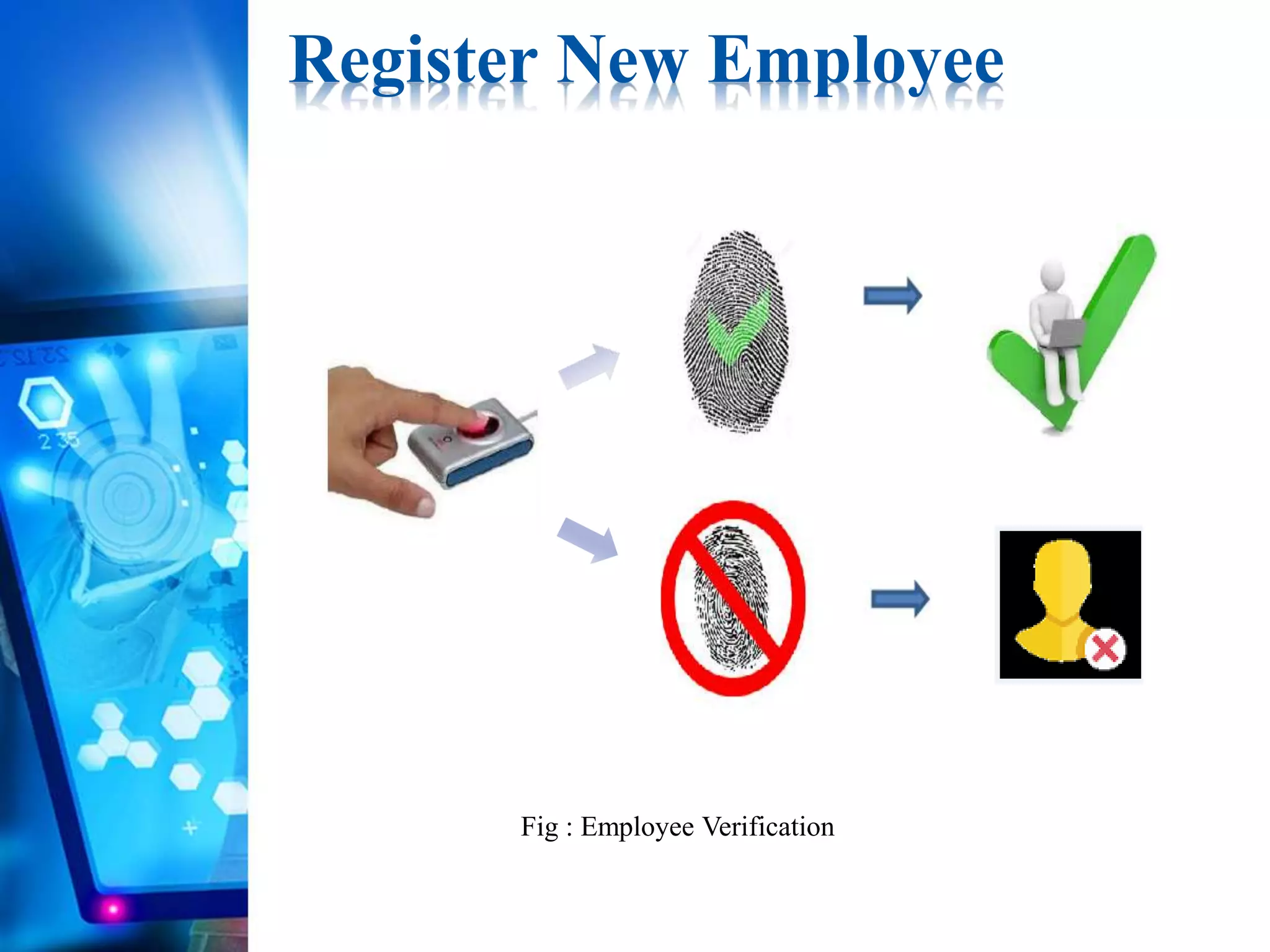
employee enters the company he/she verify by fingerprint
verification.
 When employee enter his/her time starts. Employee shows
personal details like designation, enter time, holidays etc.
 Employees leave the office also fingerprint verification.
Monthly salary and bonus are given using the system.
 All the works are reported finally at last.. This report will be
generated by SAP Crystal Report.
Our Approach
 The project background model specially developed on the basis
of certain programming language. In following section here we
are going to give a brief description about this language in this
project.
 Example:
o Programming Language
 C#.NET
 SQL Server 2012
o IDE Software
 Microsoft Visual Studio 2012
 Microsoft Management Studio 2012
 SAP Crystal Report
Background Studies
we will discuss and analyses about the developing process of
Employee Automation System including Software Requirement
Specification (SRS).
 Software Requirement Specifications
 Product description
 Problem statement
 File lost
 File damaged
 Difficult to search record
 Space-consuming
 Difficult to view reports
 Concerned with
 Data gathering
 Data analysis
Analysis of the System
To complete this project first we have gathered necessary data or
information from our supervisor, our respective teachers, friends,
junior students of our department, and internet. It was complex
because our system is unique and needed data are not available. It
was expensive too and required a lot of work and time. To gather
information we have used certain sources:
 Documentation
 Onsite observations
Data Gathering
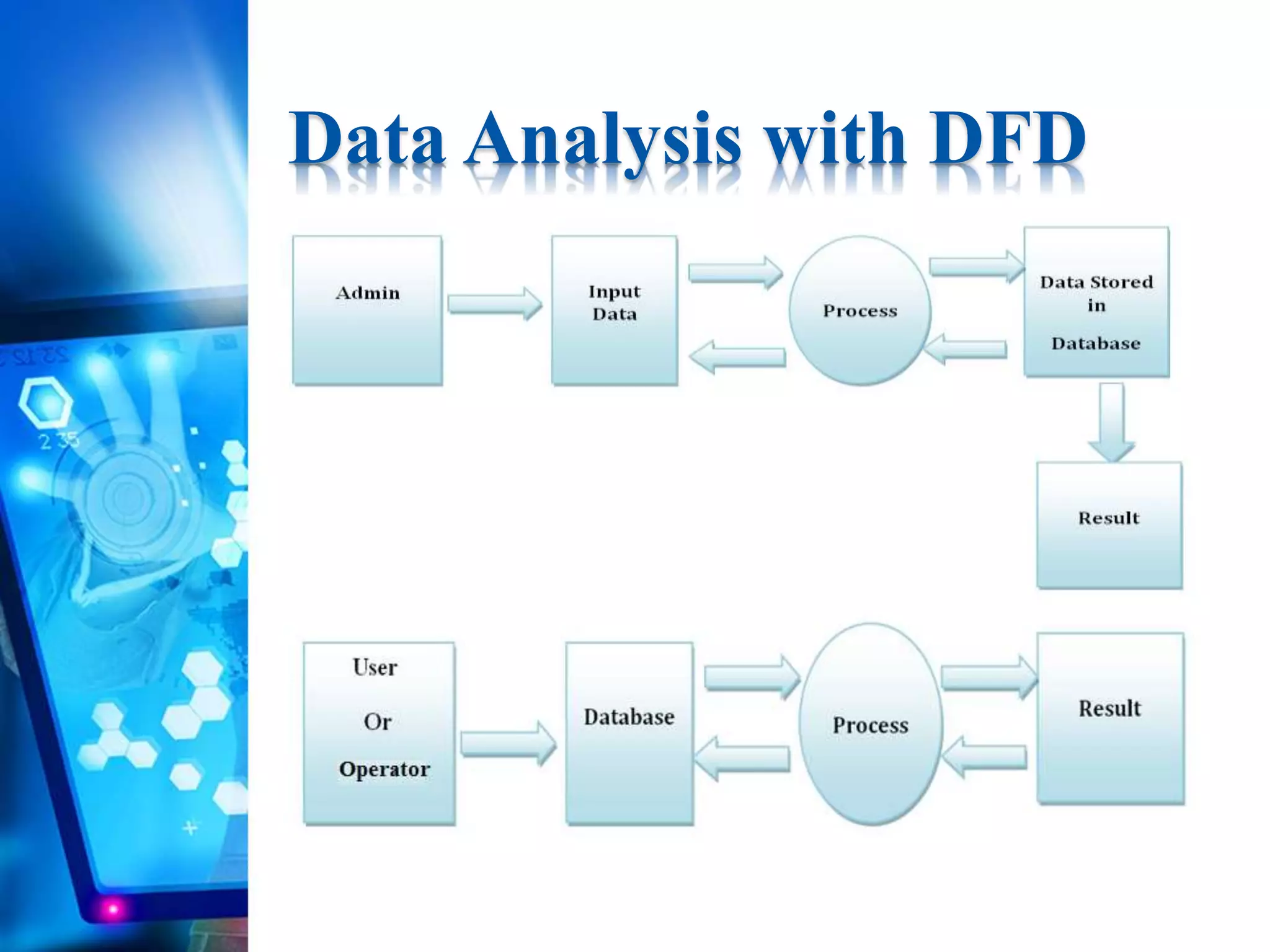
Data Analysis with DFD
 The System Design Document describes the requirements,
operating environment, system and subsystem architecture, files
and database design, input formats, output layouts, human-
machine interfaces, detailed design and external interfaces.
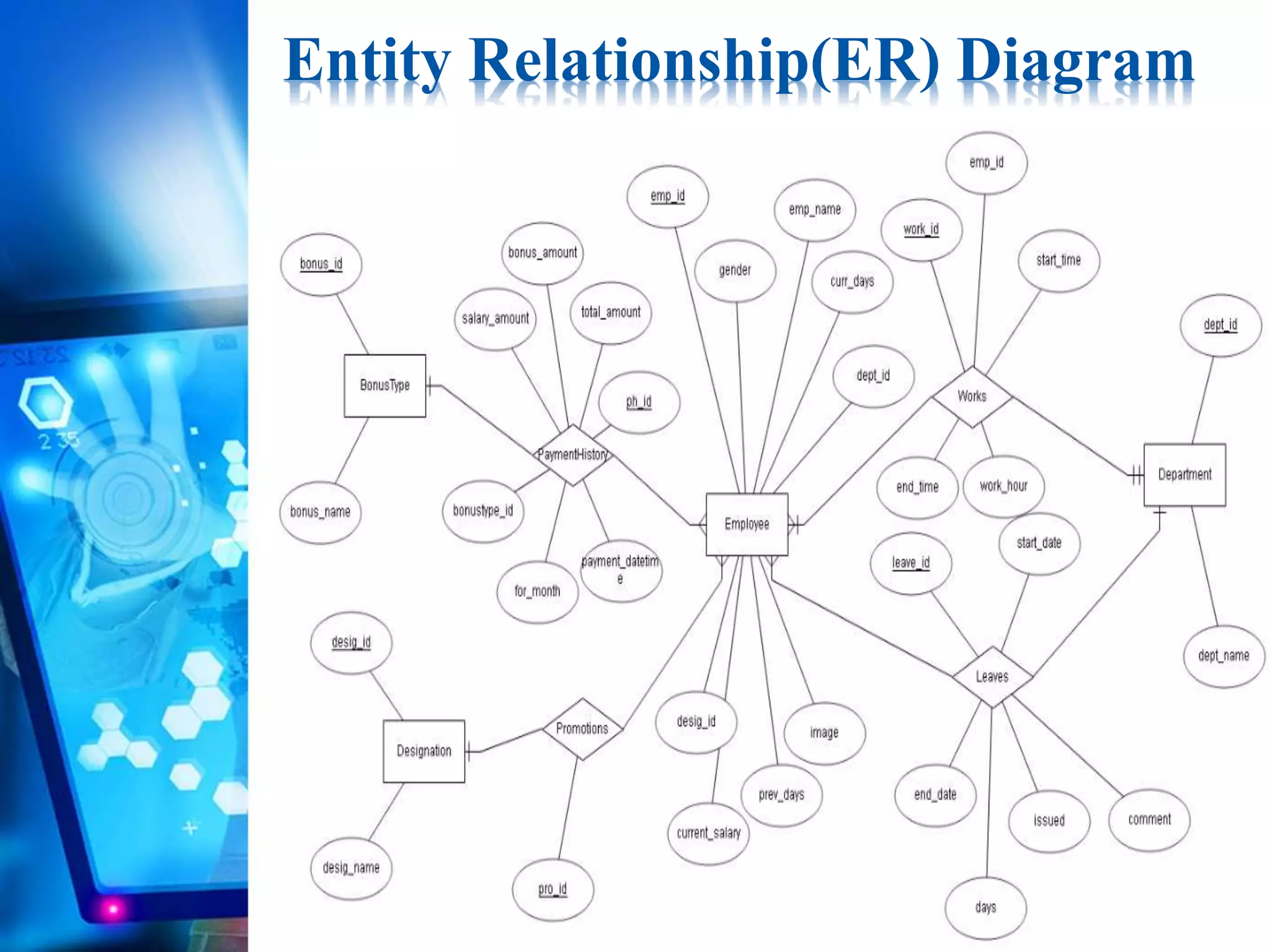
 Entity Relationship(ER) Diagram
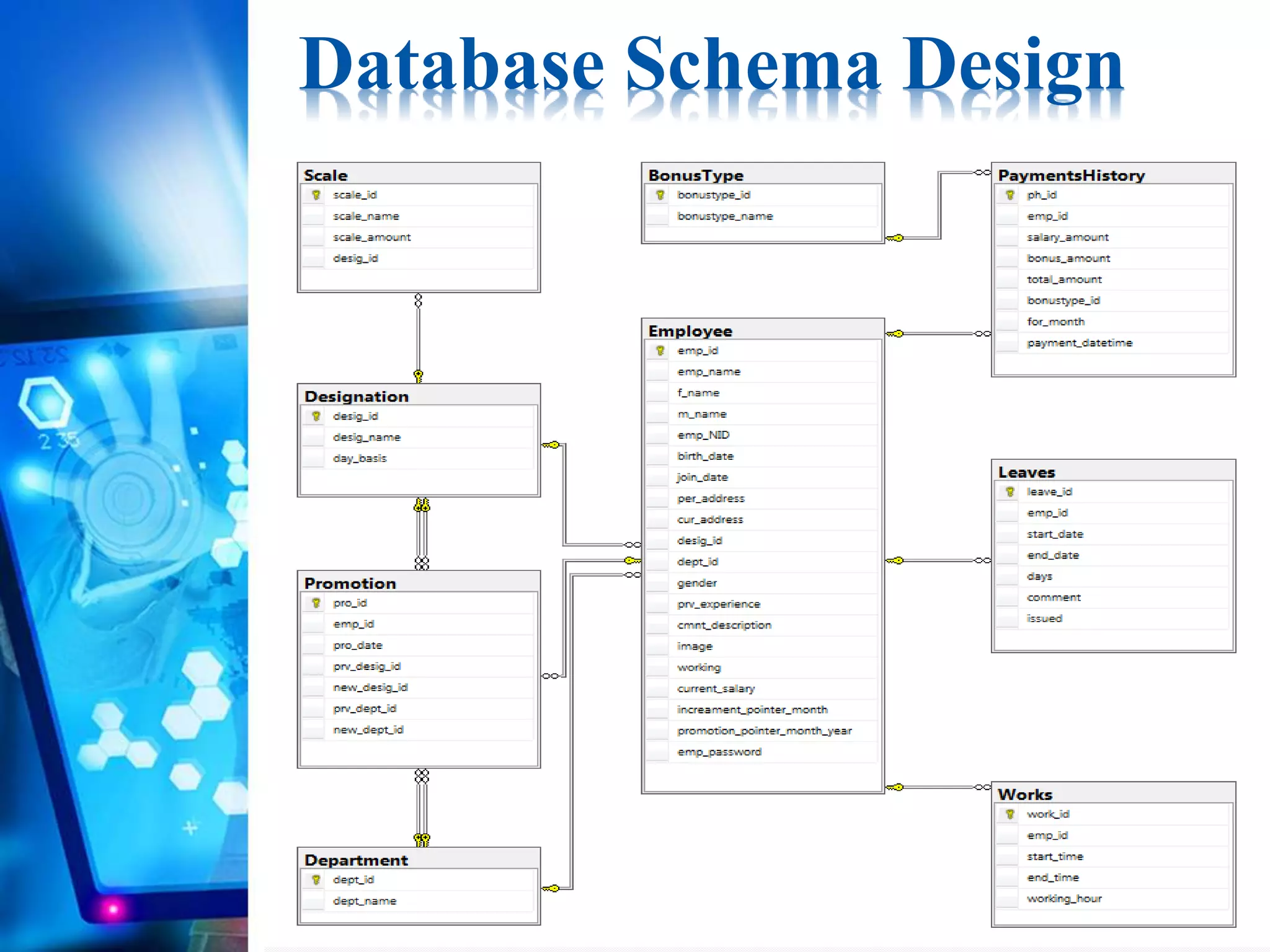
 Database Schema Design
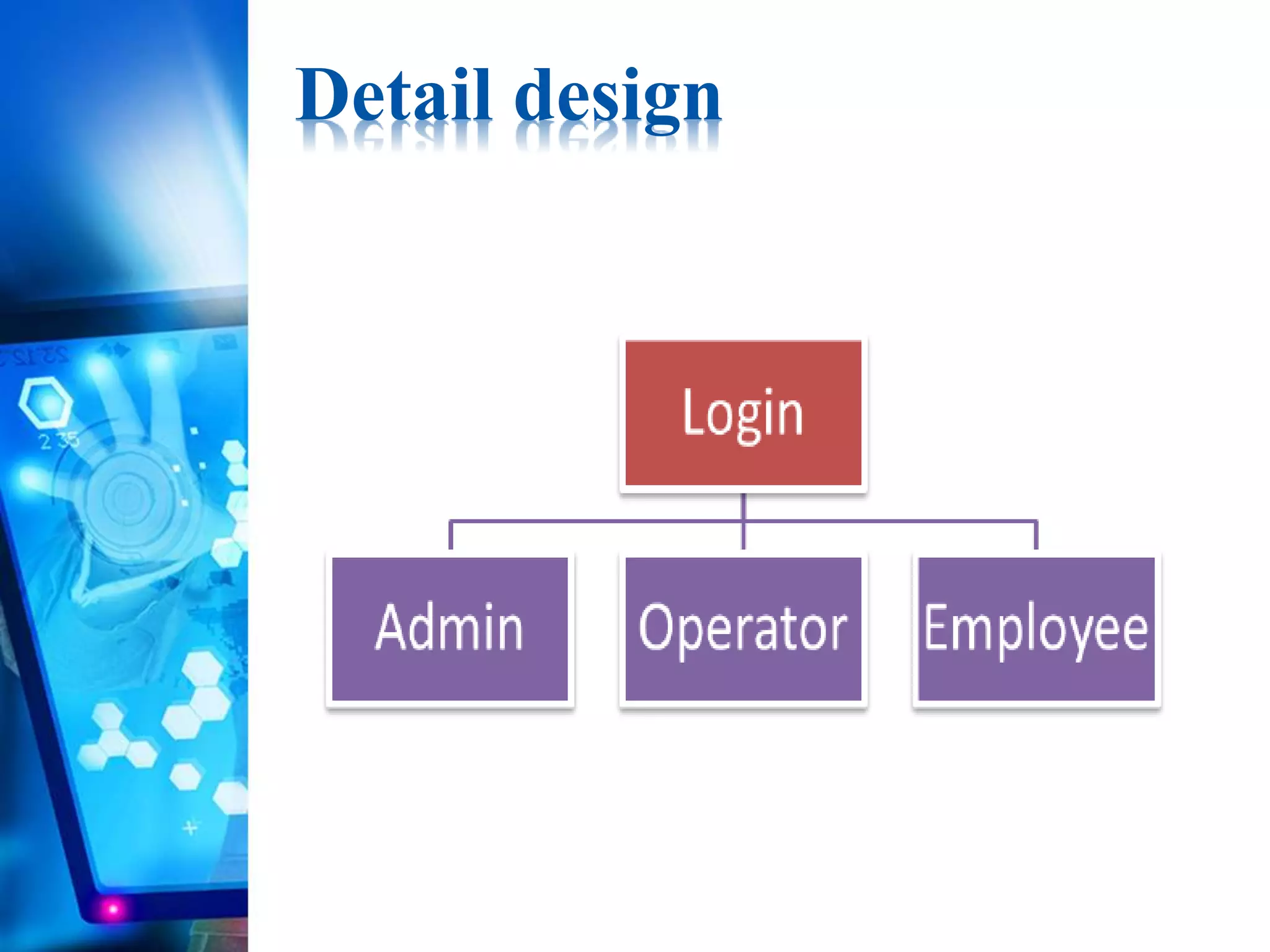
 Detail design
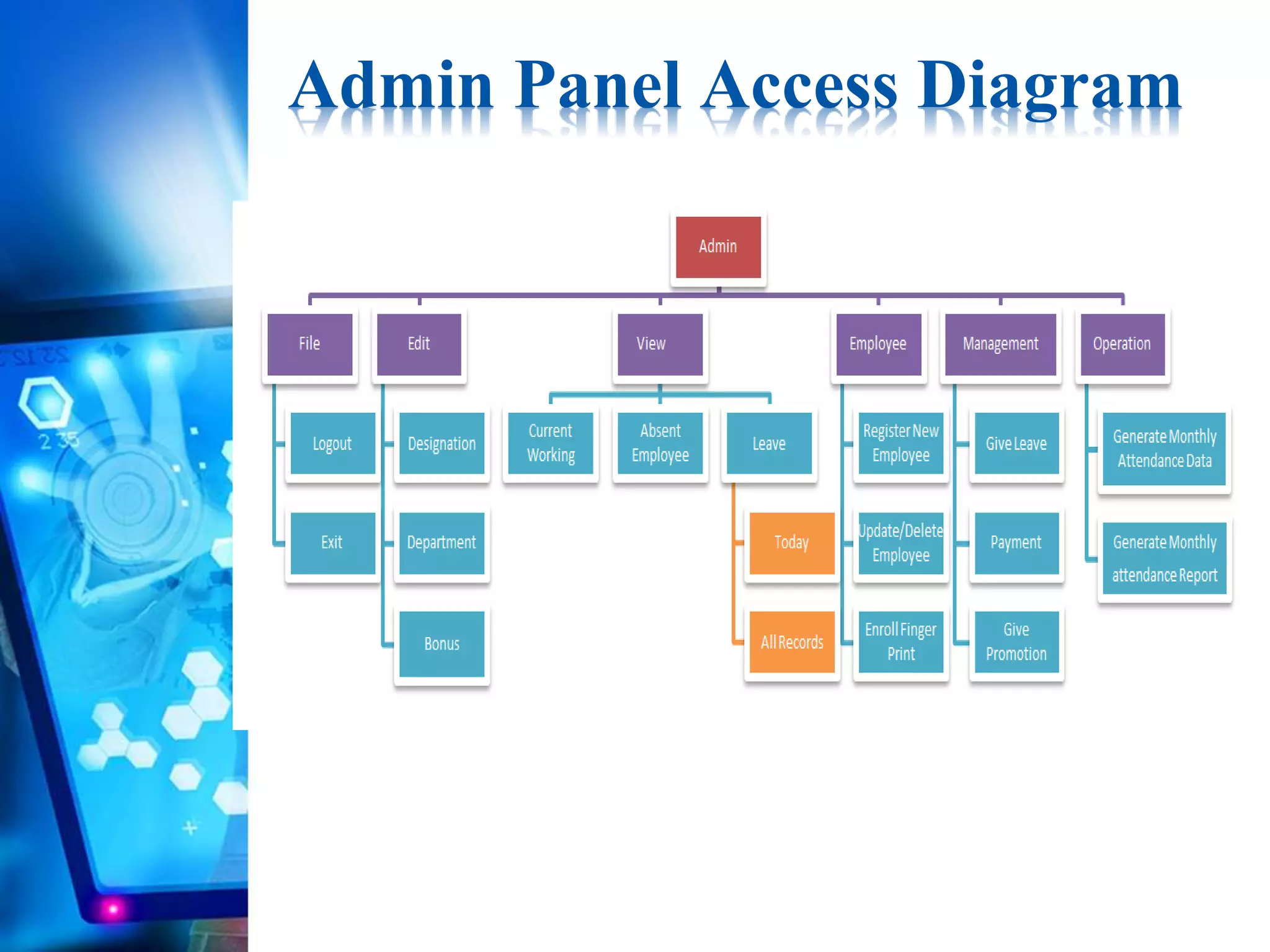
 Admin Panel
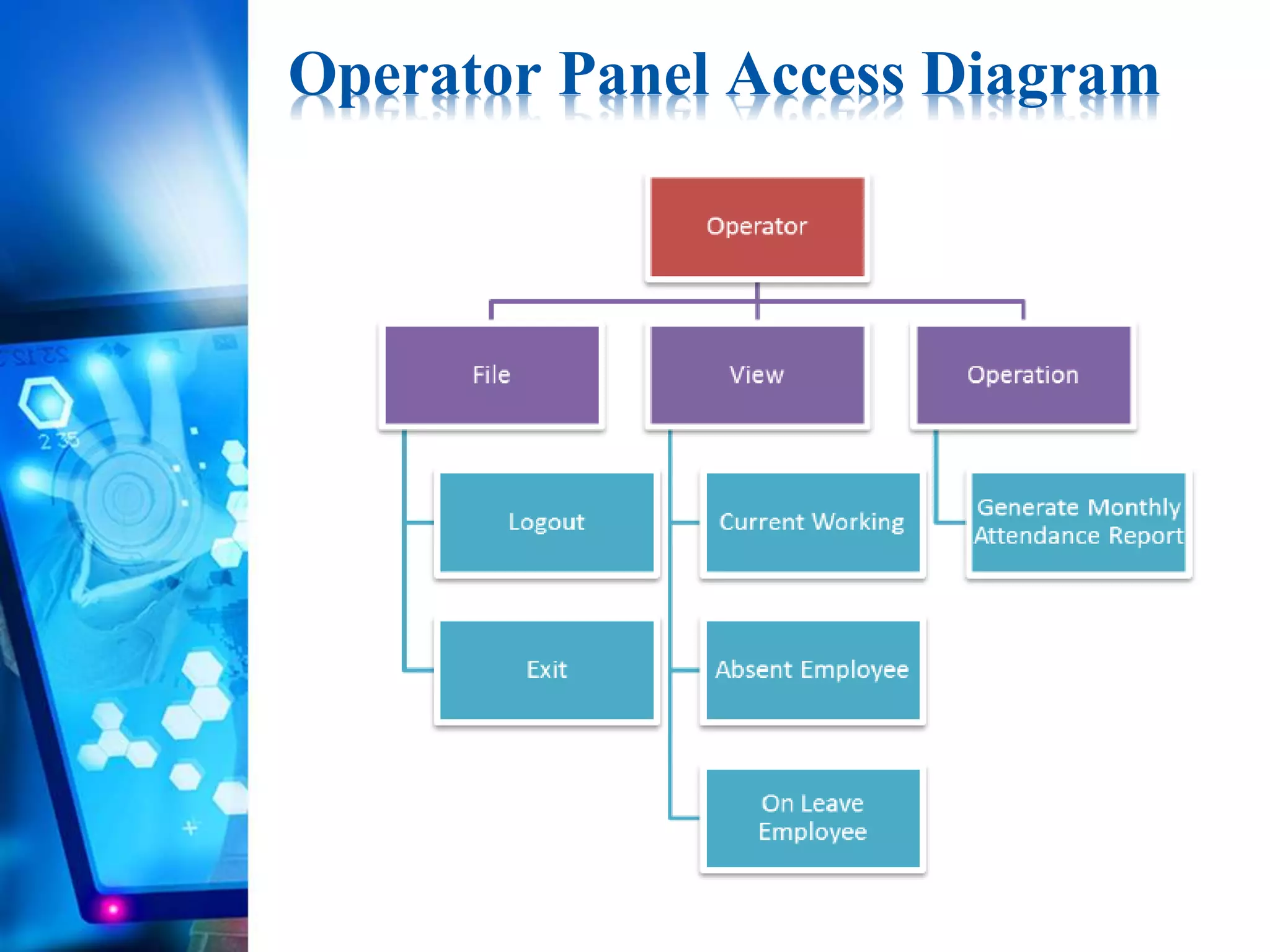
 Operator Panel
 Employee Panel
Design of the System
Entity Relationship(ER) Diagram
Database Schema Design
Detail design
Admin Panel Access Diagram
Operator Panel Access Diagram
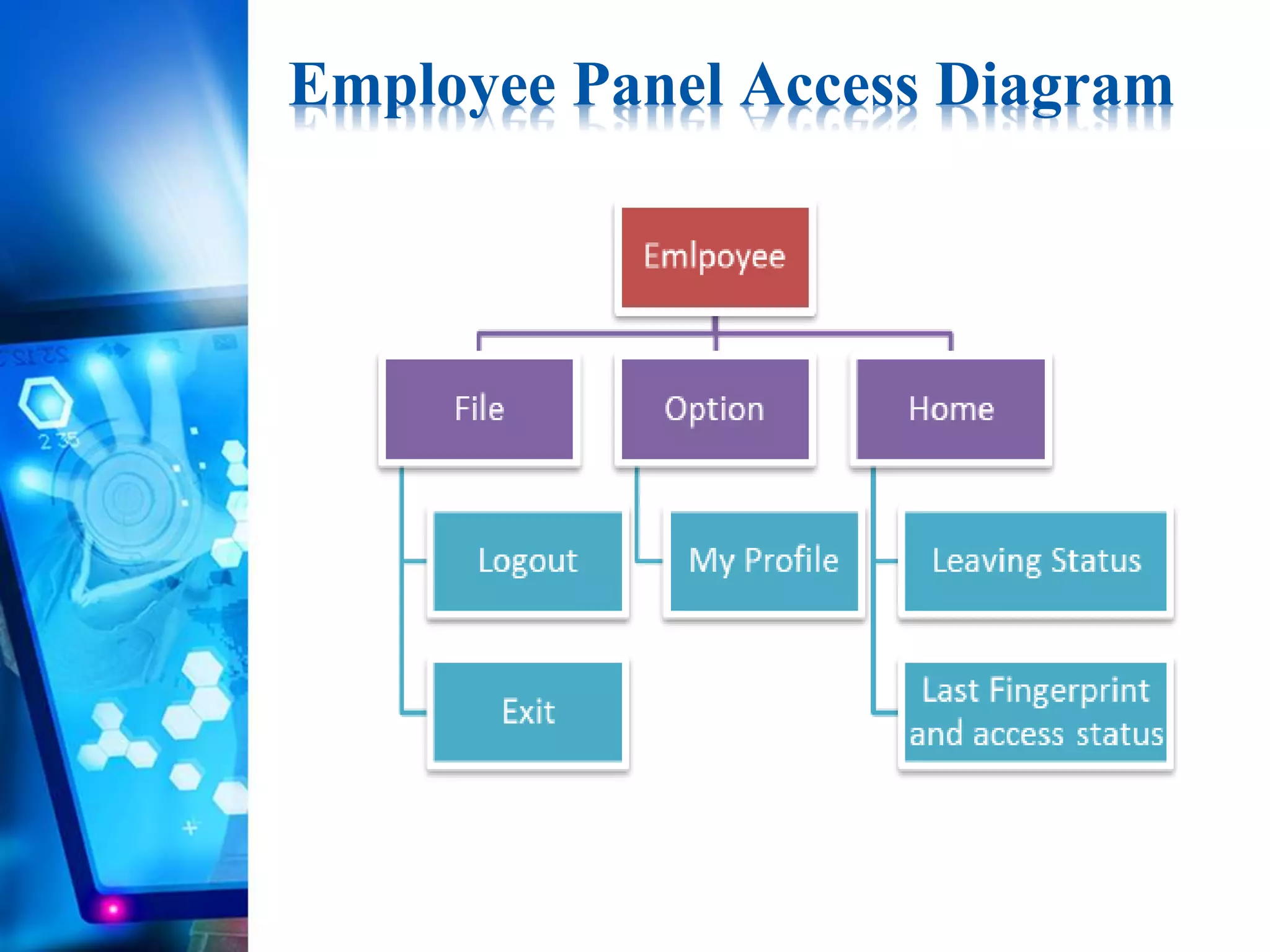
Employee Panel Access Diagram
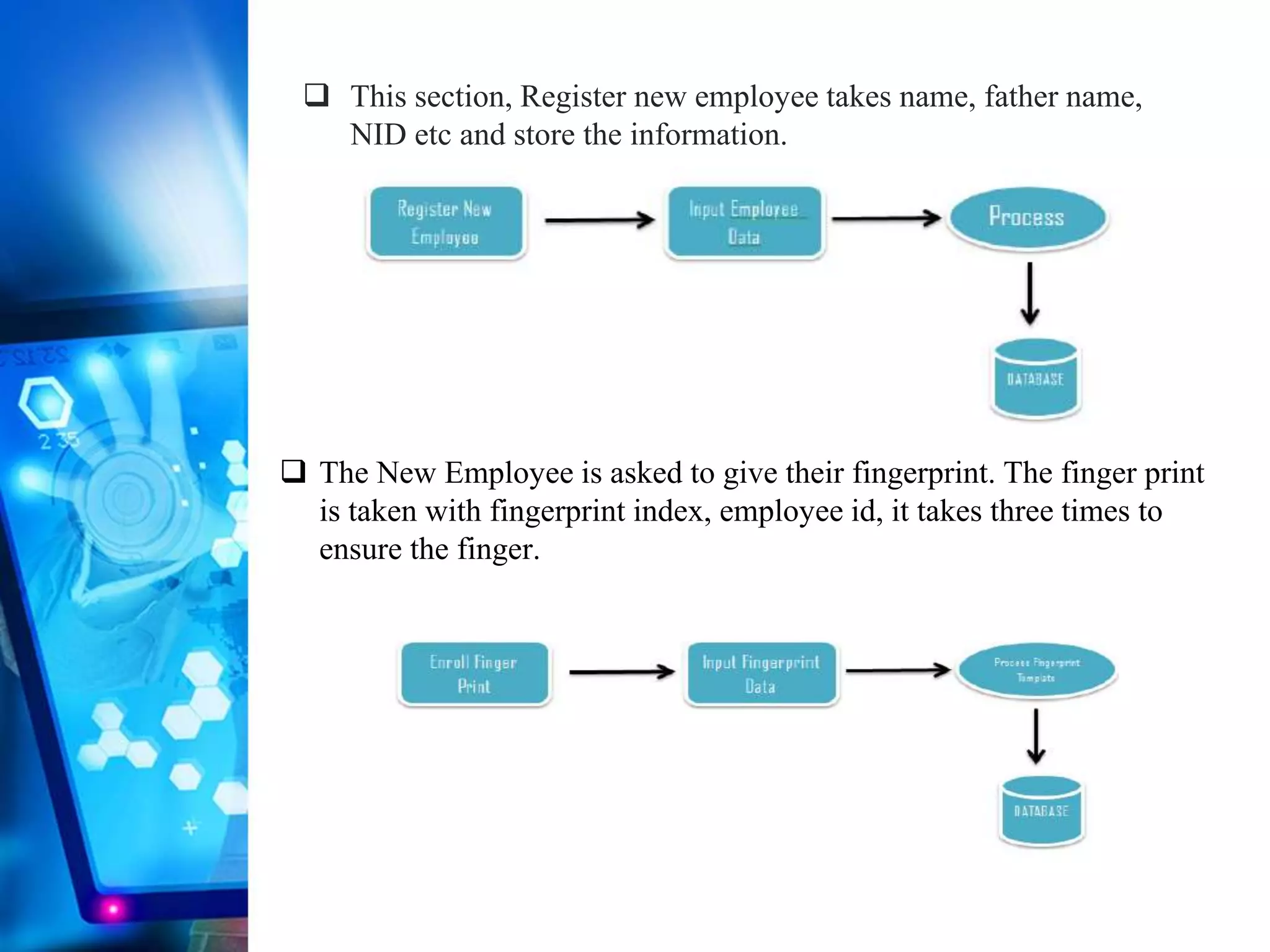
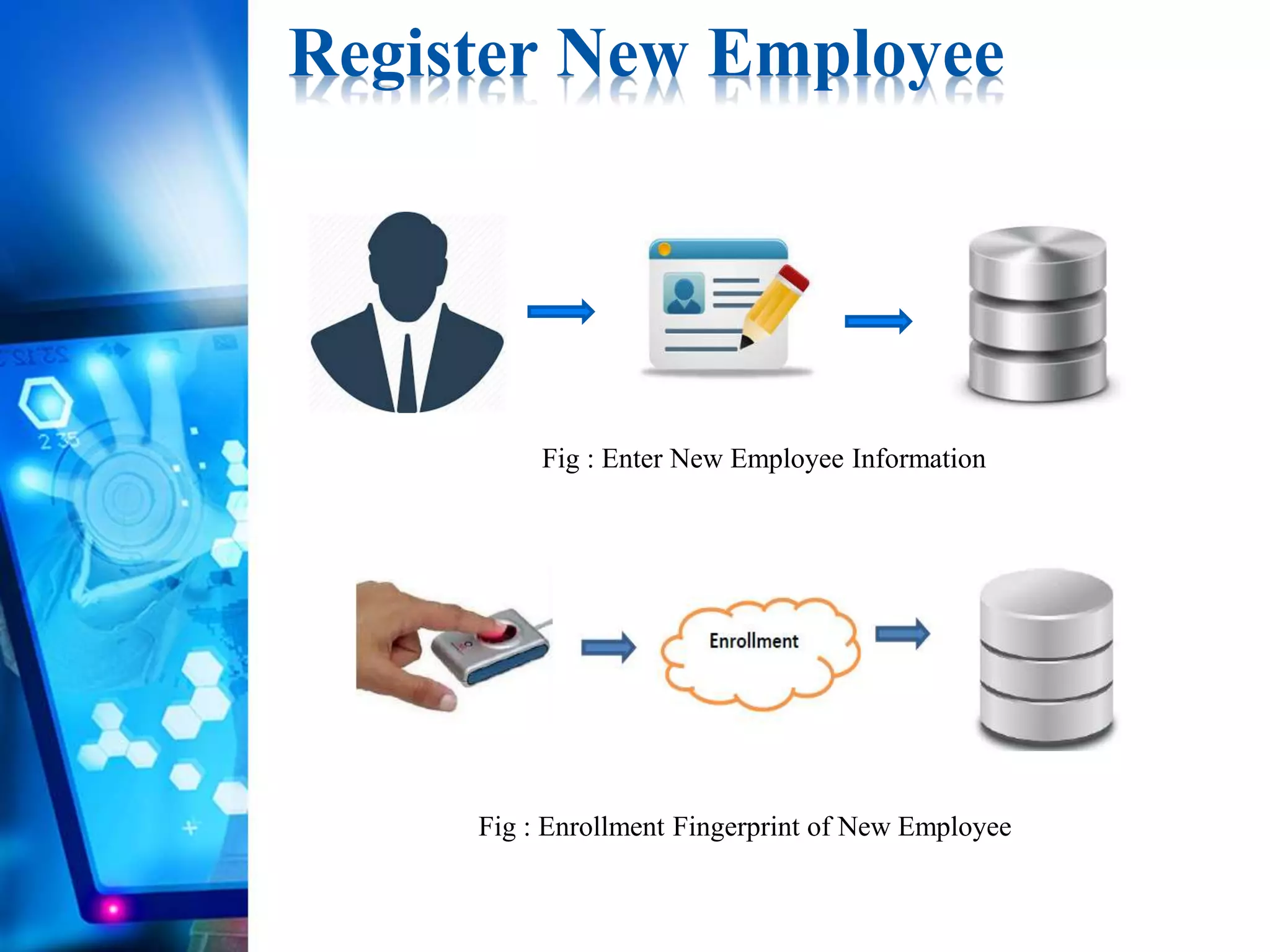
 This section, Register new employee takes name, father name,
NID etc and store the information.
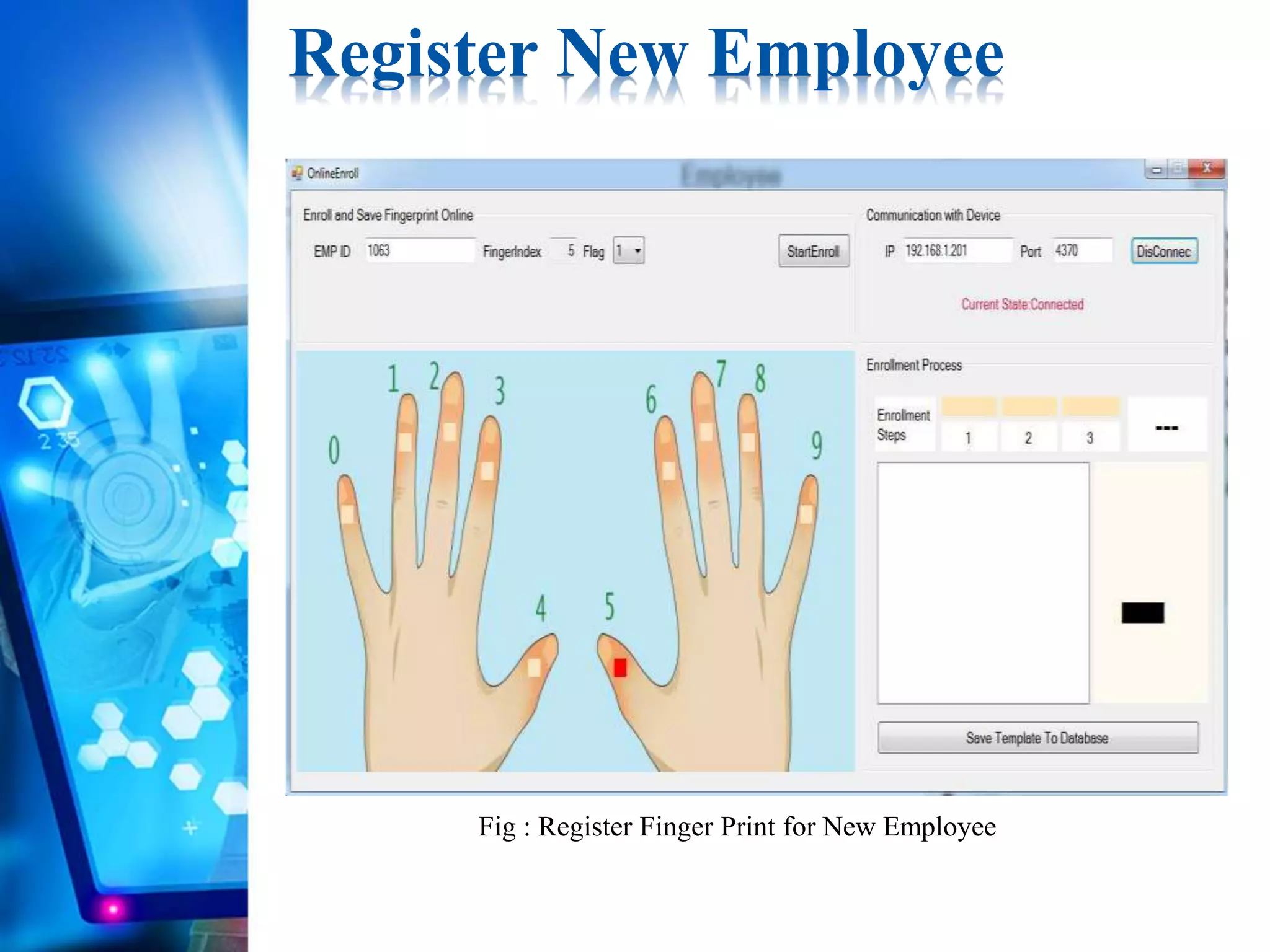
 The New Employee is asked to give their fingerprint. The finger print
is taken with fingerprint index, employee id, it takes three times to
ensure the finger.
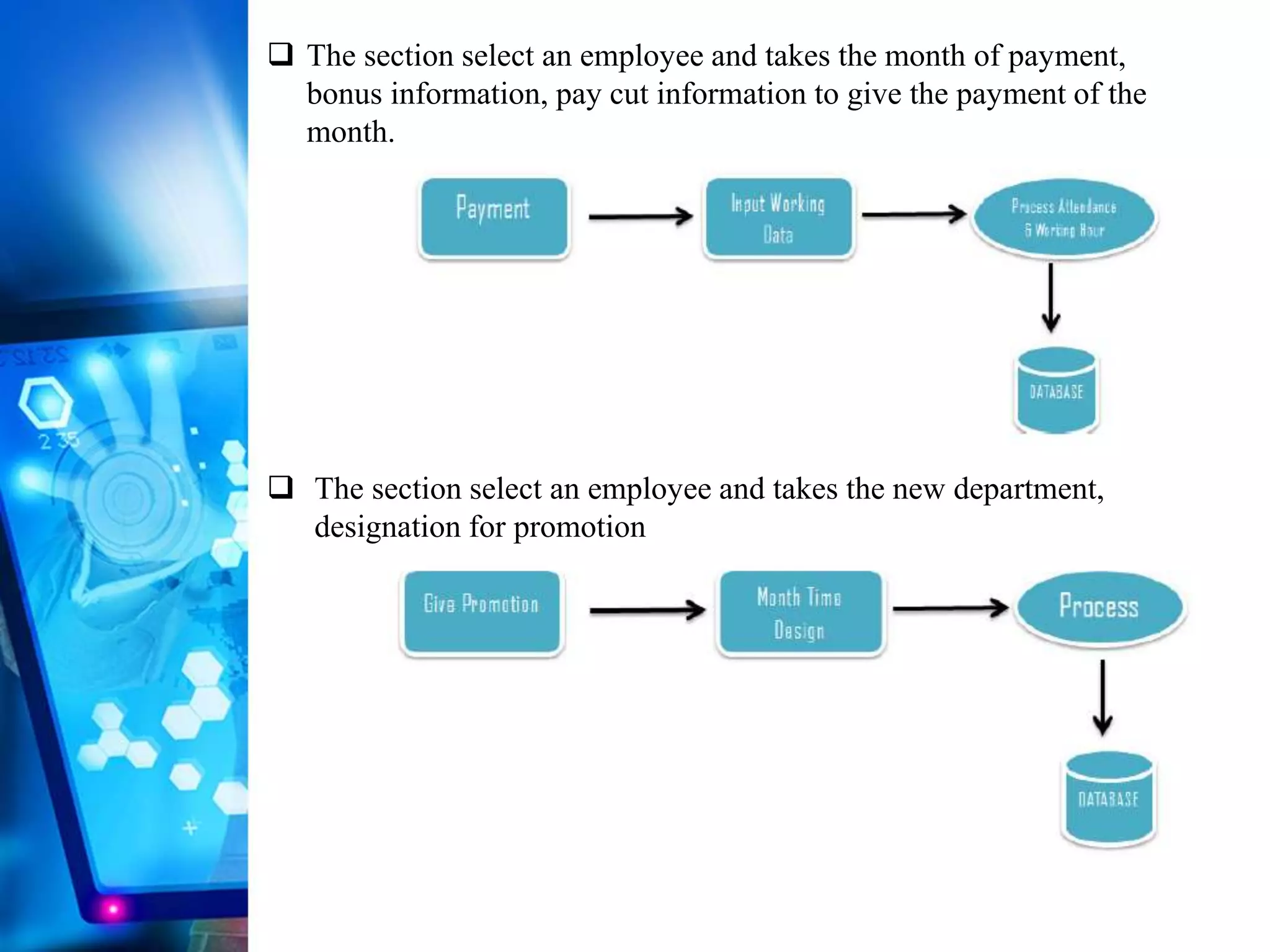
 The section select an employee and takes the month of payment,
bonus information, pay cut information to give the payment of the
month.
 The section select an employee and takes the new department,
designation for promotion
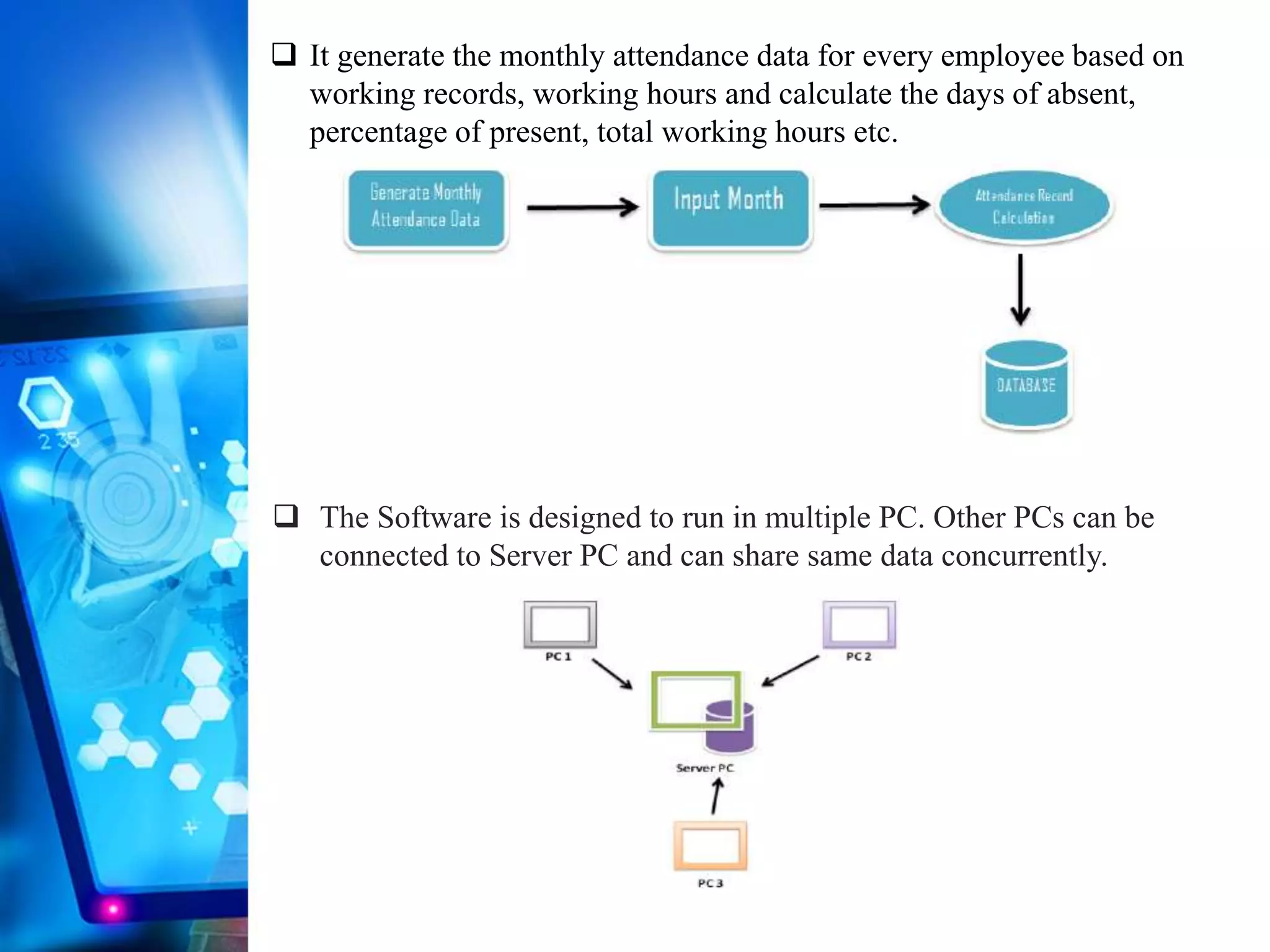
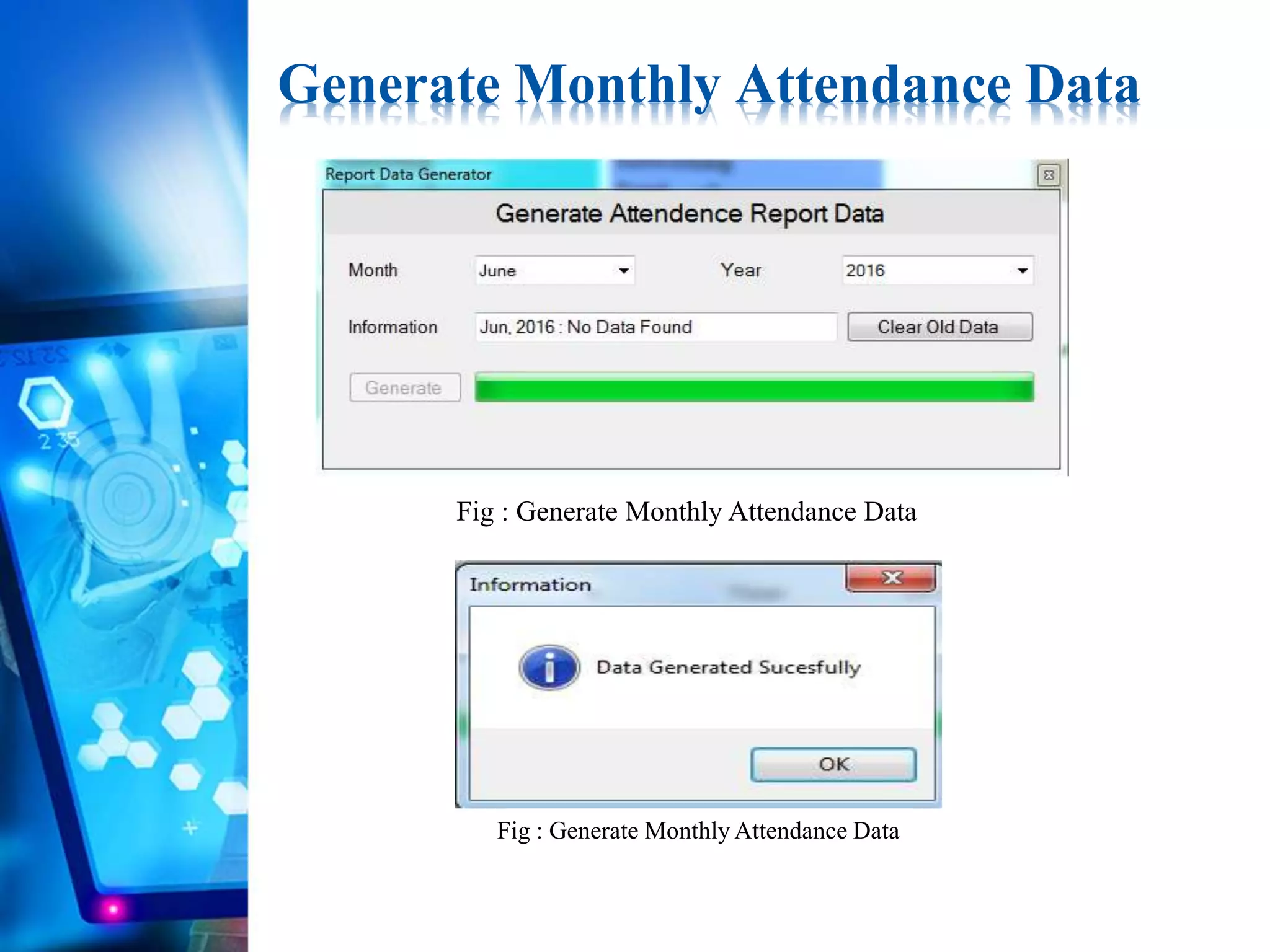
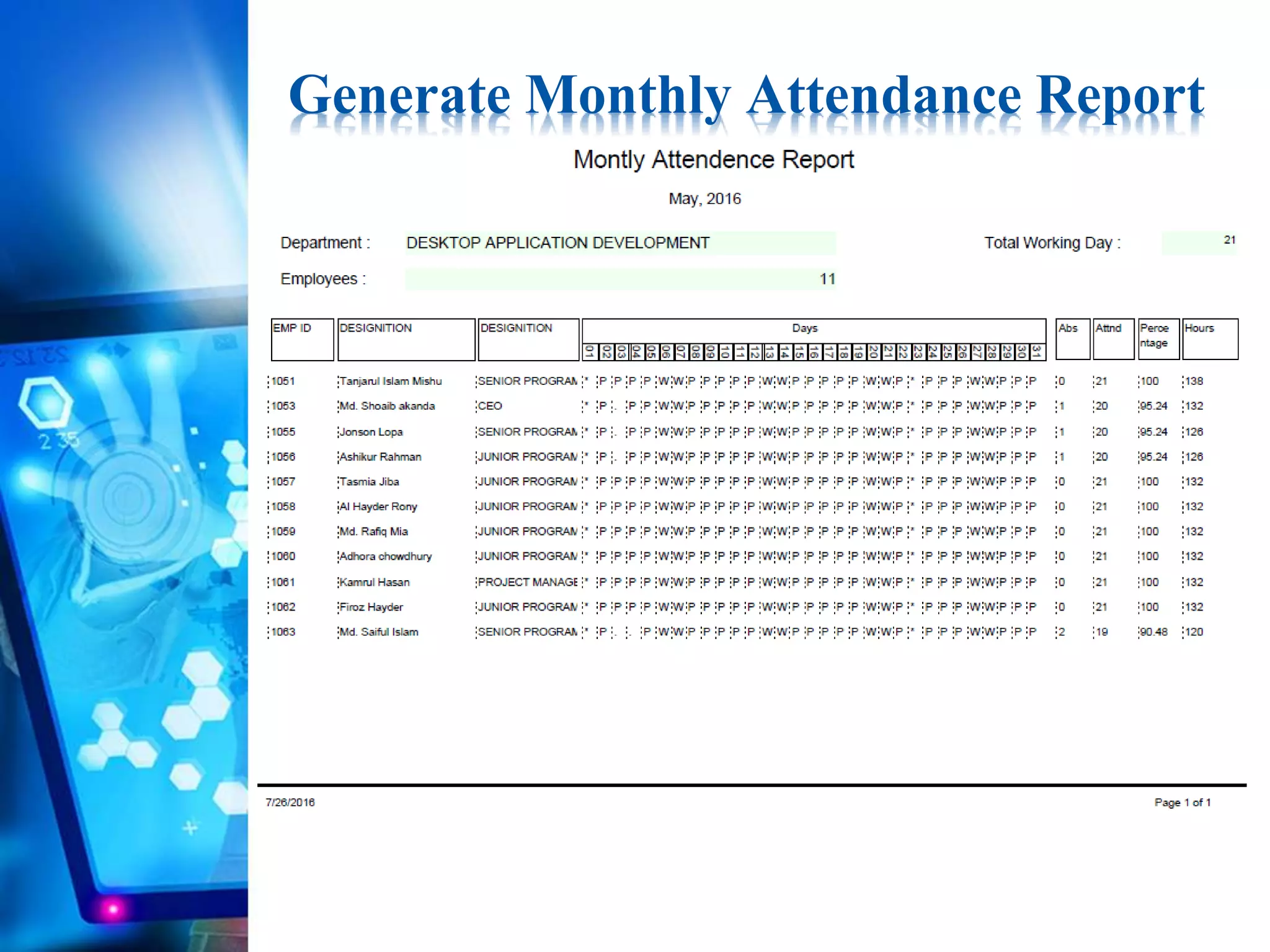
 It generate the monthly attendance data for every employee based on
working records, working hours and calculate the days of absent,
percentage of present, total working hours etc.
 The Software is designed to run in multiple PC. Other PCs can be
connected to Server PC and can share same data concurrently.
The development phase is an operational phase of our system .This
is the phase where we start to code the system. We follow the
requirements specification from the design stage and start to create
the new system.
 Login system
 Main Window (Home)
 Register New Employee
 Update/Delete Employee
 Employee Detection by Finger Print Sensor
 Designation Management
 Department Management
 Bonus Type Management
 Giving Leave to Employee
Development of the System
 Salary Payment
 Giving Promotion
 Currently Working Status
 Absent Employees
 Employees on Leave
 Generate Monthly Attendance Data
 Generate Monthly Attendance Report
 Operator window
 Employee Window
Development of the System
Software Development Model
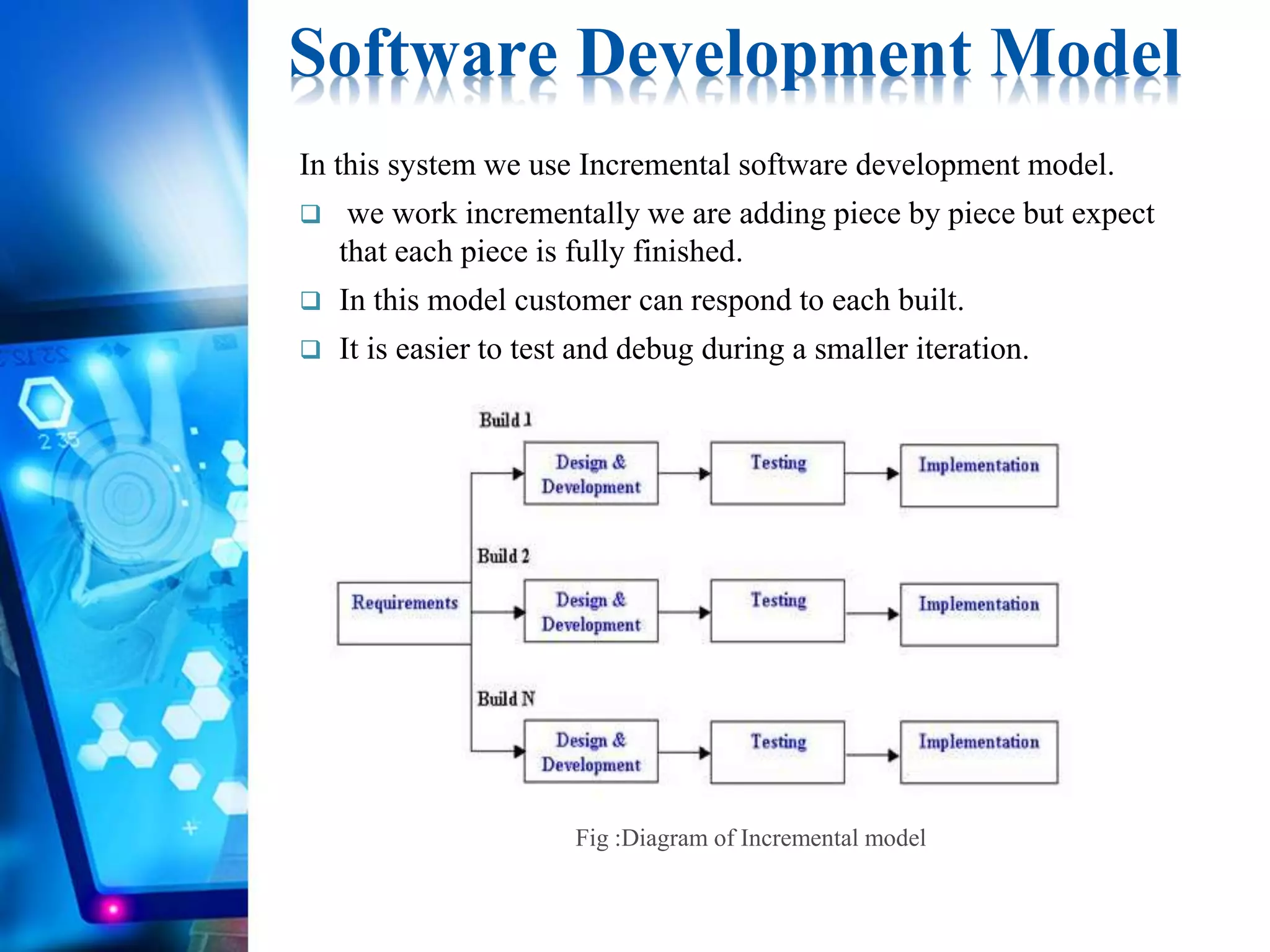
In this system we use Incremental software development model.
 we work incrementally we are adding piece by piece but expect
that each piece is fully finished.
 In this model customer can respond to each built.
 It is easier to test and debug during a smaller iteration.
Fig :Diagram of Incremental model
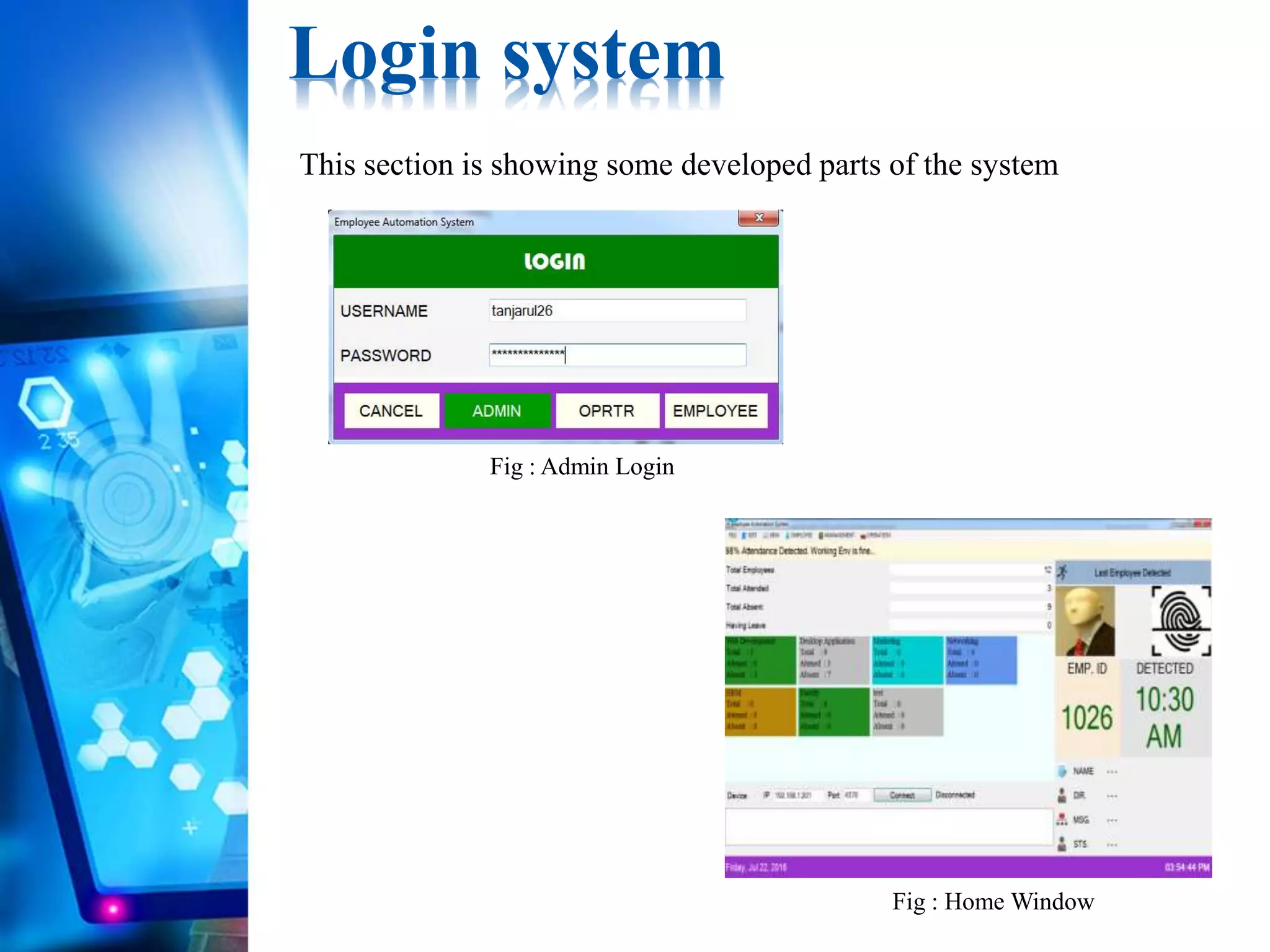
Login system
Fig : Admin Login
This section is showing some developed parts of the system
Fig : Home Window
Register New Employee
Fig : Enrollment Fingerprint of New Employee
Fig : Enter New Employee Information
Register New Employee
Fig : Employee Verification
Register New Employee
Fig : Register Finger Print for New Employee
Generate Monthly Attendance Data
Fig : Generate Monthly Attendance Data
Generate Monthly Attendance Report
Limitation of the System
 It has no installation process like other software those are created
using like java language.
 The device we used to capture fingerprint takes maximum 5000
fingerprint templates only.
 We are unable to do all kinds of testing we just maintain form, unit
and module validation.
• Punch Card Employee Detection: It will be used to identify
employee by punch card also.
• Notice Board: There will be a common and department wise
notice board for employees.
• Share Files and Messages: Employees can share file among
them and can send messages also.
• Employee Recruitment: Employee Recruitment system will be
added to the system.
Future Scope
Implement Fingerprint authentication for employee automation system

Implement Fingerprint authentication for employee automation system

  • 2.
    Supervised By: Dr. Md.Mijanur Rahman Associate Professor, Dept. of CSE, JKKNIU. Presented By: Tanjarul Islam Mishu Md. Saiful Islam Md. Shoaib Akanda Roll:11102026 Roll:11102011 Roll:10102034 Reg:1538 Reg:1526 Reg:1003 Dept. Of CSE Dept. Of CSE Dept. Of CSE JKKNIU. JKKNIU. JKKNIU.
  • 3.
     Introduction  Objectives Our Approach  Background Studies  Analysis of the System  Design of the System  Development of the System  Limitation of the System  Future Scope Road Map
  • 4.
     Now-a-days, welive in age of Information Communication and Technology (ICT). We can’t think a single moment without technology.  This is the revolutionary time of computer technology. Most of the works depends on computer application.  Every organization has different employee management needs, therefore we design exclusive employee management system that are adapted to your managerial requirements.  One of the main features of in Employee Automation System is time tracking for employees. In this software, there will be a fingerprint verification system to identify the employee. Introduction
  • 5.
     To simplifythe task of maintaining records of employees in an office.  To easy the Employee Attendance System.  To provide a comprehensive approach towards the management of employee information.  To improve productivity and efficiency for day to day management in an office.  To enable the employees towards achievement of superior standards of work performance.  To serve information to a user to interact with the system. Objectives
  • 6.
     First, weanalysis the previous developed worked about Employee Management System. Then we started to analyze the requirements of our project.  we first design the structure of the system. The system provides proper security and reduces the manual work. which gives facility available for every organization.  Employee enter to leave all works are recorded. When an employee enters the company he/she verify by fingerprint verification.  When employee enter his/her time starts. Employee shows personal details like designation, enter time, holidays etc.  Employees leave the office also fingerprint verification. Monthly salary and bonus are given using the system.  All the works are reported finally at last.. This report will be generated by SAP Crystal Report. Our Approach
  • 7.
     The projectbackground model specially developed on the basis of certain programming language. In following section here we are going to give a brief description about this language in this project.  Example: o Programming Language  C#.NET  SQL Server 2012 o IDE Software  Microsoft Visual Studio 2012  Microsoft Management Studio 2012  SAP Crystal Report Background Studies
  • 8.
    we will discussand analyses about the developing process of Employee Automation System including Software Requirement Specification (SRS).  Software Requirement Specifications  Product description  Problem statement  File lost  File damaged  Difficult to search record  Space-consuming  Difficult to view reports  Concerned with  Data gathering  Data analysis Analysis of the System
  • 9.
    To complete thisproject first we have gathered necessary data or information from our supervisor, our respective teachers, friends, junior students of our department, and internet. It was complex because our system is unique and needed data are not available. It was expensive too and required a lot of work and time. To gather information we have used certain sources:  Documentation  Onsite observations Data Gathering
  • 10.
  • 11.
     The SystemDesign Document describes the requirements, operating environment, system and subsystem architecture, files and database design, input formats, output layouts, human- machine interfaces, detailed design and external interfaces.  Entity Relationship(ER) Diagram  Database Schema Design  Detail design  Admin Panel  Operator Panel  Employee Panel Design of the System
  • 12.
  • 13.
  • 14.
  • 15.
  • 16.
  • 17.
  • 18.
     This section,Register new employee takes name, father name, NID etc and store the information.  The New Employee is asked to give their fingerprint. The finger print is taken with fingerprint index, employee id, it takes three times to ensure the finger.
  • 19.
     The sectionselect an employee and takes the month of payment, bonus information, pay cut information to give the payment of the month.  The section select an employee and takes the new department, designation for promotion
  • 20.
     It generatethe monthly attendance data for every employee based on working records, working hours and calculate the days of absent, percentage of present, total working hours etc.  The Software is designed to run in multiple PC. Other PCs can be connected to Server PC and can share same data concurrently.
  • 21.
    The development phaseis an operational phase of our system .This is the phase where we start to code the system. We follow the requirements specification from the design stage and start to create the new system.  Login system  Main Window (Home)  Register New Employee  Update/Delete Employee  Employee Detection by Finger Print Sensor  Designation Management  Department Management  Bonus Type Management  Giving Leave to Employee Development of the System
  • 22.
     Salary Payment Giving Promotion  Currently Working Status  Absent Employees  Employees on Leave  Generate Monthly Attendance Data  Generate Monthly Attendance Report  Operator window  Employee Window Development of the System
  • 23.
    Software Development Model Inthis system we use Incremental software development model.  we work incrementally we are adding piece by piece but expect that each piece is fully finished.  In this model customer can respond to each built.  It is easier to test and debug during a smaller iteration. Fig :Diagram of Incremental model
  • 24.
    Login system Fig :Admin Login This section is showing some developed parts of the system Fig : Home Window
  • 25.
    Register New Employee Fig: Enrollment Fingerprint of New Employee Fig : Enter New Employee Information
  • 26.
    Register New Employee Fig: Employee Verification
  • 27.
    Register New Employee Fig: Register Finger Print for New Employee
  • 28.
    Generate Monthly AttendanceData Fig : Generate Monthly Attendance Data Fig : Generate Monthly Attendance Data
  • 29.
  • 30.
    Limitation of theSystem  It has no installation process like other software those are created using like java language.  The device we used to capture fingerprint takes maximum 5000 fingerprint templates only.  We are unable to do all kinds of testing we just maintain form, unit and module validation.
  • 31.
    • Punch CardEmployee Detection: It will be used to identify employee by punch card also. • Notice Board: There will be a common and department wise notice board for employees. • Share Files and Messages: Employees can share file among them and can send messages also. • Employee Recruitment: Employee Recruitment system will be added to the system. Future Scope