FINANCIAL STATEMENTS
Presented By :
Samina Khan
INTRODUCTION
Financial statements are the end products of
the accounting process, which reveals the
financial results of the specified period and
financial position as on particular date. It is
the basic and formal annual report through
which a business communicates financial
information to its various user groups.
NATURE OF FINANCIAL STATEMENT:
Recorded facts
Accounting conventions
 Postulates(Assumptions)
 Personal Judgements
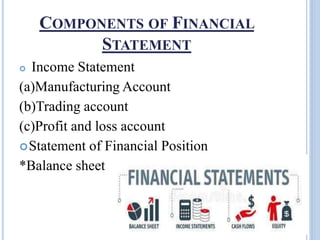
COMPONENTS OF FINANCIAL
STATEMENT
 Income Statement
(a)Manufacturing Account
(b)Trading account
(c)Profit and loss account
Statement of Financial Position
*Balance sheet
IMPORTANCE OF FINANCIAL
STATEMENTS
Importance to management
Importance to Creditors
Importance to Bankers
Importance to Investors
 Importance to Government
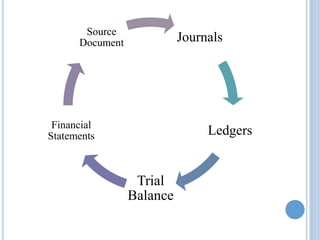
Journals
Ledgers
Trial
Balance
Financial
Statements
Source
Document
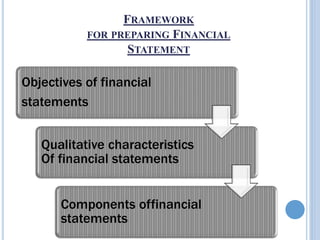
FRAMEWORK
FOR PREPARING FINANCIAL
STATEMENT
Objectives of financial
statements
Qualitative characteristics
Of financial statements
Components offinancial
statements
OBJECTIVES
 To provide reliable financial information
about economic resources(assets) and
obligations(liabilities) of a business firm.
 To provide information about the earning
capacity of the business firm.
 To provide reliable information about the
changes in resources and obligations arising out
of business activities.
 To disclose , the various accounting policies
followed in preparing the financial statement to its
various user groups.
 To disclose, to the extent possible, other related
information to financial statement that is relevant
to the needs of the users.
FINANCIAL STATEMENTS FOR ALL
PURPOSES
The general purpose of the financial
statements is to provide information about
the results of operations, financial
position, and cash flows of an
organization.
This information is used by the readers of
financial statements to make decisions
regarding the allocation of resources.
`
 The income statement informs the reader about
the ability of a business to generate a profit. In
addition, it reveals the volume of sales, and the
nature of the various types of expenses.
 The purpose of the balance sheet is used to
estimate the liquidity, funding, and debt position
of an entity, and is the basis for a number of
liquidity ratios.
Credit decisions. They should extend
credit to a business, or restrict the amount
of credit already extended.
Investment decisions decide whether to
invest, and the price per share at which
they want to invest.
Taxation decisions. Government entities
may tax a business based on its assets or
income, and can derive this information
from the financials.
In short, the financial statements have a
number of purposes, depending upon
who is reading the information and which
financial statements are being perused.
Financial statement

Financial statement

  • 1.
  • 2.
    INTRODUCTION Financial statements arethe end products of the accounting process, which reveals the financial results of the specified period and financial position as on particular date. It is the basic and formal annual report through which a business communicates financial information to its various user groups.
  • 3.
    NATURE OF FINANCIALSTATEMENT: Recorded facts Accounting conventions  Postulates(Assumptions)  Personal Judgements
  • 4.
    COMPONENTS OF FINANCIAL STATEMENT Income Statement (a)Manufacturing Account (b)Trading account (c)Profit and loss account Statement of Financial Position *Balance sheet
  • 5.
    IMPORTANCE OF FINANCIAL STATEMENTS Importanceto management Importance to Creditors Importance to Bankers Importance to Investors  Importance to Government
  • 6.
  • 7.
    FRAMEWORK FOR PREPARING FINANCIAL STATEMENT Objectivesof financial statements Qualitative characteristics Of financial statements Components offinancial statements
  • 8.
    OBJECTIVES  To providereliable financial information about economic resources(assets) and obligations(liabilities) of a business firm.  To provide information about the earning capacity of the business firm.  To provide reliable information about the changes in resources and obligations arising out of business activities.
  • 9.
     To disclose, the various accounting policies followed in preparing the financial statement to its various user groups.  To disclose, to the extent possible, other related information to financial statement that is relevant to the needs of the users.
  • 10.
    FINANCIAL STATEMENTS FORALL PURPOSES The general purpose of the financial statements is to provide information about the results of operations, financial position, and cash flows of an organization. This information is used by the readers of financial statements to make decisions regarding the allocation of resources.
  • 11.
    `  The incomestatement informs the reader about the ability of a business to generate a profit. In addition, it reveals the volume of sales, and the nature of the various types of expenses.  The purpose of the balance sheet is used to estimate the liquidity, funding, and debt position of an entity, and is the basis for a number of liquidity ratios.
  • 12.
    Credit decisions. Theyshould extend credit to a business, or restrict the amount of credit already extended. Investment decisions decide whether to invest, and the price per share at which they want to invest.
  • 13.
    Taxation decisions. Governmententities may tax a business based on its assets or income, and can derive this information from the financials. In short, the financial statements have a number of purposes, depending upon who is reading the information and which financial statements are being perused.