Ratio and ItsImportance
Ratio analysis express the relationship among selected items of Financial
statement data. A ratio expresses the mathematical relationship between one
quantity and another. The relationship is expressed in terms of percentage, rate or
proportion.
It is an important tool for analyzing the company's financial performance. The
following are the important advantages of the accounting ratios.
1. Analyzing Financial Statements
Ratio analysis is an important technique of financial statement analysis.
Accounting ratios are useful for understanding the financial position of the
company. Different users such as investors, management. bankers and
creditors use the ratio to analyze the financial situation of the company for
their decision making purpose.
2. Judging Efficiency
Accounting ratios are important for judging the company's efficiency in terms
of its operations and management. They help judge how well the company
has been able to utilize its assets and earn profits.
3.
Ratio and ItsImportance
3. Locating Weakness
Accounting ratios can also be used in locating weakness of the
company's operations even though its overall performance may be
quite good. Management can then pay attention to the weakness
and take remedial measures to overcome them.
4. Formulating Plans
Although accounting ratios are used to analyze the company's past
financial performance, they can also be used to establish future
trends of its financial performance. As a result, they help formulate
the company's future plans.
5. Comparing Performance
It is essential for a company to know how well it is performing over
the years and as compared to the other firms of the similar nature.
Besides, it is also important to know how well its different divisions
are performing among themselves in different years. Ratio analysis
facilitates such comparison.
4.
Ratios for FinancialStatement Analysis
Liquidity Ratio
Profitability Ratio
Capital Market Ratio
Other Ratio
5.
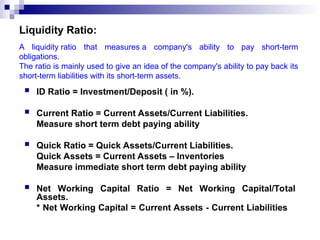
Liquidity Ratio:
IDRatio = Investment/Deposit ( in %).
Current Ratio = Current Assets/Current Liabilities.
Measure short term debt paying ability
Quick Ratio = Quick Assets/Current Liabilities.
Quick Assets = Current Assets – Inventories
Measure immediate short term debt paying ability
Net Working Capital Ratio = Net Working Capital/Total
Assets.
* Net Working Capital = Current Assets - Current Liabilities
A liquidity ratio that measures a company's ability to pay short-term
obligations.
The ratio is mainly used to give an idea of the company's ability to pay back its
short-term liabilities with its short-term assets.
6.
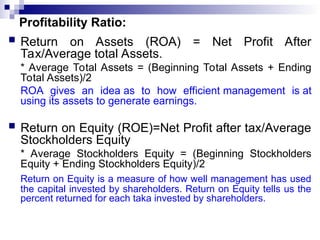
Profitability Ratio:
Returnon Assets (ROA) = Net Profit After
Tax/Average total Assets.
* Average Total Assets = (Beginning Total Assets + Ending
Total Assets)/2
ROA gives an idea as to how efficient management is at
using its assets to generate earnings.
Return on Equity (ROE)=Net Profit after tax/Average
Stockholders Equity
* Average Stockholders Equity = (Beginning Stockholders
Equity + Ending Stockholders Equity)/2
Return on Equity is a measure of how well management has used
the capital invested by shareholders. Return on Equity tells us the
percent returned for each taka invested by shareholders.
7.
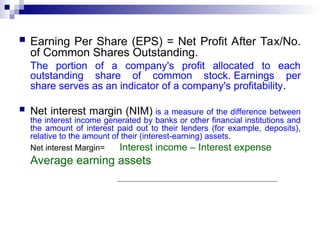
Earning PerShare (EPS) = Net Profit After Tax/No.
of Common Shares Outstanding.
The portion of a company's profit allocated to each
outstanding share of common stock. Earnings per
share serves as an indicator of a company's profitability.
Net interest margin (NIM) is a measure of the difference between
the interest income generated by banks or other financial institutions and
the amount of interest paid out to their lenders (for example, deposits),
relative to the amount of their (interest-earning) assets.
Net interest Margin= Interest income – Interest expense
Average earning assets
8.
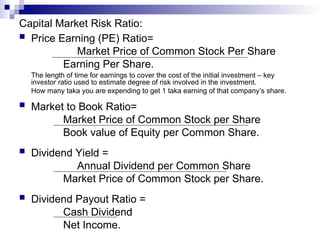
Capital Market RiskRatio:
Price Earning (PE) Ratio=
Market Price of Common Stock Per Share
Earning Per Share.
The length of time for earnings to cover the cost of the initial investment – key
investor ratio used to estimate degree of risk involved in the investment.
How many taka you are expending to get 1 taka earning of that company’s share.
Market to Book Ratio=
Market Price of Common Stock per Share
Book value of Equity per Common Share.
Dividend Yield =
Annual Dividend per Common Share
Market Price of Common Stock per Share.
Dividend Payout Ratio =
Cash Dividend
Net Income.
9.
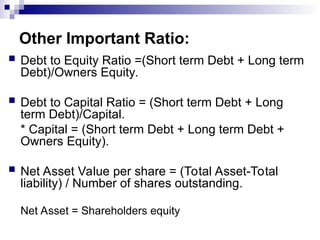
Other Important Ratio:
Debt to Equity Ratio =(Short term Debt + Long term
Debt)/Owners Equity.
Debt to Capital Ratio = (Short term Debt + Long
term Debt)/Capital.
* Capital = (Short term Debt + Long term Debt +
Owners Equity).
Net Asset Value per share = (Total Asset-Total
liability) / Number of shares outstanding.
Net Asset = Shareholders equity
10.
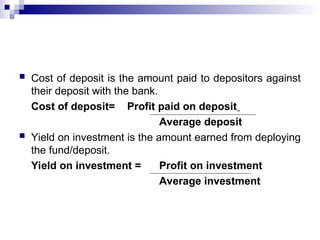
Cost ofdeposit is the amount paid to depositors against
their deposit with the bank.
Cost of deposit= Profit paid on deposit
Average deposit
Yield on investment is the amount earned from deploying
the fund/deposit.
Yield on investment = Profit on investment
Average investment
11.
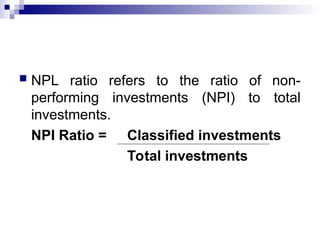
NPL ratiorefers to the ratio of non-
performing investments (NPI) to total
investments.
NPI Ratio = Classified investments
Total investments