CHAPTER 2: FINANCIAL
MARKETS AND INSTITUTIONS
June 22, 2015 - University of St. La Salle
ECONOMIC SYSTEM
Household sector
Who saves money
Business sector
Who needs money for their operations
How do these two sectors meet and transact with each
other?
LEARNING OBJECTIVES
Capital allocation, financial markets, and financial
institutions (LO1)
Stock markets (LO2)
INTRODUCTION
CAPITAL ALLOCATION (LO1)
Direct transfers - no need of financial institutions; little
capital for small firms
Primary market transactions - businesses’ securities and
savers’ money simply pass through the investment bank
Financial intermediary - wherein new forms of capital are
created (Certificates of deposit)
FINANCIAL MARKETS (LO1)
Facilitates the transfer of savings from savers to investors
Provides pricing information in the market
Provides liquidity
Saves time, money and efforts.
FINANCIAL MARKETS (LO1)
Physical asset markets vs financial asset markets
Spot Markets vs Futures Markets
Money markets vs Capital markets
Primary markets vs Secondary markets
Private markets vs Public markets
Derivatives
FINANCIAL INSTITUTIONS
(LO1)
Investment banks
Commercial banks
Financial services
corporation
Credit unions
Pension funds
Life insurance companies
Mutual funds
Exchange traded funds
Hedge funds
Private equity companies
FINANCIAL INSTITUTIONS
(LO1)
Where does money come from?
The money is created from thin air every time we make a
loan. When you take out P1 million to buy a car, a bank
doesn’t actually take P1 million in notes from its vaults to put
in your account. “At that moment, new money is created,”
according to the Bank of England’s report on “Money
Creation in the Modern economy.” Banknotes - which are
printed by the Central Bank - reflect only around 3 to 10% of
a country’s actual money. the Central Bank sets a monetary
policy, which among other things regulates loans and
therefore the amount of wealth that is created.
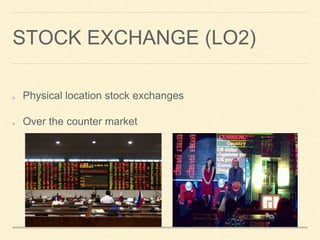
STOCK EXCHANGE (LO2)
Physical location stock exchanges
Over the counter market
Chapter 2 Financial Markets & Institutions

Chapter 2 Financial Markets & Institutions

  • 1.
    CHAPTER 2: FINANCIAL MARKETSAND INSTITUTIONS June 22, 2015 - University of St. La Salle
  • 2.
    ECONOMIC SYSTEM Household sector Whosaves money Business sector Who needs money for their operations How do these two sectors meet and transact with each other?
  • 3.
    LEARNING OBJECTIVES Capital allocation,financial markets, and financial institutions (LO1) Stock markets (LO2)
  • 4.
  • 5.
    CAPITAL ALLOCATION (LO1) Directtransfers - no need of financial institutions; little capital for small firms Primary market transactions - businesses’ securities and savers’ money simply pass through the investment bank Financial intermediary - wherein new forms of capital are created (Certificates of deposit)
  • 6.
    FINANCIAL MARKETS (LO1) Facilitatesthe transfer of savings from savers to investors Provides pricing information in the market Provides liquidity Saves time, money and efforts.
  • 7.
    FINANCIAL MARKETS (LO1) Physicalasset markets vs financial asset markets Spot Markets vs Futures Markets Money markets vs Capital markets Primary markets vs Secondary markets Private markets vs Public markets Derivatives
  • 8.
    FINANCIAL INSTITUTIONS (LO1) Investment banks Commercialbanks Financial services corporation Credit unions Pension funds Life insurance companies Mutual funds Exchange traded funds Hedge funds Private equity companies
  • 9.
    FINANCIAL INSTITUTIONS (LO1) Where doesmoney come from? The money is created from thin air every time we make a loan. When you take out P1 million to buy a car, a bank doesn’t actually take P1 million in notes from its vaults to put in your account. “At that moment, new money is created,” according to the Bank of England’s report on “Money Creation in the Modern economy.” Banknotes - which are printed by the Central Bank - reflect only around 3 to 10% of a country’s actual money. the Central Bank sets a monetary policy, which among other things regulates loans and therefore the amount of wealth that is created.
  • 10.
    STOCK EXCHANGE (LO2) Physicallocation stock exchanges Over the counter market

Editor's Notes

  • #2 *Cash is essential to run, modernise, expand business - machinery, factories, intangibles, labor, daily operations *Available adequate finance is vital
  • #3 via banks via financial markets
  • #9 Financial Services is the area of finance concerned with the design and delivery of advice and financial products to individuals, businesses, and governments.