



1. FINANCIAL MANAGEMENT
2. DIFFERENCE BETWEEN ACCOUNTING AND FINANCE
3. CLASSIFICATION OF CAPITAL
4. SOURCES OF FINANCE
5. TYPES OF FINANCIAL INSTITUTION
6. OBJECTIVES OF FINANCIAL MANAGEMENT
7. SCOPE OF FINANCIAL MANAGEMENT
8. SHARES V/S DEBENTURES
9. TYPES OF SHARE V/S DEBENTURES
“Finance defined as the art and
science of managing money.”
Finance includes capital, funds,
money and amount.
Finance is one of the important
and integral part of business
concerns, hence, it plays a major
role in every part of the business
activities.
Business Finance can broadly be
defined as the activity concerned
with planning, raising, controlling,
administering of the funds used in
the business.
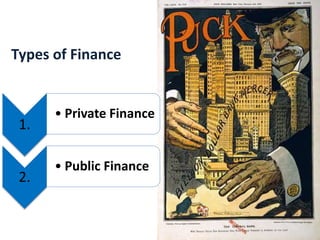
Types of Finance
1.
• Private Finance
2.
• Public Finance
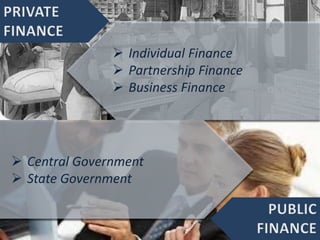
 Individual Finance
 Partnership Finance
 Business Finance
 Central Government
 State Government
• Financial Management means
planning, organizing, directing
and controlling the financial
activities of an organization.
“Financial Management deals
with how the corporation obtain
the funds and how it uses them.”
 Hoagland
• The business goal can be
achieved only with the help of
effective management of finance.
We can’t neglect the importance
of Finance.
• “Financial Planning is an important
part of the business concern, which
helps to promotion of an enterprise.”
• Proper use and allocation of funds
leads to improve the operational
efficiency of the business concern.
When the finance manger uses the
funds properly, they can reduce the
cost of the capital and increase the
value of the firm.
• Financial management helps to
take sound financial decision in
the business concern. Financial
decision will affect the entire
business operation of the concern.
Profitability of the concern purely
depends on the effectiveness and
proper utilization of funds by the
business concern. Financial
management helps to improve the
profitability position of the
concern with the help of strong
financial control devices such as a
budgetary control, ratio analysis
and cost volume profit analysis.
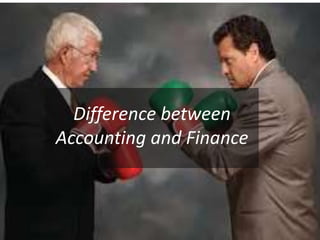
Difference between
Accounting and Finance
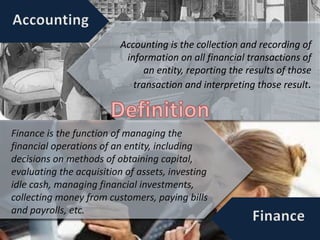
Accounting is the collection and recording of
information on all financial transactions of
an entity, reporting the results of those
transaction and interpreting those result.
Finance is the function of managing the
financial operations of an entity, including
decisions on methods of obtaining capital,
evaluating the acquisition of assets, investing
idle cash, managing financial investments,
collecting money from customers, paying bills
and payrolls, etc.
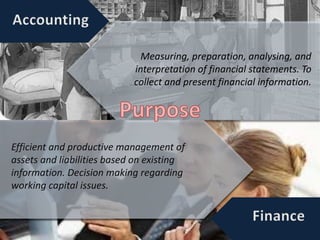
Measuring, preparation, analysing, and
interpretation of financial statements. To
collect and present financial information.
Efficient and productive management of
assets and liabilities based on existing
information. Decision making regarding
working capital issues.
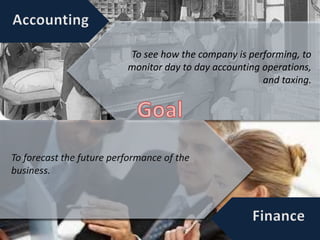
To see how the company is performing, to
monitor day to day accounting operations,
and taxing.
To forecast the future performance of the
business.
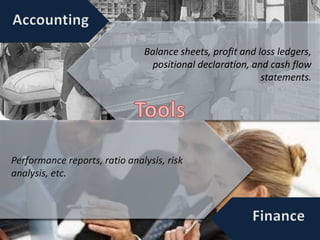
Balance sheets, profit and loss ledgers,
positional declaration, and cash flow
statements.
Performance reports, ratio analysis, risk
analysis, etc.
The term ‘Capital’ is rather broad as it
include both financial and physical
assets.
Capital is used by a corporation to
finance its assets, daily operations,
expansion and other activities that
require financing beyond what can be
provided by its on-going returns.
Classification of Capital
1
• Fixed Capital
2
• Working Capital
3
• Sunk Capital
4
• Floating Capital
Classification of Capital
6
•Money Capital
7
•Real Capital
8
•Private Capital
9
•Social Capital
• It refers to durable capital goods
which are used in production
again and again till they wear out.
Machinery, tools, means of
transport, factory building, etc. are
fixed capital. Fixed capital does not
mean fixed in location. Since the
money invested in such capital
goods is fixed for a long period, it
is called Fixed Capital.
• Working capital refers to all capital (financial
or non-financial) that is used in everyday
production activities. Without working capital,
an entrepreneur cannot continue the
production processes. Working capital is that
part of capital invested which is used for
running the business such like money which is
used to buy stock, pay expenses and finance
credit.
• Some capital can be used for a particular
task only. This type of capital is known as sunk
capital. For example, railway track can be
used only for train commutation. Hence,
railway track is an example for sunk capital.
Sunk capital is also known as ‘specific’ or
‘specialized’ capital.
• Unlike sunk capital, some sort of
capital can be used for various
purposes. For example, dams are
useful for irrigation, drinking
water and generating electricity.
Thus, this type of capital is known
as floating capital. Because the
capital can be used for various
purposes, it is also known as ‘non-
specific’ or ‘non-specialized’
capital.
• Money capital means the money funds
available with the enterprise for purchasing
various types of capital goods, raw materials
etc. it is also called liquid capital. At the
beginning the money capital is required for
two purposes one for acquiring fixed assets
i.e. fixed capital goods and another for
purchasing raw materials, payment of wages
and meeting certain current expenses i.e.
working
• On the other hand, real capital is
referred to the capital goods other
than money such as physical
assets machinery, factory
buildings, semi-finished goods,
raw materials, transport
equipment's, etc.
• All the physical assets (other than land), as
well as investments, which bring income to
an individual are called private capital.
• Private capital, as the name indicates,
refers to capital owned by individuals.
Examples of private capital are buildings,
personal vehicles and so on.
• All the assets owned by a
community as a whole in the form
of non-commercial assets are
called social capital e.g. roads,
public parks, hospitals, etc.
It is rightly said that finance is the life-blood
of business. No Business can be carried on
without source of finance .
The financial manager is mainly responsible
for raising the required finance for the
business. There are several sources of Finance
and as such the finance has to be raised from
the right kind of sources
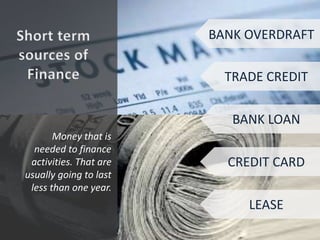
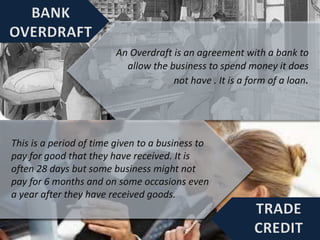
BANK OVERDRAFT
Money that is
needed to finance
activities. That are
usually going to last
less than one year.
TRADE CREDIT
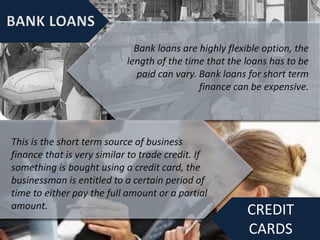
BANK LOAN
CREDIT CARD
LEASE
An Overdraft is an agreement with a bank to
allow the business to spend money it does
not have . It is a form of a loan.
This is a period of time given to a business to
pay for good that they have received. It is
often 28 days but some business might not
pay for 6 months and on some occasions even
a year after they have received goods.
CREDIT
CARDS
Bank loans are highly flexible option, the
length of the time that the loans has to be
paid can vary. Bank loans for short term
finance can be expensive.
This is the short term source of business
finance that is very similar to trade credit. If
something is bought using a credit card, the
businessman is entitled to a certain period of
time to either pay the full amount or a partial
amount.
This source of short term business finance
implies that the business is paying for the use
of a product but it does not own it. Lease is
often referred to as hiring. A lease
arrangement on a product might mean that
the company pays out a certain amount of
money per month for a specific number of
years. At the end of the time period the
product is returned to the owner.
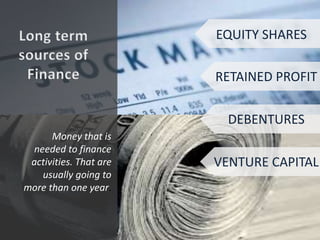
EQUITY SHARES
Money that is
needed to finance
activities. That are
usually going to
more than one year.
RETAINED PROFIT
DEBENTURES
VENTURE CAPITAL
RETAINED
PROFIT
Equity capital represents ownership capital
as equity share holders collectively own the
company. They enjoy there rewards and bear
the risk of ownership.
Profits from a business account can be used
by the owners for their own personal use or
can be used to put back into the business.
VENTUER
CAPITAL
A form of stock market loans for Ltd
companies which is secured against your
business assets. Failure to pay back loan on
time will result in seizure of those assets by
your creditor.
Venture capital is money provided by
professionals who alongside management
invest in young, rapidly growing companies
that have the potential to develop into
significant economics contributors.
A financial institution is an establishment that
conducts financial transactions such as
investments, loans and deposits.
Everything from depositing money to taking out
loans and exchanging currencies must be done
through financial institutions.
Commerical Banks
 Commercial banks accept deposits
and provide security and convenience
to their customers.
 Transactions can be handled with
checks, debit cards or credit cards,
instead.
 Commercial banks are like SBI, Bank Of
India, Punjab National Bank etc.
Investment Banks
 Investment banks may be called "banks"
their operations are far different than
deposit-gathering commercial banks.
 An investment bank is a financial
intermediary that performs a variety of
services for businesses and some
governments.
 Investment banks focus on initial public
offerings (IPOs) and large public
and private share offerings .
Insurance Companies
 By insuring a large number of people,
insurance companies can operate
profitably and at the same time pay for
claims that may arise.
 Insurance companies use statistical
analysis to project what their actual losses
will be within a given class.
 They know that not all insured individuals
will suffer losses at the same time or at all.
Investment Companies
An investment company is a corporation
or a trust through which individuals
invest in diversified, professionally
managed portfolios of securities by
pooling their funds with those of other
investors.
 Unit investment trusts (UITs).
 Face amount certificate companies.
 Managed investment companies.
Closed-End investment
companies
 A closed-end investment company issues
shares in a one-time public offering.
 It does not continually offer new shares,
nor does it redeem its shares like an
open-end investment company.
 The market value of the closed-end
fund's shares will be based on supply
and demand, much like other securities.
Open-End investment
companies
 Open-end investment
companies, also known
as mutual funds, continuously
issue new shares.
 These shares may only be
purchased from the investment
company and sold back to the
investment company.
Profit
Maximization
Wealth
Maximization
• The main objective of financial
management is profit
maximization. The finance
manager tries to earn maximum
profits for the company in the
short-term and the long-term.
•A situation where output exceeds
input, that is the value created by
the use of resources is more than
the total of the input resources
Favorable Arguments for
Profit Maximization.
1. The barometer for measuring
efficiency.
2. Profit reduces risk of a business
concern.
3. Profit is main source of finance.
4. Profit helps to meet social needs.
1. Profit maximization leads to
exploitation of workers and
consumers.
2. Profit maximization creates
immoral activities.
3. Profit maximization leads to
inequalities among
stockholders.
Unfavorable Arguments for
Profit Maximization.
Drawback of Profit
Maximization
1. It is vague.
2. It ignores the Time value of money.
3. It ignores risk factor.
4. Dividend Policy
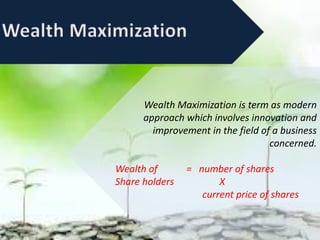
Wealth Maximization is term as modern
approach which involves innovation and
improvement in the field of a business
concerned.
Wealth of = number of shares
Share holders X
current price of shares
Favorable Arguments of
Wealth Maximization
1. Wealth maximization is superior to the
profit maximization.
2. It provides exact value of business concern.
3. It considers both time and risk.
4. Wealth maximization provides effective
allocation of resources.
5. It insures the economic interest of the
society.
1. The ultimate aim of the wealth
maximization is to maximize profit.
2. Wealth maximization can be activated
only with the profitable position of the
business concern.
Unfavorable Arguments of
Wealth Maximization
•Financial management has a
wide scope. The scope of
financial management includes
the following five ‘A’s.
2. ACQUISITION
3. ALLOCATION
4. APPROPRIATION
5. ASSESSMENT
ASSESSMENT
It also controls all the financial
activities of the company. Financial
management is the most important
functional area of management. All
other functional areas such as
production management, marketing
management, personnel management,
etc. depends on Financial management.
Efficient financial management is
required for survival, growth and
success of the company or firm
Shares vs Debentures
1
• Comparison Chart
2
• Definition
3
• Key difference
4
• Similarities
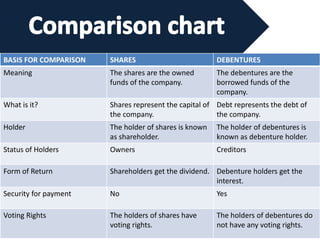
BASIS FOR COMPARISON SHARES DEBENTURES
Meaning The shares are the owned
funds of the company.
The debentures are the
borrowed funds of the
company.
What is it? Shares represent the capital of
the company.
Debt represents the debt of
the company.
Holder The holder of shares is known
as shareholder.
The holder of debentures is
known as debenture holder.
Status of Holders Owners Creditors
Form of Return Shareholders get the dividend. Debenture holders get the
interest.
Security for payment No Yes
Voting Rights The holders of shares have
voting rights.
The holders of debentures do
not have any voting rights.
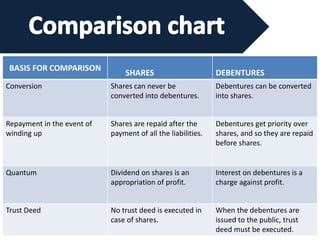
BASIS FOR COMPARISON
SHARES DEBENTURES
Conversion Shares can never be
converted into debentures.
Debentures can be converted
into shares.
Repayment in the event of
winding up
Shares are repaid after the
payment of all the liabilities.
Debentures get priority over
shares, and so they are repaid
before shares.
Quantum Dividend on shares is an
appropriation of profit.
Interest on debentures is a
charge against profit.
Trust Deed No trust deed is executed in
case of shares.
When the debentures are
issued to the public, trust
deed must be executed.
Definition of Shares
Smallest division of the company’s
capital is known as shares. The
shares are offered for sale in the
open market, i.e. stock market to
raise capital for the company. The
rate on which the shares are
offered is known as share price. It
represents the portion of
ownership of the shareholder in
the company.
Equity Shares
The shares which carry voting rights
on which the rate of dividend is not
fixed. They are irredeemable in
nature.
Preference Shares
The shares which do not carry
voting rights, but the rate of
dividend is fixed. They are
redeemable in nature.
Definition of Debentures
A long term debt instrument issued
by the company under its common
seal, to the debenture holder
showing the indebtedness of the
company. The debentures can
be redeemable or irredeemable in
nature. They are freely transferable.
The return on debentures is in the
form of interest at a fixed rate.
Types of debentures
• Secured Debentures
• Unsecured Debentures
• Convertible Debentures
• Non-convertible Debentures
• Registered Debentures
• Bearer Debentures
• Redeemable debentures
• Non Redeemable debentures
Key Differences Between
Shares and Debentures
 The holder of shares is known as
shareholder while the holder of
debentures is known as debenture holder.
 Share is the capital of the company but
Debenture is the debt of the company.
 The shares represent ownership of the
shareholders in the company. On the other
hand, debentures represent indebtedness
of the company.
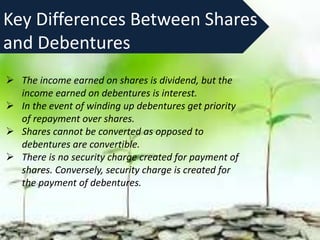
Key Differences Between Shares
and Debentures
 The income earned on shares is dividend, but the
income earned on debentures is interest.
 In the event of winding up debentures get priority
of repayment over shares.
 Shares cannot be converted as opposed to
debentures are convertible.
 There is no security charge created for payment of
shares. Conversely, security charge is created for
the payment of debentures.
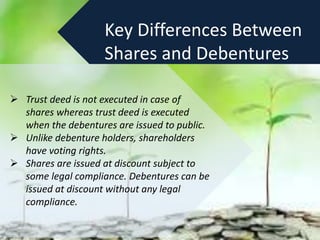
Key Differences Between
Shares and Debentures
 Trust deed is not executed in case of
shares whereas trust deed is executed
when the debentures are issued to public.
 Unlike debenture holders, shareholders
have voting rights.
 Shares are issued at discount subject to
some legal compliance. Debentures can be
issued at discount without any legal
compliance.
Similarities
 Both are Financial Assets.
 Both can issued to public.
 Source of raising money for the
company.
 They can be issued at discount.

Financial management

  • 2.
    1. FINANCIAL MANAGEMENT 2.DIFFERENCE BETWEEN ACCOUNTING AND FINANCE 3. CLASSIFICATION OF CAPITAL 4. SOURCES OF FINANCE 5. TYPES OF FINANCIAL INSTITUTION 6. OBJECTIVES OF FINANCIAL MANAGEMENT 7. SCOPE OF FINANCIAL MANAGEMENT 8. SHARES V/S DEBENTURES 9. TYPES OF SHARE V/S DEBENTURES
  • 3.
    “Finance defined asthe art and science of managing money.” Finance includes capital, funds, money and amount.
  • 4.
    Finance is oneof the important and integral part of business concerns, hence, it plays a major role in every part of the business activities. Business Finance can broadly be defined as the activity concerned with planning, raising, controlling, administering of the funds used in the business.
  • 5.
    Types of Finance 1. •Private Finance 2. • Public Finance
  • 6.
     Individual Finance Partnership Finance  Business Finance  Central Government  State Government
  • 7.
    • Financial Managementmeans planning, organizing, directing and controlling the financial activities of an organization. “Financial Management deals with how the corporation obtain the funds and how it uses them.”  Hoagland
  • 8.
    • The businessgoal can be achieved only with the help of effective management of finance. We can’t neglect the importance of Finance.
  • 9.
    • “Financial Planningis an important part of the business concern, which helps to promotion of an enterprise.” • Proper use and allocation of funds leads to improve the operational efficiency of the business concern. When the finance manger uses the funds properly, they can reduce the cost of the capital and increase the value of the firm.
  • 10.
    • Financial managementhelps to take sound financial decision in the business concern. Financial decision will affect the entire business operation of the concern.
  • 11.
    Profitability of theconcern purely depends on the effectiveness and proper utilization of funds by the business concern. Financial management helps to improve the profitability position of the concern with the help of strong financial control devices such as a budgetary control, ratio analysis and cost volume profit analysis.
  • 12.
  • 13.
    Accounting is thecollection and recording of information on all financial transactions of an entity, reporting the results of those transaction and interpreting those result. Finance is the function of managing the financial operations of an entity, including decisions on methods of obtaining capital, evaluating the acquisition of assets, investing idle cash, managing financial investments, collecting money from customers, paying bills and payrolls, etc.
  • 14.
    Measuring, preparation, analysing,and interpretation of financial statements. To collect and present financial information. Efficient and productive management of assets and liabilities based on existing information. Decision making regarding working capital issues.
  • 15.
    To see howthe company is performing, to monitor day to day accounting operations, and taxing. To forecast the future performance of the business.
  • 16.
    Balance sheets, profitand loss ledgers, positional declaration, and cash flow statements. Performance reports, ratio analysis, risk analysis, etc.
  • 17.
    The term ‘Capital’is rather broad as it include both financial and physical assets. Capital is used by a corporation to finance its assets, daily operations, expansion and other activities that require financing beyond what can be provided by its on-going returns.
  • 18.
    Classification of Capital 1 •Fixed Capital 2 • Working Capital 3 • Sunk Capital 4 • Floating Capital
  • 19.
    Classification of Capital 6 •MoneyCapital 7 •Real Capital 8 •Private Capital 9 •Social Capital
  • 20.
    • It refersto durable capital goods which are used in production again and again till they wear out. Machinery, tools, means of transport, factory building, etc. are fixed capital. Fixed capital does not mean fixed in location. Since the money invested in such capital goods is fixed for a long period, it is called Fixed Capital.
  • 21.
    • Working capitalrefers to all capital (financial or non-financial) that is used in everyday production activities. Without working capital, an entrepreneur cannot continue the production processes. Working capital is that part of capital invested which is used for running the business such like money which is used to buy stock, pay expenses and finance credit.
  • 22.
    • Some capitalcan be used for a particular task only. This type of capital is known as sunk capital. For example, railway track can be used only for train commutation. Hence, railway track is an example for sunk capital. Sunk capital is also known as ‘specific’ or ‘specialized’ capital.
  • 23.
    • Unlike sunkcapital, some sort of capital can be used for various purposes. For example, dams are useful for irrigation, drinking water and generating electricity. Thus, this type of capital is known as floating capital. Because the capital can be used for various purposes, it is also known as ‘non- specific’ or ‘non-specialized’ capital.
  • 24.
    • Money capitalmeans the money funds available with the enterprise for purchasing various types of capital goods, raw materials etc. it is also called liquid capital. At the beginning the money capital is required for two purposes one for acquiring fixed assets i.e. fixed capital goods and another for purchasing raw materials, payment of wages and meeting certain current expenses i.e. working
  • 25.
    • On theother hand, real capital is referred to the capital goods other than money such as physical assets machinery, factory buildings, semi-finished goods, raw materials, transport equipment's, etc.
  • 26.
    • All thephysical assets (other than land), as well as investments, which bring income to an individual are called private capital. • Private capital, as the name indicates, refers to capital owned by individuals. Examples of private capital are buildings, personal vehicles and so on.
  • 27.
    • All theassets owned by a community as a whole in the form of non-commercial assets are called social capital e.g. roads, public parks, hospitals, etc.
  • 28.
    It is rightlysaid that finance is the life-blood of business. No Business can be carried on without source of finance . The financial manager is mainly responsible for raising the required finance for the business. There are several sources of Finance and as such the finance has to be raised from the right kind of sources
  • 29.
    BANK OVERDRAFT Money thatis needed to finance activities. That are usually going to last less than one year. TRADE CREDIT BANK LOAN CREDIT CARD LEASE
  • 30.
    An Overdraft isan agreement with a bank to allow the business to spend money it does not have . It is a form of a loan. This is a period of time given to a business to pay for good that they have received. It is often 28 days but some business might not pay for 6 months and on some occasions even a year after they have received goods.
  • 31.
    CREDIT CARDS Bank loans arehighly flexible option, the length of the time that the loans has to be paid can vary. Bank loans for short term finance can be expensive. This is the short term source of business finance that is very similar to trade credit. If something is bought using a credit card, the businessman is entitled to a certain period of time to either pay the full amount or a partial amount.
  • 32.
    This source ofshort term business finance implies that the business is paying for the use of a product but it does not own it. Lease is often referred to as hiring. A lease arrangement on a product might mean that the company pays out a certain amount of money per month for a specific number of years. At the end of the time period the product is returned to the owner.
  • 33.
    EQUITY SHARES Money thatis needed to finance activities. That are usually going to more than one year. RETAINED PROFIT DEBENTURES VENTURE CAPITAL
  • 34.
    RETAINED PROFIT Equity capital representsownership capital as equity share holders collectively own the company. They enjoy there rewards and bear the risk of ownership. Profits from a business account can be used by the owners for their own personal use or can be used to put back into the business.
  • 35.
    VENTUER CAPITAL A form ofstock market loans for Ltd companies which is secured against your business assets. Failure to pay back loan on time will result in seizure of those assets by your creditor. Venture capital is money provided by professionals who alongside management invest in young, rapidly growing companies that have the potential to develop into significant economics contributors.
  • 36.
    A financial institutionis an establishment that conducts financial transactions such as investments, loans and deposits. Everything from depositing money to taking out loans and exchanging currencies must be done through financial institutions.
  • 37.
    Commerical Banks  Commercialbanks accept deposits and provide security and convenience to their customers.  Transactions can be handled with checks, debit cards or credit cards, instead.  Commercial banks are like SBI, Bank Of India, Punjab National Bank etc.
  • 38.
    Investment Banks  Investmentbanks may be called "banks" their operations are far different than deposit-gathering commercial banks.  An investment bank is a financial intermediary that performs a variety of services for businesses and some governments.  Investment banks focus on initial public offerings (IPOs) and large public and private share offerings .
  • 39.
    Insurance Companies  Byinsuring a large number of people, insurance companies can operate profitably and at the same time pay for claims that may arise.  Insurance companies use statistical analysis to project what their actual losses will be within a given class.  They know that not all insured individuals will suffer losses at the same time or at all.
  • 40.
    Investment Companies An investmentcompany is a corporation or a trust through which individuals invest in diversified, professionally managed portfolios of securities by pooling their funds with those of other investors.  Unit investment trusts (UITs).  Face amount certificate companies.  Managed investment companies.
  • 41.
    Closed-End investment companies  Aclosed-end investment company issues shares in a one-time public offering.  It does not continually offer new shares, nor does it redeem its shares like an open-end investment company.  The market value of the closed-end fund's shares will be based on supply and demand, much like other securities.
  • 42.
    Open-End investment companies  Open-endinvestment companies, also known as mutual funds, continuously issue new shares.  These shares may only be purchased from the investment company and sold back to the investment company.
  • 44.
  • 45.
    • The mainobjective of financial management is profit maximization. The finance manager tries to earn maximum profits for the company in the short-term and the long-term. •A situation where output exceeds input, that is the value created by the use of resources is more than the total of the input resources
  • 46.
    Favorable Arguments for ProfitMaximization. 1. The barometer for measuring efficiency. 2. Profit reduces risk of a business concern. 3. Profit is main source of finance. 4. Profit helps to meet social needs.
  • 47.
    1. Profit maximizationleads to exploitation of workers and consumers. 2. Profit maximization creates immoral activities. 3. Profit maximization leads to inequalities among stockholders. Unfavorable Arguments for Profit Maximization.
  • 48.
    Drawback of Profit Maximization 1.It is vague. 2. It ignores the Time value of money. 3. It ignores risk factor. 4. Dividend Policy
  • 49.
    Wealth Maximization isterm as modern approach which involves innovation and improvement in the field of a business concerned. Wealth of = number of shares Share holders X current price of shares
  • 50.
    Favorable Arguments of WealthMaximization 1. Wealth maximization is superior to the profit maximization. 2. It provides exact value of business concern. 3. It considers both time and risk. 4. Wealth maximization provides effective allocation of resources. 5. It insures the economic interest of the society.
  • 51.
    1. The ultimateaim of the wealth maximization is to maximize profit. 2. Wealth maximization can be activated only with the profitable position of the business concern. Unfavorable Arguments of Wealth Maximization
  • 52.
    •Financial management hasa wide scope. The scope of financial management includes the following five ‘A’s.
  • 56.
  • 57.
  • 58.
  • 59.
  • 60.
    ASSESSMENT It also controlsall the financial activities of the company. Financial management is the most important functional area of management. All other functional areas such as production management, marketing management, personnel management, etc. depends on Financial management. Efficient financial management is required for survival, growth and success of the company or firm
  • 61.
    Shares vs Debentures 1 •Comparison Chart 2 • Definition 3 • Key difference 4 • Similarities
  • 62.
    BASIS FOR COMPARISONSHARES DEBENTURES Meaning The shares are the owned funds of the company. The debentures are the borrowed funds of the company. What is it? Shares represent the capital of the company. Debt represents the debt of the company. Holder The holder of shares is known as shareholder. The holder of debentures is known as debenture holder. Status of Holders Owners Creditors Form of Return Shareholders get the dividend. Debenture holders get the interest. Security for payment No Yes Voting Rights The holders of shares have voting rights. The holders of debentures do not have any voting rights.
  • 63.
    BASIS FOR COMPARISON SHARESDEBENTURES Conversion Shares can never be converted into debentures. Debentures can be converted into shares. Repayment in the event of winding up Shares are repaid after the payment of all the liabilities. Debentures get priority over shares, and so they are repaid before shares. Quantum Dividend on shares is an appropriation of profit. Interest on debentures is a charge against profit. Trust Deed No trust deed is executed in case of shares. When the debentures are issued to the public, trust deed must be executed.
  • 64.
    Definition of Shares Smallestdivision of the company’s capital is known as shares. The shares are offered for sale in the open market, i.e. stock market to raise capital for the company. The rate on which the shares are offered is known as share price. It represents the portion of ownership of the shareholder in the company.
  • 65.
    Equity Shares The shareswhich carry voting rights on which the rate of dividend is not fixed. They are irredeemable in nature.
  • 66.
    Preference Shares The shareswhich do not carry voting rights, but the rate of dividend is fixed. They are redeemable in nature.
  • 67.
    Definition of Debentures Along term debt instrument issued by the company under its common seal, to the debenture holder showing the indebtedness of the company. The debentures can be redeemable or irredeemable in nature. They are freely transferable. The return on debentures is in the form of interest at a fixed rate.
  • 68.
    Types of debentures •Secured Debentures • Unsecured Debentures • Convertible Debentures • Non-convertible Debentures • Registered Debentures • Bearer Debentures • Redeemable debentures • Non Redeemable debentures
  • 69.
    Key Differences Between Sharesand Debentures  The holder of shares is known as shareholder while the holder of debentures is known as debenture holder.  Share is the capital of the company but Debenture is the debt of the company.  The shares represent ownership of the shareholders in the company. On the other hand, debentures represent indebtedness of the company.
  • 70.
    Key Differences BetweenShares and Debentures  The income earned on shares is dividend, but the income earned on debentures is interest.  In the event of winding up debentures get priority of repayment over shares.  Shares cannot be converted as opposed to debentures are convertible.  There is no security charge created for payment of shares. Conversely, security charge is created for the payment of debentures.
  • 71.
    Key Differences Between Sharesand Debentures  Trust deed is not executed in case of shares whereas trust deed is executed when the debentures are issued to public.  Unlike debenture holders, shareholders have voting rights.  Shares are issued at discount subject to some legal compliance. Debentures can be issued at discount without any legal compliance.
  • 72.
    Similarities  Both areFinancial Assets.  Both can issued to public.  Source of raising money for the company.  They can be issued at discount.