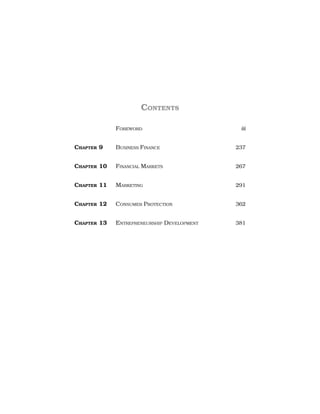
CONTENTS
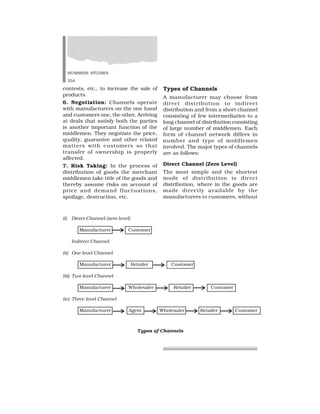
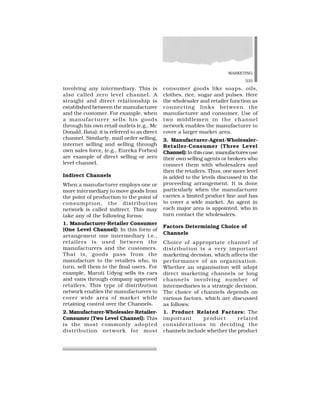
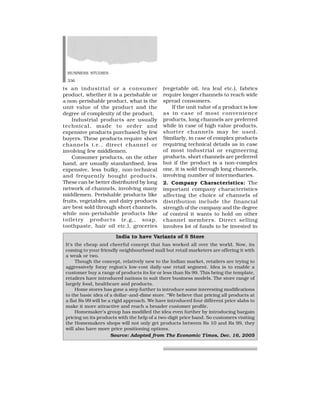
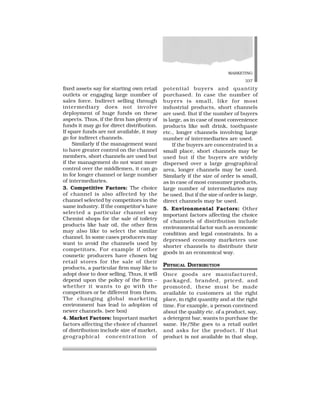
FOREWORD iii
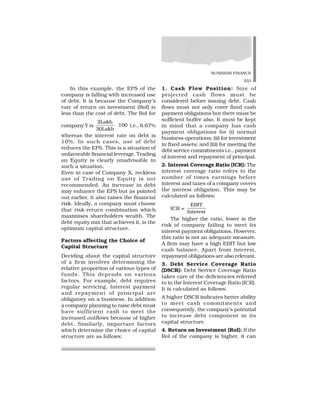
CHAPTER 9 BUSINESS FINANCE 237
CHAPTER 10 FINANCIAL MARKETS 267
CHAPTER 11 MARKETING 291
CHAPTER 12 CONSUMER PROTECTION 362
CHAPTER 13 ENTREPRENEURSHIP DEVELOPMENT 381
CHAPTER
10
FINANCIAL MARKETS
IDEA SEEKS TO CAPITALISE ON
MARKET MOMENTUM
With the explosive growth of their
subscriber base, telecom companies
are all looking at capital markets to
raise funds to fuel their expansion
plan. Idea Cellular, the fifth largest
operator in the country and the
flagship telecom venture of AV Birla
Group, has decided to enter the capital
market to raise between Rs. 1,700 and
Rs. 2,000 crore.
The company has appointed J.M.
Morgan Stanley, Merrill Lynch among
other as book-runners for the
proposed Initial Public Offer (IPO),
which is expected to be ready by
January end.
Since, under SEBI norms, the
minimum float size is 10 per cent, the
company will divest between 10
and 12 per cent, “The last private
placement made by the promoters is
at a market capitalisation of
Rs. 15,000 crore. The proposed float
is expected to be at 10 to 20 per cent
premium of the private placement
price,” AV Birla Group recently
divested 35 per cent stake in the
company to a clutch of private equity
firms. However, this is a fresh issue of
shares, where the proceeds will be
utilised by Ideal Cellular for capital
expenditure. After the proposed
issues, the promoters stake will come
down to around 58 per cent.
Source: www.hindustantimes.com
LEARNING OBJECTIVES
After studying this chapter, you
should be able to:
  explain the meaning of
Financial Market;
  explain the meaning of Money
Market and describe its
Instruments;
  explain the nature and types of
Capital Market;
  distinguish between Money
Market and Capital Market;
  explain the meaning and
functions of Stock Exchanges;
  explain the functioning of NSEI
and OTCEI; and
  describe the role of SEBI in
investor protection.
BUSINESS STUDIES
268
INTRODUCTION
You all know that a business needs
finance from the time an entrepreneur
makes the decision to start it. It needs
finance both for working capital
requirements such as payments for
raw materials and salaries to its
employees, and fixed capital
expenditure such as the purchase of
machinery or building or to expand its
production capacity. The above
example gives a fair picture of how
companies need to raise funds from the
capital markets. Idea Cellular decided
to enter the Indian capital market for
its needs of expansion. In this chapter
you will study concepts like private
placement, Initial public Offer (IPO) and
capital markets which you come across
in the example of Idea Cellular.
Business can raise these funds from
various sources and in different ways
through financial markets. This
chapter provides a brief description of
the mechanism through which finances
are mobilised by a business organisation
for both short term and long term
requirements. It also explains the
institutional structure and the regulatory
measures for different financial markets.
CONCEPT OF FINANCIAL MARKET
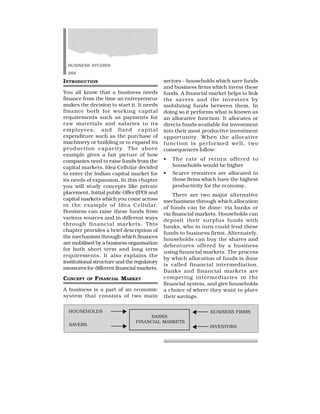
A business is a part of an economic
system that consists of two main
sectors – households which save funds
and business firms which invest these
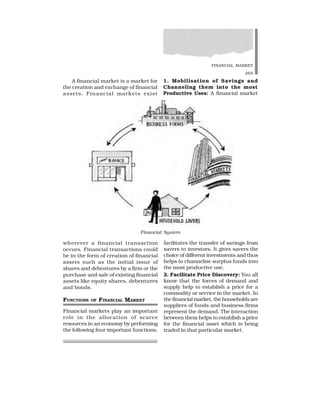
funds. A financial market helps to link
the savers and the investors by
mobilizing funds between them. In
doing so it performs what is known as
an allocative function. It allocates or
directs funds available for investment
into their most productive investment
opportunity. When the allocative
function is performed well, two
consequences follow:
• The rate of return offered to
households would be higher
• Scarce resources are allocated to
those firms which have the highest
productivity for the economy.
There are two major alternative
mechanisms through which allocation
of funds can be done: via banks or
via financial markets. Households can
deposit their surplus funds with
banks, who in turn could lend these
funds to business firms. Alternately,
households can buy the shares and
debentures offered by a business
using financial markets. The process
by which allocation of funds is done
is called financial intermediation.
Banks and financial markets are
competing intermediaries in the
financial system, and give households
a choice of where they want to place
their savings.
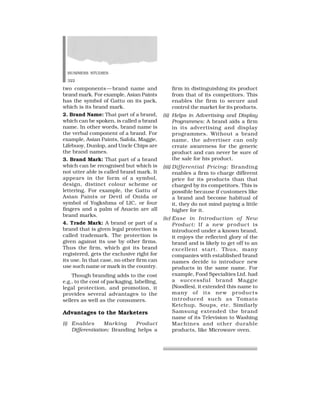
HOUSEHOLDS BUSINESS FIRMS
INVESTORSSAVERS
BANKS
FINANCIAL MARKETS
FINANCIAL MARKET
269
wherever a financial transaction
occurs. Financial transactions could
be in the form of creation of financial
assets such as the initial issue of
shares and debentures by a firm or the
purchase and sale of existing financial
assets like equity shares, debentures
and bonds.
FUNCTIONS OF FINANCIAL MARKET
Financial markets play an important
role in the allocation of scarce
resources in an economy by performing
the following four important functions.
facilitates the transfer of savings from
savers to investors. It gives savers the
choice of different investments and thus
helps to channelise surplus funds into
the most productive use.
2. Facilitate Price Discovery: You all
know that the forces of demand and
supply help to establish a price for a
commodity or service in the market. In
the financial market, the households are
suppliers of funds and business firms
represent the demand. The interaction
between them helps to establish a price
for the financial asset which is being
traded in that particular market.
A financial market is a market for
the creation and exchange of financial
assets. Financial markets exist
Financial System
1. Mobilisation of Savings and
Channeling them into the most
Productive Uses: A financial market
BUSINESS STUDIES
270
3. Provide Liquidity to Financial
Assets: Financial markets facilitate easy
purchase and sale of financial assets.
In doing so they provide liquidity to
financial assets, so that they can be
easily converted into cash whenever
required. Holders of assets can readily
sell their financial assets through the
mechanism of the financial market.
4. Reduce the Cost of Transactions:
Financial markets provide valuable
information about securities being
traded in the market. It helps to save
time, effort and money that both
buyers and sellers of a financial asset
would have to otherwise spend to try
and find each other. The financial
market is thus, a common platform
where buyers and sellers can meet for
fulfillment of their individual needs.
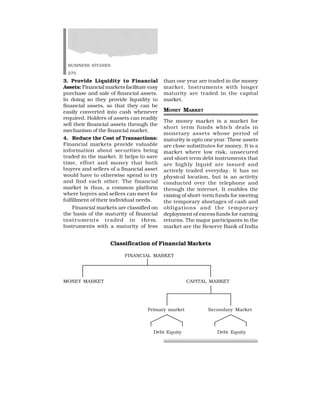
Financial markets are classified on
the basis of the maturity of financial
instruments traded in them.
Instruments with a maturity of less
than one year are traded in the money
market. Instruments with longer
maturity are traded in the capital
market.
MONEY MARKET
The money market is a market for
short term funds which deals in
monetary assets whose period of
maturity is upto one year. These assets
are close substitutes for money. It is a
market where low risk, unsecured
and short term debt instruments that
are highly liquid are issued and
actively traded everyday. It has no
physical location, but is an activity
conducted over the telephone and
through the internet. It enables the
raising of short-term funds for meeting
the temporary shortages of cash and
obligations and the temporary
deployment of excess funds for earning
returns. The major participants in the
market are the Reserve Bank of India
Classification of Financial Markets
FINANCIAL MARKET
MONEY MARKET CAPITAL MARKET
Primary market Secondary Market
Debt Equity Debt Equity
FINANCIAL MARKET
271
(RBI), Commercial Banks, Non-
Banking Finance Companies, State
Governments, Large Corporate Houses
and Mutual Funds.
MONEY MARKET INSTRUMENTS
1. Treasury Bill: A Treasury bill is
basically an instrument of short-term
borrowing by the Government of India
maturing in less than one year. They
are also known as Zero Coupon Bonds
issued by the Reserve Bank of India on
behalf of the Central Government to
meet its short-term requirement of
funds. Treasury bills are issued in the
form of a promissory note. They are
highly liquid and have assured yield
and negligible risk of default. They are
issued at a price which is lower than
their face value and repaid at par. The
difference between the price at which
the treasury bills are issued and their
redemption value is the interest
receivable on them and is called
discount. Treasury bills are available
for a minimum amount of Rs 25,000
and in multiples thereof.
Example: Suppose an investor
purchases a 91 days Treasury bill with
a face value of Rs. 1,00,000 for
Rs. 96,000. By holding the bill until the
maturity date, the investor receives
Rs. 1,00,000. The difference of
Rs. 4,000 between the proceeds
received at maturity and the amount
paid to purchase the bill represents the
interest received by him.
2. Commercial Paper: Commercial
paper is a short-term unsecured
promissory note, negotiable and
transferable by endorsement and
delivery with a fixed maturity period. It
is issued by large and creditworthy
companies to raise short-term funds at
lower rates of interest than market rates.
It usually has a maturity period of 15
days to one year. The issuance of
commercial paper is an alternative to
bank borrowing for large companies
that are generally considered to be
financially strong. It is sold at a discount
and redeemed at par. The original
purpose of commercial paper was to
provide short-terms funds for seasonal
and working capital needs. For example
companies use this instrument for
purposes such as bridge financing.
Example: Suppose a company needs
long-term finance to buy some
machinery. In order to raise the long
term funds in the capital market the
company will have to incur floatation
costs (costs associated with floating of
an issue are brokerage, commission,
printing of applications and advertising
etc.). Funds raised through commercial
paper are used to meet the floatation
costs. This is known as Bridge Financing.
3. Call Money: Call money is short
term finance repayable on demand, with
a maturity period of one day to fifteen
days, used for inter-bank transactions.
Commercial banks have to maintain a
minimum cash balance known as cash
reserve ratio. The Reserve Bank of India
changes the cash reserve ratio from time
to time which in turn affects the amount
of funds available to be given as loans
by commercial banks. Call money is a
method by which banks borrow from
each other to be able to maintain the
BUSINESS STUDIES
272
cash reserve ratio. The interest rate paid
on call money loans is known as the call
rate. It is a highly volatile rate that varies
from day-to-day and sometimes even
from hour-to-hour. There is an inverse
relationship between call rates and
other short-term money market
instruments such as certificates of
deposit and commercial paper. A rise in
call money rates makes other sources
of finance such as commercial paper
and certificates of deposit cheaper in
comparison for banks raise funds from
these sources.
4. Certificate of Deposit: Certificates
of deposit (CD) are unsecured,
negotiable, short-term instruments in
bearer form, issued by commercial
banks and development financial
institutions. They can be issued to
individuals, corporations and
companies during periods of tight
liquidity when the deposit growth of
banks is slow but the demand for
credit is high. They help to mobilise a
large amount of money for short
periods.
5. Commercial Bill: A commercial
bill is a bill of exchange used to finance
the working capital requirements of
business firms. It is a short-term,
negotiable, self-liquidating instrument
which is used to finance the credit sales
of firms. When goods are sold on credit,
the buyer becomes liable to make
payment on a specific date in future.
The seller could wait till the specified
date or make use of a bill of exchange.
The seller (drawer) of the goods draws
the bill and the buyer (drawee) accepts
it. On being accepted, the bill becomes
a marketable instrument and is called
a trade bill. These bills can be
discounted with a bank if the seller
needs funds before the bill matures.
When a trade bill is accepted by a
commercial bank it is known as a
commercial bill.
Sterlite Industries
Sterlite Industries, part of the London listed Vedanta Resources Group, is
scheduled to be listed on the New York Stock Exchange through an initial
public offering (IPO) of about $2 billion. The proceeds will be used to fund its
$1.9 billion, Greenfield power project in Orissa and to expand its aluminium
and copper facilities.
The IPO is a part of an enabling resolution passed by Sterlite to raise upto
12,500 crores through American Depository Shares (ADS). Consequently, the
company has increased its authorised capital from Rs 150 crore to
Rs 185 crore by creating an additional 17.5 crore equity shares of Rs 2 each.
The shares of Sterlite, which will be among the first metal firms from India to
list on NYSE, outpaced Sensex and rose by 1.4% to close at Rs 545.2 on BSE
on the day of the announcement.
Source: The Economic Times
FINANCIAL MARKET
273
CAPITAL MARKET
The term capital market refers to
facilities and institutional arrangements
through which long-term funds, both
debt and equity are raised and invested.
It consists of a series of channels
through which savings of the
community are made available for
industrial and commercial enterprises
and for the public in general. It directs
these savings into their most productive
use leading to growth and development
of the economy. The capital market
consists of development banks,
commercial banks and stock
exchanges.
An ideal capital market is one where
finance is available at reasonable cost.
The process of economic development
is facilitated by the existence of a well
functioning capital market. In fact,
development of the financial system is
seen as a necessary condition for
economic growth. It is essential that
financial institutions are sufficiently
developed and that market operations
are free, fair, competitive and
transparent. The capital market should
also be efficient in respect of the
information that it delivers, minimise
transaction costs and allocate capital
most productively.
The Capital Market can be divided
into two parts: a. Primary Market
b. Secondary Market
PRIMARY MARKET
The primary market is also known as
the new issues market. It deals with
new securities being issued for the first
time. The essential function of a primary
market is to facilitate the transfer of
investible funds from savers to
entrepreneurs seeking to establish new
enterprises or to expand existing ones
through the issue of securities for the
first time. The investors in this market
are banks, financial institutions,
insurance companies, mutual funds
and individuals.
A company can raise capital
through the primary market in the form
of equity shares, preference shares,
debentures, loans and deposits. Funds
raised may be for setting up new
projects, expansion, diversification,
modernisation of existing projects,
mergers and takeovers etc.
Methods of Floatation
There are various methods of floating
new issues in the primary market :
1. Offer through Prospectus: Offer
through prospectus is the most
popular method of raising funds by
public companies in the primary
market. This involves inviting
subscription from the public through
issue of prospectus. A prospectus
makes a direct appeal to investors to
raise capital, through an advertisement
in newspapers and magazines. The
issues may be underwritten and also
are required to be listed on at least one
stock exchange. The contents of the
prospectus have to be in accordance
with the provisions of the Companies
Act and SEBI disclosure and investor
protection guidelines.
BUSINESS STUDIES
274
2. Offer for Sale: Under this method
securities are not issued directly to the
public but are offered for sale through
intermediaries like issuing houses or
stock brokers. In this case, a company
sells securities enbloc at an agreed price
to brokers who, in turn, resell them to
the investing public.
3. Private Placement: Private
placement is the allotment of securities
by a company to institutional investors
and some selected individuals. It helps
to raise capital morequicklythanapublic
issue.Accesstotheprimarymarketcanbe
expensiveonaccountofvariousmandatory
and non-mandatory expenses. Some
companies,therefore,cannotaffordapublic
issueandchoosetouseprivateplacement.
4. Rights Issue: This is a privilege given
to existing shareholders to subscribe to
a new issue of shares according to the
terms and conditions of the company.
The shareholders are offered the ‘right’
to buy new shares in proportion to the
number of shares they already possess.
5. e-IPOs: A company proposing to
issue capital to the public through the
on-line system of the stock exchange
has to enter into an agreement with the
stock exchange. This is called an Initial
Public Offer (IPO). SEBI registered
brokers have to be appointed for the
purpose of accepting applications and
placing orders with the company. The
issuer company should also appoint a
registrar to the issue having electronic
connectivity with the exchange. The
issuer company can apply for listing of
its securities on any exchange other
than the exchange through which it has
offered its securities. The lead manager
coordinates all the activities amongst
intermediaries connected with the issue.
SECONDARY MARKET
The secondary market is also known
as the stock market or stock exchange.
It is a market for the purchase and sale
of existing securities. It helps existing
investors to disinvest and fresh
investors to enter the market. It also
provides liquidity and marketability to
existing securities. It also contributes
to economic growth by channelising
funds towards the most productive
investments through the process of
disinvestment and reinvestment.
Securities are traded, cleared and
settled within the regulatory framework
prescribed by SEBI. Advances in
information technology have made
trading through stock exchanges
accessible from anywhere in the
country through trading terminals.
Along with the growth of the primary
market in the country, the secondary
market has also grown significantly
during the last ten years.
Distinction between Capital Market
and Money Market
Both the money market and the capital
market are the centres which arrange
for the transfer of funds from the
suppliers of funds to the users of funds.
They differ, however, in regard to the
maturity periods of the financial assets
created and dealt with for affecting the
transfer of funds. As explained earlier,
money market arranges for short term
FINANCIAL MARKET
275
and capital market provides for
medium to long-term funds. The time
length in respect of short-term funds
is less than and upto one year.
STOCK EXCHANGE
A stock exchange is an institution which
provides a platform for buying and selling
of existing securities. As a market, the
stock exchange facilitates the exchange
of a security (share, debenture etc.) into
money and vice versa. Stock exchanges
help companies raise finance, provide
liquidity and safety of investment to the
investors and enhance the credit
worthiness of individual companies.
Meaning of Stock Exchange
According to Securities Contracts
(Regulation) Act 1956, stock exchange
means any body of individuals,
whether incorporated or not,
constituted for the purpose of assisting,
regulating or controlling the business
of buying and selling or dealing in
securities.
Functions of a Stock Exchange
The efficient functioning of a stock
exchange creates a conducive climate
for an active and growing primary
market for new issues. An active and
healthy secondary market in existing
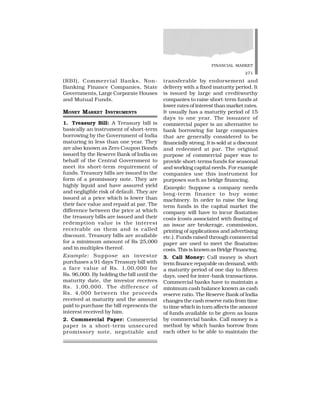
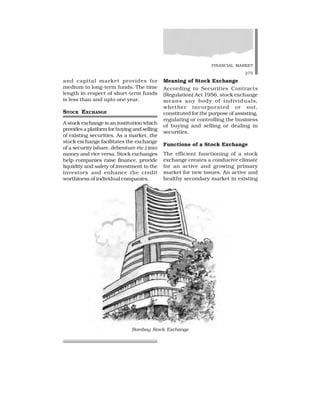
Bombay Stock Exchange
BUSINESS STUDIES
276
securities leads to positive environment
among investors. The following are
some of the important functions of a
stock exchange.
1. Providing Liquidity and Market-
ability to Existing Securities: The
basic function of a stock exchange is the
creation of a continuous market where
securities are bought and sold. It gives
investors the chance to disinvest and
reinvest. This provides both liquidity and
easy marketability to already existing
securities in the market.
2. Pricing of Securities: Share prices
on a stock exchange are determined by
the forces of demand and supply. A
stock exchange is a mechanism of
constant valuation through which the
prices of securities are determined.
Such a valuation provides important
instant information to both buyers and
sellers in the market.
3. Safety of Transaction: The
membership of a stock exchange is well-
regulated and its dealings are well
defined according to the existing legal
framework. This ensures that the
investing public gets a safe and fair deal
on the market.
4. Contributes to Economic Growth:
A stock exchange is a market in which
existing securities are resold or traded.
Through this process of disinvestment
and reinvestment savings get
channelised into their most productive
investment avenues. This leads to
capital formation and economic
growth.
5. Spreading of Equity Cult: The
stock exchange can play a vital role in
ensuring wider share ownership by
regulating new issues, better trading
practices and taking effective steps in
educating the public about investments.
History of the Stock Market in India
The history of the stock market in India goes back to the end of the eighteenth
century when long-term negotiable securities were first issued. In 1850 the
Companies Act was introduced for the first time bringing with it the feature of
limited liability and generating investor interest in corporate securities. The
first stock exchange in India was set-up in 1875 as The Native Share and
Stock Brokers Association in Bombay. Today it is known as the Bombay Stock
Exchange (BSE). This was followed by the development of exchanges in
Ahmedabad (1894), Calcutta(1908) and Madras(1937). It is interesting to note
that stock exchanges were first set up in major centers of trade and commerce.
Until the early 1990s, the Indian secondary market comprised regional
stock exchanges with BSE heading the list. After the reforms of 1991, the
Indian secondary market acquired a three tier form. This consists of:
• Regional Stock Exchanges
• National Stock Exchange (NSE)
• Over the Counter Exchange of India (OTCEI)
FINANCIAL MARKET
277
6. Providing Scope for Speculation:
The stock exchange provides sufficient
scope within the provisions of law for
speculative activity in a restricted and
controlled manner. It is generally
accepted that a certain degree of healthy
speculation is necessary to ensure
liquidity and price continuity in the
stock market.
TRADING PROCEDURE ON A STOCK
EXCHANGE
Till a few years ago trading on a stock
exchange took place through a public
outcry or auction system. This has
been replaced by an online screen
based electronic trading system as
almost all exchanges have become
electronic. Trading has, therefore,
shifted from the stock market floor to
the brokers’ office where trades are
executed through a computer. Brokers
are members of a stock exchange
through whom trading of securities is
done. Brokers may be individuals,
partnership firms or corporate bodies.
They are the intermediaries between
the buyers and sellers. Earlier these
members owned, controlled and
managed the exchanges. The ownership
and management of stock exchanges
by brokers often led to a conflict of
interest between the brokers and their
clients. This led to ‘demutualisation’ of
stock exchanges. Demutualisation
separates the ownership and control of
stock exchanges from the trading rights
of members. This reduces the conflict of
interest between the exchange and the
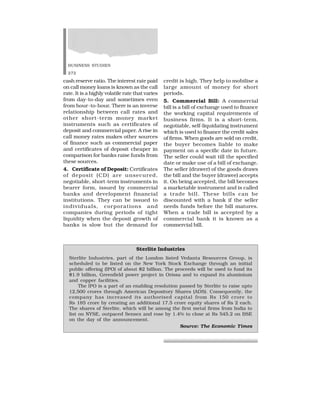
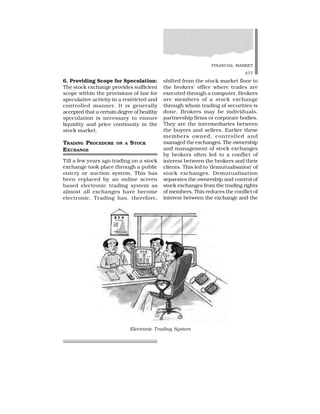
Electronic Trading System
BUSINESS STUDIES
278
brokers and the chances of brokers using
stock exchanges for personal gains.
A company’s securities can be
traded on a stock exchange only if they
are listed or quoted on it. Companies
have to fulfill a stringent set of
requirements to get their securities
listed on a stock exchange. This
ensures that the interest of the
shareholders is adequately looked after.
Transactions on a stock exchange may
be carried out on either cash basis or a
carry over basis. The carry over basis
is also called badla and is a unique
feature of Indian stock markets,
particularly the BSE. A stock exchange
year is divided into periods called
‘accounts’ which vary from a fortnight
to a month. All transactions made
during one account are to be settled
by payment for purchases and by
delivery of share certificates in the case
of sales on notified days of the clearing
programme of a given stock exchange.
A share certificate is proof of
ownership of securities by an individual.
Purchase and sale transactions in
securities involved the exchange of
money in return for the share certificate.
This led to problems of theft, forgery,
transfer delays and time involved in
paperwork. To eliminate these problems
an electronic book entry form of holding
and transferring securities has been
introduced. This is referred to as
‘dematerialisation of securities’.
NATIONAL STOCK EXCHANGE OF INDIA
(NSE)
The National Stock Exchange is the
latest, most modern and technology
driven exchange. It was incorporated
in 1992 and was recognised as a stock
Stock Market Index
A stock market index is a barometer of market behaviour. It measures overall
market sentiment through a set of stocks that are representative of the market.
It reflects market direction and indicates day-to-day fluctuations in stock
prices. An ideal index must represent changes in the prices of securities and
reflect price movements of typical shares for better market representation. In
the Indian markets the BSE, SENSEX and NSE, NIFTY are important indices.
Some important global stock market indices are:
• Dow Jones Industrial Average is among the oldest quoted stock market
index in the US.
• NASDAQ Composite Index is the market capitalisation weightages of prices
for stocks listed in the NASDAQ stock market.
• S and P 500 Index is made up of 500 biggest publicly traded companies in
the US. The S and P 500 is often treated as a proxy for the US stock market.
• FTSE 100 consists of the largest 100 companies by full market value listed
on the London Stock Exchange. The FTSE 100 is the benchmark index of
the European market.
FINANCIAL MARKET
279
exchange in April 1993. It started
operations in 1994, with trading on the
wholesale debt market segment.
Subsequently, it launched the capital
market segment in November 1994 as
a trading platform for equities and
the futures and options segment in
June 2000 for various derivative
instruments. NSE has set up a
nationwide fully automated screen
based trading system.
The NSE was setup by leading
financial institutions, banks, insurance
companies and other financial
intermediaries. It is managed by
professionals, who do not directly or
indirectly trade on the exchange. The
trading rights are with the trading
members who offer their services to the
investors. The board of NSE comprises
of senior executives from promoter
institutions and eminent professionals,
without having any representation from
trading members.
OBJECTIVES OF NSE
NSE was set up with the following
objectives:
a. Establishing a nationwide trading
facility for all types of securities.
b. Ensuring equal access to investors all
over the country through an
appropriate communication network.
c. Providing a fair, efficient and
transparent securities market
using electronic trading system.
d. Enabling shorter settlement cycles
and book entry settlements.
e. Meeting international benchmarks
and standards.
Within a span of ten years, NSE has
been able to achieve its objectives for
which it was set up. It has been playing
a leading role as a change agent in
transforming the Indian capital market.
NSE has been able to take the stock
market to the door step of the investors.
Some Common Stock Market Terms
You would have often come across the following terms in magazines or
newspapers when you read about the stock market.
BOURSES is another word for the stock market
BULLS and BEARS – The term does not refer to animals but to market
sentiment of the investors. A Bullish phase refers to a period of optimism and
a Bearish phase to a period of perssimism on the Bourses.
BADLA – This refers to a carry forward system of settlement, particularly at
the BSE. It is a facility that allows the postponement of the delivery or payment
of a transaction from one settlement period to another.
ODD LOT TRADING – Trading in multiples of 100 stocks or less.
PENNY STOCKS – These are securities that have no value on the stock
exchange but whose trading contributes to speculation.
BUSINESS STUDIES
280
It has ensured that technology has
been harnessed to deliver the services
to the investors across the country at
the lowest cost. It has provided a nation
wide screen based automated trading
system with a high degree of
transparency and equal access to
investors irrespective of geographical
location.
MARKET SEGMENTS OF NSE
The Exchange provides trading in the
following two segments.
(i) Whole Sale Debt Market Segment:
This segment provides a trading
platform for a wide range of fixed
income securities that include
central government securities,
treasury bills, state development
loans, bonds issued by public
sector undertakings, floating rate
bonds, zero coupon bonds, index
bonds, commercial paper, certificate
of deposit, corporate debentures
and mutual funds.
(ii) Capital Market Segment: The
capital market segment of NSE
provides an efficient and transparent
platform for trading in equity,
preference, debentures, exchange
traded funds as well as retail
Government securities.
OVER THE COUNTER EXCHANGE OF INDIA
(OTCEI)
The OTCEI is a company incorporated
under the Companies Act 1956. It was
set-up to provide small and medium
companies an access to the capital
market for raising finance in a cost
SENSEX — The Bombay Stock Exchange Sensitive Index
Have you counted the number of times newspaper headlines in the past few
weeks have been screaming about the SENSEX? It goes up and down all the
time and seems to be a very important part of business and economic news. Has
that made you wonder what the SENSEX actually is?
The SENSEX is the benchmark index of the BSE. Since the BSE has been the
leading exchange of the Indian secondary market, the SENSEX has been an
important indicator of the Indian stock market. It is the most frequently used
indicator while reporting on the state of the market. An index has just one job: to
capture the price movement. So a stock index will reflect the price movements of
shares while a bond index captures the manner in which bond prices go up or
down. If the SENSEX rises, it indicates the market is doing well. Since stocks are
supposed to reflect what companies expect to earn in the future, a rising index
indicates that investors expect better earnings from companies. It is also a measure
of the state of the Indian economy. If Indian companies are expected to do well,
obviously the economy should do well too.
The SENSEX, launched in 1986 is made up of 30 of the most actively traded
stocks in the market. In fact, they account for half the BSE’s market capitalisation.
They represent 13 sectors of the economy and are leaders in their respective
industries.
FINANCIAL MARKET
281
effective manner. It was also meant to
provide investors with a convenient,
transparent and efficient avenue for
capital market investment. It is fully
computerised, transparent, single
window exchange ‘which commenced
trading in 1992. This exchange is
established on the lines of NASDAQ
(National Association of Securities
Dealers Automated Quotations) the
OTC exchange in USA. It has been
promoted by UTI, ICICI, IDBI, IFCI, LIC,
GIC, SBI Capital markets and Can
Bank Financial Services.
Over the counter market may be
defined as a place where buyers seek
sellers and vice-versa and then attempt
to arrange terms and conditions for
purchase/sale acceptable to both the
parties. It is a negotiated market place
that exists any where as opposed to the
auction market place, represented by
the activity on securities exchanges.
Thus, in the OTC exchange, trading
takes place when a buyer or seller
walks up to an OTCEI counter, taps
on the computer screen, finds quotes
and effects a purchase or sale
depending on whether the prices meet
their targets. There is no particular
market place in the geographical
sense. The objectives of OTCEI are to
provide quicker liquidity to securities
at a fixed and fair price, liquidity for
less traded securities or that of small
companies, a simplified process of
buying and selling and easy and
cheaper means of making public sale
of new issues.
Advantages of OTC Market
1. It provides a trading platform to
smaller and less liquid companies
as they are not eligible for listing
on a regular exchange.
2. It is a cost effective method for
corporates as there is a lower cost
of new issues and lower expenses
of servicing the investors.
3. Family concerns and closely held
companies can go public through
OTC.
4. Dealers can operate both in new
issues and secondary market at
their option.
5. It gives greater freedom of choice
to investors to choose stocks by
dealers for market making in both
primary and secondary markets.
6. It is a transparent system of trading
with no problem of bad or short
deliveries.
7. Information flows are free and more
direct from market makers to
customers since there is close
contact between them.
SECURITIES AND EXCHANGE BOARD OF
INDIA (SEBI)
The Securities and Exchange Board
of India was established by the
Government of India on 12 April 1988
as an interim administrative body to
promote orderly and healthy growth
of securities market and for investor
protection. It was to function under
BUSINESS STUDIES
282
the overall administrative control of
the Ministry of Finance of the
Government of India. The SEBI was
given a statutory status on 30
January 1992 through an ordinance.
The ordinance was later replaced by
an Act of Parliament known as the
Securities and Exchange Board of
India Act, 1992.
Reasons for the Establishment of
SEBI
The capital market has witnessed a
tremendous growth during 1980’s,
characterised particularly by the
increasing participation of the
public. This ever expanding
investors population and market
capitalisation led to a variety of
malpractices on the part of
companies, brokers, merchant
bankers, investment consultants and
others involved in the securities
market. The glaring examples of
these malpractices include existence
of self – styled merchant bankers
unofficial private placements, rigging
of prices, unofficial premium on new
issues, non-adherence of provisions
of the Companies Act, violation of
rules and regulations of stock
exchanges and listing requirements,
delay in delivery of shares etc. These
malpractices and unfair trading
practices have eroded investor
confidence and multiplied investor
grievances. The Government and the
stock exchanges were rather helpless
in redressing the investor’s problems
because of lack of proper penal
provisions in the existing legislation.
In view of the above, the Government
of India decided to set-up a separate
regulatory body known as Securities
and Exchange Board of India.
Purpose and Role of SEBI
The basic purpose of SEBI is to create
an environment to facilitate efficient
mobilisation and allocation of
resources through the securities
markets. It also aims to stimulate
competition and encourage innovation.
This environment includes rules and
regulations, institutions and their
interrelationships, instruments,
practices, infrastructure and policy
framework.
This environment aims at meeting
the needs of the three groups which
basically constitute the market, viz,
the issuers of securities (Companies),
the investors and the market
intermediaries.
• To the issuers, it aims to provide a
market place in which they can
confidently look forward to raising
finances they need in an easy, fair
and efficient manner.
• To the investors, it should provide
protection of their rights and
interests through adequate,
accurate and authentic information
and disclosure of information on a
continuous basis.
• To the intermediaries, it should
offer a competitive, professionalised
and expanding market with
adequate and efficient infrastructure
so that they are able to render
better service to the investors and
issuers.
FINANCIAL MARKET
283
Objectives of SEBI
The overall objective of SEBI is to
protect the interests of investors and to
promote the development of, and
regulate the securities market. This
may be elaborated as follows:
1. To regulate stock exchanges and
the securities industry to promote
their orderly functioning.
2. To protect the rights and interests
of investors, particularly individual
investors and to guide and educate
them.
3. To prevent trading malpractices
and achieve a balance between self
regulation by the securities industry
and its statutory regulation.
4. To regulate and develop a code of
conduct and fair practices by
intermediaries like brokers,
merchant bankers etc., with a view
to making them competitive and
professional.
Functions of SEBI
Keeping in mind the emerging nature
of the securities market in India, SEBI
was entrusted with the twin task of
both regulation and development of the
securities market.
Regulatory Functions
1. Registration of brokers and sub-
brokers and other players in the
market.
2. Registration of collective investment
schemes and Mutual Funds.
3. Regulation of Stock Bankers and
portfolio exchanges, and merchant
bankers.
4. Prohibition of fraudulent and
unfair trade practices.
5. Controlling insider trading and
takeover bids and imposing
penalties for such practices.
6. Calling for information by
undertaking inspection, conducting
enquiries and audits of stock
exchanges and intermediaries.
7. Levying fee or other charges for
carrying out the purposes of the Act.
8. Performing and exercising such
power under Securities Contracts
(Regulation) Act 1956, as may be
delegated by the Government of
India.
Development Functions
1. Investor education
2. Training of intermediaries
3. Promotion of fair practices and
code of conduct of all SRO’s.
4. Conducting research and publishing
information useful to all market
participants.
The Organisation Structure of SEBI
As SEBI is a statutory body there has
been a considerable expansion in the
range and scope of its activities. Each of
the activities of the SEBI now demands
more careful, closer, co-ordinated and
intensive attention to enable it to attain
its objectives. Accordingly, SEBI has
been restructured and rationalised in
tune with its expanded scope. It has
decided its activities into five operational
departments. Each department is
headed by an executive director. Apart
from its head office at Mumbai, SEBI has
BUSINESS STUDIES
284
opened regional offices in Kolkalta,
Chennai, and Delhi to attend to investor
complaints and liaise with the issuers,
intermediaries and stock exchanges in
the concerned region.
The SEBI also formed two advisory
committees. They are the Primary
Market Advisory Committee and the
Secondary Market Advisory Committee.
These committees consist of the market
players, the investors associations
recognised by the SEBI and the
eminent persons in the capital market.
They provide important inputs to the
SEBI’S policies.
The objectives of the two
Committees are as follows:
a. To advise SEBI on matters relating
to the regulation of intermediaries
for ensuring investors protection in
the primary market.
b. To advise SEBI on issues related to
the development of primary market
in India.
c. To advise SEBI on disclosure
requirements for companies.
d. To advise for changes in legal
framework to introduce simplification
and transparency in the primary
market.
e. To advice the board in matters
relating to the development and
regulation of the secondary market
in the country.
The committees are however non-
statutory in nature and the SEBI is not
bound by the advise of the committee.
These committees are a part of SEBI’s
constant endeavor to obtain a feedback
from the market players on various
issues relating to the regulations and
development of the market.
SEBI Violations
SEBI on Thursday unearthed yet another abuse of IPO norms in the IDFC’s
Initial Public Offering (IPO) where a few investors opened over 14,000
dematerialised accounts to corner large number of shares of the company.
This is the second such incident, after a similar such violations were
detected in the YES Bank’s IPO.
SEBI said in IDFC’s IPO too four investors opened as many as 14,807
dematerialised accounts with Karvy-DP and ‘Strangely’, all these account
holders have their bank accounts with Bharat Overseas Bank Ltd.,
Ahmedabad.
SEBI order said: “Further probe is required for examining the systemic
fault, if any, of the registrar Karvy-RTI, i.e., Karvy Computer Shares P Ltd.,
and the lead managers Kotak Mahindra Capital Company Ltd., DSP Merrill
Lynch Ltd. and SBI Capital Markets Ltd. in identifying and weeding out the
benami applications.”
Reference is being made to the RBI to examine the role of BOB, HDFC Bank,
Indian Overseas Bank, ING Vysya Bank and Vijaya Bank in opening the
bank accounts of these benami entities and apparently funding them.
Source: The Economic Times
FINANCIAL MARKET
285
KEY TERMS
Financial Market Money Market Treasury Bills
Commercial Paper Call Money Certificate of Deposit
Commercial Bill Money Market Mutual Fund Capital
Market Primary Market Secondary Market
Stock Exchange SEBI, NSE OTCEI
SUMMARY
Financial Market is a market for creation and exchange of financial assets. It
helps in mobilisation and channelising the savings into most productive uses.
Financial markets also helps in price discovery and provide liquidity to
financial assets.
Money Market is a market for short-term funds. It deals in monetory assets
whose period of maturity is less than one year. The instruments of money
market includes treasury bills, commercial paper, call money, REPO’s,
Certificate of deposit, commercial bills, participation certificates and money
market mutual funds.
Capital Market is a place where long-term funds are mobilised by the corporate
undertakings and Government. Capital Market may be devided into primary
market and secondary market. Primary market deals with new securities which
were not previously tradable to the public. Secondary market is a place where
existing securities are bought and sold.
Stock Exchanges are the organisations which provide a platform for buying
and selling of existing securities. Stock exchanges provide continuous market
for securities, helps in price discovery, widening shareownership and provide
scope for speculation.
The National Stock Exchange of India is the latest, most modern and technology
driven exchange and was incorporated in 1992. OTCEI was incorporated in
1992 to provide listing facility for small companies with paid up capital of less
than 3 crores.
Securities and Exchange Board of India was established in 1988 and was
given statutory status through an Act in 1992. The SEBI was set-up to protect
the interests of investors, development and regulation of securities market.
BUSINESS STUDIES
286
EXERCISES
Multiple choice questions
1. Primary and Secondary Markets
a. Compete with each other
b. Complement each other
c. Function Independently
d. Control each other
2. Total number of Stock Exchanges in India are
a. 20 b. 21 c. 22 d. 23
3. The settlement cycle in NSE is
a. T + 5 b. T + 3 c. T + 2 d. T+1
4. National Stock Exchange of India was recognized as stock exchange in the year.
a. 1992 b. 1993 c. 1994 d. 1995
5. NSE commenced futures trading in the year
a. 1999 b. 2000 c. 2001 d. 2002
6. Clearing and settlement operations of NSE is carried out by
a. NSDL b. NSCCL c. SBI d. CDSL
7. OTCEI was started on the lines of
a. NASDAQ b. NYSE c. NASAQ d. NSE
8. To be listed on OTCEI, the minimum capital requirement for a company is
a. Rs. 5 Croresb. Rs. 3 Crores c. Rs. 6 Crores d. Rs. 1 Crores
9. Treasury Bills are basically
a. An instrument to borrow short term funds
b. An instrument to borrow long term funds
c. An instrument of capital market
d. None of the above
10.REPO is
a. Repurchase agreement b. Reliance Petroleum
c. Read and Process d. None of the above
Short answer questions
1. What are the functions of financial markets?
2. “Money Market is essentially Market for short term funds” Discuss.
3. What is Treasury Bill ?
FINANCIAL MARKET
287
4. What is REPO and Reverse REPO?
5. Distinguish between Capital Market and Money Market.
6. What are the functions of Stock Exchange?
7. What are the objectives of SEBI?
8. What are the objectives of NSE?
9. What is OTCEI?
Long answer questions
1. Explain the various Money Market Instruments.
2. What are the methods of floatation in Primary Market.
3. Explain the Capital Market reforms in India.
4. Explain the objectives and functions of SEBI
5. Explain the various segments of NSE.
Projects and Assignments
1. Collect the information about the companies that have mobilised resources
through primay market.
2. Collect the information on various measures taken by SEBI to protect the
interests of investors since its inception.
Try and Solve this Crossword
BUSINESS STUDIES
288
3. Send a group of students to a trading terminal in your city to gain first hand
information on securities trading and prepare a report.
4. Collect data about the movements in SENSEX and NIFTY puring the last
one month. Find out whether the two move in same or opposite direction.
5. Collect information about SEBI action for Investor Protection taken during
last two years.
6. Collect information about e-IPO’s in the Indian Market in the last one year.
Clues to the Crossword
Across
1. Commission Agent who transacts in securities on behalf of non members
or members (6).
2. Changes in the price of securities in the stock market. (12)
3. Inclusion of securities in the official trade list of securities in stock market (7)
4. Place of trade I securities (6)
5. Result of selling shares at a price lower than the purchase price. (4)
6. An independent dealer in securities (6)
7. Includes shares, scripts, bonds, debentures (10)
8. Speculator who expects the prices to go down (4)
9. Buying and selling of securities to manipulate the market (7)
10. Speculator who deals in new securities only (4)
Down
1. Speculator expecting a rise in the prices (4)
2. Means ‘with’ (3)
3. Means a part or fraction of capital (6)
4. Fraction of profit paid to government (3)
5. Illegal, game based on chance (8)
6. Official statement of securities in the stock market (5)
7. Those who buy and sell securities with objective of profit (10)
8. Money invested in business (7)
9. Return on shares out of profits (8)
10. Instrument acknowledging a debt (9)
11. Govt. document acknowledging a debt (5)
12. Profit or yield (4)
FINANCIAL MARKET
289
Case Problem I
‘R’ Limited is a real estate company which was formed in 1950. In about 56
years of its existence the company has managed to carve out a niche for itself in
this sector. Lately, this sector is witnessing a boom due to the fact that the Indian
economy is on the rise. The incomes of middle class are rising. More people can
afford to buy homes for themselves due to easy availability of loans and
accompanying tax concessions.
To expand its business in India and abroad the company is weighing various
options to raise money through equity offerings in India. Whether to tap equity or
debt. market whether to raise money from domestic market or international market
or Combination of both? Whe their to raise the necessary financé from money
market or capital market. It is also planning to list itself in New York Stock Exchange
to raise money through ADR’s. To make its offerings attractive it is planning to
offer host of financial plans products to its stakeholders and investors and also
expand it’s listing at NSE after complying with the regulations of SEBI.
(i) What benefits will the company derive from listing at NSE?
(ii) What are the regulations of SEBI that the company must comply with?
(iii) How does the SEBI exercise control over ‘R’ Limited in the interest of
investors?
Case Problem II
NSE Indices World Markets
Index Current Prev. %CHG Index Current Prev. % Change
S&P CNX Nifty 3641.1 3770.55 -3.43% NYSE Composite 8926.88 9120.93 -2.13%
CNX Nifty Junior 6458.55 6634.85 -2.66% NASDAQ Composite 2350.57 2402.29 -2.15%
CNX IT 5100.5 5314.05 -4.02% DOW Jones I. A. 12076 12318.6 -1.97%
Bank Nifty 5039.05 5251.55 -4.05% S&P 500 1377.95 1406.6 -2.04%
CNX 100 3519.35 3640.35 -3.32% Nikkei 225 16676.9 17178.8 -2.92%
More
Source: www.nseindia.com
The above figures are taken from the website of national stock exchange of
India. They illustrate the movement of NSE stock indices as well as world stock
indices on the date indicated.
Questions
1. What do you mean by a stock index? How is it calculated?
2. What conclusions can you draw from the various movements of NSE stock
indices?
3. What factors affect the movement of stock indices? Elaborate on the nature
of these factors.
BUSINESS STUDIES
290
4. What relationship do you see between the movement of indices in world
markets and NSE indices?
5. Give details of all the indices mentioned above. You can find information on
the web or business magazines.
(The teacher should help the students in answering these questions. They
can look at the website mentioned above and also website of SEBI, i.e.,
www.sebi.gov.in for educational material. This exercise will help the students
in understanding the stock markets clearly and also create interest therein.)
Project Work
1. Study the wwebsite of Mumbai Stock Exchange, i.e., www.bseindia.com and
compile information which you find useful. Discuss it in your class and find
out how it can help you should you decide to invest in the stock market.
Prepare a report on your findings with the help of your teacher.
2. Prepare a report on the role of SEBI in regulating the Indian stock market.
You can get this information on its website namely www.sebi.gov.in. Do you
think something else should be done to increase the number of investors in
the stock market?
Answers to the Crossword
Across 1. Broker 2. Fluctuations 4. Listing 8. Market 9. Loss
13. Jobber 15. Securities 16. Bear 17. Rigging 18. Stag
Down 1. Bull 3. Cum 5. Stocks 6. Tax 7. Gambling
9. Lists 10. Speculator 11. Capital 12. Dividend 14. Debenture
16. Bonds 19. Gain
LEARNING OBJECTIVES
After studying this chapter, you
should be able to:
  explain the meaning of
‘marketing’;
  distinguish between ‘marketing’
and ‘selling’;
  list out important functions of
marketing;
  examine the role of marketing in
the development of an economy
in a firm, to the society and to
consumers;
  explain the elements of
marketing mix;
  classify products into different
categories;
  analyse the factors affecting
price determination;
  list out the types of channels of
distribution; and
  explain the tools of promotion
mix viz., advertising, personal
selling, sales promotion and
publicity.
CHAPTER
11
MARKETING
WHERE DO COMPANIES DO THEIR
BUSINESSES?
In the Markets or in the Society?
It is an undisputed fact that a company’s
survival does not depend upon its
consumers alone, but a diverse set of
stakeholders like the government,
religious leaders, social activists, NGOs,
media, etc. Hence, earning the
satisfaction of these segments is also as
imperative as they add to the power of
the brand by word of mouth.
The social concern adds to the
strength of the brand. Corporates that
embraced the deepest social values,
have been successful in building
powerful brand, and, eventually, robust
customer relationship. The area of
corporate social justice fall under two
broad categories. The issues such as the
nutrition of children, child care, old-age
homes, amelioration of hunger, offering
aid to those affected by natural
calamities, etc. needing instant attention
with humanitarian perspective, comes
under the first category.
The issues that contribute to
making society a pleasant place to live
in the long run, may be grouped under
the second category. Issues which
comes under this category are health
awareness and aid, education,
environmental protection, women’s
employment and empowerment,
preventing unjust discriminations (on
the basis of caste, community, religion,
ethnicity, race, and sex), eradication of
poverty through employment,
preservation of culture, values, and
ethics, contribution to research, etc.
BUSINESS STUDIES
292
Let us consider a typical day in our life.
Right from the time we get up in the
morning to the time we go to bed, we
use number of products to satisfy our
different needs. Beginning with the
breakfast, we take such items as bread,
butter, milk, and rice, to satisfy our
hunger; use the services of a bus or an
auto or a cycle to reach to our school
or place of work; read books, magazines
and newspapers, to keep ourselves
informed and acquire knowledge; use
computers, cell phone, television and
other gadgets for communication/
entertainment; and purchase many
other products like gifts, shoes,
clothing, furniture, etc., from market
to satisfy our different needs.
Who makes these products and
why? These products are manufactured
and marketed by different firms. For
example, Lifebouy soap, Closeup
toothpaste, Surf detergent powder are
manufactured by Hindustan Lever;
Ariel detergent powder by Procter and
Gamble, Dairy Milk Chocolate by
Nestle, Atlas Cycles by Atlas cycle
company, Kwality Ice-creams by
Kwality Walls, LG Televisions by LG
Electronics and so on. These firms are
called marketers. These firms
undertake various activities to
stimulate the demand for their
products and earn profit by satisfying
customer’s needs and wants. People
purchase products because these
satisfy some of their needs.
Number of activities are performed
by the marketers to facilitate exchange
of goods and services between
producers and the users of such
products. These activities are referred
to as marketing activities.
For a proper understanding of
marketing, number of questions need
to be answered. These include: What
do we mean by a market? What can be
marketed? Is it products or services or
something more? Who is a marketer?
What is marketing management?
These points have been taken up for
discussion in the following sections.
Infosys Technologies, the leading software consulting service provider, has been
certified ISO 14001, compliant by Det Norske Veritas for its development centers in
Pune, Chennai, Bangalore, Bhubaneshwar, Hyderabad, Mangalore, Mohali, and
Mysore, for its ‘Ozone Initiative’. Through this initiative, Infosys has committed for
continual improvement.
Procter and Gamble’s (P&G) philosophy is that it should lead the industry in
implementing a global environmental programme. P&G is one of the first companies
in the world to actively study the influence of consumer products on the environment
and introduce concentrated products, recycled plastic bottles, and refill packages
to the industry. The overall packaging per case has been reduced by an average of
27% and a reduction of 37% in air, waste, and water emissions has been achieved
consistently since 1990. P&G contributes to sustainable development and addresses
environmental and social issues connected with its products and services.
Source: Adopted from ‘Effective Executive’, Feb. 2006
MARKETING
293
WHAT IS A MARKET
In the traditional sense, the term
‘market’ refers to the place where
buyers and sellers gather to enter into
transactions involving the exchange of
goods and services. It is in this sense
that this term is being used in day to
day language, even today. The other
ways in which this term is being used
is in the context of a product market
(cotton market, gold or share market),
geographic market (national and
international market), type of buyers
(consumer market and industrial
market) and the quantity of goods
transacted (retail market and
wholesale market).
But in modern marketing sense,
the term market has a broader
meaning. It refers to a set of actual and
potential buyers of a product or service.
For example, when a fashion designer
designs a new dress and offers it for
exchange, all the people who are willing
to buy and offer some value for it can
be stated to be the market for that
dress. Similarly, market for fans or
bicycles or electric bulbs or shampoos
refers to all the actual and potential
buyers for these products.
WHAT IS MARKETING
The term marketing has been described
by different people in different ways.
Some people believe that marketing is
same thing as ‘shopping’. Whenever
they go out for shopping of certain
products or services, they describe it
as marketing. There are some other
people who confuse marketing with
‘selling’ and feel that marketing activity
starts after a product or service has
been produced. Some people describe
it to mean ‘merchandising’ or designing
a product. All these descriptions may
be partly correct but marketing is a
much broader concept, which is
discussed as follows:
Traditionally marketing has been
described in terms of its functions or
activities. In this respect, marketing
has been referred to as performance
of business activities that direct the
flow of goods and services from
producers to consumers.
We know that mostly manufac-
turing firms do not produce goods for
their own consumption but for the
consumption or use by others.
Therefore, to move the goods and
services from producers to consumers,
“Business is not financial science, it’s about trading, buying and selling. It’s
about creating a product or service so good that people will pay for it.”
— Anta Roddick
“Marketing takes a day to learn. Unfortunately it takes time to master.”
— Philip Kotler
BUSINESS STUDIES
294
number of activities such as product
designing or merchandising, packaging,
warehousing, transportation, branding,
selling, advertising and pricing are
required. All these activities are
referred to as marketing activities.
Thus, ‘merchandising’, ‘selling’ and
‘shopping’ are all part of a large number
of activities undertaken by a firm,
which are collectively called marketing.
It may be noted here that marketing
is not merely a post-production activity.
It includes many activities that are
performed even before goods are
actually produced and continue even
after the goods have been sold. For
example, activities such as
identification of customer needs,
collection of information for developing
the product, designing suitable product
package and giving it a brand name
are performed before commencement
of the actual production. Similarly,
many follow up activities are required
for maintaining good customer
relations for procuring repeat sale.
In modern times, emphasis is
placed on describing marketing as a
social process. It is a process whereby
people exchange goods and services for
money or for something of value to
them. Taking the social perspective,
Phillip Kolter has defined marketing as,
“a social process by which individual
groups obtain what they need and want
through creating offerings and freely
exchanging products and services of
value with others”.
Thus, marketing is a social process
where in people interact with others,
in order to persuade them to act in a
particular way, say to purchase a
product or a service, rather than forcing
them to do so. A careful analysis of the
definition shows the following
important features of marketing:
1. Need and Want: The process of
marketing helps individuals and
groups in obtaining what they need and
want. Thus, the primary reason or
motivation for people to engage in the
process of marketing is to satisfy some
of their needs or wants. In other words,
the focus of the marketing process is
on satisfaction of the needs and wants
of individuals and organisations.
A need is a state of felt deprivation
or feeling of being deprived of
something. If unsatisfied, it leaves a
person unhappy and uncomfortable.
For example, on getting hungry, we
become uncomfortable and start
looking for objects that are capable of
satisfying our hunger.
Needs are basic to human beings
and do not pertain to a particular
product. Wants, on the other hand,
are culturally defined objects that are
potential satisfiers of needs. In other
words, human needs shaped by such
factors as culture, personality and
religion are called wants. A basic need
for food, for example, may take
various forms such as want for dosa
and rice for a South Indian and
chapatti and vegetables for a North
Indian person.
A marketer’s job in an organisation
is to identify needs of the target
customers and develop products and
services that satisfy such needs.
MARKETING
295
2. Creating a Market Offering: On the
part of the marketers, the effort
involves creation of a ‘market offering.
Market offering refers to a complete
offer for a product or service, having
given features like size, quality, taste,
etc; at a certain price; available at a
given outlet or location and so on. Let
us say the offer is for a cell phone,
available in four different versions, on
the basis of certain features such as
size of memory, television viewing,
internet, camera, etc., for a given price,
say between Rs. 5,000 and Rs. 20,000
(depending on the model selected),
available for sale at say firm’s exclusive
shops in and around all metropolitan
cities in the country. A good ‘market
offer’ is the one which is developed after
analysing the needs and preferences
of the potential buyers.
3. Customer Value: The process of
marketing facilitates exchange of
products and services between the
buyers and the sellers. The buyers,
however, make buying decisions on
their perceptions of the value of the
product or service in satisfying their
need, in relation to its cost. A product
will be purchased only if it is perceived
to be giving greatest benefit or value
for the money. The job of a marketer,
therefore, is to add to the value of the
product so that the customers prefer
it in relation to the competing products
and decide to purchase it.
4. Exchange Mechanism: The
process of marketing works through
the exchange mechanism. The
individuals (buyers and sellers) obtain
what they need and want through the
process of exchange. In other words,
the process of marketing involves
exchange of products and services for
money or something considered
valuable by the people.
Exchange refers to the process
through which two or more parties
come together to obtain the desired
product or service from someone,
offering the same by giving something
in return. For example, a person
feeling hungry may get food by offering
to give money or some other product
or service in return to someone who
is willing to accept the same for food.
In the modern world, goods are
produced at different places and are
distributed over a wide geographical
area through various middlemen,
involving exchanges at different levels
of distribution. Exchange is, therefore,
referred to as the essence of
marketing. For any exchange to take
place, it is important that the following
conditions are satisfied:
(i) involvement of at least two parties
viz., the buyer and the seller.
(ii) each party should be capable of
offering something of value to the
other. For example, the seller offers
a product and the buyer, money.
(iii) each party should have the ability
to communicate and deliver the
product or service. No exchange
can take place if the buyers and
sellers are not able to
communicate with each other or if
they can not deliver something of
value to the other.
BUSINESS STUDIES
296
(iv) each party should have freedom to
accept or reject other party’s offer.
(v) the parties should be willing to
enter into transaction with each
other. Thus, the acceptance or
rejection of the offer takes place on
voluntary basis rather than on the
bases of any compulsion.
The points listed above are the
necessary conditions for an exchange
to take place. Whether the exchange
actually takes place or not depends
on the suitability of the act of exchange
to both the parties, whether it makes
the parties better off or at least not
worse off.
Another important point to be
noted is that Marketing is not merely a
business phenomena or confined only
to business organisations. Marketing
activities are equally relevant to non-
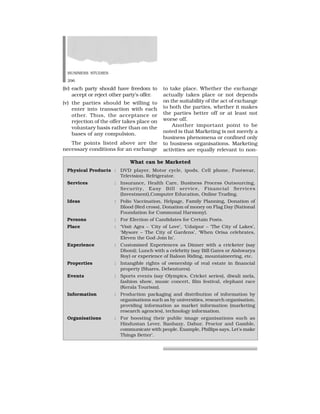
What can be Marketed
Physical Products : DVD player, Motor cycle, ipods, Cell phone, Footwear,
Television, Refrigerator.
Services : Insurance, Health Care, Business Process Outsourcing,
Security, Easy Bill service, Financial Services
(Investment),Computer Education, Online Trading.
Ideas : Polio Vaccination, Helpage, Family Planning, Donation of
Blood (Red cross), Donation of money on Flag Day (National
Foundation for Communal Harmony).
Persons : For Election of Candidates for Certain Posts.
Place : ‘Visit Agra – ‘City of Love’, ‘Udaipur – ‘The City of Lakes’,
‘Mysore – The City of Gardens’, ‘When Orisa celebrates,
Eleven the God Join In’.
Experience : Customised Experiences as Dinner with a cricketer (say
Dhoni); Lunch with a celebrity (say Bill Gates or Aishwarya
Roy) or experience of Baloon Riding, mountaineering, etc.
Properties : Intangible rights of ownership of real estate in financial
property (Shares, Debentures).
Events : Sports events (say Olympics, Cricket series), diwali mela,
fashion show, music concert, film festival, elephant race
(Kerala Tourism).
Information : Production packaging and distribution of information by
organisations such as by universities, research organisation,
providing information as market information (marketing
research agencies), technology information.
Organisations : For boosting their public image organisations such as
Hindustan Lever, Ranbaxy, Dabur, Proctor and Gamble,
communicate with people. Example, Phillips says, Let’s make
Things Better’.
MARKETING
297
profit organisations such as hospitals,
schools, sports clubs and social and
religious organisations. It helps these
organisations in achieving their goals
such as spreading the message of
family planning, improving the literacy
standards of people and providing
medication to the sick.
WHAT CAN BE MARKETED
The question commonly coming to the
mind is what can be marketed. Is it a
product or service or something else. Let
us first understand what is a product?
A product is a ‘bundle of utilities’
or ‘source of satisfaction’, that can be
used to satisfy human needs and
wants. It is not confined to physical
objects, such as motor cycle, biscuit,
bulb and pencil but also refers to other
things of value such as services, ideas,
places, etc., that can be offered to the
potential buyers for their use. In the
marketing literature, anything that can
be of value to the buyer can be termed
as a ‘product’. It can be tangible, i.e.,
which can be felt, seen and touched
physically such as a pencil, a cycle or
an intangible such as services rendered
by a doctor, hairdresser or a lawyer.
Apart from the product, what can
be marketed is a service or a person
(say political parties persuading to
vote for a particular candidate) or an
idea (say Red Cross persuading to
donate blood) or a place (say Kerala
Tourism persuading people to visit
Kerala for health tourism). Thus,
anything that is of value to the other
can be marketed. It can be a product
or a service or a person or a place or
an idea or an event or an organisation
or experience or properties. (see box)
Who is a marketer? : Marketer refers
to any person who takes more active
part in the process of exchange.
Normally it is the seller who is more
active in the exchange process as he/
she analyses the needs of the potential
buyers, develops a market offering and
persuades the buyers to buy the
product. However, there may be
certain situations where the buyer
may be taking more active role in the
exchange process. Let us say in
situations of rare supply, the buyer
may be taking extra efforts in
persuading the seller to sell the
product to him/her. This may be
happening in defence deals or take a
situation where a country having
installed a nuclear plant needs the
supply of nuclear fuel or ‘Heavy Water’.
It may need to convince the supplier
of the products to supply the same to
it, by promising that it will be used
for peaceful purposes only. In this
case, the buyer will be treated as the
marketer. Thus, any body, who takes
Do it yourself
Collect five advertisements each for the marketing of (a) ideas and (b) places from a
newspaper or a magazine. Write in your notebook, the messages conveyed through
these and discuss in the class indicating which of these messages are more appealing
to you. Give reasons in support of your answer.
BUSINESS STUDIES
298
more active role in the exchange
process will be taken as the marketer.
MARKETING MANAGEMENT
Marketing management means
management of the marketing
function. In other words, marketing
management refers to planning,
organising, directing and control of the
activities which facilitate exchange of
goods and services between producers
and consumers or users of products
and services. Thus the focus of
marketing management is on achieving
desired exchange outcomes with the
target markets. Taking a management
perspective, the term marketing has
been defined as “the process of
planning and executing the conception,
pricing, promotion and distribution of
ideas, goods and services to create
exchanges that satisfy individual and
organisational goals” by American
Management Association, similarly
Philip Kotler has defined Marketing
management as the art and science of
choosing target markets and getting,
keeping and growing customers
through creating, delivering and
communicating superior customer
values of management.
A careful analysis of the definition
reveals that the process of
management of marketing involves:
(i) Choosing a target market, say a
manufacturer may choose to make
readymade garments for children
up to the age of 5 years;
(ii) In respect of the target market
chosen, the focus of the process of
management is on getting, keeping
as well as growing the customers.
That means the marketer has to
create demand for his products so
that the target customers
purchase the product, keep them
satisfied with the firm’s products
and also attract more customers
to the firm’s products so that the
firm can grow; and
(iii) The mechanism for achieving the
objective is through creating,
developing and communicating
superior values for the customers.
That means, the primary job of a
marketing manager is to create
superior values so that the
customers are attracted to the
products and services and
communicate these values to the
prospective buyers and persuade
them to buy these products.
Marketing management involves
performance of various functions such
as analysing and planning the
marketing activities, implementing
marketing plans and setting control
mechanism. These functions are to be
performed in such a way that
organisation’s objectives are achieved
at the minimum cost.
Marketing management generally
is related to creation of demand.
However, in certain situations, the
manager has to restrict the demand.
For example, if there is a situation of
‘overfull demand’, i.e., the demand
being more than what the company
can or want to handle, (like what the
situation in our country was before the
adoption of policies of liberalisation
MARKETING
299
and globalisation, in early 90’s, in
most consumer products be it
automobiles or electronics goods or
other durable products. The job of
marketing mangers, in these
situations would be to find ways to
reduce the demand temporarily by say
reducing the expenditure on
promotion or increasing the prices.
Similarly, if the demand is ‘irregular’,
such as in case of seasonal products,
(say fans, woollen clothes) the
marketer’s job is to change the time
pattern of demand through such
methods as providing short-term
incentives, to the buyers. Thus, the
marketing management in not only
concerned with creating demand but
with managing the demand effectively,
as per the situation in the market.
MARKETING AND SELLING
Many people confuse ‘selling’ for
‘marketing’. They consider these two
terms as one and the same. Marketing
refers to a large set of activities of which
selling is just one part. For example, a
marketer of televisions, before making
the sale, does a lot of other activities
such as planning the type and model
of televisions to be produced, the price
at which it would be sold and selecting
the distribution outlets at which the
same would be available, etc. In short,
marketing involves whole range of
activities relating to planning, pricing,
promoting and distributing the
products that satisfy customer’s needs.
The function of selling, on the
other hand, is restricted to promotion
of goods and services through
salesmanship, advertising, publicity
and short-term incentives so that title
of the product is transferred from
seller to buyer or in other words
product is converted into cash.
The major differences between
selling and marketing are listed as
below:
(i) Part of the Process vs Wider Term:
Selling is only a part of the process
of marketing and is concerned with
promoting and transferring
possession and ownership of goods
from the seller to the buyer.
Marketing is a much wider term
consisting of number of activities
such as identification of the
customer’s needs, developing the
products to satisfy these needs,
fixing prices and persuading the
potential buyers to buy the same.
Thus, selling is merely a part of
marketing.
(ii) Transfer of Title vs Satisfying
Customer Needs: The main focus
of selling is on affecting transfer
of title and possession of goods
from sellers to consumers or users.
In contrast, marketing activities
put greater thrust on achieving
maximum satisfaction of the
customer’s needs and wants.
(iii) Profit through Maximising Sales vs
Customer Satisfaction: All selling
activities are directed at maximising
sales and, thereby, the profits of the
firm. In other words, the emphasis
is on profit maximisation through
maximisation of sales. Marketing,
BUSINESS STUDIES
300
on the other hand, is concerned with
customer satisfaction and thereby
increasing profit in the long run. A
marketing organisation, thus,
attaches highest importance to
customer satisfaction as a route to
profit maximisation.
(iv) Start and End of the Activities:
Selling activities start after the
product has been developed while
marketing activities start much
before the product is produced and
continue even after the product
has been sold.
(v) Difference in the Emphasis: In
selling, the emphasis is on bending
the customer according to the
product while in marketing, the
attempt is to develop the product
and other strategies as per the
customer needs.
vi. Difference in the Strategies: Selling
involves efforts like promotion and
persuasion while marketing uses
integrated marketing efforts
involving strategies in respect of
product, promotion, pricing and
physical distribution.
MARKETING MANAGEMENT PHILOSOPHIES
In order to achieve desired exchange
outcomes with target markets, it is
important to decide what philosophy
or thinking should guide the marketing
efforts of an organisation. An
understanding of the philosophy or the
concept to be adopted is important as
it determines the emphasis or the
weightage to be put on different factors,
in achieving the organisational
objectives. For example, whether the
marketing efforts of an organisation
will focus on the product—say
designing its features etc or on selling
techniques or on customer’s needs or
the social concerns.
The concept or philosophy of
marketing has evolved over a period
of time, and is discussed as follows.
Production Concept
During the earlier days of industrial
revolution, the demand for industrial
goods started picking up but the
number of producers were limited. As
a result, the demand exceeded the
supply. Selling was no problem.
Anybody who could produce the goods
was able to sell. The focus of business
activities was, therefore, on production
of goods. It was believed that profits
could be maximised by producing at
large scale, thereby reducing the
average cost of production. It was also
assumed that consumers would
favour those products which were
widely available at an affordable price.
Thus, availability and affordability of
the product were considered to be the
key to the success of a firm. Therefore,
greater emphasis was placed on
improving the production and
distribution efficiency of the firms.
Product Concept
As a result of emphasis on production
capacity during the earlier days, the
position of supply increased over period
of time. Mere availability and low price
of the product could not ensure
MARKETING
301
increased sale and as such the survival
and growth of the firm. Thus, with the
increase in the supply of the products,
customers started looking for products
which were superior in quality,
performance and features. Therefore,
the emphasis of the firms shifted from
quantity of production to quality of
products. The focus of business activity
changed to bringing continuous
improvement in the quality,
incorporating new features etc. Thus,
product improvement became the key
to profit maximisation of a firm, under
the concept of product orientation.
Selling Concept
With the passage of time, the
marketing environment underwent
further change. The increase in the
scale of business further improved the
position with respect to supply of
goods, resulting in increased
competition among sellers. The
product quality and availability did not
ensure the survival and growth of
firms because of the large number of
sellers selling quality products. This
led to greater importance to attracting
and persuading customers to buy the
product. The business philosophy
changed. It was assumed that the
customers would not buy, or not buy
enough, unless they are adequately
convinced and motivated to do so.
Therefore, firms must undertake
aggressive selling and promotional
efforts to make customers buy their
products. The use of promotional
techniques such as advertising,
personal selling and sales promotion
were considered essential for selling
of products. Thus, the focus of
business firms shifted to pushing the
sale of products through aggressive
selling techniques with a view to
persuade, lure or coax the buyers to
buy the products. Making sale
through any means became
important. It was assumed that buyers
can be manipulated but what was
forgotten was that in the long run what
matters most is the customer
satisfaction, rather than anything else.
Marketing Concept
Marketing orientation implies that
focus on satisfaction of customer’s
needs is the key to the success of any
organisation in the market. It assumes
that in the long run an organisation
can achieve its objective of
maximisation of profit by identifying
the needs of its present and
prospective buyers and satisfying
them in an effective way. All the
decisions in a firm are taken from the
point of view of the customers. In other
words, customer’s satisfaction become
the focal point of all decision making
in the organisation. For example, what
product will be produced, with what
features and at what price shall it be
sold, or where shall it be made
available for sale will depend on what
do the customers want. If the
customers want features like double
door in a refrigerator or a separate
provision for water cooler in it, the
organisation would produce a
refrigerator with these features, would
price it at a level which the customers
BUSINESS STUDIES
302
bought not merely because of their
quality, packing or brand name, but
because they satisfy a specific need of
a customer. A pre-requisite for the
success of any organisation, therefore,
is to understand and respond to
customer needs.
are willing to pay and so on. If all
marketing decisions are taken with
this prospective, selling will not be any
problem. It will automatically follow.
The basic role of a firm then is to
‘identify a need and fill it’. The concept
implies that products ad-services are
Differences in the Marketing Management Philosophies
Philosophies/ Production Product Selling Marketing Societal
Bases Concept Concept Concept Concept Concept
1. Starting Factory Factory Factory Market Market,
Point Society
2. Main Quantity of Quality, Existing Customer Customer
Focus product performance, product needs needs and
features of society’s
product well being
3. Means Availability Product Selling Integrated Integrated
and improve- and marketing marketing
affordability ments promoting
of product
4. Ends Profit through Profit through Profit Profit Profit
volume of product through through through
production quality sales customer customer
volume satisfaction satisfaction
and social
welfare
Test Your Understanding I
State whether the following statements are true or false:
(i) focus of marketing activities is on facilitating exchange of goods from producers
to consumers or users;
(ii) in modern marketing, the term market refers to the place where buyers and
sellers meet for the exchange of goods and services;
(iii) marketing is same thing as shopping for goods and services;
(iv) marketing is a post production activity only;
(v) marketing is equally relevant to non-profit organisations;
(vi) The terms ‘need’ and ‘want’ are used interchangeably in the marketing literature;
(vii) marketing management means management of the marketing function; and
(viii) Product designing does not come under the purview of marketing activities.
MARKETING
303
To sum up, the marketing concept
is based on the following pillars:
(i) Identification of market or
customer who are chosen as the
target of marketing effort.
(ii) Understanding needs and wants
of customers in the target market.
(iii) Development of products or
services for satisfying needs of the
target market.
(iv) Satisfying needs of target market
better than the competitors.
(v) Doing all this at a profit.
Thus, the focus of the marketing
concept is on customer needs and the
customer satisfaction becomes the
means to achieving the firms’ objective
of maximising profit. The purpose of
marketing is to generate customer
value at a profit.
The Societal Marketing Concept
The marketing concept, as described
in the preceeding section cannot be
considered as adequate if we look at
the challenges posed by social
problems like environmental
pollution, deforestation, shortage of
resources, population explosion and
inflation. It is so because any activity
which satisfies human needs but is
detrimental to the interests of the
society at large cannot be justified. The
business orientation should,
therefore, not be short-sighted to serve
only consumers’ needs. It should also
consider large issues of long-term
social welfare, as illustrated above.
The societal marketing concept
holds that the task of any organisation
is to identify the needs and wants of
the target market and deliver the
desired satisfaction in an effective and
efficient manner so that the long-term
well-being of the consumers and the
society is taken care of. Thus, the
societal marketing concept is the
extension of the marketing concept as
supplemented by the concern for the
long-term welfare of the society. Apart
from the customer satisfaction, it pays
attention to the social, ethical and
ecological aspects of marketing. There
are large number of such issues that
need to be attended.
FUNCTIONS OF MARKETING
Marketing is concerned with exchange
of goods and services from producers
to consumers or users in such a way
that maximises the satisfaction of
customers’ needs. From the view point
of management function, number of
activities are involved, which have
been described as below:
1. Gathering and Analysing Market
Information: One of the important
functions of a marketer is to gather
and analyse market information. This
is necessary to identify the needs of
the customers and take various
decisions for the successful marketing
of the products and services. This is
important for making an analysis of
the available opportunities and threats
as well as strengths and weaknesses
of the organisation and help in
BUSINESS STUDIES
304
deciding what opportunities can best
be pursued by it. For example, rapid
growth is predicted in several areas
in the Indian economy, say in the use
of internet, market for Cell phones and
several other areas. Which of these
areas a particular organisation should
enter or in which area should it
expand requires a careful scanning of
the strengths and, weaknesses of the
organisation, which is done with the
help of careful market analysis.
With the growth of computers, a
new trend has emerged in the
collection of market information. More
and more companies are using
interactive sites on the internet, to
gather customer views and opinions,
before taking important business
decisions. (see the box on Global
Brands) One of the popular TV News
Channel (in Hindi) seeks viewers
choice (through SMS) on which of the
given four or five main news stories of
The Future of Global Brands
Role of Digital connection and consumer cooperation
In China and India, booming middle classes and fast-rising disposable incomes
have created a still-under-tapped consumer culture. Let’s not forget the lessons
being learned about the brand-building, power of digital connections and consumer
co-creation. Since the advent of the internet, sites that offer social interaction and
connectivity have been at the forefront of our digital revolution, reshaping the way
consumers expect to interact with each other and, ultimately, with brands.
Online tag-sale site e-Bay, for example was one of the first sites to teach us that
you can trust people online as well as you might trust a friendly neighbour. That
social interaction paved the way for Friendster and MySpace and You Tube, a social
networking tool that, in the past year, has empowered consumers to create their
own content and post it to a global audience. Anyone who doubts the real market
potential of such a platform only needs to check out October’s biggest business
headlines: Google purchased the site for $ 1.65 billion.
HSBC effort attempted a similar goal, to give consumers a forum for conversation.
At your pointofview.com, consumers in 76 countries can weigh in and give their
opinions on subjects including cloning, fashion, wind farms and video games.
Teenagers in Chinese cities surf the web for 5.1 hours a week, and the online
ad-market is booming—by more than 75% annually for the past three years,
according to Business Week, Mobile phones are among the most coveted pieces of
technology. And 17.5 million bloggers (and their 75 million readers), many of whom
fall within the coveted 18–25 age groups, are shaping consumer opinions in China
with more intensity than they do in the US.
The internet age has put advertisers and branding experts face-to-face with an
empowered consumer. And those consumers are happy to listen to our messages,
as long as we are willing to listen to them.
Source: Adopted from Brand Equity, Nov. 1, 2006
MARKETING
305
the day would be broadcasted as
detailed story at the prime time, to
ensure that the viewers get to listen
to the story of their own choice.
2. Marketing Planning: Another
important activity or area of work of a
marketer is to develop appropriate
marketing plans so that the marketing
objectives of the organisation can be
achieved. For example a marketer of
colour TVs, having 10 per cent of the
current market share in the country
aims at enhancing his market share to
20 per cent, in the next three years. He
will have to develop a complete
marketing plan covering various
important aspects including the plan for
increasing the level of production,
promotion of the products, etc. and
specify the action programmes to
achieve these objectives.
3. Product Designing and
Development: Another important
marketing activity or decision area
relates to product designing and
development. The design of the
product contributes to making the
product attractive to the target
customers. A good design can improve
performance of a product and also give
it a competitive advantage in the
market. For example, when we plan
to buy any product say a motorbike,
we not only see its features like cost,
mileage, etc. but also the design
aspects like its shape, style, etc.
4. Standardisation and Grading:
Standardisation refers to producing
goods of predetermined specifications,
which helps in achieving uniformity and
consistencyintheoutput.Standardisation
ensures the buyers that goods conform
to the predetermined standards of
quality, price and packaging and reduces
the need for inspection, testing and
evaluation of the products.
Grading is the process of
classification of products into different
groups, on the basis of some of its
important characteristics such as
quality, size, etc. Grading is particularly
necessary for products which are not
produced according to predetermined
specifications, such as in the case of
agricultural products, say wheat,
oranges, etc. Grading ensures that
goods belong to a particular quality and
helps in realising higher prices for high
quality output.
5. Packaging and Labelling:
Packaging refers to designing the
package for the products. Labelling
refers to designing the label to be put
on the package. Label may vary from
a simple tag to complex graphics.
Packaging and labelling have
become so important in modern day
marketing that these are considered
as the pillars of marketing. Packaging
is important not only for protection of
the products but also serves as a
promotional tool. Sometimes, the
quality of the product is assessed by
the buyers form packaging. We have
seen that in the success of many of
the consumer brands in recent times
such as Lays or Uncle Chips potato
wafers Clinic Plus shampoos, and
Colgate Toothpaste, etc., packaging
has played an important role.
BUSINESS STUDIES
306
6. Branding: A very important decision
area for marketing of most consumer
products is whether to sell the product
in its generic name (name of the
category of the product, say Fan, Pen,
etc.) or to sell them in a brand name
(such as Pollar Fan or Rottomac Pen).
Brand name helps in creating product
differentiations, i.e., providing basis for
distinguishing the product of a firm
with that of the competitor, which in
turn, helps in building customer’s
loyality and in promoting its sale. The
important decision areas in respect of
branding include deciding the branding
strategy, say whether each product will
be given a separate brand name or the
same brand name will be extended to
all products of the company, say
Phillips Bulbs, Tubes and Television or
Videocon Washing Machine, Television,
and Refrigerator. Selection of the brand
name plays important role in the
success of a product.
7. Customer Support Services: A very
important function of the marketing
management relates to developing
customer support services such as after
sales services, handling customer
complaints and adjustments,
procuring credit services, maintenance
services, technical services and
consumer information. All these
services aim at providing maximum
satisfaction to the customers, which is
the key to marketing success in
modern days. Customer support
services prove very effective in bringing
repeat sales from the customers and
developing brand loyality for a product.
8.Pricing of Products: Price of product
refers to the amount of money
customers have to pay to obtain a
product. Price is an important factor
affecting the success or failure of a
product in the market. The demand for
a product or service is related to its
price. Generally lower the price, higher
would be the demand for the product
and vice-versa. The marketers have
to properly analyse the factors
determining the price of a product and
take several crucial decisions in this
respect, including setting the pricing
objectives, determining the pricing
strategies, determining the price and
changing the prices.
9. Promotion: Promotion of products
and services involves informing the
customers about the firm’s product,
its features, etc. and persuading them
to purchase these products. The four
important methods of promotion
include advertising, Personal Selling,
Publicity and Sales Promotion. A
marketer has to take several crucial,
decisions in respect of promotion of
the products and services such as
deciding the promotion budget, the
promotion mix, i.e., the combination
of the promotional tools that will be
use, the promotion budget, etc.
10. Physical Distribution: Managing
physical distribution is another very
important function in the marketing
of goods and services. The two major
decision areas under this function
include (a) decision regarding
channels of distribution or the
marketing intermediaries (like whole
MARKETING
307
salers, retailers) to be used and (b)
physical movement of the product
from where it is produced to a place
where it is required by the customers
for their consumption or use. The
important decision areas under
physical distribution include
managing inventory (levels of stock of
goods), storage and warehousing and
transportation of goods from one place
to the other.
11. Transportation: Transportation
involves physical movement of goods
from one place to the other. As
generally the users of products,
particularly consumer products are
wide spread and geographically
separated from the place these are
produced, it is necessary to move them
to the place where it is needed for
consumption or use, For example, tea
produced in Assam has to be
transported not only within the state
but to other far off places like Tamil
Nadu, Punjab, Jammu and Kashmir
and Haryana, Rajasthan, where it is
consumed.
A marketing firm has to analyse
its transportation needs after taking
into consideration various factors
such as nature of the product, cost
and location of target market and take
decisions in respect of mode of
transportation to be chosen and other
related aspects.
12. Storage or Warehousing: Usually
there is a time gap between the
production or procurement of goods
and their sale or use. It may be
because of irregular demand for the
products such as in the case of woollen
garments or Raincoats or there may
be irregular supply because of
seasonal production such as in the
case of agricultural products
(sugarcane, rice, wheat, cotton, etc.).
In order to maintain smooth flow of
products in the market, there is a need
for proper storage of the products.
Further, there is a need for storage of
adequate stock of goods to protect
against unavoidable delays in delivery
or to meet out contingencies in the
demand. In the process of marketing,
the function of storage is performed
by different agencies such as
manufacturers, wholesalers and
retailers.
ROLE OF MARKETING
All marketing organisations operate
either to earn profit or pursue some
other goals such as community
service, improvement of quality of life
or promotion of a cause, say UNICEF
working for the welfare of children or
‘Helpage’ working for the cause of
senior citizens. Whether it is a
profit organisation or a non-profit
organisation, marketing plays
an important role in achieving its
objectives. It helps the individual
consumers in raising their standard
of living by making available the
products and services that satisfy their
needs and wants. It also plays a
significant role in the economic
development of a nation. The role of
marketing in different situations may
be described in brief as follows.
BUSINESS STUDIES
308
Role in a Firm
The modern concept of marketing
plays a significant role in achieving the
objectives of a firm. It emphasises that
customer satisfaction is the key to the
survival and growth of an organisation
in the contemporary competitive
marketing environment. By adopting
marketing orientation, an organisation
whether profit making or non-profit
making, can achieve its goals in the
most effective manner. It helps in
focusing the activities of an
organisation on the needs and wants
of the customers. For example, what
products or services will be marketed
by a firm will depend upon what do
its customers need. Thus, an analysis
of the needs of the customers shall be
undertaken in order to decide what to
produce and sell. The product will
then be designed according to the
needs of the potential buyers and be
made available through the outlets
convenient to customers and be priced
at a level which the target customers
can afford. In other words, marketing
as a business philosophy helps in
serving the customers by satisfying
their needs. It is a well known fact that
a satisfied customer is the most
valuable asset of any firm. Thus,
marketing plays a crucial role in the
survival and growth of a firm.
Role in the Economy
Marketing plays a significant role in the
development of an economy. It acts as
a catalyst in the economic development
of a country and helps in raising the
standards of living of the people.
Development of a nation can be
judged by the level of standard of living
of its people. Another important
criteria, which is related to the first
one, is the per capita income of an
average citizen of a country. On this
basis, an underdeveloped country may
be stated to be one which is
characterised by factors like poverty,
scarcity of goods and services,
predominance of agriculture, etc.
Marketing can play a significant
role in the economic development of a
nation. It can inspire people to
undertake new activities and to set up
enterprises for producing goods that
are needed by the customers.
Marketing can help in overcoming
obstacles posed by high prices due to
imbalances in the levels of production
and consumption. It can also ensure
smooth flow of goods through efficient
physical distribution arrangements.
In other words, marketing can help
in finding out right type of products
and services that a firm should
manufacture, the places where it
should make such products available
for sale, the price at which the
products should be sold and the
channels that should be used for
moving the products to the ultimate
place of consumption or use. This
linkage between the business and
consumption centres, accelerates the
economic activity leading to higher
incomes, more consumption and
increased savings and investment.
MARKETING
309
MARKETING MIX
As stated in an earlier section, the
process of marketing involves creating
a market offering, to satisfy the needs
and wants of the present and potential
buyers. The real question is how to
create a market offering. Let us say a
profitable business opportunity is
seen by some firm in the field of
producing soft drinks. To develop and
market a new brand of soft drinks, a
number of important decisions will
have to be taken for example whether
to go for any collaboration with a
foreign manufacturer of soft drinks,
whether to produce for the local
market or for a wider market, what will
be the features of the new product,
and so on.
There are large number of factors
affecting marketing decisions. These
can broadly be divided into two
categories: (i) controllable factors, and
(ii) non-controllable factors. Controllable
factors are those factors which can be
influenced at the level of the firm. In
the previous illustration, for example,
whether the drink will be packed in
glass bottles or plastic cans; what will
be the name (brand name) of the drink;
at what price it will be sold, (at par
with the price at which other
competitive brands are sold or below
it or above it); what distribution
network will be used to make the
product available (e.g., hotels,
restaurants, groceries shops, kiosks
selling cigarette, paan, etc.) to the
buyers whether the new soft drink will
be promoted by putting up
advertisements in newspaper or
magazine or on radio or television; or
say if newspaper, whether in a local
newspaper or a national daily; whether
in a paper of regional language or an
English daily, etc. is decided at the
level of marketing manager of the firm.
However, there are certain other
factors which affect the decision but
are not controllable at the firm’s level.
These are called environmental
variables. For example, the political
factors such as the government policy
on whether to allow any technical or
financial collaboration in the area of
soft drinks, production or economic
factors such as rate of inflation
prevailing in a given period or a credit
policy of the central bank affecting the
total availability of money in the
Test your Understanding II
State whether the following statements are true or false:
(i) packaging serves as a promotional tool;
(ii) storage adds time value to the product;
(iii) financing is important for marketing only high value products;
(iv) marketing play important role from the point of view of individual consumers
only; and
(v) marketing acts as a catalyst in the economic development of a country.
BUSINESS STUDIES
310
market, all of which affect the sale of
a particular product but can not be
controlled or influenced by the
decisions at the level of a firm. To be
successful, the decisions regarding
‘controllable factors’ are to be taken
keeping the environmental variables
into consideration.
The controllable variables become
marketing tools, which are constantly
shaped and reshaped by marketing
managers, to achieve marketing
success. For example a firm can
reshape a market offering by bringing
in a change in any of the variable under
its own control say introducing a
change in the price or promotion offer
or product features or channel used to
make the product available to buyers.
Thus, from a number of alternatives
available a firm chooses a particular
combination to develop a market
offering. The combination of variables
chosen by a firm to prepare its market
offering is also called marketing mix.
Thus, marketing mix is described as
the set of marketing tools that a firm
uses to pursue its marketing objectives
in a target market.
ELEMENTS OF MARKETING MIX
The marketing mix consists of various
variables, which have broadly been
classified into four categories,
popularly known as four Ps of
marketing. These are: (i) Product, (ii)
Price, (iii) Place, and (iv) Promotion,
and are discussed as follows:
1. Product: Product means goods or
services or ‘anything of value’, which
is offered to the market for exchange.
For example, Hindustan Lever
company offers number of consumer
products like toiletries (Close-Up
Toothpaste, Lifebuoy Soap, etc.),
Marketing Mix: Elements
Product Price
Product Mix Price Level
Product Quality Margins
New Product Pricing Policy
Design and Development Pricing Strategies
Packaging Price Change
Labelling
Branding
Place Promotion
Channel Strategy Promotion Mix
Channel Selection Advertising
Channel Conflict Personal Selling
Channel Cooperation Sales Promotion
Physical Distribution Publicity
Public Relations
MARKETING
311
detergent powder (Surf, Wheel), food
products (Refined Vegetable Oil); Tata
offers Tata Steel, Trucks, Salt and a
large number of other products; LG
Electronics Offers Televisions,
Refrigerators, Colour Monitors for
Computers, etc; Amul offers number
of food products (Amul Milk, Ghee,
Butter, Cheese, Chocolates, etc.).
The concept of product relates to
not only the physical product as
mentioned in the above examples but
also the benefits offered by it from
customer’s view point (for example
toothpaste is bought for whitening
teeth, strengthening gums, etc.). The
concept of product also include the
extended product or what is offered
to the customers by way of after sales
services, handling complaints,
availability of spare parts etc.
These aspects are very important,
particularly in the marketing of
consumer durable products (like
Automobiles, Refrigerators, etc.). The
important product decisions include
deciding about the features, quality,
packaging, labelling and branding of
the products.
2. Price: Price is the amount of money
customers have to pay to obtain the
product. In case of most of the
products, level of price affects the level
of their demand. The marketers have
not only to decide about the objectives
of price setting but to analyse the
factors determining the price and fix
a price for the firm’s products.
Decisions have also to be taken in
respect of discounts to customers,
traders and credit terms, etc. so that
customers perceive the price to be in
line with the value of the product.
3. Place: Place or Physical
Distribution include activities that
make firm’s products available to the
target customers. Important decision
areas in this respect include selection
of dealers or intermediaries to reach
the customers, providing support to
the intermediaries (by way of
discounts, promotional campaigns,
etc.). The intermediaries in turn keep
inventory of the firm’s products,
demonstrate them to potential buyers,
negotiate price with buyers, close sales
and also service the products after the
sale. The other decision areas relate
to managing inventory, storage and
warehousing and transportation of
goods from the place it is produced to
the place it is required by the buyers.
4. Promotion: Promotion of products
and services include activities that
communicate availability, features,
merits, etc. of the products to the
target customers and persuade
them to buy it. Most marketing
organisations, undertake various
promotional activities and spend
substantial amount of money on the
promotion of their goods through
using number of tools such as
advertising, personal selling and sales
promotion techniques (like price
discounts, free samples, etc.). A large
number of decisions are to be taken
in each of the area specified above. For
example, in the respect of advertising
it is important to decide about the
message, the media to be used
(example print-media–newspaper,
BUSINESS STUDIES
312
magazines, etc. the objections of
customers, etc.).
The success of a market offer will
depend on how well these ingredients
are mixed to create superior value for
the customers and simultaneously
achieve their sale and profit objectives.
Let us say a firm would like to achieve
necessary volume of sale at a cost that
will permit a desired level of profit. But
so many alternative mixes can be
adopted by a firm to achieve this
objectives. The issue before a firm then
is to decide what would be the most
effective combination of elements to
achieve the given objectives.
PRODUCT
In common parlance, the word
‘product’, is used to refer only to the
physical or tangible attributes of a
product. For example, we say we have
bought a car or a pen or a Cell phone
or a tractor.
Our decision to buy a product is
not only affected by its physical
qualities, but also by certain non-
tangible and psychological factors,
e.g., brand name, reputation,
guaranty, packaging etc. Let us say,
when a person buys a car, he/she is
not just buying a few nuts and bolts,
an engine, four wheels and so on.
Rather he/she is buying a means of
transport, a status symbol, guarantees
and warranties accompanying the
product, image of the company and
many other such attributes. Thus, in
marketing, product is a mixture of
tangible and intangible attributes,
which are capable of being exchanged
for a value, with ability to satisfy
customer needs. Besides physical
objects, we also include services,
ideas, persons, and places in the
PepsiCo. Eyes New Products, Acquisitions
Aims at Adding Production Capacity for Gatorade and other Non-carbonated Drinks
PepsiCo on Monday said it will launch new healthier products next year and
focus on growth in emerging markets, a continuation of the strategy that helped the
world’s No. 2 beverage company stay profitable ever as sales growth of its flagship
soft drinks has slowed.
PepsiCo’s new CEO Indra Nooyi, who took the reins on October 1, also said the
company was on track to meet its annual target of volume and revenue growth in
the mid-single digits and earnings per share growth in the low double digits.
PepsiCo. evolved from being known mostly for selling soda and salty snacks
into a $33-billion food company that has embraced the push into healthier options
like Tropicana juice, Aquafina water and whole grain Quaker Oats Cereals.
The company said that moving forward, its capital expenditure as a percentage
of sales would increase, and that most of the increased spending will go to expansion
in developing and emerging markets and adding manufacturing capacity for Gatorade
and other non-carbonated drinks.
Source: Adopted from Economic Times, Oct. 25, 2006
MARKETING
313
concept of product. Thus, product may
be defined as anything that can be
offered to a market to satisfy a want
or need. It is offered for attention,
acquisition, use or consumption.
From the customer’s point of view,
a product is a bundle of utilities, which
is purchased because of its capability
to provide satisfaction of certain need.
A buyer buys a product or service for
what it does for her or the benefit it
provides to her. There can be three
types of benefits a customer may seek
to satisfy from the purchase of a
product, viz., (i) functional benefits, (ii)
psychological benefits, and (iii) social
benefits. For example, the purchase of
a motorcycle provides functional utility
of transportation, but at the same time
satisfies the need for prestige and
esteem and provides social benefit by
the way of acceptance from a group,
by riding a motorbike. Thus, all these
aspects should be considered while
planning for a product.
It is customer for companies to
review the progress of their present
products and constantly look for
opportunities of diversifying into never
areas. (see box on PepsiCo.)
LET US DO IT
Enlist the functional, psychological
and social benefits that can
be achieved by the purchase of
(i) Personal computer, (ii) Colour
television, (iii) Wrist watch.
CLASSIFICATION OF PRODUCT
Products may broadly be classified
into two categories — (i) consumers’
products, and (ii) industrial products.
The consumer products may further
Product
Consumer Product Industrial Product
Durability Basis Shopping Efforts Involved
Non- Durable Services Conven- Shopping Speciality
Durable ience Products Products
Products
Classification of Product
BUSINESS STUDIES
314
be classified into different groups, as
detailed below:
CONSUMER PRODUCTS
Products, which are purchased by the
ultimate consumers or users for
satisfying their personal needs and
desires are referred to as consumer
products. For example, soap, edible oil,
eatables, textiles, toothpaste, fans, etc.
which we use for our personal and non-
business use are consumer goods.
The consumer products have been
classified on the basis of two important
factors: (A) the extent of shopping
efforts involved, and (B) durability of
the product. These have been
explained as below:
A. Shopping Efforts Involved
On the basis of the time and effort
buyers are willing to spend in the
purchase of a product, we can classify
the consumer product into the following
three categories as here under:
1. Convenience Products: Those
consumer products, which are
purchased frequently, immediately and
with least time and efforts are referred
to as convenience goods. Examples of
such products are cigarettes, ice
creams, medicines, newspaper,
stationery items toothpaste. etc. These
products have low unit-value and are
bought in small qualities. Some of the
important characteristics of such
products are:
Convenience Products
MARKETING
315
(a) These products are purchased at
convenient locations, with least
efforts and time;
(b) Convenience products have a
regular and continuous demand,
as these generally come under the
category of essential products;
(c) These products have small unit of
purchase and low prices. For
example the eggs are sold at Rs.
28 per dozen and the customers
(f) Sales promotion schemes or short-
term incentives such as sales
contests, discount offers, etc play
an important role in the marketing
of such products.
2. Shopping Products: Shopping
products are those consumer goods,
in the purchase of which buyers
devote considerable time, to compare
the quality, price, style, suitability,
etc., at several stores, before making
Shopping Products
purchase them in small numbers;
(d) Convenience products have
standardised price as most of these
products are branded products;
(e) The competition in these products
is high as the supply is greater
than the demand. The marketers
have, therefore, to heavily advertise
for these products; and
final purchase. Some of the examples
of shopping products are clothes,
shoes, jewellery, furniture, radio,
television, etc. The important
characteristics of shopping products
are as below:
(a) The shopping products are
generally of durable nature, i.e.,
they normally survive many uses;
BUSINESS STUDIES
316
(b) The unit price as well as profit
margin of shopping products is
generally high;
(c) As these products have high unit
price, customers compare the
products of different companies
before making selection;
(d) Purchases of shopping products
are generally pre-planned and
there is little degree of impulse
buying in these products; and
(e) Retailers generally play an
important role in the sale of
shopping products as lot of
persuasive effort is needed to
convince the buyers to purchase
them.
3. Speciality Products: Speciality
products are those consumer goods
which have certain special features
because of which people make special
efforts in their purchase. These
products are such, which have
reached a brand loyalty of the highest
order, with a significant number of
buyers. The buyers are willing to
spend a lot of time and efforts on the
purchase of such products. For
example, if there is a rare collection of
artwork or of antiques, some people
may be willing to spend a lot of
shopping effort and travel long
distance to buy such products. In our
day-to-day life, we see people going to
a particular hair-cutting saloon or
restaurant, or a tailor. The demand for
these goods is relatively inelastic, i.e.,
even if the price is increased, the
demand does not come down. Some
of the important characteristics of the
speciality products may be summed
up as follows:
(a) The demand for speciality products
is limited as relatively small
number of people buy these
products;
(b) These products are generally costly
and their unit price is very high;
Speciality Products
MARKETING
317
(c) These products are available for
sale at few places as the number
of customers is small and are
willing to take extra efforts in the
purchase of these products;
(d) An aggressive promotion is required
for the sale of speciality products,
in order to inform people about
their availability, features, etc.; and
(e) After sales services are very
important for many of the
speciality products.
B. Durability of Products
On the basis of their durability, the
consumer products have been
classified into three categories—
Durable, Non-durable and Services.
1. Non-durable Products: The
consumer products which are
normally consumed in one or few uses
are called non-durable products. For
example, we purchase products like
toothpaste, detergents, bathing soap
and stationary products etc. From the
marketing point of view, these
products generally command a small
margin, should be made available in
many locations and need to be heavily
advertised.
2. Durable Products: Those
tangible consumer products which
normally survive many uses, for
example, refrigerator, radio, bicycle,
sewing machine and kitchen gadgets
are referred to as durable products.
These goods are generally used for a
longer period, command a higher per
unit margin, require greater
personal-selling efforts, guarantees
Marketing of Services
India Post Has 28% Market Share Against Blue Dart’s 20%
Speed Post Leads the Race in Express Mail
Speed Post has emerged as a market leader in the express mail category with a
27.55% volume share, a study commissioned by the Department of Post (DOP) and
government of India shows.
According to the study, almost 46.67% crore articles were sent by express mail
in 05-06. The study values the express mail industry alone (excluding logistics and
cargo which account for almost 35-40% of private firm’s turnover) at around Rs
1,500 crore. In value terms, while Speed Post is the leader, Blue Dart is a close
second with a 20% market share, followed by DTDC with a 11.91% share and First
Flight with a 10.89% share.
“This has been possible because of our competitive pricing. We are offering the
same services as other private couriers do, with the same efficiency but at half the
rates”, added Mr. Samuel. In fact, Speed Post claims that its volumes have increased
by almost 30-40% after the introduction of the One India One Rate scheme.
Express companies are hopeful that the market is going to grow further with
the setting up of SEZs and greater economic activity in the country fuelled by the
increasing throughput from the manufacturing sector.
Source: Adopted from Economic Times, Oct. 20, 2006
BUSINESS STUDIES
318
and after sales services, on the part
of the seller.
3. Services: The durable and non-
durable goods are tangible in the
sense that these have a physical
existence and can be seen and
touched. Services are intangible in
form. By services we mean those
activities, benefits or satisfactions,
which are offered for sale, e.g., dry
cleaning, watch repairs, hair cutting,
postal services, services offered by a
doctor, an architect and a lawyer. Some
of the distinguishing characteristics of
services are as follows:
(a) By their very nature, services are
intangible, i.e., we can not see, feel
or touch them;
(b) A service is inseparable from its
source. That means we cannot
separate the service from the
person providing the service;
(c) The services cannot be stored.
They are highly perishable. For
example, if a tailor does not work
for one week, the services he would
have provided during such period
go waste; and
(d) Services are highly variable as their
type and quality depends on the
person providing them. That is
why, there is a difference in the
extent of satisfaction we get from
the services provided by different
people.
INDUSTRIAL PRODUCTS
Industrial products are those
products, which are used as inputs
in producing other products. The
examples of such products are raw
materials, engines, lubricants,
machines, tools, etc. In other words,
industrial products are meant for non-
personal and business use for
producing other products.
The market for industrial products
consists of manufacturers, transport
agencies, banks and insurance
companies, mining companies and
public utilities. The important
characteristics of industrial products
are given below:
1. Number of Buyers: As compared
to the consumer products, the
numbers of buyers of industrial
products are limited. For example,
sugarcane is purchased by few
producers of sugar, but sugar, which
is a consumer product, is purchased
by crores of people in our country.
2. Channel Levels: Because of limited
number of buyers, the sale of
industrial products is generally made
with the help of shorter channels of
distribution, i.e., direct selling or one
level channel.
3. Geographic Concentration:
Because of location of industries at
certain points or regions, industrial
markets are highly concentrated,
geographically. For instance, the
demand for power loom comes from
Bombay, Sholapur, Bangalore, etc.
where the textile industry is
concentrated in our country.
4. Derived Demand: The demand for
industrial products is derived from the
demand for consumer products. For
MARKETING
319
example, the demand for leather will
be derived from demand for shoes and
other leather products in the market.
5. Role of Technical Considerations:
Technical considerations assume
greater significance in the purchase
of industrial products because these
products are complex products,
bought for use in business operations.
6. Reciprocal Buying: Some big
companies from basic industries like
oil, steel, rubber, and medicines resort
to the practice of reciprocal buying. For
example, Ashok Leyland may buy tyres
and tubes from MRF, which in turn
may buy trucks from Leyland,
whenever it feels the need for the same.
7. Leasing Out: A growing trend in
industrial product market is to lease
out rather than to purchase the
products on outright basis because of
the heavy price of these products.
Classification
The industrial goods are classified into
the following major categories:
(i) Materials and Parts: These
include goods that enter the
manufacture’s products
completely. Such goods are of
two types: (a) Raw material:
including farm products like
cotton, sugar cane, oil seed and
natural products such as
minerals (say crude petroleum,
iron ore), fish and lumber; and
(b) manufactured material and
parts. These are again of two
types – component materials
like glass, iron, plastic and
component parts such as tyre,
electric bulb, steering, and
battery.
(ii) Capital Items: These are such
goods that are used in the
Industrial Goods
Materials and Capital Items Supplies and
Parts Business Services
Raw Manufactured Installations Equipments Maintanence Operating
Material Material and Parts and Repair Supplies
items
Farm Natural Component Component
Products Products Material Parts
Classification of Industrial Goods
BUSINESS STUDIES
320
production of finished goods.
These include: (a) installations
like elevators, mainframe
Computers, and (b)
equipments like Hand Tools,
Personal Computer, Fax
Machines, etc.
products have different buying
motives and have different attitudes
and use different approaches in the
purchase of the products. For
example, an industrial buyer is
expected to be more rational who will
study the cost of different available
Test Your Understanding III
Please check whether the following statements are true or false:
(i) Products purchased by ultimate consumers for satisfying their personal needs
are referred to as industrial products.
(ii) Speciality products are generally costly and their unit price is high.
(iii) Purchase of convenience products in generally pre-planned.
(iv) Shopping products are purchased frequently, immediately and with least
efforts.
(v) Sales promotional schemes play important role in the sale of industrial
products.
(vi) Product is anything that can be offered to a market to satisfy a want or need.
(vii) Durable products are normally consumed in one or few uses.
(viii) Services can not be stored.
(ix) Furniture is an example of consumer non-durable product.
(x) Toothpaste is an example of consumer product.
(iii) Supplies and Business
Services: These are short
lasting goods and services that
facilitate developing or
managing the finished product.
These include: (a) maintenance
and repair items like Paint,
Nails, etc., and (b) operating
supplies like Lubricant,
Computer Stationary, Writing
Paper, etc.
The difference in the nature of
consumer products and industrial
products is important because of the
fact that the buyers of the two sets of
brands, their technical specifications
and the goodwill of the supplier.
Whereas, the buyer of a consumer
product may be more impulsive and
emotional who is susceptible to
advertising and various sales
promotion schemes.
BRANDING
One of the most important decisions
that a marketer has to take in the area
of ‘product’ is in respect of branding.
He has to decide whether the firm’s
products will be marketed under a
brand name or a generic name.
MARKETING
321
Generic name refers to the name of
the whole class of the product. For
example, a book, a wristwatch, tyre,
camera, toilet soap, etc. We know that
a camera is a lens surrounded by
plastic or steel from all sides and
having certain other features such as
a flash gun and so on. Similarly book
is a bunch of papers, which are in a
bound form, on which some useful
information about a subject is printed.
Thus, all products having these
characteristics would be called by the
generic name such as camera or book.
If products were sold by generic
names, it would be very difficult for the
marketers to distinguish their products
from that of their competitors. Thus,
most marketers give a name to their
product, which helps in identifying and
distinguishing their products from the
competitors’ products. This process of
giving a name or a sign or a symbol
etc., to a product is called branding.
The various terms relating to branding
are as follows:
1. Brand: A brand is a name, term,
sign, symbol, design or some
combination of them, used to identify
the products—goods or services of one
seller or group of sellers and to
differentiate them from those of the
competitors. For example, some of the
common brands are Bata, Lifebuoy,
Dunlop, Hot Shot, and Parker. Brand
is a comprehensive term, which has
Brands and Branding
Branding is creating a corporate brand identity for consumer, and getting that
brand identity imprinted on the minds of consumer, and this requires brand
positioning and brand management.
A brand today is an entity (product. service, company, person, technology, etc.),
that offers a set of value exchange measures between what the owner/market
seeks and the price he is willing to pay for.
It has always seemed to me that your brand is formed primarily, not by what
your company says about itself, but what the company does.
— Jeff Bezos
A product is something made in a factory; a brand is something that is bought by
the customer. A product can be copied by a competitor; a brand is unique. A
product can be quickly outdated; a successful brand is timeless.
— Stephen King
Your brand’s power lies in dominance. It is better to have 50% of one market,
instead of 10% of five markets.
— Al Ries
Your brand image is primarily an emotional construct. Emotion is probably always
more powerful in swaying people than reason. but people like to be able to
rationalise their choices.
— Drayton Bird
Source: Adopted from Effective Executive, 2006
BUSINESS STUDIES
322
two components—brand name and
brand mark. For example, Asian Paints
has the symbol of Gattu on its pack,
which is its brand mark.
2. Brand Name: That part of a brand,
which can be spoken, is called a brand
name. In other words, brand name is
the verbal component of a brand. For
example, Asian Paints, Safola, Maggie,
Lifebuoy, Dunlop, and Uncle Chips are
the brand names.
3. Brand Mark: That part of a brand
which can be recognised but which is
not utter able is called brand mark. It
appears in the form of a symbol,
design, distinct colour scheme or
lettering. For example, the Gattu of
Asian Paints or Devil of Onida or
symbol of Yogkshma of LIC, or four
fingers and a palm of Anacin are all
brand marks.
4. Trade Mark: A brand or part of a
brand that is given legal protection is
called trademark. The protection is
given against its use by other firms.
Thus the firm, which got its brand
registered, gets the exclusive right for
its use. In that case, no other firm can
use such name or mark in the country.
Though branding adds to the cost
e.g., to the cost of packaging, labelling,
legal protection, and promotion, it
provides several advantages to the
sellers as well as the consumers.
Advantages to the Marketers
(i) Enables Marking Product
Differentiation: Branding helps a
firm in distinguishing its product
from that of its competitors. This
enables the firm to secure and
control the market for its products.
(ii) Helps in Advertising and Display
Programmes: A brand aids a firm
in its advertising and display
programmes. Without a brand
name, the advertiser can only
create awareness for the generic
product and can never be sure of
the sale for his product.
(iii) Differential Pricing: Branding
enables a firm to charge different
price for its products than that
charged by its competitors. This is
possible because if customers like
a brand and become habitual of
it, they do not mind paying a little
higher for it.
(iv) Ease in Introduction of New
Product: If a new product is
introduced under a known brand,
it enjoys the reflected glory of the
brand and is likely to get off to an
excellent start. Thus, many
companies with established brand
names decide to introduce new
products in the same name. For
example, Food Specialties Ltd. had
a successful brand Maggie
(Noodles), it extended this name to
many of its new products
introduced such as Tomato
Ketchup, Soups, etc. Similarly
Samsung extended the brand
name of its Television to Washing
Machines and other durable
products, like Microwave oven.
MARKETING
323
Advantages to Customers
(i) Helps in Product Identification:
Branding helps the customers in
identifying the products. For
example, if a person is satisfied
with a particular brand of a
product, say tea leaves or detergent
soap, he need not make a close
inspection every time, he has to
buy that product. Thus, branding
greatly facilitates repeat purchase
of the products.
(ii) Ensures Quality: Branding ensures
a particular level of quality of the
product. Thus, whenever there is
any deviation in the quality, the
customers can have recourse to the
manufacturer or the marketer. This
builds up confidence of the
customers and helps in increasing
his level of satisfaction.
(iii) Status Symbol: Some brands
become status symbols because of
their quality. The consumers of
those brands of products feel proud
of using them and adds to the level
of satisfaction of the customers.
Characteristics of Good Brand
Name
Choosing the right brand name is not
an easy decision. What makes this
decision important is the fact that once
a brand name is chosen and the product
is launched in the market, changing the
brand name is very difficult. So, getting
it right the first time is very essential.
Following are some of the
considerations, which should be kept
in mind while choosing a brand name.
(i) The brand name should be short,
easy to pronounce, spell,
recognise and remember e.g.,
Ponds, VIP, Rin, Vim, etc.
(ii) A brand should suggest the
product’s benefits and qualities.
It should be appropriate to the
product’s function. e.g., Rasika,
Genteel, Promise, My Fair Lady
and Boost.
(iii) A brand name should be
distinctive e.g., Liril, Sprit, Safari,
Zodiac.
(iv) The brand name should be
adaptable to packing or labelling
requirements, to different
advertising media and to different
languages.
(v) The brand name should be
sufficiently versatile to
accommodate new products,
which are added to the product
line e.g., Maggie, Colgate.
(vi) It should be capable of being
registered and protected legally.
Do it Yourself
Visit a retail store in your locality and prepare a list of the (i) number of brands
available, (ii) the price of each brand, and (iii) most selling brand in respect of any
three consumer non-durable products such as Toilet Soap, Detergent Powder,
Cooking, Oil, Toothpaste, Tea, etc. used in your family. Which brand of each of
the product selected is used in your family? Give reasons.
BUSINESS STUDIES
324
(vii) Chosen name should have
staying power i.e., it should not
get out of date.
PACKAGING
One of the most important
developments affecting the business
world in recent years has been in the
area of packaging. Many products,
which we thought could never lend
themselves to packing because of their
nature, have been successfully packed
e.g., Pulses, Ghee, Milk, Salt, Cold
Drinks, etc. Packaging refers to the act
of designing and producing the
container or wrapper of a product.
Packaging plays a very important role
in the marketing success or failure of
many products, particularly the
consumer non-durable products. In
fact if one makes an analysis of the
reasons for the success of some of the
successful products in the recent past,
it can be noted that packaging has
played its due role. For example, it was
one of the important factors in the
success of products like Maggie’s
Noodles, Uncle Chips or Crax wafers.
Levels of Packaging
There can be three different levels of
packaging. These are as below:
1. Primary Package: It refers to the
product’s immediate container. In
some cases, the primary package is
kept till the consumer is ready to use
the product (e.g., plastic packet for
socks); whereas in other cases, it is
Levels of Packaging
MARKETING
325
kept throughout the entire life of the
product (e.g., a toothpaste tube, a
match box, etc.).
2. Secondary Packaging: It refers to
additional layers of protection that are
kept till the product is ready for use,
e.g., a tube of shaving cream usually
comes in a card board box. When
consumers start using the shaving
cream, they will dispose off the box
but retain the primary tube.
3. Transportation Packaging: It refers
to further packaging components
necessary for storage, identification or
transportation. For example a
toothpaste manufacturer may send the
goods to retailers in corrugated boxes
containing 10, 20, or 100 units.
Importance of Packaging
Packaging has acquired great
significance in the marketing of goods
and services, because of following
reasons:
(i) Rising Standards of Health and
Sanitation: Because of the
increasing standards of living in
the country, more and more people
have started purchasing packed
goods as the chances of
adulteration in such goods are
minimised.
(ii) Self Service Outlets: The self-service
retail outlets are becoming very
popular, particularly in major cities
and towns. Because of this, some
of the traditional role assigned to
personal selling in respect of
promotion has gone to packaging.
(iii) Innovational Opportunity: Some of
the recent developments in the
area of packaging have completely
changed the marketing scene in
the country. For example, milk can
now be stored for 4-5 days without
refrigeration in the recently
developed packing materials.
Similarly, in the area of
pharmaceuticals, soft drinks, etc.,
lots of new innovations have come
in respect of packaging. As a
result, the scope for the marketing
of such products has increased.
(iv) Product Differentiation: Packaging is
one of the very important means of
creating product differentiation.
The colour, size, material etc., of
package makes real difference in
the perception of customers about
the quality of the product. For
example, by looking at the
package of a product say Paint or
Hair Oil, one can make some
guess about quality of the product
contained in it.
Functions of Packaging
As stated above, packaging performs
a number of functions in the
marketing of goods. Some of the
important functions are as follows:
(i) Product Identification: Packaging
greatly helps in identification of the
products. For example, Colgate in
red colour, or Ponds cream jar can
be easily identified by its package.
(ii) Product Protection: Packaging
protects the contents of a product
BUSINESS STUDIES
326
from spoilage, breakage, leakage,
pilferage, damage, climatic effect,
etc. This kind of protection is
required during storing, distribution
and transportation of the product.
(iii) Facilitating Use of the Product: The
size and shape of the package
should be such that it should be
convenient to open, handle and use
for the consumers. Cosmetics,
medicines and tubes of toothpastes
are good examples of this.
(iv) Product Promotion: Packaging is
also used for promotion purposes.
A startling colour scheme,
photograph or typeface may be
used to attract attention of the
people at the point of purchase.
Sometimes it may work even better
than advertising. In self-service
stores, this role of packaging
becomes all the more important.
Labelling
A simple looking but important task
in the marketing of goods relates to
designing the label to be put on the
package. The label may vary from a
simple tag attached to the product
(such as in case of local unbranded
products like sugar, wheat, pulses,
etc.) indicating some information
about the quality or price, to complex
graphics that are part of the package,
like the ones on branded products (say
the graphic of Boat and Patwar on the
package of a popular brand of After
Shave Lotion or of a lady offering a
pen to solicit the views of the users,
on the label of a detergent powder).
Lables are useful in providing detailed
information about the product, its
contents, method of use, etc. The
various functions performed by a label
are as follows:
1. Describe the Product and Specify
its Contents: Let us look at some of
the labels of the products used by us
in our day to day life. The label on the
package of a local tea company
describes the company as ‘ Mohini Tea
Company, an ISO 9001:200C Certified
Company’; a popular brand of Prickly
Heat Powder, describes how the
product provides relief from prickly
heat and controls bacterial growth and
infection, giving caution forbidding its
application on cuts and wounds.
Package of fast food products like
ready to eat Dosa, Idli or Noodles,
describe the procedure of cooking
these products; the Package of a
toothpaste brand lists the ‘Ten Teeth
and Gum Problems’, which the
product claims to fight with its
Do it Yourself
Visit a local Grocery Shop and find out any two products which are sold both in
packaged form and in loose (unpackaged) form and find out i) The product for
which the sale in packaged form is greater ii) The product for which sale in loose
form is greater. iii) the benefit, to the retailer in selling goods on i) packaged form
and ii) unpackaged form.
MARKETING
327
‘Complete Germicheck Formula’; the
Package of a brand of Coconut Oil
describes the product as pure coconut
oil with Heena, Amla, Lemon and
specifies how these are good for Hair.
Thus, one of the most important
functions of labels is to describe the
product, its usage, cautions in use,
etc. and specify its contents.
2. Identification of the Product or
Brand: The other important
function performed by labels is to
help in identifying the product or
brand. For example, the brand name
of and product, say Biscuits or
Potato Chips imprinted on its
package helps us to identify, from
number of packages, which one is
our favourite brand. Other common
identification information provided
by the labels include name and
address of the manufacturer, net
weight when packed, manufacturing
date, maximum retail price and
Batch number.
3. Grading of Products: Another
important function performed by labels
is to help grading the products into
different categories. Sometimes
marketers assign different grades to
indicate different features or quality of
the product. For example, a popular
brand of Hair Conditioners comes in
different categories for different hair, say
for ‘normal hair’ and for other
categories. Different type of tea is sold
by some brands under Yellow, Red and
Green Label categories.
4. Help in Promotion of Products: An
important function of label is to aid in
promotion of the products. A carefully
designed label can attract attention and
give reason to purchase. We see many
product labels providing promotional
messages for example, the pack of a
popular Amla Hair Oil states, ‘Baalon
mein Dum, Life mein Fun’. The label
on the package of a brand of Detergent
Powder says, ‘Keep cloth look good and
your machine in top condition’. Labels
play important role in sales
promotional schemes launched by
companies. For example the label on
the package of a Shaving Cream
mentions, ‘40% Extra Free’ or package
of a toothpaste mentioning, ‘Free
Toothbrush Inside’, or ‘Save Rs15’.
5. Providing In formation Required
by Law: Another important function
of labeling is to provide information
required by law. For example, the
statutory warning on the package of
Cigarette or Pan Masala, ‘Smoking is
Injurious to Health’ or ‘Chewing
Do it Yourself
1. Examine the label on the package of any three branded products recently
purchased for use in your family and list out the type of information contained
on these.
2. Find out the promotional messages given on the package of any three consumer
products of your choice and comment how can these help in the sale of these
products.
BUSINESS STUDIES
328
Tobacco is Injurious to Health’. Such
information is required on processed
foods, drugs and tobacco products. In
case of hazardous or poisonous
material, appropriate safety-warning
need to be put on the label.
Thus, labels perform number of
important functions relating to
communicating with the potential
buyers and promoting the sale of the
products.
PRICING
When a product is bought, some money
is paid for it. This money represent the
sum of values that consumers
exchange for the benefit of having or
using the prdocut and is referred to as
the price of the product. Similarly,
money paid for the services such as fare
for the transport service, premium for
an insurance policy, and fee to a doctor
for his medical advise represent the
price of these services. Price may
therefore be defined as the amount of
money paid by a buyer (or received by
a seller) in consideration of the
purchase of a product or a service.
Pricing occupies an important
place in the marketing of goods and
services by a firm. No product can be
launched without a price tag or at least
some guidelines for pricing. Pricing is
often used as a regulator of the
demand of a product. Generally, if the
price of a product is increased, its
demand comes down, and vice-versa.
Pricing is considered to be an
effective competitive weapon. In the
conditions of perfect competition,
most of the firms compete with each
other on the basis of this factor. It is
also the single most important factor
affecting the revenue and profits of a
firm. Thus, most marketing firms give
high importance to the fixation of price
for their products and services.
Factors Affecting Price
Determination
There are number of factors which
affect the fixation of the price of a
product. Some of the important factors
in this regard are discussed as below:
1. Product Cost: One of the most
important factor affecting price of a
product or service is its cost. This
includes the cost of producing,
distributing and selling the product.
The cost sets the minimum level or the
floor price at which the product may
be sold. Generally all marketing firms
strive to cover all their costs, at least
in the long run. In addition, they aim
at earning a margin of profit over and
above the costs. In certain circumstance,
for example, at the time of introducing
a new product or while entering a new
market, the products may be sold at
a price, which does not cover all the
costs. But in the long run, a firm
cannot survive unless at least all its
costs are covered.
There are broadly three types of
costs: viz., Fixed Costs, Variable Costs
and Semi Variable Costs. Fixed costs
are those costs, which do not vary with
the level of activity of a firm say with
the volume of production or sale. For
example, rent of a building or salary
MARKETING
329
of a sales manager remains the same
whether 1000 units or 10 units are
produced in a week.
Those costs which vary in direct
proportion with the level of activity are
called variable costs. For example, the
costs of raw material, labour and power
are directly related with the quantity
of goods produced. Let us say, if the
cost of wood for manufacturing one
chair comes to Rs.100 the cost of wood
for 10 chairs would be Rs. 1000.
Obviously, there will be no cost of wood
if no chair is produced.
Semi variable costs are those costs
which vary with the level of activity
but not in direct proportion with it.
For example, compensation of a sales
person may include a fixed salary of
say Rs. 10,000 plus a commission of
5 per cent on sales. With an increase
in the volume of sales, the total
compensation will increase but not in
direct proportion with the change in
the volume of sale.
Total Costs are the sum total of the
fixed, variable and semi-variable costs
for the specific level of activity, say
volume of sales or quantity produced.
2. The Utility and Demand: While the
product costs set the lower limits of
the price, the utility provided by the
product and the intensity of demand
of the buyer sets the upper limit of
price, which a buyer would be
prepared to pay. In fact the price must
reflect the interest of both the parties
to the transaction—the buyer and the
seller. The buyer may be ready to pay
up to the point where the utility from
the product is at least equal to the
sacrifice made in terms of the price
paid. The seller would, however, try to
at least cover the costs. According to
the law of demand, consumers usually
purchase more units at a low price
than at a high price.
The price of a product is affected
by the elasticity of demand of the
product. The demand is said to be
elastic if a relatively small change in
price results in large change in the
quantity demanded. Here numerically,
the price elasticity is greater than one.
In the case of inelastic demand, the
total revenue increases when the price
is increased and goes down when the
price is reduced. If the demand of a
product is inelastic, the firm is in a
better position to fix higher prices.
3. Extent of Competition in the
Market: Between the lower limit and
the upper limit where would the price
settle down? This is affected by the
nature and the degree of competition.
The price will tend to reach the upper
limit in case there is lesser degree of
competition while under conditions of
free competition, the price will tend to
be set at the lowest level.
Competitors’ prices and their
anticipated reactions must be
considered before fixing the price of a
product. Not only the price but the
quality and the features of the
competitive products must be examined
carefully, before fixing the price.
4. Government and Legal Regulations:
In order to protect the interest of
public against unfair practices in the
field of price fixing, Government can
intervene and regulate the price of
BUSINESS STUDIES
330
commodities. Government can declare
a product as essential product and
regulate its price. For example, the
cost of a drug manufactured by a
company having monopoly in the
production of the same come to Rs 20
per strip of ten and the buyer is
prepared to pay any amount for it, say
Rs 200. In the absence of any
competitor, the seller may be tempted
to extort the maximum amount of
Rs 200 for the drug and intervene to
regulate the price. Usually in such a
case, the Government does not allow
the firms to charge such a high price
and intervene to regulate the price of
the drug. This can be done by the
Government by declaring the drug as
essential commodity and regulating its
price. (see box)
5. Pricing Objectives: Pricing
objectives are another important factor
affecting the fixation of the price of a
product or a service. Generally the
objective is stated to be maximise the
profits. But there is a difference in
maximising profit in the short run and
in the long run. If the firm decides to
maximise profits in the short run, it
would tend to charge maximum price
for its products. But if it is to maximise
its total profit in the long run, it would
opt for a lower per unit price so that it
can capture larger share of the market
and earn greater profits through
increased sales.
Apart from profit maximisation, the
pricing objectives of a firm may include:
(a) Obtaining Market Share Leadership:
If a firms objective is to obtain larger
share of the market; it will keep the
price of its products at lower levels
so that greater number of people are
attracted to purchase the products;
(b) Surviving in a Competitive Market:
If a firm is facing difficulties in
surviving in the market because of
intense competition or introduction
of a more efficient substitute by
a competitor, it may resort to
NPPA Sets 20% annual Cap for drug Price Rise
Drug price watchdog National Pharmaceutical Pricing Authority (NPPA) has decided
to invoke the ‘public interest’ clause in the drugs law more often to pressure
companies to reduce prices of medicines that go up more than 20% in a year.
The pricing body has also decided to limit its communication with companies to
just one reminder asking them to respond to the show-cause notice on why the
drug should not be recommended for price control, sources told ET.
NPPA has now started scrutinising the fluctuations in the price-to-retailer of
48,600 formulation packs every month. Every month, two to three formulations are
likely to get caught on an average.
So far, NPPA has recommended 45 cases of alleged abnormal price increase to
the Chemicals Ministry for appropriate action, on which the ministry has sent notices
to 11 companies asking them to reduce prices or face price control.
Source: Adopted from The Economic Times, Nov. 3, 2006
MARKETING
331
discounting its products or running
a promotion campaign to liquidate
its stock; and
(c) Attaining Product Quality
Leadership: In this case, normally
higher prices are charged to cover
high quality and high cost of
Research and Development.
Thus, the price of a firm’s products
and services is affected by the pricing
objective of the firm.
6. Marketing Methods Used: Price
fixation process is also affected by
other elements of marketing such as
distribution system, quality of
salesmen employed, quality and
amount of advertising, sales
promotion efforts, the type of
packaging, product differentiation,
credit facility and customer services
provided. For example, if a company
provides free home delivery, it has
some of flexibility in fixing prices.
Similarly, uniqueness of any of the
elements mentioned above gives the
company a competitive freedom in
fixing prices of its products.
PHYSICAL DISTRIBUTION
The fourth important element of
marketing mix is the physical
distribution of products and services.
It is concerned with making the goods
and services available at the right
place, so that people can purchase the
same. There are two important
decisions relating to this aspect—one
regarding physical movement of goods
from producers to consumers or users
and two, regarding the channels or
using intermediaries in the
distribution process. These are
described as follows:
Channels of Distribution
In case of large number of consumer
products, the potential buyers are
scattered over a wide geographical area.
In order to contact these people
efficiently and effectively, it is important
to take the help of number of
intermediaries as contacting them
directly may not be cost effective and
may be difficult even otherwise. For
example, a manufacturer of detergent
powder in Gujarat would find it very
difficult to directly approach customers,
say in Delhi, Thiruvananthapuram,
Bhuvaneshwar, Hyderabad Srinagar
and other far off places. Therefore, he/
she would supply a large quantity of
his/her product to a big merchant, say
in Hyderabad. This big merchant would
then supply detergent powder to
relatively small sellers in various towns
of Hyderabad. These sellers would, in
turn, resell the goods to customers. In
this manner, goods are distributed from
the place of production to the place of
consumption. These people, institutions,
merchants, and functionaries, who take
part in the distribution function, are
called ‘Channels of Distribution’.
(see figure on channels)
Channels of Distribution are set of
firms and individuals that take title,
or assist in transferring title, to
particular goods or services as it
moves from the producers to the
consumers. In other words, channel
refers to a team of merchants, agents,
BUSINESS STUDIES
332
and business institutions that
combine physical movement and title
movement of products to reach
specific destinations.
Mostly goods and services are
distributed through a network of
marketing channels. For example we
buy merchandise of our need such as
salt, bulb, tea, sugar, soap, paper,
books, flour, etc., from retail sellers.
The channels bring economy of
effort. This can be better understood
with the help of an example. Let us
say you have to buy four things, viz.,
Sugar, Bulb, Coffee and Ink. Most
probably you would walk into a
General Merchant’s Shop and buy all
the articles form one place. Imagine
what would happen if there were no
middlemen or general merchants
available. In that case you would have
to buy directly from the manufacturers
of these products. You will have to
make four contacts, each with the
producer of Sugar, Bulb, Coffee and
Ink. Compared to this, there was only
one contact when all the things were
bought from the same general
merchant. Now let us assume that
there are four customers needing the
same four articles. In all sixteen
contacts would have to be made. In
case middleman are used, as shown
in the part II of the figure, only eight
contacts could be needed. Thus, use
of middlemen brings economy of effort.
This situation is illustrated in the
preceeding figure.
Apart from the economy of effort,
middlemen help to cover large
geographical area and bring efficiency
in distribution, including transportation,
storage and negotiation. They bring
convenience to customers as they
make various items available at one
store and also serve as authentic
source of market information as they
are in direct contact with the customer.
Functions of Distribution
Channels
Channels of distribution smoothen the
flow of goods by creating possession,
place and time utilities. They facilitate
Channels of Distribution used for a Consumer Product
MARKETING
333
movement of goods by overcoming
various time, place and possession
barriers that exist between the
manufacturers and consumers. The
important functions performed by
middlemen are as follows:
1. Sorting: Middlemen procure
supplies of goods from a variety of
sources, which is often not of the same
quality, nature, and size. For example,
a wholesaler of cashew nuts may
procure a large quantity from different
cashew nut producing areas, which
would contain nuts of varied quality
and sizes. He/She then sorts the nuts
into homogenous groups on the basis
of the size or quality.
2. Accumulation: This function
involves accumulation of goods into
larger homogeneous stocks, which
help in maintaining continuous flow
of supply.
3. Allocation: Allocation involves
breaking homogenous stock into
smaller, marketable lots. For example,
once cashew nuts are graded and large
quantities are built, these are divided
into convenient packs of say 1 kg, 500
gms and 250 gms, to sell them to
different types of buyers.
4. Assorting: Middlemen build
assortment of products for resale.
There is usually a difference between
the product lines made by
manufacturers and the assortment or
combinations desired by the users. For
example, a cricket player may need a
bat, a ball, wickets, gloves, helmet, a
T-shirt, and a pair of shoes. Perhaps
no one manufacturer produces these
products in desired combination.
Middlemen procure variety of goods
from different sources and deliver them
in combinations desired by customers.
5. Product Promotion: Mostly
advertising and other sales promotion
activities are organised by
manufacturers. Middlemen also
participate in certain activities such as
demonstrations, special displays,
Economy of Efforts with the use of Channels
BUSINESS STUDIES
334
contests, etc., to increase the sale of
products.
6. Negotiation: Channels operate
with manufacturers on the one hand
and customers one, the other. Arriving
at deals that satisfy both the parties
is another important function of the
middlemen. They negotiate the price,
quality, guarantee and other related
matters with customers so that
transfer of ownership is properly
affected.
7. Risk Taking: In the process of
distribution of goods the merchant
middlemen take title of the goods and
thereby assume risks on account of
price and demand fluctuations,
spoilage, destruction, etc.
Types of Channels
A manufacturer may choose from
direct distribution to indirect
distribution and from a short channel
consisting of few intermediaries to a
long channel of distribution consisting
of large number of middlemen. Each
form of channel network differs in
number and type of middlemen
involved. The major types of channels
are as follows:
Direct Channel (Zero Level)
The most simple and the shortest
mode of distribution is direct
distribution, where in the goods are
made directly available by the
manufacturers to customers, without
(i) Direct Channel (zero level)
Manufacturer Customer
Indirect Channel
(ii) One level Channel
Manufacturer Retailer Customer
(iii) Two level Channel
Manufacturer Wholesaler Retailer Customer
(iv) Three level Channel
Manufacturer Agent Wholesaler Retailer Customer
Types of Channels
MARKETING
335
involving any intermediary. This is
also called zero level channel. A
straight and direct relationship is
established between the manufacturer
and the customer. For example, when
a manufacturer sells his goods
through his own retail outlets (e.g., Mc
Donald, Bata); it is referred to as direct
channel. Similarly, mail order selling,
internet selling and selling through
own sales force, (e.g., Eureka Forbes)
are example of direct selling or zero
level channel.
Indirect Channels
When a manufacturer employs one or
more intermediary to move goods from
the point of production to the point of
consumption, the distribution
network is called indirect. This may
take any of the following forms:
1. Manufacturer-Retailer Consumer
(One Level Channel): In this form of
arrangement one intermediary i.e.,
retailers is used between the
manufacturers and the customers.
That is, goods pass from the
manufacture to the retailers who, in
turn, sell them to the final users. For
example, Maruti Udyog sells its cars
and vans through company approved
retailers. This type of distribution
network enables the manufacturers to
cover wide area of market while
retaining control over the Channels.
2. Manufacturer-Wholesaler-Retailer-
Consumer (Two Level Channel): This
is the most commonly adopted
distribution network for most
consumer goods like soaps, oils,
clothes, rice, sugar and pulses. Here
the wholesaler and retailer function as
connecting links between the
manufacturer and consumer. Use of
two middlemen in the channel
network enables the manufacturer to
cover a larger market area.
3. Manufacturer-Agent-Wholesaler-
Retailer-Consumer (Three Level
Channel):Inthiscase,manufacturesuse
their own selling agents or brokers who
connect them with wholesalers and
then the retailers. Thus, one more level
is added to the levels discussed in the
proceeding arrangement. It is done
particularly when the manufacturer
carries a limited product line and has
to cover a wide market. An agent in
each major area is appointed, who in
turn contact the wholesalers.
Factors Determining Choice of
Channels
Choice of appropriate channel of
distribution is a very important
marketing decision, which affects the
performance of an organisation.
Whether an organisation will adopt
direct marketing channels or long
channels involving number of
intermediaries is a strategic decision.
The choice of channels depends on
various factors, which are discussed
as follows:
1. Product Related Factors: The
important product related
considerations in deciding the
channels include whether the product
BUSINESS STUDIES
336
is an industrial or a consumer
product, whether it is a perishable or
a non-perishable product, what is the
unit value of the product and the
degree of complexity of the product.
Industrial products are usually
technical, made to order and
expensive products purchased by few
buyers. These products require short
channels i.e., direct channel or
involving few middlemen.
Consumer products, on the other
hand, are usually standardised, less
expensive, less bulky, non-technical
and frequently bought products.
These can be better distributed by long
network of channels, involving many
middlemen. Perishable products like
fruits, vegetables, and dairy products
are best sold through short channels,
while non-perishable products like
toiletry products (e.g., soap,
toothpaste, hair oil etc.), groceries
(vegetable oil, tea leaf etc.), fabrics
require longer channels to reach wide
spread consumers.
If the unit value of a product is low
as in case of most convenience
products, long channels are preferred
while in case of high value products,
shorter channels may be used.
Similarly, in case of complex products
requiring technical details as in case
of most industrial or engineering
products, short channels are preferred
but if the product is a non-complex
one, it is sold through long channels,
involving number of intermediaries.
2. Company Characteristics: The
important company characteristics
affecting the choice of channels of
distribution include the financial
strength of the company and the degree
of control it wants to hold on other
channel members. Direct selling
involves lot of funds to be invested in
India to have Variants of $ Store
It’s the cheap and cheerful concept that has worked all over the world. Now, its
coming to your friendly neighbourhood mall but retail marketers are offering it with
a weak or two.
Though the concept, relatively new to the Indian market, retailers are trying to
aggressively foray region’s low-cost daily-use retail segment. Idea is to enable a
customer buy a range of products its for or less than Rs 99. This being the template,
retailers have introduced nations to suit there business models. The store range of
largely food, healthcare and products.
Home stores has gone a step further to introduce some interesting modifications
to the basic idea of a dollar-and-dime store. “We believe that pricing all products at
a flat Rs 99 will be a rigid approach. We have introduced four different price slabs to
make it more attractive and reach a broader customer profile.
Homemaker’s group has modified the idea even further by introducing bargain
pricing on its products with the help of a two-digit price band. So customers visiting
the Homemakers shops will not only get products between Rs 10 and Rs 99, they
will also have more price positioning options.
Source: Adopted from The Economic Times, Dec. 16, 2005
MARKETING
337
fixed assets say for starting own retail
outlets or engaging large number of
sales force. Indirect selling through
intermediary does not involve
deployment of huge funds on these
aspects. Thus, if the firm has plenty of
funds it may go for direct distribution.
If spare funds are not available, it may
go for indirect channels.
Similarly if the management want
to have greater control on the channel
members, short channels are used but
if the management do not want more
control over the middlemen, it can go
in for longer channel or large number
of intermediaries.
3. Competitive Factors: The choice
of channel is also affected by the
channel selected by competitors in the
same industry. If the competitor’s have
selected a particular channel say
Chemist shops for the sale of toiletry
products like hair oil, the other firm
may also like to select the similar
channel. In some cases producers may
want to avoid the channels used by
competitors. For example if other
cosmetic producers have chosen big
retail stores for the sale of their
products, a particular firm may like to
adopt door to door selling. Thus, it will
depend upon the policy of the firm –
whether it wants to go with the
competitors or be different from them.
The changing global marketing
environment has lead to adoption of
newer channels. (see box)
4. Market Factors: Important market
factors affecting the choice of channel
of distribution include size of market,
geographical concentration of
potential buyers and quantity
purchased. In case the number of
buyers is small, like for most
industrial products, short channels
are used. But if the number of buyers
is large, as in case of most convenience
products like soft drink, toothpaste
etc., longer channels involving large
number of intermediaries are used.
If the buyers are concentrated in a
small place, short channels may be
used but if the buyers are widely
dispersed over a large geographical
area, longer channels may be used.
Similarly if the size of order is small,
as in case of most consumer products,
large number of intermediaries may
be used. But if the size of order is large,
direct channels may be used.
5. Environmental Factors: Other
important factors affecting the choice
of channels of distribution include
environmental factor such as economic
condition and legal constraints. In a
depressed economy marketers use
shorter channels to distribute their
goods in an economical way.
PHYSICAL DISTRIBUTION
Once goods are manufactured,
packaged, branded, priced, and
promoted, these must be made
available to customers at the right
place, in right quantity and at the right
time. For example, a person convinced
about the quality etc. of a product, say,
a detergent bar, wants to purchase the
same. He/She goes to a retail outlet
and asks for the product. If that
product is not available in that shop,
BUSINESS STUDIES
338
he/she may purchase some of the
alternative brand available. This way
a sure sale is lost because goods were
not available at the place where the
customer wanted to purchase. Thus,
it is an important responsibility of the
marketers to make the product
physically available at a place where
the customers would like them to buy.
The physical handling and movement
of goods from place of production to
the place of distribution is referred to
as physical distribution, which is a very
important element of marketing mix.
Physical distribution covers all the
activities required to physically move
goods from manufacturers to the
customers. Important activities involved
in the physical distribution include
transportation, warehousing, material
handling, and inventory control. These
activities constitute major components
of physical distribution.
Components of Physical
Distribution
The main components of physical
distribution are explained as follows:
1. Order Processing: In a typical
buyer -seller relationship order
placement is the first step. Products
flow from manufacturers to customers
via channel members while orders flow
in the reverse direction, from
customers to the manufacturers. A
good physical distribution system
should provide for an accurate and
speedy processing of orders, in the
absence of which goods would reach
the customers late or in wrong quantity
or specifications. This would result in
customer dissatisfaction, with the
danger of loss of business and goodwill.
2. Transportation: Transportation is
the means of carrying goods and raw
materials from the point of production
to the point of sale. It is one of the
major elements in the physical
distribution of goods. It is important
because unless the goods are
physically made available, the sale
cannot be completed.
3. Warehousing: Warehousing refers
to the act of storing and assorting
products in order to create time utility
in them. The basic purpose of
warehousing activities is to arrange
placement of goods and provide
facilities to store them. The need for
warehousing arises because there may
be difference between the time a
product is produced and the time it is
required for consumption. Generally
the efficiency of a firm in serving its
customers will depend on where these
warehouses are located and where are
these to be delivered.
Generally larger the number of
warehouses a firm has, lesser would
be the time taken in serving customers
at different locations but greater would
be the cost of warehousing and vice-
versa. Thus the firm has to strike a
balance between the cost of
warehousing and the level of customer
service.
For products requiring long-term
storage (such as agricultural products)
the warehouses are located near
production sites. This helps in
MARKETING
339
minimising the charges on
transportation of the goods. On the other
hand, the products which are bulky and
hard to ship (machinery, automobiles)
as well as perishable products (bakery,
meat, vegetables) are kept at different
locations near the market.
4. Inventory Control: Linked to
warehousing decisions are the inventory
decisions which hold key to success for
many manufacturers, especially those
where the perunit cost is high. A very
important decision in respect of
inventory is deciding about the level of
inventory. Higher the level of inventory,
higher will be the level of service to
customers but the cost of carrying the
inventory will also be high because lot
Nothing Beats Word of Mouth in India
Nothing sways an Indian buyer’s choice more than a word of reassurance from the
people he knows. Now even high octane media blitz. A global online survey conducted
by ACNielsen puts word of mouth communication and referencing as the biggest
influence than conventional advertising on consumers in their buying decisions. In
big ticket purchases like cars, mobile phones and home loans, the study says that
almost 50% of consumers in India rely on the references from their friends and
relatives while making their decisions.
The story is different in developed economies. Take the case of automobiles. In
markets like the US, Canada and Japan more people are influenced by conventional
advertising by automobile companies, in developing markets like India, Malaysia
and Thailand it’s the neighbour or the colleague who tips the scales one way or the
other. “In case of luxury goods, the psyche of Indians has always been different.
Buying a car is a family decision, so it is only natural that all the members of the
family will talk to all the other users of a similar products, who they know”, General
Motors India director P Balendran said:
“No wonder, large automakers in India spend as much on customer satisfaction
as advertising, and recognitions like the JD Power Customer Satisfaction awards
taken so seriously.”
When the whole world is going crazy with Inter not and mobile marketing, it is
interesting that for Indians it’s still conventional advertising and word of mouth
campaigns that sways their choices. Unlike in the West, Indians come from a very
closely-knit society where people get influenced by their peers, relatives and local
celebrities. People are more than willing to accept a brand if it’s endorsed by their
favourite superstar or is recommended by their close associates,” AC Nielsen (south
Asia) ED Sarang Panchal says:
“However, in markets like the US, previous experience with the products is the
strongest influencer overall and particularly when it came to buying cars (49%),
choosing a banks (46%), mobile phone (39%) and loans (35%). World of mouth is a
priority while buying weight loss products and mobile phones.”
Source: Adopted from Economic Times, Oct. 24, 2006
BUSINESS STUDIES
340
of capital would be tied up in the stock.
Thus, a balance is to be maintained in
respect of the cost and customer
satisfaction. With advancements in
computers and information technology
the need for keeping higher inventory
is reducing and the new concept of Just-
in-Time-Inventory decision is becoming
popular in an increasing number of
companies.
The decision regarding level of
inventory involves prediction about
the demand for the product. A correct
estimate of the demand helps to hold
inventory and cost level down to a
minimum. This not only helps the firm
in terms of the cash flows but also in
terms of its ability to maintain
production at a consistent level.
The major factors determining
inventory levels include:
(a) firm’s policy regarding the level of
customer service to be offered.
Higher the level of service greater
will be the need to keep more
inventories;
(b) degree of accuracy of the sales
forecasts. In case more accurate
estimates are available, the need
for keeping very high level of
inventory can be minimised;
(c) responsiveness of the distribution
system i.e., ability of the system
to transmit inventory needs back
to the factory and get products in
the market. In case the time
required to respond to the
additional demand for the
products is high there is a need to
maintain higher inventory. But if
the additional demand can be met
in less time, the need for inventory
will also be low; and
(d) cost of inventory, which includes
holding cost such as cost of
warehousing, tied up capital, etc
and the manufacturing cost.
PROMOTION
A company may produce a good quality
product, price it appropriately and make
it available at the selling points, which
are convenient to customers. But in
spite of all this, the product may not
sell well in the market. There is a need
for developing proper communication
with the market. In the absence of
communication, the customers would
M C
A U
R S
K T
E O
T M
E E
R R
ADVERTISING PERSONAL SELLING
PUBLICITY SALES PROMOTION
Promotion Mix
Marketing Communications
MARKETING
341
not be able to know about the product
and how it can satisfy their needs and
wants or may not be convinced about
its utility and benefits.
Promotion refers to the use of
communication with the twin objective
of informing potential customers
about a product and persuading them
to buy it. In other words, promotion
is an important element of marketing
mix by which marketers makes use of
various tools of communication to
encourage exchange of goods and
services in the market.
PROMOTION MIX
Promotion mix refers to combination
of promotional tools used by an
organisation to achieve its
communication objectives. Various
tools of communication are used by
the marketers to inform and persuade
customers about their firm’s products.
These include: (i) Advertising, (ii)
Personal Selling, (iii) Sales Promotion,
and (iv) Publicity. These tools are also
called elements of promotion mix and
can be used in different combinations,
to achieve the goals of promotion. For
example consumer goods firms may
use more of advertising through mass
media while the industrial goods firms
may be using more of personal selling.
What combination of these elements
is used by a firm will depend upon
various factors such as nature of
market, nature product, the
promotions budget, objectives of
promotion, etc. Let us first know about
these elements in some details.
ADVERTISING
We generally come across hundreds
of advertising messages everyday,
which tell us about various products
such as toilet soaps, detergent powder,
soft drinks and services such as
hotels, insurance policies, etc.
Advertising is perhaps the most
commonly used tool of promotion.
It is an impersonal form of
communication, which is paid for by
the marketers (sponsors) to promote
some goods or service. The most
common modes of advertising are
‘newspapers’, ‘magazines’, ‘television’,
and ‘radio’.
The important distinguishing
features of advertising are as follows:
(i) Paid Form: Advertising is a paid
form of communication. That is, the
sponsor has to bear the cost of
Advertising
“If you’re trying to persuade people to do something, or buy something, it seems
to me you should use their language, the language in which they think.”
—David Ogilvy
“We find that advertising works the way the grass grows. You can never see it,
but every week you have to move the lawn.”
—Andy Travis
BUSINESS STUDIES
342
communicating with the prospects.
(ii) Impersonality: There is no direct
face-to-face contact between the
prospect and the advertiser. It is
therefore, referred to as impersonal
method of promotion. Advertising
creates a monologue and not a
dialogue.
(iii) Identified Sponsor: Advertising is
undertaken by some identified
individual or company, who makes
the advertising efforts and also
bears the cost of it.
Merits of Advertising
Advertising, as a medium of
communication, has the following
merits:
(i) Mass Reach: Advertising is a
medium through which a large
number of people can be reached
over a vast geographical area. For
example, an advertisement
message placed in a national daily
reaches lakhs of its subscribers.
(ii) Enhancing Customer Satisfaction
and Confidence: Advertising
creates confidence amongst
prospective buyers as they feel
more comfortable and assured
about the product quality and
hence feel more satisfied.
(iii) Expressiveness: With the
developments in art, computer
designs, and graphics, advertising
has developed into one of the most
forceful medium of communication.
With the special effects that can
be created, even simple products
and messages can look very
attractive.
(iv) Economy: Advertising is a very
economical mode of communication
if large number of people are to be
reached. Because of its wide reach,
the overall cost of advertising
gets spread over numerous
communication links established.
As a result the per-unit cost of
reach comes low.
Limitations of Advertising
The following are the major limitations
of advertising as a tool of promotion:
(i) Less Forceful: Advertising is an
impersonal form of communication.
It is less forceful than the personal
selling as there is no compulsion
on the prospects to pay attention
to the message.
(ii) Lack of Feedback: The evaluation
of the effectiveness of advertising
message is very difficult as there
is no immediate and accurate
feedback mechanism of the
message that is delivered.
(iii) Inflexibility: Advertising is less
flexible as the message is
standardised and is not tailor
made to the requirements of the
different customer groups.
(iv) Low Effectiveness: As the volume
of advertising is getting more and
more expanded it is becoming
difficult to make advertising
messages heard by the target
prospects. This is affecting the
effectiveness of advertising.
MARKETING
343
OBJECTIONS TO ADVERTISING
In the proceeding sections, you have
noted the merits and limitations of
advertising. Though advertising is one
of the most frequently used medium
of promotion of goods and services,
it attracts lot of criticism. The
opponents of advertising say that the
expenditure on advertising is a social
waste as it adds to the cost, multiplies
the needs of people and undermines
social values. The proponents,
however, argue that advertising is
very useful as it increases the reach,
brings the pay unit cost of production
down and adds to the growth of the
economy. It is therefore, important to
examine the major criticisms against
advertising and see the extent to
which these are true. This is taken
up as follows:
1. Adds to Cost: The opponents of
advertising argue that advertising
unnecessarily adds to the cost of
product, which is ultimately passed
on to the buyers in the form of high
Value AD
Government Shining
It’s not the heavy weight in the FMCG sector which are ruling the roost as top
advertisers on the tube, but surprisingly it’s the government departments and
public sector units. Apart from Procter & Gamble, Bajaj Consumer Care, Joyco
and Eicher Motors, the list of top advertisers across television and print is
dominated by Sarkari outfits flaunting their new found passion for mass-media
led public communication.
Top Five Advertisers on Television
Ad Time
(in ‘000 seconds)
Procter & Gamble Home Products 799
Central Excise Department 375
West Bengal Information and Culture 275
Joyco India Ltd. 227
Bajaj Consumer Care Ltd. 165
Print
Ad Volume
(Col.com in’000)
Sikkim/Royal Govt. Of Bhutan 416
Ratan Ayurvedic Sansthan 388
Government Of Mizoram 251
Ministry Of Petroleum and Natural Gas 209
Eicher Motors Ltd. 157
Source: Adopted from The Economic Times
BUSINESS STUDIES
344
prices. An advertisement on TV, for a
few seconds, for example, costs the
marketers several lakhs of rupees.
Similarly an advertisement in print
media say in a newspaper or a
magazine costs the marketers a large
amount of money. The money spent
adds to the cost, which in an
important factor in fixation of the price
of a product.
True, advertisement of a product
costs lot of money but it helps to
increase the demand for the product
as large number of potential buyers
come to know about the availability
of the products, its features etc. and
are persuaded to buy it. The increased
demand leads to higher production,
which brings with it the economies of
scale. As a result, the per unit cost of
production comes down as the total
cost is divided by larger number of
units. Thus, the expenditure on
advertisement adds to the total cost
but the per unit cost comes down
which in fact lessens the burden of
consumers rather than adding to it.
2. Undermines Social Values: Another
important criticism of advertising is
that it undermines social values and
promotes materialism. It breeds
discontent among people as they come
to know about new products and feel
dissatisfied with their present state of
affairs. Some advertisements show new
life styles, which don’t find social
approval.
This criticism is not entirely true.
Advertisement in fact helps buyers by
informing them about the new
products, which may be improvement
over the existing products. If the
buyers are not informed about these
products, they may be using inefficient
products. Further, the job of an
advertisement is to inform. The final
choice to buy or not to buy anyway
rests with the buyers. They will buy if
the advertised product satisfies some
of their needs. They may be motivated
to work harder to be able to purchase
these products.
3. Confuses the Buyers: Another
criticism against advertisement is that
so many products are being advertised
which makes similar claims that the
buyer gets confused as to which one
is true and which one should be relied
upon. For example, we may note
similar claims of whiteness or stain
removing abilities in competing
brands of detergent powder or claims
of whiteness of tooth or ‘feelings of
freshness’ in competing brands of
toothpaste that it is sometimes
confusing to us as to which one to buy.
The supporters of advertisement,
however, argue that we are all rational
human beings who make our decisions
for purchase of products on factors
such as price, style, size, etc. Thus the
buyers can clear their confusion by
analysing the information provided on
the advertisements and other sources
before taking a decision to purchase a
product. However, this criticism cannot
be completely overruled.
4. Encourages Sale of Inferior
Products: Advertising does not
distinguish between superior and
inferior products and persuade people
to purchase even the inferior products.
MARKETING
345
In fact superiority and inferiority
depends on the quality, which is a
relative concept. The desired level of
quality will depend on the economic
status and preferences of the target
customers. Advertisements sell
products of a given quality and the
buyers will buy if it suits their
requirements. No advertisement
should however, make false claim
about the quality of a product. If a firm
makes a false claims it can be
prosecuted for the same.
5. Some Advertisements are in Bad
Taste: Another criticism against
advertising is that some advertise-ments
are in bad taste. These show something
which in not approved by some people
say advertisements showing women
dancing when not required or running
after a man because he is wearing a
particular suit or using a particular
perfume are certainly not good. Some
advertisements distort the relationship
like employer employee and are quite
offensive.
Celebrities’ Influence on Brands’ Performance
Example of ad campaigns featuring celebrities, which resulted in brand building
and growth in volumes.
Cadbury’s and Amitabh Bachchan: The commercial, a testimonial by Bachchan
on a factory visit, was launched to rebuild the trust in the brand. Twelve weeks
after the campaign was launched, the sales reached 90 per cent of volumes prior to
the worm crisis. Big B’s presence helped the company to get media coverage that
added to the campaign’s impact.
Santro and Shah Rukh Khan: Shah Rukh was roped in Santro ad to strike an
immediate bond with the consumers. Shah Rukh Khan is an unconventional
superhero with a quirky acting style that matched the image of Santro.
Titan and Aamir Khan: Both are considered to be Indian icons and have made a
mark internationally; the obsession with detail is common to both, as also a sense
of style. The Mangal Pandey look, which was unconventional, made the advertisement
stand out, along with the fact that Aamir is less exposed than the other celebrities.
Munch and Rani Mukherjee: The campaign for Munch was aired on TV roped Rani
Mukherjee to give “a big brand feel”. The company got incredibly good result in
recall and the ad was a big hit with kids. Rani was used as a consumer and not as
a filmstar.
Sachin Tendulkar and Boost: Research indicated that the brand’s association
with Sachin has consistently been successful in strengthening the brand’s core
values and building brand stature. Kids look up to Sachin as a true hero, want to
emulate everything that he does and can’t seem to get enough of him.
Source: Adopted from Indian Journal of Marketing, Oct. 5, 2006
BUSINESS STUDIES
346
Personal Selling
‘Most people think ‘selling’ is the same as ‘talking’. But the most effective
salespeople know that listening is the most important part of their job.’
—Roy Bartell
‘You don’t close a sale, you open a relationship if you want to build a long-term,
successful enterprise.’
—Patricia Fripp
We have seen the views of the
opponents and the proponents of
advertising. There may be some
chances of misuse of advertising as a
tool, which can be properly
safeguarded by the law or by
developing a code of conduct by the
advertisers, for their self regulation.
However, most of the criticism against
advertising are not entirely true. In the
changed economic environment of
globalisation, advertising is
considered as an important tool of
marketing. It helps a firm in effectively
communicating with its target market,
increasing the sale and there by
reducing the per unit cost of
production. It is not a social waste,
rather it adds value to the social cause
by giving a boost to production and
generating employment.
PERSONAL SELLING
Personal selling involves oral
presentation of message in the form of
conversation with one or more
prospective customers for the purpose
of making sales. It is a personal form of
communication. Companies appoint
salespersons to contact prospective
buyers and create awareness about
the product and develop product
preferences with the aim of making sale.
Features of Personal Selling
(i) Personal Form: In personal selling
a direct face-to-face dialogue takes
place that involves an interactive
relationship between the seller and
the buyer.
(ii) Development of Relationship:
Personal selling allows a
salesperson to develop personal
relationships with the prospective
customers, which may become
important in making sale.
Merits of Personal Selling
(i) Flexibility: There is lot of flexibility
in personal selling. The sales
presentation can be adjusted to fit
the specific needs of the individual
customers.
(ii) Direct Feedback: As there is direct
face-to-face communication in
personal selling, it is possible to
take a direct feed back from the
customer and to adapt the
presentation according to the
needs of the prospects.
MARKETING
347
(iii) Minimum Wastage: The wastage of
efforts in personal selling can be
minimised as company can decide
the target customers before
making any contact with them.
ROLE OF PERSONAL SELLING
Personal selling plays a very
important role in the marketing of
goods and services. The importance
of personal selling to businessmen,
customers and society may be
described as below.
Importance to Businessmen
Personal selling is a powerful tool for
creating demand for a firm’s products
and increasing their sale. The
importance of personal selling to a
business organisation may be
described as follows:
(i) Effective Promotional Tool:
Personal selling is very effective
promotional tool, which helps in
influencing the prospects about
the merits of a product and
thereby increasing its sale.
(ii) Flexible Tool: Personal selling is
more flexible than other tools of
promotion such as advertising
and sales promotion. It helps
business persons in adopting
their offer in varying purchase
situations.
(iii) Minimises Wastage of Efforts:
Compared with other tools of
promotion, the possibility of
wastage of efforts in personal
selling is minimum. This helps
the business persons in bringing
economy in their efforts.
(iv) Consumer Attention: There is an
opportunity to detect the loss of
consumer attention and interest
in a personal selling situation.
This helps a business person in
successfully completing the sale.
(v) Lasting Relationship: Personal
selling helps to develop lasting
relationship between the sales
persons and the customers, which
is very important for achieving the
objectives of business.
(vi) Personal Rapport: Development of
personal rapport with customers
increases the competitive strength
of a business organisation.
(vii) Role in Introduction Stage:
Personal selling plays very
important role in the introduction
stage of a new product as it helps
in persuading customers about
the merits of the product.
(viii) Link with Customers: Sales people
play three different roles, namely
persuasive role, service role and
informative role, and thereby link
a business firm to its customers.
Importance to Customers
This role of personal selling becomes
more important for the illiterate and
rural customers, who do not have
many other means of getting product
information.
The customers are benefited by
personal selling in the following ways:
BUSINESS STUDIES
348
(i) Help in Identifying Needs:
Personal selling helps the
customers in identifying their
needs and wants and in knowing
how these can best be satisfied.
(ii) Latest Market Information:
Customers get latest market
information regarding price
changes, product availability and
shortages and new product
introduction, which help them in
taking the purchase decisions in
a better way.
(iii) Expert Advice: Customers get
expert advice and guidance in
purchasing various goods and
services, which help them in
making better purchase.
(iv) Induces Customers: Personal
selling induces customers to
purchase new products that
satisfy their needs in a better way
and thereby helps in improving
their standards of living.
Importance to Society
Personal selling plays a very
productive role in the economic
progress of a society. The more specific
benefits of personal selling to a society
are as follows:
(i) Converts Latest Demand:
Personal selling converts latest
demand into effective demand. It
is through this cycle that the
economic activity in the society
is fostered, leading to more jobs,
more incomes and more products
and services. That is how
economic growth is influenced by
personal selling.
(ii) Employment Opportunities: Personal
selling offers greater income and
employment opportunities to the
unemployed youth.
(iii) Career Opportunities: Personal
selling provides attractive career
with greater opportunities for
advancement and job satisfaction
as well as security, respect,
variety, interest and independence
to young men and women.
(iv) Mobility of Sales People: There is
a greater degree of mobility in
sales people, which promote
travel and tourism in the country.
(v) Product Standardisation: Personal
selling increases product
standardisation and uniformity
in consumption pattern in a
diverse society.
SALES PROMOTION
Sales promotion refers to short-term
incentives, which are designed to
encourage the buyers to make
immediate purchase of a product or
service. These include all promotional
efforts other than advertising,
personal selling and publicity, used by
a company to boost its sales. Sales
promotion activities include offering
cash discounts, sales contests, free gift
offers, and free sample distribution.
Sales promotion is usually undertaken
to supplement other promotional
efforts such as advertising and
personal selling.
MARKETING
349
Companies use sales promotion
tools specifically designed to promote
to customers (e.g., free samples,
discounts, and contests), tradesmen
or middlemen (e.g., cooperative
advertising, dealer discounts and
dealer incentives and contests) and
to sales person (e.g., bonus, salesmen
contests, special offers). Sales
promotions include only those
activities that are used to provide
short term incentives to boost the
sales of a firm.
Merits of Sales Promotion
(i) Attention Value: Sales promotion
activities attract attention of the
people because of the use of
incentives.
(ii) Useful in New Product Launch:
Sales promotion tools can be very
effective at the time of introduction
of a new product in the market. It
induces people to break away from
their regular buying behaviour and
try the new product.
(iii) Synergy in Total Promotional
Efforts: Sales promotion activities
are designed to supplement the
personal selling and advertising
efforts used by a firm and add to
the over all effectiveness of the
promotional efforts of a firm.
Limitation of Sales Promotion
(i) Reflects Crisis: If a firm frequently
rely on sales promotion, it may give
the impression that it is unable to
manage its sales or that there are
no takers of its product.
(ii) Spoils Product Image: Use of sales
promotion tools may affect the
image of a product. The buyers may
start feeling that the product is not
of good quality or is not
appropriately priced.
Commonly used Sales Promotion
Activities
1. Rebate: Offering products at special
prices, to clear off excess inventory.
Example, a car manufacturer’s offer to
sell a particular brand of car at a
discount of Rs 10,000, for a limited
period.
2. Discount: Offering products at less
than list price. Example, a shoe
company’s offer of ‘Discount Up to
50%’ or a shirt marketer’s offer of
‘50+40% Discount’.
3. Refunds: Refunding a part of price
paid by customer on some proof of
purchase, say on return of empty
foils or wrapper. This is commonly
used by food product companies, to
boost their sales.
4. Product Combinations: Offering
another product as gift along with the
purchase of a product, say offer of a
pack of ½ kg of rice with the purchase
of a bag of Aatta (wheat flour), or ‘Get
128 KB Memory Card Free with a
Digicam’ or Buy a TV of 25+ and Get a
Vacuum Cleaner Free’ or ‘100 Gm Bottle
of Sauce Free With 1 kg Detergent.’
5. Quantity Gift: Offering extra
quantity of the product commonly
used by marketer of toiletry products.
For example, a shaving cream’s offer
of ‘40% Extra’ or A Hotel’s offer of
BUSINESS STUDIES
350
“Take a 2 Night 3 Days Package At the
Hotel and Get an Extra Night Stay At
Just Rs 500” or ‘Buy 2 Get 1 Free’ offer
of a marketer of shirts.
6. Instant Draws and Assigned Gift:
For example, ‘Scratch a Card’ or ‘Burst
a Cracker’ and instantly win a
Refrigerator, Car, T-shirt, Computer,
with the purchase of a TV.
7. Lucky Draw: For example, the offer
of a bathing soap to win a gold coin
on lucky draw coupon for free petrol
on purchase of certain quantity of
petrol from given petrol pump or lucky
Sales Promotion
MARKETING
351
draw coupon on purchase of easy
undergarment and win a car offer.
8. Usable Benefit: ‘Purchase goods
worth Rs 3000 and get a holiday package
worth Rs 3000 free’ or ‘Get a Discount
Voucher for Accessories on Apparel
Purchase of Rs 1000 and above.’
9. Full finance @ 0%: Many
marketers of consumer durables such
as Electronic goods, automobiles etc
offer easy financing schemes such as
‘24 easy instalments, Eight Up Front
and 16 To Be Paid as Post Dated
Cheques’. However, one should be
careful about the file charges, which
sometimes is nothing but interest
recovered in advance.
10. Sampling: Offer of free sample of
a product, say a detergent powder or
tooth paste to potential customers at
the time of launch of a new brand.
11. Contests: Competitive events
involving application of skills or luck,
say salving a quiz or answering some
questions.
PUBLICITY
Publicity is similar to advertising, in
the sense that it is a non-personal form
of communication. However, as against
advertising it is a non-paid form of
communication. Publicity generally
takes place when favourable news is
presented in the mass media about a
product or service. For example, if a
manufacturer achieves a breakthrough
by developing a car engine, which runs
on water instead of petrol, and this
news is covered by television or radio
or newspapers in the form of a news
item. It would be termed as publicity
because the engine manufacturer
would benefit from such dissemination
of information about its achievement
by the media but would not bear any
cost for the same. Thus, the two
important features of publicity are that:
(i) Publicity is an unpaid form of
communication. It does not involve
any direct expenditure by the
marketing firm; and
(ii) There is no identified sponsor for
the communication as the message
goes as a news item.
In publicity, as the information is
disseminated by an independent
source, e.g., the press in the form of
news stories and features, the
message has more credibility than if
that comes as a sponsored message
in advertising.
Also, as the message goes in the
form of a news rather than direct sales
communication, it can reach even to
those persons who otherwise may not
pay attention to paid communication.
However, an important limitation
of publicity is that as a medium of
promotion, it is not within the control
of a marketing firm. The media would
cover only those pieces of information,
which are news worthy and which
symbolise some achievement in the
field. Thus, a firm can’t use publicity
to actively promote its products.
BUSINESS STUDIES
352
Difference between Advertising and Personal Selling
S. Advertising Personal Selling
No.
Personal selling is a personal form of
communication.
In personal selling, the sales talk is
adjusted keeping view customer’s
background and needs.
Personal selling is highly flexible. as
the message can be adjusted.
Only a limited number of people can
be contacted because of time and cost
considerations.
The cost per person is quite high in
the case of personal selling.
Personal selling efforts take a lot of
time to cover the entire market.
Personal selling makes use of sales
staff, which has limited reach.
Personal selling provides direct and
immediate feed back. Sales persons
come to know about the customers’
reactions immediately.
Personal selling plays important role
at the awareness stage of decision
making.
Personal selling is more helpful in
selling products to the industrial
buyers or to intermediaries such as
dealers and retailers who are relatively
few in numbers.
1. Advertising is an impersonal form of
communication.
2. Advertising involves transmission of
standardised messages, i.e., same
message is sent to all the customers
in a market segment.
3. Advertising is inflexible as the
message can’ t be adjusted to the
needs of the buyer.
4. It reaches masses, i.e., a large number
of people can be approached.
5. In advertising the cost per person
reached is very low.
6. Advertising can cover the market in a
short time.
7. Advertising makes use of mass media
such television, radio, newspaper, and
magazines.
8. Advertising lacks direct feedback.
Marketing research efforts are needed
to judge customers’ reactions to
advertising.
9. Advertising is more useful in creating
and building interest of the
consumers in the firms products.
10. Advertising is more useful in
marketing to the ultimate consumer’s
who are large in numbers
The major differences between advertising and personal selling are as follows:
MARKETING
353
SUMMARY
In the traditional sense, the term ‘market’ refers to the place where buyers
and sellers gather to enter into transactions involving the exchange of goods
and services. But in modern marketing sense, it refers to a set of actual and
potential buyers of a product or service.
What is Marketing: The term marketing has been described as performance
of business activities that direct the flow of goods and services from producers
to consumers. Marketing is not merely a post-production activity. It includes
many activities that are performed even before goods are actually produced
and continue even after the goods have been sold.
In Modern Times: Marketing is described as a social process by which
individual groups obtain what they need and want through creating offerings
and freely exchanging products and services of value with others. Marketing
is not merely a business phenomena or confined only to business organisations.
Marketing activities are equally relevant to non-profit organisations
What can be Marketed: Anything that is of value to the other can be marketed.
It can be a product or a service or a person or a place or an idea. It can also be
an experience, properties, events, information or organisation.
Marketing management means management of the marketing function. It refers
to ‘The art and science of choosing target markets and getting, keeping and
growing customers through creating, delivering and communicating superior
customer value of management.’
Marketing and Selling: Many people confuse ‘selling’ for ‘marketing’. However,
selling is only a part of the process of marketing. The main focus of selling is
on affecting transfer of title and possession of goods from sellers to users.
Marketing activities put greater thrust on maximising customer’s satisfaction.
KEY TERMS
Marketing Brand Mark Market Packaging
Marketing Management Labelling Marketing Mix
Channels of Distribution Marketing Offering Physical Distribution
Consumer Product Promotion Industrial Product
Promotion Mix Convenience Product Advertising
Shopping Product Personal Selling Speciality Product
Publicity Generic Name Sales Promotion
Brand Brand Name Trade Mark
BUSINESS STUDIES
354
Marketing Management Philosophies: The different business philosophies
or concepts guiding the marketing efforts are: (i) Production Concept which
assumes that availability and affordability of the product are the key to the
success of a firm and puts greater emphasis on improving the production and
distribution efficiency of the firms. (ii) Product Concept assumes that product
improvement is, the key to profit maximisation of a firm; (iii) Sales Concept
assumes that the customers would not buy, or not buy enough, unless they
are adequately convinced and motivated to do so, It is believed that aggressive
selling and promotional efforts are important to make customers buy their
products. (iv) Marketing Concept implies that focus on satisfaction of customer’s
needs is the key to the success of any organisation in the market. (v) The
Societal Marketing Concept is the extension of the marketing concept as
supplemented by the concern for the long-term welfare of the society.
Functions of Marketing: The important functions of marketing include
Gathering and Analysing Market Information, Marketing Planning, Product
Designing and Development, Standardisation and Grading, Packaging and
Labelling, Branding, Customer Support Services, Pricing of Products,
Promotion, Physical distribution, Transportation, Storage or Warehousing.
Role of Marketing: By adopting marketing orientation, an organisation
whether profit making or non-profit making, can achieve its goals in the most
effective manner. Also marketing acts as a catalyst in the economic development
of a country and helps in raising the standards of living of people.
Marketing Mix is a set of marketing tools that the firm uses to pursue its
marketing objectives in a target market. The variables or elements of marketing
mix have been classified in to four categories, popularly known as four Ps of
marketing viz., Product, Price, Place and Promotion. These elements are
combined to create an offer.
Product: In common parlance, the word ‘product’, is used to refer only to the
physical or tangible attributes of a product. In marketing, product is a mixture
of tangible and intangible attributes, which are capable of being exchanged
for a value, with ability to satisfy customer needs. It is anything that can be
offered to a market to satisfy a want or need. Products may broadly be classified
into two categories—industrial products and consumers’ products. Products,
which are purchased, by the ultimate consumers or users for satisfying their
personal needs and desires are referred to as consumer products. On the
basis of shopping efforts involved, the products are classified as Convenience
Product, Shopping Products and Speciality Products. On the basis of their
durability, consumer products have been classified into categories—Durable,
Non-durable and Services.
MARKETING
355
Those activities, benefits or satisfactions, which are offered for sale, e.g., dry
cleaning, watch repairs, hair cutting, are called services.
Industrial products are those products, which are used as inputs in producing
other products. These are broadly classified in to (i) Materials and Parts, (ii)
Capital Items, and (iii) Supplies and Business Services.
Generic name refers to the name of the whole class of the product. For example,
a book, a wristwatch, and tyre. A brand is a name, term, sign, symbol, design
or some combination of them, used to identify the products—goods or services
of one seller or group of sellers and to differentiate them from those of the
competitors. That part of a brand, which can be spoken, is called a brand
name.
That part of a brand which can be recognized but which is not utter able is
called brand mark. Brand mark appears in the form of a symbol, design,
distinct colour scheme or lettering. Brand or part of a brand that is given legal
protection is called trademark.
A good brand name should be short, easy to pronounce, spell, recognize and
remember; Should suggest the product’s benefits and qualities; be distinctive;
be adaptable to packing or labelling requirements; be sufficiently versatile to
accommodate new products; be capable of being registered and protected legally
and have staying power i.e. it should not get out of date.
Packaging: The act of designing and producing the container or wrapper of a
product is referred as packaging. There can be three different levels of
packaging. viz Primary package, Secondary packaged, Transport package.
Packaging performs a number of functions in the marketing of goods. Some of
the important functions, include Product identification; Product protection;
Facilitating the use of the product and Promotion of goods and services.
Labelling: A simple looking but important task in the marketing of goods
relates to designing the label to be put on the package. The label may vary
from a simple tag attached to the product to complex graphics that are part of
the package. The most important functions of labels include i) describing the
product ii) help in identifying the product or brand; iii) help in grading the
products into different categories; and aids in promotion of the products.
Pricing: Price may be defined as the amount of money paid by a buyer or
received by a seller in consideration of the purchase of a product or service.
Generally, if the price of a product is increased, its demand comes down,
and vice-versa. Pricing is considered to be an effective competitive weapon.
It is also the single most important factor affecting the revenue and profits
of a firm.
BUSINESS STUDIES
356
The factors affecting price determination are (i) Product Cost (ii) The Utility
and Demand (iii) Competition (iv) Government and Legal Regulations and v)
Marketing Methods Used.
Physical Distribution: There are two important decisions relating to this aspect-
one regarding physical movement of goods and two, regarding the channels.
Channels of Distribution are set of firms and individuals that take title, or
assist in transferring title, to particular goods or services as it moves from the
producers to the consumers. Channels of distribution smoothen the flow of
goods by creating possession, place and time utilities. The important functions
performed by middlemen are: (i) Sorting; (ii) accumulation; (iii) allocation; (iv)
assorting; (v) product promotion; (vi) negotiation; and (vii) risk taking:
Types of Channels: (I) Direct distribution channels are those where in the
goods are made directly available by the manufacturers to customers, without
involving any intermediary; include (II) Indirect Distribution Channels include
i. Manufacturer - Retailer – Consumer (One Level Channel) ii. Manufacturer -
Wholesaler - Retailer- Consumer (Two Level Channel) iii. Manufacturer - Agent
- Retailer- Consumer (Three Level Channel) Factors Determining Choice of
Channels include i. Product Related Factors; ii. Company Characteristics iii.
Competitive Factor iv. Market Factor; and v. Environmental Factor.
Physical Distribution Covers all the activities required to physically move
goods from manufacturers to the customers. The main component of physical
distribution are. i. Order Processing; ii. Transportation; iii. Warehousing; and
iv. Inventory Control: Just-in-Time-Inventory.
Promotion: Promotion refers to the use of communication with the twin
objective of informing potential customers about a product and persuading
them to buy it. There are four major tools, or elements of promotion mix,
which are. (i) Advertising, (ii) Personal Selling, (iii) Sales Promotion, and (iv)
Publicity. These tools are used in different combinations to achieve the goals
of promotion.
Advertising is the most commonly used tool of promotion. It is an impersonal
form of communication, which is paid for by the marketers (Sponsors) to
promote some goods or service. The merits of advertising, as a medium of
communication, include i. Mass reach ; ii. Enhancing customer satisfaction
and confidence iii. Expressiveness; and iv. Economy
The limitations of advertising are that it is (i) less forceful (ii) lacks Feedback
(iii) inflexibility (iv) low effectiveness The most common Objections to Advertising
are that it i. adds to cost; ii. undermines social Values; iii. confuses the buyers;
and iv. encourages sale of Inferior Products:
MARKETING
357
Most of the criticisms against advertising are not fully true. Advertising is
therefore considered an essential function of marketing.
Personal Selling involves oral presentation of message in the form of
conversation with one or more prospective customers for the purpose of making
sales. Personal Selling plays important role for the business persons as well
as for the society
Sales Promotion refers to short-term incentives, which are designed to
encourage the buyers to make immediate purchase of a product service. These
include promotional efforts other than advertising, personal selling and
publicity, used by a company to boost its sales. Commonly used Sales Promotion
Activities include Rebate, Discount, Refunds, Product Combinations, Quantity
Gift, Instant Draws and Assigned Gift, Lucky Draw, Usable Benefit, Full Finance
@ 0%, sampling, and contests
Publicity is similar to advertising, in the sense that it is a non-personal form of
communication. However, as against advertising it is a non-paid form of
communication. In publicity, as the information is disseminated by an
independent source. However, an important limitation of publicity is that as a
medium of promotion, it is not within the control of a marketing firm.
EXERCISES
Very short answer questions
(i) Explain the advantages of branding to marketers of goods and services.
(ii) List the characteristics of a good brand name.
(iii) What is the societal concept of marketing?
(iv) List the characteristics of convenience products.
(v) Enlist the advantages of packaging of a consumer products.
(vi) What are the limitations of a advertising as a promotional tool? Enlist
(vii) List five shopping products purchased by you or your family during
the last few months.
Short answer question
(i) What is marketing ? What functions does if play with process of
exchange of goods and services? Explain.
(ii) Distinguish between the product concept and production concept of
marketing.
(iii) Product is a bundle of utilities? Do you agree? comment.
BUSINESS STUDIES
358
(iv) What are industrial products? How are they different from consumer
products? Explain.
(v) Distinguish between convenience product and shopping product.
(vi) ‘Products is a mixture of tangible and intangible attributes’. Discuss
(vii) Describe the functions of labeling in the marketing of products
(viii) Discuss the role of intermediaries in the distribution of consumer non
durable products.
(ix) Explain the factors determining choice of channels of distribution.
(x) Explain briefly the components of physical distribution.
(xi) Define advertising. What are its main features? Explain.
(xii) Discuss the role of ‘sales promotion’ as an element of promotion mix.
Long answer type questions
(i) Define Marketing. How is it different from selling? Discuss
(ii) What is the Marketing concept? How does it help in the effective
marketing of goods and services.
(iii) What is marketing mix? What are it main elements? Explain.
(iv) How does branding help in Creating product differentiation? Does it
help in marketing of goods and services? Discuss
(v) What are the factors affecting determination of the price of a product
or service? Explain
(vi) What do you mean by ‘channels of distribution’ ? What functions do
they play in the distribution of goods and service? Explain
(vii) Explain the major activities involved in the physical distribution of
products.
(viii) ‘Expenditure on advertising is a social waste’ Do you agree? Discuss
(ix) Distinguish between advertising and personal selling.
Projects/Assignment
(i) Visit in a team of four-five students to different marketing organisations
in your locality (retailers, wholesalers, distributors etc). Find what
marketing activities are undertaken by them. Do you find any difference
in the activities in the organisations visited by you? What common
activities are found in these organisations? Write a report.
(ii) Collect ten advertisements appearing in newspapers, magazines etc
about recent sales promotional schemes about some consumers durable
MARKETING
359
or non durable products of your choice. Also collect some promotional
material about these products written on the package of these products
(cartons/wrappers/bottles etc.) and write important features of the
scheme in your notebook. Make a presentation in your class about the
sales promotional schemes.
Application based questions
(i) As marketing manager of a big hotel located at an important tourist
destination, what societal concerns would be faced by you and what
steps would you plan to take care of these concerns? Discuss.
(ii) Suppose you are the marketing vice president of an insurance company,
planning to design a new mediclaim policy for senior citizens. What
information would you like to collect to perform this task and how will
you collect such information? Discuss.
(iii) What shopping products have been purchased by you/your family in
the last six months. Make a list and specify what factors influenced the
purchase of each of these products.
(iv) What information is generally placed on the package of a food product.
Design a label for one of the ford product of your choice.
(v) For buyers of consumer durable products, what ‘customer care services’
would you plan as a manager of a firm marketing new brand of
motorcycle, Discuss.
Case Problems
Nokia takes four-lane road to consumers.
NEW DELHI: After having grabbed a king-size 79% share of the Rs 15,000-
crore mobile handset market in India, Nokia India has found a new way of
connecting people.
The mobile handset manufacturer has embarked upon a brand new retail
strategy that is based on a classification of its consumers into four major
groups that separates people in terms of usage, income level and lifestyle.
The classification is based on an extensive survey – the Nokia Segmentation
Study —that was carried over two years involving 42,000 consumers from 16
countries. It studied the impact lifestyle choices and attitudes have on the
mobile devices consumers buy and how they use them.
The strategy, which was announced globally in June last year, is being
unfolded in India now. While the nitty-gritty of the new strategy is still being
BUSINESS STUDIES
360
worked out, it is likely that the company would follow separate marketing
strategies for the four different segments. The advertising campaigns could be
different for the segments.
Nokia’s entire product portfolio has now been re-aligned towards these
four groups to address the specific needs of each. The first of these segments
Live, aimed a first time users whose basic need is to stay in touch with voice
as the main driver, would have basic handsets low on features and price.
“These may be functional phones but the target group for these phones
range from SEC C (low socio-economic class) to SEC A1+ (very high socio-
economic class) markets,” says Nokia India marketing head Devinder Kishore.
The second segment Connect looks at more evolved users who look for more
functionality and features and connectivity. Accordingly, phones in this
segment would have GPRS, camera and music capabilities.
The next two categories, Achieve and Explore, are aimed at high-end users
and have Nokia’s top-end handsets. For example, Achieve segment looks at
enterprise users who need to have business functionalities in their phones.
Nokia’s new E-series has been put under this segment with handsets having
QWERTY keyboards and full Internet capabilities.
Aimed at high-end lifestyle users, Explore would be the most prominent
segment for the company in the coming years. Says Nokia India multimedia
business director Vineet Taneja, “This segment would see the most vibrant
growth in the coming year. It will look at five different areas – applications,
imaging, mobile TV, music and gaming. We are fast developing the ecosystem
to support these areas.”
Nokia acquired music solution and content provider LoudEye and GPS
solution provider Gate5. It is all slated to launch its most high-profile handset,
which boasts of having a 5 mega pixel camera and GPS capabilities apart
from iPod quality music, in February.
Says Taneja, “There is increasing demand for convergence and multiple
functionalities in high-end handsets. The N-series will try to address that.”
Nokia feels that the new platform strategy wherein different handsets are
launched under a platform, like the N-Series, will become a status and style
statement and drive numbers.
Source: www.economictimes.indiatimes.com
MARKETING
361
Question
1. Identify the four market segments that Nokia plans to address as per the
news report above.
2. What is the basis of classification of the market used by the company?
3. What do you mean by realignment of product portfolio? Illustrate this
from the case above.
4. Identify the points that can be highlighted in marketing campaigns for
each segment.
5. What are the different considerations in the mind of consumers of each
segment while purchasing mobile phones as given in the above case?
LEARNING OBJECTIVES
After studying this chapter, you
should be able to:
  state the importance of
consumer protection;
  briefly explain legal framework
for consumer protection in
India;
  describe consumer rights in
India;
  list out consumer responsibilities;
  briefly describe the ways and
means of consumer protection;
and
  describe the role of consumer
organisations and NGOs in
protecting consumers’ interests.
CHAPTER
12
CONSUMER PROTECTION
MAHARASHTRA CONSUMER COMMISSION
SLAPS FINE OF RS ONE LAKH ON
COCA COLA
The Maharashtra State Consumer
Commission has asked Coca Cola, one
of the international fizzy drinks
manufacturer, its bottler and
distributor to pay Rs one lakh in
damages to a consumer who found
impurities in a bottle of soft drink that
he had bought.
Chandrashekhar Paradkar, a
resident of Shankar Nagar area here,
filed a complaint with the Nagpur
district Consumer Grievances Fourm
seeking compensation of Rupees four
lakh after he found some solid objects
inside a sealed bottle of a soft drink.
He had bought six various brands of
the soft drink— two bottles each of
Mazaa, Coca Cola and Sprite from a
shop near his house.
Based on that, the District Forum
earlier gave a ruling after finding Coca
Cola, its bottlers Superior Drinks Pvt.
Ltd. and distributors Balaji Sales guilty
of supplying drinks unfit for human
consumption, which was upheld by the
State Consumer Commission.
The District Forum had found
objects resembling pieces of mosquito
repellent mats floating inside the sealed
bottle. Having conducted the tests by a
Public Health Laboratory, they found
the drink unfit for human consumption.
The District Forum came down
heavily on the company saying
CONSUMER PROTECTION
363
in unscrupulous, exploitative and
unfair trade practices like defective
and unsafe products, adulteration,
false and misleading advertising,
hoarding, black-marketing etc. This
means that a consumer might be
exposed to risks due to unsafe
products, might suffer from bad health
due to adulterated food products,
might be cheated because of
misleading advertisements or sale of
spurious products, might have to pay
a higher price when sellers engage in
overpricing, hoarding or black-
marketing etc. Thus, there is a need
for providing adequate protection to
consumers against such practices of
the sellers. Let us now discuss the
importance of consumer protection.
IMPORTANCE OF CONSUMER
PROTECTION
Consumer Protection has a wide
agenda. It not only includes educating
consumers about their rights and
responsibilities, but also helps in
getting their grievances redressed. It
not only requires a judicial machinery
for protecting the interests of
consumers but also requires the
consumers to get together and form
The above case is just one of the
examples of the many problems that
consumers might have to face in the
purchase, use and consumption of
goods and services. The case also
highlights the need for an appropriate
legal protection to be provided to
consumers to protect them from
various forms of exploitation from the
seller. Have you ever thought what
would be the plight of consumers if
adequate protection is not provided to
them? Can the present day businesses
afford to ignore the interests of
consumers? The area of consumer
protection has emerged as a very
important area of study having
significance for both the consumers
and businesses alike.
INTRODUCTION
A consumer is said to be a king in a
free market economy. The earlier
approach of caveat emptor, which
means “Let the buyer beware”, has
now been changed to caveat venditor
(“Let the seller beware”). However, with
growing competition and in an attempt
to increase their sales and market
share, manufacturers and service-
providers may be tempted to engage
multinational giants would not be allowed to have a free run and exploit a poor country
like India by manufacturing and marketing sub-standard products.
While giving its ruling, the District Forum relied upon the historic Donald versus
Stevenson case, wherein heavy compensation had been awarded to a consumer,
who had found rusted nails inside a bottle of ginger beer.
Source: http://www.indlaw.com/guest/news
BUSINESS STUDIES
364
themselves into consumer associations
for protection and promotion of their
interests. At the same time, consumer
protection has a special significance for
businesses too.
From Consumers’ point of view
The importance of consumer
protection from the consumers’ point
of view can be understood from the
following points:
(i) Consumer Ignorance: In the light
of widespread ignorance of
consumers about their rights and
reliefs available to them, it becomes
necessary to educate them about the
same so as to achieve consumer
awareness.
(ii) Unorganised Consumers: Con-
sumers need to be organised in the
form of consumer organisations which
would take care of their interests.
Though, in India, we do have consumer
organisations which are working in this
direction, adequate protection is
required to be given to consumers till
these organisations become powerful
enough to protect and promote the
interests of consumers.
(iii) Widespread Exploitation of
Consumers: Consumers might be
Compensation for impurities in cold drinks
CONSUMER PROTECTION
365
exploited by unscrupulous, exploitative
and unfair trade practices like defective
and unsafe products, adulteration,
false and misleading advertising,
hoarding, black-marketing etc.
Consumers need protection against
such malpractices of the sellers.
From the point of view of
Business
A business must also lay emphasis on
protecting the consumers and adequately
satisfying them. This is important
because of the following reasons:
(i) Long-term Interest of Business:
Enlightened businesses realise that it
is in their long-term interest to satisfy
their customers. Satisfied customers
not only lead to repeat sales but also
provide good feedback to prospective
customers and thus, help in
increasing the customer-base of
business. Thus, business firms should
aim at long-term profit maximisation
through customer satisfaction.
(ii) Business uses Society’s
Resources: Business organisations use
resources which belong to the society.
They, thus, have a responsibility to
supply such products and render such
services which are in public interest
and would not impair public confidence
in them.
(iii) Social Responsibility: A business
has social responsibilities towards
various interest groups. Business
organisations make money by selling
goods and providing services to
consumers. Thus, consumers form an
important group among the many
stakeholders of business and like
other stakeholders, their interest has
to be well taken care of.
(iv) Moral Justification: It is the moral
duty of any business to take care of
consumer’s interest and avoid any form
of their exploitation. Thus, a business
must avoid unscrupulous, exploitative
and unfair trade practices like defective
and unsafe products, adulteration,
false and misleading advertising,
hoarding, black marketing etc.
(v) Government Intervention: A
business engaging in any form of
exploitative trade practices would
invite government intervention or
action. This can impair and
tarnish the image of the company.
Thus, it is advisable that business
organisations voluntarily resort to
such practices where the customers’
needs and interests will well be taken
care of.
In view of the above, the government
of India has enacted several regulations
designed to provide adequate protection
to consumers. We shall now discuss
some of these regulations.
LEGAL PROTECTION TO CONSUMERS
The Indian legal framework consists of
a number of regulations which provide
protection to consumers. Some of these
regulations are as under.
1. The Consumer Protection Act,
1986: The Consumer Protection Act,
1986 seeks to protect and promote the
interests of consumers. The Act
provides safeguards to consumers
BUSINESS STUDIES
366
against defective goods, deficient
services, unfair trade practices, and
other forms of their exploitation. The
Act provides for the setting up of a
three-tier machinery, consisting of
District Forums, State Commissions
and the National Commission. It also
provides for the formation of consumer
protection councils in every District
and State, and at the apex level.
2. The Contract Act, 1982: The Act
lays down the conditions in which the
promises made by parties to a contract
will be binding on each other. The Act
also specifies the remedies available
to parties in case of breach of contract.
3. The Sale of Goods Act, 1930: The
Act provides some safeguards and
reliefs to the buyers of the goods in
case the goods purchased do not
comply with express or implied
conditions or warranties.
4. The Essential Commodities Act,
1955: The Act aims at controlling
production, supply and distribution of
essential commodities, checking
inflationary trend in their prices and
ensuring equal distribution of
essential commodities. The Act also
provides for action against anti-social
activities of profiteers, hoarders and
black-marketers.
Protection against malpractices and exploitation
CONSUMER PROTECTION
367
5. The Agricultural Produce
(Grading and Marking) Act, 1937:
The Act prescribes grade standards for
agricultural commodities and live-
stock products. The Act stipulates the
conditions which govern the use of
standards and lays down the
procedure for grading, marking and
packing of agricultural produce. The
quality mark provided under the Act
is known as AGMARK, an acronym for
Agricultural Marketing.
6. The Prevention of Food
Adulteration Act, 1954: The Act aims
to check adulteration of food articles
and ensure their purity so as to
maintain public health.
7. The Standards of Weights and
Measures Act, 1976: The provisions
of this Act are applicable in case of
those goods which are sold or
distributed by weight, measure or
number. It provides protection to
consumers against the malpractice of
under-weight or under-measure.
8. The Trade Marks Act, 1999: This
Act has repealed and replaced the Trade
and Merchandise Marks Act, 1958. The
Act prevents the use of fraudulent
marks on products and thus, provides
protection to the consumers against
such products.
9. The Competition Act, 2002: This
Act has repealed and replaced the
Monopolies and Restrictive Trade
Practices Act, 1969. The Act provides
protection to the consumers in case
of practices adopted by business firms
which hamper competition in the
market.
10. The Bureau of Indian Standards
Act, 1986: The Bureau of Indian
Standards has been set up under the
Act. The Bureau has two major
activities: formulation of quality
standards for goods and their
certification through the BIS certification
scheme. Manufacturers are permitted
to use the ISI mark on their products
only after ensuring that the goods
conform to the prescribed quality
standards. The Bureau has also setup
a grievance cell where consumers can
make a complaint about the quality
of products carrying the ISI mark.
The most important of these
regulations is the Consumer
Protection Act which provides for six
consumer rights and helps consumers
in getting their grievances redressed
for any shortcoming in the goods
purchased or services availed.
THE CONSUMER PROTECTION ACT,
1986
The Consumer Protection Act (CPA)
seeks to protect and promote the
consumers’ interest through speedy
and inexpensive redressal of their
grievances.
The scope of the Act is very wide.
It is applicable to all types of
undertakings, big and small, whether
in the private or public sector, or in
the co-operative sector, whether a
manufacturer or a trader, and whether
supplying goods or providing services.
The Act confers certain rights to
consumers with a view to empowering
them and to protect their interests.
BUSINESS STUDIES
368
CONSUMER RIGHTS
The Consumer Protection Act provides
for six rights of consumers. The
consumer protection councils set up
under the Act are intended to promote
and protect the various rights of
consumers. These rights include the
following:
1. Right to Safety: The consumer has
a right to be protected against goods
and services which are hazardous to
life and health. For instance, electrical
appliances which are manufactured
with substandard products or do not
conform to the safety norms might
cause serious injury. Thus, consumers
are educated that they should use
electrical appliances which are ISI
marked as this would be an assurance
of such products meeting quality
specifications.
2. Right to be Informed: The
consumer has a right to have complete
information about the product he
intends to buy including its
ingredients, date of manufacture,
price, quantity, directions for use, etc.
It is because of this reason that the
legal framework in India requires the
manufactures to provide such
information on the package and label
of the product.
3. Right to Choose: The consumer
has the freedom to choose from a
variety of products at competitive
prices. This implies that the marketers
should offer a wide variety of products
in terms of quality, brand, prices, size,
etc. and allow the consumer to make
a choice from amongst these.
4. Right to be Heard: The consumer
has a right to file a complaint and to
be heard in case of dissatisfaction with
a good or a service. It is because of this
reason that many enlightened business
firms have set up their own consumer
service and grievance cells. Many
consumer organisations are also
working towards this direction and
helping consumers in redressal of their
grievances.
5. Right to seek Redressal: The
consumer has a right to get relief in
case the product or service falls short
of his expectations. The Consumer
Protection Act provides a number of
reliefs to the consumers including
replacement of the product, removal
of defect in the product, compensation
paid for any loss or injury suffered by
the consumer, etc.
6. Right to Consumer Education: The
consumer has a right to acquire
knowledge and to be a well informed
consumer throughout life. He should
be aware about his rights and the
reliefs available to him in case of a
product or service falling short of his
expectations. Many consumer
organisations and some enlightened
businesses are taking an active part in
educating consumers in this respect.
The Consumer Protection Act by
conferring these rights on the
consumers empowers them to fight
against any unscrupulous, exploitative
and unfair trade practices adopted by
sellers. The Box on East Delhi eatery
shows how a restaurant owner was
fined for overpricing bottled water.
CONSUMER PROTECTION
369
Consumer rights, by themselves,
cannot be effective in achieving the
objective of consumer protection.
Consumer protection can, in effect, be
achieved only when the consumers also
understand their responsibilities.
CONSUMER RESPONSIBILITIES
A consumer should keep in mind the
following responsibilities while
purchasing, using and consuming
goods and services.
(i) Be aware about various goods
and services available in the
market so that an intelligent and
wise choice can be made.
(ii) Buy only standardised goods as
they provide quality assurance.
Thus, look for ISI mark on
electrical goods, FPO mark on food
products, Hallmark on jewelry etc.
(iii) Learn about the risks associated
with products and services, follow
manufacturer’s instructions and
use the products safely.
(iv) Read labels carefully so as to have
information about prices, net
weight, manufacturing and expiry
dates, etc.
(v) Assert yourself to ensure that you
get a fair deal.
(vi) Be honest in your dealings.
Choose only from legal goods and
services and discourage
unscrupulous practices like
black-marketing, hoarding etc.
(vii) Ask for a cash memo on purchase
of goods or services. This would
serve as a proof of the purchase
made.
(viii) File a complaint in an appropriate
consumer forum in case of a
Eatery fined for Overpricing Bottled Water
A restaurant owner in east Delhi has been directed to pay a fine of Rs. 5,000 to a
customer who was asked to shell out Rs. 34 for a water bottle which had a maximum
retail price (MRP) of Rs.12. The fine comes at a time when consumer courts are
turning the heat on shop-owners who overcharge. In a recent landmark decision, the
state consumer commission had slapped a fine of Rs. 50,000 on a cineplex for similar
malpractice. Goel was awarded the compensation by east district consumer forum
president and members directing Zaika Bazaar, Karkardooma Complex, to compensate
Goel for overcharging. The Forum said: “The present complaint is covered by the
judgment of the state consumer commision in case of Nirulas vs Ankit Jain in which
it said no trader or service provider can charge more price than an item’s MRP printed
on the packed item, if delivered packed”. Ordering the restaurant owner to discontinue
the malpractice, the forum said charging higher amount than MRP, if delivered in
packed form, was against the law of the land. Goel had bought a bottle of Aquafina
water from the restaurant in November last year and was asked to pay Rs.34 for it,
including a VAT of Rs. 4, when the bottle had a MRP of Rs.12 printed on it.
Source: www.corecentre.org
BUSINESS STUDIES
370
shortcoming in the quality of goods
purchased or services availed. Do
not fail to take an action even when
the amount involved is small.
(ix) Form consumer societies which
would play an active part in
educating consumers and
safeguarding their interests.
(x) Respect the environment. Avoid
waste, littering and contributing
to pollution.
A consumers’ awareness about his
rights and responsibilities is just one
of the ways in which the objective of
consumer protection can be achieved.
There are other ways in which this
objective may be achieved.
WAYS AND MEANS OF CONSUMER
PROTECTION
There are various ways in which the
objective of consumer protection can
be achieved.
1. Self Regulation by Business:
Enlightened business firms realise
that it is in their long-term interest to
serve the customers well. Socially
responsible firms follow ethical
standards and practices in dealing
with their customers. Many firms have
set up their customer service and
grievance cells to redress the problems
and grievances of their consumers.
2. Business Associations: The
associations of trade, commerce and
Marks indicating quality in different products
CONSUMER PROTECTION
371
business like Federation of Indian
Chambers of Commerce of India
(FICCI) and Confederation of Indian
Industries (CII) have laid down their
code of conduct which lay down for
their members the guidelines in their
dealings with the customers.
3. Consumer Awareness: A consumer,
who is well informed about his rights
and the reliefs available to him, would
be in a position to raise his voice
against any unfair trade practices or
unscrupulous exploitation. In addition
to this, an understanding of his
responsibilities would also enable a
consumer to safeguard his interests.
4. Consumer Organisations:
Consumer organisations play an
important role in educating consumers
about their rights and providing
protection to them. These organisations
can force business firms to avoid
malpractices and exploitation of
consumers.
5. Government: The government can
protect the interests of the consumers
by enacting various legislations. The
legal framework in India encompasses
various legislations which provide
protection to consumers. The most
important of these regulations is the
Consumer Protection Act, 1986. The
Consumer Awareness
BUSINESS STUDIES
372
Act provides for a three-tier machinery
at the district, state and national levels
for redressal of consumer grievances.
The redressal mechanism under this
three-tier machinery has been
explained hereunder.
REDRESSAL AGENCIES UNDER THE
CONSUMER PROTECTION ACT
For the redressal of consumer
grievances, the Consumer Protection
Act provides for setting up of a three-
tier enforcement machinery at the
District, State, and the National levels,
known as the District Consumer
Dispute Redressal Forum, State
Consumer Disputes Redressal
Commission, and the National
Consumer Disputes Redressal
Commission. They are briefly referred
to as the ‘District Forum’, ‘State
Commission’, and the ‘National
Commission’, respectively. While the
National Commission is set up by the
Central Government, the State
Commissions and the District Forums
are set up, in each State and District,
respectively, by the State Government
concerned. The Figure on redressal
agencies shows the hierarchical
structure of this three-tire machinery.
Before studying the set-up and
functioning of these redressal agencies
let see how the Consumer Protection
Act defines a consumer and who can
file a complaint under the Consumer
Protection Act.
Consumer: A ‘consumer’ is generally
understood as a person who uses or
consumes goods or avails of any service.
Under the Consumer Protection Act, a
consumer is defined as:
(a) Any person who buys any goods for
a consideration, which has been
paid or promised, or partly paid and
partly promised, or under any
scheme of deferred payment. It
includes any user of such goods,
when such use is made with the
approval of the buyer, but does not
include a person who obtains goods
for re-sale or any commercial
purpose.
National Commission
State Commission
District Forum
Redressal Agencies under the Consumer Protection Act
CONSUMER PROTECTION
373
(b) Any person who hires or avails of
any service, for a consideration
which has been paid or promised, or
partly paid and partly promised, or
under any system of deferred
payment. It includes any beneficiary
of services when such services are
availed of with the approval of the
person concerned, but does not
include a person who avails of such
services for any commercial purpose.
Who can file a complaint?: A
complaint before the appropriate
consumer forum can be made by:
(i) Any consumer;
(ii) Any registered consumers’
association;
(iii) The Central Government or any
State Government;
(iv) One or more consumers, on behalf
of numerous consumers having
the same interest; and
(v) A legal heir or representative of a
deceased consumer.
Let us now see how the consumer
grievances are redressed by the three-
tire machinery under the Consumer
Protection Act.
1. District Forum: The District Forum
consists of a President and two other
members, one of whom should be a
woman. They all are appointed by the
State Government concerned. A
complaint can to be made to the
appropriate District Forum when the
value of the goods or services in
question, along with the compensation
claimed, does not exceed Rs. 20 lakhs.
On receiving the complaint, the District
Forum shall refer the complaint to the
party against whom the complaint is
filed. If required, the goods or a sample
thereof, shall be sent for testing in a
laboratory. The District Forum shall
pass an order after considering the test
report from the laboratory and hearing
to the party against whom the
complaint is filed. In case the aggrieved
party is not satisfied with the order of
the District Forum, he can appeal
before the State Commission within 30
days of the passing of the order.
2. State Commission: Each State
Commission consists of a President
and not less than two other members,
one of whom should be a woman. They
are appointed by the State Government
concerned. A complaint can to be made
to the appropriate State Commission
when the value of the goods or services
in question, along with the
compensation claimed, exceeds Rs. 20
lakhs but does not exceed Rs. 1 crore.
The appeals against the orders of a
District Forum can also be filed before
the State Commission. On receiving the
complaint, the State Commission shall
refer the complaint to the party against
whom the complaint is filed. If required,
the goods or a sample thereof, shall be
sent for testing in a laboratory. The
State Commission shall pass an order
after considering the test report from
the laboratory and hearing to the party
against whom the complaint is filed.
In case the aggrieved party is not
satisfied with the order of the State
Commission, he can appeal before the
National Commission within 30 days
of the passing of the order.
BUSINESS STUDIES
374
3. National Commission: The
National Commission consists of a
President and at least four other
members, one of whom should be a
woman. They are appointed by the
Central Government. A complaint can
to be made to the National Commission
when the value of the goods or services
in question, along with the
compensation claimed, exceeds Rs. 1
crore. The appeals against the orders
of a State Commission can also be filed
before the National Commission. On
receiving the complaint, the National
Commission shall refer the complaint
to the party against whom the
complaint is filed. If required, the goods
or a sample thereof, shall be sent for
testing in a laboratory. The National
Commission shall pass an order after
considering the test report from the
laboratory and hearing to the party
against whom the complaint is filed.
An order passed by the National
Commission in a matter of its original
jurisdiction is appealable before the
Supreme Court. This means that only
those appeals where the value of goods
and services in question, along with
the compensation claimed, exceeded Rs.
1 crore and where the aggrieved party
was not satisfied with the order of the
National Commission, can be taken to
the Supreme Court of India. Moreover,
in a case decided by the District Forum,
the appeal can be filed before the State
Commission and, thereafter, the order
of the State Commission can be
challenged before the National
Commission and no further.
Relief Available
If the consumer court is satisfied about
the genuineness of the complaint, it
can issue one or more of the following
directions to the opposite party.
(i) To remove the defect in goods or
deficiency in service.
(ii) To replace the defective product
with a new one, free from any
defect.
(iii) To refund the price paid for the
product, or the charges paid for
the service.
(iv) To pay a reasonable amount of
compensation for any loss or
injury suffered by the consumer
due to the negligence of the
opposite party.
(v) To pay punitive damages in
appropriate circumstances.
(vi) To discontinue the unfair/
restrictive trade practice and not
to repeat it in the future.
(vii) Not to offer hazardous goods for
sale.
(viii) To withdraw the hazardous goods
from sale.
(ix) To cease manufacture of
hazardous goods and to desist
from offering hazardous services.
(x) To pay any amount (not less than
5% of the value of the defective
goods or deficient services
provided), to be credited to the
Consumer Welfare Fund or any
other organisation/person, to be
utilised in the prescribed manner.
CONSUMER PROTECTION
375
(xi) To issue corrective advertisement to
neutralise the effect of a misleading
advertisement.
(xii) To pay adequate costs to the
appropriate party.
Brings out some decided cases
where a complaint was filed in a
consumer court for defective goods
and deficient services.
ROLE OF CONSUMER ORGANISATIONS
AND NGOS
In India, several consumer
organisations and non-governmental
organisations (NGOs) have been set
up for the protection and promotion
of consumers’ interests. Non-
governmental organisations are non-
profit organisations which aim at
Some Decided Cases
Under the Consumer Protection Act, a consumer can file a complaint against the
manufacturers or sellers for any defective good supplied to him or any deficient
services rendered to him.
In Jose Philip Mampillil vs. M/s Premier automobiles Ltd. & Anr, a diesel car
purchased by the appellant (consumer) was found defective. The defects in the car
were not removed by the defendants (manufacturer and dealer). The Commissioner
appointed by the District Forum found a large number of defects in the car.
Consequently, the District Forum directed repair of car free of cost and replacement
of engine. The order was upheld by the State Commission except for the direction
for replacement of engine.
In the case of Sashikant Krishnaii Dole vs. Shikshan Prasarak Mandali, the
National Commission held that failure to amount basic safeguards in the swimming
pool amounts to deficiency in service. A school owned a swimming pool and offered
swimming facilities to the public on payment of a fee. The school conducted winter
and summer training camps to train boys in swimming and for this purpose engaged
a coach. The plaintiffs enrolled their only son for learning swimming under the
guidance of the coach. It was alleged that due to the negligence of the coach, the
boy drowned and died. The school denied any responsibility on its part. The coach
claimed that he had considerable experience in coaching young boys is swimming.
When the deceased was found to have been drowned, the coach immediately took
him out of the water and removed the water from his stomach and gave him artificial
respiration and thereafter took him to a doctor. The doctor advised that the boy be
taken to the nearest hospital where the boy died. The State Commission held the
school and the coach deficient in rendering service to the deceased. On appeal, the
order was upheld by the National Commission.
Adapted from: www.indiainfoline.com
BUSINESS STUDIES
376
promoting the welfare of people. They
have a constitution of their own and
are free from government interference.
Consumer organisations and NGOs
perform several functions for the
protection and promotion of interest
of consumers. These include:
(i) Educating the general public
about consumer rights by
organising training programmes,
seminars and workshops.
CERS Wins Case against Railways
In a case filed by Consumer Education and Research Society (CERS), Ahmedabad,
and a senior couple, the Consumer Dispute Redressal Forum, Ahmedabad City,
has held the Railways responsible for negligence and directed it to pay Rs. 2000
to the couple for its mental agony and Rs. 3000 towards cost.
Mr. Man Mohan Singh and his wife Kamlesh had bought a railway journey-
cum-reservation ticket at Ahmedabad for travel from New Delhi to Kanpur Central
by the Shatabdi Express on 2 December 2001. The details on the ticket, including
the coach number, the date of journey, etc., were illegible. Hence, they were
forced to buy another ticket for journey from New Delhi to Kanpur. They applied
for a refund for the earlier ticket but, as the Forum noted, they had to suffer
much for the purpose. In spite of the couple’s giving the Ahmedabad residential
address for sending the refund, the Railways sent it to their Delhi address. They
approached CERS for help.
CERS filed a complaint against the Railways before the Consumer Dispute
Redressal Forum, Ahmedabad City, under Sections 2(1)(g) and 2(1)(o) of the
Consumer Protection Act, 1986. CERS claimed that the two senior citizens had
to face mental harassment due to the deficiency in service by the Railways. The
Railways contended, among other things, that the Forum had no territorial
jurisdiction after cancellation of the ticket, the couple were no more consumers
in the eye of the law, the complaint was time-barred and the Railway Claim
Tribunal was the proper forum to entertain the complaint about refund.
The Forum, however, observed that the couple’s difficulties amounted to the
Railways’ deficiency in service and ordered it to pay Rs. 2000 to the couple for
the mental agony suffered by them and Rs. 3000 as cost. The Forum did not
decide on the amount of refund, which it said, was “to be exclusively dealt with
by the Railway Claim Tribunal”.
Source: www.corecentre.org
(ii) Publishing periodicals and other
publications to impart knowledge
about consumer problems, legal
reporting, reliefs available and
other matters of interest.
(iii) Carrying out comparative testing
of consumer products in accredited
laboratories to test relative qualities
of competing brands and
publishing the test results for the
benefit of consumers.
CONSUMER PROTECTION
377
(iv) Encouraging consumers to
strongly protest and take an
action against unscrupulous,
exploitative and unfair trade
practices of sellers.
(v) Providing legal assistance to
consumers by way of providing
aid, legal advice etc. in seeking
legal remedy.
(vi) Filing complaints in appropriate
consumer courts on behalf of the
consumers.
(vii) Taking an initiative in filing cases
in consumer courts in the
interest of the general public, not
for any individual.
Some of the important consumer
organisations and NGOs engaged in
protecting and promoting consumers’
interests include the following.
(i) Consumer Coordination Council,
Delhi
(ii) Common Cause, Delhi
(iii) Voluntary Organisation in
Interest of Consumer Education
(VOICE), Delhi
(iv) ConsumerEducationandResearch
Centre (CERC), Ahmedabad
(v) Consumer Protection Council
(CPC), Ahmedabad
(vi) Consumer Guidance Society of
India (CGSI), Mumbai
(vii) Mumbai Grahak Panchayat,
Mumbai
(viii) Karnataka Consumer Service
Society, Bangalore
(ix) Consumers’ Association, Kolkata
(x) Consumer Unity and Trust
Society (CUTS), Jaipur
KEY TERMS
Consumer Protection Consumer Right Consumer Responsibilities
Redressal Grades Standards
SUMMARY
Importance of Consumer Protection: From the point of consumers, consumer
protection is important because consumers are ignorant, unorganised and
exploited by sellers. Consumer Protection is also important for a business
because (i) It is in the long-term interest of business, (ii) Business uses society’s
resources, (iii) It is a social responsibility of business, (iv) It has moral justification,
(v) It avoids government intervention in the functioning of business.
Legal Protection to Consumers: The Indian legal framework consists of a
number of regulations which provide protection to consumers. These include
(i) The Consumer Protection Act, 1986, (ii) The Contract Act, 1982, (iii) The
Sale of Goods Act, 1930, (iv) The Essential Commodities Act, 1955, (v) The
BUSINESS STUDIES
378
Agricultural Produce (Grading and Marking) Act, 1937, (vi) The Prevention
of Food Adulteration Act, 1954, (vii) The Standards of Weights and Measures
Act, 1976, (viii) The Trade Marks Act, 1999, (ix) The Competition Act, 2002,
(x) The Bureau of Indian Standards Act, 1986.
Consumer Rights: The Consumer Protection Act, 1986 provides for six
consumer rights. These are (i) Right to safety, (ii) Right to be Informed,
(iii) Right to choose, (iv) Right to be heard, (v) Right to seek redressal,
(vi) Right to consumer education.
Consumer Responsibilities: In addition to exercising his rights, a consumer
should also keep in mind his responsibilities while purchasing, using and
consuming goods and services.
Ways and Means of Consumer Protection: There are various ways in which
the objective of consumer protection can be achieved. These Include (i) Self
regulation by business, (ii) Business associations, (iii) Consumer awareness,
(iv) Consumer organisations, (v) Government.
Redressal Agencies under the Consumer Protection Act: The Consumer
Protection Act provides for setting up of a three-tier enforcement machinery
at the District, State, and the National levels. They are referred to as the
‘District Forum’, ‘State Commission’, and the ‘National Commission’. There
are various reliefs available to a consumer under the Act. The appropriate
consumer court may pass an order for removal of defect in goods, replace a
defective product, refund the price of the product etc.
Consumer Organisations and NGOs: In India, several consumer organisations
and non-governmental organisations (NGOs) are playing an active role in
protection and promotion of consumers’ interests.
EXERCISES
True or False
State whether the following statements are true or false.
(i) Consumer protection has a moral justification for business.
(ii) In addition to rights, a consumer also has some responsibilities.
(iii) A complaint can to be made to a District Forum when the value of the
goods or services in question, along with the compensation claimed,
exceeds Rs. 20 lakhs.
(iv) The Consumer Protection Act provides for six consumer rights.
CONSUMER PROTECTION
379
(v) ISI is the quality certification mark used in case of food products.
(vi) Under the Consumer Protection Act, a complaint can be filed by a
consumer for a defective good and also for deficiency in service.
Short answer questions
(i) Explain the importance of consumer protection from the point of view of
a business.
(ii) Enumerate the various Acts passed by the Government of India which
help in protection of consumers’ interests.
(iii) What are the responsibilities of a consumer?
(iv) Who can file a complaint in a consumer court?
(v) What kind of cases can be filed in a State Commission?
(vi) Explain the role of consumer organisations and NGOs in protecting and
promoting consumers’ interests.
Long answer questions
(i) Explain the rights and responsibilities of a consumer.
(ii) What are various ways in which the objective of consumer protection can
be achieved? Explain the role of consumer organisations and NGOs in
this regard.
(iii) Explain the redressal mechanism available to consumers under the
Consumer Protection Act, 1986.
Application based questions
(i) Visit a consumer organisation in your town. List down the various
functions performed by it.
(ii) Collect some newspaper cuttings of some consumer cases and the rulings
given therein.
Case Problem
Now, filing complaint is just a click away. Filing a complaint in a consumer
court’s going to get a lot easier by the end of this year, virtually. No matter
which part of the country you’re in, it’s going to happen at the click of a mouse.
The project, called Confonet (Computerisation and Computer Networking of
Consumer Fora), is being executed on a turnkey basis by the National
Informatics Centre (NIC).
BUSINESS STUDIES
380
”Online registration of complaints, the government hopes, will promote
e-governance, transparency, efficiency and streamlining of consumer fora,” said
an official in the consumer affairs ministry. Of Rs 48.64 crore set aside for the
project, the government has released Rs 30.56 crore so far, the official added.
”Besides software development and testing, networking and project
implementation, integration and site preparation, it will include purchase of
hardware for all the 583 district fora, 35 state commissions and the National
Commission,” the official said.
At present, computer systems and system software have been delivered to 25
state commissions and 300 district fora — never mind the fact that it’s
sometimes a long wait before the hardware is finally unpacked and set up in
some of the districts. Meanwhile, training of staff, sometimes in the classroom
and sometimes through e-learning sessions, are in full swing.
”But just setting up an online complaint filing system won’t ensure a strong
consumer protection movement in the country — for that we’re working on
GenNext and the best way to do that is to go to schools,” the official said.
The government is, therefore, involving school children to form consumer clubs
so as to involve them in various consumer welfare activities.
Part of the funding for running the club is to come from various state
governments, with an equally matching grant from the Centre. However, a
number of state governments are yet to sanction the fund — some of these
include Uttar Pradesh, Madhya Pradesh and Kerala.
Source: www.economictimes.indiatimes.com
Question
1. What new measure is the ministry of consumer affairs taking to make
filing of complaint easy?
2. What role can you as a student play to contribute to the cause of consumer
protection?
3. What scenario of consumer protection do you foresee when the measures
proposed in the above news report are implemented?
(Teachers are advised to help students to study judgements of various consumer
forums including National Consumer Disputes Redressal Commission at
www.ncdrc.nic.in. This initiative will help the pupils to understand the role of
consumer protection in India better. Various published material can also be
used. Consumer clubs in schools can also help the students in this regard.)
LEARNING OBJECTIVES
After studying this chapter, you
should be able to:
  state the meaning of the
terms, ‘entrepreneur,’
‘entrepreneurship’ and ‘enterprise’;
  distinguish between
entrepreneurship and
management and discuss the
characteristics of
entrepreneurship;
  explain the need for
entrepreneurship;
  describe the roles and functions
of the entrepreneurs;
  identify the entrepreneurial
competencies;
  explain and follow the process
of entrepreneurship
development; and
  identify with the values,
attitudes and motivation for a
plunge in entrepreneurship.
CHAPTER
13
ENTREPRENEURSHIP
DEVELOPMENT
SEEDS OF VIRCHOW
Until 1981 Narayan Reddy, M.Sc.
Organic Chemistry, had been working
for a pharmaceutical company where he
had developed a molecule. He was
contemplating commercial utilisation of
that molecule by setting up a small-scale
unit – much smaller than what he
actually started. Actually, he met two
medicos, who had just returned from a
Gulf country and were looking for some
productive avenue for investment of
their savings (remember the Gulf
crisis?), Reddy’s idea appealed to them.
Thus, the willing entrepreneurs met–
where there is a will there is a way–
and the seeds for the venture were
sown. After a detailed study of the
technical, economic, commercial and
financial feasibility of the idea of
manufacturing a bulk drug from the
molecule, ‘Virchow Laboratories’ was
started in 1982 as a SSI with an initial
investment of Rs. 28 lakhs – Rs. 8 lakh
in the form of equal contribution by the
three promoters and Rs. 20 lakh
funding from the Andhra Pradesh
State Finance Corporation (APSFC).
Project implementation was even more
challenging as he set out to acquire land,
construct factory, purchase equipment,
negotiate with suppliers, potential
customers and obtain environmental,
drug control and other clearances.
Initially, it was he who acted as the pivot
of the enterprise wheel. In the course of
time, a strong managerial team was put
in place and thanks to persistent
emphasis on good management
BUSINESS STUDIES
382
And, in the process, entrepreneurship
becomes crucial for overall economic
development of a nation.
Given its important role in the
overall scheme of economic development,
it is interesting to note that not
many persons opt for a career in
entrepreneurship. Traditionally, it was
believed that entrepreneurs are born.
No society can wait for the chance
of ‘birth’ of entrepreneurs to pursue its
developmental plans. In fact, plans for
economic development would bear
little fruit unless entrepreneurship
development is regarded as a deliberate
process of making people aware of
entrepreneurship as a career at an early
age and creating situations where they
may actually make a choice to become
entrepreneurs.
When you make this choice, you
become a job-provider rather than a
job-seeker, besides enjoying a host of
other financial and psychological
rewards. Taking to entrepreneurship is
surely more a matter of aspiring to
become an entrepreneur rather as
being born as one.
INTRODUCTION
Entrepreneurship is the process of
setting up one’s own business as distinct
from pursuing any other economic
activity, be it employment or practising
some profession. The person who
set-up his business is called an
entrepreneur. The output of the process,
that is, the business unit is called an
enterprise. You may invoke ‘subject-
verb-object (SVO)’ relationship in English
grammar to clearly understand these
terms. (See Figure on SVO Analogy)
It is interesting to note that
entrepreneurship besides providing
self-employment to the entrepreneur is
responsible to a great extent for creation
and expansion of opportunities for the
other two economic activities, that is,
employment and profession. (Can you
think why and how?) Further, each
business gives rise to other businesses–
the suppliers of raw materials and
components, service providers (be it
transport, courier, telecom, distributor
middlemen and advertising firms,
accounting firms and advocates etc.
practices, Virchow emerged as the world’s largest and the best producer of the basic
drug from the chosen molecule. In fact, web search on ‘Virchow Laboratories’ takes
you to the home page saying “Welcome to Virchow Group of Companies”, the group
comprising 4 companies with Virchow Laboratories being the flagship company.
Entrepreneur Entrepreneurship Enterprise
The Person/The Actor The Process/The Act The Outcome
Subject Verb Object
SVO Analogy
ENTREPRENEURSHIP DEVELOPMENT
383
THE CONCEPT OF ENTREPRENEURSHIP
You are aware that entrepreneurship
is regarded as one of the four major
factors of production, the other three
being land, labour and capital.
However, it should surprise you that
as regards its French origin, the term
‘entrepreneurship’ (derived from the
verb ‘entreprende’ meaning ‘to
undertake’) pertained not to economics
but to undertaking of military
expeditions. So is true of many terms
in management such as strategy (a
course of action to beat the competition,
the ‘enemy’) and logistics (movement of
men and machines for timely
availability), etc. Historically, as wars
are followed by economic recons-
truction, it should be no surprise that
military concepts are used in
economics and management. It may be
pointed out that whereas the wars are
rare and far between, in today’s
competitive world, entrepreneurs wage
wars everyday. There is a tremendous
pressure to continually develop new
products, explore new markets, update
technology and devise innovative ways
of marketing and so on.
The term ‘entrepreneur’ was first
introduced in economics by the early
18th century French economist Richard
Cantillon. In his writings, he formally
defined the entrepreneur as the “agent
who buys means of production at certain
prices in order to sell the produce at
uncertainpricesinthefuture”.Sincethen
a perusal of the usage of the term in
economics shows that entrepreneurship
implies risk/uncertainty bearing;
coordination of productive resources;
introduction of innovations; and the
provision of capital.
Entrepreneurship: All in your Hands
BUSINESS STUDIES
384
We would like to define entrepre-
neurship as a systematic, purposeful
and creative activity of identifying a
need, mobilising resources and
organising production with a view to
delivering value to the customers,
returns for the investors and profits for
the self in accordance with the risks
and uncertainties associated with
business. This definition points to certain
characteristics of entrepreneurship that
we turn our attention to.
CHARACTERISTICS OF ENTREPRENEURSHIP
In the SVO formulation of the concepts
of entrepreneur, entrepreneurship and
enterprise, we saw that entrepreneur-
ship is about the process of setting up
a business. One cannot help but
marvel at the beauty of the process: how
does one first of all decide to choose own
business as a career; how does one
sense a market opportunity; how does
one muster up courage to embark
upon it, and mobilise the requisite
resources, etc.; so much so that
recourse to entrepreneurship, in
common parlance, is considered as an
exclusive preserve of a few gifted
individuals. In the following paragraphs,
our effort would be to establish
entrepreneurship as a career that you
should aspire for. Remember, resources
may be limited, aspiration need not be.
So, you can aspire for something
greater, bigger than your present status
and resources. And start today.
Remember, aspiration means desire
multiplied by action.
1. Systematic Activity: Entrepre-
neurship is not a mysterious gift or
Nurturing Success
ENTREPRENEURSHIP DEVELOPMENT
385
charm and something that happens
by chance! It is a systematic, step-by-
step and purposeful activity. It has
certain temperamental, skill and other
knowledgeandcompetencyrequirements
that can be acquired, learnt and
developed, both by formal educational
and vocational training as well as by
observation and work experience. Such
an understanding of the process of
entrepreneurship is crucial for dispelling
the myth that entrepreneurs are born
rather than made.
2. Lawful and Purposeful Activity:
The object of entrepreneurship is lawful
business. It is important to take note
of this as one may try to legitimise
unlawful actions as entrepreneurship
on the grounds that just as
entrepreneurship entails risk, so does
illicit businesses. Purpose of entrepre-
neurship is creation of value for
personal profit and social gain.
3. Innovation: From the point of
view of the firm, innovation may be cost
saving or revenue-enhancing. If it does
both it is more than welcome. Even if it
does none, it is still welcome as
innovation must become a habit!
Entrepreneurship is creative in the
sense that it involves creation of value.
You must appreciate that in the
absence of entrepreneurship ‘matter’
does not become a “resource.” By
combining the various factors of
production, entrepreneurs produce
goods and services that meet the needs
and wants of the society. Every
entrepreneurial act results in income
and wealth generation. Even when
innovations destroy the existing
industries, for example, zerox machines
destroyed carbon paper industry,
mobile telephony threatens landline/
basic telephony, net gains accruing to
the economy lend such entrepreneurial
actions as commendable as the acts of
creative destruction.
Entrepreneurship is creative also
in the sense that it involves
innovation- introduction of new
products, discovery of new markets
and sources of supply of inputs,
technological breakthroughs as well as
introduction of newer organisational
forms for doing things better, cheaper,
faster and, in the present context, in a
manner that causes the least harm to
the ecology/environment. It is possible
that entrepreneurs in developing
countries may not be pioneering/
innovative in introducing path-
breaking, radical innovations. They
may be the first or second adopters of
technologies developed elsewhere.
That does not make their achievement
small. For imitating technologies from
developed world to the indigenous
setting is quite challenging. A lady
entrepreneur wanting to introduce
thermal pads for industrial heating
faced tremendous reluctance form the
owners of chemical and sugar mills
despite the established superiority of
her products over the conventional
heating of the vessels by burning of
wood/coke or using LPG. Moreover,
there is no need to suffer from “it was
not invented here” complex– there is
no need to reinvent the wheel. The
global electronics major, Sony did not
invent the transistor! It used the
BUSINESS STUDIES
386
transistor to build entertainment
products that are world leaders.
4. Organisation of Production:
Production, implying creation of form,
place, time personal utility, requires
the combined utilisation of diverse
factors of production, land, labour,
capital and technology. Entrepreneur,
in response to a perceived business
opportunity mobilises these resources
into a productive enterprise or firm.
It may be pointed out that the
entrepreneur may not be possessing
any of these resources; he may just
have the ‘idea’ that he promotes among
the resource providers. In an economy
with a well-developed financial system,
he has to convince just the funding
institutions and with the capital so
arranged he may enter into contracts
of supply of equipment, materials,
utilities (such as water and electricity)
and technology. What lies at the core
of organisation of production is the
knowledge about availability and
location of the resources as well as the
optimum way to combine them. An
entrepreneur needs negotiation skills
to raise these in the best interests of
the enterprise. Organisation of
production also involves product
development and development of the
market for the product. Besides,
entrepreneur may be required to
develop even the sources of supply of
requisite inputs. For example, whether
it is a matter of putting together an
automobile manufacturing unit or
manufacture of burger/pizza, besides
cultivating a market and developing
products to suit its tastes and
preferences, there would be a need to
develop a pool of suppliers of the
diverse components or elements that
go into their manufacture.
5. Risk-taking: As the entrepreneur
contracts for an assured supply of the
various inputs for his project, he incurs
the risk of paying them off whether or
not the venture succeeds. Thus,
landowner gets the contracted rent,
capital providers gets the contracted
interest, and the workforce gets the
contracted wages and salaries.
However, there is no assurance of profit
to the entrepreneur.
It may be pointed out that the
possibility of absolute ruin may be rare
as the entrepreneur does everything
within his control to de-risk the
business. For example he may enter
into prior contract with the customers
of his production. So much so that he
may just be contract manufacturer or
marketer of someone else’s products!
What is generally implied by risk-
taking is that realised profit may be
less than the expected profit.
It is generally believed that
entrepreneurs take high risks. Yes,
individuals opting for a career in
entrepreneurship take a bigger risk
that involved in a career in employment
or practice of a profession as there is
no “assured” payoff. (See Box above)
In practice, for example, when a person
quits a job to start on his own, he tries
to calculate whether he or she would
be able to earn the same level of income
or not. To an observer, the risk of
quitting a well-entrenched and
promising career seems a “high” risk,
ENTREPRENEURSHIP DEVELOPMENT
387
but what the person has taken is a
calculated risk. The situation is
similarly to a motorcyclist in the ‘ring
of death’ or a trapeze artist in circus.
While the spectators are in the awe of
the high-risk, the artists have taken a
calculated risk given their training,
skills, and of course, confidence and
daring. It is said that the entrepreneurs
thrive on circumstances where odds
favouring and against success area
even, that is 50:50 situations. They are
so sure of their capabilities that they
convert 50% chances into 100%
success. They avoid situations with
higher risks as they hate failure as
anyone would do; they dislike lower
risk situations as business ceases to
be a game/fun! Risk as such more
than a financial stake, becomes a matter
of personal stake, where less than
expected performance causes
displeasure and distress.
The characteristics of entrepreneur-
ship discussed as above apply in
diverse contexts, so does the usage
of the term, viz., Agricultural/Rural
Entrepreneurship, Industrial entrepre-
neurship, Technopreneurship, Netpre-
neurship, Green/Environmental or
Ecopreneurship, Intra-corporate/firm
or Intrapreneusrhip and Social
entrepreneurship. In fact, entrepre-
neurship has come to be regarded as a
Understanding Entrepreneurial Returns and Risks
Entrepreneurial returns are based on a mathematical expectation, E (Ri
) where
the subscript ‘i’ shows that there are a number of possible rates of return
from a business decision, say, 20%, 18%, 17% and 15%. Actually, there may
be quite a large distribution of alternative returns from an investment decision,
we have taken just 4 observations to keep it simple. Supposing all these returns
are equally likely, then E (Ri
) would be the simple average of these returns.
That is, E (Ri
) = ✂ = 20+18+17+15/4= 17.5%. In other words, the expected
returns from the entrepreneurial decision in this case are 17.5 %. Risk can
be measured in terms of a measure of variation around this expectation, more
precisely it is the standard deviation of the distribution of returns or óRi
. In
this case it works out be 1.8 %. In other words, actual or realised returns may
deviate from expected returns to the extent of 1.8%. Clearly, higher the value
of standard deviation, larger the risk. It is often said that higher the risk
greater the returns. What this means is as under:
(a) for a given risk, a rational person would prefer a higher than or equal to
the expected returns.
(b) for a given return, a rational person would prefer a lower risk.
(c) should the risk increase, there should be at least a proportional increase
in returns.
(d) because the risk runs either ways, that is, realised returns may be more
or less that the expected returns, entrepreneurs who are incorrigibly
optimistic, tend to believe that variation would only be one-sided, that is,
on the higher side.
BUSINESS STUDIES
388
‘type of behaviours’, whereby one,
(i) rather than becoming a part of the
problem, proactively tries to solve it;
(ii) uses personal creativity and intellect
to develop innovative solutions;
(iii) thinks beyond resources presently
controlled in exploiting the emerging
opportunities or attending to the
impending problems; (iv) has the
conviction to convince others of one’s
ideas and seek their commitment
towards the project; and (v) has the
courage of heart to withstand
adversities, persist despite setbacks
and be generally optimistic.
RELATIONSHIP BETWEEN
ENTREPRENEURSHIP AND MANAGEMENT
Entrepreneurship is about business
start-ups and renewals. That is, it
appears at the time of starting a new
business, disappears for some time in
the course of stabilising the venture as
an on-going business and reappears in
case there is a need for introducing
changes in product, market, technology,
structure and so on. In fact, it is said that
everyone is an entrepreneur when he
actually ‘carries out new combinations,’
and loses that character as soon as he
has built up his business, when he
settles down to running it as other people
run their businesses. In developed
countries, the distinction between the
entrepreneurial focus on start-ups and
managerial focus on routine is so sharp
that it is argued that once the project
has reached a level of maturity, the
entrepreneurs must move out and the
managers must come in.
In developing countries, however, the
concept of owner-manager seems more
apt for entrepreneurship as the
entrepreneur remains attached even to
the day-to-day operations of the venture.
In fact, their lacking in managerial skills
is often forwarded as the cause of
business failures. Just as managers are
expected to play entrepreneurial roles in
the times of need, likewise the
entrepreneurs must also demonstrate
managerial abilities for the success of
their ventures. Irrespective of whether the
entrepreneurs pave way for the managers
or they themselves assume the
managerial responsibilities, it is possible
to distinguish between the terms
entrepreneurship and management. (See
the table on next page)
NEED FOR ENTREPRENEURSHIP
Every country, whether developed or
developing, needs entrepreneurs.
Whereas, a developing country needs
entrepreneurs to initiate the process of
development, the developed one needs
entrepreneurship to sustain it. In the
present Indian context, where on the
one hand, employment opportunities
in public sector and large-scale sector
are shrinking, and on the other,
vast opportunities arising from
globalisation are waiting to be exploited;
entrepreneurship can really take India
to the heights of becoming a super
economic power. (See the Box entitled
‘India Needs Entrepreneurs’)
Studies by Global Entrepre-
neurship Monitor, a research programem
involving annual assessment of the
ENTREPRENEURSHIP DEVELOPMENT
389
Differences between Entrepreneurship and Management
S. Basis of Differentiation Entrepreneurship Management
No.
1. Focus Business start-up Ongoing operations of
an existing business
2. Resource orientation The entrepreneur A manager is
does not feel constrained by the
constrained by resources at his
resource. disposal
Entrepreneur
mobilises the
resources
3. Approach to the task Informal Formal
4. Primary motivation Achievement Power
5. Status vis-à-vis the Owner Employee
enterprise
6. Primary economic reward Profit Salary
7. Innovation orientation Challenges the Maintains the
status quo, that status quo
is, the existing
8. Risk orientation Risk-taker Risk-averse
9. Approach to decision- Driven by inductive Driven by deductive
making logic and personal logic and research
courage and
determination
10. Scale of operations Small business Large business
11. Primary skill requirement Opportunity Organising, systems
spotting, initiative, design and operating
resource procedures, people
negotiation management
12. Specialisation orientation Generalist has to Specialist
know and do all
the trades
by himself
BUSINESS STUDIES
390
national level of entrepreneurial activity
across a number of countries (visit,
www.gemconsortium.org) show that
differencesinthelevelsof entrepreneurial
activity account for the differences in
the level of economic growth to the
extent of as much as 33%.
What is that the entrepreneurs do
to affect economic development? This
leads us to a discussion of the functions
of the entrepreneurs in relation to
economic development. As the
enterprise is the object of their
endeavour, it is also necessary that we
examine their functions in relation to
the enterprise as well.
Thus, the need for entrepre-
neurship arises from the functions the
entrepreneurs perform in relation to the
process of economic development and
in relation to the business enterprise.
FUNCTIONS OF ENTREPRENEURS IN
RELATION TO ECONOMIC DEVELOPMENT
You are aware that entrepreneurs
“organise” the production process. In
the absence this function, all other
resources, namely land, labour and
capital would remain idle. They may
not be inventing/discovering the
products, their role in commercial
exploitation of the advancements in
science and technology via organisation
of the productive apparatus makes the
other resources productive and useful.
So much so that it is said that in the
absence of entrepreneurial intervention,
every plant would remain a weed and
every mineral would remain a rock.
1. Contribution to GDP: Increase in
the Gross Domestic Product or GDP is
the most common definition of economic
development. You are aware that income
is generated in the process of
production. So, entrepreneurs generate
income via organisation of production be
it agriculture, manufacturing or services.
You are also aware that income
generated is distributed among the
factors of production where land gets
rent, labour gets wages and salaries,
capital gets interest and the residual
income accrues to the entrepreneur in
India needs Entrepreneurs
It needs them for two reasons: to capitalise on new opportunities and to create
wealth and new jobs. A McKinsey and Company–Nasscom report estimates that
India needs at least 8,000 new businesses to achieve its target of building a $ 87
billion IT sector by 2008. Similarly, in the next 10 years, 110-130 million Indian
citizens will be searching for jobs, including 80-100 million looking for their first
jobs; that’s seven times Australia’s population. This does not include disguised
unemployment of over 50% among the 230 million employed in rural India. Since
traditional large employers – including the government and the old economy players –
may find it difficult to sustain this level of employment in the future, it is
entrepreneurs who will create these new jobs and opportunities.
Source: http://www.uwcsea.edu. (First published in India Today,
February 2001)
ENTREPRENEURSHIP DEVELOPMENT
391
the form of profits. As rent and interest
accrue to those few who have land and
capital respectively whereas larger
masses are destined to earn their
incomes via wage employment, the
biggest contribution of the
entrepreneurship lies in capital
formation and generation of
employment. This is what we turn our
attention to.
2. Capital Formation: The entrepre-
neurial decision, in effect, is an
investment decision that augments the
productive capacity of the economy
and hence results in capital formation.
In fact, GDP and capital formation are
related to each other via Capital Output
Ratio (COR); more precisely Incremental
Capital Output Ratio (ICOR) that
measures the percentage increase in
capital formation required obtaining a
percentage increase in GDP. So, if a
country desires to grow @ 10.0 % p.a.
and its ICOR is 2.6, then it must ensure
capital formation @ 26.0% p.a.
Entrepreneurs, by investing their own
savings and informally mobilising the
savings of their friends and relatives
contribute to the process of capital
formation. These informal funding
supplements the funds made available
by the formal means of raising
resources from banks, financial
institutions and capital markets.
Capital Formation
BUSINESS STUDIES
392
3. Generation of Employment: Every
new business is a source of employment
to people with different abilities, skills
and qualifications. As such
entrepreneurship becomes a source of
livelihood to those who do neither have
capital to earn interest on nor have the
land to earn rent . In fact, what they earn
is not only a livelihood or means of
sustenance but also a lifestyle for
themselves and their families as well as
personal job satisfaction. As such
entrepreneurs touch the lives of many,
directly as well as indirectly.
4. Generation of Business
Opportunities for Others: Every new
business creates opportunities for the
suppliers of inputs (this is referred to
as backward linkages) and the
marketers of the output (what is
referred to as forward linkages). As a
pen manufacturer you would create
opportunities for refill manufacturers
as well as wholesalers and retailers of
stationery products. These immediate
linkages induce further linkages. For
example greater opportunities for refill
manufacturers would mean expansion
of business for ink manufacturers. In
general, there are greater opportunities
for transporters, advertisers, and, so on.
So,viaachain-reaction,entrepreneurship
provides a spur to the level of economic
activity.
5. Improvement in Economic
Efficiency: You are aware that
efficiency means to have greater output
from the same input. Entrepreneurs
improve economic efficiency by,
a. Improving processes, reducing
wastes, increasing yield ,and,
b. Bringing about technical progress,
that is, by altering labour-capital
ratios. You are aware that if labour
is provided with good implements
(capital), its productivity increases.
6. Increasing the Spectrum and
Scope of Economic Activities:
Development does not merely mean
‘more’ and ‘better’ of the existing, it
also and more crucially means
diversification of economic activities–
across the geographic, sectoral and
technological scope.
You are aware that underdeveloped
countries are caught in the vicious cycles
on the demand as well as supply side.
Entrepreneurs penetrate into and break
these cycles, for example, by organising
and orienting domestic production for
exports. Thus, production (and thereby
generation of income) is not constrained
by the inadequacy of domestic demand.
(Demand-side Vicious Cycle). In today’s
context,youareawarethatIndiaispoised
to become a manufacturing hub for the
global markets for diverse products.
Economic development is also
constrained by the supply-side
pressures resulting into absence of
capacity to meet the demand whether
domestic or overseas. Entrepreneurs
mobilise local and even overseas
resources to augment the productive
capacity of a country. Indian
Multinational Giants is fast becoming
a reality.
Entrepreneurs lead the process of
economic development via bringing
ENTREPRENEURSHIP DEVELOPMENT
393
Small-Scale Entrepreneurship among Marginalised Groups in India
Marginalised Groups Proportional Representation
in Overall Entrepreneurship (%)
Women Entrepreneurs 8
Scheduled Caste (SC) Entrepreneurs 8
Scheduled Tribes (ST) Entrepreneurs 4
Entrepreneurs from the Other 49
Backward Classes (OBC)
Source: Third Census of Small Scale Industries in India, Ministry of Small
Scale Industries, Government of India
about sectoral change. You must be
aware that as the economies grow,
percentage of GDP originating from
agriculture decreases and that
originating in industry and services
sectors goes up. Entrepreneurs through
their decisions to divest from the stale
sectors and invest in green-field sectors
bring about a virtual transformation of
the economy from ‘underdeveloped’ to
an ‘emerging’ and ‘developed’ status.
7. Impact on Local Communities:
Entrepreneurship, in its natural
habitat, that is, small business is a great
leveler. You may see from table on
marginalised groups. That small-scale
entrepre-neurship enables such
marginalised groups as women, SC, ST
and OBC to pursue their economic
dreams. As there are no entry barriers
in terms of educational qualifications,
entrepreneurship is an even more
attractive career option for such
marginalised groups.
Agro-basedruralindustriesandcraft-
basedcottageindustriescanreallycatapult
local communities to socio-economic
success stories. Local governments do
their bit in developing these
entrepreneurship clusters with a view to
encouraging inter-firm collaboration and
developmentofcommonfacilities.entitled,
‘Entrepreneurship Clusters in India.’
In regard to the development of
entrepreneurship for impacting local
communities, some corporate-sector
initiatives also deserve a mention. ITC
through their ‘e-Chaupal’ (visit http:/
www.itcportal.com agri_exports/
e-choupal_new.htm) and HLL through
their ‘Shakti’ (visit www.hllshakti.com)
initiatives have sought to mobilise
native entrepreneurs for improving the
lot of those lying at the bottom of the
economic pyramid.
8. Fostering the Spirit of Exploration,
Experimentation and Daring:
Economic development, among other
things, requires breaking away from
the shackles of traditions and beliefs
that restrict growth. For example if
‘crossing the seas’ were a taboo, there
would not have been international trade
and the resultant economic growth.
BUSINESS STUDIES
394
The established ways of life need to be
challenged and change must be seen
as an opportunity to improve rather
than something to be scared of.
Entrepreneurs, through their urge to
do something new, seeing change as an
opportunity, experimenting with the
novel ideas and showing the courage
to try them prepare a fertile ground for
persistent economic development. Have
you seen the Hindi movie ‘Lagaan,’
where the protagonist Bhuvan raises a
cricket team from the villagers who had
not even seen the game? Don’t the feats
of Karasn Bhai of ‘Nirma’ who
challenged ‘Surf’ from the mighty
Hindustan Lever Limited make you
proud of the daring of the
entrepreneurs?
Thus, whether one looks at economic
development narrowly in terms of the
increase in GDP or in the wider context
of economic, institutional and social
change, entrepreneurship plays a
Indian Small and Medium Enterprises (SME) Clusters
With a contribution of 40% to the country’s industrial output and 35% to
direct exports, the Small-Scale Industry (SSI) sector has achieved significant
milestones for the industrial development of India. Within the SSI sector, an
important role is played by the numerous clusters that have been in existence
for decades and sometimes even for centuries. According to a United Nations
Industrial Development Organisation (UNIDO), there are 388 SSI clusters
having 4,90,000 enterprises, employing 7.5 million persons with an output of
Rs. 160,000 crore p.a. The number. of entrepreneurs in these clusters has
been growing @ 15-18% p.a. over the last ten years. Besides, there are
approximately 2000 rural and artisan based clusters in India.
Some Indian SSE clusters are so big that they account for 90 per cent of
India’s total production output in selected products. As for example, the
knitwear cluster of Ludhiana and Hosiery cluster in Tripur in Tamil Nadu.
Almost the entire Gems and Jewellery exports are from the clusters of Surat
and Mumbai. Similarly, the clusters of Chennai, Agra and Kolkata are well
known for leather and leather products.
However, the majority of Indian clusters, especially in the handicrafts sector,
are very small with no more than hundred workers, so specialised that no
other place in the world matches their skills and the quality of their output.
This is the case, for example, of the Paithani sarees cluster in Maharashtra.
However, only a tiny minority of such artisan clusters are globally competitive.
The formidable challenges created for the SSE sector by the liberalisation
of the Indian economy, as well as its closer integration within the global
economy, have generated a great deal of interest within India on novel
approaches to SSE development. As a result, both private and public sector
institutions at the Central as well as the State levels are increasingly
undertaking cluster development initiatives.
Source: www.smallindustryindia.com
ENTREPRENEURSHIP DEVELOPMENT
395
crucial role. Global Entrepreneurship
Monitor studies report a lag of 1-2
years between entrepreneurial
activity and economic development,
suggesting that it takes time for the
impact of entrepreneurship on
economic development.
An important observation needs be
made here. While entrepreneurship
leads to economic development, the
vice-versa is also true. That is,
economic development also fosters
entrepreneurship development. Growing
economies provide a fertile soil for the
flourishingofentrepreneurship,anaspect
that we will take up while discussing
entrepreneurship development.
ROLE OF ENTREPRENEURS IN RELATION
TO THEIR ENTERPRISE
Drawing an analogy from musicology
in explaining the role of the
entrepreneurs in relation to their
enterprise, one may say that an
entrepreneur is not only the composer
of the musical score and the conductor
of orchestra but also a one man band.
His roles and functions get much
broader in scope in a developing
country context like ours. entitled ‘Role
and Functions of the Entrepreneur in
Relation to his/her enterprise.’
These elements are no sequential as
the figure may convey, the entrepreneur
may have to address to all these elements
simultaneously. Yet, depending upon
their backgrounds, the individual
entrepreneur may prefer one over the
other. For example, technicians tend to
be over obsessed with the production
aspect; those with marketing background
may over emphasise creation of market.
Investor type entrepreneurs may be
over concerned with the returns from
the project. One should resist the
temptation of looking at the business
only from one’s own narrow perspective.
Having said this, it is apt that we
provide a brief description of the
various issues that may be relevant at
each stage.
Opportunity Scouting: Entrepreneurial
opportunities have to be actively
searched for. One may rely on
personal observation, discovery or
invention. Personal/professional
contacts/networks and experience or
may also help in identifying business
opportunities. Alternatively, one may
rely on published reports, surveys
and the like. Narayan Reddy of
Virchow Laboratories relied on the
personal discovery of the molecule during
his employment with a pharmaceutical
company. As observation means
seeing/hearing/smelling with a
purpose, opportunity spotting
presupposes tendency to look at the
things and phenomenon from an
entrepreneurial mindset. Most of us
have a consumer’s mindset. If we see
any object of desire, may be a pen,
laptop, latest model of the mobile
phone or somebody eating pizza or
burger, we crave to have the same thing
for ourselves. The entrepreneurial
mind, on the other hand starts
working out, what would be the
market size, where to procure it from
and at what price, will I able to woo
the customers from the existing
BUSINESS STUDIES
396
Roles and Functions of the Entrepreneur in relation the Enterprise
Developing Exchange Relationships
1. Perceiving market opportunities
2. Gaining command over scarce resources
3. Purchasing inputs
4. Marketing of Products and responding to competition
Political Administration
5. Dealing with public bureaucracy (approvals, concessions, taxes)
6. Managing human relations within the firm
7. Managing customer and supplier relations.
Management Control
8. Managing finance
9. Managing production
Technology
10. Acquiring and overseeing assembly of the factory
11. Industrial engineering (minimising inputs with a given production
process)
12. Upgrading the production process and product quality
13. Introducing new production techniques and products.
Note: The scope of the entrepreneurial functions varies with the level of
economy in which the entrepreneur operates; scale of production/operations;
and entrepreneurs’ comparative efficiency in utilising managerial employees.
In developed countries, entrepreneurship assumes upon themselves the
responsibility of introducing innovations and after some time, pave way for
the managers. In large-scale organisations, entrepreneurs provide leadership
and there is a team of managers to look after specific aspects of enterprise.
Likewise, those entrepreneurs who have the ability and willingness to delegate
may concentrate on a select few, strategic aspects of enterprise.
In terms of the process of setting up a business, therefore, an entrepreneur
is on the look out for and spots the business opportunity, assesses its value,
develops it in the form of a product/service idea, assembles he resources
and gets going.
Source: Peter Kilby, (ed.), Entrepreneurship and Economic
Development,? New York: The Free Press, 1971.
ENTREPRENEURSHIP DEVELOPMENT
397
players and how– by selling it
cheaper, by providing more value or
by better service and so on.
Entrepreneurial opportunities may
also be identified through a process of
research of international, domestic,
sectoral/ industrial analysis.
For example, post WTO,
international trade and investment have
become freer of restrictions. Textile
quotas are being phased out, and, there
are greater opportunities for textile and
textile made-ups from India. Global
outsourcing is on the rise and India
offers a huge and varied pool of
technical manpower that makes it a
cost effective destination for in-bound
global outsourcing in manufacturing
as well as Information Technology
Enabled Services (ITES).
Identification of Specific Product
Offering: While the environment scan
leads to the discovery of more
generalised business opportunities,
there is a need to zero in on to a specific
product or service idea. For example,
trade liberalisation since WTOs has
resulted in export opportunities, but
Resource mobilisation
Scanning the environment for entrepreneurial opportunities
Development of product/service idea
Assessment of feasibility of the idea and preparation of a business plan
Appraisal by the funding agencies
Project Commissioning and launch
Adaptation and management of growth
Process of Setting up a Business
BUSINESS STUDIES
398
the question is what to export and
where? You may be required to compile
a country-product matrix to be able to
decide. (See proforma)
This way you may arrive at the
product-market combination showing
the fastest growing import and from
your point of view export potential.
Deciding on the product offering
makes the highest demand on the
entrepreneur’s creativity and
innovativeness. Yet, in a competitive
environment, it is possible to
differentiate your product offering even
if the generic product is the same and
serves the same need.
Clearly decision on specific
product offering necessitates decisions
on who is buying, why, and what are
the value expectations. You will be able
to succeed when the value delivered
not only meets but also exceeds
customers’ expectations and create a
‘Vow!’ impact.
Feasibility Analysis: The product
offering idea must be technically feasible,
that is it should be possible with the
available technology to convert the idea
into a reality. And this should be
possible at a cost that can be covered
by the price it will fetch; in other words,
the idea must be economically feasible
too. The project cost should be within
the resources available and the resource
providers should be reasonably sure of
an appropriate return on (profit) and
return of (safety and liquidity) of their
investments. That is, the idea must be
financially viable as well. There should
be enough sales in the immediate and
the prospect of growth in the foreseeable
future; there should be adequate
assurance on the commercial viability
of the chosen product offering. Now a
day, it is also important to be sure that
there aren’t any environmental and
other legal restrictions/necessity of prior
approvals for setting up the business.
It is also to be decided as to whether the
business will be organised as a
proprietary concern/partnership firm/
company or cooperative entity.
Clearly the chosen product offering
must be feasible from the diverse
perspectives. You must compile these
findings in the form of a business plan
that would have to be submitted to the
funding authorities, in the Indian
context, the State Finance Corporation
of your area. They may be having a
prescribed proforma in which the details
of the business plan are required to be
furnished and, as such there may a
need to adapt the contents accordingly.
An idea about the generic contents of a
business plan may be had from.
The business plan may be
appraised by the funding institution,
and upon satisfying itself about the
desirability of assisting your project
and upon the furnishing of some
margin money it may sanction the loan
International State of the State of the
Environment Domestic Economy Sector/Industry
IDS Analysis for Entrepreneurial Opportunities
ENTREPRENEURSHIP DEVELOPMENT
399
amount. Recall, Narayan Reddy and his
two other associates provided Rs. 8
lakhs and the APSFC contributed
Rs. 20 lakhs toward the overall project
cost of Rs. 28 lakhs. Upon the project
approval, the entrepreneur can proceed
for project commissioning, that is
putting up the factory premises,
installing the equipment, obtaining the
supplies of the input materials with a
view to starting the manufacture and
marketing the product.
As noted earlier too, entrepreneurial
functions do not come to an end with
the business start-up. He often looks
after its day-to-day operations and
strives for its stability and growth.
Entrepreneurial roles and
functions clearly seem onerous.
Perhaps that is why many shy away
Countries
A B C D E
Import Statistics for Immediately Preceding Years
1 2 3 4 5 1 2 3 4 5 1 2 3 4 5 1 2 3 4 5 1 2 3 4 5
X1
X2
X3
X4
X5
Proforma Country-Product Matrix
Products
Need of the Generic Product Examples of Differentiating
Customer Specific Offering
• Size
• Zero Waiting time
• Dine- in/Carry Away
Delivery
Food Burger • Add-ons e.g., Beverage/
Chips or No-frills
• Choice of Fried/Grilled
• Customisation of topping,
choice of ingredients
Product Differentiation
BUSINESS STUDIES
400
to simpler, softer and safer options of
employment and practice of
profession. Entrepreneurial going may
be tough; but then that is where the
tough get going! Do not worry if
presently you may find yourself short
on those competencies, values and
attitudes. It is just a matter of making
up your mind for a career in
entrepreneurship and grooming
yourselves for it. This takes us to the
discussion of the process of
entrepreneurship development.
THE PROCESS OF ENTREPRENEURSHIP
DEVELOPMENT
Entrepreneurship does not emerge
spontaneously. Rather it is the outcome
of a dynamic process of interaction
between the person and the
environment. Ultimately the choice of
entrepreneurship as a career lies with
the individual, yet he must see it as a
desirable as well as a feasible option. In
this regard, it becomes imperative to
look at both the factors in the
environment as well as the factors in the
individual as having a nearing on the
perception of desirability and feasibility
and thereby entrepreneurship
development. One may, therefore, model
the process of entrepreneurship
development in terms.
In general, capitalist economy with
its emphasis on individual achievement
is more suitable for entrepreneurship.
Lower rates of taxation on personal
income, lower rates of interest and
moderate inflation stimulate
Technical
Administrative/Legal Economic
Commercial Financial
Aspects of Feasibility Analysis
ENTREPRENEURSHIP DEVELOPMENT
401
entrepreneurial activity. (Can you think
why it is so?) Moderately low external
value of domestic currency or in other
words, moderately lower exchange
rates, stimulate import substituting
and export promoting entrepre-
neurship. (Can you rationalise why?).
Well developed financial system, good
infrastructure, helpful bureaucracy all
these have a favourable impact on
entrepreneurship. Specially designed
and dedicated institutions such as
National Institute for Entrepreneurship
and Small Business Development (visit,
niesbud.nic.in), Entrepreneurship
Development Institute of India (visit,
www.ediindia.org) that conduct
entrepreneurship awareness and
entrepreneurship development
programmes (EAPs and EDPs) a further
fillip to this activity.
An important enabler or disabler of
entrepreneurship is the prevailing
socio-cultural milieu. Those societies
that respect individual freedom to
choose among occupations, that
encourage the spirit of enquiry,
exploration and experimentation,
celebrate individual accomplishment
and in general accord important status
to the entrepreneurs are likely to have
self-sustaining supply of able and
willing men and women for taking to
entrepreneurship as a career.
THE ROLE OF THE INDIVIDUAL IN
ENTREPRENEURSHIP DEVELOPMENT
Mr. Narayan Reddy was desirous of
starting a small scale industry and also
had a sense of efficacy or readiness to
pursue it given his qualifications,
Business Plan
1. Executive Summary
2. Business/industry background
3. Product/service to be offered
4. Market analysis
5. Sales and marketing strategy
6. Production/operations strategy
7. Management
8. Risk factors
9. Funds required
10. Return on and off investment and exit routes
11. Use of the sales proceeds
12. Financial summaries
13. Appendices, e.g., Reports on Market Survey,
Financial Statements, Track Record etc.
BUSINESS STUDIES
402
experience and the necessary values,
attitudes and motivation (the opening
case does not elaborate this. We will
discuss these at suitable places). Even
you may like to see as to where do you
find yourself on the desirability
(willingness)-efficacy (ability) matrix,
won’t you?
As you may see from the matrix
figure able and willing men and women
are a “ready” source of entrepreneurship.
Such persons leap up the first
opportunity comes their way to be on
their own. Recall, Narayan Reddy leapt
up the opportunity as he met the two
medicos who had returned from the Gulf.
At any point of time, there are
many men and women who “want” to
set up a business of their own but
experience self-perceived barriers to
entrepreneurship. They could be having
a low perception of self-efficacy either
on account of lack of resources (or to be
more correct, resourcefulness),
knowledge or know-how, and the skills.
Collectively, these are referred to as
competencies, which now we turn our
attention to.
ENTREPRENEURIAL COMPETENCIES
Every opportunity and successful
performance of every role and function
has a competence requirement. Its true
of entrepre-neurship as well. entitled
‘Cash OR KASH?’
The term ‘competence’ refers to a
composite of knowledge, skills and a
host of psychosocial attributes
(including Attitudes and Motivation that
Individual Personality: Environmental Influences:
competencies, motivations, Economic Development, Economic
values and attitudes Policy and Institutional Framework
Shape
Individual perception that Individual perception that
entrepreneurship is a “I can live up to the challenge
desirable career option of being on my own”
Entrepreneurship
Development
ENTREPRENEURSHIP DEVELOPMENT
403
The Role of Environment in Entrepreneurship Development
Entrepreneurs bring about economic growth and development, and the
latter in turn provides a fertile soil for the flourishing of entrepreneurship.
There certainly is a mutually facilitating reciprocity between economic
growth and entrepreneurship development.
Economic
Development
we will be discussing separately) in a
person that mark his/her effectiveness
for a task. The phrase ‘composite’ is
crucial. For example, the competence
“ability to communicate vision” is much
more than proficiency in writing/
speaking skills. It would involve, just to
illustrate, vision clarity, understanding
the audience background, interest and
readiness, knowledge about the media
and choosing the most appropriate one,
attracting attention, delivery, leaving not
merely an impression but also an
impact and, assessing effectiveness. So,
when the entrepreneur in the television
interview pointed out KASH as the
determinants of successful
entrepreneurship, he was indeed
referring to the competencies.
Competency approach to human
resource development in general and
entrepreneurship development in
particular was pioneered by David
McClelland, a Harvard University
psychologist in the late 1960’s and early
1970’s. (You will be learning more on
McClelland’s work when we discuss
entrepreneurial motivation.) McClelland
set out to define competency variables
that could be used in predicting job
performance and that were not biased
by race, gender, or socio-economic
factors. As a result, it becomes more
important to learn what a person does
rather than who he/she is. That is why
management and also entrepreneurship
is better defined as what a manager or
an entrepreneur does. Because
competencies can be built via a process
of education and development, we may
say that entrepreneurs are made.
Whatarethedistinctcompetenciesfor
entrepreneurship? In thisregard onemay
refer to the efforts of Entrepreneurship
Development Institute of India (EDI), a
national resource institution in the area
of entrepreneurship education research
anddevelopment(visit,www.ediindia.org).
EDI has identified a set of 15
competencies that contribute toward
entrepreneurialperformanceandsuccess.
These are briefly stated hereunder.
Entrepreneurship
BUSINESS STUDIES
404
Persistence: A ‘never say die’ attitude,
not giving up easily, striving
continuously until success is achieved.
Information seeking: Knowing and
knowing who knows, consulting experts,
reading relevant material and an overall
openness to ideas and information.
Concern for High Quality of Work:
Attention to details and observance of
established standards and norms.
Commitment to Work Contract:
Taking personal pains to complete a
task as scheduled.
attending to production, marketing and
financial aspects (parts) of the overall
business strategy (the whole).
Problem-solving: Observing the
symptoms, diagnosing and curing.
Self-confidence: Not being afraid of the
risks associated with business and
relying on one’s capabilities to
successfully manage these.
Assertiveness: Conveying emphatically
one’s vision and convincing others of
its value.
Initiative: Acting out of choice rather
than compulsion, taking the lead
rather than waiting for others to start.
Sees and Acts on Opportunities: A
mindset where one is trained to look for
business opportunities from everyday
experiences. Recall ‘oranges’ example.
Efficiency Orientation: Concern for
conservation of time, money and effort.
Systematic Planning: Breaking up
the complex whole into parts, close
examination of the parts and inferring
about the whole; e.g. simultaneously
Eager Ready
Entrepreneur Entrepreneur
Not Ready Potential
Entrepreneur Entrepreneur
Low High
Self-Efficacy
Desirability
LowHigh
Efficacy-Desirability Matrix
ENTREPRENEURSHIP DEVELOPMENT
405
Persuasion: Eliciting support of others
in the venture.
Use of Influence Strategies: Providing
leadership.
Monitoring: Ensuring the progress of
the venture as planned.
Concern for Employee Welfare:
Believing in employee well being as the
key to competitiveness and success and
initiating programmes of employee
welfare.
You would, now, be interested in
knowing as to how to build these
competencies. Knowledge competencies
(what you know regarding facts,
technologies, a profession, procedures,
a job, an organisation, etc.) can be
developed by, for example by reading
and interacting with people who know.
Skill competencies (what you say or do
that results in good or poor
performance) can be acquired by
practice, haven’t you heard “practice
Cash or KASH
“What do you need to be a business person?” was the opening question the anchor of
a television interview asked an eminent business personality. “Caash” she heard and
though that her interview is going to be a spoil, for it was an answer so obvious and
exhaustive that there was not anything else to talk. Or this is what she thought.
The entrepreneur saved her day, “young lady,” he continued, “you seem to have got it
wrong!” “What I meant was not C_a_s_h_=Cash, but K_A_S_H= KASH!”
Interview was off to a flying start! And the interviewee went on to elaborate what he
meant, K=Knowledge, A=Attitude, S=Skills and H=Habits.
BUSINESS STUDIES
406
makes a man perfect”? For example,
‘persuasion,’ and ‘use of influence
strategies’ require presentation skills.
You may do double the homework on
what you want to say, how you want
to say, who is your audience and what
are their backgrounds, what could be
the possible questions that may be
asked, what would be their answers
and so on. Practice it all over a number
of times, may be before mirror or your
friends, so that when you are actually
in that situation, you perform well.
ENTREPRENEURIAL MOTIVATION
Men and women who have a perception
of self-efficacy and are yet to feel
interested in or motivated by the idea
of being on their own comprise a
potential, future source of
entrepreneurship. What motivates a
person is a question easier asked than
answered. Mr. Narayan Reddy was
driven by the desire to utilise his
discovery of the molecule as a business
opportunity. In terms of Maslow’s need
hierarchy theory, one may say that Mr.
Narayan Reddy was driven by the need
for self-actualisation. Since
entrepreneurial situation is characterised
by personal accomplishment in
competitive situations and involving
higher standards of excellence, one
often come across reference to ‘need for
achievement’ or N-ach for short as the
primary driver of entrepreneurial
behaviour. See Box entitled ‘How N-
Ach. Drives Entrepreneurship and
Economic Development’.
Need for Achievement (N-Ach.): Need
for achievement implies a desire to
accomplish something difficult. To
master, manipulate, or organise
physical objects, human beings or
ideas. To do this as rapidly and as
independently as possible. To overcome
obstacles and attain a high standard.
To excel one’s self. To rival and surpass
others. To increase self–regard by
successful exercise of talent. Yes
entrepreneurship provides you with the
best opportunity for making the best
use of your talents as in employment
the 9-5 routine, pressure to adhere to
rules and regulations, preference for
compliance of boss’s instructions over
the use of personal creativity and
innovativeness stifles your progress
and self-development. You can create
a work environment that suits your
abilities and interests.
Need for Power (N-Pow): Need for
Power is the concern for influencing
people or the behaviour of others for
moving in the chosen direction and
attaining the envisioned objectives. In
common perception, politicians, social-
religious leaders Chief Executive Officers
(CEOs), Government Bureaucrats/Civil
Servants typify the need for power. Such
a perception seems more based on the
belief that the source of power lies in
the “position” a person occupies in
organisational/societal context. In the
same vein, business ownership too may
imply a need for power. Moreover, you
would appreciate that the process of
founding a business, one has to win
the commitment of capital providers,
ENTREPRENEURSHIP DEVELOPMENT
407
suppliers of equipment and materials,
the employees and that of the
customers. Power may not be used to
further one’s self- interests alone, it may
be also be used to touch the lives of
others, to make a difference.
Entrepreneurs driven by this socialised
face of the need for power. They found
organisations that are a source of
sustenance and self- respect for many.
needs. Entrepreneurs are believed to be
low on affiliation, as they are and
expected to be, innovative, trendsetters
and tradition breakers. However, it is not
necessary that affiliation should only
interfere with achievement. In certain
cultures, family comprises the bedrock
on which the successful careers are
built. One works, as if, not for personal
gratification but for family. Desire to
Need for Affiliation (N-Aff.): Often you
must have heard your parents saying
that whatever they do they do it for their
children. If a man thinks about
interpersonal relationships, he has a
concern for affiliation. It implies, among
other things a tendency of the people to
conform to the wishes and norms of
those whom they value. Apparently,
social activists, environmentalists,
teachers, and doctors and nurses may
seem as predominantly driven by these
carry on the tradition of business in the
family and the community to which one
belongs, may be interpreted as reflecting
need for affiliation as well. In the
countries with the colonial past, such
as ours, the first generation of
entrepreneurs in Independent India was
driven by patriotic fervor and the desire
to rebuild the economy left stagnated
by the alien rulers. One can certainly
trace some elements of affiliation
motivation in such instances.
How N-Ach. Drives Economic and Entrepreneurship Development
Credit for investigating and bringing to the fore the role of need for achievement
goes to McClelland, the Harvard professor whom we referred to also in the
discussion of competency based approach to human resource and
entrepreneurship development. He set out to investigate why some countries
are more developed than others He sought to find answer to this question by
examining the proposition that ‘differences in the level of achievement
motivation are responsible for ‘differences in the level of economic development’.
For this he examined the popular stories and folklore and readers up to primary
classes of 39 countries for finding out whether they focused on personal
accomplishment, triumph of human courage and effort over the circumstances
and so on. McClelland’s research upheld the proposition that differences in
the levels of achievement motivation as revealed by the analysis of the stories
and the readers accounted for the differences in the level of economic
development. How? What would be the process? McClelland observed that
entrepreneurship becomes the medium through which the achievement
motivation manifests the best and through which the development takes off.
BUSINESS STUDIES
408
Need for Autonomy (N-Aut.): The
need for autonomy is a desire for
independence and being responsible
and accountable to oneself rather than
some external authority for
performance. It is the desire for an
opportunity for the fullest expression
of one’s abilities. In the context of
entrepreneurship, it is usually
interpreted as the determination not to
work for someone else. In most job
situations, employees are given little
freedom to exercise their discretion in
taking decisions and choosing a course
of action so much so that absence of it
drives them into starting their own
ventures. As such n-pow. becomes
more a desire for preserving one’s ethos
rather than the freedom from the boss.
Take the example of another
Hyderabad based entrepreneur entitled
Entrepreneurship for Preserving
Personal Work Ethos).
What does the above discussion
mean for entrepreneurship development?
It means that for promoting entrepre-
neurship it is important to kindle and
arouse the right motivation. In the
absence of motivation, even able men
and women may not take to entrepre-
neurship. Hence. In every Entrepre-
neurship Awareness Programme (EAP)
or Entrepreneurship Development
Programme (EDP), there are special
sessions on entrepreneurial motivation,
besides sessions on entrepreneurial
competencies.
You may note that motivation and
ability can positively reinforce each
other. Persons having abilities search
for the avenues for their expression and
hence are drawn to entrepreneurship.
Persons eager to be on their own may
strive hard to acquire the necessary
competencies to realise their dreams.
How truly one has said that
entrepreneurs are the dreamers
who do!
In explaining and developing
entrepreneurial motivation, it is
important to learn that different
individuals are motivated differently, and
that one may be trying to satisfy more
than one need through one’s pursuit.
This is an important observation as
economic theory very simply says that
the objective of the firm or that of the
entrepreneur is profit maximisation.
ENTREPRENEURIAL VALUES AND
ATTITUDES
While explaining human behaviour,
one often comes across the terms
values and attitudes. Rather than
attempting to distinguish between these
two terms, it would be sufficient to say
here that taken together, entrepreneurial
values and attitudes refer to the
behavioural choices individuals make
for success in entrepreneurship. The
word ‘choice’ is important, as there are
alternative ways of behaving too.
In entrepreneurship, a host of
behavioural tendencies or orientations
have been reported as having a bearing
on success. The entrepreneur in ‘Cash
or KASH’ labeled these as ‘Habits’,
some researches have called these as
policies or strategies. Be it the decision
ENTREPRENEURSHIP DEVELOPMENT
409
to make a choice about entrepreneurship
as a career, be it the decision to choose
the product line, growth strategy, profit
making and social responsibility you
would be required to make choices. The
choice that you make may have a
tremendous impact on your
performance. What we do here is to
profile some of the dimensions relating
to starting and managing a business
and the associated behavioural
alternatives, we have considered here
two to keep the things simple. We have
highlighted those alternatives that have
been generally observed to be
associated with superior performance.
Entrepreneurship for Preserving Personal Work Ethos
In industries having captive power plants, a day’s downtime can cause a loss
of crores of rupees. While working for a public sector electrical major, an
engineer found it really difficult to cope with the bureaucratic attitude in
servicing the customers. It clashed with his personal value, ‘client’s problems
be attended first, paperwork can wait’. He quit the job and started a turbine
repairing and furbishing company. Incidentally, it takes more money to travel
or to transport than to repair or refurbish the turbine. But the downtime is
reduced and the clients are happy. Later the company also diversified into
the manufacture of the parts and commissioning of the captive power plants
on a turnkey basis.
BUSINESS STUDIES
410
Behavioural Choices for Entrepreneurial Success
S. No. Dimensions Behavioural Alternatives
1. Type of Entrepreneurship Choose pioneering/innovative products
Choose tried and tested products
2. Business Decision Choose business as per qualifications/experience
Grab whatever opportunity comes your way
3. HRM: Recruitment Policy Recruit trustworthy, dependable and obedient employees
Recruit qualified and trained professionals
4. Managing Growth: Pace Grow only at/to manageable pace/extent
Make a hay while the sun shines
5. Organising: Ability Supervise closely
to Delegate Delegate and decentralise
6. Marketing Management: Sell hard what you produce
Marketing Concept Produce according to customers’ requirements
7. HRM: Compensation Reward good performance by additional
increments/promotions
Reward just as you please
9. Managing Growth: Grow around core-competence
Direction Grab whatever opportunity comes your way
10. Marketing Management: Change the product only if absolutely necessary
Product Planning Innovate/improvise continually
and Development
11. Operations Management: Locate the business near social contacts
Locational Decision Locate purely on economic merits
12. Operations Management: Increase profit by negotiating hard with suppliers,
Cost Rationalisation workers and customers
Reduce cost by cutting the overheads and
improved efficiency
13. Managing Competition Fight the competition
Avoid competition
14. Planning: Approach to Scan the environment for business information
Decision-making Rely on intuition/judgment
15. Organising: Formalisation Do everything by yourself
Appoint specialists and professionalise the systems
16. Ethics Never compromise on business ethics
Everything is fair in love, war and business
17. Succession Planning Plan and train a successor
Business will find a successor
18. Planning: Time Horizon Have a long term perspective
Live your business day-by-day
19. Operations Management: Invest in R and D
Research and Development R and D is an ill-affordable luxury
ENTREPRENEURSHIP DEVELOPMENT
411
KEY TERMS
Entrepreneurship Enterprise
Entrepreneurial Risks Experimentation
Exploration Rural Entrepreneurship
Entrepreneurial Opportunities Entrepreneurial Competencies
SUMMARY
The terms ‘entrepreneur,’ ‘entrepreneurship’ and ‘enterprise’ can be understood
by drawing an analogy with the structure of a sentence in English language.
Entrepreneur is the person (the subject), entrepreneurship is the process (the
verb) and enterprise is the creation of the person and the output of the process
(the object).
Entrepreneurs play important roles both in relation to economic development
and in relation to the enterprise. In relation to economic development, entrepreneurs
contribute to growth in GDP, capital formation and employment generation besides
creating business opportunities for others and bringing about an improvement
in the quality of life in the community in which they operate. In relation to the
enterprise, they perform a number of roles right from the conception of a business
idea, examining its feasibility and mobilisation of resources for its eventual
realisation as a business firm. They bear the uncertainties and risks associated
with the business activity, introduce product, market, technological and a host of
other innovations. In the developing country context they also assume the
responsibility for the day-to-day management of the enterprise.
Given its critical role in economic development at a broader level and business
start-ups at the micro level, it is imperative that a conscious effort be made to
popularise entrepreneurship as a career option. In this regard, EAPs and EDPs
can play an important role. Besides, there is a need to create an entrepreneurship
friendly environment. Since, entrepreneurship is the outcome of a dynamic
interaction between the person and the environment, there is need also for
developing entrepreneurial competencies, motivations, values and attitudes.
EXERCISES
Multiple choice questions
Put a tick against the most appropriate answer to the following questions.
1. Entrepreneurs undertake
a. Calculated risks
b. High risks
BUSINESS STUDIES
412
c. Low risks
d. Moderate and calculated risks
2. In economics, which of the following is not a function of the entrepreneur?
a. Risk-taking
b. Provision of capital and organisation of production
c. Innovation
d. Day to day conduct of business
3. Which of the following statements does not clearly distinguish between
entrepreneurship and management?
a. Entrepreneurs found the business; managers operate it
b. Entrepreneurs are the owners of their businesses; managers are
employees
c. Entrepreneurs earn profits; managers earn salaries
d. Entrepreneurship is once for all activity; management is a
continuous activity
4. In the roles and functions of the entrepreneur identified by Kilby, which
of the following is not an aspect of ‘political administration’?
a. Dealing with public bureaucracy
b. Managing human relations within the firm
c. Introducing new production techniques and products
d. Managing customer and supplier relations
5. Which of the following attitudes is not generally associated with
successful entrepreneurship
a. Investing in R and D
b. Live your business day by day
c. Innovate and improvise continually
d. Produce as per customers’ requirements
Short answer questions
1. Clarify the meaning of the terms ‘entrepreneur,’ ‘entrepreneurship,’ and
‘enterprise.’
2. Why is entrepreneurship regarded as a creative activity?
3. “Entrepreneurs undertake ‘moderate’ risks.” Elaborate this statement.
4. How does entrepreneurship result in increasing the spectrum and scope
of economic activities?
ENTREPRENEURSHIP DEVELOPMENT
413
5. Describe briefly the role of achievement motivation in entrepreneurship.
Long answer questions
1. Describe briefly the steps involved in starting a new business.
2. Examine the nature of relationship between entrepreneurship and
economic development.
3. Clarify how motivation and abilities impact an individual’s decision to
choose entrepreneurship as a career.
Application question
Anshuman was a very industrious sales executive with a small herbal cosmetic
manufacturer. He earned a good salary and commission on the business he
brought for the firm and had very good command over the Delhi market for
which he had virtually become indispensable. He was aware of the enviable
position he held in the firm and thought aloud:
“The key to success in any business is the sale of its products. The beginning
and end of the business cycle is nothing but sale and “other” people working in
the factory to manufacture products are mere cogs in the business machine set
in motion by sales people. So why carry this burden and get only a tiny share of
the prosperity of the firm? Instead others enjoying the fruits of my labour, why
should I not start my own business?”
Should Anshuman take a leap? Give reasons for your answer.
Case Problem
Inspiring Feat: Dailywage Labourer Turns Entrepreneur
A landless woman from Bihar has been nominated among the top 25 farmers in
Asia by a Mexican website.
Forty-five-year old Lalmuni Devi was a daily wage labourer when she decided to
take destiny into her own hands and transformed herself into a successful
mushroom farmer. Today she manages to make Rs. 12,000 every year for an
investment of only Rs. 600.
Her feat finds mention on a Mexican website that has grouped her as the top 25
inspirational farmers in its photo gallery.
”I am a poor woman. I thought that mushroom farming would profit henceforth
I started it. Now I can earn a living for my family,” said Lalmuni Devi.
Successful enterprise
The success story has caught on with many women in the Azadpur village on
the outskirts of Patna.
BUSINESS STUDIES
414
”It is effortless farming, which we can even do in our village. Working in the
scorching heat is very tiring. Mushroom farming generates more profit,” said
Urmila Devi.
Lalmuni and other landless women have been encouraged by the Indian Council
for Agriculture Research to take up mushroom farming.
”It is to help the poorest of the poor through alternative livelihood support system.
For that we have chosen a village where people have no land and they have to
share croppers,” said Dr A.R. Khan, Principal Scientist, ICAR, Patna.
Lalmuni’s efforts have paved the way for many other landless women to take up
mushroom farming and earn a livelihood for their family with little effort.
Source: - www.ndtv.com/features downloaded on 15/3/2006 at 1.35 am
Question
1. What inspiring feat did Lalmuni Devi perform?
2. Do you feel that you can also become an entrepreneur?
3. What qualities of entrepreneur did Lalmuni Devi exhibit?
4. What are the benefits and risks of becoming an entrepreneur? How can you
guard against the risks?
(Teachers should highlight the qualities of entrepreneurs and motivate
students to do so. Help that is available from the government of India is
listed on the website www.india.gov.in.).
Project Work
1. Visit a newly started small business in your neighbourhood and interview
the owner. Prepare a report on how he/she decided to start the enterprise
and the difficulties he/she faced. Also include steps taken by the owner to
overcome them. Discuss the findings in the class.
2. Study the life history of great entrepreneurs such as Dhirubai Ambani,
Jamshedji Tata, G.D.Birla or Kiran Mazumdar Shaw etc. Prepare a list of
common traits in these people and discuss it in your class. Can you imbibe
some of these qualities and start some enterprise later on in life?
LEARNING OBJECTIVES
After studying this chapter, you
should be able to:
  explain the meaning of business
finance;
  describe financial management;
  explain the role of financial
management in our enterprise;
  discuss objectives of financial
management and how they
could be achieved;
  explain the meaning and
importance of financial
planning;
  state the meaning of capital
structure;
  analyse the factors affecting the
choice of an appropriate capital
structure;
  state meaning of fixed capital
and working capital; and
  analyse the factors affecting the
requirement of fixed and
working capital.
CHAPTER
9
BUSINESS FINANCE
TATA STEEL ACQUIRES CORUS
Tata Steel, the biggest steel producer
in the Indian private sector has acquired
Corus, (formerly known as British Steel)
in a deal worth $8.6 billion. This makes
Tata Steel the fifth largest steel
producer in the world. A financial
decision of this magnitude has
significant implicitness for both Tata
Steel and Corus as well as their
employees and shareholders. To
mention some of them:
✁ Tata Steel will become the fifth
largest producer of steel in the world.
✁ Tata Steel will raise a debt of over
$ 8 billion to finance the transaction.
The deal will be paid for by Tata Steel
UK, a special purpose vehicle (SPV)
set up for the purpose. This SPV will
get funds from Tata Steel routed
through a Singapore subsidiary.
Another company of the Tata group,
Tata Sons Ltd. will invest $ 1 billion
dollars for preference shares along
with Tata Steel which will invest an
equal amount.
✁ Tata Steel the acquirer company shall
have to arrange about 36,500 crores
of rupees to finance the takeover.
✁ Tata Steel will have to raise this
amount through debt or equity or a
combination of both. Some amount
may come from internal accruals also.
This financing decision will affect the
capital structure of Tata Steel.
✁ Tata Steel hopes to increase
production to 40 million tonnes and
revenue to 32 billion US dollars by
2012.
BUSINESS STUDIES
238
tangible like machinery, factories,
buildings, offices; or intangible such
as trademarks, patents technical
expertise etc. Also finance is central
to running day-to-day operations of
business like buying supplies, paying
bills, salaries, collecting cash from
customers, etc. thus, needed at every
stage in the life of a business entity.
Availability of adequate finance is,
thus, very crucial for the survival and
growth of a business.
FINANCIAL MANAGEMENT
All finance comes at some cost. It is
quite imperative that it needs to be
carefully managed. Financial
Management is concerned with optimal
procurement as well as usage of
finance. For optimal procurement,
different available sources of finance
are identified and compared in terms
of their costs and associated risks.
Similarly, the finance so procured
needs to be invested in a manner that
the returns from the investment exceed
the cost at which procurement has
taken place. Financial Management
aims at reducing the cost of funds
procured, keeping the risk under
INTORDUCTION
In the above case, these decisions
require careful financial planning, an
understanding of the resultant capital
structure and the riskiness and
profitability of the enterprise. All these
have a bearing on shareholders as well
as employees. They require an
understanding of business finance,
major financial decision making areas,
financial risk, the fixed and working
capital requirements of the business.
Finance, as we all know, is essential
for running a business. Success of
business depends on how well finance
is invested in assets and operations
and how timely and cheaply the
finances are arranged, from outside or
from within the business.
MEANING OF BUSINESS FINANCE
Money required for carrying out
business activities is called business
finance. Almost all business activities
require some finance. Finance is
needed to establish a business, to run
it, to modernise it, to expand, or
diversify it. It is required for buying a
whole variety of assets, they may be
  It may affect the competitiveness of Tata Steel because the cost of production of
steel in all probability, will change.
  Dividend paying capacity of Tata Steel may be affected because of this huge cash
outflow and because of a significantly higher debt which would need to be serviced
before paying any dividends to shareholders.
  The degree of risk shall also be affected. Needless to emphasise that decisions
like this affect the future of the organisation. These decisions are almost irrevocable
after they have been formalised.
Source: The Economic Times
BUSINESS FINANCE
239
control and achieving effective
deployment of such funds. It also aims
at ensuring availability of enough funds
whenever required as well as avoiding
idle finance. Needless to say that the
future of a business depends a great
deal on the quality of its Financial
Management.
Role: Role of Financial Management
cannot be over-emphasised, since it
has a direct bearing on the financial
health of a business. The financial
statements such as Balance Sheet and
Profit and Loss Account reflect a firms
financial position and its financial
health. Almost all items in the financial
statements of a business are affected
directly or indirectly through some
financial management decisions. Some
prominent examples of the aspects
being affected could be as under:
(i) The size as well as the composition
of Fixed Assets of the business: For
example, a capital budgeting
decision to invest a sum of Rs. 100
crores in fixed assets would raise
the size of fixed assets block by this
amount.
(ii) The quantum of Current Assets as
well as its break-up into cash,
inventories and receivables: With an
increase in the investment in fixed
assets, there is commensurate
increase in the working capital
requirements. The quantum of
currents assets is also influenced
by financial management decisions.
In addition decisions about credit
policy, inventory management
affect the amount of debtors and
inventory which in turn affect the
total current assets as well as their
composition.
(iii) The amount of long term and short
term financing to be used: Financial
management, inter alia, involves
decision about the proportion of
long and short-term finance. An
organisation wanting to remain
more liquid would raise relatively
more amount on a long term basis
and vice-versa. There is a choice
between liquidity and profitability.
The underlying assumption here is
that current liabilities cost less
than long term liabilities.
(iv) Break-up of long term financing into
debt, equity etc: Of the total long
term finance, the proportions to be
raised by way of debt and/or equity
is also a financial management
decision. The amounts of debt,
equity share capital, preference
share capital are affected by the
financing decision, which is a part
of financing management.
(v) All items in the Profit and Loss
Account e.g., Interest, Expense,
Depreciation etc. : Higher amount
of debt means higher interest
expense in future. Similarly, use
of higher equity may entail higher
payment of dividends. Similarly, an
expansion of business which is a
result of capital budgeting decision
is likely to affect virtually all items
in the profit and loss account of
the business.
In other words it can, thus, be
stated that the financial statements of
BUSINESS STUDIES
240
a business have been largely
determined by financial management
decisions taken earlier. Similarly, the
future financial statements would
depend upon past as well as current
financial decisions. Thus, the overall
financial health of a business is
determined by the quality of its
financial management. Good financial
management aims at mobilisation of
financial resources at a lower cost and
deployment of these in most lucrative
activities.
OBJECTIVES
Primary aim of financial management
is to maximise shareholder’s wealth,
which is referred to as the wealth
maximisation concept. The market
price of a company’s shares are linked
to the three basic financial decisions
which you will study a little later. This
is because a company funds belong to
the shareholders and the manner in
which they are invested and the return
earned by them determines their
market value or price. It means
maximisation of the market value of
equity shares. Market price of equity
share increase if the benefits from a
decision exceed the cost involved.
Thus, all financial decisions aim at
ensuring that each decision is efficient
and adds some value. Such value
additions tend to increase the market
price of shares.
Therefore, when a decision is taken
about investment in a new machine,
the aim of financial management is to
ensure that benefits from the
investment exceed the cost so that
some value addition takes place.
Similarly, when the finance is procured
the aim is to reduce the cost so that
the value addition is even higher.
In fact, in all financial decisions,
major or minor, the ultimate objective
that guides the decision-maker is that
some value addition should take place
so that the market price of equity
shares is maximised. It can happen
through efficient decision making.
Decision-making is efficient if, out of
various available alternative the best
is selected.
FINANCIAL DECISIONS
In a financial context, it means the
selection of best financing alternative
or best investment alternative.
Financial decision-making is concerned
with three broad decisions which are
as under:
Investment Decision
A firm’s resources are scarce in
comparison to the uses to which they
can be put. A firm, therefore, has to
choose where to invest these
resources, so that they are able to earn
the highest possible return for their
investors. The investment decision,
therefore, relates to how the firm’s
funds are invested in different assets.
Investment decision can be long-
term or short-term. A long-term
investment decision is also called a
Capital Budgeting decision. It involves
committing the finance on a long-term
basis. For example, making investment
in a new machine to replace an existing
BUSINESS FINANCE
241
one or acquiring a new fixed asset or
opening a new branch etc. These
decisions are very crucial for any
business since they affect its earning
capacity over the long run. The size of
assets, the profitability and
competitiveness are all affected by the
capital budgeting decisions. Moreover,
these decisions normally involve huge
amounts of investment and are
irreversible except at a huge cost.
Therefore, once made, it is often almost
impossible for a business to wriggle out
of such decisions. Therefore, they need
to be taken with utmost care obviously.
These decisions must be taken by those
who understand them comprehensively.
A bad capital budgeting decision
normally has the capacity to severely
damage the financial fortune of a
business.Short term investment
decisions (also called working capital
decisions) are concerned with the
decisions about the levels of cash,
inventories and debtors. These
decisions affect the day to day working
of a business. These affect the liquidity
as well as profitability of a business.
Efficient cash management, inventory
management and receivables
management are essential ingredients
of sound working capital management.
Factors affecting Capital
Budgeting Decision
A number of projects are always
available to a business to invest in. But
each project has to be evaluated
carefully and depending upon the
returns, a particular project is either
Wealth Maximisation Concept
BUSINESS STUDIES
242
selected or rejected. If there is only one
project then its viability in terms of the
rate of return viz., investment and its
comparability with the industry’s
average is seen. There are certain
factors which affect capital budgeting
decisions.
(a) Cash flows of the project: When a
company takes an investment
decision involving huge amount it
expects to generate some cash
flows over a period. These cash
flows are in the form of a series of
cash receipts and payments over
the life of an investment. The
amount of these cash flows should
be carefully analysed before
considering a capital budgeting
decision.
(b) The rate of return: The most
important criterion is the rate of
return of the project. These
calculations are based on the
expected returns from each
proposal and the assessment of
risk involved. Suppose, there are
two projects A and B (with the same
risk involved) with a rate of return
of 10 per cent and 12 per cent,
respectively, then under normal
circumstance, project B will be
selected.
(c) The investment criteria involved:
The decision to invest in a
particular project involves a
number of calculations regarding
the amount of investment, interest
rate, cash flows and rate of return.
There are different techniques to
evaluate investment proposals
which are known as capital
budgeting techniques. These
techniques are applied to each
proposal before selecting a
particular project.
Financing Decision
This decision is about the quantum of
finance to be raised from various
long-term sources (short-term sources
are studied in working capital
management).
It involves identification of various
available sources. The main sources
of funds for a firm are shareholders
funds and borrowed funds.
Shareholders funds refer to equity
capital and retained earnings.
Borrowed funds refer to finance raised
as debentures or other forms of debt.
A firm has to decide the proportion of
funds to be raised from either source
based on their basic characteristics.
Interest on borrowed funds have to be
paid regardless of whether or not a firm
has made a profit. Likewise, borrowed
funds have to be repaid at a fixed time.
The risk of default on payment is
known as financial risk which has to
be considered by a firm likely to have
insufficient shareholders to make
these fixed payments. Shareholders
funds on the other hand involve no
commitment regarding payment of
returns or repayment of capital. A firm,
therefore, needs to have a judicious
mix of both debt and equity in making
financing decisions, which may be
debt, equity, preference share capital
and retained earnings.
BUSINESS FINANCE
243
The cost of each type of finance is
estimated. Some sources may be
cheaper than others. For example,
debt is considered the cheapest of all
sources, tax deductibility of interest
makes it still cheaper. Associated risk
is also different for each source e.g., it
is necessary to pay interest on debt
and redeem the principal amount on
maturity. There is no such compulsion
to pay any dividend on equity shares.
Thus, there is some amount of
financial risk in debt financing. The
overall financial risk depends upon the
proportion of debt in the total capital.
The fund raising exercise also costs
something. This cost is called
floatation cost. It also must be
considered while evaluating different
sources. Financing decision is, thus,
Financial Decisions
BUSINESS STUDIES
244
concerned with the decisions about
how much to be raised from which
source. This decision determines the
overall cost of capital and the financial
risk of the enterprise.
Factors Affecting Financing
Decision
The financing decisions are affected by
various factors. Some of the important
factors are as follows:
(a) Cost: The cost of raising funds
through different sources are
different. A prudent financial
manager would normally opt for a
source which is the cheapest.
(b) Risk: The risk associated with
different sources is different.
(c) FloatationCosts: Higher the floatation
cost, less attractive the source.
(d) Cash Flow Position of the Business:
A stronger cash flow position may
make debt financing more viable
than funding through equity.
(e) Level of Fixed Operating Costs: If
a business has high level of fixed
operating costs (e.g., building
rent, Insurance premium,
Salaries etc.), It must opt for
lower fixed financing costs.
Hence, lower debt financing is
better. Similarly, if fixed operating
cost is less, more of debt
financing may be preferred.
(f) Control Considerations: Issues of
more equity may lead to dilution
of management’s control over the
business. Debt financing has no
such implication. Companies
afraid of a takeover bid may
consequently prefer debt to equity.
India Inc. Issues Bonus Shares and Dividends
Corporate India has opened its purse strings to shareholders with interim
dividends and bonus shares. At least 60 companies have declared interim dividend
or announced plans to do so in the first three weeks of January. In addition, around
12 companies have announced bonus share issues this month, about three times
more than January 2006.
There are range of things that a company can do for maximising shareholder
value and dividend is the most direct and simple form of it. Ideally companies need
to balance it up between paying cash and building value of the stock for total
shareholder returns.
This trend of dividends and bonuses is in synchronisation with the good profits
being posted by companies. It’s a way of rewarding shareholders.
A number of companies have also announced plans of bonus shares for their
shareholders. Most of the companies who have already declared bonus issues or
announced that they would be taking it up in their next board meeting are small or
mid-sized companies.
Source: The Economic Times
BUSINESS FINANCE
245
(g) State of Capital Markets: Health of
the capital market may also affect
the choice of source of fund. During
the period when stock market is
rising, more people are ready to
invest in equity. However,
depressed capital market may
make issue of equity shares
difficult for any company.
Dividend Decision
The third important decision that
every financial manager has to take
relates to the distribution of dividend.
Dividend is that portion of profit
which is distributed to shareholders.
The decision involved here is how
much of the profit earned by company
(after paying tax) is to be distributed
to the shareholders and how much of
it should be retained in the business
for meeting the investment
requirements. While dividend
constitutes current income re-
investment as retained earning
increases the firms future earning
capacity. The extent of retained
earnings, also influences the
financing decision of the firm. Since
the firm does not require finds to the
extent of re-invested retained
earnings, the decision regarding
dividend should be taken keeping in
view the overall objective of
maximising shareholder’s wealth.
Factors Affecting Dividend Decision
How much of the profits earned by a
company will be distributed as profit
and how much will be retained in the
business is affected by many factors.
Some of the important factors are
discussed as follows:
(a) Earnings: Dividends are paid out
of current and past earning.
Therefore, earnings is a major
determinant of the decision about
dividend.
(b) Stability of Earnings: Other things
remaining the same, a company
having stable earning is in a
position to declare higher
dividends. As against this, a
company having unstable earnings
is likely to pay smaller dividend.
(c) Stability of Dividends: It has been
found that the companies generally
follow a policy of stabilising
dividend per share. The increase
in dividends is generally made
when there is confidence that their
earning potential has gone up and
not just the earnings of the current
year. In other words, dividend per
share is not altered if the change
in earnings is small or seen to be
temporary in nature.
(d) Growth Opportunities: Companies
having good growth opportunities
retain more money out of their
earnings so as to finance the
required investment. The dividend
in growth companies is, therefore,
smaller, than that in the non–
growth companies.
(e) Cash Flow Position: Dividends
involve an outflow of cash. A
company may be profitable but
short on cash. Availability of
enough cash in the company is
BUSINESS STUDIES
246
necessary for declaration of
dividend by it.
(f) Shareholder Preference: While
declaring dividends, managements
usually keep in mind the
preferences of the shareholders in
this regard. If the shareholders in
general desire that at least a certain
amount is paid as dividend, the
companies are likely to declare the
same. There are always some
shareholders who depend upon a
regular income from their
investments.
(g) Taxation Policy: The choice between
payment of dividends and retaining
the earnings is, to some extent,
affected by difference in the tax
treatment of dividends and capital
gains. If tax on dividend is higher
it would be better to pay less by
way of dividends. As compared to
this, higher dividends may be
declared if tax rates are relatively
lower. Though the dividends are free
of tax in the hands of shareholders
a dividend distribution tax is levied
on companies. Thus, under the
present tax policy, shareholders are
likely to prefer higher dividends.
(h) Stock Market Reaction: Investors,
in general, view an increase in
dividend as a good news and stock
prices react positively to it.
Similarly, a decrease in dividend
may have a negative impact on the
share prices in the stock market.
Thus, the possible impact of
dividend policy on the equity share
price is one of the important factors
considered by the management
while taking a decision about it.
(i) Access to Capital Market: Large and
reputed companies generally have
easy access to the capital market
and therefore may depend less on
retained earning to finance their
growth. These companies tend to
pay higher dividends than the
smaller companies which have
relatively low access to the market.
(j) Legal Constraints: Certain
provisions of the Company’s Act
place restrictions on payouts as
dividend. Such provisions must be
adhered to while declaring the
dividends.
(k) Contractual Constraints: While
granting loans to a company,
sometimes the lender may impose
certain restrictions on the payment
of dividends in future. The
companies are required to ensure
that the dividends does not violate
the terms of the loan agreement in
this regard.
FINANCIAL PLANNING
Financial planning is essentially
preparation of a financial blueprint of
an organisation’s future operations.
The objective of financial planning is
to ensure that enough funds are
available at right time. If adequate
funds are not available the firm will
not be able to honour its commitments
and carry out its plans. On the other
hand if excess funds are available, it
will unnecessarily add to the cost and
BUSINESS FINANCE
247
may encourage wasteful expenditure.
It must be kept in mind that financial
planning is not equivalent to or a
substitute for financial management.
Financial management aims at
choosing the best investment and
financing alternatives by focusing on
their costs and benefits. Its objective
is to increase the shareholders wealth.
Financial planning on the other hand
aims at smooth operations by focusing
on fund requirements and their
availability in the light of financial
decisions. For example, if a capital
budgeting decisions is taken, the
operations are likely to be at a higher
scale. The amount of expenses and
revenues are likely to increase.
Financial planning process tries to
forecast all the items which are likely
to undergo changes. It enables the
management to foresee the fund
requirements both the quantum as
well as the timing. Likely shortage and
Rising Dividends can Support Valuations
Over the next few years, companies cannot afford to ignore dividends. Investors are
looking for higher payouts and need the assurance of a stated dividend policy.
In India, though, there are few companies that are as consistent in dividend
payments, even over the past five years.
The dividend yield, though, has steadily declined and is now at an average of 1.1
per cent for a set of 800 companies. These companies form part of the various BSE
and NSE indices. Not only has the dividend yield gone down, there is not one company
in this list that has increased dividends in line with profit growth in each of the past
five years.
Among companies in the set, those that have steadily increased the payout over
the years include a number of multinational companies that also earn a high return
on net worth. Companies such as Astrazeneca Pharma, Nestle India, Hindustan
Lever, Clariant, Pfizer, GlaxoSmithKline Consumer and Cummins India have
enhanced dividends to deliver value to shareholders. These companies do not seem
to be constrained for growth, either. Some Indian companies that have also shown
the way forward include Automotive Axles, Ranbaxy Labs, Hero Honda Motors,
Asian Paints, Thermax and a number of banking and non-banking finance
companies. These companies, too, are growing fast, and the declaration of dividends
has not dampened prospects.
Companies that have held on to profits and not declared dividends include e-
Serve, Cranes Software, Sesa Goa, Tata Motors, Moser Baer, ABB, MICO, Aztec
Software, Havells India, Amtek India and Sterlite Industries. This is only an indicative
list and includes many more. The dividend payout ratio in the case of the indicated
companies is less than 20 per cent. Investors, however, need dividends to rise and
they also need a stated dividend policy. The earnings yield (inverse of PE ratio) is
now at about 6 per cent. If the payout ratio were stepped up to 40 per cent then the
dividend yield would rise to about 2.5 per cent.
http://www.thehindubusinessline.com/iw/2005/07/24
BUSINESS STUDIES
248
surpluses are forecast so that
necessary activities are taken in
advance to meet those situations.
Thus, financial planning strives to
achieve the following twin objectives.
(a) To ensure availability of funds
whenever these are required: This
include a proper estimation of the
funds required for different
purposes such as for the purchase
of long-term assets or to meet day-
to-day expenses of business etc.
Apart from this, there is a need to
estimate the time at which these
funds are to be made available.
Financial planning also tries to
specify possible sources of these
funds.
(b) To see that the firm does not raise
resources unnecessarily: Excess
funding is almost as bad as
inadequate funding. Even if there
is some surplus money, good
financial planning would put it to
the best possible use so that the
financial resources are not left
idle and don’t unnecessarily add
to the cost.
Thus, a proper matching of funds
requirements and their availability is
sought to be achieved by financial
planning. This process of estimating the
fund requirement of a business and
specifying the sources of funds is called
financial planning. Financial planning
takes into consideration the growth,
performance, investments and
requirement of funds for a given period.
Financial planning includes both short-
term as well as long-term planning.
Long-term planning relates to long term
growth and investment. It focuses on
capital expenditure programmes.
Short-term planning covers short-term
financial plan called budget.
Typically, financial planning is
done for three to five years. For longer
periods it becomes more difficult and
less useful. Plans made for periods of
one year or less are termed as budgets.
Budgets are example of financial
planning exercise in greater details.
They include detailed plan of action
for a period of one year or less.
Financial planning usually begins
with the preparation of a sales
forecast. Let us say a company is
making a financial plan for the next
five years. It will start with an estimate
of the sales which are likely to happen
in the next five years. Based on these,
the financial statements are prepared
keeping in mind the requirement of
funds for investment in the fixed
capital and working capital. Then the
expected profits during the period are
estimated so that an idea can be made
of how much of the fund requirements
can be met internally i.e., through
retained earnings (after dividend
payouts). This results in an
estimation of the requirement for
external funds. Further, the sources
from which the external funds
requirement can be met are identified
and cash budgets are made,
incorporating these factors.
BUSINESS FINANCE
249
IMPORTANCE
Financial planning is an important part
of overall planning of any business
enterprise. It aims at enabling the
company to tackle the uncertainty in
respect of the availability and timing of
the funds and helps in smooth
functioning of an organisation. The
importance of financial planning can
be explained as follows:
(i) It tries to forecast what may
happen in future under different
business situations. By doing so,
it helps the firms to face the
eventual situation in a better way.
In other words, it makes the firm
better prepared to face the future.
For example, a growth of 20% in
sales is predicted. However, it may
happen that the growth rate
eventually turns out to be 10% or
30%. Many items of expenses
shall be different in these three
situations. By preparing a
blueprint of these three situations
Cutting Back on Debt
Even successful businesses have debt, but how much is too much? Learning how
to manage debt is what can put you ahead.
Taking on the right amount of debt can mean the difference between a business
struggling to survive and one that can respond nimbly to changing economic or
market conditions. A number of circumstances may justify acquiring debt. As a
general rule, borrowing makes the most sense when you need to bolster cash flow
or finance growth or expansion. But while debt can provide the leverage you need to
grow, too much debt can strangle your business. So the question is: How much
debt is too much?
The answer, experts say, lies in a careful analysis of your cash flow as well as
your industry. A business that doesn’t grow dies. You’ve got to grow, but you’ve got
to grow within the financial constraints of your business. What is the ideal capital
structure a business needs in its industry to remain viable? The higher the
volatility (in your industry), the less debt you should have. The smaller the volatility,
the more debt you can afford.
Although banks and other financial institutions look for a satisfactory debt-to-
equity ratio before agreeing to make a loan, don’t assume a creditor’s willingness to
extend funds is evidence that your business is in a strong debt position. Some financial
institutions are overzealous lenders, particularly when trying to lure or hold on to
promising business customers. “The bank may be looking more at collateral than
whether the (business’s) earnings are going to come in to justify the debt service.
To avoid these and other credit pitfalls, it’s up to you to get the financial facts
on your business and make sound borrowing decisions. Unfortunately, many
entrepreneurs fail to recognise how important financial analysis is to running a
successful business. Even business owners who receive detailed financial statements
from their accountants often do not take advantage of the valuable information
contained in the documents.
http://www.entrepreneur.com/magazine/entrepreneur/2006/December
BUSINESS STUDIES
250
the management may decide what
must be done in each of these
situations. This preparation of
alternative financial plans to meet
different situations is clearly of
immense help in running the
business smoothly.
(ii) It helps in avoiding business
shocks and surprises and helps
the company in preparing for the
future.
(iii) If helps in co-ordinating various
business functions e.g., sales and
production functions, by providing
clear policies and procedures.
(iv) Detailed plans of action prepared
under financial planning reduce
waste, duplication of efforts, and
gaps in planning.
(v) It tries to link the present with the
future.
(vi) It provides a link between
investment and financing decisions
on a continuous basis.
(vii) By spelling out detailed objectives
for various business segments, it
makes the evaluation of actual
performance easier.
CAPITAL STRUCTURE
One of the important decisions under
financial management relates to the
financing pattern or the proportion of
the use of different sources in raising
funds. On the basis of ownership, the
sources of business finance can be
broadly classified into two categories
viz., ‘owners funds’ and ‘borrowed
funds’. Owner’s funds consist of equity
share capital, preference share capital
and reserves and surpluses or retained
earnings. Borrowed funds can be in the
form of loans, debentures, public
deposits etc. These may be borrowed
from banks, other financial institutions,
debentureholders and public.
Capital structure refers to the mix
between owners and borrowed funds.
These shall be referred as equity and
debt in the subsequent text. It can be
calculated as debt-equity ratio
i.e.,
Debt
Equity
✂
✄
☎
✆
✝
✞ or as the proportion of
debt out of total capital
i.e.,
Debt
Debt + Equity
 
✁
✟
✠
✡
☛ .
Debt and equity differ significantly
in their cost and riskiness for the firm.
Cost of debt is lower than cost of equity
for a firm because lender’s risk is lower
than equity shareholder’s risk, since
lenders earn on assured return and
repayment of capital and, therefore,
they should require a lower rate of
return. Additionally, interest paid on
debt is a deductible expense for
computation of tax liability whereas
dividends are paid out of after-tax
profits. Increased use of debt, therefore,
is likely to lower the overall cost of
capital of the firm provided that cost of
equity remains unaffected. Impact of a
change in the debt-equity ratio upon
the earning per share is dealt with in
greater details later in this chapter.
Debt is cheaper but is more risky
for a business because payment of
interest and the return of principal is
BUSINESS FINANCE
251
obligatory for the business. Any default
in meeting these commitments may
force the business to go into liquidation.
There is no such compulsion in case of
equity, which is therefore, considered
riskless for the business. Higher use of
debt increases the fixed financial
charges of a business. As a result,
increased use of debt increases the
financial risk of a business.
Financial risk is the chance that a
firm would fail to meet its payment
obligations.
Capital structure of a business
thus, affects both the profitability
and the financial risk. A capital
structure will be said to be optimal
when the proportion of debt and
equity is such that it results in an
increase in the value of the equity
share. In other words, all decisions
relating to capital structure should
emphasis on increasing the
shareholders wealth.
The proportion of debt in the
overall capital is also called financial
Example I
Company X Ltd.
Total Funds used Rs. 30 Lakh
Interest rate 10% p.a.
Tax rate 30%
EBIT Rs. 4 Lakh
Debt
Situation I Nil
Situation II Rs. 10 Lakh
Situation III Rs. 20 Lakh
EBIT-EPS Analysis
Situation I Situation II Situation III
EBIT 4,00,000 4,00,000 4,00,000
Interest NIL 1,00,000 2,00,000
EBT 4,00,000 3,00,000 2,00,000
(Earnings before taxes)
Tax 1,20,000 90,000 60,000
EAT 2,80,000 2,10,000 1,40,000
(Earnings after taxes)
No. of shares of Rs.10 3,00,000 2,00,000 1,00,000
EPS 0.93 1.05 1.40
(Earnings per share)
BUSINESS STUDIES
252
leverage. Financial leverage is
computed as
D
E
or
D
D+ E when D is the
Debt and E is the Equity. As the
financial leverage increases, the cost
of funds declines because of increased
use of cheaper debt but the financial
risk increases. The impact of financial
leverage on the profitability of a
business can be seen through EBIT-
EPS (Earning before Interest and
Taxes-Earning per Share) analysis as
in the following example.
Three situations are considered.
There is no debt in situation-I i.e.
(unlevered business). Debt of Rs. 10
lakh and 20 lakh are assumed in
situations-II and III, respectively. All
debt is at 10% p.a.
The company earns Rs. 0.93 per
share if it is unlevered. With debt of Rs.
10 lakh its EPS is Rs. 1.05. With a still
higher debt of Rs. 20 lakh, its, EPS rises
to Rs. 1.40. Why is the EPS rising with
higher debt? It is because the cost of
debt is lower than the return that
company is earning on funds employed.
The company is earning a return on
investment (RoI)
of 13.33%
EBIT
Total Investment
100
✂
✄
☎
✆
✝
✞ ,
4Lakh
30Lakh
100
 
✁
✟
✠
✡
☛ . This is higher than
the 10% interest it is paying on debt
funds. With higher use of debt, this
difference between RoI and cost of debt
increases the EPS. This is a situation
of favourable financial leverage. In such
cases, companies often employ more of
cheaper debt to enhance the EPS. Such
practice is called Trading on Equity.
Trading on Equity refers to the
increase in profit earned by the equity
shareholders due to the presence of
fixed financial charges like interest.
Now consider the following case of
Company Y. All details are the same
except that the company is earning a
profit before interest and taxes of
Rs. 2 lakh.
Example II
Company Y Ltd.
Situation I Situation II Situation III
EBIT 2,00,000 2,00,000 2,00,000
Interest NIL 1,00,000 2,00,000
EBT 2,00,000 1,00,000 NIL
Tax 60,000 30,000 NIL
EAT 1,40,000 70,000 NIL
No. of shares of Rs.10 3,00,000 2,00,000 1,00,000
EPS 0.47 0.35 NIL
BUSINESS FINANCE
253
In this example, the EPS of the
company is falling with increased use
of debt. It is because the Company’s
rate of return on investment (RoI) is
less than the cost of debt. The RoI for
company Y is
2Lakh
30Lakh
100 i.e., 6.67%
whereas the interest rate on debt is
10%. In such cases, use of debt
reduces the EPS. This is a situation of
unfavorable financial leverage. Trading
on Equity is clearly unadvisable in
such a situation.
Even in case of Company X, reckless
use of Trading on Equity is not
recommended. An increase in debt
may enhance the EPS but as pointed
out earlier, it also raises the financial
risk. Ideally, a company must choose
that risk-return combination which
maximises shareholders wealth. The
debt-equity mix that achieves it, is the
optimum capital structure.
Factors affecting the Choice of
Capital Structure
Deciding about the capital structure
of a firm involves determining the
relative proportion of various types of
funds. This depends on various
factors. For example, debt requires
regular servicing. Interest payment
and repayment of principal are
obligatory on a business. In addition
a company planning to raise debt must
have sufficient cash to meet the
increased outflows because of higher
debt. Similarly, important factors
which determine the choice of capital
structure are as follows:
1. Cash Flow Position: Size of
projected cash flows must be
considered before issuing debt. Cash
flows must not only cover fixed cash
payment obligations but there must be
sufficient buffer also. It must be kept
in mind that a company has cash
payment obligations for (i) normal
business operations; (ii) for investment
in fixed assets; and (iii) for meeting the
debt service commitments i.e., payment
of interest and repayment of principal.
2. Interest Coverage Ratio (ICR): The
interest coverage ratio refers to the
number of times earnings before
interest and taxes of a company covers
the interest obligation. This may be
calculated as follows:
ICR =
EBIT
Interest
The higher the ratio, lower is the
risk of company failing to meet its
interest payment obligations. However,
this ratio is not an adequate measure.
A firm may have a high EBIT but low
cash balance. Apart from interest,
repayment obligations are also relevant.
3. Debt Service Coverage Ratio
(DSCR): Debt Service Coverage Ratio
takes care of the deficiencies referred
to in the Interest Coverage Ratio (ICR).
It is calculated as follows:
A higher DSCR indicates better ability
to meet cash commitments and
consequently, the company’s potential
to increase debt component in its
capital structure.
4. Return on Investment (RoI): If the
RoI of the company is higher, it can
BUSINESS STUDIES
254
Who funds Indian industry, why it matters?
Using data on listed Indian firms from the mid-1980s to the 1990s, several
issues relating to Indian industry were investigated. One aspect then was the
extremely limited extent to which promoters and entrepreneurs actually owned
shares in the various companies they had control of
Proportions of the total capital of the firm
Percentage Share
Where did the borrowing come from?
Borrowing from Commercial Bank 26.69
Borrowings from Financial Institutions 19.89
Debentures 7.78
Fixed deposits 3.86
Other borrowings 8.78
Who owned the shares?
Shares held by the public at large 10.88
Foreign shareholding 3.54
Government shareholding 5.49
Institutional shareholding 8.44
Directors’ shareholding 2.81
Top 50 shareholders shareholding 1.85
Total Debt and Equity Capital of a Company 100
Nevertheless, in spite of the relative lack of ownership, the majority of listed
entities, mostly private sector companies, were managed by these founders, their
successive family members and other promoters as if they were fiefdoms.
By and large, Indian companies were essentially financed by debt. This was
unlike in the West. If the total debt plus nominal equity capital in the average.
Indian company was 100, then 67 per cent of that amount came in the form of debt
capital while equity capital contributed only 33 per cent.
If the share of government ownership in corporate equity and the share of
financial institutions’ equity was added, then over 60 per cent (26.69 + 19.89 +
5.49 + 8.44) of firms’ finances were funded by the state in one form or another.
Foreign shareholders, in spite of a lot a clamour about their role in India’s
corporate economy, hardly owned more than 4 per cent (3.54) of the shares in
India’s listed companies. While the public at large provided about 11 per cent of the
finances of an average Indian listed company, the share of the Top 50 shareholders
was less than 2 (1.85) per cent.
It is within this particular shareholding category that promoters, entrepreneurs and
the other large shareholders’ equity stakes fall under for the purposes of classification.
The public at large provides five times as much money for the company as the
entrepreneurs. Yet, a group of individuals, whose financial contributions towards a
company are exceedingly small in magnitude, effectively control the company.
http://www.thehindubusinessline.com/2005/10/07
BUSINESS FINANCE
255
choose to use trading on equity to
increase its EPS, i.e., its ability to use
debt is greater. We have already
observed in Example I that a firm can
use more debt to increase its EPS.
However, in Example II, use of higher
debt is reducing the EPS. It is because
the firm is earning an RoI of only
6.67% which lower than its cost of
debt. In example I the RoI is 13.33%,
and trading on equity is profitable. It
shows that, RoI is an important
determinant of the company’s ability
to use Trading on equity and thus the
capital structure.
5. Cost of debt: A firm’s ability to
borrow at a lower rate increases its
capacity to employ higher debt. Thus,
more debt can be used if debt can be
raised at a lower rate.
6. Tax Rate: Since interest is a
deductible expense, cost of debt is
affected by the tax rate. The firms in
our examples are borrowing @ 10%.
Since the tax rate is 30%, the after tax
cost of debt is only 7%. A higher tax
rate, thus, makes debt relatively
cheaper and increases its attraction
vis-à-vis equity.
7. Cost of Equity: Stock owners
expect a rate of return from the equity
which is commensurate with the risk
they are assuming. When a company
increases debt, the financial risk faced
by the equity holders, increases.
Consequently, their desired rate of
return may increase. It is for this
reason that a company can not use
debt beyond a point. If debt is used
beyond that point, cost of equity may
go up sharply and share price may
decrease inspite of increased EPS.
Consequently, for maximisation of
shareholders’ wealth, debt can be used
only upto a level.
8. Floatation Costs: Process of raising
resources also involves some cost.
Public issue of shares and debentures
requires considerable expenditure.
Getting a loan from a financial
institution may not cost so much.
These considerations may also affect
the choice between debt and equity
and hence the capital structure.
9. Risk Consideration: As discussed
earlier, use of debt increases the
financial risk of a business. Financial
risk refers to a position when a
company is unable to meet its fixed
financial charges namely interest
payment, preference dividend and
repayment obligations. Apart from the
financial risk, every business has some
operating risk (also called business
risk). Business risk depends upon
fixed operating costs. Higher fixed
operating costs result in higher
business risk and vice-versa. The total
risk depends upon both the business
risk and the financial risk. If a firm’s
business risk is lower, its capacity to
use debt is higher and vice-versa.
10. Flexibility: If a firm uses its debt
potential to the full, it loses flexibility
to issue further debt. To maintain
flexibility, it must maintain some
borrowing power to take care of
unforeseen circumstances.
11. Control: Debt normally does not
cause a dilution of control. A public
BUSINESS STUDIES
256
issue of equity may reduce the
managements holding in the company
and make it vulnerable to takeover. This
factor also influences the choice
between debt and equity especially in
companies in which the current holding
of management is on a lower side.
12. Regulatory Framework: Every
company operates within a regulatory
framework provided by the law e.g.,
public issue of shares and debentures
have to be made under SEBI
guidelines. Raising funds from banks
and other financial institutions require
fulfillment of other norms. The relative
ease with which these norms can, be
met or the procedures completed may
also have a bearing upon the choice of
the source of finance.
13. Stock Market Conditions: If the
stock markets are bullish, equity
shares are more easily sold even at a
higher price. Use of equity is often
preferred by companies in such a
situation. However, during a bearish
phase, a company, may find raising of
equity capital more difficult and it may
opt for debt. Thus, stock market
conditions often affect the choice
between the two.
14. Capital Structure of other
Companies: A useful guideline in the
capital structure planning is the debt-
equity ratios of other companies in the
same industry. There are usually some
industry norms which may help. Care
however must be taken that the
company does not follow the industry
norms blindly. For example, if the
business risk of a firm is higher, it can
not afford the same financial risk. It
should go in for low debt. Thus, the
management must know what the
industry norms are, whether they are
following them or deviating from them
and adequate justification must be
there in both cases.
FIXED AND WORKING CAPITAL
Meaning
Every business needs funds to finance
its assets and activities. Investment is
required to be made in fixed assets and
current assets. Fixed assets are those
which remains in the business for
more than one year, usually for much
longer e.g., plant and machinery,
furniture and fixture, land and
building, vehicles etc.
Decision to invest in fixed assets
must be taken very carefully as the
investment is usually quite large.
Such decisions once taken are
irrevocable except at a huge loss.
Such decisions are called capital
budgeting decisions.
Current assets are those assets
which, in the normal routine of the
business, get converted into cash or
cash equivalents with in one year e.g.,
inventories, debtors, bills receivable etc.
Management of Fixed Capital
Fixed capital refers to investment in
long-term assets. Management of fixed
capital involves around allocation
of firm’s capital to different projects
or assets with long-term implications for
the business. These decisions are called
investment decisions or capital
BUSINESS FINANCE
257
budgeting decisions and affect the
growth, profitability and risk of
the business in the long run. These long-
term assets last for more than one year.
It must be financed through
long-term sources of capital such as
equity or preference shares,
debentures, long-term loans and
retained earnings of the business.
Fixed Assets should never be financed
through short-term sources.
Investment in these assets would
also include expenditure on
acquisition, expansion, modernisation
and their replacement. These decisions
include purchase of land, building,
plant and machinery, launching a new
product line or investing in advanced
techniques of production. Major
expenditures such as those on
advertising campaign or research and
development programme having long
term implications for the firm are also
examples of capital budgeting
decisions. The management of fixed
capital or investment or capital
budgeting decisions are important for
the following reasons:
(i) Long-term growth and effects:
These decisions have bearing on
the long-term growth. The funds
invested in long-term assets are
likely to yield returns in the future.
These affect future possibilities and
prospects of the business.
(ii) Large amount of funds involved:
These decisions result in a
substantial portion of capital funds
being blocked in long-term projects.
Therefore, these investment
programmes are planned after a
detailed analysis is undertaken.
This may involve decisions like
where to procure funds from and
at what rate of interest.
(iii) Risk involved: Fixed capital
involves investment of huge
amounts. It affects the returns of
the firm as a whole in the long-
term. Therefore, investment
decisions involving fixed capital
influence the overall business risk
complexion of the firm.
(iv) Irreversible decisions: These
decisions once taken, are not
reversible without incurring heavy
losses. Abandoning a project after
heavy investment is made is quite
costly in terms of waste of funds.
Therefore, these decisions should
be taken only after carefully
evaluating each detail or else the
adverse financial consequences
may be very heavy.
Factors affecting the Requirement
of Fixed Capital
1. Nature of Business: The type of
business has a bearing upon the fixed
capital requirements. For example, a
trading concern needs lower
investment in fixed assets compared
with a manufacturing organisation;
since it does not require to purchase
plant and machinery etc.
2. Scale of Operations: A larger
organisation operating at a higher
scale needs bigger plant, more space
etc. and therefore, requires higher
investment in fixed assets when
compared with the small organisation.
BUSINESS STUDIES
258
and starting a cement manufacturing
plant. Obviously, its investment in
fixed capital will increase.
7. Financing Alternatives: A
developed financial market may provide
leasing facilities as an alternative to
outright purchase. When an asset is
taken on lease, the firm pays lease
rentals and uses it. By doing so, it
avoids huge sums required to purchase
it. Availability of leasing facilities, thus,
may reduce the funds required to be
invested in fixed assets, thereby
reducing the fixed capital requirements.
Such a strategy is specially suitable in
high risk lines of business.
8. Level of Collaboration: At times,
certain business organisations share
each other’s facilities. For example, a
bank may use another’s ATM or some
of them may jointly establish a
particular facility. This is feasible if the
scale of operations of each one of them
is not sufficient to make full use of the
facility. Such collaboration reduces the
level of investment in fixed assets
for each one of the participating
organisations.
WORKING CAPITAL
Apart from the investment in fixed
assets every business organisation
needs to invest in current assets. This
investment facilitates smooth day-to-
day operations of the business. Current
assets are usually more liquid but
contribute less to the profits than fixed
assets. Examples of current assets, in
order of their liquidity, are as under.
3. Choice of Technique: Some
organisations are capital intensive
whereas others are labour intensive. A
capital-intensive organisation requires
higher investment in plant and
machinery as it relies less on manual
labour. The requirement of fixed capital
for such organisations would be higher.
Labour intensive organisations on the
other hand require less investment in
fixed assets. Hence, their fixed capital
requirement is lower.
4. Technology Upgradation: In
certain industries, assets become
obsolete sooner. Consequently, their
replacements become due faster.
Higher investment in fixed assets
may, therefore, be required in such
cases. For example, computers
become obsolete faster and are
replaced much sooner than say,
furniture. Thus, such organisations
which use assets which are prone to
obsolescence require higher fixed
capital to purchase such assets.
5. Growth Prospects: Higher growth of
an organisation generally requires
higher investment in fixed assets. Even
when such growth is expected, a
business may choose to create higher
capacity in order to meet the anticipated
higher demand quicker. This entails
higher investment in fixed assets and
consequently higher fixed capital.
6. Diversification: A firm may
choose to diversify its operations for
various reasons, With diversification,
fixed capital requirements increase
e.g., a textile company is diversifying
BUSINESS FINANCE
259
1. Cash in hand/Cash at Bank
2. Marketable securities
3. Bills receivable
4. Debtors
5. Finished goods inventory
6. Work in progress
7. Raw materials
8. Prepaid expenses
These assets, as noted earlier, are
expected to get converted into cash or
cash equivalents within a period of one
year. These provide liquidity to the
business. An asset is more liquid if it
can be converted into cash quicker and
without reduction in value. Insufficient
investment in current assets may
make it more difficult for an
organisation to meet its payment
obligations. However, these assets
provide little or low return. Hence, a
balance needs to be struck between
liquidity and profitability.
Current liabilities are those
payment obligations which, when they
arise, are due for payment within one
year; such as bills payable, creditors,
outstanding expenses, advances
received from customers etc.
Some part of current assets is
usually financed through short-term
sources, i.e., current liabilities. The
rest is financed through long-term
sources and is called net working
capital. Thus, NWC = CA – CL i.e.
Current Assets - Current Liabilities.
Working Capital Position
”Its been a rather glamorous 18 months, with sales just huge,” says, CFO of PT Astra
International, the US $4 billion in sales Indonesian automaker. Indonesia is on the
growth path again, and a new breed of consumer is eager for a first vehicle – motorcycles
– as well as Astra’s more premium brands of Hondas and Toyotas. And one of the
most beautiful parts of the proposition is that working capital management seems to
be taking care of itself. “Depending on the business, and counting trade receivables
only, we have between eight and 19 days working capital,” which is manageable given
the company’s steady growth. One of the reasons that working capital has not expanded
at the rate of the business is inventory, or rather the dearth of it. “We’re in a market
that responds very strongly to new products,” says the manager “and the presales of
products are very high. We have advanced orders from four to six months, with
deposits paid, and this helps our cash position.” Best of all, as soon as a vehicle is off
the assembly line, it’s out to the dealer. “We have low inventory costs and the product
lines are very easy to move.” The salutary role of banks in working capital management
is one reason that cashflow has improved in his business. Better management is a
result of banking competition that has allowed the company to move from traditional
bankers, the state-owned Indian institutions, to more competitive private institutions
and the foreign banks that partner with them. These banks have invested in technology,
allowing a visibility over cashflow unheard of five years ago.
http://www.cfoasia.com/archives/200503-02.htm
BUSINESS STUDIES
260
Thus, net working capital may be
defined as the excess of current assets
over current liabilities.
FACTORS AFFECTING THE WORKING
CAPITAL REQUIREMENTS
1. Nature of Business: The basic
nature of a business influences the
amount of working capital required. A
trading organisation usually needs a
lower amount of working capital
compared to a manufacturing
organisation. This is because there is,
usually no processing, therefore, there
is no distinction between raw materials
and finished goods. Sales can be
effected immediately upon the receipt
of materials, sometimes even before
that. In a manufacturing business,
however, raw material needs to be
converted into finished goods before
any sales become possible. Other
factors remaining the same, trading
business requires less working capital.
Similarly, service industries which
usually do not have to maintain
inventory require less working capital.
2. Scale of Operations: For
organisations which operate on a higher
scale of operation, the quantum of
inventory, debtors required is generally
high. Such organisations, therefore,
require large amount of working capital
as compared to the organisations which
operate on a lower scale.
3. Business Cycle: Different phases
of business cycles affect the
requirement of working capital by a
firm. In case of a boom, the sales as
well as production are likely to be
higher and therefore, higher amount
of working capital is required. As
against this the requirement for
working capital will be lower
during period of depression as the
sales as well as production will be low.
4. Seasonal Factors: Most business
have some seasonality in their
operations. In peak season, because of
higher level of activity, higher amount
of working capital is required. As
against this, the level of activity as well
as the requirement for working capital
will be lower during the lean season.
5. Production Cycle: Production cycle
is the time span between the receipt of
raw material and their conversion into
finished goods. Some businesses have
a longer production cycle while some
have a shorter one. Duration and the
length of production cycle, affects the
amount of funds required for raw
materials and expenses. Consequently,
working capital requirement is higher
in firms with longer processing cycle
and lower in firms with shorter
processing cycle.
6. Credit Allowed: Different firms allow
different credit terms to their
customers. These depend upon the level
of competition that a firm faces as well
as the credit worthiness of their
clientele. A liberal credit policy results
in higher amount of debtors, increasing
the requirement of working capital.
7. Credit Availed: Just as a firm
allows credit to its customers it also
may get credit from its suppliers. To
the extent, it avails the credit on its
purchases, the working capital
requirement is reduced.
BUSINESS FINANCE
261
8. Operating Efficiency: Firms
manage their operations with varied
degrees of efficiency. For example, a
firm managing its raw materials
efficiently may be able to manage with
a smaller balance. This is reflected in
a higher inventory turnover ratio.
Similarly, a better debtors turnover
ratio may be achieved reducing the
amount tied up in receivable. Better
sales effort may reduce the average
time for which finished goods inventory
is held. Such efficiencies may reduce
the level of raw materials, finished
goods and debtors resulting in lower
requirement of working capital.
9. Availability of Raw Material: If the
raw materials and other required
materials are available freely and
continuously, lower stock levels may
suffice. If, however, raw materials do
not have a record of un-interrupted
availability, higher stock levels may be
required. In addition, the time lag
between the placement of order and
actual receipt of the materials (also
called lead time) is also relevant.
Higher the lead time, higher the
quantity of material to be stored and
higher is the amount of working capital
requirement.
10. Growth Prospects: If the growth
potential of a concern is perceived to
be higher, it will require higher amount
of working capital so that is able to
meet higher production and sales
target whenever required.
11. Level of Competition: Higher
level of competitiveness may
necessitate higher stocks of finished
goods to meet urgent orders from
customers. This increases the working
capital requirement. Competition may
also force the firm to extend liberal
credit terms discussed earlier.
12. Inflation: With rising prices,
higher amounts are required even to
maintain a constant volume of
production and sales. The working
capital requirement of a business
thus, become higher with higher rate
of inflation. It must, however, be noted
that an inflation rate of 5%, does not
mean that every component of
working capital will change by the
same percentage. The actual
requirement shall depend upon the
rates of price change of different
components (e.g., raw material,
finished goods, labour cost,) Finished
goods as well as their proportion in
the total requirement.
KEY TERMS
Financial Management Wealth Maximisation Investment Decision
Financing Decision Dividend Decision Capital Budgeting
Working Capital Financial Planning Capital Structure
Trading on Equity
BUSINESS STUDIES
262
SUMMARY
Business finance: Money required for carrying out business activities is
called business finance. Almost all business activities require some finance.
Finance is needed to establish a business, to run it, to modernise it, to
expand, or diversify it
Financial Management: Financial Management is concerned with optimal
procurement as well as usage of finance. For optimal procurement, different
available sources of finance are identified and compared in terms of their costs
and associated risks.
Objectives and Financial Decisions Primary aim of financial management is
to maximise shareholder’s wealth, which is referred to as the wealth
maximisation concept. The market price of a company’s shares are linked to
the three basic financial decisions
Financial decision-making is concerned with three broad decisions which are
Investment Decision, Financing Decision, Dividend Decision
Financial Planning and Importance Financial planning is essentially
preparation of a financial blueprint of an organisation’s future operations. The
objective of financial planning is to ensure that enough funds are available at
right time.
Financial planning strives to achieve the following twin objectives.
(a) To ensure availability of funds whenever these are required:
(b) To see that the firm does not raise resources unnecessarily:
Financial planning is an important part of overall planning of any business
enterprise. It aims at enabling the company to tackle the uncertainty in respect
of the availability and timing of the funds and helps in smooth functioning of
an organisation.
Capital Structure and Factors One of the important decisions under financial
management relates to the financing pattern or the proportion of the use of
different sources in raising funds. On the basis of ownership, the sources
of business finance can be broadly classified into two categories viz., ‘owners
funds’ and ‘borrowed funds’. Capital structure refers to the mix between owners
and borrowed funds.
Deciding about the capital structure of a firm involves determining the
relative proportion of various types of funds. This depends on various factors
which are: Cash Flow Position, Interest Coverage Ratio (ICR), Debt Service
Coverage Ratio (DSCR), Return on Investment (RoI), Cost of debt, Tax Rate,
Cost of Equity, Floatation Costs, Risk Consideration, Flexibility, Control,
BUSINESS FINANCE
263
Regulatory Framework, Stock Market Conditions, Capital Structure of other
Companies.
Fixed and Working Capital Fixed capital refers to investment in long-term
assets. Management of fixed capital involves around allocation of firm’s capital
to different projects or assets with long-term implications for the business.
These decisions are called investment decisions or capital budgeting decisions
and affect the growth, profitability and risk of the business in the long run.
Factors affecting the Requirement of Fixed Capital are: Nature of Business,
Scale of Operations, Choice of Technique, Technology Upgradation, Growth
Prospects, Diversification, Financing Alternatives, Level of Collaboration.
Apart from the investment in fixed assets every business organisation needs
to invest in current assets. This investment facilitates smooth day-to-day
operations of the business. Current assets are usually more liquid but
contribute less to the profits than fixed assets.
Factors affecting the working capital requirements are: Nature of Business,
Scale of Operations, Business Cycle, Seasonal Factor, Production Cycle, Credit
Allowed, Credit Availed, Operating Efficiency, Availability of Raw Material,
Growth Prospects, Level of competition, Inflation.
EXERCISES
Objective type questions
1. The cheapest source of finance is
a. debenture b. equity share capital
c. preference share d. retained earning
2. A decision to acquire a new and modern plant to upgrade an old one is a
a. financing decision
b. working capital decision
c. investment decision
d. dividend decision
3. Other things remaining the same, an increase in the tax rate on corporate
profits will
a. make debt relatively cheaper
b. make debt relatively less cheap home
c. no impact on the cost of debt
d. we can’t say
BUSINESS STUDIES
264
4. Companies with higher growth paternal are likely to
a. pay lower dividends
b. pay higher dividends
c. dividends are not affected by growth considerations
d. none of the above
5. Financial leverage is called favorable if
a. Return on Investment is lower than cost of debt
b. ROI is higher than cost of debt
c. Debt is nearly available
d. If the degree of existing financial leverage is low
6. Higher debt equity ratio
Debt
Equity
✂
✄
☎
✆
✝
✞ results in
a. lower financial risk
b. higher degree of operating risk
c. higher degree of financial risk
d. higher EPS
7. Higher working capital usually results in
a. higher current ratio, higer risk and higher profits
b. lower current ratio, higher risk and profits
c. higher equitably, lower risk and lower profits
d. lower equitably, lower risk and higher profits
8. Current assets are those assets which get converted into cash
a. within six month b. within one year
c. between one and three year d. between three and five year
9. Financial planning arrives at
a. minimising the external borrowing by resorting to equity issues
b. entering that the firm always have sinthicicanlty more fund than
required so that there is no pancity of funds
c. ensuring that the firm paces neither a shortage nor a glut of unusable
funds
d. doing only what is possible with the funds that the firms has at its
disposal
BUSINESS FINANCE
265
10. Higher dividends per share is associated with
a. high earnings, high cash flows, unusable earnings and higher growth
opportunities
b. high earnings, high cash flows, stable earnings and high growth
opportunities
c. high earnings, high cash flows, stable earnings and lower growth
opportunities
d. high earnings, low cash flows, stable earnings and lower growth
opportunities
11. A fixed asset should be financed through
a. a long-term liability b. a short-term liability
c. a mix of long and short-term liabilities
12. Current assets of a business firm should be financed through
a. current liability only b. long-term liability only
c. partly from both types i.e. long and short term liabilities
Short answer questions
1. What is meant by capital structure?
2. Discuss the two objectives of financial planning.
3. What is ‘Financial Risk?’ Why does it arise?
4. Define a ‘Current Assets’ and gave four examples?
5. Financial management is based on three broad financial decisions. What
are these?
6. What is the main objectives of financial management? Briefly explain.
7. Discuss about working capital affecting both the liquidity as well as
profitability of a business.
Long answer questions
1. What is meant by working capital. How is it calculated. Discuss five
important determinants of working capital requirements.
2. Capital structure decision is essentially optimisation of risk-return
relationship. Comment.
3. A capital budgeting decisions is capable of changing the financial fortune
of a business. Do you agree? Why or Why not?
4. Explain factors affecting the dividend decision.
BUSINESS STUDIES
266
5. Explain the term ‘ Trading on Equity’. Why, When and How it can be
used by a business organisation?
Case Problem
‘S’ Limited is manufacturing steel at its plant in India. It is enjoying a buoyant
demand for its products as economic growth is about 7%-8% and the demand
for steel is growing. It is planning to set up a new steel plant to cash on the
increased demand it is facing. It is estimated that it will require about
Rs. 5000 crores to set up and about Rs 500 crores of working capital to start
the new plant.
Questions
1. What is the role and objectives of financial management for this company?
2. What is the importance of having a financial plan for this company? Give
an imaginary plan to support your answer.
3. What are the factors, which will affect capital structure of this company?
4. Keeping in mind that it is a highly capital intensive sector what factors will
affect the fixed and working capital. Give reasons with regard to both in
support of your answer.
Project Work
1. Pick up annual reports of 2 or more companies engaged in the same line of
business. You can access this data on the respective websites of the
companies and other sources. Compare their capital structures. Analyse
the reasons for the difference. You can also use ratio analysis for this.
Prepare a report of your findings and discuss it in the class with the help of
your teacher.
2. From the annual reports that you use in activity 1 analyse the working
capital of the companies. You can use short- term solvency ratios. Study
the operating cycle of the line of business you have choosen and prepare a
report as to the soundness of the working capital management of the
companies you are studying. Prepare a report of your findings and discuss
it in class with the help of your teacher.

NCERT Class-12-Business-Studies-part-2

  • 2.
    CONTENTS FOREWORD iii CHAPTER 9BUSINESS FINANCE 237 CHAPTER 10 FINANCIAL MARKETS 267 CHAPTER 11 MARKETING 291 CHAPTER 12 CONSUMER PROTECTION 362 CHAPTER 13 ENTREPRENEURSHIP DEVELOPMENT 381
  • 3.
    CHAPTER 10 FINANCIAL MARKETS IDEA SEEKSTO CAPITALISE ON MARKET MOMENTUM With the explosive growth of their subscriber base, telecom companies are all looking at capital markets to raise funds to fuel their expansion plan. Idea Cellular, the fifth largest operator in the country and the flagship telecom venture of AV Birla Group, has decided to enter the capital market to raise between Rs. 1,700 and Rs. 2,000 crore. The company has appointed J.M. Morgan Stanley, Merrill Lynch among other as book-runners for the proposed Initial Public Offer (IPO), which is expected to be ready by January end. Since, under SEBI norms, the minimum float size is 10 per cent, the company will divest between 10 and 12 per cent, “The last private placement made by the promoters is at a market capitalisation of Rs. 15,000 crore. The proposed float is expected to be at 10 to 20 per cent premium of the private placement price,” AV Birla Group recently divested 35 per cent stake in the company to a clutch of private equity firms. However, this is a fresh issue of shares, where the proceeds will be utilised by Ideal Cellular for capital expenditure. After the proposed issues, the promoters stake will come down to around 58 per cent. Source: www.hindustantimes.com LEARNING OBJECTIVES After studying this chapter, you should be able to:   explain the meaning of Financial Market;   explain the meaning of Money Market and describe its Instruments;   explain the nature and types of Capital Market;   distinguish between Money Market and Capital Market;   explain the meaning and functions of Stock Exchanges;   explain the functioning of NSEI and OTCEI; and   describe the role of SEBI in investor protection.
  • 4.
    BUSINESS STUDIES 268 INTRODUCTION You allknow that a business needs finance from the time an entrepreneur makes the decision to start it. It needs finance both for working capital requirements such as payments for raw materials and salaries to its employees, and fixed capital expenditure such as the purchase of machinery or building or to expand its production capacity. The above example gives a fair picture of how companies need to raise funds from the capital markets. Idea Cellular decided to enter the Indian capital market for its needs of expansion. In this chapter you will study concepts like private placement, Initial public Offer (IPO) and capital markets which you come across in the example of Idea Cellular. Business can raise these funds from various sources and in different ways through financial markets. This chapter provides a brief description of the mechanism through which finances are mobilised by a business organisation for both short term and long term requirements. It also explains the institutional structure and the regulatory measures for different financial markets. CONCEPT OF FINANCIAL MARKET A business is a part of an economic system that consists of two main sectors – households which save funds and business firms which invest these funds. A financial market helps to link the savers and the investors by mobilizing funds between them. In doing so it performs what is known as an allocative function. It allocates or directs funds available for investment into their most productive investment opportunity. When the allocative function is performed well, two consequences follow: • The rate of return offered to households would be higher • Scarce resources are allocated to those firms which have the highest productivity for the economy. There are two major alternative mechanisms through which allocation of funds can be done: via banks or via financial markets. Households can deposit their surplus funds with banks, who in turn could lend these funds to business firms. Alternately, households can buy the shares and debentures offered by a business using financial markets. The process by which allocation of funds is done is called financial intermediation. Banks and financial markets are competing intermediaries in the financial system, and give households a choice of where they want to place their savings. HOUSEHOLDS BUSINESS FIRMS INVESTORSSAVERS BANKS FINANCIAL MARKETS
  • 5.
    FINANCIAL MARKET 269 wherever afinancial transaction occurs. Financial transactions could be in the form of creation of financial assets such as the initial issue of shares and debentures by a firm or the purchase and sale of existing financial assets like equity shares, debentures and bonds. FUNCTIONS OF FINANCIAL MARKET Financial markets play an important role in the allocation of scarce resources in an economy by performing the following four important functions. facilitates the transfer of savings from savers to investors. It gives savers the choice of different investments and thus helps to channelise surplus funds into the most productive use. 2. Facilitate Price Discovery: You all know that the forces of demand and supply help to establish a price for a commodity or service in the market. In the financial market, the households are suppliers of funds and business firms represent the demand. The interaction between them helps to establish a price for the financial asset which is being traded in that particular market. A financial market is a market for the creation and exchange of financial assets. Financial markets exist Financial System 1. Mobilisation of Savings and Channeling them into the most Productive Uses: A financial market
  • 6.
    BUSINESS STUDIES 270 3. ProvideLiquidity to Financial Assets: Financial markets facilitate easy purchase and sale of financial assets. In doing so they provide liquidity to financial assets, so that they can be easily converted into cash whenever required. Holders of assets can readily sell their financial assets through the mechanism of the financial market. 4. Reduce the Cost of Transactions: Financial markets provide valuable information about securities being traded in the market. It helps to save time, effort and money that both buyers and sellers of a financial asset would have to otherwise spend to try and find each other. The financial market is thus, a common platform where buyers and sellers can meet for fulfillment of their individual needs. Financial markets are classified on the basis of the maturity of financial instruments traded in them. Instruments with a maturity of less than one year are traded in the money market. Instruments with longer maturity are traded in the capital market. MONEY MARKET The money market is a market for short term funds which deals in monetary assets whose period of maturity is upto one year. These assets are close substitutes for money. It is a market where low risk, unsecured and short term debt instruments that are highly liquid are issued and actively traded everyday. It has no physical location, but is an activity conducted over the telephone and through the internet. It enables the raising of short-term funds for meeting the temporary shortages of cash and obligations and the temporary deployment of excess funds for earning returns. The major participants in the market are the Reserve Bank of India Classification of Financial Markets FINANCIAL MARKET MONEY MARKET CAPITAL MARKET Primary market Secondary Market Debt Equity Debt Equity
  • 7.
    FINANCIAL MARKET 271 (RBI), CommercialBanks, Non- Banking Finance Companies, State Governments, Large Corporate Houses and Mutual Funds. MONEY MARKET INSTRUMENTS 1. Treasury Bill: A Treasury bill is basically an instrument of short-term borrowing by the Government of India maturing in less than one year. They are also known as Zero Coupon Bonds issued by the Reserve Bank of India on behalf of the Central Government to meet its short-term requirement of funds. Treasury bills are issued in the form of a promissory note. They are highly liquid and have assured yield and negligible risk of default. They are issued at a price which is lower than their face value and repaid at par. The difference between the price at which the treasury bills are issued and their redemption value is the interest receivable on them and is called discount. Treasury bills are available for a minimum amount of Rs 25,000 and in multiples thereof. Example: Suppose an investor purchases a 91 days Treasury bill with a face value of Rs. 1,00,000 for Rs. 96,000. By holding the bill until the maturity date, the investor receives Rs. 1,00,000. The difference of Rs. 4,000 between the proceeds received at maturity and the amount paid to purchase the bill represents the interest received by him. 2. Commercial Paper: Commercial paper is a short-term unsecured promissory note, negotiable and transferable by endorsement and delivery with a fixed maturity period. It is issued by large and creditworthy companies to raise short-term funds at lower rates of interest than market rates. It usually has a maturity period of 15 days to one year. The issuance of commercial paper is an alternative to bank borrowing for large companies that are generally considered to be financially strong. It is sold at a discount and redeemed at par. The original purpose of commercial paper was to provide short-terms funds for seasonal and working capital needs. For example companies use this instrument for purposes such as bridge financing. Example: Suppose a company needs long-term finance to buy some machinery. In order to raise the long term funds in the capital market the company will have to incur floatation costs (costs associated with floating of an issue are brokerage, commission, printing of applications and advertising etc.). Funds raised through commercial paper are used to meet the floatation costs. This is known as Bridge Financing. 3. Call Money: Call money is short term finance repayable on demand, with a maturity period of one day to fifteen days, used for inter-bank transactions. Commercial banks have to maintain a minimum cash balance known as cash reserve ratio. The Reserve Bank of India changes the cash reserve ratio from time to time which in turn affects the amount of funds available to be given as loans by commercial banks. Call money is a method by which banks borrow from each other to be able to maintain the
  • 8.
    BUSINESS STUDIES 272 cash reserveratio. The interest rate paid on call money loans is known as the call rate. It is a highly volatile rate that varies from day-to-day and sometimes even from hour-to-hour. There is an inverse relationship between call rates and other short-term money market instruments such as certificates of deposit and commercial paper. A rise in call money rates makes other sources of finance such as commercial paper and certificates of deposit cheaper in comparison for banks raise funds from these sources. 4. Certificate of Deposit: Certificates of deposit (CD) are unsecured, negotiable, short-term instruments in bearer form, issued by commercial banks and development financial institutions. They can be issued to individuals, corporations and companies during periods of tight liquidity when the deposit growth of banks is slow but the demand for credit is high. They help to mobilise a large amount of money for short periods. 5. Commercial Bill: A commercial bill is a bill of exchange used to finance the working capital requirements of business firms. It is a short-term, negotiable, self-liquidating instrument which is used to finance the credit sales of firms. When goods are sold on credit, the buyer becomes liable to make payment on a specific date in future. The seller could wait till the specified date or make use of a bill of exchange. The seller (drawer) of the goods draws the bill and the buyer (drawee) accepts it. On being accepted, the bill becomes a marketable instrument and is called a trade bill. These bills can be discounted with a bank if the seller needs funds before the bill matures. When a trade bill is accepted by a commercial bank it is known as a commercial bill. Sterlite Industries Sterlite Industries, part of the London listed Vedanta Resources Group, is scheduled to be listed on the New York Stock Exchange through an initial public offering (IPO) of about $2 billion. The proceeds will be used to fund its $1.9 billion, Greenfield power project in Orissa and to expand its aluminium and copper facilities. The IPO is a part of an enabling resolution passed by Sterlite to raise upto 12,500 crores through American Depository Shares (ADS). Consequently, the company has increased its authorised capital from Rs 150 crore to Rs 185 crore by creating an additional 17.5 crore equity shares of Rs 2 each. The shares of Sterlite, which will be among the first metal firms from India to list on NYSE, outpaced Sensex and rose by 1.4% to close at Rs 545.2 on BSE on the day of the announcement. Source: The Economic Times
  • 9.
    FINANCIAL MARKET 273 CAPITAL MARKET Theterm capital market refers to facilities and institutional arrangements through which long-term funds, both debt and equity are raised and invested. It consists of a series of channels through which savings of the community are made available for industrial and commercial enterprises and for the public in general. It directs these savings into their most productive use leading to growth and development of the economy. The capital market consists of development banks, commercial banks and stock exchanges. An ideal capital market is one where finance is available at reasonable cost. The process of economic development is facilitated by the existence of a well functioning capital market. In fact, development of the financial system is seen as a necessary condition for economic growth. It is essential that financial institutions are sufficiently developed and that market operations are free, fair, competitive and transparent. The capital market should also be efficient in respect of the information that it delivers, minimise transaction costs and allocate capital most productively. The Capital Market can be divided into two parts: a. Primary Market b. Secondary Market PRIMARY MARKET The primary market is also known as the new issues market. It deals with new securities being issued for the first time. The essential function of a primary market is to facilitate the transfer of investible funds from savers to entrepreneurs seeking to establish new enterprises or to expand existing ones through the issue of securities for the first time. The investors in this market are banks, financial institutions, insurance companies, mutual funds and individuals. A company can raise capital through the primary market in the form of equity shares, preference shares, debentures, loans and deposits. Funds raised may be for setting up new projects, expansion, diversification, modernisation of existing projects, mergers and takeovers etc. Methods of Floatation There are various methods of floating new issues in the primary market : 1. Offer through Prospectus: Offer through prospectus is the most popular method of raising funds by public companies in the primary market. This involves inviting subscription from the public through issue of prospectus. A prospectus makes a direct appeal to investors to raise capital, through an advertisement in newspapers and magazines. The issues may be underwritten and also are required to be listed on at least one stock exchange. The contents of the prospectus have to be in accordance with the provisions of the Companies Act and SEBI disclosure and investor protection guidelines.
  • 10.
    BUSINESS STUDIES 274 2. Offerfor Sale: Under this method securities are not issued directly to the public but are offered for sale through intermediaries like issuing houses or stock brokers. In this case, a company sells securities enbloc at an agreed price to brokers who, in turn, resell them to the investing public. 3. Private Placement: Private placement is the allotment of securities by a company to institutional investors and some selected individuals. It helps to raise capital morequicklythanapublic issue.Accesstotheprimarymarketcanbe expensiveonaccountofvariousmandatory and non-mandatory expenses. Some companies,therefore,cannotaffordapublic issueandchoosetouseprivateplacement. 4. Rights Issue: This is a privilege given to existing shareholders to subscribe to a new issue of shares according to the terms and conditions of the company. The shareholders are offered the ‘right’ to buy new shares in proportion to the number of shares they already possess. 5. e-IPOs: A company proposing to issue capital to the public through the on-line system of the stock exchange has to enter into an agreement with the stock exchange. This is called an Initial Public Offer (IPO). SEBI registered brokers have to be appointed for the purpose of accepting applications and placing orders with the company. The issuer company should also appoint a registrar to the issue having electronic connectivity with the exchange. The issuer company can apply for listing of its securities on any exchange other than the exchange through which it has offered its securities. The lead manager coordinates all the activities amongst intermediaries connected with the issue. SECONDARY MARKET The secondary market is also known as the stock market or stock exchange. It is a market for the purchase and sale of existing securities. It helps existing investors to disinvest and fresh investors to enter the market. It also provides liquidity and marketability to existing securities. It also contributes to economic growth by channelising funds towards the most productive investments through the process of disinvestment and reinvestment. Securities are traded, cleared and settled within the regulatory framework prescribed by SEBI. Advances in information technology have made trading through stock exchanges accessible from anywhere in the country through trading terminals. Along with the growth of the primary market in the country, the secondary market has also grown significantly during the last ten years. Distinction between Capital Market and Money Market Both the money market and the capital market are the centres which arrange for the transfer of funds from the suppliers of funds to the users of funds. They differ, however, in regard to the maturity periods of the financial assets created and dealt with for affecting the transfer of funds. As explained earlier, money market arranges for short term
  • 11.
    FINANCIAL MARKET 275 and capitalmarket provides for medium to long-term funds. The time length in respect of short-term funds is less than and upto one year. STOCK EXCHANGE A stock exchange is an institution which provides a platform for buying and selling of existing securities. As a market, the stock exchange facilitates the exchange of a security (share, debenture etc.) into money and vice versa. Stock exchanges help companies raise finance, provide liquidity and safety of investment to the investors and enhance the credit worthiness of individual companies. Meaning of Stock Exchange According to Securities Contracts (Regulation) Act 1956, stock exchange means any body of individuals, whether incorporated or not, constituted for the purpose of assisting, regulating or controlling the business of buying and selling or dealing in securities. Functions of a Stock Exchange The efficient functioning of a stock exchange creates a conducive climate for an active and growing primary market for new issues. An active and healthy secondary market in existing Bombay Stock Exchange
  • 12.
    BUSINESS STUDIES 276 securities leadsto positive environment among investors. The following are some of the important functions of a stock exchange. 1. Providing Liquidity and Market- ability to Existing Securities: The basic function of a stock exchange is the creation of a continuous market where securities are bought and sold. It gives investors the chance to disinvest and reinvest. This provides both liquidity and easy marketability to already existing securities in the market. 2. Pricing of Securities: Share prices on a stock exchange are determined by the forces of demand and supply. A stock exchange is a mechanism of constant valuation through which the prices of securities are determined. Such a valuation provides important instant information to both buyers and sellers in the market. 3. Safety of Transaction: The membership of a stock exchange is well- regulated and its dealings are well defined according to the existing legal framework. This ensures that the investing public gets a safe and fair deal on the market. 4. Contributes to Economic Growth: A stock exchange is a market in which existing securities are resold or traded. Through this process of disinvestment and reinvestment savings get channelised into their most productive investment avenues. This leads to capital formation and economic growth. 5. Spreading of Equity Cult: The stock exchange can play a vital role in ensuring wider share ownership by regulating new issues, better trading practices and taking effective steps in educating the public about investments. History of the Stock Market in India The history of the stock market in India goes back to the end of the eighteenth century when long-term negotiable securities were first issued. In 1850 the Companies Act was introduced for the first time bringing with it the feature of limited liability and generating investor interest in corporate securities. The first stock exchange in India was set-up in 1875 as The Native Share and Stock Brokers Association in Bombay. Today it is known as the Bombay Stock Exchange (BSE). This was followed by the development of exchanges in Ahmedabad (1894), Calcutta(1908) and Madras(1937). It is interesting to note that stock exchanges were first set up in major centers of trade and commerce. Until the early 1990s, the Indian secondary market comprised regional stock exchanges with BSE heading the list. After the reforms of 1991, the Indian secondary market acquired a three tier form. This consists of: • Regional Stock Exchanges • National Stock Exchange (NSE) • Over the Counter Exchange of India (OTCEI)
  • 13.
    FINANCIAL MARKET 277 6. ProvidingScope for Speculation: The stock exchange provides sufficient scope within the provisions of law for speculative activity in a restricted and controlled manner. It is generally accepted that a certain degree of healthy speculation is necessary to ensure liquidity and price continuity in the stock market. TRADING PROCEDURE ON A STOCK EXCHANGE Till a few years ago trading on a stock exchange took place through a public outcry or auction system. This has been replaced by an online screen based electronic trading system as almost all exchanges have become electronic. Trading has, therefore, shifted from the stock market floor to the brokers’ office where trades are executed through a computer. Brokers are members of a stock exchange through whom trading of securities is done. Brokers may be individuals, partnership firms or corporate bodies. They are the intermediaries between the buyers and sellers. Earlier these members owned, controlled and managed the exchanges. The ownership and management of stock exchanges by brokers often led to a conflict of interest between the brokers and their clients. This led to ‘demutualisation’ of stock exchanges. Demutualisation separates the ownership and control of stock exchanges from the trading rights of members. This reduces the conflict of interest between the exchange and the Electronic Trading System
  • 14.
    BUSINESS STUDIES 278 brokers andthe chances of brokers using stock exchanges for personal gains. A company’s securities can be traded on a stock exchange only if they are listed or quoted on it. Companies have to fulfill a stringent set of requirements to get their securities listed on a stock exchange. This ensures that the interest of the shareholders is adequately looked after. Transactions on a stock exchange may be carried out on either cash basis or a carry over basis. The carry over basis is also called badla and is a unique feature of Indian stock markets, particularly the BSE. A stock exchange year is divided into periods called ‘accounts’ which vary from a fortnight to a month. All transactions made during one account are to be settled by payment for purchases and by delivery of share certificates in the case of sales on notified days of the clearing programme of a given stock exchange. A share certificate is proof of ownership of securities by an individual. Purchase and sale transactions in securities involved the exchange of money in return for the share certificate. This led to problems of theft, forgery, transfer delays and time involved in paperwork. To eliminate these problems an electronic book entry form of holding and transferring securities has been introduced. This is referred to as ‘dematerialisation of securities’. NATIONAL STOCK EXCHANGE OF INDIA (NSE) The National Stock Exchange is the latest, most modern and technology driven exchange. It was incorporated in 1992 and was recognised as a stock Stock Market Index A stock market index is a barometer of market behaviour. It measures overall market sentiment through a set of stocks that are representative of the market. It reflects market direction and indicates day-to-day fluctuations in stock prices. An ideal index must represent changes in the prices of securities and reflect price movements of typical shares for better market representation. In the Indian markets the BSE, SENSEX and NSE, NIFTY are important indices. Some important global stock market indices are: • Dow Jones Industrial Average is among the oldest quoted stock market index in the US. • NASDAQ Composite Index is the market capitalisation weightages of prices for stocks listed in the NASDAQ stock market. • S and P 500 Index is made up of 500 biggest publicly traded companies in the US. The S and P 500 is often treated as a proxy for the US stock market. • FTSE 100 consists of the largest 100 companies by full market value listed on the London Stock Exchange. The FTSE 100 is the benchmark index of the European market.
  • 15.
    FINANCIAL MARKET 279 exchange inApril 1993. It started operations in 1994, with trading on the wholesale debt market segment. Subsequently, it launched the capital market segment in November 1994 as a trading platform for equities and the futures and options segment in June 2000 for various derivative instruments. NSE has set up a nationwide fully automated screen based trading system. The NSE was setup by leading financial institutions, banks, insurance companies and other financial intermediaries. It is managed by professionals, who do not directly or indirectly trade on the exchange. The trading rights are with the trading members who offer their services to the investors. The board of NSE comprises of senior executives from promoter institutions and eminent professionals, without having any representation from trading members. OBJECTIVES OF NSE NSE was set up with the following objectives: a. Establishing a nationwide trading facility for all types of securities. b. Ensuring equal access to investors all over the country through an appropriate communication network. c. Providing a fair, efficient and transparent securities market using electronic trading system. d. Enabling shorter settlement cycles and book entry settlements. e. Meeting international benchmarks and standards. Within a span of ten years, NSE has been able to achieve its objectives for which it was set up. It has been playing a leading role as a change agent in transforming the Indian capital market. NSE has been able to take the stock market to the door step of the investors. Some Common Stock Market Terms You would have often come across the following terms in magazines or newspapers when you read about the stock market. BOURSES is another word for the stock market BULLS and BEARS – The term does not refer to animals but to market sentiment of the investors. A Bullish phase refers to a period of optimism and a Bearish phase to a period of perssimism on the Bourses. BADLA – This refers to a carry forward system of settlement, particularly at the BSE. It is a facility that allows the postponement of the delivery or payment of a transaction from one settlement period to another. ODD LOT TRADING – Trading in multiples of 100 stocks or less. PENNY STOCKS – These are securities that have no value on the stock exchange but whose trading contributes to speculation.
  • 16.
    BUSINESS STUDIES 280 It hasensured that technology has been harnessed to deliver the services to the investors across the country at the lowest cost. It has provided a nation wide screen based automated trading system with a high degree of transparency and equal access to investors irrespective of geographical location. MARKET SEGMENTS OF NSE The Exchange provides trading in the following two segments. (i) Whole Sale Debt Market Segment: This segment provides a trading platform for a wide range of fixed income securities that include central government securities, treasury bills, state development loans, bonds issued by public sector undertakings, floating rate bonds, zero coupon bonds, index bonds, commercial paper, certificate of deposit, corporate debentures and mutual funds. (ii) Capital Market Segment: The capital market segment of NSE provides an efficient and transparent platform for trading in equity, preference, debentures, exchange traded funds as well as retail Government securities. OVER THE COUNTER EXCHANGE OF INDIA (OTCEI) The OTCEI is a company incorporated under the Companies Act 1956. It was set-up to provide small and medium companies an access to the capital market for raising finance in a cost SENSEX — The Bombay Stock Exchange Sensitive Index Have you counted the number of times newspaper headlines in the past few weeks have been screaming about the SENSEX? It goes up and down all the time and seems to be a very important part of business and economic news. Has that made you wonder what the SENSEX actually is? The SENSEX is the benchmark index of the BSE. Since the BSE has been the leading exchange of the Indian secondary market, the SENSEX has been an important indicator of the Indian stock market. It is the most frequently used indicator while reporting on the state of the market. An index has just one job: to capture the price movement. So a stock index will reflect the price movements of shares while a bond index captures the manner in which bond prices go up or down. If the SENSEX rises, it indicates the market is doing well. Since stocks are supposed to reflect what companies expect to earn in the future, a rising index indicates that investors expect better earnings from companies. It is also a measure of the state of the Indian economy. If Indian companies are expected to do well, obviously the economy should do well too. The SENSEX, launched in 1986 is made up of 30 of the most actively traded stocks in the market. In fact, they account for half the BSE’s market capitalisation. They represent 13 sectors of the economy and are leaders in their respective industries.
  • 17.
    FINANCIAL MARKET 281 effective manner.It was also meant to provide investors with a convenient, transparent and efficient avenue for capital market investment. It is fully computerised, transparent, single window exchange ‘which commenced trading in 1992. This exchange is established on the lines of NASDAQ (National Association of Securities Dealers Automated Quotations) the OTC exchange in USA. It has been promoted by UTI, ICICI, IDBI, IFCI, LIC, GIC, SBI Capital markets and Can Bank Financial Services. Over the counter market may be defined as a place where buyers seek sellers and vice-versa and then attempt to arrange terms and conditions for purchase/sale acceptable to both the parties. It is a negotiated market place that exists any where as opposed to the auction market place, represented by the activity on securities exchanges. Thus, in the OTC exchange, trading takes place when a buyer or seller walks up to an OTCEI counter, taps on the computer screen, finds quotes and effects a purchase or sale depending on whether the prices meet their targets. There is no particular market place in the geographical sense. The objectives of OTCEI are to provide quicker liquidity to securities at a fixed and fair price, liquidity for less traded securities or that of small companies, a simplified process of buying and selling and easy and cheaper means of making public sale of new issues. Advantages of OTC Market 1. It provides a trading platform to smaller and less liquid companies as they are not eligible for listing on a regular exchange. 2. It is a cost effective method for corporates as there is a lower cost of new issues and lower expenses of servicing the investors. 3. Family concerns and closely held companies can go public through OTC. 4. Dealers can operate both in new issues and secondary market at their option. 5. It gives greater freedom of choice to investors to choose stocks by dealers for market making in both primary and secondary markets. 6. It is a transparent system of trading with no problem of bad or short deliveries. 7. Information flows are free and more direct from market makers to customers since there is close contact between them. SECURITIES AND EXCHANGE BOARD OF INDIA (SEBI) The Securities and Exchange Board of India was established by the Government of India on 12 April 1988 as an interim administrative body to promote orderly and healthy growth of securities market and for investor protection. It was to function under
  • 18.
    BUSINESS STUDIES 282 the overalladministrative control of the Ministry of Finance of the Government of India. The SEBI was given a statutory status on 30 January 1992 through an ordinance. The ordinance was later replaced by an Act of Parliament known as the Securities and Exchange Board of India Act, 1992. Reasons for the Establishment of SEBI The capital market has witnessed a tremendous growth during 1980’s, characterised particularly by the increasing participation of the public. This ever expanding investors population and market capitalisation led to a variety of malpractices on the part of companies, brokers, merchant bankers, investment consultants and others involved in the securities market. The glaring examples of these malpractices include existence of self – styled merchant bankers unofficial private placements, rigging of prices, unofficial premium on new issues, non-adherence of provisions of the Companies Act, violation of rules and regulations of stock exchanges and listing requirements, delay in delivery of shares etc. These malpractices and unfair trading practices have eroded investor confidence and multiplied investor grievances. The Government and the stock exchanges were rather helpless in redressing the investor’s problems because of lack of proper penal provisions in the existing legislation. In view of the above, the Government of India decided to set-up a separate regulatory body known as Securities and Exchange Board of India. Purpose and Role of SEBI The basic purpose of SEBI is to create an environment to facilitate efficient mobilisation and allocation of resources through the securities markets. It also aims to stimulate competition and encourage innovation. This environment includes rules and regulations, institutions and their interrelationships, instruments, practices, infrastructure and policy framework. This environment aims at meeting the needs of the three groups which basically constitute the market, viz, the issuers of securities (Companies), the investors and the market intermediaries. • To the issuers, it aims to provide a market place in which they can confidently look forward to raising finances they need in an easy, fair and efficient manner. • To the investors, it should provide protection of their rights and interests through adequate, accurate and authentic information and disclosure of information on a continuous basis. • To the intermediaries, it should offer a competitive, professionalised and expanding market with adequate and efficient infrastructure so that they are able to render better service to the investors and issuers.
  • 19.
    FINANCIAL MARKET 283 Objectives ofSEBI The overall objective of SEBI is to protect the interests of investors and to promote the development of, and regulate the securities market. This may be elaborated as follows: 1. To regulate stock exchanges and the securities industry to promote their orderly functioning. 2. To protect the rights and interests of investors, particularly individual investors and to guide and educate them. 3. To prevent trading malpractices and achieve a balance between self regulation by the securities industry and its statutory regulation. 4. To regulate and develop a code of conduct and fair practices by intermediaries like brokers, merchant bankers etc., with a view to making them competitive and professional. Functions of SEBI Keeping in mind the emerging nature of the securities market in India, SEBI was entrusted with the twin task of both regulation and development of the securities market. Regulatory Functions 1. Registration of brokers and sub- brokers and other players in the market. 2. Registration of collective investment schemes and Mutual Funds. 3. Regulation of Stock Bankers and portfolio exchanges, and merchant bankers. 4. Prohibition of fraudulent and unfair trade practices. 5. Controlling insider trading and takeover bids and imposing penalties for such practices. 6. Calling for information by undertaking inspection, conducting enquiries and audits of stock exchanges and intermediaries. 7. Levying fee or other charges for carrying out the purposes of the Act. 8. Performing and exercising such power under Securities Contracts (Regulation) Act 1956, as may be delegated by the Government of India. Development Functions 1. Investor education 2. Training of intermediaries 3. Promotion of fair practices and code of conduct of all SRO’s. 4. Conducting research and publishing information useful to all market participants. The Organisation Structure of SEBI As SEBI is a statutory body there has been a considerable expansion in the range and scope of its activities. Each of the activities of the SEBI now demands more careful, closer, co-ordinated and intensive attention to enable it to attain its objectives. Accordingly, SEBI has been restructured and rationalised in tune with its expanded scope. It has decided its activities into five operational departments. Each department is headed by an executive director. Apart from its head office at Mumbai, SEBI has
  • 20.
    BUSINESS STUDIES 284 opened regionaloffices in Kolkalta, Chennai, and Delhi to attend to investor complaints and liaise with the issuers, intermediaries and stock exchanges in the concerned region. The SEBI also formed two advisory committees. They are the Primary Market Advisory Committee and the Secondary Market Advisory Committee. These committees consist of the market players, the investors associations recognised by the SEBI and the eminent persons in the capital market. They provide important inputs to the SEBI’S policies. The objectives of the two Committees are as follows: a. To advise SEBI on matters relating to the regulation of intermediaries for ensuring investors protection in the primary market. b. To advise SEBI on issues related to the development of primary market in India. c. To advise SEBI on disclosure requirements for companies. d. To advise for changes in legal framework to introduce simplification and transparency in the primary market. e. To advice the board in matters relating to the development and regulation of the secondary market in the country. The committees are however non- statutory in nature and the SEBI is not bound by the advise of the committee. These committees are a part of SEBI’s constant endeavor to obtain a feedback from the market players on various issues relating to the regulations and development of the market. SEBI Violations SEBI on Thursday unearthed yet another abuse of IPO norms in the IDFC’s Initial Public Offering (IPO) where a few investors opened over 14,000 dematerialised accounts to corner large number of shares of the company. This is the second such incident, after a similar such violations were detected in the YES Bank’s IPO. SEBI said in IDFC’s IPO too four investors opened as many as 14,807 dematerialised accounts with Karvy-DP and ‘Strangely’, all these account holders have their bank accounts with Bharat Overseas Bank Ltd., Ahmedabad. SEBI order said: “Further probe is required for examining the systemic fault, if any, of the registrar Karvy-RTI, i.e., Karvy Computer Shares P Ltd., and the lead managers Kotak Mahindra Capital Company Ltd., DSP Merrill Lynch Ltd. and SBI Capital Markets Ltd. in identifying and weeding out the benami applications.” Reference is being made to the RBI to examine the role of BOB, HDFC Bank, Indian Overseas Bank, ING Vysya Bank and Vijaya Bank in opening the bank accounts of these benami entities and apparently funding them. Source: The Economic Times
  • 21.
    FINANCIAL MARKET 285 KEY TERMS FinancialMarket Money Market Treasury Bills Commercial Paper Call Money Certificate of Deposit Commercial Bill Money Market Mutual Fund Capital Market Primary Market Secondary Market Stock Exchange SEBI, NSE OTCEI SUMMARY Financial Market is a market for creation and exchange of financial assets. It helps in mobilisation and channelising the savings into most productive uses. Financial markets also helps in price discovery and provide liquidity to financial assets. Money Market is a market for short-term funds. It deals in monetory assets whose period of maturity is less than one year. The instruments of money market includes treasury bills, commercial paper, call money, REPO’s, Certificate of deposit, commercial bills, participation certificates and money market mutual funds. Capital Market is a place where long-term funds are mobilised by the corporate undertakings and Government. Capital Market may be devided into primary market and secondary market. Primary market deals with new securities which were not previously tradable to the public. Secondary market is a place where existing securities are bought and sold. Stock Exchanges are the organisations which provide a platform for buying and selling of existing securities. Stock exchanges provide continuous market for securities, helps in price discovery, widening shareownership and provide scope for speculation. The National Stock Exchange of India is the latest, most modern and technology driven exchange and was incorporated in 1992. OTCEI was incorporated in 1992 to provide listing facility for small companies with paid up capital of less than 3 crores. Securities and Exchange Board of India was established in 1988 and was given statutory status through an Act in 1992. The SEBI was set-up to protect the interests of investors, development and regulation of securities market.
  • 22.
    BUSINESS STUDIES 286 EXERCISES Multiple choicequestions 1. Primary and Secondary Markets a. Compete with each other b. Complement each other c. Function Independently d. Control each other 2. Total number of Stock Exchanges in India are a. 20 b. 21 c. 22 d. 23 3. The settlement cycle in NSE is a. T + 5 b. T + 3 c. T + 2 d. T+1 4. National Stock Exchange of India was recognized as stock exchange in the year. a. 1992 b. 1993 c. 1994 d. 1995 5. NSE commenced futures trading in the year a. 1999 b. 2000 c. 2001 d. 2002 6. Clearing and settlement operations of NSE is carried out by a. NSDL b. NSCCL c. SBI d. CDSL 7. OTCEI was started on the lines of a. NASDAQ b. NYSE c. NASAQ d. NSE 8. To be listed on OTCEI, the minimum capital requirement for a company is a. Rs. 5 Croresb. Rs. 3 Crores c. Rs. 6 Crores d. Rs. 1 Crores 9. Treasury Bills are basically a. An instrument to borrow short term funds b. An instrument to borrow long term funds c. An instrument of capital market d. None of the above 10.REPO is a. Repurchase agreement b. Reliance Petroleum c. Read and Process d. None of the above Short answer questions 1. What are the functions of financial markets? 2. “Money Market is essentially Market for short term funds” Discuss. 3. What is Treasury Bill ?
  • 23.
    FINANCIAL MARKET 287 4. Whatis REPO and Reverse REPO? 5. Distinguish between Capital Market and Money Market. 6. What are the functions of Stock Exchange? 7. What are the objectives of SEBI? 8. What are the objectives of NSE? 9. What is OTCEI? Long answer questions 1. Explain the various Money Market Instruments. 2. What are the methods of floatation in Primary Market. 3. Explain the Capital Market reforms in India. 4. Explain the objectives and functions of SEBI 5. Explain the various segments of NSE. Projects and Assignments 1. Collect the information about the companies that have mobilised resources through primay market. 2. Collect the information on various measures taken by SEBI to protect the interests of investors since its inception. Try and Solve this Crossword
  • 24.
    BUSINESS STUDIES 288 3. Senda group of students to a trading terminal in your city to gain first hand information on securities trading and prepare a report. 4. Collect data about the movements in SENSEX and NIFTY puring the last one month. Find out whether the two move in same or opposite direction. 5. Collect information about SEBI action for Investor Protection taken during last two years. 6. Collect information about e-IPO’s in the Indian Market in the last one year. Clues to the Crossword Across 1. Commission Agent who transacts in securities on behalf of non members or members (6). 2. Changes in the price of securities in the stock market. (12) 3. Inclusion of securities in the official trade list of securities in stock market (7) 4. Place of trade I securities (6) 5. Result of selling shares at a price lower than the purchase price. (4) 6. An independent dealer in securities (6) 7. Includes shares, scripts, bonds, debentures (10) 8. Speculator who expects the prices to go down (4) 9. Buying and selling of securities to manipulate the market (7) 10. Speculator who deals in new securities only (4) Down 1. Speculator expecting a rise in the prices (4) 2. Means ‘with’ (3) 3. Means a part or fraction of capital (6) 4. Fraction of profit paid to government (3) 5. Illegal, game based on chance (8) 6. Official statement of securities in the stock market (5) 7. Those who buy and sell securities with objective of profit (10) 8. Money invested in business (7) 9. Return on shares out of profits (8) 10. Instrument acknowledging a debt (9) 11. Govt. document acknowledging a debt (5) 12. Profit or yield (4)
  • 25.
    FINANCIAL MARKET 289 Case ProblemI ‘R’ Limited is a real estate company which was formed in 1950. In about 56 years of its existence the company has managed to carve out a niche for itself in this sector. Lately, this sector is witnessing a boom due to the fact that the Indian economy is on the rise. The incomes of middle class are rising. More people can afford to buy homes for themselves due to easy availability of loans and accompanying tax concessions. To expand its business in India and abroad the company is weighing various options to raise money through equity offerings in India. Whether to tap equity or debt. market whether to raise money from domestic market or international market or Combination of both? Whe their to raise the necessary financé from money market or capital market. It is also planning to list itself in New York Stock Exchange to raise money through ADR’s. To make its offerings attractive it is planning to offer host of financial plans products to its stakeholders and investors and also expand it’s listing at NSE after complying with the regulations of SEBI. (i) What benefits will the company derive from listing at NSE? (ii) What are the regulations of SEBI that the company must comply with? (iii) How does the SEBI exercise control over ‘R’ Limited in the interest of investors? Case Problem II NSE Indices World Markets Index Current Prev. %CHG Index Current Prev. % Change S&P CNX Nifty 3641.1 3770.55 -3.43% NYSE Composite 8926.88 9120.93 -2.13% CNX Nifty Junior 6458.55 6634.85 -2.66% NASDAQ Composite 2350.57 2402.29 -2.15% CNX IT 5100.5 5314.05 -4.02% DOW Jones I. A. 12076 12318.6 -1.97% Bank Nifty 5039.05 5251.55 -4.05% S&P 500 1377.95 1406.6 -2.04% CNX 100 3519.35 3640.35 -3.32% Nikkei 225 16676.9 17178.8 -2.92% More Source: www.nseindia.com The above figures are taken from the website of national stock exchange of India. They illustrate the movement of NSE stock indices as well as world stock indices on the date indicated. Questions 1. What do you mean by a stock index? How is it calculated? 2. What conclusions can you draw from the various movements of NSE stock indices? 3. What factors affect the movement of stock indices? Elaborate on the nature of these factors.
  • 26.
    BUSINESS STUDIES 290 4. Whatrelationship do you see between the movement of indices in world markets and NSE indices? 5. Give details of all the indices mentioned above. You can find information on the web or business magazines. (The teacher should help the students in answering these questions. They can look at the website mentioned above and also website of SEBI, i.e., www.sebi.gov.in for educational material. This exercise will help the students in understanding the stock markets clearly and also create interest therein.) Project Work 1. Study the wwebsite of Mumbai Stock Exchange, i.e., www.bseindia.com and compile information which you find useful. Discuss it in your class and find out how it can help you should you decide to invest in the stock market. Prepare a report on your findings with the help of your teacher. 2. Prepare a report on the role of SEBI in regulating the Indian stock market. You can get this information on its website namely www.sebi.gov.in. Do you think something else should be done to increase the number of investors in the stock market? Answers to the Crossword Across 1. Broker 2. Fluctuations 4. Listing 8. Market 9. Loss 13. Jobber 15. Securities 16. Bear 17. Rigging 18. Stag Down 1. Bull 3. Cum 5. Stocks 6. Tax 7. Gambling 9. Lists 10. Speculator 11. Capital 12. Dividend 14. Debenture 16. Bonds 19. Gain
  • 27.
    LEARNING OBJECTIVES After studyingthis chapter, you should be able to:   explain the meaning of ‘marketing’;   distinguish between ‘marketing’ and ‘selling’;   list out important functions of marketing;   examine the role of marketing in the development of an economy in a firm, to the society and to consumers;   explain the elements of marketing mix;   classify products into different categories;   analyse the factors affecting price determination;   list out the types of channels of distribution; and   explain the tools of promotion mix viz., advertising, personal selling, sales promotion and publicity. CHAPTER 11 MARKETING WHERE DO COMPANIES DO THEIR BUSINESSES? In the Markets or in the Society? It is an undisputed fact that a company’s survival does not depend upon its consumers alone, but a diverse set of stakeholders like the government, religious leaders, social activists, NGOs, media, etc. Hence, earning the satisfaction of these segments is also as imperative as they add to the power of the brand by word of mouth. The social concern adds to the strength of the brand. Corporates that embraced the deepest social values, have been successful in building powerful brand, and, eventually, robust customer relationship. The area of corporate social justice fall under two broad categories. The issues such as the nutrition of children, child care, old-age homes, amelioration of hunger, offering aid to those affected by natural calamities, etc. needing instant attention with humanitarian perspective, comes under the first category. The issues that contribute to making society a pleasant place to live in the long run, may be grouped under the second category. Issues which comes under this category are health awareness and aid, education, environmental protection, women’s employment and empowerment, preventing unjust discriminations (on the basis of caste, community, religion, ethnicity, race, and sex), eradication of poverty through employment, preservation of culture, values, and ethics, contribution to research, etc.
  • 28.
    BUSINESS STUDIES 292 Let usconsider a typical day in our life. Right from the time we get up in the morning to the time we go to bed, we use number of products to satisfy our different needs. Beginning with the breakfast, we take such items as bread, butter, milk, and rice, to satisfy our hunger; use the services of a bus or an auto or a cycle to reach to our school or place of work; read books, magazines and newspapers, to keep ourselves informed and acquire knowledge; use computers, cell phone, television and other gadgets for communication/ entertainment; and purchase many other products like gifts, shoes, clothing, furniture, etc., from market to satisfy our different needs. Who makes these products and why? These products are manufactured and marketed by different firms. For example, Lifebouy soap, Closeup toothpaste, Surf detergent powder are manufactured by Hindustan Lever; Ariel detergent powder by Procter and Gamble, Dairy Milk Chocolate by Nestle, Atlas Cycles by Atlas cycle company, Kwality Ice-creams by Kwality Walls, LG Televisions by LG Electronics and so on. These firms are called marketers. These firms undertake various activities to stimulate the demand for their products and earn profit by satisfying customer’s needs and wants. People purchase products because these satisfy some of their needs. Number of activities are performed by the marketers to facilitate exchange of goods and services between producers and the users of such products. These activities are referred to as marketing activities. For a proper understanding of marketing, number of questions need to be answered. These include: What do we mean by a market? What can be marketed? Is it products or services or something more? Who is a marketer? What is marketing management? These points have been taken up for discussion in the following sections. Infosys Technologies, the leading software consulting service provider, has been certified ISO 14001, compliant by Det Norske Veritas for its development centers in Pune, Chennai, Bangalore, Bhubaneshwar, Hyderabad, Mangalore, Mohali, and Mysore, for its ‘Ozone Initiative’. Through this initiative, Infosys has committed for continual improvement. Procter and Gamble’s (P&G) philosophy is that it should lead the industry in implementing a global environmental programme. P&G is one of the first companies in the world to actively study the influence of consumer products on the environment and introduce concentrated products, recycled plastic bottles, and refill packages to the industry. The overall packaging per case has been reduced by an average of 27% and a reduction of 37% in air, waste, and water emissions has been achieved consistently since 1990. P&G contributes to sustainable development and addresses environmental and social issues connected with its products and services. Source: Adopted from ‘Effective Executive’, Feb. 2006
  • 29.
    MARKETING 293 WHAT IS AMARKET In the traditional sense, the term ‘market’ refers to the place where buyers and sellers gather to enter into transactions involving the exchange of goods and services. It is in this sense that this term is being used in day to day language, even today. The other ways in which this term is being used is in the context of a product market (cotton market, gold or share market), geographic market (national and international market), type of buyers (consumer market and industrial market) and the quantity of goods transacted (retail market and wholesale market). But in modern marketing sense, the term market has a broader meaning. It refers to a set of actual and potential buyers of a product or service. For example, when a fashion designer designs a new dress and offers it for exchange, all the people who are willing to buy and offer some value for it can be stated to be the market for that dress. Similarly, market for fans or bicycles or electric bulbs or shampoos refers to all the actual and potential buyers for these products. WHAT IS MARKETING The term marketing has been described by different people in different ways. Some people believe that marketing is same thing as ‘shopping’. Whenever they go out for shopping of certain products or services, they describe it as marketing. There are some other people who confuse marketing with ‘selling’ and feel that marketing activity starts after a product or service has been produced. Some people describe it to mean ‘merchandising’ or designing a product. All these descriptions may be partly correct but marketing is a much broader concept, which is discussed as follows: Traditionally marketing has been described in terms of its functions or activities. In this respect, marketing has been referred to as performance of business activities that direct the flow of goods and services from producers to consumers. We know that mostly manufac- turing firms do not produce goods for their own consumption but for the consumption or use by others. Therefore, to move the goods and services from producers to consumers, “Business is not financial science, it’s about trading, buying and selling. It’s about creating a product or service so good that people will pay for it.” — Anta Roddick “Marketing takes a day to learn. Unfortunately it takes time to master.” — Philip Kotler
  • 30.
    BUSINESS STUDIES 294 number ofactivities such as product designing or merchandising, packaging, warehousing, transportation, branding, selling, advertising and pricing are required. All these activities are referred to as marketing activities. Thus, ‘merchandising’, ‘selling’ and ‘shopping’ are all part of a large number of activities undertaken by a firm, which are collectively called marketing. It may be noted here that marketing is not merely a post-production activity. It includes many activities that are performed even before goods are actually produced and continue even after the goods have been sold. For example, activities such as identification of customer needs, collection of information for developing the product, designing suitable product package and giving it a brand name are performed before commencement of the actual production. Similarly, many follow up activities are required for maintaining good customer relations for procuring repeat sale. In modern times, emphasis is placed on describing marketing as a social process. It is a process whereby people exchange goods and services for money or for something of value to them. Taking the social perspective, Phillip Kolter has defined marketing as, “a social process by which individual groups obtain what they need and want through creating offerings and freely exchanging products and services of value with others”. Thus, marketing is a social process where in people interact with others, in order to persuade them to act in a particular way, say to purchase a product or a service, rather than forcing them to do so. A careful analysis of the definition shows the following important features of marketing: 1. Need and Want: The process of marketing helps individuals and groups in obtaining what they need and want. Thus, the primary reason or motivation for people to engage in the process of marketing is to satisfy some of their needs or wants. In other words, the focus of the marketing process is on satisfaction of the needs and wants of individuals and organisations. A need is a state of felt deprivation or feeling of being deprived of something. If unsatisfied, it leaves a person unhappy and uncomfortable. For example, on getting hungry, we become uncomfortable and start looking for objects that are capable of satisfying our hunger. Needs are basic to human beings and do not pertain to a particular product. Wants, on the other hand, are culturally defined objects that are potential satisfiers of needs. In other words, human needs shaped by such factors as culture, personality and religion are called wants. A basic need for food, for example, may take various forms such as want for dosa and rice for a South Indian and chapatti and vegetables for a North Indian person. A marketer’s job in an organisation is to identify needs of the target customers and develop products and services that satisfy such needs.
  • 31.
    MARKETING 295 2. Creating aMarket Offering: On the part of the marketers, the effort involves creation of a ‘market offering. Market offering refers to a complete offer for a product or service, having given features like size, quality, taste, etc; at a certain price; available at a given outlet or location and so on. Let us say the offer is for a cell phone, available in four different versions, on the basis of certain features such as size of memory, television viewing, internet, camera, etc., for a given price, say between Rs. 5,000 and Rs. 20,000 (depending on the model selected), available for sale at say firm’s exclusive shops in and around all metropolitan cities in the country. A good ‘market offer’ is the one which is developed after analysing the needs and preferences of the potential buyers. 3. Customer Value: The process of marketing facilitates exchange of products and services between the buyers and the sellers. The buyers, however, make buying decisions on their perceptions of the value of the product or service in satisfying their need, in relation to its cost. A product will be purchased only if it is perceived to be giving greatest benefit or value for the money. The job of a marketer, therefore, is to add to the value of the product so that the customers prefer it in relation to the competing products and decide to purchase it. 4. Exchange Mechanism: The process of marketing works through the exchange mechanism. The individuals (buyers and sellers) obtain what they need and want through the process of exchange. In other words, the process of marketing involves exchange of products and services for money or something considered valuable by the people. Exchange refers to the process through which two or more parties come together to obtain the desired product or service from someone, offering the same by giving something in return. For example, a person feeling hungry may get food by offering to give money or some other product or service in return to someone who is willing to accept the same for food. In the modern world, goods are produced at different places and are distributed over a wide geographical area through various middlemen, involving exchanges at different levels of distribution. Exchange is, therefore, referred to as the essence of marketing. For any exchange to take place, it is important that the following conditions are satisfied: (i) involvement of at least two parties viz., the buyer and the seller. (ii) each party should be capable of offering something of value to the other. For example, the seller offers a product and the buyer, money. (iii) each party should have the ability to communicate and deliver the product or service. No exchange can take place if the buyers and sellers are not able to communicate with each other or if they can not deliver something of value to the other.
  • 32.
    BUSINESS STUDIES 296 (iv) eachparty should have freedom to accept or reject other party’s offer. (v) the parties should be willing to enter into transaction with each other. Thus, the acceptance or rejection of the offer takes place on voluntary basis rather than on the bases of any compulsion. The points listed above are the necessary conditions for an exchange to take place. Whether the exchange actually takes place or not depends on the suitability of the act of exchange to both the parties, whether it makes the parties better off or at least not worse off. Another important point to be noted is that Marketing is not merely a business phenomena or confined only to business organisations. Marketing activities are equally relevant to non- What can be Marketed Physical Products : DVD player, Motor cycle, ipods, Cell phone, Footwear, Television, Refrigerator. Services : Insurance, Health Care, Business Process Outsourcing, Security, Easy Bill service, Financial Services (Investment),Computer Education, Online Trading. Ideas : Polio Vaccination, Helpage, Family Planning, Donation of Blood (Red cross), Donation of money on Flag Day (National Foundation for Communal Harmony). Persons : For Election of Candidates for Certain Posts. Place : ‘Visit Agra – ‘City of Love’, ‘Udaipur – ‘The City of Lakes’, ‘Mysore – The City of Gardens’, ‘When Orisa celebrates, Eleven the God Join In’. Experience : Customised Experiences as Dinner with a cricketer (say Dhoni); Lunch with a celebrity (say Bill Gates or Aishwarya Roy) or experience of Baloon Riding, mountaineering, etc. Properties : Intangible rights of ownership of real estate in financial property (Shares, Debentures). Events : Sports events (say Olympics, Cricket series), diwali mela, fashion show, music concert, film festival, elephant race (Kerala Tourism). Information : Production packaging and distribution of information by organisations such as by universities, research organisation, providing information as market information (marketing research agencies), technology information. Organisations : For boosting their public image organisations such as Hindustan Lever, Ranbaxy, Dabur, Proctor and Gamble, communicate with people. Example, Phillips says, Let’s make Things Better’.
  • 33.
    MARKETING 297 profit organisations suchas hospitals, schools, sports clubs and social and religious organisations. It helps these organisations in achieving their goals such as spreading the message of family planning, improving the literacy standards of people and providing medication to the sick. WHAT CAN BE MARKETED The question commonly coming to the mind is what can be marketed. Is it a product or service or something else. Let us first understand what is a product? A product is a ‘bundle of utilities’ or ‘source of satisfaction’, that can be used to satisfy human needs and wants. It is not confined to physical objects, such as motor cycle, biscuit, bulb and pencil but also refers to other things of value such as services, ideas, places, etc., that can be offered to the potential buyers for their use. In the marketing literature, anything that can be of value to the buyer can be termed as a ‘product’. It can be tangible, i.e., which can be felt, seen and touched physically such as a pencil, a cycle or an intangible such as services rendered by a doctor, hairdresser or a lawyer. Apart from the product, what can be marketed is a service or a person (say political parties persuading to vote for a particular candidate) or an idea (say Red Cross persuading to donate blood) or a place (say Kerala Tourism persuading people to visit Kerala for health tourism). Thus, anything that is of value to the other can be marketed. It can be a product or a service or a person or a place or an idea or an event or an organisation or experience or properties. (see box) Who is a marketer? : Marketer refers to any person who takes more active part in the process of exchange. Normally it is the seller who is more active in the exchange process as he/ she analyses the needs of the potential buyers, develops a market offering and persuades the buyers to buy the product. However, there may be certain situations where the buyer may be taking more active role in the exchange process. Let us say in situations of rare supply, the buyer may be taking extra efforts in persuading the seller to sell the product to him/her. This may be happening in defence deals or take a situation where a country having installed a nuclear plant needs the supply of nuclear fuel or ‘Heavy Water’. It may need to convince the supplier of the products to supply the same to it, by promising that it will be used for peaceful purposes only. In this case, the buyer will be treated as the marketer. Thus, any body, who takes Do it yourself Collect five advertisements each for the marketing of (a) ideas and (b) places from a newspaper or a magazine. Write in your notebook, the messages conveyed through these and discuss in the class indicating which of these messages are more appealing to you. Give reasons in support of your answer.
  • 34.
    BUSINESS STUDIES 298 more activerole in the exchange process will be taken as the marketer. MARKETING MANAGEMENT Marketing management means management of the marketing function. In other words, marketing management refers to planning, organising, directing and control of the activities which facilitate exchange of goods and services between producers and consumers or users of products and services. Thus the focus of marketing management is on achieving desired exchange outcomes with the target markets. Taking a management perspective, the term marketing has been defined as “the process of planning and executing the conception, pricing, promotion and distribution of ideas, goods and services to create exchanges that satisfy individual and organisational goals” by American Management Association, similarly Philip Kotler has defined Marketing management as the art and science of choosing target markets and getting, keeping and growing customers through creating, delivering and communicating superior customer values of management. A careful analysis of the definition reveals that the process of management of marketing involves: (i) Choosing a target market, say a manufacturer may choose to make readymade garments for children up to the age of 5 years; (ii) In respect of the target market chosen, the focus of the process of management is on getting, keeping as well as growing the customers. That means the marketer has to create demand for his products so that the target customers purchase the product, keep them satisfied with the firm’s products and also attract more customers to the firm’s products so that the firm can grow; and (iii) The mechanism for achieving the objective is through creating, developing and communicating superior values for the customers. That means, the primary job of a marketing manager is to create superior values so that the customers are attracted to the products and services and communicate these values to the prospective buyers and persuade them to buy these products. Marketing management involves performance of various functions such as analysing and planning the marketing activities, implementing marketing plans and setting control mechanism. These functions are to be performed in such a way that organisation’s objectives are achieved at the minimum cost. Marketing management generally is related to creation of demand. However, in certain situations, the manager has to restrict the demand. For example, if there is a situation of ‘overfull demand’, i.e., the demand being more than what the company can or want to handle, (like what the situation in our country was before the adoption of policies of liberalisation
  • 35.
    MARKETING 299 and globalisation, inearly 90’s, in most consumer products be it automobiles or electronics goods or other durable products. The job of marketing mangers, in these situations would be to find ways to reduce the demand temporarily by say reducing the expenditure on promotion or increasing the prices. Similarly, if the demand is ‘irregular’, such as in case of seasonal products, (say fans, woollen clothes) the marketer’s job is to change the time pattern of demand through such methods as providing short-term incentives, to the buyers. Thus, the marketing management in not only concerned with creating demand but with managing the demand effectively, as per the situation in the market. MARKETING AND SELLING Many people confuse ‘selling’ for ‘marketing’. They consider these two terms as one and the same. Marketing refers to a large set of activities of which selling is just one part. For example, a marketer of televisions, before making the sale, does a lot of other activities such as planning the type and model of televisions to be produced, the price at which it would be sold and selecting the distribution outlets at which the same would be available, etc. In short, marketing involves whole range of activities relating to planning, pricing, promoting and distributing the products that satisfy customer’s needs. The function of selling, on the other hand, is restricted to promotion of goods and services through salesmanship, advertising, publicity and short-term incentives so that title of the product is transferred from seller to buyer or in other words product is converted into cash. The major differences between selling and marketing are listed as below: (i) Part of the Process vs Wider Term: Selling is only a part of the process of marketing and is concerned with promoting and transferring possession and ownership of goods from the seller to the buyer. Marketing is a much wider term consisting of number of activities such as identification of the customer’s needs, developing the products to satisfy these needs, fixing prices and persuading the potential buyers to buy the same. Thus, selling is merely a part of marketing. (ii) Transfer of Title vs Satisfying Customer Needs: The main focus of selling is on affecting transfer of title and possession of goods from sellers to consumers or users. In contrast, marketing activities put greater thrust on achieving maximum satisfaction of the customer’s needs and wants. (iii) Profit through Maximising Sales vs Customer Satisfaction: All selling activities are directed at maximising sales and, thereby, the profits of the firm. In other words, the emphasis is on profit maximisation through maximisation of sales. Marketing,
  • 36.
    BUSINESS STUDIES 300 on theother hand, is concerned with customer satisfaction and thereby increasing profit in the long run. A marketing organisation, thus, attaches highest importance to customer satisfaction as a route to profit maximisation. (iv) Start and End of the Activities: Selling activities start after the product has been developed while marketing activities start much before the product is produced and continue even after the product has been sold. (v) Difference in the Emphasis: In selling, the emphasis is on bending the customer according to the product while in marketing, the attempt is to develop the product and other strategies as per the customer needs. vi. Difference in the Strategies: Selling involves efforts like promotion and persuasion while marketing uses integrated marketing efforts involving strategies in respect of product, promotion, pricing and physical distribution. MARKETING MANAGEMENT PHILOSOPHIES In order to achieve desired exchange outcomes with target markets, it is important to decide what philosophy or thinking should guide the marketing efforts of an organisation. An understanding of the philosophy or the concept to be adopted is important as it determines the emphasis or the weightage to be put on different factors, in achieving the organisational objectives. For example, whether the marketing efforts of an organisation will focus on the product—say designing its features etc or on selling techniques or on customer’s needs or the social concerns. The concept or philosophy of marketing has evolved over a period of time, and is discussed as follows. Production Concept During the earlier days of industrial revolution, the demand for industrial goods started picking up but the number of producers were limited. As a result, the demand exceeded the supply. Selling was no problem. Anybody who could produce the goods was able to sell. The focus of business activities was, therefore, on production of goods. It was believed that profits could be maximised by producing at large scale, thereby reducing the average cost of production. It was also assumed that consumers would favour those products which were widely available at an affordable price. Thus, availability and affordability of the product were considered to be the key to the success of a firm. Therefore, greater emphasis was placed on improving the production and distribution efficiency of the firms. Product Concept As a result of emphasis on production capacity during the earlier days, the position of supply increased over period of time. Mere availability and low price of the product could not ensure
  • 37.
    MARKETING 301 increased sale andas such the survival and growth of the firm. Thus, with the increase in the supply of the products, customers started looking for products which were superior in quality, performance and features. Therefore, the emphasis of the firms shifted from quantity of production to quality of products. The focus of business activity changed to bringing continuous improvement in the quality, incorporating new features etc. Thus, product improvement became the key to profit maximisation of a firm, under the concept of product orientation. Selling Concept With the passage of time, the marketing environment underwent further change. The increase in the scale of business further improved the position with respect to supply of goods, resulting in increased competition among sellers. The product quality and availability did not ensure the survival and growth of firms because of the large number of sellers selling quality products. This led to greater importance to attracting and persuading customers to buy the product. The business philosophy changed. It was assumed that the customers would not buy, or not buy enough, unless they are adequately convinced and motivated to do so. Therefore, firms must undertake aggressive selling and promotional efforts to make customers buy their products. The use of promotional techniques such as advertising, personal selling and sales promotion were considered essential for selling of products. Thus, the focus of business firms shifted to pushing the sale of products through aggressive selling techniques with a view to persuade, lure or coax the buyers to buy the products. Making sale through any means became important. It was assumed that buyers can be manipulated but what was forgotten was that in the long run what matters most is the customer satisfaction, rather than anything else. Marketing Concept Marketing orientation implies that focus on satisfaction of customer’s needs is the key to the success of any organisation in the market. It assumes that in the long run an organisation can achieve its objective of maximisation of profit by identifying the needs of its present and prospective buyers and satisfying them in an effective way. All the decisions in a firm are taken from the point of view of the customers. In other words, customer’s satisfaction become the focal point of all decision making in the organisation. For example, what product will be produced, with what features and at what price shall it be sold, or where shall it be made available for sale will depend on what do the customers want. If the customers want features like double door in a refrigerator or a separate provision for water cooler in it, the organisation would produce a refrigerator with these features, would price it at a level which the customers
  • 38.
    BUSINESS STUDIES 302 bought notmerely because of their quality, packing or brand name, but because they satisfy a specific need of a customer. A pre-requisite for the success of any organisation, therefore, is to understand and respond to customer needs. are willing to pay and so on. If all marketing decisions are taken with this prospective, selling will not be any problem. It will automatically follow. The basic role of a firm then is to ‘identify a need and fill it’. The concept implies that products ad-services are Differences in the Marketing Management Philosophies Philosophies/ Production Product Selling Marketing Societal Bases Concept Concept Concept Concept Concept 1. Starting Factory Factory Factory Market Market, Point Society 2. Main Quantity of Quality, Existing Customer Customer Focus product performance, product needs needs and features of society’s product well being 3. Means Availability Product Selling Integrated Integrated and improve- and marketing marketing affordability ments promoting of product 4. Ends Profit through Profit through Profit Profit Profit volume of product through through through production quality sales customer customer volume satisfaction satisfaction and social welfare Test Your Understanding I State whether the following statements are true or false: (i) focus of marketing activities is on facilitating exchange of goods from producers to consumers or users; (ii) in modern marketing, the term market refers to the place where buyers and sellers meet for the exchange of goods and services; (iii) marketing is same thing as shopping for goods and services; (iv) marketing is a post production activity only; (v) marketing is equally relevant to non-profit organisations; (vi) The terms ‘need’ and ‘want’ are used interchangeably in the marketing literature; (vii) marketing management means management of the marketing function; and (viii) Product designing does not come under the purview of marketing activities.
  • 39.
    MARKETING 303 To sum up,the marketing concept is based on the following pillars: (i) Identification of market or customer who are chosen as the target of marketing effort. (ii) Understanding needs and wants of customers in the target market. (iii) Development of products or services for satisfying needs of the target market. (iv) Satisfying needs of target market better than the competitors. (v) Doing all this at a profit. Thus, the focus of the marketing concept is on customer needs and the customer satisfaction becomes the means to achieving the firms’ objective of maximising profit. The purpose of marketing is to generate customer value at a profit. The Societal Marketing Concept The marketing concept, as described in the preceeding section cannot be considered as adequate if we look at the challenges posed by social problems like environmental pollution, deforestation, shortage of resources, population explosion and inflation. It is so because any activity which satisfies human needs but is detrimental to the interests of the society at large cannot be justified. The business orientation should, therefore, not be short-sighted to serve only consumers’ needs. It should also consider large issues of long-term social welfare, as illustrated above. The societal marketing concept holds that the task of any organisation is to identify the needs and wants of the target market and deliver the desired satisfaction in an effective and efficient manner so that the long-term well-being of the consumers and the society is taken care of. Thus, the societal marketing concept is the extension of the marketing concept as supplemented by the concern for the long-term welfare of the society. Apart from the customer satisfaction, it pays attention to the social, ethical and ecological aspects of marketing. There are large number of such issues that need to be attended. FUNCTIONS OF MARKETING Marketing is concerned with exchange of goods and services from producers to consumers or users in such a way that maximises the satisfaction of customers’ needs. From the view point of management function, number of activities are involved, which have been described as below: 1. Gathering and Analysing Market Information: One of the important functions of a marketer is to gather and analyse market information. This is necessary to identify the needs of the customers and take various decisions for the successful marketing of the products and services. This is important for making an analysis of the available opportunities and threats as well as strengths and weaknesses of the organisation and help in
  • 40.
    BUSINESS STUDIES 304 deciding whatopportunities can best be pursued by it. For example, rapid growth is predicted in several areas in the Indian economy, say in the use of internet, market for Cell phones and several other areas. Which of these areas a particular organisation should enter or in which area should it expand requires a careful scanning of the strengths and, weaknesses of the organisation, which is done with the help of careful market analysis. With the growth of computers, a new trend has emerged in the collection of market information. More and more companies are using interactive sites on the internet, to gather customer views and opinions, before taking important business decisions. (see the box on Global Brands) One of the popular TV News Channel (in Hindi) seeks viewers choice (through SMS) on which of the given four or five main news stories of The Future of Global Brands Role of Digital connection and consumer cooperation In China and India, booming middle classes and fast-rising disposable incomes have created a still-under-tapped consumer culture. Let’s not forget the lessons being learned about the brand-building, power of digital connections and consumer co-creation. Since the advent of the internet, sites that offer social interaction and connectivity have been at the forefront of our digital revolution, reshaping the way consumers expect to interact with each other and, ultimately, with brands. Online tag-sale site e-Bay, for example was one of the first sites to teach us that you can trust people online as well as you might trust a friendly neighbour. That social interaction paved the way for Friendster and MySpace and You Tube, a social networking tool that, in the past year, has empowered consumers to create their own content and post it to a global audience. Anyone who doubts the real market potential of such a platform only needs to check out October’s biggest business headlines: Google purchased the site for $ 1.65 billion. HSBC effort attempted a similar goal, to give consumers a forum for conversation. At your pointofview.com, consumers in 76 countries can weigh in and give their opinions on subjects including cloning, fashion, wind farms and video games. Teenagers in Chinese cities surf the web for 5.1 hours a week, and the online ad-market is booming—by more than 75% annually for the past three years, according to Business Week, Mobile phones are among the most coveted pieces of technology. And 17.5 million bloggers (and their 75 million readers), many of whom fall within the coveted 18–25 age groups, are shaping consumer opinions in China with more intensity than they do in the US. The internet age has put advertisers and branding experts face-to-face with an empowered consumer. And those consumers are happy to listen to our messages, as long as we are willing to listen to them. Source: Adopted from Brand Equity, Nov. 1, 2006
  • 41.
    MARKETING 305 the day wouldbe broadcasted as detailed story at the prime time, to ensure that the viewers get to listen to the story of their own choice. 2. Marketing Planning: Another important activity or area of work of a marketer is to develop appropriate marketing plans so that the marketing objectives of the organisation can be achieved. For example a marketer of colour TVs, having 10 per cent of the current market share in the country aims at enhancing his market share to 20 per cent, in the next three years. He will have to develop a complete marketing plan covering various important aspects including the plan for increasing the level of production, promotion of the products, etc. and specify the action programmes to achieve these objectives. 3. Product Designing and Development: Another important marketing activity or decision area relates to product designing and development. The design of the product contributes to making the product attractive to the target customers. A good design can improve performance of a product and also give it a competitive advantage in the market. For example, when we plan to buy any product say a motorbike, we not only see its features like cost, mileage, etc. but also the design aspects like its shape, style, etc. 4. Standardisation and Grading: Standardisation refers to producing goods of predetermined specifications, which helps in achieving uniformity and consistencyintheoutput.Standardisation ensures the buyers that goods conform to the predetermined standards of quality, price and packaging and reduces the need for inspection, testing and evaluation of the products. Grading is the process of classification of products into different groups, on the basis of some of its important characteristics such as quality, size, etc. Grading is particularly necessary for products which are not produced according to predetermined specifications, such as in the case of agricultural products, say wheat, oranges, etc. Grading ensures that goods belong to a particular quality and helps in realising higher prices for high quality output. 5. Packaging and Labelling: Packaging refers to designing the package for the products. Labelling refers to designing the label to be put on the package. Label may vary from a simple tag to complex graphics. Packaging and labelling have become so important in modern day marketing that these are considered as the pillars of marketing. Packaging is important not only for protection of the products but also serves as a promotional tool. Sometimes, the quality of the product is assessed by the buyers form packaging. We have seen that in the success of many of the consumer brands in recent times such as Lays or Uncle Chips potato wafers Clinic Plus shampoos, and Colgate Toothpaste, etc., packaging has played an important role.
  • 42.
    BUSINESS STUDIES 306 6. Branding:A very important decision area for marketing of most consumer products is whether to sell the product in its generic name (name of the category of the product, say Fan, Pen, etc.) or to sell them in a brand name (such as Pollar Fan or Rottomac Pen). Brand name helps in creating product differentiations, i.e., providing basis for distinguishing the product of a firm with that of the competitor, which in turn, helps in building customer’s loyality and in promoting its sale. The important decision areas in respect of branding include deciding the branding strategy, say whether each product will be given a separate brand name or the same brand name will be extended to all products of the company, say Phillips Bulbs, Tubes and Television or Videocon Washing Machine, Television, and Refrigerator. Selection of the brand name plays important role in the success of a product. 7. Customer Support Services: A very important function of the marketing management relates to developing customer support services such as after sales services, handling customer complaints and adjustments, procuring credit services, maintenance services, technical services and consumer information. All these services aim at providing maximum satisfaction to the customers, which is the key to marketing success in modern days. Customer support services prove very effective in bringing repeat sales from the customers and developing brand loyality for a product. 8.Pricing of Products: Price of product refers to the amount of money customers have to pay to obtain a product. Price is an important factor affecting the success or failure of a product in the market. The demand for a product or service is related to its price. Generally lower the price, higher would be the demand for the product and vice-versa. The marketers have to properly analyse the factors determining the price of a product and take several crucial decisions in this respect, including setting the pricing objectives, determining the pricing strategies, determining the price and changing the prices. 9. Promotion: Promotion of products and services involves informing the customers about the firm’s product, its features, etc. and persuading them to purchase these products. The four important methods of promotion include advertising, Personal Selling, Publicity and Sales Promotion. A marketer has to take several crucial, decisions in respect of promotion of the products and services such as deciding the promotion budget, the promotion mix, i.e., the combination of the promotional tools that will be use, the promotion budget, etc. 10. Physical Distribution: Managing physical distribution is another very important function in the marketing of goods and services. The two major decision areas under this function include (a) decision regarding channels of distribution or the marketing intermediaries (like whole
  • 43.
    MARKETING 307 salers, retailers) tobe used and (b) physical movement of the product from where it is produced to a place where it is required by the customers for their consumption or use. The important decision areas under physical distribution include managing inventory (levels of stock of goods), storage and warehousing and transportation of goods from one place to the other. 11. Transportation: Transportation involves physical movement of goods from one place to the other. As generally the users of products, particularly consumer products are wide spread and geographically separated from the place these are produced, it is necessary to move them to the place where it is needed for consumption or use, For example, tea produced in Assam has to be transported not only within the state but to other far off places like Tamil Nadu, Punjab, Jammu and Kashmir and Haryana, Rajasthan, where it is consumed. A marketing firm has to analyse its transportation needs after taking into consideration various factors such as nature of the product, cost and location of target market and take decisions in respect of mode of transportation to be chosen and other related aspects. 12. Storage or Warehousing: Usually there is a time gap between the production or procurement of goods and their sale or use. It may be because of irregular demand for the products such as in the case of woollen garments or Raincoats or there may be irregular supply because of seasonal production such as in the case of agricultural products (sugarcane, rice, wheat, cotton, etc.). In order to maintain smooth flow of products in the market, there is a need for proper storage of the products. Further, there is a need for storage of adequate stock of goods to protect against unavoidable delays in delivery or to meet out contingencies in the demand. In the process of marketing, the function of storage is performed by different agencies such as manufacturers, wholesalers and retailers. ROLE OF MARKETING All marketing organisations operate either to earn profit or pursue some other goals such as community service, improvement of quality of life or promotion of a cause, say UNICEF working for the welfare of children or ‘Helpage’ working for the cause of senior citizens. Whether it is a profit organisation or a non-profit organisation, marketing plays an important role in achieving its objectives. It helps the individual consumers in raising their standard of living by making available the products and services that satisfy their needs and wants. It also plays a significant role in the economic development of a nation. The role of marketing in different situations may be described in brief as follows.
  • 44.
    BUSINESS STUDIES 308 Role ina Firm The modern concept of marketing plays a significant role in achieving the objectives of a firm. It emphasises that customer satisfaction is the key to the survival and growth of an organisation in the contemporary competitive marketing environment. By adopting marketing orientation, an organisation whether profit making or non-profit making, can achieve its goals in the most effective manner. It helps in focusing the activities of an organisation on the needs and wants of the customers. For example, what products or services will be marketed by a firm will depend upon what do its customers need. Thus, an analysis of the needs of the customers shall be undertaken in order to decide what to produce and sell. The product will then be designed according to the needs of the potential buyers and be made available through the outlets convenient to customers and be priced at a level which the target customers can afford. In other words, marketing as a business philosophy helps in serving the customers by satisfying their needs. It is a well known fact that a satisfied customer is the most valuable asset of any firm. Thus, marketing plays a crucial role in the survival and growth of a firm. Role in the Economy Marketing plays a significant role in the development of an economy. It acts as a catalyst in the economic development of a country and helps in raising the standards of living of the people. Development of a nation can be judged by the level of standard of living of its people. Another important criteria, which is related to the first one, is the per capita income of an average citizen of a country. On this basis, an underdeveloped country may be stated to be one which is characterised by factors like poverty, scarcity of goods and services, predominance of agriculture, etc. Marketing can play a significant role in the economic development of a nation. It can inspire people to undertake new activities and to set up enterprises for producing goods that are needed by the customers. Marketing can help in overcoming obstacles posed by high prices due to imbalances in the levels of production and consumption. It can also ensure smooth flow of goods through efficient physical distribution arrangements. In other words, marketing can help in finding out right type of products and services that a firm should manufacture, the places where it should make such products available for sale, the price at which the products should be sold and the channels that should be used for moving the products to the ultimate place of consumption or use. This linkage between the business and consumption centres, accelerates the economic activity leading to higher incomes, more consumption and increased savings and investment.
  • 45.
    MARKETING 309 MARKETING MIX As statedin an earlier section, the process of marketing involves creating a market offering, to satisfy the needs and wants of the present and potential buyers. The real question is how to create a market offering. Let us say a profitable business opportunity is seen by some firm in the field of producing soft drinks. To develop and market a new brand of soft drinks, a number of important decisions will have to be taken for example whether to go for any collaboration with a foreign manufacturer of soft drinks, whether to produce for the local market or for a wider market, what will be the features of the new product, and so on. There are large number of factors affecting marketing decisions. These can broadly be divided into two categories: (i) controllable factors, and (ii) non-controllable factors. Controllable factors are those factors which can be influenced at the level of the firm. In the previous illustration, for example, whether the drink will be packed in glass bottles or plastic cans; what will be the name (brand name) of the drink; at what price it will be sold, (at par with the price at which other competitive brands are sold or below it or above it); what distribution network will be used to make the product available (e.g., hotels, restaurants, groceries shops, kiosks selling cigarette, paan, etc.) to the buyers whether the new soft drink will be promoted by putting up advertisements in newspaper or magazine or on radio or television; or say if newspaper, whether in a local newspaper or a national daily; whether in a paper of regional language or an English daily, etc. is decided at the level of marketing manager of the firm. However, there are certain other factors which affect the decision but are not controllable at the firm’s level. These are called environmental variables. For example, the political factors such as the government policy on whether to allow any technical or financial collaboration in the area of soft drinks, production or economic factors such as rate of inflation prevailing in a given period or a credit policy of the central bank affecting the total availability of money in the Test your Understanding II State whether the following statements are true or false: (i) packaging serves as a promotional tool; (ii) storage adds time value to the product; (iii) financing is important for marketing only high value products; (iv) marketing play important role from the point of view of individual consumers only; and (v) marketing acts as a catalyst in the economic development of a country.
  • 46.
    BUSINESS STUDIES 310 market, allof which affect the sale of a particular product but can not be controlled or influenced by the decisions at the level of a firm. To be successful, the decisions regarding ‘controllable factors’ are to be taken keeping the environmental variables into consideration. The controllable variables become marketing tools, which are constantly shaped and reshaped by marketing managers, to achieve marketing success. For example a firm can reshape a market offering by bringing in a change in any of the variable under its own control say introducing a change in the price or promotion offer or product features or channel used to make the product available to buyers. Thus, from a number of alternatives available a firm chooses a particular combination to develop a market offering. The combination of variables chosen by a firm to prepare its market offering is also called marketing mix. Thus, marketing mix is described as the set of marketing tools that a firm uses to pursue its marketing objectives in a target market. ELEMENTS OF MARKETING MIX The marketing mix consists of various variables, which have broadly been classified into four categories, popularly known as four Ps of marketing. These are: (i) Product, (ii) Price, (iii) Place, and (iv) Promotion, and are discussed as follows: 1. Product: Product means goods or services or ‘anything of value’, which is offered to the market for exchange. For example, Hindustan Lever company offers number of consumer products like toiletries (Close-Up Toothpaste, Lifebuoy Soap, etc.), Marketing Mix: Elements Product Price Product Mix Price Level Product Quality Margins New Product Pricing Policy Design and Development Pricing Strategies Packaging Price Change Labelling Branding Place Promotion Channel Strategy Promotion Mix Channel Selection Advertising Channel Conflict Personal Selling Channel Cooperation Sales Promotion Physical Distribution Publicity Public Relations
  • 47.
    MARKETING 311 detergent powder (Surf,Wheel), food products (Refined Vegetable Oil); Tata offers Tata Steel, Trucks, Salt and a large number of other products; LG Electronics Offers Televisions, Refrigerators, Colour Monitors for Computers, etc; Amul offers number of food products (Amul Milk, Ghee, Butter, Cheese, Chocolates, etc.). The concept of product relates to not only the physical product as mentioned in the above examples but also the benefits offered by it from customer’s view point (for example toothpaste is bought for whitening teeth, strengthening gums, etc.). The concept of product also include the extended product or what is offered to the customers by way of after sales services, handling complaints, availability of spare parts etc. These aspects are very important, particularly in the marketing of consumer durable products (like Automobiles, Refrigerators, etc.). The important product decisions include deciding about the features, quality, packaging, labelling and branding of the products. 2. Price: Price is the amount of money customers have to pay to obtain the product. In case of most of the products, level of price affects the level of their demand. The marketers have not only to decide about the objectives of price setting but to analyse the factors determining the price and fix a price for the firm’s products. Decisions have also to be taken in respect of discounts to customers, traders and credit terms, etc. so that customers perceive the price to be in line with the value of the product. 3. Place: Place or Physical Distribution include activities that make firm’s products available to the target customers. Important decision areas in this respect include selection of dealers or intermediaries to reach the customers, providing support to the intermediaries (by way of discounts, promotional campaigns, etc.). The intermediaries in turn keep inventory of the firm’s products, demonstrate them to potential buyers, negotiate price with buyers, close sales and also service the products after the sale. The other decision areas relate to managing inventory, storage and warehousing and transportation of goods from the place it is produced to the place it is required by the buyers. 4. Promotion: Promotion of products and services include activities that communicate availability, features, merits, etc. of the products to the target customers and persuade them to buy it. Most marketing organisations, undertake various promotional activities and spend substantial amount of money on the promotion of their goods through using number of tools such as advertising, personal selling and sales promotion techniques (like price discounts, free samples, etc.). A large number of decisions are to be taken in each of the area specified above. For example, in the respect of advertising it is important to decide about the message, the media to be used (example print-media–newspaper,
  • 48.
    BUSINESS STUDIES 312 magazines, etc.the objections of customers, etc.). The success of a market offer will depend on how well these ingredients are mixed to create superior value for the customers and simultaneously achieve their sale and profit objectives. Let us say a firm would like to achieve necessary volume of sale at a cost that will permit a desired level of profit. But so many alternative mixes can be adopted by a firm to achieve this objectives. The issue before a firm then is to decide what would be the most effective combination of elements to achieve the given objectives. PRODUCT In common parlance, the word ‘product’, is used to refer only to the physical or tangible attributes of a product. For example, we say we have bought a car or a pen or a Cell phone or a tractor. Our decision to buy a product is not only affected by its physical qualities, but also by certain non- tangible and psychological factors, e.g., brand name, reputation, guaranty, packaging etc. Let us say, when a person buys a car, he/she is not just buying a few nuts and bolts, an engine, four wheels and so on. Rather he/she is buying a means of transport, a status symbol, guarantees and warranties accompanying the product, image of the company and many other such attributes. Thus, in marketing, product is a mixture of tangible and intangible attributes, which are capable of being exchanged for a value, with ability to satisfy customer needs. Besides physical objects, we also include services, ideas, persons, and places in the PepsiCo. Eyes New Products, Acquisitions Aims at Adding Production Capacity for Gatorade and other Non-carbonated Drinks PepsiCo on Monday said it will launch new healthier products next year and focus on growth in emerging markets, a continuation of the strategy that helped the world’s No. 2 beverage company stay profitable ever as sales growth of its flagship soft drinks has slowed. PepsiCo’s new CEO Indra Nooyi, who took the reins on October 1, also said the company was on track to meet its annual target of volume and revenue growth in the mid-single digits and earnings per share growth in the low double digits. PepsiCo. evolved from being known mostly for selling soda and salty snacks into a $33-billion food company that has embraced the push into healthier options like Tropicana juice, Aquafina water and whole grain Quaker Oats Cereals. The company said that moving forward, its capital expenditure as a percentage of sales would increase, and that most of the increased spending will go to expansion in developing and emerging markets and adding manufacturing capacity for Gatorade and other non-carbonated drinks. Source: Adopted from Economic Times, Oct. 25, 2006
  • 49.
    MARKETING 313 concept of product.Thus, product may be defined as anything that can be offered to a market to satisfy a want or need. It is offered for attention, acquisition, use or consumption. From the customer’s point of view, a product is a bundle of utilities, which is purchased because of its capability to provide satisfaction of certain need. A buyer buys a product or service for what it does for her or the benefit it provides to her. There can be three types of benefits a customer may seek to satisfy from the purchase of a product, viz., (i) functional benefits, (ii) psychological benefits, and (iii) social benefits. For example, the purchase of a motorcycle provides functional utility of transportation, but at the same time satisfies the need for prestige and esteem and provides social benefit by the way of acceptance from a group, by riding a motorbike. Thus, all these aspects should be considered while planning for a product. It is customer for companies to review the progress of their present products and constantly look for opportunities of diversifying into never areas. (see box on PepsiCo.) LET US DO IT Enlist the functional, psychological and social benefits that can be achieved by the purchase of (i) Personal computer, (ii) Colour television, (iii) Wrist watch. CLASSIFICATION OF PRODUCT Products may broadly be classified into two categories — (i) consumers’ products, and (ii) industrial products. The consumer products may further Product Consumer Product Industrial Product Durability Basis Shopping Efforts Involved Non- Durable Services Conven- Shopping Speciality Durable ience Products Products Products Classification of Product
  • 50.
    BUSINESS STUDIES 314 be classifiedinto different groups, as detailed below: CONSUMER PRODUCTS Products, which are purchased by the ultimate consumers or users for satisfying their personal needs and desires are referred to as consumer products. For example, soap, edible oil, eatables, textiles, toothpaste, fans, etc. which we use for our personal and non- business use are consumer goods. The consumer products have been classified on the basis of two important factors: (A) the extent of shopping efforts involved, and (B) durability of the product. These have been explained as below: A. Shopping Efforts Involved On the basis of the time and effort buyers are willing to spend in the purchase of a product, we can classify the consumer product into the following three categories as here under: 1. Convenience Products: Those consumer products, which are purchased frequently, immediately and with least time and efforts are referred to as convenience goods. Examples of such products are cigarettes, ice creams, medicines, newspaper, stationery items toothpaste. etc. These products have low unit-value and are bought in small qualities. Some of the important characteristics of such products are: Convenience Products
  • 51.
    MARKETING 315 (a) These productsare purchased at convenient locations, with least efforts and time; (b) Convenience products have a regular and continuous demand, as these generally come under the category of essential products; (c) These products have small unit of purchase and low prices. For example the eggs are sold at Rs. 28 per dozen and the customers (f) Sales promotion schemes or short- term incentives such as sales contests, discount offers, etc play an important role in the marketing of such products. 2. Shopping Products: Shopping products are those consumer goods, in the purchase of which buyers devote considerable time, to compare the quality, price, style, suitability, etc., at several stores, before making Shopping Products purchase them in small numbers; (d) Convenience products have standardised price as most of these products are branded products; (e) The competition in these products is high as the supply is greater than the demand. The marketers have, therefore, to heavily advertise for these products; and final purchase. Some of the examples of shopping products are clothes, shoes, jewellery, furniture, radio, television, etc. The important characteristics of shopping products are as below: (a) The shopping products are generally of durable nature, i.e., they normally survive many uses;
  • 52.
    BUSINESS STUDIES 316 (b) Theunit price as well as profit margin of shopping products is generally high; (c) As these products have high unit price, customers compare the products of different companies before making selection; (d) Purchases of shopping products are generally pre-planned and there is little degree of impulse buying in these products; and (e) Retailers generally play an important role in the sale of shopping products as lot of persuasive effort is needed to convince the buyers to purchase them. 3. Speciality Products: Speciality products are those consumer goods which have certain special features because of which people make special efforts in their purchase. These products are such, which have reached a brand loyalty of the highest order, with a significant number of buyers. The buyers are willing to spend a lot of time and efforts on the purchase of such products. For example, if there is a rare collection of artwork or of antiques, some people may be willing to spend a lot of shopping effort and travel long distance to buy such products. In our day-to-day life, we see people going to a particular hair-cutting saloon or restaurant, or a tailor. The demand for these goods is relatively inelastic, i.e., even if the price is increased, the demand does not come down. Some of the important characteristics of the speciality products may be summed up as follows: (a) The demand for speciality products is limited as relatively small number of people buy these products; (b) These products are generally costly and their unit price is very high; Speciality Products
  • 53.
    MARKETING 317 (c) These productsare available for sale at few places as the number of customers is small and are willing to take extra efforts in the purchase of these products; (d) An aggressive promotion is required for the sale of speciality products, in order to inform people about their availability, features, etc.; and (e) After sales services are very important for many of the speciality products. B. Durability of Products On the basis of their durability, the consumer products have been classified into three categories— Durable, Non-durable and Services. 1. Non-durable Products: The consumer products which are normally consumed in one or few uses are called non-durable products. For example, we purchase products like toothpaste, detergents, bathing soap and stationary products etc. From the marketing point of view, these products generally command a small margin, should be made available in many locations and need to be heavily advertised. 2. Durable Products: Those tangible consumer products which normally survive many uses, for example, refrigerator, radio, bicycle, sewing machine and kitchen gadgets are referred to as durable products. These goods are generally used for a longer period, command a higher per unit margin, require greater personal-selling efforts, guarantees Marketing of Services India Post Has 28% Market Share Against Blue Dart’s 20% Speed Post Leads the Race in Express Mail Speed Post has emerged as a market leader in the express mail category with a 27.55% volume share, a study commissioned by the Department of Post (DOP) and government of India shows. According to the study, almost 46.67% crore articles were sent by express mail in 05-06. The study values the express mail industry alone (excluding logistics and cargo which account for almost 35-40% of private firm’s turnover) at around Rs 1,500 crore. In value terms, while Speed Post is the leader, Blue Dart is a close second with a 20% market share, followed by DTDC with a 11.91% share and First Flight with a 10.89% share. “This has been possible because of our competitive pricing. We are offering the same services as other private couriers do, with the same efficiency but at half the rates”, added Mr. Samuel. In fact, Speed Post claims that its volumes have increased by almost 30-40% after the introduction of the One India One Rate scheme. Express companies are hopeful that the market is going to grow further with the setting up of SEZs and greater economic activity in the country fuelled by the increasing throughput from the manufacturing sector. Source: Adopted from Economic Times, Oct. 20, 2006
  • 54.
    BUSINESS STUDIES 318 and aftersales services, on the part of the seller. 3. Services: The durable and non- durable goods are tangible in the sense that these have a physical existence and can be seen and touched. Services are intangible in form. By services we mean those activities, benefits or satisfactions, which are offered for sale, e.g., dry cleaning, watch repairs, hair cutting, postal services, services offered by a doctor, an architect and a lawyer. Some of the distinguishing characteristics of services are as follows: (a) By their very nature, services are intangible, i.e., we can not see, feel or touch them; (b) A service is inseparable from its source. That means we cannot separate the service from the person providing the service; (c) The services cannot be stored. They are highly perishable. For example, if a tailor does not work for one week, the services he would have provided during such period go waste; and (d) Services are highly variable as their type and quality depends on the person providing them. That is why, there is a difference in the extent of satisfaction we get from the services provided by different people. INDUSTRIAL PRODUCTS Industrial products are those products, which are used as inputs in producing other products. The examples of such products are raw materials, engines, lubricants, machines, tools, etc. In other words, industrial products are meant for non- personal and business use for producing other products. The market for industrial products consists of manufacturers, transport agencies, banks and insurance companies, mining companies and public utilities. The important characteristics of industrial products are given below: 1. Number of Buyers: As compared to the consumer products, the numbers of buyers of industrial products are limited. For example, sugarcane is purchased by few producers of sugar, but sugar, which is a consumer product, is purchased by crores of people in our country. 2. Channel Levels: Because of limited number of buyers, the sale of industrial products is generally made with the help of shorter channels of distribution, i.e., direct selling or one level channel. 3. Geographic Concentration: Because of location of industries at certain points or regions, industrial markets are highly concentrated, geographically. For instance, the demand for power loom comes from Bombay, Sholapur, Bangalore, etc. where the textile industry is concentrated in our country. 4. Derived Demand: The demand for industrial products is derived from the demand for consumer products. For
  • 55.
    MARKETING 319 example, the demandfor leather will be derived from demand for shoes and other leather products in the market. 5. Role of Technical Considerations: Technical considerations assume greater significance in the purchase of industrial products because these products are complex products, bought for use in business operations. 6. Reciprocal Buying: Some big companies from basic industries like oil, steel, rubber, and medicines resort to the practice of reciprocal buying. For example, Ashok Leyland may buy tyres and tubes from MRF, which in turn may buy trucks from Leyland, whenever it feels the need for the same. 7. Leasing Out: A growing trend in industrial product market is to lease out rather than to purchase the products on outright basis because of the heavy price of these products. Classification The industrial goods are classified into the following major categories: (i) Materials and Parts: These include goods that enter the manufacture’s products completely. Such goods are of two types: (a) Raw material: including farm products like cotton, sugar cane, oil seed and natural products such as minerals (say crude petroleum, iron ore), fish and lumber; and (b) manufactured material and parts. These are again of two types – component materials like glass, iron, plastic and component parts such as tyre, electric bulb, steering, and battery. (ii) Capital Items: These are such goods that are used in the Industrial Goods Materials and Capital Items Supplies and Parts Business Services Raw Manufactured Installations Equipments Maintanence Operating Material Material and Parts and Repair Supplies items Farm Natural Component Component Products Products Material Parts Classification of Industrial Goods
  • 56.
    BUSINESS STUDIES 320 production offinished goods. These include: (a) installations like elevators, mainframe Computers, and (b) equipments like Hand Tools, Personal Computer, Fax Machines, etc. products have different buying motives and have different attitudes and use different approaches in the purchase of the products. For example, an industrial buyer is expected to be more rational who will study the cost of different available Test Your Understanding III Please check whether the following statements are true or false: (i) Products purchased by ultimate consumers for satisfying their personal needs are referred to as industrial products. (ii) Speciality products are generally costly and their unit price is high. (iii) Purchase of convenience products in generally pre-planned. (iv) Shopping products are purchased frequently, immediately and with least efforts. (v) Sales promotional schemes play important role in the sale of industrial products. (vi) Product is anything that can be offered to a market to satisfy a want or need. (vii) Durable products are normally consumed in one or few uses. (viii) Services can not be stored. (ix) Furniture is an example of consumer non-durable product. (x) Toothpaste is an example of consumer product. (iii) Supplies and Business Services: These are short lasting goods and services that facilitate developing or managing the finished product. These include: (a) maintenance and repair items like Paint, Nails, etc., and (b) operating supplies like Lubricant, Computer Stationary, Writing Paper, etc. The difference in the nature of consumer products and industrial products is important because of the fact that the buyers of the two sets of brands, their technical specifications and the goodwill of the supplier. Whereas, the buyer of a consumer product may be more impulsive and emotional who is susceptible to advertising and various sales promotion schemes. BRANDING One of the most important decisions that a marketer has to take in the area of ‘product’ is in respect of branding. He has to decide whether the firm’s products will be marketed under a brand name or a generic name.
  • 57.
    MARKETING 321 Generic name refersto the name of the whole class of the product. For example, a book, a wristwatch, tyre, camera, toilet soap, etc. We know that a camera is a lens surrounded by plastic or steel from all sides and having certain other features such as a flash gun and so on. Similarly book is a bunch of papers, which are in a bound form, on which some useful information about a subject is printed. Thus, all products having these characteristics would be called by the generic name such as camera or book. If products were sold by generic names, it would be very difficult for the marketers to distinguish their products from that of their competitors. Thus, most marketers give a name to their product, which helps in identifying and distinguishing their products from the competitors’ products. This process of giving a name or a sign or a symbol etc., to a product is called branding. The various terms relating to branding are as follows: 1. Brand: A brand is a name, term, sign, symbol, design or some combination of them, used to identify the products—goods or services of one seller or group of sellers and to differentiate them from those of the competitors. For example, some of the common brands are Bata, Lifebuoy, Dunlop, Hot Shot, and Parker. Brand is a comprehensive term, which has Brands and Branding Branding is creating a corporate brand identity for consumer, and getting that brand identity imprinted on the minds of consumer, and this requires brand positioning and brand management. A brand today is an entity (product. service, company, person, technology, etc.), that offers a set of value exchange measures between what the owner/market seeks and the price he is willing to pay for. It has always seemed to me that your brand is formed primarily, not by what your company says about itself, but what the company does. — Jeff Bezos A product is something made in a factory; a brand is something that is bought by the customer. A product can be copied by a competitor; a brand is unique. A product can be quickly outdated; a successful brand is timeless. — Stephen King Your brand’s power lies in dominance. It is better to have 50% of one market, instead of 10% of five markets. — Al Ries Your brand image is primarily an emotional construct. Emotion is probably always more powerful in swaying people than reason. but people like to be able to rationalise their choices. — Drayton Bird Source: Adopted from Effective Executive, 2006
  • 58.
    BUSINESS STUDIES 322 two components—brandname and brand mark. For example, Asian Paints has the symbol of Gattu on its pack, which is its brand mark. 2. Brand Name: That part of a brand, which can be spoken, is called a brand name. In other words, brand name is the verbal component of a brand. For example, Asian Paints, Safola, Maggie, Lifebuoy, Dunlop, and Uncle Chips are the brand names. 3. Brand Mark: That part of a brand which can be recognised but which is not utter able is called brand mark. It appears in the form of a symbol, design, distinct colour scheme or lettering. For example, the Gattu of Asian Paints or Devil of Onida or symbol of Yogkshma of LIC, or four fingers and a palm of Anacin are all brand marks. 4. Trade Mark: A brand or part of a brand that is given legal protection is called trademark. The protection is given against its use by other firms. Thus the firm, which got its brand registered, gets the exclusive right for its use. In that case, no other firm can use such name or mark in the country. Though branding adds to the cost e.g., to the cost of packaging, labelling, legal protection, and promotion, it provides several advantages to the sellers as well as the consumers. Advantages to the Marketers (i) Enables Marking Product Differentiation: Branding helps a firm in distinguishing its product from that of its competitors. This enables the firm to secure and control the market for its products. (ii) Helps in Advertising and Display Programmes: A brand aids a firm in its advertising and display programmes. Without a brand name, the advertiser can only create awareness for the generic product and can never be sure of the sale for his product. (iii) Differential Pricing: Branding enables a firm to charge different price for its products than that charged by its competitors. This is possible because if customers like a brand and become habitual of it, they do not mind paying a little higher for it. (iv) Ease in Introduction of New Product: If a new product is introduced under a known brand, it enjoys the reflected glory of the brand and is likely to get off to an excellent start. Thus, many companies with established brand names decide to introduce new products in the same name. For example, Food Specialties Ltd. had a successful brand Maggie (Noodles), it extended this name to many of its new products introduced such as Tomato Ketchup, Soups, etc. Similarly Samsung extended the brand name of its Television to Washing Machines and other durable products, like Microwave oven.
  • 59.
    MARKETING 323 Advantages to Customers (i)Helps in Product Identification: Branding helps the customers in identifying the products. For example, if a person is satisfied with a particular brand of a product, say tea leaves or detergent soap, he need not make a close inspection every time, he has to buy that product. Thus, branding greatly facilitates repeat purchase of the products. (ii) Ensures Quality: Branding ensures a particular level of quality of the product. Thus, whenever there is any deviation in the quality, the customers can have recourse to the manufacturer or the marketer. This builds up confidence of the customers and helps in increasing his level of satisfaction. (iii) Status Symbol: Some brands become status symbols because of their quality. The consumers of those brands of products feel proud of using them and adds to the level of satisfaction of the customers. Characteristics of Good Brand Name Choosing the right brand name is not an easy decision. What makes this decision important is the fact that once a brand name is chosen and the product is launched in the market, changing the brand name is very difficult. So, getting it right the first time is very essential. Following are some of the considerations, which should be kept in mind while choosing a brand name. (i) The brand name should be short, easy to pronounce, spell, recognise and remember e.g., Ponds, VIP, Rin, Vim, etc. (ii) A brand should suggest the product’s benefits and qualities. It should be appropriate to the product’s function. e.g., Rasika, Genteel, Promise, My Fair Lady and Boost. (iii) A brand name should be distinctive e.g., Liril, Sprit, Safari, Zodiac. (iv) The brand name should be adaptable to packing or labelling requirements, to different advertising media and to different languages. (v) The brand name should be sufficiently versatile to accommodate new products, which are added to the product line e.g., Maggie, Colgate. (vi) It should be capable of being registered and protected legally. Do it Yourself Visit a retail store in your locality and prepare a list of the (i) number of brands available, (ii) the price of each brand, and (iii) most selling brand in respect of any three consumer non-durable products such as Toilet Soap, Detergent Powder, Cooking, Oil, Toothpaste, Tea, etc. used in your family. Which brand of each of the product selected is used in your family? Give reasons.
  • 60.
    BUSINESS STUDIES 324 (vii) Chosenname should have staying power i.e., it should not get out of date. PACKAGING One of the most important developments affecting the business world in recent years has been in the area of packaging. Many products, which we thought could never lend themselves to packing because of their nature, have been successfully packed e.g., Pulses, Ghee, Milk, Salt, Cold Drinks, etc. Packaging refers to the act of designing and producing the container or wrapper of a product. Packaging plays a very important role in the marketing success or failure of many products, particularly the consumer non-durable products. In fact if one makes an analysis of the reasons for the success of some of the successful products in the recent past, it can be noted that packaging has played its due role. For example, it was one of the important factors in the success of products like Maggie’s Noodles, Uncle Chips or Crax wafers. Levels of Packaging There can be three different levels of packaging. These are as below: 1. Primary Package: It refers to the product’s immediate container. In some cases, the primary package is kept till the consumer is ready to use the product (e.g., plastic packet for socks); whereas in other cases, it is Levels of Packaging
  • 61.
    MARKETING 325 kept throughout theentire life of the product (e.g., a toothpaste tube, a match box, etc.). 2. Secondary Packaging: It refers to additional layers of protection that are kept till the product is ready for use, e.g., a tube of shaving cream usually comes in a card board box. When consumers start using the shaving cream, they will dispose off the box but retain the primary tube. 3. Transportation Packaging: It refers to further packaging components necessary for storage, identification or transportation. For example a toothpaste manufacturer may send the goods to retailers in corrugated boxes containing 10, 20, or 100 units. Importance of Packaging Packaging has acquired great significance in the marketing of goods and services, because of following reasons: (i) Rising Standards of Health and Sanitation: Because of the increasing standards of living in the country, more and more people have started purchasing packed goods as the chances of adulteration in such goods are minimised. (ii) Self Service Outlets: The self-service retail outlets are becoming very popular, particularly in major cities and towns. Because of this, some of the traditional role assigned to personal selling in respect of promotion has gone to packaging. (iii) Innovational Opportunity: Some of the recent developments in the area of packaging have completely changed the marketing scene in the country. For example, milk can now be stored for 4-5 days without refrigeration in the recently developed packing materials. Similarly, in the area of pharmaceuticals, soft drinks, etc., lots of new innovations have come in respect of packaging. As a result, the scope for the marketing of such products has increased. (iv) Product Differentiation: Packaging is one of the very important means of creating product differentiation. The colour, size, material etc., of package makes real difference in the perception of customers about the quality of the product. For example, by looking at the package of a product say Paint or Hair Oil, one can make some guess about quality of the product contained in it. Functions of Packaging As stated above, packaging performs a number of functions in the marketing of goods. Some of the important functions are as follows: (i) Product Identification: Packaging greatly helps in identification of the products. For example, Colgate in red colour, or Ponds cream jar can be easily identified by its package. (ii) Product Protection: Packaging protects the contents of a product
  • 62.
    BUSINESS STUDIES 326 from spoilage,breakage, leakage, pilferage, damage, climatic effect, etc. This kind of protection is required during storing, distribution and transportation of the product. (iii) Facilitating Use of the Product: The size and shape of the package should be such that it should be convenient to open, handle and use for the consumers. Cosmetics, medicines and tubes of toothpastes are good examples of this. (iv) Product Promotion: Packaging is also used for promotion purposes. A startling colour scheme, photograph or typeface may be used to attract attention of the people at the point of purchase. Sometimes it may work even better than advertising. In self-service stores, this role of packaging becomes all the more important. Labelling A simple looking but important task in the marketing of goods relates to designing the label to be put on the package. The label may vary from a simple tag attached to the product (such as in case of local unbranded products like sugar, wheat, pulses, etc.) indicating some information about the quality or price, to complex graphics that are part of the package, like the ones on branded products (say the graphic of Boat and Patwar on the package of a popular brand of After Shave Lotion or of a lady offering a pen to solicit the views of the users, on the label of a detergent powder). Lables are useful in providing detailed information about the product, its contents, method of use, etc. The various functions performed by a label are as follows: 1. Describe the Product and Specify its Contents: Let us look at some of the labels of the products used by us in our day to day life. The label on the package of a local tea company describes the company as ‘ Mohini Tea Company, an ISO 9001:200C Certified Company’; a popular brand of Prickly Heat Powder, describes how the product provides relief from prickly heat and controls bacterial growth and infection, giving caution forbidding its application on cuts and wounds. Package of fast food products like ready to eat Dosa, Idli or Noodles, describe the procedure of cooking these products; the Package of a toothpaste brand lists the ‘Ten Teeth and Gum Problems’, which the product claims to fight with its Do it Yourself Visit a local Grocery Shop and find out any two products which are sold both in packaged form and in loose (unpackaged) form and find out i) The product for which the sale in packaged form is greater ii) The product for which sale in loose form is greater. iii) the benefit, to the retailer in selling goods on i) packaged form and ii) unpackaged form.
  • 63.
    MARKETING 327 ‘Complete Germicheck Formula’;the Package of a brand of Coconut Oil describes the product as pure coconut oil with Heena, Amla, Lemon and specifies how these are good for Hair. Thus, one of the most important functions of labels is to describe the product, its usage, cautions in use, etc. and specify its contents. 2. Identification of the Product or Brand: The other important function performed by labels is to help in identifying the product or brand. For example, the brand name of and product, say Biscuits or Potato Chips imprinted on its package helps us to identify, from number of packages, which one is our favourite brand. Other common identification information provided by the labels include name and address of the manufacturer, net weight when packed, manufacturing date, maximum retail price and Batch number. 3. Grading of Products: Another important function performed by labels is to help grading the products into different categories. Sometimes marketers assign different grades to indicate different features or quality of the product. For example, a popular brand of Hair Conditioners comes in different categories for different hair, say for ‘normal hair’ and for other categories. Different type of tea is sold by some brands under Yellow, Red and Green Label categories. 4. Help in Promotion of Products: An important function of label is to aid in promotion of the products. A carefully designed label can attract attention and give reason to purchase. We see many product labels providing promotional messages for example, the pack of a popular Amla Hair Oil states, ‘Baalon mein Dum, Life mein Fun’. The label on the package of a brand of Detergent Powder says, ‘Keep cloth look good and your machine in top condition’. Labels play important role in sales promotional schemes launched by companies. For example the label on the package of a Shaving Cream mentions, ‘40% Extra Free’ or package of a toothpaste mentioning, ‘Free Toothbrush Inside’, or ‘Save Rs15’. 5. Providing In formation Required by Law: Another important function of labeling is to provide information required by law. For example, the statutory warning on the package of Cigarette or Pan Masala, ‘Smoking is Injurious to Health’ or ‘Chewing Do it Yourself 1. Examine the label on the package of any three branded products recently purchased for use in your family and list out the type of information contained on these. 2. Find out the promotional messages given on the package of any three consumer products of your choice and comment how can these help in the sale of these products.
  • 64.
    BUSINESS STUDIES 328 Tobacco isInjurious to Health’. Such information is required on processed foods, drugs and tobacco products. In case of hazardous or poisonous material, appropriate safety-warning need to be put on the label. Thus, labels perform number of important functions relating to communicating with the potential buyers and promoting the sale of the products. PRICING When a product is bought, some money is paid for it. This money represent the sum of values that consumers exchange for the benefit of having or using the prdocut and is referred to as the price of the product. Similarly, money paid for the services such as fare for the transport service, premium for an insurance policy, and fee to a doctor for his medical advise represent the price of these services. Price may therefore be defined as the amount of money paid by a buyer (or received by a seller) in consideration of the purchase of a product or a service. Pricing occupies an important place in the marketing of goods and services by a firm. No product can be launched without a price tag or at least some guidelines for pricing. Pricing is often used as a regulator of the demand of a product. Generally, if the price of a product is increased, its demand comes down, and vice-versa. Pricing is considered to be an effective competitive weapon. In the conditions of perfect competition, most of the firms compete with each other on the basis of this factor. It is also the single most important factor affecting the revenue and profits of a firm. Thus, most marketing firms give high importance to the fixation of price for their products and services. Factors Affecting Price Determination There are number of factors which affect the fixation of the price of a product. Some of the important factors in this regard are discussed as below: 1. Product Cost: One of the most important factor affecting price of a product or service is its cost. This includes the cost of producing, distributing and selling the product. The cost sets the minimum level or the floor price at which the product may be sold. Generally all marketing firms strive to cover all their costs, at least in the long run. In addition, they aim at earning a margin of profit over and above the costs. In certain circumstance, for example, at the time of introducing a new product or while entering a new market, the products may be sold at a price, which does not cover all the costs. But in the long run, a firm cannot survive unless at least all its costs are covered. There are broadly three types of costs: viz., Fixed Costs, Variable Costs and Semi Variable Costs. Fixed costs are those costs, which do not vary with the level of activity of a firm say with the volume of production or sale. For example, rent of a building or salary
  • 65.
    MARKETING 329 of a salesmanager remains the same whether 1000 units or 10 units are produced in a week. Those costs which vary in direct proportion with the level of activity are called variable costs. For example, the costs of raw material, labour and power are directly related with the quantity of goods produced. Let us say, if the cost of wood for manufacturing one chair comes to Rs.100 the cost of wood for 10 chairs would be Rs. 1000. Obviously, there will be no cost of wood if no chair is produced. Semi variable costs are those costs which vary with the level of activity but not in direct proportion with it. For example, compensation of a sales person may include a fixed salary of say Rs. 10,000 plus a commission of 5 per cent on sales. With an increase in the volume of sales, the total compensation will increase but not in direct proportion with the change in the volume of sale. Total Costs are the sum total of the fixed, variable and semi-variable costs for the specific level of activity, say volume of sales or quantity produced. 2. The Utility and Demand: While the product costs set the lower limits of the price, the utility provided by the product and the intensity of demand of the buyer sets the upper limit of price, which a buyer would be prepared to pay. In fact the price must reflect the interest of both the parties to the transaction—the buyer and the seller. The buyer may be ready to pay up to the point where the utility from the product is at least equal to the sacrifice made in terms of the price paid. The seller would, however, try to at least cover the costs. According to the law of demand, consumers usually purchase more units at a low price than at a high price. The price of a product is affected by the elasticity of demand of the product. The demand is said to be elastic if a relatively small change in price results in large change in the quantity demanded. Here numerically, the price elasticity is greater than one. In the case of inelastic demand, the total revenue increases when the price is increased and goes down when the price is reduced. If the demand of a product is inelastic, the firm is in a better position to fix higher prices. 3. Extent of Competition in the Market: Between the lower limit and the upper limit where would the price settle down? This is affected by the nature and the degree of competition. The price will tend to reach the upper limit in case there is lesser degree of competition while under conditions of free competition, the price will tend to be set at the lowest level. Competitors’ prices and their anticipated reactions must be considered before fixing the price of a product. Not only the price but the quality and the features of the competitive products must be examined carefully, before fixing the price. 4. Government and Legal Regulations: In order to protect the interest of public against unfair practices in the field of price fixing, Government can intervene and regulate the price of
  • 66.
    BUSINESS STUDIES 330 commodities. Governmentcan declare a product as essential product and regulate its price. For example, the cost of a drug manufactured by a company having monopoly in the production of the same come to Rs 20 per strip of ten and the buyer is prepared to pay any amount for it, say Rs 200. In the absence of any competitor, the seller may be tempted to extort the maximum amount of Rs 200 for the drug and intervene to regulate the price. Usually in such a case, the Government does not allow the firms to charge such a high price and intervene to regulate the price of the drug. This can be done by the Government by declaring the drug as essential commodity and regulating its price. (see box) 5. Pricing Objectives: Pricing objectives are another important factor affecting the fixation of the price of a product or a service. Generally the objective is stated to be maximise the profits. But there is a difference in maximising profit in the short run and in the long run. If the firm decides to maximise profits in the short run, it would tend to charge maximum price for its products. But if it is to maximise its total profit in the long run, it would opt for a lower per unit price so that it can capture larger share of the market and earn greater profits through increased sales. Apart from profit maximisation, the pricing objectives of a firm may include: (a) Obtaining Market Share Leadership: If a firms objective is to obtain larger share of the market; it will keep the price of its products at lower levels so that greater number of people are attracted to purchase the products; (b) Surviving in a Competitive Market: If a firm is facing difficulties in surviving in the market because of intense competition or introduction of a more efficient substitute by a competitor, it may resort to NPPA Sets 20% annual Cap for drug Price Rise Drug price watchdog National Pharmaceutical Pricing Authority (NPPA) has decided to invoke the ‘public interest’ clause in the drugs law more often to pressure companies to reduce prices of medicines that go up more than 20% in a year. The pricing body has also decided to limit its communication with companies to just one reminder asking them to respond to the show-cause notice on why the drug should not be recommended for price control, sources told ET. NPPA has now started scrutinising the fluctuations in the price-to-retailer of 48,600 formulation packs every month. Every month, two to three formulations are likely to get caught on an average. So far, NPPA has recommended 45 cases of alleged abnormal price increase to the Chemicals Ministry for appropriate action, on which the ministry has sent notices to 11 companies asking them to reduce prices or face price control. Source: Adopted from The Economic Times, Nov. 3, 2006
  • 67.
    MARKETING 331 discounting its productsor running a promotion campaign to liquidate its stock; and (c) Attaining Product Quality Leadership: In this case, normally higher prices are charged to cover high quality and high cost of Research and Development. Thus, the price of a firm’s products and services is affected by the pricing objective of the firm. 6. Marketing Methods Used: Price fixation process is also affected by other elements of marketing such as distribution system, quality of salesmen employed, quality and amount of advertising, sales promotion efforts, the type of packaging, product differentiation, credit facility and customer services provided. For example, if a company provides free home delivery, it has some of flexibility in fixing prices. Similarly, uniqueness of any of the elements mentioned above gives the company a competitive freedom in fixing prices of its products. PHYSICAL DISTRIBUTION The fourth important element of marketing mix is the physical distribution of products and services. It is concerned with making the goods and services available at the right place, so that people can purchase the same. There are two important decisions relating to this aspect—one regarding physical movement of goods from producers to consumers or users and two, regarding the channels or using intermediaries in the distribution process. These are described as follows: Channels of Distribution In case of large number of consumer products, the potential buyers are scattered over a wide geographical area. In order to contact these people efficiently and effectively, it is important to take the help of number of intermediaries as contacting them directly may not be cost effective and may be difficult even otherwise. For example, a manufacturer of detergent powder in Gujarat would find it very difficult to directly approach customers, say in Delhi, Thiruvananthapuram, Bhuvaneshwar, Hyderabad Srinagar and other far off places. Therefore, he/ she would supply a large quantity of his/her product to a big merchant, say in Hyderabad. This big merchant would then supply detergent powder to relatively small sellers in various towns of Hyderabad. These sellers would, in turn, resell the goods to customers. In this manner, goods are distributed from the place of production to the place of consumption. These people, institutions, merchants, and functionaries, who take part in the distribution function, are called ‘Channels of Distribution’. (see figure on channels) Channels of Distribution are set of firms and individuals that take title, or assist in transferring title, to particular goods or services as it moves from the producers to the consumers. In other words, channel refers to a team of merchants, agents,
  • 68.
    BUSINESS STUDIES 332 and businessinstitutions that combine physical movement and title movement of products to reach specific destinations. Mostly goods and services are distributed through a network of marketing channels. For example we buy merchandise of our need such as salt, bulb, tea, sugar, soap, paper, books, flour, etc., from retail sellers. The channels bring economy of effort. This can be better understood with the help of an example. Let us say you have to buy four things, viz., Sugar, Bulb, Coffee and Ink. Most probably you would walk into a General Merchant’s Shop and buy all the articles form one place. Imagine what would happen if there were no middlemen or general merchants available. In that case you would have to buy directly from the manufacturers of these products. You will have to make four contacts, each with the producer of Sugar, Bulb, Coffee and Ink. Compared to this, there was only one contact when all the things were bought from the same general merchant. Now let us assume that there are four customers needing the same four articles. In all sixteen contacts would have to be made. In case middleman are used, as shown in the part II of the figure, only eight contacts could be needed. Thus, use of middlemen brings economy of effort. This situation is illustrated in the preceeding figure. Apart from the economy of effort, middlemen help to cover large geographical area and bring efficiency in distribution, including transportation, storage and negotiation. They bring convenience to customers as they make various items available at one store and also serve as authentic source of market information as they are in direct contact with the customer. Functions of Distribution Channels Channels of distribution smoothen the flow of goods by creating possession, place and time utilities. They facilitate Channels of Distribution used for a Consumer Product
  • 69.
    MARKETING 333 movement of goodsby overcoming various time, place and possession barriers that exist between the manufacturers and consumers. The important functions performed by middlemen are as follows: 1. Sorting: Middlemen procure supplies of goods from a variety of sources, which is often not of the same quality, nature, and size. For example, a wholesaler of cashew nuts may procure a large quantity from different cashew nut producing areas, which would contain nuts of varied quality and sizes. He/She then sorts the nuts into homogenous groups on the basis of the size or quality. 2. Accumulation: This function involves accumulation of goods into larger homogeneous stocks, which help in maintaining continuous flow of supply. 3. Allocation: Allocation involves breaking homogenous stock into smaller, marketable lots. For example, once cashew nuts are graded and large quantities are built, these are divided into convenient packs of say 1 kg, 500 gms and 250 gms, to sell them to different types of buyers. 4. Assorting: Middlemen build assortment of products for resale. There is usually a difference between the product lines made by manufacturers and the assortment or combinations desired by the users. For example, a cricket player may need a bat, a ball, wickets, gloves, helmet, a T-shirt, and a pair of shoes. Perhaps no one manufacturer produces these products in desired combination. Middlemen procure variety of goods from different sources and deliver them in combinations desired by customers. 5. Product Promotion: Mostly advertising and other sales promotion activities are organised by manufacturers. Middlemen also participate in certain activities such as demonstrations, special displays, Economy of Efforts with the use of Channels
  • 70.
    BUSINESS STUDIES 334 contests, etc.,to increase the sale of products. 6. Negotiation: Channels operate with manufacturers on the one hand and customers one, the other. Arriving at deals that satisfy both the parties is another important function of the middlemen. They negotiate the price, quality, guarantee and other related matters with customers so that transfer of ownership is properly affected. 7. Risk Taking: In the process of distribution of goods the merchant middlemen take title of the goods and thereby assume risks on account of price and demand fluctuations, spoilage, destruction, etc. Types of Channels A manufacturer may choose from direct distribution to indirect distribution and from a short channel consisting of few intermediaries to a long channel of distribution consisting of large number of middlemen. Each form of channel network differs in number and type of middlemen involved. The major types of channels are as follows: Direct Channel (Zero Level) The most simple and the shortest mode of distribution is direct distribution, where in the goods are made directly available by the manufacturers to customers, without (i) Direct Channel (zero level) Manufacturer Customer Indirect Channel (ii) One level Channel Manufacturer Retailer Customer (iii) Two level Channel Manufacturer Wholesaler Retailer Customer (iv) Three level Channel Manufacturer Agent Wholesaler Retailer Customer Types of Channels
  • 71.
    MARKETING 335 involving any intermediary.This is also called zero level channel. A straight and direct relationship is established between the manufacturer and the customer. For example, when a manufacturer sells his goods through his own retail outlets (e.g., Mc Donald, Bata); it is referred to as direct channel. Similarly, mail order selling, internet selling and selling through own sales force, (e.g., Eureka Forbes) are example of direct selling or zero level channel. Indirect Channels When a manufacturer employs one or more intermediary to move goods from the point of production to the point of consumption, the distribution network is called indirect. This may take any of the following forms: 1. Manufacturer-Retailer Consumer (One Level Channel): In this form of arrangement one intermediary i.e., retailers is used between the manufacturers and the customers. That is, goods pass from the manufacture to the retailers who, in turn, sell them to the final users. For example, Maruti Udyog sells its cars and vans through company approved retailers. This type of distribution network enables the manufacturers to cover wide area of market while retaining control over the Channels. 2. Manufacturer-Wholesaler-Retailer- Consumer (Two Level Channel): This is the most commonly adopted distribution network for most consumer goods like soaps, oils, clothes, rice, sugar and pulses. Here the wholesaler and retailer function as connecting links between the manufacturer and consumer. Use of two middlemen in the channel network enables the manufacturer to cover a larger market area. 3. Manufacturer-Agent-Wholesaler- Retailer-Consumer (Three Level Channel):Inthiscase,manufacturesuse their own selling agents or brokers who connect them with wholesalers and then the retailers. Thus, one more level is added to the levels discussed in the proceeding arrangement. It is done particularly when the manufacturer carries a limited product line and has to cover a wide market. An agent in each major area is appointed, who in turn contact the wholesalers. Factors Determining Choice of Channels Choice of appropriate channel of distribution is a very important marketing decision, which affects the performance of an organisation. Whether an organisation will adopt direct marketing channels or long channels involving number of intermediaries is a strategic decision. The choice of channels depends on various factors, which are discussed as follows: 1. Product Related Factors: The important product related considerations in deciding the channels include whether the product
  • 72.
    BUSINESS STUDIES 336 is anindustrial or a consumer product, whether it is a perishable or a non-perishable product, what is the unit value of the product and the degree of complexity of the product. Industrial products are usually technical, made to order and expensive products purchased by few buyers. These products require short channels i.e., direct channel or involving few middlemen. Consumer products, on the other hand, are usually standardised, less expensive, less bulky, non-technical and frequently bought products. These can be better distributed by long network of channels, involving many middlemen. Perishable products like fruits, vegetables, and dairy products are best sold through short channels, while non-perishable products like toiletry products (e.g., soap, toothpaste, hair oil etc.), groceries (vegetable oil, tea leaf etc.), fabrics require longer channels to reach wide spread consumers. If the unit value of a product is low as in case of most convenience products, long channels are preferred while in case of high value products, shorter channels may be used. Similarly, in case of complex products requiring technical details as in case of most industrial or engineering products, short channels are preferred but if the product is a non-complex one, it is sold through long channels, involving number of intermediaries. 2. Company Characteristics: The important company characteristics affecting the choice of channels of distribution include the financial strength of the company and the degree of control it wants to hold on other channel members. Direct selling involves lot of funds to be invested in India to have Variants of $ Store It’s the cheap and cheerful concept that has worked all over the world. Now, its coming to your friendly neighbourhood mall but retail marketers are offering it with a weak or two. Though the concept, relatively new to the Indian market, retailers are trying to aggressively foray region’s low-cost daily-use retail segment. Idea is to enable a customer buy a range of products its for or less than Rs 99. This being the template, retailers have introduced nations to suit there business models. The store range of largely food, healthcare and products. Home stores has gone a step further to introduce some interesting modifications to the basic idea of a dollar-and-dime store. “We believe that pricing all products at a flat Rs 99 will be a rigid approach. We have introduced four different price slabs to make it more attractive and reach a broader customer profile. Homemaker’s group has modified the idea even further by introducing bargain pricing on its products with the help of a two-digit price band. So customers visiting the Homemakers shops will not only get products between Rs 10 and Rs 99, they will also have more price positioning options. Source: Adopted from The Economic Times, Dec. 16, 2005
  • 73.
    MARKETING 337 fixed assets sayfor starting own retail outlets or engaging large number of sales force. Indirect selling through intermediary does not involve deployment of huge funds on these aspects. Thus, if the firm has plenty of funds it may go for direct distribution. If spare funds are not available, it may go for indirect channels. Similarly if the management want to have greater control on the channel members, short channels are used but if the management do not want more control over the middlemen, it can go in for longer channel or large number of intermediaries. 3. Competitive Factors: The choice of channel is also affected by the channel selected by competitors in the same industry. If the competitor’s have selected a particular channel say Chemist shops for the sale of toiletry products like hair oil, the other firm may also like to select the similar channel. In some cases producers may want to avoid the channels used by competitors. For example if other cosmetic producers have chosen big retail stores for the sale of their products, a particular firm may like to adopt door to door selling. Thus, it will depend upon the policy of the firm – whether it wants to go with the competitors or be different from them. The changing global marketing environment has lead to adoption of newer channels. (see box) 4. Market Factors: Important market factors affecting the choice of channel of distribution include size of market, geographical concentration of potential buyers and quantity purchased. In case the number of buyers is small, like for most industrial products, short channels are used. But if the number of buyers is large, as in case of most convenience products like soft drink, toothpaste etc., longer channels involving large number of intermediaries are used. If the buyers are concentrated in a small place, short channels may be used but if the buyers are widely dispersed over a large geographical area, longer channels may be used. Similarly if the size of order is small, as in case of most consumer products, large number of intermediaries may be used. But if the size of order is large, direct channels may be used. 5. Environmental Factors: Other important factors affecting the choice of channels of distribution include environmental factor such as economic condition and legal constraints. In a depressed economy marketers use shorter channels to distribute their goods in an economical way. PHYSICAL DISTRIBUTION Once goods are manufactured, packaged, branded, priced, and promoted, these must be made available to customers at the right place, in right quantity and at the right time. For example, a person convinced about the quality etc. of a product, say, a detergent bar, wants to purchase the same. He/She goes to a retail outlet and asks for the product. If that product is not available in that shop,
  • 74.
    BUSINESS STUDIES 338 he/she maypurchase some of the alternative brand available. This way a sure sale is lost because goods were not available at the place where the customer wanted to purchase. Thus, it is an important responsibility of the marketers to make the product physically available at a place where the customers would like them to buy. The physical handling and movement of goods from place of production to the place of distribution is referred to as physical distribution, which is a very important element of marketing mix. Physical distribution covers all the activities required to physically move goods from manufacturers to the customers. Important activities involved in the physical distribution include transportation, warehousing, material handling, and inventory control. These activities constitute major components of physical distribution. Components of Physical Distribution The main components of physical distribution are explained as follows: 1. Order Processing: In a typical buyer -seller relationship order placement is the first step. Products flow from manufacturers to customers via channel members while orders flow in the reverse direction, from customers to the manufacturers. A good physical distribution system should provide for an accurate and speedy processing of orders, in the absence of which goods would reach the customers late or in wrong quantity or specifications. This would result in customer dissatisfaction, with the danger of loss of business and goodwill. 2. Transportation: Transportation is the means of carrying goods and raw materials from the point of production to the point of sale. It is one of the major elements in the physical distribution of goods. It is important because unless the goods are physically made available, the sale cannot be completed. 3. Warehousing: Warehousing refers to the act of storing and assorting products in order to create time utility in them. The basic purpose of warehousing activities is to arrange placement of goods and provide facilities to store them. The need for warehousing arises because there may be difference between the time a product is produced and the time it is required for consumption. Generally the efficiency of a firm in serving its customers will depend on where these warehouses are located and where are these to be delivered. Generally larger the number of warehouses a firm has, lesser would be the time taken in serving customers at different locations but greater would be the cost of warehousing and vice- versa. Thus the firm has to strike a balance between the cost of warehousing and the level of customer service. For products requiring long-term storage (such as agricultural products) the warehouses are located near production sites. This helps in
  • 75.
    MARKETING 339 minimising the chargeson transportation of the goods. On the other hand, the products which are bulky and hard to ship (machinery, automobiles) as well as perishable products (bakery, meat, vegetables) are kept at different locations near the market. 4. Inventory Control: Linked to warehousing decisions are the inventory decisions which hold key to success for many manufacturers, especially those where the perunit cost is high. A very important decision in respect of inventory is deciding about the level of inventory. Higher the level of inventory, higher will be the level of service to customers but the cost of carrying the inventory will also be high because lot Nothing Beats Word of Mouth in India Nothing sways an Indian buyer’s choice more than a word of reassurance from the people he knows. Now even high octane media blitz. A global online survey conducted by ACNielsen puts word of mouth communication and referencing as the biggest influence than conventional advertising on consumers in their buying decisions. In big ticket purchases like cars, mobile phones and home loans, the study says that almost 50% of consumers in India rely on the references from their friends and relatives while making their decisions. The story is different in developed economies. Take the case of automobiles. In markets like the US, Canada and Japan more people are influenced by conventional advertising by automobile companies, in developing markets like India, Malaysia and Thailand it’s the neighbour or the colleague who tips the scales one way or the other. “In case of luxury goods, the psyche of Indians has always been different. Buying a car is a family decision, so it is only natural that all the members of the family will talk to all the other users of a similar products, who they know”, General Motors India director P Balendran said: “No wonder, large automakers in India spend as much on customer satisfaction as advertising, and recognitions like the JD Power Customer Satisfaction awards taken so seriously.” When the whole world is going crazy with Inter not and mobile marketing, it is interesting that for Indians it’s still conventional advertising and word of mouth campaigns that sways their choices. Unlike in the West, Indians come from a very closely-knit society where people get influenced by their peers, relatives and local celebrities. People are more than willing to accept a brand if it’s endorsed by their favourite superstar or is recommended by their close associates,” AC Nielsen (south Asia) ED Sarang Panchal says: “However, in markets like the US, previous experience with the products is the strongest influencer overall and particularly when it came to buying cars (49%), choosing a banks (46%), mobile phone (39%) and loans (35%). World of mouth is a priority while buying weight loss products and mobile phones.” Source: Adopted from Economic Times, Oct. 24, 2006
  • 76.
    BUSINESS STUDIES 340 of capitalwould be tied up in the stock. Thus, a balance is to be maintained in respect of the cost and customer satisfaction. With advancements in computers and information technology the need for keeping higher inventory is reducing and the new concept of Just- in-Time-Inventory decision is becoming popular in an increasing number of companies. The decision regarding level of inventory involves prediction about the demand for the product. A correct estimate of the demand helps to hold inventory and cost level down to a minimum. This not only helps the firm in terms of the cash flows but also in terms of its ability to maintain production at a consistent level. The major factors determining inventory levels include: (a) firm’s policy regarding the level of customer service to be offered. Higher the level of service greater will be the need to keep more inventories; (b) degree of accuracy of the sales forecasts. In case more accurate estimates are available, the need for keeping very high level of inventory can be minimised; (c) responsiveness of the distribution system i.e., ability of the system to transmit inventory needs back to the factory and get products in the market. In case the time required to respond to the additional demand for the products is high there is a need to maintain higher inventory. But if the additional demand can be met in less time, the need for inventory will also be low; and (d) cost of inventory, which includes holding cost such as cost of warehousing, tied up capital, etc and the manufacturing cost. PROMOTION A company may produce a good quality product, price it appropriately and make it available at the selling points, which are convenient to customers. But in spite of all this, the product may not sell well in the market. There is a need for developing proper communication with the market. In the absence of communication, the customers would M C A U R S K T E O T M E E R R ADVERTISING PERSONAL SELLING PUBLICITY SALES PROMOTION Promotion Mix Marketing Communications
  • 77.
    MARKETING 341 not be ableto know about the product and how it can satisfy their needs and wants or may not be convinced about its utility and benefits. Promotion refers to the use of communication with the twin objective of informing potential customers about a product and persuading them to buy it. In other words, promotion is an important element of marketing mix by which marketers makes use of various tools of communication to encourage exchange of goods and services in the market. PROMOTION MIX Promotion mix refers to combination of promotional tools used by an organisation to achieve its communication objectives. Various tools of communication are used by the marketers to inform and persuade customers about their firm’s products. These include: (i) Advertising, (ii) Personal Selling, (iii) Sales Promotion, and (iv) Publicity. These tools are also called elements of promotion mix and can be used in different combinations, to achieve the goals of promotion. For example consumer goods firms may use more of advertising through mass media while the industrial goods firms may be using more of personal selling. What combination of these elements is used by a firm will depend upon various factors such as nature of market, nature product, the promotions budget, objectives of promotion, etc. Let us first know about these elements in some details. ADVERTISING We generally come across hundreds of advertising messages everyday, which tell us about various products such as toilet soaps, detergent powder, soft drinks and services such as hotels, insurance policies, etc. Advertising is perhaps the most commonly used tool of promotion. It is an impersonal form of communication, which is paid for by the marketers (sponsors) to promote some goods or service. The most common modes of advertising are ‘newspapers’, ‘magazines’, ‘television’, and ‘radio’. The important distinguishing features of advertising are as follows: (i) Paid Form: Advertising is a paid form of communication. That is, the sponsor has to bear the cost of Advertising “If you’re trying to persuade people to do something, or buy something, it seems to me you should use their language, the language in which they think.” —David Ogilvy “We find that advertising works the way the grass grows. You can never see it, but every week you have to move the lawn.” —Andy Travis
  • 78.
    BUSINESS STUDIES 342 communicating withthe prospects. (ii) Impersonality: There is no direct face-to-face contact between the prospect and the advertiser. It is therefore, referred to as impersonal method of promotion. Advertising creates a monologue and not a dialogue. (iii) Identified Sponsor: Advertising is undertaken by some identified individual or company, who makes the advertising efforts and also bears the cost of it. Merits of Advertising Advertising, as a medium of communication, has the following merits: (i) Mass Reach: Advertising is a medium through which a large number of people can be reached over a vast geographical area. For example, an advertisement message placed in a national daily reaches lakhs of its subscribers. (ii) Enhancing Customer Satisfaction and Confidence: Advertising creates confidence amongst prospective buyers as they feel more comfortable and assured about the product quality and hence feel more satisfied. (iii) Expressiveness: With the developments in art, computer designs, and graphics, advertising has developed into one of the most forceful medium of communication. With the special effects that can be created, even simple products and messages can look very attractive. (iv) Economy: Advertising is a very economical mode of communication if large number of people are to be reached. Because of its wide reach, the overall cost of advertising gets spread over numerous communication links established. As a result the per-unit cost of reach comes low. Limitations of Advertising The following are the major limitations of advertising as a tool of promotion: (i) Less Forceful: Advertising is an impersonal form of communication. It is less forceful than the personal selling as there is no compulsion on the prospects to pay attention to the message. (ii) Lack of Feedback: The evaluation of the effectiveness of advertising message is very difficult as there is no immediate and accurate feedback mechanism of the message that is delivered. (iii) Inflexibility: Advertising is less flexible as the message is standardised and is not tailor made to the requirements of the different customer groups. (iv) Low Effectiveness: As the volume of advertising is getting more and more expanded it is becoming difficult to make advertising messages heard by the target prospects. This is affecting the effectiveness of advertising.
  • 79.
    MARKETING 343 OBJECTIONS TO ADVERTISING Inthe proceeding sections, you have noted the merits and limitations of advertising. Though advertising is one of the most frequently used medium of promotion of goods and services, it attracts lot of criticism. The opponents of advertising say that the expenditure on advertising is a social waste as it adds to the cost, multiplies the needs of people and undermines social values. The proponents, however, argue that advertising is very useful as it increases the reach, brings the pay unit cost of production down and adds to the growth of the economy. It is therefore, important to examine the major criticisms against advertising and see the extent to which these are true. This is taken up as follows: 1. Adds to Cost: The opponents of advertising argue that advertising unnecessarily adds to the cost of product, which is ultimately passed on to the buyers in the form of high Value AD Government Shining It’s not the heavy weight in the FMCG sector which are ruling the roost as top advertisers on the tube, but surprisingly it’s the government departments and public sector units. Apart from Procter & Gamble, Bajaj Consumer Care, Joyco and Eicher Motors, the list of top advertisers across television and print is dominated by Sarkari outfits flaunting their new found passion for mass-media led public communication. Top Five Advertisers on Television Ad Time (in ‘000 seconds) Procter & Gamble Home Products 799 Central Excise Department 375 West Bengal Information and Culture 275 Joyco India Ltd. 227 Bajaj Consumer Care Ltd. 165 Print Ad Volume (Col.com in’000) Sikkim/Royal Govt. Of Bhutan 416 Ratan Ayurvedic Sansthan 388 Government Of Mizoram 251 Ministry Of Petroleum and Natural Gas 209 Eicher Motors Ltd. 157 Source: Adopted from The Economic Times
  • 80.
    BUSINESS STUDIES 344 prices. Anadvertisement on TV, for a few seconds, for example, costs the marketers several lakhs of rupees. Similarly an advertisement in print media say in a newspaper or a magazine costs the marketers a large amount of money. The money spent adds to the cost, which in an important factor in fixation of the price of a product. True, advertisement of a product costs lot of money but it helps to increase the demand for the product as large number of potential buyers come to know about the availability of the products, its features etc. and are persuaded to buy it. The increased demand leads to higher production, which brings with it the economies of scale. As a result, the per unit cost of production comes down as the total cost is divided by larger number of units. Thus, the expenditure on advertisement adds to the total cost but the per unit cost comes down which in fact lessens the burden of consumers rather than adding to it. 2. Undermines Social Values: Another important criticism of advertising is that it undermines social values and promotes materialism. It breeds discontent among people as they come to know about new products and feel dissatisfied with their present state of affairs. Some advertisements show new life styles, which don’t find social approval. This criticism is not entirely true. Advertisement in fact helps buyers by informing them about the new products, which may be improvement over the existing products. If the buyers are not informed about these products, they may be using inefficient products. Further, the job of an advertisement is to inform. The final choice to buy or not to buy anyway rests with the buyers. They will buy if the advertised product satisfies some of their needs. They may be motivated to work harder to be able to purchase these products. 3. Confuses the Buyers: Another criticism against advertisement is that so many products are being advertised which makes similar claims that the buyer gets confused as to which one is true and which one should be relied upon. For example, we may note similar claims of whiteness or stain removing abilities in competing brands of detergent powder or claims of whiteness of tooth or ‘feelings of freshness’ in competing brands of toothpaste that it is sometimes confusing to us as to which one to buy. The supporters of advertisement, however, argue that we are all rational human beings who make our decisions for purchase of products on factors such as price, style, size, etc. Thus the buyers can clear their confusion by analysing the information provided on the advertisements and other sources before taking a decision to purchase a product. However, this criticism cannot be completely overruled. 4. Encourages Sale of Inferior Products: Advertising does not distinguish between superior and inferior products and persuade people to purchase even the inferior products.
  • 81.
    MARKETING 345 In fact superiorityand inferiority depends on the quality, which is a relative concept. The desired level of quality will depend on the economic status and preferences of the target customers. Advertisements sell products of a given quality and the buyers will buy if it suits their requirements. No advertisement should however, make false claim about the quality of a product. If a firm makes a false claims it can be prosecuted for the same. 5. Some Advertisements are in Bad Taste: Another criticism against advertising is that some advertise-ments are in bad taste. These show something which in not approved by some people say advertisements showing women dancing when not required or running after a man because he is wearing a particular suit or using a particular perfume are certainly not good. Some advertisements distort the relationship like employer employee and are quite offensive. Celebrities’ Influence on Brands’ Performance Example of ad campaigns featuring celebrities, which resulted in brand building and growth in volumes. Cadbury’s and Amitabh Bachchan: The commercial, a testimonial by Bachchan on a factory visit, was launched to rebuild the trust in the brand. Twelve weeks after the campaign was launched, the sales reached 90 per cent of volumes prior to the worm crisis. Big B’s presence helped the company to get media coverage that added to the campaign’s impact. Santro and Shah Rukh Khan: Shah Rukh was roped in Santro ad to strike an immediate bond with the consumers. Shah Rukh Khan is an unconventional superhero with a quirky acting style that matched the image of Santro. Titan and Aamir Khan: Both are considered to be Indian icons and have made a mark internationally; the obsession with detail is common to both, as also a sense of style. The Mangal Pandey look, which was unconventional, made the advertisement stand out, along with the fact that Aamir is less exposed than the other celebrities. Munch and Rani Mukherjee: The campaign for Munch was aired on TV roped Rani Mukherjee to give “a big brand feel”. The company got incredibly good result in recall and the ad was a big hit with kids. Rani was used as a consumer and not as a filmstar. Sachin Tendulkar and Boost: Research indicated that the brand’s association with Sachin has consistently been successful in strengthening the brand’s core values and building brand stature. Kids look up to Sachin as a true hero, want to emulate everything that he does and can’t seem to get enough of him. Source: Adopted from Indian Journal of Marketing, Oct. 5, 2006
  • 82.
    BUSINESS STUDIES 346 Personal Selling ‘Mostpeople think ‘selling’ is the same as ‘talking’. But the most effective salespeople know that listening is the most important part of their job.’ —Roy Bartell ‘You don’t close a sale, you open a relationship if you want to build a long-term, successful enterprise.’ —Patricia Fripp We have seen the views of the opponents and the proponents of advertising. There may be some chances of misuse of advertising as a tool, which can be properly safeguarded by the law or by developing a code of conduct by the advertisers, for their self regulation. However, most of the criticism against advertising are not entirely true. In the changed economic environment of globalisation, advertising is considered as an important tool of marketing. It helps a firm in effectively communicating with its target market, increasing the sale and there by reducing the per unit cost of production. It is not a social waste, rather it adds value to the social cause by giving a boost to production and generating employment. PERSONAL SELLING Personal selling involves oral presentation of message in the form of conversation with one or more prospective customers for the purpose of making sales. It is a personal form of communication. Companies appoint salespersons to contact prospective buyers and create awareness about the product and develop product preferences with the aim of making sale. Features of Personal Selling (i) Personal Form: In personal selling a direct face-to-face dialogue takes place that involves an interactive relationship between the seller and the buyer. (ii) Development of Relationship: Personal selling allows a salesperson to develop personal relationships with the prospective customers, which may become important in making sale. Merits of Personal Selling (i) Flexibility: There is lot of flexibility in personal selling. The sales presentation can be adjusted to fit the specific needs of the individual customers. (ii) Direct Feedback: As there is direct face-to-face communication in personal selling, it is possible to take a direct feed back from the customer and to adapt the presentation according to the needs of the prospects.
  • 83.
    MARKETING 347 (iii) Minimum Wastage:The wastage of efforts in personal selling can be minimised as company can decide the target customers before making any contact with them. ROLE OF PERSONAL SELLING Personal selling plays a very important role in the marketing of goods and services. The importance of personal selling to businessmen, customers and society may be described as below. Importance to Businessmen Personal selling is a powerful tool for creating demand for a firm’s products and increasing their sale. The importance of personal selling to a business organisation may be described as follows: (i) Effective Promotional Tool: Personal selling is very effective promotional tool, which helps in influencing the prospects about the merits of a product and thereby increasing its sale. (ii) Flexible Tool: Personal selling is more flexible than other tools of promotion such as advertising and sales promotion. It helps business persons in adopting their offer in varying purchase situations. (iii) Minimises Wastage of Efforts: Compared with other tools of promotion, the possibility of wastage of efforts in personal selling is minimum. This helps the business persons in bringing economy in their efforts. (iv) Consumer Attention: There is an opportunity to detect the loss of consumer attention and interest in a personal selling situation. This helps a business person in successfully completing the sale. (v) Lasting Relationship: Personal selling helps to develop lasting relationship between the sales persons and the customers, which is very important for achieving the objectives of business. (vi) Personal Rapport: Development of personal rapport with customers increases the competitive strength of a business organisation. (vii) Role in Introduction Stage: Personal selling plays very important role in the introduction stage of a new product as it helps in persuading customers about the merits of the product. (viii) Link with Customers: Sales people play three different roles, namely persuasive role, service role and informative role, and thereby link a business firm to its customers. Importance to Customers This role of personal selling becomes more important for the illiterate and rural customers, who do not have many other means of getting product information. The customers are benefited by personal selling in the following ways:
  • 84.
    BUSINESS STUDIES 348 (i) Helpin Identifying Needs: Personal selling helps the customers in identifying their needs and wants and in knowing how these can best be satisfied. (ii) Latest Market Information: Customers get latest market information regarding price changes, product availability and shortages and new product introduction, which help them in taking the purchase decisions in a better way. (iii) Expert Advice: Customers get expert advice and guidance in purchasing various goods and services, which help them in making better purchase. (iv) Induces Customers: Personal selling induces customers to purchase new products that satisfy their needs in a better way and thereby helps in improving their standards of living. Importance to Society Personal selling plays a very productive role in the economic progress of a society. The more specific benefits of personal selling to a society are as follows: (i) Converts Latest Demand: Personal selling converts latest demand into effective demand. It is through this cycle that the economic activity in the society is fostered, leading to more jobs, more incomes and more products and services. That is how economic growth is influenced by personal selling. (ii) Employment Opportunities: Personal selling offers greater income and employment opportunities to the unemployed youth. (iii) Career Opportunities: Personal selling provides attractive career with greater opportunities for advancement and job satisfaction as well as security, respect, variety, interest and independence to young men and women. (iv) Mobility of Sales People: There is a greater degree of mobility in sales people, which promote travel and tourism in the country. (v) Product Standardisation: Personal selling increases product standardisation and uniformity in consumption pattern in a diverse society. SALES PROMOTION Sales promotion refers to short-term incentives, which are designed to encourage the buyers to make immediate purchase of a product or service. These include all promotional efforts other than advertising, personal selling and publicity, used by a company to boost its sales. Sales promotion activities include offering cash discounts, sales contests, free gift offers, and free sample distribution. Sales promotion is usually undertaken to supplement other promotional efforts such as advertising and personal selling.
  • 85.
    MARKETING 349 Companies use salespromotion tools specifically designed to promote to customers (e.g., free samples, discounts, and contests), tradesmen or middlemen (e.g., cooperative advertising, dealer discounts and dealer incentives and contests) and to sales person (e.g., bonus, salesmen contests, special offers). Sales promotions include only those activities that are used to provide short term incentives to boost the sales of a firm. Merits of Sales Promotion (i) Attention Value: Sales promotion activities attract attention of the people because of the use of incentives. (ii) Useful in New Product Launch: Sales promotion tools can be very effective at the time of introduction of a new product in the market. It induces people to break away from their regular buying behaviour and try the new product. (iii) Synergy in Total Promotional Efforts: Sales promotion activities are designed to supplement the personal selling and advertising efforts used by a firm and add to the over all effectiveness of the promotional efforts of a firm. Limitation of Sales Promotion (i) Reflects Crisis: If a firm frequently rely on sales promotion, it may give the impression that it is unable to manage its sales or that there are no takers of its product. (ii) Spoils Product Image: Use of sales promotion tools may affect the image of a product. The buyers may start feeling that the product is not of good quality or is not appropriately priced. Commonly used Sales Promotion Activities 1. Rebate: Offering products at special prices, to clear off excess inventory. Example, a car manufacturer’s offer to sell a particular brand of car at a discount of Rs 10,000, for a limited period. 2. Discount: Offering products at less than list price. Example, a shoe company’s offer of ‘Discount Up to 50%’ or a shirt marketer’s offer of ‘50+40% Discount’. 3. Refunds: Refunding a part of price paid by customer on some proof of purchase, say on return of empty foils or wrapper. This is commonly used by food product companies, to boost their sales. 4. Product Combinations: Offering another product as gift along with the purchase of a product, say offer of a pack of ½ kg of rice with the purchase of a bag of Aatta (wheat flour), or ‘Get 128 KB Memory Card Free with a Digicam’ or Buy a TV of 25+ and Get a Vacuum Cleaner Free’ or ‘100 Gm Bottle of Sauce Free With 1 kg Detergent.’ 5. Quantity Gift: Offering extra quantity of the product commonly used by marketer of toiletry products. For example, a shaving cream’s offer of ‘40% Extra’ or A Hotel’s offer of
  • 86.
    BUSINESS STUDIES 350 “Take a2 Night 3 Days Package At the Hotel and Get an Extra Night Stay At Just Rs 500” or ‘Buy 2 Get 1 Free’ offer of a marketer of shirts. 6. Instant Draws and Assigned Gift: For example, ‘Scratch a Card’ or ‘Burst a Cracker’ and instantly win a Refrigerator, Car, T-shirt, Computer, with the purchase of a TV. 7. Lucky Draw: For example, the offer of a bathing soap to win a gold coin on lucky draw coupon for free petrol on purchase of certain quantity of petrol from given petrol pump or lucky Sales Promotion
  • 87.
    MARKETING 351 draw coupon onpurchase of easy undergarment and win a car offer. 8. Usable Benefit: ‘Purchase goods worth Rs 3000 and get a holiday package worth Rs 3000 free’ or ‘Get a Discount Voucher for Accessories on Apparel Purchase of Rs 1000 and above.’ 9. Full finance @ 0%: Many marketers of consumer durables such as Electronic goods, automobiles etc offer easy financing schemes such as ‘24 easy instalments, Eight Up Front and 16 To Be Paid as Post Dated Cheques’. However, one should be careful about the file charges, which sometimes is nothing but interest recovered in advance. 10. Sampling: Offer of free sample of a product, say a detergent powder or tooth paste to potential customers at the time of launch of a new brand. 11. Contests: Competitive events involving application of skills or luck, say salving a quiz or answering some questions. PUBLICITY Publicity is similar to advertising, in the sense that it is a non-personal form of communication. However, as against advertising it is a non-paid form of communication. Publicity generally takes place when favourable news is presented in the mass media about a product or service. For example, if a manufacturer achieves a breakthrough by developing a car engine, which runs on water instead of petrol, and this news is covered by television or radio or newspapers in the form of a news item. It would be termed as publicity because the engine manufacturer would benefit from such dissemination of information about its achievement by the media but would not bear any cost for the same. Thus, the two important features of publicity are that: (i) Publicity is an unpaid form of communication. It does not involve any direct expenditure by the marketing firm; and (ii) There is no identified sponsor for the communication as the message goes as a news item. In publicity, as the information is disseminated by an independent source, e.g., the press in the form of news stories and features, the message has more credibility than if that comes as a sponsored message in advertising. Also, as the message goes in the form of a news rather than direct sales communication, it can reach even to those persons who otherwise may not pay attention to paid communication. However, an important limitation of publicity is that as a medium of promotion, it is not within the control of a marketing firm. The media would cover only those pieces of information, which are news worthy and which symbolise some achievement in the field. Thus, a firm can’t use publicity to actively promote its products.
  • 88.
    BUSINESS STUDIES 352 Difference betweenAdvertising and Personal Selling S. Advertising Personal Selling No. Personal selling is a personal form of communication. In personal selling, the sales talk is adjusted keeping view customer’s background and needs. Personal selling is highly flexible. as the message can be adjusted. Only a limited number of people can be contacted because of time and cost considerations. The cost per person is quite high in the case of personal selling. Personal selling efforts take a lot of time to cover the entire market. Personal selling makes use of sales staff, which has limited reach. Personal selling provides direct and immediate feed back. Sales persons come to know about the customers’ reactions immediately. Personal selling plays important role at the awareness stage of decision making. Personal selling is more helpful in selling products to the industrial buyers or to intermediaries such as dealers and retailers who are relatively few in numbers. 1. Advertising is an impersonal form of communication. 2. Advertising involves transmission of standardised messages, i.e., same message is sent to all the customers in a market segment. 3. Advertising is inflexible as the message can’ t be adjusted to the needs of the buyer. 4. It reaches masses, i.e., a large number of people can be approached. 5. In advertising the cost per person reached is very low. 6. Advertising can cover the market in a short time. 7. Advertising makes use of mass media such television, radio, newspaper, and magazines. 8. Advertising lacks direct feedback. Marketing research efforts are needed to judge customers’ reactions to advertising. 9. Advertising is more useful in creating and building interest of the consumers in the firms products. 10. Advertising is more useful in marketing to the ultimate consumer’s who are large in numbers The major differences between advertising and personal selling are as follows:
  • 89.
    MARKETING 353 SUMMARY In the traditionalsense, the term ‘market’ refers to the place where buyers and sellers gather to enter into transactions involving the exchange of goods and services. But in modern marketing sense, it refers to a set of actual and potential buyers of a product or service. What is Marketing: The term marketing has been described as performance of business activities that direct the flow of goods and services from producers to consumers. Marketing is not merely a post-production activity. It includes many activities that are performed even before goods are actually produced and continue even after the goods have been sold. In Modern Times: Marketing is described as a social process by which individual groups obtain what they need and want through creating offerings and freely exchanging products and services of value with others. Marketing is not merely a business phenomena or confined only to business organisations. Marketing activities are equally relevant to non-profit organisations What can be Marketed: Anything that is of value to the other can be marketed. It can be a product or a service or a person or a place or an idea. It can also be an experience, properties, events, information or organisation. Marketing management means management of the marketing function. It refers to ‘The art and science of choosing target markets and getting, keeping and growing customers through creating, delivering and communicating superior customer value of management.’ Marketing and Selling: Many people confuse ‘selling’ for ‘marketing’. However, selling is only a part of the process of marketing. The main focus of selling is on affecting transfer of title and possession of goods from sellers to users. Marketing activities put greater thrust on maximising customer’s satisfaction. KEY TERMS Marketing Brand Mark Market Packaging Marketing Management Labelling Marketing Mix Channels of Distribution Marketing Offering Physical Distribution Consumer Product Promotion Industrial Product Promotion Mix Convenience Product Advertising Shopping Product Personal Selling Speciality Product Publicity Generic Name Sales Promotion Brand Brand Name Trade Mark
  • 90.
    BUSINESS STUDIES 354 Marketing ManagementPhilosophies: The different business philosophies or concepts guiding the marketing efforts are: (i) Production Concept which assumes that availability and affordability of the product are the key to the success of a firm and puts greater emphasis on improving the production and distribution efficiency of the firms. (ii) Product Concept assumes that product improvement is, the key to profit maximisation of a firm; (iii) Sales Concept assumes that the customers would not buy, or not buy enough, unless they are adequately convinced and motivated to do so, It is believed that aggressive selling and promotional efforts are important to make customers buy their products. (iv) Marketing Concept implies that focus on satisfaction of customer’s needs is the key to the success of any organisation in the market. (v) The Societal Marketing Concept is the extension of the marketing concept as supplemented by the concern for the long-term welfare of the society. Functions of Marketing: The important functions of marketing include Gathering and Analysing Market Information, Marketing Planning, Product Designing and Development, Standardisation and Grading, Packaging and Labelling, Branding, Customer Support Services, Pricing of Products, Promotion, Physical distribution, Transportation, Storage or Warehousing. Role of Marketing: By adopting marketing orientation, an organisation whether profit making or non-profit making, can achieve its goals in the most effective manner. Also marketing acts as a catalyst in the economic development of a country and helps in raising the standards of living of people. Marketing Mix is a set of marketing tools that the firm uses to pursue its marketing objectives in a target market. The variables or elements of marketing mix have been classified in to four categories, popularly known as four Ps of marketing viz., Product, Price, Place and Promotion. These elements are combined to create an offer. Product: In common parlance, the word ‘product’, is used to refer only to the physical or tangible attributes of a product. In marketing, product is a mixture of tangible and intangible attributes, which are capable of being exchanged for a value, with ability to satisfy customer needs. It is anything that can be offered to a market to satisfy a want or need. Products may broadly be classified into two categories—industrial products and consumers’ products. Products, which are purchased, by the ultimate consumers or users for satisfying their personal needs and desires are referred to as consumer products. On the basis of shopping efforts involved, the products are classified as Convenience Product, Shopping Products and Speciality Products. On the basis of their durability, consumer products have been classified into categories—Durable, Non-durable and Services.
  • 91.
    MARKETING 355 Those activities, benefitsor satisfactions, which are offered for sale, e.g., dry cleaning, watch repairs, hair cutting, are called services. Industrial products are those products, which are used as inputs in producing other products. These are broadly classified in to (i) Materials and Parts, (ii) Capital Items, and (iii) Supplies and Business Services. Generic name refers to the name of the whole class of the product. For example, a book, a wristwatch, and tyre. A brand is a name, term, sign, symbol, design or some combination of them, used to identify the products—goods or services of one seller or group of sellers and to differentiate them from those of the competitors. That part of a brand, which can be spoken, is called a brand name. That part of a brand which can be recognized but which is not utter able is called brand mark. Brand mark appears in the form of a symbol, design, distinct colour scheme or lettering. Brand or part of a brand that is given legal protection is called trademark. A good brand name should be short, easy to pronounce, spell, recognize and remember; Should suggest the product’s benefits and qualities; be distinctive; be adaptable to packing or labelling requirements; be sufficiently versatile to accommodate new products; be capable of being registered and protected legally and have staying power i.e. it should not get out of date. Packaging: The act of designing and producing the container or wrapper of a product is referred as packaging. There can be three different levels of packaging. viz Primary package, Secondary packaged, Transport package. Packaging performs a number of functions in the marketing of goods. Some of the important functions, include Product identification; Product protection; Facilitating the use of the product and Promotion of goods and services. Labelling: A simple looking but important task in the marketing of goods relates to designing the label to be put on the package. The label may vary from a simple tag attached to the product to complex graphics that are part of the package. The most important functions of labels include i) describing the product ii) help in identifying the product or brand; iii) help in grading the products into different categories; and aids in promotion of the products. Pricing: Price may be defined as the amount of money paid by a buyer or received by a seller in consideration of the purchase of a product or service. Generally, if the price of a product is increased, its demand comes down, and vice-versa. Pricing is considered to be an effective competitive weapon. It is also the single most important factor affecting the revenue and profits of a firm.
  • 92.
    BUSINESS STUDIES 356 The factorsaffecting price determination are (i) Product Cost (ii) The Utility and Demand (iii) Competition (iv) Government and Legal Regulations and v) Marketing Methods Used. Physical Distribution: There are two important decisions relating to this aspect- one regarding physical movement of goods and two, regarding the channels. Channels of Distribution are set of firms and individuals that take title, or assist in transferring title, to particular goods or services as it moves from the producers to the consumers. Channels of distribution smoothen the flow of goods by creating possession, place and time utilities. The important functions performed by middlemen are: (i) Sorting; (ii) accumulation; (iii) allocation; (iv) assorting; (v) product promotion; (vi) negotiation; and (vii) risk taking: Types of Channels: (I) Direct distribution channels are those where in the goods are made directly available by the manufacturers to customers, without involving any intermediary; include (II) Indirect Distribution Channels include i. Manufacturer - Retailer – Consumer (One Level Channel) ii. Manufacturer - Wholesaler - Retailer- Consumer (Two Level Channel) iii. Manufacturer - Agent - Retailer- Consumer (Three Level Channel) Factors Determining Choice of Channels include i. Product Related Factors; ii. Company Characteristics iii. Competitive Factor iv. Market Factor; and v. Environmental Factor. Physical Distribution Covers all the activities required to physically move goods from manufacturers to the customers. The main component of physical distribution are. i. Order Processing; ii. Transportation; iii. Warehousing; and iv. Inventory Control: Just-in-Time-Inventory. Promotion: Promotion refers to the use of communication with the twin objective of informing potential customers about a product and persuading them to buy it. There are four major tools, or elements of promotion mix, which are. (i) Advertising, (ii) Personal Selling, (iii) Sales Promotion, and (iv) Publicity. These tools are used in different combinations to achieve the goals of promotion. Advertising is the most commonly used tool of promotion. It is an impersonal form of communication, which is paid for by the marketers (Sponsors) to promote some goods or service. The merits of advertising, as a medium of communication, include i. Mass reach ; ii. Enhancing customer satisfaction and confidence iii. Expressiveness; and iv. Economy The limitations of advertising are that it is (i) less forceful (ii) lacks Feedback (iii) inflexibility (iv) low effectiveness The most common Objections to Advertising are that it i. adds to cost; ii. undermines social Values; iii. confuses the buyers; and iv. encourages sale of Inferior Products:
  • 93.
    MARKETING 357 Most of thecriticisms against advertising are not fully true. Advertising is therefore considered an essential function of marketing. Personal Selling involves oral presentation of message in the form of conversation with one or more prospective customers for the purpose of making sales. Personal Selling plays important role for the business persons as well as for the society Sales Promotion refers to short-term incentives, which are designed to encourage the buyers to make immediate purchase of a product service. These include promotional efforts other than advertising, personal selling and publicity, used by a company to boost its sales. Commonly used Sales Promotion Activities include Rebate, Discount, Refunds, Product Combinations, Quantity Gift, Instant Draws and Assigned Gift, Lucky Draw, Usable Benefit, Full Finance @ 0%, sampling, and contests Publicity is similar to advertising, in the sense that it is a non-personal form of communication. However, as against advertising it is a non-paid form of communication. In publicity, as the information is disseminated by an independent source. However, an important limitation of publicity is that as a medium of promotion, it is not within the control of a marketing firm. EXERCISES Very short answer questions (i) Explain the advantages of branding to marketers of goods and services. (ii) List the characteristics of a good brand name. (iii) What is the societal concept of marketing? (iv) List the characteristics of convenience products. (v) Enlist the advantages of packaging of a consumer products. (vi) What are the limitations of a advertising as a promotional tool? Enlist (vii) List five shopping products purchased by you or your family during the last few months. Short answer question (i) What is marketing ? What functions does if play with process of exchange of goods and services? Explain. (ii) Distinguish between the product concept and production concept of marketing. (iii) Product is a bundle of utilities? Do you agree? comment.
  • 94.
    BUSINESS STUDIES 358 (iv) Whatare industrial products? How are they different from consumer products? Explain. (v) Distinguish between convenience product and shopping product. (vi) ‘Products is a mixture of tangible and intangible attributes’. Discuss (vii) Describe the functions of labeling in the marketing of products (viii) Discuss the role of intermediaries in the distribution of consumer non durable products. (ix) Explain the factors determining choice of channels of distribution. (x) Explain briefly the components of physical distribution. (xi) Define advertising. What are its main features? Explain. (xii) Discuss the role of ‘sales promotion’ as an element of promotion mix. Long answer type questions (i) Define Marketing. How is it different from selling? Discuss (ii) What is the Marketing concept? How does it help in the effective marketing of goods and services. (iii) What is marketing mix? What are it main elements? Explain. (iv) How does branding help in Creating product differentiation? Does it help in marketing of goods and services? Discuss (v) What are the factors affecting determination of the price of a product or service? Explain (vi) What do you mean by ‘channels of distribution’ ? What functions do they play in the distribution of goods and service? Explain (vii) Explain the major activities involved in the physical distribution of products. (viii) ‘Expenditure on advertising is a social waste’ Do you agree? Discuss (ix) Distinguish between advertising and personal selling. Projects/Assignment (i) Visit in a team of four-five students to different marketing organisations in your locality (retailers, wholesalers, distributors etc). Find what marketing activities are undertaken by them. Do you find any difference in the activities in the organisations visited by you? What common activities are found in these organisations? Write a report. (ii) Collect ten advertisements appearing in newspapers, magazines etc about recent sales promotional schemes about some consumers durable
  • 95.
    MARKETING 359 or non durableproducts of your choice. Also collect some promotional material about these products written on the package of these products (cartons/wrappers/bottles etc.) and write important features of the scheme in your notebook. Make a presentation in your class about the sales promotional schemes. Application based questions (i) As marketing manager of a big hotel located at an important tourist destination, what societal concerns would be faced by you and what steps would you plan to take care of these concerns? Discuss. (ii) Suppose you are the marketing vice president of an insurance company, planning to design a new mediclaim policy for senior citizens. What information would you like to collect to perform this task and how will you collect such information? Discuss. (iii) What shopping products have been purchased by you/your family in the last six months. Make a list and specify what factors influenced the purchase of each of these products. (iv) What information is generally placed on the package of a food product. Design a label for one of the ford product of your choice. (v) For buyers of consumer durable products, what ‘customer care services’ would you plan as a manager of a firm marketing new brand of motorcycle, Discuss. Case Problems Nokia takes four-lane road to consumers. NEW DELHI: After having grabbed a king-size 79% share of the Rs 15,000- crore mobile handset market in India, Nokia India has found a new way of connecting people. The mobile handset manufacturer has embarked upon a brand new retail strategy that is based on a classification of its consumers into four major groups that separates people in terms of usage, income level and lifestyle. The classification is based on an extensive survey – the Nokia Segmentation Study —that was carried over two years involving 42,000 consumers from 16 countries. It studied the impact lifestyle choices and attitudes have on the mobile devices consumers buy and how they use them. The strategy, which was announced globally in June last year, is being unfolded in India now. While the nitty-gritty of the new strategy is still being
  • 96.
    BUSINESS STUDIES 360 worked out,it is likely that the company would follow separate marketing strategies for the four different segments. The advertising campaigns could be different for the segments. Nokia’s entire product portfolio has now been re-aligned towards these four groups to address the specific needs of each. The first of these segments Live, aimed a first time users whose basic need is to stay in touch with voice as the main driver, would have basic handsets low on features and price. “These may be functional phones but the target group for these phones range from SEC C (low socio-economic class) to SEC A1+ (very high socio- economic class) markets,” says Nokia India marketing head Devinder Kishore. The second segment Connect looks at more evolved users who look for more functionality and features and connectivity. Accordingly, phones in this segment would have GPRS, camera and music capabilities. The next two categories, Achieve and Explore, are aimed at high-end users and have Nokia’s top-end handsets. For example, Achieve segment looks at enterprise users who need to have business functionalities in their phones. Nokia’s new E-series has been put under this segment with handsets having QWERTY keyboards and full Internet capabilities. Aimed at high-end lifestyle users, Explore would be the most prominent segment for the company in the coming years. Says Nokia India multimedia business director Vineet Taneja, “This segment would see the most vibrant growth in the coming year. It will look at five different areas – applications, imaging, mobile TV, music and gaming. We are fast developing the ecosystem to support these areas.” Nokia acquired music solution and content provider LoudEye and GPS solution provider Gate5. It is all slated to launch its most high-profile handset, which boasts of having a 5 mega pixel camera and GPS capabilities apart from iPod quality music, in February. Says Taneja, “There is increasing demand for convergence and multiple functionalities in high-end handsets. The N-series will try to address that.” Nokia feels that the new platform strategy wherein different handsets are launched under a platform, like the N-Series, will become a status and style statement and drive numbers. Source: www.economictimes.indiatimes.com
  • 97.
    MARKETING 361 Question 1. Identify thefour market segments that Nokia plans to address as per the news report above. 2. What is the basis of classification of the market used by the company? 3. What do you mean by realignment of product portfolio? Illustrate this from the case above. 4. Identify the points that can be highlighted in marketing campaigns for each segment. 5. What are the different considerations in the mind of consumers of each segment while purchasing mobile phones as given in the above case?
  • 98.
    LEARNING OBJECTIVES After studyingthis chapter, you should be able to:   state the importance of consumer protection;   briefly explain legal framework for consumer protection in India;   describe consumer rights in India;   list out consumer responsibilities;   briefly describe the ways and means of consumer protection; and   describe the role of consumer organisations and NGOs in protecting consumers’ interests. CHAPTER 12 CONSUMER PROTECTION MAHARASHTRA CONSUMER COMMISSION SLAPS FINE OF RS ONE LAKH ON COCA COLA The Maharashtra State Consumer Commission has asked Coca Cola, one of the international fizzy drinks manufacturer, its bottler and distributor to pay Rs one lakh in damages to a consumer who found impurities in a bottle of soft drink that he had bought. Chandrashekhar Paradkar, a resident of Shankar Nagar area here, filed a complaint with the Nagpur district Consumer Grievances Fourm seeking compensation of Rupees four lakh after he found some solid objects inside a sealed bottle of a soft drink. He had bought six various brands of the soft drink— two bottles each of Mazaa, Coca Cola and Sprite from a shop near his house. Based on that, the District Forum earlier gave a ruling after finding Coca Cola, its bottlers Superior Drinks Pvt. Ltd. and distributors Balaji Sales guilty of supplying drinks unfit for human consumption, which was upheld by the State Consumer Commission. The District Forum had found objects resembling pieces of mosquito repellent mats floating inside the sealed bottle. Having conducted the tests by a Public Health Laboratory, they found the drink unfit for human consumption. The District Forum came down heavily on the company saying
  • 99.
    CONSUMER PROTECTION 363 in unscrupulous,exploitative and unfair trade practices like defective and unsafe products, adulteration, false and misleading advertising, hoarding, black-marketing etc. This means that a consumer might be exposed to risks due to unsafe products, might suffer from bad health due to adulterated food products, might be cheated because of misleading advertisements or sale of spurious products, might have to pay a higher price when sellers engage in overpricing, hoarding or black- marketing etc. Thus, there is a need for providing adequate protection to consumers against such practices of the sellers. Let us now discuss the importance of consumer protection. IMPORTANCE OF CONSUMER PROTECTION Consumer Protection has a wide agenda. It not only includes educating consumers about their rights and responsibilities, but also helps in getting their grievances redressed. It not only requires a judicial machinery for protecting the interests of consumers but also requires the consumers to get together and form The above case is just one of the examples of the many problems that consumers might have to face in the purchase, use and consumption of goods and services. The case also highlights the need for an appropriate legal protection to be provided to consumers to protect them from various forms of exploitation from the seller. Have you ever thought what would be the plight of consumers if adequate protection is not provided to them? Can the present day businesses afford to ignore the interests of consumers? The area of consumer protection has emerged as a very important area of study having significance for both the consumers and businesses alike. INTRODUCTION A consumer is said to be a king in a free market economy. The earlier approach of caveat emptor, which means “Let the buyer beware”, has now been changed to caveat venditor (“Let the seller beware”). However, with growing competition and in an attempt to increase their sales and market share, manufacturers and service- providers may be tempted to engage multinational giants would not be allowed to have a free run and exploit a poor country like India by manufacturing and marketing sub-standard products. While giving its ruling, the District Forum relied upon the historic Donald versus Stevenson case, wherein heavy compensation had been awarded to a consumer, who had found rusted nails inside a bottle of ginger beer. Source: http://www.indlaw.com/guest/news
  • 100.
    BUSINESS STUDIES 364 themselves intoconsumer associations for protection and promotion of their interests. At the same time, consumer protection has a special significance for businesses too. From Consumers’ point of view The importance of consumer protection from the consumers’ point of view can be understood from the following points: (i) Consumer Ignorance: In the light of widespread ignorance of consumers about their rights and reliefs available to them, it becomes necessary to educate them about the same so as to achieve consumer awareness. (ii) Unorganised Consumers: Con- sumers need to be organised in the form of consumer organisations which would take care of their interests. Though, in India, we do have consumer organisations which are working in this direction, adequate protection is required to be given to consumers till these organisations become powerful enough to protect and promote the interests of consumers. (iii) Widespread Exploitation of Consumers: Consumers might be Compensation for impurities in cold drinks
  • 101.
    CONSUMER PROTECTION 365 exploited byunscrupulous, exploitative and unfair trade practices like defective and unsafe products, adulteration, false and misleading advertising, hoarding, black-marketing etc. Consumers need protection against such malpractices of the sellers. From the point of view of Business A business must also lay emphasis on protecting the consumers and adequately satisfying them. This is important because of the following reasons: (i) Long-term Interest of Business: Enlightened businesses realise that it is in their long-term interest to satisfy their customers. Satisfied customers not only lead to repeat sales but also provide good feedback to prospective customers and thus, help in increasing the customer-base of business. Thus, business firms should aim at long-term profit maximisation through customer satisfaction. (ii) Business uses Society’s Resources: Business organisations use resources which belong to the society. They, thus, have a responsibility to supply such products and render such services which are in public interest and would not impair public confidence in them. (iii) Social Responsibility: A business has social responsibilities towards various interest groups. Business organisations make money by selling goods and providing services to consumers. Thus, consumers form an important group among the many stakeholders of business and like other stakeholders, their interest has to be well taken care of. (iv) Moral Justification: It is the moral duty of any business to take care of consumer’s interest and avoid any form of their exploitation. Thus, a business must avoid unscrupulous, exploitative and unfair trade practices like defective and unsafe products, adulteration, false and misleading advertising, hoarding, black marketing etc. (v) Government Intervention: A business engaging in any form of exploitative trade practices would invite government intervention or action. This can impair and tarnish the image of the company. Thus, it is advisable that business organisations voluntarily resort to such practices where the customers’ needs and interests will well be taken care of. In view of the above, the government of India has enacted several regulations designed to provide adequate protection to consumers. We shall now discuss some of these regulations. LEGAL PROTECTION TO CONSUMERS The Indian legal framework consists of a number of regulations which provide protection to consumers. Some of these regulations are as under. 1. The Consumer Protection Act, 1986: The Consumer Protection Act, 1986 seeks to protect and promote the interests of consumers. The Act provides safeguards to consumers
  • 102.
    BUSINESS STUDIES 366 against defectivegoods, deficient services, unfair trade practices, and other forms of their exploitation. The Act provides for the setting up of a three-tier machinery, consisting of District Forums, State Commissions and the National Commission. It also provides for the formation of consumer protection councils in every District and State, and at the apex level. 2. The Contract Act, 1982: The Act lays down the conditions in which the promises made by parties to a contract will be binding on each other. The Act also specifies the remedies available to parties in case of breach of contract. 3. The Sale of Goods Act, 1930: The Act provides some safeguards and reliefs to the buyers of the goods in case the goods purchased do not comply with express or implied conditions or warranties. 4. The Essential Commodities Act, 1955: The Act aims at controlling production, supply and distribution of essential commodities, checking inflationary trend in their prices and ensuring equal distribution of essential commodities. The Act also provides for action against anti-social activities of profiteers, hoarders and black-marketers. Protection against malpractices and exploitation
  • 103.
    CONSUMER PROTECTION 367 5. TheAgricultural Produce (Grading and Marking) Act, 1937: The Act prescribes grade standards for agricultural commodities and live- stock products. The Act stipulates the conditions which govern the use of standards and lays down the procedure for grading, marking and packing of agricultural produce. The quality mark provided under the Act is known as AGMARK, an acronym for Agricultural Marketing. 6. The Prevention of Food Adulteration Act, 1954: The Act aims to check adulteration of food articles and ensure their purity so as to maintain public health. 7. The Standards of Weights and Measures Act, 1976: The provisions of this Act are applicable in case of those goods which are sold or distributed by weight, measure or number. It provides protection to consumers against the malpractice of under-weight or under-measure. 8. The Trade Marks Act, 1999: This Act has repealed and replaced the Trade and Merchandise Marks Act, 1958. The Act prevents the use of fraudulent marks on products and thus, provides protection to the consumers against such products. 9. The Competition Act, 2002: This Act has repealed and replaced the Monopolies and Restrictive Trade Practices Act, 1969. The Act provides protection to the consumers in case of practices adopted by business firms which hamper competition in the market. 10. The Bureau of Indian Standards Act, 1986: The Bureau of Indian Standards has been set up under the Act. The Bureau has two major activities: formulation of quality standards for goods and their certification through the BIS certification scheme. Manufacturers are permitted to use the ISI mark on their products only after ensuring that the goods conform to the prescribed quality standards. The Bureau has also setup a grievance cell where consumers can make a complaint about the quality of products carrying the ISI mark. The most important of these regulations is the Consumer Protection Act which provides for six consumer rights and helps consumers in getting their grievances redressed for any shortcoming in the goods purchased or services availed. THE CONSUMER PROTECTION ACT, 1986 The Consumer Protection Act (CPA) seeks to protect and promote the consumers’ interest through speedy and inexpensive redressal of their grievances. The scope of the Act is very wide. It is applicable to all types of undertakings, big and small, whether in the private or public sector, or in the co-operative sector, whether a manufacturer or a trader, and whether supplying goods or providing services. The Act confers certain rights to consumers with a view to empowering them and to protect their interests.
  • 104.
    BUSINESS STUDIES 368 CONSUMER RIGHTS TheConsumer Protection Act provides for six rights of consumers. The consumer protection councils set up under the Act are intended to promote and protect the various rights of consumers. These rights include the following: 1. Right to Safety: The consumer has a right to be protected against goods and services which are hazardous to life and health. For instance, electrical appliances which are manufactured with substandard products or do not conform to the safety norms might cause serious injury. Thus, consumers are educated that they should use electrical appliances which are ISI marked as this would be an assurance of such products meeting quality specifications. 2. Right to be Informed: The consumer has a right to have complete information about the product he intends to buy including its ingredients, date of manufacture, price, quantity, directions for use, etc. It is because of this reason that the legal framework in India requires the manufactures to provide such information on the package and label of the product. 3. Right to Choose: The consumer has the freedom to choose from a variety of products at competitive prices. This implies that the marketers should offer a wide variety of products in terms of quality, brand, prices, size, etc. and allow the consumer to make a choice from amongst these. 4. Right to be Heard: The consumer has a right to file a complaint and to be heard in case of dissatisfaction with a good or a service. It is because of this reason that many enlightened business firms have set up their own consumer service and grievance cells. Many consumer organisations are also working towards this direction and helping consumers in redressal of their grievances. 5. Right to seek Redressal: The consumer has a right to get relief in case the product or service falls short of his expectations. The Consumer Protection Act provides a number of reliefs to the consumers including replacement of the product, removal of defect in the product, compensation paid for any loss or injury suffered by the consumer, etc. 6. Right to Consumer Education: The consumer has a right to acquire knowledge and to be a well informed consumer throughout life. He should be aware about his rights and the reliefs available to him in case of a product or service falling short of his expectations. Many consumer organisations and some enlightened businesses are taking an active part in educating consumers in this respect. The Consumer Protection Act by conferring these rights on the consumers empowers them to fight against any unscrupulous, exploitative and unfair trade practices adopted by sellers. The Box on East Delhi eatery shows how a restaurant owner was fined for overpricing bottled water.
  • 105.
    CONSUMER PROTECTION 369 Consumer rights,by themselves, cannot be effective in achieving the objective of consumer protection. Consumer protection can, in effect, be achieved only when the consumers also understand their responsibilities. CONSUMER RESPONSIBILITIES A consumer should keep in mind the following responsibilities while purchasing, using and consuming goods and services. (i) Be aware about various goods and services available in the market so that an intelligent and wise choice can be made. (ii) Buy only standardised goods as they provide quality assurance. Thus, look for ISI mark on electrical goods, FPO mark on food products, Hallmark on jewelry etc. (iii) Learn about the risks associated with products and services, follow manufacturer’s instructions and use the products safely. (iv) Read labels carefully so as to have information about prices, net weight, manufacturing and expiry dates, etc. (v) Assert yourself to ensure that you get a fair deal. (vi) Be honest in your dealings. Choose only from legal goods and services and discourage unscrupulous practices like black-marketing, hoarding etc. (vii) Ask for a cash memo on purchase of goods or services. This would serve as a proof of the purchase made. (viii) File a complaint in an appropriate consumer forum in case of a Eatery fined for Overpricing Bottled Water A restaurant owner in east Delhi has been directed to pay a fine of Rs. 5,000 to a customer who was asked to shell out Rs. 34 for a water bottle which had a maximum retail price (MRP) of Rs.12. The fine comes at a time when consumer courts are turning the heat on shop-owners who overcharge. In a recent landmark decision, the state consumer commission had slapped a fine of Rs. 50,000 on a cineplex for similar malpractice. Goel was awarded the compensation by east district consumer forum president and members directing Zaika Bazaar, Karkardooma Complex, to compensate Goel for overcharging. The Forum said: “The present complaint is covered by the judgment of the state consumer commision in case of Nirulas vs Ankit Jain in which it said no trader or service provider can charge more price than an item’s MRP printed on the packed item, if delivered packed”. Ordering the restaurant owner to discontinue the malpractice, the forum said charging higher amount than MRP, if delivered in packed form, was against the law of the land. Goel had bought a bottle of Aquafina water from the restaurant in November last year and was asked to pay Rs.34 for it, including a VAT of Rs. 4, when the bottle had a MRP of Rs.12 printed on it. Source: www.corecentre.org
  • 106.
    BUSINESS STUDIES 370 shortcoming inthe quality of goods purchased or services availed. Do not fail to take an action even when the amount involved is small. (ix) Form consumer societies which would play an active part in educating consumers and safeguarding their interests. (x) Respect the environment. Avoid waste, littering and contributing to pollution. A consumers’ awareness about his rights and responsibilities is just one of the ways in which the objective of consumer protection can be achieved. There are other ways in which this objective may be achieved. WAYS AND MEANS OF CONSUMER PROTECTION There are various ways in which the objective of consumer protection can be achieved. 1. Self Regulation by Business: Enlightened business firms realise that it is in their long-term interest to serve the customers well. Socially responsible firms follow ethical standards and practices in dealing with their customers. Many firms have set up their customer service and grievance cells to redress the problems and grievances of their consumers. 2. Business Associations: The associations of trade, commerce and Marks indicating quality in different products
  • 107.
    CONSUMER PROTECTION 371 business likeFederation of Indian Chambers of Commerce of India (FICCI) and Confederation of Indian Industries (CII) have laid down their code of conduct which lay down for their members the guidelines in their dealings with the customers. 3. Consumer Awareness: A consumer, who is well informed about his rights and the reliefs available to him, would be in a position to raise his voice against any unfair trade practices or unscrupulous exploitation. In addition to this, an understanding of his responsibilities would also enable a consumer to safeguard his interests. 4. Consumer Organisations: Consumer organisations play an important role in educating consumers about their rights and providing protection to them. These organisations can force business firms to avoid malpractices and exploitation of consumers. 5. Government: The government can protect the interests of the consumers by enacting various legislations. The legal framework in India encompasses various legislations which provide protection to consumers. The most important of these regulations is the Consumer Protection Act, 1986. The Consumer Awareness
  • 108.
    BUSINESS STUDIES 372 Act providesfor a three-tier machinery at the district, state and national levels for redressal of consumer grievances. The redressal mechanism under this three-tier machinery has been explained hereunder. REDRESSAL AGENCIES UNDER THE CONSUMER PROTECTION ACT For the redressal of consumer grievances, the Consumer Protection Act provides for setting up of a three- tier enforcement machinery at the District, State, and the National levels, known as the District Consumer Dispute Redressal Forum, State Consumer Disputes Redressal Commission, and the National Consumer Disputes Redressal Commission. They are briefly referred to as the ‘District Forum’, ‘State Commission’, and the ‘National Commission’, respectively. While the National Commission is set up by the Central Government, the State Commissions and the District Forums are set up, in each State and District, respectively, by the State Government concerned. The Figure on redressal agencies shows the hierarchical structure of this three-tire machinery. Before studying the set-up and functioning of these redressal agencies let see how the Consumer Protection Act defines a consumer and who can file a complaint under the Consumer Protection Act. Consumer: A ‘consumer’ is generally understood as a person who uses or consumes goods or avails of any service. Under the Consumer Protection Act, a consumer is defined as: (a) Any person who buys any goods for a consideration, which has been paid or promised, or partly paid and partly promised, or under any scheme of deferred payment. It includes any user of such goods, when such use is made with the approval of the buyer, but does not include a person who obtains goods for re-sale or any commercial purpose. National Commission State Commission District Forum Redressal Agencies under the Consumer Protection Act
  • 109.
    CONSUMER PROTECTION 373 (b) Anyperson who hires or avails of any service, for a consideration which has been paid or promised, or partly paid and partly promised, or under any system of deferred payment. It includes any beneficiary of services when such services are availed of with the approval of the person concerned, but does not include a person who avails of such services for any commercial purpose. Who can file a complaint?: A complaint before the appropriate consumer forum can be made by: (i) Any consumer; (ii) Any registered consumers’ association; (iii) The Central Government or any State Government; (iv) One or more consumers, on behalf of numerous consumers having the same interest; and (v) A legal heir or representative of a deceased consumer. Let us now see how the consumer grievances are redressed by the three- tire machinery under the Consumer Protection Act. 1. District Forum: The District Forum consists of a President and two other members, one of whom should be a woman. They all are appointed by the State Government concerned. A complaint can to be made to the appropriate District Forum when the value of the goods or services in question, along with the compensation claimed, does not exceed Rs. 20 lakhs. On receiving the complaint, the District Forum shall refer the complaint to the party against whom the complaint is filed. If required, the goods or a sample thereof, shall be sent for testing in a laboratory. The District Forum shall pass an order after considering the test report from the laboratory and hearing to the party against whom the complaint is filed. In case the aggrieved party is not satisfied with the order of the District Forum, he can appeal before the State Commission within 30 days of the passing of the order. 2. State Commission: Each State Commission consists of a President and not less than two other members, one of whom should be a woman. They are appointed by the State Government concerned. A complaint can to be made to the appropriate State Commission when the value of the goods or services in question, along with the compensation claimed, exceeds Rs. 20 lakhs but does not exceed Rs. 1 crore. The appeals against the orders of a District Forum can also be filed before the State Commission. On receiving the complaint, the State Commission shall refer the complaint to the party against whom the complaint is filed. If required, the goods or a sample thereof, shall be sent for testing in a laboratory. The State Commission shall pass an order after considering the test report from the laboratory and hearing to the party against whom the complaint is filed. In case the aggrieved party is not satisfied with the order of the State Commission, he can appeal before the National Commission within 30 days of the passing of the order.
  • 110.
    BUSINESS STUDIES 374 3. NationalCommission: The National Commission consists of a President and at least four other members, one of whom should be a woman. They are appointed by the Central Government. A complaint can to be made to the National Commission when the value of the goods or services in question, along with the compensation claimed, exceeds Rs. 1 crore. The appeals against the orders of a State Commission can also be filed before the National Commission. On receiving the complaint, the National Commission shall refer the complaint to the party against whom the complaint is filed. If required, the goods or a sample thereof, shall be sent for testing in a laboratory. The National Commission shall pass an order after considering the test report from the laboratory and hearing to the party against whom the complaint is filed. An order passed by the National Commission in a matter of its original jurisdiction is appealable before the Supreme Court. This means that only those appeals where the value of goods and services in question, along with the compensation claimed, exceeded Rs. 1 crore and where the aggrieved party was not satisfied with the order of the National Commission, can be taken to the Supreme Court of India. Moreover, in a case decided by the District Forum, the appeal can be filed before the State Commission and, thereafter, the order of the State Commission can be challenged before the National Commission and no further. Relief Available If the consumer court is satisfied about the genuineness of the complaint, it can issue one or more of the following directions to the opposite party. (i) To remove the defect in goods or deficiency in service. (ii) To replace the defective product with a new one, free from any defect. (iii) To refund the price paid for the product, or the charges paid for the service. (iv) To pay a reasonable amount of compensation for any loss or injury suffered by the consumer due to the negligence of the opposite party. (v) To pay punitive damages in appropriate circumstances. (vi) To discontinue the unfair/ restrictive trade practice and not to repeat it in the future. (vii) Not to offer hazardous goods for sale. (viii) To withdraw the hazardous goods from sale. (ix) To cease manufacture of hazardous goods and to desist from offering hazardous services. (x) To pay any amount (not less than 5% of the value of the defective goods or deficient services provided), to be credited to the Consumer Welfare Fund or any other organisation/person, to be utilised in the prescribed manner.
  • 111.
    CONSUMER PROTECTION 375 (xi) Toissue corrective advertisement to neutralise the effect of a misleading advertisement. (xii) To pay adequate costs to the appropriate party. Brings out some decided cases where a complaint was filed in a consumer court for defective goods and deficient services. ROLE OF CONSUMER ORGANISATIONS AND NGOS In India, several consumer organisations and non-governmental organisations (NGOs) have been set up for the protection and promotion of consumers’ interests. Non- governmental organisations are non- profit organisations which aim at Some Decided Cases Under the Consumer Protection Act, a consumer can file a complaint against the manufacturers or sellers for any defective good supplied to him or any deficient services rendered to him. In Jose Philip Mampillil vs. M/s Premier automobiles Ltd. & Anr, a diesel car purchased by the appellant (consumer) was found defective. The defects in the car were not removed by the defendants (manufacturer and dealer). The Commissioner appointed by the District Forum found a large number of defects in the car. Consequently, the District Forum directed repair of car free of cost and replacement of engine. The order was upheld by the State Commission except for the direction for replacement of engine. In the case of Sashikant Krishnaii Dole vs. Shikshan Prasarak Mandali, the National Commission held that failure to amount basic safeguards in the swimming pool amounts to deficiency in service. A school owned a swimming pool and offered swimming facilities to the public on payment of a fee. The school conducted winter and summer training camps to train boys in swimming and for this purpose engaged a coach. The plaintiffs enrolled their only son for learning swimming under the guidance of the coach. It was alleged that due to the negligence of the coach, the boy drowned and died. The school denied any responsibility on its part. The coach claimed that he had considerable experience in coaching young boys is swimming. When the deceased was found to have been drowned, the coach immediately took him out of the water and removed the water from his stomach and gave him artificial respiration and thereafter took him to a doctor. The doctor advised that the boy be taken to the nearest hospital where the boy died. The State Commission held the school and the coach deficient in rendering service to the deceased. On appeal, the order was upheld by the National Commission. Adapted from: www.indiainfoline.com
  • 112.
    BUSINESS STUDIES 376 promoting thewelfare of people. They have a constitution of their own and are free from government interference. Consumer organisations and NGOs perform several functions for the protection and promotion of interest of consumers. These include: (i) Educating the general public about consumer rights by organising training programmes, seminars and workshops. CERS Wins Case against Railways In a case filed by Consumer Education and Research Society (CERS), Ahmedabad, and a senior couple, the Consumer Dispute Redressal Forum, Ahmedabad City, has held the Railways responsible for negligence and directed it to pay Rs. 2000 to the couple for its mental agony and Rs. 3000 towards cost. Mr. Man Mohan Singh and his wife Kamlesh had bought a railway journey- cum-reservation ticket at Ahmedabad for travel from New Delhi to Kanpur Central by the Shatabdi Express on 2 December 2001. The details on the ticket, including the coach number, the date of journey, etc., were illegible. Hence, they were forced to buy another ticket for journey from New Delhi to Kanpur. They applied for a refund for the earlier ticket but, as the Forum noted, they had to suffer much for the purpose. In spite of the couple’s giving the Ahmedabad residential address for sending the refund, the Railways sent it to their Delhi address. They approached CERS for help. CERS filed a complaint against the Railways before the Consumer Dispute Redressal Forum, Ahmedabad City, under Sections 2(1)(g) and 2(1)(o) of the Consumer Protection Act, 1986. CERS claimed that the two senior citizens had to face mental harassment due to the deficiency in service by the Railways. The Railways contended, among other things, that the Forum had no territorial jurisdiction after cancellation of the ticket, the couple were no more consumers in the eye of the law, the complaint was time-barred and the Railway Claim Tribunal was the proper forum to entertain the complaint about refund. The Forum, however, observed that the couple’s difficulties amounted to the Railways’ deficiency in service and ordered it to pay Rs. 2000 to the couple for the mental agony suffered by them and Rs. 3000 as cost. The Forum did not decide on the amount of refund, which it said, was “to be exclusively dealt with by the Railway Claim Tribunal”. Source: www.corecentre.org (ii) Publishing periodicals and other publications to impart knowledge about consumer problems, legal reporting, reliefs available and other matters of interest. (iii) Carrying out comparative testing of consumer products in accredited laboratories to test relative qualities of competing brands and publishing the test results for the benefit of consumers.
  • 113.
    CONSUMER PROTECTION 377 (iv) Encouragingconsumers to strongly protest and take an action against unscrupulous, exploitative and unfair trade practices of sellers. (v) Providing legal assistance to consumers by way of providing aid, legal advice etc. in seeking legal remedy. (vi) Filing complaints in appropriate consumer courts on behalf of the consumers. (vii) Taking an initiative in filing cases in consumer courts in the interest of the general public, not for any individual. Some of the important consumer organisations and NGOs engaged in protecting and promoting consumers’ interests include the following. (i) Consumer Coordination Council, Delhi (ii) Common Cause, Delhi (iii) Voluntary Organisation in Interest of Consumer Education (VOICE), Delhi (iv) ConsumerEducationandResearch Centre (CERC), Ahmedabad (v) Consumer Protection Council (CPC), Ahmedabad (vi) Consumer Guidance Society of India (CGSI), Mumbai (vii) Mumbai Grahak Panchayat, Mumbai (viii) Karnataka Consumer Service Society, Bangalore (ix) Consumers’ Association, Kolkata (x) Consumer Unity and Trust Society (CUTS), Jaipur KEY TERMS Consumer Protection Consumer Right Consumer Responsibilities Redressal Grades Standards SUMMARY Importance of Consumer Protection: From the point of consumers, consumer protection is important because consumers are ignorant, unorganised and exploited by sellers. Consumer Protection is also important for a business because (i) It is in the long-term interest of business, (ii) Business uses society’s resources, (iii) It is a social responsibility of business, (iv) It has moral justification, (v) It avoids government intervention in the functioning of business. Legal Protection to Consumers: The Indian legal framework consists of a number of regulations which provide protection to consumers. These include (i) The Consumer Protection Act, 1986, (ii) The Contract Act, 1982, (iii) The Sale of Goods Act, 1930, (iv) The Essential Commodities Act, 1955, (v) The
  • 114.
    BUSINESS STUDIES 378 Agricultural Produce(Grading and Marking) Act, 1937, (vi) The Prevention of Food Adulteration Act, 1954, (vii) The Standards of Weights and Measures Act, 1976, (viii) The Trade Marks Act, 1999, (ix) The Competition Act, 2002, (x) The Bureau of Indian Standards Act, 1986. Consumer Rights: The Consumer Protection Act, 1986 provides for six consumer rights. These are (i) Right to safety, (ii) Right to be Informed, (iii) Right to choose, (iv) Right to be heard, (v) Right to seek redressal, (vi) Right to consumer education. Consumer Responsibilities: In addition to exercising his rights, a consumer should also keep in mind his responsibilities while purchasing, using and consuming goods and services. Ways and Means of Consumer Protection: There are various ways in which the objective of consumer protection can be achieved. These Include (i) Self regulation by business, (ii) Business associations, (iii) Consumer awareness, (iv) Consumer organisations, (v) Government. Redressal Agencies under the Consumer Protection Act: The Consumer Protection Act provides for setting up of a three-tier enforcement machinery at the District, State, and the National levels. They are referred to as the ‘District Forum’, ‘State Commission’, and the ‘National Commission’. There are various reliefs available to a consumer under the Act. The appropriate consumer court may pass an order for removal of defect in goods, replace a defective product, refund the price of the product etc. Consumer Organisations and NGOs: In India, several consumer organisations and non-governmental organisations (NGOs) are playing an active role in protection and promotion of consumers’ interests. EXERCISES True or False State whether the following statements are true or false. (i) Consumer protection has a moral justification for business. (ii) In addition to rights, a consumer also has some responsibilities. (iii) A complaint can to be made to a District Forum when the value of the goods or services in question, along with the compensation claimed, exceeds Rs. 20 lakhs. (iv) The Consumer Protection Act provides for six consumer rights.
  • 115.
    CONSUMER PROTECTION 379 (v) ISIis the quality certification mark used in case of food products. (vi) Under the Consumer Protection Act, a complaint can be filed by a consumer for a defective good and also for deficiency in service. Short answer questions (i) Explain the importance of consumer protection from the point of view of a business. (ii) Enumerate the various Acts passed by the Government of India which help in protection of consumers’ interests. (iii) What are the responsibilities of a consumer? (iv) Who can file a complaint in a consumer court? (v) What kind of cases can be filed in a State Commission? (vi) Explain the role of consumer organisations and NGOs in protecting and promoting consumers’ interests. Long answer questions (i) Explain the rights and responsibilities of a consumer. (ii) What are various ways in which the objective of consumer protection can be achieved? Explain the role of consumer organisations and NGOs in this regard. (iii) Explain the redressal mechanism available to consumers under the Consumer Protection Act, 1986. Application based questions (i) Visit a consumer organisation in your town. List down the various functions performed by it. (ii) Collect some newspaper cuttings of some consumer cases and the rulings given therein. Case Problem Now, filing complaint is just a click away. Filing a complaint in a consumer court’s going to get a lot easier by the end of this year, virtually. No matter which part of the country you’re in, it’s going to happen at the click of a mouse. The project, called Confonet (Computerisation and Computer Networking of Consumer Fora), is being executed on a turnkey basis by the National Informatics Centre (NIC).
  • 116.
    BUSINESS STUDIES 380 ”Online registrationof complaints, the government hopes, will promote e-governance, transparency, efficiency and streamlining of consumer fora,” said an official in the consumer affairs ministry. Of Rs 48.64 crore set aside for the project, the government has released Rs 30.56 crore so far, the official added. ”Besides software development and testing, networking and project implementation, integration and site preparation, it will include purchase of hardware for all the 583 district fora, 35 state commissions and the National Commission,” the official said. At present, computer systems and system software have been delivered to 25 state commissions and 300 district fora — never mind the fact that it’s sometimes a long wait before the hardware is finally unpacked and set up in some of the districts. Meanwhile, training of staff, sometimes in the classroom and sometimes through e-learning sessions, are in full swing. ”But just setting up an online complaint filing system won’t ensure a strong consumer protection movement in the country — for that we’re working on GenNext and the best way to do that is to go to schools,” the official said. The government is, therefore, involving school children to form consumer clubs so as to involve them in various consumer welfare activities. Part of the funding for running the club is to come from various state governments, with an equally matching grant from the Centre. However, a number of state governments are yet to sanction the fund — some of these include Uttar Pradesh, Madhya Pradesh and Kerala. Source: www.economictimes.indiatimes.com Question 1. What new measure is the ministry of consumer affairs taking to make filing of complaint easy? 2. What role can you as a student play to contribute to the cause of consumer protection? 3. What scenario of consumer protection do you foresee when the measures proposed in the above news report are implemented? (Teachers are advised to help students to study judgements of various consumer forums including National Consumer Disputes Redressal Commission at www.ncdrc.nic.in. This initiative will help the pupils to understand the role of consumer protection in India better. Various published material can also be used. Consumer clubs in schools can also help the students in this regard.)
  • 117.
    LEARNING OBJECTIVES After studyingthis chapter, you should be able to:   state the meaning of the terms, ‘entrepreneur,’ ‘entrepreneurship’ and ‘enterprise’;   distinguish between entrepreneurship and management and discuss the characteristics of entrepreneurship;   explain the need for entrepreneurship;   describe the roles and functions of the entrepreneurs;   identify the entrepreneurial competencies;   explain and follow the process of entrepreneurship development; and   identify with the values, attitudes and motivation for a plunge in entrepreneurship. CHAPTER 13 ENTREPRENEURSHIP DEVELOPMENT SEEDS OF VIRCHOW Until 1981 Narayan Reddy, M.Sc. Organic Chemistry, had been working for a pharmaceutical company where he had developed a molecule. He was contemplating commercial utilisation of that molecule by setting up a small-scale unit – much smaller than what he actually started. Actually, he met two medicos, who had just returned from a Gulf country and were looking for some productive avenue for investment of their savings (remember the Gulf crisis?), Reddy’s idea appealed to them. Thus, the willing entrepreneurs met– where there is a will there is a way– and the seeds for the venture were sown. After a detailed study of the technical, economic, commercial and financial feasibility of the idea of manufacturing a bulk drug from the molecule, ‘Virchow Laboratories’ was started in 1982 as a SSI with an initial investment of Rs. 28 lakhs – Rs. 8 lakh in the form of equal contribution by the three promoters and Rs. 20 lakh funding from the Andhra Pradesh State Finance Corporation (APSFC). Project implementation was even more challenging as he set out to acquire land, construct factory, purchase equipment, negotiate with suppliers, potential customers and obtain environmental, drug control and other clearances. Initially, it was he who acted as the pivot of the enterprise wheel. In the course of time, a strong managerial team was put in place and thanks to persistent emphasis on good management
  • 118.
    BUSINESS STUDIES 382 And, inthe process, entrepreneurship becomes crucial for overall economic development of a nation. Given its important role in the overall scheme of economic development, it is interesting to note that not many persons opt for a career in entrepreneurship. Traditionally, it was believed that entrepreneurs are born. No society can wait for the chance of ‘birth’ of entrepreneurs to pursue its developmental plans. In fact, plans for economic development would bear little fruit unless entrepreneurship development is regarded as a deliberate process of making people aware of entrepreneurship as a career at an early age and creating situations where they may actually make a choice to become entrepreneurs. When you make this choice, you become a job-provider rather than a job-seeker, besides enjoying a host of other financial and psychological rewards. Taking to entrepreneurship is surely more a matter of aspiring to become an entrepreneur rather as being born as one. INTRODUCTION Entrepreneurship is the process of setting up one’s own business as distinct from pursuing any other economic activity, be it employment or practising some profession. The person who set-up his business is called an entrepreneur. The output of the process, that is, the business unit is called an enterprise. You may invoke ‘subject- verb-object (SVO)’ relationship in English grammar to clearly understand these terms. (See Figure on SVO Analogy) It is interesting to note that entrepreneurship besides providing self-employment to the entrepreneur is responsible to a great extent for creation and expansion of opportunities for the other two economic activities, that is, employment and profession. (Can you think why and how?) Further, each business gives rise to other businesses– the suppliers of raw materials and components, service providers (be it transport, courier, telecom, distributor middlemen and advertising firms, accounting firms and advocates etc. practices, Virchow emerged as the world’s largest and the best producer of the basic drug from the chosen molecule. In fact, web search on ‘Virchow Laboratories’ takes you to the home page saying “Welcome to Virchow Group of Companies”, the group comprising 4 companies with Virchow Laboratories being the flagship company. Entrepreneur Entrepreneurship Enterprise The Person/The Actor The Process/The Act The Outcome Subject Verb Object SVO Analogy
  • 119.
    ENTREPRENEURSHIP DEVELOPMENT 383 THE CONCEPTOF ENTREPRENEURSHIP You are aware that entrepreneurship is regarded as one of the four major factors of production, the other three being land, labour and capital. However, it should surprise you that as regards its French origin, the term ‘entrepreneurship’ (derived from the verb ‘entreprende’ meaning ‘to undertake’) pertained not to economics but to undertaking of military expeditions. So is true of many terms in management such as strategy (a course of action to beat the competition, the ‘enemy’) and logistics (movement of men and machines for timely availability), etc. Historically, as wars are followed by economic recons- truction, it should be no surprise that military concepts are used in economics and management. It may be pointed out that whereas the wars are rare and far between, in today’s competitive world, entrepreneurs wage wars everyday. There is a tremendous pressure to continually develop new products, explore new markets, update technology and devise innovative ways of marketing and so on. The term ‘entrepreneur’ was first introduced in economics by the early 18th century French economist Richard Cantillon. In his writings, he formally defined the entrepreneur as the “agent who buys means of production at certain prices in order to sell the produce at uncertainpricesinthefuture”.Sincethen a perusal of the usage of the term in economics shows that entrepreneurship implies risk/uncertainty bearing; coordination of productive resources; introduction of innovations; and the provision of capital. Entrepreneurship: All in your Hands
  • 120.
    BUSINESS STUDIES 384 We wouldlike to define entrepre- neurship as a systematic, purposeful and creative activity of identifying a need, mobilising resources and organising production with a view to delivering value to the customers, returns for the investors and profits for the self in accordance with the risks and uncertainties associated with business. This definition points to certain characteristics of entrepreneurship that we turn our attention to. CHARACTERISTICS OF ENTREPRENEURSHIP In the SVO formulation of the concepts of entrepreneur, entrepreneurship and enterprise, we saw that entrepreneur- ship is about the process of setting up a business. One cannot help but marvel at the beauty of the process: how does one first of all decide to choose own business as a career; how does one sense a market opportunity; how does one muster up courage to embark upon it, and mobilise the requisite resources, etc.; so much so that recourse to entrepreneurship, in common parlance, is considered as an exclusive preserve of a few gifted individuals. In the following paragraphs, our effort would be to establish entrepreneurship as a career that you should aspire for. Remember, resources may be limited, aspiration need not be. So, you can aspire for something greater, bigger than your present status and resources. And start today. Remember, aspiration means desire multiplied by action. 1. Systematic Activity: Entrepre- neurship is not a mysterious gift or Nurturing Success
  • 121.
    ENTREPRENEURSHIP DEVELOPMENT 385 charm andsomething that happens by chance! It is a systematic, step-by- step and purposeful activity. It has certain temperamental, skill and other knowledgeandcompetencyrequirements that can be acquired, learnt and developed, both by formal educational and vocational training as well as by observation and work experience. Such an understanding of the process of entrepreneurship is crucial for dispelling the myth that entrepreneurs are born rather than made. 2. Lawful and Purposeful Activity: The object of entrepreneurship is lawful business. It is important to take note of this as one may try to legitimise unlawful actions as entrepreneurship on the grounds that just as entrepreneurship entails risk, so does illicit businesses. Purpose of entrepre- neurship is creation of value for personal profit and social gain. 3. Innovation: From the point of view of the firm, innovation may be cost saving or revenue-enhancing. If it does both it is more than welcome. Even if it does none, it is still welcome as innovation must become a habit! Entrepreneurship is creative in the sense that it involves creation of value. You must appreciate that in the absence of entrepreneurship ‘matter’ does not become a “resource.” By combining the various factors of production, entrepreneurs produce goods and services that meet the needs and wants of the society. Every entrepreneurial act results in income and wealth generation. Even when innovations destroy the existing industries, for example, zerox machines destroyed carbon paper industry, mobile telephony threatens landline/ basic telephony, net gains accruing to the economy lend such entrepreneurial actions as commendable as the acts of creative destruction. Entrepreneurship is creative also in the sense that it involves innovation- introduction of new products, discovery of new markets and sources of supply of inputs, technological breakthroughs as well as introduction of newer organisational forms for doing things better, cheaper, faster and, in the present context, in a manner that causes the least harm to the ecology/environment. It is possible that entrepreneurs in developing countries may not be pioneering/ innovative in introducing path- breaking, radical innovations. They may be the first or second adopters of technologies developed elsewhere. That does not make their achievement small. For imitating technologies from developed world to the indigenous setting is quite challenging. A lady entrepreneur wanting to introduce thermal pads for industrial heating faced tremendous reluctance form the owners of chemical and sugar mills despite the established superiority of her products over the conventional heating of the vessels by burning of wood/coke or using LPG. Moreover, there is no need to suffer from “it was not invented here” complex– there is no need to reinvent the wheel. The global electronics major, Sony did not invent the transistor! It used the
  • 122.
    BUSINESS STUDIES 386 transistor tobuild entertainment products that are world leaders. 4. Organisation of Production: Production, implying creation of form, place, time personal utility, requires the combined utilisation of diverse factors of production, land, labour, capital and technology. Entrepreneur, in response to a perceived business opportunity mobilises these resources into a productive enterprise or firm. It may be pointed out that the entrepreneur may not be possessing any of these resources; he may just have the ‘idea’ that he promotes among the resource providers. In an economy with a well-developed financial system, he has to convince just the funding institutions and with the capital so arranged he may enter into contracts of supply of equipment, materials, utilities (such as water and electricity) and technology. What lies at the core of organisation of production is the knowledge about availability and location of the resources as well as the optimum way to combine them. An entrepreneur needs negotiation skills to raise these in the best interests of the enterprise. Organisation of production also involves product development and development of the market for the product. Besides, entrepreneur may be required to develop even the sources of supply of requisite inputs. For example, whether it is a matter of putting together an automobile manufacturing unit or manufacture of burger/pizza, besides cultivating a market and developing products to suit its tastes and preferences, there would be a need to develop a pool of suppliers of the diverse components or elements that go into their manufacture. 5. Risk-taking: As the entrepreneur contracts for an assured supply of the various inputs for his project, he incurs the risk of paying them off whether or not the venture succeeds. Thus, landowner gets the contracted rent, capital providers gets the contracted interest, and the workforce gets the contracted wages and salaries. However, there is no assurance of profit to the entrepreneur. It may be pointed out that the possibility of absolute ruin may be rare as the entrepreneur does everything within his control to de-risk the business. For example he may enter into prior contract with the customers of his production. So much so that he may just be contract manufacturer or marketer of someone else’s products! What is generally implied by risk- taking is that realised profit may be less than the expected profit. It is generally believed that entrepreneurs take high risks. Yes, individuals opting for a career in entrepreneurship take a bigger risk that involved in a career in employment or practice of a profession as there is no “assured” payoff. (See Box above) In practice, for example, when a person quits a job to start on his own, he tries to calculate whether he or she would be able to earn the same level of income or not. To an observer, the risk of quitting a well-entrenched and promising career seems a “high” risk,
  • 123.
    ENTREPRENEURSHIP DEVELOPMENT 387 but whatthe person has taken is a calculated risk. The situation is similarly to a motorcyclist in the ‘ring of death’ or a trapeze artist in circus. While the spectators are in the awe of the high-risk, the artists have taken a calculated risk given their training, skills, and of course, confidence and daring. It is said that the entrepreneurs thrive on circumstances where odds favouring and against success area even, that is 50:50 situations. They are so sure of their capabilities that they convert 50% chances into 100% success. They avoid situations with higher risks as they hate failure as anyone would do; they dislike lower risk situations as business ceases to be a game/fun! Risk as such more than a financial stake, becomes a matter of personal stake, where less than expected performance causes displeasure and distress. The characteristics of entrepreneur- ship discussed as above apply in diverse contexts, so does the usage of the term, viz., Agricultural/Rural Entrepreneurship, Industrial entrepre- neurship, Technopreneurship, Netpre- neurship, Green/Environmental or Ecopreneurship, Intra-corporate/firm or Intrapreneusrhip and Social entrepreneurship. In fact, entrepre- neurship has come to be regarded as a Understanding Entrepreneurial Returns and Risks Entrepreneurial returns are based on a mathematical expectation, E (Ri ) where the subscript ‘i’ shows that there are a number of possible rates of return from a business decision, say, 20%, 18%, 17% and 15%. Actually, there may be quite a large distribution of alternative returns from an investment decision, we have taken just 4 observations to keep it simple. Supposing all these returns are equally likely, then E (Ri ) would be the simple average of these returns. That is, E (Ri ) = ✂ = 20+18+17+15/4= 17.5%. In other words, the expected returns from the entrepreneurial decision in this case are 17.5 %. Risk can be measured in terms of a measure of variation around this expectation, more precisely it is the standard deviation of the distribution of returns or óRi . In this case it works out be 1.8 %. In other words, actual or realised returns may deviate from expected returns to the extent of 1.8%. Clearly, higher the value of standard deviation, larger the risk. It is often said that higher the risk greater the returns. What this means is as under: (a) for a given risk, a rational person would prefer a higher than or equal to the expected returns. (b) for a given return, a rational person would prefer a lower risk. (c) should the risk increase, there should be at least a proportional increase in returns. (d) because the risk runs either ways, that is, realised returns may be more or less that the expected returns, entrepreneurs who are incorrigibly optimistic, tend to believe that variation would only be one-sided, that is, on the higher side.
  • 124.
    BUSINESS STUDIES 388 ‘type ofbehaviours’, whereby one, (i) rather than becoming a part of the problem, proactively tries to solve it; (ii) uses personal creativity and intellect to develop innovative solutions; (iii) thinks beyond resources presently controlled in exploiting the emerging opportunities or attending to the impending problems; (iv) has the conviction to convince others of one’s ideas and seek their commitment towards the project; and (v) has the courage of heart to withstand adversities, persist despite setbacks and be generally optimistic. RELATIONSHIP BETWEEN ENTREPRENEURSHIP AND MANAGEMENT Entrepreneurship is about business start-ups and renewals. That is, it appears at the time of starting a new business, disappears for some time in the course of stabilising the venture as an on-going business and reappears in case there is a need for introducing changes in product, market, technology, structure and so on. In fact, it is said that everyone is an entrepreneur when he actually ‘carries out new combinations,’ and loses that character as soon as he has built up his business, when he settles down to running it as other people run their businesses. In developed countries, the distinction between the entrepreneurial focus on start-ups and managerial focus on routine is so sharp that it is argued that once the project has reached a level of maturity, the entrepreneurs must move out and the managers must come in. In developing countries, however, the concept of owner-manager seems more apt for entrepreneurship as the entrepreneur remains attached even to the day-to-day operations of the venture. In fact, their lacking in managerial skills is often forwarded as the cause of business failures. Just as managers are expected to play entrepreneurial roles in the times of need, likewise the entrepreneurs must also demonstrate managerial abilities for the success of their ventures. Irrespective of whether the entrepreneurs pave way for the managers or they themselves assume the managerial responsibilities, it is possible to distinguish between the terms entrepreneurship and management. (See the table on next page) NEED FOR ENTREPRENEURSHIP Every country, whether developed or developing, needs entrepreneurs. Whereas, a developing country needs entrepreneurs to initiate the process of development, the developed one needs entrepreneurship to sustain it. In the present Indian context, where on the one hand, employment opportunities in public sector and large-scale sector are shrinking, and on the other, vast opportunities arising from globalisation are waiting to be exploited; entrepreneurship can really take India to the heights of becoming a super economic power. (See the Box entitled ‘India Needs Entrepreneurs’) Studies by Global Entrepre- neurship Monitor, a research programem involving annual assessment of the
  • 125.
    ENTREPRENEURSHIP DEVELOPMENT 389 Differences betweenEntrepreneurship and Management S. Basis of Differentiation Entrepreneurship Management No. 1. Focus Business start-up Ongoing operations of an existing business 2. Resource orientation The entrepreneur A manager is does not feel constrained by the constrained by resources at his resource. disposal Entrepreneur mobilises the resources 3. Approach to the task Informal Formal 4. Primary motivation Achievement Power 5. Status vis-à-vis the Owner Employee enterprise 6. Primary economic reward Profit Salary 7. Innovation orientation Challenges the Maintains the status quo, that status quo is, the existing 8. Risk orientation Risk-taker Risk-averse 9. Approach to decision- Driven by inductive Driven by deductive making logic and personal logic and research courage and determination 10. Scale of operations Small business Large business 11. Primary skill requirement Opportunity Organising, systems spotting, initiative, design and operating resource procedures, people negotiation management 12. Specialisation orientation Generalist has to Specialist know and do all the trades by himself
  • 126.
    BUSINESS STUDIES 390 national levelof entrepreneurial activity across a number of countries (visit, www.gemconsortium.org) show that differencesinthelevelsof entrepreneurial activity account for the differences in the level of economic growth to the extent of as much as 33%. What is that the entrepreneurs do to affect economic development? This leads us to a discussion of the functions of the entrepreneurs in relation to economic development. As the enterprise is the object of their endeavour, it is also necessary that we examine their functions in relation to the enterprise as well. Thus, the need for entrepre- neurship arises from the functions the entrepreneurs perform in relation to the process of economic development and in relation to the business enterprise. FUNCTIONS OF ENTREPRENEURS IN RELATION TO ECONOMIC DEVELOPMENT You are aware that entrepreneurs “organise” the production process. In the absence this function, all other resources, namely land, labour and capital would remain idle. They may not be inventing/discovering the products, their role in commercial exploitation of the advancements in science and technology via organisation of the productive apparatus makes the other resources productive and useful. So much so that it is said that in the absence of entrepreneurial intervention, every plant would remain a weed and every mineral would remain a rock. 1. Contribution to GDP: Increase in the Gross Domestic Product or GDP is the most common definition of economic development. You are aware that income is generated in the process of production. So, entrepreneurs generate income via organisation of production be it agriculture, manufacturing or services. You are also aware that income generated is distributed among the factors of production where land gets rent, labour gets wages and salaries, capital gets interest and the residual income accrues to the entrepreneur in India needs Entrepreneurs It needs them for two reasons: to capitalise on new opportunities and to create wealth and new jobs. A McKinsey and Company–Nasscom report estimates that India needs at least 8,000 new businesses to achieve its target of building a $ 87 billion IT sector by 2008. Similarly, in the next 10 years, 110-130 million Indian citizens will be searching for jobs, including 80-100 million looking for their first jobs; that’s seven times Australia’s population. This does not include disguised unemployment of over 50% among the 230 million employed in rural India. Since traditional large employers – including the government and the old economy players – may find it difficult to sustain this level of employment in the future, it is entrepreneurs who will create these new jobs and opportunities. Source: http://www.uwcsea.edu. (First published in India Today, February 2001)
  • 127.
    ENTREPRENEURSHIP DEVELOPMENT 391 the formof profits. As rent and interest accrue to those few who have land and capital respectively whereas larger masses are destined to earn their incomes via wage employment, the biggest contribution of the entrepreneurship lies in capital formation and generation of employment. This is what we turn our attention to. 2. Capital Formation: The entrepre- neurial decision, in effect, is an investment decision that augments the productive capacity of the economy and hence results in capital formation. In fact, GDP and capital formation are related to each other via Capital Output Ratio (COR); more precisely Incremental Capital Output Ratio (ICOR) that measures the percentage increase in capital formation required obtaining a percentage increase in GDP. So, if a country desires to grow @ 10.0 % p.a. and its ICOR is 2.6, then it must ensure capital formation @ 26.0% p.a. Entrepreneurs, by investing their own savings and informally mobilising the savings of their friends and relatives contribute to the process of capital formation. These informal funding supplements the funds made available by the formal means of raising resources from banks, financial institutions and capital markets. Capital Formation
  • 128.
    BUSINESS STUDIES 392 3. Generationof Employment: Every new business is a source of employment to people with different abilities, skills and qualifications. As such entrepreneurship becomes a source of livelihood to those who do neither have capital to earn interest on nor have the land to earn rent . In fact, what they earn is not only a livelihood or means of sustenance but also a lifestyle for themselves and their families as well as personal job satisfaction. As such entrepreneurs touch the lives of many, directly as well as indirectly. 4. Generation of Business Opportunities for Others: Every new business creates opportunities for the suppliers of inputs (this is referred to as backward linkages) and the marketers of the output (what is referred to as forward linkages). As a pen manufacturer you would create opportunities for refill manufacturers as well as wholesalers and retailers of stationery products. These immediate linkages induce further linkages. For example greater opportunities for refill manufacturers would mean expansion of business for ink manufacturers. In general, there are greater opportunities for transporters, advertisers, and, so on. So,viaachain-reaction,entrepreneurship provides a spur to the level of economic activity. 5. Improvement in Economic Efficiency: You are aware that efficiency means to have greater output from the same input. Entrepreneurs improve economic efficiency by, a. Improving processes, reducing wastes, increasing yield ,and, b. Bringing about technical progress, that is, by altering labour-capital ratios. You are aware that if labour is provided with good implements (capital), its productivity increases. 6. Increasing the Spectrum and Scope of Economic Activities: Development does not merely mean ‘more’ and ‘better’ of the existing, it also and more crucially means diversification of economic activities– across the geographic, sectoral and technological scope. You are aware that underdeveloped countries are caught in the vicious cycles on the demand as well as supply side. Entrepreneurs penetrate into and break these cycles, for example, by organising and orienting domestic production for exports. Thus, production (and thereby generation of income) is not constrained by the inadequacy of domestic demand. (Demand-side Vicious Cycle). In today’s context,youareawarethatIndiaispoised to become a manufacturing hub for the global markets for diverse products. Economic development is also constrained by the supply-side pressures resulting into absence of capacity to meet the demand whether domestic or overseas. Entrepreneurs mobilise local and even overseas resources to augment the productive capacity of a country. Indian Multinational Giants is fast becoming a reality. Entrepreneurs lead the process of economic development via bringing
  • 129.
    ENTREPRENEURSHIP DEVELOPMENT 393 Small-Scale Entrepreneurshipamong Marginalised Groups in India Marginalised Groups Proportional Representation in Overall Entrepreneurship (%) Women Entrepreneurs 8 Scheduled Caste (SC) Entrepreneurs 8 Scheduled Tribes (ST) Entrepreneurs 4 Entrepreneurs from the Other 49 Backward Classes (OBC) Source: Third Census of Small Scale Industries in India, Ministry of Small Scale Industries, Government of India about sectoral change. You must be aware that as the economies grow, percentage of GDP originating from agriculture decreases and that originating in industry and services sectors goes up. Entrepreneurs through their decisions to divest from the stale sectors and invest in green-field sectors bring about a virtual transformation of the economy from ‘underdeveloped’ to an ‘emerging’ and ‘developed’ status. 7. Impact on Local Communities: Entrepreneurship, in its natural habitat, that is, small business is a great leveler. You may see from table on marginalised groups. That small-scale entrepre-neurship enables such marginalised groups as women, SC, ST and OBC to pursue their economic dreams. As there are no entry barriers in terms of educational qualifications, entrepreneurship is an even more attractive career option for such marginalised groups. Agro-basedruralindustriesandcraft- basedcottageindustriescanreallycatapult local communities to socio-economic success stories. Local governments do their bit in developing these entrepreneurship clusters with a view to encouraging inter-firm collaboration and developmentofcommonfacilities.entitled, ‘Entrepreneurship Clusters in India.’ In regard to the development of entrepreneurship for impacting local communities, some corporate-sector initiatives also deserve a mention. ITC through their ‘e-Chaupal’ (visit http:/ www.itcportal.com agri_exports/ e-choupal_new.htm) and HLL through their ‘Shakti’ (visit www.hllshakti.com) initiatives have sought to mobilise native entrepreneurs for improving the lot of those lying at the bottom of the economic pyramid. 8. Fostering the Spirit of Exploration, Experimentation and Daring: Economic development, among other things, requires breaking away from the shackles of traditions and beliefs that restrict growth. For example if ‘crossing the seas’ were a taboo, there would not have been international trade and the resultant economic growth.
  • 130.
    BUSINESS STUDIES 394 The establishedways of life need to be challenged and change must be seen as an opportunity to improve rather than something to be scared of. Entrepreneurs, through their urge to do something new, seeing change as an opportunity, experimenting with the novel ideas and showing the courage to try them prepare a fertile ground for persistent economic development. Have you seen the Hindi movie ‘Lagaan,’ where the protagonist Bhuvan raises a cricket team from the villagers who had not even seen the game? Don’t the feats of Karasn Bhai of ‘Nirma’ who challenged ‘Surf’ from the mighty Hindustan Lever Limited make you proud of the daring of the entrepreneurs? Thus, whether one looks at economic development narrowly in terms of the increase in GDP or in the wider context of economic, institutional and social change, entrepreneurship plays a Indian Small and Medium Enterprises (SME) Clusters With a contribution of 40% to the country’s industrial output and 35% to direct exports, the Small-Scale Industry (SSI) sector has achieved significant milestones for the industrial development of India. Within the SSI sector, an important role is played by the numerous clusters that have been in existence for decades and sometimes even for centuries. According to a United Nations Industrial Development Organisation (UNIDO), there are 388 SSI clusters having 4,90,000 enterprises, employing 7.5 million persons with an output of Rs. 160,000 crore p.a. The number. of entrepreneurs in these clusters has been growing @ 15-18% p.a. over the last ten years. Besides, there are approximately 2000 rural and artisan based clusters in India. Some Indian SSE clusters are so big that they account for 90 per cent of India’s total production output in selected products. As for example, the knitwear cluster of Ludhiana and Hosiery cluster in Tripur in Tamil Nadu. Almost the entire Gems and Jewellery exports are from the clusters of Surat and Mumbai. Similarly, the clusters of Chennai, Agra and Kolkata are well known for leather and leather products. However, the majority of Indian clusters, especially in the handicrafts sector, are very small with no more than hundred workers, so specialised that no other place in the world matches their skills and the quality of their output. This is the case, for example, of the Paithani sarees cluster in Maharashtra. However, only a tiny minority of such artisan clusters are globally competitive. The formidable challenges created for the SSE sector by the liberalisation of the Indian economy, as well as its closer integration within the global economy, have generated a great deal of interest within India on novel approaches to SSE development. As a result, both private and public sector institutions at the Central as well as the State levels are increasingly undertaking cluster development initiatives. Source: www.smallindustryindia.com
  • 131.
    ENTREPRENEURSHIP DEVELOPMENT 395 crucial role.Global Entrepreneurship Monitor studies report a lag of 1-2 years between entrepreneurial activity and economic development, suggesting that it takes time for the impact of entrepreneurship on economic development. An important observation needs be made here. While entrepreneurship leads to economic development, the vice-versa is also true. That is, economic development also fosters entrepreneurship development. Growing economies provide a fertile soil for the flourishingofentrepreneurship,anaspect that we will take up while discussing entrepreneurship development. ROLE OF ENTREPRENEURS IN RELATION TO THEIR ENTERPRISE Drawing an analogy from musicology in explaining the role of the entrepreneurs in relation to their enterprise, one may say that an entrepreneur is not only the composer of the musical score and the conductor of orchestra but also a one man band. His roles and functions get much broader in scope in a developing country context like ours. entitled ‘Role and Functions of the Entrepreneur in Relation to his/her enterprise.’ These elements are no sequential as the figure may convey, the entrepreneur may have to address to all these elements simultaneously. Yet, depending upon their backgrounds, the individual entrepreneur may prefer one over the other. For example, technicians tend to be over obsessed with the production aspect; those with marketing background may over emphasise creation of market. Investor type entrepreneurs may be over concerned with the returns from the project. One should resist the temptation of looking at the business only from one’s own narrow perspective. Having said this, it is apt that we provide a brief description of the various issues that may be relevant at each stage. Opportunity Scouting: Entrepreneurial opportunities have to be actively searched for. One may rely on personal observation, discovery or invention. Personal/professional contacts/networks and experience or may also help in identifying business opportunities. Alternatively, one may rely on published reports, surveys and the like. Narayan Reddy of Virchow Laboratories relied on the personal discovery of the molecule during his employment with a pharmaceutical company. As observation means seeing/hearing/smelling with a purpose, opportunity spotting presupposes tendency to look at the things and phenomenon from an entrepreneurial mindset. Most of us have a consumer’s mindset. If we see any object of desire, may be a pen, laptop, latest model of the mobile phone or somebody eating pizza or burger, we crave to have the same thing for ourselves. The entrepreneurial mind, on the other hand starts working out, what would be the market size, where to procure it from and at what price, will I able to woo the customers from the existing
  • 132.
    BUSINESS STUDIES 396 Roles andFunctions of the Entrepreneur in relation the Enterprise Developing Exchange Relationships 1. Perceiving market opportunities 2. Gaining command over scarce resources 3. Purchasing inputs 4. Marketing of Products and responding to competition Political Administration 5. Dealing with public bureaucracy (approvals, concessions, taxes) 6. Managing human relations within the firm 7. Managing customer and supplier relations. Management Control 8. Managing finance 9. Managing production Technology 10. Acquiring and overseeing assembly of the factory 11. Industrial engineering (minimising inputs with a given production process) 12. Upgrading the production process and product quality 13. Introducing new production techniques and products. Note: The scope of the entrepreneurial functions varies with the level of economy in which the entrepreneur operates; scale of production/operations; and entrepreneurs’ comparative efficiency in utilising managerial employees. In developed countries, entrepreneurship assumes upon themselves the responsibility of introducing innovations and after some time, pave way for the managers. In large-scale organisations, entrepreneurs provide leadership and there is a team of managers to look after specific aspects of enterprise. Likewise, those entrepreneurs who have the ability and willingness to delegate may concentrate on a select few, strategic aspects of enterprise. In terms of the process of setting up a business, therefore, an entrepreneur is on the look out for and spots the business opportunity, assesses its value, develops it in the form of a product/service idea, assembles he resources and gets going. Source: Peter Kilby, (ed.), Entrepreneurship and Economic Development,? New York: The Free Press, 1971.
  • 133.
    ENTREPRENEURSHIP DEVELOPMENT 397 players andhow– by selling it cheaper, by providing more value or by better service and so on. Entrepreneurial opportunities may also be identified through a process of research of international, domestic, sectoral/ industrial analysis. For example, post WTO, international trade and investment have become freer of restrictions. Textile quotas are being phased out, and, there are greater opportunities for textile and textile made-ups from India. Global outsourcing is on the rise and India offers a huge and varied pool of technical manpower that makes it a cost effective destination for in-bound global outsourcing in manufacturing as well as Information Technology Enabled Services (ITES). Identification of Specific Product Offering: While the environment scan leads to the discovery of more generalised business opportunities, there is a need to zero in on to a specific product or service idea. For example, trade liberalisation since WTOs has resulted in export opportunities, but Resource mobilisation Scanning the environment for entrepreneurial opportunities Development of product/service idea Assessment of feasibility of the idea and preparation of a business plan Appraisal by the funding agencies Project Commissioning and launch Adaptation and management of growth Process of Setting up a Business
  • 134.
    BUSINESS STUDIES 398 the questionis what to export and where? You may be required to compile a country-product matrix to be able to decide. (See proforma) This way you may arrive at the product-market combination showing the fastest growing import and from your point of view export potential. Deciding on the product offering makes the highest demand on the entrepreneur’s creativity and innovativeness. Yet, in a competitive environment, it is possible to differentiate your product offering even if the generic product is the same and serves the same need. Clearly decision on specific product offering necessitates decisions on who is buying, why, and what are the value expectations. You will be able to succeed when the value delivered not only meets but also exceeds customers’ expectations and create a ‘Vow!’ impact. Feasibility Analysis: The product offering idea must be technically feasible, that is it should be possible with the available technology to convert the idea into a reality. And this should be possible at a cost that can be covered by the price it will fetch; in other words, the idea must be economically feasible too. The project cost should be within the resources available and the resource providers should be reasonably sure of an appropriate return on (profit) and return of (safety and liquidity) of their investments. That is, the idea must be financially viable as well. There should be enough sales in the immediate and the prospect of growth in the foreseeable future; there should be adequate assurance on the commercial viability of the chosen product offering. Now a day, it is also important to be sure that there aren’t any environmental and other legal restrictions/necessity of prior approvals for setting up the business. It is also to be decided as to whether the business will be organised as a proprietary concern/partnership firm/ company or cooperative entity. Clearly the chosen product offering must be feasible from the diverse perspectives. You must compile these findings in the form of a business plan that would have to be submitted to the funding authorities, in the Indian context, the State Finance Corporation of your area. They may be having a prescribed proforma in which the details of the business plan are required to be furnished and, as such there may a need to adapt the contents accordingly. An idea about the generic contents of a business plan may be had from. The business plan may be appraised by the funding institution, and upon satisfying itself about the desirability of assisting your project and upon the furnishing of some margin money it may sanction the loan International State of the State of the Environment Domestic Economy Sector/Industry IDS Analysis for Entrepreneurial Opportunities
  • 135.
    ENTREPRENEURSHIP DEVELOPMENT 399 amount. Recall,Narayan Reddy and his two other associates provided Rs. 8 lakhs and the APSFC contributed Rs. 20 lakhs toward the overall project cost of Rs. 28 lakhs. Upon the project approval, the entrepreneur can proceed for project commissioning, that is putting up the factory premises, installing the equipment, obtaining the supplies of the input materials with a view to starting the manufacture and marketing the product. As noted earlier too, entrepreneurial functions do not come to an end with the business start-up. He often looks after its day-to-day operations and strives for its stability and growth. Entrepreneurial roles and functions clearly seem onerous. Perhaps that is why many shy away Countries A B C D E Import Statistics for Immediately Preceding Years 1 2 3 4 5 1 2 3 4 5 1 2 3 4 5 1 2 3 4 5 1 2 3 4 5 X1 X2 X3 X4 X5 Proforma Country-Product Matrix Products Need of the Generic Product Examples of Differentiating Customer Specific Offering • Size • Zero Waiting time • Dine- in/Carry Away Delivery Food Burger • Add-ons e.g., Beverage/ Chips or No-frills • Choice of Fried/Grilled • Customisation of topping, choice of ingredients Product Differentiation
  • 136.
    BUSINESS STUDIES 400 to simpler,softer and safer options of employment and practice of profession. Entrepreneurial going may be tough; but then that is where the tough get going! Do not worry if presently you may find yourself short on those competencies, values and attitudes. It is just a matter of making up your mind for a career in entrepreneurship and grooming yourselves for it. This takes us to the discussion of the process of entrepreneurship development. THE PROCESS OF ENTREPRENEURSHIP DEVELOPMENT Entrepreneurship does not emerge spontaneously. Rather it is the outcome of a dynamic process of interaction between the person and the environment. Ultimately the choice of entrepreneurship as a career lies with the individual, yet he must see it as a desirable as well as a feasible option. In this regard, it becomes imperative to look at both the factors in the environment as well as the factors in the individual as having a nearing on the perception of desirability and feasibility and thereby entrepreneurship development. One may, therefore, model the process of entrepreneurship development in terms. In general, capitalist economy with its emphasis on individual achievement is more suitable for entrepreneurship. Lower rates of taxation on personal income, lower rates of interest and moderate inflation stimulate Technical Administrative/Legal Economic Commercial Financial Aspects of Feasibility Analysis
  • 137.
    ENTREPRENEURSHIP DEVELOPMENT 401 entrepreneurial activity.(Can you think why it is so?) Moderately low external value of domestic currency or in other words, moderately lower exchange rates, stimulate import substituting and export promoting entrepre- neurship. (Can you rationalise why?). Well developed financial system, good infrastructure, helpful bureaucracy all these have a favourable impact on entrepreneurship. Specially designed and dedicated institutions such as National Institute for Entrepreneurship and Small Business Development (visit, niesbud.nic.in), Entrepreneurship Development Institute of India (visit, www.ediindia.org) that conduct entrepreneurship awareness and entrepreneurship development programmes (EAPs and EDPs) a further fillip to this activity. An important enabler or disabler of entrepreneurship is the prevailing socio-cultural milieu. Those societies that respect individual freedom to choose among occupations, that encourage the spirit of enquiry, exploration and experimentation, celebrate individual accomplishment and in general accord important status to the entrepreneurs are likely to have self-sustaining supply of able and willing men and women for taking to entrepreneurship as a career. THE ROLE OF THE INDIVIDUAL IN ENTREPRENEURSHIP DEVELOPMENT Mr. Narayan Reddy was desirous of starting a small scale industry and also had a sense of efficacy or readiness to pursue it given his qualifications, Business Plan 1. Executive Summary 2. Business/industry background 3. Product/service to be offered 4. Market analysis 5. Sales and marketing strategy 6. Production/operations strategy 7. Management 8. Risk factors 9. Funds required 10. Return on and off investment and exit routes 11. Use of the sales proceeds 12. Financial summaries 13. Appendices, e.g., Reports on Market Survey, Financial Statements, Track Record etc.
  • 138.
    BUSINESS STUDIES 402 experience andthe necessary values, attitudes and motivation (the opening case does not elaborate this. We will discuss these at suitable places). Even you may like to see as to where do you find yourself on the desirability (willingness)-efficacy (ability) matrix, won’t you? As you may see from the matrix figure able and willing men and women are a “ready” source of entrepreneurship. Such persons leap up the first opportunity comes their way to be on their own. Recall, Narayan Reddy leapt up the opportunity as he met the two medicos who had returned from the Gulf. At any point of time, there are many men and women who “want” to set up a business of their own but experience self-perceived barriers to entrepreneurship. They could be having a low perception of self-efficacy either on account of lack of resources (or to be more correct, resourcefulness), knowledge or know-how, and the skills. Collectively, these are referred to as competencies, which now we turn our attention to. ENTREPRENEURIAL COMPETENCIES Every opportunity and successful performance of every role and function has a competence requirement. Its true of entrepre-neurship as well. entitled ‘Cash OR KASH?’ The term ‘competence’ refers to a composite of knowledge, skills and a host of psychosocial attributes (including Attitudes and Motivation that Individual Personality: Environmental Influences: competencies, motivations, Economic Development, Economic values and attitudes Policy and Institutional Framework Shape Individual perception that Individual perception that entrepreneurship is a “I can live up to the challenge desirable career option of being on my own” Entrepreneurship Development
  • 139.
    ENTREPRENEURSHIP DEVELOPMENT 403 The Roleof Environment in Entrepreneurship Development Entrepreneurs bring about economic growth and development, and the latter in turn provides a fertile soil for the flourishing of entrepreneurship. There certainly is a mutually facilitating reciprocity between economic growth and entrepreneurship development. Economic Development we will be discussing separately) in a person that mark his/her effectiveness for a task. The phrase ‘composite’ is crucial. For example, the competence “ability to communicate vision” is much more than proficiency in writing/ speaking skills. It would involve, just to illustrate, vision clarity, understanding the audience background, interest and readiness, knowledge about the media and choosing the most appropriate one, attracting attention, delivery, leaving not merely an impression but also an impact and, assessing effectiveness. So, when the entrepreneur in the television interview pointed out KASH as the determinants of successful entrepreneurship, he was indeed referring to the competencies. Competency approach to human resource development in general and entrepreneurship development in particular was pioneered by David McClelland, a Harvard University psychologist in the late 1960’s and early 1970’s. (You will be learning more on McClelland’s work when we discuss entrepreneurial motivation.) McClelland set out to define competency variables that could be used in predicting job performance and that were not biased by race, gender, or socio-economic factors. As a result, it becomes more important to learn what a person does rather than who he/she is. That is why management and also entrepreneurship is better defined as what a manager or an entrepreneur does. Because competencies can be built via a process of education and development, we may say that entrepreneurs are made. Whatarethedistinctcompetenciesfor entrepreneurship? In thisregard onemay refer to the efforts of Entrepreneurship Development Institute of India (EDI), a national resource institution in the area of entrepreneurship education research anddevelopment(visit,www.ediindia.org). EDI has identified a set of 15 competencies that contribute toward entrepreneurialperformanceandsuccess. These are briefly stated hereunder. Entrepreneurship
  • 140.
    BUSINESS STUDIES 404 Persistence: A‘never say die’ attitude, not giving up easily, striving continuously until success is achieved. Information seeking: Knowing and knowing who knows, consulting experts, reading relevant material and an overall openness to ideas and information. Concern for High Quality of Work: Attention to details and observance of established standards and norms. Commitment to Work Contract: Taking personal pains to complete a task as scheduled. attending to production, marketing and financial aspects (parts) of the overall business strategy (the whole). Problem-solving: Observing the symptoms, diagnosing and curing. Self-confidence: Not being afraid of the risks associated with business and relying on one’s capabilities to successfully manage these. Assertiveness: Conveying emphatically one’s vision and convincing others of its value. Initiative: Acting out of choice rather than compulsion, taking the lead rather than waiting for others to start. Sees and Acts on Opportunities: A mindset where one is trained to look for business opportunities from everyday experiences. Recall ‘oranges’ example. Efficiency Orientation: Concern for conservation of time, money and effort. Systematic Planning: Breaking up the complex whole into parts, close examination of the parts and inferring about the whole; e.g. simultaneously Eager Ready Entrepreneur Entrepreneur Not Ready Potential Entrepreneur Entrepreneur Low High Self-Efficacy Desirability LowHigh Efficacy-Desirability Matrix
  • 141.
    ENTREPRENEURSHIP DEVELOPMENT 405 Persuasion: Elicitingsupport of others in the venture. Use of Influence Strategies: Providing leadership. Monitoring: Ensuring the progress of the venture as planned. Concern for Employee Welfare: Believing in employee well being as the key to competitiveness and success and initiating programmes of employee welfare. You would, now, be interested in knowing as to how to build these competencies. Knowledge competencies (what you know regarding facts, technologies, a profession, procedures, a job, an organisation, etc.) can be developed by, for example by reading and interacting with people who know. Skill competencies (what you say or do that results in good or poor performance) can be acquired by practice, haven’t you heard “practice Cash or KASH “What do you need to be a business person?” was the opening question the anchor of a television interview asked an eminent business personality. “Caash” she heard and though that her interview is going to be a spoil, for it was an answer so obvious and exhaustive that there was not anything else to talk. Or this is what she thought. The entrepreneur saved her day, “young lady,” he continued, “you seem to have got it wrong!” “What I meant was not C_a_s_h_=Cash, but K_A_S_H= KASH!” Interview was off to a flying start! And the interviewee went on to elaborate what he meant, K=Knowledge, A=Attitude, S=Skills and H=Habits.
  • 142.
    BUSINESS STUDIES 406 makes aman perfect”? For example, ‘persuasion,’ and ‘use of influence strategies’ require presentation skills. You may do double the homework on what you want to say, how you want to say, who is your audience and what are their backgrounds, what could be the possible questions that may be asked, what would be their answers and so on. Practice it all over a number of times, may be before mirror or your friends, so that when you are actually in that situation, you perform well. ENTREPRENEURIAL MOTIVATION Men and women who have a perception of self-efficacy and are yet to feel interested in or motivated by the idea of being on their own comprise a potential, future source of entrepreneurship. What motivates a person is a question easier asked than answered. Mr. Narayan Reddy was driven by the desire to utilise his discovery of the molecule as a business opportunity. In terms of Maslow’s need hierarchy theory, one may say that Mr. Narayan Reddy was driven by the need for self-actualisation. Since entrepreneurial situation is characterised by personal accomplishment in competitive situations and involving higher standards of excellence, one often come across reference to ‘need for achievement’ or N-ach for short as the primary driver of entrepreneurial behaviour. See Box entitled ‘How N- Ach. Drives Entrepreneurship and Economic Development’. Need for Achievement (N-Ach.): Need for achievement implies a desire to accomplish something difficult. To master, manipulate, or organise physical objects, human beings or ideas. To do this as rapidly and as independently as possible. To overcome obstacles and attain a high standard. To excel one’s self. To rival and surpass others. To increase self–regard by successful exercise of talent. Yes entrepreneurship provides you with the best opportunity for making the best use of your talents as in employment the 9-5 routine, pressure to adhere to rules and regulations, preference for compliance of boss’s instructions over the use of personal creativity and innovativeness stifles your progress and self-development. You can create a work environment that suits your abilities and interests. Need for Power (N-Pow): Need for Power is the concern for influencing people or the behaviour of others for moving in the chosen direction and attaining the envisioned objectives. In common perception, politicians, social- religious leaders Chief Executive Officers (CEOs), Government Bureaucrats/Civil Servants typify the need for power. Such a perception seems more based on the belief that the source of power lies in the “position” a person occupies in organisational/societal context. In the same vein, business ownership too may imply a need for power. Moreover, you would appreciate that the process of founding a business, one has to win the commitment of capital providers,
  • 143.
    ENTREPRENEURSHIP DEVELOPMENT 407 suppliers ofequipment and materials, the employees and that of the customers. Power may not be used to further one’s self- interests alone, it may be also be used to touch the lives of others, to make a difference. Entrepreneurs driven by this socialised face of the need for power. They found organisations that are a source of sustenance and self- respect for many. needs. Entrepreneurs are believed to be low on affiliation, as they are and expected to be, innovative, trendsetters and tradition breakers. However, it is not necessary that affiliation should only interfere with achievement. In certain cultures, family comprises the bedrock on which the successful careers are built. One works, as if, not for personal gratification but for family. Desire to Need for Affiliation (N-Aff.): Often you must have heard your parents saying that whatever they do they do it for their children. If a man thinks about interpersonal relationships, he has a concern for affiliation. It implies, among other things a tendency of the people to conform to the wishes and norms of those whom they value. Apparently, social activists, environmentalists, teachers, and doctors and nurses may seem as predominantly driven by these carry on the tradition of business in the family and the community to which one belongs, may be interpreted as reflecting need for affiliation as well. In the countries with the colonial past, such as ours, the first generation of entrepreneurs in Independent India was driven by patriotic fervor and the desire to rebuild the economy left stagnated by the alien rulers. One can certainly trace some elements of affiliation motivation in such instances. How N-Ach. Drives Economic and Entrepreneurship Development Credit for investigating and bringing to the fore the role of need for achievement goes to McClelland, the Harvard professor whom we referred to also in the discussion of competency based approach to human resource and entrepreneurship development. He set out to investigate why some countries are more developed than others He sought to find answer to this question by examining the proposition that ‘differences in the level of achievement motivation are responsible for ‘differences in the level of economic development’. For this he examined the popular stories and folklore and readers up to primary classes of 39 countries for finding out whether they focused on personal accomplishment, triumph of human courage and effort over the circumstances and so on. McClelland’s research upheld the proposition that differences in the levels of achievement motivation as revealed by the analysis of the stories and the readers accounted for the differences in the level of economic development. How? What would be the process? McClelland observed that entrepreneurship becomes the medium through which the achievement motivation manifests the best and through which the development takes off.
  • 144.
    BUSINESS STUDIES 408 Need forAutonomy (N-Aut.): The need for autonomy is a desire for independence and being responsible and accountable to oneself rather than some external authority for performance. It is the desire for an opportunity for the fullest expression of one’s abilities. In the context of entrepreneurship, it is usually interpreted as the determination not to work for someone else. In most job situations, employees are given little freedom to exercise their discretion in taking decisions and choosing a course of action so much so that absence of it drives them into starting their own ventures. As such n-pow. becomes more a desire for preserving one’s ethos rather than the freedom from the boss. Take the example of another Hyderabad based entrepreneur entitled Entrepreneurship for Preserving Personal Work Ethos). What does the above discussion mean for entrepreneurship development? It means that for promoting entrepre- neurship it is important to kindle and arouse the right motivation. In the absence of motivation, even able men and women may not take to entrepre- neurship. Hence. In every Entrepre- neurship Awareness Programme (EAP) or Entrepreneurship Development Programme (EDP), there are special sessions on entrepreneurial motivation, besides sessions on entrepreneurial competencies. You may note that motivation and ability can positively reinforce each other. Persons having abilities search for the avenues for their expression and hence are drawn to entrepreneurship. Persons eager to be on their own may strive hard to acquire the necessary competencies to realise their dreams. How truly one has said that entrepreneurs are the dreamers who do! In explaining and developing entrepreneurial motivation, it is important to learn that different individuals are motivated differently, and that one may be trying to satisfy more than one need through one’s pursuit. This is an important observation as economic theory very simply says that the objective of the firm or that of the entrepreneur is profit maximisation. ENTREPRENEURIAL VALUES AND ATTITUDES While explaining human behaviour, one often comes across the terms values and attitudes. Rather than attempting to distinguish between these two terms, it would be sufficient to say here that taken together, entrepreneurial values and attitudes refer to the behavioural choices individuals make for success in entrepreneurship. The word ‘choice’ is important, as there are alternative ways of behaving too. In entrepreneurship, a host of behavioural tendencies or orientations have been reported as having a bearing on success. The entrepreneur in ‘Cash or KASH’ labeled these as ‘Habits’, some researches have called these as policies or strategies. Be it the decision
  • 145.
    ENTREPRENEURSHIP DEVELOPMENT 409 to makea choice about entrepreneurship as a career, be it the decision to choose the product line, growth strategy, profit making and social responsibility you would be required to make choices. The choice that you make may have a tremendous impact on your performance. What we do here is to profile some of the dimensions relating to starting and managing a business and the associated behavioural alternatives, we have considered here two to keep the things simple. We have highlighted those alternatives that have been generally observed to be associated with superior performance. Entrepreneurship for Preserving Personal Work Ethos In industries having captive power plants, a day’s downtime can cause a loss of crores of rupees. While working for a public sector electrical major, an engineer found it really difficult to cope with the bureaucratic attitude in servicing the customers. It clashed with his personal value, ‘client’s problems be attended first, paperwork can wait’. He quit the job and started a turbine repairing and furbishing company. Incidentally, it takes more money to travel or to transport than to repair or refurbish the turbine. But the downtime is reduced and the clients are happy. Later the company also diversified into the manufacture of the parts and commissioning of the captive power plants on a turnkey basis.
  • 146.
    BUSINESS STUDIES 410 Behavioural Choicesfor Entrepreneurial Success S. No. Dimensions Behavioural Alternatives 1. Type of Entrepreneurship Choose pioneering/innovative products Choose tried and tested products 2. Business Decision Choose business as per qualifications/experience Grab whatever opportunity comes your way 3. HRM: Recruitment Policy Recruit trustworthy, dependable and obedient employees Recruit qualified and trained professionals 4. Managing Growth: Pace Grow only at/to manageable pace/extent Make a hay while the sun shines 5. Organising: Ability Supervise closely to Delegate Delegate and decentralise 6. Marketing Management: Sell hard what you produce Marketing Concept Produce according to customers’ requirements 7. HRM: Compensation Reward good performance by additional increments/promotions Reward just as you please 9. Managing Growth: Grow around core-competence Direction Grab whatever opportunity comes your way 10. Marketing Management: Change the product only if absolutely necessary Product Planning Innovate/improvise continually and Development 11. Operations Management: Locate the business near social contacts Locational Decision Locate purely on economic merits 12. Operations Management: Increase profit by negotiating hard with suppliers, Cost Rationalisation workers and customers Reduce cost by cutting the overheads and improved efficiency 13. Managing Competition Fight the competition Avoid competition 14. Planning: Approach to Scan the environment for business information Decision-making Rely on intuition/judgment 15. Organising: Formalisation Do everything by yourself Appoint specialists and professionalise the systems 16. Ethics Never compromise on business ethics Everything is fair in love, war and business 17. Succession Planning Plan and train a successor Business will find a successor 18. Planning: Time Horizon Have a long term perspective Live your business day-by-day 19. Operations Management: Invest in R and D Research and Development R and D is an ill-affordable luxury
  • 147.
    ENTREPRENEURSHIP DEVELOPMENT 411 KEY TERMS EntrepreneurshipEnterprise Entrepreneurial Risks Experimentation Exploration Rural Entrepreneurship Entrepreneurial Opportunities Entrepreneurial Competencies SUMMARY The terms ‘entrepreneur,’ ‘entrepreneurship’ and ‘enterprise’ can be understood by drawing an analogy with the structure of a sentence in English language. Entrepreneur is the person (the subject), entrepreneurship is the process (the verb) and enterprise is the creation of the person and the output of the process (the object). Entrepreneurs play important roles both in relation to economic development and in relation to the enterprise. In relation to economic development, entrepreneurs contribute to growth in GDP, capital formation and employment generation besides creating business opportunities for others and bringing about an improvement in the quality of life in the community in which they operate. In relation to the enterprise, they perform a number of roles right from the conception of a business idea, examining its feasibility and mobilisation of resources for its eventual realisation as a business firm. They bear the uncertainties and risks associated with the business activity, introduce product, market, technological and a host of other innovations. In the developing country context they also assume the responsibility for the day-to-day management of the enterprise. Given its critical role in economic development at a broader level and business start-ups at the micro level, it is imperative that a conscious effort be made to popularise entrepreneurship as a career option. In this regard, EAPs and EDPs can play an important role. Besides, there is a need to create an entrepreneurship friendly environment. Since, entrepreneurship is the outcome of a dynamic interaction between the person and the environment, there is need also for developing entrepreneurial competencies, motivations, values and attitudes. EXERCISES Multiple choice questions Put a tick against the most appropriate answer to the following questions. 1. Entrepreneurs undertake a. Calculated risks b. High risks
  • 148.
    BUSINESS STUDIES 412 c. Lowrisks d. Moderate and calculated risks 2. In economics, which of the following is not a function of the entrepreneur? a. Risk-taking b. Provision of capital and organisation of production c. Innovation d. Day to day conduct of business 3. Which of the following statements does not clearly distinguish between entrepreneurship and management? a. Entrepreneurs found the business; managers operate it b. Entrepreneurs are the owners of their businesses; managers are employees c. Entrepreneurs earn profits; managers earn salaries d. Entrepreneurship is once for all activity; management is a continuous activity 4. In the roles and functions of the entrepreneur identified by Kilby, which of the following is not an aspect of ‘political administration’? a. Dealing with public bureaucracy b. Managing human relations within the firm c. Introducing new production techniques and products d. Managing customer and supplier relations 5. Which of the following attitudes is not generally associated with successful entrepreneurship a. Investing in R and D b. Live your business day by day c. Innovate and improvise continually d. Produce as per customers’ requirements Short answer questions 1. Clarify the meaning of the terms ‘entrepreneur,’ ‘entrepreneurship,’ and ‘enterprise.’ 2. Why is entrepreneurship regarded as a creative activity? 3. “Entrepreneurs undertake ‘moderate’ risks.” Elaborate this statement. 4. How does entrepreneurship result in increasing the spectrum and scope of economic activities?
  • 149.
    ENTREPRENEURSHIP DEVELOPMENT 413 5. Describebriefly the role of achievement motivation in entrepreneurship. Long answer questions 1. Describe briefly the steps involved in starting a new business. 2. Examine the nature of relationship between entrepreneurship and economic development. 3. Clarify how motivation and abilities impact an individual’s decision to choose entrepreneurship as a career. Application question Anshuman was a very industrious sales executive with a small herbal cosmetic manufacturer. He earned a good salary and commission on the business he brought for the firm and had very good command over the Delhi market for which he had virtually become indispensable. He was aware of the enviable position he held in the firm and thought aloud: “The key to success in any business is the sale of its products. The beginning and end of the business cycle is nothing but sale and “other” people working in the factory to manufacture products are mere cogs in the business machine set in motion by sales people. So why carry this burden and get only a tiny share of the prosperity of the firm? Instead others enjoying the fruits of my labour, why should I not start my own business?” Should Anshuman take a leap? Give reasons for your answer. Case Problem Inspiring Feat: Dailywage Labourer Turns Entrepreneur A landless woman from Bihar has been nominated among the top 25 farmers in Asia by a Mexican website. Forty-five-year old Lalmuni Devi was a daily wage labourer when she decided to take destiny into her own hands and transformed herself into a successful mushroom farmer. Today she manages to make Rs. 12,000 every year for an investment of only Rs. 600. Her feat finds mention on a Mexican website that has grouped her as the top 25 inspirational farmers in its photo gallery. ”I am a poor woman. I thought that mushroom farming would profit henceforth I started it. Now I can earn a living for my family,” said Lalmuni Devi. Successful enterprise The success story has caught on with many women in the Azadpur village on the outskirts of Patna.
  • 150.
    BUSINESS STUDIES 414 ”It iseffortless farming, which we can even do in our village. Working in the scorching heat is very tiring. Mushroom farming generates more profit,” said Urmila Devi. Lalmuni and other landless women have been encouraged by the Indian Council for Agriculture Research to take up mushroom farming. ”It is to help the poorest of the poor through alternative livelihood support system. For that we have chosen a village where people have no land and they have to share croppers,” said Dr A.R. Khan, Principal Scientist, ICAR, Patna. Lalmuni’s efforts have paved the way for many other landless women to take up mushroom farming and earn a livelihood for their family with little effort. Source: - www.ndtv.com/features downloaded on 15/3/2006 at 1.35 am Question 1. What inspiring feat did Lalmuni Devi perform? 2. Do you feel that you can also become an entrepreneur? 3. What qualities of entrepreneur did Lalmuni Devi exhibit? 4. What are the benefits and risks of becoming an entrepreneur? How can you guard against the risks? (Teachers should highlight the qualities of entrepreneurs and motivate students to do so. Help that is available from the government of India is listed on the website www.india.gov.in.). Project Work 1. Visit a newly started small business in your neighbourhood and interview the owner. Prepare a report on how he/she decided to start the enterprise and the difficulties he/she faced. Also include steps taken by the owner to overcome them. Discuss the findings in the class. 2. Study the life history of great entrepreneurs such as Dhirubai Ambani, Jamshedji Tata, G.D.Birla or Kiran Mazumdar Shaw etc. Prepare a list of common traits in these people and discuss it in your class. Can you imbibe some of these qualities and start some enterprise later on in life?
  • 151.
    LEARNING OBJECTIVES After studyingthis chapter, you should be able to:   explain the meaning of business finance;   describe financial management;   explain the role of financial management in our enterprise;   discuss objectives of financial management and how they could be achieved;   explain the meaning and importance of financial planning;   state the meaning of capital structure;   analyse the factors affecting the choice of an appropriate capital structure;   state meaning of fixed capital and working capital; and   analyse the factors affecting the requirement of fixed and working capital. CHAPTER 9 BUSINESS FINANCE TATA STEEL ACQUIRES CORUS Tata Steel, the biggest steel producer in the Indian private sector has acquired Corus, (formerly known as British Steel) in a deal worth $8.6 billion. This makes Tata Steel the fifth largest steel producer in the world. A financial decision of this magnitude has significant implicitness for both Tata Steel and Corus as well as their employees and shareholders. To mention some of them: ✁ Tata Steel will become the fifth largest producer of steel in the world. ✁ Tata Steel will raise a debt of over $ 8 billion to finance the transaction. The deal will be paid for by Tata Steel UK, a special purpose vehicle (SPV) set up for the purpose. This SPV will get funds from Tata Steel routed through a Singapore subsidiary. Another company of the Tata group, Tata Sons Ltd. will invest $ 1 billion dollars for preference shares along with Tata Steel which will invest an equal amount. ✁ Tata Steel the acquirer company shall have to arrange about 36,500 crores of rupees to finance the takeover. ✁ Tata Steel will have to raise this amount through debt or equity or a combination of both. Some amount may come from internal accruals also. This financing decision will affect the capital structure of Tata Steel. ✁ Tata Steel hopes to increase production to 40 million tonnes and revenue to 32 billion US dollars by 2012.
  • 152.
    BUSINESS STUDIES 238 tangible likemachinery, factories, buildings, offices; or intangible such as trademarks, patents technical expertise etc. Also finance is central to running day-to-day operations of business like buying supplies, paying bills, salaries, collecting cash from customers, etc. thus, needed at every stage in the life of a business entity. Availability of adequate finance is, thus, very crucial for the survival and growth of a business. FINANCIAL MANAGEMENT All finance comes at some cost. It is quite imperative that it needs to be carefully managed. Financial Management is concerned with optimal procurement as well as usage of finance. For optimal procurement, different available sources of finance are identified and compared in terms of their costs and associated risks. Similarly, the finance so procured needs to be invested in a manner that the returns from the investment exceed the cost at which procurement has taken place. Financial Management aims at reducing the cost of funds procured, keeping the risk under INTORDUCTION In the above case, these decisions require careful financial planning, an understanding of the resultant capital structure and the riskiness and profitability of the enterprise. All these have a bearing on shareholders as well as employees. They require an understanding of business finance, major financial decision making areas, financial risk, the fixed and working capital requirements of the business. Finance, as we all know, is essential for running a business. Success of business depends on how well finance is invested in assets and operations and how timely and cheaply the finances are arranged, from outside or from within the business. MEANING OF BUSINESS FINANCE Money required for carrying out business activities is called business finance. Almost all business activities require some finance. Finance is needed to establish a business, to run it, to modernise it, to expand, or diversify it. It is required for buying a whole variety of assets, they may be   It may affect the competitiveness of Tata Steel because the cost of production of steel in all probability, will change.   Dividend paying capacity of Tata Steel may be affected because of this huge cash outflow and because of a significantly higher debt which would need to be serviced before paying any dividends to shareholders.   The degree of risk shall also be affected. Needless to emphasise that decisions like this affect the future of the organisation. These decisions are almost irrevocable after they have been formalised. Source: The Economic Times
  • 153.
    BUSINESS FINANCE 239 control andachieving effective deployment of such funds. It also aims at ensuring availability of enough funds whenever required as well as avoiding idle finance. Needless to say that the future of a business depends a great deal on the quality of its Financial Management. Role: Role of Financial Management cannot be over-emphasised, since it has a direct bearing on the financial health of a business. The financial statements such as Balance Sheet and Profit and Loss Account reflect a firms financial position and its financial health. Almost all items in the financial statements of a business are affected directly or indirectly through some financial management decisions. Some prominent examples of the aspects being affected could be as under: (i) The size as well as the composition of Fixed Assets of the business: For example, a capital budgeting decision to invest a sum of Rs. 100 crores in fixed assets would raise the size of fixed assets block by this amount. (ii) The quantum of Current Assets as well as its break-up into cash, inventories and receivables: With an increase in the investment in fixed assets, there is commensurate increase in the working capital requirements. The quantum of currents assets is also influenced by financial management decisions. In addition decisions about credit policy, inventory management affect the amount of debtors and inventory which in turn affect the total current assets as well as their composition. (iii) The amount of long term and short term financing to be used: Financial management, inter alia, involves decision about the proportion of long and short-term finance. An organisation wanting to remain more liquid would raise relatively more amount on a long term basis and vice-versa. There is a choice between liquidity and profitability. The underlying assumption here is that current liabilities cost less than long term liabilities. (iv) Break-up of long term financing into debt, equity etc: Of the total long term finance, the proportions to be raised by way of debt and/or equity is also a financial management decision. The amounts of debt, equity share capital, preference share capital are affected by the financing decision, which is a part of financing management. (v) All items in the Profit and Loss Account e.g., Interest, Expense, Depreciation etc. : Higher amount of debt means higher interest expense in future. Similarly, use of higher equity may entail higher payment of dividends. Similarly, an expansion of business which is a result of capital budgeting decision is likely to affect virtually all items in the profit and loss account of the business. In other words it can, thus, be stated that the financial statements of
  • 154.
    BUSINESS STUDIES 240 a businesshave been largely determined by financial management decisions taken earlier. Similarly, the future financial statements would depend upon past as well as current financial decisions. Thus, the overall financial health of a business is determined by the quality of its financial management. Good financial management aims at mobilisation of financial resources at a lower cost and deployment of these in most lucrative activities. OBJECTIVES Primary aim of financial management is to maximise shareholder’s wealth, which is referred to as the wealth maximisation concept. The market price of a company’s shares are linked to the three basic financial decisions which you will study a little later. This is because a company funds belong to the shareholders and the manner in which they are invested and the return earned by them determines their market value or price. It means maximisation of the market value of equity shares. Market price of equity share increase if the benefits from a decision exceed the cost involved. Thus, all financial decisions aim at ensuring that each decision is efficient and adds some value. Such value additions tend to increase the market price of shares. Therefore, when a decision is taken about investment in a new machine, the aim of financial management is to ensure that benefits from the investment exceed the cost so that some value addition takes place. Similarly, when the finance is procured the aim is to reduce the cost so that the value addition is even higher. In fact, in all financial decisions, major or minor, the ultimate objective that guides the decision-maker is that some value addition should take place so that the market price of equity shares is maximised. It can happen through efficient decision making. Decision-making is efficient if, out of various available alternative the best is selected. FINANCIAL DECISIONS In a financial context, it means the selection of best financing alternative or best investment alternative. Financial decision-making is concerned with three broad decisions which are as under: Investment Decision A firm’s resources are scarce in comparison to the uses to which they can be put. A firm, therefore, has to choose where to invest these resources, so that they are able to earn the highest possible return for their investors. The investment decision, therefore, relates to how the firm’s funds are invested in different assets. Investment decision can be long- term or short-term. A long-term investment decision is also called a Capital Budgeting decision. It involves committing the finance on a long-term basis. For example, making investment in a new machine to replace an existing
  • 155.
    BUSINESS FINANCE 241 one oracquiring a new fixed asset or opening a new branch etc. These decisions are very crucial for any business since they affect its earning capacity over the long run. The size of assets, the profitability and competitiveness are all affected by the capital budgeting decisions. Moreover, these decisions normally involve huge amounts of investment and are irreversible except at a huge cost. Therefore, once made, it is often almost impossible for a business to wriggle out of such decisions. Therefore, they need to be taken with utmost care obviously. These decisions must be taken by those who understand them comprehensively. A bad capital budgeting decision normally has the capacity to severely damage the financial fortune of a business.Short term investment decisions (also called working capital decisions) are concerned with the decisions about the levels of cash, inventories and debtors. These decisions affect the day to day working of a business. These affect the liquidity as well as profitability of a business. Efficient cash management, inventory management and receivables management are essential ingredients of sound working capital management. Factors affecting Capital Budgeting Decision A number of projects are always available to a business to invest in. But each project has to be evaluated carefully and depending upon the returns, a particular project is either Wealth Maximisation Concept
  • 156.
    BUSINESS STUDIES 242 selected orrejected. If there is only one project then its viability in terms of the rate of return viz., investment and its comparability with the industry’s average is seen. There are certain factors which affect capital budgeting decisions. (a) Cash flows of the project: When a company takes an investment decision involving huge amount it expects to generate some cash flows over a period. These cash flows are in the form of a series of cash receipts and payments over the life of an investment. The amount of these cash flows should be carefully analysed before considering a capital budgeting decision. (b) The rate of return: The most important criterion is the rate of return of the project. These calculations are based on the expected returns from each proposal and the assessment of risk involved. Suppose, there are two projects A and B (with the same risk involved) with a rate of return of 10 per cent and 12 per cent, respectively, then under normal circumstance, project B will be selected. (c) The investment criteria involved: The decision to invest in a particular project involves a number of calculations regarding the amount of investment, interest rate, cash flows and rate of return. There are different techniques to evaluate investment proposals which are known as capital budgeting techniques. These techniques are applied to each proposal before selecting a particular project. Financing Decision This decision is about the quantum of finance to be raised from various long-term sources (short-term sources are studied in working capital management). It involves identification of various available sources. The main sources of funds for a firm are shareholders funds and borrowed funds. Shareholders funds refer to equity capital and retained earnings. Borrowed funds refer to finance raised as debentures or other forms of debt. A firm has to decide the proportion of funds to be raised from either source based on their basic characteristics. Interest on borrowed funds have to be paid regardless of whether or not a firm has made a profit. Likewise, borrowed funds have to be repaid at a fixed time. The risk of default on payment is known as financial risk which has to be considered by a firm likely to have insufficient shareholders to make these fixed payments. Shareholders funds on the other hand involve no commitment regarding payment of returns or repayment of capital. A firm, therefore, needs to have a judicious mix of both debt and equity in making financing decisions, which may be debt, equity, preference share capital and retained earnings.
  • 157.
    BUSINESS FINANCE 243 The costof each type of finance is estimated. Some sources may be cheaper than others. For example, debt is considered the cheapest of all sources, tax deductibility of interest makes it still cheaper. Associated risk is also different for each source e.g., it is necessary to pay interest on debt and redeem the principal amount on maturity. There is no such compulsion to pay any dividend on equity shares. Thus, there is some amount of financial risk in debt financing. The overall financial risk depends upon the proportion of debt in the total capital. The fund raising exercise also costs something. This cost is called floatation cost. It also must be considered while evaluating different sources. Financing decision is, thus, Financial Decisions
  • 158.
    BUSINESS STUDIES 244 concerned withthe decisions about how much to be raised from which source. This decision determines the overall cost of capital and the financial risk of the enterprise. Factors Affecting Financing Decision The financing decisions are affected by various factors. Some of the important factors are as follows: (a) Cost: The cost of raising funds through different sources are different. A prudent financial manager would normally opt for a source which is the cheapest. (b) Risk: The risk associated with different sources is different. (c) FloatationCosts: Higher the floatation cost, less attractive the source. (d) Cash Flow Position of the Business: A stronger cash flow position may make debt financing more viable than funding through equity. (e) Level of Fixed Operating Costs: If a business has high level of fixed operating costs (e.g., building rent, Insurance premium, Salaries etc.), It must opt for lower fixed financing costs. Hence, lower debt financing is better. Similarly, if fixed operating cost is less, more of debt financing may be preferred. (f) Control Considerations: Issues of more equity may lead to dilution of management’s control over the business. Debt financing has no such implication. Companies afraid of a takeover bid may consequently prefer debt to equity. India Inc. Issues Bonus Shares and Dividends Corporate India has opened its purse strings to shareholders with interim dividends and bonus shares. At least 60 companies have declared interim dividend or announced plans to do so in the first three weeks of January. In addition, around 12 companies have announced bonus share issues this month, about three times more than January 2006. There are range of things that a company can do for maximising shareholder value and dividend is the most direct and simple form of it. Ideally companies need to balance it up between paying cash and building value of the stock for total shareholder returns. This trend of dividends and bonuses is in synchronisation with the good profits being posted by companies. It’s a way of rewarding shareholders. A number of companies have also announced plans of bonus shares for their shareholders. Most of the companies who have already declared bonus issues or announced that they would be taking it up in their next board meeting are small or mid-sized companies. Source: The Economic Times
  • 159.
    BUSINESS FINANCE 245 (g) Stateof Capital Markets: Health of the capital market may also affect the choice of source of fund. During the period when stock market is rising, more people are ready to invest in equity. However, depressed capital market may make issue of equity shares difficult for any company. Dividend Decision The third important decision that every financial manager has to take relates to the distribution of dividend. Dividend is that portion of profit which is distributed to shareholders. The decision involved here is how much of the profit earned by company (after paying tax) is to be distributed to the shareholders and how much of it should be retained in the business for meeting the investment requirements. While dividend constitutes current income re- investment as retained earning increases the firms future earning capacity. The extent of retained earnings, also influences the financing decision of the firm. Since the firm does not require finds to the extent of re-invested retained earnings, the decision regarding dividend should be taken keeping in view the overall objective of maximising shareholder’s wealth. Factors Affecting Dividend Decision How much of the profits earned by a company will be distributed as profit and how much will be retained in the business is affected by many factors. Some of the important factors are discussed as follows: (a) Earnings: Dividends are paid out of current and past earning. Therefore, earnings is a major determinant of the decision about dividend. (b) Stability of Earnings: Other things remaining the same, a company having stable earning is in a position to declare higher dividends. As against this, a company having unstable earnings is likely to pay smaller dividend. (c) Stability of Dividends: It has been found that the companies generally follow a policy of stabilising dividend per share. The increase in dividends is generally made when there is confidence that their earning potential has gone up and not just the earnings of the current year. In other words, dividend per share is not altered if the change in earnings is small or seen to be temporary in nature. (d) Growth Opportunities: Companies having good growth opportunities retain more money out of their earnings so as to finance the required investment. The dividend in growth companies is, therefore, smaller, than that in the non– growth companies. (e) Cash Flow Position: Dividends involve an outflow of cash. A company may be profitable but short on cash. Availability of enough cash in the company is
  • 160.
    BUSINESS STUDIES 246 necessary fordeclaration of dividend by it. (f) Shareholder Preference: While declaring dividends, managements usually keep in mind the preferences of the shareholders in this regard. If the shareholders in general desire that at least a certain amount is paid as dividend, the companies are likely to declare the same. There are always some shareholders who depend upon a regular income from their investments. (g) Taxation Policy: The choice between payment of dividends and retaining the earnings is, to some extent, affected by difference in the tax treatment of dividends and capital gains. If tax on dividend is higher it would be better to pay less by way of dividends. As compared to this, higher dividends may be declared if tax rates are relatively lower. Though the dividends are free of tax in the hands of shareholders a dividend distribution tax is levied on companies. Thus, under the present tax policy, shareholders are likely to prefer higher dividends. (h) Stock Market Reaction: Investors, in general, view an increase in dividend as a good news and stock prices react positively to it. Similarly, a decrease in dividend may have a negative impact on the share prices in the stock market. Thus, the possible impact of dividend policy on the equity share price is one of the important factors considered by the management while taking a decision about it. (i) Access to Capital Market: Large and reputed companies generally have easy access to the capital market and therefore may depend less on retained earning to finance their growth. These companies tend to pay higher dividends than the smaller companies which have relatively low access to the market. (j) Legal Constraints: Certain provisions of the Company’s Act place restrictions on payouts as dividend. Such provisions must be adhered to while declaring the dividends. (k) Contractual Constraints: While granting loans to a company, sometimes the lender may impose certain restrictions on the payment of dividends in future. The companies are required to ensure that the dividends does not violate the terms of the loan agreement in this regard. FINANCIAL PLANNING Financial planning is essentially preparation of a financial blueprint of an organisation’s future operations. The objective of financial planning is to ensure that enough funds are available at right time. If adequate funds are not available the firm will not be able to honour its commitments and carry out its plans. On the other hand if excess funds are available, it will unnecessarily add to the cost and
  • 161.
    BUSINESS FINANCE 247 may encouragewasteful expenditure. It must be kept in mind that financial planning is not equivalent to or a substitute for financial management. Financial management aims at choosing the best investment and financing alternatives by focusing on their costs and benefits. Its objective is to increase the shareholders wealth. Financial planning on the other hand aims at smooth operations by focusing on fund requirements and their availability in the light of financial decisions. For example, if a capital budgeting decisions is taken, the operations are likely to be at a higher scale. The amount of expenses and revenues are likely to increase. Financial planning process tries to forecast all the items which are likely to undergo changes. It enables the management to foresee the fund requirements both the quantum as well as the timing. Likely shortage and Rising Dividends can Support Valuations Over the next few years, companies cannot afford to ignore dividends. Investors are looking for higher payouts and need the assurance of a stated dividend policy. In India, though, there are few companies that are as consistent in dividend payments, even over the past five years. The dividend yield, though, has steadily declined and is now at an average of 1.1 per cent for a set of 800 companies. These companies form part of the various BSE and NSE indices. Not only has the dividend yield gone down, there is not one company in this list that has increased dividends in line with profit growth in each of the past five years. Among companies in the set, those that have steadily increased the payout over the years include a number of multinational companies that also earn a high return on net worth. Companies such as Astrazeneca Pharma, Nestle India, Hindustan Lever, Clariant, Pfizer, GlaxoSmithKline Consumer and Cummins India have enhanced dividends to deliver value to shareholders. These companies do not seem to be constrained for growth, either. Some Indian companies that have also shown the way forward include Automotive Axles, Ranbaxy Labs, Hero Honda Motors, Asian Paints, Thermax and a number of banking and non-banking finance companies. These companies, too, are growing fast, and the declaration of dividends has not dampened prospects. Companies that have held on to profits and not declared dividends include e- Serve, Cranes Software, Sesa Goa, Tata Motors, Moser Baer, ABB, MICO, Aztec Software, Havells India, Amtek India and Sterlite Industries. This is only an indicative list and includes many more. The dividend payout ratio in the case of the indicated companies is less than 20 per cent. Investors, however, need dividends to rise and they also need a stated dividend policy. The earnings yield (inverse of PE ratio) is now at about 6 per cent. If the payout ratio were stepped up to 40 per cent then the dividend yield would rise to about 2.5 per cent. http://www.thehindubusinessline.com/iw/2005/07/24
  • 162.
    BUSINESS STUDIES 248 surpluses areforecast so that necessary activities are taken in advance to meet those situations. Thus, financial planning strives to achieve the following twin objectives. (a) To ensure availability of funds whenever these are required: This include a proper estimation of the funds required for different purposes such as for the purchase of long-term assets or to meet day- to-day expenses of business etc. Apart from this, there is a need to estimate the time at which these funds are to be made available. Financial planning also tries to specify possible sources of these funds. (b) To see that the firm does not raise resources unnecessarily: Excess funding is almost as bad as inadequate funding. Even if there is some surplus money, good financial planning would put it to the best possible use so that the financial resources are not left idle and don’t unnecessarily add to the cost. Thus, a proper matching of funds requirements and their availability is sought to be achieved by financial planning. This process of estimating the fund requirement of a business and specifying the sources of funds is called financial planning. Financial planning takes into consideration the growth, performance, investments and requirement of funds for a given period. Financial planning includes both short- term as well as long-term planning. Long-term planning relates to long term growth and investment. It focuses on capital expenditure programmes. Short-term planning covers short-term financial plan called budget. Typically, financial planning is done for three to five years. For longer periods it becomes more difficult and less useful. Plans made for periods of one year or less are termed as budgets. Budgets are example of financial planning exercise in greater details. They include detailed plan of action for a period of one year or less. Financial planning usually begins with the preparation of a sales forecast. Let us say a company is making a financial plan for the next five years. It will start with an estimate of the sales which are likely to happen in the next five years. Based on these, the financial statements are prepared keeping in mind the requirement of funds for investment in the fixed capital and working capital. Then the expected profits during the period are estimated so that an idea can be made of how much of the fund requirements can be met internally i.e., through retained earnings (after dividend payouts). This results in an estimation of the requirement for external funds. Further, the sources from which the external funds requirement can be met are identified and cash budgets are made, incorporating these factors.
  • 163.
    BUSINESS FINANCE 249 IMPORTANCE Financial planningis an important part of overall planning of any business enterprise. It aims at enabling the company to tackle the uncertainty in respect of the availability and timing of the funds and helps in smooth functioning of an organisation. The importance of financial planning can be explained as follows: (i) It tries to forecast what may happen in future under different business situations. By doing so, it helps the firms to face the eventual situation in a better way. In other words, it makes the firm better prepared to face the future. For example, a growth of 20% in sales is predicted. However, it may happen that the growth rate eventually turns out to be 10% or 30%. Many items of expenses shall be different in these three situations. By preparing a blueprint of these three situations Cutting Back on Debt Even successful businesses have debt, but how much is too much? Learning how to manage debt is what can put you ahead. Taking on the right amount of debt can mean the difference between a business struggling to survive and one that can respond nimbly to changing economic or market conditions. A number of circumstances may justify acquiring debt. As a general rule, borrowing makes the most sense when you need to bolster cash flow or finance growth or expansion. But while debt can provide the leverage you need to grow, too much debt can strangle your business. So the question is: How much debt is too much? The answer, experts say, lies in a careful analysis of your cash flow as well as your industry. A business that doesn’t grow dies. You’ve got to grow, but you’ve got to grow within the financial constraints of your business. What is the ideal capital structure a business needs in its industry to remain viable? The higher the volatility (in your industry), the less debt you should have. The smaller the volatility, the more debt you can afford. Although banks and other financial institutions look for a satisfactory debt-to- equity ratio before agreeing to make a loan, don’t assume a creditor’s willingness to extend funds is evidence that your business is in a strong debt position. Some financial institutions are overzealous lenders, particularly when trying to lure or hold on to promising business customers. “The bank may be looking more at collateral than whether the (business’s) earnings are going to come in to justify the debt service. To avoid these and other credit pitfalls, it’s up to you to get the financial facts on your business and make sound borrowing decisions. Unfortunately, many entrepreneurs fail to recognise how important financial analysis is to running a successful business. Even business owners who receive detailed financial statements from their accountants often do not take advantage of the valuable information contained in the documents. http://www.entrepreneur.com/magazine/entrepreneur/2006/December
  • 164.
    BUSINESS STUDIES 250 the managementmay decide what must be done in each of these situations. This preparation of alternative financial plans to meet different situations is clearly of immense help in running the business smoothly. (ii) It helps in avoiding business shocks and surprises and helps the company in preparing for the future. (iii) If helps in co-ordinating various business functions e.g., sales and production functions, by providing clear policies and procedures. (iv) Detailed plans of action prepared under financial planning reduce waste, duplication of efforts, and gaps in planning. (v) It tries to link the present with the future. (vi) It provides a link between investment and financing decisions on a continuous basis. (vii) By spelling out detailed objectives for various business segments, it makes the evaluation of actual performance easier. CAPITAL STRUCTURE One of the important decisions under financial management relates to the financing pattern or the proportion of the use of different sources in raising funds. On the basis of ownership, the sources of business finance can be broadly classified into two categories viz., ‘owners funds’ and ‘borrowed funds’. Owner’s funds consist of equity share capital, preference share capital and reserves and surpluses or retained earnings. Borrowed funds can be in the form of loans, debentures, public deposits etc. These may be borrowed from banks, other financial institutions, debentureholders and public. Capital structure refers to the mix between owners and borrowed funds. These shall be referred as equity and debt in the subsequent text. It can be calculated as debt-equity ratio i.e., Debt Equity ✂ ✄ ☎ ✆ ✝ ✞ or as the proportion of debt out of total capital i.e., Debt Debt + Equity   ✁ ✟ ✠ ✡ ☛ . Debt and equity differ significantly in their cost and riskiness for the firm. Cost of debt is lower than cost of equity for a firm because lender’s risk is lower than equity shareholder’s risk, since lenders earn on assured return and repayment of capital and, therefore, they should require a lower rate of return. Additionally, interest paid on debt is a deductible expense for computation of tax liability whereas dividends are paid out of after-tax profits. Increased use of debt, therefore, is likely to lower the overall cost of capital of the firm provided that cost of equity remains unaffected. Impact of a change in the debt-equity ratio upon the earning per share is dealt with in greater details later in this chapter. Debt is cheaper but is more risky for a business because payment of interest and the return of principal is
  • 165.
    BUSINESS FINANCE 251 obligatory forthe business. Any default in meeting these commitments may force the business to go into liquidation. There is no such compulsion in case of equity, which is therefore, considered riskless for the business. Higher use of debt increases the fixed financial charges of a business. As a result, increased use of debt increases the financial risk of a business. Financial risk is the chance that a firm would fail to meet its payment obligations. Capital structure of a business thus, affects both the profitability and the financial risk. A capital structure will be said to be optimal when the proportion of debt and equity is such that it results in an increase in the value of the equity share. In other words, all decisions relating to capital structure should emphasis on increasing the shareholders wealth. The proportion of debt in the overall capital is also called financial Example I Company X Ltd. Total Funds used Rs. 30 Lakh Interest rate 10% p.a. Tax rate 30% EBIT Rs. 4 Lakh Debt Situation I Nil Situation II Rs. 10 Lakh Situation III Rs. 20 Lakh EBIT-EPS Analysis Situation I Situation II Situation III EBIT 4,00,000 4,00,000 4,00,000 Interest NIL 1,00,000 2,00,000 EBT 4,00,000 3,00,000 2,00,000 (Earnings before taxes) Tax 1,20,000 90,000 60,000 EAT 2,80,000 2,10,000 1,40,000 (Earnings after taxes) No. of shares of Rs.10 3,00,000 2,00,000 1,00,000 EPS 0.93 1.05 1.40 (Earnings per share)
  • 166.
    BUSINESS STUDIES 252 leverage. Financialleverage is computed as D E or D D+ E when D is the Debt and E is the Equity. As the financial leverage increases, the cost of funds declines because of increased use of cheaper debt but the financial risk increases. The impact of financial leverage on the profitability of a business can be seen through EBIT- EPS (Earning before Interest and Taxes-Earning per Share) analysis as in the following example. Three situations are considered. There is no debt in situation-I i.e. (unlevered business). Debt of Rs. 10 lakh and 20 lakh are assumed in situations-II and III, respectively. All debt is at 10% p.a. The company earns Rs. 0.93 per share if it is unlevered. With debt of Rs. 10 lakh its EPS is Rs. 1.05. With a still higher debt of Rs. 20 lakh, its, EPS rises to Rs. 1.40. Why is the EPS rising with higher debt? It is because the cost of debt is lower than the return that company is earning on funds employed. The company is earning a return on investment (RoI) of 13.33% EBIT Total Investment 100 ✂ ✄ ☎ ✆ ✝ ✞ , 4Lakh 30Lakh 100   ✁ ✟ ✠ ✡ ☛ . This is higher than the 10% interest it is paying on debt funds. With higher use of debt, this difference between RoI and cost of debt increases the EPS. This is a situation of favourable financial leverage. In such cases, companies often employ more of cheaper debt to enhance the EPS. Such practice is called Trading on Equity. Trading on Equity refers to the increase in profit earned by the equity shareholders due to the presence of fixed financial charges like interest. Now consider the following case of Company Y. All details are the same except that the company is earning a profit before interest and taxes of Rs. 2 lakh. Example II Company Y Ltd. Situation I Situation II Situation III EBIT 2,00,000 2,00,000 2,00,000 Interest NIL 1,00,000 2,00,000 EBT 2,00,000 1,00,000 NIL Tax 60,000 30,000 NIL EAT 1,40,000 70,000 NIL No. of shares of Rs.10 3,00,000 2,00,000 1,00,000 EPS 0.47 0.35 NIL
  • 167.
    BUSINESS FINANCE 253 In thisexample, the EPS of the company is falling with increased use of debt. It is because the Company’s rate of return on investment (RoI) is less than the cost of debt. The RoI for company Y is 2Lakh 30Lakh 100 i.e., 6.67% whereas the interest rate on debt is 10%. In such cases, use of debt reduces the EPS. This is a situation of unfavorable financial leverage. Trading on Equity is clearly unadvisable in such a situation. Even in case of Company X, reckless use of Trading on Equity is not recommended. An increase in debt may enhance the EPS but as pointed out earlier, it also raises the financial risk. Ideally, a company must choose that risk-return combination which maximises shareholders wealth. The debt-equity mix that achieves it, is the optimum capital structure. Factors affecting the Choice of Capital Structure Deciding about the capital structure of a firm involves determining the relative proportion of various types of funds. This depends on various factors. For example, debt requires regular servicing. Interest payment and repayment of principal are obligatory on a business. In addition a company planning to raise debt must have sufficient cash to meet the increased outflows because of higher debt. Similarly, important factors which determine the choice of capital structure are as follows: 1. Cash Flow Position: Size of projected cash flows must be considered before issuing debt. Cash flows must not only cover fixed cash payment obligations but there must be sufficient buffer also. It must be kept in mind that a company has cash payment obligations for (i) normal business operations; (ii) for investment in fixed assets; and (iii) for meeting the debt service commitments i.e., payment of interest and repayment of principal. 2. Interest Coverage Ratio (ICR): The interest coverage ratio refers to the number of times earnings before interest and taxes of a company covers the interest obligation. This may be calculated as follows: ICR = EBIT Interest The higher the ratio, lower is the risk of company failing to meet its interest payment obligations. However, this ratio is not an adequate measure. A firm may have a high EBIT but low cash balance. Apart from interest, repayment obligations are also relevant. 3. Debt Service Coverage Ratio (DSCR): Debt Service Coverage Ratio takes care of the deficiencies referred to in the Interest Coverage Ratio (ICR). It is calculated as follows: A higher DSCR indicates better ability to meet cash commitments and consequently, the company’s potential to increase debt component in its capital structure. 4. Return on Investment (RoI): If the RoI of the company is higher, it can
  • 168.
    BUSINESS STUDIES 254 Who fundsIndian industry, why it matters? Using data on listed Indian firms from the mid-1980s to the 1990s, several issues relating to Indian industry were investigated. One aspect then was the extremely limited extent to which promoters and entrepreneurs actually owned shares in the various companies they had control of Proportions of the total capital of the firm Percentage Share Where did the borrowing come from? Borrowing from Commercial Bank 26.69 Borrowings from Financial Institutions 19.89 Debentures 7.78 Fixed deposits 3.86 Other borrowings 8.78 Who owned the shares? Shares held by the public at large 10.88 Foreign shareholding 3.54 Government shareholding 5.49 Institutional shareholding 8.44 Directors’ shareholding 2.81 Top 50 shareholders shareholding 1.85 Total Debt and Equity Capital of a Company 100 Nevertheless, in spite of the relative lack of ownership, the majority of listed entities, mostly private sector companies, were managed by these founders, their successive family members and other promoters as if they were fiefdoms. By and large, Indian companies were essentially financed by debt. This was unlike in the West. If the total debt plus nominal equity capital in the average. Indian company was 100, then 67 per cent of that amount came in the form of debt capital while equity capital contributed only 33 per cent. If the share of government ownership in corporate equity and the share of financial institutions’ equity was added, then over 60 per cent (26.69 + 19.89 + 5.49 + 8.44) of firms’ finances were funded by the state in one form or another. Foreign shareholders, in spite of a lot a clamour about their role in India’s corporate economy, hardly owned more than 4 per cent (3.54) of the shares in India’s listed companies. While the public at large provided about 11 per cent of the finances of an average Indian listed company, the share of the Top 50 shareholders was less than 2 (1.85) per cent. It is within this particular shareholding category that promoters, entrepreneurs and the other large shareholders’ equity stakes fall under for the purposes of classification. The public at large provides five times as much money for the company as the entrepreneurs. Yet, a group of individuals, whose financial contributions towards a company are exceedingly small in magnitude, effectively control the company. http://www.thehindubusinessline.com/2005/10/07
  • 169.
    BUSINESS FINANCE 255 choose touse trading on equity to increase its EPS, i.e., its ability to use debt is greater. We have already observed in Example I that a firm can use more debt to increase its EPS. However, in Example II, use of higher debt is reducing the EPS. It is because the firm is earning an RoI of only 6.67% which lower than its cost of debt. In example I the RoI is 13.33%, and trading on equity is profitable. It shows that, RoI is an important determinant of the company’s ability to use Trading on equity and thus the capital structure. 5. Cost of debt: A firm’s ability to borrow at a lower rate increases its capacity to employ higher debt. Thus, more debt can be used if debt can be raised at a lower rate. 6. Tax Rate: Since interest is a deductible expense, cost of debt is affected by the tax rate. The firms in our examples are borrowing @ 10%. Since the tax rate is 30%, the after tax cost of debt is only 7%. A higher tax rate, thus, makes debt relatively cheaper and increases its attraction vis-à-vis equity. 7. Cost of Equity: Stock owners expect a rate of return from the equity which is commensurate with the risk they are assuming. When a company increases debt, the financial risk faced by the equity holders, increases. Consequently, their desired rate of return may increase. It is for this reason that a company can not use debt beyond a point. If debt is used beyond that point, cost of equity may go up sharply and share price may decrease inspite of increased EPS. Consequently, for maximisation of shareholders’ wealth, debt can be used only upto a level. 8. Floatation Costs: Process of raising resources also involves some cost. Public issue of shares and debentures requires considerable expenditure. Getting a loan from a financial institution may not cost so much. These considerations may also affect the choice between debt and equity and hence the capital structure. 9. Risk Consideration: As discussed earlier, use of debt increases the financial risk of a business. Financial risk refers to a position when a company is unable to meet its fixed financial charges namely interest payment, preference dividend and repayment obligations. Apart from the financial risk, every business has some operating risk (also called business risk). Business risk depends upon fixed operating costs. Higher fixed operating costs result in higher business risk and vice-versa. The total risk depends upon both the business risk and the financial risk. If a firm’s business risk is lower, its capacity to use debt is higher and vice-versa. 10. Flexibility: If a firm uses its debt potential to the full, it loses flexibility to issue further debt. To maintain flexibility, it must maintain some borrowing power to take care of unforeseen circumstances. 11. Control: Debt normally does not cause a dilution of control. A public
  • 170.
    BUSINESS STUDIES 256 issue ofequity may reduce the managements holding in the company and make it vulnerable to takeover. This factor also influences the choice between debt and equity especially in companies in which the current holding of management is on a lower side. 12. Regulatory Framework: Every company operates within a regulatory framework provided by the law e.g., public issue of shares and debentures have to be made under SEBI guidelines. Raising funds from banks and other financial institutions require fulfillment of other norms. The relative ease with which these norms can, be met or the procedures completed may also have a bearing upon the choice of the source of finance. 13. Stock Market Conditions: If the stock markets are bullish, equity shares are more easily sold even at a higher price. Use of equity is often preferred by companies in such a situation. However, during a bearish phase, a company, may find raising of equity capital more difficult and it may opt for debt. Thus, stock market conditions often affect the choice between the two. 14. Capital Structure of other Companies: A useful guideline in the capital structure planning is the debt- equity ratios of other companies in the same industry. There are usually some industry norms which may help. Care however must be taken that the company does not follow the industry norms blindly. For example, if the business risk of a firm is higher, it can not afford the same financial risk. It should go in for low debt. Thus, the management must know what the industry norms are, whether they are following them or deviating from them and adequate justification must be there in both cases. FIXED AND WORKING CAPITAL Meaning Every business needs funds to finance its assets and activities. Investment is required to be made in fixed assets and current assets. Fixed assets are those which remains in the business for more than one year, usually for much longer e.g., plant and machinery, furniture and fixture, land and building, vehicles etc. Decision to invest in fixed assets must be taken very carefully as the investment is usually quite large. Such decisions once taken are irrevocable except at a huge loss. Such decisions are called capital budgeting decisions. Current assets are those assets which, in the normal routine of the business, get converted into cash or cash equivalents with in one year e.g., inventories, debtors, bills receivable etc. Management of Fixed Capital Fixed capital refers to investment in long-term assets. Management of fixed capital involves around allocation of firm’s capital to different projects or assets with long-term implications for the business. These decisions are called investment decisions or capital
  • 171.
    BUSINESS FINANCE 257 budgeting decisionsand affect the growth, profitability and risk of the business in the long run. These long- term assets last for more than one year. It must be financed through long-term sources of capital such as equity or preference shares, debentures, long-term loans and retained earnings of the business. Fixed Assets should never be financed through short-term sources. Investment in these assets would also include expenditure on acquisition, expansion, modernisation and their replacement. These decisions include purchase of land, building, plant and machinery, launching a new product line or investing in advanced techniques of production. Major expenditures such as those on advertising campaign or research and development programme having long term implications for the firm are also examples of capital budgeting decisions. The management of fixed capital or investment or capital budgeting decisions are important for the following reasons: (i) Long-term growth and effects: These decisions have bearing on the long-term growth. The funds invested in long-term assets are likely to yield returns in the future. These affect future possibilities and prospects of the business. (ii) Large amount of funds involved: These decisions result in a substantial portion of capital funds being blocked in long-term projects. Therefore, these investment programmes are planned after a detailed analysis is undertaken. This may involve decisions like where to procure funds from and at what rate of interest. (iii) Risk involved: Fixed capital involves investment of huge amounts. It affects the returns of the firm as a whole in the long- term. Therefore, investment decisions involving fixed capital influence the overall business risk complexion of the firm. (iv) Irreversible decisions: These decisions once taken, are not reversible without incurring heavy losses. Abandoning a project after heavy investment is made is quite costly in terms of waste of funds. Therefore, these decisions should be taken only after carefully evaluating each detail or else the adverse financial consequences may be very heavy. Factors affecting the Requirement of Fixed Capital 1. Nature of Business: The type of business has a bearing upon the fixed capital requirements. For example, a trading concern needs lower investment in fixed assets compared with a manufacturing organisation; since it does not require to purchase plant and machinery etc. 2. Scale of Operations: A larger organisation operating at a higher scale needs bigger plant, more space etc. and therefore, requires higher investment in fixed assets when compared with the small organisation.
  • 172.
    BUSINESS STUDIES 258 and startinga cement manufacturing plant. Obviously, its investment in fixed capital will increase. 7. Financing Alternatives: A developed financial market may provide leasing facilities as an alternative to outright purchase. When an asset is taken on lease, the firm pays lease rentals and uses it. By doing so, it avoids huge sums required to purchase it. Availability of leasing facilities, thus, may reduce the funds required to be invested in fixed assets, thereby reducing the fixed capital requirements. Such a strategy is specially suitable in high risk lines of business. 8. Level of Collaboration: At times, certain business organisations share each other’s facilities. For example, a bank may use another’s ATM or some of them may jointly establish a particular facility. This is feasible if the scale of operations of each one of them is not sufficient to make full use of the facility. Such collaboration reduces the level of investment in fixed assets for each one of the participating organisations. WORKING CAPITAL Apart from the investment in fixed assets every business organisation needs to invest in current assets. This investment facilitates smooth day-to- day operations of the business. Current assets are usually more liquid but contribute less to the profits than fixed assets. Examples of current assets, in order of their liquidity, are as under. 3. Choice of Technique: Some organisations are capital intensive whereas others are labour intensive. A capital-intensive organisation requires higher investment in plant and machinery as it relies less on manual labour. The requirement of fixed capital for such organisations would be higher. Labour intensive organisations on the other hand require less investment in fixed assets. Hence, their fixed capital requirement is lower. 4. Technology Upgradation: In certain industries, assets become obsolete sooner. Consequently, their replacements become due faster. Higher investment in fixed assets may, therefore, be required in such cases. For example, computers become obsolete faster and are replaced much sooner than say, furniture. Thus, such organisations which use assets which are prone to obsolescence require higher fixed capital to purchase such assets. 5. Growth Prospects: Higher growth of an organisation generally requires higher investment in fixed assets. Even when such growth is expected, a business may choose to create higher capacity in order to meet the anticipated higher demand quicker. This entails higher investment in fixed assets and consequently higher fixed capital. 6. Diversification: A firm may choose to diversify its operations for various reasons, With diversification, fixed capital requirements increase e.g., a textile company is diversifying
  • 173.
    BUSINESS FINANCE 259 1. Cashin hand/Cash at Bank 2. Marketable securities 3. Bills receivable 4. Debtors 5. Finished goods inventory 6. Work in progress 7. Raw materials 8. Prepaid expenses These assets, as noted earlier, are expected to get converted into cash or cash equivalents within a period of one year. These provide liquidity to the business. An asset is more liquid if it can be converted into cash quicker and without reduction in value. Insufficient investment in current assets may make it more difficult for an organisation to meet its payment obligations. However, these assets provide little or low return. Hence, a balance needs to be struck between liquidity and profitability. Current liabilities are those payment obligations which, when they arise, are due for payment within one year; such as bills payable, creditors, outstanding expenses, advances received from customers etc. Some part of current assets is usually financed through short-term sources, i.e., current liabilities. The rest is financed through long-term sources and is called net working capital. Thus, NWC = CA – CL i.e. Current Assets - Current Liabilities. Working Capital Position ”Its been a rather glamorous 18 months, with sales just huge,” says, CFO of PT Astra International, the US $4 billion in sales Indonesian automaker. Indonesia is on the growth path again, and a new breed of consumer is eager for a first vehicle – motorcycles – as well as Astra’s more premium brands of Hondas and Toyotas. And one of the most beautiful parts of the proposition is that working capital management seems to be taking care of itself. “Depending on the business, and counting trade receivables only, we have between eight and 19 days working capital,” which is manageable given the company’s steady growth. One of the reasons that working capital has not expanded at the rate of the business is inventory, or rather the dearth of it. “We’re in a market that responds very strongly to new products,” says the manager “and the presales of products are very high. We have advanced orders from four to six months, with deposits paid, and this helps our cash position.” Best of all, as soon as a vehicle is off the assembly line, it’s out to the dealer. “We have low inventory costs and the product lines are very easy to move.” The salutary role of banks in working capital management is one reason that cashflow has improved in his business. Better management is a result of banking competition that has allowed the company to move from traditional bankers, the state-owned Indian institutions, to more competitive private institutions and the foreign banks that partner with them. These banks have invested in technology, allowing a visibility over cashflow unheard of five years ago. http://www.cfoasia.com/archives/200503-02.htm
  • 174.
    BUSINESS STUDIES 260 Thus, networking capital may be defined as the excess of current assets over current liabilities. FACTORS AFFECTING THE WORKING CAPITAL REQUIREMENTS 1. Nature of Business: The basic nature of a business influences the amount of working capital required. A trading organisation usually needs a lower amount of working capital compared to a manufacturing organisation. This is because there is, usually no processing, therefore, there is no distinction between raw materials and finished goods. Sales can be effected immediately upon the receipt of materials, sometimes even before that. In a manufacturing business, however, raw material needs to be converted into finished goods before any sales become possible. Other factors remaining the same, trading business requires less working capital. Similarly, service industries which usually do not have to maintain inventory require less working capital. 2. Scale of Operations: For organisations which operate on a higher scale of operation, the quantum of inventory, debtors required is generally high. Such organisations, therefore, require large amount of working capital as compared to the organisations which operate on a lower scale. 3. Business Cycle: Different phases of business cycles affect the requirement of working capital by a firm. In case of a boom, the sales as well as production are likely to be higher and therefore, higher amount of working capital is required. As against this the requirement for working capital will be lower during period of depression as the sales as well as production will be low. 4. Seasonal Factors: Most business have some seasonality in their operations. In peak season, because of higher level of activity, higher amount of working capital is required. As against this, the level of activity as well as the requirement for working capital will be lower during the lean season. 5. Production Cycle: Production cycle is the time span between the receipt of raw material and their conversion into finished goods. Some businesses have a longer production cycle while some have a shorter one. Duration and the length of production cycle, affects the amount of funds required for raw materials and expenses. Consequently, working capital requirement is higher in firms with longer processing cycle and lower in firms with shorter processing cycle. 6. Credit Allowed: Different firms allow different credit terms to their customers. These depend upon the level of competition that a firm faces as well as the credit worthiness of their clientele. A liberal credit policy results in higher amount of debtors, increasing the requirement of working capital. 7. Credit Availed: Just as a firm allows credit to its customers it also may get credit from its suppliers. To the extent, it avails the credit on its purchases, the working capital requirement is reduced.
  • 175.
    BUSINESS FINANCE 261 8. OperatingEfficiency: Firms manage their operations with varied degrees of efficiency. For example, a firm managing its raw materials efficiently may be able to manage with a smaller balance. This is reflected in a higher inventory turnover ratio. Similarly, a better debtors turnover ratio may be achieved reducing the amount tied up in receivable. Better sales effort may reduce the average time for which finished goods inventory is held. Such efficiencies may reduce the level of raw materials, finished goods and debtors resulting in lower requirement of working capital. 9. Availability of Raw Material: If the raw materials and other required materials are available freely and continuously, lower stock levels may suffice. If, however, raw materials do not have a record of un-interrupted availability, higher stock levels may be required. In addition, the time lag between the placement of order and actual receipt of the materials (also called lead time) is also relevant. Higher the lead time, higher the quantity of material to be stored and higher is the amount of working capital requirement. 10. Growth Prospects: If the growth potential of a concern is perceived to be higher, it will require higher amount of working capital so that is able to meet higher production and sales target whenever required. 11. Level of Competition: Higher level of competitiveness may necessitate higher stocks of finished goods to meet urgent orders from customers. This increases the working capital requirement. Competition may also force the firm to extend liberal credit terms discussed earlier. 12. Inflation: With rising prices, higher amounts are required even to maintain a constant volume of production and sales. The working capital requirement of a business thus, become higher with higher rate of inflation. It must, however, be noted that an inflation rate of 5%, does not mean that every component of working capital will change by the same percentage. The actual requirement shall depend upon the rates of price change of different components (e.g., raw material, finished goods, labour cost,) Finished goods as well as their proportion in the total requirement. KEY TERMS Financial Management Wealth Maximisation Investment Decision Financing Decision Dividend Decision Capital Budgeting Working Capital Financial Planning Capital Structure Trading on Equity
  • 176.
    BUSINESS STUDIES 262 SUMMARY Business finance:Money required for carrying out business activities is called business finance. Almost all business activities require some finance. Finance is needed to establish a business, to run it, to modernise it, to expand, or diversify it Financial Management: Financial Management is concerned with optimal procurement as well as usage of finance. For optimal procurement, different available sources of finance are identified and compared in terms of their costs and associated risks. Objectives and Financial Decisions Primary aim of financial management is to maximise shareholder’s wealth, which is referred to as the wealth maximisation concept. The market price of a company’s shares are linked to the three basic financial decisions Financial decision-making is concerned with three broad decisions which are Investment Decision, Financing Decision, Dividend Decision Financial Planning and Importance Financial planning is essentially preparation of a financial blueprint of an organisation’s future operations. The objective of financial planning is to ensure that enough funds are available at right time. Financial planning strives to achieve the following twin objectives. (a) To ensure availability of funds whenever these are required: (b) To see that the firm does not raise resources unnecessarily: Financial planning is an important part of overall planning of any business enterprise. It aims at enabling the company to tackle the uncertainty in respect of the availability and timing of the funds and helps in smooth functioning of an organisation. Capital Structure and Factors One of the important decisions under financial management relates to the financing pattern or the proportion of the use of different sources in raising funds. On the basis of ownership, the sources of business finance can be broadly classified into two categories viz., ‘owners funds’ and ‘borrowed funds’. Capital structure refers to the mix between owners and borrowed funds. Deciding about the capital structure of a firm involves determining the relative proportion of various types of funds. This depends on various factors which are: Cash Flow Position, Interest Coverage Ratio (ICR), Debt Service Coverage Ratio (DSCR), Return on Investment (RoI), Cost of debt, Tax Rate, Cost of Equity, Floatation Costs, Risk Consideration, Flexibility, Control,
  • 177.
    BUSINESS FINANCE 263 Regulatory Framework,Stock Market Conditions, Capital Structure of other Companies. Fixed and Working Capital Fixed capital refers to investment in long-term assets. Management of fixed capital involves around allocation of firm’s capital to different projects or assets with long-term implications for the business. These decisions are called investment decisions or capital budgeting decisions and affect the growth, profitability and risk of the business in the long run. Factors affecting the Requirement of Fixed Capital are: Nature of Business, Scale of Operations, Choice of Technique, Technology Upgradation, Growth Prospects, Diversification, Financing Alternatives, Level of Collaboration. Apart from the investment in fixed assets every business organisation needs to invest in current assets. This investment facilitates smooth day-to-day operations of the business. Current assets are usually more liquid but contribute less to the profits than fixed assets. Factors affecting the working capital requirements are: Nature of Business, Scale of Operations, Business Cycle, Seasonal Factor, Production Cycle, Credit Allowed, Credit Availed, Operating Efficiency, Availability of Raw Material, Growth Prospects, Level of competition, Inflation. EXERCISES Objective type questions 1. The cheapest source of finance is a. debenture b. equity share capital c. preference share d. retained earning 2. A decision to acquire a new and modern plant to upgrade an old one is a a. financing decision b. working capital decision c. investment decision d. dividend decision 3. Other things remaining the same, an increase in the tax rate on corporate profits will a. make debt relatively cheaper b. make debt relatively less cheap home c. no impact on the cost of debt d. we can’t say
  • 178.
    BUSINESS STUDIES 264 4. Companieswith higher growth paternal are likely to a. pay lower dividends b. pay higher dividends c. dividends are not affected by growth considerations d. none of the above 5. Financial leverage is called favorable if a. Return on Investment is lower than cost of debt b. ROI is higher than cost of debt c. Debt is nearly available d. If the degree of existing financial leverage is low 6. Higher debt equity ratio Debt Equity ✂ ✄ ☎ ✆ ✝ ✞ results in a. lower financial risk b. higher degree of operating risk c. higher degree of financial risk d. higher EPS 7. Higher working capital usually results in a. higher current ratio, higer risk and higher profits b. lower current ratio, higher risk and profits c. higher equitably, lower risk and lower profits d. lower equitably, lower risk and higher profits 8. Current assets are those assets which get converted into cash a. within six month b. within one year c. between one and three year d. between three and five year 9. Financial planning arrives at a. minimising the external borrowing by resorting to equity issues b. entering that the firm always have sinthicicanlty more fund than required so that there is no pancity of funds c. ensuring that the firm paces neither a shortage nor a glut of unusable funds d. doing only what is possible with the funds that the firms has at its disposal
  • 179.
    BUSINESS FINANCE 265 10. Higherdividends per share is associated with a. high earnings, high cash flows, unusable earnings and higher growth opportunities b. high earnings, high cash flows, stable earnings and high growth opportunities c. high earnings, high cash flows, stable earnings and lower growth opportunities d. high earnings, low cash flows, stable earnings and lower growth opportunities 11. A fixed asset should be financed through a. a long-term liability b. a short-term liability c. a mix of long and short-term liabilities 12. Current assets of a business firm should be financed through a. current liability only b. long-term liability only c. partly from both types i.e. long and short term liabilities Short answer questions 1. What is meant by capital structure? 2. Discuss the two objectives of financial planning. 3. What is ‘Financial Risk?’ Why does it arise? 4. Define a ‘Current Assets’ and gave four examples? 5. Financial management is based on three broad financial decisions. What are these? 6. What is the main objectives of financial management? Briefly explain. 7. Discuss about working capital affecting both the liquidity as well as profitability of a business. Long answer questions 1. What is meant by working capital. How is it calculated. Discuss five important determinants of working capital requirements. 2. Capital structure decision is essentially optimisation of risk-return relationship. Comment. 3. A capital budgeting decisions is capable of changing the financial fortune of a business. Do you agree? Why or Why not? 4. Explain factors affecting the dividend decision.
  • 180.
    BUSINESS STUDIES 266 5. Explainthe term ‘ Trading on Equity’. Why, When and How it can be used by a business organisation? Case Problem ‘S’ Limited is manufacturing steel at its plant in India. It is enjoying a buoyant demand for its products as economic growth is about 7%-8% and the demand for steel is growing. It is planning to set up a new steel plant to cash on the increased demand it is facing. It is estimated that it will require about Rs. 5000 crores to set up and about Rs 500 crores of working capital to start the new plant. Questions 1. What is the role and objectives of financial management for this company? 2. What is the importance of having a financial plan for this company? Give an imaginary plan to support your answer. 3. What are the factors, which will affect capital structure of this company? 4. Keeping in mind that it is a highly capital intensive sector what factors will affect the fixed and working capital. Give reasons with regard to both in support of your answer. Project Work 1. Pick up annual reports of 2 or more companies engaged in the same line of business. You can access this data on the respective websites of the companies and other sources. Compare their capital structures. Analyse the reasons for the difference. You can also use ratio analysis for this. Prepare a report of your findings and discuss it in the class with the help of your teacher. 2. From the annual reports that you use in activity 1 analyse the working capital of the companies. You can use short- term solvency ratios. Study the operating cycle of the line of business you have choosen and prepare a report as to the soundness of the working capital management of the companies you are studying. Prepare a report of your findings and discuss it in class with the help of your teacher.