Chapter 11
Financial Markets
FINANCIAL MARKETS
Financial Markets
Savings and
Investment
SECTION 1
Investing in a
Market
Economy
SECTION 2
Buying and
Selling Stocks
Section 3
Bonds and
Other Financial
Instruments
Section 4
Section 1 - Savings and
Investment
There are two things you can do with your money—spend it or save it.
Savings is
income not used for consumption, in other words not spent on
immediate wants.
Savings that are put to use are investments. In general, investment is
the use of
income today in a way that allows for a future benefit. More specifically,
economic
investment refers to money lent to businesses—to finance the
construction of a new factory, for example.
Personal investment refers to the act of individuals putting their savings
into financial assets, such as CDs, stocks, bonds, or mutual funds.
The financial system consists of institutions, such as banks, insurance markets,
bond markets, and stock markets, that help transfer funds between savers
and investors.
Bringing Savings and Investment
Together
Individuals and businesses can save surplus funds in many ways,
including savings
accounts at commercial banks or S&Ls, certificates of deposit (CDs),
corporate or
government bonds, and stocks. The agent receiving these funds is a
borrower, who
issues savers written confirmation of the transaction. This written
confirmation is
called a financial asset, or a claim on the property of the borrower.
Sometimes savers and borrowers come together directly in a financial market,
a situation in which buyers and sellers exchange particular types of financial
assets.
For example, an individual or business might buy corporate bonds or shares of
stock.
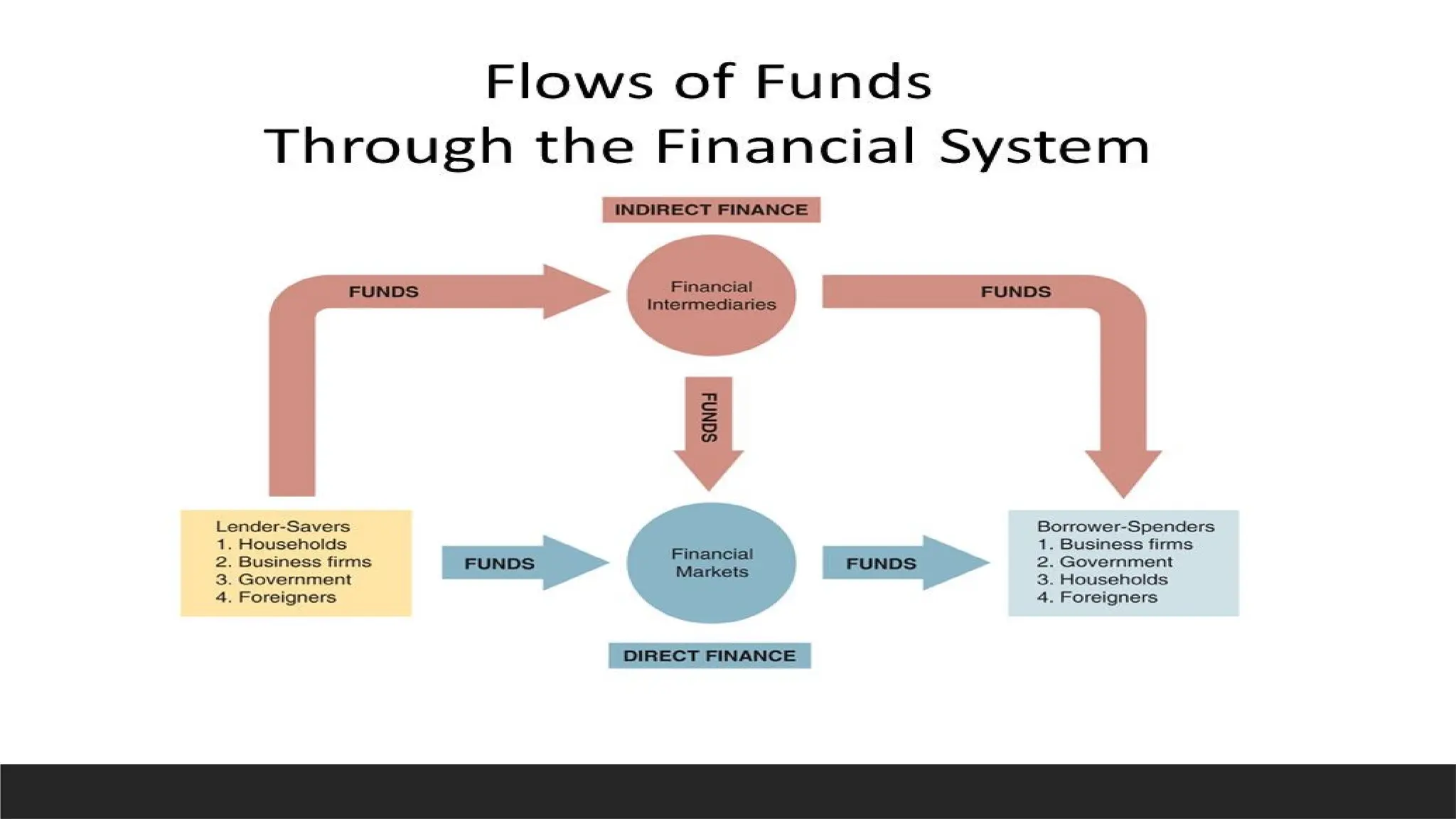
More often, however, financial intermediaries bring savers, borrowers, and
financial
assets together. A financial intermediary is a financial institution that collects
funds
from savers and then invests these funds in loans and other financial assets.
Figure
Other common financial intermediaries include finance companies, which
make small loans; pension funds, which invest money for groups of workers;
and
life insurance companies, which invest funds collected from policyholders. A
mutual
fund is a pool of money managed by an investment company that gathers
money
from individual investors and purchases a range of financial assets. Investors
own
shares of the entire fund based on the amount of their investment. These
institutions
gather their money in different ways and provide many different financial
assets to a variety of investors.
Financial Asset Markets
The different financial assets discussed in this section are bought and sold on
various financial markets. Economists tend to categorize these markets based
on
two factors—time (how long the loan is for) and whether the financial assets
can
be resold. Based on time, economists distinguish between the capital
market, the
market for buying and selling long-term financial assets, and the money
market, the
market for buying and selling short-term financial assets. In regard to
resalability,
economists distinguish between the primary market, which is the market for
buying
newly created financial assets directly from the issuing entity, and the
secondary
market, which is the market where financial assets are resold.
FACTOR 1 Time
There are two time-sensitive markets. Capital markets are markets where assets are held
for longer than a year. Some examples of assets sold on the capital market include certain
kinds of securities, namely stocks and bonds, mortgages, and long-term CDs. Because
these loans are for longer periods of time, the money may be invested in projects that
require large amounts of capital, such as buying homes, building new factories, retooling
established factories, or financing government projects.
Money markets are markets where loans are made for less than a year. Examples of
assets traded in these markets include short-term CDs that depositors can redeem in a
few months and Treasury bills, which allow the U.S. government to borrow money for
short periods of time.
FACTOR 2 Resalability
There also are two kinds of markets based on whether the financial assets can be
resold. Primary markets are markets for financial assets that can be redeemed
only
by the original buyer. Examples include savings bonds and small denomination
CDs.
The term primary market also refers to the market where the first issue of a
stock is
sold to the public through investment bankers.
Secondary markets are resale markets for financial assets. These markets offer
liquidity to personal investors. So, investors are able to turn their assets into cash
relatively quickly. Stocks and bonds, which you’ll learn more about later in this
chapter,
are two of the most prominent financial assets sold on the secondary market.
SECTION 2 Investing in a Market
Economy
Why Are You Investing?
The first thing that you might do is to decide why you are
investing. This reason is your investment objective, a
financial goal that an investor uses to determine if an
investment is appropriate.
Risk and Return
Once investors have decided their financial objectives, there are two other
related
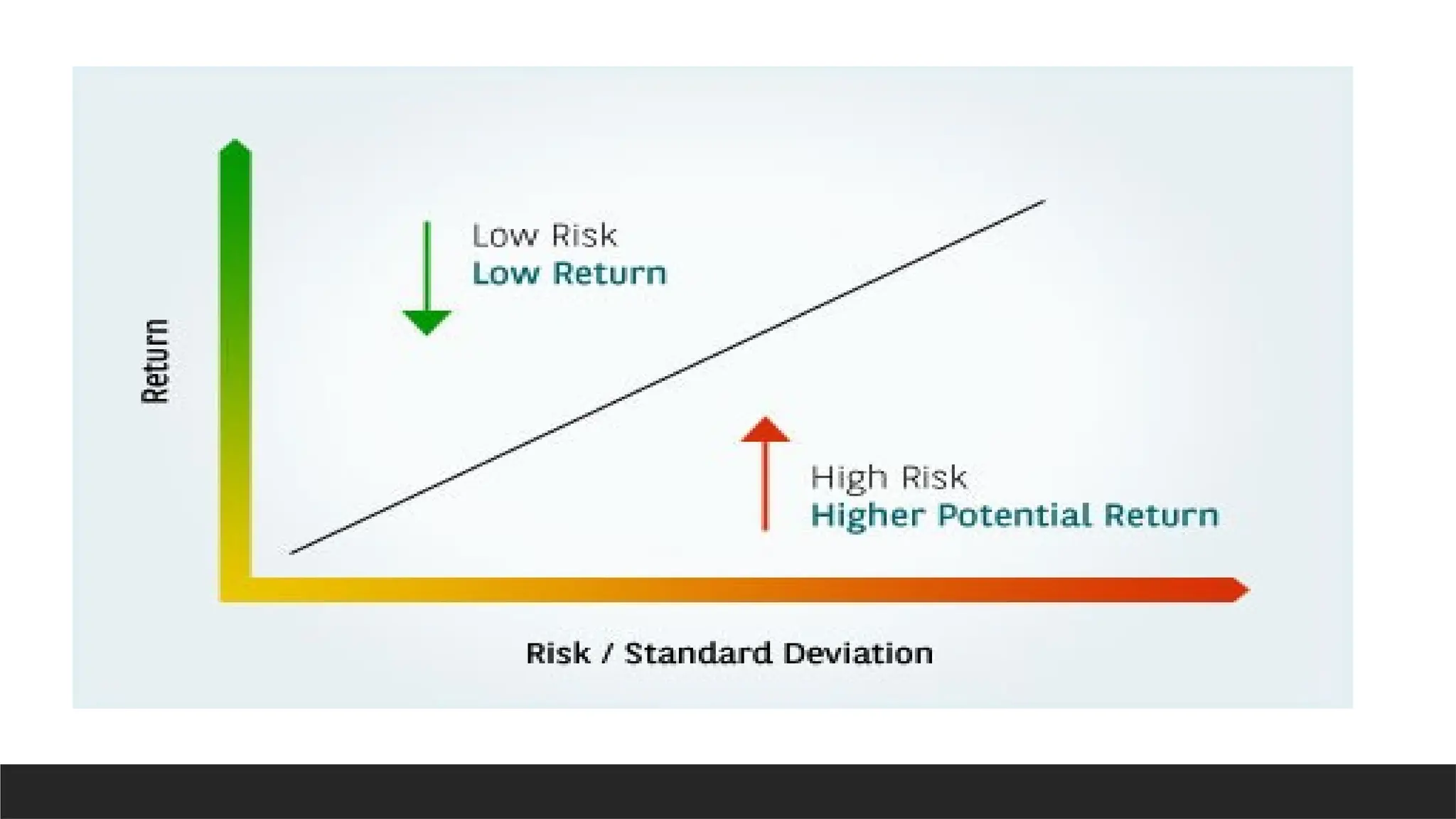
issues they might consider—risk and return. Risk is the possibility for loss on
an
investment, and return is the profit or loss made on an investment.
While savings deposits in banks are insured against loss, most investments
carry some possibility of losing part of the money invested. Return may refer
to
the interest paid on a savings account or CD or the increase in value of a
stock over
time. Most investors try to balance risk and return through diversification,
the
practice of distributing investments among different financial assets to
maximize
When most investors think about risk, they think about the possibility of losing
some of their initial investment, often referred to as their principal. Even if they
don’t earn a lot of money on the investment, they want to get back at least what
they put in. Investments that guarantee no loss of principal include insured
savings
deposits and CDs. Bonds that are backed by the U.S. government are also
considered
to be almost risk-free because it is highly unlikely that the government would
not
pay back its loans. Almost all other investments carry some risk.
Risk and Return
One of the biggest risks investors face, even with safe investments like those
described above, is loss of the purchasing power of the money invested due
to inflation.
(Remember that inflation is a general rise in the level of prices.) That is why
many financial advisers warn against investing everything in safe
investments that
pay a guaranteed rate of interest that may not keep up with inflation.
Risk and Return
Other investments, such as stocks and corporate bonds, carry a
higher degree of risk because the return depends on how
profitable the company is. Investors who purchase stock with the
expectation that it will appreciate in value over time may lose
some of their money if the company runs into problems or other
economic factors affect the value of the stock.
Risk and Return
Section 3 Buying and Selling
Stocks
However, most stock is then resold to investors through a stock
exchange, a
secondary market where securities (stocks and bonds) are bought and
sold. Most
people buy stocks as a financial investment, with the expectation that
the stock price will rise and that they can resell the stock for a profit.
Gains made from the sale of securities are called capital gains.
Why Buy Stock?
Investors buy stock for two reasons. The first is to earn dividend
payments, which are a share of the corporation’s profits that are paid
back to the corporation’s stockholders. The second reason is to earn
capital gains by selling the stock at a price greater than the purchase
price. If stock is sold below the buying price, the seller makes a capital
loss
.
Types of Stock
There are essentially two types of stock—common stock and preferred
stock.
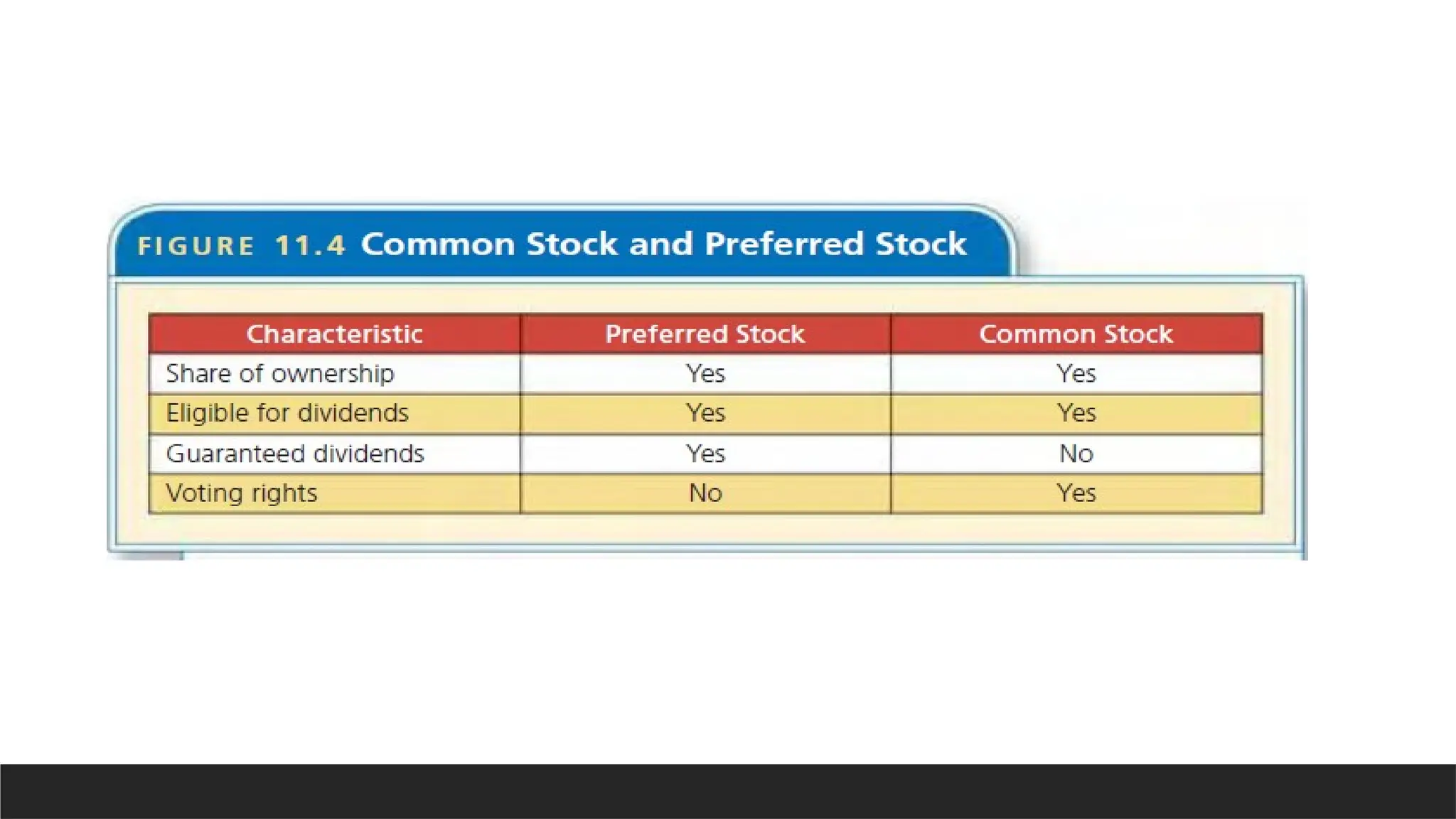
Common stock is share of ownership in a corporation, giving holders
voting rights
and a share of profits. Preferred stock is share of ownership in a
corporation giving
holders a share of profits (paid before common stockholders) but no
voting rights.
Most people who buy stock choose to buy common stock.
Trading Stock
When investors want to buy or sell stock, they use a stockbroker, an agent who,
for a commission, buys and sells securities for customers. Stockbrokers, sometimes
just called brokers, generally work for brokerage firms. Investors may interact with
brokers in person, by phone, or online. The broker’s primary job is to carry out the
investor’s instructions to make trades. Some brokers also provide investment
advice. Brokers buy and sell stocks for their customers on a variety of stock
exchanges.
Measuring How Stocks Perform
About half of all U.S. households now own stocks, and the stock market’s
performance
is followed closely on the nightly news, not just in specialized business media.
Perhaps you have heard a statement like this one: “Wall Street responded
positively
to the latest employment figures, with the Dow making robust gains for the
first
time in several weeks.” The Dow is a stock index, an instrument used to
measure
and report the change in prices of a set of stocks. Stock indexes measure the
performance— whether gaining or declining in value—of many individual
stocks and the
stock market as a whole.
Stock Indexes
Stock indexes provide a snapshot of how the stock market is performing.
The Dow—
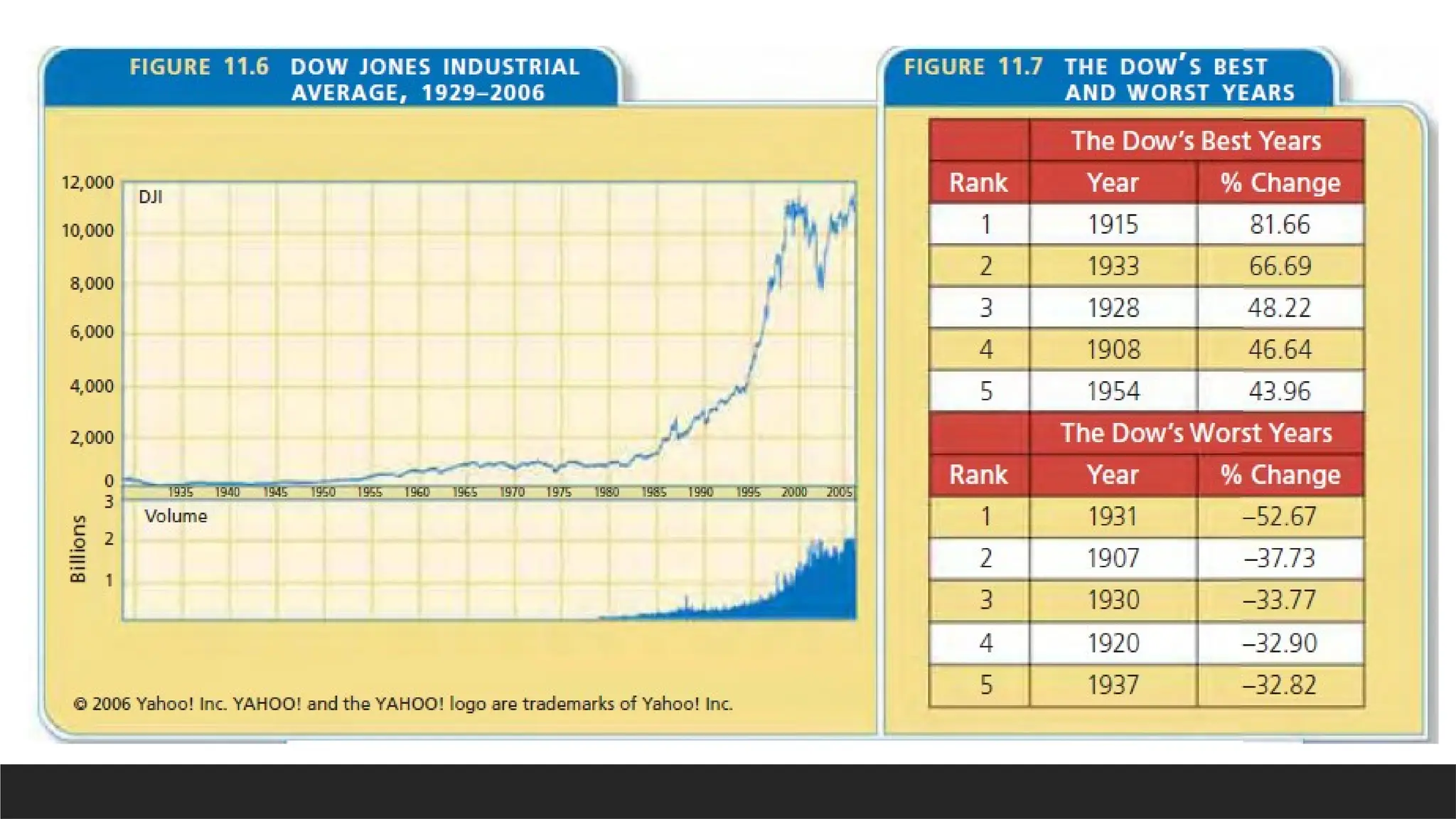
short for the Dow Jones Industrial Average (DJIA)—is the most well known.
(For
help reading Figure 11.6, turn to the Skillbuilder on page 342.) Other U.S.
indexes
often cited include the Standard & Poor’s 500 (S&P 500) and the NASDAQ
Composite.
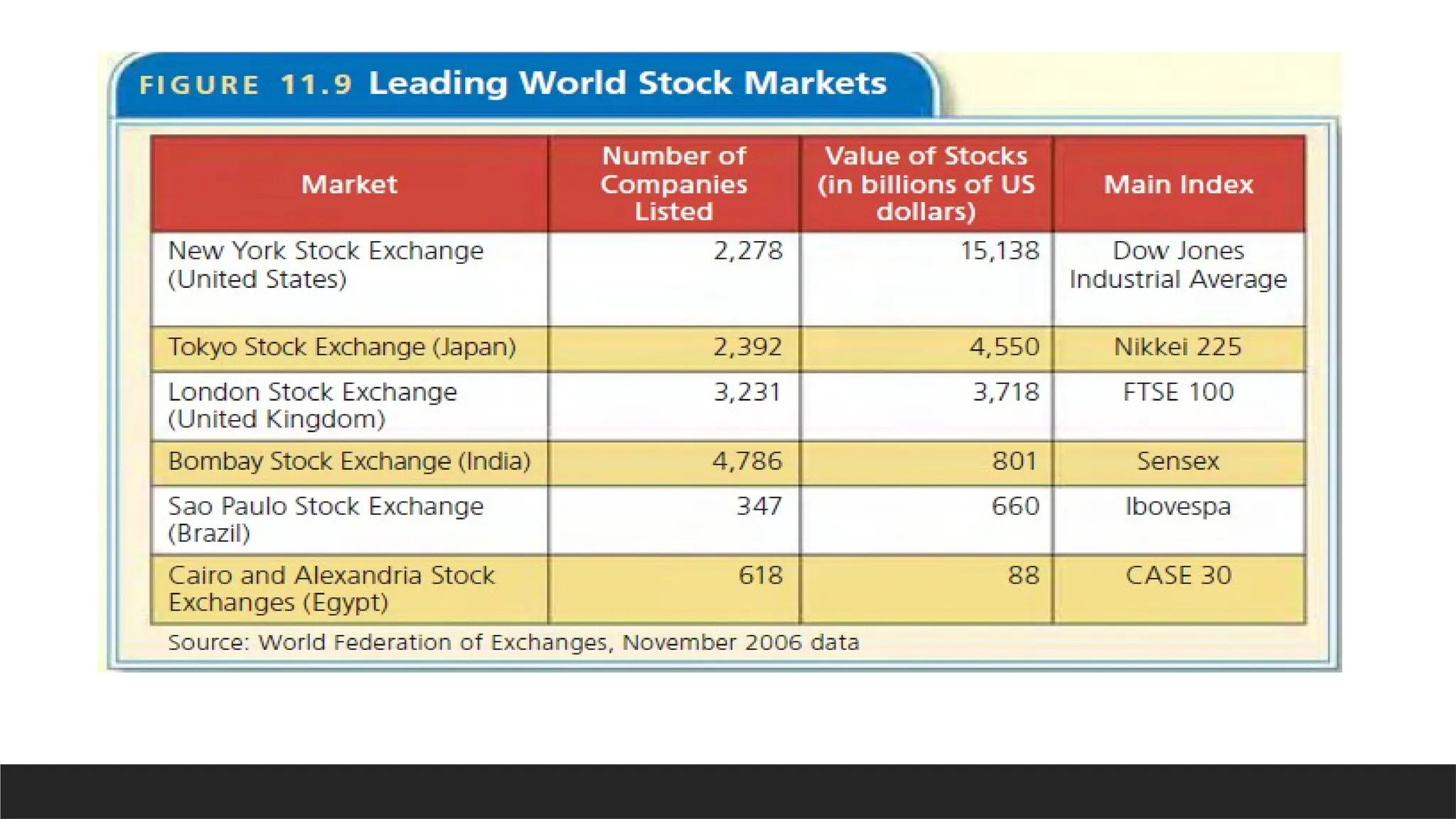
Global stock indexes include the Hang Seng Index (Hong Kong), the DAX
(Germany), the Nikkei 225 (Japan), and the FTSE 100 (Britain). Each index
measures
the performance of a different group of stocks.
Tracking the Dow
Changes in the Dow reflect trends in stock market prices.
The terms bull market and bear market are commonly
used
to describe these trends. A bull market is a situation
where
stock market prices rise steadily over a relatively long
period
of time. A bear market is a situation where stock market
prices
decline steadily over a relatively long period of time.
Those
who follow the stock market track the Dow and other
indexes
Thank you

Fixed Income Structured Product and ways of free-risk trading

  • 1.
  • 2.
    Financial Markets Savings and Investment SECTION1 Investing in a Market Economy SECTION 2 Buying and Selling Stocks Section 3 Bonds and Other Financial Instruments Section 4
  • 3.
    Section 1 -Savings and Investment There are two things you can do with your money—spend it or save it. Savings is income not used for consumption, in other words not spent on immediate wants. Savings that are put to use are investments. In general, investment is the use of income today in a way that allows for a future benefit. More specifically, economic investment refers to money lent to businesses—to finance the construction of a new factory, for example. Personal investment refers to the act of individuals putting their savings into financial assets, such as CDs, stocks, bonds, or mutual funds. The financial system consists of institutions, such as banks, insurance markets, bond markets, and stock markets, that help transfer funds between savers and investors.
  • 4.
    Bringing Savings andInvestment Together Individuals and businesses can save surplus funds in many ways, including savings accounts at commercial banks or S&Ls, certificates of deposit (CDs), corporate or government bonds, and stocks. The agent receiving these funds is a borrower, who issues savers written confirmation of the transaction. This written confirmation is called a financial asset, or a claim on the property of the borrower. Sometimes savers and borrowers come together directly in a financial market, a situation in which buyers and sellers exchange particular types of financial assets. For example, an individual or business might buy corporate bonds or shares of stock. More often, however, financial intermediaries bring savers, borrowers, and financial assets together. A financial intermediary is a financial institution that collects funds from savers and then invests these funds in loans and other financial assets. Figure
  • 5.
    Other common financialintermediaries include finance companies, which make small loans; pension funds, which invest money for groups of workers; and life insurance companies, which invest funds collected from policyholders. A mutual fund is a pool of money managed by an investment company that gathers money from individual investors and purchases a range of financial assets. Investors own shares of the entire fund based on the amount of their investment. These institutions gather their money in different ways and provide many different financial assets to a variety of investors.
  • 7.
    Financial Asset Markets Thedifferent financial assets discussed in this section are bought and sold on various financial markets. Economists tend to categorize these markets based on two factors—time (how long the loan is for) and whether the financial assets can be resold. Based on time, economists distinguish between the capital market, the market for buying and selling long-term financial assets, and the money market, the market for buying and selling short-term financial assets. In regard to resalability, economists distinguish between the primary market, which is the market for buying newly created financial assets directly from the issuing entity, and the secondary market, which is the market where financial assets are resold.
  • 8.
    FACTOR 1 Time Thereare two time-sensitive markets. Capital markets are markets where assets are held for longer than a year. Some examples of assets sold on the capital market include certain kinds of securities, namely stocks and bonds, mortgages, and long-term CDs. Because these loans are for longer periods of time, the money may be invested in projects that require large amounts of capital, such as buying homes, building new factories, retooling established factories, or financing government projects. Money markets are markets where loans are made for less than a year. Examples of assets traded in these markets include short-term CDs that depositors can redeem in a few months and Treasury bills, which allow the U.S. government to borrow money for short periods of time.
  • 9.
    FACTOR 2 Resalability Therealso are two kinds of markets based on whether the financial assets can be resold. Primary markets are markets for financial assets that can be redeemed only by the original buyer. Examples include savings bonds and small denomination CDs. The term primary market also refers to the market where the first issue of a stock is sold to the public through investment bankers. Secondary markets are resale markets for financial assets. These markets offer liquidity to personal investors. So, investors are able to turn their assets into cash relatively quickly. Stocks and bonds, which you’ll learn more about later in this chapter, are two of the most prominent financial assets sold on the secondary market.
  • 10.
    SECTION 2 Investingin a Market Economy Why Are You Investing? The first thing that you might do is to decide why you are investing. This reason is your investment objective, a financial goal that an investor uses to determine if an investment is appropriate.
  • 11.
    Risk and Return Onceinvestors have decided their financial objectives, there are two other related issues they might consider—risk and return. Risk is the possibility for loss on an investment, and return is the profit or loss made on an investment. While savings deposits in banks are insured against loss, most investments carry some possibility of losing part of the money invested. Return may refer to the interest paid on a savings account or CD or the increase in value of a stock over time. Most investors try to balance risk and return through diversification, the practice of distributing investments among different financial assets to maximize
  • 12.
    When most investorsthink about risk, they think about the possibility of losing some of their initial investment, often referred to as their principal. Even if they don’t earn a lot of money on the investment, they want to get back at least what they put in. Investments that guarantee no loss of principal include insured savings deposits and CDs. Bonds that are backed by the U.S. government are also considered to be almost risk-free because it is highly unlikely that the government would not pay back its loans. Almost all other investments carry some risk. Risk and Return
  • 13.
    One of thebiggest risks investors face, even with safe investments like those described above, is loss of the purchasing power of the money invested due to inflation. (Remember that inflation is a general rise in the level of prices.) That is why many financial advisers warn against investing everything in safe investments that pay a guaranteed rate of interest that may not keep up with inflation. Risk and Return
  • 14.
    Other investments, suchas stocks and corporate bonds, carry a higher degree of risk because the return depends on how profitable the company is. Investors who purchase stock with the expectation that it will appreciate in value over time may lose some of their money if the company runs into problems or other economic factors affect the value of the stock. Risk and Return
  • 16.
    Section 3 Buyingand Selling Stocks However, most stock is then resold to investors through a stock exchange, a secondary market where securities (stocks and bonds) are bought and sold. Most people buy stocks as a financial investment, with the expectation that the stock price will rise and that they can resell the stock for a profit. Gains made from the sale of securities are called capital gains.
  • 17.
    Why Buy Stock? Investorsbuy stock for two reasons. The first is to earn dividend payments, which are a share of the corporation’s profits that are paid back to the corporation’s stockholders. The second reason is to earn capital gains by selling the stock at a price greater than the purchase price. If stock is sold below the buying price, the seller makes a capital loss .
  • 18.
    Types of Stock Thereare essentially two types of stock—common stock and preferred stock. Common stock is share of ownership in a corporation, giving holders voting rights and a share of profits. Preferred stock is share of ownership in a corporation giving holders a share of profits (paid before common stockholders) but no voting rights. Most people who buy stock choose to buy common stock.
  • 20.
    Trading Stock When investorswant to buy or sell stock, they use a stockbroker, an agent who, for a commission, buys and sells securities for customers. Stockbrokers, sometimes just called brokers, generally work for brokerage firms. Investors may interact with brokers in person, by phone, or online. The broker’s primary job is to carry out the investor’s instructions to make trades. Some brokers also provide investment advice. Brokers buy and sell stocks for their customers on a variety of stock exchanges.
  • 23.
    Measuring How StocksPerform About half of all U.S. households now own stocks, and the stock market’s performance is followed closely on the nightly news, not just in specialized business media. Perhaps you have heard a statement like this one: “Wall Street responded positively to the latest employment figures, with the Dow making robust gains for the first time in several weeks.” The Dow is a stock index, an instrument used to measure and report the change in prices of a set of stocks. Stock indexes measure the performance— whether gaining or declining in value—of many individual stocks and the stock market as a whole.
  • 24.
    Stock Indexes Stock indexesprovide a snapshot of how the stock market is performing. The Dow— short for the Dow Jones Industrial Average (DJIA)—is the most well known. (For help reading Figure 11.6, turn to the Skillbuilder on page 342.) Other U.S. indexes often cited include the Standard & Poor’s 500 (S&P 500) and the NASDAQ Composite. Global stock indexes include the Hang Seng Index (Hong Kong), the DAX (Germany), the Nikkei 225 (Japan), and the FTSE 100 (Britain). Each index measures the performance of a different group of stocks.
  • 26.
    Tracking the Dow Changesin the Dow reflect trends in stock market prices. The terms bull market and bear market are commonly used to describe these trends. A bull market is a situation where stock market prices rise steadily over a relatively long period of time. A bear market is a situation where stock market prices decline steadily over a relatively long period of time. Those who follow the stock market track the Dow and other indexes
  • 29.