Finance Orientation:
For PE/VC Funded IT
Product/Services Co
Seemant Shrivastav,
Managing Partner,
Attentio Corporate Services LLP
Agenda
• Introduction: Key Components
• Finance: Do’s
• Finance: Don’ts
• Focus Areas for Business Owners
© 2015 SeemantShrivastav
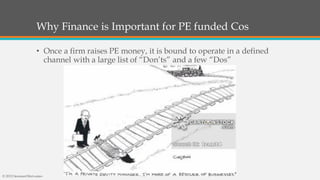
Why Finance is Important for PE funded Cos
• Once a firm raises PE money, it is bound to operate in a defined
channel with a large list of “Don’ts” and a few “Dos”
© 2015 SeemantShrivastav
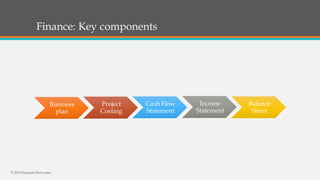
Finance: Key components
Business
plan
Balance
Sheet
Income
Statement
Cash Flow
Statement
Project
Costing
© 2015 SeemantShrivastav
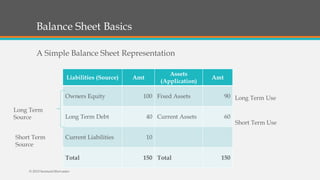
Balance Sheet Basics
Liabilities (Source) Amt
Assets
(Application)
Amt
Owners Equity 100 Fixed Assets 90
Long Term Debt 40 Current Assets 60
Current Liabilities 10
Total 150 Total 150
A Simple Balance Sheet Representation
Long Term
Source
Long Term Use
Short Term
Source
Short Term Use
© 2015 SeemantShrivastav
Two Golden Rules for Balance Sheet Management
• Always invest (or spend) your money on assets or investments
which will generate a return which is equal to or more than cost of
capital for your firm
• Invest your money in such a way that assets generate returns
before liabilities demand an outflow
© 2015 SeemantShrivastav
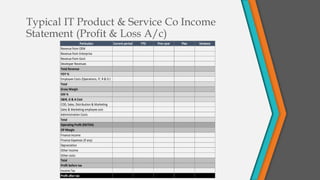
Typical IT Product & Service Co Income
Statement (Profit & Loss A/c)
Particulars Current period YTD Prev year Plan Variance
Revenue from OEM
Revenue from Enterprise
Revenue from Govt
Developer Revenues
Total Revenue
YOY %
Employee Costs (Operations, IT, R & D )
Total
Gross Margin
GM %
S&M, G & A Cost
COD, Sales, Distribution & Marketing
Sales & Marketing employee cost
Administration Costs
Total
Operating Profit (EBITDA)
OP Margin
Finance Income
Finance Expenses (if any)
Depreciation
Other income
Other costs
Total
Profit before tax
Income Tax
Profit after tax
Cash Flow
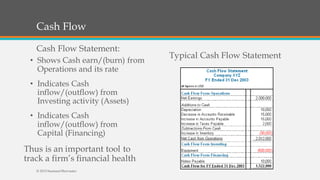
Cash Flow Statement:
• Shows Cash earn/(burn) from
Operations and its rate
• Indicates Cash
inflow/(outflow) from
Investing activity (Assets)
• Indicates Cash
inflow/(outflow) from
Capital (Financing)
Typical Cash Flow Statement
Thus is an important tool to
track a firm’s financial health
© 2015 SeemantShrivastav
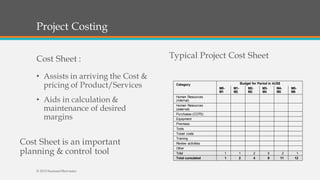
Project Costing
Cost Sheet :
• Assists in arriving the Cost &
pricing of Product/Services
• Aids in calculation &
maintenance of desired
margins
Typical Project Cost Sheet
Cost Sheet is an important
planning & control tool
Category Budget for Period in kUS$
M0-
M1
M1-
M2
M2-
M3
M3-
M4
M4-
M5
M5-
M6
Human Resources
(internal)
Human Resources
(external)
Purchases (COTS)
Equipment
Premises
Tools
Travel costs
Training
Review activities
Other
Total 1 1 2 5 2 1
Total cumulated 1 2 4 9 11 12
© 2015 SeemantShrivastav
Business Plan
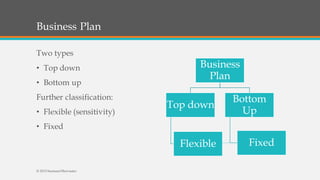
Two types
• Top down
• Bottom up
Further classification:
• Flexible (sensitivity)
• Fixed
Business
Plan
Top down
Flexible
Bottom
Up
Fixed
© 2015 SeemantShrivastav
Business Plan (contd)
• Don’t plan for certainty– everything is uncertain
• Build Sensitivity analysis in the model factoring in worst case, base
case & best case scenarios
• It’s a good idea to give a stretch plan to Sales team. Say Board
approved Sales plan is 100 then inform Sales that they need to
achieve 110 or 120 depending on team capability & market
conditions
• Major expenses, Salaries, Professional fees, Marketing, Biz dev etc
need to be monitored closely vis-à-vis the plan
© 2015 SeemantShrivastav
Some Finance Do’s
• Do review your Sales, Receivables, Payables & Cash position
(including investments) once in a week.
• Do go through the MIS provided and understand the key drivers of
your business. There could be some important parameters coming
up as we develop the MIS. Say segmental & geographical revenue
analysis, productivity or revenue per employee realized etc.
• Do review your compliance status vis-à-vis compliance calendar
provided once every month.
• Do engage in regular discussions with investor reps on financial
performance of company and do ask for help where needed.
© 2015 SeemantShrivastav
Some Finance Don’ts
• Don’t underestimate the importance of building a good business
plan. Recommend you folks kick start the exercise in Q4 2015-16.
• Don’t ever leave finance to your Consultants, CFO or Controller
(whenever you have one). The buck stops at you!
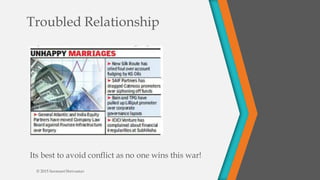
• Don’t hide or try to cover any bad news from investor, its always a
good idea to discuss and work out solutions with investor (see slide:
troubled relationship)
• Don’t assume a month or quarter of bad results are an aberration. If
you drill down to major reasons of the bad results, you’d be able to
isolate and address the problems and resolve the organization
performance challenges quickly.
© 2015 SeemantShrivastav
Troubled Relationship
Its best to avoid conflict as no one wins this war!
© 2015 Seemant Shrivastav
Focus
As a business owner focus on
• Cash earn vs Burn
• Working Capital & Investments
• Margins on Sales and EBITDA
• Capex plan & ROI
• ROCE (IRR)
© 2015 SeemantShrivastav
Others Important Focus Areas
• Corporate Governance
• Reporting & Flagging off matter to investors
• Compliance
• Risks & Controls
© 2015 SeemantShrivastav
Questions
THANKS

Finance orientation for PE/VC funded IT/SAAS Co

  • 1.
    Finance Orientation: For PE/VCFunded IT Product/Services Co Seemant Shrivastav, Managing Partner, Attentio Corporate Services LLP
  • 2.
    Agenda • Introduction: KeyComponents • Finance: Do’s • Finance: Don’ts • Focus Areas for Business Owners © 2015 SeemantShrivastav
  • 3.
    Why Finance isImportant for PE funded Cos • Once a firm raises PE money, it is bound to operate in a defined channel with a large list of “Don’ts” and a few “Dos” © 2015 SeemantShrivastav
  • 4.
    Finance: Key components Business plan Balance Sheet Income Statement CashFlow Statement Project Costing © 2015 SeemantShrivastav
  • 5.
    Balance Sheet Basics Liabilities(Source) Amt Assets (Application) Amt Owners Equity 100 Fixed Assets 90 Long Term Debt 40 Current Assets 60 Current Liabilities 10 Total 150 Total 150 A Simple Balance Sheet Representation Long Term Source Long Term Use Short Term Source Short Term Use © 2015 SeemantShrivastav
  • 6.
    Two Golden Rulesfor Balance Sheet Management • Always invest (or spend) your money on assets or investments which will generate a return which is equal to or more than cost of capital for your firm • Invest your money in such a way that assets generate returns before liabilities demand an outflow © 2015 SeemantShrivastav
  • 7.
    Typical IT Product& Service Co Income Statement (Profit & Loss A/c) Particulars Current period YTD Prev year Plan Variance Revenue from OEM Revenue from Enterprise Revenue from Govt Developer Revenues Total Revenue YOY % Employee Costs (Operations, IT, R & D ) Total Gross Margin GM % S&M, G & A Cost COD, Sales, Distribution & Marketing Sales & Marketing employee cost Administration Costs Total Operating Profit (EBITDA) OP Margin Finance Income Finance Expenses (if any) Depreciation Other income Other costs Total Profit before tax Income Tax Profit after tax
  • 8.
    Cash Flow Cash FlowStatement: • Shows Cash earn/(burn) from Operations and its rate • Indicates Cash inflow/(outflow) from Investing activity (Assets) • Indicates Cash inflow/(outflow) from Capital (Financing) Typical Cash Flow Statement Thus is an important tool to track a firm’s financial health © 2015 SeemantShrivastav
  • 9.
    Project Costing Cost Sheet: • Assists in arriving the Cost & pricing of Product/Services • Aids in calculation & maintenance of desired margins Typical Project Cost Sheet Cost Sheet is an important planning & control tool Category Budget for Period in kUS$ M0- M1 M1- M2 M2- M3 M3- M4 M4- M5 M5- M6 Human Resources (internal) Human Resources (external) Purchases (COTS) Equipment Premises Tools Travel costs Training Review activities Other Total 1 1 2 5 2 1 Total cumulated 1 2 4 9 11 12 © 2015 SeemantShrivastav
  • 10.
    Business Plan Two types •Top down • Bottom up Further classification: • Flexible (sensitivity) • Fixed Business Plan Top down Flexible Bottom Up Fixed © 2015 SeemantShrivastav
  • 11.
    Business Plan (contd) •Don’t plan for certainty– everything is uncertain • Build Sensitivity analysis in the model factoring in worst case, base case & best case scenarios • It’s a good idea to give a stretch plan to Sales team. Say Board approved Sales plan is 100 then inform Sales that they need to achieve 110 or 120 depending on team capability & market conditions • Major expenses, Salaries, Professional fees, Marketing, Biz dev etc need to be monitored closely vis-à-vis the plan © 2015 SeemantShrivastav
  • 12.
    Some Finance Do’s •Do review your Sales, Receivables, Payables & Cash position (including investments) once in a week. • Do go through the MIS provided and understand the key drivers of your business. There could be some important parameters coming up as we develop the MIS. Say segmental & geographical revenue analysis, productivity or revenue per employee realized etc. • Do review your compliance status vis-à-vis compliance calendar provided once every month. • Do engage in regular discussions with investor reps on financial performance of company and do ask for help where needed. © 2015 SeemantShrivastav
  • 13.
    Some Finance Don’ts •Don’t underestimate the importance of building a good business plan. Recommend you folks kick start the exercise in Q4 2015-16. • Don’t ever leave finance to your Consultants, CFO or Controller (whenever you have one). The buck stops at you! • Don’t hide or try to cover any bad news from investor, its always a good idea to discuss and work out solutions with investor (see slide: troubled relationship) • Don’t assume a month or quarter of bad results are an aberration. If you drill down to major reasons of the bad results, you’d be able to isolate and address the problems and resolve the organization performance challenges quickly. © 2015 SeemantShrivastav
  • 14.
    Troubled Relationship Its bestto avoid conflict as no one wins this war! © 2015 Seemant Shrivastav
  • 15.
    Focus As a businessowner focus on • Cash earn vs Burn • Working Capital & Investments • Margins on Sales and EBITDA • Capex plan & ROI • ROCE (IRR) © 2015 SeemantShrivastav
  • 16.
    Others Important FocusAreas • Corporate Governance • Reporting & Flagging off matter to investors • Compliance • Risks & Controls © 2015 SeemantShrivastav
  • 17.