Seemant Shrivastav
Managing Partner
AttentioCorporate Services LLP
Startup India: Overview
Agenda
• What are Startups?
• Startup Culture.
• Startup Ecosystem & Its Components.
• Problems faced by Startups.
• Type of entities
• Government Initiatives for Startups.
• Tax Exemptions by Government.
• Funding Options
• Conclusion
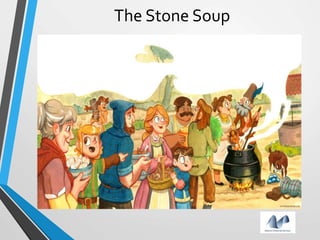
The Stone Soup
What are Startups?
Startup is :
• An entrepreneurial venture
• In a newly emerged, fast-growing sectors
• By usually a group of co-founders
• Working on validation of MVP
• For hyper growth later
Startup Culture
An ideal Startup culture characterized by
• Informal culture
• Lack of hierarchy/ Flat organisation
• Quick decision making, nimble footed
• Focus on growth & profitability
• Receptive to market/customers
Startup Ecosystem
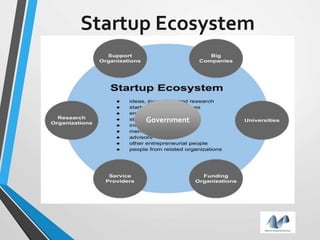
A startup ecosystem consists of
• people
• startups in their various stages & types
• support organisations like universities, funding
organizations, incubators, accelerators, co-working
spaces etc.
• research organizations,
• service provider organizations (like legal, financial
services etc.)
• Clients (large corporations & other entities)
• Last but not least, Government
Startup Ecosystem
Government
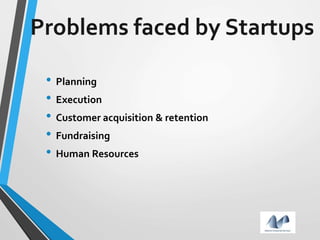
Problems faced by Startups
• Planning
• Execution
• Customer acquisition & retention
• Fundraising
• Human Resources
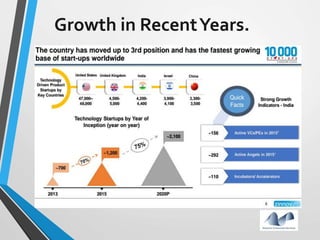
Growth in RecentYears.
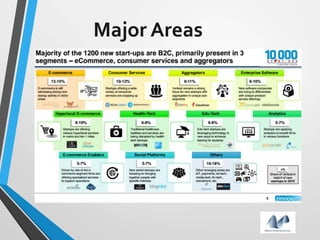
Major Areas
Types of Entities
• Sole Proprietorship
• One Person Company
• Partnership
• HUF
• LLP
• Private Limited Company
• Public Limited Company
• Public Limited, Listed
Company
Suited for small, mid
sized &/or family held
businesses
Suited for
professional growth
oriented businesses
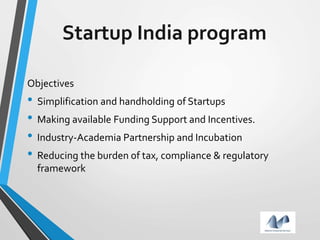
Startup India program
Objectives
• Simplification and handholding of Startups
• Making available Funding Support and Incentives.
• Industry-Academia Partnership and Incubation
• Reducing the burden of tax, compliance & regulatory
framework
Mobile App & Portal
• To serve as the single platform for Startups for interacting with
Government and Regulatory Institutions for all business needs & info
exchange
• In order to commence operations, Startups require registration with
relevant regulatory authorities.
• a checklist of required licenses covering labour licensing,
environmental clearances etc. be made available on portal
Other Initiatives
• Effective April 1, 2015 Central Government, State Government and PSUs have to
mandatorily procure at least 20% from the Micro Small and Medium Enterprise
(MSME).
• In order to promote Startups, Government shall exempt Startups (in the
manufacturing sector) from the criteria of “prior experience/ turnover” without
any relaxation in quality standards or technical parameters.
• To make it easier for Startups to wind up operations, a swift and simple process
has been proposed for Startups to wind-up operations.
Tax Exemptions
• Exemptions on Capital Gains for Angel,VC/AIF investors If invested via funds
of funds recognized by GOI
• Recognized Startups exempted from IncomeTax for three years post
recognition
• If consideration paid is higher than FMV then the difference is taxed as other
income in hands of investors. Investors in Startups have been exempted
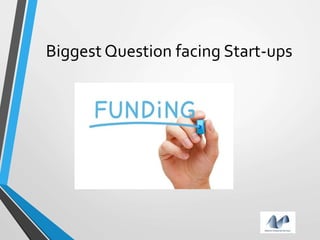
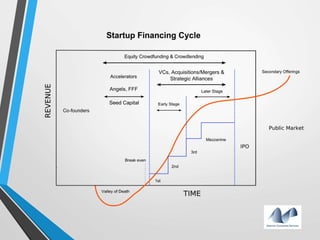
Biggest Question facing Start-ups
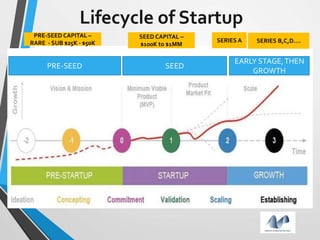
PRE-SEED SEED
EARLY STAGE,THEN
GROWTH
SEED CAPITAL –
$100K to $1MM
PRE-SEED CAPITAL –
RARE - SUB $25K - $50K SERIES A SERIES B,C,D….
Lifecycle of Startup
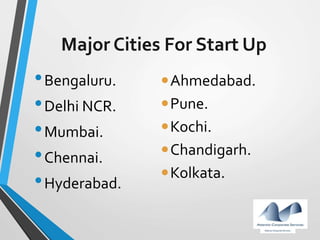
Major Cities For Start Up
•Bengaluru.
•Delhi NCR.
•Mumbai.
•Chennai.
•Hyderabad.
Ahmedabad.
Pune.
Kochi.
Chandigarh.
Kolkata.
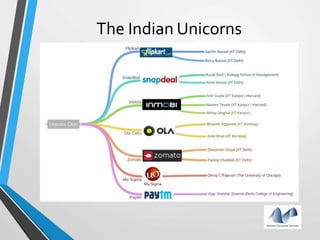
The Indian Unicorns
Point to be noted..
• Angel Investors & Angel funds
• Venture funds &
• Private Equity
Are not the only source of funds for your start up
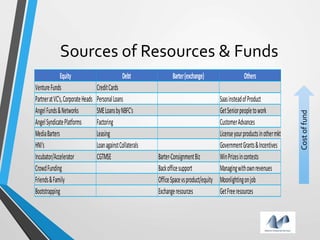
Sources of Resources & Funds
Equity Debt Barter(exchange) Others
VentureFunds CreditCards
PartneratVC's,CorporateHeads PersonalLoans SaasinsteadofProduct
AngelFunds&Networks SMELoansbyNBFC's GetSeniorpeopletowork
AngelSyndicatePlatforms Factoring CustomerAdvances
MediaBarters Leasing Licenseyourproductsinothermkt
HNI's LoanagainstCollaterals GovernmentGrants&Incentives
Incubator/Accelerator CGTMSE Barter-ConsignmentBiz WinPrizesincontests
CrowdFunding Backofficesupport Managingwithownrevenues
Friends&Family OfficeSpacevsproduct/equity Moonlightingonjob
Bootstrapping Exchangeresources GetFreeresources
Costoffund
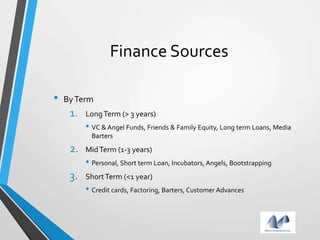
Finance Sources
• ByTerm
1. LongTerm (> 3 years)
• VC & Angel Funds, Friends & Family Equity, Long term Loans, Media
Barters
2. MidTerm (1-3 years)
• Personal, Short term Loan, Incubators, Angels, Bootstrapping
3. ShortTerm (<1 year)
• Credit cards, Factoring, Barters, Customer Advances
Fundraising questions – 1/2
• How much funding should I raise?
• When should I raise money?At what stage should I not?
• What heads and stage should I raise money for?
• What are the relevant sources of finance for me and how
should I prioritise? What are the pros and cons of each
type?
• How much equity should I give? At what terms?
• How should I value my company?
• How should I give equity when I am unable to value my
company?
• How should I reach out to investors?
• How many investors would I have to reach to find
one?
• How long will this process take ?
• Should I appoint anyone for the process ?
• How much will the fund raising process co?st
• What is the right structure/instrument?
Fundraising questions –2/2
In Conclusion
• Define your round – amount, tranche, dilution
• Structure a process – Project Plan and CRM
• Seeking advice – entrepreneurs, investors, mentors, industry
guys – ask for advice, you get money; ask money, get advice
• Selecting aVC –Terms, Follow On, Strategic Support, Brand
Name,Time to money, Integrity/Competition, Dilution
• Finding a good lawyer
Finally..
Thanks!
Questions?
Reach out-
: seemant@icloud.com
: @seemants

Startup India Overview

  • 1.
    Seemant Shrivastav Managing Partner AttentioCorporateServices LLP Startup India: Overview
  • 2.
    Agenda • What areStartups? • Startup Culture. • Startup Ecosystem & Its Components. • Problems faced by Startups. • Type of entities • Government Initiatives for Startups. • Tax Exemptions by Government. • Funding Options • Conclusion
  • 3.
  • 4.
    What are Startups? Startupis : • An entrepreneurial venture • In a newly emerged, fast-growing sectors • By usually a group of co-founders • Working on validation of MVP • For hyper growth later
  • 6.
    Startup Culture An idealStartup culture characterized by • Informal culture • Lack of hierarchy/ Flat organisation • Quick decision making, nimble footed • Focus on growth & profitability • Receptive to market/customers
  • 7.
    Startup Ecosystem A startupecosystem consists of • people • startups in their various stages & types • support organisations like universities, funding organizations, incubators, accelerators, co-working spaces etc. • research organizations, • service provider organizations (like legal, financial services etc.) • Clients (large corporations & other entities) • Last but not least, Government
  • 8.
  • 9.
    Problems faced byStartups • Planning • Execution • Customer acquisition & retention • Fundraising • Human Resources
  • 10.
  • 11.
  • 12.
    Types of Entities •Sole Proprietorship • One Person Company • Partnership • HUF • LLP • Private Limited Company • Public Limited Company • Public Limited, Listed Company Suited for small, mid sized &/or family held businesses Suited for professional growth oriented businesses
  • 13.
    Startup India program Objectives •Simplification and handholding of Startups • Making available Funding Support and Incentives. • Industry-Academia Partnership and Incubation • Reducing the burden of tax, compliance & regulatory framework
  • 14.
    Mobile App &Portal • To serve as the single platform for Startups for interacting with Government and Regulatory Institutions for all business needs & info exchange • In order to commence operations, Startups require registration with relevant regulatory authorities. • a checklist of required licenses covering labour licensing, environmental clearances etc. be made available on portal
  • 15.
    Other Initiatives • EffectiveApril 1, 2015 Central Government, State Government and PSUs have to mandatorily procure at least 20% from the Micro Small and Medium Enterprise (MSME). • In order to promote Startups, Government shall exempt Startups (in the manufacturing sector) from the criteria of “prior experience/ turnover” without any relaxation in quality standards or technical parameters. • To make it easier for Startups to wind up operations, a swift and simple process has been proposed for Startups to wind-up operations.
  • 16.
    Tax Exemptions • Exemptionson Capital Gains for Angel,VC/AIF investors If invested via funds of funds recognized by GOI • Recognized Startups exempted from IncomeTax for three years post recognition • If consideration paid is higher than FMV then the difference is taxed as other income in hands of investors. Investors in Startups have been exempted
  • 17.
  • 20.
    PRE-SEED SEED EARLY STAGE,THEN GROWTH SEEDCAPITAL – $100K to $1MM PRE-SEED CAPITAL – RARE - SUB $25K - $50K SERIES A SERIES B,C,D…. Lifecycle of Startup
  • 21.
    Major Cities ForStart Up •Bengaluru. •Delhi NCR. •Mumbai. •Chennai. •Hyderabad. Ahmedabad. Pune. Kochi. Chandigarh. Kolkata.
  • 23.
  • 24.
    Point to benoted.. • Angel Investors & Angel funds • Venture funds & • Private Equity Are not the only source of funds for your start up
  • 25.
    Sources of Resources& Funds Equity Debt Barter(exchange) Others VentureFunds CreditCards PartneratVC's,CorporateHeads PersonalLoans SaasinsteadofProduct AngelFunds&Networks SMELoansbyNBFC's GetSeniorpeopletowork AngelSyndicatePlatforms Factoring CustomerAdvances MediaBarters Leasing Licenseyourproductsinothermkt HNI's LoanagainstCollaterals GovernmentGrants&Incentives Incubator/Accelerator CGTMSE Barter-ConsignmentBiz WinPrizesincontests CrowdFunding Backofficesupport Managingwithownrevenues Friends&Family OfficeSpacevsproduct/equity Moonlightingonjob Bootstrapping Exchangeresources GetFreeresources Costoffund
  • 26.
    Finance Sources • ByTerm 1.LongTerm (> 3 years) • VC & Angel Funds, Friends & Family Equity, Long term Loans, Media Barters 2. MidTerm (1-3 years) • Personal, Short term Loan, Incubators, Angels, Bootstrapping 3. ShortTerm (<1 year) • Credit cards, Factoring, Barters, Customer Advances
  • 27.
    Fundraising questions –1/2 • How much funding should I raise? • When should I raise money?At what stage should I not? • What heads and stage should I raise money for? • What are the relevant sources of finance for me and how should I prioritise? What are the pros and cons of each type? • How much equity should I give? At what terms? • How should I value my company? • How should I give equity when I am unable to value my company?
  • 28.
    • How shouldI reach out to investors? • How many investors would I have to reach to find one? • How long will this process take ? • Should I appoint anyone for the process ? • How much will the fund raising process co?st • What is the right structure/instrument? Fundraising questions –2/2
  • 29.
    In Conclusion • Defineyour round – amount, tranche, dilution • Structure a process – Project Plan and CRM • Seeking advice – entrepreneurs, investors, mentors, industry guys – ask for advice, you get money; ask money, get advice • Selecting aVC –Terms, Follow On, Strategic Support, Brand Name,Time to money, Integrity/Competition, Dilution • Finding a good lawyer
  • 30.
  • 31.

Editor's Notes

  • #2 SHOW OF HANDS How many of you have work ex How many of you want to work post your program How many of you wish to Start up How many are undecided How many of those who wish to start up have family business or profession
  • #4 Takeaway: The guy had a vision & was resourceful enough to get others on board that vision to realise his dreams. Start up founders have a similar role
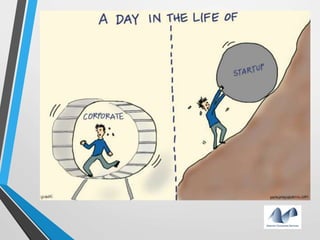
  • #6 COMMENTS?? In a corporate you will be running an invented wheel whereas in a start up you invent your wheel & take it up the Hill. But if you succeed then the satisfaction is 100 times better & even if you fail, there is always a next time
  • #7 Informal culture Lack of hierarchy/ Flat organisation Quick decision making, nimble footed Focus on growth & profitability (ASK) Receptive to market/customers
  • #8 people,  startups in their various stages & types support organisations like universities, funding organizations, incubators, accelerators, co-working spaces etc., research organizations, service provider organizations (like legal, financial services etc.) Clients (large corporations & other entities) Last but not least, Government
  • #10 Problems faced by Startups & reason for their failures Plan: Benjamin Franklin: If you fail to plan then you are planning to fail Customer Acq: LTV> CAC Fund raising: empahsise on cash flows/ organisation may be profitable yet run out of cash & vice versa HR: Good management team
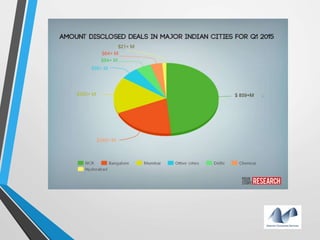
  • #11 With over $9 billion worth investment in 2015 and three to four startups emerging every day, India has paved its way to secure the third position in the world in terms of the number of startups, 4200 and counting, a growth of 40%, by the end of 2015. The latest report by industry body NASSCOM and Zinnov, analyzes the current scenario and emerging trends across the various dimensions that define the Indian startup ecosystem, and gauge India’s position as a global startup hub that is becoming attractive for investors, startups, & corporates. As per the statistics given in the report, the number of active investors in the ecosystem has grown from 220 in 2014 to 490 in 2015, depicting a 2.3X growth. Further, 8 out of every 10 top VC/PE Firms in India are foreign, and global investment in the Indian ecosystem is leading to an increased FDI.
  • #12 Ecomm_ flipkart/snapdeal Hyperlocal: Grofers, Bigbasket, Swiggy Consumer Service: Zimmber, housejoy Healthtech: Medgenome, 1 mg Healthcare: Practo, Moc Doc, Lybrate Edutech Embibe, Byjus Topper Enetrprise S/w: Freshdesk, capillary, chargebee Analytics: Incedo, dextro
  • #13 Ask questions on structures Explain difference in structures, compliance & governance
  • #14 Startup India is a flagship initiative of the Government of India, intended to build a strong eco-system for nurturing innovation and Startups in the country that will drive sustainable economic growth and generate large scale employment opportunities. The Government through this initiative aims to empower Startups to grow through innovation and design.
  • #16 The above promote entrepreneurs to experiment with new and innovative ideas, without having the fear of facing a complex and long-drawn exit process where their capital remain interminably stuck.
  • #17  With this objective, exemption shall be given to persons who have capital gains during the year, if they have invested such capital gains in the Fund of Funds recognized by the Government. This will augment the funds available to various VCs/AIFs for investment in Startups. Profits of Startup initiatives are exempted from income-tax for a period of 3 years. This fiscal exemption shall facilitate growth of business and meet the working capital requirements during the initial years of operations. The exemption shall be available subject to non-distribution of dividend by the Startup.
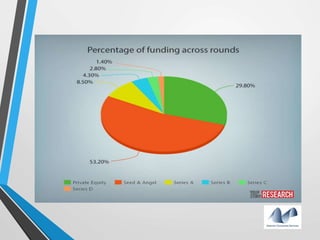
  • #20 Refer to Valley of death vs Seed & Angel
  • #24 Like not everyone can become a Mukesh Ambani, Steve Jobs or PM Modi, similarly not everyone can have a unicorn start up. Its good to have them as ref. The fun is in journey & not in destination
  • #31 Donkey Story Personal Story Don’t be tied down by Dogmas, false insecurities & fears. It’s a big world out there waiting for you. Go out as a gladiator & slay your dragons and emerge winner. Even if you don’t succeed, there is always a next time. All the best, God bless!