Financing the
Business
Finance
You have to hang on to that
money like its gold. Look
after every pound because it
will allow you to get your
idea right and prove it.
Nobody will give you money
until you prove your idea is a
winner….There’s lots of
money out there but only for
proven concepts.
Martyn Dawes
Financing the Business
All that Entrepreneur needs is Money
Lack of access to finance is cited as one of most
reported barrier to start or grow the business
In recent years, women entrepreneurs and minorities
complain about it
Financing the Business
All that Entrepreneur needs is Money
How?
Control over business vs Provision of Funds
Flexibility and Security at minimum price
Financing the Business
All that Entrepreneur needs is Money
Sources?
From Family, Relatives, Friends
(Internal Finance)
Does this mode requires any formal written
agreement (terms and conditions)
Financing the Business
All that Entrepreneur needs is Money
External Sources?
Loans
Shares
Partnership
Loans
Advantages
• Term of loan is fixed –
not repayable on
demand
• Interest & capital
repayments fixed &
known in advance
• Rate of interest
usually lower than
overdraft
Disadvantages
• Usually secured
• Can be refused
because of lack
of security
• Requires good
cash flow to
pay interest &
repay capital
Bank Overdraft
Advantages
• Flexible, once
agreed available
on demand
• Cheap
• Good solution to
short-term need
Disadvantages
• Repayable on
demand
• Usually secured
• Can be refused
because of lack of
security
• Higher rate of
interest than loans
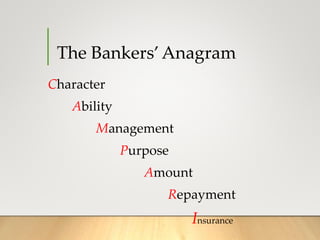
The Bankers’Anagram
Character
Ability
Management
Purpose
Amount
Repayment
Insurance
Banking Relationships
• Trust and respect
• Personal relationship - regular contact
• Regular information
- from firms: accounts. budgets, etc.
- from banks: new facilities, rate charges etc.
• No surprises
- from firms: keep to agreed borrowing
- from banks: notification well in advance of changes in
borrowing arrangements
What Worries Bank Managers
• Frequent excesses on the account
• Losses
• Lack of financial information
• Developing hard-core borrowing
• Diminishing or rapidly increasing turnover
• Declining margins
• Inability to meet forecasts
• Over-reliance on too few customers or suppliers
• Unavailable directors
• Poor credit control
Sources Of Finance
Equity Capital
(public and government buy shares of a business)
Debt Financing
(loans secured from banks, public and government)
Retained Earnings
(profit re-invested in business)
Equity
Long-term investment, placed at risk
 Your own money
 The money of family and friends
 Business Angels – investments £10K - £250K
 Venture Capitalists – mainly investments over £2 million
 Stock Markets– mainly used as later stage investment or as an ‘exit route’
Equity
• Dilutes ownership
• Dividends may be expected
• Outsiders may want to interfere
• Business angels require growth prospects
• Venture capitalists require significant growth
• Both investors will want an exit route in future
• Both will take a significant proportion of profits
• Both will require detail information
FINANCING IN PAKISTAN
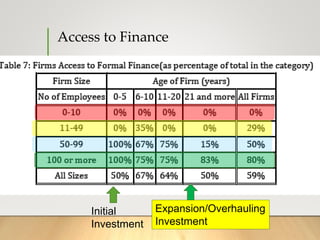
Access to Finance
Initial
Investment
Expansion/Overhauling
Investment
Access To Finance
• Commercial banks apply conservative policies while lending to
SMEs.
• More importantly, the exiting structure of financial sector was
developed to serve medium to large enterprises that are organized as
formal businesses.
• Most banks consider lending to SMEs an unattractive venture due to
a range of objective and subjective factors including ;
• high transaction costs
• SMEs' inability to comply with tangible collateral requirement
• no linkage of financial products with SME sector needs, etc.
Access To Finance
The SME sector is not homogeneous, therefore, the attractiveness of an
enterprise to financial institutions varies with SME size, structure of
organization, maturity, industrial sector, etc.
Within the Investment Climate Survey, it was observed that 57 per cent of
new investment for Small and Medium Enterprises and 67 per cent of
working capital finance comes from internal finance or retained
earnings;
only about 7 per cent of funds for investment or working capital come
from banks or other financial institutions.
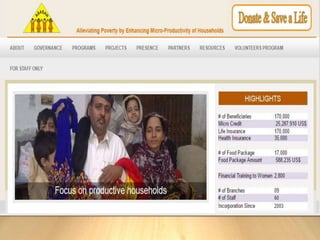
MICRO-FINANCING
NON GOVERNMENTAL ORGANIZATIONS
1. Akhuwat
2. Asasah (Registered under The Companies Ordinance, 1984 ( Non-Profit Company;
Section 42)
3. Kashf Foundation (Registered under The Societies Registration Act, 1860)
Examples of Other MFI
4. Taraqee Foundation (Registered under SECP Comp Ord. 1984)
5. Helping Hand for Relief and Development (HHRD) (Registered under Trust Act 1982)
6. Jinnah Welfare Society (Registered under The Voluntary Social Welfare Agencies
Ordinance, 1961)
7. The Pakistan Microfinance Network (PMN)
8. Orangi Pilot Project
9. Sindh Agricultural and Forestry Workers Coordinating Organization
10. National Rural Support Program
11. Punjab Rural Support Program
12. Sarhad Rural Support Program
13. Orix Leasing Pakistan Ltd.
Financing business
Financing business
Financing business

Financing business

  • 1.
  • 2.
    Finance You have tohang on to that money like its gold. Look after every pound because it will allow you to get your idea right and prove it. Nobody will give you money until you prove your idea is a winner….There’s lots of money out there but only for proven concepts. Martyn Dawes
  • 3.
    Financing the Business Allthat Entrepreneur needs is Money Lack of access to finance is cited as one of most reported barrier to start or grow the business In recent years, women entrepreneurs and minorities complain about it
  • 4.
    Financing the Business Allthat Entrepreneur needs is Money How? Control over business vs Provision of Funds Flexibility and Security at minimum price
  • 5.
    Financing the Business Allthat Entrepreneur needs is Money Sources? From Family, Relatives, Friends (Internal Finance) Does this mode requires any formal written agreement (terms and conditions)
  • 6.
    Financing the Business Allthat Entrepreneur needs is Money External Sources? Loans Shares Partnership
  • 7.
    Loans Advantages • Term ofloan is fixed – not repayable on demand • Interest & capital repayments fixed & known in advance • Rate of interest usually lower than overdraft Disadvantages • Usually secured • Can be refused because of lack of security • Requires good cash flow to pay interest & repay capital
  • 8.
    Bank Overdraft Advantages • Flexible,once agreed available on demand • Cheap • Good solution to short-term need Disadvantages • Repayable on demand • Usually secured • Can be refused because of lack of security • Higher rate of interest than loans
  • 9.
  • 10.
    Banking Relationships • Trustand respect • Personal relationship - regular contact • Regular information - from firms: accounts. budgets, etc. - from banks: new facilities, rate charges etc. • No surprises - from firms: keep to agreed borrowing - from banks: notification well in advance of changes in borrowing arrangements
  • 11.
    What Worries BankManagers • Frequent excesses on the account • Losses • Lack of financial information • Developing hard-core borrowing • Diminishing or rapidly increasing turnover • Declining margins • Inability to meet forecasts • Over-reliance on too few customers or suppliers • Unavailable directors • Poor credit control
  • 12.
    Sources Of Finance EquityCapital (public and government buy shares of a business) Debt Financing (loans secured from banks, public and government) Retained Earnings (profit re-invested in business)
  • 13.
    Equity Long-term investment, placedat risk  Your own money  The money of family and friends  Business Angels – investments £10K - £250K  Venture Capitalists – mainly investments over £2 million  Stock Markets– mainly used as later stage investment or as an ‘exit route’
  • 14.
    Equity • Dilutes ownership •Dividends may be expected • Outsiders may want to interfere • Business angels require growth prospects • Venture capitalists require significant growth • Both investors will want an exit route in future • Both will take a significant proportion of profits • Both will require detail information
  • 15.
  • 16.
  • 17.
    Access To Finance •Commercial banks apply conservative policies while lending to SMEs. • More importantly, the exiting structure of financial sector was developed to serve medium to large enterprises that are organized as formal businesses. • Most banks consider lending to SMEs an unattractive venture due to a range of objective and subjective factors including ; • high transaction costs • SMEs' inability to comply with tangible collateral requirement • no linkage of financial products with SME sector needs, etc.
  • 18.
    Access To Finance TheSME sector is not homogeneous, therefore, the attractiveness of an enterprise to financial institutions varies with SME size, structure of organization, maturity, industrial sector, etc. Within the Investment Climate Survey, it was observed that 57 per cent of new investment for Small and Medium Enterprises and 67 per cent of working capital finance comes from internal finance or retained earnings; only about 7 per cent of funds for investment or working capital come from banks or other financial institutions.
  • 19.
    MICRO-FINANCING NON GOVERNMENTAL ORGANIZATIONS 1.Akhuwat 2. Asasah (Registered under The Companies Ordinance, 1984 ( Non-Profit Company; Section 42) 3. Kashf Foundation (Registered under The Societies Registration Act, 1860) Examples of Other MFI 4. Taraqee Foundation (Registered under SECP Comp Ord. 1984) 5. Helping Hand for Relief and Development (HHRD) (Registered under Trust Act 1982) 6. Jinnah Welfare Society (Registered under The Voluntary Social Welfare Agencies Ordinance, 1961) 7. The Pakistan Microfinance Network (PMN) 8. Orangi Pilot Project 9. Sindh Agricultural and Forestry Workers Coordinating Organization 10. National Rural Support Program 11. Punjab Rural Support Program 12. Sarhad Rural Support Program 13. Orix Leasing Pakistan Ltd.