2.1. Financial System and Financial Markets 
Financial System = the set of financial institutions and the relationships between 
these, which serve to money transfer between persons/ 
companies/institutions that have excess funds to the persons/ 
companies/institutions that have deficits of funds 
1 
Basic Finance – Financial Systems 
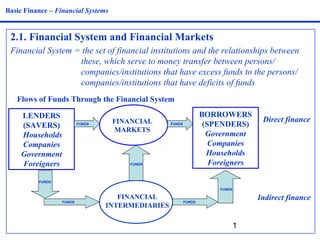
Flows of Funds Through the Financial System 
LENDERS 
(SAVERS) 
Households 
Companies 
Government 
Foreigners 
BORROWERS 
(SPENDERS) 
Government 
Companies 
Households 
Foreigners 
FINANCIAL 
MARKETS 
FUNDS FUNDS 
Direct finance 
FINANCIAL 
INTERMEDIARIES 
FUNDS 
FUNDS FUNDS 
FUNDS 
FUNDS 
Indirect finance
2 
Basic Finance – Financial Systems 
Participants in the financial systems 
Households (including individuals) 
- L - interested to get a normal return for funds (proportional with the risk) 
- B- financing consumption and/or personal investments 
Companies 
- B - financing investments and working capital 
- L - interested to invest (temporary) excess cash 
Government 
- B - financing expenditures (temporarily - treasury bills / for long terms (>1 year) – 
government bonds) 
- L - placing temporary excess cash 
Foreigners 
- L - import loans and foreign investments 
- B - export loans and investments of domestic entities abroad
3 
Basic Finance – Financial Systems 
Issues related to financial investments: 
Adverse Selection – the inability of the investors to differentiate between the 
investment opportunities due to an asymmetry in information 
(lack of information at investors level) 
Moral Hazard – the possibility that the borrowers to change their behaviour after 
the investment decision or to provide misleading information about its 
assets, liabilities or credit capacity (fraud risk)
Financial intermediaries 
Depository Institutions (Commercial Banks, Saving Banks) offer passive interest rate 
for savers’ deposits. Partly, (except for reserve requirements), from these sources, banks grant 
loans, charging the active interest. 
Active interest rate > Passive interest rate 
Bank’s Interest Margin = Active interest rate - Passive interest rate 
Investment Intermediaries (Mutual Funds; Investment Funds) – professionally 
managed type of collective investment scheme that pools money from many investors and 
invests it in stocks, bonds, short-term money market instruments, and/or other securities. 
Contractual Savings Institutions 
- Pension funds - pool of assets forming an independent legal entity that are bought with the 
contributions to a pension plan for the exclusive purpose of financing pension plan benefits. 
- Insurance companies - compensate loss (including death or illness – for life insurance) 
when these incur from the insurance premiums. 
4 
Basic Finance – Financial Systems
* Intermediaries in the financial markets (especially in the capital market) 
 Brokers (Brokerage firms) – trade securities on behalf of their customer , based on 
brokerage fees charged (to customers). 
. 
 Dealers - trade securities for their own account. 
5 
Basic Finance – Financial Systems 
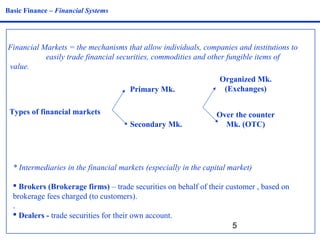
Financial Markets = the mechanisms that allow individuals, companies and institutions to 
easily trade financial securities, commodities and other fungible items of 
value. 
Types of financial markets 
Primary Mk. 
Secondary Mk. 
Organized Mk. 
(Exchanges) 
Over the counter 
Mk. (OTC)
Primary mk. vs. Secondary mk. 
Primary mk. – the first sale of securities - issuance (usually without any negotiation). 
Companies, governments or public sector institutions can obtain funds through the sale of 
a new stock or bond issue. This is typically done through a syndicate of securities dealers. 
The process of selling new issues to investors is called underwriting. In the case of a new 
stock issue, this sale is an initial public offering (IPO). 
Secondary mk. (aftermarket) – the market of previously issued securities 
6 
Basic Finance – Financial Systems 
Exchange mk. vs. Over the counter mk. 
Organized mk. (Exchange mk.) - fixed trading rules; established physical location; trading 
is usually conducted by auction + standardized securities. (NYSE; BSE) 
Over the counter mk. (OTC) - directly trade of securities, between two parties, located in a 
variety of places and a variety of ways (by telephone or by computer ) + unstandardized 
securities (NASDAQ; former RASDAQ)
Basic Finance – Financial Systems 
2.2. Financial markets 
Examples: 
Money Market– market of short term and highly liquid securities issued by government or 
banks; 
Banking System – both market of deposits and market of bank loans for households and 
companies; 
Capital Market – market of long term securities; 
FOREX Market – market of foreign currencies; 
Government Securities (T-bills) Market – market of government bills (≤1 year) with 
“zero” default risk (by extension this market refers to the market of any maturities and also 
to the securities issued by municipalities); 
Insurance Market; 
Real Estate and Other Alternative Assets Market. 
7 
Remember the issues ? 
- Moral hazard 
- Adverse Selection 
need of Market Supervisory Authorities
8 
Basic Finance – Financial Systems 
Supervisory Authorities 
Money Market; Banking System & FOREX Market, including Government 
Securities Market (with maturities < 1 year) - CENTRAL BANK (National Bank of 
Romania – NBR (BNR)); 
Capital Market, including Government Securities Market (with maturities ≥1 year) – 
Securities and Exchange Commission (National Securities Commission 
(CNVM)) ; 
Insurance Market - Insurance Supervisory Commission;
Basic Finance – Financial Systems 
Financial Securities 
- PRIMARY (BASIC) 
- DERIVATIVES 
- SYNTHETIC 
1. Primary (Basic) 
• Shares = equity investments (company ownership & associated risks and 
benefits), (in public or private -unlisted- companies) 
- common shares - proportional vote in General Shareholders Meetings; 
- right to be voted as manager; 
- right to received the proportional dividends from distributed net profit; 
- in the case of bankruptcy, the common shareholders are the last ones 
9 
to benefit from the capital recuperated; 
(unlimited risk& unlimited return) 
- preferred shares - no vote in General Shareholders Meetings; 
(fixed income) - right to receive fixed dividends, independent of the company’s result; 
- in the case of bankruptcy, the preferred equity is redeemed before 
common equity. 
(limited risk& limited return)
Basic Finance – Financial Systems 
• Bonds (fixed income) = debt securities, in which the issuer owes the holders a 
debt 
(at its par value /face value) and, depending on the terms of the bond, is 
obliged 
to pay fixed interest (the coupon – sometimes variable) and/or to repay the 
principal at a later date, termed maturity. 
- in case of bankruptcy, bond holders have priority in receiving the money, after 
the liquidation of the bond issuer’s assets; 
- the coupon and the principal may be indexed with the inflation rate; 
- the risk of non-payment for coupon or reimbursement price is lower than in the 
case of stock; 
- price is inverse correlated with the market interest rate 
- no decision right. 
(limited risk& limited return) 
• Money market instruments 
10 
- Commercial Papers 
- Negotiable Certificates of Deposit 
- T - Bills 
- Municipal Notes
Basic Finance – Financial Systems 
2. Derivative securities 
• Convertible bonds – offer the options to choose, at the maturity, between 
11 
reimbursement or share conversion 
• Futures contracts/ Forward contracts - represent standardized (futures) / 
unstandardized (forward) contracts between sellers and buyers to transfer a number of 
securities, at a price established at the moment of the contract signing, traded on 
exchanges (futures)/on OTC markets (forward). 
• Options – standardized contracts that give the right, but not the obligation, of one of the 
parties (buyer) to buy (CALL opt.) or to sell (PUT opt.) a certain number of securities 
at an exercise price and at a certain pre-established maturity date. This right is 
compensated by payment of a premium, which is traded on exchanges. (examples) 
3. Synthetic securities 
• Market index contracts (index futures) 
*Types of orders on capital market 
1. Market orders 
2. Limit orders 
3. Short sales – Margin requirements (examples) 
4. Stop loss
Main types of financial systems: 
I. Anglo-Saxon Financial System 
- Based on capital markets (capital markets oriented) 
- Good treatment for shareholders 
- Investors are protected at the highest level 
- Information is largely available on the market 
- Market is considered the best regulator (by the way of the securities market prices) 
- Competition is very important 
Main Goal - maximisation of the shareholders’ wealth 
II. Continental European Financial System 
- Based on banks (banks oriented); 
- Low number of IPOs 
- Banks regulate the system 
- The competition is not so important 
- Strong labor unions 
Main Goal - harmonisation of stakeholders’ interests 
12 
Basic Finance – Financial Systems
13 
Basic Finance – Financial Systems 
Main types of financial systems: 
III. Japanese Financial System 
- Based on typically business groups (keiretsu), formed by banks, companies; insurance 
companies; 
- This groups are centered on a bank (so mainly this system is a bank oriented system) 
- Low level of protection for minority shareholders; 
- Competition between groups. 
* Islamic Financial System

Finance 03

  • 1.
    2.1. Financial Systemand Financial Markets Financial System = the set of financial institutions and the relationships between these, which serve to money transfer between persons/ companies/institutions that have excess funds to the persons/ companies/institutions that have deficits of funds 1 Basic Finance – Financial Systems Flows of Funds Through the Financial System LENDERS (SAVERS) Households Companies Government Foreigners BORROWERS (SPENDERS) Government Companies Households Foreigners FINANCIAL MARKETS FUNDS FUNDS Direct finance FINANCIAL INTERMEDIARIES FUNDS FUNDS FUNDS FUNDS FUNDS Indirect finance
  • 2.
    2 Basic Finance– Financial Systems Participants in the financial systems Households (including individuals) - L - interested to get a normal return for funds (proportional with the risk) - B- financing consumption and/or personal investments Companies - B - financing investments and working capital - L - interested to invest (temporary) excess cash Government - B - financing expenditures (temporarily - treasury bills / for long terms (>1 year) – government bonds) - L - placing temporary excess cash Foreigners - L - import loans and foreign investments - B - export loans and investments of domestic entities abroad
  • 3.
    3 Basic Finance– Financial Systems Issues related to financial investments: Adverse Selection – the inability of the investors to differentiate between the investment opportunities due to an asymmetry in information (lack of information at investors level) Moral Hazard – the possibility that the borrowers to change their behaviour after the investment decision or to provide misleading information about its assets, liabilities or credit capacity (fraud risk)
  • 4.
    Financial intermediaries DepositoryInstitutions (Commercial Banks, Saving Banks) offer passive interest rate for savers’ deposits. Partly, (except for reserve requirements), from these sources, banks grant loans, charging the active interest. Active interest rate > Passive interest rate Bank’s Interest Margin = Active interest rate - Passive interest rate Investment Intermediaries (Mutual Funds; Investment Funds) – professionally managed type of collective investment scheme that pools money from many investors and invests it in stocks, bonds, short-term money market instruments, and/or other securities. Contractual Savings Institutions - Pension funds - pool of assets forming an independent legal entity that are bought with the contributions to a pension plan for the exclusive purpose of financing pension plan benefits. - Insurance companies - compensate loss (including death or illness – for life insurance) when these incur from the insurance premiums. 4 Basic Finance – Financial Systems
  • 5.
    * Intermediaries inthe financial markets (especially in the capital market)  Brokers (Brokerage firms) – trade securities on behalf of their customer , based on brokerage fees charged (to customers). .  Dealers - trade securities for their own account. 5 Basic Finance – Financial Systems Financial Markets = the mechanisms that allow individuals, companies and institutions to easily trade financial securities, commodities and other fungible items of value. Types of financial markets Primary Mk. Secondary Mk. Organized Mk. (Exchanges) Over the counter Mk. (OTC)
  • 6.
    Primary mk. vs.Secondary mk. Primary mk. – the first sale of securities - issuance (usually without any negotiation). Companies, governments or public sector institutions can obtain funds through the sale of a new stock or bond issue. This is typically done through a syndicate of securities dealers. The process of selling new issues to investors is called underwriting. In the case of a new stock issue, this sale is an initial public offering (IPO). Secondary mk. (aftermarket) – the market of previously issued securities 6 Basic Finance – Financial Systems Exchange mk. vs. Over the counter mk. Organized mk. (Exchange mk.) - fixed trading rules; established physical location; trading is usually conducted by auction + standardized securities. (NYSE; BSE) Over the counter mk. (OTC) - directly trade of securities, between two parties, located in a variety of places and a variety of ways (by telephone or by computer ) + unstandardized securities (NASDAQ; former RASDAQ)
  • 7.
    Basic Finance –Financial Systems 2.2. Financial markets Examples: Money Market– market of short term and highly liquid securities issued by government or banks; Banking System – both market of deposits and market of bank loans for households and companies; Capital Market – market of long term securities; FOREX Market – market of foreign currencies; Government Securities (T-bills) Market – market of government bills (≤1 year) with “zero” default risk (by extension this market refers to the market of any maturities and also to the securities issued by municipalities); Insurance Market; Real Estate and Other Alternative Assets Market. 7 Remember the issues ? - Moral hazard - Adverse Selection need of Market Supervisory Authorities
  • 8.
    8 Basic Finance– Financial Systems Supervisory Authorities Money Market; Banking System & FOREX Market, including Government Securities Market (with maturities < 1 year) - CENTRAL BANK (National Bank of Romania – NBR (BNR)); Capital Market, including Government Securities Market (with maturities ≥1 year) – Securities and Exchange Commission (National Securities Commission (CNVM)) ; Insurance Market - Insurance Supervisory Commission;
  • 9.
    Basic Finance –Financial Systems Financial Securities - PRIMARY (BASIC) - DERIVATIVES - SYNTHETIC 1. Primary (Basic) • Shares = equity investments (company ownership & associated risks and benefits), (in public or private -unlisted- companies) - common shares - proportional vote in General Shareholders Meetings; - right to be voted as manager; - right to received the proportional dividends from distributed net profit; - in the case of bankruptcy, the common shareholders are the last ones 9 to benefit from the capital recuperated; (unlimited risk& unlimited return) - preferred shares - no vote in General Shareholders Meetings; (fixed income) - right to receive fixed dividends, independent of the company’s result; - in the case of bankruptcy, the preferred equity is redeemed before common equity. (limited risk& limited return)
  • 10.
    Basic Finance –Financial Systems • Bonds (fixed income) = debt securities, in which the issuer owes the holders a debt (at its par value /face value) and, depending on the terms of the bond, is obliged to pay fixed interest (the coupon – sometimes variable) and/or to repay the principal at a later date, termed maturity. - in case of bankruptcy, bond holders have priority in receiving the money, after the liquidation of the bond issuer’s assets; - the coupon and the principal may be indexed with the inflation rate; - the risk of non-payment for coupon or reimbursement price is lower than in the case of stock; - price is inverse correlated with the market interest rate - no decision right. (limited risk& limited return) • Money market instruments 10 - Commercial Papers - Negotiable Certificates of Deposit - T - Bills - Municipal Notes
  • 11.
    Basic Finance –Financial Systems 2. Derivative securities • Convertible bonds – offer the options to choose, at the maturity, between 11 reimbursement or share conversion • Futures contracts/ Forward contracts - represent standardized (futures) / unstandardized (forward) contracts between sellers and buyers to transfer a number of securities, at a price established at the moment of the contract signing, traded on exchanges (futures)/on OTC markets (forward). • Options – standardized contracts that give the right, but not the obligation, of one of the parties (buyer) to buy (CALL opt.) or to sell (PUT opt.) a certain number of securities at an exercise price and at a certain pre-established maturity date. This right is compensated by payment of a premium, which is traded on exchanges. (examples) 3. Synthetic securities • Market index contracts (index futures) *Types of orders on capital market 1. Market orders 2. Limit orders 3. Short sales – Margin requirements (examples) 4. Stop loss
  • 12.
    Main types offinancial systems: I. Anglo-Saxon Financial System - Based on capital markets (capital markets oriented) - Good treatment for shareholders - Investors are protected at the highest level - Information is largely available on the market - Market is considered the best regulator (by the way of the securities market prices) - Competition is very important Main Goal - maximisation of the shareholders’ wealth II. Continental European Financial System - Based on banks (banks oriented); - Low number of IPOs - Banks regulate the system - The competition is not so important - Strong labor unions Main Goal - harmonisation of stakeholders’ interests 12 Basic Finance – Financial Systems
  • 13.
    13 Basic Finance– Financial Systems Main types of financial systems: III. Japanese Financial System - Based on typically business groups (keiretsu), formed by banks, companies; insurance companies; - This groups are centered on a bank (so mainly this system is a bank oriented system) - Low level of protection for minority shareholders; - Competition between groups. * Islamic Financial System