Sorin Anagnoste
• To differentiate between several types of companies 
• To identify the main organizational characteristics of companies belonging to different categories 
• To identify and comment the main forms for capital raising 
• To explain the concept of “franchising”
•Branch of industry 
•Goods producing businesses/ service businesses 
•Size (SMEs, large companies) 
•Cooperation form (strategic alliances, joint venture, cartel etc.) 
•Legal form (sole proprietorship, private limited company, public stock ownership etc. ) 
•Ownership (private, public)
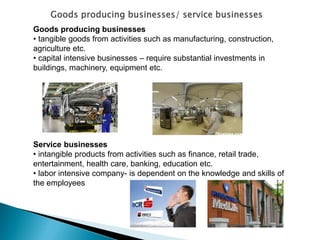
Goods producing businesses 
• tangible goods from activities such as manufacturing, construction, agriculture etc. 
• capital intensive businesses – require substantial investments in buildings, machinery, equipment etc. Service businesses 
• intangible products from activities such as finance, retail trade, entertainment, health care, banking, education etc. 
• labor intensive company- is dependent on the knowledge and skills of the employees
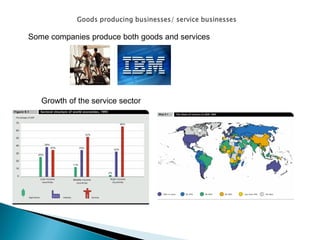
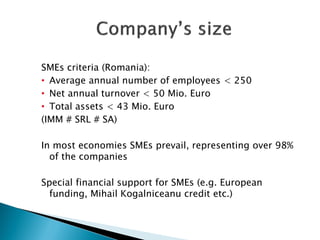
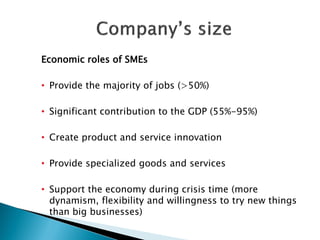
Growth of the service sector 
Some companies produce both goods and services
Key factors which trigger the growth of service sector: 
•Consumers have more disposable income 
•Changing demographic pattern and lifestyle trends 
•Services are needed to support complex goods and new technology 
•Specialization/ need for professional advice 
•Barriers to entry are low
SMEs criteria (Romania): 
•Average annual number of employees < 250 
•Net annual turnover < 50 Mio. Euro 
•Total assets < 43 Mio. Euro 
(IMM # SRL # SA) 
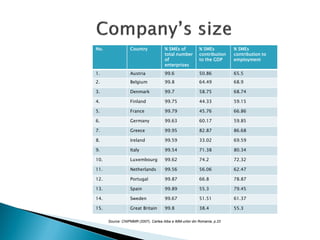
In most economies SMEs prevail, representing over 98% of the companies 
Special financial support for SMEs (e.g. European funding, Mihail Kogalniceanu credit etc.)
Economic roles of SMEs 
•Provide the majority of jobs (>50%) 
•Significant contribution to the GDP (55%-95%) 
•Create product and service innovation 
•Provide specialized goods and services 
•Support the economy during crisis time (more dynamism, flexibility and willingness to try new things than big businesses)
No. 
Country 
% SMEs of total number of enterprises 
% SMEs contribution to the GDP 
% SMEs contribution to employment 
1. 
Austria 
99.6 
50.86 
65.5 
2. 
Belgium 
99.8 
64.49 
68.9 
3. 
Denmark 
99.7 
58.75 
68.74 
4. 
Finland 
99.75 
44.33 
59.15 
5. 
France 
99.79 
45.76 
66.86 
6. 
Germany 
99.63 
60.17 
59.85 
7. 
Greece 
99.95 
82.87 
86.68 
8. 
Ireland 
99.59 
33.02 
69.59 
9. 
Italy 
99.54 
71.38 
80.34 
10. 
Luxembourg 
99.62 
74.2 
72.32 
11. 
Netherlands 
99.56 
56.06 
62.47 
12. 
Portugal 
99.87 
66.8 
78.87 
13. 
Spain 
99.89 
55.3 
79.45 
14. 
Sweden 
99.67 
51.51 
61.37 
15. 
Great Britain 
99.8 
38.4 
55.3 
Source: CNIPMMR (2007), Cartea Alba a IMM-urilor din Romania, p.22
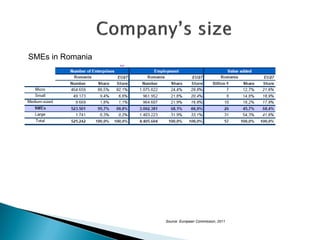
SMEs in Romania 
Source: European Commission, 2011
Company’s size 
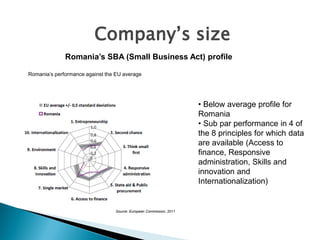
Romania’s SBA (Small Business Act) profile Romania’s performance against the EU average 
• Below average profile for Romania 
• Sub par performance in 4 of the 8 principles for which data are available (Access to finance, Responsive administration, Skills and innovation and Internationalization) 
Source: European Commission, 2011
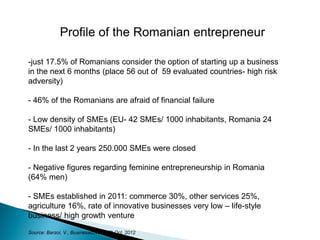
Profile of the Romanian entrepreneur 
-just 17.5% of Romanians consider the option of starting up a business in the next 6 months (place 56 out of 59 evaluated countries- high risk adversity) 
- 46% of the Romanians are afraid of financial failure 
- Low density of SMEs (EU- 42 SMEs/ 1000 inhabitants, Romania 24 SMEs/ 1000 inhabitants) 
- In the last 2 years 250.000 SMEs were closed 
- Negative figures regarding feminine entrepreneurship in Romania (64% men) 
- SMEs established in 2011: commerce 30%, other services 25%, agriculture 16%, rate of innovative businesses very low – life-style business/ high growth venture Source: Barzoi, V., Businesscover, 30th Oct. 2012
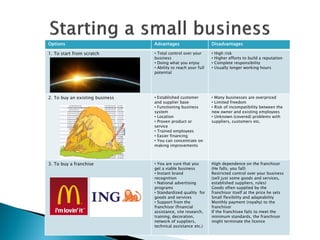
Options 
Advantages 
Disadvantages 
1. To start from scratch 
• Total control over your business 
• Doing what you enjoy 
• Ability to reach your full potential 
• High risk 
• Higher efforts to build a reputation 
• Complete responsibility 
• Usually longer working hours 
2. To buy an existing business 
• Established customer and supplier base 
• Functioning business system 
• Location 
• Proven product or service 
• Trained employees 
• Easier financing 
• You can concentrate on making improvements 
• Many businesses are overpriced 
• Limited freedom 
• Risk of incompatibility between the new owner and existing employees 
• Unknown (covered) problems with suppliers, customers etc. 
3. To buy a franchise 
• You are sure that you get a viable business 
• Instant brand recognition 
• National advertising programs 
• Standardized quality for goods and services 
• Support from the franchisor (financial assistance, site research, training, decoration, network of suppliers, technical assistance etc.) 
High dependence on the franchisor (He falls, you fall) 
Restricted control over your business (sell just some goods and services, established suppliers, rules) 
Goods often supplied by the franchisor itself at the price he sets 
Small flexibility and adaptability 
Monthly payment (royalty) to the franchisor 
If the franchisee fails to meet the minimum standards, the franchisor might terminate the licence
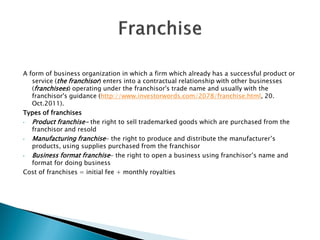
A form of business organization in which a firm which already has a successful product or service (the franchisor) enters into a contractual relationship with other businesses (franchisees) operating under the franchisor's trade name and usually with the franchisor's guidance (http://www.investorwords.com/2078/franchise.html, 20. Oct.2011). 
Types of franchises 
•Product franchise- the right to sell trademarked goods which are purchased from the franchisor and resold 
•Manufacturing franchise- the right to produce and distribute the manufacturer’s products, using supplies purchased from the franchisor 
•Business format franchise- the right to open a business using franchisor’s name and format for doing business 
Cost of franchises = initial fee + monthly royalties
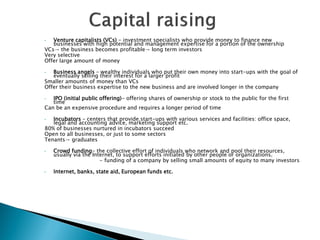
•Venture capitalists (VCs) - investment specialists who provide money to finance new businesses with high potential and management expertise for a portion of the ownership 
VCs→ the business becomes profitable→ long term investors 
Very selective 
Offer large amount of money 
•Business angels – wealthy individuals who put their own money into start-ups with the goal of eventually selling their interest for a larger profit 
Smaller amounts of money than VCs 
Offer their business expertise to the new business and are involved longer in the company 
•IPO (initial public offering)- offering shares of ownership or stock to the public for the first time 
Can be an expensive procedure and requires a longer period of time 
•Incubators – centers that provide start-ups with various services and facilities: office space, legal and accounting advice, marketing support etc. 
80% of businesses nurtured in incubators succeed 
Open to all businesses, or just to some sectors 
Tenants→ graduates 
•Crowd funding- the collective effort of individuals who network and pool their resources, usually via the Internet, to support efforts initiated by other people or organizations. 
- funding of a company by selling small amounts of equity to many investors 
•Internet, banks, state aid, European funds etc.
Thank you!

Bei lecture 3_types_of_companies

  • 1.
  • 2.
    • To differentiatebetween several types of companies • To identify the main organizational characteristics of companies belonging to different categories • To identify and comment the main forms for capital raising • To explain the concept of “franchising”
  • 3.
    •Branch of industry •Goods producing businesses/ service businesses •Size (SMEs, large companies) •Cooperation form (strategic alliances, joint venture, cartel etc.) •Legal form (sole proprietorship, private limited company, public stock ownership etc. ) •Ownership (private, public)
  • 4.
    Goods producing businesses • tangible goods from activities such as manufacturing, construction, agriculture etc. • capital intensive businesses – require substantial investments in buildings, machinery, equipment etc. Service businesses • intangible products from activities such as finance, retail trade, entertainment, health care, banking, education etc. • labor intensive company- is dependent on the knowledge and skills of the employees
  • 5.
    Growth of theservice sector Some companies produce both goods and services
  • 6.
    Key factors whichtrigger the growth of service sector: •Consumers have more disposable income •Changing demographic pattern and lifestyle trends •Services are needed to support complex goods and new technology •Specialization/ need for professional advice •Barriers to entry are low
  • 7.
    SMEs criteria (Romania): •Average annual number of employees < 250 •Net annual turnover < 50 Mio. Euro •Total assets < 43 Mio. Euro (IMM # SRL # SA) In most economies SMEs prevail, representing over 98% of the companies Special financial support for SMEs (e.g. European funding, Mihail Kogalniceanu credit etc.)
  • 8.
    Economic roles ofSMEs •Provide the majority of jobs (>50%) •Significant contribution to the GDP (55%-95%) •Create product and service innovation •Provide specialized goods and services •Support the economy during crisis time (more dynamism, flexibility and willingness to try new things than big businesses)
  • 9.
    No. Country %SMEs of total number of enterprises % SMEs contribution to the GDP % SMEs contribution to employment 1. Austria 99.6 50.86 65.5 2. Belgium 99.8 64.49 68.9 3. Denmark 99.7 58.75 68.74 4. Finland 99.75 44.33 59.15 5. France 99.79 45.76 66.86 6. Germany 99.63 60.17 59.85 7. Greece 99.95 82.87 86.68 8. Ireland 99.59 33.02 69.59 9. Italy 99.54 71.38 80.34 10. Luxembourg 99.62 74.2 72.32 11. Netherlands 99.56 56.06 62.47 12. Portugal 99.87 66.8 78.87 13. Spain 99.89 55.3 79.45 14. Sweden 99.67 51.51 61.37 15. Great Britain 99.8 38.4 55.3 Source: CNIPMMR (2007), Cartea Alba a IMM-urilor din Romania, p.22
  • 10.
    SMEs in Romania Source: European Commission, 2011
  • 11.
    Company’s size Romania’sSBA (Small Business Act) profile Romania’s performance against the EU average • Below average profile for Romania • Sub par performance in 4 of the 8 principles for which data are available (Access to finance, Responsive administration, Skills and innovation and Internationalization) Source: European Commission, 2011
  • 12.
    Profile of theRomanian entrepreneur -just 17.5% of Romanians consider the option of starting up a business in the next 6 months (place 56 out of 59 evaluated countries- high risk adversity) - 46% of the Romanians are afraid of financial failure - Low density of SMEs (EU- 42 SMEs/ 1000 inhabitants, Romania 24 SMEs/ 1000 inhabitants) - In the last 2 years 250.000 SMEs were closed - Negative figures regarding feminine entrepreneurship in Romania (64% men) - SMEs established in 2011: commerce 30%, other services 25%, agriculture 16%, rate of innovative businesses very low – life-style business/ high growth venture Source: Barzoi, V., Businesscover, 30th Oct. 2012
  • 13.
    Options Advantages Disadvantages 1. To start from scratch • Total control over your business • Doing what you enjoy • Ability to reach your full potential • High risk • Higher efforts to build a reputation • Complete responsibility • Usually longer working hours 2. To buy an existing business • Established customer and supplier base • Functioning business system • Location • Proven product or service • Trained employees • Easier financing • You can concentrate on making improvements • Many businesses are overpriced • Limited freedom • Risk of incompatibility between the new owner and existing employees • Unknown (covered) problems with suppliers, customers etc. 3. To buy a franchise • You are sure that you get a viable business • Instant brand recognition • National advertising programs • Standardized quality for goods and services • Support from the franchisor (financial assistance, site research, training, decoration, network of suppliers, technical assistance etc.) High dependence on the franchisor (He falls, you fall) Restricted control over your business (sell just some goods and services, established suppliers, rules) Goods often supplied by the franchisor itself at the price he sets Small flexibility and adaptability Monthly payment (royalty) to the franchisor If the franchisee fails to meet the minimum standards, the franchisor might terminate the licence
  • 14.
    A form ofbusiness organization in which a firm which already has a successful product or service (the franchisor) enters into a contractual relationship with other businesses (franchisees) operating under the franchisor's trade name and usually with the franchisor's guidance (http://www.investorwords.com/2078/franchise.html, 20. Oct.2011). Types of franchises •Product franchise- the right to sell trademarked goods which are purchased from the franchisor and resold •Manufacturing franchise- the right to produce and distribute the manufacturer’s products, using supplies purchased from the franchisor •Business format franchise- the right to open a business using franchisor’s name and format for doing business Cost of franchises = initial fee + monthly royalties
  • 15.
    •Venture capitalists (VCs)- investment specialists who provide money to finance new businesses with high potential and management expertise for a portion of the ownership VCs→ the business becomes profitable→ long term investors Very selective Offer large amount of money •Business angels – wealthy individuals who put their own money into start-ups with the goal of eventually selling their interest for a larger profit Smaller amounts of money than VCs Offer their business expertise to the new business and are involved longer in the company •IPO (initial public offering)- offering shares of ownership or stock to the public for the first time Can be an expensive procedure and requires a longer period of time •Incubators – centers that provide start-ups with various services and facilities: office space, legal and accounting advice, marketing support etc. 80% of businesses nurtured in incubators succeed Open to all businesses, or just to some sectors Tenants→ graduates •Crowd funding- the collective effort of individuals who network and pool their resources, usually via the Internet, to support efforts initiated by other people or organizations. - funding of a company by selling small amounts of equity to many investors •Internet, banks, state aid, European funds etc.
  • 19.